1. Introduction
1.1. Background and Challenges: Hybrid Power Systems Under Dual Energy–Environmental Constraints
Global warming caused by greenhouse gas emissions has become a global issue. The temperature rise control target set by the Paris Agreement has promoted countries to formulate and issue carbon neutrality roadmaps [
1]. The transportation sector accounts for approximately 24% of global final energy consumption and 21% of carbon emissions, and the carbon emissions from fossil energy power generation in the power system account for more than 35%. The green and low-carbon transformation of the two sectors is the core method employed to achieve the global carbon neutrality goal [
2]. Single energy forms have inherent technical shortcomings: for example, internal combustion engines are prone to efficiency degradation and higher emissions under low-load conditions [
3]; pure electric power systems are restricted by driving range and inadequate charging infrastructure [
4]; and renewable energy is difficult to integrate stably and efficiently into the power grid due to its intermittent and fluctuating characteristics [
5]. Hybrid power systems integrate multiple heterogeneous energy units to realize the collaborative regulation and optimal allocation of energy flow, which can effectively compensate for the performance shortcomings of single energy. In the marine sector, the energy efficiency of diesel–electric hybrid power systems can be improved by 10–20% [
6]; in the road vehicle sector, hybrid power technology has become the core technical solution for automakers to meet stringent emission regulations [
7]; and in the power system, multi-energy microgrids are becoming the core support to improve renewable energy consumption and penetration rate [
8].
Although the multi-energy coupling characteristic of hybrid power systems brings significant performance advantages, it greatly increases the control complexity of the system. As the “control core” of hybrid power systems, the energy management strategy needs to collaboratively optimize multiple coupled and trade-off objectives on the premise of meeting dynamic load demands, including minimizing fuel consumption, reducing pollutant emissions, extending the service life of key components, and maintaining stable system operation. Meanwhile, system operation must comply with a series of stringent physical constraints. The strong coupling of objectives and constraints, coupled with the uncertainty of the actual operating conditions, makes the energy management of hybrid power systems a typical multi-objective, multi-constraint, nonlinear stochastic dynamic optimization problem, posing stringent requirements for the real-time performance, adaptability and generalization ability of control strategies [
9].
1.2. Problem Statement and Research Objectives
The core scientific hypothesis of this review is that Deep Reinforcement Learning (DRL), which integrates the high-dimensional feature perception capability of deep learning and the sequential decision-making advantage of RL, can fundamentally resolve the inherent contradiction between model dependence and environmental adaptability in traditional hybrid power system energy management methods, and provide a systematic technical solution for the engineering implementation of real-time intelligent energy management for hybrid power systems.
The mathematical essence of the energy management problem of hybrid power systems is a type of sequential decision-making problem. Its core is to find the optimal control strategy
under the conditions that the system topology and component models are known, and future load information cannot be perfectly predicted, so as to output control instructions according to the real-time state of the system, and achieve the global optimum of the comprehensive performance index
while completing the established operation tasks [
10].
To address this problem, researchers have proposed a variety of traditional energy management methods, which are mainly divided into three categories: rule-based, optimization-based and shallow intelligence-based. To clearly reveal the performance boundaries of traditional methods and clarify the technical breakthrough points of DRL, this paper builds a comparative analysis framework between traditional methods and DRL using seven dimensions: model dependence, online computing burden, optimality guarantee, adaptive ability, uncertainty handling, multi-objective trade-off and an engineering implementation threshold, as shown in
Table 1.
Rule-based methods are easy in terms of engineering implementation but cannot guarantee optimization performance, with their fuel consumption being 15–25% higher than the global optimal solution under stochastic operating conditions [
16]; global optimization methods (such as DP and PMP) can obtain theoretical global optimal solutions, but cannot be deployed online due to exponentially increasing computational complexity [
17]; real-time optimization methods (such as ECMS and MPC) can be applied online, but their performance highly depends on model accuracy [
18]; and shallow intelligence-based control methods still rely on engineering experience design and lack the ability to handle high-dimensional sequential optimization problems [
19]. The common limitation of the above traditional methods is the fundamental contradiction between “model dependence” and “environmental adaptability”, and the emergence of DRL provides a novel technical route to resolve this contradiction.
1.3. The Rise of DRL and Its Potential in Energy Control
Reinforcement Learning (RL) is naturally suitable for sequential decision-making optimization problems, but traditional RL suffers from the severe “curse of dimensionality” due to its failure to handle high-dimensional state and action spaces. Deep learning, with its excellent nonlinear function approximation capability, provides core technical support to overcome this dilemma [
20]. The proposal of Deep Q-Network (DQN) in 2013 marked the advent of DRL. This technology integrates the high-dimensional feature representation capability of deep learning and the sequential decision-making capability of RL, and can effectively solve complex control problems with high dimensions, continuity and randomness [
21].
Existing studies have shown that DRL has high compatibility with the energy management problem of hybrid power systems, and its potential technical advantages in engineering applications are mainly reflected in five aspects: (1) it is a model-free attribute, with no need to construct accurate mechanistic models of the system; (2) it performs end-to-end autonomous learning, automatically mining task-related system features; (3) it has a long-term planning capability, achieving global optimization of system performance; (4) it is characterized by strong adaptability and robustness, adapting to dynamically changing operating scenarios; and (5) it has high-dimensional-space processing capability, efficiently completing the multi-variable optimization of complex systems [
22,
23,
24].
Numerous studies have verified the application value of DRL in the energy management of hybrid power systems. In integrated power systems and low-carbon energy transition scenarios, researchers have proposed a series of modeling and forecasting methods to optimize power allocation and capacity planning, providing a theoretical basis for the optimal operation of multi-energy hybrid systems. Zaporozhets et al. established a novel methodology to determine zonal electricity generation and capacity requirements in integrated power systems, which combines historical load pattern analysis and calibration techniques to achieve high-precision zonal power prediction, with the generation error below 0.39% [
25]. Denysov et al. further developed a mathematical model for forecasting the development of integrated power systems toward low-carbon transition, focusing on nuclear-centric expansion and introducing stochastic economic and technological factors into the forecasting framework, which provides an effective tool for the long-term scenario planning of hybrid energy systems [
26]. Meanwhile, DRL, with its strong sequential decision-making ability, has gradually become a key technology in solving the real-time optimization problem of hybrid power systems. However, there is still an obvious technical gap between the theoretical advantages of this technology and large-scale engineering implementation [
27].
However, it should be objectively noted that DRL technology still faces unresolved core bottlenecks in engineering applications, including a low sample efficiency, insufficient safety guarantee in real-world deployment, simulation-to-reality gap, and poor interpretability of neural network decisions. These bottlenecks restrict the large-scale engineering deployment of DRL-based energy management strategies, which is the core focus of this review.
1.4. Research Scope, Framework and Contributions
1.4.1. Literature Search and Selection Methodology
This systematic review follows the PRISMA (Preferred Reporting Items for Systematic Reviews and Meta-Analyses) guidelines to ensure transparency, reproducibility, and rigor.
Databases and Search Strategy
The literature retrieval was performed in four authoritative academic databases from January 2013 to March 2026 (covering the full development period of DRL in energy management):
- -
Web of Science Core Collection;
- -
Scopus;
- -
IEEE Xplore;
- -
CNKI.
The search combined three groups of keywords:
- -
Group 1 (Algorithm): DRL, DQN, PPO, DDPG, TD3, and SAC;
- -
Group 2 (System): Hybrid Power System, Hybrid Electric Vehicle, Hybrid Ship, Microgrid, and Energy Storage.
- -
Group 3 (Application): Energy Management Strategy, Power Allocation, Sequential Decision-Making, and Optimal Control.
Inclusion and Exclusion Criteria
Inclusion Criteria:
- (1)
Peer-reviewed journal articles, conference papers, or authoritative technical reports.
- (2)
Focused on DRL-based energy management for hybrid power systems with quantitative validation.
- (3)
Published between 2013 and Q1 2026.
- (4)
Provided reproducible algorithm design, simulation/experimental results, and clear comparison benchmarks.
Exclusion Criteria:
- (1)
Pure theoretical studies without simulation/experimental verification.
- (2)
Traditional RL (non-deep) or non-hybrid power system studies.
- (3)
Review papers, patents, books, and non-English/non-Chinese papers unreadable for accurate analysis.
- (4)
Duplicate or highly overlapping publications from the same authors/dataset.
Screening Flow
- (1)
The initial search yielded 1287 records.
- (2)
The title/abstract screening removed 982 irrelevant records.
- (3)
The full-text screening excluded 102 low-quality/non-compliant papers.
- (4)
The final inclusion was 214 high-quality papers for systematic analysis.
Standardized Comparative Synthesis
To improve the cross-study comparability, this review unifies the following:
- -
Benchmark baseline: DP global optimum, ECMS, and MPC.
- -
Evaluation metrics: Fuel consumption, generalization error, inference time, and battery stress.
- -
Algorithm comparison: The same hybrid powertrain model, and the same driving/operating cycles (WLTC, UDDS, and standard marine/microgrid profiles)
1.4.2. Scope, Structure and Academic Contributions
The existing review studies on DRL in the field of hybrid power system energy management generally have problems relating to a single research perspective and fragmented analysis framework. Taking “DRL as the core controller for engineering implementation of real-time energy management in various physical hybrid power systems” as the research scope, this paper systematically sorts out domestic and international research results up to the first quarter of 2026.
The academic contributions of this paper are mainly reflected in four aspects:
- (1)
It constructs a full-chain technical analysis framework of “algorithm–application–verification–challenges–prospects” to realize the systematic sorting of research results in this field;
- (2)
It proposes a DRL algorithm classification system from the perspective of control engineering, and clarifys the adaptation logic between various algorithms and energy management problems;
- (3)
It extracts the cross-domain application design rules of DRL, and summarizes the common design ideas and differentiated technical routes of four major application fields;
- (4)
It deeply analyzes the core bottlenecks of DRL engineering implementation in this field and sorts out the corresponding cutting-edge solutions, providing theoretical and methodological support for the engineering application of this technology.
2. Hybrid Power Systems and Energy Management Problems
The design of energy management strategies for hybrid power systems highly depends on their physical architectures. The energy flow paths and control degrees of freedom vary essentially under different architectures, which directly determine the decision boundaries and solution difficulty of energy management [
26]. This chapter first sorts out four typical architectures of hybrid power systems, analyzes the energy flow characteristics and core difficulties of energy management for each architecture, then formalizes the energy management problem as a Markov Decision Process (MDP) to complete the mathematical modeling of the problem, and finally explains the inherent mechanism of DRL breaking through the performance boundaries of traditional energy management methods.
2.1. Typical Architectures of Hybrid Power Systems and Their Impacts on Energy Management
2.1.1. Scope and Classification of Hybrid Power Systems Covered in This Review
This review focuses on hybrid power systems that integrate two or more heterogeneous energy/power generation units, with energy storage systems as the core regulation component, and realize collaborative energy flow optimization through energy management strategies. The types of hybrid power systems covered, and their corresponding load types, operating modes and core control requirements, are clearly defined as follows.
Classification by Application Scenario and System Architecture
The hybrid power systems covered in this review are divided into four major categories, covering mobile power systems and stationary energy systems:
- (1)
Land vehicle hybrid power systems: This includes passenger cars, light commercial vehicles, heavy-duty commercial vehicles, engineering machinery and special vehicles. The system architectures include series, parallel and series–parallel (power-split) types, with the core load being the vehicle traction load, and auxiliary loads including air conditioning, on-board electrical equipment, etc. The core control requirement is to realize the real-time torque/power distribution between the engine and motor under dynamic driving conditions, while meeting the constraints of fuel economy, emissions, battery life and driving smoothness.
- (2)
Marine/watercraft hybrid power systems: This includes inland ferries, coastal ships, ocean-going vessels, cruise ships, offshore support vessels, tugboats and other special work vessels. The system architectures are mainly series diesel–electric hybrid and multi-energy integrated power systems, with the core load being the ship propulsion load, and auxiliary loads including shipboard electrical equipment, Heating, Ventilation, and Air Conditioning (HVAC) systems, etc. The core control requirement is to coordinate the operation of multiple generator sets and energy storage systems under complex sea conditions, while meeting the constraints of fuel economy, emissions, navigation safety and equipment life.
- (3)
Aerial vehicle hybrid power systems: This includes electric Vertical Take-Off and Landing (eVTOL) aircraft and long-endurance Hybrid Unmanned Aerial Vehicles (HUAVs). The system architectures are mainly fuel cell–battery hybrid series systems, with the core load being the aircraft propulsion load and flight control system load. The core control requirement is to realize optimal energy allocation across flight phases, with the highest priority being on flight safety and fault tolerance, while meeting the endurance and stability requirements.
- (4)
Stationary hybrid power systems (microgrids): This includes grid-connected microgrids, off-grid/islanded microgrids, and Virtual Power Plants (VPPs) formed by multiple microgrids. This category covers the application scenarios mentioned in the existing research, as well as off-grid systems for remote and rural facilities (such as farms, pastoral areas, and island settlements), small commercial facilities, and industrial parks. The system architecture is a multi-energy Direct Current/Alternating Current (DC/AC) microgrid with the DC bus as the core, integrating photovoltaic, wind power, diesel generators, fuel cells and other power generation units, as well as batteries, supercapacitors and other energy storage systems.
Classification by Operating Mode, Load Type and Control Requirements for Stationary Microgrids
For stationary hybrid power systems (microgrids), this review covers two core operating modes, with corresponding load types and control requirements:
- (1)
Grid-connected mode: The microgrid is interconnected with the utility grid, and can realize bidirectional power exchange with the grid. The load types include commercial building loads, industrial park loads, urban residential loads, and small business loads. The core control requirements include: maximizing the self-consumption of renewable energy, optimizing the electricity purchase/sale strategy according to the time-of-use electricity price, maintaining the stable operation of the DC/AC bus, and meeting the grid access and dispatching requirements of the utility grid.
- (2)
Islanded/off-grid mode: The microgrid operates independently without the support of the utility grid, which is the only power source for the loads. The load types include remote rural residential loads, farm irrigation and production loads, island settlement loads, and off-grid communication base station loads. The core control requirements include: realizing the real-time power balance between generation and load, ensuring the continuous and reliable power supply of critical loads, maximizing the utilization of renewable energy to reduce the dependence on diesel generators, and maintaining the voltage and frequency stability of the microgrid under extreme conditions such as renewable energy output fluctuation and load sudden change.
All the DRL application cases and technical analysis in this review are carried out based on the above-defined scope of hybrid power systems, which covers the mainstream application scenarios of hybrid power systems at home and abroad.
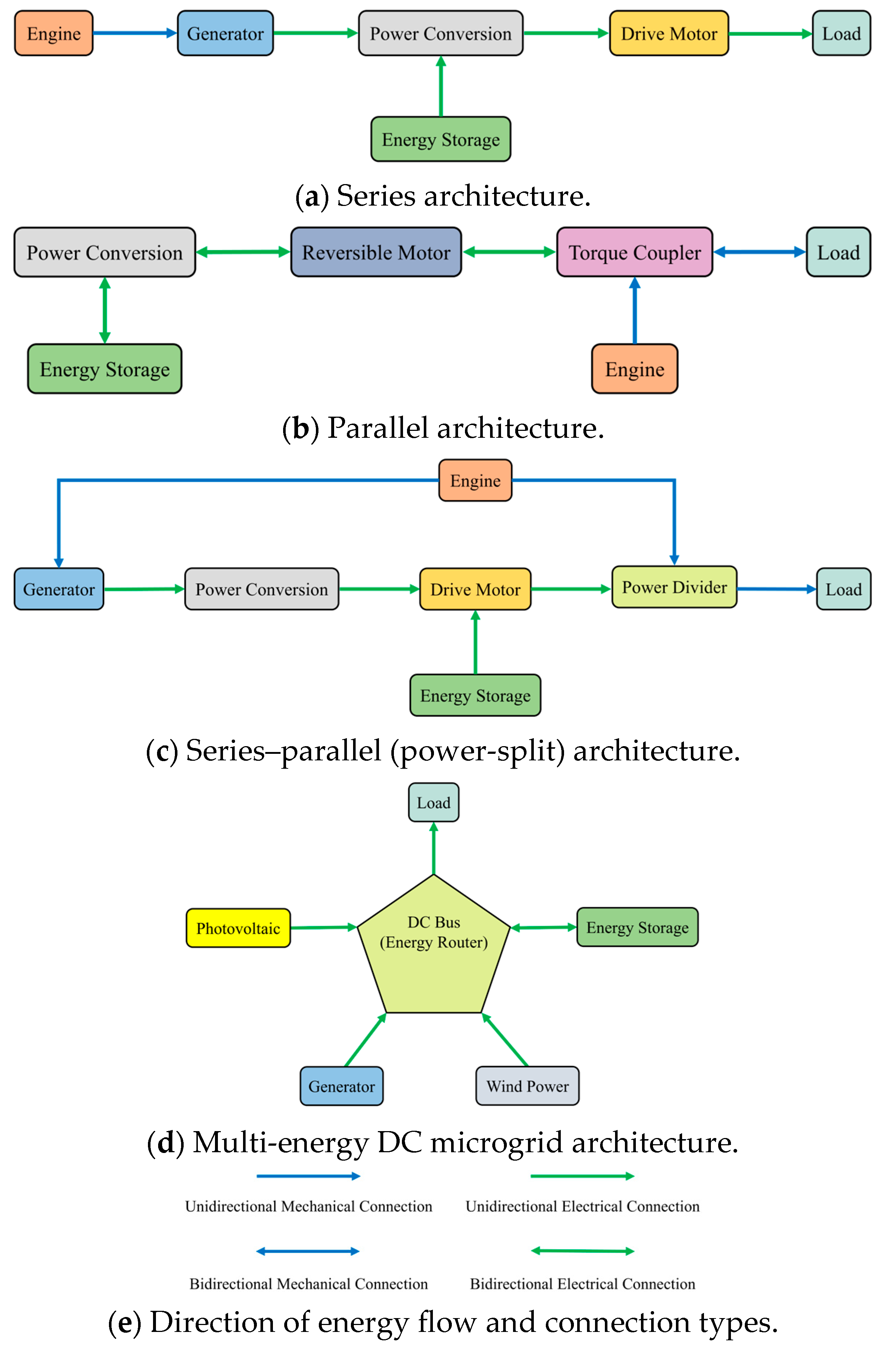
According to the coupling form of energy flow, as shown in
Figure 1, hybrid power systems can be divided into three basic architectures: series, parallel and series–parallel (power-split), and further extended to multi-energy DC microgrids and integrated power systems. The control degree of freedom of the system increases with the improvement in architecture complexity, which also directly determines the difficulty of solving the energy management problem [
27].
2.1.2. Series Hybrid Power Architecture
In the series architecture, the heat engine is fully decoupled from the driving wheels. The heat engine only generates electric energy by driving the generator, and the system energy flow follows the chain transmission path of “chemical energy → mechanical energy → electrical energy → mechanical energy”. Since the heat engine is decoupled from the load, it can be stably controlled to operate at a constant power in the high-efficiency zone, effectively avoiding low-efficiency operation. This architecture has significant advantages under urban low-speed and frequent start–stop conditions, but the system efficiency is low under high-speed conditions due to secondary energy conversion. The core of energy management for this architecture is power distribution decision-making, and the main technical difficulty lies in real-time decision-making of heat engine start–stop and output power, as well as suppressing load fluctuations with the help of energy storage systems. Typical application scenarios include urban buses, port tugboats, etc. [
28,
29].
2.1.3. Parallel Hybrid Power Architecture
The parallel architecture keeps the direct mechanical transmission path from the heat engine to the wheels, and is connected in parallel with an electric drive path. The two paths can drive the load collaboratively or independently. The diversity of energy flow makes the comprehensive energy efficiency of this architecture superior to that of the series architecture: direct mechanical drive reduces energy conversion losses, and the electric path provides control flexibility and regenerative braking capability for the system. The core of energy management for this architecture is torque distribution, which requires real-time decision-making of output torque of the heat engine and motor, and coordination of system operating mode switching. It is a typical multi-objective real-time optimization problem. Relying on full-operating-condition adaptability, the parallel architecture is widely used in passenger vehicles, conventional ships and other fields [
30,
31].
2.1.4. Series–Parallel (Power-Split) Hybrid Power Architecture
The series–parallel architecture decomposes the output power of the heat engine into two paths: mechanical transmission and electrical transmission through power-split devices such as planetary gear sets. By controlling the generator, the continuous adjustment of the heat engine speed and load is realized, maintaining the heat engine in the high-efficiency zone at all times. The energy flow of this architecture has both characteristics of the series and parallel architectures, with the highest controllability among the three basic architectures and the optimal comprehensive system performance. Its energy management needs to coordinate three coupled control variables, the heat engine throttle, generator torque and drive motor torque, simultaneously. The core technical challenge lies in real-time optimization of power-split ratio and multi-variable collaborative control. The Toyota Hybrid System (THS) is a model for the commercial application of this architecture [
32].
In marine, microgrid-related and other scenarios, the concept of hybrid power is further expanded to multi-energy integrated DC microgrids and integrated power systems. This architecture takes the DC bus as the energy router to realize networked coupling of multiple power generation units, energy storage devices and loads. The energy management problem is upgraded to a multi-timescale optimization problem combining global energy scheduling (minute-level) and real-time power distribution (millisecond-level), facing challenges such as multi-timescale coupling, strong operational randomness, and multi-component collaborative control. Typical application scenarios include ship-integrated power systems, island microgrids, etc. [
33,
34].
2.2. Mathematical Modeling of Energy Management Problems
The energy management of hybrid power systems is a typical dynamic sequential decision-making problem, which can usually be formalized as an MDP. A standard MDP is defined by a five-tuple
, where
is the state space,
is the action space,
is the state transition function,
is the reward function, and
is the discount factor [
35].
2.2.1. State Space
The state vector
shall include all the observable system information related to energy management decision-making, usually consisting of four parts: the energy storage state, the prime mover state, load and operating condition information, and environmental information. Historical and predictive information is introduced in some studies to improve the forward-looking nature of decision-making [
36]. The composition of typical state variables for energy management of hybrid power systems is shown in
Table 2. The selection of state variables varies in different application scenarios, and state variables need to be normalized to improve the training efficiency of DRL.
2.2.2. Action Space
The design of the action vector
shall match the control degrees of freedom of the system and comply with the physical constraints of the equipment. According to the type of control instructions, the action space can be divided into continuous action space, discrete action space and hybrid action space. Most energy management problems of hybrid power systems in engineering practice are mixed-integer action spaces [
42]. The typical forms and application scenarios of the three types of action spaces are shown in
Table 3.
2.2.3. State Transition and Reward Function
The state transition function
describes how control actions affect the system state. As a model-free method, DRL does not need to explicitly construct this function, but implicitly learns the dynamic characteristics of the system through the interaction process with the system [
46].
The reward function
is a key bridge that transforms engineering optimization objectives into numerical signals understandable to agents, and its design directly determines the optimization performance of DRL strategies. The reward function for the energy management of hybrid power systems usually adopts the form of the weighted sum of multiple objectives, and the typical sub-item designs are shown in
Table 4. The reward function design should follow the principle of “punishing negative behaviors and rewarding positive behaviors”, should avoid the sparse reward problem, and should guide the learning process of agents through reward shaping [
47].
2.2.4. Optimization Objective
The optimization objective of energy management for hybrid power systems is to find the optimal control strategy
to maximize the expected cumulative discounted reward of the system; its mathematical expression is
where
is the operating trajectory of the system, and
is the discount factor, whose value determines the agent’s attention to short-term and long-term rewards [
54].
2.3. Performance Boundaries of Traditional Methods and Potential Breakthroughs of DRL
The performance boundaries of traditional energy management methods essentially stem from the fundamental contradiction between the “model-driven” optimization idea and the “complex, stochastic and dynamic” actual operating scenarios. As a data-driven sequential decision-making optimization method, DRL’s core technical advantage lies in getting rid of the dependence on prior system models, and has irreplaceable application potential in the following four types of scenarios:
- (1)
The system characteristics are too complex and highly nonlinear, making it difficult to accurately describe with concise mathematical models;
- (2)
There is a lot of uncertainty in the system operating environment, which is difficult to accurately characterize through prediction methods;
- (3)
The system has multiple optimization objectives with complex spatiotemporal coupling relationships;
- (4)
Engineering applications expect the system to have lifelong learning and self-optimization capabilities.
DRL fundamentally solves the contradiction between “model dependence” and “environmental adaptability” that exists in traditional energy management methods, and has become a core technology to break through the performance boundaries of energy management for hybrid power systems [
55,
56,
57].
3. Fundamentals of DRL and Mainstream Algorithm System for Hybrid Power System Energy Management
The energy management problem of hybrid power systems has been formalized as a MDP in Chapter 2, and DRL is a data-driven sequential decision-making method designed to solve this type of stochastic dynamic optimization problem [
58]. This chapter abandons redundant pure theoretical derivation, focuses on the core requirements of hybrid power system energy management, clarifies the core logic of DRL to break through the performance bottleneck of traditional methods, classifies mainstream DRL algorithms from the perspective of control engineering, and clarifies the adaptation logic between each algorithm and energy management scenarios.
3.1. Core Theoretical Foundations of DRL for Energy Management
3.1.1. Core Mapping Between MDP and Energy Management
As defined in
Section 2.2, the energy management MDP is a five-tuple
. For hybrid power system control, the core mapping between MDP elements and engineering practice is as follows:
- (1)
State space : The observable system information related to decision-making (battery SOC, load demand, prime mover status, etc.), which is the input of the DRL controller;
- (2)
Action space : The controllable variables of the system (torque/power distribution, mode switching, etc.), which is the output of the DRL controller;
- (3)
State transition : The dynamic change law of the system after the control action is executed. DRL implicitly learns this law through data interaction without building an accurate mechanism model, which is its core advantage over traditional model-based methods;
- (4)
Reward function : The numerical mapping of engineering optimization objectives (fuel saving, emission reduction, battery life protection, etc.), which is the core guide for DRL strategy learning;
- (5)
Discount factor : This determines the weight of long-term and short-term rewards, and is used to balance the immediate fuel saving effect and long-term system health optimization.
3.1.2. Core Value Functions for Strategy Optimization
The value function is the theoretical cornerstone of DRL strategy optimization, and its core definition and engineering significance in energy management are shown in
Table 5. We only retain the core functions directly related to strategy design, and abandon redundant pure mathematical derivation.
The optimal strategy of the system can be obtained by solving the Bellman optimality equation, which is the theoretical basis for DRL to approach the global optimal energy management effect [
62].
3.2. Core Advantages of DRL over Traditional Tabular RL
Traditional tabular RL (e.g., Q-Learning) suffers from the curse of dimensionality in energy management scenarios: the state and action spaces of hybrid power systems are high-dimensional and continuous (e.g., continuous SOC, vehicle speed, and torque demand), and the number of state-action pairs increases exponentially, making it impossible to solve effectively [
63].
DRL uses deep neural networks to parameterize the value function or strategy function, and fits the nonlinear mapping relationship between system states, actions and rewards through the powerful nonlinear approximation ability of neural networks, which fundamentally solves the curse of dimensionality. This enables DRL to handle the complex high-dimensional continuous optimization problem of hybrid power system energy management, which is the core premise for its engineering application [
64].
3.3. Mainstream DRL Algorithm Classification and Adaptability in Energy Management
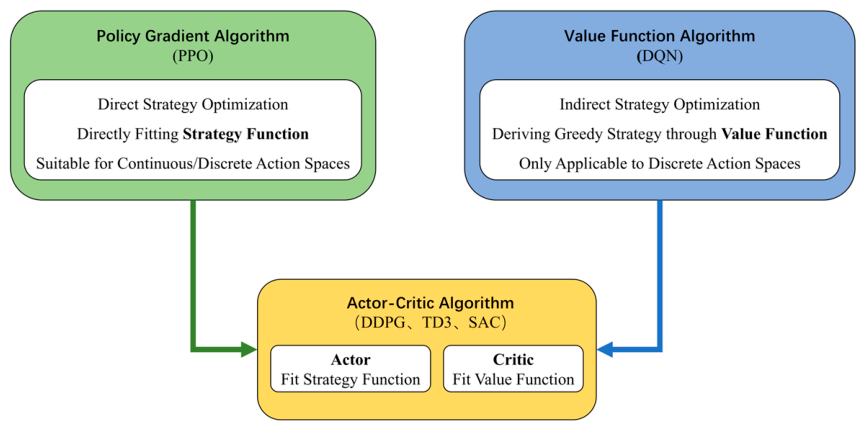
From the perspective of control engineering, mainstream DRL algorithms are divided into three categories: value function-based, policy gradient-based, and actor–critic methods.
Figure 2 shows the basic principles, typical representatives and inter-relationships of the three categories of DRL algorithms, clearly reflecting the evolutionary context and improvement directions of the algorithms. The algorithm design always revolves around three core goals: improving continuous space processing capability, enhancing learning stability, and boosting sample efficiency, which are also the core requirements proposed by hybrid power system energy management for DRL algorithms [
65,
66,
67]. This section focuses on the core characteristics of each algorithm and its adaptation logic in hybrid power system energy management, abandons redundant pure algorithm training process description, and directly aligns with the engineering application requirements of the review theme.
3.3.1. Value Function-Based Algorithms
Core Principle: They indirectly derive the optimal strategy by fitting the optimal action value function
of the system. The typical representative is DQN and its improved variants (Double DQN; Dueling DQN). The core innovations of DQN are the introduction of experience replay and target networks, which effectively solve the instability problem in the training process of traditional RL [
68,
69].
Adaptability in Energy Management:
- (1)
Naturally suitable for discrete action spaces, and can be directly applied to the high-level mode decision-making (engine start–stop; operating mode selection) of hybrid power systems;
- (2)
Need to discretize the action space when dealing with continuous torque/power distribution problems, which will lead to optimization accuracy loss and action dimension explosion;
- (3)
Not the mainstream algorithm for underlying continuous control of energy management, and is only used for simple system architecture or high-level mode switching scenarios [
70].
3.3.2. Policy Gradient-Based Algorithms
Core Principle: They directly parameterize the policy function
, and maximize the expected cumulative reward of the system through gradient ascent. The typical representative is Proximal Policy Optimization (PPO), which constrains the strategy update amplitude through clipping, and balances optimization performance and implementation simplicity [
71].
Adaptability in Energy Management [
72]:
- (1)
Can directly process continuous action spaces, and realize fine-grained control of torque/power distribution of hybrid power systems;
- (2)
Has an extremely stable training process, strong robustness to hyperparameters, and low engineering implementation difficulty;
- (3)
Is widely used in complex scenarios with strong uncertainty, such as marine hybrid power systems, multi-energy microgrids, and multi-agent collaborative optimization.
3.3.3. Actor–Critic (AC) Methods
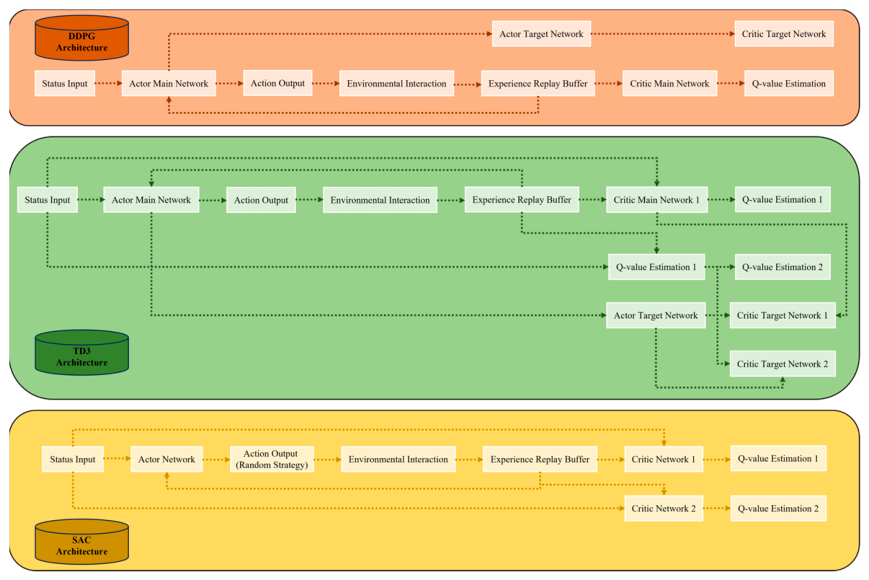
The AC framework is the mainstream algorithm system in the field of hybrid power system energy management. It combines the advantages of value-based and policy gradient methods: the actor network parameterizes the strategy function and directly outputs control actions; the critic network parameterizes the value function and provides gradient update guidance for the actor network. It has both continuous space processing capability and a high sample efficiency [
73].
The typical representatives of this type of algorithm include DDPG, TD3, and SAC, and the comparison of their core architectures is shown in
Figure 3.
The core representatives and their adaptation characteristics in energy management are shown in
Table 6, and the core architecture comparison of the algorithms is supported by existing mainstream research [
74,
75,
76].
3.3.4. Hybrid Action Space Processing for Engineering Practice
Most energy management problems in engineering practice involve hybrid action spaces (discrete mode selection + continuous power/torque control). The mainstream processing method in this field is the branched structure network method: the output layer of the network is designed as a multi-branch structure, where one branch outputs discrete action probability distribution, and the other branches output continuous control parameters. This method does not need to modify the core algorithm framework; it only adjusts the output layer structure, and supports end-to-end learning, which is the most widely used method in engineering practice [
83]. Other mainstream methods include the parameterized action space method and hierarchical RL method, and their advantages and limitations have been fully discussed in existing research [
84,
85,
86].
3.3.5. Standardized Benchmark Comparison of Mainstream DRL Algorithms
To eliminate the performance deviation caused by inconsistent models and operating conditions in different studies, this paper constructs a standardized benchmark test set for parallel hybrid electric vehicle energy management, which is the most widely used scenario in this field. The benchmark adopts a unified forward simulation model of a parallel hybrid passenger car, the worldwide harmonized light vehicles test cycle (WLTC) as the standard driving cycle, and the same state space, action space and reward function design for all algorithms. The core configuration of the benchmark is as follows:
- (1)
System model: Parallel hybrid passenger car with 1.5 L gasoline engine + 110 kW drive motor + 1.2 kW⋅h lithium-ion battery;
- (2)
State space: Battery SOC, vehicle speed, required torque, and engine speed;
- (3)
Action space: Continuous torque distribution between engine and motor;
- (4)
Reward function: Weighted sum of fuel consumption minimization, and SOC maintenance and control smoothness;
- (5)
Training configuration: 100 training episodes, fixed random seed (42 seeds), same simulation step size (100 ms), and unified training hardware (NVIDIA RTX 3090 GPU).
The standardized quantitative comparison results of mainstream DRL algorithms under the same benchmark are shown in
Table 7.
The comparison results under the standardized benchmark consistently verify the performance advantages of DRL over traditional methods, and clarify the performance boundaries of different types of DRL algorithms: TD3 and SAC have the best comprehensive optimization performance, approaching the DP global optimum; PPO has the most stable training process and strong generalization ability; and DQN has the fastest inference speed but the lowest optimization accuracy, which is consistent with the application characteristics of various algorithms sorted out in this paper.
3.4. Key Engineering Design Points of DRL for Physical System Control
This section only retains the core design points directly related to the engineering implementation of hybrid power system energy management, and abandons redundant theoretical descriptions:
- (1)
State Preprocessing and Normalization: Min–Max scaling is used to normalize all the state variables to the [−1, 1] or [0, 1] interval to eliminate the influence of dimension and numerical range differences on training efficiency, which is the most widely used preprocessing method in this field [
87];
- (2)
Reward Function Engineering: Dense instantaneous rewards are designed according to engineering optimization objectives to avoid sparse reward problems and balance the weight of multiple objectives (fuel consumption, battery life, emissions, etc.) through weighted sum. Reward shaping is the core link to guide the agent to learn the optimal strategy that meets the engineering requirements [
88];
- (3)
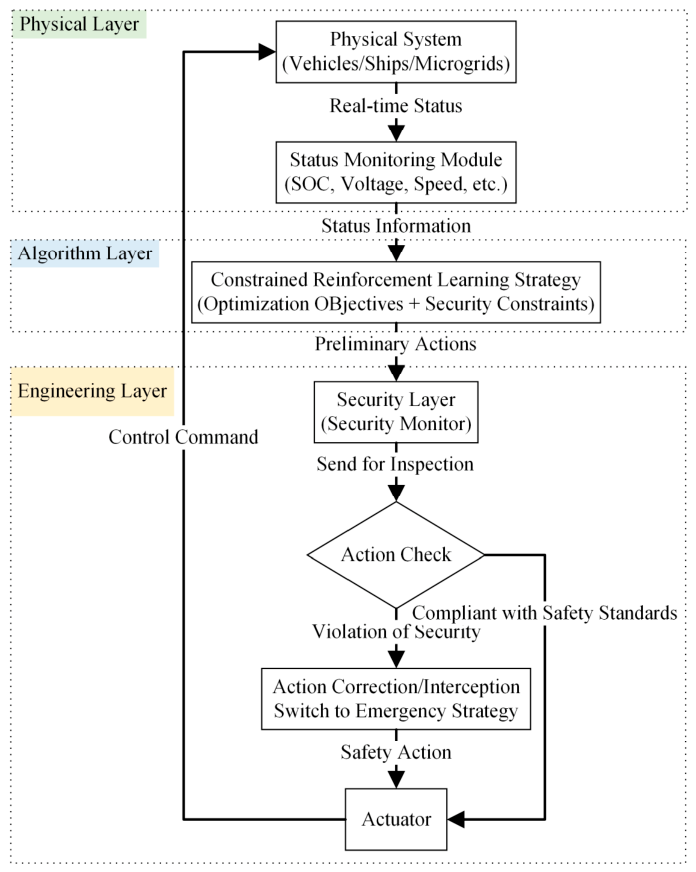
Exploration and Safety Balance: A physics-based safety monitor is added at the output end of the DRL strategy to correct or intercept dangerous actions in real time, which is the most engineering-friendly safety guarantee scheme at present. A constrained RL can also be used to explicitly add safety constraints to the optimization objective at the algorithm level [
89];
- (4)
Partial Observability Compensation: The past 5–10 historical observation sequences are concatenated as the input of the network, or use Long Short-Term Memory (LSTM) to learn the temporal characteristics of the system, to make up for the partial observability of the actual physical system [
90].
4. Applications of DRL in Energy Management of Various Hybrid Power Systems: Cases and Analyses
The application design of DRL in the energy management of hybrid power systems follows no single fixed paradigm. The four major application domains—land vehicles, watercraft, aerial vehicles, and stationary microgrids—differ substantially in terms of their system architectures, operating profiles, optimization objectives, and constraint sets. These differences directly shape the distinct approaches to state–action space construction, reward function design, and training pipeline development for DRL in each domain. Meanwhile, high-dimensional state processing, continuous action optimization, and multi-objective trade-off represent universal core requirements across all fields [
91,
92,
93,
94]. This chapter systematically dissects the detailed application design, algorithmic modifications, and real-world performance of DRL for each of the four domains, extracting cross-domain common design principles and domain-specific technical routes.
4.1. Land Vehicle Hybrid Power Systems
Land vehicles represent the earliest and most mature application area of DRL for hybrid power system energy management, with a well-established standardized workflow: simulation training → Hardware-in-the-Loop (HIL) validation → real-vehicle testing [
95].
4.1.1. Passenger Cars and Light Commercial Vehicles
Passenger cars and light commercial vehicles predominantly adopt parallel and power-split (series–parallel) hybrid architectures. The core of energy management is the refined real-time distribution of torque and power [
96,
97].
Core Design Paradigm
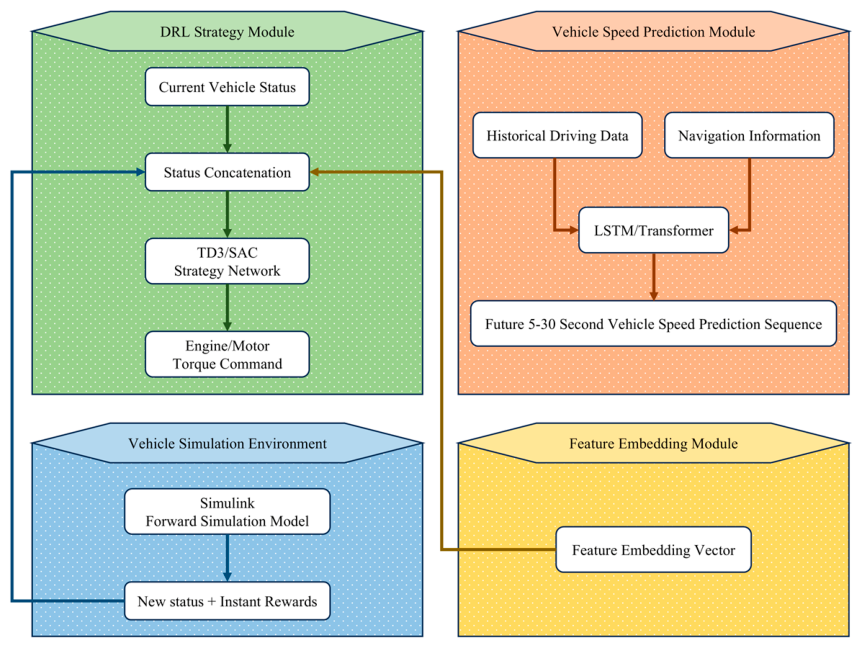
The state space integrates core variables including vehicle speed, acceleration, demanded power, battery SOC, and engine status. A recent research focus is incorporating short-term (5–30 s) velocity/power prediction into the state vector, encoding predictive features via LSTM networks, and feeding them into the policy network to enable DRL with predictive decision-making capability [
98].
Figure 4 illustrates a DRL energy management framework fused with future predictive information (using a hybrid electric vehicle as an example) [
99].
The action space is tailored to the system architecture: parallel/power-split layouts typically use a 2D continuous torque vector as the control action, while series layouts use a power distribution vector [
100,
101]. Some studies employ a hybrid action space that combines discrete operating-mode selection with continuous power/torque control [
102]. The reward function uses a weighted multi-objective sum, with the key terms covering fuel consumption, battery degradation, SOC maintenance, and control smoothness [
103].
4.1.2. Heavy-Duty Commercial Vehicles, Engineering Machinery, and Special Vehicles
These vehicles exhibit unique operational characteristics, including severe transient load fluctuations, strong coupling among multiple systems, and stringent equipment lifespan requirements; as a result, their energy management is significantly more challenging than that of passenger cars and light commercial vehicles [
108].
Core Challenges and Design Features
Energy management for such vehicles faces three core challenges:
- (1)
Severe transient load fluctuations (e.g., power spikes in excavators);
- (2)
Strong multi-system coupling (e.g., electro-hydraulic integration);
- (3)
Stringent lifetime requirements for key components.
Corresponding design features include targeted DRL training using repetitive duty cycles and strengthened component-protection weighting in the reward function [
109].
Typical Application Cases
Hybrid excavators: Yoo et al. used TD3 to coordinate power allocation among the engine, supercapacitor, and main motor. A penalty for hydraulic pressure fluctuation was added to the reward function, and action timing was optimized for hydraulic flow coupling. The result was fuel savings of over 27% while hydraulic shock was reduced by 42%, with robust performance validated across multiple operating modes [
110]. Hybrid mining trucks: Tang et al. developed a DDPG-based strategy that incorporates continuous road grade and preceding-vehicle motion. Under real mine conditions, fuel economy improved by 7.1% over an MPC-DQN hierarchical method while maintaining car-following safety [
111]. Military hybrid tracked vehicles: Han et al. used Double Deep Q-Network (DDQN) for energy management of a dual-motor drivetrain. Fuel economy rose by ~7.1% over conventional DQN, reaching 93.2% of the DP benchmark [
112].
4.2. Watercraft Hybrid Power Systems
Marine hybrid power systems operate under complex, highly variable loads, where the limitations of conventional energy management methods are especially pronounced—creating ample room for DRL adoption [
113].
4.2.1. Commercial Ships: From Inland Waterways to Ocean-Going Vessels
DRL-based energy management for commercial ships is scenario-adaptive. The dominant algorithms are PPO, TD3, and SAC, with optimization objectives adapted to vessel type and operating environment [
114,
115,
116].
Inland ferries and coastal ships: Wu et al. used Double Q-learning for a plug-in fuel cell–battery ferry. The agent learned from continuous random power profiles without future preview, achieving 96.9% of the near-optimal cost performance [
117]. Ocean container ships: Xiao et al. used knowledge-distillation-compressed DRL to co-optimize speed and energy scheduling for diesel–electric hybrids. Fuel consumption dropped by 4.2%, high-efficiency engine operation rose by 12%, and computational complexity fell by 30% [
118]. Cruise ships: Guo et al. built a DDPG-based energy management strategy for multi-energy cruise hybrids. Compared with DQN, the scheme optimized diesel engine operation and cut the total fuel use by 3.6% [
119].
4.2.2. Special-Purpose Work Vessels
Special marine vessels face extreme load swings and strict operational–performance requirements. Energy management must prioritize operational stability while maximizing efficiency [
120].
Offshore support vessels: Wang et al. used an improved K-means++ route-clustering method plus DDPG for power allocation. Fuel consumption was reduced by 2.3%, 5.5%, 18.1%, and 20.1% relative to DQN, Q-learning-, HAAR-, and rule-based methods, respectively [
121]. Tugboats: Gaber et al. applied an enhanced DDPG algorithm that accounts for photovoltaic uncertainty to balance hydrogen fuel cell and battery power. The total economic cost fell by 1.36% and 0.96% versus Double DQN and PPO, respectively [
122].
4.2.3. Technical Implementation Characteristics
Marine DRL research presents two prominent characteristics:
- (1)
A heavy reliance on high-fidelity simulation and digital twins, using tools such as MATLAB/Simulink (Simscape Marine) and DNV GL SESAM;
- (2)
HIL testing as a critical bridge between simulated and real ship deployment, requiring seamless integration with the actual vessel power management system [
123].
4.3. Aerial Vehicles and Hybrid UAV Power Systems
Aviation imposes extremely high safety requirements. DRL research in this domain remains exploratory, with a focus on eVTOL aircraft and long-endurance UAVs [
124].
4.3.1. eVTOL Aircraft
Energy management for eVTOL focuses on optimal energy allocation and fault-tolerant control across flight phases. Optimal energy allocation: Liu et al. used an improved PPO algorithm to dynamically adjust thrust allocation under urban wind fields. Energy consumption fell by ~11% while preserving ride comfort and low noise [
125]. Fault reconfiguration: Liu et al. trained a PPO-based fault-tolerant controller for quadrotor eVTOLs. Upon single-motor failure, thrust redistribution was completed within 150 ms, maintaining stable flight and mission completion [
126].
4.3.2. Long-Endurance Hybrid UAVs
Aviation DRL is still largely simulation-based, with limited real-flight testing. The chief bottlenecks are airworthiness certification and embedded deployment [
127]. Guo et al. proposed a DRL framework combining B-spline trajectory parameterization and Adaptive ECMS (A-ECMS) for hydrogen fuel cell–battery UAVs. Endurance increased by 18%, hydrogen consumption dropped by 12.3%, and environmental adaptability was enhanced via parameter identification [
128].
4.4. Microgrids and Distributed Energy Systems
Microgrids are generalized hybrid energy systems whose energy management requires coordinated dispatch and a supply–demand balance across multiple energy sources. DRL—especially Multi-Agent Deep Reinforcement Learning (MARL)—has become a core research direction [
129].
4.4.1. Energy Dispatch for Off-Grid Microgrids
The core objective is to balance generation and load in real time while maximizing renewable penetration. Centralized DRL: Guo et al. used centralized PPO for diesel–battery–renewable off-grid microgrids. Diesel use fell by 15%, renewable consumption rose by 18%, and computation speed tripled versus traditional methods [
130]. Distributed MARL: Harrold et al. developed a Multi-Agent Deep Deterministic Policy Gradient (MADDPG) scheme for peer-to-peer energy trading. Renewable utilization improved by 21.4%, operating costs fell by 25%, and decisions relied only on local information [
131].
4.4.2. Grid-Connected Microgrids and VPPs
Grid-connected microgrids optimize economic benefits using electricity price signals [
132]; VPPs coordinate multiple microgrids for global efficiency [
133]. Chen et al. used multi-agent consensus control for distributed economic dispatch in grid-connected microgrids, cutting operating costs by 10% [
134]. Yan et al. combined a two-layer electricity–carbon pricing framework with a multi-agent Stackelberg game for VPPs. The scheme optimized trading strategies in coupled electricity–carbon–green certificate markets and strengthened low-carbon performance [
135].
5. Experimental Validation Platforms, Simulation Tools, and Systematic Evaluation
The research and engineering deployment of DRL in the energy management of hybrid power systems depend strongly on high-fidelity simulation environments, efficient training frameworks, and rigorous verification procedures [
136]. This chapter systematically reviews mainstream simulation tools, DRL training techniques, the four-stage verification process, and a comprehensive performance evaluation system in this field, providing methodological guidance for the engineering application of DRL.
5.1. High-Fidelity System Simulation Environments
A high-fidelity simulation environment is the foundation for DRL policy training. Its core requirement is that the dynamic characteristics of the simulation model closely match those of the physical system, ensuring the validity and reliability of simulation results [
137]. Simulation tools and modeling methods vary significantly across application domains. The mainstream high-fidelity simulation software and their interfaces with DRL training frameworks are summarized in
Table 8.
5.1.1. Land Vehicle System Simulation Environment
Academic research predominantly uses MATLAB/Simulink for building component-level hybrid power system models. Industrial validation employs professional tools such as AVL CRUISETM and GT-SUITE, with simulation deviations from real-vehicle tests typically below 5%, meeting engineering validation requirements [
144,
145].
5.1.2. Marine Powertrain Simulation Environment
MATLAB/Simulink is commonly used for standalone marine powertrain simulation, with custom models built for specific vessel types [
146]. Multi-physics coupled simulation relies on marine professional platforms such as DNV GL SESAM and Siemens Simcenter, enabling the collaborative simulation of marine propulsion, fluid dynamics, structural mechanics, and other physical fields [
147,
148].
5.1.3. Microgrid and Power System Simulation Environment
Electromagnetic transient simulation (microsecond-level) for microgrids focuses on real-time power distribution, with core tools including MATLAB/Simulink and PSCAD/EMTDC [
149,
150]. Power flow and long-term dynamic simulation (minute-level) targets global energy scheduling, using tools such as OpenDSS, GridLAB-D, and DIgSILENT [
151].
5.1.4. Standardized Construction of DRL Training Interfaces
Mainstream interface methods between DRL training frameworks and simulation software include Simulink-specific interfaces (S-Function), FMI/FMU standard interfaces, and OpenAI Gym/Gymnasium environment encapsulation. The core requirement of interface design is to ensure real-time performance and the synchronization between simulation and training, avoiding the performance degradation caused by interface latency [
152].
5.2. DRL Algorithm Development and High-Performance Training
Leveraging mainstream deep learning frameworks, high-level DRL libraries, distributed training, and automated hyperparameter tuning can drastically improve DRL training efficiency and shorten development cycles [
153].
5.2.1. Mainstream DRL Development Frameworks and High-Level Libraries
Deep learning frameworks constitute the foundation of DRL algorithm development. PyTorch is widely used for its flexibility in academic algorithm innovation [
154], while TensorFlow offers high computational efficiency for industrial deployment [
155]. High-level DRL libraries encapsulate classic algorithms to lower development barriers:
- (1)
Stable-Baselines3: User-friendly and suitable for academic research [
156];
- (2)
Ray RLlib: Supports high-performance distributed training, and is ideal for industrial applications [
157];
- (3)
Tianshou: Modular design, and is convenient for algorithm innovation [
158].
5.2.2. Distributed Training Technology
Distributed training is the core technique for improving DRL efficiency, adopting a parallel data collection and centralized model update paradigm [
159]. The Actor–Learner architecture in Ray RLlib is a representative implementation: multiple Actors interact with the environment in parallel to collect samples, and a single Learner performs centralized model updates, reducing the training time from weeks to days [
160].
5.2.3. Automated Hyperparameter Tuning
Hyperparameter selection directly affects DRL training stability and convergence speed. Traditional manual tuning is inefficient and subjective. Modern tools such as Optuna and Ray Tune use Bayesian optimization, genetic algorithms, and other intelligent methods to search for optimal hyperparameter combinations, improving tuning efficiency by 3–5 times compared with manual tuning [
161].
5.3. HIL and Physical Validation Processes
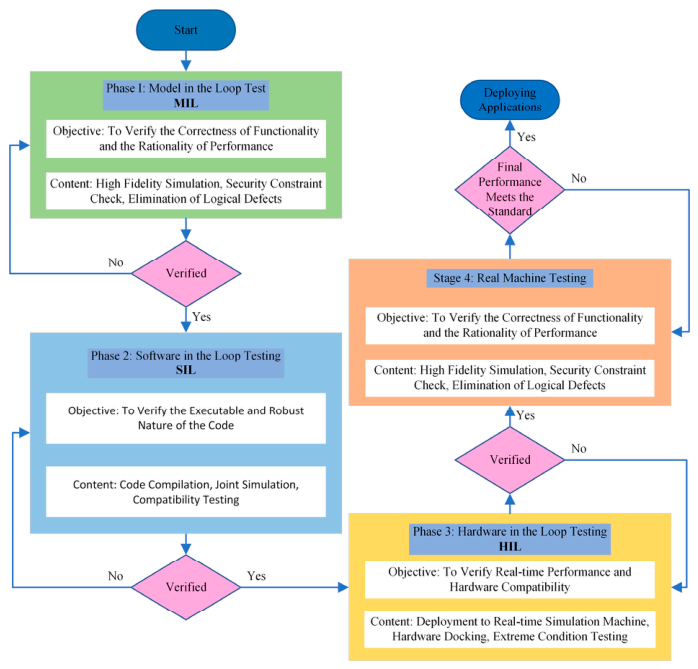
The deployment of DRL policies from simulation to physical systems requires a strict four-stage validation flow, which gradually verifies functional correctness, engineering feasibility, and operational safety, as shown in
Figure 5 [
162].
5.3.1. Model-in-the-Loop (MIL) Testing
MIL testing is the foundational validation stage, verifying the functional correctness and performance rationality of DRL policies in a non-real-time simulation environment. Extensive simulation tests eliminate logical flaws and design defects in policies. This stage features low cost and high efficiency, serving as the basis for iterative policy optimization [
163].
5.3.2. Software-in-the-Loop (SIL) Testing
SIL testing compiles DRL policy code into executable code (C/C++, etc.) for target hardware, and performs co-simulation with simulation models in a PC-based software environment. It validates the executability, robustness, and compatibility of policy code, providing software support for subsequent hardware deployment [
164].
5.3.3. HIL Testing
HIL testing is a critical transition between simulation-based and physical deployment. DRL policies are deployed to real-time simulators or target embedded controllers, interfacing with the core hardware of physical systems (e.g., battery simulators, motor controllers, and generator set simulators) to build a closed-loop test environment. This stage validates real-time performance, hardware compatibility, and operational safety under extreme conditions [
165].
5.3.4. Real-Vehicle/Real-Ship/Real-Aircraft Testing
Real-world testing is the final validation stage, verifying the actual performance, robustness, and engineering practicality of DRL policies on physical systems. Strict safety protocols are required, and average performance is evaluated through repeated tests. Real-world test results serve as the final basis for large-scale engineering deployment [
166].
5.4. Comprehensive Performance Evaluation Index System
A scientific and comprehensive evaluation system is essential for objectively measuring DRL policy performance and enabling cross-policy comparison. As shown in
Table 9, this paper establishes a six-dimensional evaluation system covering economic, environmental, equipment lifetime, control quality, computational performance, and robustness aspects, tailored to the engineering objectives of hybrid power systems and the algorithmic characteristics of DRL.
5.4.1. Economic Indicators
Economic performance is the core optimization objective of hybrid power system energy management. The key indicators include the total fuel consumption, total electricity cost, and equivalent total cost. The equivalent total cost monetizes fuel consumption, component degradation, maintenance, and electricity purchase, representing the most comprehensive economic evaluation metric [
172].
5.4.2. Environmental Indicators
Environmental indicators include the total CO
2 emissions and pollutant emissions (NO
x, SO
x, and PM), which are critical for complying with carbon neutrality and environmental regulations. Trade-offs often exist between environmental and economic performance, requiring balanced weight settings in the reward function [
173].
5.4.3. Equipment Lifetime Indicators
These indicators assess how DRL policies affect the service life of key components. The battery stress index integrates the current RMS, C-rate, SOC fluctuation, and temperature to evaluate aging. The engine operating point distribution measures the proportion of operation in high-efficiency regions, reflecting efficiency and wear. DRL can extend the component lifetime by optimizing operation toward high-efficiency, low-stress regions [
174].
5.4.4. Control Quality Indicators
Control quality reflects operational smoothness and stability. Lower mode switching frequency and smaller torque/power variation improve ride comfort. Bus voltage fluctuation directly indicates power system stability [
175].
5.4.5. Computational Performance Indicators
Computational performance is critical for embedded deployment. The single-step inference time must be shorter than the system’s control cycle to satisfy real-time requirements. The model size must fit the storage capacity of target hardware. Model compression techniques such as quantization, pruning, and knowledge distillation are used to optimize computational efficiency before deployment [
176].
5.4.6. Robustness Indicators
Robustness characterizes the adaptability to dynamic and complex scenarios. The operating condition generalization error is the performance volatility under unseen cycles. Parameter perturbation robustness is the performance degradation caused by component parameter drift. DRL policies exhibit significantly stronger robustness than traditional model-dependent methods [
177].
5.4.7. Comprehensive Weighting and Decision-Making
Trade-offs exist among the six dimensions (e.g., economy vs. lifetime; environment vs. economy). In engineering applications, weights are assigned based on scenario-specific priorities, and a comprehensive weighted scoring method is used to quantitatively evaluate and select DRL policies [
178].
6. Key Challenges, Open Issues, and Cutting-Edge Solutions
DRL provides a promising optimization paradigm for hybrid power system energy management, but its engineering deployment still faces several coupled core bottlenecks. This chapter systematically analyzes the critical challenges and their intrinsic causes of DRL application in this field from five dimensions: algorithm training, engineering safety, environmental adaptation, decision interpretability, and multi-objective optimization, and sorts out the corresponding cutting-edge solutions.
6.1. Sample Efficiency and Prohibitive Training Costs
Low sample efficiency is an inherent drawback of DRL: policy convergence normally requires millions to tens of millions of environmental interaction samples. Meanwhile, the single-step time consumption of high-fidelity simulation is long, leading to DRL training cycles of several days to weeks and high training costs, which severely restrict the efficiency of engineering research and development [
179]. At present, four leading solutions are adopted to improve sample efficiency and reduce training costs.
6.1.1. Offline RL
Offline RL directly learns control policies from historical interaction data without online interaction with the environment, effectively cutting training costs. Conservative Q-Learning (CQL) is a representative algorithm of this type. When applied to the energy management of hybrid electric vehicles, offline RL policies trained on historical driving data reduce the training time by more than 80%, while achieving a fuel economy comparable to online-trained policies. The main challenge of this method is the distribution shift problem, which CQL and similar algorithms alleviate by making conservative estimations for unknown actions [
180].
6.1.2. Model-Based RL
Model-based RL first learns a “world model” of environmental dynamics from a small number of samples, and then conducts policy exploration and optimization on this model to reduce interactions with the real environment. DreamerV3 is a representative method of this type. When applied to hybrid power system energy management, it improves training efficiency by 3–5 times. The core challenge is the model bias problem, i.e., discrepancies between the learned world model and real environmental dynamics that may degrade policy performance [
181].
6.1.3. Imitation Learning and Pre-Training
Imitation learning uses expert demonstration data to provide high-quality initial values for DRL policies, and then completes policy optimization with a small amount of online fine-tuning, greatly boosting sample efficiency. Behavior Cloning (BC) is a basic method of imitation learning, where expert data can be derived from DP optimal trajectories or engineer experience decisions. When applied to hybrid power systems, this method improves sample efficiency by 80%. The core challenge is the compound error problem, which requires online fine-tuning to correct the policy [
182].
6.1.4. Transfer Learning and Meta-Learning
Transfer learning reuses learning outcomes from source tasks to target tasks, reducing sample demand for target tasks. Meta-learning (e.g., Model-Agnostic Meta-Learning; MAML) equips agents with the ability to “learn how to learn”, enabling fast convergence with few samples on new tasks. Both methods effectively improve the sample efficiency of DRL in hybrid power system energy management. The main challenge is negative transfer, where performance drops sharply when the source and target tasks differ greatly [
183].
6.2. Safety, Reliability, and Verifiability
Safety and reliability are imperative requirements for safety-critical physical systems, and the core bottleneck for the industrial landing of DRL in hybrid power system energy management. The “black-box” nature and random exploration behavior of DRL make it difficult to guarantee operational safety under all working conditions, and policy reliability cannot be verified by traditional methods [
184].
Figure 6 shows a safe DRL framework with a safety layer and constrained optimization, which constructs a dual safety protection system for DRL policies from algorithmic and engineering perspectives, and has become the mainstream design paradigm for safe DRL in hybrid power system energy management [
185]. At present, four leading solutions are adopted.
6.2.1. Safety Layer/Shielding
A physics rule-based safety monitor is added at the output of the DRL policy to correct or intercept dangerous control actions in real time. This method is simple to implement without modifying the DRL algorithm, making it the most engineering-friendly safety guarantee scheme at present. The core challenge is balancing system protection and policy exploration space when setting constraint boundaries [
186].
6.2.2. Constrained RL
Safety constraints are explicitly added to the optimization objective of DRL to ensure the system’s operational safety at the algorithmic level. Constrained Policy Optimization (CPO) is a representative algorithm of this type. This method strictly satisfies safety constraints such as battery SOC, engine load, and bus voltage. The main challenge is high algorithmic complexity, and the natural trade-off between the system’s safety and optimization performance [
187].
6.2.3. Formal Verification and Robustness Analysis
Formal verification uses mathematical logic to prove that neural network policies satisfy safety attributes for all input states. Robustness analysis quantifies the policy’s resistance to external disturbances. This method theoretically guarantees policy safety and reliability, but is currently only applicable to small-scale neural networks and simple safety attributes, representing a core direction for future DRL safety research [
188].
6.2.4. Distributed Fault-Tolerant Architecture
A distributed “primary backup control” fault-tolerant architecture is adopted, where DRL serves as the primary controller and traditional control strategies act as backups. The DRL policy executes optimal control under normal working conditions, and the system immediately switches to the backup controller in case of faults or extreme conditions, ensuring safe operation. This architecture is the most accepted DRL deployment scheme in industry [
189].
6.2.5. Engineering Certification and Regulatory Compliance for Real-World Deployment
The engineering deployment of DRL-based energy management strategies in safety-critical hybrid power systems must comply with strict industry certification standards and regulatory procedures, which is a core prerequisite for real-world application. The mainstream international certification standards, permit acquisition procedures, and key technical requirements are detailed as follows.
Industry-Specific Functional Safety Certification Standards
DRL-based controllers shall comply with the functional safety requirements of the corresponding industry; the core applicable standards include the following:
- (1)
Automotive field: International Organization for Standardization 26262 (ISO 26262) [
190] Road vehicles—Functional safety standard, which requires the DRL control system to meet the corresponding Automotive Safety Integrity Level (ASIL). For passenger car hybrid power system energy management, the minimum requirement is ASIL-B, and the powertrain safety-related functions need to meet ASIL-D. The standard requires the complete traceability of the DRL strategy development process, quantitative risk assessment, and fault injection testing to verify the safety of the strategy under all operating conditions [
191]
- (2)
Marine field: DNV GL Rules for Classification of Ships and INTERNATIONAL ELECTROTECHNICAL COMMISSION 61508 (IEC 61508) [
192] Functional safety of electrical/electronic/programmable electronic safety-related systems. The marine hybrid power system controller must pass the type approval of the classification society, which requires HIL testing of the DRL strategy under extreme sea conditions and fault scenarios, long-term stability verification, and compliance with the marine environmental protection and operational safety regulations [
193];
- (3)
Power system/microgrid field: INSTITUTE OF ELECTRICAL AND ELECTRONICS ENGINEERS 1547 (IEEE 1547) [
194] Standard for Interconnection and Interoperability of Distributed Energy Resources with Associated Electric Power Systems Interfaces and IEC 61508. The grid-connected DRL energy management controller must pass the grid access certification, which requires verification of the strategy’s stability under grid voltage/frequency fluctuations, fault ride-through capability, and compliance with the grid dispatching rules [
195].
Practical Permit Acquisition Procedures for Real-World Deployment
The practical permit acquisition process for DRL-based energy management systems in engineering applications usually includes five core steps:
- (1)
Development phase compliance: Complete the development of the DRL strategy in accordance with the functional safety standard V-model, including requirement specification, system design, algorithm implementation, and verification planning, with full-process document traceability;
- (2)
Simulation and HIL verification: Complete MIL/SIL/HIL testing under all operating conditions, including normal operating conditions, extreme scenarios, and fault injection tests, and provide a complete test report to prove that the strategy meets the safety and performance requirements;
- (3)
Prototype testing: Deploy the DRL strategy to the physical prototype, complete the real-machine test under controllable scenarios, and verify the actual performance, stability and safety of the strategy in the real physical system;
- (4)
Type approval/certification application: Submit the development documents, test reports, and prototype test data to the third-party certification body (such as TECHNISCHER ÜBERWACHUNGSVEREIN (TÜV) for automotive and DNV GL for marine) for type approval, and complete the required supplementary tests according to the certification body’s requirements;
- (5)
Batch deployment permit: After obtaining the type approval certificate, complete the final compliance inspection of the batch products, and obtain the official deployment permit from the industry regulatory authority.
Core Certification Challenges for AI-Based Controllers
At present, the core challenge of DRL strategy certification lies in the “black-box” nature of neural networks, which cannot be verified by traditional test coverage methods. The industry’s mainstream solutions include the following:
- (1)
Adopting the “primary backup” architecture, where the DRL strategy is used as the primary controller, and the certified traditional rule-based/MPC strategy is used as the safety backup controller, which has been widely accepted by certification bodies;
- (2)
Using formal verification methods to mathematically prove the safety attributes of the DRL neural network, ensuring that the strategy will not output dangerous control actions under any input state;
- (3)
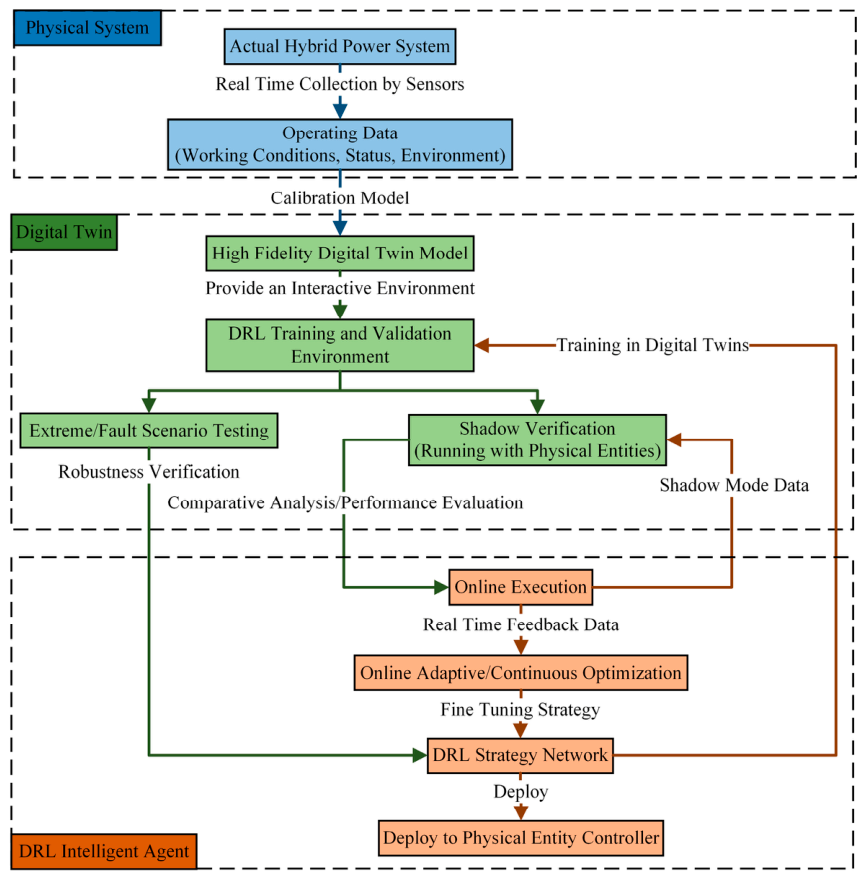
Completing long-term shadow mode operation verification in the digital twin, accumulating massive operating data to prove the reliability of the strategy.
6.3. Generalization and Environmental Adaptability
DRL policies often undergo severe performance degradation under out-of-distribution working conditions and system parameter drift, and during the simulation-to-reality transfer, namely insufficient generalization and environmental adaptability, which is a major obstacle to DRL engineering deployment [
196].
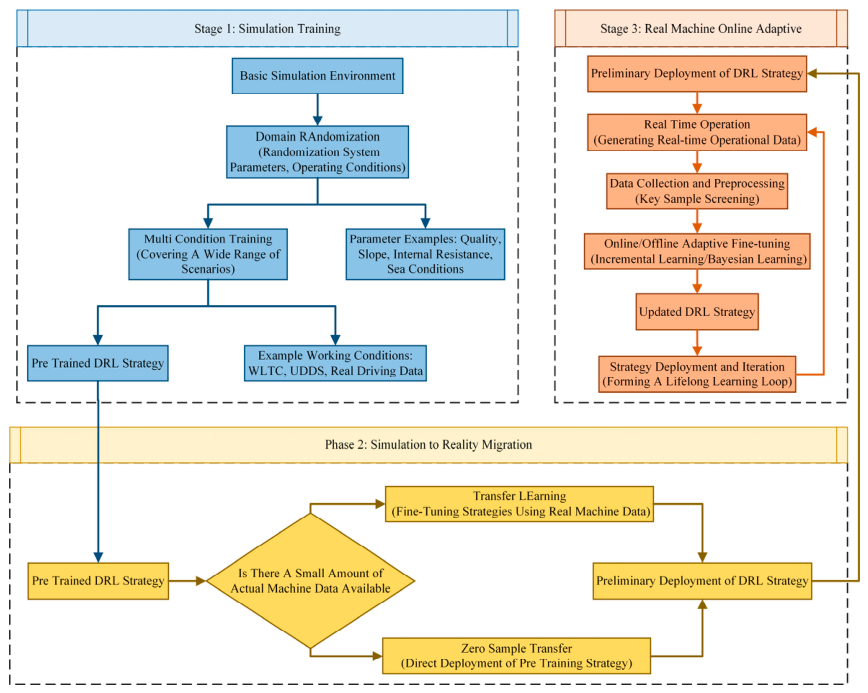
Figure 7 shows a technical roadmap for transfer learning and online continuous adaptive learning from simulation to reality, providing a full-process technical solution for improving DRL policy generalization [
197]. At present, three leading solutions are adopted.
6.3.1. Domain Randomization
The system component parameters and operating conditions are randomized during simulation training, enabling DRL policies to learn general control laws independent of specific parameters and working conditions, thus enhancing policy generalization. The randomized parameters usually include the system mass, road gradient, component internal resistance, and equipment efficiency. DRL policies trained with domain randomization reduce performance volatility under unseen working conditions from over 15% to 3–5%. The core challenge is reasonably designing the randomization range and probability distribution based on engineering practice [
198].
6.3.2. Online Adaptation and Continuous Learning
Real-time operational data from physical systems are used to safely fine-tune DRL policies, adapting them to dynamic scenarios such as component aging and changing working conditions. Incremental learning and Bayesian learning are commonly used to achieve online continuous policy optimization. The core challenge is catastrophic forgetting, where policies may lose learned knowledge when acquiring new skills, requiring effective anti-forgetting mechanisms [
199].
6.3.3. High-Fidelity Simulation Environments and Digital Twins
Multi-physics simulation, high-precision component modeling, and real working condition data are integrated to build high-fidelity simulation environments, narrowing the gap between simulation and reality. Digital twins synchronize with physical systems via real-time sensor data, providing a continuously interactive and safely iterative training carrier for DRL. DRL policies trained on digital twins improve real-machine performance by 5–8% compared with traditional simulation training [
200].
6.4. Interpretability and Decision Credibility
The “black-box” nature of deep neural networks renders DRL decision logic uninterpretable for engineers, leading to industrial caution toward large-scale deployment, namely insufficient interpretability and decision credibility, which is a major barrier to the scaled application of DRL in hybrid power system energy management [
201]. At present, four leading solutions are adopted.
6.4.1. Attention Mechanism Visualization
An attention mechanism is introduced into the DRL policy network to visualize the weight of each state variable during policy decision-making. This method intuitively shows the decision focus of the policy and helps engineers to understand the decision basis, but only reflects “what the policy focuses on” rather than “why it focuses on it” [
202].
6.4.2. Counterfactual Analysis and Impact Factor Assessment
State feature values are systematically modified to observe changes in control actions, quantifying the influence of each state feature on decisions. This method provides quantifiable explanatory indicators for policy decisions and improves decision credibility. The core challenge is the high computational cost, making it unsuitable for real-time control [
203].
6.4.3. Policy Distillation
Simple, highly interpretable models (e.g., decision trees and linear regression models) are used to mimic the decision behavior of complex DRL policies, achieving fully interpretable decision logic at the cost of only 3–5% performance loss. This method is simple to implement and the most practical solution to improve DRL interpretability in engineering [
204].
6.4.4. Integration of Symbolic Knowledge and Hybrid AI
Physical laws and engineering rules are embedded as hard constraints into deep neural networks to build a “gray-box” optimization model. For example, the engine optimal efficiency line and battery SOC safety constraints are embedded into the policy network, making policies naturally conform to physical intuition and fundamentally improving interpretability and decision credibility [
205].
6.4.5. Formal Verification Methodology for Interpretability and Safety in Critical Scenarios
In safety-critical scenarios (such as vehicle powertrain control, ship integrated power system control, and microgrid-connected control), the interpretability of DRL strategies must be guaranteed by formal methods, which provide mathematical-level rigorous proof of the network’s decision logic and safety attributes, rather than just qualitative interpretability analysis. The core formal verification methodologies, technical implementation and engineering examples for DRL energy management strategies are detailed as follows.
6.5. Automation of Multi-Objective Trade-Offs and Pareto Front Exploration
Traditional multi-objective energy management optimization depends on manual reward weight tuning, which is subjective and inefficient. A single weight setting cannot adapt to dynamic changes in objective priorities during operation. Automating multi-objective trade-offs and efficiently exploring the Pareto front is a key issue for DRL application in the multi-objective energy management of hybrid power systems [
208]. At present, two leading solutions are adopted.
6.5.1. Multi-Objective RL
Multi-objective RL directly learns a set of Pareto-optimal policies in the multi-objective space, where each policy corresponds to an objective trade-off scheme without manual weight setting. Multi-Objective SAC (MO-SAC) is a representative algorithm of this type, which effectively learns the Pareto front between fuel economy and battery life, and between economy-related and environmental performance. Engineers can flexibly select the optimal policy according to actual scenarios. The core challenge is high computational complexity, making it difficult to handle high-dimensional multi-objective optimization [
209].
6.5.2. Inverse RL
Inverse RL reversely derives implicit reward functions and objective weights from expert demonstration data, automating the reward function design. This method learns weight settings from experienced engineer decisions or DP optimal trajectories, enabling DRL policies to reproduce expert decision logic. The main challenge is the ill-posed nature of the inverse problem, i.e., multiple reward functions can generate the same expert behavior, requiring regularization to select reasonable reward functions [
210].
7. Future Prospects and Frontier Interdisciplinary Directions
The development of DRL in the energy management of hybrid power systems has evolved from single-algorithm optimization to a new stage of deep interdisciplinary integration. To address the core bottlenecks of engineering deployment, DRL must be deeply coupled with cutting-edge technologies such as digital twins, edge computing, swarm intelligence, and physics-informed modeling to build a full-closed-loop intelligent energy management system featuring perception–decision–execution–iteration. This chapter prospects the core development trends of DRL in hybrid power system energy management from five frontier interdisciplinary directions.
7.1. Deep Closed-Loop Integration with Digital Twin Technology
As a high-fidelity virtual mapping carrier of physical systems, the deep closed-loop integration of digital twins and DRL will fundamentally reshape the research, development, and operation paradigms of hybrid power system energy management. As shown in
Figure 8, the integration of DRL and digital twins will be embodied in three core closed-loop scenarios in the future, realizing full-lifecycle optimization from training to deployment and iteration [
211]. The core application directions include three categories.
7.1.1. Shadow Mode and Continuous Validation
During the operation of physical systems, a DRL “shadow controller” in the digital twin runs in parallel with the real controller to continuously verify DRL policy performance without affecting system safety. Long-term shadow operation accumulates performance comparison evidence, gradually building industrial trust in DRL policies and providing data support for final primary controller switching.
7.1.2. Continuous Learning and System Evolution
Real-time operational data from physical systems are used to update the digital twin model. DRL policies are safely fine-tuned in the updated twin model and deployed to physical entities after validation, forming a closed loop of physical data → twin calibration → policy fine-tuning → real-machine deployment. This mode enables the lifelong learning of DRL policies and the intelligent evolution of hybrid power systems, keeping the system always adapted to dynamically changing operating scenarios.
7.1.3. Active Safety Testing for Extreme and Fault Scenarios
Extreme operating conditions and fault signals are actively injected into the digital twin to test the emergency response capability of DRL policies and identify potential safety hazards. Training on massive virtual fault scenarios equips DRL policies with diverse fault-handling logic, significantly improving fault tolerance and safety in real-machine operation.
7.2. Edge AI and Ultra-Lightweight Deployment
Traditional DRL models have large parameter scales and high computational complexity, making their direct deployment on resource-constrained embedded industrial computers challenging. Edge AI technology realizes ultra-lightweight DRL deployment through model compression, compilation optimization, and hardware adaptation to meet the real-time control requirements of hybrid power systems. The core technical directions include three categories.
7.2.1. Advanced Model Compression and Compilation Optimization
Model compression is a core technology for ultra-lightweight deployment. Current advanced methods include the following: quantization (converting FP32 to INT8/INT4, reducing storage and computational requirements by 4–8 times), structured pruning (removing redundant parameters, reducing the number of parameters by 60%, and increasing inference speed by 2.5 times), and knowledge distillation (small models achieving over 95% of the performance of large models with 1/10 of the parameters). Additionally, operator optimization and parallel scheduling via AI compilers such as TVM reduce the inference time per step for lightweight models to under 5 ms, meeting real-time control requirements [
212].
7.2.2. Neural-Symbolic AI and Programmable AI
Physical laws and engineering constraints are embedded as symbolic rules into DRL networks to build neural-symbolic AI models. The model only needs to learn optimization logic beyond predefined rules, drastically reducing models’ parameter size.
7.2.3. Online Adaptation and Incremental Learning at the Edge
An edge–cloud collaborative training architecture is constructed. Embedded hardware collects real-time system operation data and uploads key samples to the cloud for the incremental fine-tuning of lightweight models. Optimized models are updated to edge controllers via Over-the-Air (OTA) technology, closing the loop of edge deployment, data collection, cloud fine-tuning, and edge update. This architecture enables the continuous adaptation of DRL policies at the edge.
7.3. Swarm Intelligence and Collaborative Energy Internet
Future intelligent energy management will evolve from single-system optimization to multi-system collaborative optimization. MARL will support coordinated decision-making among distributed energy entities to build an efficient and flexible collaborative energy internet. The core development directions include two categories.
7.3.1. Multi-Agent Collaborative Optimization
MARL breaks the optimization boundary of single systems and achieves global coordinated decision-making of multiple independent agents through efficient communication mechanisms and fair credit assignment. The core technical challenge lies in inter-agent credit assignment and communication overhead. Future research will develop lightweight communication protocols and distributed credit assignment algorithms to balance collaboration performance and system complexity.
7.3.2. Deep Integration of Game Theory and MARL
Among multiple energy entities with competitive and cooperative relationships, game theory must be deeply integrated with MARL to enable agents to learn Nash equilibrium strategies in non-cooperative or mixed game scenarios. This integrated technology will provide a novel decision framework for scenarios such as electricity market trading, port energy sharing, and intercity fleet scheduling, balancing individual rationality and global optimality. Game-theoretic MARL has been applied in microgrid electricity price games and will become a core paradigm for multi-agent collaborative decision-making in the energy internet, supporting energy market rule design and trading mechanism optimization.
7.4. Physics-Informed DRL
Physics-Informed Deep Reinforcement Learning (PI-DRL) deeply integrates domain knowledge, physical laws, and DRL for hybrid power systems, achieving the organic unity of data-driven and knowledge-guided approaches to build a “gray-box” optimization model with strong optimization performance, robustness, and interpretability. The core technical pathways include two categories.
7.4.1. Physics-Informed Neural Networks
Physical equations, conservation laws, and component constraints are embedded as hard constraints into the loss function of neural networks to guide the network in learning feature representations and decision logic consistent with physical laws, avoiding decisions that violate physical common sense.
7.4.2. Hierarchical RL and Skill Reuse
Complex energy management tasks are decomposed into a hierarchical architecture of high-level skill decision-making and low-level action execution. High-level policies learn abstract skills such as cruise control, regenerative braking, and high-efficiency power generation based on engineering knowledge. Low-level policies learn refined continuous control actions under skill constraints.
7.5. Standardization, Open-Source Ecosystem, and Benchmark Testing
Building a standardized open-source ecosystem and benchmark testing platform is critical to the sound and rapid development of DRL in hybrid power system energy management. To improve reproducibility and comparability, we provide verifiable open-source repositories, standardized environment versions, fixed random seeds, unified hyperparameters, and public datasets that can be directly used by researchers.
7.5.1. Open-Source Benchmark Frameworks (Verifiable GitHub Repositories)
The following mature open-source benchmarks are widely used in academic research and industrial development, with complete code, models, and experiment templates:
- (1)
DRL-Base-EMS (Unified HEV/PHEV Energy Management Benchmark)
- -
- -
Function: It supports HEV/PHEV energy management; it includes 13 popular DRL algorithms (both discrete and continuous action space), complete vehicle simulation environment, and benchmark tasks with standard evaluation metrics (cumulative reward, convergence fuel economy, and training time).
- (2)
DRL-for-Energy-Systems-Optimal-Scheduling
- -
- -
Function: It provides the fair comparison of DDPG/TD3/SAC/PPO for microgrid/hybrid system scheduling, with complete data and training pipelines.
- (3)
RL-ADN (DRL for ESS Dispatch in Distribution Networks)
- -
- -
Function: It provides a high-performance DRL environment for energy storage optimization; it supports real grid data and HIL verification.
- (4)
microgrid-ems-drl
- -
- -
Function: It provides CIGRE standard microgrid + DRL energy management, with complete training and evaluation code.
7.5.2. Standardized Environment and Version Configuration (Unified and Reproducible)
To ensure result consistency, all benchmarks adopt the fixed environment version widely accepted in the field:
- -
Python: 3.9/3.10.
- -
DRL Environment: Gymnasium 0.29.1 (Farama Foundation, official successor to OpenAI Gym).
- -
Simulation Platform: MATLAB/Simulink R2023b, OpenModelica 1.20.0.
- -
Deep Learning Framework: PyTorch 2.0.1, TensorFlow 2.12.0.
- -
DRL Algorithm Library: Stable-Baselines3 2.0.0, Ray RLlib 2.30.0.
7.5.3. Fixed Random Seeds and Unified Hyperparameters
- (1)
Fixed Random Seeds (For Full Reproducibility).
Global fixed random seeds used in all open benchmarks:
- -
PyTorch/Numpy: ‘seed = 42’;
- -
Gymnasium Environment: ‘seed = 123’;
- -
Neural Network Initialization: ‘seed = 100’.
- (2)
Standardized Hyperparameter Template (Directly Usable Experiment Template).
The unified hyperparameters of mainstream DRL algorithms in hybrid power system energy management systems are shown in
Table 10:
7.5.4. Public and Verifiable Energy Datasets
All the following datasets are free, open, and officially maintained:
- (1)
OpenEI (Open Energy Information)
- -
- -
Data: Commercial/residential hourly load profiles, EV charging data, and renewable generation profiles.
- (2)
Pecan Street Dataport
- -
- -
Data: Real household energy use, EV charging, and solar PV generation (measured data).
- (3)
IEEE PES Data Sharing Platform
- -
- -
Data: 235+ standardized power system datasets (microgrid, load, and renewable energy).
- (4)
Open Power System Data
- -
- -
Data: European grid load and generation time series (hourly resolution).
7.5.5. Experiment Template (Directly Copied for Use)
A minimal runnable template for hybrid power system EMS based on Stable-Baselines3 follows:
# Standard Experiment Template (Reproducible)
import gymnasium as gym
from stable_baselines3 import TD3
# Fixed Environment Version
env = gym.make (“HybridPowerSystem-v0”, disable_env_checker = True)
# Fixed Random Seed
env.reset (seed = 42)
# Standard Hyperparameters (split for readability)
model = TD3(
“MlpPolicy”,
env,
learning_rate = 1 × 10⁻³,
buffer_size = 1,000,000,
batch_size = 128,
gamma = 0.99,
seed = 42
)
# Training
model.learn (total_timesteps = 1,000,000)
8. Conclusions
DRL, with its model-free nature, end-to-end learning capability and long-term global planning advantages, provides a promising solution to the energy management problem of hybrid power systems—a typical multi-objective, multi-constraint and strongly nonlinear stochastic dynamic optimization problem. It drives the transformation of this field from model-driven local instantaneous optimization to data and knowledge dual-driven global intelligent optimization, providing core technical support for energy conservation, carbon reduction and carbon neutrality goals in transportation, power and other sectors. This paper systematically reviews the research progress of DRL in hybrid power system energy management up to the first quarter of 2026, constructs a full-chain technical framework of algorithm–application–verification–challenges–prospects, analyzes technical bottlenecks and cutting-edge solutions, and forecasts interdisciplinary development trends. The core research conclusions with quantitative support are drawn as follows:
- (1)
DRL reconstructs the optimization paradigm of hybrid power system energy management, fundamentally resolving the contradiction between model dependence and environmental adaptability of traditional methods. The quantitative results show that DRL-based strategies can achieve 93–99.5% of the DP theoretical global optimum in fuel economy, which is 5–25% higher than rule-based methods, and the performance degradation under unseen operating conditions is only 3.1–4.8%, less than 1/3 of that of ECMS.
- (2)
The adaptability between algorithms and scenarios determines the engineering performance of DRL. The actor–critic framework (TD3; SAC) has become the mainstream tool in this field, with a 3–5 times higher sample efficiency than DQN and other value function-based algorithms; the PPO algorithm is widely used in ships and microgrids due to its stable training, with a 15–21% improvement in renewable energy consumption in microgrid scenarios compared with traditional methods.
- (3)
Full-chain verification and standardized evaluation are core prerequisites for engineering deployment. The four-stage validation process (MIL → SIL → HIL → real-machine testing) can effectively reduce the simulation-to-reality gap, and the six-dimensional evaluation system constructed in this paper realizes the quantitative evaluation of DRL strategies from economy to robustness.
- (4)
Breakthroughs in core technical bottlenecks rely on the deep integration of interdisciplinary technologies. Offline RL and imitation learning improve DRL sample efficiency by more than 80%; safety layer and constrained RL reduce the safety violation rate of DRL strategies to nearly zero; domain randomization and digital twins reduce the performance degradation of simulation-trained strategies in real scenarios from over 15% to 3–5%.
- (5)
Interdisciplinary integration defines the development direction of next-generation intelligent energy management systems. The deep coupling of DRL with digital twins, edge AI and swarm intelligence will drive the transformation of hybrid power system energy management from single-system local optimization to multi-system global collaborative optimization, supporting the low-carbon transformation of transportation and power sectors.
The limitations of this study are as follows: the insufficient quantitative comparative analysis of different DRL algorithms in the same standardized scenario, and the limited support from large-sample engineering measured data; the insufficient in-depth review of fault-tolerant control and safety decision-making under extreme fault scenarios; and the limited discussion of cost–benefit analysis and economic evaluation in DRL engineering deployment. Future research can conduct further systematic studies around the above directions.
Looking forward, the development of DRL in hybrid power system energy management will focus on three core directions: first, safe and reliable engineering deployment, building a dual guarantee system of “algorithmic safety + engineering fault tolerance” through the deep integration of constrained RL, formal verification and digital twins to solve deployment challenges in safety-critical scenarios and promote DRL from laboratories to engineering practice; second, data–knowledge dual-driven intelligent evolution, deeply embedding physical laws, engineering rules and domain knowledge into DRL models to build a “gray-box” framework with strong optimization performance, robustness and interpretability, achieving simultaneous improvements in sample efficiency and decision credibility; and third, cross-system collaborative global optimization, realizing the distributed collaborative scheduling of fleets, ship fleets, VPPs and other group systems based on multi-agent RL and game theory, breaking the optimization boundary of single systems, and providing core technical support for low-carbon, efficient and flexible operation of the energy internet.
DRL is profoundly reshaping the technical landscape of hybrid power system energy management. Its deep integration with cutting-edge technologies such as digital twins, edge computing and swarm intelligence will not only break through current engineering bottlenecks but also drive the intelligent transformation of sustainable transportation and energy systems. Despite numerous challenges in algorithm optimization, hardware adaptation and ecosystem construction, with the continuous improvement of the algorithm system, the upgrading of hardware technology and the gradual establishment of an open-source ecosystem, DRL is expected to become the core enabling technology of next-generation intelligent energy management systems, with the continuous solution of core engineering bottlenecks, playing a pivotal role in achieving global energy transition and carbon neutrality goals.
Author Contributions
Conceptualization, W.L.; methodology, Z.L.; software, Z.L.; validation, H.T.; formal analysis, Z.L.; investigation, Z.L.; resources, Z.L.; data curation, W.L.; writing—original draft preparation, Z.L.; writing—review and editing, W.L.; visualization, Z.L.; supervision, W.L.; project administration, H.T.; and funding acquisition, H.T. All authors have read and agreed to the published version of the manuscript.
Funding
This research received no external funding.
Data Availability Statement
The data presented in this study are available on request from the corresponding author.
Acknowledgments
The authors acknowledge the technical support and experimental materials provided by the Institute of Internal Combustion Engine Research, School of Energy and Power Engineering, Dalian University of Technology.
Conflicts of Interest
The authors declare no conflicts of interest.
Abbreviations
The following abbreviations are used in this manuscript:
| AC | Alternating Current/Actor–Critic |
| BC | Behavior Cloning |
| CQL | Conservative Q-Learning |
| CPO | Constrained Policy Optimization |
| DC | Direct Current |
| DDPG | Deep Deterministic Policy Gradient |
| DNV GL | Det Norske Veritas Germanischer Lloyd |
| DQN | Deep Q-Network |
| DRL | Deep Reinforcement Learning |
| DP | Dynamic Programming |
| ECMS | Equivalent Consumption Minimization Strategy |
| eVTOL | electric Vertical Take-Off and Landing |
| FMI | Functional Mock-up Interface |
| FMU | Functional Mock-up Unit |
| HIL | Hardware-in-the-Loop |
| HUAVs | Hybrid Unmanned Aerial Vehicles |
| HVAC | Heating, Ventilation, and Air Conditioning |
| IEC | International Electrotechnical Commission |
| IEEE | Institute of Electrical and Electronics Engineers |
| ISO | International Organization for Standardization |
| LSTM | Long Short-Term Memory |
| MAML | Model-Agnostic Meta-Learning |
| MARL | Multi-Agent Deep Reinforcement Learning |
| MADDPG | Multi-Agent Deep Deterministic Policy Gradient |
| MDP | Markov Decision Process |
| MIL | Model-in-the-Loop |
| MPC | Model Predictive Control |
| OTA | Over-the-Air |
| PI-DRL | Physics-Informed Deep Reinforcement Learning |
| PMP | Pontryagin’s Minimum Principle |
| PPO | Proximal Policy Optimization |
| RL | Reinforcement Learning |
| RMS | Root Mean Square |
| SAC | Soft Actor–Critic |
| SIL | Software-in-the-Loop |
| SOC | State of Charge |
| TD3 | Twin Delayed Deep Deterministic Policy Gradient |
| TÜV | Technischer Überwachungsverein |
| VPPs | Virtual Power Plants |
References
- Andersson, Ö.; Börjesson, P. The greenhouse gas emissions of an electrified vehicle combined with renewable fuels: Life cycle assessment and policy implications. Appl. Energy 2021, 289, 116621. [Google Scholar] [CrossRef]
- Zhou, Y. Energy sharing and trading on a novel spatiotemporal energy network in Guangdong-Hong Kong-Macao Greater Bay Area. Appl. Energy 2022, 318, 119131. [Google Scholar] [CrossRef]
- Luján, J.; Garcia, A.; Monsalve-Serrano, J.; Martínez-Boggio, S. Effectiveness of hybrid powertrains to reduce the fuel consumption and NOx emissions of a Euro 6d-temp diesel engine under real-life driving conditions. Energy Convers. Manag. 2019, 199, 111987. [Google Scholar] [CrossRef]
- Wenig, J.; Sodenkamp, M.; Staake, T. Battery versus infrastructure: Tradeoffs between battery capacity and charging infrastructure for plug-in hybrid electric vehicles. Appl. Energy 2019, 255, 113787. [Google Scholar] [CrossRef]
- Xiong, H.; Xu, B.; Kheav, K.; Luo, X.; Zhang, X.; Patelli, E.; Guo, P.; Chen, D. Multiscale power fluctuation evaluation of a hydro-wind-photovoltaic system. Renew. Energy 2021, 175, 153–166. [Google Scholar] [CrossRef]
- Jung, J.; Kim, H.; Jeon, H.; Kim, S. Impact of ESS capacity and energy management strategy on fuel consumption in hybrid electric propulsion systems. J. Mar. Sci. Eng. 2026, 14, 567. [Google Scholar] [CrossRef]
- Tran, D.D.; Vafaeipour, M.; El Baghdadi, M.; Barrero, R.; Van Mierlo, J.; Hegazy, O. Thorough state-of-the-art analysis of electric and hybrid vehicle powertrains: Topologies and integrated energy management strategies. Renew. Sustain. Energy Rev. 2020, 119, 109596. [Google Scholar] [CrossRef]
- Ding, X.; Sun, W.; Harrison, G.P.; Lv, X.; Weng, Y. Multi-objective optimization for an integrated renewable, power-to-gas and solid oxide fuel cell/gas turbine hybrid system in microgrid. Energy 2020, 213, 118804. [Google Scholar] [CrossRef]
- Zhou, J.; Xue, Y.; Xu, D.; Li, C.; Zhao, W. Self-learning energy management strategy for hybrid electric vehicle via curiosity-inspired asynchronous deep reinforcement learning. Energy 2022, 242, 122548. [Google Scholar] [CrossRef]
- Kong, Y.; Xu, N.; Liu, Q.; Sui, Y.; Yue, F. A data-driven energy management methods for parallel PHEVs based on action dependent heuristic dynamic programming (ADHDP) model. Energy 2023, 265, 126306. [Google Scholar] [CrossRef]
- Wang, H.; Ye, Y.; Zhang, J.; Xu, B. A comparative study of 13 deep reinforcement learning based energy management methods for a hybrid electric vehicle. Energy 2023, 266, 126497. [Google Scholar] [CrossRef]
- Kumar, P.; Rawlings, J.B.; Wright, S.J. Industrial, large-scale model predictive control with structured neural networks. Comput Chem. Eng. 2021, 150, 107291. [Google Scholar] [CrossRef]
- Lian, R.; Peng, J.; Wu, Y.; Tan, H.; Zhang, H. Rule-interposing deep reinforcement learning based energy management strategy for power-split hybrid electric vehicle. Energy 2020, 197, 117297. [Google Scholar] [CrossRef]
- Ceusters, G.; Rodríguez, R.C.; García, A.B.; Franke, R.; Deconinck, G.; Helsen, L.; Nowé, A.; Messagie, M.; Camargo, L.R. Model-predictive control and reinforcement learning in multi-energy system case studies. Appl. Energy 2021, 303, 117634. [Google Scholar] [CrossRef]
- Zou, R.; Fan, L.; Dong, Y.; Zheng, S.; Hu, C. DQL energy management: An online-updated algorithm and its application in fix-line hybrid electric vehicle. Energy 2021, 225, 120174. [Google Scholar] [CrossRef]
- Aletras, N.; Doulgeris, S.; Samaras, Z.; Ntziachristos, L. Comparative assessment of supervisory control algorithms for a Plug-In hybrid electric vehicle. Energies 2023, 16, 1497. [Google Scholar] [CrossRef]
- Bae, J.W.; Kim, K.K.K. Gaussian process approximate dynamic programming for energy-optimal supervisory control of parallel hybrid electric vehicles. IEEE Trans. Veh. Technol. 2022, 71, 8367–8380. [Google Scholar] [CrossRef]
- Sun, X.; Chen, Z.; Han, S.; Tian, X.; Jin, Z.; Cao, Y.; Xue, M. Adaptive real-time ECMS with equivalent factor optimization for plug-in hybrid electric buses. Energy 2024, 304, 132014. [Google Scholar] [CrossRef]
- Wu, Y.; Zhao, Y.; Wen, C.; Zhang, J.; Yan, X. Research on energy management strategies for high-power diesel-electric hybrid tractors based on double deep Q-network. Sci. Rep. 2025, 15, 17130. [Google Scholar] [CrossRef]
- Tan, H.; Zhang, H.; Peng, J.; Jiang, Z.; Wu, Y. Energy management of hybrid electric bus based on deep reinforcement learning in continuous state and action space. Energy Convers. Manag. 2019, 195, 548–560. [Google Scholar] [CrossRef]
- Mnih, V.; Kavukcuoglu, K.; Silver, D.; Rusu, A.A.; Veness, J.; Bellemare, M.G.; Graves, A.; Riedmiller, M.; Fidjeland, A.K.; Ostrovski, G.; et al. Human-level control through deep reinforcement learning. Nature 2015, 518, 529–533. [Google Scholar] [CrossRef] [PubMed]
- Du, G.; Zou, Y.; Zhang, X.; Liu, T.; Wu, J.; He, D. Deep reinforcement learning based energy management for a hybrid electric vehicle. Energy 2020, 201, 117591. [Google Scholar] [CrossRef]
- Guo, X.; Yan, X.; Chen, Z.; Meng, Z. Research on energy management strategy of heavy-duty fuel cell hybrid vehicles based on dueling-double-deep Q-network. Energy 2022, 260, 125095. [Google Scholar] [CrossRef]
- Ma, X.; Liu, H.; Han, L.; Yang, N.; Li, M. An real-time intelligent energy management based on deep reinforcement learning and model predictive control for hybrid electric vehicles considering battery life. Energy 2025, 324, 135931. [Google Scholar] [CrossRef]
- Zaporozhets, A.; Babak, V.; Kulyk, M.; Denysov, V. Novel methodology for determining necessary and sufficient power in integrated power systems based on the forecasted volumes of electricity production. Electricity 2025, 6, 41. [Google Scholar] [CrossRef]
- Denysov, V.; Kulyk, M.; Babak, V.; Zaporozhets, A.; Kostenko, G. Modeling nuclear-centric scenarios for Ukraine’s low-carbon energy transition using diffusion and regression techniques. Energies 2024, 17, 5229. [Google Scholar] [CrossRef]
- Boukoberine, M.N.; Zia, M.F.; Berghout, T.; Benbouzid, M. Reinforcement learning-based energy management for hybrid electric vehicles: A comprehensive up-to-date review on methods, challenges, and research gaps. Energy AI 2025, 21, 100514. [Google Scholar] [CrossRef]
- Xue, Q.; Zhang, X.; Teng, T.; Zhang, J.; Feng, Z.; Lv, Q. A comprehensive review on classification, energy management strategy, and control algorithm for hybrid electric vehicles. Energies 2020, 13, 5355. [Google Scholar] [CrossRef]
- Saiteja, P.; Ashok, B. Critical review on structural architecture, energy control strategies and development process towards optimal energy management in hybrid vehicles. Renew. Sustain. Energy Rev. 2022, 157, 112038. [Google Scholar] [CrossRef]
- Shabbir, W.; Evangelou, S.A. Real-time control strategy to maximize hybrid electric vehicle powertrain efficiency. Appl. Energy 2014, 135, 512–522. [Google Scholar] [CrossRef]
- Li, Z.; Long, W.; Lu, W.; Tian, H. Research on energy management strategy for marine methanol–electric hybrid propulsion system based on DP-ANFIS algorithm. Energies 2025, 18, 4879. [Google Scholar] [CrossRef]
- Wang, J. Real-time torque distribution simulation of parallel hybrid vehicle engine. Front. Mech. Eng. 2025, 11, 1647691. [Google Scholar] [CrossRef]
- Zhang, C.; Zhang, Z.; Shao, C.; Zhou, M.; Li, G. Insights into optimization design and energy management of marine parallel hybrid power system. IEEE Trans. Transp. Electrif. 2025, 11, 11451–11462. [Google Scholar] [CrossRef]
- García, A.; Carlucci, P.; Monsalve-Serrano, J.; Valletta, A.; Martínez-Boggio, S. Energy management optimization for a power-split hybrid in a dual-mode RCCI-CDC engine. Appl. Energy 2021, 302, 117525. [Google Scholar] [CrossRef]
- Butler, C.L.; Alleyne, A.G. Sampling-Based Planning and Predictive Control for Energy Management of a Shipboard Integrated Power System With High Ramp Rate Load. J. Dyn. Syst. Meas. Control 2026, 148, 021002. [Google Scholar] [CrossRef]
- Deng, J.; Wang, X.; Chen, T.; Meng, F. An energy router based on multi-hybrid energy storage system with energy coordinated management strategy in island operation mode. Renew. Energy 2023, 212, 274–278. [Google Scholar] [CrossRef]
- Cui, F.; An, D.; Xi, H. Integrated energy hub dispatch with a multi-mode CAES–BESS hybrid system: An option-based hierarchical reinforcement learning approach. Appl. Energy 2024, 374, 123950. [Google Scholar] [CrossRef]
- Wang, X.M.; Ma, B. Battery Life-Aware Predictive Deep Reinforcement Learning Energy Management for Hybrid Electric Vehicles. Sustainability 2026, 18, 2555. [Google Scholar] [CrossRef]
- Yang, C.; Zha, M.; Wang, W.; Yang, L.; You, S.; Xiang, C. Motor-temperature-aware predictive energy management strategy for plug-in hybrid electric vehicles using rolling game optimization. IEEE Trans. Transp. Electrif. 2021, 7, 2209–2223. [Google Scholar] [CrossRef]
- Zhao, Z.; Jin, J. Two-Layer Model Predictive Control of Energy Management Strategy for Hybrid Energy Storage Systems. Energies 2026, 19, 1524. [Google Scholar] [CrossRef]
- Banka, S.; Ashok Kumar, D.V. Hierarchical Data-Driven and PSO-Based Energy Management of Hybrid Energy Storage Systems in DC Microgrids. Automation 2026, 7, 50. [Google Scholar] [CrossRef]
- Hou, J.; Sun, J.; Hofmann, H. Control development and performance evaluation for battery/flywheel hybrid energy storage solutions to mitigate load fluctuations in all-electric ship propulsion systems. Appl. Energy 2018, 212, 919–930. [Google Scholar] [CrossRef]
- Monroy-Morales, J.L.; Peña-Alzola, R.; Campos-Gaona, D.; Anaya-Lara, O. Complete transitions of hybrid wind-diesel systems with clutch and flywheel-based energy storage. Energies 2022, 15, 7120. [Google Scholar] [CrossRef]
- Li, Y.; He, H.; Khajepour, A.; Wang, H.; Peng, J. Energy management for a power-split hybrid electric bus via deep reinforcement learning with terrain information. Appl. Energy 2019, 255, 113762. [Google Scholar] [CrossRef]
- Huang, C.; Zhang, H.; Wang, L.; Luo, X.; Song, Y. Mixed deep reinforcement learning considering discrete-continuous hybrid action space for smart home energy management. J. Mod. Power Syst. Clean Energy 2022, 10, 743–754. [Google Scholar] [CrossRef]
- Gong, C.; Xu, J.; Lin, Y. Plug-In Hybrid Electric Vehicle Energy Management with Clutch Engagement Control via Continuous-Discrete Reinforcement Learning. Energy Technol. 2024, 12, 2301512. [Google Scholar] [CrossRef]
- Altun, Y.E.; Kutlar, O.A. Energy management systems’ modeling and optimization in hybrid electric vehicles. Energies 2024, 17, 1696. [Google Scholar] [CrossRef]
- Cao, D.; Zhao, J.; Hu, W.; Ding, F.; Yu, N.; Huang, Q.; Chen, Z. Model-free voltage control of active distribution system with PVs using surrogate model-based deep reinforcement learning. Appl. Energy 2022, 306, 117982. [Google Scholar] [CrossRef]
- Qi, C.; Zhu, Y.; Song, C.; Yan, G.; Xiao, F.; Wang, D.; Zhang, X.; Cao, J.; Song, S. Hierarchical reinforcement learning based energy management strategy for hybrid electric vehicle. Energy 2022, 238, 121703. [Google Scholar] [CrossRef]
- Zhang, Y.; Zhang, C.; Fan, R.; Huang, S.; Yang, Y.; Xu, Q. Twin delayed deep deterministic policy gradient-based deep reinforcement learning for energy management of fuel cell vehicle integrating durability information of powertrain. Energy Convers. Manag. 2022, 274, 116454. [Google Scholar] [CrossRef]
- Bäumler, A.; Benterki, A.; Meng, J.; Azib, T.; Boukhnifer, M. Energy management strategies based on soft actor critic reinforcement learning with a proper reward function design based on battery state of charge constraints. J. Energy Storage 2024, 90, 111797. [Google Scholar] [CrossRef]
- Yang, D.; Wang, L.; Yu, K.; Liang, J. A reinforcement learning-based energy management strategy for fuel cell hybrid vehicle considering real-time velocity prediction. Energy Convers. Manag. 2022, 274, 116453. [Google Scholar] [CrossRef]
- Deng, K.; Liu, Y.; Hai, D.; Peng, H.; Löwenstein, L.; Pischinger, S.; Hameyer, K. Deep reinforcement learning based energy management strategy of fuel cell hybrid railway vehicles considering fuel cell aging. Energy Convers. Manag. 2022, 251, 115030. [Google Scholar] [CrossRef]
- Tang, X.; Zhou, H.; Wang, F.; Wang, W.; Lin, X. Longevity-conscious energy management strategy of fuel cell hybrid electric Vehicle Based on deep reinforcement learning. Energy 2022, 238, 121593. [Google Scholar] [CrossRef]
- Sellali, M.; Ravey, A.; Betka, A.; Kouzou, A.; Benbouzid, M.; Djerdir, A.; Kennel, R.; Abdelrahem, M. Multi-objective optimization-based health-conscious predictive energy management strategy for fuel cell hybrid electric vehicles. Energies 2022, 15, 1318. [Google Scholar] [CrossRef]
- Wu, P.; Partridge, J.; Anderlini, E.; Liu, Y.; Bucknall, R. An intelligent energy management framework for hybrid-electric propulsion systems using deep reinforcement learning. Int. J. Hydrog. Energy 2025, 106, 282–294. [Google Scholar] [CrossRef]
- Chen, J.; Shu, H.; Tang, X.; Liu, T.; Wang, W. Deep reinforcement learning-based multi-objective control of hybrid power system combined with road recognition under time-varying environment. Energy 2022, 239, 122123. [Google Scholar] [CrossRef]
- Wang, Y.; Tan, H.; Wu, Y.; Peng, J. Hybrid electric vehicle energy management with computer vision and deep reinforcement learning. IEEE Trans. Ind. Inform. 2020, 17, 3857–3868. [Google Scholar] [CrossRef]
- Hua, M.; Zhang, C.; Zhang, F.; Li, Z.; Yu, X.; Xu, H.; Zhou, Q. Energy management of multi-mode plug-in hybrid electric vehicle using multi-agent deep reinforcement learning. Appl. Energy 2023, 348, 121526. [Google Scholar] [CrossRef]
- Zhang, B.; Hu, W.; Xu, X.; Li, T.; Zhang, Z.; Chen, Z. Physical-model-free intelligent energy management for a grid-connected hybrid wind-microturbine-PV-EV energy system via deep reinforcement learning approach. Renew. Energy 2022, 200, 433–448. [Google Scholar] [CrossRef]
- Liu, T.; Tan, K.; Zhu, W.; Feng, L. Computationally efficient energy management for a parallel hybrid electric vehicle using adaptive dynamic programming. IEEE Trans. Intell. Veh. 2023, 9, 4085–4099. [Google Scholar] [CrossRef]
- Zhang, Z.; Zhang, T.; Hong, J.; Zhang, H.; Yang, J.; Jia, Q. Double deep Q-network guided energy management strategy of a novel electric-hydraulic hybrid electric vehicle. Energy 2023, 269, 126858. [Google Scholar] [CrossRef]
- Biswas, A.; Anselma, P.G.; Emadi, A. Real-time optimal energy management of multimode hybrid electric powertrain with online trainable asynchronous advantage actor–critic algorithm. IEEE Trans. Transp. Electrif. 2021, 8, 2676–2694. [Google Scholar] [CrossRef]
- Cots, O.; Dutto, R.; Jan, S.; Laporte, S. A bilevel optimal control method and application to the hybrid electric vehicle. Optim. Control Appl. Methods 2025, 46, 1104–1119. [Google Scholar] [CrossRef]
- Tresca, L.; Pulvirenti, L.; Rolando, L. A cutting-edge energy management system for a hybrid electric vehicle relying on soft actor–critic deep reinforcement learning. Transp. Eng. 2025, 19, 100308. [Google Scholar] [CrossRef]
- Niu, Z.; Wu, J.; He, H. A novel experience replay-based offline deep reinforcement learning for energy management of hybrid electric vehicles. IEEE Trans. Ind. Electron. 2024, 72, 7160–7169. [Google Scholar] [CrossRef]
- Tang, X.; Chen, J.; Qin, Y.; Liu, T.; Yang, K.; Khajepour, A.; Li, S. Reinforcement learning-based energy management for hybrid power systems: State-of-the-art survey, review, and perspectives. Chin. J. Mech. Eng. 2024, 37, 14–38. [Google Scholar] [CrossRef]
- Wang, L.; Wang, X. Enhanced Deep Reinforcement Learning Strategy for Energy Management in Plug-in Hybrid Electric Vehicles with Entropy Regularization and Prioritized Experience Replay. Energy Eng. 2024, 121, 3953. [Google Scholar] [CrossRef]
- Huang, R.; He, H. A novel data-driven energy management strategy for fuel cell hybrid electric bus based on improved twin delayed deep deterministic policy gradient algorithm. Int. J. Hydrog. Energy 2024, 52, 782–798. [Google Scholar] [CrossRef]
- Li, J.; Wang, H.; He, H.; Wei, Z.; Yang, Q.; Igic, P. Battery optimal sizing under a synergistic framework with DQN-based power managements for the fuel cell hybrid powertrain. IEEE Trans. Transp. Electrif. 2021, 8, 36–47. [Google Scholar] [CrossRef]
- Wu, P.; Partridge, J.; Anderlini, E.; Liu, Y.; Bucknall, R. Near-optimal energy management for plug-in hybrid fuel cell and battery propulsion using deep reinforcement learning. Int. J. Hydrog. Energy 2021, 46, 40022–40040. [Google Scholar] [CrossRef]
- Zhou, J.; Li, Z.; Wang, C.; Zhao, W. Deep reinforcement learning based energy management strategy for multi-mode hybrid electric vehicle with dual planetary gear set. Proc. Inst. Mech. Eng. Part D J. Eng. Transp. 2025, 240, 2514–2531. [Google Scholar] [CrossRef]
- Xu, X.; Zhang, L.; Lai, J.; Yang, L.; Xiao, J. Safe reinforcement learning for power allocation of hybrid energy storage systems in electric vehicles using PPO and predictive safety filter. IEEE Trans. Transp. Electrif. 2024, 11, 4024–4034. [Google Scholar] [CrossRef]
- Zhang, C.; Li, T.; Cui, W.; Cui, N. Proximal policy optimization based intelligent energy management for plug-in hybrid electric bus considering battery thermal characteristic. World Electr. Veh. J. 2023, 14, 47. [Google Scholar] [CrossRef]
- Zhang, B.; Hu, W.; Cao, D.; Li, T.; Zhang, Z.; Chen, Z.; Blaabjerg, F. Soft actor-critic–based multi-objective optimized energy conversion and management strategy for integrated energy systems with renewable energy. Energy Convers. Manag. 2021, 243, 114381. [Google Scholar] [CrossRef]
- Xu, D.; Cui, Y.; Ye, J.; Cha, S.W.; Li, A.; Zheng, C. A soft actor-critic-based energy management strategy for electric vehicles with hybrid energy storage systems. J. Power Sources 2022, 524, 231099. [Google Scholar] [CrossRef]
- Zhou, J.; Xue, S.; Xue, Y.; Liao, Y.; Liu, J.; Zhao, W. A novel energy management strategy of hybrid electric vehicle via an improved TD3 deep reinforcement learning. Energy 2021, 224, 120118. [Google Scholar] [CrossRef]
- Huang, R.; He, H.; Zhao, X.; Wang, Y.; Li, M. Battery health-aware and naturalistic data-driven energy management for hybrid electric bus based on TD3 deep reinforcement learning algorithm. Appl. Energy 2022, 321, 119353. [Google Scholar] [CrossRef]
- Li, K.; Jia, C.; Han, X.; He, H. A novel minimal-cost power allocation strategy for fuel cell hybrid buses based on deep reinforcement learning algorithms. Sustainability 2023, 15, 7967. [Google Scholar] [CrossRef]
- Li, T.; Cui, W.; Cui, N. Soft actor-critic algorithm-based energy management strategy for plug-in hybrid electric vehicle. World Electr. Veh. J. 2022, 13, 193. [Google Scholar] [CrossRef]
- Ma, Z.; Huo, Q.; Zhang, T.; Hao, J.; Wang, W. Deep deterministic policy gradient based energy management strategy for hybrid electric tracked vehicle with online updating mechanism. IEEE Access 2021, 9, 7280–7292. [Google Scholar] [CrossRef]
- Han, R.; Lian, R.; He, H.; Han, X. Continuous reinforcement learning-based energy management strategy for hybrid electric-tracked vehicles. IEEE J. Emerg. Sel. Top. Power Electron. 2021, 11, 19–31. [Google Scholar] [CrossRef]
- Xu, Y.; Li, Y.; Gao, W. Comparative analysis of reinforcement learning approaches for multi-objective optimization in residential hybrid energy systems. Buildings 2024, 14, 2645. [Google Scholar] [CrossRef]
- Sun, W.; Zou, Y.; Zhang, X.; Guo, N.; Zhang, B.; Du, G. High robustness energy management strategy of hybrid electric vehicle based on improved soft actor-critic deep reinforcement learning. Energy 2022, 258, 124806. [Google Scholar] [CrossRef]
- Xu, J.; Lin, Y. Energy management for hybrid electric vehicles using safe hybrid-action reinforcement learning. Mathematics 2024, 12, 663. [Google Scholar] [CrossRef]
- Wang, L.; Hou, L.; Liu, S.; Han, Z.; Wu, J. Reinforcement contract design for vehicular-edge computing scheduling and energy trading via deep Q-network with hybrid action space. IEEE Trans. Mob. Comput. 2023, 23, 6770–6784. [Google Scholar] [CrossRef]
- Fan, X.; Guo, L.; Hong, J.; Wang, Z.; Chen, H. Constrained hierarchical hybrid Q-network for energy management of HEVs. IEEE Trans. Transp. Electrif. 2024, 10, 9579–9590. [Google Scholar] [CrossRef]
- Liu, B.; Xu, B.; He, T.; Yu, W.; Guo, F. Hybrid deep reinforcement learning considering discrete-continuous action spaces for real-time energy management in more electric aircraft. Energies 2022, 15, 6323. [Google Scholar] [CrossRef]
- Lian, R.; Tan, H.; Peng, J.; Li, Q.; Wu, Y. Cross-type transfer for deep reinforcement learning based hybrid electric vehicle energy management. IEEE Trans. Veh. Technol. 2020, 69, 8367–8380. [Google Scholar] [CrossRef]
- Qi, X.; Luo, Y.; Wu, G.; Boriboonsomsin, K.; Barth, M. Deep reinforcement learning enabled self-learning control for energy efficient driving. Transp. Res. Part C. Emerg. Technol. 2019, 99, 67–81. [Google Scholar] [CrossRef]
- Zhang, H.; Peng, J.; Tan, H.; Dong, H.; Ding, F. A deep reinforcement learning-based energy management framework with Lagrangian relaxation for plug-in hybrid electric vehicle. IEEE Trans. Transp. Electrif. 2020, 7, 1146–1160. [Google Scholar] [CrossRef]
- Zhu, Z.; Gupta, S.; Gupta, A.; Canova, M. A deep reinforcement learning framework for eco-driving in connected and automated hybrid electric vehicles. IEEE Trans. Veh. Technol. 2023, 73, 1713–1725. [Google Scholar] [CrossRef]
- Chen, X.; Wu, Z.; Karimi, H.R.; Li, Q.; Li, Z. A unified deep reinforcement learning energy management strategy for multi-powertrain vehicles based on meta learning and hard sample mining. Control Eng. Pract. 2025, 163, 106396. [Google Scholar] [CrossRef]
- Jung, W.; Chang, D. Deep reinforcement learning-based energy management for liquid hydrogen-fueled hybrid electric ship propulsion system. J. Mar. Sci. Eng. 2023, 11, 2007. [Google Scholar] [CrossRef]
- Liu, Y.; Sun, K.; Lv, M. Stratospheric wind field feature extraction and energy management for hybrid electric solar airship with deep reinforcement learning. Sustain. Energy Technol. Assess. 2024, 71, 103993. [Google Scholar] [CrossRef]
- Legrene, I.; Wong, T.; Dessaint, L.A. Deep reinforcement learning approach for hybrid renewable energy systems optimization. Eng. Appl. Artif. Intell. 2025, 159, 111650. [Google Scholar] [CrossRef]
- Zhang, J.; Shen, T.; Kako, J. Short-term optimal energy management of power-split hybrid electric vehicles under velocity tracking control. IEEE Trans. Veh. Technol. 2019, 69, 182–193. [Google Scholar] [CrossRef]
- Anselma, P.G.; Biswas, A.; Belingardi, G.; Emadi, A. Rapid assessment of the fuel economy capability of parallel and series-parallel hybrid electric vehicles. Appl. Energy 2020, 275, 115319. [Google Scholar] [CrossRef]
- Geng, W.; Lou, D.; Wang, C.; Zhang, T. A cascaded energy management optimization method of multimode power-split hybrid electric vehicles. Energy 2020, 199, 117224. [Google Scholar] [CrossRef]
- Liu, X.; Wang, Y.; Zhang, K.; Li, W. Energy management strategy based on deep reinforcement learning and speed prediction for power-split hybrid electric vehicle with multidimensional continuous control. Energy Technol. 2023, 11, 2300231. [Google Scholar] [CrossRef]
- Li, K.; Zhou, J.; Jia, C.; Yi, F.; Zhang, C. Energy sources durability energy management for fuel cell hybrid electric bus based on deep reinforcement learning considering future terrain information. Int. J. Hydrog. Energy 2024, 52, 821–833. [Google Scholar] [CrossRef]
- Ruan, J.; Wu, C.; Cui, H.; Li, W.; Sauer, D.U. Delayed deep deterministic policy gradient-based energy management strategy for overall energy consumption optimization of dual motor electrified powertrain. IEEE Trans. Veh. Technol. 2023, 72, 11415–11427. [Google Scholar] [CrossRef]
- Ju, F.; Zhuang, W.; Wang, L.; Zhang, Z. Comparison of four-wheel-drive hybrid powertrain configurations. Energy 2020, 209, 118286. [Google Scholar] [CrossRef]
- Xu, J.; Azad, N.L.; Lin, Y. Mixed-Integer Optimal Control via Reinforcement Learning: A Case Study on Hybrid Electric Vehicle Energy Management. Optim. Control Appl. Methods 2025, 46, 307–319. [Google Scholar] [CrossRef]
- Wang, W.; Guo, X.; Yang, C.; Zhang, Y.; Zhao, Y.; Huang, D.; Xiang, C. A multi-objective optimization energy management strategy for power split HEV based on velocity prediction. Energy 2022, 238, 121714. [Google Scholar] [CrossRef]
- Zhang, H.; Liao, K.; Yang, J.; Yin, Z.; He, Z. Long-term and short-term coordinated scheduling for wind-PV-hydro-storage hybrid energy system based on deep reinforcement learning. IEEE Trans. Sustain. Energy 2025, 16, 1697–1710. [Google Scholar] [CrossRef]
- Tang, X.; Chen, J.; Pu, H.; Liu, T.; Khajepour, A. Double deep reinforcement learning-based energy management for a parallel hybrid electric vehicle with engine start–stop strategy. IEEE Trans. Transp. Electrif. 2021, 8, 1376–1388. [Google Scholar] [CrossRef]
- Fang, Z.; Chen, Z.; Yu, Q.; Zhang, B.; Yang, R. Online power management strategy for plug-in hybrid electric vehicles based on deep reinforcement learning and driving cycle reconstruction. Green Energy Intell. Transp. 2022, 1, 100016. [Google Scholar] [CrossRef]
- Wu, Y.; Zhang, Y.; Li, G.; Shen, J.; Chen, Z.; Liu, Y. A predictive energy management strategy for multi-mode plug-in hybrid electric vehicles based on multi neural networks. Energy 2020, 208, 118366. [Google Scholar] [CrossRef]
- Wang, X.; Huang, Y.; Wang, J. Study on driver-oriented energy management strategy for hybrid heavy-duty off-road vehicles under aggressive transient operating condition. Sustainability 2023, 15, 7539. [Google Scholar] [CrossRef]
- Zhang, W.; Wang, J.; Liu, Y.; Gao, G.; Liang, S.; Ma, H. Reinforcement learning-based intelligent energy management architecture for hybrid construction machinery. Appl. Energy 2020, 275, 115401. [Google Scholar] [CrossRef]
- Yoo, S.; An, S.; Park, C.G.; Kim, N. Design and control of hybrid electric power system for a hydraulically actuated excavator. SAE Int. J. Commer. Veh. 2009, 2, 264–273. [Google Scholar] [CrossRef]
- Tang, Q.; Chen, X.; Bian, Y.; Zhang, L.; Tang, X.; Hu, M. DRL-based Coordinated Optimization Control for Intelligent Connected Hybrid Electric Mining Trucks under Coupled Dynamic Load-Continuous Slope Conditions. IEEE Trans. Transp. Electrif. 2025, 12, 753–766. [Google Scholar] [CrossRef]
- Han, X.; He, H.; Wu, J.; Peng, J.; Li, Y. Energy management based on reinforcement learning with double deep Q-learning for a hybrid electric tracked vehicle. Appl. Energy 2019, 254, 113708. [Google Scholar] [CrossRef]
- Hasanvand, S.; Rafiei, M.; Gheisarnejad, M.; Khooban, M.H. Reliable power scheduling of an emission-free ship: Multiobjective deep reinforcement learning. IEEE Trans. Transp. Electrif. 2020, 6, 832–843. [Google Scholar] [CrossRef]
- Abdalla, A.; Kirchen, P.; Gopaluni, B. Deep reinforcement learning for methane slip reduction in hybrid-powered liquefied natural gas marine vessels. Sustain. Energy Technol. Assess. 2025, 81, 104404. [Google Scholar] [CrossRef]
- Reddy, N.P.; Skjetne, R.; Os, O.S.; Papageorgiou, D. A comparison of the state-of-the-art reinforcement learning algorithms for health-aware energy and emissions management in zero-emission ships. IEEE J. Emerg. Sel. Top. Ind. Electron. 2023, 1, 149–166. [Google Scholar] [CrossRef]
- Abdalla, A.; Gopaluni, B.; Kirchen, P. Greenhouse Gas Emissions Reduction of a Hybrid-Powered Ferry using Deep Reinforcement Learning for Power Load Distribution. IFAC-PapersOnLine 2024, 58, 169–175. [Google Scholar] [CrossRef]
- Wu, P.; Partridge, J.; Bucknall, R. Cost-effective reinforcement learning energy management for plug-in hybrid fuel cell and battery ships. Appl. Energy 2020, 275, 115258. [Google Scholar] [CrossRef]
- Xiao, H.; Fu, L.; Shang, C.; Bao, X.; Xu, X. A knowledge distillation compression algorithm for ship speed and energy coordinated optimal scheduling model based on deep reinforcement learning. IEEE Trans. Transp. Electrif. 2024, 11, 945–960. [Google Scholar] [CrossRef]
- Guo, X.; Tang, D.; Yuan, Y.; Yuan, C.; Shen, B.; Guerrero, J.M. A New Energy Management Strategy Supported by Reinforcement Learning: A Case Study of a Multi-Energy Cruise Ship. J. Mar. Sci. Eng. 2025, 13, 720. [Google Scholar] [CrossRef]
- Chen, H.; Zhang, Z.; Guan, C.; Gao, H. Optimization of sizing and frequency control in battery/supercapacitor hybrid energy storage system for fuel cell ship. Energy 2020, 197, 117285. [Google Scholar] [CrossRef]
- Wang, X.; Yuan, Y.; Tong, L.; Yuan, C.; Shen, B.; Long, T. Energy management strategy for diesel–electric hybrid ship considering sailing route division based on DDPG. IEEE Trans. Transp. Electrif. 2023, 10, 187–202. [Google Scholar] [CrossRef]
- Gaber, M.; El-banna, S.H.; Hamad, M.S.; El-Dabah, M. An intelligent energy management system for ship hybrid power system based on renewable energy resources. J. Al-Azhar Univ. Eng. Sect. 2021, 16, 712–723. [Google Scholar] [CrossRef]
- Zhang, S.; Liang, T.; Dinavahi, V. Hybrid ML-EMT-based digital twin for device-level HIL real-time emulation of ship-board microgrid on FPGA. IEEE J. Emerg. Sel. Top. Ind. Electron. 2023, 4, 1265–1277. [Google Scholar] [CrossRef]
- Xiao, Y.; Zhang, J.; Ruiz, H.S.; Roumeliotis, I.; Zhang, X. Safe reinforcement learning-based energy management for fuel cell hybrid electric aircraft with longevity considerations. Energy 2025, 338, 138782. [Google Scholar] [CrossRef]
- Liu, S.; Li, W.; Li, H.; Li, S. Reinforcement learning based multi-perspective motion planning of manned electric vertical take-off and landing vehicle in urban environment with wind fields. Eng. Appl. Artif. Intell. 2025, 149, 110392. [Google Scholar] [CrossRef]
- Liu, X.; Yuan, Z.; Gao, Z.; Zhang, W. Reinforcement learning-based fault-tolerant control for quadrotor UAVs under actuator fault. IEEE Trans. Ind. Inform. 2024, 20, 13926–13935. [Google Scholar] [CrossRef]
- Li, S. HGAT-MAPPO for Ultra-Dense Urban Air Mobility: Communication-Aware Graph Attention, Physics-Informed Energy Optimization, and Simplex Runtime Assurance. J. Low.-Alt. Econ. Intell. Aviat. 2026, 1, 31–45. [Google Scholar]
- Guo, X.; Song, X.; Zeng, D.; Dong, Z.; Yu, X.; Liu, L. Integrated energy-efficient planning and management framework for autonomous long-endurance flight of hydrogen fuel cell/battery hybrid UAVs. IEEE/ASME Trans. Mechatron. 2025, 30, 6337–6347. [Google Scholar] [CrossRef]
- Chen, T.; Bu, S.; Liu, X.; Kang, J.; Yu, F.R.; Han, Z. Peer-to-peer energy trading and energy conversion in interconnected multi-energy microgrids using multi-agent deep reinforcement learning. IEEE Trans. Smart Grid 2021, 13, 715–727. [Google Scholar] [CrossRef]
- Guo, C.; Wang, X.; Zheng, Y.; Zhang, F. Real-time optimal energy management of microgrid with uncertainties based on deep reinforcement learning. Energy 2022, 238, 121873. [Google Scholar] [CrossRef]
- Harrold, D.J.B.; Cao, J.; Fan, Z. Renewable energy integration and microgrid energy trading using multi-agent deep reinforcement learning. Appl. Energy 2022, 318, 119151. [Google Scholar] [CrossRef]
- Mirzaei, M.A.; Hemmati, M.; Zare, K.; Abapour, M.; Mohammadi-Ivatloo, B.; Marzband, M.; Anvari-Moghaddam, A. A novel hybrid two-stage framework for flexible bidding strategy of reconfigurable micro-grid in day-ahead and real-time markets. Int. J. Electr. Power Energy Syst. 2020, 123, 106293. [Google Scholar] [CrossRef]
- Liu, N.; Wang, J.; Wang, L. Hybrid energy sharing for multiple microgrids in an integrated heat–electricity energy system. IEEE Trans. Sustain. Energy 2018, 10, 1139–1151. [Google Scholar] [CrossRef]
- Chen, W.; Li, T. Distributed economic dispatch for energy internet based on multiagent consensus control. IEEE Trans. Autom. Control 2020, 66, 137–152. [Google Scholar] [CrossRef]
- Yan, Y.; Xie, S.; Tang, J.; Qian, B.; Lin, X.; Zhang, F. Transaction strategy of virtual power plants and multi-energy systems with multi-agent Stackelberg game based on integrated energy-carbon pricing. Front. Energy Res. 2024, 12, 1459667. [Google Scholar] [CrossRef]
- Du, G.; Zou, Y.; Zhang, X.; Guo, L.; Guo, N. Energy management for a hybrid electric vehicle based on prioritized deep reinforcement learning framework. Energy 2022, 241, 122523. [Google Scholar] [CrossRef]
- Wang, H.; Biswas, A.; Ahmed, R.; Yan, F.; Emadi, A. Hierarchical Energy Management Recognizing Powertrain Dynamics for Electrified Vehicles With Deep Reinforcement Learning and Transfer Learning. IEEE Trans. Transp. Electrif. 2024, 11, 3466–3479. [Google Scholar] [CrossRef]
- Maino, C.; Mastropietro, A.; Sorrentino, L.; Busto, E.; Misul, D.; Spessa, E. Project and development of a reinforcement learning based control algorithm for hybrid electric vehicles. Appl. Sci. 2022, 12, 812. [Google Scholar] [CrossRef]
- Hu, B.; Li, J. A deployment-efficient energy management strategy for connected hybrid electric vehicle based on offline reinforcement learning. IEEE Trans. Ind. Electron. 2021, 69, 9644–9654. [Google Scholar] [CrossRef]
- Skjong, S.; Pedersen, E. A distributed object-oriented simulator framework for marine power plants with weak power grids. J. Mar. Eng. Technol. 2023, 22, 176–188. [Google Scholar] [CrossRef]
- Torreglosa, J.P.; González-Rivera, E.; García-Triviño, P.; Vera, D. Performance analysis of a hybrid electric ship by real-time verification. Energies 2022, 15, 2116. [Google Scholar] [CrossRef]
- Huang, Y.; Li, G.; Chen, C.; Bian, Y.; Qian, T.; Bie, Z. Resilient distribution networks by microgrid formation using deep reinforcement learning. IEEE Trans. Smart Grid 2022, 13, 4918–4930. [Google Scholar] [CrossRef]
- Mahmud, S.; Ponkiya, B.; Katikaneni, S.; Pandey, S.; Mattimadugu, K.; Yi, Z.; Walker, V.; Wang, C.; Westover, T.; Javaid, A.Y. Design and optimization of a modular hydrogen-based integrated energy system to maximize revenue via nuclear-renewable sources. Energy 2024, 313, 133763. [Google Scholar] [CrossRef]
- Shen, P.; Zhao, Z.; Zhan, X.; Li, J. Particle swarm optimization of driving torque demand decision based on fuel economy for plug-in hybrid electric vehicle. Energy 2017, 123, 89–107. [Google Scholar] [CrossRef]
- Li, H.; Guo, Y.; Cheng, S.; Yao, T.; Cui, G. Improved Model and Strategy Optimization for Energy Management of the Power System in Range-Extended Sprayers Based on AVL-CRUISE and MATLAB/Simulink. Agriculture 2026, 16, 580. [Google Scholar] [CrossRef]
- Xiao, N.; Xu, X.; Chen, B. Research on simulation and experiment of ship complex diesel-electric hybrid propulsion system. J. Ship Res. 2020, 64, 171–184. [Google Scholar] [CrossRef]
- Amin, I.; Ali, M.E.A.; Bayoumi, S.; Oterkus, S.; Shawky, H.; Oterkus, E. Conceptual design and numerical analysis of a novel floating desalination plant powered by marine renewable energy for Egypt. J. Mar. Sci. Eng. 2020, 8, 95. [Google Scholar] [CrossRef]
- Shakeri, N.; Zadeh, M.; Bruinsma, J. Dynamic modeling and validation of a fuel cell-based hybrid power system for zero-emission marine propulsion: An equivalent circuit model approach. IEEE J. Emerg. Sel. Top. Ind. Electron. 2023, 3, 1065–1079. [Google Scholar] [CrossRef]
- Li, F.; Zhu, J.; Yu, L.; Bu, S.; Zhao, H.; Zhao, J. An imbalance-status-enabled autonomous global power-sharing scheme for solid-state transformer interconnected hybrid AC/DC microgrids. IEEE Trans. Smart Grid 2022, 14, 1750–1762. [Google Scholar] [CrossRef]
- Malik, S.M.; Sun, Y.; Hu, J. An adaptive virtual capacitive droop for hybrid energy storage system in DC microgrid. J. Energy Storage 2023, 70, 107809. [Google Scholar] [CrossRef]
- Sarwar, S.; Kirli, D.; Merlin, M.M.C.; Kiprakis, A.E. Major challenges towards energy management and power sharing in a hybrid AC/DC microgrid: A review. Energies 2022, 15, 8851. [Google Scholar] [CrossRef]
- Thummerer, T.; Stoljar, J.; Mikelsons, L. NeuralFMU: Presenting a workflow for integrating hybrid neuralODEs into real-world applications. Electronics 2022, 11, 3202. [Google Scholar] [CrossRef]
- Huang, R.; Chen, Y.; Yin, T.; Li, X.; Li, A.; Tan, J. Accelerated derivative-free deep reinforcement learning for large-scale grid emergency voltage control. IEEE Trans. Power Syst. 2021, 37, 14–25. [Google Scholar] [CrossRef]
- Yi, Z.; Luo, Y.; Westover, T.; Katikaneni, S.; Ponkiya, B.; Sah, S.; Mahmud, S.; Raker, D.; Javaid, A.; Heben, M.J. Deep reinforcement learning based optimization for a tightly coupled nuclear renewable integrated energy system. Appl. Energy 2022, 328, 120113. [Google Scholar] [CrossRef]
- Haspolat, C.; Yalcin, Y. Energy Management of P2 Hybrid Electric Vehicle Based on Event-Triggered Nonlinear Model Predictive Control and Deep Q Network. World Electr. Veh. J. 2023, 14, 135. [Google Scholar] [CrossRef]
- Wu, C.; Ruan, J.; Cui, H.; Zhang, B.; Li, T.; Zhang, K. The application of machine learning based energy management strategy in multi-mode plug-in hybrid electric vehicle, part I: Twin Delayed Deep Deterministic Policy Gradient algorithm design for hybrid mode. Energy 2023, 262, 125084. [Google Scholar] [CrossRef]
- Kang, D.; Kang, D.; Hwangbo, S.; Niaz, H.; Lee, W.B.; Liu, J.J.; Na, J. Optimal planning of hybrid energy storage systems using curtailed renewable energy through deep reinforcement learning. Energy 2023, 284, 128623. [Google Scholar] [CrossRef]
- Hu, Z.; Zheng, P.; Chan, K.W.; Bu, S.; Zhu, Z.; Wei, X. A hybrid data-driven approach integrating temporal fusion transformer and soft actor-critic algorithm for optimal scheduling of building integrated energy systems. J. Mod. Power Syst. Clean Energy 2025, 13, 878–891. [Google Scholar] [CrossRef]
- Sun, T.; Ma, C.; Li, Z.; Yang, K. Cloud Computing-based Parallel Deep Reinforcement Learning Energy Management Strategy for Connected PHEVs. Eng. Lett. 2024, 32, 1210–1220. [Google Scholar]
- Hu, B.; Li, J. An edge computing framework for powertrain control system optimization of intelligent and connected vehicles based on curiosity-driven deep reinforcement learning. IEEE Trans. Ind. Electron. 2020, 68, 7652–7661. [Google Scholar] [CrossRef]
- Zou, R.; Zou, Y.; Dong, Y.; Fan, L. A self-adaptive energy management strategy for plug-in hybrid electric vehicle based on deep Q learning. J. Phys. Conf. Ser. 2020, 1576, 012037. [Google Scholar] [CrossRef]
- Lou, D.; Zhao, Y.; Tang, Y.; Fang, L.; Zhuang, C. Research on scenario-adaptive D4QN energy management with real-time control for HEVs. Proc. Inst. Mech. Eng. Part D. J. Eng. Transp. 2024, 240, 1973–1997. [Google Scholar] [CrossRef]
- Zhang, G.; Hu, W.; Cao, D.; Liu, W.; Huang, R.; Huang, Q.; Chen, Z.; Blaabjerg, F. Data-driven optimal energy management for a wind-solar-diesel-battery-reverse osmosis hybrid energy system using a deep reinforcement learning approach. Energy Convers. Manag. 2021, 227, 113608. [Google Scholar] [CrossRef]
- Zhang, B.; Zou, Y.; Zhang, X.; Du, G.; Jiao, F.; Guo, N. Online updating energy management strategy based on deep reinforcement learning with accelerated training for hybrid electric tracked vehicles. IEEE Trans. Transp. Electrif. 2022, 8, 3289–3306. [Google Scholar] [CrossRef]
- Zhang, H.; Chen, B.; Lei, N.; Li, B.; Li, R.; Wang, Z. Integrated thermal and energy management of connected hybrid electric vehicles using deep reinforcement learning. IEEE Trans. Transp. Electrif. 2023, 10, 4594–4603. [Google Scholar] [CrossRef]
- Li, W.; Cui, H.; Nemeth, T.; Jansen, J.; Ünlübayir, C.; Wei, Z.; Zhang, L.; Wang, Z.; Ruan, J.; Dai, H.; et al. Deep reinforcement learning-based energy management of hybrid battery systems in electric vehicles. J. Energy Storage 2021, 36, 102355. [Google Scholar] [CrossRef]
- Wang, Z.; He, H.; Peng, J.; Chen, W.; Wu, C.; Fan, Y.; Zhou, J. A comparative study of deep reinforcement learning based energy management strategy for hybrid electric vehicle. Energy Convers. Manag. 2023, 293, 117442. [Google Scholar] [CrossRef]
- Hu, H.; Yuan, W.W.; Su, M.; Ou, K. Optimizing fuel economy and durability of hybrid fuel cell electric vehicles using deep reinforcement learning-based energy management systems. Energy Convers. Manag. 2023, 291, 117288. [Google Scholar] [CrossRef]
- Su, Q.; Huang, R.; Zhang, Z.; Shou, Y.; He, H. Uncertainty-aware Deep Reinforcement Learning for Trainable Equivalent Consumption Minimization Strategy of Fuel Cell Hybrid Electric Tracked Vehicle. IEEE Trans. Transp. Electrif. 2025, 11, 10310–10321. [Google Scholar] [CrossRef]
- Zhu, L.; Liu, Y.; Guo, H.; Liu, S. Health-Aware Differentiated Energy Management for Multi-Stack Fuel Cell Hybrid Power Systems on Ships. J. Mar. Sci. Eng. 2026, 14, 460. [Google Scholar] [CrossRef]
- Qu, J.; Wang, H.; Zou, L.; Zhang, L.; Zhang, T.; Zhou, J. A two-layer energy management strategy of fuel cell hybrid system in electric ships. IEEE Trans. Ind. Appl. 2024, 61, 4246–4256. [Google Scholar] [CrossRef]
- Hu, X.; Zou, C.; Tang, X.; Liu, T.; Hu, L. Cost-optimal energy management of hybrid electric vehicles using fuel cell/battery health-aware predictive control. IEEE Trans. Power Electron. 2019, 35, 382–392. [Google Scholar] [CrossRef]
- Yazar, O.; Coskun, S.; Zhang, F.; Li, L.; Huang, C.; Mei, P.; Karimi, H.R. A novel energy management strategy for hybrid electric vehicles using deep reinforcement incentive learning. Energy 2025, 334, 137594. [Google Scholar] [CrossRef]
- Lu, H.; Tao, F.; Fu, Z.; Sun, H. Battery-degradation-involved energy management strategy based on deep reinforcement learning for fuel cell/battery/ultracapacitor hybrid electric vehicle. Electr. Power Syst. Res. 2023, 220, 109235. [Google Scholar] [CrossRef]
- Oubelaid, A.; Kakouche, K.; Belkhier, Y.; Khosravi, N.; Taib, N.; Rekioua, T.; Bajaj, M.; Rekioua, D.; Tuka, M.B. New coordinated drive mode switching strategy for distributed drive electric vehicles with energy storage system. Sci. Rep. 2024, 14, 6448. [Google Scholar] [CrossRef] [PubMed]
- Luan, S.; Gu, Z.; Xu, R.; Zhao, Q.; Chen, G. LRP-based network pruning and policy distillation of robust and non-robust DRL agents for embedded systems. Concurr. Comput. Pract. Exp. 2023, 35, e7351. [Google Scholar] [CrossRef]
- Wang, Y.; Wu, J.; He, H.; Sun, F.; Wei, Z. Data-driven energy management for electric vehicles using offline reinforcement learning. Nat. Commun. 2025, 16, 2835. [Google Scholar] [CrossRef]
- Yao, F.; Zhao, W.; Forshaw, M.; Song, Y. A holistic power optimization approach for microgrid control based on deep reinforcement learning. Neurocomputing 2025, 654, 131375. [Google Scholar] [CrossRef]
- Huang, R.; He, H.; Gao, M. Training-efficient and cost-optimal energy management for fuel cell hybrid electric bus based on a novel distributed deep reinforcement learning framework. Appl. Energy 2023, 346, 121358. [Google Scholar] [CrossRef]
- Kumar, A.; Zhou, A.; Tucker, G.; Levine, S. Conservative q-learning for offline reinforcement learning. Adv. Neural Inf. Process. Syst. 2020, 33, 1179–1191. [Google Scholar]
- Shen, H.; Shen, X.; Chen, Y. Real-Time Microgrid Energy Scheduling Using Meta-Reinforcement Learning. Energies 2024, 17, 2367. [Google Scholar] [CrossRef]
- Jiang, J.; Zhang, S.; Wang, J.; Shen, W.; Xue, C.; Ye, Q.; Lv, Z.; Xu, M.; Miao, S. Intelligent Frequency Control for Hybrid Multi-Source Power Systems: A Stepwise Expert-Teaching PPO Approach. Processes 2025, 13, 3396. [Google Scholar] [CrossRef]
- Guo, X.; Liu, T.; Tang, B.; Tang, X.; Zhang, J.; Tan, W. Transfer deep reinforcement learning-enabled energy management strategy for hybrid tracked vehicle. IEEE Access 2020, 8, 165837–165848. [Google Scholar] [CrossRef]
- Hu, B.; Xiao, Y.; Zhang, S.; Liu, B. A data-driven solution for energy management strategy of hybrid electric vehicles based on uncertainty-aware model-based offline reinforcement learning. IEEE Trans. Ind. Inform. 2022, 19, 7709–7719. [Google Scholar] [CrossRef]
- Wang, Y.; Qiu, D.; Sun, M.; Strbac, G.; Gao, Z. Secure energy management of multi-energy microgrid: A physical-informed safe reinforcement learning approach. Appl. Energy 2023, 335, 120759. [Google Scholar] [CrossRef]
- Kou, P.; Liang, D.; Wang, C.; Wu, Z.; Gao, L. Safe deep reinforcement learning-based constrained optimal control scheme for active distribution networks. Appl. Energy 2020, 264, 114772. [Google Scholar] [CrossRef]
- Wu, J.; Wei, Z.; Li, W.; Wang, Y.; Li, Y.; Sauer, D.U. Battery thermal-and health-constrained energy management for hybrid electric bus based on soft actor-critic DRL algorithm. IEEE Trans. Ind. Inform. 2020, 17, 3751–3761. [Google Scholar] [CrossRef]
- ISO 26262:2018; Road Vehicles-Functional Safety. ISO: Geneva, Switzerland, 2018.
- Xia, Y.; Xu, Y.; Wang, Y.; Mondal, S.; Dasgupta, S.; Gupta, A. A safe policy learning-based method for decentralized and economic frequency control in isolated networked-microgrid systems. IEEE Trans. Sustain. Energy 2022, 13, 1982–1993. [Google Scholar] [CrossRef]
- IEC 61508:2010; Functional Safety of Electrical/Electronic/Programmable Electronic Safety-Related Systems. IEC: Geneva, Switzerland, 2010.
- Sini, J.; Violante, M.; Tronci, F. A novel ISO 26262-compliant test bench to assess the diagnostic coverage of software hardening techniques against digital components random hardware failures. Electronics 2022, 11, 901. [Google Scholar] [CrossRef]
- IEEE 1547-2018; IEEE Standard for Interconnection and Interoperability of Distributed Energy Resources with Associated Electric Power Systems Interfaces. IEEE: New York, NY, USA, 2018.
- Zhu, H.; Li, B.; Chen, Y.; Dou, Y.; Tian, Y.; Li, Y.; Li, H.; Gao, Z. An energy management optimization method for arctic space environment monitoring buoys based on deep reinforcement learning. Energies 2026, 19, 1487. [Google Scholar] [CrossRef]
- Addai, M.; Musilek, P. Artificial intelligence-enhanced droop control for renewable energy-based microgrids: A comprehensive review. Electronics 2026, 15, 707. [Google Scholar] [CrossRef]
- Ghofrani, M. Edge-intelligent and cyber-resilient coordination of electric vehicles and distributed energy resources in modern distribution grids. Energies 2026, 19, 1867. [Google Scholar] [CrossRef]
- Hu, B.; Li, J. Shifting deep reinforcement learning algorithm toward training directly in transient real-world environment: A case study in powertrain control. IEEE Trans. Ind. Inform. 2021, 17, 8198–8206. [Google Scholar] [CrossRef]
- He, H.; Su, Q.; Huang, R.; Niu, Z. Enabling intelligent transferable energy management of series hybrid electric tracked vehicle across motion dimensions via soft actor-critic algorithm. Energy 2024, 294, 130933. [Google Scholar] [CrossRef]
- Ahmic, K.; Ultsch, J.; Brembeck, J.; Winter, C. Reinforcement learning-based path following control with dynamics randomization for parametric uncertainties in autonomous driving. Appl. Sci. 2023, 13, 3456. [Google Scholar] [CrossRef]
- Zhang, Z.; Huang, Y.; Zhang, C.; Zheng, Q.; Yang, L.; You, X. Digital twin-enhanced deep reinforcement learning for resource management in networks slicing. IEEE Trans. Commun. 2024, 72, 6209–6224. [Google Scholar] [CrossRef]
- Machlev, R.; Heistrene, L.; Perl, M.; Levy, K.Y.; Belikov, J.; Mannor, S.; Levron, Y. Explainable Artificial Intelligence (XAI) techniques for energy and power systems: Review, challenges and opportunities. Energy AI 2022, 9, 100169. [Google Scholar] [CrossRef]
- Wu, C.; Peng, J.; Pi, D.; Guo, X.; Zhang, H.; Wang, Z. Health-conscious Integrated thermal management strategy using hybrid attention deep reinforcement learning for battery electric vehicles. IEEE Trans. Power Electron. 2025, 40, 15795–15807. [Google Scholar] [CrossRef]
- Bezold, V.; Wagner, P.; Hofmann, J.; Huber, M.; Sauer, A. Trustworthy and explainable deep reinforcement learning for safe and energy-efficient process control: A use case in industrial compressed air systems. Energy AI 2026, 24, 100685. [Google Scholar] [CrossRef]
- Wu, Z.; Ma, B. Research on HEV energy management strategy based on improved deep reinforcement learning. J. Ind. Manag. Optim. 2023, 19, 8451–8468. [Google Scholar] [CrossRef]
- Biswas, A.; Acquarone, M.; Wang, H.; Miretti, F.; Misul, D.A.; Emadi, A. Safe reinforcement learning for energy management of electrified vehicle with novel physics-informed exploration strategy. IEEE Trans. Transp. Electrif. 2024, 10, 9814–9828. [Google Scholar] [CrossRef]
- Fan, Y.; He, H.; Wang, Z.; Peng, J.; Zhang, H.; Chen, W. A DRL-based Ecological Driving Strategy for Series Hybrid Energy Vehicle Including Battery Degradation. Energy Procedia 2021, 20, 1–8. [Google Scholar]
- Zhu, L.; Tao, F.; Fu, Z.; Li, M.; Deng, G. Safety-involved co-optimization of speed trajectory and energy management for fuel cell-battery electric vehicle in car-following scenarios. Complex Intell. Syst. 2025, 11, 89. [Google Scholar] [CrossRef]
- Landers, M.; Doryab, A. Deep reinforcement learning verification: A survey. ACM Comput. Surv. 2023, 55, 1–31. [Google Scholar] [CrossRef]
- Chen, D.; Wang, Y.; Gao, W. Combining a gradient-based method and an evolution strategy for multi-objective reinforcement learning. Appl. Intell. 2020, 50, 3301–3317. [Google Scholar] [CrossRef]
- Lv, H.; Qi, C.; Song, C.; Song, S.; Zhang, R.; Xiao, F. Energy management of hybrid electric vehicles based on inverse reinforcement learning. Energy Rep. 2022, 8, 5215–5224. [Google Scholar] [CrossRef]
- Saba, I.; Alobaidi, A.H.; Alghamdi, S.; Tariq, M. Digital twin and TD3-Enabled optimization of xEV energy management in Vehicle-to-Grid Networks. IEEE Access 2025, 13, 92495–92506. [Google Scholar] [CrossRef]
| Disclaimer/Publisher’s Note: The statements, opinions and data contained in all publications are solely those of the individual author(s) and contributor(s) and not of MDPI and/or the editor(s). MDPI and/or the editor(s) disclaim responsibility for any injury to people or property resulting from any ideas, methods, instructions or products referred to in the content. |