Article

Modelling the Capacity, Structure, and Operation Profile of a Net-Zero Power System in Poland in the 2060s


by
Dariusz Bradło
1,*,
Witold Żukowski
1,
Jan Porzuczek
2,
Małgorzata Olek
2 and
Gabriela Berkowicz-Płatek
1
1
Faculty of Chemical Engineering and Technology, Cracow University of Technology, Warszawska 24, 31-155 Cracow, Poland
2
Faculty of Environmental Engineering and Energy, Cracow University of Technology, Warszawska 24, 31-155 Cracow, Poland
*
Author to whom correspondence should be addressed.
Energies 2026, 19(4), 969; https://doi.org/10.3390/en19040969
Submission received: 16 January 2026 / Revised: 7 February 2026 / Accepted: 11 February 2026 / Published: 12 February 2026

Abstract

This study presents an analysis of selected approaches to transforming the Polish power system towards a net-zero greenhouse gas (GHG) emission economy by 2060. The generation-side system models primarily comprise renewable energy sources (RES), supported by nuclear power plants. Two system balancing scenarios were examined: Model G, based on biomethane-fired gas turbines and electrolysers utilising surplus energy; and Model H, which relies primarily on reversible fuel cells (RFCs) operating in a Power-to-Power configuration. Both models were considered under two demographic projections for Poland in 2060: maintaining the current population level (100%) and a decline to 71%. Simulations were performed with an hourly time step over a nine-year period, starting from 2060, using weather data from 2015 to 2023. The total electricity demand in the analysed scenarios ranges from 352 to 542 TWh/year, representing 2.1–3.2 times the current level. The proposed systems include 64 GW of onshore wind capacity, 33 GW of offshore wind, 136 GW of PV, 10 GW of nuclear generation, and extensive storage systems for electricity, heat, and gases (biomethane and hydrogen). In Model G, biomethane and hydrogen storage play a crucial role, requiring storage capacities of 5.8–7.5 billion Nm3 for biomethane and 6.2–7.0 billion Nm3 for hydrogen. In Model H, long-term storage relies on hydrogen reservoirs (approximately 12.5 billion Nm3) integrated with RFC units. The results demonstrate that the choice of architecture dictates the scale and technical requirements of the storage infrastructure. Notably, hydrogen serves as an effective energy storage medium, enabling the elimination of peak gas turbines from the system. Consequently, biomethane resources can be redirected to support the decarbonisation of other sectors of the economy.

1. Introduction

In order to mitigate global climate change, energy policies predicated on net-zero greenhouse gas (GHG) emissions are being promoted worldwide. To date, 145 countries have declared net-zero commitments, with target years including 2050 (e.g., Switzerland, the United Kingdom, Chile, Canada, Australia, Brazil), 2060 (e.g., Saudi Arabia, Russia, Kazakhstan), and 2070 (India) [1]. China, accounting for approximately 33% of global CO2 emissions in 2024 [2], has pledged to achieve carbon neutrality by 2060 [3]. The European Union (EU) aims to attain climate neutrality by 2050, as articulated in the European Green Deal [4]. An interim EU objective is to reduce GHG emissions by at least 55% by 2030 relative to 1990 levels.
Poland is a member state of the EU. Consequently, the country is preparing long-term strategies to operationalise net-zero policy goals. The envisaged transition will necessitate intensive development and comprehensive changes across numerous economic sectors. At present, the Polish power system comprises the following principal generation sources: hard coal-fired power plants (20,263 MW), lignite-fired power plants (7605 MW), gas-fired power plants (5976 MW), hydropower plants (2430 MW), wind farms (10,852 MW), and photovoltaic installations (21,618 MW) [5]. Consequently, in 2024, Poland’s total energy supply remained predominantly fossil-based: 33% from coal, 33% from oil, and 18% from natural gas. Simultaneously, approximately 70% of electricity generation was derived from fossil fuels (about 56% from coal and about 12% from natural gas). The share of electricity in total final energy consumption in 2023 was only around 16%. Poland is nevertheless progressing towards renewable energy deployment despite substantial reliance on domestic coal resources. The Polish photovoltaic (PV) market ranks among the fastest-growing in the EU, accompanied by ambitious plans for offshore wind development and increasing uptake of heat pumps. By 2030, Poland intends to commission at least 3.4 GW of offshore wind capacity [6]. Between 2012 and 2024, a total of 684,000 heat pumps were supplied to wholesalers and installers [7].

1.1. Energy Storage in High-Penetration RES

With the growing share of weather-dependent renewable energy sources (RES), energy storage is becoming an integral component of the power system at all levels—from households, through district heating systems and industrial sectors, to the national scale. Energy can be stored both in the form of electricity (electrochemical batteries, pumped-storage hydropower plants) and thermal energy, including technologies such as tank thermal energy storage, phase-change materials (PCM), and underground thermal energy storage.
Domestic hot water (DHW) tanks and buffer vessels predominate in residential buildings, typically integrated with heat pumps and solar installations. Approximately 2.4 million such units were sold in Poland between 2013 and 2024. [8]. In 2021, Poland had 5.6368 million single-family houses [9]. The decarbonisation of the building sector indicates further growth in the number of installed storage units. Typical DHW tank volumes range from 50 to 300 litres, while buffer tanks usually have capacities between 300 and 800 litres. Assuming that by 2060 all buildings will be equipped with zero-emission heat sources and tanks of an average capacity of 350 litres, this corresponds to a total thermal storage capacity of approximately 70 GWh (ΔT ≈ 30 °C). At the prosumer level, there is also increasing interest in battery energy storage systems (BESS), which enable surplus energy utilisation and enhance self-consumption. According to forecasts, depending on the development scenario, the total capacity of prosumer-scale electricity storage may reach between 4.4 and 7.9 GWh by 2040 [10].
Industrial thermal energy storage can be implemented using sensible heat technologies such as water tanks, thermal oils, solid materials (e.g., concrete, rocks [11]), and molten salts, e.g., NaNO3–KNO3 [12]. These technologies operate across a wide temperature range—from approximately 30–100 °C for water, 150–300 °C for thermal oils and solids, up to 500–600 °C for molten salts—and are primarily used for short-term storage (hours to days). Alternatively, latent heat storage using phase-change materials with well-defined transition temperatures, typically in the range of 50–200 °C, is particularly suitable for processes requiring stable thermal conditions [13]. The greatest potential for long-term, including seasonal, thermal energy storage lies in thermochemical and sorption technologies, capable of operating at temperatures of 200–800 °C [14], offering high energy density and low losses, although currently remaining at the research and demonstration stage. Estimating the capacity of these storage systems is challenging. They are usually integrated with specific process lines, and the relevant data are not available.
In urban district heating systems, water-based thermal accumulators are widely used. In Poland, combined heat and power plants operate tanks with capacities ranging from hundreds of MWh to over 1 GWh at temperature differences of 30–50 °C [15]. For seasonal heat demand balancing, solutions such as pit thermal energy storage (PTES) and borehole thermal energy storage (BTES) are considered, enabling storage of several to tens of GWh per season; given land availability constraints, the national potential of PTES technology is estimated at approximately 2.4 GWh [16].
At the national level, pumped-storage hydropower (PSH) plays a key role in electricity storage, with a current installed capacity of around 1.7 GW and storage capacity of 7.3 GWh. Plans include the construction of additional PSH plants with a total capacity of approximately 2.8 GW and storage capacity of 19.5 GWh, notably the Tolkmicko (1 GW, 12 GWh) and Młoty (1 GW, 4 GWh) facilities [17]. Additionally, the Solina and Niedzica hydropower plants have a combined theoretical hydrological resource of about 52 GWh, although the currently licenced capacity of Solina at approximately 200 MW is around 640 MWh [18], indicating further exploitable reserves. In this study, the total PSH capacity assumed for 2060 is 30 GWh.
Accelerated growth is also observed in the segment of large-scale BESS. The Polish Energy Group (PGE) plans to build storage facilities with a total capacity of approximately 8 GWh by 2035 [19], including BESS at Żarnowiec (260 MW, 900 MWh) [20] and Gryfino (40 MW, 800 MWh) [21]. The total planned capacity is expected to reach around 17.5 GWh [22,23,24,25,26,27,28]. In the capacity market main auctions for the 2029 delivery year, battery storage systems secured approximately 1.8 GW of capacity (with a 17-year capacity obligation) [29]. According to the national investment strategy, installed BESS capacity is projected to increase to approximately 8.7 GW by 2040 [30].

1.2. Hydrogen as an Energy Storage Medium

High capital expenditure [31], capacity degradation, calendar ageing [32], self-discharge behaviour [33], as well as issues related to raw material availability and environmental degradation from extraction [34], indicate that Poland’s energy storage system cannot and should not rely solely on batteries. Owing to its capacity for long-term chemical energy storage, hydrogen should become an integral component of the permanent energy system infrastructure. This solution is particularly attractive due to its zero-emission production from RES electricity and the multifunctionality of its applications [35]. Poland’s geological conditions allow hydrogen storage in three types of formations: salt caverns, porous formations such as depleted hydrocarbon reservoirs, and saline aquifers [36].
Salt caverns are considered the most efficient and well-established technology for large-scale hydrogen storage. They enable rapid injection and withdrawal cycles, making them ideal for peak demand balancing. They require less cushion gas compared to porous structures, reducing operational costs. Hydrogen stored in this way maintains high purity (no chemical reactions with salt). Depleted natural gas reservoirs are larger than salt caverns, making them suitable for seasonal storage. However, these formations pose risks of hydrogen contamination from residual natural gas and reduced recovery efficiency due to gas mixing and microbial activity [37]. Saline aquifers are the least explored but offer large capacities. They require the highest amount of cushion gas (up to 80% of volume) to maintain structure and pressure. Chemical interactions between hydrogen, brine, and rock may lead to resource losses and require monitoring [38].
Currently in Poland, cavern storage facilities used for underground natural gas storage have a total working capacity of 3.23 billion Nm3 (9.65 TWhH2); after planned expansion, this will increase to 4.70 billion Nm3 (14.0 TWhH2) [39]. Regarding depleted gas reservoirs, the most significant region in Poland is the Polish Lowlands [40]. Uliasz-Misiak et al. analysed 114 natural gas fields in this area, identifying seven sites (Bogdaj-Uciechów, Kościan S, Pniewy, Radlin, Załęcze, Żuchlów, Brońsko) as the first candidates for hydrogen storage. The technical storage potential in these locations is estimated at 20.3–42.3 TWhH2, enabling storage of over 200 TWhH2 in total [41]. For deep saline aquifers, particularly promising areas include the Mid-Polish Mesozoic Basin. Among the analysed structures, 36 were previously identified for CO2 storage [42]. For three aquifers—Konary, Suliszewo, and Sierpc—the hydrogen storage capacity was estimated at 5.1 TWh H2. The total capacity of deep saline aquifers is estimated by Tarkowski et al. at 28.6–38.1 TWhH2 [43]. The theoretical working gas capacity of the assessed salt caverns, depleted hydrocarbon reservoirs, and saline aquifers is 4.70 billion Nm3 (14.0 TWhH2) [39], 66.7 billion Nm3 (200 TWhH2) [41], and 11.4 billion Nm3 (38.1 TWhH2) [43], respectively.
Alternatives to large-scale physical hydrogen storage in geological formations include chemical methods. In many countries, governments and energy agencies recognise ammonia as the most promising hydrogen carrier and storage medium in the energy transition. Its synthesis and cracking are well-established processes, and Poland has 60 years of experience in ammonia production, ranking as the third-largest producer in the EU-27 [44]. Research is also focused on hydrogen storage in organic substances. Liquid Organic Hydrogen Carriers (LOHC) primarily involve cyclic organic compounds such as cyclohexane/benzene and decalin/naphthalene, which can undergo reversible hydrogenation and dehydrogenation reactions [45], with pilot projects confirming LOHC feasibility [46]. Simple organic compounds such as formic acid, methanol, and ethanol can also act as hydrogen carriers, facilitating liquid-phase storage [47]. Previous studies have shown that hydrogen can be released in a controlled manner from polyoxymethylene [48]. In this form, hydrogen stored as a formaldehyde polymer (solid, stable under ambient conditions, non-toxic) can be kept in standard silos.
In this study, hydrogen is considered as a chemical energy carrier within a Power-to-Power (P2P) cycle. In this approach, surplus energy is used for hydrogen production via water electrolysis. The produced hydrogen can then be stored and later reconverted into electricity in fuel cells during periods of high demand. Each stage of this cycle—electrolysis, compression, liquefaction, storage, distribution, and conversion in fuel cells—incurs energy losses. The overall efficiency of the process, referred to as round-trip efficiency (RTE), is a key parameter for assessing P2P system performance. For example, systems based on high-efficiency solid oxide electrolysers (SOEC), followed by storage in hydrides and combustion in micro gas turbines (mGT), achieve a maximum RTE of 29% [49]. Conversely, reversible fuel cells (RFCs) are attracting significant attention due to their potential to substantially improve efficiency. RFCs are electrochemical devices capable of operating both as fuel cells for electricity generation and as electrolysers for hydrogen production [50]. Literature reports various efficiency values for such devices, mainly from modelling studies. Examples include reversible solid oxide cells (rSOC), with declared efficiencies of 70% for SOEC and 60% for solid oxide fuel cells (SOFC) [51], or even 93% for SOEC and 77% for SOFC [52]. Santhanam et al. [53] estimated a theoretical maximum RTE of 98%, although current technology achieves up to 60% at 30 bar pressure. It should be noted that these efficiencies exclude intermediate stages such as hydrogen storage and distribution. Other RFC types include Proton Exchange Membrane (PEM)-based systems, which are currently popular. Comparative analyses of rSOC and PEM-RFCs systems address aspects such as lifetime, cost, and efficiency, indicating, for example, that the power ratio of electrolysers to fuel cells may be approximately 2:1 for PEM-RFCs and 6:1 for rSOC [51,54]. Nevertheless, predicting the parameters of such devices in 2060 remains challenging; therefore, this study adopts values consistent with those reported in the literature.

1.3. Challenges Associated with a Net-Zero Energy Model

Energy transitions aimed at achieving the net-zero target must not disregard the critical issue of energy security. This concept extends beyond the balancing of production, consumption, and storage. A fundamental aspect is ensuring the stability of the national power system, which becomes particularly challenging in systems with a high penetration of weather-dependent generation sources. Furthermore, compliance with power quality standards defined by relevant regulations (e.g., [55]) is essential.
Power quality encompasses multiple factors. Among the most significant are the control of voltage and frequency, as these are the two primary parameters for maintaining system stability. Any imbalance between energy generation and consumption can result in voltage and frequency deviations, which can potentially lead to grid instability. Short-term disturbances such as flicker, swells, sags, or transients not only reduce user comfort but may also cause equipment damage. Additionally, elevated levels of harmonic distortion, quantified by the Total Harmonic Distortion (THD) index, contribute to increased energy losses [56]. These phenomena disrupt the operation of electrical devices and, in severe cases, may trigger failures within the power network.
Recent examples of large-scale emergency events [57,58,59], classified at the highest OB3 level (blackout) according to the Incident Classification Scale (ICS) methodology [60], demonstrate how local disturbances in grid stability can propagate across entire regions. Published reports [57,58,59] emphasise the importance of compensation devices for mitigating network disturbances, as well as their adequate quantity and capacity. They also highlight the role of advanced control systems in limiting the consequences of such failures.
With the increasing share of weather-dependent RES, grid control issues have become the subject of intensive research efforts [61,62,63]. The gradual reduction in the role of conventional generation units based on rotating machines with significant inertia leads to a decrease in the overall system inertia. Consequently, the contribution of so-called ‘spinning reserve’, an inertial buffer that enables compensation for network imbalances, is also diminished. As a result, the power system becomes more vulnerable to destabilising effects, even from short-term disturbances. To counteract this, solutions referred to as virtual inertia [64] are being introduced. These are devices designed to emulate the inertial behaviour of synchronous generators by employing power electronic converters and advanced control techniques.
Currently, the most rapidly developing solutions for electrical energy storage are battery-based systems, often directly integrated with renewable energy sources such as photovoltaic and wind power. As previously mentioned, subsequent stages of power system modernisation advocate the gradual replacement of battery storage with technologies based on hydrogen. Regardless of the chosen technology, the complexity of conversion and storage systems utilising direct current necessitates the use of inverter-based resources (IBR). Presently, inverters can be broadly categorised into two groups: grid-following inverters (GFL) and grid-forming inverters (GFM) [65,66]. A grid-forming inverter is a device that actively regulates voltage and frequency, emulating the inertial response typically provided by synchronous generators. This capability enables grid stabilisation and facilitates the integration of renewable energy sources. The current predominance of GFL inverters, particularly in distributed prosumer photovoltaic systems, adversely affects grid stability. It is recommended that the share of GFM inverters should reach at least 30%.
A key role in stabilising modern power systems is played by devices belonging to the Flexible AC Transmission Systems (FACTS) family [66,67]. Their essential function is to compensate for disturbances such as voltage fluctuations and frequency instability, thereby ensuring grid balance and reactive power management. The integration of FACTS devices into contemporary grids is therefore critical, especially given the growing penetration of renewable energy sources. Commonly deployed FACTS solutions include Static VAR Compensators (SVC), Thyristor-Controlled Series Capacitors (TCSC), Static Synchronous Compensators (STATCOM), and Static Synchronous Series Compensators (SSSC) [67]. A common feature of all FACTS devices is the use of fast-switching power electronic circuits controlled by purpose-specific algorithms. Some FACTS devices are connected in series with the transmission line, while others are installed in parallel.
It is noteworthy that specific electrical devices, although primarily designed for other purposes, can exhibit functionalities similar to FACTS systems. One such example is water electrolysers, provided that they operate under an appropriate control regime [68]. In ref. [69], the properties of electrolysers functioning as smart loads were analysed. The study demonstrated that, depending on the utilisation level of the electrolyser, it was possible to modulate the network load, indirectly contributing to voltage regulation. Moreover, improvements were observed in other aspects of power quality. These characteristics were further explained in ref. [70], where impedance spectroscopy was employed to determine the frequency response of electrolysers. The results indicate the potential for controlling the phase angle and, consequently, sourcing or sinking reactive power. Additionally, Valikhany et al. [64] investigated the feasibility of employing electrolysers and battery storage systems equipped with appropriate power electronics and control strategies as sources of virtual inertia. Attention is also drawn to the potential application of supercapacitor banks, which are significantly better suited for short-term buffering compared to conventional battery systems. These properties highlight an additional, beneficial aspect of hydrogen-based energy storage.

1.4. Demographic Impact on the Power System

As of 31 December 2024, the population of Poland was 37,489,087 [71]. The population forecast for 2023–2060, prepared by Statistics Poland [72], indicates the following, depending on the scenario:
  • a decline in population to approximately 30.93 million in the baseline (medium) variant, 26.65 million in the low variant, and 34.80 million in the high variant,
  • an advanced process of societal ageing—a dynamic increase in the share of the 65+ population,
  • a reduction in the working-age population by 25–40%, depending on the scenario,
  • changes in the structure of households and the spatial distribution of the population.
These factors may affect energy demand across various sectors, including residential and municipal, transport, and services. A decline in the number of inhabitants leads to reduced energy consumption for residential heating, cooling, lighting, and the services sector. At the same time, a growing share of elderly people alters the demand profile—energy is consumed differently than by a younger, economically active population. A shrinking working-age population results in lower economic activity and, thereby, reduced overall energy demand of the economy. Furthermore, anticipated population movements—including continued suburban expansion—will reshape future energy consumption profiles in transport and buildings. In light of the above, it is justified to apply a demographic correction factor in forecasting energy demand to 2060.

1.5. A New Balancing Model for the Polish Power System

The net-zero balancing strategy established in our earlier work [73] serves as a baseline for this analysis. However, while the 2060 target remains unchanged, this paper introduces a pivotal shift in system architecture to evaluate the performance of a novel integrated model. In the previous approach [73], supply-side balancing relied on biomethane-fired gas turbines, serving as centrally dispatched generation units (CDGUs). Conversely, the demand side utilised a centralised electrolyser system, acting as centrally dispatched consumption units (CDCUs). These electrolysers were the final recipients of surplus RES energy (after electricity and heat storage), and the produced hydrogen was allocated to decarbonization of hard-to-abate industries, particularly heavy industry.
In view of the global trend recognising hydrogen as an energy storage medium, we simulate a system in which hydrogen directly functions as storage within a Power-to-Power configuration. This variant becomes feasible if electrolysers are replaced by reversible fuel cells (RFCs). In the proposed concept, RFCs are the first recipients of surplus RES energy, while simultaneously assuming the role of stabilising generation units (currently provided by coal-fired plants). Consequently, RFCs operate both as centrally dispatched demand units and centrally dispatched generation units, ensuring system stability on both the demand and supply sides.
The differences between the two models are summarised in Table 1. Simulations were conducted for four modelling variants: the reference model from [73] based on biomethane-fired gas turbines (Model G) and the RFCs-based model (Model H). Both models were analysed under two demographic scenarios: the current population level (100%) and the “low” population forecast (71%) [57].
This study extends previous research by presenting a long-term comparative assessment of two fundamentally different net-zero balancing strategies for the Polish energy system. It anticipates the comprehensive electrification of transportation and heating sectors, complemented by the decarbonisation of industrial production. Both systems were evaluated under identical meteorological and demographic conditions. The key innovation lies in the combination of multi-year hourly simulations, demographic projections, cross-sector electrification and optimised storage sizing. This enables a comprehensive assessment of the capacity requirements of energy infrastructure components and decarbonisation pathways.

2. The Methods of Simulation

2.1. Simulation Tools

The calculations were performed using an energy system simulator developed by the Polish governmental institution, the National Centre for Research and Development (NCBR) [74,75]. The parameters characterising the power system were computed using MS Excel 2021 and MATLAB R2025b. For optimisation of system parameters, the ‘fmincon’ function with the ‘sqp’ algorithm was applied. A detailed description of the simulator is provided in [73].

2.2. Input Data

Simulations were conducted with an hourly time step to align with the resolution of meteorological data (solar irradiance, wind speed, ambient temperature). These data were used to calculate RES generation, heating demand, and heat pump performance. Input datasets were sourced from publicly available tools and databases (PVGIS [76], ENTSO-E [77], Open-meteo [78], and Instrat [79]).
Input parameters for the net-zero energy system in 2060 were selected based on analyses presented in [73]. In summary, the minimum renewable capacities ensuring a positive energy balance under weather conditions from 2015 to 2023 were determined. For wind energy, the potential installed onshore capacity in Poland ranges from 63.4 GW to 118.3 GW, depending on the legally required minimum distance between wind farms and residential areas (700 m or 500 m, respectively). The potential offshore wind capacity in the Polish Baltic Sea region is 33 GW [80]. The photovoltaic potential in Poland has not been precisely defined, but estimates for agrophotovoltaics alone indicate a capacity of 118.8 GW [81]. In the model, installed capacities were assumed as follows: 64 GW onshore wind, 33 GW offshore wind, and 136 GW PV. An additional balancing element is nuclear power. According to estimates by the Ministry of Climate, the economic feasibility and rationale for developing nuclear generation with a total capacity of 9.9 GW by 2050 have been confirmed [82]. The current electrical capacity of heat pumps (1.5 GWE) was estimated based on the following assumptions: 684,000 units with an average thermal capacity of 8 kW and a seasonal coefficient of performance (SCOP) of 3.5.

2.3. Energy Storage Modelling and the Role of RFCs

In the new model (Model H), surplus electricity is first directed to RFCs operating in electrolysis mode, followed by stationary battery storage, electric vehicles, PSH, and thermal storage systems. Energy deficits are compensated sequentially by RFCs (in fuel cells mode), residential thermal storage, industrial thermal storage, and electricity storage. This configuration positions RFCs as key stabilising units within the system.
It was assumed that the electrolysers and fuel cells’ capacities within RFCs are equal. Electrolysis efficiency was set at 90%, fuel cells efficiency at 70%, and hydrogen storage and transmission efficiency at 97%, resulting in an overall Power-to-Power round-trip efficiency (RTE) of 61.1%. Additionally, it was assumed that 90% of waste heat from RFCs can be stored in industrial thermal storage systems, subject to sufficient storage capacity.

2.4. Assumptions for Electricity and Heat Storage

The total electricity storage capacity was preliminarily set at 400 GWh, including 30 GWh for PSH and 230 GWh in electric vehicles. The latter assumes 23 million EVs by 2060, each with an average battery capacity of 50 kWh, of which 20% of this capacity is utilised for energy storage purposes. Thermal storage capacities were set at 70 GWh for residential systems and 35 GWh for industrial systems.

2.5. Energy Import as a Balancing Mechanism

A novel feature of the model is the inclusion of electricity imports as the final balancing mechanism. The annual average imports were assumed to be 2 TWh throughout the analysed period. Considering Poland’s electricity production (166–180 TWh) and import level (15 TWh) during 2021–2023 [83], the adopted value is realistic and facilitates a reduction in the required generation capacities.

2.6. Biomethane and Industrial Decarbonisation

Biomethane plays a significant role in both models (G and H). The projected biomethane production of 7.8 billion Nm3/year by 2060 is based on the current technical potential presented in national reports [84,85]. In contrast to Model G (described in [73], where green hydrogen was used to decarbonise industry), Model H adopts extensive biomethane utilisation. It could be used as: a feedstock for hydrogen production (fertilisers, refineries), a methane substitute (steel, cement), and a base for synthetic fuels (aviation, shipping). Assuming hydrogen production via steam methane reforming with Carbon Capture and Storage (CCS efficiency of 90%) and a consumption rate of 3.7 kg biomethane/kg H2 [86], industrial hydrogen demand corresponds to 7.87 billion Nm3 of biomethane annually. Only domestic sources of biomethane and hydrogen were considered.

2.7. Optimisation Procedure

Remaining system parameters for 2060 were determined using a sequential optimisation procedure. In the first step, the minimum heat pump capacity was calculated to ensure that 90% of the heating demand is met by heat pumps (10% by electric heaters). Next, the minimum RFCs capacity was determined under the constraint of ≤2 TWh/year electricity import. Subsequently, the minimum hydrogen storage capacity required to guarantee a continuous supply to fuel cells was established. The final step involved optimising the minimum capacities of electricity and thermal storage systems to maintain the assumed electricity import level. For Model G [73], an analogous optimisation approach was applied, but with a different sequence: minimum heat pump capacity, minimum gas turbine capacity, minimum electricity and thermal storage capacities, minimum electrolyser capacity, and minimum biomethane and hydrogen storage capacities. In all scenarios, PSH capacity was fixed at 30 GWh, and the minimum battery storage capacity was set at 17.5 GWh.

2.8. Simulation Scenarios

The simulations covered a nine-year period following 2060, during which: weather conditions corresponded to those observed in 2015–2023, electricity demand replicated the patterns observed in 2015–2023, and heating and transport demand remained constant at 2023 levels. For both models (G and H), simulations were conducted under demographic constraints, assuming a demographic index of 71% (low population scenario [72]). This index was applied to estimate future electricity production and demand, alongside transport, heating, and storage capacities relative to the baseline (100% population). An exception was made for the industrial sector, for which constant demand for heat and hydrogen was assumed at 70.8 TWh and 56.3 TWh, respectively (2024 levels). This approach reflects the fact that industrial production in Poland is strongly influenced by global market conditions, making the impact of domestic demographics difficult to quantify.

3. Results and Discussion

3.1. Electricity Demand

The current average annual electricity demand in Poland is 168.1 TWh (Base 2025, Table 2). In the proposed climate-neutral models, this value increases significantly to 446.0 TWh (2.7× current demand), 352.2 TWh (2.1×), 541.5 TWh (3.2×), and 395.7 TWh (2.4×) for models G-100%, G-71%, H-100%, and H-71%, respectively. This indicates that achieving net-zero GHG emissions requires preparing the power system to transmit electricity volumes 2.7–3.2 times higher than today in models G-100% and H-100%, or 2.1–2.4 times higher in models G-71% and H-71%. This is a direct consequence of the complete electrification of sectors such as heating and transport, alongside the introduction of hydrogen as a chemical energy carrier. The higher energy demand in Model H stems from the operational characteristics of electrolysers integrated with RFCs. These units produce hydrogen not only for industrial decarbonisation but also as part of the power system balancing mechanism. While this mechanism increases total electricity consumption, it simultaneously enhances system flexibility under conditions of high variability in RES generation. In Model G, hydrogen production is limited to industrial demand, leading to lower overall electricity consumption.

3.2. Generation Structure and the Role of Balancing Resources

Currently, the Polish power system has limited RES capacities—approximately 21.6 GW of PV and 10.9 GW of onshore wind (Table 2). Based on weather conditions from 2015 to 2023, these capacities yield an average annual generation of around 51.3 TWh, covering one-third of national demand.
In the analysed scenarios, G-100% and H-100%, electricity is generated primarily by onshore and offshore wind farms and PV installations, yielding approximately 445 TWh annually. In models G-71% and H-71%, this output is around 314 TWh. The system is supported by nuclear power plants (10 GW) and balancing units, whose characteristics depend on the adopted model. In Model G, stabilisation is provided by biomethane-fired gas turbines with capacities of 37.9 GW (G 100%) and 26.9 GW (G-71%), and electrolysers rated at 12.1 GW and 14.5 GW, respectively. In Model H, this role is assumed by RFCs with capacities of 41.1 GW (H-100%) and 29.7 GW (H-71%).
A notable result is that the required electrolyser capacity in Model G-71% (14.5 GW) is higher than in Model G-100% (12.1 GW). This stems from the lower installed RES capacity; to meet constant industrial hydrogen demand, the system requires more intensive operation of electrolysers during narrower windows of surplus generation. This system behaviour is consistent with the findings of Liponi et al. [87], who show that reduced renewable energy penetration leads to lower electrolyser utilisation rates. Consequently, it requires higher installed electrolyser capacities to meet steady hydrogen demand with variable renewable supply.
To meet residential heating demand, heat pump capacities of 9.81 GWE in 100% scenarios and 6.92 GWE in 71% scenarios are required, reflecting the projected population decline.
Table 2. The comparison of the electricity system parameter values used to carry out simulations for 2025 and 2060 (energy values are the result of simulations).
ModelProductionHeat
Pumps
StorageDemand
Wind OnshoreWind OffshorePVNuclearGasFuel Cells BatteriesEV BatteriesPSHHeat Storage
(Industry)
Heat Storage (Household)TransportationIndustry HeatHousehold HeatElectricityElectrolysers
GWGWEGWhEGWhThElectrification—Share of Current
Demand
GW
Base (2025)10.90.021.60.06.00.01.50.20.07.32.429.20%0%11%100%0.0
G-100% (2060)64.033.0136.010.037.9 *0.09.81 *17.5 *0.0 *30.020.2 *48.2 *100%100%100%100%12.1 *
G-71% (2060)45.223.396.07.126.9 *0.06.92 *17.5 *0.0 *30.024.7 *40.2 *71%100%71%71%14.5 *
H-100% (2060)64.033.0136.010.00.041.1 *9.81 *140.0 *230.0 *30.035.0 *70.0 *100%100%100%100%41.1 *
H-71% (2060)45.223.396.07.10.029.7 *6.92 *98.8 *162.3 *30.024.7 *49.4 *71%100%71%71%29.7 *
Energy, TWh
Base (2025)31.10.020.20.0116.80.0 0.00.021.3146.80.0
G-100% (2060)183.2135.1126.970.845.50.0 104.670.867.5146.856.3
G-71% (2060)129.295.389.549.936.40.0 73.870.847.6103.656.3
H-100% (2060)183.2135.1126.970.80.060.8 104.670.867.5146.8151.7
H-71% (2060)129.295.389.549.90.050.1 73.870.847.6103.699.9
* optimised values

3.3. Energy Balance, Surplus Generation, and the Significance of Unused Energy

In models G-71% and H-71%, the average annual generation from RES and nuclear power amounts to 364.0 TWh, while the combined demand for electricity, heat, and transport totals 295.8 TWh (Table 3 and Table 4). Despite this apparent surplus on an annual energy basis, limitations in electricity and thermal storage capacities necessitate the activation of supporting sources or energy imports during periods of low wind and solar availability. This illustrates a fundamental challenge of highly decarbonized energy systems: positive annual energy balances do not necessarily translate into real-time power adequacy or system reliability under unfavourable weather conditions as widely discussed in the literature [88,89].
In Model G-71%, gas turbines operating in cogeneration deliver 36.4 TWh of electricity and 7.2 TWh of heat. A transmission loss of 5% for gas was assumed, resulting in 1.9 TWh on the demand side. Electrolysers utilise surplus energy in this scenario, producing 56.4 TWh of hydrogen for industrial use. In Model H-71%, RFCs stabilise the system on both the demand side (99.9 TWh) and the supply side (50.1 TWh).
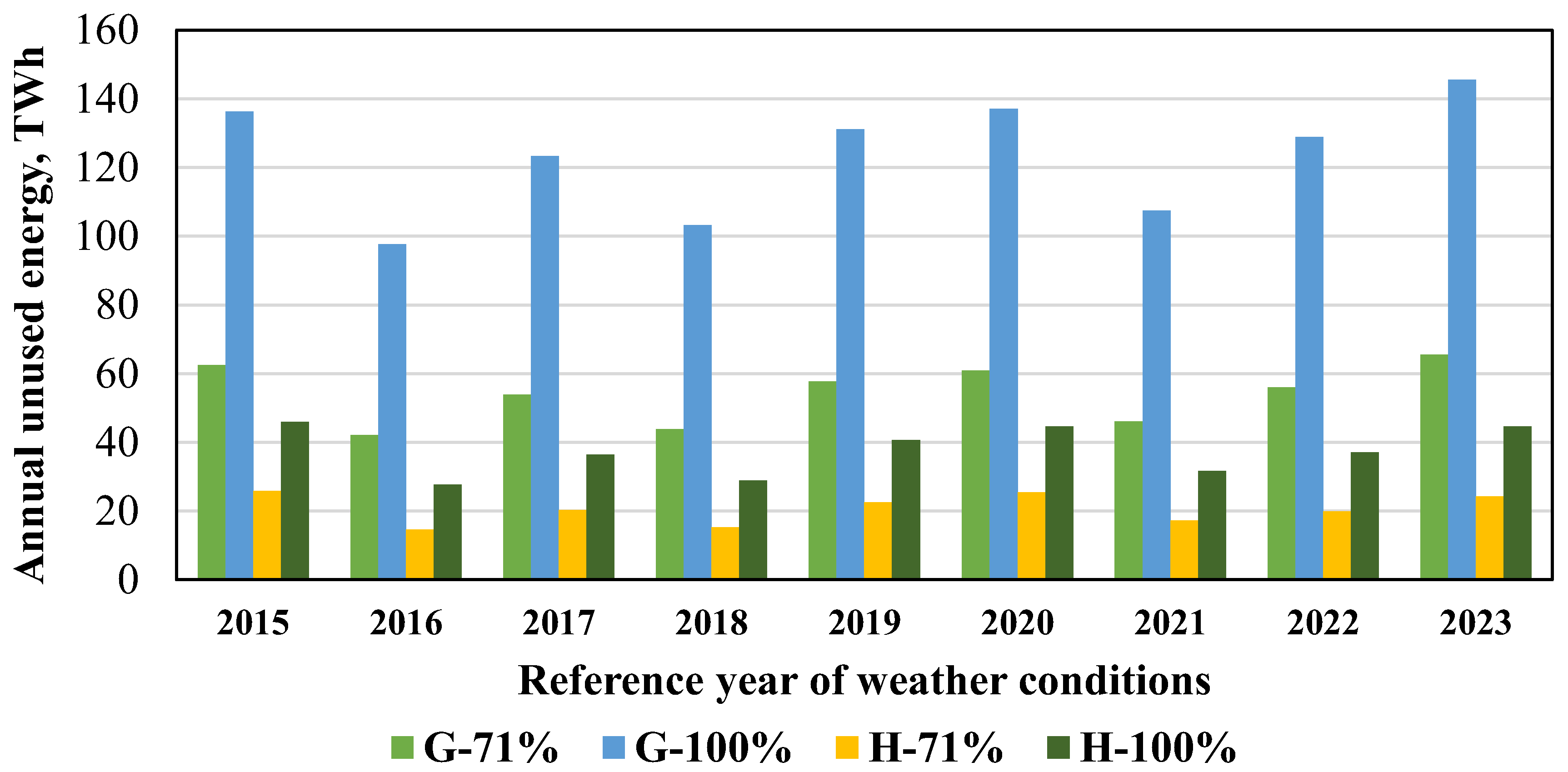
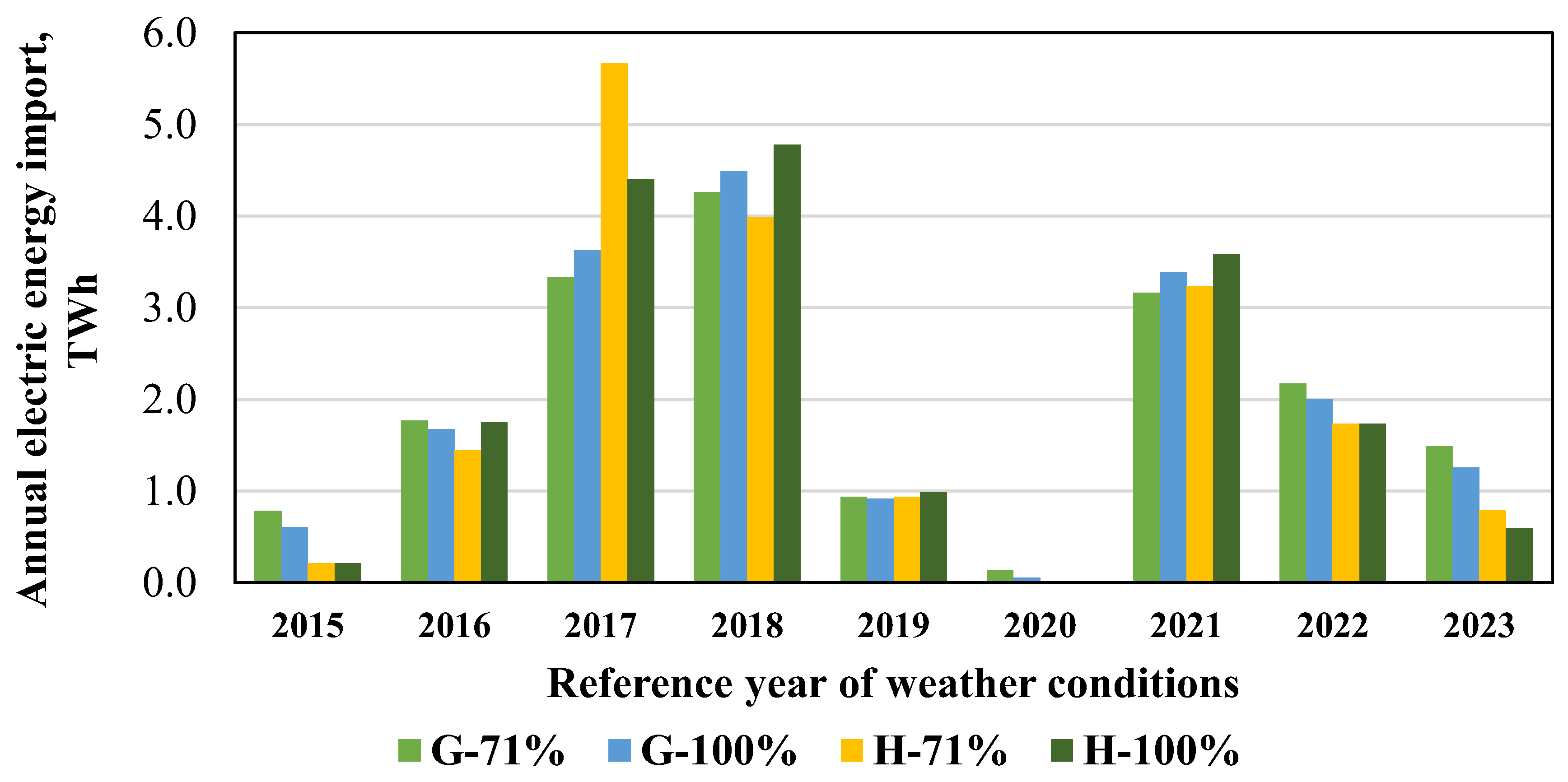
Despite the application of advanced balancing mechanisms, both models exhibit significant amounts of unused energy, amounting to 20.6 TWh in H-71% and 54.3 TWh in G-71%. On an annual basis, this volume ranges from 20.6 TWh in H-71% to 123.4 TWh in G-100%. These values remain stable across subsequent simulation years (Figure 1) suggesting that inter-annual weather variability has a limited impact on the overall structural surplus. This indicates a structural overcapacity within the system, which converges with findings from other European energy transition models [90] suggesting that intentional overcapacity is often more cost-effective than long-term storage. Such surpluses represent significant potential for further development of the hydrogen sector or energy-intensive industrial branches—particularly those that can operate flexibly in response to grid conditions. Examples include energy-intensive artificial intelligence training processes with adjustable intensity or autonomous dark factories, which do not require continuous human-staffed operation.

3.4. Electricity and Heat Storage

Electricity and thermal storage systems support the system’s energy balance. In Model H-100%, storage capacities remained at the levels established at the beginning of the analysis; however, their contribution to the overall energy balance was minimal (Table 2). Optimisation performed for Model G-100% reduced the electricity storage capacity to 47.5 GWhE, which is 352.5 GWhE less than in Model H-100%. The capacities of industrial thermal storage and residential thermal storage were also reduced by 14.8 GWhTh and 21.8 GWhTh, respectively. In Model H-71%, it was not possible to reduce the capacities of electricity and thermal storage through optimisation. Conversely, in Model G-71%, the total battery storage capacity was 47.5 GWhE, which is 243.5 GWhE less compared to Model H-71%. Additionally, residential thermal storage capacity was reduced by 9.2 GWhTh in Model G-71%.
The operation of electricity and thermal storage systems is detailed in Table 5 and Table 6, which present the nine-year cumulative performance of each storage type. It was assumed that all storage units were initially charged to 50%. Electricity and thermal storage play a crucial role in short-term system balancing; however, their effectiveness is significantly constrained by technical parameters.
According to the simulator’s logic, residential thermal storage accumulates heat from three sources: waste heat from gas turbines operating in cogeneration, heat available from heat pumps during periods of electricity surplus, and heat from electric heaters located adjacent to the storage units. Residential thermal storage, with a charging/discharging time of 50 h, achieves practical efficiencies of 66.3% in Model G-71% and 35.5% in Model H-71%, despite a theoretically assumed efficiency of 98%. Limited storage capacity results in significant dissipation of surplus heat to the environment. Even a 1000-fold increase in storage capacity in Model G-71% raises efficiency only to 73%, indicating the inherent limitations of this solution.
Industrial thermal storage exhibits even lower efficiency, at 24.3% in Model G-71% and 0.8% in Model H-71%. In the simulator, industrial thermal storage is assumed to use electric heaters that activate only during temporary electricity surpluses. The charging/discharging time for this storage type was set at 50 h. Additional heat sources for industrial storage include waste heat from electrolysers and, in Model H, waste heat from fuel cells. In practice, due to limited storage capacity and long charging times, waste heat from electrolysers and RFCs is almost entirely lost.
Electricity storage systems, with a charging/discharging duration of 6 h, achieve the assumed efficiency of 85%, making them the most effective tool for short-term power balancing. It should be noted that the simulator does not differentiate between battery storage, electric vehicles acting as storage units, and pumped-storage hydropower plants.

3.5. Hydrogen and Biomethane Storage

While battery storage systems handle short-term power balancing, hydrogen and biomethane storage play a crucial role in ensuring long-term supply stability.
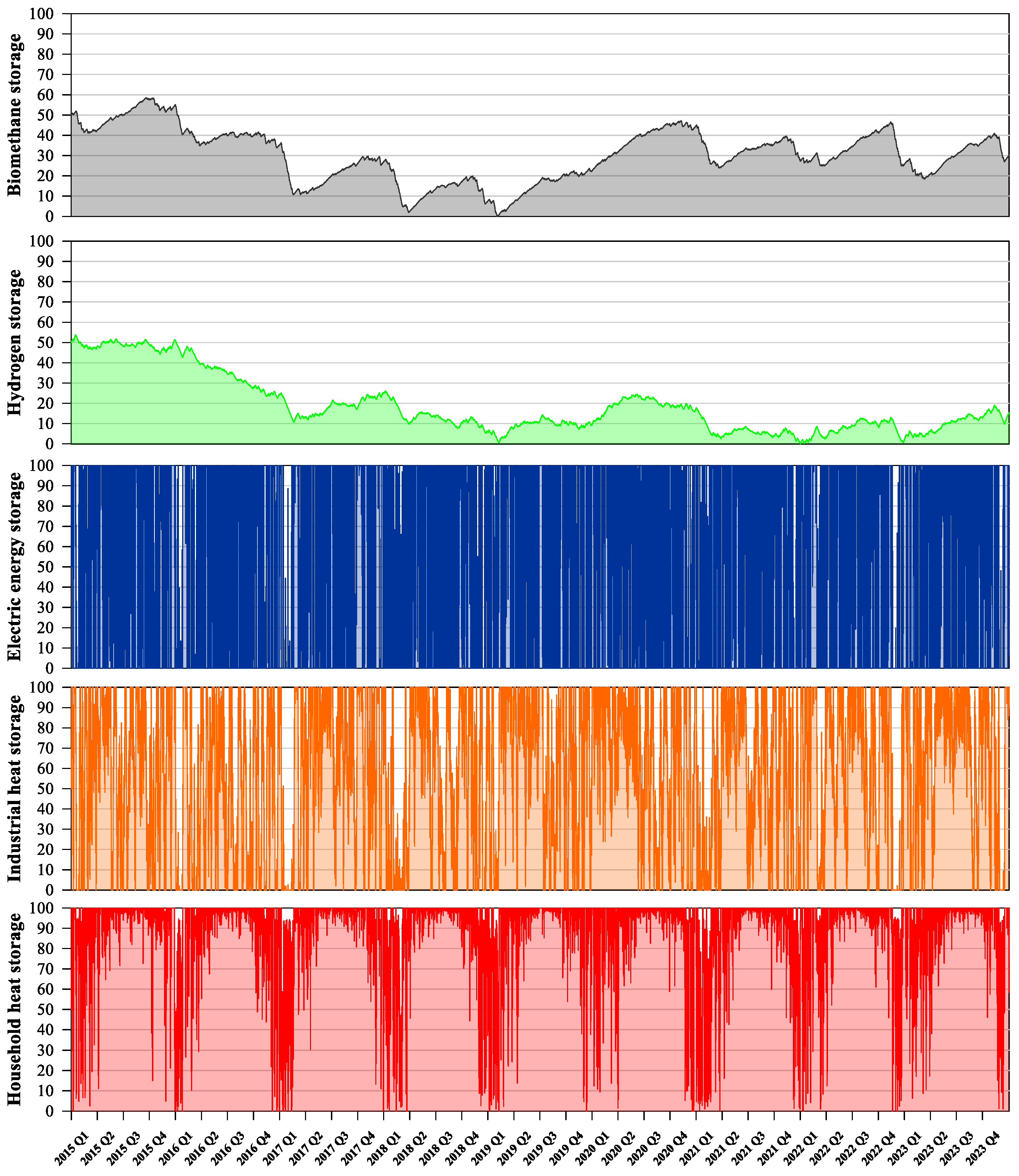
In Model G, hydrogen storage serves as a safeguard for industrial supply, and its location should prioritise proximity to major industrial hubs to optimise delivery and minimise transport losses. The minimum required hydrogen storage capacity in Model G-71% is 6.5 billion Nm3, which, assuming 50% initial filling, corresponds to a total capacity of 13.0 billion Nm3 (Table 7). As evidenced by Figure 2, this facility reaches a peak of 7.0 billion Nm3 without ever attaining full capacity. Nevertheless, this requirement represents a technological, logistical, and economic challenge, particularly since Model G allocates all available salt caverns and methane storage facilities exclusively for biomethane.
In Model H, the minimum total hydrogen storage capacity was determined to ensure a continuous supply to fuel cells and prevent storage depletion. For Model H-71%, this results in a capacity of 12.5 billion Nm3 (Table 7). This value poses a major infrastructural challenge, considering that salt cavern storage capacity is estimated at only 4.7 billion Nm3 (14.0 TWhH2) after expansion [44]. While depleted hydrocarbon reservoirs, with a potential capacity of 66.7 billion Nm3 [42], could theoretically meet this demand; however, they require a detailed geological assessment and the deployment of hydrogen conversion and off-take infrastructure. The theoretical hydrogen storage efficiency assumed in the simulation is 97%; however, due to the limited storage capacity, the actual efficiency for Model H-71% was 81%.
Biomethane demand in the analysed scenarios is less than 7.9 billion Nm3/year, remaining below Poland’s theoretical production potential—except in Model G-100% (Table 7). In the latter case, the shortfall would need to be met by importing biomethane or by increasing the capacity of other generation elements within the system. For Model G-71%, biomethane production stands at a slightly lower level of 5.8 billion Nm3, resulting in a lower required storage capacity.
For biomethane storage in Model G-71%, the initial filling level was set at 5.0 billion Nm3. Assuming 50% initial filling, the total storage capacity should be 10 billion Nm3, although this could be reduced to 5.8 billion Nm3 with a higher initial filling level (Table 7).
Model H exhibits a different characteristic, where biomethane production is closely correlated with industrial activity. It is therefore assumed that during periods of increased demand for methane or hydrogen, biomethane production is intensified. Theoretically, this approach eliminates the need for long-term biomethane storage and the use of existing methane storage facilities. Instead, this strategy shifts the requirement toward the storage of biomass feedstocks intended for biomethane production—a challenge that is less problematic than constructing gas storage infrastructure. In practice, however, ensuring the stable operation of a biomethane plant may still require a biomethane buffer to maintain a continuous supply to industry.
In both models, the combined storage capacity for biomethane and hydrogen is comparable, although Model G requires 0.3–1.3 billion Nm3 more (Table 7). However, the hydrogen balance profiles differ significantly. In Model G, hydrogen losses due to overproduction are avoided, as production is limited to quantities required for industrial decarbonisation. In contrast, Model H exhibits surplus hydrogen production, stemming from the assumption of equal capacities for electrolysers and fuel cells. If literature-based ratios for RFCs were applied (electrolyser-to-fuel cell power ratios of 2:1 to 6:1), even greater hydrogen overproduction would occur in the absence of centralised electrolyser capacity control. Thus, similar to surplus electricity, this excess hydrogen could be considered an opportunity for the development of certain industrial sectors or for widely discussed applications in transport. However, if surplus hydrogen were assumed to be lost, the round-trip efficiency (RTE) of the electricity–hydrogen–electricity cycle would decrease from the projected 61.1% to 40.1% in Model H-100% or 50.2% in Model H-71%.

3.6. State of Charge of Storage Systems

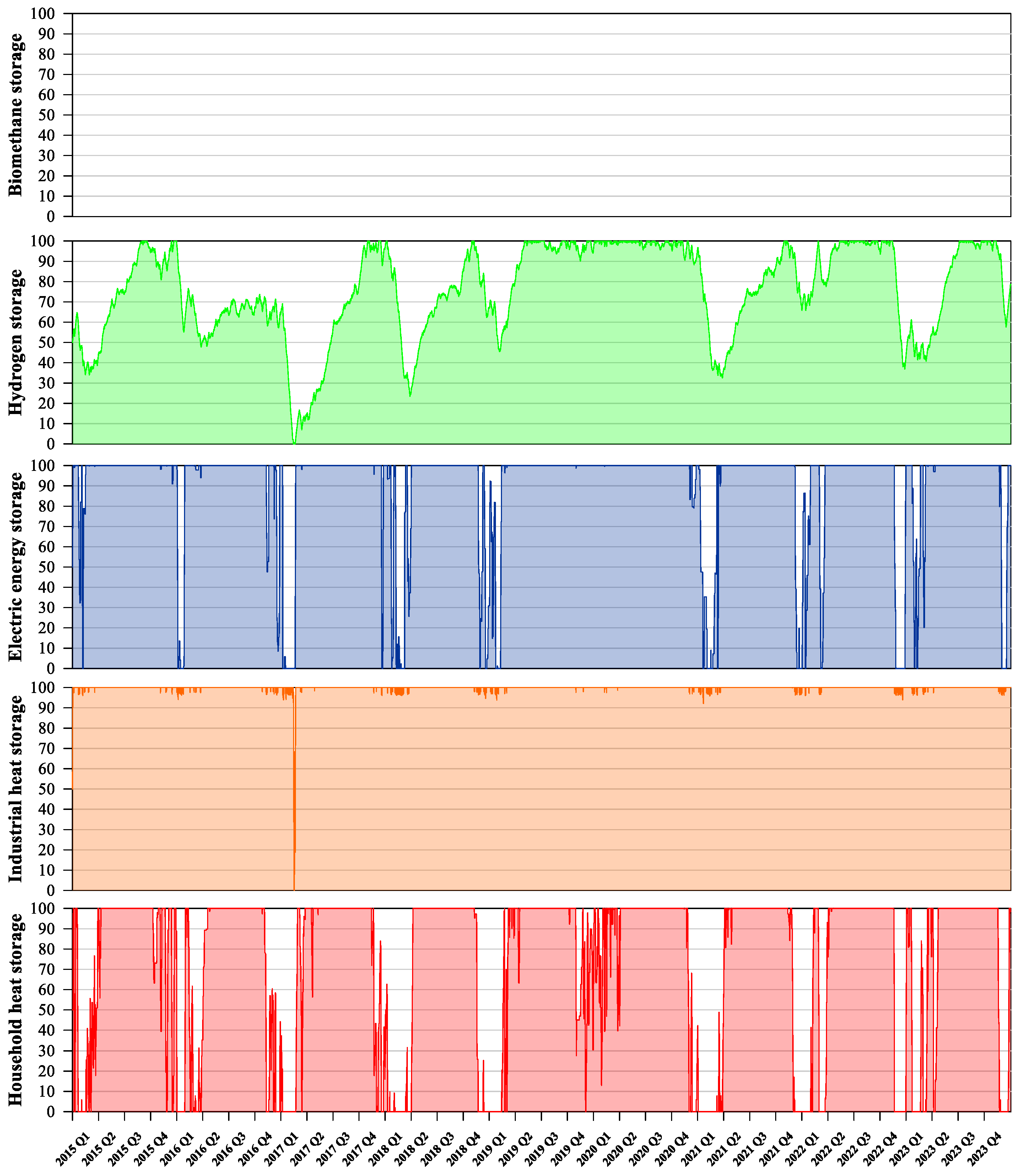
An analysis of the state of charge across different storage types reveals significant differences between Models G and H (Figure 2 and Figure 3). Regardless of storage type, both models exhibit periods of low charge levels due to adverse weather conditions and increased electricity and heat demand.
In Model G, electricity and thermal storage systems serve as the primary recipients of surplus energy, leading to intensive utilisation year-round, particularly from November to March (Figure 2). Energy flows to and from storage in Model G-71% were 7–30 times higher than in Model H-71% (Table 5 and Table 6). Such continuous operation and a high number of cycles may accelerate wear and degradation, increasing the frequency of replacements.
In Model H-71%, storage systems played a secondary role, as electrolysers absorbed the majority of the surplus RES generation. In this model, electricity and residential thermal storage remained fully charged for most of the analysed period, while also experiencing extended periods of complete discharge (Figure 3). Such extreme states can be detrimental to durability—particularly for batteries, which should not operate below a defined threshold (typically 10%). Industrial thermal storage remained nearly fully charged throughout the entire period, preventing the absorption of waste heat from RFCs and rendering its contribution to system performance negligible. Consequently, while storage systems in Model H have large nominal capacities (Table 2), their actual contribution to the energy balance is minimal. This suggests that their capacity could be significantly reduced with only a modest increase in RFCs’ capacity.
The situation differs for compressed gas storage, which is designed to avoid full depletion. In Model G-71%, the biomethane storage reached its minimum level during the period corresponding to Q1 2019 weather conditions, while hydrogen storage reached its lowest levels during Q1 2019, Q1 2022, and Q1 2023. In Model H-71%, the most critical period occurred under Q1 2017 conditions, during which the hydrogen storage was nearly exhausted.

3.7. Operating Modes of Storage Systems

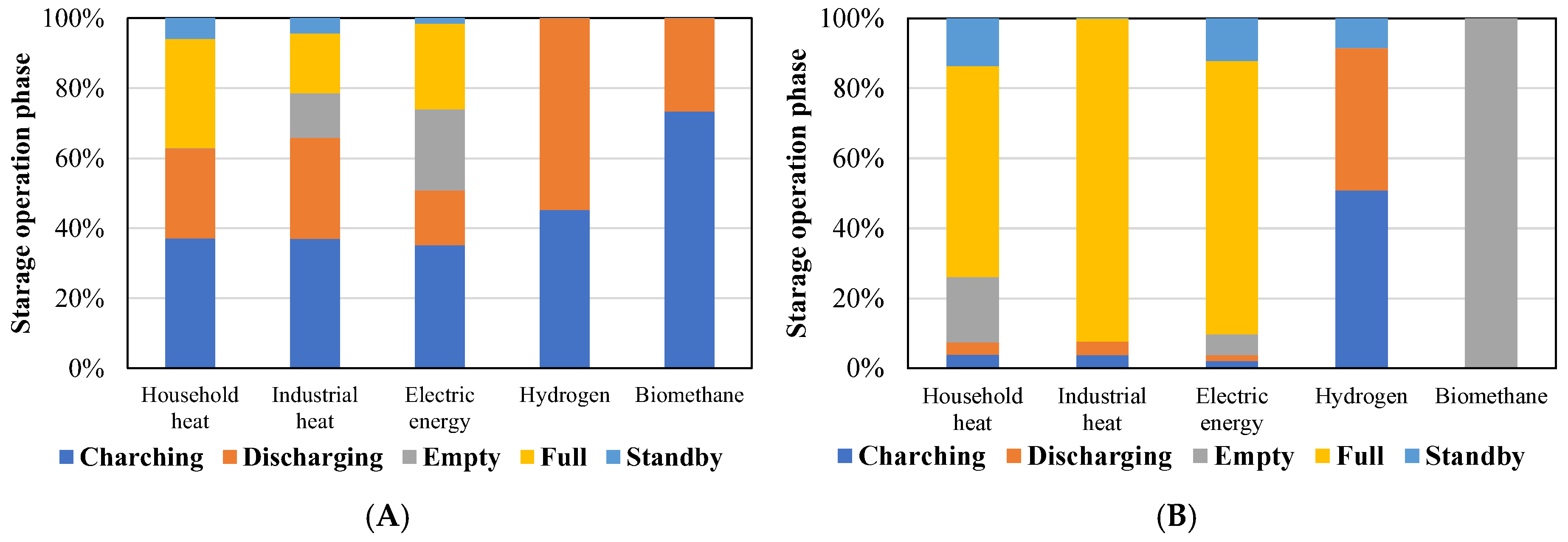
In Model G-71% (Figure 4A), storage systems remained in active operation (charging/discharging) for the majority of the period, with utilisation rates ranging 51% and 66%. Full charge durations varied significantly, from 17% for industrial thermal storage to 31% for residential thermal storage. In Model H-71% (Figure 4B), electricity and thermal storage systems operated only during short intervals (4–8%), remaining fully charged for the majority of the time (60–92%), which confirms their limited role in this scenario. The simulations did not account for self-discharge effects, which are particularly relevant for thermal storage. In practice, maintaining a full charge for such prolonged periods would lead to substantial energy losses in this model.
Analysis of battery storage revealed that in Model G-71%, batteries remained fully discharged for 23% of the time, compared to only 6% in Model H-71%. This indicates that despite intensive cycling in Model G, cumulative downtime in a fully discharged state is significant, potentially constraining system flexibility during critical moments. A possible solution is to increase battery capacity to maintain a minimum state of charge, ensuring balancing capability during periods of low RES generation.
In Model G-71%, gas storage systems operated continuously throughout the analysed period. The biomethane storage remained in charging mode for 73.4% of the time, while the hydrogen storage was being charged for 45.3% of the time. In Model H-71% (Figure 4B), hydrogen storage was being charged for 50.9% of the time, but also exhibited standby states (8.4%).

3.8. Operation of Electrolysers, Gas Turbines, and RFCs

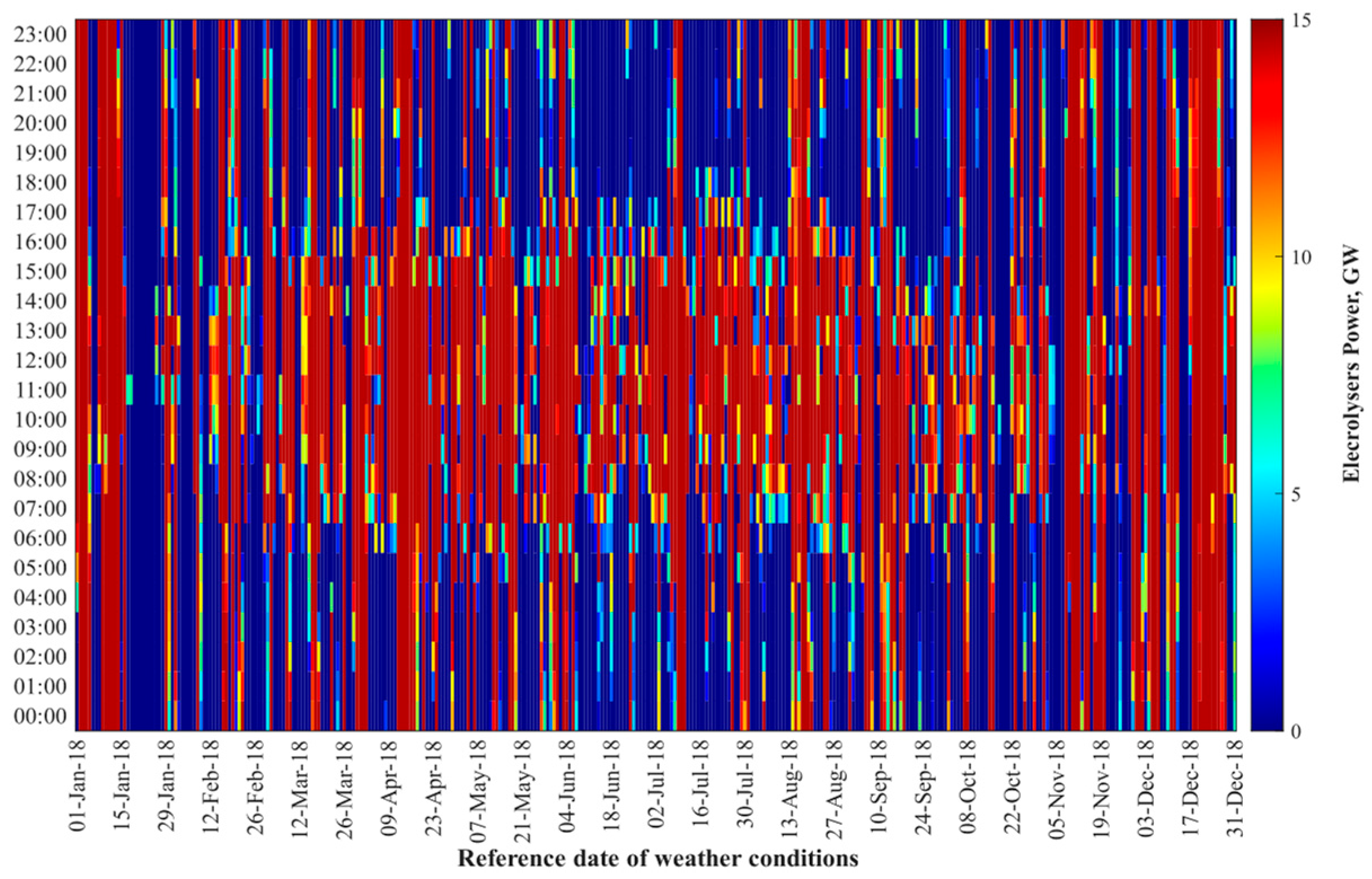
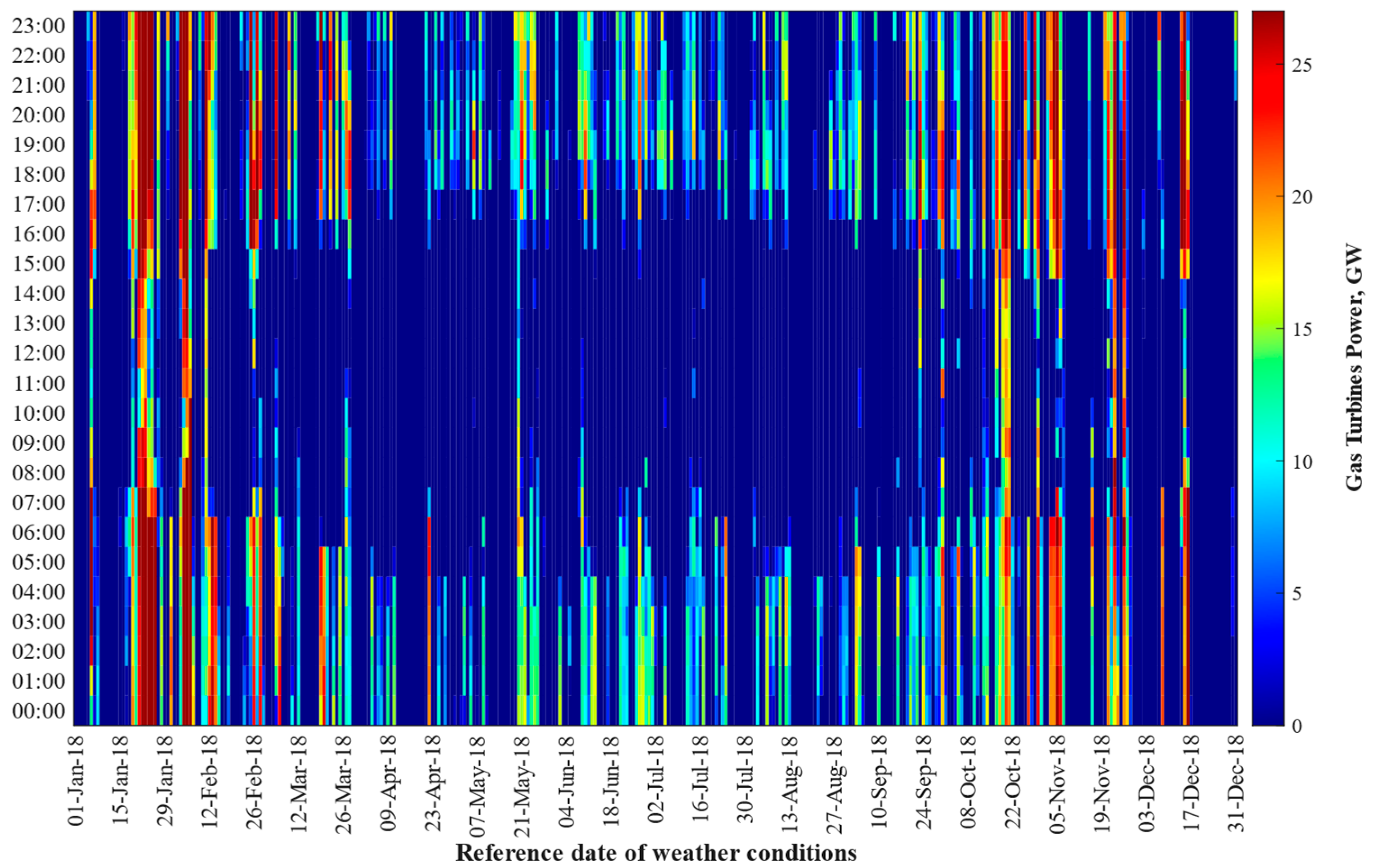
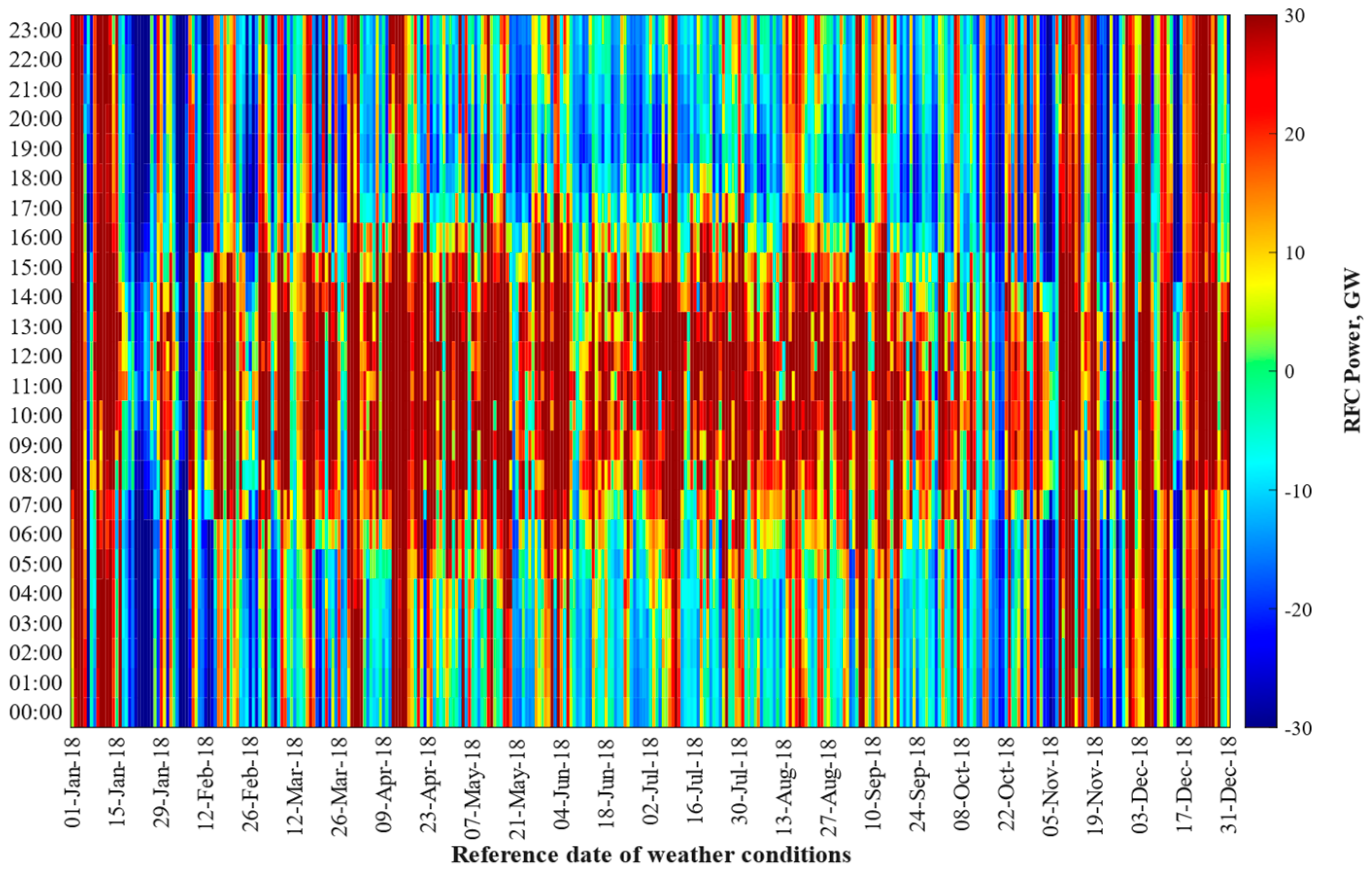
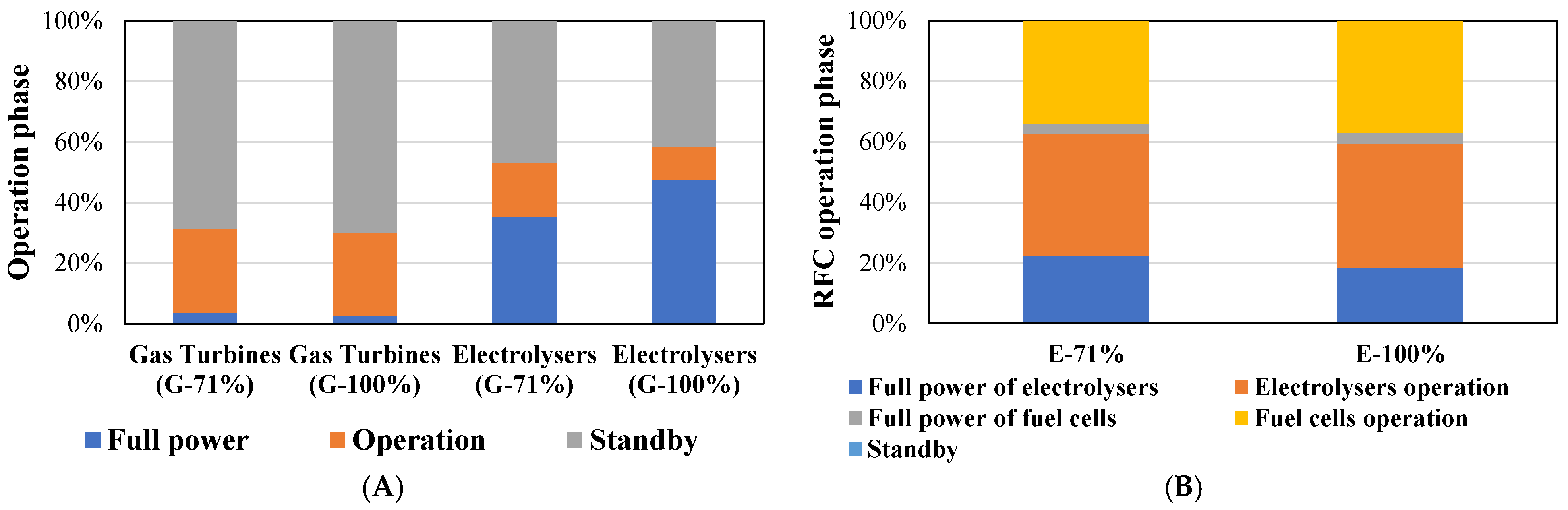
Using hourly data, Figure 5, Figure 6 and Figure 7 illustrate the operational profiles of the main centrally dispatched units in both models under 2018 weather conditions. Figure 8 provides a quantitative summary of the operating modes for these components over the entire nine-year simulation period.
In Model G-71%, the average electrolyser power reached 12.1 GW (84% of available capacity), compared to 11.0 GW (91%) in Model G-100%. Electrolysers operated at maximum power for 35–48% of the time and at partial load for 11–18% (Figure 8A). Gas turbines ran at maximum power for 3% of the time and at reduced power for 27%, with an average output of 13.3 GW (49% of available capacity) in G-71% and 17.4 GW (46%) in G-100%.
Hourly power profiles (G-71%, 2018, Figure 5) reveal a strong correlation between electrolyser activity and PV generation. Electrolysers predominantly reached maximum power between 07:00 and 15:00. Extended periods of continuous peak operation—lasting entire days or several consecutive days—occurred during wind generation surplus. Conversely, prolonged periods of inactivity were also observed. These intervals provide opportunities for necessary maintenance and servicing. However, the system must account for start-up losses and ramp-up times. Furthermore, such periods result in heat losses associated with reheating the equipment to required operating temperatures.
Gas turbines operated predominantly during morning and evening peaks throughout the year (G-71%, 2018, Figure 6), with maximum output coinciding with adverse weather conditions—typically January–March and October–December. These units serve as balancing and reserve capacity; therefore, their siting and capacity must align with demand characteristics and RES variability to ensure reliability during peak hours and unfavourable conditions.
The operational profile of RFCs in Model H differs markedly. In this scenario, RFCs predominantly functioned in electrolyser mode, operating at maximum power for 19–23% and at partial load for 40–41% (Figure 8B). The average electrolyser power reached 19.3 GW (65% of available capacity) in H-71% and 27.7 GW (67%) in H-100%. Conversely, RFCs operation in fuel cells mode accounted for 3–4% of the time at maximum power and 34–37% at partial load, with average fuel cells output at 14.1 GW (47%) in H-71% and 18.6 GW (45%) in H-100%.
A key finding is the minimal share of standby periods for RFCs, ranging from 0.12 to 0.19%. This high utilisation rate supports the validity of the proposed balancing approach in Model H. Hourly power profiles (H-71%, 2018, Figure 7) confirm near-continuous RFCs operation at loads near maximum capacity. However, such intensive operation may have significant implications for device durability and lifetime. Although the simulations did not account for maintenance downtime, all equipment requires periodic servicing in practice. Therefore, for the solution proposed in Model H to be feasible, it is necessary to provide redundant RFCs capacity to compensate for maintenance activities and other typical operational constraints.

3.9. Energy Imports and Their Role

The average annual electricity import assumed in the simulations was 2 TWh. However, import levels varied across simulation years (Figure 9). The analysis shows that electricity imports were low or zero under weather conditions similar to those in 2020, whereas the most adverse conditions for most scenarios corresponded to those observed in 2018. An exception was Model H-71%, where the maximum annual electricity import reached 5.67 TWh/year under weather conditions observed in 2017.
Using this model as an example—where substantial periodic imports were required—specific time intervals exhibiting power shortages were identified based on simulation results (Table 8). These periods coincided with months characterised by particularly unfavourable weather conditions combined with increased electricity and heat demand. Under Polish climatic conditions, these occurred primarily November–March, with January and February being the most prevalent.
Hourly analysis of Model H-71% indicates that, despite the small proportion of imports over the entire nine-year simulation period (2.1% of the time, across 152 days or 23 months), imports played a critical balancing role during short, high-stress intervals. Maximum hourly import values—34 GWh in Model G-71% and 57 GWh in Model H-71%—highlight the need to ensure adequate transmission capacity and access to external sources during periods of peak energy deficit.
These findings suggest that the complete elimination of imports could lead to excessive installed capacity oversizing. Considering current cross-border flow levels (<2 GW [91]), the import volumes determined in the simulations represent an additional challenge for both models.
From a technical perspective, the two system variants represent fundamentally different approaches to energy balancing and RES integration (Table 9), as reflected in the differences in generation, storage, and conversion technologies. In Model G, the role of the central balancing unit is performed by biomethane-fired gas turbines, whereas in Model H, this function is assumed by reversible fuel cells. This distinction translates into markedly different scales of electrolyser capacity requirements: approximately 12–15 GW in Model G, compared to 30–41 GW in Model H, where RFCs also serve as balancing units.
Distinct differences are also evident in storage infrastructure. In Model G, battery storage capacity is relatively low, remaining at around 20 GWh, whereas Model H requires significantly larger short-term storage capacities, reaching 260–370 GWh. A similar pattern applies to thermal storage: capacities in Model G are smaller than in Model H, where thermal storage is considered as an integral element for stabilising the heating system.
The most pronounced differences occur in the scale and function of hydrogen and biomethane storage. Model G necessitates the construction of large hydrogen storage facilities, which compete for available capacity and infrastructure with biomethane storage, essential for industrial decarbonisation and maintaining gaseous fuels in the system. Model H also requires substantial hydrogen storage; however, due to the different role of biomethane, there is no competition for resources. In Model H, biomethane storage is either negligible or limited to small volumes.
These differences also influence the pathways for industrial decarbonisation. In Model G, the transition relies primarily on hydrogen, requiring deep technological and infrastructural changes, particularly in energy-intensive sectors. In contrast, Model H enables a simpler decarbonisation pathway through the use of biomethane in existing installations or with minimal technological adjustments.
The expansion of large scale systems is subject to several practical constraints. The deployment of wind and PV infrastructure is contingent upon land availability that meets a series of technical, environmental and spatial criteria, which may significantly restrict potential development areas. Furthermore, permitting procedures often introduce significant lead times, as projects must undergo comprehensive environmental impact assessments, public consultations and multi-level administrative reviews. Grid reinforcement is equally critical to accommodate escalating energy flows, the construction of new transmission lines and substations is essential for integrating renewable sources while maintaining system stability. Additionally cross border transfer limits may constrain the effectiveness of imports, as interconnector capacity might be insufficient to support system balancing during periods of peak stress. Seasonal variability exacerbates these bottlenecks, particularly when interconnectors reach congestion limits. Collectively, these factors may impede the projected build out and increase the total cost of the energy transition. Consequently, the establishment of a robust policy framework and the integration of planning processes are imperative to facilitate this transformation.

4. Conclusions

This study evaluated four variants of a national power system for a net-zero Poland, comparing Model G (biomethane-fired gas turbines) with Model H (reversible fuel cells, RFCs). A comparative assessment reveals a fundamental trade-off between technological complexity and resource dependency. Model G offers a lower technical threshold, requiring 12.1–14.5 GW of electrolyser capacity. However, it remains critically dependent on large-scale biomethane production and constant biomass availability, which pose logistical challenges and introduce risks to the long-term stability of biomass supply chains. In contrast, Model H represents a more technologically advanced paradigm; by employing 29.7–41.1 GW of RFCs, it obviates the need for gas turbines and streamlines industrial decarbonisation. It must be noted, however, that RFCs are currently at an early stage of development and are not yet available at the required technical scale, making their implementation dependent on rapid technological breakthroughs and high capital investment.
The analysis indicates that while Model H relies on an average annual electricity import of 2 TWh, this dependency is a strategic choice to enhance economic efficiency. By leveraging cross-border exchange, the system avoids the excessive over-dimensioning of domestic generation and storage infrastructure that would otherwise be required during rare periods of low RES availability. Regardless of the chosen model, the transition requires an extensive investment programme, as the combined storage demand for hydrogen and biomethane could reach 13.7 billion Nm3 (approx. 41 TWhH2). The current Polish infrastructure is insufficient to meet these requirements, necessitating the urgent development of salt caverns and the modernisation of existing gas storage facilities.
From a policy perspective, the findings highlight the need for a synchronised approach that integrates RES growth with the expansion of regional grid interconnectors and the R&D-driven deployment of emerging technologies such as RFCs. Furthermore, certain limitations regarding the fluctuating capital costs and the efficiency of long-term geological storage remain. Future research should therefore focus on scaling up of reversible fuel cells from pilot projects to industrial-scale applications, their operational stability under dynamic weather conditions, and the optimisation of surplus energy use across varying demographic scenarios, where required RES capacities may range from 164.5 GW to 233 GW. The presented calculations provide an essential framework for methodologies shaping long-term national investment policies aimed at eliminating anthropogenic environmental impacts associated with GHG emissions.

Author Contributions

Conceptualisation, W.Ż., G.B.-P. and J.P.; methodology, software, and validation, D.B., M.O. and G.B.-P.; formal analysis, investigation, and data curation, W.Ż., D.B. and M.O.; writing—original draft preparation, D.B., M.O., J.P. and G.B.-P.; writing—review and editing, D.B., W.Ż. and M.O. All authors have read and agreed to the published version of the manuscript.

Funding

This research received no external funding.

Data Availability Statement

The raw data supporting the conclusions of this article will be made available by the authors on request.

Conflicts of Interest

The authors declare no conflicts of interest.

References

  1. The Climate Action Tracker (CAT). CAT Net Zero Target Evaluations. Available online: https://climateactiontracker.org/global/cat-net-zero-target-evaluations/ (accessed on 20 December 2025).
  2. International Energy Agency (IEA). CO2 Emissions. Available online: https://www.iea.org/reports/global-energy-review-2025/co2-emissions (accessed on 20 December 2025).
  3. Chen, Z.Y.; Zhao, L.T.; Cheng, L.; Qiu, R.X. How does China respond to the Carbon Border Adjustment Mechanism? An approach of global trade analysis. Energy Policy 2025, 198, 114486. [Google Scholar] [CrossRef]
  4. Fetting, C. The European Green Deal; ESDN Report; ESDN Office: Vienna, Austria, 2020. [Google Scholar]
  5. Polish Transmission System Operator (Polskie Sieci Elektroenergetyczne S.A.). Types of Generation Sources and Definitions, How the National Power System Operates. Available online: https://www.pse.pl/jak-funkcjonuje-krajowy-system-elektroenergetyczny/rodzaje-zrodel-wytworczych-i-definicje (accessed on 20 December 2025). (In Polish)
  6. International Energy Agency (IEA). Energy System of Poland. Available online: https://www.iea.org/countries/poland (accessed on 20 December 2025).
  7. PORT PC. The Polish Heat Pump Market Is Returning to Growth. Available online: https://portpc.pl/polski-rynek-pomp-ciepla-wraca-do-wzrostow-pozytywne-sygnaly-w-i-polroczu-2025/ (accessed on 20 December 2025). (In Polish)
  8. Association of Heating Equipment Manufacturers and Importers (Stowarzyszenie Producentów i Importerów Urządzeń Grzewczych). Report on the Heating Equipment Market in Poland 2024. Available online: https://spiug.pl/app/uploads/2025/06/Raport_Rynek_urzadzen_grzewczych_w_Polsce_2024.pdf (accessed on 20 December 2025). (In Polish)
  9. Statistics Poland (Główny Urząd Statystyczny). Housing Conditions in Poland According to the Results of the National Population and Housing Census 2021. Available online: https://stat.gov.pl/download/gfx/portalinformacyjny/pl/defaultaktualnosci/6536/5/2/1/warunki_mieszkaniowe_w_polsce_w_swietle_wynikow_narodowego_spisu_powszechnego_ludnosci_i_mieszkan_2021.pdf (accessed on 20 December 2025). (In Polish)
  10. Polish Energy Storage Association (Polskie Stowarzyszenie Magazynowania Energii). The Impact of Expanding Energy Storage Infrastructure on Economic Development in Poland—Forecast Until 2040. Available online: https://psme.org.pl/wp-content/uploads/2024/03/RAPORT_PSME_AGH.pdf (accessed on 20 December 2025). (In Polish)
  11. Singh, H.; Saini, R.P.; Saini, J.S. A review on packed bed solar energy storage systems. Renew. Sustain. Energy Rev. 2010, 14, 1059–1069. [Google Scholar] [CrossRef]
  12. Nunes, V.M.B.; Lourenço, M.J.V.; Santos, F.J.V.; Nieto de Castro, C.A. Molten alkali carbonates as alternative engineering fluids for high temperature applications. Appl. Energy 2019, 242, 1626–1633. [Google Scholar] [CrossRef]
  13. Sharma, A.; Tyagi, V.V.; Chen, C.R.; Buddhi, D. Review on thermal energy storage with phase change materials and applications. Renew. Sustain. Energy Rev. 2009, 13, 318–345. [Google Scholar] [CrossRef]
  14. Lizana, J.; Chacartegui, R.; Barrios-Padura, A.; Valverde, J.M. Advances in thermal energy storage materials and their applications towards zero energy buildings: A critical review. Appl. Energy 2017, 203, 219–239. [Google Scholar] [CrossRef]
  15. Zwierzchowski, R.; Niemyjski, O.; Wołowicz, M. Energy Savings Analysis for Operation of Steam Cushion System for Sensible Thermal Energy Storages. Energies 2022, 15, 286. [Google Scholar] [CrossRef]
  16. Institute for Renewable Energy (Instytut Energetyki Odnawialnej). Roadmap for the Heat Storage Market in Poland. Available online: https://ieo.pl/dokumenty/aktualnosci/06092024/raport mapa drogowa dla rynku magazynów ciepła w polsce.pdf (accessed on 20 December 2025). (In Polish)
  17. Expert Team for the Construction of Pumped Storage Power Plants (Zespół Ekspercki do spraw Budowy Elektrowni Szczytowo-Pompowych). The Role of Pumped Storage Power Plants in the National Power System: Conditions and Directions of Development. Available online: https://www.gov.pl/attachment/5560c5ac-fdc9-46e0-bf06-eb0dabd113dd (accessed on 20 December 2025). (In Polish)
  18. Energy Regulatory Office (Urząd Regulacji Energetyki). Licence Nr MEE/3/2876/W/OŁO/2022/MWi. Available online: https://api.ure.gov.pl/api/ConcessionFuel/download/55842189-C402-402D-BC22-3257F9B6B728 (accessed on 20 December 2025).
  19. PGE Polska Grupa Energetyczna S.A. PGE Group’s 2035 Strategy. Available online: https://www.gkpge.pl/content/download/61ab3879bd5772c1ab88ace3f7b99f13/file/20250612_Strategia_PGE_2035_EN_final_share.pdf (accessed on 20 December 2025).
  20. Polish Ministry of Climate and Environment. Poland’s Largest Battery-Based Energy Storage Facility Is Developed in Żarnowiec. Available online: https://www.gov.pl/web/climate/polands-largest-battery-based-energy-storage-facility-is-developed-in-zarnowiec (accessed on 20 December 2025).
  21. Raymond, X. Poland’s PGE Launches Tender for 400 MW/800 MWh Battery Storage System. Available online: https://www.blackridgeresearch.com/news-releases/polands-pge-launches-tender-battery-storage-system (accessed on 20 December 2025).
  22. Hynfra Energy Storage Webpage. Available online: https://www.hynfraenergystorage.pl/ (accessed on 20 December 2025).
  23. OX2 Webpage. Available online: https://www.ox2.com/newsroom/press-releases-news/2024/ox2-secures-200-mw-of-battery-storage-at-government-auctions-in-poland/ (accessed on 20 December 2025).
  24. E-Magazyny Webpage. Available online: https://e-magazyny.pl/aktualnosci/rekordowe-zainteresowanie-magazynami-energii-na-najnowszej-aukcji-rynku-mocy/ (accessed on 20 December 2025). (In Polish)
  25. Markosyan, M. DTEK, Columbus Energy Plan to Add 398 MW of Energy Storage. Available online: https://renewablesnow.com/news/dtek-columbus-energy-plan-to-add-398-mw-of-energy-storage-837221/ (accessed on 20 December 2025).
  26. DRI-ENERGY Webpage. Available online: https://dri-energy.com/en/dri-acquires-112mw-battery-storage-project-poland-from-greenvolt/ (accessed on 20 December 2025).
  27. N2OFF Inc. N2OFF via Solterra Expands European Footprint with Entry into Fourth Project—A Battery Storage Venture in Poland. Available online: https://www.globenewswire.com/news-release/2025/05/09/3078159/0/en/N2OFF-via-Solterra-Expands-European-Footprint-with-Entry-into-Fourth-Project-a-Battery-Storage-Venture-in-Poland.html (accessed on 20 December 2025).
  28. Axpo Holding AG Webpage. Available online: https://www.axpo.com/group/en/news-and-stories/media-releases/2025/axpo-and-edp-sign-landmark-agreement-to-optimise-energy-storage-.html (accessed on 20 December 2025).
  29. Energy Regulatory Office (Urząd Regulacji Energetyki). Information from the Chairman of the Energy Regulatory Office No. 2/2025 of 3 January 2025 on the Announcement of the Final Results of the Main Auction for the 2029 Delivery Year. Available online: https://www.ure.gov.pl/download/9/15112/Ostateczneogloszeniewynikowaukcjiglownejna2029.pdf (accessed on 20 December 2025). (In Polish)
  30. Ministry of Climate and Environment of the Republic of Poland. Appendix 3 to aKPEiK: Forecast Assumptions and Forecasting Methodology. Available online: https://bip.mos.gov.pl/fileadmin/user_upload/bip/dostep_do_informacji/2024-10-11_Zal_3_do_proj_aKPEiK_Zalozenia_prognostyczne.pdf (accessed on 20 December 2025). (In Polish)
  31. Chatzigeorgiou, N.G.; Theocharides, S.; Makrides, G.; Georghiou, G.E. A review on battery energy storage systems: Applications, developments, and research trends of hybrid installations in the end-user sector. J. Energy Storage 2024, 86, 111192. [Google Scholar] [CrossRef]
  32. Garttan, G.; Alahakoon, S.; Emami, K.; Jayasinghe, S.G. Battery Energy Storage Systems: Energy Market Review, Challenges, and Opportunities in Frequency Control Ancillary Services. Energies 2025, 18, 4174. [Google Scholar] [CrossRef]
  33. Holze, R. Self-discharge of Batteries: Causes, Mechanisms and Remedies. Adv. Mater. Sci. Technol. 2022, 4, 32–47. [Google Scholar] [CrossRef]
  34. Ngoy, K.R.; Lukong, V.T.; Yoro, K.O.; Makambo, J.B.; Chukwuati, N.C.; Ibegbulam, C.; Eterigho-Ikelegbe, O.; Ukoba, K.; Jen, T.C. Lithium-ion batteries and the future of sustainable energy: A comprehensive review. Renew. Sustain. Energy Rev. 2025, 223, 115971. [Google Scholar] [CrossRef]
  35. Al Kareem, S.S.A.; Hassan, Q.; Fakhruldeen, H.F.; Hanoon, T.M.; Jabbar, F.I.; Algburi, S.; Khalaf, D.H. A review on physical and chemical hydrogen storage methods for sustainable energy applications. Unconv. Resour. 2025, 8, 235. [Google Scholar] [CrossRef]
  36. Ligęza, K.; Narloch, P. Prospects for storing hydrogen from renewable energy sources in Poland, part 1. Nowa Energ. 2023, 1, 39–45. (In Polish) [Google Scholar]
  37. Maniglio, M.; Rivolta, G.; Elgendy, A.; Panfili, P.; Cominelli, A. Evaluating the Impact of Biochemical Reactions on H2 Storage in Depleted Gas Fields. In Proceedings of the SPE Annual Technical Conference and Exhibition, San Antonio, TX, USA, 16–18 October 2023. [Google Scholar] [CrossRef]
  38. Delshad, M.; Umurzakov, Y.; Sepehrnoori, K.; Eichhubl, P.; Batista Fernandes, B.R. Hydrogen Storage Assessment in Depleted Oil Reservoir and Saline Aquifer. Energies 2022, 15, 8132. [Google Scholar] [CrossRef]
  39. Filar, B.; Miziołek, M.; Cicha-Szot, R.; Moska, A.; Kwilosz, T.; Szpunar, T. Analysis of the possibility of increasing the working capacity of underground gas storage facilities in Poland. Naft. Gaz 2024, 80, 571–580. (In Polish) [Google Scholar] [CrossRef]
  40. State Geological Service (Państwowa Służba Geologiczna). Balance Sheet of Mineral Resources In Poland as at 31 December 2024. Available online: https://www.pgi.gov.pl/images/surowce/2024/bilans_2024.pdf (accessed on 20 December 2025). (In Polish)
  41. Uliasz-Misiak, B.; Lewandowska-Śmierzchalska, J.; Matuła, R. Hydrogen Storage Potential in Natural Gas Deposits in the Polish Lowlands. Energies 2024, 17, 374. [Google Scholar] [CrossRef]
  42. Tarkowski, R. Perspectives of using the geological subsurface for hydrogen storage in Poland. Int. J. Hydrogen Energy 2017, 42, 347–355. [Google Scholar] [CrossRef]
  43. Tarkowski, R.; Lankof, L.; Luboń, K.; Michalski, J. Hydrogen storage capacity of salt caverns and deep aquifers versus demand for hydrogen storage: A case study of Poland. Appl. Energy 2024, 355, 122268. [Google Scholar] [CrossRef]
  44. Bonnet-Cantalloube, B.; Espitalier-Noël, M.; Ferrari De Carvalho, P.; Fonseca, J.; Pawelec, G. Clean Ammonia in the Future Energy Systems. Available online: https://hydrogeneurope.eu/wp-content/uploads/2023/03/2023.03_H2Europe_Clean_Ammonia_Report_DIGITAL_FINAL.pdf (accessed on 20 December 2025).
  45. Agyekum, E.B.; Tarawneh, B.; Rashid, F.L. State-of-the-Art review of liquid organic hydrogen carriers for hydrogen storage and transport: Challenges and perspectives. Appl. Energy 2025, 400, 126555. [Google Scholar] [CrossRef]
  46. Li, H.; Zhang, X.; Zhang, C.; Ding, Z.; Jin, X. Application and Analysis of Liquid Organic Hydrogen Carrier (LOHC) Technology in Practical Projects. Energies 2024, 17, 1940. [Google Scholar] [CrossRef]
  47. Żukowski, W.; Berkowicz-Płatek, G.; Wencel, K.; Migas, P.; Wrona, J.; Reyna-Bowen, L. Hydrogen production from liquid organic hydrogen carriers in a fluidized-bed made out of Co3O4-cenosphere catalyst. Int. J. Hydrogen Energy 2025, 136, 358–370. [Google Scholar] [CrossRef]
  48. Berkowicz-Płatek, G.; Żukowski, W.; Leski, K. Production of hydrogen from polyoxymethylene in a binary fluidized bed. Appl. Energy 2024, 360, 122833. [Google Scholar] [CrossRef]
  49. Escamilla, A.; Sánchez, D.; García-Rodríguez, L. Assessment of power-to-power renewable energy storage based on the smart integration of hydrogen and micro gas turbine technologies. Int. J. Hydrogen Energy 2022, 47, 17505–17525. [Google Scholar] [CrossRef]
  50. Nguyen, V.N.; Blum, L. Reversible fuel cells. Compend. Hydrog. Energy Hydrog. Energy Convers. 2016, 3, 115–145. [Google Scholar] [CrossRef]
  51. Lamagna, M.; Ferrario, A.M.; Astiaso Garcia, D.; Mcphail, S.; Comodi, G. Reversible solid oxide cell coupled to an offshore wind turbine as a poly-generation energy system for auxiliary backup generation and hydrogen production. Energy Rep. 2022, 8, 14259–14273. [Google Scholar] [CrossRef]
  52. Yang, Y.; Lei, J.; Huang, X.; Liao, Z.; Liu, Y.; Tu, Z. Recent Development in Reversible Solid Oxide Fuel Cells: Theory, Integration and Prospective. ChemElectroChem 2024, 11, e202300593. [Google Scholar] [CrossRef]
  53. Santhanam, S.; Heddrich, M.P.; Riedel, M.; Friedrich, K.A. Theoretical and experimental study of Reversible Solid Oxide Cell (r-SOC) systems for energy storage. Energy 2017, 141, 202–214. [Google Scholar] [CrossRef]
  54. Wei, M.; Levis, G.; Mayyas, A. Reversible Fuel Cell Cost Analysis. Available online: https://www.hydrogen.energy.gov/docs/hydrogenprogramlibraries/pdfs/review20/fc332_wei_2020_o.pdf (accessed on 20 December 2025).
  55. The European Parliament and the Council of the European Union. Regulation (EU) 2019/943 of the European Parliament and of the Council of 5 June 2019 on the Internal Market for Electricity. Available online: https://eur-lex.europa.eu/legal-content/EN/TXT/PDF/?uri=CELEX:32019R0943 (accessed on 20 December 2025).
  56. Daniel, K.; Kütt, L.; Naveed Iqbal, M.; Shabbir, N.; Ashraf Raja, H.; Sardar, M.U. A Review of Harmonic Detection, Suppression, Aggregation, and Estimation Techniques. Appl. Sci. 2024, 14, 966. [Google Scholar] [CrossRef]
  57. ICS Investigation Expert Panel Grid Incident in South-East Europe on 21 June 2024. Available online: https://eepublicdownloads.blob.core.windows.net/public-cdn-container/clean-documents/Publications/2024/entso-e_incident_report_240621_250225_02.pdf (accessed on 20 December 2025).
  58. ICS Investigation Expert Panel Grid Incident in North Macedonia on 18 May 2025. Available online: https://eepublicdownloads.blob.core.windows.net/public-cdn-container/clean-documents/Publications/2025/251106_factual_report_on_MEPSO_incident_18_May_2025.pdf (accessed on 20 December 2025).
  59. ICS Investigation Expert Panel Grid Incident in Spain and Portugal on 28 April 2025. Available online: https://eepublicdownloads.blob.core.windows.net/public-cdn-container/clean-documents/Publications/2025/entso-e_incident_report_ES-PT_April_2025_06.pdf (accessed on 20 December 2025).
  60. ENTSO-E Incident Classification Scale Methodology. Available online: https://eepublicdownloads.entsoe.eu/clean-documents/SOC documents/Incident_Classification_Scale/200629_Incident_Classification_Scale_Methodology_revised_and_in_use_as_of_2020.pdf (accessed on 20 December 2025).
  61. Rashid, S.M. Employing advanced control, energy storage, and renewable technologies to enhance power system stability. Energy Rep. 2024, 11, 3202–3223. [Google Scholar] [CrossRef]
  62. Ugwuagbo, E.; Ray, B.; Sul, J.; Nabi, N.; Datta, U.; Emami, K. Optimal allocation of grid-connected converter-based energy resources for securing power system stability: A comprehensive review. Electr. Power Syst. Res. 2025, 248, 111978. [Google Scholar] [CrossRef]
  63. Jeyaraj, T.; Ponnusamy, A.; Selvaraj, D. Hybrid renewable energy systems stability analysis through future advancement technique: A review. Appl. Energy 2025, 383, 125355. [Google Scholar] [CrossRef]
  64. Valikhany, M.; Astero, P.; Lehtonen, M.; Peltoniemi, P. A review on the suitability of virtual inertia strategies for the next generation of low-inertia power systems. e-Prime Adv. Electr. Eng. Electron. Energy 2025, 14, 101131. [Google Scholar] [CrossRef]
  65. Bahrani, B.; Ravanji, M.H.; Kroposki, B.; Ramasubramanian, D.; Guillaud, X.; Prevost, T.; Cutululis, N.A. Grid-Forming Inverter-Based Resource Research Landscape: Understanding the Key Assets for Renewable-Rich Power Systems. IEEE Power Energy Mag. 2024, 22, 18–29. [Google Scholar] [CrossRef]
  66. Moore, P.; Alimi, O.A.; Abu-Siada, A. A Review of System Strength and Inertia in Renewable-Energy-Dominated Grids: Challenges, Sustainability, and Solutions. Challenges 2025, 16, 12. [Google Scholar]
  67. Alajrash, B.H.; Salem, M.; Swadi, M.; Senjyu, T.; Kamarol, M.; Motahhir, S. A comprehensive review of FACTS devices in modern power systems: Addressing power quality, optimal placement, and stability with renewable energy penetration. Energy Rep. 2024, 11, 5350–5371. [Google Scholar] [CrossRef]
  68. Flamm, B.; Peter, C.; Büchi, F.N.; Lygeros, J. Electrolyzer modeling and real-time control for optimized production of hydrogen gas. Appl. Energy 2021, 281, 116031. [Google Scholar] [CrossRef]
  69. Fernández, R.D.; Martínez, L.A.; Peña, R.R.; Mantz, R.J. Electrolyzers as smart loads, preserving the lifetime. Int. J. Hydrogen Energy 2024, 52, 72–79. [Google Scholar] [CrossRef]
  70. Sanchez-Ruiz, A.; de Groot, M.T. High-power electrolyzer characterization via smart power converters. Int. J. Hydrogen Energy 2024, 96, 1243–1250. [Google Scholar] [CrossRef]
  71. Statistics Poland (Główny Urząd Statystyczny). Demographic Yearbook of Poland. Available online: https://stat.gov.pl/download/gfx/portalinformacyjny/pl/defaultaktualnosci/5515/3/19/1/rocznik_demograficzny_2025_pl.pdf (accessed on 20 December 2025). (In Polish)
  72. Statistics Poland (Główny Urząd Statystyczny). Population Projection 2023–2060. Available online: https://stat.gov.pl/download/gfx/portalinformacyjny/pl/defaultaktualnosci/5469/11/1/1/1-prognoza_ludnosci_na_lata_2023-2060_.pdf (accessed on 20 December 2025). (In Polish)
  73. Bradło, D.; Żukowski, W.; Porzuczek, J.; Olek, M.; Berkowicz-Płatek, G. Towards Net Zero in Poland: A Novel Approach to Power Grid Balance with Centralized Hydrogen Production Units. Energies 2025, 18, 1576. [Google Scholar] [CrossRef]
  74. National Center of Research and Development Polish Power System Simulator. Available online: https://symulatorsystemuenergetycznego.ncbr.gov.pl/en/ (accessed on 20 December 2025).
  75. Popkiewicz, M. NCBR’s Zero-emission Energy System Symulator. Energetyka 2024, 5, 181–198. (In Polish) [Google Scholar]
  76. Photovoltaic Geographical Information System (PVGIS) Webpage. Available online: https://re.jrc.ec.europa.eu/pvg_tools/en/ (accessed on 20 December 2025).
  77. ENTSO-E Transparency Platform. Available online: https://transparency.entsoe.eu/ (accessed on 20 December 2025).
  78. Open-Meteo Webpage. Available online: https://open-meteo.com/ (accessed on 20 December 2025).
  79. Instrat Foundation Webpage. Available online: https://energy.instrat.pl/en/electrical-system/generation-capacity-are/ (accessed on 20 December 2025).
  80. Polish Wind Energy Association (Polskie Stowarzyszenie Energetyki Wiatrowej). Rethinking Wind Energy: Necessary Legislative Changes and Onshore Potential Analysis. Available online: https://www.psew.pl/wp-content/uploads/2024/09/Psew_2024_Energia_na_nowo_poprawione.pdf (accessed on 20 December 2025). (In Polish)
  81. Czyżak, P.; Mindeková, T. Empowering Farmers in Central Europe: The Case for agri-PV. Available online: https://ember-energy.org/app/uploads/2024/09/Empowering-farmers-in-Central-Europe-1.pdf (accessed on 20 December 2025).
  82. Ministry of the Climate of the Republic of Poland. The Polish Nuclear Power Programme; Annex to Resolution No. 141 of the Cabinet of Ministers of 2 October 2020; Ministry of the Climate of the Republic of Poland: Warsaw, Poland, 2020; p. 946. (In Polish)
  83. Statistics Poland (Główny Urząd Statystyczny). Energy. 2024. Available online: https://stat.gov.pl/download/gfx/portalinformacyjny/pl/defaultaktualnosci/5485/1/12/1/energia_2024.pdf (accessed on 20 December 2025).
  84. Polish Biomethane Association Biogas and Biomethane in Poland Report. Available online: https://magazynbiomasa.pl/biogas-and-biomethane-in-poland-report-pobierz-za-darmo/ (accessed on 20 December 2025).
  85. Krasuska, E.; Waliszewska, H.; Krzymiński, M.; Lenart, K.; Popkiewicz, M.; Racięcki, W. The Real Potential for Biomethane Production in Poland. Available online: https://www.gov.pl/attachment/1d27ccd0-14be-46ee-9535-68cef31dd0b0 (accessed on 20 December 2025). (In Polish)
  86. Clean Air Task Force Hydrogen Production Calculator. Available online: https://www.catf.us/hydrogen-converter/#smr (accessed on 20 December 2025).
  87. Liponi, A.; Pasini, G.; Baccioli, A.; Ferrari, L. Evaluating the Potential and Limits of Green Electrolysis in Future Energy Scenarios with High Renewable Share. Energies 2025, 18, 1654. [Google Scholar] [CrossRef]
  88. Sepulveda, N.A.; Jenkins, J.D.; de Sisternes, F.J.; Lester, R.K. The Role of Firm Low-Carbon Electricity Resources in Deep Decarbonization of Power Generation. Joule 2018, 2, 2403–2420. [Google Scholar] [CrossRef]
  89. Brown, T.; Schlachtberger, D.; Kies, A.; Schramm, S.; Greiner, M. Synergies of sector coupling and transmission reinforcement in a cost-optimised, highly renewable European energy system. Energy 2018, 160, 720–739. [Google Scholar] [CrossRef]
  90. Hasan, M.H.; Keiner, D.; Breyer, C. Techno-economic analysis of inter-annual energy storage and overcapacity in 100% renewable energy systems for 145 regions globally. Appl. Energy 2025, 401, 126736. [Google Scholar] [CrossRef]
  91. Forum Energii Energy Transition in Poland. 2024 Edition. Available online: www.forum-energii.eu/en/download/download/transformacja-edycja-2024 (accessed on 20 December 2025).
Figure 1. The comparison of the annual unused energy in individual years of the long-term simulation.
Energies 19 00969 g001
Figure 2. The state of charge of the storage systems over a nine-year simulation period for the Model G-71%.
Energies 19 00969 g002
Figure 3. The state of charge of the storage systems over a nine-year simulation period for the Model H-71%.
Energies 19 00969 g003
Figure 4. The operation profiles of storage systems over a nine-year simulation period: (A) Model G-71%; (B) Model H-71%.
Energies 19 00969 g004
Figure 5. The operation of electrolysers in the model G-71% under 2018 weather conditions.
Energies 19 00969 g005
Figure 6. The operation of gas turbines in the model G-71% under 2018 weather conditions.
Energies 19 00969 g006
Figure 7. The operation of RFCs in the model H-71% under 2018 weather conditions (Electrolysers—positive values, Fuel cells—negative values).
Energies 19 00969 g007
Figure 8. The operation profiles of the major energy consumers and producers over a nine-year simulation period: (A) Model G-71%; (B) Model H-71%.
Energies 19 00969 g008
Figure 9. The comparison of annual electricity imports in a long-term simulation.
Energies 19 00969 g009
Table 1. The comparison of approaches to the functioning of a net-zero energy system in Poland.
Model GModel H
System balancingbiomethane-fired gas turbinesreversible fuel cells
Industry decarbonizationhydrogen from electrolysisbiomethane
Priority of electrolysersthe final recipient
of excess energy
the first recipient
of excess energy
Electrolyser capacityoptimised to meet industrial hydrogen production needsoptimised to balance
the system
Biomethane production and storageconnected to gas turbinesconnected to industrial
facilities
Hydrogen production and storageconnected to industrial
facilities
connected to renewable
energy sources
Centrally dispatched
generation units
biomethane-fired gas turbinesreversible fuel cells
Centrally dispatched
consumption units
electrolysersreversible fuel cells
Table 3. The average annual balance of the electric energy system in the model G-71%.
SupplyTWhDemandTWh
Wind onshore129.2Electricity103.6
Wind offshore95.3Industry heat70.8
PV89.5Household heat47.6
Nuclear49.9Transportation73.8
Gas36.4Electrolysers (Hydrogen)56.4
Cogeneration7.2Unused54.3
Batteries7.7Batteries—charging9.0
Heat storage (industry)1.2Heat storage (industry)—charging1.3
Heat storage (household)8.0Heat storage (household)—charging7.8
Import2.0Transmission losses of gas1.9
SUM426.5SUM426.5
Table 4. The average annual balance of the electric energy system in the model H-71%.
SupplyTWhDemandTWh
Wind onshore129.2Electricity103.6
Wind offshore95.3Industry heat70.8
PV89.5Household heat47.6
Nuclear49.9Transportation73.8
Reversible Fuel Cells (Fuel Cells)50.1Reversible Fuel Cells (Electrolysers)99.9
Heat from RFCs0.2Unused20.6
Batteries0.8Batteries—charging1.0
Heat storage (industry)0.2Heat storage (industry)—charging0.2
Heat storage (household)0.3Heat storage (household)—charging0.1
Import2.0
SUM417.6SUM417.6
Table 5. The long-term balance of the storage systems in the model G-71%.
Type of StorageHeat
Household
HeatElectricHydrogenBiomethane
IndustryEnergy
UnitGWhThGWhEMillion Nm3
Storage capacity40.224.747.513,0149974
Capacity at the start20.112.323.865074987
To storage (available)108,83545,653
- heat from electrolysers45,653
- heat from heat pumps5101
- heat from electric heaters4954
- heat from cogeneration98,780
To storage (effective)73,66211,67381,359152,87165,964
67.7%0.0%
From storage72,17211,07769,132152,81265,964
Capacity at the end35.524.747.519803008
Efficiency (effective)98.0%95.0%85.0%97.0%97.0%
Efficiency66.3%24.3%85.0%97.0%97.0%
Table 6. The long-term balance of the storage systems in the model H-71%.
Type of StorageHeat
Household
HeatElectricHydrogen
IndustryEnergy
UnitGWhThGWhEMillion Nm3
Storage capacity49.424.7291.112,513
Capacity at the start24.712.3145.56256
To storage (available)6711202,733 270,911
- heat from electrolysers80,904
- heat from fuel cells121,829
- heat from heat pumps4374
- heat from electric heaters2336
- hydrogen production 270,911
To storage (effective)243116288684226,216
36.2%0.8% 83.5%
From storage235915347236215,846
Capacity at the end48.724.7291.19841.0
Efficiency (effective)98.0%95.0%85.0%97.0%
Efficiency35.5%0.8%85.0%81.0%
Table 7. The comparison of the models’ performance.
ModelG
100%
G
71%
H
100%
H
71%
Gas turbines, GW37.926.90.00.0
Electrolysers/Fuel cells, GW12.114.541.129.7
Unused energy, TWh/year123.454.337.520.6
Biomethane demand, billion m3/year9.27.37.97.9
Biomethane storage capacity, billion m312.8 (7.5) *10.0 (5.8) *--
Hydrogen demand in industry, billion m3/year17.017.00.00.0
Hydrogen storage capacity, billion m311.7 (6.2) *13.0 (7.0) *12.412.5
Hydrogen production, billion m3/year17.017.045.730.1
Unused hydrogen, billion m3/year0.00.015.35.0
Import, TWh/year2.02.02.02.0
* in brackets: the minimum capacity when the initial filling exceeds 50%.
Table 8. The long-term electricity imports on a monthly basis in the model H-71%, TWh.
02.201501.201601.201702.201712.201701.201802.201803.201811.201812.201801.201902.201901.202102.202103.202112.202101.202203.202211.202212.202202.202311.202312.2023
0.211.442.213.380.080.012.531.260.030.180.930.011.071.460.040.670.140.020.211.360.260.040.49
Table 9. The comparative overview of the features of the two proposed models for Poland’s net-zero energy system.
Model GModel H
Generation unitsbiomethane-fired gas turbinesRFC
Electrolyser powerlow (12–15 GW)high (30–41 GW)
Battery storage capacitylow (approx. 20 GWh)high (approx. 260–370 GWh)
Heat storage capacitysmaller than in the Model Hhigher than in the Model G
Hydrogen storagelarge storage facilities, competing with biomethanelarge storage facilities, possibility of using salt caverns
Biomethane storagelarge storage facilities, competing with hydrogennone or small
Industrial
decarbonisation
focused on hydrogen with a difficult transformationeasy transformation
based on biomethane
Centrally controlled unitsgas turbines and electrolysersreversible fuel cells
Disclaimer/Publisher’s Note: The statements, opinions and data contained in all publications are solely those of the individual author(s) and contributor(s) and not of MDPI and/or the editor(s). MDPI and/or the editor(s) disclaim responsibility for any injury to people or property resulting from any ideas, methods, instructions or products referred to in the content.