An Explicit Representation Method for Operational Reliability Constraints in Multi-Energy Coupled Low-Carbon Distribution Network



Abstract
1. Introduction
1.1. Background and Motivation
1.2. Literature Review
- In terms of reliability assessment: The first category relies on simulation-based approaches. Extensive research has been conducted to enhance the depth and breadth of these simulations. For instance, ref. [16] incorporated hydrogen integration into the evaluation model to address new coupling forms. To unify the assessment of heterogeneous energy qualities, ref. [17] introduced exergy-based reliability indices. Addressing the computational inefficiency for rare events, ref. [18] proposed an accelerated cross-entropy method based on subset simulation. Moreover, recent studies have extended these methods to capture dynamic behaviors: Ref. [19] utilized dynamic optimal energy flow to account for thermal inertia, while [12] analyzed the bidirectional propagation of cascading failures in interdependent systems.
- In terms of resilience enhancement: Ref. [20] first statistically verified through a comprehensive review that sector coupling—particularly with two energy types—yields significant resilience improvements compared to single-energy baselines. Building on this, research on defense and restoration against extreme disasters has been extensively conducted. For pre-disaster defense, ref. [21] proposed a three-layer defense–attack–defense robust model for integrated gas–electricity systems. Regarding disaster impact assessment, ref. [22] focused on extreme windstorms, establishing a framework to quantify cascading failure propagation. For post-disaster restoration, ref. [23] developed a coordinated strategy combining network reconfiguration with the dynamic dispatch of mobile power sources, while [24] introduced a decentralized restoration paradigm using multi-energy microgrids based on multi-task reinforcement learning.
- In terms of probabilistic security assessment: The necessity of shifting from deterministic to probabilistic frameworks was first systematically clarified by the authors of [25], who highlighted that traditional deterministic criteria (e.g., N-1) become inadequate under high renewable penetration. To address these uncertainties, ref. [26] developed a probabilistic scheme explicitly modeling the correlation among nodal power injections and frequency regulation. From a mathematical perspective, ref. [27] introduced a Lebesgue integration formulation based on high-order moments, transforming risk evaluation into a semi-definite programming problem. Expanding the assessment scope, ref. [28] proposed a unified framework combining resource adequacy with dynamic security assessment using sequential Monte Carlo simulation. Furthermore, ref. [29] extended the risk definition to integrated power systems to assess vulnerabilities against cyber–physical threats.
- In terms of optimization considering reliability constraints: Various strategies have been developed to balance economic efficiency and system reliability. Ref. [30] proposed a linearized model for energy hubs explicitly introducing maximum-allowable loss of load probability (LOLP) constraints. Expanding on this, ref. [5] addressed hydrogen integration in regional multi-energy systems, formulating a mixed-integer linear programming (MILP) model that enforces reliability constraints on critical devices. Moving towards probabilistic operation, ref. [31] developed a day-ahead security-constrained unit commitment model incorporating expected unserved energy cost via a solvable mixed-integer second-order cone programming (MISOCP). Addressing long-term planning, ref. [32] utilized fuzzy set theory to cluster contingency states in reserve expansion, while [33] introduced a reliability-constrained two-stage stochastic model for power-to-gas placement, embedding sequential Monte Carlo within the optimization framework.
- Computational inefficiency: Point-wise methods typically generate fault scenarios via state enumeration or Monte Carlo simulation (MCS) and perform load-shedding calculations for each individual scenario to evaluate reliability indices. This exhaustive, repetitive process leads to prohibitive computational complexity and excessive calculation times, rendering them unsuitable for online applications.
- Lack of situational awareness (black-box nature): Point-wise verification can only assess reliability for discrete, finite operating points. It fails to characterize the system’s global reliability region, making it impossible to explicitly obtain critical operational information such as reliability margins or adjustment directions for current operating points.
- Vulnerability to boundary risks: Relying solely on reliability constraints in optimization models often drives the optimal solution to reside near the reliability boundary. Without explicit knowledge of the complete boundary geometry, even minor local disturbances can push the system into an unreliable state.
1.3. Contributions and Organization
- A new reliability-constraint construction paradigm based on a boundary scenario set (BSS) inversion is proposed, converting LOLP constraint into no-load-shedding conditions under boundary scenarios.
- An efficient BSS identification strategy based on a fast contingency screening technique (FCST) is developed to accurately extract the BSS anchoring a given reliability threshold from massive hypothetical contingency sets.
- Leveraging the identified BSS, complex probabilistic reliability constraints are decoupled into a set of deterministic N-k security inequality constraints, yielding an explicit analytical model for PRR-based operational reliability constraints.
2. Boundary Scenario Identification for MEC-LCDN Oriented to Reliability Criterion
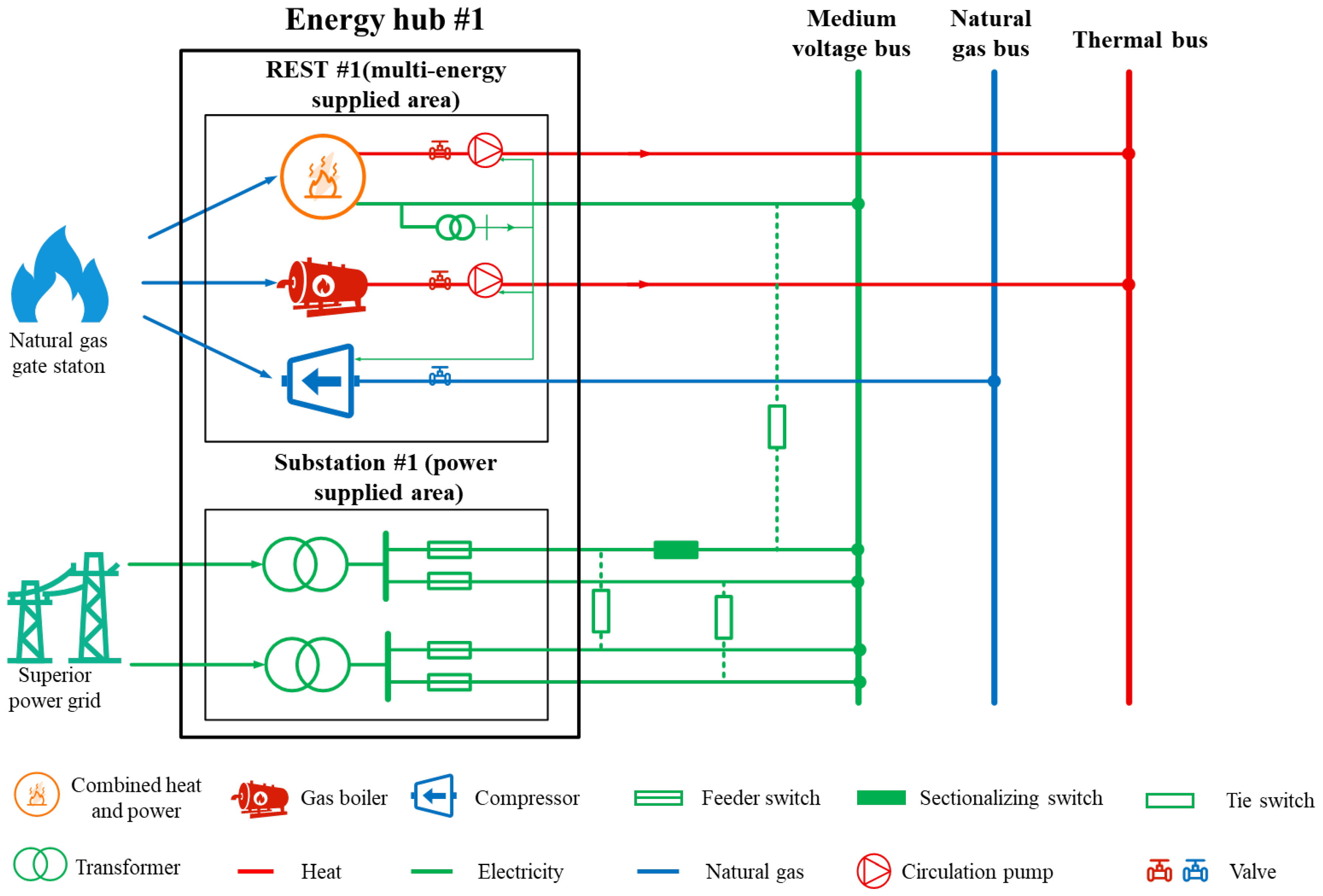
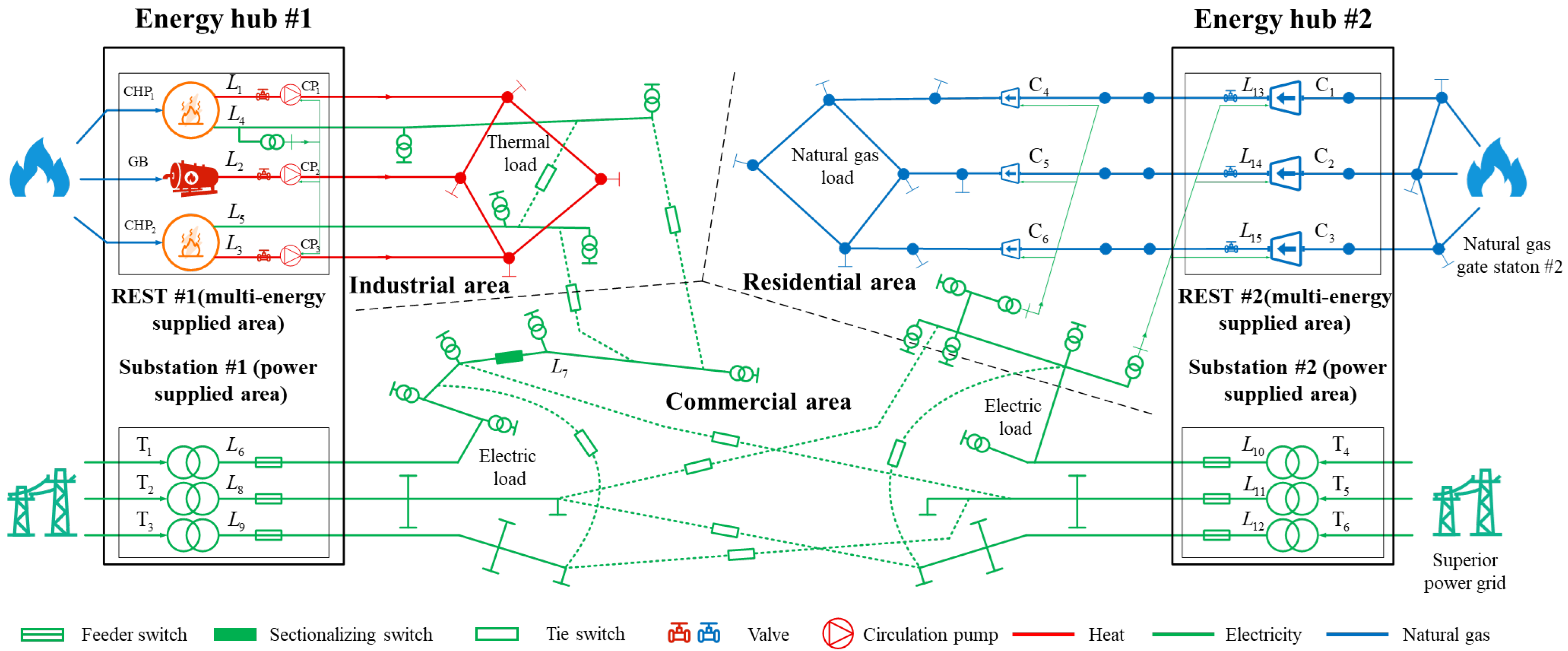
2.1. Structure of the MEC-LCDN
2.2. Definition of the PRR of MEC-LCDN
2.3. Mathematical Definition of Boundary Scenarios and the Analytical Equivalence Theorem
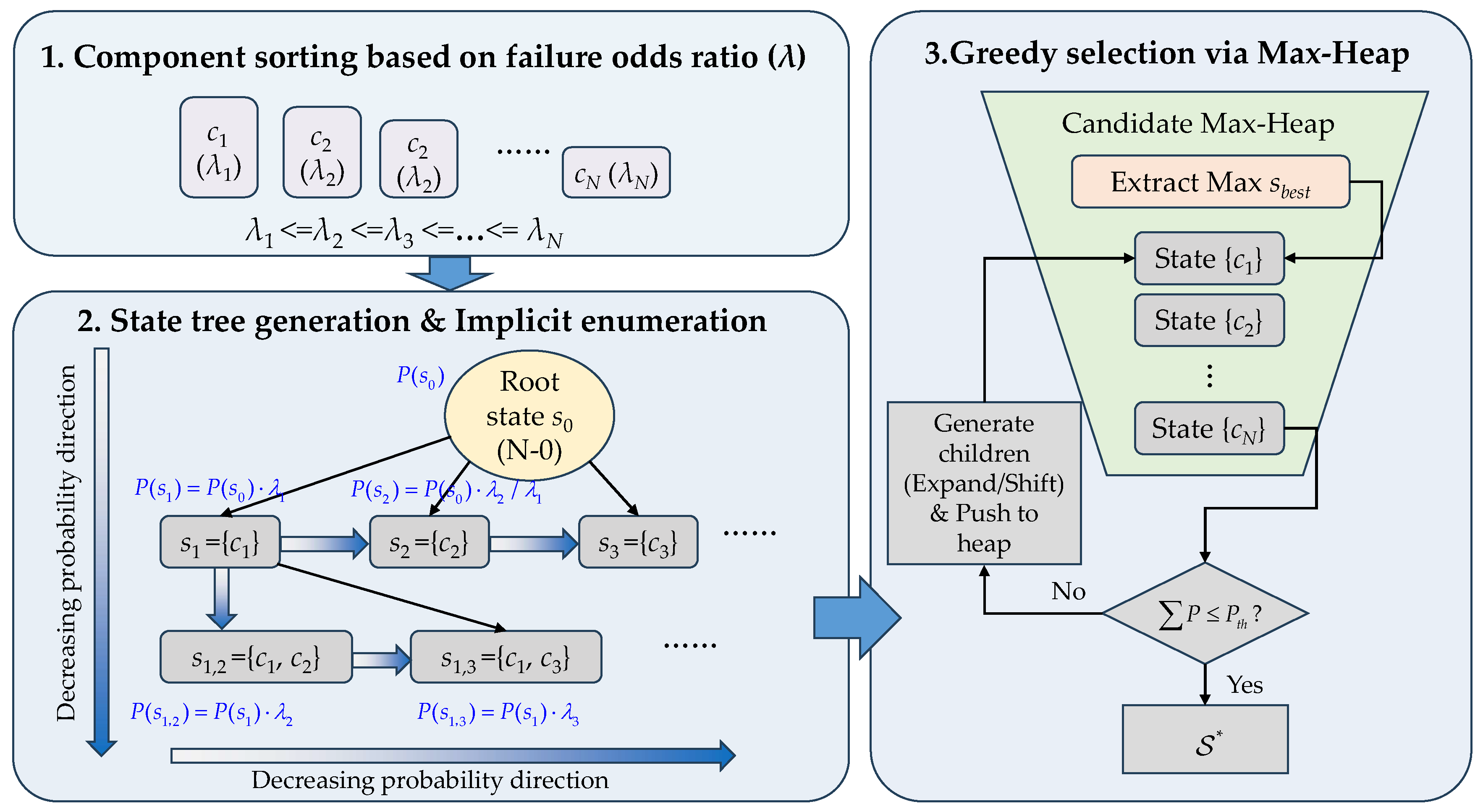
2.4. Efficient BSS Identification Strategy Based on FCST
| Algorithm 1: Efficient BSS identification strategy based on FCST |
| Input: |
| Output: |
| 1: Step 1: Preprocessing |
| 2: Calculate odds ratio . |
| 3: Sort components such that . |
| 4: Step 2: Initialization |
| 5: Define root state by (6) |
| 6: Initialize Max-Heap . |
| 7: . |
| 8: Step 3: Screening Loop |
| 9: While and do |
| 10: ; |
| 11: ; |
| 12: ; |
| 13: Let idx be the index of the last added component in . |
| 14: //Operation A: Vertical expansion |
| 15: if idx < N then |
| 16: Generate ; |
| 17: ; |
| 18: ; |
| 19: end if |
| 20: //Operation B: Horizontal replacement |
| 21: if and idx < N then |
| 22: Generate ; |
| 23: ; |
| 24: ; |
| 25: end if |
| 26: end while |
| 27: return |
3. Modeling of PRR Using BSS
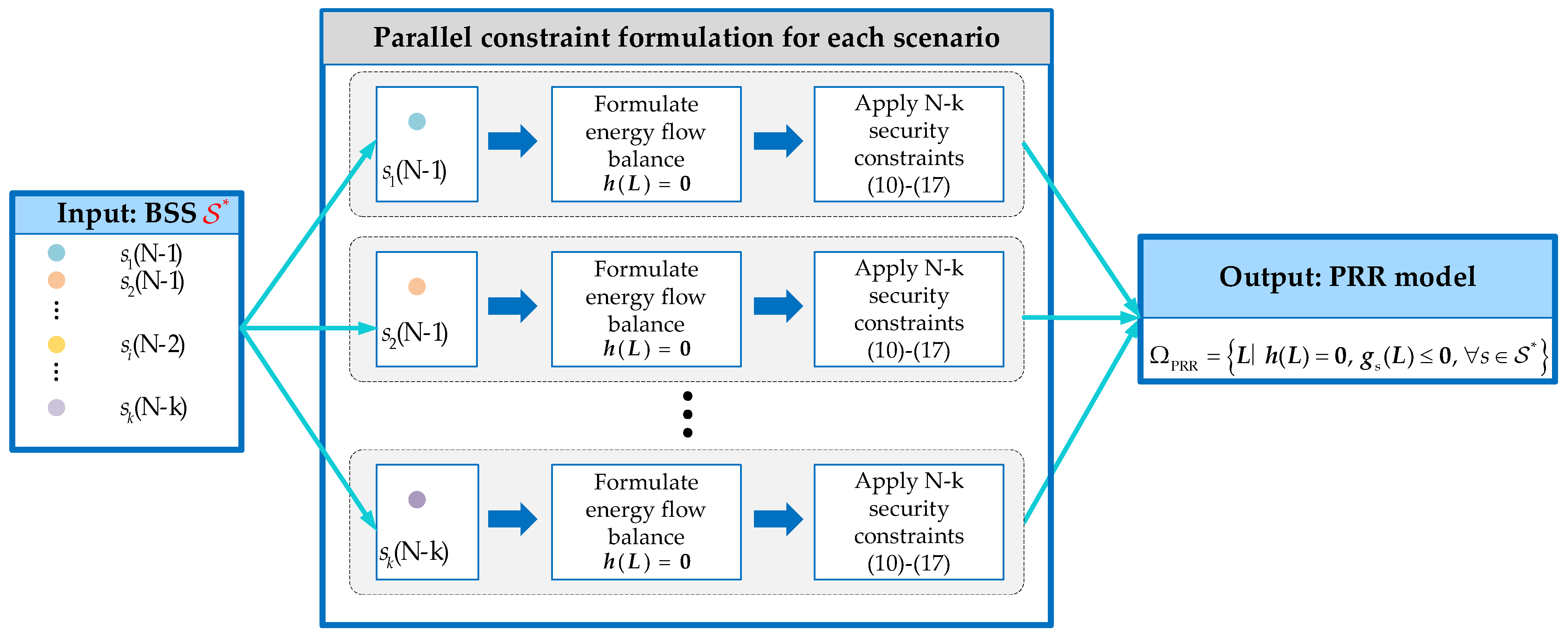
3.1. PRR Model of MEC-LCDN
3.2. Boundary Scenario Security Constraints of MEC-LCDN
3.2.1. Constraints of Key EH Equipment Under Normal Operation
- Pipeline Load Equality Constraints of Multiple Energy Types
- Load Equality Constraints between Key Equipment and Pipelines
3.2.2. Security Constraints of Key EH Equipment Under Boundary Scenarios
- Pipeline Load Transfer Equality after Equipment Failure
- Load Transfer Balance Constraint
- Capacity Margin Constraint of Interconnected Equipment
3.2.3. Security Constraints of Key EH Pipeline Exits Under Boundary Scenarios
- Load Transfer Balance Constraint for Pipelines
- Capacity Limit Constraint for Receiving Pipelines
4. PRR Boundary Modeling of MEC-LCDN and Solution
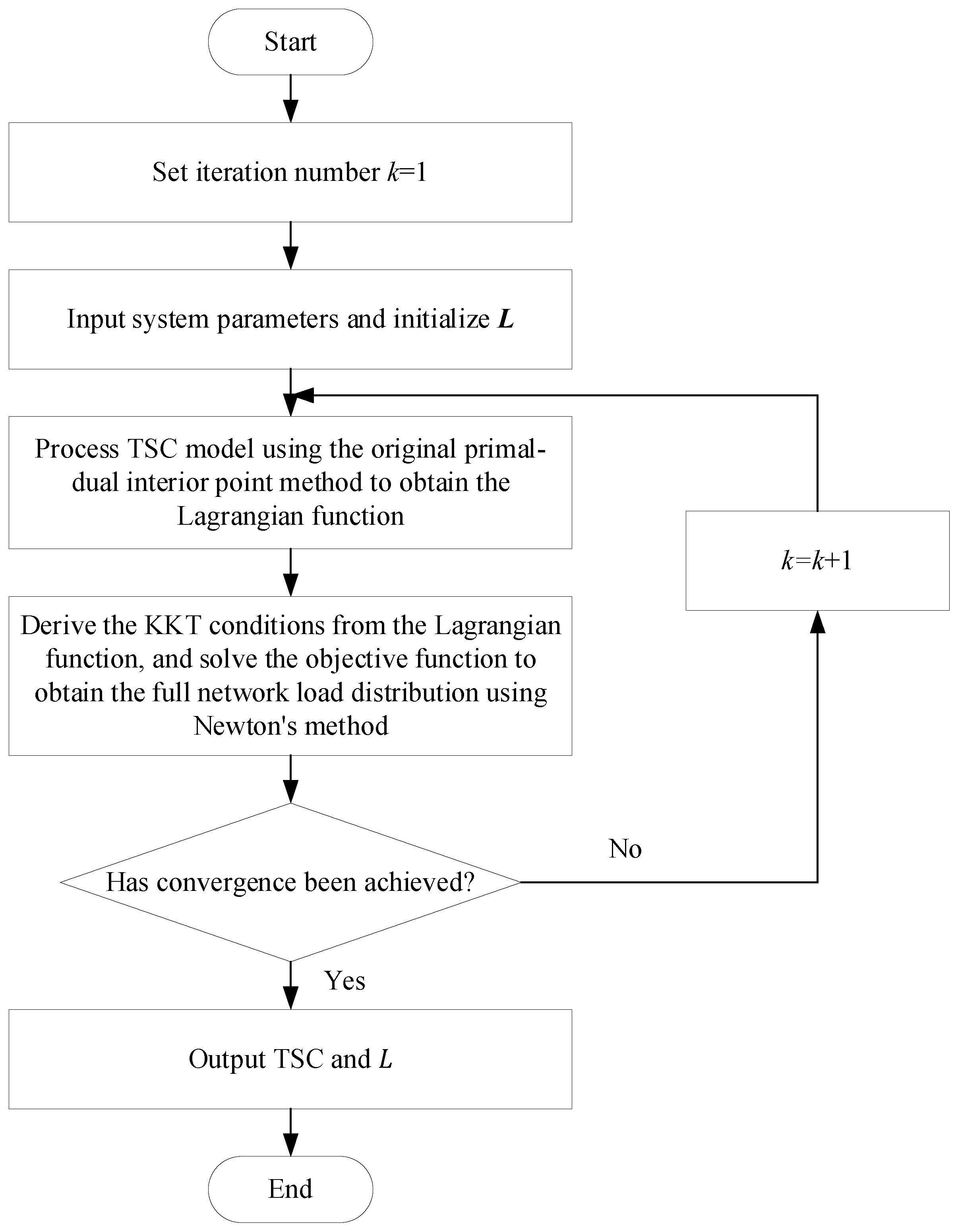
4.1. Total Supply Capability Model of MEC-LCDN and Solution
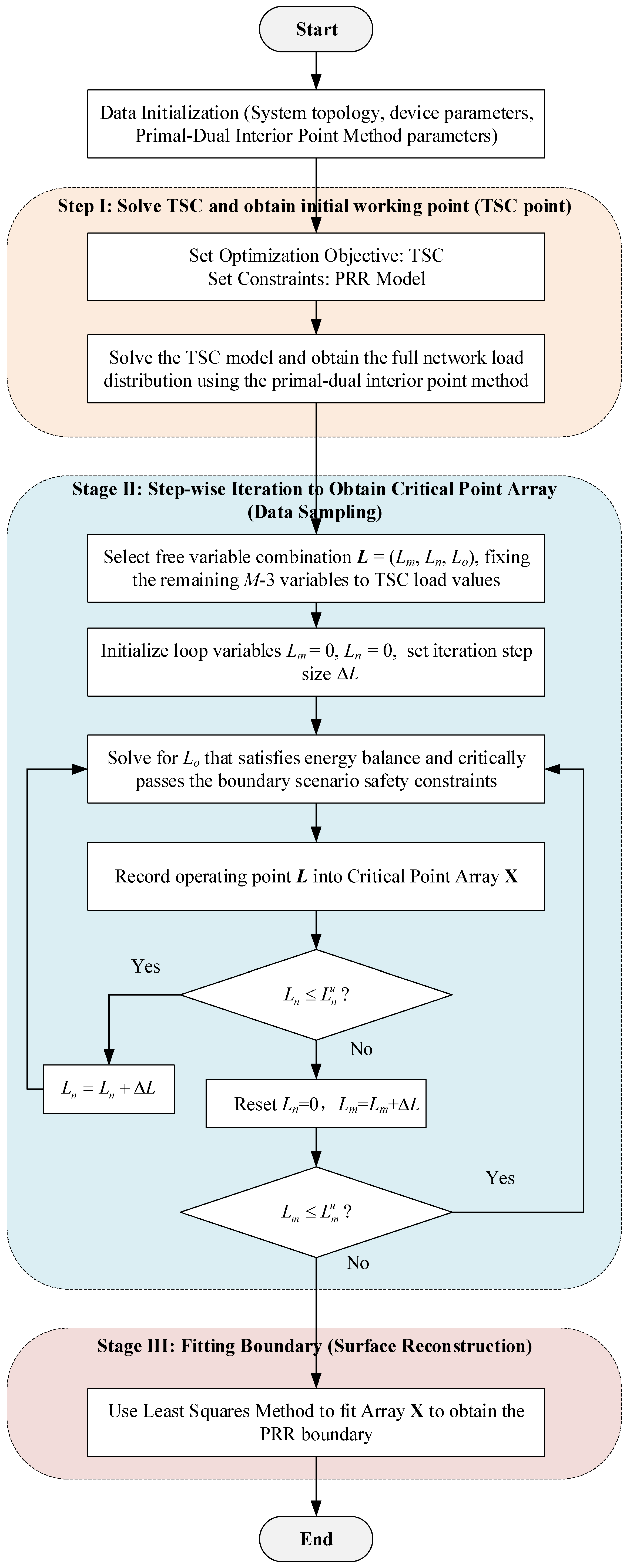
4.2. Simulation-Based Fitting and Solution of PRR Boundary
5. Case Study
5.1. Parameter Setting
5.2. Efficiency Analysis of Boundary Scenario Identification
5.3. Comparison with Two Existing Mainstream Methods
5.3.1. Comparison with Traditional N-k Truncation Method
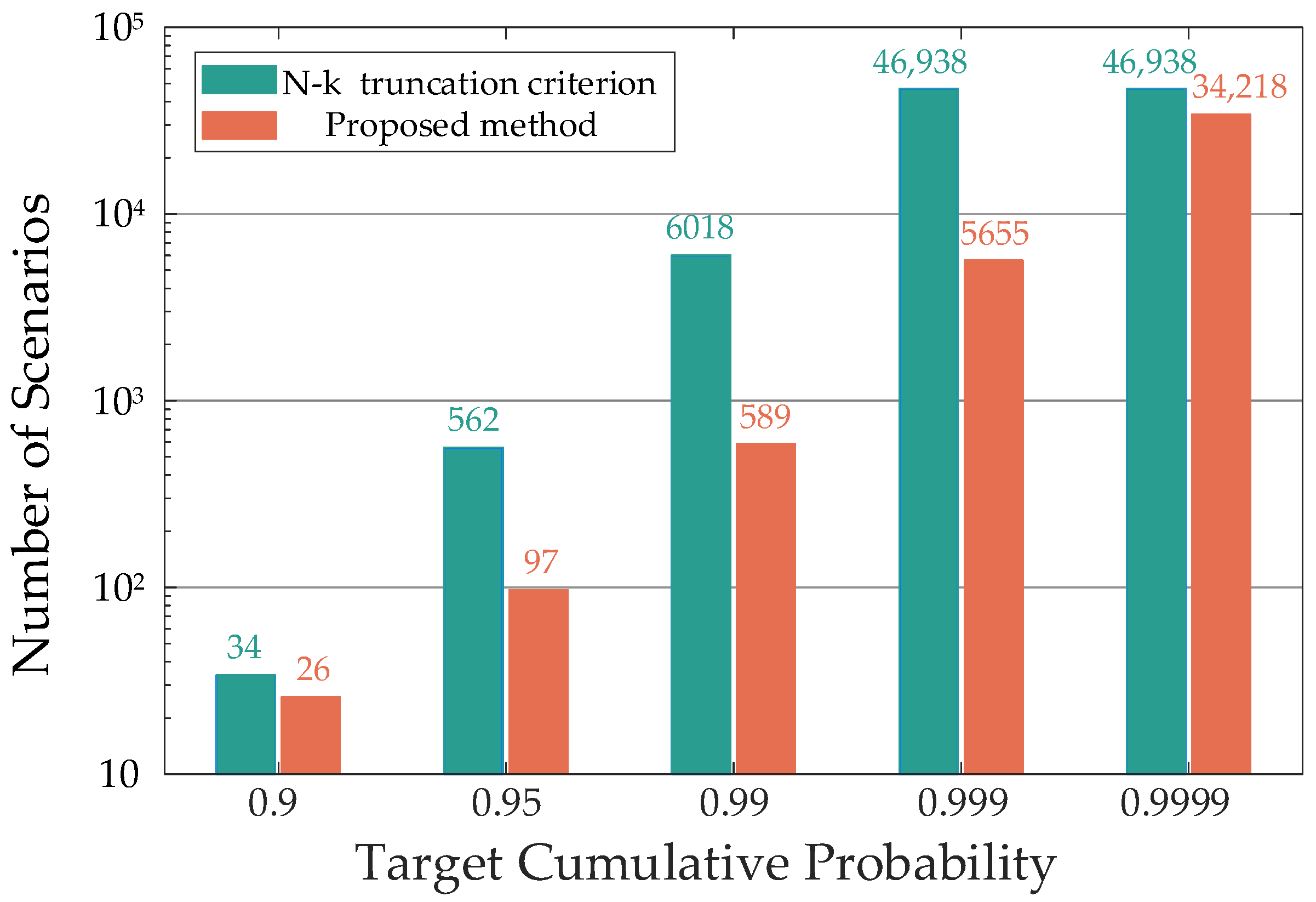
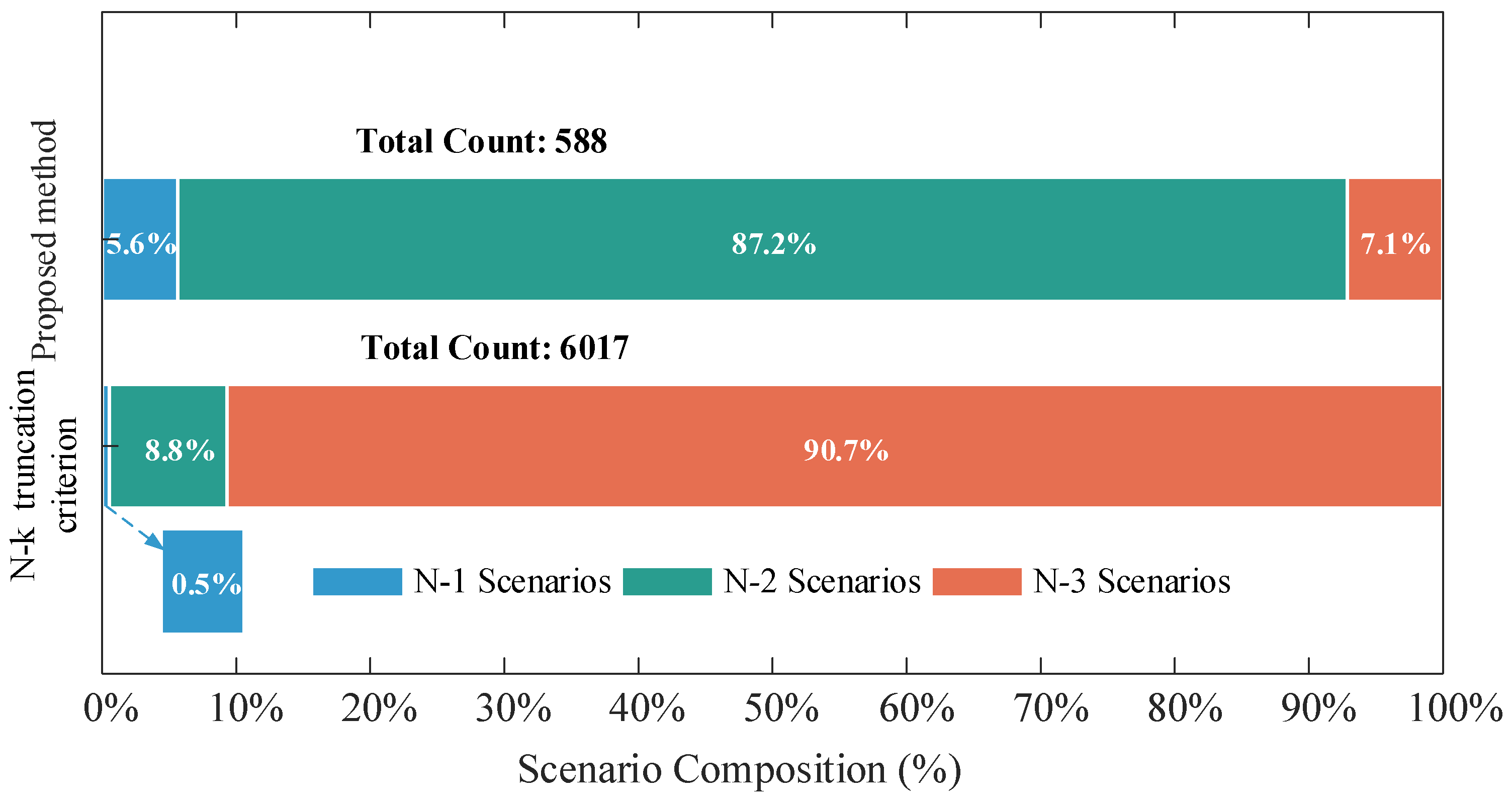
- Computational efficiency: For a single reliability assessment, the traditional method requires traversing 6017 scenarios, consuming approximately 78.8358 s. In contrast, the proposed FCST-based method screens out 90.2% of redundant scenarios, reducing the scenario set to 588 and shortening the computation time to 3.0645 s.
- Online application: The traditional method is a “black-box” assessment. If the system operating point changes, the entire simulation process must be repeated, making it unsuitable for real-time applications. The proposed method constructs an explicit “region-wise” boundary offline. For online applications, operators only need to determine the geometric relationship between the operating point and the PRR boundary (a logical judgment), which has negligible computational cost (millisecond level).
5.3.2. Comparison with N-1 SR
- Reliability coverage: Although the SR is computationally efficient (checking only 38 N-1 scenarios in this case), it fails to capture high-order risks. Under the strict reliability threshold ( = 0.01) required for MEC-LCDN, the reliability boundary is largely determined by N-2 and high-impact N-3 events. Consequently, the operating region defined by the SR is overly optimistic and larger than the actual PRR, leaving potential security blind spots for high-order contingencies.
- Methodological advantage: The proposed PRR method integrates the efficiency of the “region-based” approach with the accuracy of “probabilistic” assessment. It effectively identifies the “shrinkage” of the feasible region caused by high-order risks, ensuring that the system meets the quantified reliability target.
5.4. TSC Calculation Result of the Case
5.5. Visualization of the PRR in Two-Dimensional Space
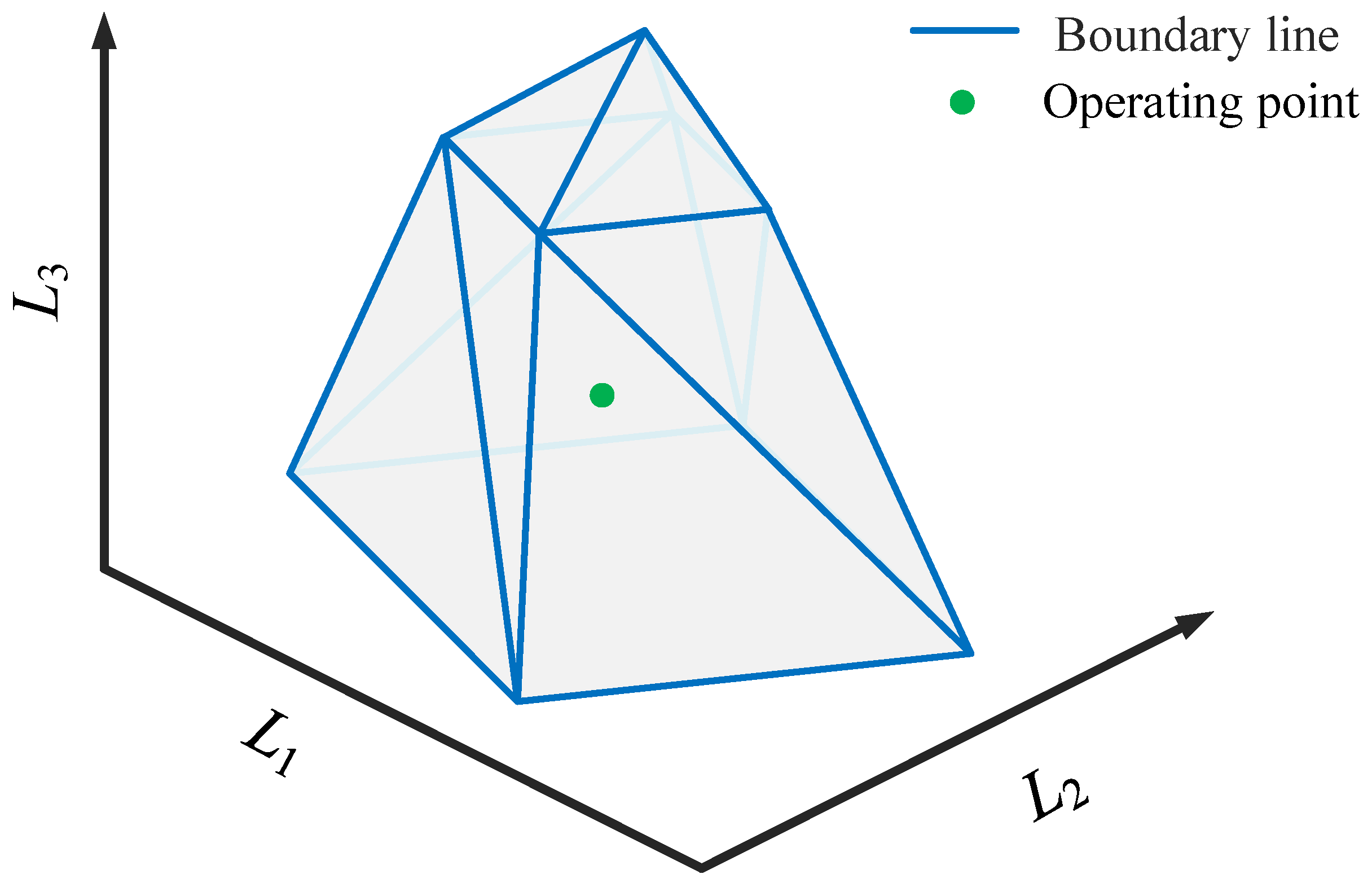
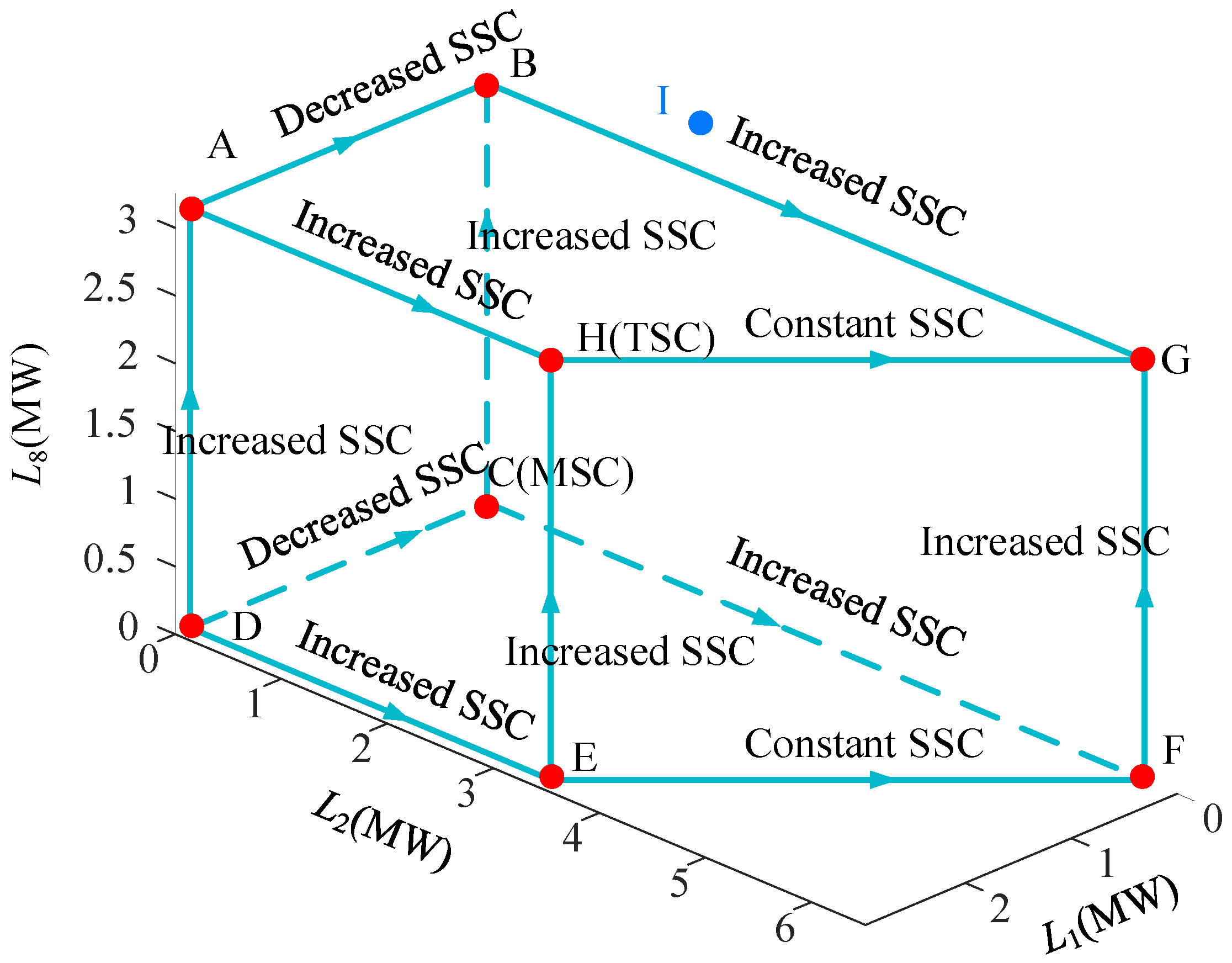
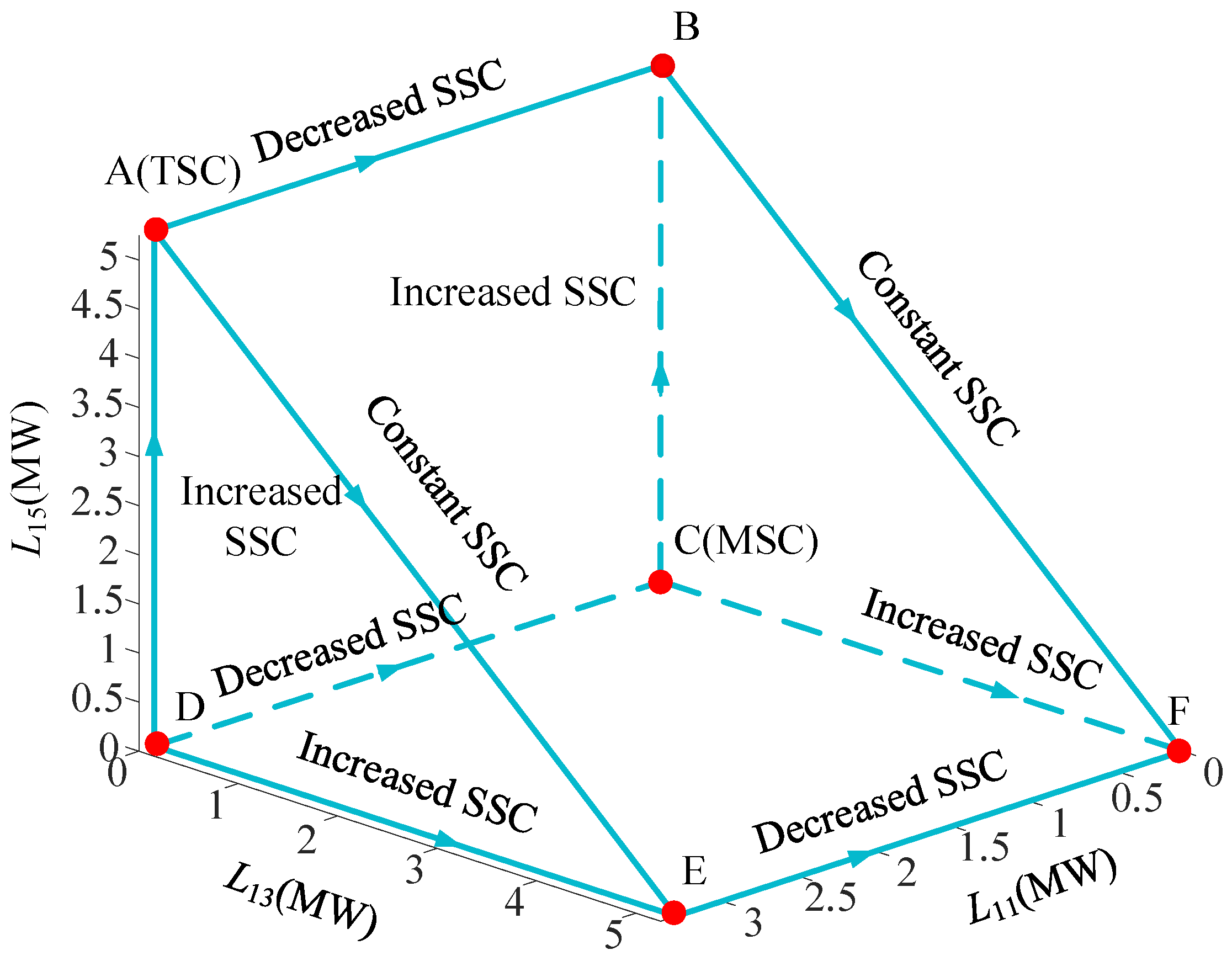
5.6. Visualization of the PRR in Three-Dimensional Space
6. Conclusions
Author Contributions
Funding
Data Availability Statement
Acknowledgments
Conflicts of Interest
References
- Huang, R.; Zhang, S.; Wang, P. Key Areas and Pathways for Carbon Emissions Reduction in Beijing for the “Dual Carbon” Targets. Energy Policy 2022, 164, 112873. [Google Scholar] [CrossRef]
- Tao, J.; Duan, J.; Tuo, L.; Gao, Q.; Tian, Q.; Lu, W. Exergy Efficiency Based Multi-Objective Configuration Optimization of Energy Hubs in the Multi-Energy Distribution System. Energy 2025, 329, 136554. [Google Scholar] [CrossRef]
- Wu, Q.; Chen, M.; Ren, H.; Li, Q.; Gao, W. Collaborative Modeling and Optimization of Energy Hubs and Multi-Energy Network Considering Hydrogen Energy. Renew. Energy 2024, 227, 120489. [Google Scholar] [CrossRef]
- Liu, C.; Wang, H.; Wang, Z.; Liu, Z.; Tang, Y.; Yang, S. Research on Life Cycle Low Carbon Optimization Method of Multi-Energy Complementary Distributed Energy System: A Review. J. Clean. Prod. 2022, 336, 130380. [Google Scholar] [CrossRef]
- Zhang, M.; Zhang, N.; Guan, D.; Ye, P.; Song, K.; Pan, X.; Wang, H.; Cheng, M. Optimal Design and Operation of Regional Multi-Energy Systems With High Renewable Penetration Considering Reliability Constraints. IEEE Access 2020, 8, 205307–205315. [Google Scholar] [CrossRef]
- Wang, P.; Liu, K.; Zhao, J.; Zheng, J.; Xu, W.; Feng, D.; Feng, S.; Yang, Y. Low-Carbon Optimal Operation of Multi-Energy Coupled Park Integrated Energy System Considering Carbon Emission Costs. J. Electr. Eng. Technol. 2025, 20, 4881–4893. [Google Scholar] [CrossRef]
- Guo, W.; Wang, Q.; Liu, H.; Desire, W.A. Multi-Energy Collaborative Optimization of Park Integrated Energy System Considering Carbon Emission and Demand Response. Energy Rep. 2023, 9, 3683–3694. [Google Scholar] [CrossRef]
- Zhang, C.; Kuang, Y. Low-Carbon Economy Optimization of Integrated Energy System Considering Electric Vehicles Charging Mode and Multi-Energy Coupling. IEEE Trans. Power Syst. 2024, 39, 3649–3660. [Google Scholar] [CrossRef]
- Lei, X.; Zhong, J.; Chen, Y.; Shao, Z.; Jian, L. Grid Integration of Electric Vehicles within Electricity and Carbon Markets: A Comprehensive Overview. eTransportation 2025, 25, 100435. [Google Scholar] [CrossRef]
- Fotopoulou, M.; Tsekouras, G.; Rakopoulos, D.; Kontargyri, V. Demand Response Optimization for the Enhancement of the Distribution System’s Operation. Sustain. Energy Grids Netw. 2025, 44, 102051. [Google Scholar] [CrossRef]
- Bao, Z.; Zhang, Q.; Wu, L.; Chen, D. Cascading Failure Propagation Simulation in Integrated Electricity and Natural Gas Systems. J. Mod. Power Syst. Clean Energy 2020, 8, 961–970. [Google Scholar] [CrossRef]
- Bao, M.; Ding, Y.; Shao, C.; Yang, Y.; Wang, P. Nodal Reliability Evaluation of Interdependent Gas and Power Systems Considering Cascading Effects. IEEE Trans. Smart Grid 2020, 11, 4090–4104. [Google Scholar] [CrossRef]
- Opinion: What Went Wrong with Texas’s Power Failure and How to Fix It. Available online: https://www.houstonchronicle.com/opinion/outlook/article/Opinion-Texas-s-power-wipe-out-what-went-15954733.php (accessed on 3 January 2026).
- Haes Alhelou, H.; Hamedani-Golshan, M.E.; Njenda, T.C.; Siano, P. A Survey on Power System Blackout and Cascading Events: Research Motivations and Challenges. Energies 2019, 12, 682. [Google Scholar] [CrossRef]
- Hawker, G.; Bell, K.; Bialek, J.; MacIver, C. Management of Extreme Weather Impacts on Electricity Grids: An International Review. Prog. Energy 2024, 6, 032005. [Google Scholar] [CrossRef]
- Wu, T.; Wang, J. Reliability Evaluation for Integrated Electricity-Gas Systems Considering Hydrogen. IEEE Trans. Sustain. Energy 2023, 14, 920–934. [Google Scholar] [CrossRef]
- Pan, C.; Bie, Z.; Li, G.; Wang, C.; Yan, C. Reliability Evaluation of Integrated Energy Systems Based on Exergy. CSEE J. Power Energy Syst. 2024, 10, 2507–2516. [Google Scholar] [CrossRef]
- Zhao, Y.; Han, Y.; Liu, Y.; Xie, K.; Li, W.; Yu, J. Cross-Entropy-Based Composite System Reliability Evaluation Using Subset Simulation and Minimum Computational Burden Criterion. IEEE Trans. Power Syst. 2021, 36, 5198–5209. [Google Scholar] [CrossRef]
- Cao, M.; Shao, C.; Hu, B.; Xie, K.; Li, W.; Peng, L.; Zhang, W. Reliability Assessment of Integrated Energy Systems Considering Emergency Dispatch Based on Dynamic Optimal Energy Flow. IEEE Trans. Sustain. Energy 2022, 13, 290–301. [Google Scholar] [CrossRef]
- Hinkelman, K.; Garcia, J.D.F.; Anbarasu, S.; Zuo, W. A Review of Multi-Energy Systems from Resiliency and Equity Perspectives. Energies 2025, 18, 4536. [Google Scholar] [CrossRef]
- Zhou, S.; Luo, S.; Wang, L.; Jiang, C.; Xiong, Z.; Gu, J.; Zhang, K. Robust Resilience Enhancement Strategy for Gas-Electricity Integrated Energy System Considering Multiple Reinforcement Levels. IET Renew. Power Gener. 2025, 19, e12953. [Google Scholar] [CrossRef]
- Wang, Y.; Yang, Y.; Xu, Q. Integrated Model for Resilience Evaluation of Power-Gas Systems Under Windstorms. CSEE J. Power Energy Syst. 2024, 10, 1427–1440. [Google Scholar] [CrossRef]
- Shi, Z.; Xu, Y.; Li, Z.; Xie, D.; Ghias, A.M.Y.M. Resilience Enhancement of a Multi-Energy Distribution System via Joint Network Reconfiguration and Mobile Sources Scheduling. CSEE J. Power Energy Syst. 2024, 1–12. [Google Scholar] [CrossRef]
- Wang, Y.; Qiu, D.; Sun, X.; Bie, Z.; Strbac, G. Coordinating Multi-Energy Microgrids for Integrated Energy System Resilience: A Multi-Task Learning Approach. IEEE Trans. Sustain. Energy 2024, 15, 920–937. [Google Scholar] [CrossRef]
- Shahzad, U. Probabilistic Security Assessment in Power Transmission Systems: A Review. J. Electr. Eng. Electron. Control Comput. Sci. 2021, 7, 25–32. [Google Scholar]
- Le, D.D.; Berizzi, A.; Bovo, C. A Probabilistic Security Assessment Approach to Power Systems with Integrated Wind Resources. Renew. Energy 2016, 85, 114–123. [Google Scholar] [CrossRef]
- Wang, G.; Li, Z.; Zhang, F.; Ju, P.; Wu, H.; Feng, C. Data-Driven Probabilistic Static Security Assessment for Power System Operation Using High-Order Moments. J. Mod. Power Syst. Clean Energy 2021, 9, 1233–1236. [Google Scholar] [CrossRef]
- Wang, Y.; Vittal, V.; Abdi-Khorsand, M.; Singh, C. Probabilistic Reliability Evaluation Including Adequacy and Dynamic Security Assessment. IEEE Trans. Power Syst. 2020, 35, 551–559. [Google Scholar] [CrossRef]
- Ciapessoni, E.; Cirio, D.; Kjølle, G.; Massucco, S.; Pitto, A.; Sforna, M. Probabilistic Risk-Based Security Assessment of Power Systems Considering Incumbent Threats and Uncertainties. IEEE Trans. Smart Grid 2016, 7, 2890–2903. [Google Scholar] [CrossRef]
- Shahmohammadi, A.; Moradi-Dalvand, M.; Ghasemi, H.; Ghazizadeh, M.S. Optimal Design of Multicarrier Energy Systems Considering Reliability Constraints. IEEE Trans. Power Deliv. 2015, 30, 878–886. [Google Scholar] [CrossRef]
- Hui, H.; Bao, M.; Ding, Y.; Yang, Y.; Xue, Y. Optimal Energy Reserve Scheduling in Integrated Electricity and Gas Systems Considering Reliability Requirements. J. Mod. Power Syst. Clean Energy 2022, 10, 1494–1506. [Google Scholar] [CrossRef]
- Bao, M.; Sun, X.; Ding, Y.; Ye, C.; Shao, C.; Wang, S.; Song, Y. Multifactor-Influenced Reliability-Constrained Reserve Expansion of Integrated Electricity-Gas Systems Considering Failure Propagation. CSEE J. Power Energy Syst. 2023, 9, 2236–2250. [Google Scholar] [CrossRef]
- Shabanian-Poodeh, M.; Hooshmand, R.-A.; Shafie-khah, M. Reliability-Constrained Configuration Optimization for Integrated Power and Natural Gas Energy Systems: A Stochastic Approach. Reliab. Eng. Syst. Saf. 2025, 254, 110600. [Google Scholar] [CrossRef]
- Jiang, T.; Zhang, R.; Li, X.; Chen, H.; Li, G. Integrated Energy System Security Region: Concepts, Methods, and Implementations. Appl. Energy 2021, 283, 116124. [Google Scholar] [CrossRef]
- Li, X.; Tian, G.; Shi, Q.; Jiang, T.; Li, F.; Jia, H. Security Region of Natural Gas Network in Electricity-Gas Integrated Energy System. Int. J. Electr. Power Energy Syst. 2020, 117, 105601. [Google Scholar] [CrossRef]
- Liu, L.; Wang, D.; Hou, K.; Jia, H.; Li, S. Region Model and Application of Regional Integrated Energy System Security Analysis. Appl. Energy 2020, 260, 114268. [Google Scholar] [CrossRef]
- Chen, S.; Wei, Z.; Sun, G.; Wei, W.; Wang, D. Convex Hull Based Robust Security Region for Electricity-Gas Integrated Energy Systems. IEEE Trans. Power Syst. 2019, 34, 1740–1748. [Google Scholar] [CrossRef]
- Liu, X. Research on Dimension Reduction for Visualization of Simplified Security Region of Integrated Energy System Considering Renewable Energy Access. Int. J. Electr. Power Energy Syst. 2024, 156, 109777. [Google Scholar] [CrossRef]
- Su, J.; Chiang, H.-D.; Alberto, L.F.C. Two-Time-Scale Approach to Characterize the Steady-State Security Region for the Electricity-Gas Integrated Energy System. IEEE Trans. Power Syst. 2021, 36, 5863–5873. [Google Scholar] [CrossRef]
- Li, X.; Xie, K.; Shao, C.; Hu, B. A Region-Based Approach for the Operational Reliability Evaluation of Power Systems With Renewable Energy Integration. IEEE Trans. Power Syst. 2024, 39, 3389–3400. [Google Scholar] [CrossRef]
- Guelpa, E.; Verda, V. Model for Optimal Malfunction Management in Extended District Heating Networks. Appl. Energy 2018, 230, 519–530. [Google Scholar] [CrossRef]
- Billinton, R.; Allan, R.N. Reliability Evaluation of Power Systems; Springer US: Boston, MA, USA, 1984; ISBN 978-1-4615-7733-1. [Google Scholar]
- Wang, W.; Wang, D.; Jia, H.; Chen, Z.; Tang, J. A Decomposed Solution of Multi-Energy Flow in Regional Integrated Energy Systems Considering Operational Constraints. Energy Procedia 2017, 105, 2335–2341. [Google Scholar] [CrossRef]
- Xie, L.; Chiang, H.-D. Weighted Multiple Predictor-Corrector Interior Point Method for Optimal Power Flow. Electr. Power Compon. Syst. 2011, 39, 99–112. [Google Scholar] [CrossRef]
- Kojima, M.; Tunçel, L. Monotonicity of Primal–Dual Interior-Point Algorithms for Semidefinite Programming Problems. Optim. Methods Softw. 1998, 10, 275–296. [Google Scholar] [CrossRef]
- Allan, R.N.; Billinton, R.; Sjarief, I.; Goel, L.; So, K.S. A Reliability Test System for Educational Purposes—Basic Distribution System Data and Results. IEEE Trans. Power Syst. 1991, 6, 813–820. [Google Scholar] [CrossRef]
- Yao, S.; Gu, W.; Lu, S.; Wu, C. A Transient Thermodynamic Model of District Heating Network for Operational Optimization of the Energy Integration System. In Proceedings of the 2017 IEEE Conference on Energy Internet and Energy System Integration (EI2), Beijing, China, 26–28 November 2017; pp. 1–6. [Google Scholar]
- An, S.; Li, Q.; Gedra, T.W. Natural Gas and Electricity Optimal Power Flow. In Proceedings of the 2003 IEEE PES Transmission and Distribution Conference and Exposition, Dallas, TX, USA, 7–12 September 2003; Volume 1, pp. 138–143. [Google Scholar]



| References | Core Methodology | Reliability Criterion | Model Representation | Computational Characteristics |
|---|---|---|---|---|
| [12,16,17,18,19] | MCS, state enumeration | LOLP | Implicit | Low Efficiency |
| [20,21,22,23,24] | Dynamic cascading analysis, restoration optimization | Resilience metrics | Implicit/Optimization | Low Efficiency |
| [25,26,27,28,29] | Analytical methods (e.g., moments), SMCS | Risk, probability | Implicit/Semi-explicit | Medium/Low Efficiency |
| [5,30,31,32,33] | Stochastic programming, MILP/MISOCP | Probabilistic constraints embedded in optimization | Implicit/Integrated | Low Efficiency |
| [34,35,36,37,38,39] | Geometric approximation (hyperplanes, convex hulls) | Deterministic (N-1) or robust worst-case | Explicit | High Efficiency |
| Proposed method | Boundary scenario inversion, FCST | 0.01 Covers N-k risks | Explicit | High Efficiency |
| Pipeline | Type of Trunk Pipeline | Rated Capacity/Flow of Trunk Pipeline |
|---|---|---|
| Electric feeder L4–L9 | JKLYJ-120 (type I) | 10 MVA |
| Electric feeder L10–L12 | JKLYJ-150 (type II) | 12 MVA |
| Thermal pipeline | DN400 | 376.99 kg/s |
| Natural gas pipeline | DN120 | 0.5 MMCFD |
| EH Type | Object | Equipment | Equipment Parameters | Equipment Capacity |
|---|---|---|---|---|
| EH #1 | RES #1 | GB | Efficiency: 0.9 | 10 MW |
| CHP1, CHP2 | cm: 0.8, cv: 0.1 | Electricity: 12 MW, Heat: 12 MW | ||
| CP1, CP2, CP3 | Efficiency: 0.6 | 0.3 MW | ||
| Substation #1 | T1 | Voltage ratio: 35 kV/10 kV | 15 MVA | |
| T2 | Voltage ratio: 35 kV/10 kV | 15 MVA | ||
| T3 | Voltage ratio: 35 kV/10 kV | 15 MVA | ||
| EH #2 | RES #2 | C1 | Compressor ratio: 1.15 | 11 MW |
| C2 | Compressor ratio: 1.20 | 10 MW | ||
| C3 | Compressor ratio: 1.20 | 10 MW | ||
| Substation #2 | T4 | Voltage ratio: 35 kV/10 kV | 12 MVA | |
| T5 | Voltage ratio: 35 kV/10 kV | 12 MVA | ||
| T6 | Voltage ratio: 35 kV/10 kV | 12 MVA |
| Component Type | Component ID | Unavailability |
|---|---|---|
| Transformer | T1–T3 | 0.020 |
| T4–T6 | 0.015 | |
| Circulation pump | CP1–CP3 | 0.030 |
| Thermal pipeline | L1–L3 | 0.004 |
| Natural gas pipeline | L13–L15 | 0.004 |
| Electric feeder | L4–L9 | 0.005 |
| L10–L12 | 0.006 | |
| Combined heat and power | CHP1, CHP2 | 0.015 |
| Gas boiler | GB | 0.013 |
| Compressor | C1–C3 | 0.030 |
| C4–C6 | 0.020 |
| Traditional N-k Truncation | N − 1 SR [36] | Proposed Method | |
|---|---|---|---|
| Assessment scope | Point-wise (specific point) | Region-wise (whole space) | Region-wise (whole space) |
| Scenario basis | Exhaustive (N − 1 to N − 3) | Only N − 1 | Boundary scenarios (N-k) |
| Number of scenarios | 6017 | 33 | 588 |
| Computation time (s) | 78.8358 s (per point) | 0.0032 s | 3.0645 s |
| Reliability criterion | Quantified (LOLP) | Unquantified (Deterministic) | Quantified (LOLP ≤ 0.01) |
| High-order risk | Covered | Ignored | Covered |
| Visualization | No | Yes | Yes |
| Pipeline ID | 1 | 2 | 3 | 4 | 5 | 6 | 7 | 8 | 9 | 10 | 11 | 12 | 13 | 14 | 15 |
|---|---|---|---|---|---|---|---|---|---|---|---|---|---|---|---|
| Load Lm(MW) | 2.237 | 4.332 | 2.431 | 2.752 | 2.672 | 3.237 | 3.076 | 2.761 | 2.679 | 3.000 | 2.583 | 2.740 | 2.719 | 2.568 | 4.714 |
Disclaimer/Publisher’s Note: The statements, opinions and data contained in all publications are solely those of the individual author(s) and contributor(s) and not of MDPI and/or the editor(s). MDPI and/or the editor(s) disclaim responsibility for any injury to people or property resulting from any ideas, methods, instructions or products referred to in the content. |
© 2026 by the authors. Licensee MDPI, Basel, Switzerland. This article is an open access article distributed under the terms and conditions of the Creative Commons Attribution (CC BY) license.
Share and Cite
Liu, T.; Shao, C.; Yu, M.; Li, X.; Liao, Q. An Explicit Representation Method for Operational Reliability Constraints in Multi-Energy Coupled Low-Carbon Distribution Network. Energies 2026, 19, 904. https://doi.org/10.3390/en19040904
Liu T, Shao C, Yu M, Li X, Liao Q. An Explicit Representation Method for Operational Reliability Constraints in Multi-Energy Coupled Low-Carbon Distribution Network. Energies. 2026; 19(4):904. https://doi.org/10.3390/en19040904
Chicago/Turabian StyleLiu, Taoxing, Changzheng Shao, Mingfeng Yu, Xintong Li, and Qinglong Liao. 2026. "An Explicit Representation Method for Operational Reliability Constraints in Multi-Energy Coupled Low-Carbon Distribution Network" Energies 19, no. 4: 904. https://doi.org/10.3390/en19040904
APA StyleLiu, T., Shao, C., Yu, M., Li, X., & Liao, Q. (2026). An Explicit Representation Method for Operational Reliability Constraints in Multi-Energy Coupled Low-Carbon Distribution Network. Energies, 19(4), 904. https://doi.org/10.3390/en19040904