Study on Hydrogen Seepage Laws in Tree-Shaped Reservoir Fractures of the Storage Formation of Underground Hydrogen Storage in Depleted Oil and Gas Reservoirs Considering Slip Effects




Abstract
1. Introduction
2. Equivalent-Permeability Model for Hydrogen Flow in a Tree-Shaped Fracture Network
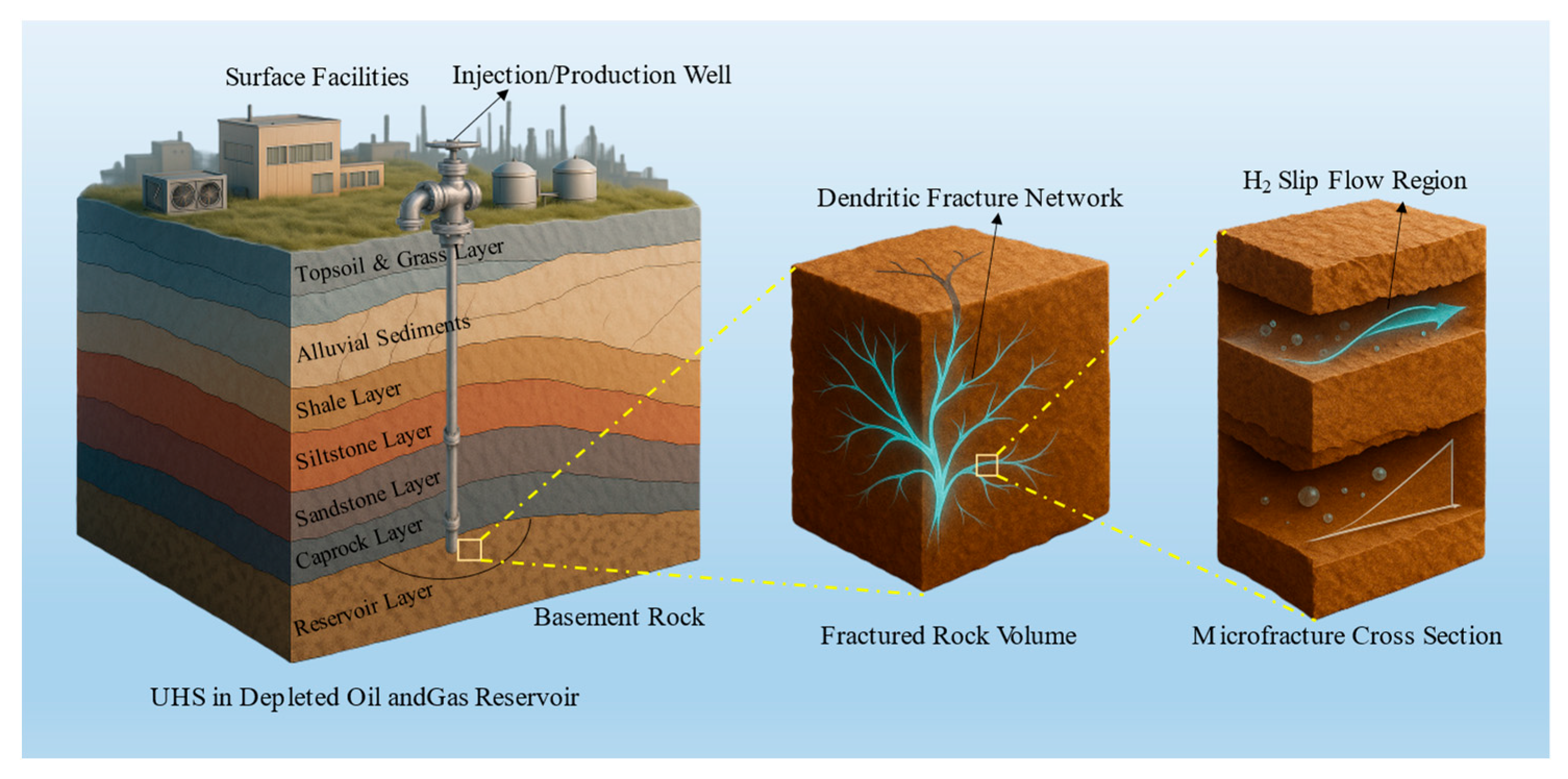
2.1. Conceptual Model and Fundamental Assumptions for Tree-Shaped Fractures in UHS in Depleted Oil and Gas Reservoirs
- The gas is treated as a compressible Newtonian fluid. During one injection–production operation, pressure variations are assumed to be small compared with the mean pore pressure. An equivalent mean pressure is therefore used. Steady-state Darcy flow is assumed. The flow is laminar at the fracture scale.
- Under the in situ stress conditions, the fracture geometry is assumed to remain stable. Pronounced aperture closure and shear slip induced by pressure fluctuations are neglected. Flow–solid coupling effects are not considered.
- Matrix permeability is assumed to be much lower than fracture permeability. The representative elementary volume scale equivalent permeability is therefore controlled primarily by the tree-shaped fracture network.
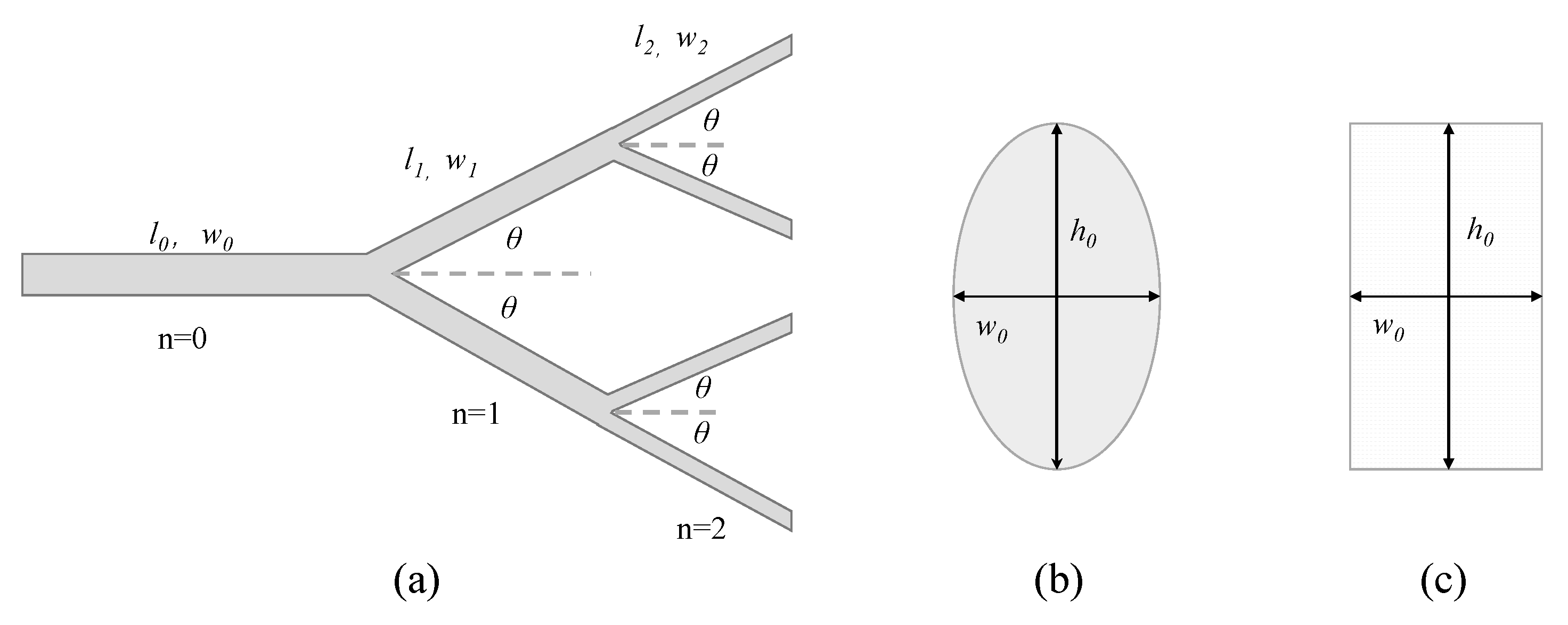
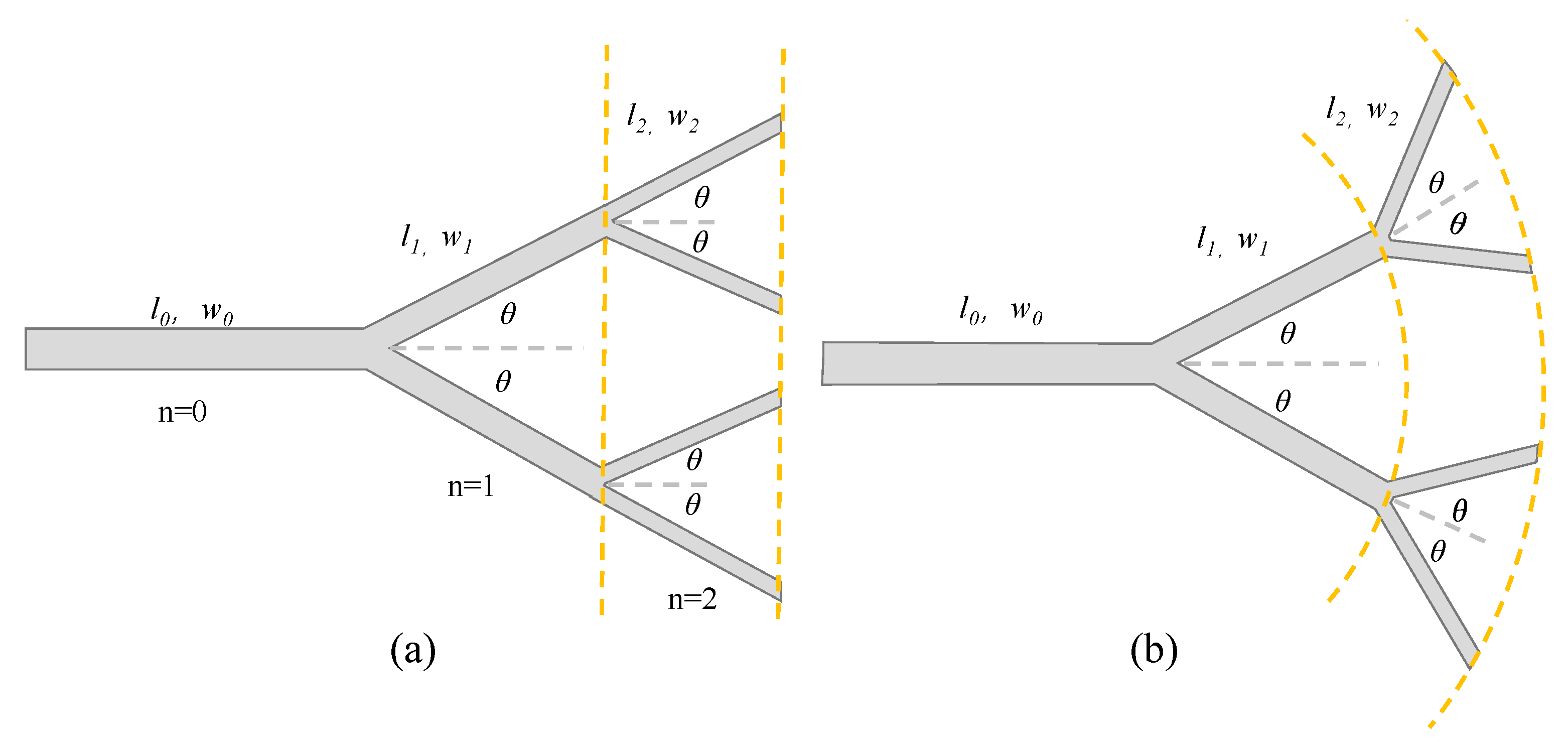
- The tree-shaped fracture network is assumed to include one main fracture and multiple levels of branching fractures. In the plane, branching is represented by pairwise symmetric bifurcations at a prescribed branching angle. Geometric parameters are scaled proportionally across branching levels. The scaling is characterized by the length ratio, width ratio, and height ratio.
- Consistent with classical hydraulic-fracturing models, the main-fracture cross-section is approximated as either elliptical or rectangular.
2.2. Geometric Parameterization of the Tree-Shaped Fracture Network
2.2.1. Total Fracture Volume and Total Fracture Length
2.2.2. Equivalent Cross-Sectional Area and Characteristic Length
2.3. Equivalent Permeability of Tree-Shaped Fractures Without Slip
2.3.1. Governing Equation for Hydrogen Seepage in a Single-Level Fracture
2.3.2. Equivalent Permeability of the Tree-Shaped Fracture Network
2.4. Hydrogen Slip Effects and Gas-Type Correction
2.5. Upscaling to the REV Scale for Depleted Oil and Gas Reservoirs Containing Tree-Shaped Fractures
3. Results and Discussion
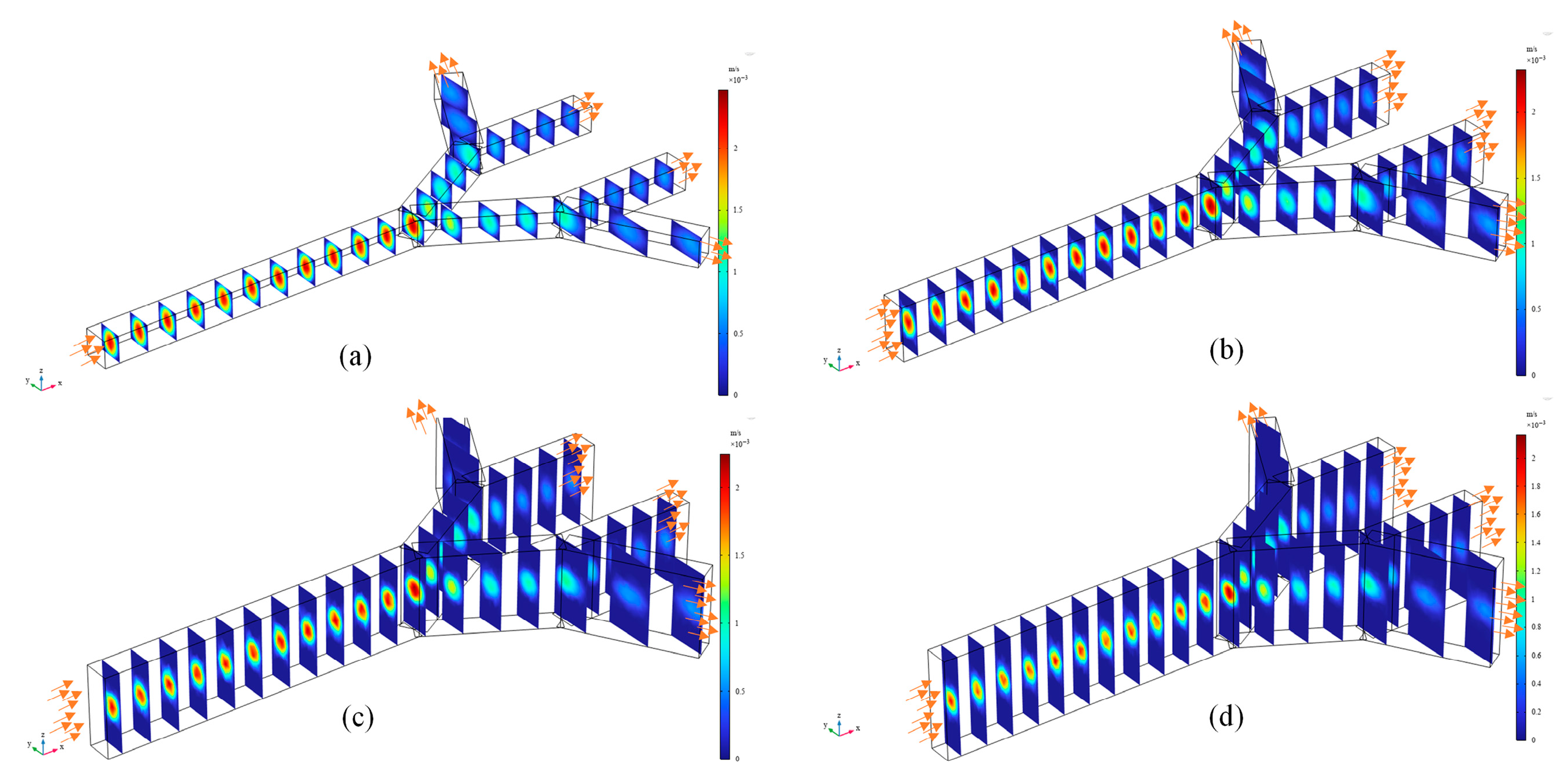
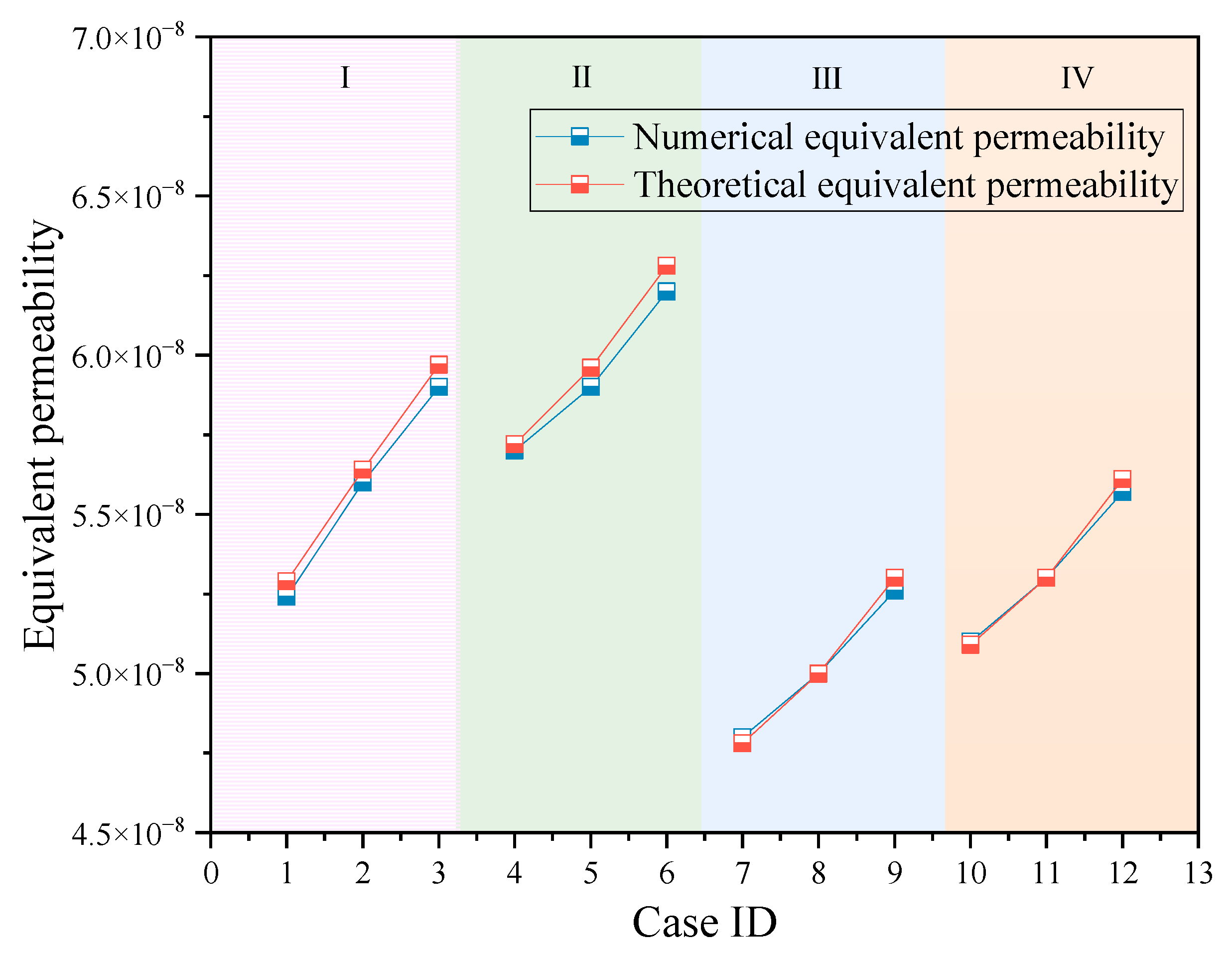
3.1. Validation of the Analytical Equivalent-Permeability Model Against 3D Numerical Simulations
3.2. Effects of Geometric Parameters on the Equivalent Permeability of Tree-Shaped Fractures
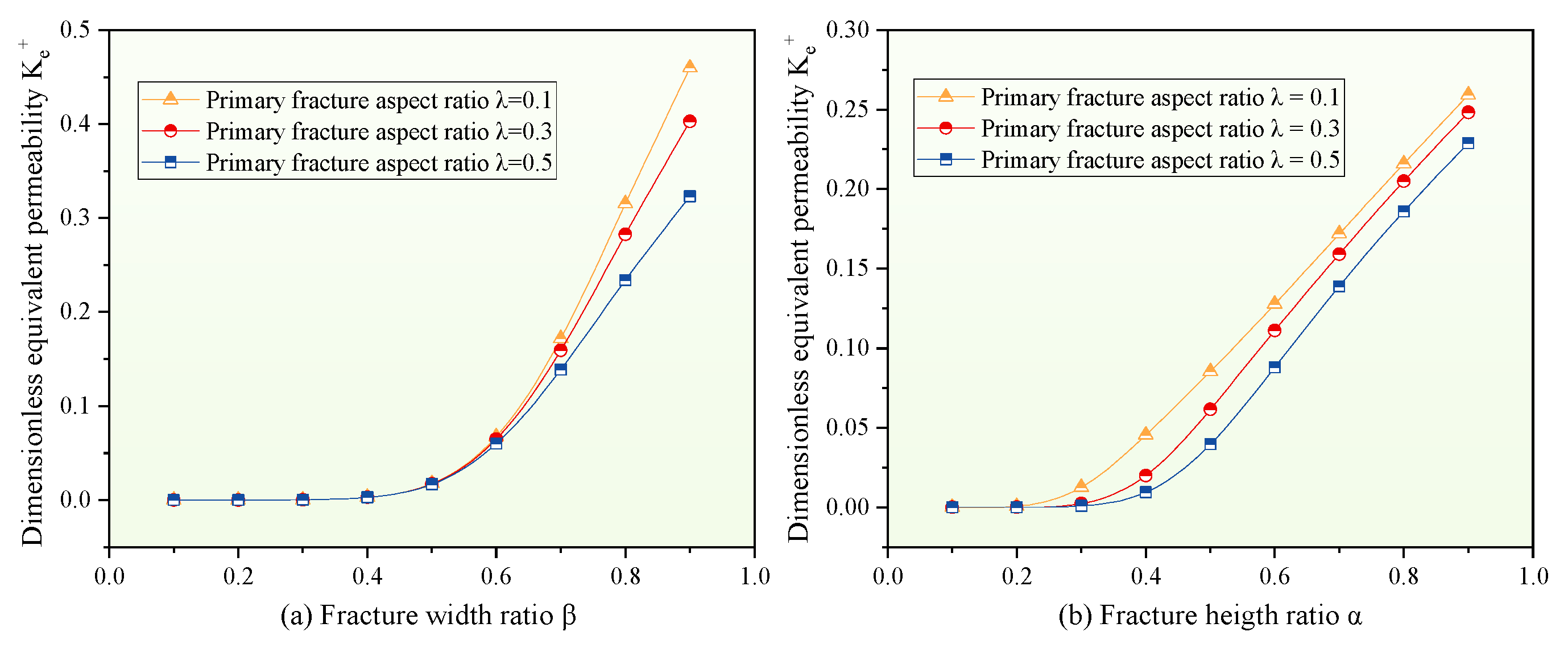
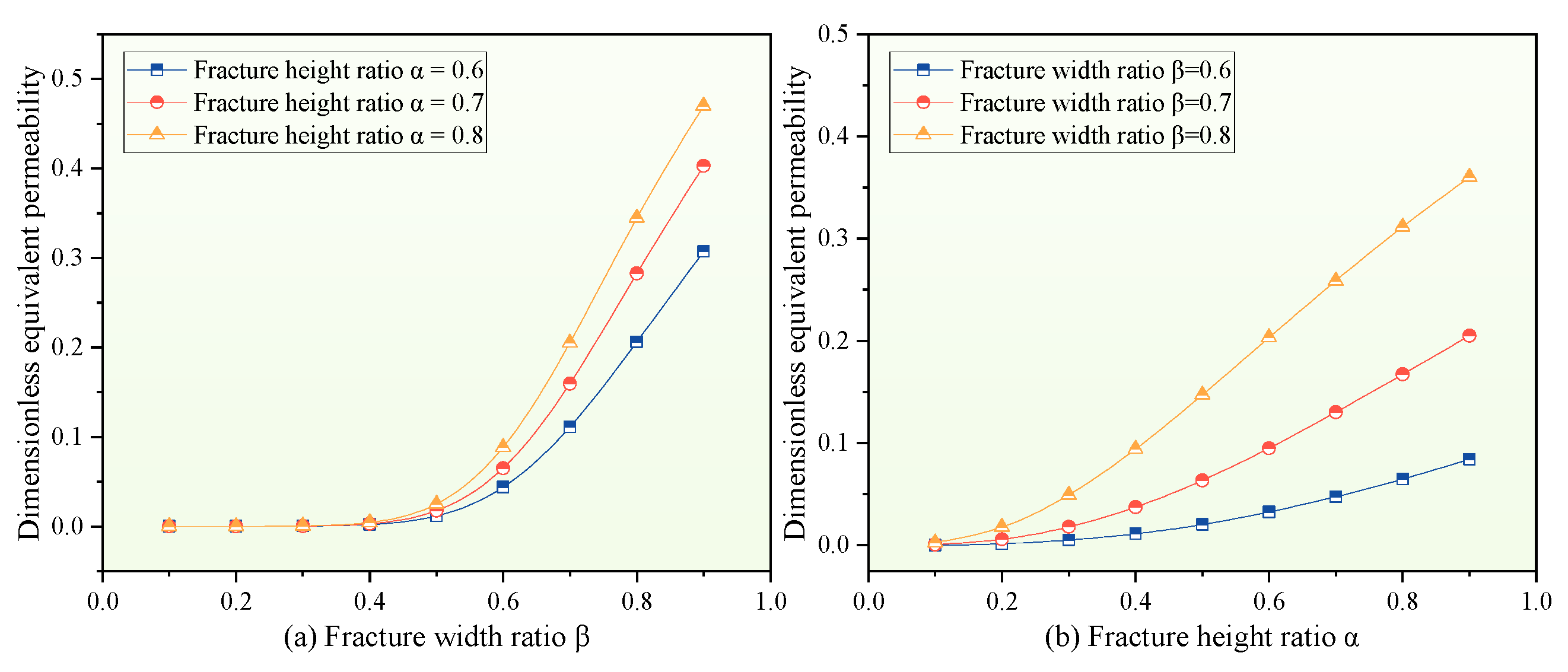
3.2.1. Coupled Effects of the Width Ratio β and Height Ratio α
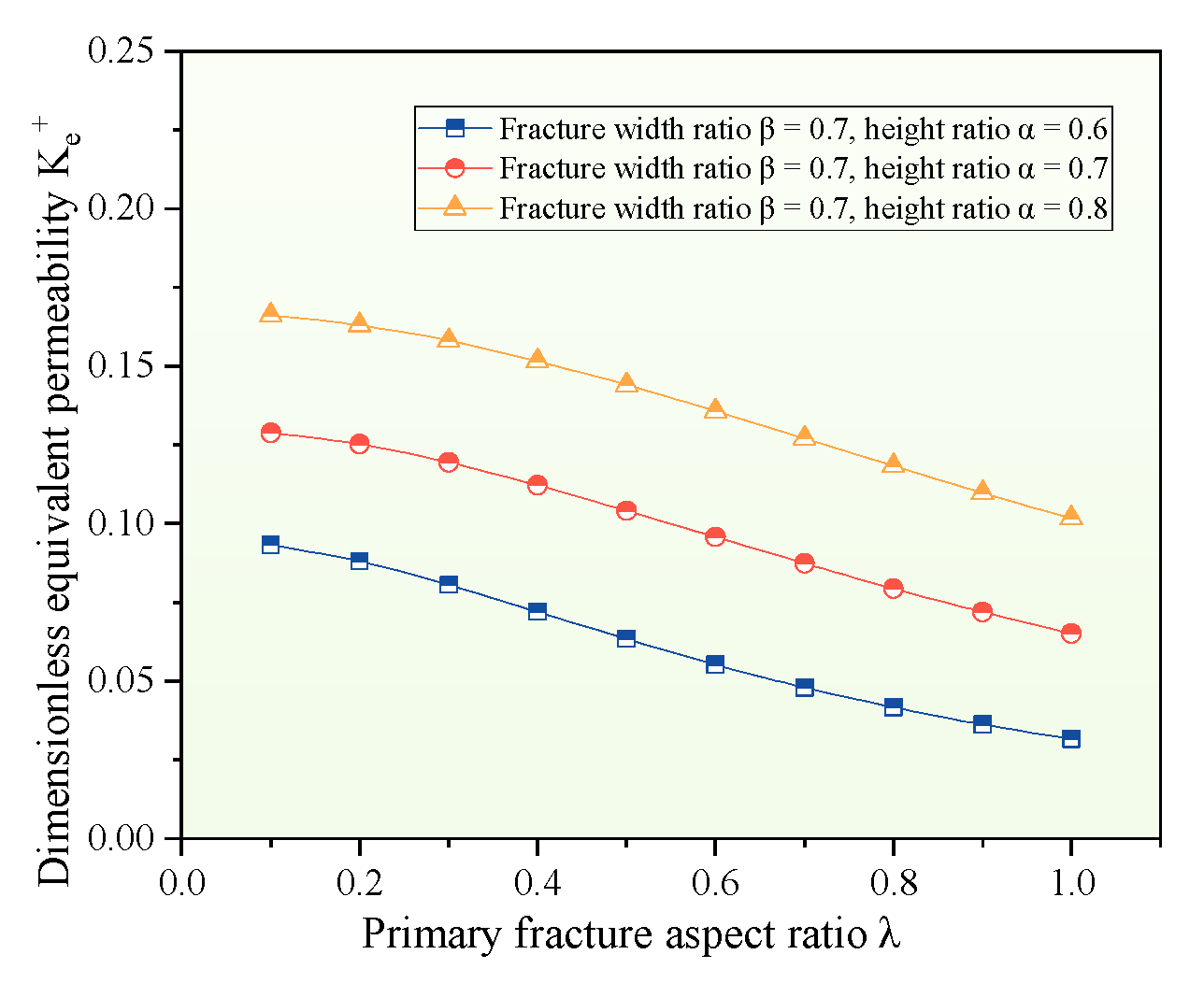
3.2.2. Effect of the Main-Fracture Aspect Ratio λ on the Equivalent Permeability
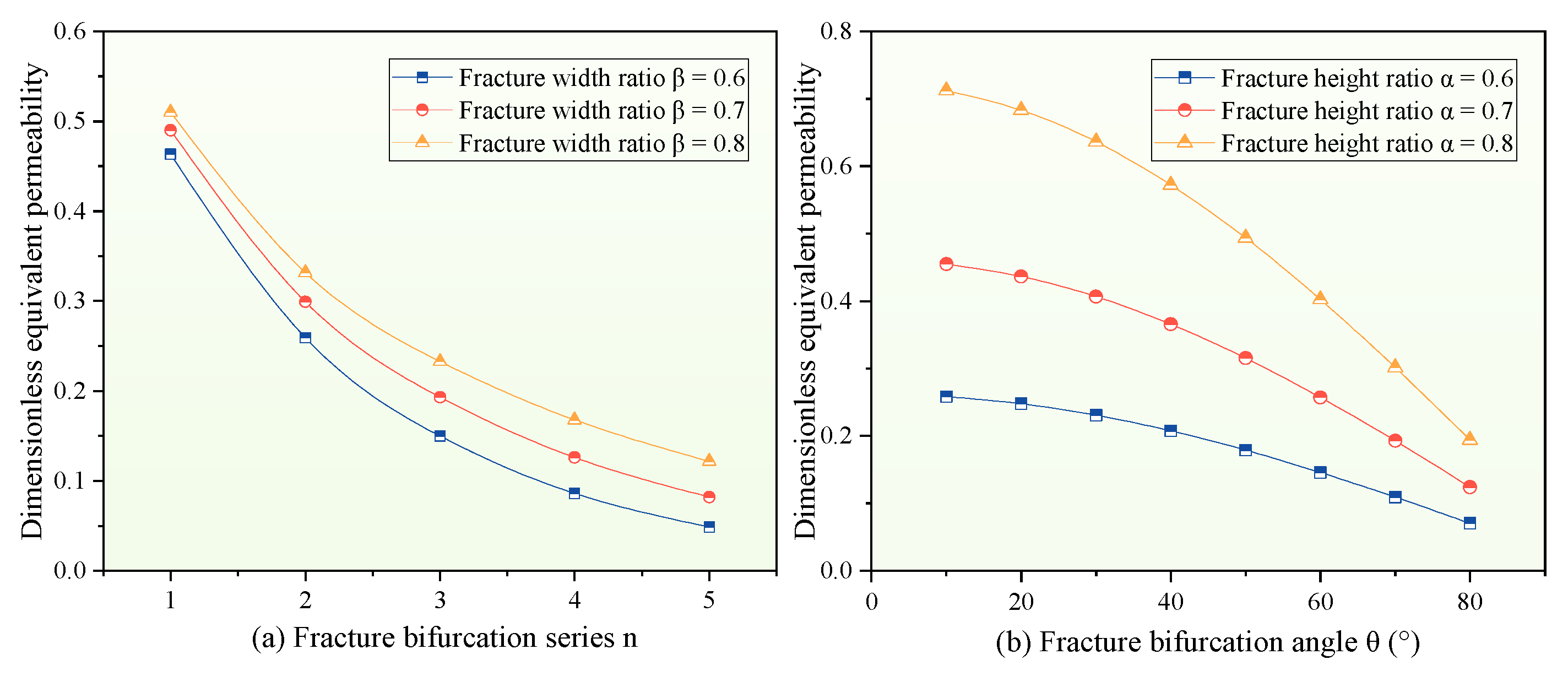
3.2.3. Effects of the Branching Order n and Branching Angle θ
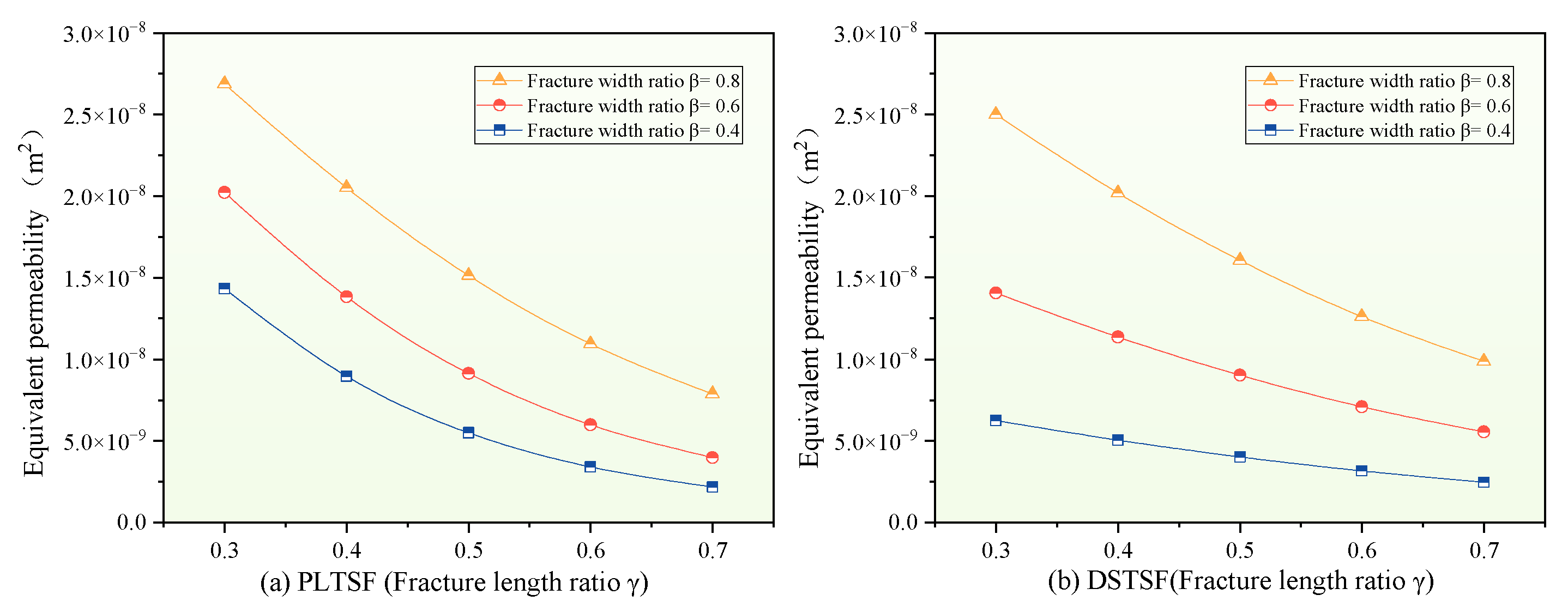
3.3. Comparison of Equivalent Permeability Between Different Cross-Sections
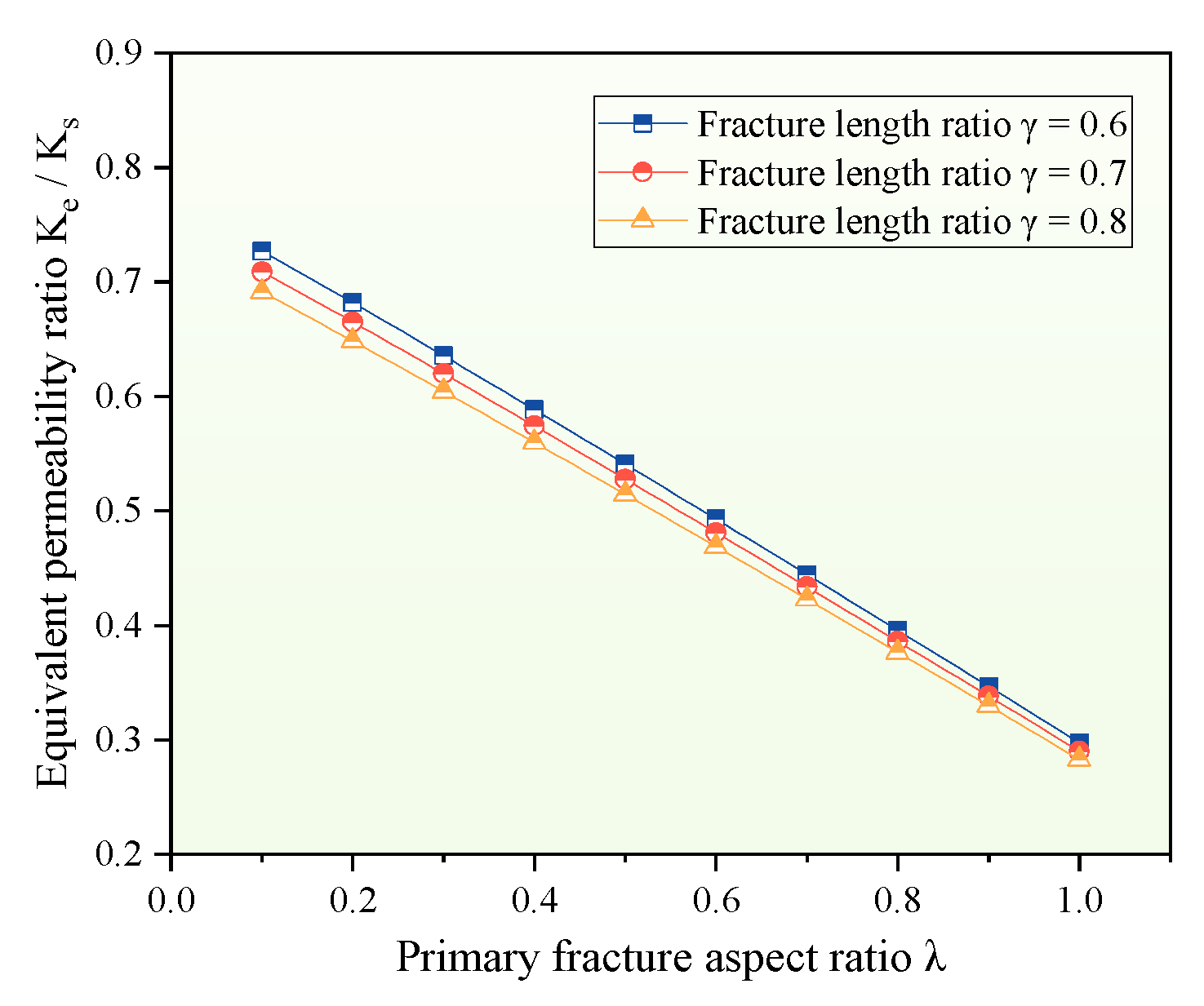
3.3.1. Effect of the Main-Fracture Width-to-Height Ratio λ
3.3.2. Effects of the Width Ratio β and Height Ratio α
3.3.3. Effect of the Branching Order n
3.4. Gas Type and Slip Effects
3.5. Limitations and Implications for Depleted-Reservoir UHS
- (1)
- This study focused on the fracture-dominated, pressure-driven flow, in which case, the matrix advective flow is typically much smaller than fracture flow and treated as a low-permeability boundary. However, hydrogen diffusion into the matrix can be non-negligible in some reservoirs. This behavior depends on pore structure and residence time. Capturing this effect requires coupling the present model with a fracture–matrix mass-transfer description.
- (2)
- Steady-state, single-phase gas flow is assumed to enable the analytical derivations and to quantify the flow capacity of tree-shaped fracture networks. Field injection and production are transient. Local two-phase effects (for example, hydrogen–brine) can also occur during pressure cycling. Therefore, the present results are best interpreted as a parametric baseline for fracture-network flow capacity. Extensions to transient and multiphase flow remain needed.
- (3)
- The comparison among hydrogen, nitrogen, and methane is made using apparent equivalent permeability. In practice, injection and production also depend on viscosity, density, and real-gas behavior, near-wellbore conditions, and operational constraints. These factors should be considered when permeability-based trends are translated into field-scale performance metrics.
- (4)
- Elliptical and rectangular cross-sections are used to derive permeability relations. Natural and induced fractures often exhibit roughness and variable aperture. These features can cause deviations from idealized conductivity relations and can modify near-wall transport. In engineering applications, such effects may be handled by correction factors or by calibration against laboratory and field data.
- (5)
- Fracture apertures and network geometry are treated as prescribed and time-invariant. Under cyclic injection and withdrawal, changes in effective stress can induce stress-sensitive aperture evolution and alter conductivity. Coupling the framework with stress-dependent aperture models would improve long-term applicability.
- (6)
- The REV-scale extension relies on statistical descriptors inferred from field observations (e.g., fracture volume fraction and network parameters). Sensitivity and uncertainty analyses, together with calibration using laboratory tests and field monitoring data, are recommended for engineering use.
- (7)
- Branch fractures can have sub-millimetre apertures. The Knudsen number can then increase, and slip-to-transition behavior can occur. In that regime, a first-order Klinkenberg correction can be insufficient. More comprehensive models may be required, such as the Beskok–Karniadakis–Civan model or dusty-gas formulations. The present framework adopts the first-order correction as an engineering approximation over the operating pressure range considered.
4. Conclusions
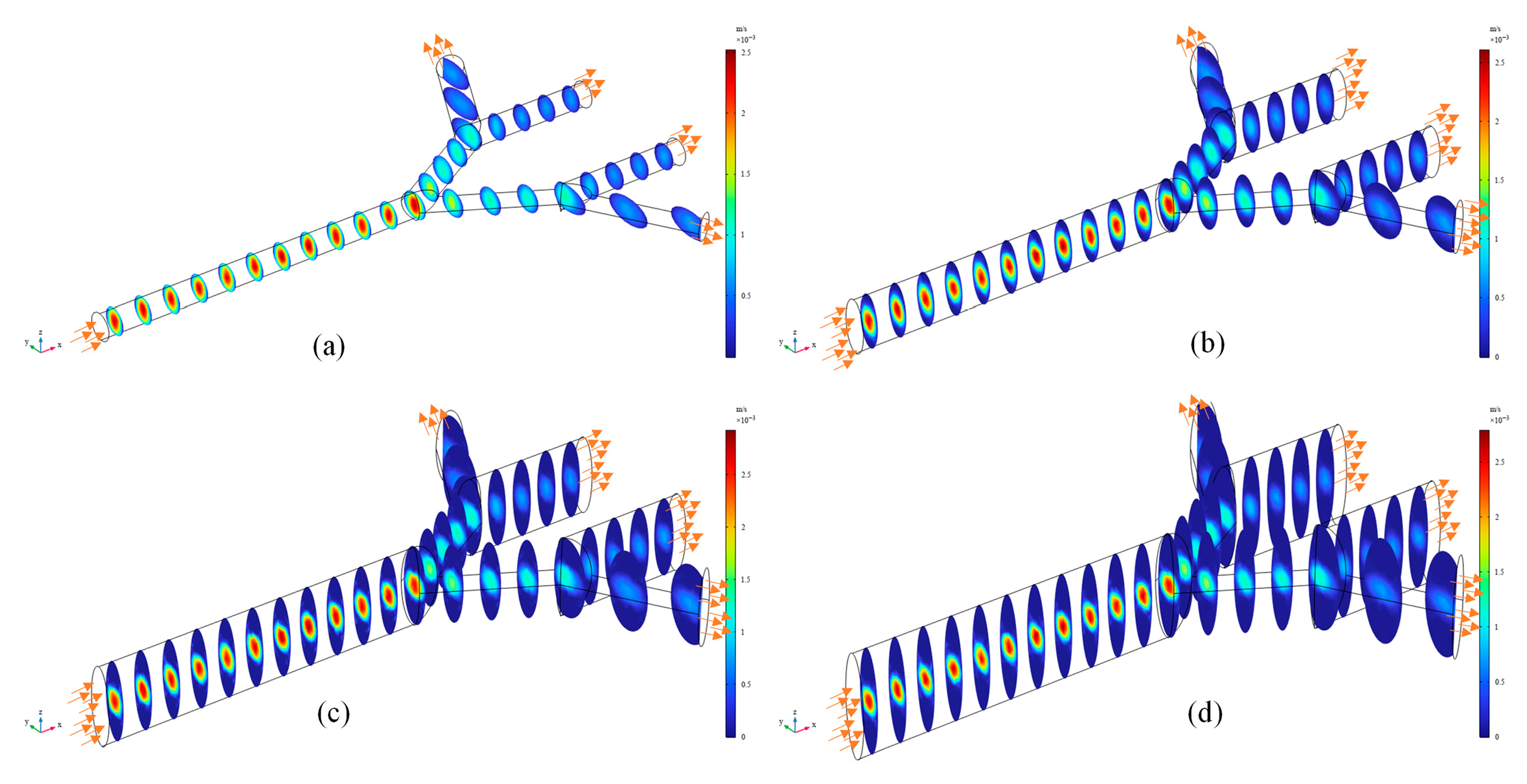
- The analytical predictions agreed well with three-dimensional numerical simulations under the sameconditions. The relative errors were generally within 3–5%, indicating the reliability of the proposed formulation.
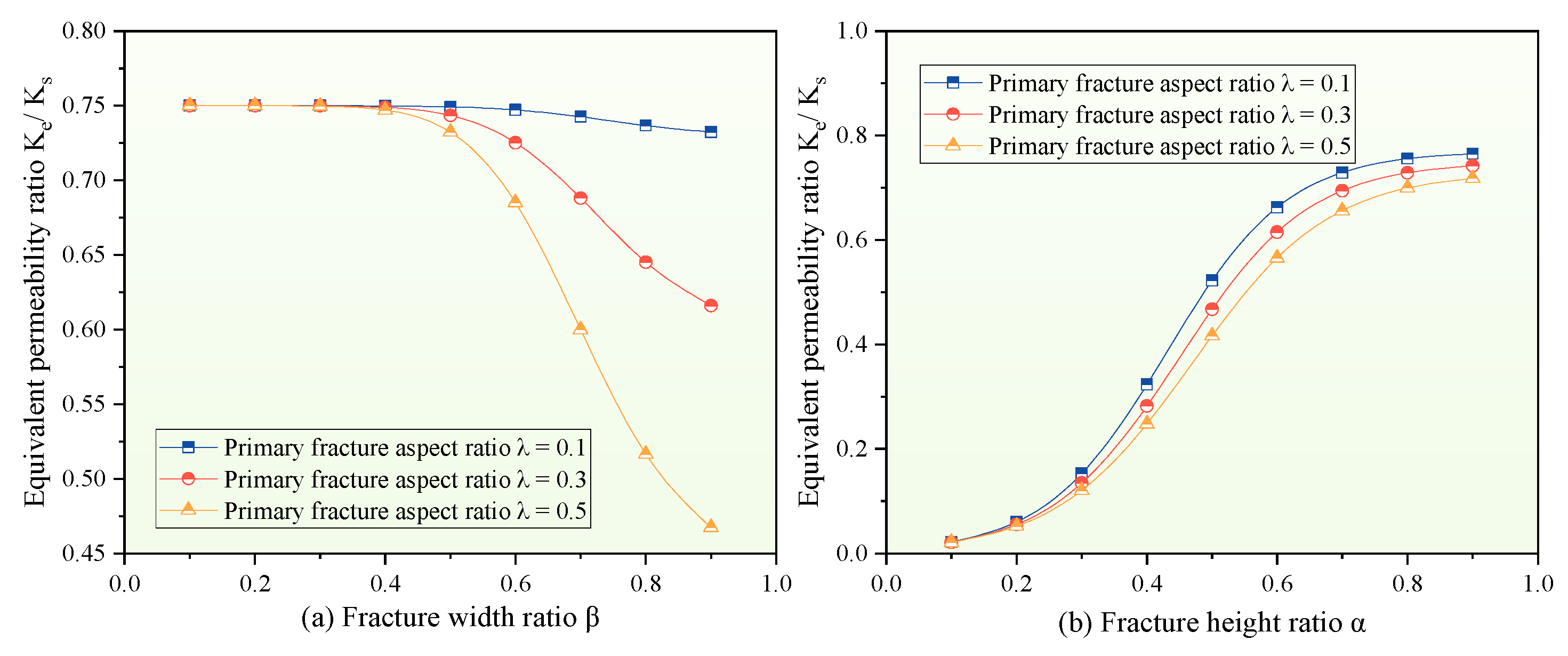
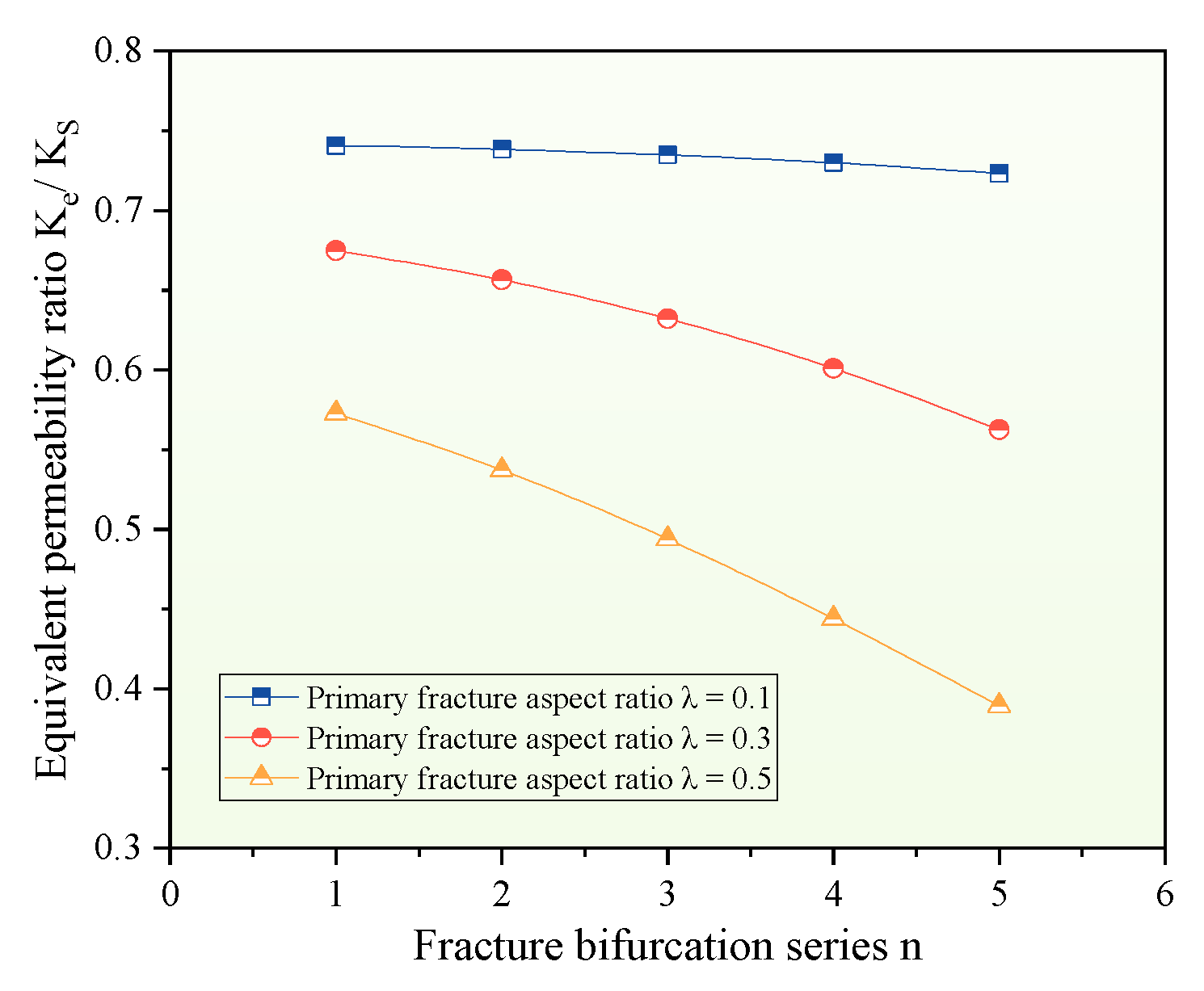
- The width ratio β was the primary parameter controlling the flow capacity of tree-shaped fracture networks. The height ratio α modulated this effect at a given β. In contrast, increasing γ, λ0, n, and θ reduced the equivalent permeability, because longer and more tortuous flow paths were produced.
- Under identical geometric parameters, the flow capacity of DSTSF was higher than that of PLTSF. Rectangular cross-sections consistently yielded higher equivalent permeability than elliptical cross-sections. The conductivity disadvantage of the elliptical cross-section became more pronounced for main fractures with a more extreme aspect ratio (λ), together with higher branching order, larger width ratios, and smaller height ratios.
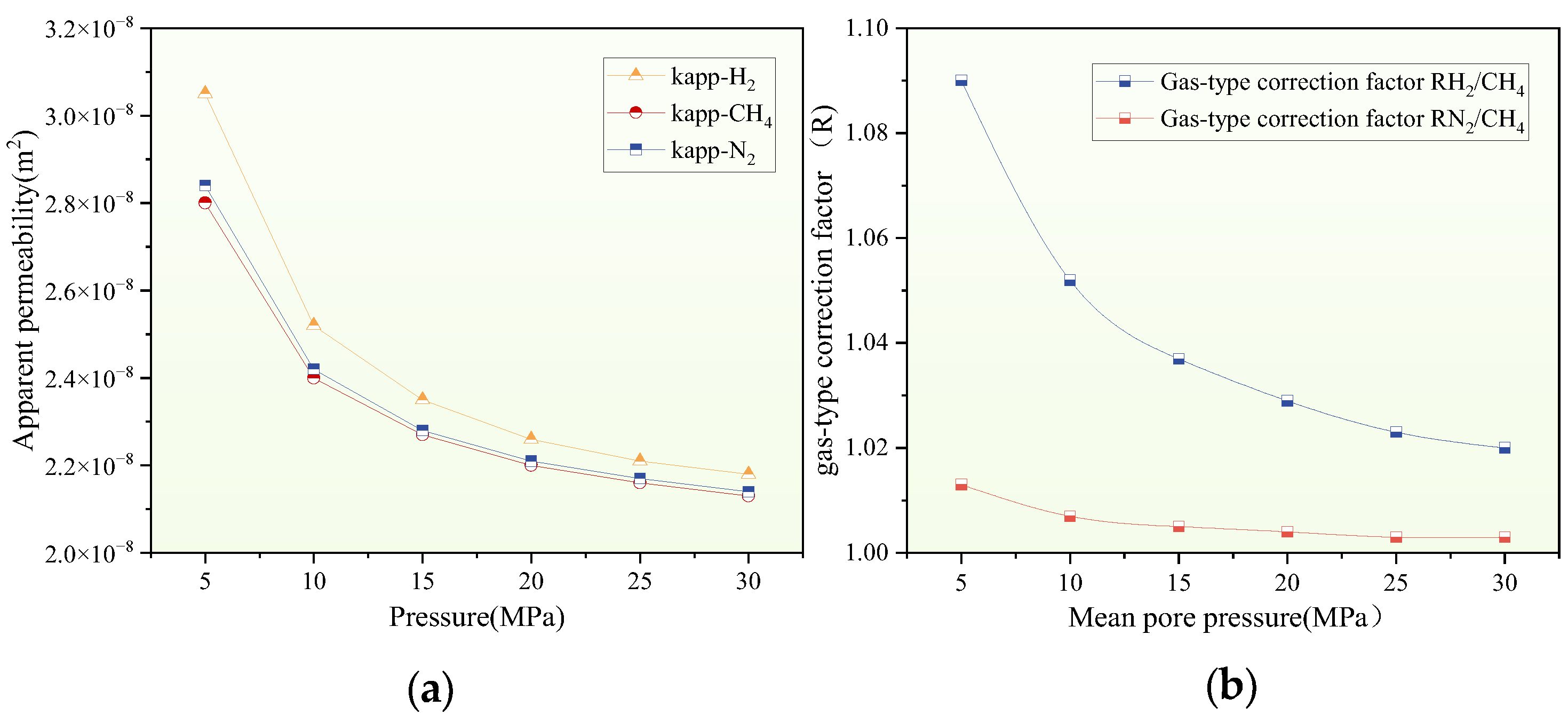
- Under the same conditions, the apparent permeability of hydrogen was approximately 2–9% higher than that of methane and nitrogen. The difference was weakened as pressure increased, and inter-gas differences remained modest over the investigated range. Therefore, when direct hydrogen measurements were limited, a near-constant correction factor could be used as a practical approximation for converting methane- or nitrogen-based permeability estimates to hydrogen conditions.
- At the REV scale, the bulk permeability was governed mainly by fracture-network geometry, scale, and connectivity, followed by the influence of gas type under depleted-reservoir underground hydrogen storage conditions.
Author Contributions
Funding
Data Availability Statement
Conflicts of Interest
Abbreviations
| l0 | Primary fracture length (m) | Ψe | Geometric dimensionless function for ellipse |
| h0 | Primary fracture height (m) | Ψs | Geometric dimensionless function for rectangle |
| w0 | Primary fracture width (m) | Ω | Dimensionless function depending only on geometry |
| θ | Fracture bifurcation angle (°) | A | Equivalent cross-sectional area (m2) |
| n | Branching order | pm | Mean pore pressure (arithmetic mean) (MPa) |
| m | Number of daughter branches per level (branching multiplicity) | kapp,g | Apparent (slip-corrected) equivalent permeability for gas (g) (m2) |
| γ | Fracture length ratio | bH2 | Klinkenberg coefficient of H2 (MPa) |
| α | Fracture height ratio | bg | Klinkenberg coefficient for gas (g) (MPa) |
| β | Fracture width ratio | ηg | Gas-type correction factor |
| lj | Length of level-j fracture | dg | Molecular kinetic diameter of gas (g) (nm) |
| hj | Height of level-j fracture | dref | Reference molecular diameter (m) |
| wj | Width of level-j fracture | bref | Reference Klinkenberg coefficient (MPa) |
| λ | Primary fracture aspect ratio for elliptical cross-section | T | Temperature (K or °C) |
| φj | Angle between level-(j) fracture and primary fracture (°) | Kn | Knudsen number |
| Φ | Total propagation (extension) angle (°) | KREV | REV-scale equivalent permeability (m2) |
| Vfe | Volume of TS fracture with elliptical cross-section (m3) | km | Matrix permeability (m2) |
| Vfs | Volume of TS fracture with rectangular cross-section (m3) | φf | Fracture volume fraction |
| Lfe | Total length of TS fracture with elliptical cross-section (m) | Vf | Fracture volume (m3) |
| Lfs | Total length of TS fracture with rectangular cross-section (m) | VREV | REV volume (m3) |
| Afe | Equivalent cross-sectional area (elliptical) (m2) | TSF | tree-shaped fracture |
| Afs | Equivalent cross-sectional area (rectangular) (m2) | PLTSF | point–line tree-shaped fracture |
| Ae | Equivalent cross-sectional area for ellipse (m2) | DSTSF | disk-shaped tree-shaped fracture |
| As | Equivalent cross-sectional area for rectangle (m2) | REV | representative elementary volume |
| L0n | Characteristic length of TS fractures (m) | KsL | Equivalent permeability for PLTSF (rectangular) (m2) |
| μ | Fluid viscosity (mPa·s) | KeC | Equivalent permeability for DSTSF (elliptical) (m2) |
| μg | Gas viscosity (Pa·s) | KsC | Equivalent permeability for DSTSF (rectangular) (m2) |
| Qe | Fluid flow rate in fracture (elliptical) (m3/s) | Ke0 | Permeability of primary fracture in TS fracture (elliptical) (m2) |
| Qs | Fluid flow rate in fracture (rectangular) (m3/s) | Ks0 | Permeability of primary fracture in TS fracture (rectangular) (m2) |
| Qg | Total flow rate through primary fracture cross-section (m3/s) | Keq | Intrinsic equivalent permeability without slip (m2) |
| Δpj,e | Pressure drop across level-(j) fracture ends (ellipse) (Pa) | Ke, Ks | General equivalent permeability (ellipse/rectangle) (m2) |
| Δpj,s | Pressure drop across level-(j) fracture ends (rectangle) (Pa) | K+eL | Dimensionless permeability for PLTSF (elliptical) |
| Δpe | Total pressure drop when cross-section is ellipse (Pa) | K+sL | Dimensionless permeability for PLTSF (rectangular) |
| Δps | Total pressure drop when cross-section is rectangle (Pa) | K+sC | Dimensionless permeability for DSTSF (rectangular) |
| K+eC | Dimensionless permeability for DSTSF (elliptical) |
References
- Liu, J.; Yang, C.; Song, R.; Wanyan, Q.; Nakayama, A.; Xiong, J. Advances of Geological Storage Engineering and Technology. GeoStorage 2025, 1, 1–26. [Google Scholar] [CrossRef]
- Ali, M.; Isah, A.; Yekeen, N.; Hassanpouryouzband, A.; Sarmadivaleh, M.; Okoroafor, E.R.; Al Kobaisi, M.; Mahmoud, M.; Vahrenkamp, V.; Hoteit, H. Recent progress in underground hydrogen storage. Energy Environ. Sci. 2025, 18, 5740–5810. [Google Scholar] [CrossRef]
- Tarkowski, R. Underground hydrogen storage: Characteristics and prospects. Renew. Sustain. Energy Rev. 2019, 105, 86–94. [Google Scholar] [CrossRef]
- Song, Y.; Song, R.; Liu, J.; Yang, C. Evaluation on H2, N2, He & CH4 diffusivity in rock and leakage rate by diffusion in underground gas storage. Int. J. Hydrogen Energy 2025, 100, 234–248. [Google Scholar]
- Miocic, J.; Heinemann, N.; Edlmann, K.; Scafidi, J.; Molaei, F.; Alcalde, J. Underground Hydrogen Storage: A Review; The Geological Society of London: London, UK, 2023. [Google Scholar]
- Zeng, L.; Sander, R.; Chen, Y.; Xie, Q. Hydrogen storage performance during underground hydrogen storage in depleted gas reservoirs: A review. Engineering 2024, 40, 211–225. [Google Scholar] [CrossRef]
- Song, R.; Feng, D.; Hui, G.; Liu, J.; Yang, C. Visualized experiments on the hydrogen transports and bubble ripening mechanism in porous reservoir of underground hydrogen storage. Int. J. Hydrogen Energy 2025, 105, 326–344. [Google Scholar] [CrossRef]
- Yang, J.; Wang, H.; Li, P. Underground Granaries: Performance, Mechanisms and Technological Challenges. GeoStorage 2025, 1, 27–41. [Google Scholar] [CrossRef]
- Hao, M.; Bai, B.; Shi, L.; Lei, H.; Yang, H.; Yang, D. Two-phase Seepage Pore Pressure Diffusion Wave-saturation Model and Its Application in CO2 Geological Storage. GeoStorage 2025, 1, 42–55. [Google Scholar] [CrossRef]
- Perera, M. A review of underground hydrogen storage in depleted gas reservoirs: Insights into various rock-fluid interaction mechanisms and their impact on the process integrity. Fuel 2023, 334, 126677. [Google Scholar] [CrossRef]
- Sadkhan, R.A.; Al-Mudhafar, W.J. Key aspects of underground hydrogen storage in depleted hydrocarbon reservoirs and saline aquifers: A review and understanding. Energy Geosci. 2024, 5, 100339. [Google Scholar] [CrossRef]
- Han, Z.; Fan, M.; Xu, D.; Bi, G. A Study of Stability and Pericavity Strain in an Underground Cavern Group for Compressed Air Energy Storage. GeoStorage 2025, 1, 56–70. [Google Scholar] [CrossRef]
- Song, R.; Feng, D.; Liu, J.; Yang, C.; Zou, S. A Review of Underground Hydrogen Storage in Depleted Oil and Gas Reservoirs. Int. J. Energy Res. 2025, 2025, 9246074. [Google Scholar] [CrossRef]
- Deng, J.; He, J.; Gao, L. Productivity model for multi-fractured horizontal wells accounting for cross-scale flow of gas and total factor characteristics of fractures. Fuel 2024, 360, 130581. [Google Scholar] [CrossRef]
- Tang, D.; Wu, J.; Zhao, J.; Zeng, B.; Song, Y.; Shen, C.; Ren, L.; Wang, Y.; Wang, Z. Numerical simulation on fracturing fluid flowback from post-fracturing shale gas wells and influencing factors. J. Pet. Explor. Prod. Technol. 2025, 15, 33. [Google Scholar] [CrossRef]
- Wu, M.; Song, R.; Zhu, Z.; Liu, J. A study on equivalent permeability models for tree-shaped fractures with different geometric parameters. Gas Sci. Eng. 2023, 112, 204946. [Google Scholar] [CrossRef]
- Liu, B.; Xu, J.; Wang, F.; Pan, R.; Lin, H.; Zhou, Y.; Yao, T. Study on Microseismic Monitoring Technology in Borehole in a CCUS-EOR Project. GeoStorage 2025, 1, 125–136. [Google Scholar] [CrossRef]
- Zhang, T. Temperature-treated Sandstone: Mechanical and Failure Behaviour under Triaxial Cyclic Loading. GeoStorage 2025, 1, 113–124. [Google Scholar] [CrossRef]
- Liu, J.; Lu, M.; Sheng, G. Description of Fracture Network of Hydraulic Fracturing Vertical Wells in Unconventional Reservoirs. Front. In Advances in Multi-Scale Multi-Physics Geophysical Modelling and Fluid Transport in Unconventional Oil and Gas Reservoir; Frontiers Media SA: Lausanne, Switzerland, 2022; Volume 9, p. 75352950. [Google Scholar]
- Jin, Y.; Zhao, B.; Yang, Y.; Dong, J.; Song, H.; Tian, Y.; Pan, J. Intelligent extraction of complexity types in fractal reservoir and its significance to estimate transport property. Fractals 2024, 32, 2450070. [Google Scholar] [CrossRef]
- Song, R.; Liu, J.; Yang, C.; Sun, S. Study on the multiphase heat and mass transfer mechanism in the dissociation of methane hydrate in reconstructed real-shape porous sediments. Energy 2022, 254, 124421. [Google Scholar] [CrossRef]
- Rezaei, A.; Hassanpouryouzband, A.; Molnar, I.; Derikvand, Z.; Haszeldine, R.S.; Edlmann, K. Relative permeability of hydrogen and aqueous brines in sandstones and carbonates at reservoir conditions. Geophys. Res. Lett. 2022, 49, e2022GL099433. [Google Scholar] [CrossRef]
- Lysyy, M.; Føyen, T.; Johannesen, E.B.; Fernø, M.; Ersland, G. Hydrogen relative permeability hysteresis in underground storage. Geophys. Res. Lett. 2022, 49, e2022GL100364. [Google Scholar] [CrossRef]
- Boon, M.; Hajibeygi, H. Experimental characterization of H2/water multiphase flow in heterogeneous sandstone rock at the core scale relevant for underground hydrogen storage (UHS). Sci. Rep. 2022, 12, 14604. [Google Scholar] [CrossRef]
- Al-Yaseri, A.; Esteban, L.; Giwelli, A.; Sarout, J.; Lebedev, M.; Sarmadivaleh, M. Initial and residual trapping of hydrogen and nitrogen in Fontainebleau sandstone using nuclear magnetic resonance core flooding. Int. J. Hydrogen Energy 2022, 47, 22482–22494. [Google Scholar] [CrossRef]
- Hashemi, L.; Glerum, W.; Farajzadeh, R.; Hajibeygi, H. Contact angle measurement for hydrogen/brine/sandstone system using captive-bubble method relevant for underground hydrogen storage. Adv. Water Resour. 2021, 154, 103964. [Google Scholar] [CrossRef]
- Li, J.; Sultan, A.S. Klinkenberg slippage effect in the permeability computations of shale gas by the pore-scale simulations. J. Nat. Gas Sci. Eng. 2017, 48, 197–202. [Google Scholar] [CrossRef]
- Zou, J.; Yue, X.; An, W.; Gu, J.; Wang, L. Applicability analysis of klinkenberg slip theory in the measurement of tight core permeability. Energies 2019, 12, 2351. [Google Scholar] [CrossRef]
- Yuan, L.; Najafimarghmaleki, A.; Dehghanpour, H. Measuring hydrogen permeability of salt rock for applications in energy storage. In Proceedings of the SPE Annual Technical Conference and Exhibition, New Orleans, LA, USA, 23–25 September 2024; SPE: Richardson, TX, USA, 2024; p. D031S031R009. [Google Scholar]
- Huang, T.; Moridis, G.J.; Blasingame, T.A.; Abdulkader, A.M.; Yan, B. Compositional reservoir simulation of underground hydrogen storage in depleted gas reservoirs. Int. J. Hydrogen Energy 2023, 48, 36035–36050. [Google Scholar] [CrossRef]
- Wang, Y.; Liu, S.; Zhao, Y. Modeling of permeability for ultra-tight coal and shale matrix: A multi-mechanistic flow approach. Fuel 2018, 232, 60–70. [Google Scholar] [CrossRef]
- Ghomashchi, R. An Introduction to Fundamentals of Diffusion in Solid State Materials; CRC Press: Boca Raton, FL, USA, 2024. [Google Scholar]
- Karimi-Fard, M.; Gong, B.; Durlofsky, L.J. Generation of coarse-scale continuum flow models from detailed fracture characterizations. Water Resour. Res. 2006, 42, W10423. [Google Scholar] [CrossRef]
- Lee, S.H.; Lough, M.; Jensen, C. Hierarchical modeling of flow in naturally fractured formations with multiple length scales. Water Resour. Res. 2001, 37, 443–455. [Google Scholar] [CrossRef]
- Sweeney, M.R.; Gable, C.W.; Karra, S.; Stauffer, P.H.; Pawar, R.J.; Hyman, J.D. Upscaled discrete fracture matrix model (UDFM): An octree-refined continuum representation of fractured porous media. Comput. Geosci. 2020, 24, 293–310. [Google Scholar] [CrossRef]
- Wang, H.; Jie, Y.; Zhou, D.; Ma, X. Underground hydrogen storage in depleted gas reservoirs with hydraulic fractures: Numerical modeling and simulation. J. Energy Storage 2024, 97, 112777. [Google Scholar] [CrossRef]
- Zamehrian, M.; Sedaee, B. A comparative analysis of gas mixing during the underground hydrogen storage in a conventional and fractured reservoir. Gas Sci. Eng. 2024, 122, 205217. [Google Scholar] [CrossRef]
- Song, R.; Wu, M.; Liu, J.; Yang, C. Pore scale modeling on microbial hydrogen consumption and mass transfer of multicomponent gas flow in underground hydrogen storage of depleted reservoir. Energy 2024, 306, 132534. [Google Scholar] [CrossRef]
- Fisher, M.; Heinze, J.; Harris, C.; Davidson, B.; Wright, C.; Dunn, K. Optimizing horizontal completion techniques in the Barnett shale using microseismic fracture mapping. In Proceedings of the SPE Annual Technical Conference and Exhibition, Houston, TX, USA, 26–29 September 2004; SPE: Richardson, TX, USA, 2004; p. SPE–90051-MS. [Google Scholar]
- Warpinski, N.R.; Mayerhofer, M.J.; Vincent, M.C.; Cipolla, C.L.; Lolon, E. Stimulating unconventional reservoirs: Maximizing network growth while optimizing fracture conductivity. J. Can. Pet. Technol. 2009, 48, 39–51. [Google Scholar] [CrossRef]
- Mayerhofer, M.J.; Lolon, E.P.; Warpinski, N.R.; Cipolla, C.L.; Walser, D.; Rightmire, C.M. What is stimulated reservoir volume? SPE Prod. Oper. 2010, 25, 89–98. [Google Scholar] [CrossRef]
- Cipolla, C.L.; Warpinski, N.R.; Mayerhofer, M.J.; Lolon, E.P.; Vincent, M.C. The relationship between fracture complexity, reservoir properties, and fracture treatment design. In Proceedings of the SPE Annual Technical Conference and Exhibition, Denver, CO, USA, 21–24 September 2008; SPE: Richardson, TX, USA, 2008; p. SPE–115769-MS. [Google Scholar]
- Zamehrian, M.; Sedaee, B. Underground hydrogen storage in a naturally fractured gas reservoir: The role of fracture. Int. J. Hydrogen Energy 2022, 47, 39606–39618. [Google Scholar] [CrossRef]
- Wang, H. Theory of Linear Poroelasticity with Applications to Geomechanics and Hydrogeology; Princeton University Press: Princeton, NJ, USA, 2000. [Google Scholar]
- Li, D.; Emami-Meybodi, H. Hydrogen mixing dynamics in depleted gas reservoirs. In Proceedings of the SPE Annual Technical Conference and Exhibition, New Orleans, LA, USA, 23–25 September 2024; SPE: Richardson, TX, USA, 2024; p. D031S031R008. [Google Scholar]
- Suzuki, A.; Watanabe, N.; Li, K.; Horne, R.N. Fracture network created by 3-D printer and its validation using CT images. Water Resour. Res. 2017, 53, 6330–6339. [Google Scholar] [CrossRef]
- Gong, B.; Karimi-Fard, M.; Durlofsky, L.J. An upscaling procedure for constructing generalized dual-porosity/dual-permeability models from discrete fracture characterizations. In Proceedings of the SPE Annual Technical Conference and Exhibition, San Antonio, TX, USA, 24–27 September 2006; SPE: Richardson, TX, USA, 2006; p. SPE–102491-MS. [Google Scholar]
- Gong, B.; Karimi-Fard, M.; Durlofsky, L.J. Upscaling discrete fracture characterizations to dual-porosity, dual-permeability models for efficient simulation of flow with strong gravitational effects. SPE J. 2008, 13, 58–67. [Google Scholar] [CrossRef]
- Li, J.; Lei, Z.; Qin, G.; Gong, B. Effective local-global upscaling of fractured reservoirs under discrete fractured discretization. Energies 2015, 8, 10178–10197. [Google Scholar] [CrossRef]
- Dershowitz, W.; La Pointe, P.; Doe, T. Advances in discrete fracture network modeling. In Proceedings of the US EPA/NGWA Fractured Rock Conference, Portland, Maine, 13–15 September 2004; pp. 882–894. [Google Scholar]
- Long, J.C.; Remer, J.; Wilson, C.; Witherspoon, P. Porous media equivalents for networks of discontinuous fractures. Water Resour. Res. 1982, 18, 645–658. [Google Scholar] [CrossRef]
- Oda, M. Permeability tensor for discontinuous rock masses. Geotechnique 1985, 35, 483–495. [Google Scholar] [CrossRef]
- Berkowitz, B. Characterizing flow and transport in fractured geological media: A review. Adv. Water Resour. 2002, 25, 861–884. [Google Scholar] [CrossRef]
- Cacas, M.-C.; Ledoux, E.; de Marsily, G.; Tillie, B.; Barbreau, A.; Durand, E.; Feuga, B.; Peaudecerf, P. Modeling fracture flow with a stochastic discrete fracture network: Calibration and validation: 1. The flow model. Water Resour. Res. 1990, 26, 479–489. [Google Scholar] [CrossRef]
- Painter, S.; Cvetkovic, V. Upscaling discrete fracture network simulations: An alternative to continuum transport models. Water Resour. Res. 2005, 41, W02002. [Google Scholar] [CrossRef]
- Hadgu, T.; Karra, S.; Kalinina, E.; Makedonska, N.; Hyman, J.D.; Klise, K.; Viswanathan, H.S.; Wang, Y. A comparative study of discrete fracture network and equivalent continuum models for simulating flow and transport in the far field of a hypothetical nuclear waste repository in crystalline host rock. J. Hydrol. 2017, 553, 59–70. [Google Scholar] [CrossRef]
- Witherspoon, P.A.; Wang, J.S.; Iwai, K.; Gale, J.E. Validity of cubic law for fluid flow in a deformable rock fracture. Water Resour. Res. 1980, 16, 1016–1024. [Google Scholar] [CrossRef]
- Zimmerman, R.W.; Bodvarsson, G.S. Hydraulic conductivity of rock fractures. Transp. Porous Media 1996, 23, 1–30. [Google Scholar] [CrossRef]
- Karimi-Fard, M.; Durlofsky, L.J.; Aziz, K. An efficient discrete-fracture model applicable for general-purpose reservoir simulators. SPE J. 2004, 9, 227–236. [Google Scholar] [CrossRef]
- Moinfar, A.; Varavei, A.; Sepehrnoori, K.; Johns, R.T. Development of an efficient embedded discrete fracture model for 3D compositional reservoir simulation in fractured reservoirs. SPE J. 2014, 19, 289–303. [Google Scholar] [CrossRef]
- Liu, X.; Zhang, L.; Zhao, Y.; He, X.; Wu, J.; Su, S. Shale gas transport in nanopores: Contribution of different transport mechanisms and influencing factors. Energy Fuels 2021, 35, 2033–2047. [Google Scholar] [CrossRef]
- Chen, X.; Yao, G. An improved model for permeability estimation in low permeable porous media based on fractal geometry and modified Hagen-Poiseuille flow. Fuel 2017, 210, 748–757. [Google Scholar] [CrossRef]
- Liu, R.; Jiang, Y.; Li, B.; Yu, L. Estimating permeability of porous media based on modified Hagen–Poiseuille flow in tortuous capillaries with variable lengths. Microfluid. Nanofluidics 2016, 20, 120. [Google Scholar] [CrossRef]
- Karniadakis, G.; Beskok, A.; Aluru, N. Microflows and Nanoflows: Fundamentals and Simulation; Springer: New York, NY, USA, 2005. [Google Scholar]
- Yuan, L.; Najafimarghmaleki, A.; Dehghanpour, H. Investigating the effects of flow regime on hydrogen transport in salt rock. Fuel 2025, 401, 135737. [Google Scholar] [CrossRef]
- Takasaki, Y.; Takamizawa, S. Gas permeation in a molecular crystal and space expansion. J. Am. Chem. Soc. 2014, 136, 6806–6809. [Google Scholar] [CrossRef]
- Wang, S.; Pan, S.; Tang, Y.; Mu, Y.; Gao, Y.; Wang, K. Hydrogen-methane transport in clay nanopores: Insights from molecular dynamics simulations. Int. J. Hydrogen Energy 2024, 69, 1450–1459. [Google Scholar] [CrossRef]
- Appiah Kubi, E.; Rahnema, H.; Koray, A.-M.; Shabani, B. Underground Hydrogen Storage: Steady-State Measurement of Hydrogen–Brine Relative Permeability with Gas Slip Correction. Gases 2025, 5, 26. [Google Scholar] [CrossRef]
- Arekhov, V.; Zhainakov, T.; Clemens, T.; Wegner, J. Measurement of effective hydrogen-methane gas diffusion coefficients in reservoir rocks. SPE Reserv. Eval. Eng. 2023, 26, 1242–1257. [Google Scholar] [CrossRef]
- Bear, J. Dynamics of Fluids in Porous Media; Courier Corporation: North Chelmsford, MA, USA, 2013. [Google Scholar]
- Nelson, R.A. Geologic Analysis of Naturally Fractured Reservoirs; Gulf Professional Publishing: Houston, TX, USA, 1985. [Google Scholar]
- Figueiredo, B.; Tsang, C.-F.; Rutqvist, J.; Niemi, A. Study of hydraulic fracturing processes in shale formations with complex geological settings. J. Pet. Sci. Eng. 2017, 152, 361–374. [Google Scholar] [CrossRef]
- Michael, E.; Ronald, O.; Peter, V. Unified Fracture Design: Bridging the Gap Between Theory and Practice; Orsa Press: Austin, TX, USA, 2002. [Google Scholar]
- Dake, L.P. Fundamentals of Reservoir Engineering; Elsevier: Amsterdam, The Netherlands, 1983. [Google Scholar]



| Group | Geometry Type | Cross-Section | Main-Fracture Length l0 (mm) | Main-Fracture Width w0 (mm) | Main-Fracture Height h0 (mm) | Length Ratio γ | Width Ratio β | Height Ratio α | Branching Order n | Branches per Level m | Branching Angle θ (°) |
|---|---|---|---|---|---|---|---|---|---|---|---|
| I | DSTSF | Elliptical | 10 | 1.0 | 5.0 | 0.6, 0.7, 0.8 | 0.6, 0.7, 0.8 | 0.6, 0.7, 0.8 | 3 | 2 | 30 |
| II | DSTSF | Rectangular | 10 | 1.0 | 5.0 | 0.6, 0.7, 0.8 | 0.6, 0.7, 0.8 | 0.6, 0.7, 0.8 | 3 | 2 | 30 |
| III | PLTSF | Rectangular | 10 | 1.0 | 5.0 | 0.6, 0.7, 0.8 | 0.6, 0.7, 0.8 | 1.0 | 3 | 2 | 30 |
| IV | DSTSF | Rectangular | 10 | 1.0 | 5.0 | 0.6, 0.7, 0.8 | 0.6, 0.7, 0.8 | 1.0 | 3 | 2 | 30 |
Disclaimer/Publisher’s Note: The statements, opinions and data contained in all publications are solely those of the individual author(s) and contributor(s) and not of MDPI and/or the editor(s). MDPI and/or the editor(s) disclaim responsibility for any injury to people or property resulting from any ideas, methods, instructions or products referred to in the content. |
© 2026 by the authors. Licensee MDPI, Basel, Switzerland. This article is an open access article distributed under the terms and conditions of the Creative Commons Attribution (CC BY) license.
Share and Cite
Feng, D.; Zou, S.; Song, R.; Liu, J.; Peng, J. Study on Hydrogen Seepage Laws in Tree-Shaped Reservoir Fractures of the Storage Formation of Underground Hydrogen Storage in Depleted Oil and Gas Reservoirs Considering Slip Effects. Energies 2026, 19, 671. https://doi.org/10.3390/en19030671
Feng D, Zou S, Song R, Liu J, Peng J. Study on Hydrogen Seepage Laws in Tree-Shaped Reservoir Fractures of the Storage Formation of Underground Hydrogen Storage in Depleted Oil and Gas Reservoirs Considering Slip Effects. Energies. 2026; 19(3):671. https://doi.org/10.3390/en19030671
Chicago/Turabian StyleFeng, Daiying, Shangjun Zou, Rui Song, Jianjun Liu, and Jiajun Peng. 2026. "Study on Hydrogen Seepage Laws in Tree-Shaped Reservoir Fractures of the Storage Formation of Underground Hydrogen Storage in Depleted Oil and Gas Reservoirs Considering Slip Effects" Energies 19, no. 3: 671. https://doi.org/10.3390/en19030671
APA StyleFeng, D., Zou, S., Song, R., Liu, J., & Peng, J. (2026). Study on Hydrogen Seepage Laws in Tree-Shaped Reservoir Fractures of the Storage Formation of Underground Hydrogen Storage in Depleted Oil and Gas Reservoirs Considering Slip Effects. Energies, 19(3), 671. https://doi.org/10.3390/en19030671