Evaluating and Optimizing Residential Electricity Price Tiers Considering Income Redistribution Equity Under Cross-Subsidies Mechanisms
Abstract
1. Introduction
2. Research Methods
2.1. Cross-Subsidy Mechanism
2.2. Gini Coefficient Method
2.3. Rank-Sum Ratio Method
2.4. Complementary Mechanisms of the Gini Coefficient and Rank-Sum Ratio Methods
3. Data Sources and Analysis
4. TEP Classification Optimization Method
4.1. Evaluation of Grouping Optimization via Inter-Group Gini Coefficients
- The inter-group Gini coefficient between Group 1 and Group 2 was 0.4188 (>0.4), indicating inequitable cross-subsidy distribution between these groups; thus, further subdivision was required. The maximum electricity consumption in Group 1 was 871 kWh, so users in Group 1 were classified into the first tier, with the annual tiered electricity consumption range set as 0–871 kWh.
- The inter-group Gini coefficient between Group 2 and Group 3 was <0.4, so no additional subdivision was needed. However, the inter-group Gini coefficient between Group 3 and Group 4 was 0.3806 (close to 0.4), signifying renewed inequity in inter-group redistribution. The maximum electricity consumption in Group 3 was 2634 kWh, so the second tier was defined as 871–2634 kWh of annual electricity consumption.
- The inter-group Gini coefficients between Group 4 and Groups 5, 6, and 7 were all <0.4 (no subdivision required), while the inter-group Gini coefficient between Group 7 and Group 8 was 0.40832 (>0.4), indicating renewed inequity in cross-subsidy distribution and necessitating subdivision. The maximum electricity consumption in Group 7 was 8167 kWh, so the third tier was set as 2634–8167 kWh of annual electricity consumption.
- The inter-group Gini coefficient between Group 8 and Group 9 was <0.4 (no subdivision required), whereas the inter-group Gini coefficient between Group 8 and Group 10 was 0.449 (>0.4). Consequently, Groups 8 and 9 were merged into the fourth tier; the maximum electricity consumption in Group 9 was 12,247 kWh, so this tier was defined as 8163–12,247 kWh of annual electricity consumption.
- The remaining Group 10 was independently classified into the fifth tier, with the annual electricity consumption range set as ≥12,247 kWh.
4.2. Recalculation and Analysis of the Overall Gini Coefficient
4.3. Recalculation and Analysis of Intra-Group Gini Coefficients
4.4. Recalculation of Inter-Group Gini Coefficients
5. Discussion
5.1. Trends and Drivers of Residential Electricity Consumption and Cross-Subsidies
5.2. Equity of Cross-Subsidy Distribution: Leakage Effect and Income Disparities
5.3. Implications for Optimizing the Tiered Pricing Framework
5.4. Theoretical and Practical Contributions
5.5. Limitations and Future Research
6. Conclusions and Policy Implications
6.1. Conclusions
- The scale of cross-subsidies expands alongside residential power consumption, accompanied by growing subsidy leakage. Over the study period, the average annual residential electricity consumption in Hebei Province rose from 1561.71 kWh to 3232.88 kWh, an increase of 107.0%. The average cross-subsidy amount increased from 122.95 CNY to 777.21 CNY, a surge of 532.2%. Subsidy intensity, defined as the ratio of subsidy amount to total electricity charges, climbed from 2.12% to 41.10%. The distribution of subsidies exhibits clear reverse redistributive characteristics. Users in the third tier, with annual consumption above 3372 kWh, received an average subsidy of 1897.43 CNY. This amount is 149.4 times and 12.1 times the subsidies received by first-tier and second-tier users, respectively. The subsidy intensity of third-tier users reached 36.61%, which is 34.49 percentage points higher than that of first-tier users. These results indicate that high-income and high-consumption groups capture most of the subsidy benefits, while low-income groups gain limited welfare improvement under current policies.
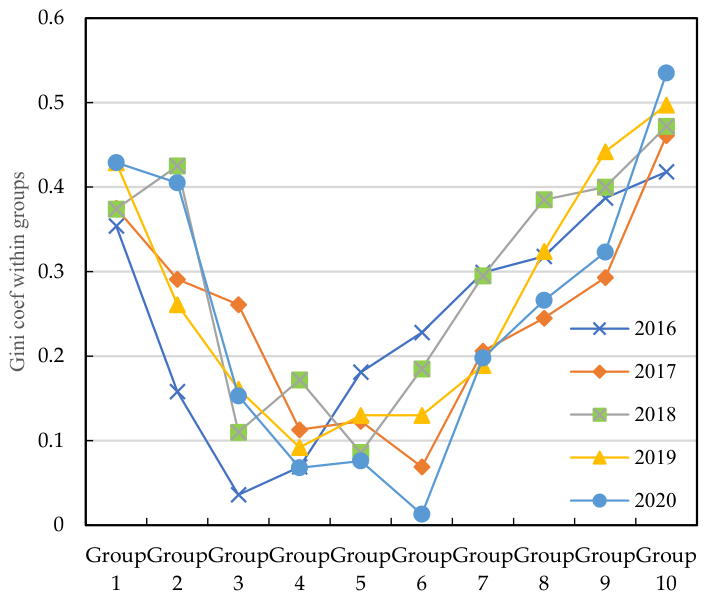
- Gini coefficient analysis identifies the structural sources of unequal cross-subsidy distribution, with inter-group disparity dominating overall inequality. The five-year average overall Gini coefficient stands at 0.449, exceeding the internationally recognized fairness warning line of 0.4. Dagum decomposition results show that inter-group disparity contributes 91.91% to total inequality, while intra-group disparity accounts for only 3.09%. Uneven subsidy distribution primarily stems from structural gaps among consumption groups rather than internal allocation differences within each group. Intra-group Gini coefficients follow an inverted U-shaped trend. The intra-group Gini coefficient reaches 0.392 for low-income group 1 and 0.472 for high-income group 10, both exceeding 0.4. For middle-income groups 3 to 8, the coefficient remains below 0.3. This distribution pattern reflects the insufficient discriminatory power of the current three-tier thresholds for extreme user groups. Subsidy allocation exhibits large fluctuations within low-income groups due to mixed basic living electricity demand, while serious imbalance exists in subsidy distribution among high-income users. Middle-income residents enjoy relatively equitable subsidy benefits because of their homogeneous electricity consumption behavior.
- The optimized scheme based on the rank-sum ratio method effectively improves subsidy distribution fairness. We adjust the 2020 residential power tariff structure of Hebei Province from three tiers to five tiers, with consumption thresholds of 0–871 kWh, 871–2634 kWh, 2634–8167 kWh, 8167–12,247 kWh, and above 12,247 kWh. The average overall Gini coefficient drops from 0.449 to 0.440, a decline of 2.0%. All intra-group Gini coefficients fall below 0.4, with a minimum value of 0.026. Inter-group Gini coefficients remain above 0.4 and peak at 0.852. The contribution rate of inter-group disparity rises to 80.87%. The optimized scheme reduces the first-tier annual consumption threshold from the original 2060 kWh to 871 kWh. The proportion of first-tier users increases from 50.1% in 2020 to approximately 65%, which effectively curbs excessive subsidy acquisition by high-income user cohorts.
6.2. Policy Implications
Author Contributions
Funding
Data Availability Statement
Conflicts of Interest
References
- Sun, C. An empirical case study about the reform of tiered pricing for household electricity in China. Appl. Energy 2015, 160, 383–389. [Google Scholar] [CrossRef]
- Wang, X.L.; Wei, C.X.; Wang, Y.H. Does the current tiered electricity pricing structure still restrain electricity consumption in China’s residential sector? Energy Policy 2022, 165, 112995. [Google Scholar] [CrossRef]
- Liu, S.Q.; Yao, J.; Ye, Z. Methods and reform measures of power-tariff cross-subsidy in China: An empirical analysis based on household control data of Shanghai Electric Power. Price Theory Pract. 2015, 8, 26–28. [Google Scholar] [CrossRef]
- Ye, Z.; Wu, Y.F.; Li, C.R.; You, P.P.; Yang, S.H.; Sun, Y. The key problems and solutions of cross-subsidy of sales price in China. Price Theory Pract. 2017, 394, 20–24. [Google Scholar] [CrossRef]
- Lin, B.; Liu, X. Electricity tariff reform and rebound effect of residential electricity consumption in China. Energy 2013, 59, 240–247. [Google Scholar] [CrossRef]
- Sun, C.W. Does the ladder electricity price reform achieve the dual goals of efficiency and fairness? Econ. Manag. 2014, 36, 156–167. [Google Scholar] [CrossRef]
- Li, F.; Li, S. The impact of cross-subsidies on utility service quality in developing countries. Econ. Model. 2018, 68, 217–228. [Google Scholar] [CrossRef]
- Li, F.; Wang, W.C.; Yi, Z.L. Cross-subsidies and government transfers: Impacts on electricity service quality in Colombia. Sustainability 2018, 10, 1599. [Google Scholar] [CrossRef]
- Pu, L.; Wang, X.H.; Tan, Z.F. Is China’s electricity price cross-subsidy policy reasonable? Comparative analysis of eastern, central, and western regions. Energy Policy 2020, 138, 111250. [Google Scholar] [CrossRef]
- Evan, D.; Sherwin, I.M.L.; Azevedo. Characterizing the association between low-income electric subsidies and the intra-day timing of electricity consumption. Environ. Res. Lett. 2020, 15, 094089. [Google Scholar]
- Lin, B.Q.; Jiang, Z.J.; Lin, J. Targeted tariff subsidies contribute to energy equity and efficiency. J. Financ. Res. 2009, 11, 1–18. [Google Scholar]
- Liu, S.Q.; Ye, Z.; Wu, Y.F. Research on the optimization of ladder pricing method to reduce cross-subsidy: The empirical analysis of the electricity price level in Tian Jin. Price Theory Pract. 2017, 6, 58–62. [Google Scholar] [CrossRef]
- Liu, Z.M.; Zhu, P.H.; Li, X. Price Optimization and Effect Evaluation of Increasing Block Pricing: Based on the Perspective of Personal Carbon Trading. Res. Econ. Manag. 2018, 39, 108–122. [Google Scholar] [CrossRef]
- Zhang, X.Z.; Tian, L.L. The Implementation and Structural Design of Electricity Increasing Block Pricing: An Empirical Analysis Based on Transnational Data. Res. Financ. Econ. Issues 2014, 7, 23–29. [Google Scholar] [CrossRef]
- Wang, T.M. Rational classification of household electricity ladder price: Reform idea based on household electricity consumption data in Liaoning Province. Price Theory Pract. 2011, 329, 21–22. [Google Scholar] [CrossRef]
- Zhu, K.D.; Song, Y.H.; Tan, Z.F.; Wu, H.L. Design Optimization Model for Tiered Pricing of Household Electricity Consumption. East China Electr. Power 2011, 39, 862–867. [Google Scholar]
- Ci, X.Y.; Chen, M.J. Quantitative research on the gradation of residential ladder electricity price. Jiangxi Soc. Sci. 2016, 36, 81–86. [Google Scholar]
- Liu, Z.M.; Li, X. Evaluation and Optimization Design on Block Electricity of the Increasing-block Electricity Pricing. Res. Econ. Manag. 2017, 38, 114–125. [Google Scholar] [CrossRef]
- Wu, L.J. Optimization of ladder electricity price reform scheme under different policy objectives. Stat. Decis. 2016, 11, 45–48. [Google Scholar] [CrossRef]
- Liu, Z.M.; Yang, D.; Feng, Y.S. Policy Evaluation and the Optimal Design for Increasing Block Pricing: The Sufficient Statistics Approach. Econ. Res. J. 2017, 52, 181–194. [Google Scholar]
- Chu, B.J.; Zhu, S.L. Research on optimization of stepped time-of-use electricity price model under the background of new electricity reform. Price Theory Pract. 2020, 2, 43–46. [Google Scholar] [CrossRef]
- Wang, Y.Z.; Long, Y.Q.; Jiang, C.P.; Qiang, X. Research on Social Security Income Redistribution effect in China. Econ. Res. J. 2016, 51, 4–15+41. [Google Scholar]
- Zang, X.Q. Basis and path choice of narrowing the gap between the rich and the poor-from the perspective of Gini paradox. J. Financ. Econ. Theory 2022, 209, 9–18. [Google Scholar] [CrossRef]
- Wang, S.; Jiang, J. Evolution and Structural Decomposition of Regional Differences in China’s Human Development Index (HDI). J. Quant. Tech. Econ. 2020, 37, 85–106. [Google Scholar] [CrossRef]
- Dagum, C. A New Approach to the Decomposition of the Gini Income Inequality Ratio. In Income Inequality, Poverty, and Economic Welfare; Physica: Heidelberg, Germany, 1998; pp. 47–63. [Google Scholar]
- Zhang, X.Z.; Liu, Z.M. Residential Electricity Demand under Mixed Time-of-Use and Tiered Pricing: An Analysis Based on the DCC Model. Econ. Res. J. 2015, 50, 146–158. [Google Scholar]
- Ma, X.H. Design of Evaluation Index System for Sustainable Development. Stat. Decis. 2006, 22, 31–33. [Google Scholar] [CrossRef]
- Yin, X.H.; Li, X. Re-study on Calculation and Decomposition Methods of Gini Coefficient. Stat. Decis. 2025, 41, 47–51. [Google Scholar] [CrossRef]
- Hebei Provincial Development and Reform Commission. Notice on Adjusting the Catalog Sales Electricity Price in Hebei Province (Jifagai Nengjia Gui (2021)). Available online: http://www.he.sgcc.com.cn/html/main/col466/column_466_1.html (accessed on 23 October 2021).
- Wang, Z.H.; Zhang, B.; Yin, J.H.; Zhang, Y.X. Determinants and policy implications for household electricity-saving behaviour: Evidence from Beijing, China. Energy Policy 2011, 39, 3550–3557. [Google Scholar] [CrossRef]
- Xue, W.L.; Mu, Y.; Zhao, X.; Zhang, D.L.; Guan, D.S. Research on Electricity Demand Prediction Based on LSTM Deep Learning Model: Considering the emerging factor of electricity spot market price. Price Theory Pract. 2025, 4, 93–98. [Google Scholar]
- Wang, H.L.; Weng, Y.Y.; Zhang, C.L. Analysis of driving factors of electricity consumption in China (1997–2017). China Electr. Power 2022, 55, 74–80. [Google Scholar] [CrossRef]
- Lin, B.; Jiang, Z. Designation and influence of household increasing block electricity tariffs in China. Energy Policy 2012, 42, 164–173. [Google Scholar] [CrossRef]
- International Energy Agency. Energy Technology Perspectives 2020; International Energy Agency: Paris, France, 2020; Available online: https://www.iea.org/reports/energy-technology-perspectives-2020 (accessed on 10 September 2020).


| Year | 2016 | 2017 | 2018 | 2019 | 2020 |
|---|---|---|---|---|---|
| Sample size | 117,931 | 118,211 | 118,178 | 118,127 | 117,838 |
| Average electricity price (CNY/kWh) | 0.527 | 0.52 | 0.506 | 0.501 | 0.495 |
| Average electricity consumption (kWh) | 1561.71 | 2187.33 | 2737.35 | 2990.17 | 3232.88 |
| Average electricity charge (CNY) | 823.02 | 1137.41 | 1385.1 | 1498.08 | 1600.28 |
| Average electricity price cross-subsidy (CNY) | 122.95 | 279.46 | 538.34 | 661.59 | 777.21 |
| Minimum electricity price cross-subsidy (CNY) | −1047.6 | −503.58 | −762.85 | −314.94 | −496.22 |
| Maximum electricity price cross-subsidy (CNY) | 8219.14 | 11,236.67 | 12,348.18 | 12,601.57 | 13,650.07 |
| Standard deviation of cross-subsidy (CNY) | 376.67 | 638.32 | 1083.99 | 1244.66 | 1360.02 |
| The proportion of samples with negative electricity price cross-subsidy to total samples (%) | 0.54% | 0.10% | 0.03% | 0.06% | 0.03% |
| Per capita disposable income (CNY) | 19,725.4 | 21,484.1 | 23,445.7 | 25,664.7 | 27,135.9 |
| Year | 2016 | 2017 | 2018 | 2019 | 2020 | Average | |
|---|---|---|---|---|---|---|---|
| First-tier users (0-2060) | Number of users | 88,274 | 74,446 | 65,656 | 62,582 | 59,028 | 69,997 |
| Average electricity price (CNY/kWh) | 0.519 | 0.515 | 0.508 | 0.503 | 0.5 | 0.509 | |
| Average electricity consumption (kWh) | 1099.223 | 1153.377 | 1172.969 | 1175.871 | 1157.53 | 1151.794 | |
| First-tier average electricity price cross-subsidy (CNY) | 0.918 | 5.825 | 14.38 | 19.759 | 22.635 | 12.703 | |
| Cross-subsidy level (%) | 0.19 | 0.96 | 2.31 | 3.27 | 3.85 | 2.12 | |
| Second-tier users (2160-3372) | Number of users | 19,037 | 24,296 | 24,612 | 23,929 | 23,297 | 23,034 |
| Average electricity price (CNY/kWh) | 0.531 | 0.518 | 0.508 | 0.502 | 0.498 | 0.511 | |
| Average electricity consumption (kWh) | 2639.268 | 2675.694 | 2675.111 | 2684.143 | 2690.656 | 2672.974 | |
| Second-tier average electricity price cross-subsidy (CNY) | 100.446 | 138.913 | 164.662 | 183.404 | 194.174 | 156.319 | |
| Cross-subsidy level (%) | 6.84 | 9.12 | 10.88 | 11.93 | 12.63 | 10.28 | |
| Third-tier users (3372-) | Number of users | 10,620 | 19,469 | 27,910 | 31,616 | 35,513 | 25,025 |
| Average electricity price (CNY/kWh) | 0.585 | 0.541 | 0.501 | 0.489 | 0.483 | 0.519 | |
| Average electricity consumption (kWh) | 5251.086 | 5531.519 | 6472.296 | 6813.067 | 7038.125 | 6221.218 | |
| Third-tier average electricity price cross-subsidy (CNY) | 1177.644 | 1501.199 | 2100.419 | 2293.972 | 2413.918 | 1897.430 | |
| Cross-subsidy level (%) | 28.66 | 34.02 | 38.90 | 40.37 | 41.10 | 36.61 |
| Year | 2016 | 2017 | 2018 | 2019 | 2020 | Average | |
|---|---|---|---|---|---|---|---|
| Overall Gini coefficient (G_T) | 0.484 | 0.448 | 0.391 | 0.441 | 0.499 | 0.449 | |
| Difference contribution within groups (G_W) | 0.025 | 0.015 | 0.014 | 0.020 | 0.018 | 0.018 | |
| Differential contribution between groups (G_nb) | 0.459 | 0.433 | 0.377 | 0.421 | 0.481 | 0.431 | |
| Ultra-high-density contribution rate (G_t) | 0.022 | 0.016 | 0.089 | 0.061 | 0.053 | 0.048 | |
| Contribution rate of differences within groups (%) | 3.352 | 3.098 | 2.331 | 4.121 | 2.561 | 3.093 | |
| Contribution rate of differences between groups (%) | 93.450 | 96.631 | 96.140 | 81.977 | 91.372 | 91.914 | |
| Contribution rate of ultra-high-density contribution Rate (%) | 3.199 | 1.092 | 1.530 | 13.901 | 6.067 | 5.158 | |
| Gini coefficients within groups | Group 1 | 0.354 | 0.375 | 0.374 | 0.429 | 0.429 | 0.392 |
| Group 2 | 0.158 | 0.291 | 0.425 | 0.261 | 0.405 | 0.312 | |
| Group 3 | 0.036 | 0.261 | 0.110 | 0.161 | 0.153 | 0.145 | |
| Group 4 | 0.069 | 0.113 | 0.172 | 0.092 | 0.068 | 0.156 | |
| Group 5 | 0.181 | 0.123 | 0.086 | 0.130 | 0.076 | 0.114 | |
| Group 6 | 0.228 | 0.069 | 0.185 | 0.130 | 0.013 | 0.149 | |
| Group 7 | 0.299 | 0.206 | 0.295 | 0.189 | 0.198 | 0.237 | |
| Group 8 | 0.318 | 0.245 | 0.385 | 0.324 | 0.266 | 0.308 | |
| Group 9 | 0.387 | 0.293 | 0.400 | 0.442 | 0.323 | 0.388 | |
| Group 10 | 0.418 | 0.461 | 0.472 | 0.497 | 0.535 | 0.472 | |
| Year | RSR | Probit (Probit) | |
|---|---|---|---|
| 2016 | 0.63 | 5.2533 | 0.669 |
| 2017 | 0.48 | 5.8416 | 0.484 |
| 2018 | 0.44 | 6.6449 | 0.349 |
| 2019 | 0.24 | 4.1584 | 0.232 |
| 2020 | 0.04 | 4.7467 | 0.096 |
| Group 1 | coef | Group 2 | coef | Group 3 | coef | Group 4 | coef | Group 5 | coef | Group 6 | coef | Group 7 | coef | Group 8 | coef | Group 9 | coef |
|---|---|---|---|---|---|---|---|---|---|---|---|---|---|---|---|---|---|
| (1&2) | 0.419 | ||||||||||||||||
| (1&3) | 0.343 | (2&3) | 0.330 | ||||||||||||||
| (1&4) | 0.323 | (2&4) | 0.381 | (3&4) | 0.138 | ||||||||||||
| (1&5) | 0.326 | (2&5) | 0.383 | (3&5) | 0.142 | (4&5) | 0.072 | ||||||||||
| (1&6) | 0.315 | (2&6) | 0.387 | (3&6) | 0.093 | (4&6) | 0.059 | (5&6) | 0.064 | ||||||||
| (1&7) | 0.436 | (2&7) | 0.404 | (3&7) | 0.348 | (4&7) | 0.240 | (5&7) | 0.239 | (6&7) | 0.278 | ||||||
| (1&8) | 0.557 | (2&8) | 0.525 | (3&8) | 0.515 | (4&8) | 0.408 | (5&8) | 0.405 | (6&8) | 0.456 | (7&8) | 0.250 | ||||
| (1&9) | 0.531 | (2&9) | 0.503 | (3&9) | 0.448 | (4&9) | 0.358 | (5&9) | 0.356 | (6&9) | 0.384 | (7&9) | 0.295 | (8&9) | 0.274 | ||
| (1&10) | 0.844 | (2&10) | 0.831 | (3&10) | 0.829 | (4&10) | 0.782 | (5&10) | 0.780 | (6&10) | 0.804 | (7&10) | 0.677 | (8&10) | 0.449 | (9&10) | 0.290 |
| Year | 2016 | 2017 | 2018 | 2019 | 2020 | Average | |
|---|---|---|---|---|---|---|---|
| Overall Gini coefficient | 0.452 | 0.445 | 0.381 | 0.440 | 0.487 | 0.440 | |
| Gini coefficients within subgroups | Group 1 | 0.368 | 0.278 | 0.298 | 0.315 | 0.270 | 0.318 |
| Group 2 | 0.187 | 0.142 | 0.159 | 0.229 | 0.122 | 0.172 | |
| Group 3 | 0.205 | 0.158 | 0.073 | 0.105 | 0.026 | 0.116 | |
| Group 4 | 0.187 | 0.377 | 0.236 | 0.318 | 0.189 | 0.268 | |
| Group 5 | 0.288 | 0.210 | |||||
| Gini coefficients between subgroups | (1&2) | 0.852 | 0.638 | 0.787 | 0.791 | 0.844 | 0.818 |
| (2&3) | 0.681 | 0.586 | 0.593 | 0.581 | 0.692 | 0.639 | |
| (3&4) | 0.452 | 0.803 | 0.446 | 0.395 | 0.443 | 0.435 | |
| (4&5) | 0.703 | 0.449 | |||||
| Difference contribution within subgroups | 0.083 | 0.029 | 0.072 | 0.083 | 0.083 | 0.081 | |
| Contribution rate of differences within groups (%) | 18.051 | 4.18 | 14.835 | 15.356 | 16.972 | 16.531 | |
| Difference contribution between subgroups | 0.357 | 0.653 | 0.418 | 0.614 | 0.403 | 0.437 | |
| Contribution rate of differences between groups (%) | 77.793 | 95.8 | 84.696 | 80.001 | 82.829 | 80.874 | |
| Contribution rate of ultra-high-density contribution rate (%) | 4.157 | 0.01 | 1.985 | 6.379 | 0.199 | 2.777 | |
Disclaimer/Publisher’s Note: The statements, opinions and data contained in all publications are solely those of the individual author(s) and contributor(s) and not of MDPI and/or the editor(s). MDPI and/or the editor(s) disclaim responsibility for any injury to people or property resulting from any ideas, methods, instructions or products referred to in the content. |
© 2026 by the authors. Licensee MDPI, Basel, Switzerland. This article is an open access article distributed under the terms and conditions of the Creative Commons Attribution (CC BY) license.
Share and Cite
Liu, S.; Ye, W.; Wu, Y.; Ye, Z. Evaluating and Optimizing Residential Electricity Price Tiers Considering Income Redistribution Equity Under Cross-Subsidies Mechanisms. Energies 2026, 19, 2774. https://doi.org/10.3390/en19122774
Liu S, Ye W, Wu Y, Ye Z. Evaluating and Optimizing Residential Electricity Price Tiers Considering Income Redistribution Equity Under Cross-Subsidies Mechanisms. Energies. 2026; 19(12):2774. https://doi.org/10.3390/en19122774
Chicago/Turabian StyleLiu, Siqiang, Wei Ye, Yongfei Wu, and Ze Ye. 2026. "Evaluating and Optimizing Residential Electricity Price Tiers Considering Income Redistribution Equity Under Cross-Subsidies Mechanisms" Energies 19, no. 12: 2774. https://doi.org/10.3390/en19122774
APA StyleLiu, S., Ye, W., Wu, Y., & Ye, Z. (2026). Evaluating and Optimizing Residential Electricity Price Tiers Considering Income Redistribution Equity Under Cross-Subsidies Mechanisms. Energies, 19(12), 2774. https://doi.org/10.3390/en19122774