Article

Particle-Transport Mechanisms and Distribution in Typical Tortuous Wedge-Shaped Interwoven Fractures of Deep Coal Seams: A CFD–DEM Study

College of Petroleum Engineering, China University of Petroleum, Beijing 102249, China
*
Author to whom correspondence should be addressed.
Energies 2026, 19(12), 2739; https://doi.org/10.3390/en19122739
Submission received: 9 May 2026 / Revised: 1 June 2026 / Accepted: 3 June 2026 / Published: 6 June 2026
(This article belongs to the Special Issue Development of Unconventional Oil and Gas Fields: 2nd Edition)

Abstract

Natural weak discontinuities, such as natural fractures, bedding planes, and coal–rock interfaces, are widely developed in deep coal reservoirs. During hydraulic fracture propagation, induced fractures readily interact with these weak planes through crossing, deflection, and combined activation, thereby forming complex fracture geometries and significantly affecting proppant transport and placement. To clarify the transport behavior of proppant under different fracture geometries, four representative tortuous wedge-shaped fractures were constructed to characterize typical fracture propagation patterns in deep coal reservoirs, namely a vertical straight fracture (“|”), a horizontal straight fracture (“—”), a T-shaped fracture, and a cross-shaped fracture (“+”). On this basis, a two-way coupled fluid–particle model was established using the CFD–DEM method to systematically investigate proppant migration, settling, and placement in different fractures, as well as the effects of injection velocity, particle size, and fluid viscosity. The results show that fracture geometry exerts a significant influence on proppant transport patterns and placement performance. Specifically, proppant transport in the “|”-shaped, T-shaped, and “+”-shaped fractures can be divided into three distinct stages: rapid start-up, stratified transport, and front advancement. In contrast, particles in the “—”-shaped fracture are only weakly affected by gravity and remain almost entirely in an orderly front-advancement regime, exhibiting the most stable and continuous placement behavior. Increasing injection velocity and fluid viscosity both improve proppant placement uniformity and markedly promote branch entry in the T-shaped fracture, whereas their improvement in the “+”-shaped fracture is relatively limited. When the fluid viscosity increases from 1 mPa·s to 5 mPa·s, the placement uniformity coefficient (PUC) of the “—”-shaped, “|”-shaped, T-shaped, and “+”-shaped fractures increases by approximately 3.2%, 5.6%, 6.3%, and 7.1%, respectively. These findings provide mechanistic insight into geometry-dependent proppant transport and placement in complex fractures of deep coal seams, and offer theoretical support for hydraulic fracturing design and parameter optimization.

1. Introduction

China contains substantial deep coalbed methane (CBM) resources, with gas in place at depths greater than 2000 m estimated to exceed 40 × 1012 m3, representing a key replacement domain for the future large-scale development of CBM [1,2,3]. Deep coal seams are characterized by large burial depth, high in situ stress, strong heterogeneity, and widespread weak discontinuities such as natural fractures, bedding planes, and coal–rock interfaces. These features render hydraulic-fracture initiation, propagation, and coalescence more complex, leading to highly diverse fracture geometries [4,5,6]. Fracture geometry governs the spatial extent of reservoir stimulation and the distribution of flow pathways, whereas proppant transport, settling, and placement in complex fractures directly control the effective propped length and fracture conductivity. Therefore, identifying representative fracture geometries in deep coal–rock systems and elucidating proppant-transport behavior under different fracture configurations are essential for evaluating stimulation effectiveness, optimizing treatment parameters, and improving productivity [6,7,8].
Fracture geometry is not controlled solely by the orientation of the maximum principal stress; rather, it results from the combined effects of weak-discontinuity distribution, interfacial mechanical properties, in situ stress state, and operational parameters [9]. In deep coal seams, weak planes associated with natural fractures, bedding, and coal–rock interfaces are pervasive and the fracture network is highly complex, making fracture propagation particularly sensitive to discontinuity architecture [10]. The interaction between a hydraulic fracture and a pre-existing weak plane can be generalized into three outcomes: (i) crossing the weak plane and continuing to propagate along the primary-fracture direction, (ii) deflecting at the weak plane and propagating along the plane, and (iii) crossing the plane while simultaneously activating it so that it participates in propagation [11]. For bedded coal–rock, fracture growth patterns are jointly governed by bedding cohesion and the in situ stress state and can be classified into four representative modes: a straight “|”-shaped fracture that initiates and propagates perpendicular to bedding when bedding cohesion is strong; a bedding-parallel “—”-shaped fracture when bedding cohesion is weak; a “T”-shaped fracture in which the primary fracture deflects into the bedding plane after encountering weakly cemented bedding; and a more complex cross-fracture network that can be abstracted as a “+”-shaped pattern, which typically forms under moderate bedding cohesion and relatively high fracture pressure, where portions of the previously bedding-deflected fracture segments reorient and repropagate along the maximum principal-stress direction [3,12]. Moreover, deep CBM fractures commonly exhibit tortuous propagation, and the fracture width typically decreases from the near-wellbore region toward the distal fracture until closure. Accordingly, the above representative configurations are further idealized in this study as tortuous wedge-shaped fractures to better approximate realistic deep-coal fracture geometries [5,10].
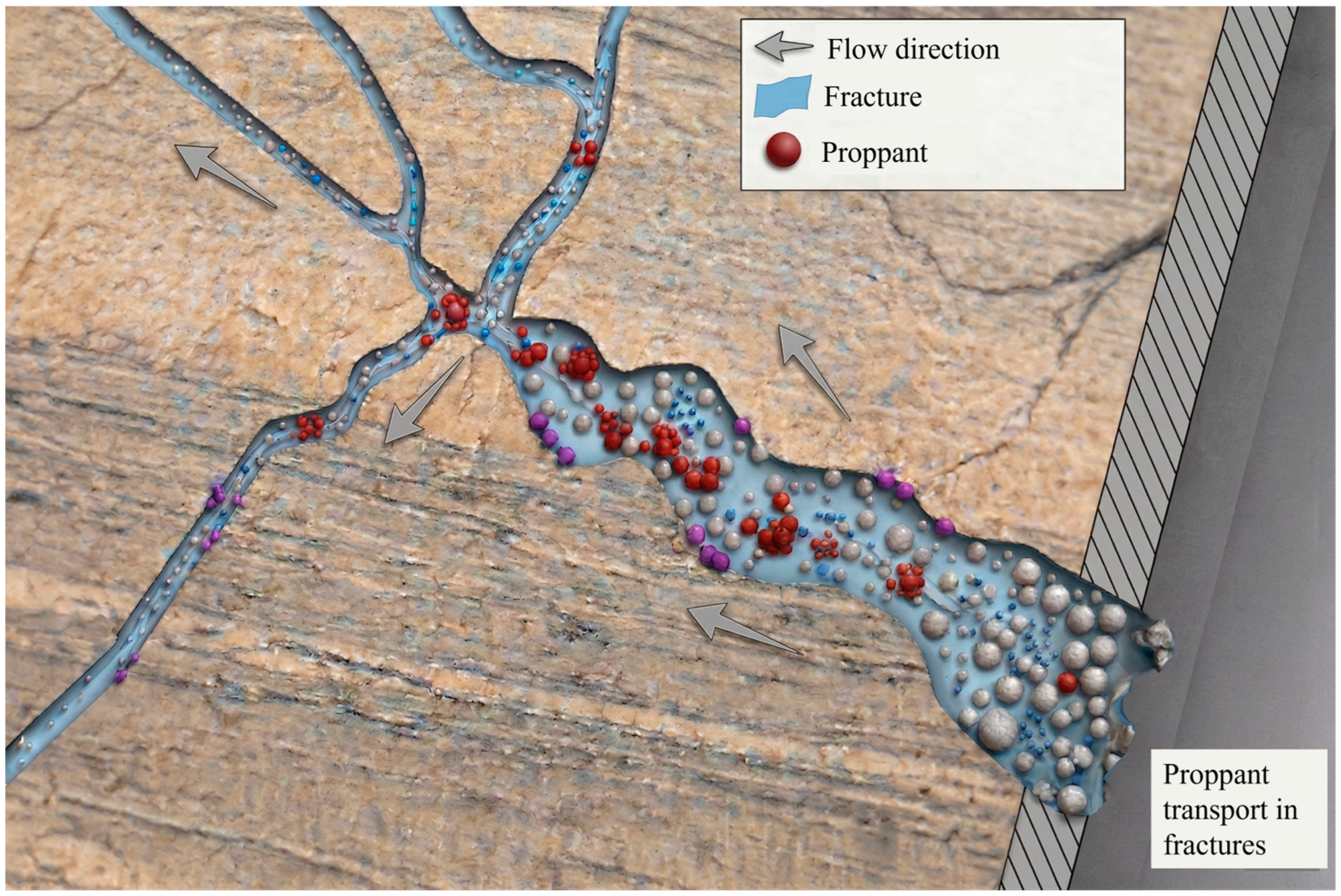
Compared with fracture propagation, proppant transport more directly determines the effective propped extent and post-fracturing conductivity. In intersecting fractures, proppant diversion and placement are jointly controlled by the main-fracture flow velocity, branch angle, and dune evolution. In irregular conduits, local geometric discontinuities can redirect slurry flow and alter particle trajectories, causing transport behavior to deviate substantially from the classical parallel-plate assumption [13]. As shown in Figure 1, proppant transport in complex fractures is not a simple suspension-settling process but a multiscale phenomenon tightly coupled with geometric confinement, flow-field reorganization, and particle–particle interactions [14,15]. The CFD–DEM method can capture single-particle contact behavior and local blockage effects, making it well suited for simulating proppant transport in complex fractures [16,17].
Existing studies have primarily relied on laboratory experiments and numerical simulations. Experimentally, Kern et al. first investigated proppant settling, placement, and bed advancement in parallel-plate fractures, establishing the foundation for subsequent studies [18]. Sahai et al. extended these experiments to complex fracture systems and examined the capability of proppants to enter branch fractures and its dependence on injection parameters [19]. Tong and Mohanty indicated that intersecting fractures typically form three distinct regions: a lower static particle bed, an intermediate slurry-transport zone, and an upper clear-fluid zone. They further indicated that proppant placement in bypass branches is controlled by the main-fracture velocity, branch angle, and proppant-bed evolution [13]. Ray et al. employed three-dimensional printed fracture models and highlighted the roles of settling, resuspension, and local bridging in shaping final proppant distributions [20]. For coal reservoirs, Huang et al. conducted fines transport and retention experiments in proppant packs and demonstrated the influences of proppant size and wettability on fines migration, retention, and conductivity impairment [21]. Overall, laboratory studies provide intuitive insights into settling, placement, and localized plugging, yet limitations in model scale, observation capability, cost, and parameter controllability hinder systematic characterization of full-field, time-resolved particle transport in complex fractures [13,19,20].
Numerical simulation has therefore become an important tool because it is cost-effective, highly controllable, repeatable, and capable of providing microscale information such as particle trajectories, local flow fields, and contact interactions [22,23]. Existing numerical methods are generally divided into Eulerian–Eulerian and Eulerian–Lagrangian frameworks. Among them, the Eulerian–Lagrangian approach has been more frequently adopted in particle-transport studies because it can explicitly retain the discrete nature of particles [23,24]. Depending on particle treatment, Eulerian–Lagrangian methods include the dense discrete phase method (DDPM), CFD–DEM, and the multiphase particle-in-cell (MP–PIC) method [22]. Reviews indicate that DDPM reduces computational cost through parcel/cluster approximations and is suitable for large-scale problems; MP–PIC simplifies collision handling using computational parcels, balancing efficiency and scalability; and CFD–DEM explicitly tracks individual particles and resolves particle–particle and particle–wall interactions, making it particularly suitable for analyzing microscale transport processes such as local settling, bridging, dune growth, and transport under complex geometric constraints [22,23,24]. Given that this study focuses on differences in local migration, settling, and placement within tortuous wedge-shaped fractures in deep coal seams, CFD–DEM is adopted due to its superior particle-scale resolution and geometric adaptability [24,25,26].
Over the past decade, numerical studies of proppant transport have evolved from planar fractures toward intersecting fractures, rough fractures, and complex fracture networks, progressively enriching the understanding of transport, deposition, and operational control. For example, Tong and Mohanty reproduced key experimental features of dune development and branch placement using DDPM [13]. Subsequent research has further examined multi-cluster and network-scale transport, addressing uneven proppant partitioning, pulsed injection, and channel evolution [27,28], transport–placement coupling during fracture propagation [29], and the influences of fluid viscosity, perforation-cluster number, particle properties, and main-branch angles on placement extent and uniformity under multi-fracture propagation and complex networks [30,31]. With increasing geometric complexity, CFD–DEM has been extended to rough fracture networks and variable injection strategies [32], and recent findings highlight that tortuosity and wedge-shaped aperture variations can markedly modify particle velocities, dune length, preferential accumulation locations, and plugging risk [33]. Related simulations have also been expanded to rough fracture networks, horizontal-wellbore transport, and injection-schedule optimization [34,35,36,37]. Nevertheless, despite these advances, unified and systematic comparative investigations remain limited regarding proppant transport in representative fracture geometries controlled by natural weak discontinuities in deep coal seams, particularly tortuous wedge-shaped fractures, where geometry-induced flow reorganization and particle redistribution at junctions can strongly affect placement outcomes [38,39,40].
To address the above research gap, the present study idealizes fracture-propagation outcomes in deep coal seams into four representative tortuous wedge-shaped fracture models, namely the “|”-shaped, “—”-shaped, “T”-shaped, and “+”-shaped fractures, and employs the CFD–DEM method to systematically investigate particle transport, settling, and placement behavior under these typical geometries. Based on the placement uniformity coefficient (PUC) and the branch-entry efficiency (BEE), the influences of key factors, including fracture geometry, injection velocity, fluid viscosity, and particle size, on proppant placement behavior within fractures are systematically assessed. The results clarify the fundamental mechanisms controlling geometry-dependent particle transport and distribution in complex deep coal-seam fractures, thereby providing a theoretical reference for hydraulic fracturing design and treatment-parameter optimization in deep coal seams.

2. Theory and Methods

2.1. Assumptions

(I)
A 2 wt% KCl solution is selected as the injection fluid and is assumed to be incompressible.
(II)
A no-slip boundary condition is imposed on the fracture walls.
(III)
Proppants are rigid spherical particles.
(IV)
Fluid filtration from the fracture into the reservoir is not considered.
Although this study primarily focuses on particle transport within the main flow channel and the filtration of fracturing fluid accounts for only a small fraction of the total flow rate, neglecting filtration may still lead to an underestimation of local velocity attenuation and the associated enhancement of particle settling. Moreover, tortuous wedge-shaped fractures were adopted to better approximate actual fracture configurations; however, the dynamic propagation of fractures was not considered. This limitation reflects a major challenge in current numerical studies of proppant transport in complex fractures.

2.2. Computational Fluid Dynamics Method

The fluid flow is formulated by solving the mass conservation equation, the momentum conservation equation, and the turbulence-transport equations, as expressed below [32]:
( ε f ρ f ) t + ε f ρ f u f = 0
where ρ f denotes the fluid density, kg m 3 , u f is the fluid velocity, m s 1 , ε f represents the fluid volume fraction, and t is time, s.
The evolution of fluid momentum is described through the corresponding conservation equation, which can be written as:
( ε f ρ f u f ) t + ε f ρ f u f u f = ε f P + ( ε f τ f ) + ε f ρ f g + M
τ f = μ [ ( u f ) + ( u f T ) ]
where P characterizes the fluid pressure, Pa . g describes the gravitational acceleration, m s 2 . M is the momentum exchange source term between the fluid phase and particles, N m 3 . The dynamic viscosity of the fluid is denoted by μ , Pa s .
The turbulent flow behavior was represented using the standard κ - ε model. Accordingly, the governing transport equations for turbulent kinetic energy and its dissipation rate are formulated as follows [41]:
( ρ f k ) t + ( ρ f k u i ) x i = x j [ ( μ + μ k σ k ) k x j ] + G k β ε + S k
( ρ f ε ) t + ( ρ f ε u i ) x i = x j [ ( μ + μ τ σ ε ) ε x j ] + c 1 G k k c 2 ρ f ε 2 k + S ε
where k characterizes the turbulent kinetic energy of the fluid phase, m 2 s 2 . ε describes the rate at which this turbulent kinetic energy is dissipated, m 2 s 3 . G k accounts for the generation of turbulent kinetic energy induced by velocity gradients, kg m 1 s 3 . σk and σε are the corresponding dimensionless turbulent Prandtl numbers associated with the transport of k and ε, respectively. In addition, S k and Sε are the turbulent exchange terms of the liquid and solid phases, kg m 1 s 3 . The turbulent viscosity is denoted by μτ, Pa s .

2.3. Discrete Element Method

The translational and rotational responses of particles are resolved using Newtonian mechanics, while particle–particle and particle–wall interactions are described by the Hertz–Mindlin contact formulation. The governing equations are therefore given as follows [42]:
m k d u k d t = F k c + F k f + ( ρ p ρ f ) V k g
I k d Ω k d t = T k c + T k f
F k f = V k β f p ε p u f u p
where m k characterizes the mass of particle k , kg . u k describes the translation velocity of particle k , m s 1 . F k c represents the resultant contact force exerted on particle k by surrounding particles and wall surfaces, N . F k f is the fluid force acting on the solid particle k , N . ρp is the density of the particle, kg m 3 . V k is the volume of solid particles, m 3 . I k denotes the inertial tensor of particle k , kg m 2 . Ω k is the angular velocity of particle k in the body coordinate system, rad s 1 . T k c is the resultant contact torque acting on particle k from other particles and wall surfaces, N m . T k f is the fluid torque acting on the solid particle k , N m .

2.4. Numerical Algorithms

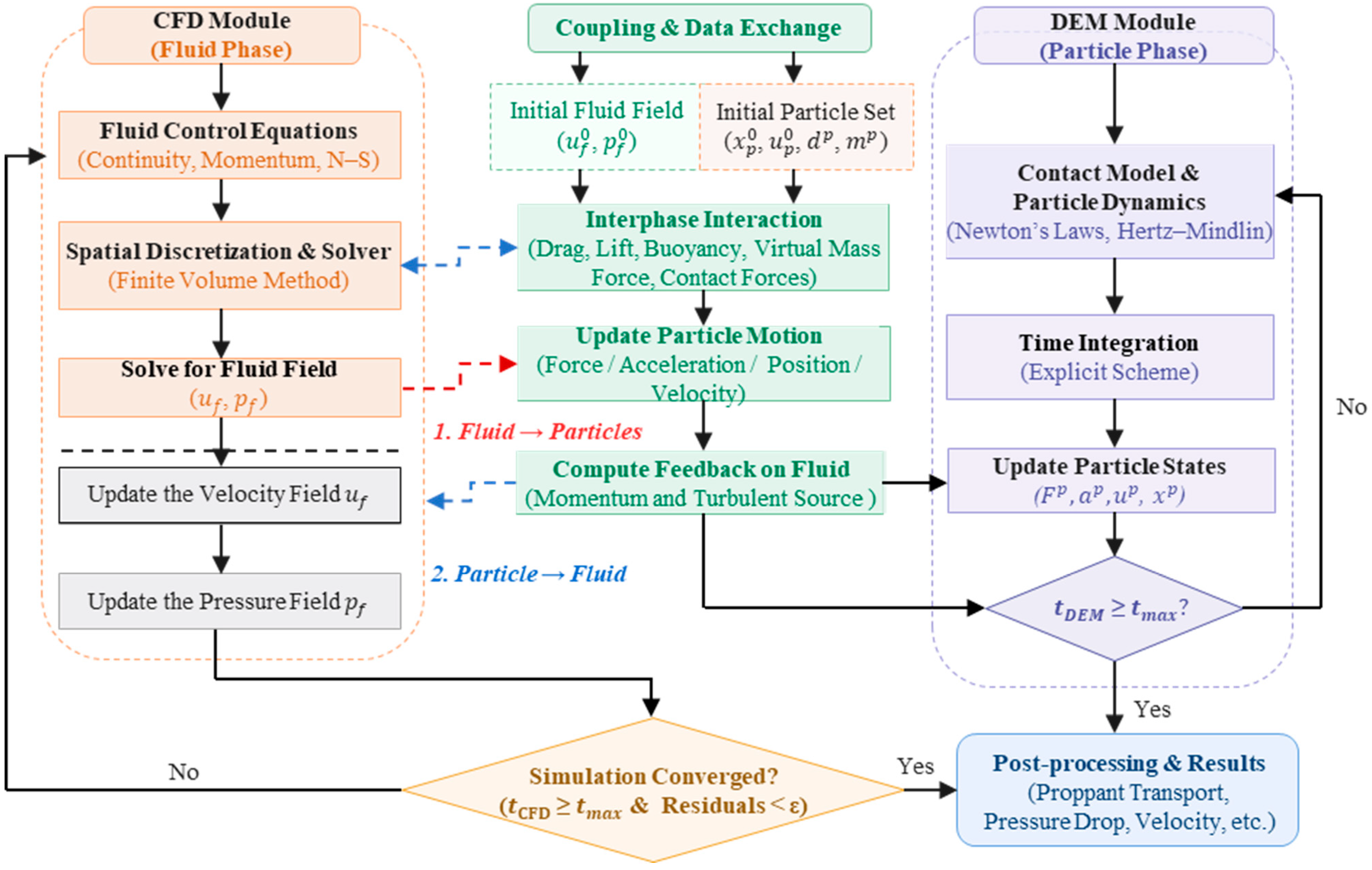
The simulation of proppant transport in fractures involves coupled two-phase motion between the carrier fluid and discrete particles; therefore, a CFD–DEM coupling method is employed. The numerical solution was performed using ANSYS Fluent 2025 R1 (ANSYS, Inc., Canonsburg, PA, USA). The calculation begins with the definition of boundary conditions and initialization of the flow field. At each time step, the fluid velocity and pressure fields are transferred from the CFD solver to the DEM module. The DEM module then calculates particle motion, updates particle positions, and evaluates the interaction forces between the fluid and particles within the computational domain. The updated particle information is subsequently returned to the CFD solver, enabling the coupled calculation to proceed to the next time step. The overall solution procedure is shown in Figure 2.

3. Results and Discussion

3.1. Geometric Models and Simulation Parameter Settings

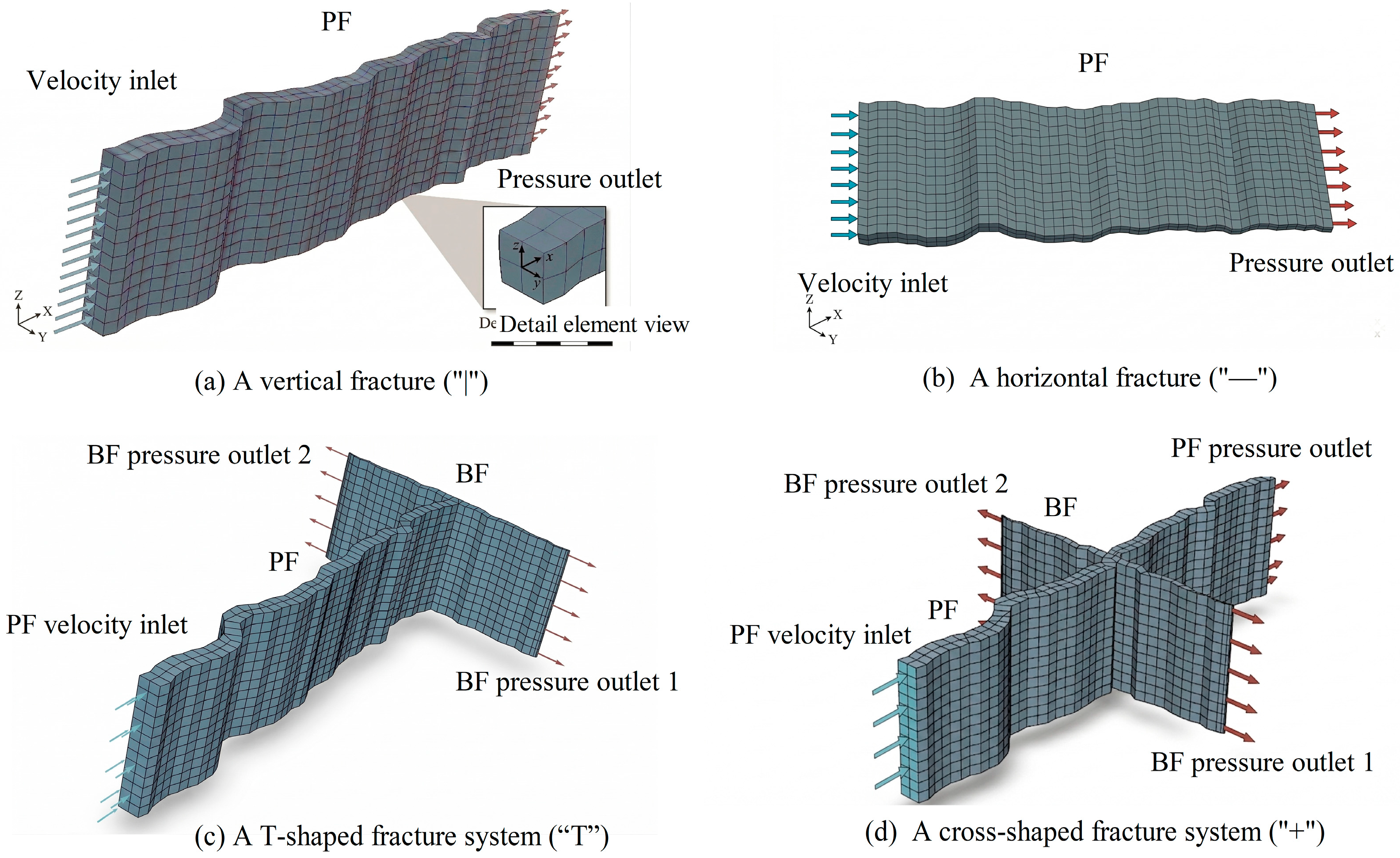
To examine how fracture geometry influences particle transport and placement, the complex fracture networks generated in deep coal seams under the coupled effects of bedding planes, natural cleats, and coal–rock interfaces were simplified into idealized geometric models. Considering that actual fractures commonly exhibit tortuous propagation paths and spatially varying fracture widths, all fracture configurations were generalized as tortuous wedge-shaped fractures. Four representative geometric models were established to characterize typical fracture configurations under different weak-plane conditions, including a vertical straight (“|”) fracture, representing the crossing mode in which the induced fracture crosses the weak plane and continues to propagate along the primary-fracture direction; a horizontal straight (“—”) fracture, representing the bedding-parallel propagation mode in which the fracture propagates along the weak plane; a T-shaped fracture, representing the deflection mode in which the fracture turns after encountering the weak plane and subsequently propagates along it; and a cross-shaped (“+”) fracture, representing the combined-activation mode in which the induced fracture crosses the weak plane while simultaneously activating it. As shown in Figure 3, fracture tortuosity was determined based on the joint roughness coefficient (JRC), and a tortuosity value of 1.1 was adopted [43,44]. A wedge angle of 1° was specified, and the fracture aperture ranged from 0.25 to 4 mm, ensuring that the modeled aperture was comparable to the hydraulic-fracture aperture in deep coal–rock reservoirs in the eastern Ordos Basin, China.
In addition, a coupled CFD–DEM method was used to model liquid–solid two-phase flow in the fractures, with the inlet and outlet boundaries defined as velocity inlet and pressure outlet, respectively. Quartz sand was used as the solid particle phase, whereas a 2 wt% KCl solution was adopted as the carrier fluid. The main simulation parameters are provided in Table 1.
In addition, injection velocity, fracturing-fluid viscosity, and particle size were selected as the main influencing factors, and a controlled-variable approach was adopted for comparative analysis. The ranges of the simulation parameters were determined with reference to the field treatment parameters used in deep coalbed methane wells in the eastern Ordos Basin. In this block, 30/50-, 40/70-, and 70/140-mesh quartz-sand proppants are commonly used, and the carrier fluid is typically low-viscosity slickwater with a viscosity close to that of fresh water. The detailed simulation cases are summarized in Table 2.

3.2. Particle-Transport Mechanisms and Distribution in Tortuous Wedge-Shaped Fractures with Different Geometries

This section focuses on the governing mechanisms of particle transport and placement in tortuous wedge-shaped fractures with different geometries. Although particles in all fracture types are jointly influenced by fluid drag, gravitational settling, and inter-particle collisions, fracture geometry can markedly alter the continuity of the main flow pathway, the manner of local flow-field reorganization, and the diversion capacity into branches, thereby modulating particle trajectories, preferential settling locations, and final placement patterns. For single-channel fractures, particle transport is primarily controlled by a long-path carrying capacity and sustained settling induced by progressive aperture tapering. In fractures containing branches, however, bends and junctions become critical regions that dominate particle redistribution and local accumulation, ultimately determining the placement extent and uniformity. Therefore, the differences among fracture geometries are not limited to the placement scale but reflect systematic variations in flow-field organization and particle-response mechanisms. Cases 5–8 were selected for detailed analysis, with the inlet velocity fixed at 0.03 m/s and the proppant mass injection rate set to 0.018 t/h.
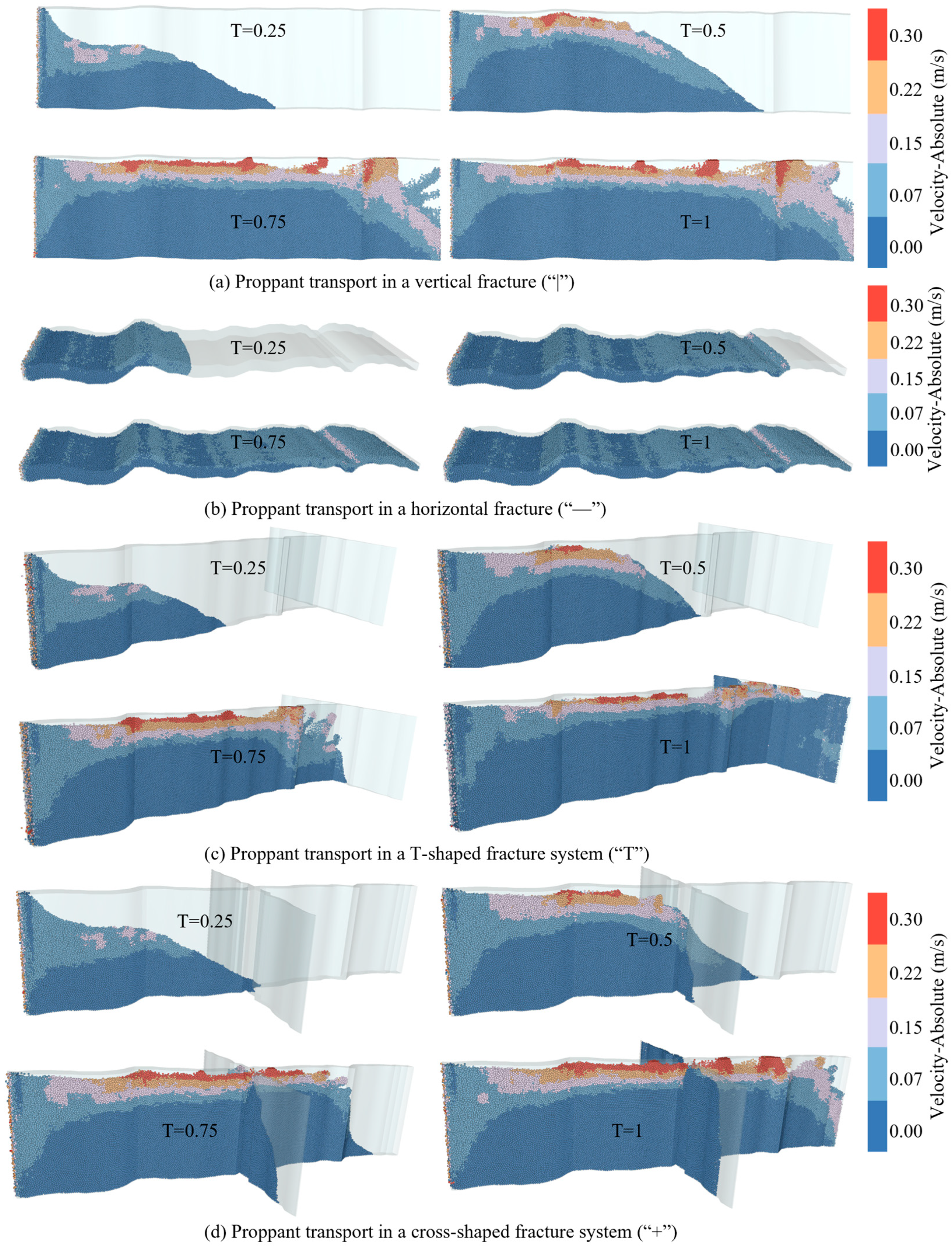
As shown in Figure 4, particle-transport behavior and final placement patterns vary significantly with fracture geometry. As shown in Figure 4a, in the “|”-shaped fracture, particles are mainly transported forward along a relatively continuous main flow pathway, while gradually settling toward the lower wall under gravity, thereby forming a continuously thickening bottom particle bed and driving the placement front forward. As shown in Figure 4b, in the “—”-shaped fracture, the transport pathway exhibits the highest continuity and the weakest disturbance. As a result, particles can advance more uniformly under fluid drag, while gravitational segregation remains relatively weak, ultimately leading to the best placement continuity. As shown in Figure 4c,d, by contrast, in the “T”-shaped fracture, the junction and turning region become the key zone for particle redistribution. After reaching the turning region, particle trajectories are jointly controlled by flow deflection, particle inertia, and particle–wall/particle–particle collisions, causing some particles to enter the branch fracture while others are retained and accumulated near the junction, thereby weakening downstream placement continuity. This effect becomes more pronounced in the “+”-shaped fracture, where stronger competitive flow diversion and more intense local flow-field reorganization around the intersection further enhance particle collisions, local retention, and deposition near the crossing region and branch entrances. Overall, as fracture geometry evolves from a single continuous pathway to complex branched and intersecting structures, particle transport shifts from relatively stable forward placement to a heterogeneous transport process jointly governed by local redistribution, collision-induced retention, and geometric confinement.
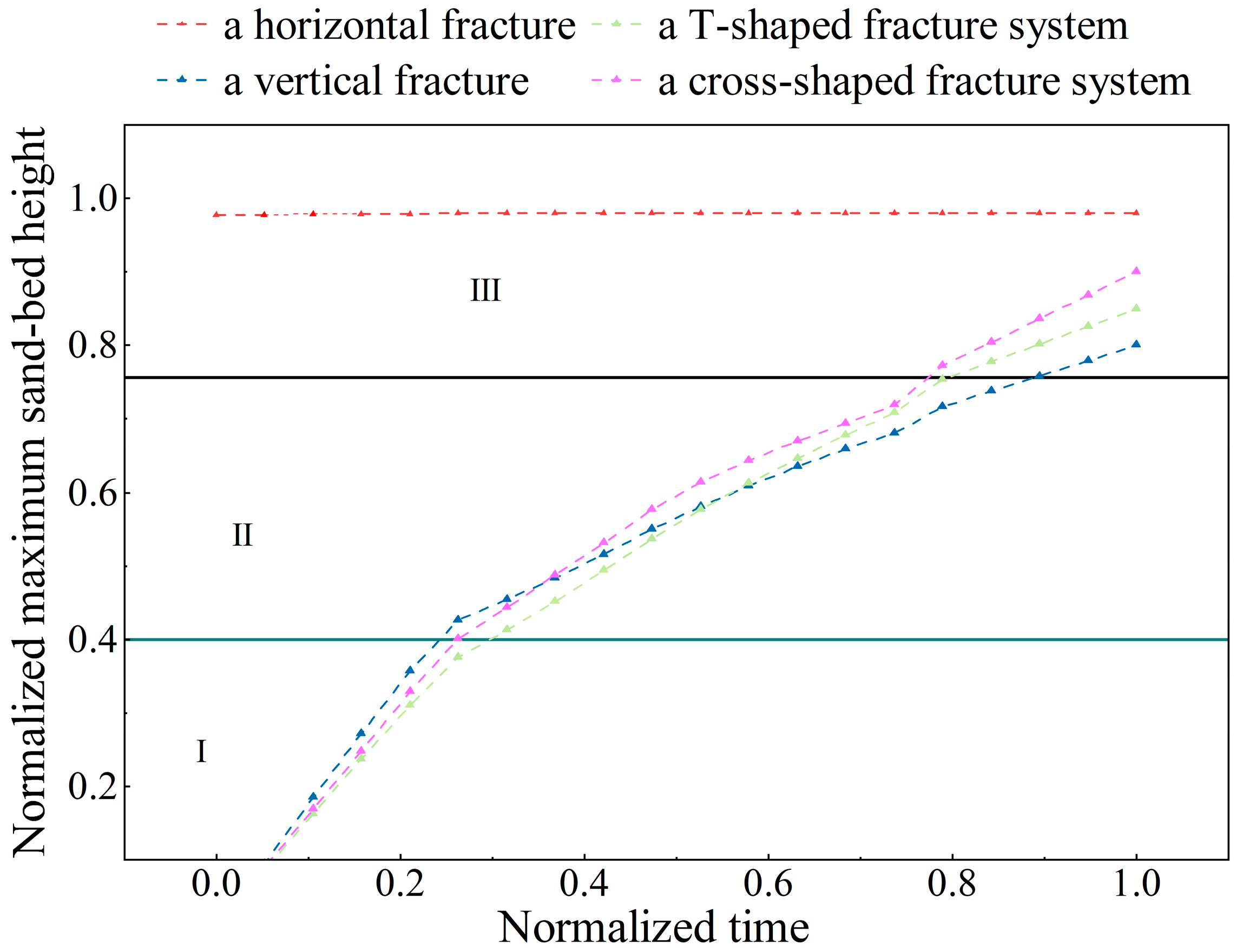
As shown in Figure 5, particle transport can be divided into three stages based on the normalized maximum sand-bed height. Proppant transport in the “|”-shaped, T-shaped, and “+”-shaped fractures exhibits distinct stage-dependent characteristics and can be divided, according to the dominant transport mechanisms, into three stages: rapid start-up, stratified transport, and front advancement. In contrast, the “—”-shaped fracture remains almost entirely in an orderly front-advancement regime. The two normalized maximum sand-bed height thresholds corresponding to the stage division are approximately 0.4 and 0.7, respectively.
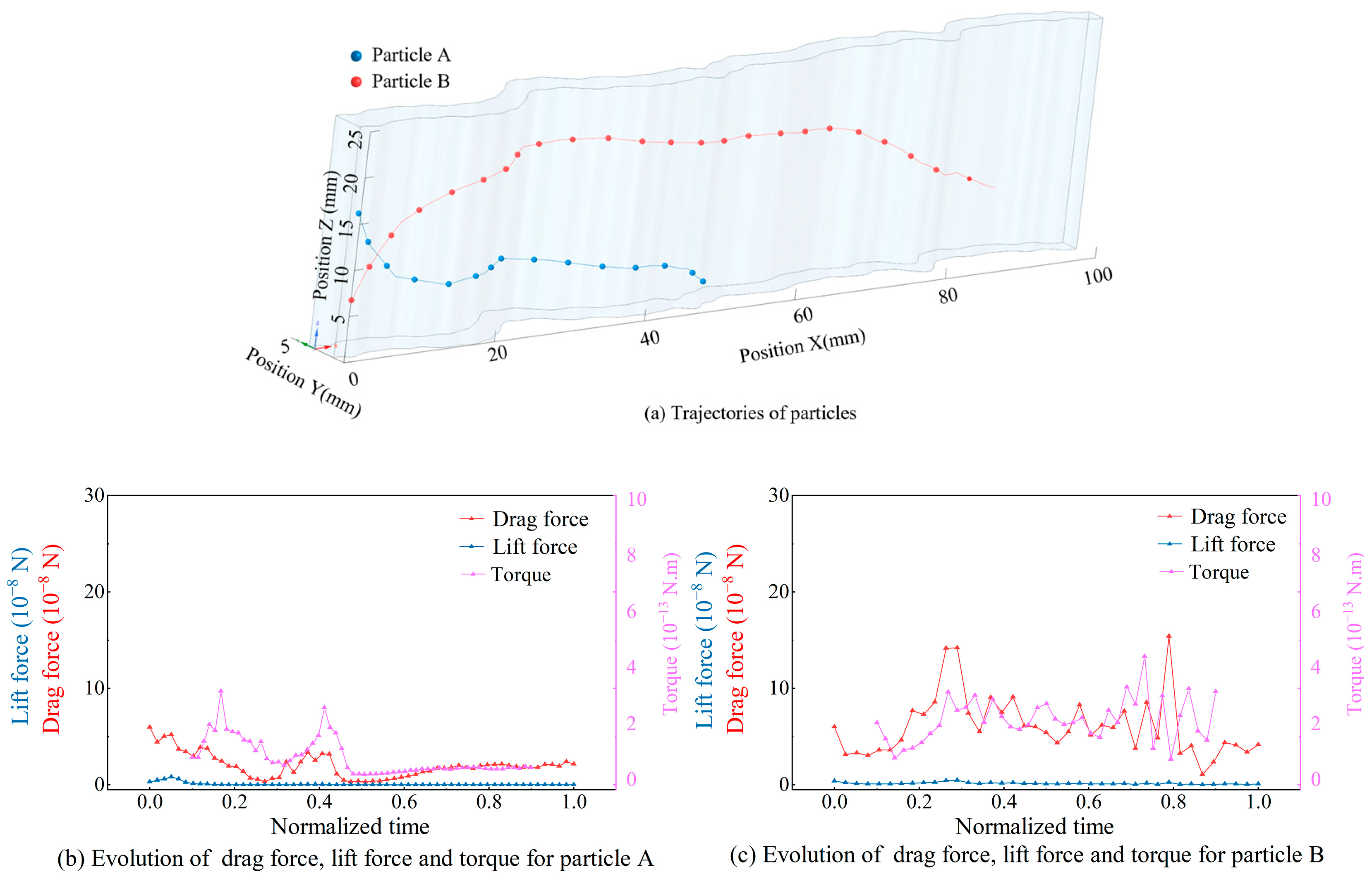
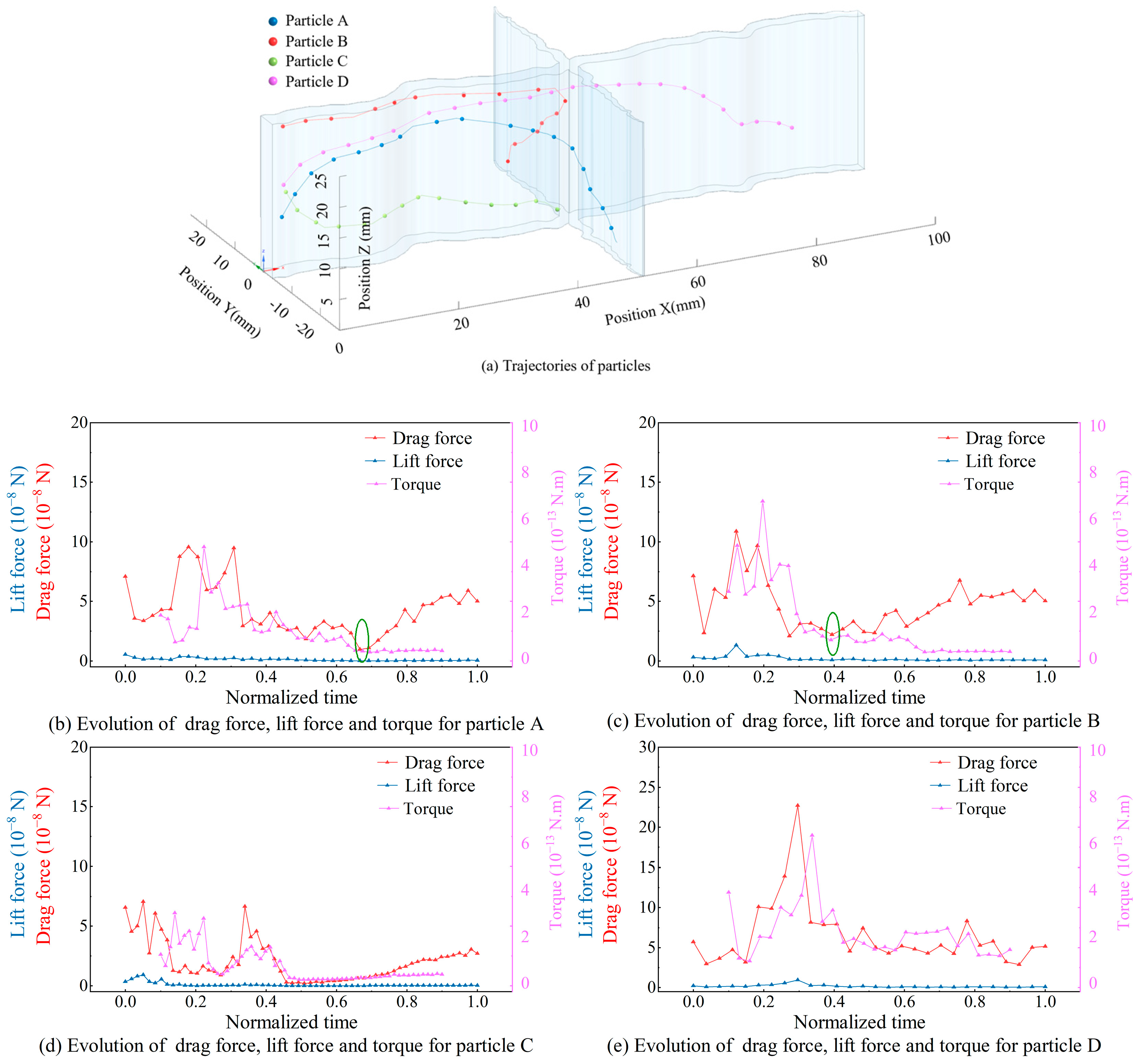
To clarify the transport and deflection mechanisms of particles within fractures, four representative particles were selected for detailed analysis. Particles A, B, C, and D represent four typical transport behaviors: particles that remain suspended in the middle section of the primary fracture without deflection, particles that migrate deep into the primary fracture, particles that deflect into the branch fracture and remain suspended in its middle section, and particles that deflect and further migrate deep into the branch fracture, respectively. As shown in Figure 6, particle trajectories in the “|”-shaped fracture generally extend along the main flow direction, but they are strongly affected by vertical gravitational settling. After entering the fracture, particles are rapidly mobilized by drag force; however, as the flow velocity decreases and the aperture gradually narrows, particles tend to migrate toward the lower wall and collide with deposited particles. The intermittent fluctuations in drag force reflect repeated transitions among transport, collision, and remobilization, whereas variations in lift force and torque indicate that wall contact and particle rotation modify local transport posture. Overall, proppant transport in the “|”-shaped fracture is governed by a coupled process of drag-driven forward motion, gravity-induced settling, and bottom-bed accumulation.
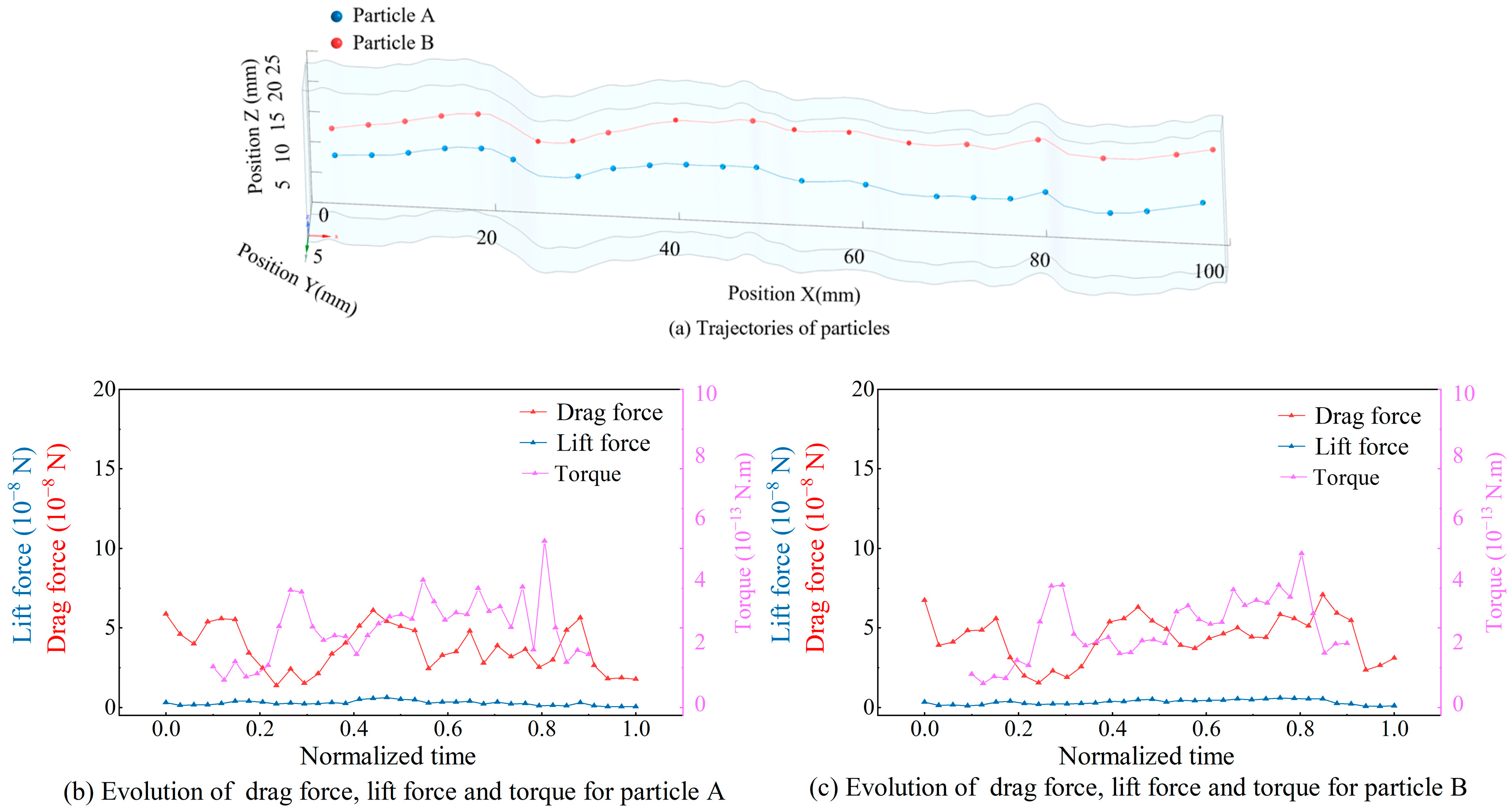
As shown in Figure 7, particle trajectories in the “—”-shaped fracture are the smoothest, indicating the highest continuity of the main flow pathway and the weakest local flow disturbance. Particles move steadily along the fracture extension direction, with drag force playing a sustained dominant role during transport. The relatively small fluctuations in lift force and torque suggest limited lateral disturbance and rotational instability. Because the coupling between gravity and the main placement direction is weak, particles are less likely to undergo pronounced stratified settling or local blockage. Proppant transport in this fracture can therefore be interpreted as continuous front advancement controlled by stable drag, resulting in the largest placement extent and the best placement continuity.
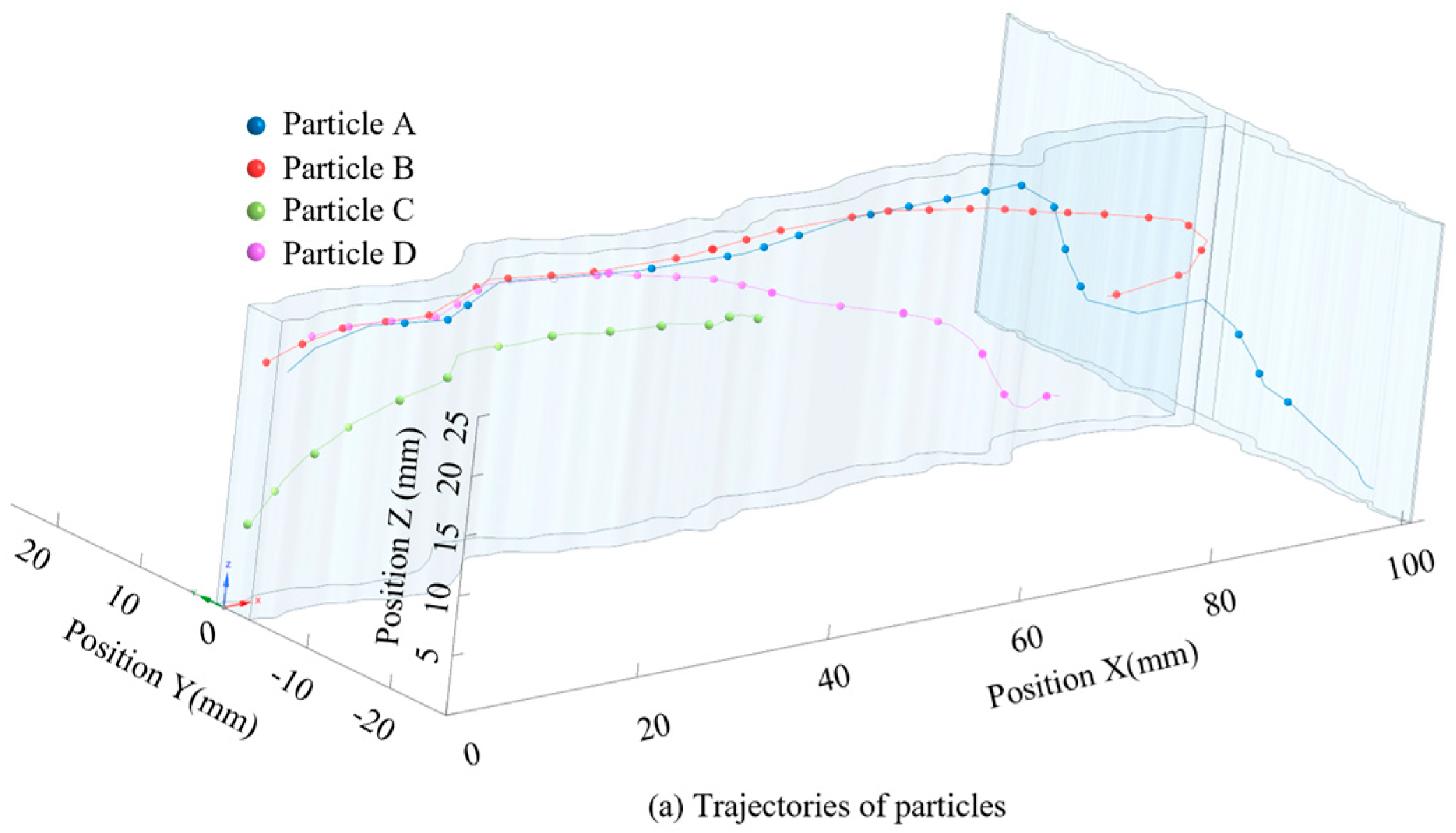
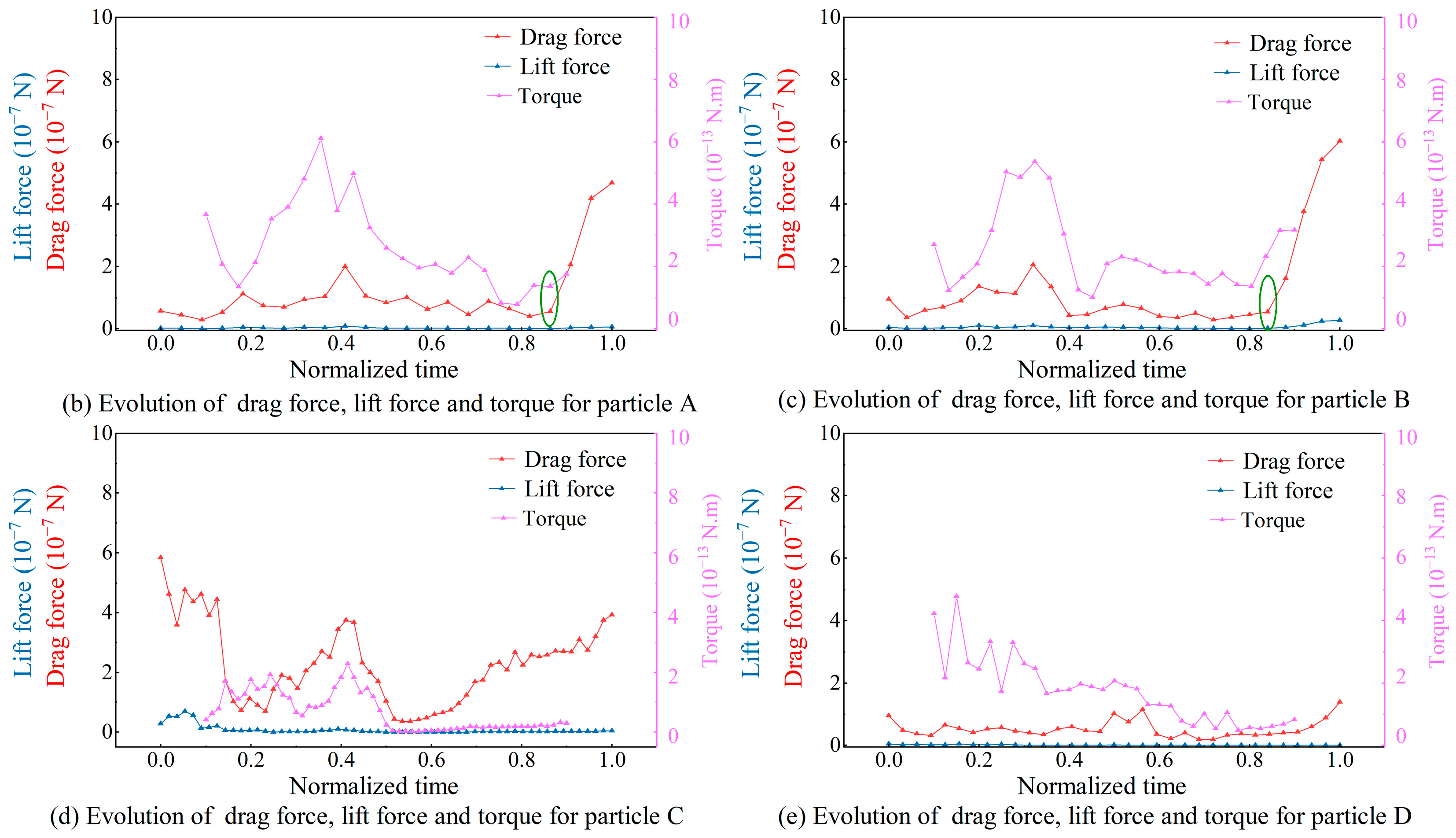
As shown in Figure 8, particle trajectories in the T-shaped fracture show pronounced divergence at the junction, indicating that this region controls both branch entry and local retention. When particles reach the junction, the fluid flow is deflected, whereas particles tend to maintain their original motion direction due to inertia. This mismatch enhances particle–wall and particle–particle collisions. Some particles enter the branch fracture under the action of the deflected flow and drag force, while others are retained near the junction due to turning resistance, collision-induced energy dissipation, and local low-velocity zones. The strong fluctuations in force and torque indicate frequent rotation, collision, and redistribution. Therefore, particle transport in the T-shaped fracture is mainly characterized by junction-controlled diversion, inertia-induced deviation, and collision-induced retention. As shown in Figure 8b,c, after the particles enter the branch fracture, the fluid velocity within the branch fracture increases significantly because its aperture is much smaller than that of the primary fracture, resulting in a marked increase in the drag force acting on the particles. Therefore, the particle position can be inferred from the variation in the drag-force curve.
As shown in Figure 9, particle trajectories in the “+”-shaped fracture are the most dispersed, indicating stronger multidirectional diversion and flow-field reorganization in the crossing region. After particles enter the intersection, competing carrying effects among different outlet pathways frequently change their motion directions, leading to abrupt local velocity variations and enhanced momentum dissipation. Meanwhile, particle–particle and particle–wall collisions become more frequent, and torque fluctuations reflect more intense particle rotation and posture adjustment. Because some particles cannot continuously obtain effective drag force, they are more likely to deposit, be retained, or even form local blockage near the crossing region and branch entrances. Thus, proppant transport in the “+”-shaped fracture is jointly controlled by competitive diversion, collision-induced energy loss, and geometric confinement, resulting in the strongest spatial heterogeneity. As shown in Figure 9b,c, when the particles arrive at the branch-fracture entrance, the flow is diverted and the local fluid velocity decreases markedly. As the apertures of both the primary and branch fractures gradually decrease, the fluid velocity increases again as the particles migrate deeper into the fractures. Consequently, the drag force acting on the particles reaches its minimum at the branch-fracture entrance. This characteristic drag-force response can be used to identify the onset of particle deflection during transport.
Overall, the differences in proppant-transport mechanisms among the four fracture geometries mainly arise from variations in main-flow-path continuity, gravity-induced settling, diversion intensity at junctions, and collision-induced energy dissipation. In the “—”-shaped fracture, the main flow pathway is the most continuous, and particles are mainly governed by stable drag-driven transport, resulting in continuous front advancement. In the “|”-shaped fracture, although the main pathway remains relatively continuous, gravity-induced settling is stronger, promoting bottom-bed formation and distal accumulation. In the T-shaped fracture, the junction controls particle diversion and retention, thereby enhancing branch entry. In the “+”-shaped fracture, multidirectional competitive diversion and intense flow-field reorganization lead to the strongest particle collisions, momentum dissipation, and local blockage. Therefore, as fracture geometry becomes more complex, proppant transport tends to shift from stable forward movement to heterogeneous placement jointly controlled by diversion, collision, and retention.
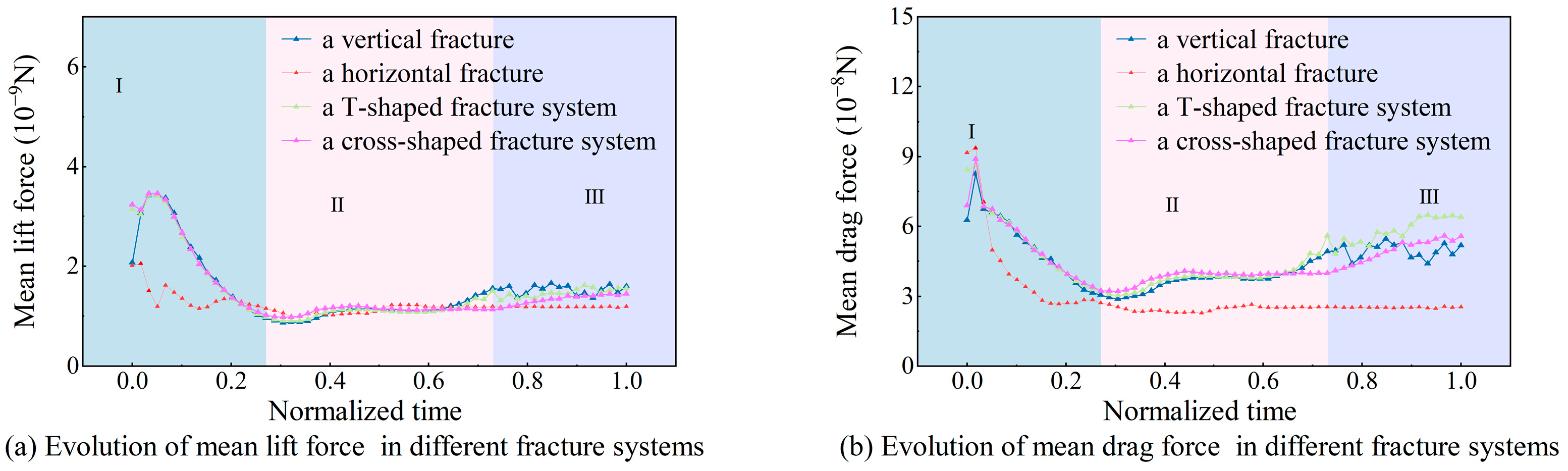
As shown in Figure 10, the evolution of the mean lift force and mean drag force indicates that the stage-dependent transport behavior of proppant is strongly controlled by fracture geometry. In the “|”-shaped, “T”-shaped, and “+”-shaped fractures, proppant transport can be divided into three stages, namely rapid start-up, stratified transport, and front advancement. The normalized-time thresholds used for stage division are approximately 0.25 and 0.75, respectively. During the rapid start-up stage, both the mean drag force and mean lift force remain at relatively high levels, and particles are rapidly mobilized after entering the fracture. Under the combined action of drag and lift, particles first form an initial suspended phase and then settle toward the fracture bottom under gravity. During the stratified transport stage, as shown in Figure 10a, the mean lift force decays rapidly, whereas the mean drag force, although reduced, is still able to sustain downstream particle transport. Therefore, this stage is jointly governed by drag-driven forward transport and gravity-controlled settling, gradually leading to the formation of a layered structure composed of a lower deposited layer and an upper transport layer. During the front-advancement stage, as shown in Figure 10b, drag remains the dominant force driving the proppant-bed front toward the distal region, whereas gravity mainly stabilizes the deposited bed; in the “T”-shaped and “+”-shaped fractures, diversion effects and local geometric constraints further enhance particle redistribution and local retention.
By contrast, the “—”-shaped fracture does not exhibit an obvious three-stage evolution. Owing to its highest continuity of the main flow pathway and the weakest diversion disturbance, proppant in this geometry rapidly enters an orderly front-advancement regime after the initial start-up stage, showing the most stable continuous placement behavior and the best overall placement performance. Among the other three fracture geometries, the “|”-shaped fracture still maintains relatively good transport continuity, although particles are more likely to settle toward the bottom and accumulate near the distal tip. The “T”-shaped fracture is characterized by particle redistribution mainly controlled by the deflection process from the junction into the branch. In the “+”-shaped fracture, however, stronger competitive diversion and more intense flow-field reorganization around the intersection make particles more prone to accumulate and be retained near the crossing region and branch entrances, ultimately resulting in the poorest continuity of advancement and the strongest spatial heterogeneity of placement.
Overall, the results indicate that proppant transport in the “|”-shaped, “T”-shaped, and “+”-shaped fractures can be classified into three stages, namely rapid start-up, stratified transport, and front advancement, whereas in the “—”-shaped fracture, particles enter the front-advancement stage directly after rapid start-up without experiencing a stratified transport stage. As fracture geometry evolves from a single continuous pathway to complex branched and intersecting structures, proppant transport shifts from stable forward placement to a more complex process characterized by stronger local redistribution and more pronounced spatial heterogeneity.
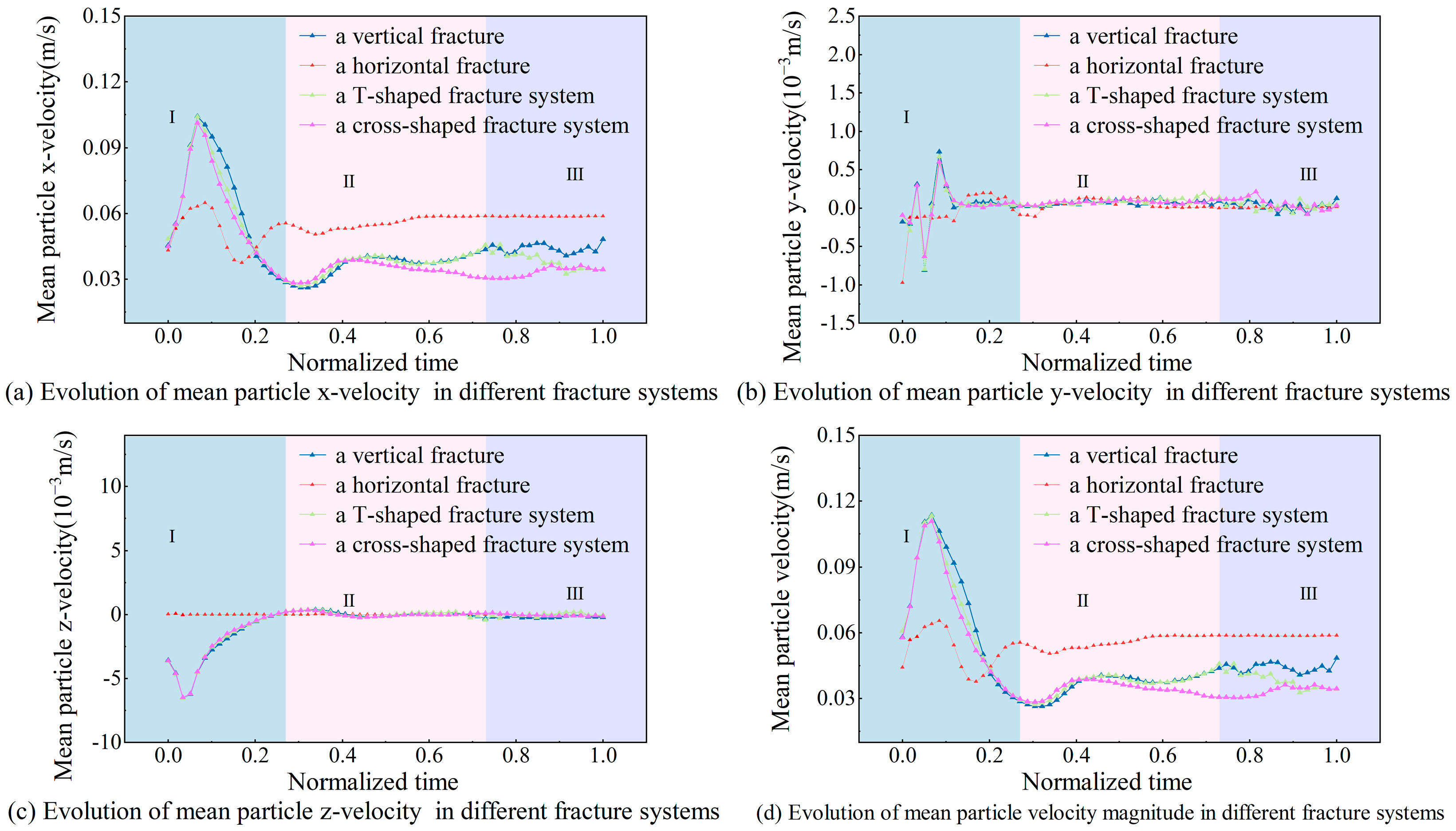
As shown in Figure 11a,d, the variation trend of the mean particle velocity is generally consistent with that of the x-direction velocity, indicating that proppant transport is primarily governed by motion in the main flow direction. Here, the x and y directions correspond to the extension directions of the primary fracture and branch fracture, respectively. By contrast, the y-direction velocity remains close to zero throughout the process and exhibits only minor fluctuations even in complex fractures, suggesting that lateral migration is mainly induced by local geometric disturbance and flow diversion. The z-direction velocity is negative at the initial stage and then gradually approaches zero, indicating that gravity-induced settling is most significant in the early stage and is subsequently replaced by front advancement along the surface of the proppant bed. In the “|”-shaped, “T”-shaped, and “+”-shaped fractures, particle-velocity evolution exhibits clear stage-dependent characteristics. As shown in Figure 11a, during the rapid start-up stage, both the x-direction velocity and the mean particle velocity increase sharply, indicating that particles are rapidly mobilized after entering the fracture. However, these three fracture geometries also show more pronounced negative z-direction velocities, indicating that although particles are rapidly carried forward, they are also more likely to migrate quickly toward the fracture bottom under gravity and form an initial deposited layer. In the subsequent stratified transport stage, the x-direction velocity and the mean particle velocity first decrease and then gradually stabilize, as shown in Figure 11b,c, whereas the y-direction and z-direction velocities remain close to zero, indicating that particle motion has shifted from initial suspension to stratified transport along the surface of the proppant bed. During the front-advancement stage, the z-direction velocity remains close to zero, indicating that the transport process is no longer dominated by pronounced settling, but rather by advancement of the proppant-bed front and local redistribution. Among these three fracture geometries, the “|”-shaped fracture maintains relatively stable forward transport; however, due to stronger early-stage settling, it develops a thicker bottom proppant bed and exhibits local accumulation near the distal tip. In the “T”-shaped fracture, the transport process is increasingly influenced by flow diversion at the junction, where some particles enter the branch while others are retained near the junction region, thereby weakening downstream placement continuity. In the “+”-shaped fracture, stronger competitive diversion and more intense flow-field reorganization around the crossing region promote particle accumulation and local deposition near the intersection and branch entrances, ultimately resulting in the poorest placement continuity and the strongest spatial heterogeneity.
By contrast, the “—”-shaped fracture does not exhibit an obvious three-stage evolution. Instead, particles rapidly enter an orderly front-advancement regime after the rapid start-up stage. Its x-direction velocity and mean particle velocity remain consistently higher and more stable than those in the other fracture geometries, indicating that this fracture geometry experiences the weakest diversion disturbance and the most stable drag-driven advancement of the proppant bed. Accordingly, the “—”-shaped fracture develops the most continuous proppant-bed morphology, achieves the largest placement extent, and exhibits the best overall placement performance.

3.3. Parametric Effects and Sensitivity Analysis of Proppant Placement Efficiency

To quantitatively characterize proppant placement under different fracture geometries, the branch-entry efficiency ( B E E ) and the placement uniformity coefficient ( P U C ) were adopted as evaluation indices. Injection velocity is considered first, followed by proppant size and fluid viscosity. Branch-entry efficiency characterizes the capacity of particles to migrate into branch fractures. It is defined as the mass ratio between particles entering the branch fracture and those entering the primary fracture, and can be written as
B E E = m b r a n c h m p r i m a r y
where m b r a n c h is the proppant mass entering the branch fracture and m p r i m a r y is the proppant mass entering the primary fracture. A larger B E E indicates a stronger ability of proppants to enter the branch fracture and a more pronounced diversion effect. The placement uniformity coefficient describes the uniformity of proppant distribution along the primary fracture and can be expressed as
P U C = 1 σ m m ¯
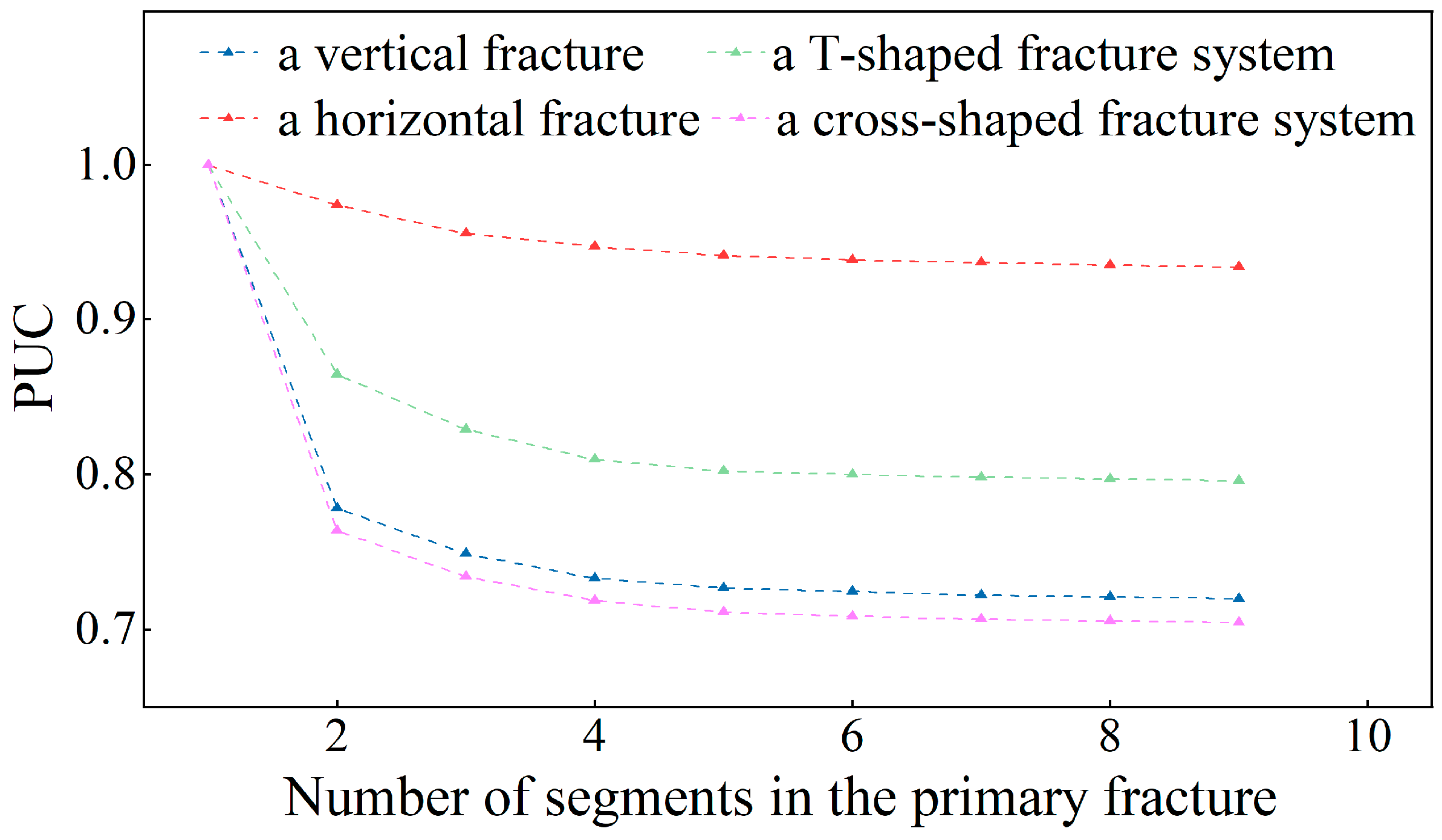
A larger P U C indicates a more uniform proppant distribution along the fracture. The primary fracture was divided into n equal segments along the main transport direction, as shown in Figure 12, P U C decreases gradually as the segment number n increases. After n reaches 5, further increasing the number of segments has only a limited effect on P U C , indicating that the calculation results tend to stabilize. Therefore, considering both result stability and computational workload, n was set to five in this study. The proppant mass in each segment was denoted as m i , which can be expressed as
m ¯ = 1 n i = 1 n m i
The standard deviation ( σ m ) can be expressed as
σ m = 1 n i = 1 n ( m i m ¯ ) 2

3.3.1. Effect of Injection Velocity on Particle Migration and Distribution in Tortuous Wedge-Shaped Fractures

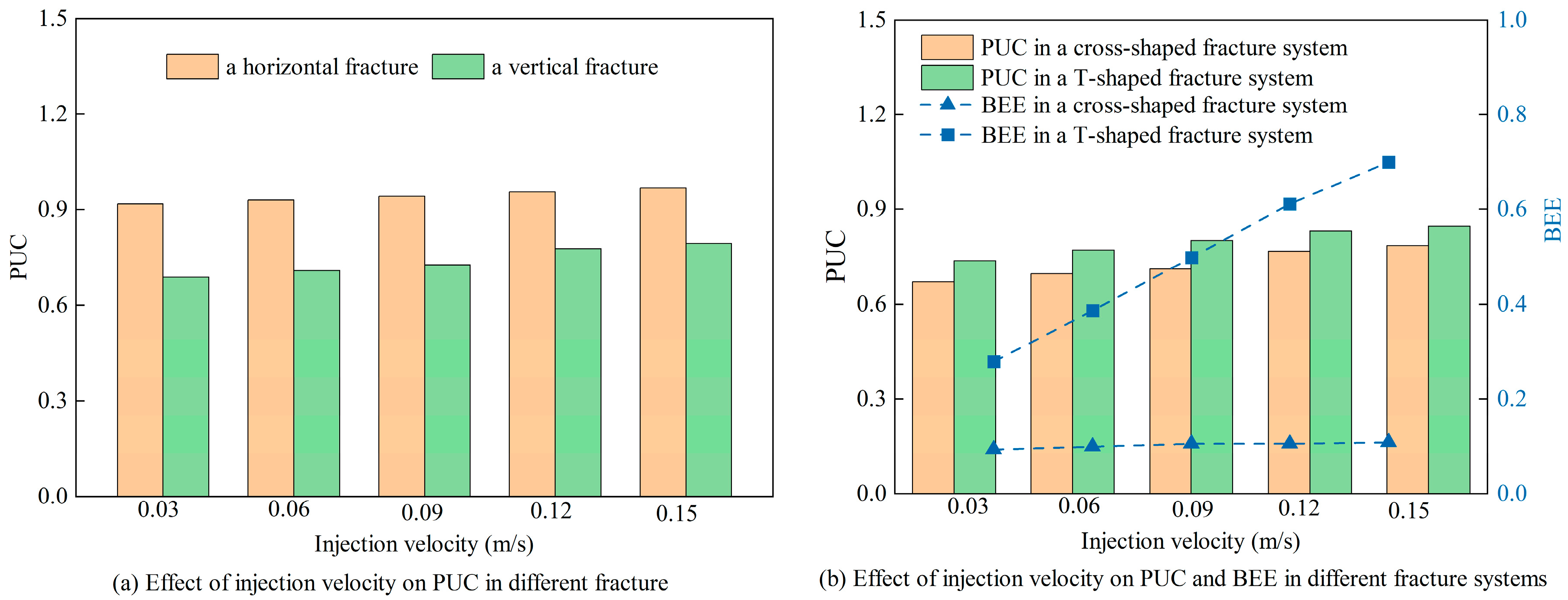
As shown in Figure 13, when the injection velocity increased from 0.03 to 0.15 m/s, the PUC values of all four fracture geometries increased, indicating that a higher injection velocity enhanced the forward transport capacity of particles and alleviated local accumulation near the inlet. As shown in Figure 13a, the PUC of the horizontal fracture increased from approximately 0.91 to 0.96, corresponding to an increase of about 5.5%, whereas that of the vertical fracture increased from approximately 0.68 to 0.79, with an increase of about 16.2%. As shown in Figure 13b, the PUC of the T-shaped fracture system increased from approximately 0.73 to 0.85, corresponding to an increase of about 16.4%, while that of the cross-shaped fracture system increased from approximately 0.66 to 0.78, with an increase of about 18.2%. Under all injection velocity conditions, the PUC consistently followed the order: horizontal fracture > T-shaped fracture system > vertical fracture > cross-shaped fracture system. The horizontal fracture consistently exhibited the highest PUC because particle transport in this geometry was scarcely affected by gravity, thereby favoring a more continuous placement pattern. The higher PUC of the T-shaped fracture system than that of the cross-shaped fracture system was mainly attributed to the effective retention of particles after entering the branch fracture, which improved the overall placement performance. Correspondingly, the BEE of the T-shaped fracture system increased markedly from approximately 0.28 to 0.70, representing an increase of about 150.0%, whereas the BEE of the cross-shaped fracture system remained nearly constant at around 0.10. These results indicate that increasing the injection velocity significantly improved branch filling in the T-shaped fracture system, whereas its effect on the cross-shaped fracture system was limited, owing to the persistent dominance of the main-fracture discharge pathway.

3.3.2. Effect of Proppant Size on Particle Migration and Distribution in Tortuous Wedge-Shaped Fractures

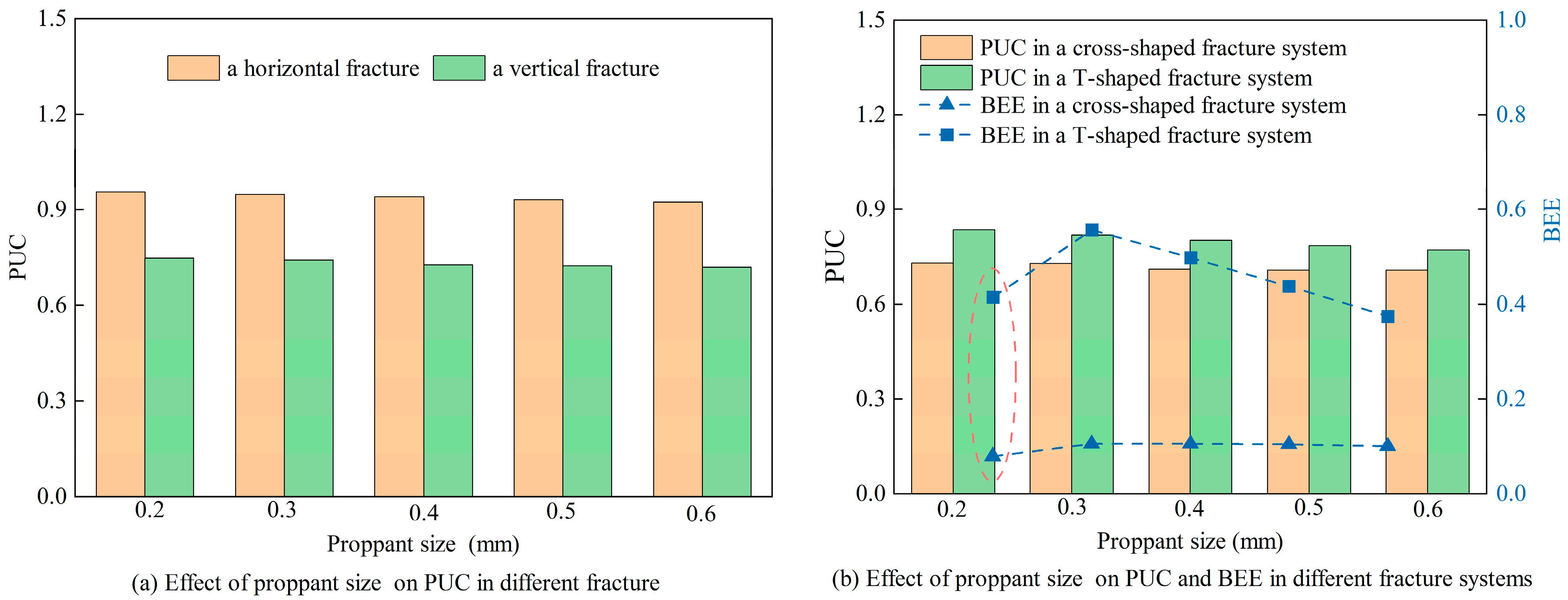
As shown in Figure 14, when the particle size increased from 0.2 to 0.6 mm, the PUC values of all four fracture geometries generally decreased, indicating that larger particle sizes were unfavorable for uniform placement in complex fractures. Specifically, the PUC values of the horizontal fracture, vertical fracture, T-shaped fracture system, and cross-shaped fracture system decreased by approximately 4.2%, 5.3%, 7.2%, and 2.8%, respectively, while the overall ranking among the four fracture geometries remained unchanged. Under all particle-size conditions, the PUC still followed the order: horizontal fracture > T-shaped fracture system > vertical fracture > cross-shaped fracture system. The horizontal fracture consistently maintained the highest PUC, indicating that its advantage in continuous placement remained the most pronounced under conditions where gravity exerted only a limited influence. The PUC of the T-shaped fracture system also remained higher than that of the cross-shaped fracture system, suggesting that particle retention within the branch fracture continued to contribute positively to placement performance. Unlike the monotonic promotion induced by injection velocity, the effect of particle size on the T-shaped fracture system exhibited a more pronounced stage-dependent characteristic. As shown in Figure 14b, the BEE of the T-shaped fracture system first increased and then decreased with increasing particle size, rising from approximately 0.42 to 0.56 and then declining to approximately 0.38, with a peak increase of about 33.3%. Under the smallest particle-size condition, the relatively low BEE was mainly because the particle size was smaller than the outlet size of the T-shaped branch fracture, so particles entering the branch could not be effectively retained. When the particle size increased to an appropriate range, particle retention within the branch fracture was enhanced, leading to an increase in BEE. However, with a further increase in particle size, particles became more prone to blockage near the branch entrance and experienced greater resistance to turning, which caused the BEE to decrease again. In contrast, the BEE of the cross-shaped fracture system remained only about 0.08–0.10 throughout, indicating that adjusting particle size alone could hardly improve branch entry performance.

3.3.3. Effect of Fluid Viscosity on Particle Migration and Distribution in Tortuous Wedge-Shaped Fractures

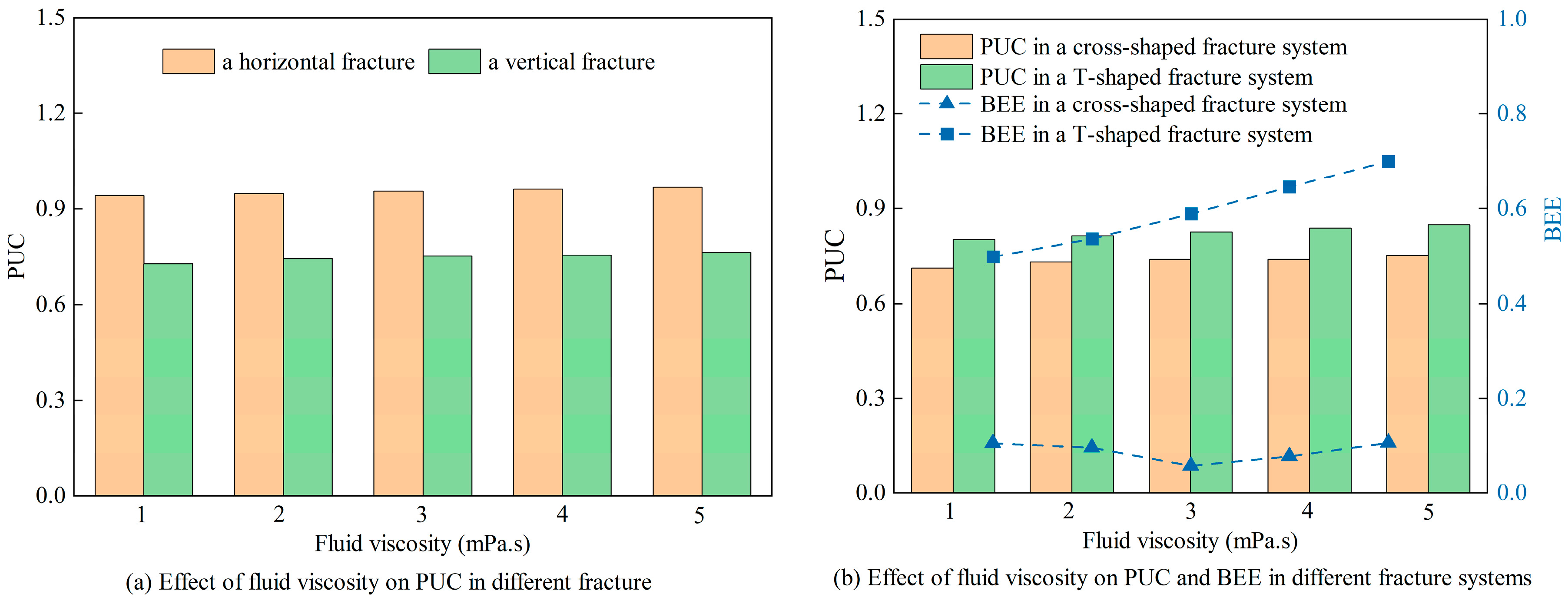
As shown in Figure 15, when the fluid viscosity increased from 1 to 5 mPa·s, the PUC values of all four fracture geometries increased, indicating that a higher fluid viscosity enhanced particle-carrying and suspension capacity, thereby improving proppant placement uniformity. Specifically, the PUC values of the horizontal fracture, vertical fracture, T-shaped fracture system, and cross-shaped fracture system increased by approximately 3.2%, 5.6%, 6.3%, and 7.1%, respectively, while the overall ranking among the four fracture geometries remained unchanged. Under all viscosity conditions, the PUC still followed the order: horizontal fracture > T-shaped fracture system > vertical fracture > cross-shaped fracture system. The horizontal fracture consistently maintained the highest PUC, indicating that its advantage in continuous placement remained the most pronounced under conditions where gravity exerted only a limited influence. The PUC of the T-shaped fracture system also remained higher than that of the cross-shaped fracture system, further suggesting that particle retention within the branch fracture continuously contributed to placement performance. Regarding branch entry behavior, as shown in Figure 15b, the BEE of the T-shaped fracture system increased from approximately 0.50 to 0.70, corresponding to an increase of about 40.0%. In contrast, the BEE of the cross-shaped fracture system fluctuated only slightly within the range of approximately 0.06–0.11. These results indicate that increasing fluid viscosity significantly promoted branch filling in the T-shaped fracture system, because particles were more readily transported into the branch fracture with the fluid and were continuously retained after entry. By contrast, although increasing viscosity improved the transport stability of particles in the cross-shaped fracture system, it could not alter the dominant role of the main-fracture discharge pathway; therefore, the increase in BEE remained limited.
The sensitivity analysis indicates that injection velocity is the most sensitive factor, followed by fluid viscosity and then particle size; the T-shaped fracture system exhibits the most pronounced response to parameter variations.

3.4. Validation of the Model

To ensure that the coupled CFD–DEM model can accurately describe particle transport in deep coal–rock fractures, the model was validated from two aspects: particle contact parameters and the in-fracture placement process. First, the reliability of the DEM contact parameters was verified using a proppant angle-of-repose experiment, thereby evaluating whether the model can reasonably represent friction, rolling, and collision behavior among particles and between particles and fracture walls. Second, previously reported proppant-transport experiments in intersecting fractures were used to validate the capability of the coupled CFD–DEM model to simulate particle settling, proppant-bed advancement, and branch entry within fractures. Finally, grid-independence verification was conducted for the developed coupled model, and the model was systematically compared with those reported in previous studies to further clarify the novelty of this work.

3.4.1. Experimental Validation Using the Angle of Repose

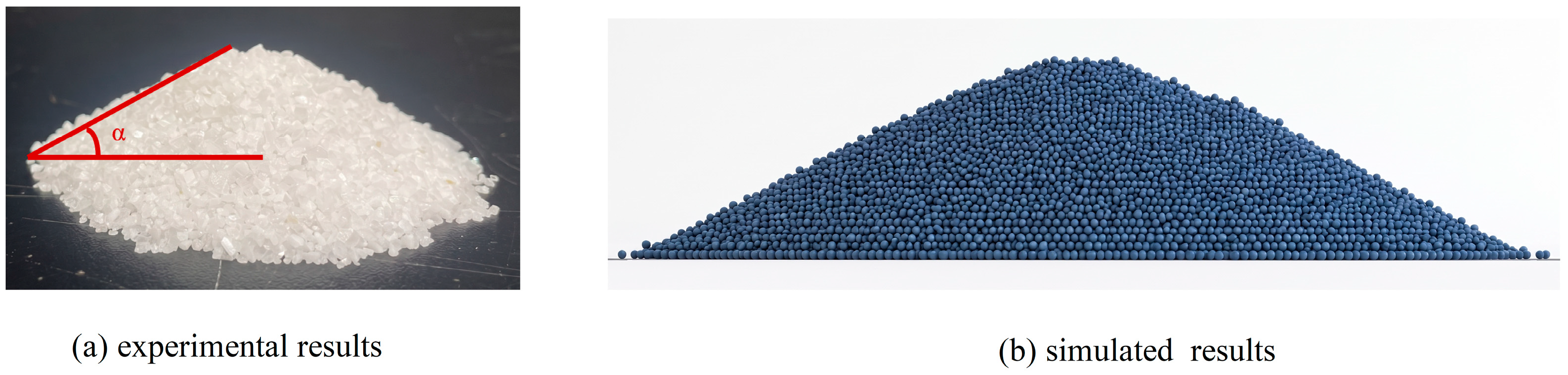
To verify the rationality of the DEM contact parameters, the simulated angle of repose was compared with the experimental proppant angle of repose under the same conditions. The DEM simulation parameters are listed in Table 3, the proppant-pile morphology is shown in Figure 16, and the validation results are summarized in Table 4. The results show that the simulated angle of repose agrees well with the experimental value, with a relative error of less than 5%, indicating that the established model can reasonably capture the contact behavior among proppant particles and between the particles and the wall.

3.4.2. Experimental Validation of Proppant Transport in Intersecting Fractures

To validate the reliability of the established numerical model, the proppant transport experiment reported by Tong et al. [13] was numerically reproduced using the coupled CFD–DEM approach. In the validation case, the geometric dimensions, proppant properties, and fluid properties were kept consistent with the experimental conditions, and the detailed parameters are listed in Table 5. The numerical simulation was performed by applying a velocity-inlet boundary and a pressure-outlet boundary. The inlet velocity was specified as 0.1 m/s, and the initial proppant velocity was assumed to be identical to the fluid velocity.
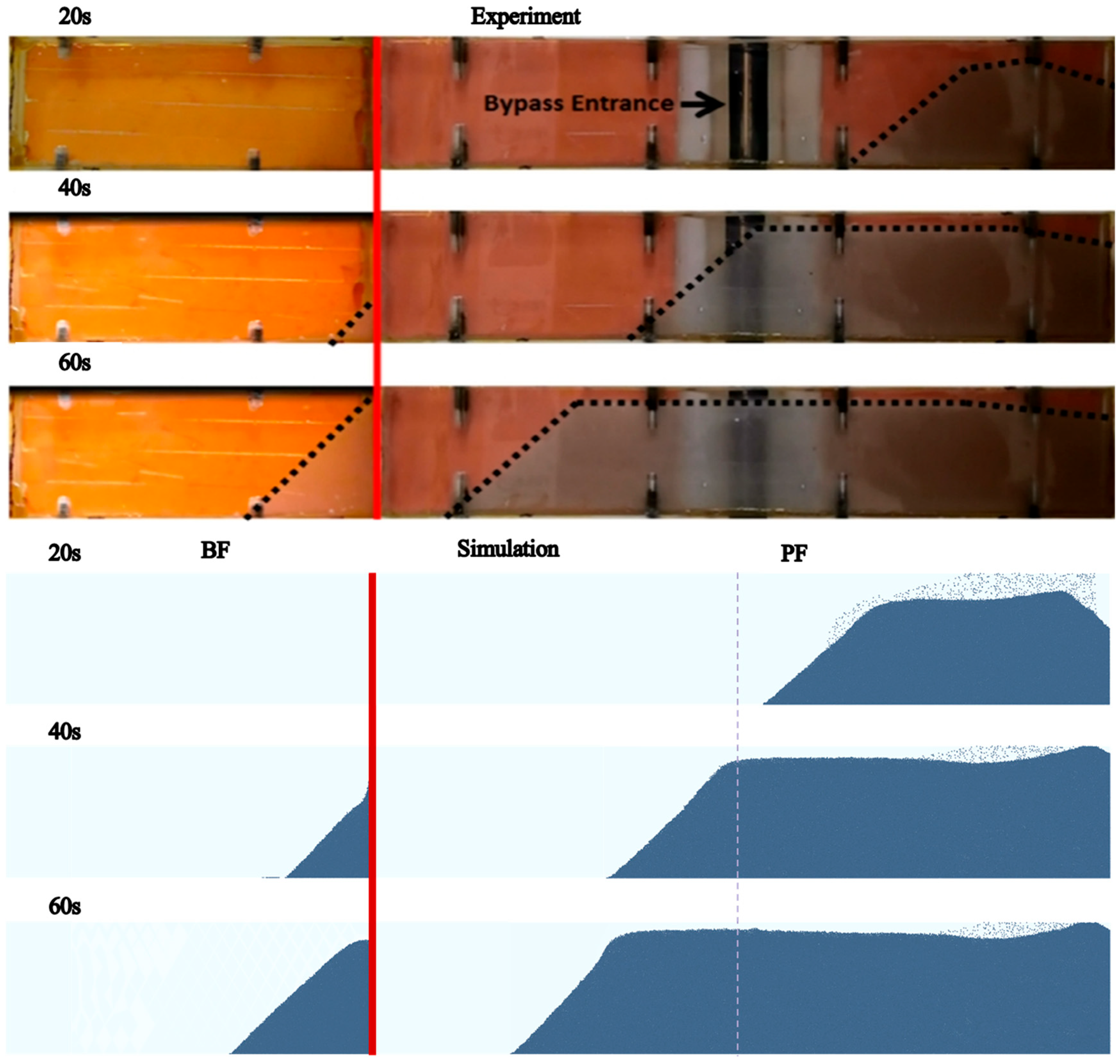
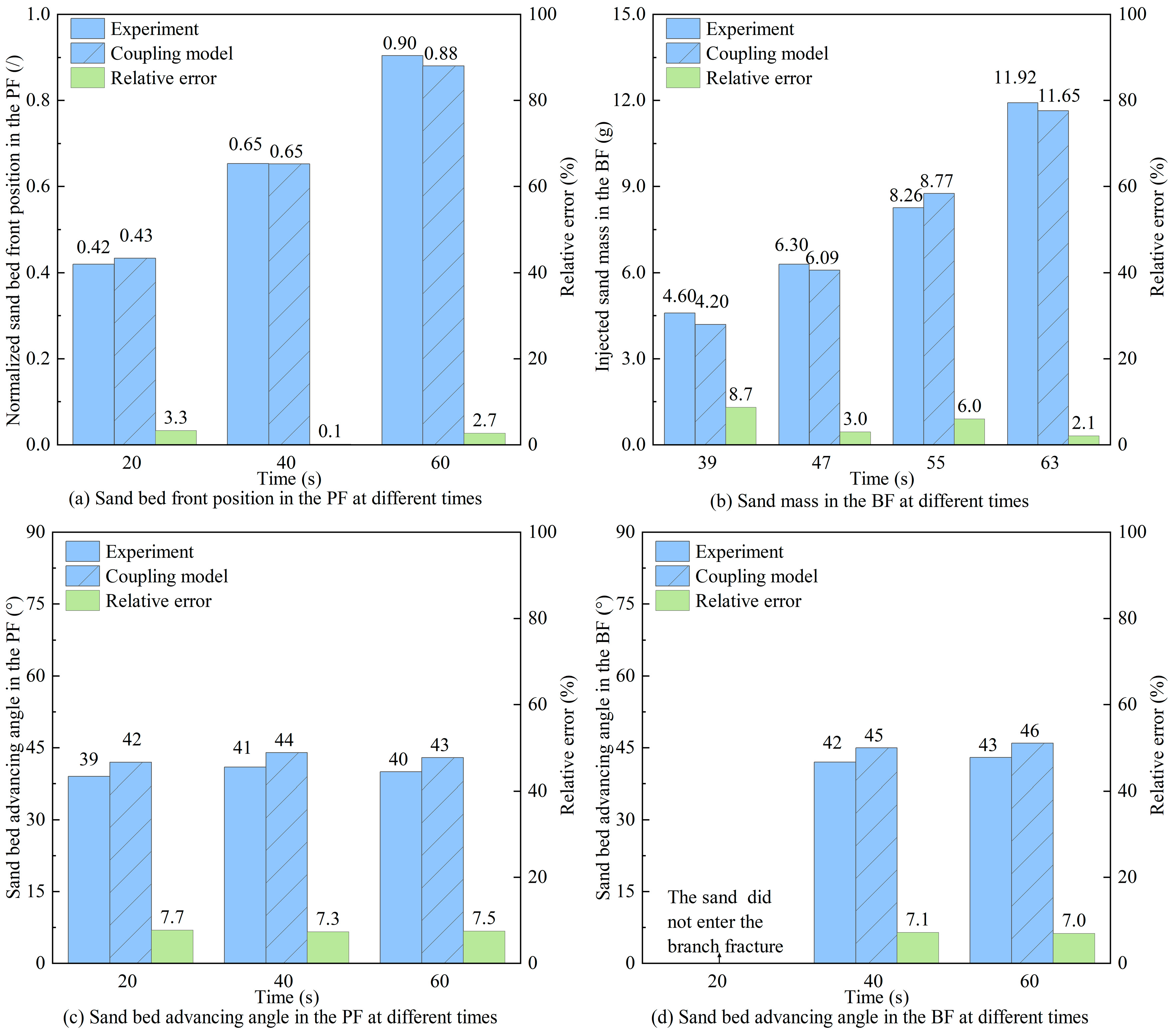
As shown in Figure 17, the simulated proppant-bed profiles in both the PF and BF agree well with the experimental observations. The normalized equilibrium height in the PF reaches 0.92, which is consistent with the experimental result. As further illustrated in Figure 18, the simulated proppant-bed front position, particle mass in the BF, and proppant-bed advancement angles in the PF and BF at different times all agree well with the experimental data, with maximum relative errors of less than 10%. These results demonstrate that the developed CFD–DEM model can reliably characterize particle transport and proppant-bed placement in complex fracture systems.

3.4.3. Grid-Independence Verification

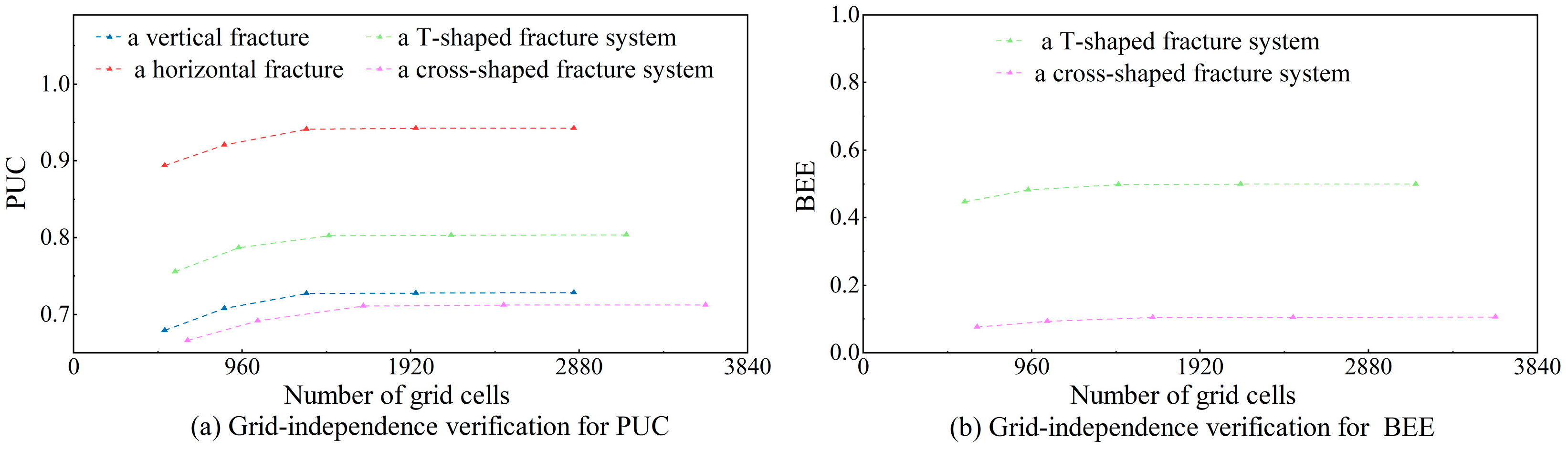
To minimize the influence of grid resolution, five mesh schemes were tested for each fracture geometry. As shown in Figure 19, the grid number has a relatively limited influence on particle transport and placement results. With grid refinement, the variations in PUC and BEE are small and gradually stabilize. After the third mesh scheme, further refinement has a negligible effect on the simulation results but increases the computational cost. Therefore, the third mesh scheme was adopted for all subsequent CFD–DEM simulations.

3.4.4. Comparison of Previous Simulation Studies on Particle-Transport Modeling

As shown in Table 6, previous numerical simulation studies on particle transport have employed various methods, including CFD, MP–PIC, and CFD–DEM. In comparison, this study developed a CFD–DEM model for particle transport in representative tortuous wedge-shaped fractures, systematically compared proppant transport and placement behavior under different fracture geometries, and quantitatively evaluated placement performance using the PUC and BEE indices. Therefore, this study provides a more systematic framework for elucidating geometry-controlled particle transport and placement mechanisms in complex fractures of deep coal seams.

4. Conclusions

(1)
Fracture geometry exerts a significant influence on proppant transport behavior and placement performance. Proppant transport in the “|”-shaped fracture, “T”-shaped fracture, and “+”-shaped fracture exhibits distinct stage-dependent characteristics and can be divided, according to the dominant forces, into three stages: rapid start-up, stratified transport, and front advancement. In contrast, the “—”-shaped fracture remains almost entirely in a regime of orderly front advancement and exhibits the best overall placement performance.
(2)
Fracture geometry significantly affects particle-motion stability and local retention by regulating the drag force, lift force, torque, and collision intensity acting on particles. In particular, junctions and turning regions enhance inertia-induced deviation, rotational disturbance, and collision-induced energy dissipation, thereby acting as key control zones responsible for differences in branch entry, local blockage, and heterogeneous placement.
(3)
The control of fracture geometry over proppant placement uniformity is highly stable. Under different injection velocities, particle sizes, and fluid viscosities, the placement performance of the four fracture geometries consistently follows the same order: “—”-shaped fracture > “T”-shaped fracture > “|”-shaped fracture > “+”-shaped fracture.
(4)
Increasing the injection velocity can significantly improve proppant placement uniformity and markedly promote branch entry in the T-shaped fracture. When the injection velocity increases from 0.03 m/s to 0.15 m/s, the PUC values of the “—”-shaped fracture, “|”-shaped fracture, “T”-shaped fracture, and “+”-shaped fracture increase by approximately 5.5%, 16.2%, 16.4%, and 18.2%, respectively. Meanwhile, the BEE of the “T”-shaped fracture increases from approximately 0.28 to 0.70, whereas the BEE of the “+”-shaped fracture remains essentially around 0.10.
(5)
An increase in fluid viscosity is generally beneficial for improving proppant placement uniformity, although the branch-entry response differs markedly among fracture geometries. When the fluid viscosity increases from 1 mPa·s to 5 mPa·s, the PUC values of the “—”-shaped fracture, “|”-shaped fracture, “T”-shaped fracture, and “+”-shaped fracture increase by approximately 3.2%, 5.6%, 6.3%, and 7.1%, respectively. Among them, the BEE of the “T”-shaped fracture increases from approximately 0.50 to 0.70, whereas that of the “+”-shaped fracture fluctuates only within a narrow range of approximately 0.06–0.11 and exhibits a trend of first decreasing and then increasing.
Implications for field design: The results indicate that proppant placement design in deep coal seams should be adjusted according to the expected fracture geometry. For relatively continuous fractures, stable drag-driven transport favors uniform placement, whereas branched and intersecting fractures are more prone to particle retention, local blockage, and nonuniform distribution. Therefore, higher injection velocity and moderately increased fluid viscosity can be used to enhance particle-carrying capacity and improve branch filling, especially in T-shaped fractures. However, for cross-shaped fractures, simply increasing velocity or viscosity may be insufficient because the main-fracture discharge pathway remains dominant. In such cases, particle size, injection schedule, and diversion-control strategies should be jointly optimized to improve effective proppant placement.
Limitations and outlook: This study simplifies complex deep-coal fracture systems into four representative tortuous wedge-shaped geometries and focuses mainly on particle transport after fracture formation. Fluid filtration, dynamic fracture propagation, closure stress, proppant embedment, particle crushing, and conductivity evolution were not fully considered. In addition, the fracture tortuosity and wedge angle were simplified to clarify the basic geometry-controlled transport mechanisms. Future work should further couple fracture propagation, filtration, stress-dependent closure, and post-placement conductivity evolution, and validate the model using laboratory experiments and field-scale data. This will help extend the present CFD–DEM framework from mechanism analysis to practical fracturing design optimization.

Author Contributions

P.Y., conceptualization (equal); data curation (equal); writing—original draft (equal); Z.W., methodology (equal); writing—review & editing (equal). All authors have read and agreed to the published version of the manuscript.

Funding

This work was financially supported by the National Natural Science Foundation of China (Grant No. 51974333). National Natural Science Foundation of China, Joint Fund Project (Grant No. U25B20125).

Data Availability Statement

The original contributions presented in this study are included in the article. Further inquiries can be directed to the corresponding author.

Conflicts of Interest

The authors declare no conflicts of interest.

Abbreviations

The following abbreviations are used in this manuscript:
CFD–DEMComputational fluid dynamics and discrete element method
CBMCoalbed methane
DEMDiscrete element method
CFDComputational fluid dynamics
DDPMDense discrete phase method
MP–PICMultiphase particle-in-cell method
PUCPlacement uniformity coefficient
BEEBranch-entry efficiency
PFPrimary fracture
BFBranch fracture

References

  1. Meng, Y.; Tang, D.; Xu, H.; Qu, Y.; Li, Y.; Zhang, W. Division of coalbed methane desorption stages and its significance. Pet. Explor. Dev. 2014, 41, 671–677. [Google Scholar] [CrossRef]
  2. Wan, Y.; Liu, W.; Ouyang, W.; Liu, W.; Han, G. Desorption area and pressure-drop region of wells in a homogeneous coalbed. J. Nat. Gas Sci. Eng. 2016, 28, 1–14. [Google Scholar] [CrossRef]
  3. Sun, S.; Zhang, Q.; Yang, F.; Wu, X.; Zheng, Y. Research progress on regulation of hydraulic fracture propagation in coal seams. Coal Sci. Technol. 2026, 54, 303–319. [Google Scholar] [CrossRef]
  4. Jiang, C.; Yang, Y.; Liu, H.; Guo, J.; Fu, Y.; Wu, J. Study on influence of natural fractures on initiation and propagation of hydraulic fracturing coal. Coal Sci. Technol. 2024, 52, 92–101. [Google Scholar] [CrossRef]
  5. Li, H.; Jiang, Z.; Shu, J.; Fan, Y.; Du, T. Numerical simulation of layer-crossing propagation behavior of hydraulic fractures at coal–rock interface. Coal Geol. Explor. 2020, 48, 106–113. [Google Scholar] [CrossRef]
  6. Huang, L.; Zhao, H.; Sheng, G.; Ruan, J.; Chen, J. A study on the bidirectional coupling mechanism between multiple fracture propagation and proppant transport in complex natural fracture systems. Rock Mech. Rock Eng. 2026. [Google Scholar] [CrossRef]
  7. Zhao, H.; Liu, C.; Xiong, Y.; Zhen, H.; Li, X. Experimental research on hydraulic fracture propagation in group of thin coal seams. J. Nat. Gas Sci. Eng. 2022, 103, 104614. [Google Scholar] [CrossRef]
  8. Yan, J.; Ni, X.; Liu, X.; Heng, S. Experimental research into the initiation and propagation of hydraulic fractures in coal combinations with different strengths. J. Energy Eng. 2025, 151, 04025019. [Google Scholar] [CrossRef]
  9. Zhao, H.; Li, W.; Wang, L.; Fu, J.; Xue, Y.; Zhu, J.; Li, S. The influence of the distribution characteristics of complex natural fracture on the hydraulic fracture propagation morphology. Front. Earth Sci. 2022, 9, 784931. [Google Scholar] [CrossRef]
  10. Xiao, H.; Wang, H.; He, T.; Yuan, C.; Zhang, H. Propagation laws of complex fracture networks in cleated thin-layer coal rocks. Phys. Fluids 2025, 37, 083366. [Google Scholar] [CrossRef]
  11. Li, J.; Zhong, Y.; Yan, Y.; Huang, T.; Mou, Q.; Yang, B. Mechanism of hydraulic fracture propagation and the uneven propagation behavior of multiple clusters in shale oil reservoirs. Fuel 2025, 395, 135241. [Google Scholar] [CrossRef]
  12. Jiang, T.; Zhang, J.; Huang, G. Experimental study of fracture geometry during hydraulic fracturing in coal. Rock Soil Mech. 2018, 39, 3677–3684. [Google Scholar] [CrossRef]
  13. Tong, S.; Mohanty, K.K. Proppant transport study in fractures with intersections. Fuel 2016, 181, 463–477. [Google Scholar] [CrossRef]
  14. Qu, H.; Hong, J.; Liu, Y.; Zeng, Z.; Liu, X.; Chen, X.; Guo, R. Experiment and simulation of slurry flow in irregular channels to understand proppant transport in complex fractures. Particuology 2023, 83, 194–211. [Google Scholar] [CrossRef]
  15. Wang, T.; Zhong, P.; Li, G.; Sheng, M.; Wen, H.; Tian, S. Transport pattern and placement characteristics of proppant in different rough fractures. Transp. Porous Media 2023, 149, 251–269. [Google Scholar] [CrossRef]
  16. Skopintsev, A.M.; Dontsov, E.V.; Kovtunenko, P.V.; Baykin, A.N.; Golovin, S.V. The coupling of an enhanced pseudo-3D model for hydraulic fracturing with a proppant transport model. Eng. Fract. Mech. 2020, 236, 107177. [Google Scholar] [CrossRef]
  17. Dontsov, E.V.; Peirce, A.P. Proppant transport in hydraulic fracturing: Crack tip screen-out in KGD and P3D models. Int. J. Solids Struct. 2015, 63, 206–218. [Google Scholar] [CrossRef]
  18. Kern, L.R.; Perkins, T.K.; Wyant, R.E. The mechanics of sand movement in fracturing. J. Pet. Technol. 1959, 11, 55–57. [Google Scholar] [CrossRef]
  19. Sahai, R.; Moghanloo, R.G. Laboratory results of proppant transport in complex fracture systems. In SPE Hydraulic Fracturing Technology Conference; Society of Petroleum Engineers: The Woodlands, TX, USA, 2014. [Google Scholar] [CrossRef]
  20. Ray, B.; Lewis, C.; Martysevich, V.; Shetty, D.A.; Walters, H.G.; Bai, J.; Ma, J. An investigation into proppant dynamics in hydraulic fracturing. In SPE Hydraulic Fracturing Technology Conference and Exhibition; Society of Petroleum Engineers: The Woodlands, TX, USA, 2017; p. SPE-184829-MS. [Google Scholar] [CrossRef]
  21. Huang, F.; Dong, C.; Shang, X.; You, Z. Effects of proppant wettability and size on transport and retention of coal fines in saturated proppant packs: Experimental and theoretical studies. Energy Fuels 2021, 35, 11976–11991. [Google Scholar] [CrossRef]
  22. Wen, Z.; Zhang, L.; Tang, H.; Zeng, J.; He, X.; Yang, Z.; Zhao, Y. A review on numerical simulation of proppant transport: Eulerian–Lagrangian views. J. Pet. Sci. Eng. 2022, 217, 110902. [Google Scholar] [CrossRef]
  23. Bandara, K.M.A.S.; Ranjith, P.G.; Rathnaweera, T.D. Improved understanding of proppant embedment behavior under reservoir conditions: A review study. Powder Technol. 2019, 352, 170–192. [Google Scholar] [CrossRef]
  24. Ding, Y.; Yang, D.; Huang, H.; Wang, H. Numerical simulation of proppant transport and placement in hydraulic fractures with the hybrid Perkins-Kern-Nordgren-Carter (PKN-C) model and particle tracking algorithm. SPE J. 2022, 27, 3914–3937. [Google Scholar] [CrossRef]
  25. Siddhamshetty, P.; Yang, S.; Kwon, J.S.-I. Modeling of hydraulic fracturing and designing of online pumping schedules to achieve uniform proppant concentration in conventional oil reservoirs. Comput. Chem. Eng. 2018, 114, 306–317. [Google Scholar] [CrossRef]
  26. Wang, Q.; Yang, Y.; Zhao, J.; Zhuang, W.; Xu, Y.; Hou, J.; Zhang, Y.; Hu, Y.; Wang, Y.; Li, X. Simulation of proppant transport in complex fracture networks based on the multiphase particle-in-cell method. Pet. Explor. Dev. 2026, 53, 213–222. [Google Scholar] [CrossRef]
  27. Wu, J.; He, Y.; Zeng, B.; Huang, H.; Gui, J.; Guo, Y. Numerical simulation study on the ultimate injection concentration and injection strategy of a proppant in hydraulic fracturing. Front. Energy Res. 2024, 12, 1370970. [Google Scholar] [CrossRef]
  28. Mao, S.; Zhang, Z.; Chun, T.; Wu, K. Field-scale numerical investigation of proppant transport among multicluster hydraulic fractures. SPE J. 2021, 26, 307–323. [Google Scholar] [CrossRef]
  29. Mao, S.; Zeng, J.; Wu, K.; Zhang, D. Lagrangian numerical simulation of proppant transport in channel fracturing. SPE J. 2023, 28, 1369–1386. [Google Scholar] [CrossRef]
  30. Wen, Z.; Tang, H.; Zhang, L.; Zhao, Y.; Zeng, J.; Zhang, J. Simulations of proppant transport in propagating multiple hydraulic fractures using the multi-phase particle-in-cell method. Powder Technol. 2025, 464, 121218. [Google Scholar] [CrossRef]
  31. Zheng, Y.; Wang, H.; Huang, H.; Ni, J.; Wang, B.; Yang, B.; Zhang, W. CFD–DEM simulation of proppant transport under variable injection strategies in rough fracture network with supercritical CO2. Powder Technol. 2025, 457, 120856. [Google Scholar] [CrossRef]
  32. Yan, P.; Wang, Z. Proppant migration and distribution simulation in tortuous fractures with gradually narrowing walls. In Proceedings of the 58th US Rock Mechanics/Geomechanics Symposium; American Rock Mechanics Association: Golden, CO, USA, 2024; p. ARMA 24-69. [Google Scholar] [CrossRef]
  33. Luo, S.; Zhang, C.; Fu, J.; Ding, H.; Xu, Y.; Yan, J. Study on proppant transport characteristics in rough fractures of fracture-network fracturing in Bohai low-permeability reservoirs. J. Southwest Pet. Univ. (Sci. Technol. Ed.) 2026, 48, 61–70. [Google Scholar] [CrossRef]
  34. Hu, X.; Li, X.; Zhou, F.; Bai, Y.; Chen, C.; Zhang, P. Simulation study on proppant transport in a horizontal wellbore considering perforation erosion. Geoenergy Sci. Eng. 2023, 231, 212282. [Google Scholar] [CrossRef]
  35. Bahri, A.; Miskimins, J.; Hill, A.D.; Zhu, D. The effect of fracture wall surface roughness on proppant transport. SPE J. 2024, 29, 5976–5992. [Google Scholar] [CrossRef]
  36. Yin, B.; Zhang, C.; Wang, Z.; Sun, B.; Gao, Y.; Wang, X.; Bi, C.; Zhang, Q.; Wang, J.; Shi, J. Proppant transport in rough fractures of unconventional oil and gas reservoirs. Pet. Explor. Dev. 2023, 50, 712–721. [Google Scholar] [CrossRef]
  37. Li, J.; Wu, M.; Zhou, L.; He, S. A new proppant type fully coupled fiber-proppant and its property evaluation for unconventional reservoirs. J. Pet. Sci. Eng. 2022, 208, 109573. [Google Scholar] [CrossRef]
  38. Alajmei, S. Prediction of proppant distribution as a function of perforation orientations. J. Pet. Explor. Prod. Technol. 2024, 14, 609–621. [Google Scholar] [CrossRef]
  39. Bahri, A.; Alajmei, S.; Miskimins, J. Particle dune height prediction. Arab. J. Sci. Eng. 2025, 50, 4853–4868. [Google Scholar] [CrossRef]
  40. Jumaa, M.; Alajmei, S.; Hassan, A.; Bahri, A. Artificial neural network (ANN) based prediction of proppant settling in horizontal wellbores during hydraulic fracturing. Sci. Rep. 2025, 15, 42390. [Google Scholar] [CrossRef]
  41. Yan, P.; Wang, Z. Evolution and prediction of deep coal–rock fracture conductivity with energy-based breakage criterion of proppant. Processes 2026, 14, 866. [Google Scholar] [CrossRef]
  42. Wang, D.; Wang, Z. 3D lattice Boltzmann method–discrete-element method with immersed moving boundary scheme numerical modeling of microparticles migration carried by a fluid in fracture. SPE J. 2022, 27, 2841–2862. [Google Scholar] [CrossRef]
  43. Barton, N.; Choubey, V. The shear strength of rock joints in theory and practice. Rock Mech. 1977, 10, 1–54. [Google Scholar] [CrossRef]
  44. Barton, N.; Wang, C.; Yong, R. Advances in joint roughness coefficient (JRC) and its engineering applications. J. Rock Mech. Geotech. Eng. 2023, 15, 3352–3379. [Google Scholar] [CrossRef]
  45. Bokane, A.; Jain, S.; Deshpande, Y.; Crespo, F. Transport and distribution of proppant in multistage fractured horizontal wells: A CFD simulation approach. In SPE Annual Technical Conference and Exhibition; Society of Petroleum Engineers: New Orleans, LA, USA, 2013; p. SPE-166096-MS. [Google Scholar] [CrossRef]
  46. Zeng, J.; Li, H.; Zhang, D. Numerical simulation of proppant transport in propagating fractures with the multi-phase particle-in-cell method. Fuel 2019, 245, 316–335. [Google Scholar] [CrossRef]
  47. Garagash, I.A.; Osiptsov, A.A.; Boronin, S.A. Dynamic bridging of proppant particles in a hydraulic fracture. Int. J. Eng. Sci. 2019, 135, 86–101. [Google Scholar] [CrossRef]
  48. Gong, Y.; Mehana, M.; El-Monier, I.; Viswanathan, H. Proppant placement in complex fracture geometries: A computational fluid dynamics study. J. Nat. Gas Sci. Eng. 2020, 79, 103295. [Google Scholar] [CrossRef]
  49. Vega, F.G.; Carlevaro, C.M.; Sánchez, M.; Pugnaloni, L.A. Stability and conductivity of proppant packs during flowback in unconventional reservoirs: A CFD–DEM simulation study. J. Pet. Sci. Eng. 2021, 201, 108381. [Google Scholar] [CrossRef]
Figure 1. Schematic illustration of proppant transport in fractures.
Energies 19 02739 g001
Figure 2. Flowchart of the CFD–DEM coupling procedure.
Energies 19 02739 g002
Figure 3. Schematic of PF–BF geometric models: (a) a vertical fracture (“|”); (b) a horizontal fracture (“—”); (c) a T-shaped fracture system (“T”); (d) a cross-shaped fracture system (“+”).
Energies 19 02739 g003
Figure 4. Proppant transport and evolution in different fracture systems: (a) a vertical fracture (“|”); (b) a horizontal fracture (“—”); (c) a T-shaped fracture system (“T”); (d) a cross-shaped fracture system (“+”).
Energies 19 02739 g004
Figure 5. Evolution of normalized maximum sand-bed height in different fracture systems.
Energies 19 02739 g005
Figure 6. Evolution of trajectories and forces in a vertical fracture (“|”): (a) trajectories of particles; (b) evolution of drag force, lift force, and torque for particle A; (c) evolution of drag force, lift force, and torque for particle B.
Energies 19 02739 g006
Figure 7. Evolution of trajectories and forces in a horizontal fracture (“—”): (a) trajectories of particles; (b) evolution of drag force, lift force, and torque for particle A; (c) evolution of drag force, lift force, and torque for particle B.
Energies 19 02739 g007
Figure 8. Evolution of trajectories and forces in a T-shaped fracture system (“T”): (a) trajectories of particles; (b) evolution of drag force, lift force, and torque for particle A; (c) evolution of drag force, lift force, and torque for particle B; (d) evolution of drag force, lift force, and torque for particle C; (e) evolution of drag force, lift force, and torque for particle D.
Energies 19 02739 g008aEnergies 19 02739 g008b
Figure 9. Evolution of trajectories and forces in a cross-shaped fracture system (“+”): (a) trajectories of particles; (b) evolution of drag force, lift force, and torque for particle A; (c) evolution of drag force, lift force, and torque for particle B; (d) evolution of drag force, lift force, and torque for particle C; (e) evolution of drag force, lift force, and torque for particle D.
Energies 19 02739 g009
Figure 10. Evolution of mean lift force and mean drag force in different fracture systems: (a) evolution of mean lift force in different fracture systems; (b) evolution of mean drag force in different fracture systems.
Energies 19 02739 g010
Figure 11. Evolution of particle velocity in different fracture systems: (a) mean particle x-velocity; (b) mean particle y-velocity; (c) mean particle z-velocity; (d) mean particle velocity magnitude.
Energies 19 02739 g011
Figure 12. Verification of the number of primary-fracture segments for PUC.
Energies 19 02739 g012
Figure 13. Effect of injection velocity on PUC and BEE in different fracture systems: (a) variation in PUC in a horizontal fracture (“—”) and a vertical fracture (“|”); (b) PUC and BEE in a T-shaped fracture system (“T”) and a cross-shaped fracture system (“+”).
Energies 19 02739 g013
Figure 14. Effect of proppant size on PUC and BEE in different fracture systems: (a) variation in PUC in a horizontal fracture (“—”) and a vertical fracture (“|”); (b) PUC and BEE in a T-shaped fracture system (“T”) and a cross-shaped fracture system (“+”).
Energies 19 02739 g014
Figure 15. Effect of fluid viscosity on PUC and BEE in different fracture systems: (a) variation in PUC in a horizontal fracture (“—”) and a vertical fracture (“|”); (b) PUC and BEE in a T-shaped fracture system (“T”) and a cross-shaped fracture system (“+”).
Energies 19 02739 g015
Figure 16. Proppant packing morphology: (a) experimental results; (b) simulated results.
Energies 19 02739 g016
Figure 17. Comparison of the experimental results of Tong et al. [13] with the model-predicted proppant bed distributions in the PF and BF.
Energies 19 02739 g017
Figure 18. Comparison between experimental results of Tong et al. [13] and model predictions: (a) proppant bed front position in the PF at different times; (b) proppant mass in the BF at different times; (c) proppant bed advancing angle in the PF at different times; (d) proppant bed advancing angle in the BF at different times.
Energies 19 02739 g018
Figure 19. Grid-independence verification for PUC and BEE.
Energies 19 02739 g019
Table 1. Parameters used in the numerical simulations.
ParametersValueUnit
Primary fracture length/height110/25mm
Branch fracture length/height55/25mm
Primary fracture width2.25–4mm
Branch fracture width0.25–2mm
Proppant density2650kg/m3
Proppant diameter0.2–0.6mm
Proppant Poisson’s ratio0.32/
Fluid density998.2kg/m3
Fluid viscosity1mPa·s
Inlet velocity0.03–0.15m/s
Restitution coefficient0.3/
Static friction coefficient0.3/
Dynamic friction coefficient0.05/
CFD time step1 × 10−5s
DEM time step1 × 10−6s
Table 2. Numerical simulation cases and parameter settings.
CaseFracture GeometryInlet Velocity
(m/s)
Particle
Diameter (mm)
Fluid Viscosity
(mPa·s)
1|0.090.2, 0.3, 0.4, 0.5, 0.61
20.090.2, 0.3, 0.4, 0.5, 0.61
3T0.090.2, 0.3, 0.4, 0.5, 0.61
4+0.090.2, 0.3, 0.4, 0.5, 0.61
5|0.03, 0.06, 0.09, 0.12, 0.150.41
60.03, 0.06, 0.09, 0.12, 0.150.41
7T0.03, 0.06, 0.09, 0.12, 0.150.41
8+0.03, 0.06, 0.09, 0.12, 0.150.41
9|0.090.41, 2, 3, 4, 5
100.090.41, 2, 3, 4, 5
11T0.090.41, 2, 3, 4, 5
12+0.090.41, 2, 3, 4, 5
Table 3. Parameter settings for validation of the model using the angle of repose.
ParametersValueUnit
Proppant density2650kg/m3
Proppant diameter0.6, 0.45mm
Proppant Young’s modulus9.8GPa
Proppant Poisson’s ratio0.32/
Wall density1500kg/m3
Wall Young’s modulus4.5GPa
Wall Poisson’s ratio0.34/
Restitution coefficient (particle–particle)0.3/
Static friction coefficient (particle–particle)0.3/
Dynamic friction coefficient (particle–particle)0.05/
Restitution coefficient (particle–wall)0.27/
Static friction coefficient (particle–wall)0.3/
Dynamic friction coefficient (particle–wall)0.12/
Table 4. Experimental validation results for the angle of repose.
Particle Size (Mesh)Experimental Value (°)Simulated Value (°)Relative Error (%)
20/4029.127.84.46
30/5029.828.44.70
Table 5. Parameter settings for validation of the model.
ParametersValueUnit
Primary fracture (PF) length/width/height381/2/76.2mm
Branch fracture (BF) length/width/height190.5/2/76.2mm
Proppant density2650kg/m3
Proppant diameter0.6mm
Proppant Poisson’s ratio0.32/
Fluid density998.2kg/m3
Fluid viscosity1mPa·s
Inlet velocity0.1m/s
Restitution coefficient0.3/
Static friction coefficient0.3/
Dynamic friction coefficient0.05/
Table 6. Summary of previous simulation studies on particle-transport modeling.
ModelMethodTortuosityWedge AngleBranch FracturePlacement Performance
Evaluation
Bokane et al. (2013) [45]CFD×××
Zeng et al. (2019) [46]MP–PIC×××
Garagash et al. (2019) [47]CFD–DEM×××
Gong et al. (2020) [48]CFD×
Vega et al. (2021) [49]CFD–DEM×××
Yan and Wang. (2024) [32]CFD–DEM××
In this paperCFD–DEM
Disclaimer/Publisher’s Note: The statements, opinions and data contained in all publications are solely those of the individual author(s) and contributor(s) and not of MDPI and/or the editor(s). MDPI and/or the editor(s) disclaim responsibility for any injury to people or property resulting from any ideas, methods, instructions or products referred to in the content.