Article

Forecast-Driven Virtual Power Plant Dispatch for Hybrid Renewable Energy Systems: Reducing Grid Dependency Using LSTM Models


1
Discipline of Electrical, Electronics and Computer Engineering, University of KwaZulu-Natal, Durban 4041, South Africa
2
Electrical and Electronic Engineering, University of Stellenbosch, Stellenbosch 7602, South Africa
*
Author to whom correspondence should be addressed.
Energies 2026, 19(11), 2730; https://doi.org/10.3390/en19112730
Submission received: 8 April 2026 / Revised: 26 April 2026 / Accepted: 29 April 2026 / Published: 5 June 2026

Abstract

This study presents a forecast-driven Advanced Forecasting Model (AFM) and Virtual Power Plant (VPP) framework for a hybrid renewable energy system comprising utility-scale solar PV, wind generation, and a Battery Energy Storage System. Long Short-Term Memory neural networks provide real-time short-term forecasts to dynamically schedule power flows based on battery state-of-charge, grid import limits, and system constraints. Solar irradiance forecasting achieved MAE = 10.674 W/m2, RMSE = 16.348 W/m2, and MAPE = 14.18%, while wind speed forecasting achieved MAE = 0.880 m/s, RMSE = 1.115 m/s, and MAPE = 22.01%. Two dispatch scenarios were evaluated over a 72 h window: a reactive baseline and the proposed AFM/VPP strategy. The AFM reduced total grid imports by 57.48% (1466.34 MWh to 623.47 MWh), increased renewable utilization, and minimized curtailment. Financial analysis indicates an accelerated break-even (Year 6 vs. Year 9), a higher net present value, and cumulative 20-year profits exceeding R26.01 billion despite marginally higher capital expenditure. Emissions analysis shows annual CO2 reductions from 123,680 t to 61,841 t, yielding 1.236 million tons of avoided emissions over 20 years. These results confirm that forecast-driven dispatch enhances operational efficiency, economic performance, and environmental sustainability, establishing a scalable approach for VPP operation in renewable-rich energy systems.

1. Introduction

The increasing share of renewable energy in modern power systems introduces challenges of intermittency and uncertainty that affect grid stability and operational planning [1]. Accurate short-term forecasting of renewable resources is therefore essential for optimizing energy dispatch and reducing dependency on conventional grid supply [2]. Forecasting challenges in electric grid operations with deep renewable penetration become much more tractable if accurate forecasts of wind and solar energy production are available in advance [3]. Accurate forecasts can alleviate negative impacts on the required spinning reserves for the reliable operation of the grid [4]. They also reduce the total cost of integrating renewable energy into the grid. For optimizing renewable energy and energy storage system integration in smart grids, Long Short-Term Memory (LSTM) methods are generally the most effective [5].
A comprehensive review of forecasting methods and dispatch-optimization techniques for hybrid renewable–storage systems has been undertaken in the authors’ prior work [1,2,3,6]. In [6], a range of forecasting models—including statistical, machine-learning, deep-learning, hybrid, and probabilistic methods—was systematically benchmarked for solar irradiance and wind speed prediction across multiple training windows, alongside a discussion of the dispatch families typically coupled with them, including rule-based, mixed-integer linear programming, metaheuristic, and forecast-error-aware approaches. That analysis demonstrated that LSTM networks consistently outperformed traditional models in terms of Mean Absolute Error (MAE), Root Mean Square Error (RMSE), and Mean Absolute Percentage Error (MAPE), with statistically validated improvements over both classical baselines and naïve persistence forecasts. Rather than re-deriving those comparisons, the present paper takes the benchmark recommendation as its starting point and focuses exclusively on the integration of LSTM-based forecasts into the dispatch optimization of a Virtual Power Plant (VPP) comprising solar PV, wind turbines, and a Battery Energy Storage System (BESS)—directly addressing the “future work: direct VPP integration” item identified in [6]. The forecast-driven rule-based dispatch formulation adopted here was chosen for three reasons:
  • Operational interpretability—transparent SOC and grid import logic is preferred over black-box optimization for utility deployment.
  • Computational efficiency—tractable at hourly resolution over a 72 h horizon.
  • Clean attribution—identical rules applied to forecast versus reactive inputs allow direct attribution of any performance improvement to the forecast layer.
The main objectives of this study are to:
  • Develop and deploy LSTM-based hourly forecasting models for solar and wind generation profiles.
  • Integrate the LSTM-forecast outputs into an optimization-based framework for VPP dispatch.
  • Compare the operational performance of forecast-based optimization against a baseline scenario without forecasting.
  • Quantify improvements in grid import reduction, environmental benefit and cost analysis.
The remainder of this paper is organized as follows: Section 2 provides a background to smart grids and Virtual Power Plants. Section 3 explains the case study, Section 4 details the methodology, Section 5 discusses simulation results and performance analysis, Section 6 delves into the financial savings, Section 7 quantifies environmental benefits and Section 8 concludes with key findings.

2. Background

The flow of electricity in power systems has traditionally been unidirectional, traveling from power plants to consumers via transmission lines across the country. The power system has been managed centrally, divided into generation, transmission, and distribution, to maintain a balance between supply and demand [7]. However, with technological advancements, the grid has been upgraded and modernized using information and communication technologies (ICT) [8]. This transformation has enhanced grid stability, resilience to disruptions, and enabled automated actions. Hence, the introduction of a smart grid allows for intelligent integration of generation, transmission, and distribution, ensuring electricity security, sustainability, and affordability [9,10].

2.1. South Africa’s Smart Grid Market Trends

South Africa is increasingly adopting smart grid technologies to modernize its electricity sector, driven by growing power demand, higher shares of renewable energy, and the need to upgrade aging grid infrastructure. The South African Smart Grid Vision provides a coordinated national framework for guiding investments and policy development [11].
The South African National Energy Development Institute (SANEDI) plays a central role in policy formulation, technical standardization, and coordinating smart grid adoption strategies in support of the government’s objective of achieving universal electrification by 2030 [12]. By enabling bidirectional communication, real-time monitoring, and intelligent energy management, smart grids lay the foundation for implementing VPPs. Globally, VPPs have moved well beyond pilot installations: commercial deployments now operate across Europe, North America, and Australia, aggregating hundreds of megawatts of distributed assets and participating in wholesale electricity markets. In South Africa and other African contexts, VPPs present an opportunity to address grid reliability and electrification challenges by coordinating distributed renewables and local microgrids [12].

2.2. Demand-Side Management

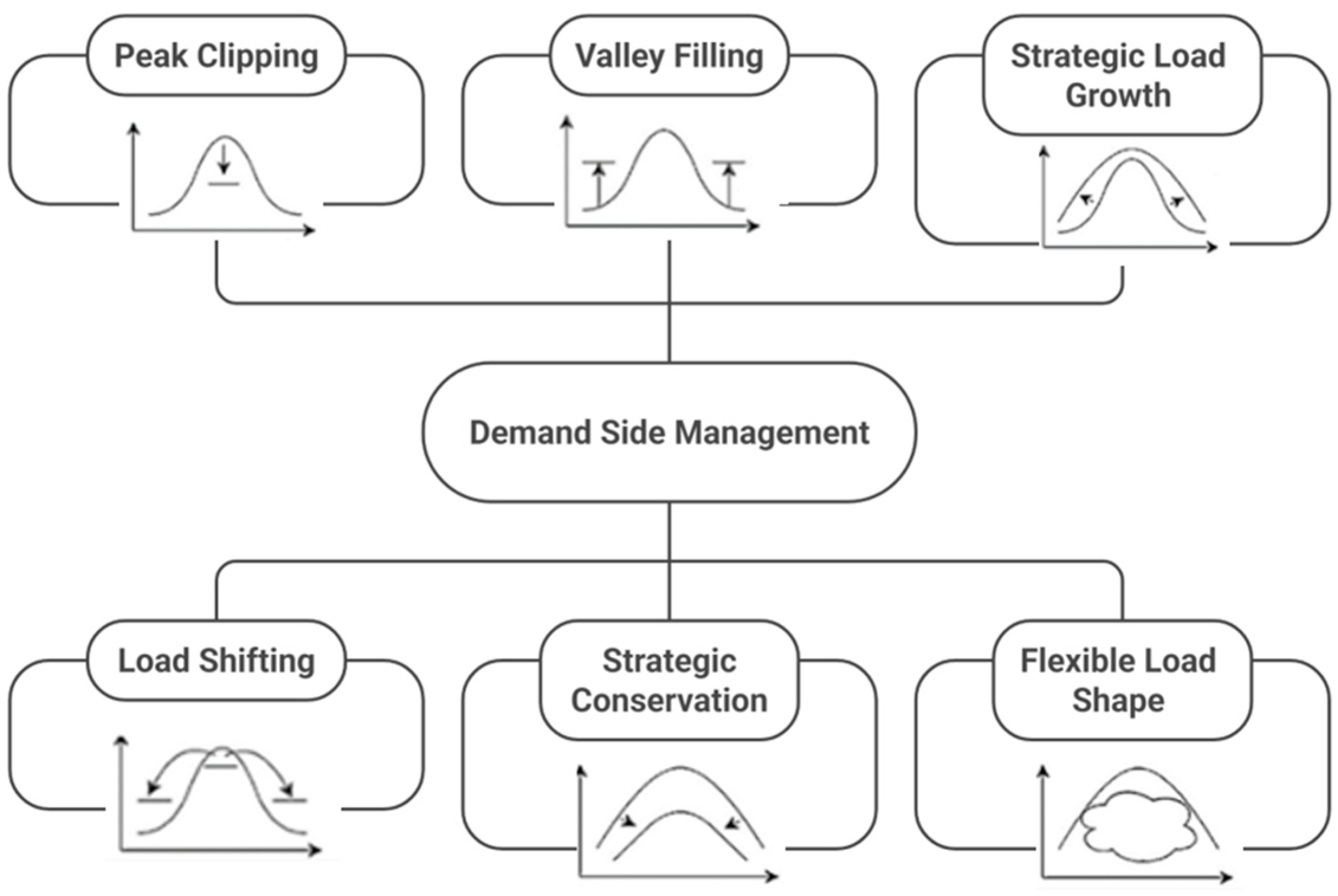
DSM and demand response (DR) are related but distinct concepts whose differences are important for understanding the VPP framework presented in this paper. DSM is a broad strategic framework through which utilities and grid operators influence how and when electricity is consumed by end users. DSM encompasses long-term load-shaping techniques—including peak clipping, valley filling, load shifting, strategic conservation, strategic load growth, and flexible load shaping—with the objective of improving overall system reliability and reducing operational costs [13,14,15,16,17]. These techniques modify the aggregate demand profile rather than responding to real-time grid signals [13]. The broader concept of distributed energy resources integrates three key components, including distributed generation, demand response, and energy storage, which collectively underpin strategies for managing demand-side energy [14]. Common DSM techniques for load shaping are illustrated in Figure 1 [15,16,17].
Peak clipping is a strategy employed in economically challenged countries to mitigate the impact of peak demand, especially when the installation costs of additional power units are prohibitive. This approach reduces both demand and peak time by directly lowering the loads of user appliances [18]. Load shifting entails moving the demand for loads from peak hours to off-peak hours by employing filling and clipping strategies. This method uses Time of Use (TOU) rates and storage devices while maintaining a constant level of total energy consumption [19]. Valley filling aims to maintain system balance during off-peak times, particularly when the average cost is lower than the load cost. This typically happens when a plant’s energy production is underutilized, and its operating expenses are low. Although peak demand remains unchanged, this strategy increases overall energy usage. By implementing this technology with thermal storage, system efficiency is significantly improved at a reduced energy cost [18].
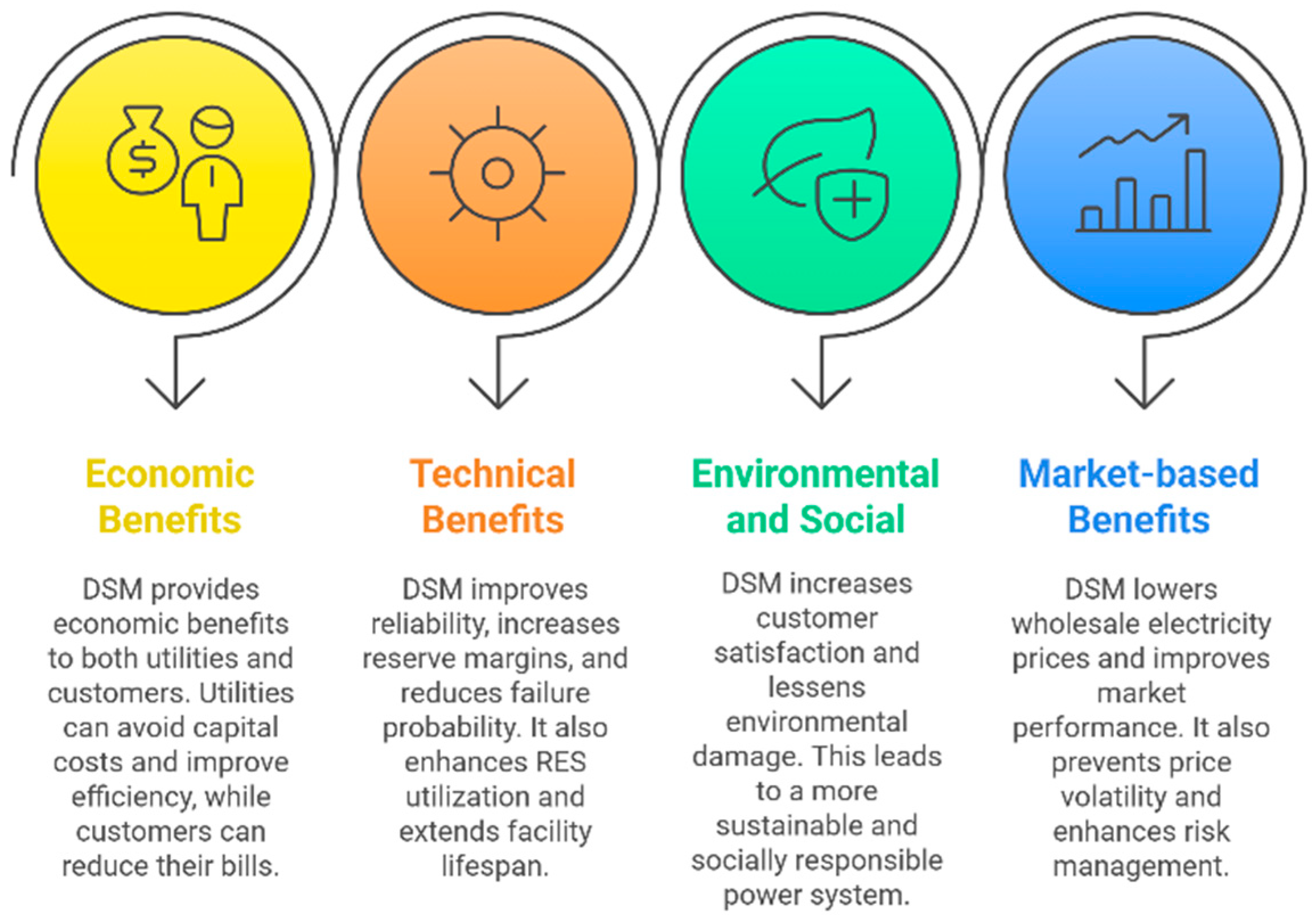
Strategic conservation aims to reduce energy loss and improve the efficiency of seasonal energy consumption by providing incentives for technological change. Although this technique is comprehensive, it is less frequently considered a load management strategy because it involves a reduction in sales without necessarily reducing peak demand. Strategic load growth involves increasing peak demand during a specific season by managing seasonal energy usage, resulting in a significant rise in both energy usage and peak demand. Utilities employ more advanced systems to achieve their targets, particularly in the electrification of industrial and commercial heating processes [20]. Flexible load shape utilizes load-limiting devices to decrease energy consumption at the user’s end without impacting the actual system conditions. Utilities can interrupt loads when necessary to reduce peak demand and alter total energy consumption [21]. Figure 2 summarizes the benefits of demand-side management.

2.3. Distributed Generation

Distributed generation (DG) refers to the production of electricity by units connected either directly to the distribution network or at the consumer level [14]. These distributed energy resources are typically small-scale energy sources capable of meeting everyday energy demands [22]. Optimizing the sizing and operation of DGs provides several technical benefits, including improved voltage profiles and reduced network losses when deployed close to load centers [23,24]. However, DG units are subject to operational failures that can limit their availability, necessitating reliability models that account for contingency scenarios through probabilistic methods. In islanded operation, limitations in control, protection, and communication infrastructure constrain functionality [25]. Despite these challenges, numerous studies have focused on assessing distribution network reliability to facilitate the transition toward intelligently managed grids. In contrast, under grid-connected conditions, DGs are typically located near load centers to enhance system reliability by partially relieving centralized generation during peak demand, emphasizing the need to quantify power exchanges between feeders in the presence of DGs [26].
For dispatchable DGs, output is predetermined and represented in Markov State Models [1], whereas non-dispatchable units such as wind and solar depend on the variability of their respective energy sources. With technological advancements and the growing penetration of sustainable resources, DERs are increasingly central to future grid infrastructure. It is projected that DER capacity will expand substantially from 1.9 million GW in 2024 to approximately 7.6 million GW by 2033, driven by distributed photovoltaics, small- to medium-scale wind turbines, microturbines, fuel cells, electric vehicles (EVs), distributed energy storage (DES), and demand response (DR) programs [27].

2.4. Demand Response

Demand response (DR) refers to the capability of modifying the electricity consumption of installations or devices, often on very short timescales, in response to appropriate signals such as electricity prices [2]. DR enhances the efficiency and reliability of power grids by actively managing consumption; for example, temporarily reducing the operation of centralized air-conditioning systems can help meet urgent power reduction requirements. However, during rapid DR events, the optimization of active cold storage control while maintaining indoor environmental conditions and satisfying grid constraints is seldom addressed [28].
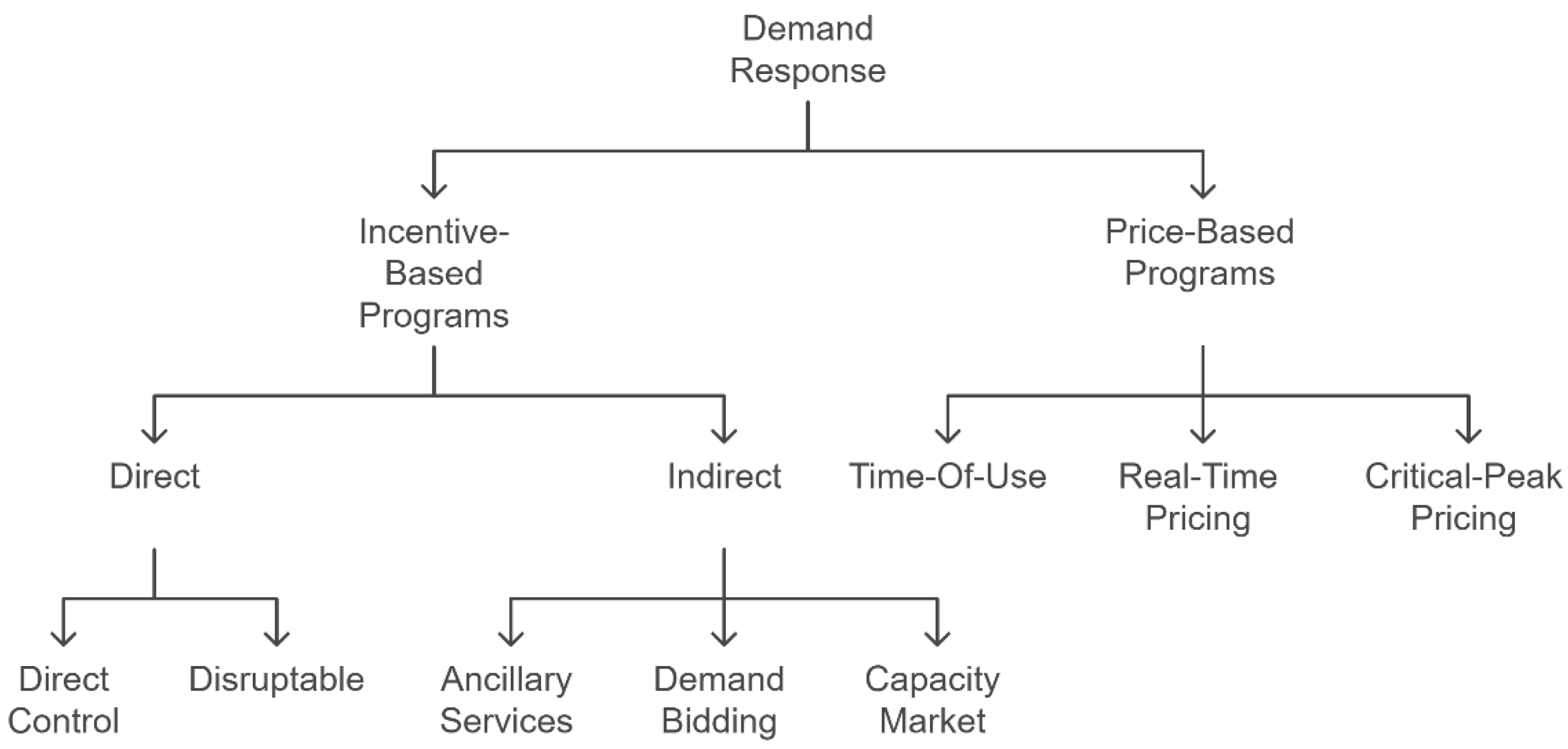
The increasing electricity demand, combined with higher penetration of weather-dependent renewable energy sources, places substantial stress on grid balance. Even minor power imbalances can compromise reliability and power quality, causing issues such as voltage fluctuations and outages [29]. Smart grids, utilizing advanced monitoring, control, and communication technologies, offer promising solutions to improve flexibility, reliability, and security in power system operations. DR represents a key mechanism through which demand-side efforts such as dynamic pricing and reliability signals support grid performance [30]. Through DR programs, consumers participate actively in grid management by adjusting their electricity usage during peak periods, often receiving financial incentives in return [31]. Additionally, DR can provide valuable capacity during contingency events, reducing reliance on traditional measures such as load shedding to maintain system stability. The classification of DR programs is summarized in Figure 3.
Demand response plays a critical role in the evolution of future power systems, alongside energy storage technologies, distributed generation, and advanced communication infrastructure [32]. In conventional power systems, consumers are largely passive, with minimal ability to monitor or actively control their flexible loads. By contrast, smart grids enable consumers to participate more actively in various aspects of grid operation and energy management. DR programs are generally classified into price-based and incentive-based schemes. Price-based programs implement dynamic pricing mechanisms to influence end-user consumption, whereas incentive-based programs provide rewards for undertaking specific actions [1]. Incentive-based programs can be further subdivided into Direct Control Load (DCL) and Indirect Control Load (ICL). DCL enables utilities to directly adjust the consumption of controllable devices with prior notice, while ICL targets appliances that can be temporarily interrupted to reduce peak demand during periods of high load.

2.5. The Virtual Power Plant Concept

A Virtual Power Plant is an advanced platform that aggregates and coordinates multiple distributed energy assets—such as solar PV, wind turbines, and BESS—to operate as a single controllable entity. Unlike conventional centralized generation, a VPP utilizes digital communication, optimization algorithms, and forecasting intelligence to balance supply and demand dynamically within a smart grid environment [33]. Commercial VPP deployments now span Sweden, Norway, Belgium, the United States, and Australia, demonstrating their ability to reduce carbon emissions, enhance grid flexibility, and integrate higher shares of renewable energy at scale.
The VPP architecture comprises three primary components:
  • Distributed Energy Resources, including decentralized generation units such as solar PV, wind, and microgrids;
  • Energy Storage Systems (ESS), such as BESS, that store excess energy and discharge during deficit periods;
  • A Central Control and Communication System, a supervisory layer for real-time data analytics, forecasting, scheduling, and power trading [34,35].
Regarding scalability to more distributed configurations: this study presents a simplified two-site VPP as a tractable starting point for validating the AFM dispatch methodology. Extending the framework to hundreds of distributed assets would require additional coordination layers, inter-asset communication protocols, and aggregation logic. Future work should explore multi-agent and hierarchical control architectures for larger-scale VPP deployments.

2.6. LSTM Architecture for Renewable Energy

Long Short-Term Memory networks are a specialized form of Recurrent Neural Network (RNN) designed to capture temporal dependencies in sequential data [36]. Understanding why LSTMs are well-suited to this problem requires a brief description of their internal mechanics. A standard RNN processes sequential inputs by maintaining a hidden state updated at each timestep. However, standard RNNs suffer from the vanishing gradient problem, where gradients diminish exponentially during backpropagation through many timesteps. LSTMs solve this through gating mechanisms: the forget gate (sigmoid-controlled, output ∈ [0, 1]) determines which cell-state elements to discard; the input gate (also sigmoid) decides which new information to store; and the output gate controls what cell-state information passes to the next timestep. The tanh activation function, which maps values to [−1, 1], is applied to the cell state and candidate values to regulate activation magnitude and prevent numerical instability [36,37]. Figure 4 displays the VPP structure.
The Adam optimizer is used for training. Adam combines momentum-based gradient descent with adaptive per-parameter learning rates, making it particularly effective for noisy, non-stationary time-series data. It maintains running estimates of both the first moment (mean) and second moment (uncentred variance) of gradients, enabling faster and more stable convergence than standard stochastic gradient descent. A gradient clipping threshold of 1.0 is applied to prevent exploding gradients on long sequences.
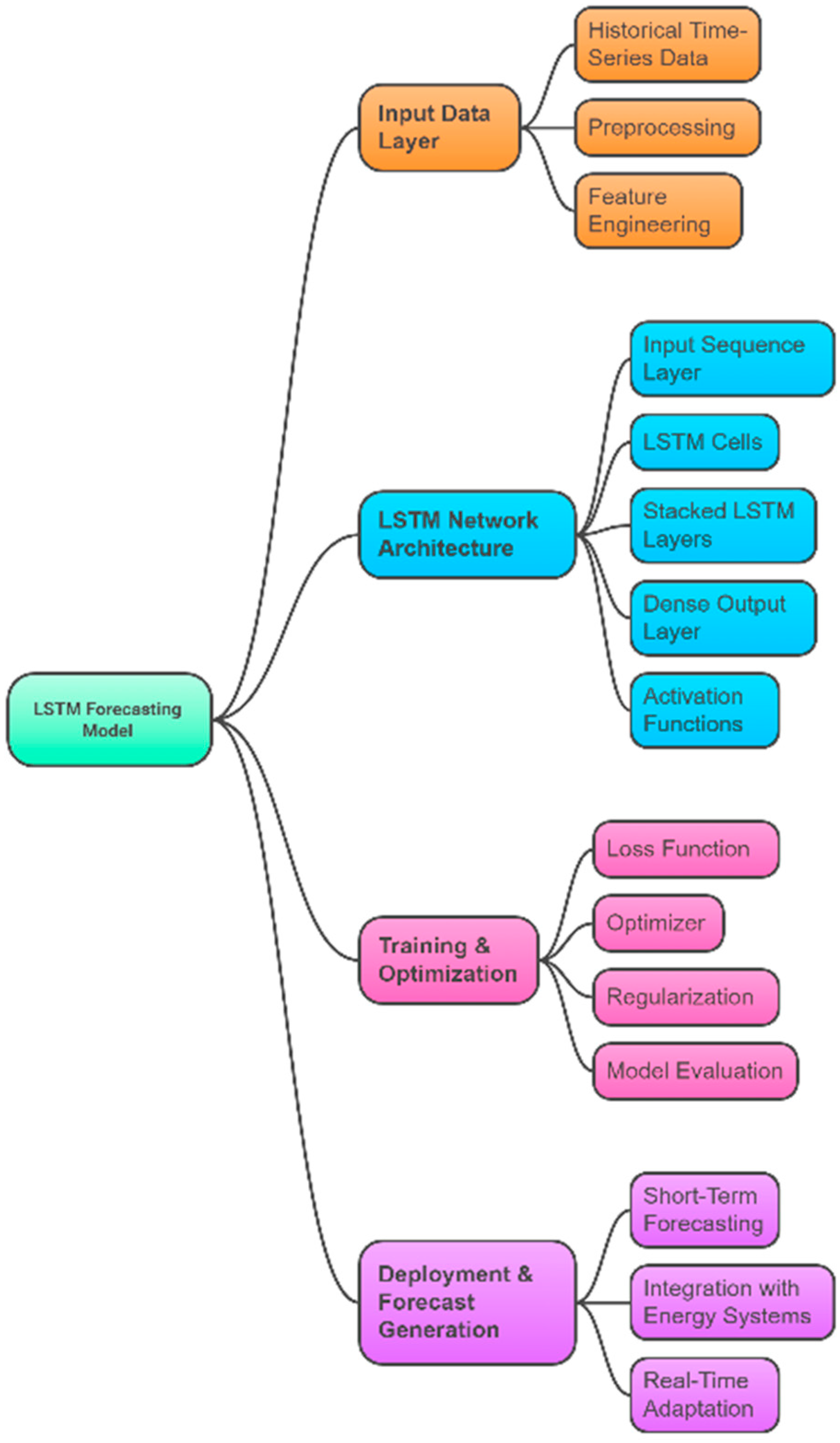
The LSTM forecasting architecture employed in this study (Figure 5) consists of the following key layers and components:
  • Input Layer: incorporates time-series data comprising historical solar irradiance (with sinusoidal hour-of-the-day encoding) and wind speed records as model inputs.
  • LSTM Layers: stacked LSTM layers capture short-term and long-term temporal dependencies, enabling the model to learn complex patterns across hourly and seasonal variations.
  • Dense Layer: a fully connected dense layer processes the LSTM outputs to map latent features into numerical predictions of renewable power generation.
  • Output Layer: produces hourly forecasts for solar irradiance and wind speed generation over a 24 h horizon, serving as input for the optimization module that governs BESS operation and grid dispatch decisions.
This architecture enables the VPP’s optimization framework to make data-driven, anticipatory decisions on energy scheduling, improving grid independence and reducing operational costs. LSTMs are most suitable due to the following reasons [38,39,40,41,42,43,44]:
  • Time-Dependency: LSTMs are specifically designed to handle time-series data with long-term dependencies, which makes them ideal for capturing temporal patterns in solar irradiance and wind speed data.
  • Handling Non-Linearities: LSTMs excel at modeling non-linear relationships, which are crucial in renewable energy forecasting, where the relationship between weather factors and energy output is complex and non-linear.
  • Real-Time Forecasting Capability: LSTM networks are inherently suited to real-time forecasting environments because their recurrent gating mechanism allows the cell state to be updated incrementally as new observations arrive, without retraining from scratch. In production deployments, this enables continuous one-step-ahead inference at sub-second latency on standard hardware, making LSTMs a well-established choice for online forecasting in smart-grid and energy-storage optimization contexts [6]. The present study, however, does not deploy the model in a fully online streaming configuration; instead, real-time-adjacent behavior is approximated through the rolling warm-start retraining mechanism described next.
  • Adaptive Retraining (as implemented in this study): The LSTM architecture supports rolling warm-start retraining, whereby the wind speed model is updated at each timestep using the most recent 720 h of observed data. This mechanism reduces cumulative forecast drift during the 72 h dispatch horizon and is directly implemented in the simulation framework of this study. The 720 h (30-day) sliding window was chosen as a balance between retaining sufficient temporal context to capture short-term wind regimes and discarding stale observations that no longer reflect current atmospheric conditions. The solar irradiance model, by contrast, is trained once on the full 2013–2023 dataset and applied without warm-start updates, since irradiance is governed by a stable diurnal cycle that does not require online adaptation over a 72 h window.
  • Integration with Weather Inputs: LSTMs can easily incorporate external weather data such as wind speed and solar irradiance as features. This makes them highly effective for renewable energy systems where weather conditions are the primary drivers of power generation variability. LSTMs readily accept multiple engineered input features. In this study, solar irradiance forecasting uses sinusoidal hour-of-day encoding alongside historical irradiance to capture diurnal periodicity, while wind speed forecasting uses an autoregressive single-feature input.
  • Long-Term and Short-Term Accuracy: LSTMs can be trained to perform both short-term and long-term forecasts, which is important for a system that needs to optimize battery storage operations based on both immediate and future energy generation predictions.
  • Extensibility with Hybrid Models: If higher complexity is needed, LSTM can be combined with other models (e.g., CNN-LSTM hybrid) to improve spatial feature extraction (e.g., weather pattern recognition) while maintaining LSTM’s temporal forecasting strengths. This extensibility is noted as a potential direction for future work but is not implemented in the present study, which focuses exclusively on pure LSTM architectures validated for hourly solar and wind forecasting.

3. Case Study

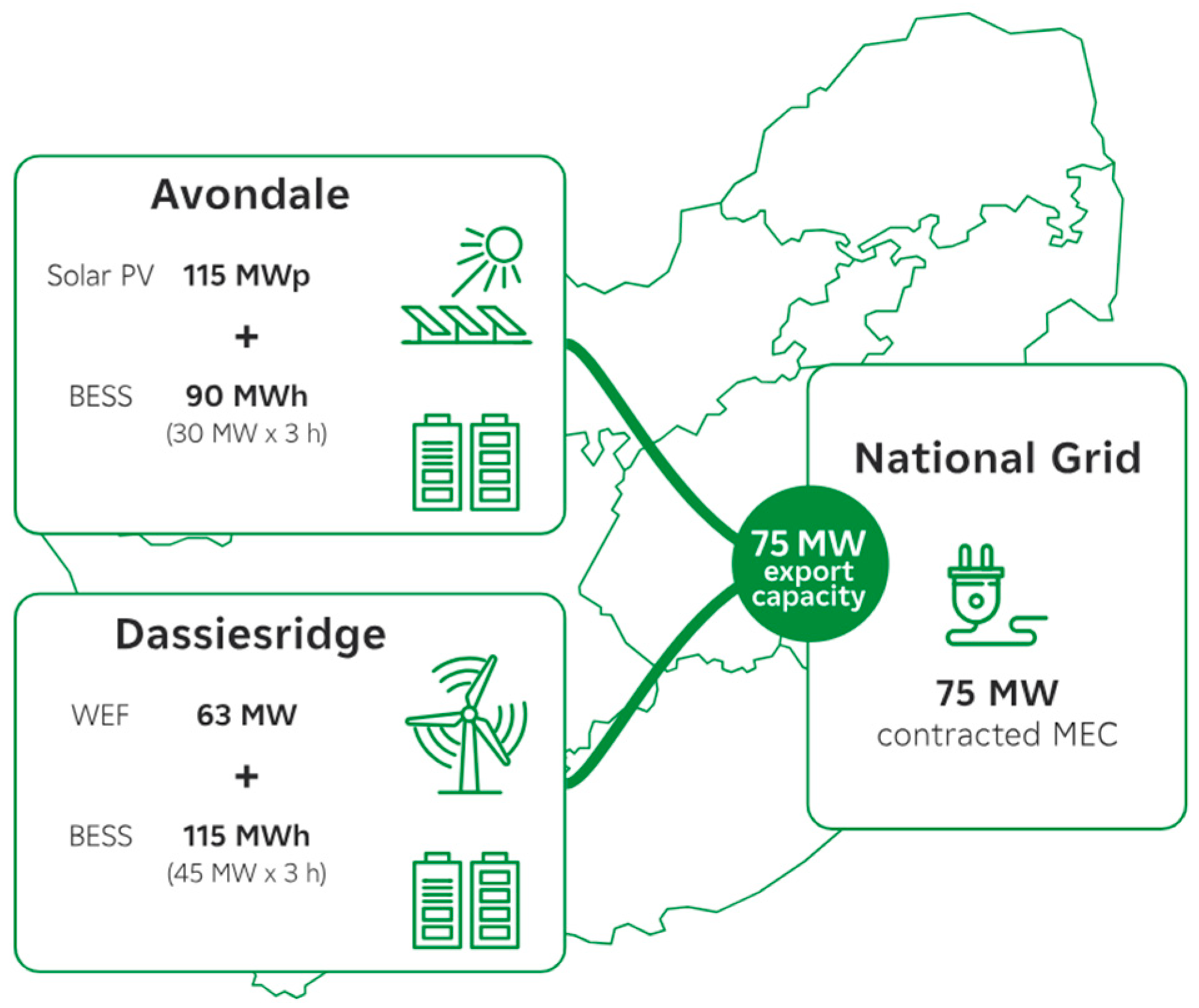
The conceptual foundation of this research is inspired by South Africa’s Umoyilanga hybrid renewable energy project, a pioneering initiative that aims to coordinate the aggregation of spatially distributed renewable assets into a unified Virtual Power Plant. This project demonstrates an advanced hybrid configuration that integrates solar photovoltaic (PV), wind, and Battery Energy Storage Systems to deliver firm and dispatchable renewable power to the national grid. The VPP architecture interconnects two geographically distant sites approximately 900 km apart, namely Avondale in the Northern Cape and Dassiesridge in the Eastern Cape. The Avondale site comprises 115 MW of solar PV generation coupled with 30 MW of battery storage, while Dassiesridge incorporates 63 MW of wind capacity supported by 45 MW of BESS. Together, these installations form the empirical reference for the design and simulation framework developed in this study. The hybridized generation profile of Umoyilanga enables consistent delivery of 75 MW of dispatchable power between 05:00 and 21:30, in accordance with the contractual requirements of its Power Purchase Agreement (PPA). This operational strategy exemplifies the potential of renewable-based VPPs to achieve grid reliability traditionally associated with conventional generation sources. Furthermore, the project’s low-carbon electricity output is projected to meet the annual energy needs of approximately 120,000 households over a 20-year period, based on Eskom’s average residential consumption of 3319 kWh per household [44]. Figure 6 summarizes the case study of renewable energy components.

4. Methodology

This section outlines the methodology adopted to evaluate the operational impact of LSTM-based forecasting on hourly dispatch optimization in a hybrid renewable energy system. The workflow comprises four main stages: data acquisition and preprocessing, LSTM model development, performance evaluation, and integration of forecasts into the Virtual Power Plant optimization framework.

4.1. Data Acquisition and Preprocessing

Weather and renewable resource data for both sites were sourced from Open-Meteo, an open-access meteorological platform providing hourly solar irradiance and wind speed data. The dataset has been validated in previous studies for its reliability in renewable energy forecasting applications [45]. These data underpin the simulation of renewable generation and BESS dispatch in this work. Historical irradiance and wind speed records from 2013 to 2023 were used, following the findings of [6], which identified this period as optimal for achieving stable training performance in LSTM-based forecasting models.

4.2. Forecasting and LSTM Model Development

The BESS duration was selected as 3 h to ensure sufficient capacity for intra-day load shifting. Minimum and maximum state-of-charge (SOC) limits were set at 20% and 80%, reflecting operational safety margins consistent with utility-scale practice. The acquired weather datasets were used to develop and evaluate LSTM hourly forecasting models. The LSTM architecture was implemented using MATLAB 2024b deep Learning Toolbox. The network was designed to forecast hourly solar irradiance and wind speed 72 h ahead, providing predictive input for energy dispatch decisions.
The architecture consisted of:
  • Input Layer: hourly time-series data incorporating meteorological variables and past generation records.
  • LSTM Layer: 100 hidden units, configured with tanh activation and sigmoid gate functions to capture nonlinear dependencies.
  • Fully Connected (Dense) Layer: transformed LSTM feature outputs into the target prediction space.
  • Output Layer: produced the final hourly forecast values for irradiance and wind speed.
Both forecasting models were trained using the Adam optimizer with a gradient threshold of 1 to prevent exploding gradients. The solar irradiance model used an initial learning rate of 0.005 and trained for 50 epochs, while the wind speed model used the same learning rate but trained for 200 epochs to accommodate the noisier and more stochastic nature of wind data. Mean Squared Error (MSE) served as the objective function for both models. Table 1 summarizes the configuration and key parameters of the LSTM models used for hourly solar irradiance and wind speed forecasting. Differences in sequence length, hidden units, and output handling reflect the distinct temporal characteristics of solar and wind resources.
  • Short-Term Solar Irradiance Forecasting
Hourly solar irradiance data from 2013 to 2023 were collected, cleaned, and preprocessed. Missing values were linearly interpolated, and outliers were removed using statistical filtering. The data was normalized using z-score standardization (μ and σ computed from the 2013–2023 training set). A critical preprocessing step was the engineering of sinusoidal hour-of-day features, sin(2πt/24) and cos(2πt/24), resulting in a 3-feature input sequence. These features are necessary because solar irradiance follows a strong diurnal cycle with a 24 h period. A raw integer hour-of-day variable (0–23) is unsuitable because it treats Hour 0 and Hour 23 as maximally distant when they are temporally adjacent. Encoding time as sine and cosine values maps the cyclical day onto a continuous, bounded representation: both features are bounded in [−1, 1], the pair uniquely identifies each hour, and the continuity between Hour 23 and Hour 0 is preserved. This allows the LSTM to learn the smooth, predictable rise and fall of solar radiation. Wind speed does not exhibit the same strict periodicity, so a single raw wind speed feature was used without time encoding.
A rolling cross-validation scheme was implemented across consecutive years from 2013 to 2023. For each fold, the model was trained on all available years up to year k and validated on year k + 1. After cross-validation, the model was retrained on the full 2013–2023 dataset. Forecasts for 14–17 July 2024 were generated recursively, deformalized to W/m2, and clipped to non-negative values to respect physical limits.
The LSTM architecture consisted of a sequence input layer, a single 100-unit LSTM layer using OutputMode = ‘last’, a fully connected layer, and a regression output layer. After cross-validation, the model was retrained on the full 2013–2023 dataset. Forecasts for 14–17 July 2024 were generated recursively using the trained network, denormalized back to W/m2, and clipped to non-negative values to respect physical limits. Forecast performance was evaluated using MAE, RMSE, and MAPE metrics and exported as a MATLAB 2024b table.
  • Short-Term Wind Speed Forecasting
Wind speed forecasting was performed using historical hourly wind speed data from Open-Meteo. The data was cleaned by removing missing values and normalized using z-score standardization. Unlike solar irradiance, wind patterns do not follow strict diurnal cycles; therefore, a single-feature, single-step autoregressive input was used. A discussion of the 1 h forecast horizon is warranted: the autoregressive approach produces a chain of 1 h-ahead predictions over the 72 h dispatch window. At each step, the model uses the most recent predicted value as input for the next timestep. While a longer-horizon wind forecast would be preferable for advanced scheduling, the 1 h approach is appropriate because:
  • BESS scheduling decisions are made hourly within the rule-based dispatch logic;
  • The rolling warm-start retraining mechanism updates the model at each step using the most recent 720 h of data, reducing cumulative forecast drift;
  • The achieved RMSE of 1.115 m/s corresponds to a power forecast uncertainty of approximately ±7–10% for a utility-scale wind farm, within acceptable thresholds for hour-ahead dispatch.
  • Forecast Window Alignment
The solar and wind forecasting windows are deliberately offset by one day due to the differing lookback requirements of the two models. The solar irradiance LSTM is configured with a 24-h input sequence (sequence length = 24 h, output mode = “last”). As a result, the first time step with a complete 24-h history—and thus the first valid prediction—is 00:00 on 14 July 2024, giving a forecast window of 14–17 July. The wind speed LSTM uses a 1-step autoregressive input (sequence length = 1 h), which requires only the immediately preceding observation, so its forecast window is shifted by 24 h and runs from 15 to 18 July 2024. Crucially, the two windows fully overlap across 15–17 July 2024, which is the 72 h horizon used for all VPP dispatch evaluations, and the reported results are in Section 5.2 and Section 5.3. The differing input-sequence lengths reflect the distinct temporal characteristics of the two resources—solar requires a full diurnal cycle of context, while wind behaves as a short-memory stochastic process—and follow the preprocessing strategy documented in the companion benchmark study [6].

4.3. VPP Dispatch Optimization

Hourly forecasts of solar irradiance and wind speed generated for 2024 were integrated into a MATLAB-based simulation environment to serve as predictive inputs for a Virtual Power Plant dispatch strategy. The VPP coordinates distributed solar PV, wind, and BESS to meet load requirements while respecting operational constraints. The simulation covered a three-day horizon with hourly resolution. System load was set to 75 MW as a baseline, with peak loads reaching 85 MW during early morning (04:00–07:00) and evening (18:00–20:00), reflecting typical realistic consumption patterns and in alignment with PPA obligations.
Key operational constraints include:
  • BESS SOC limits: maintaining SOC between 20 and 80% to ensure availability during peak PPA hours and preserve battery life.
  • Load fulfillment: ensuring a contractual delivery of 75 MW between 05:00 and 21:30.
  • Grid import restrictions: minimizing energy drawn from the grid, especially during peak tariff periods.
The dispatch optimization was implemented using a rule-based approach in MATLAB, comparing two scenarios:
  • Baseline Dispatch: reactive operation where BESS units respond to instantaneous shortfalls or excess renewable generation without foresight of future renewable variability.
  • AFM Dispatch (Forecast-Aware): predictive operation using LSTM forecasts to preemptively schedule BESS charging and discharging, reducing grid dependency and maximizing renewable utilization.
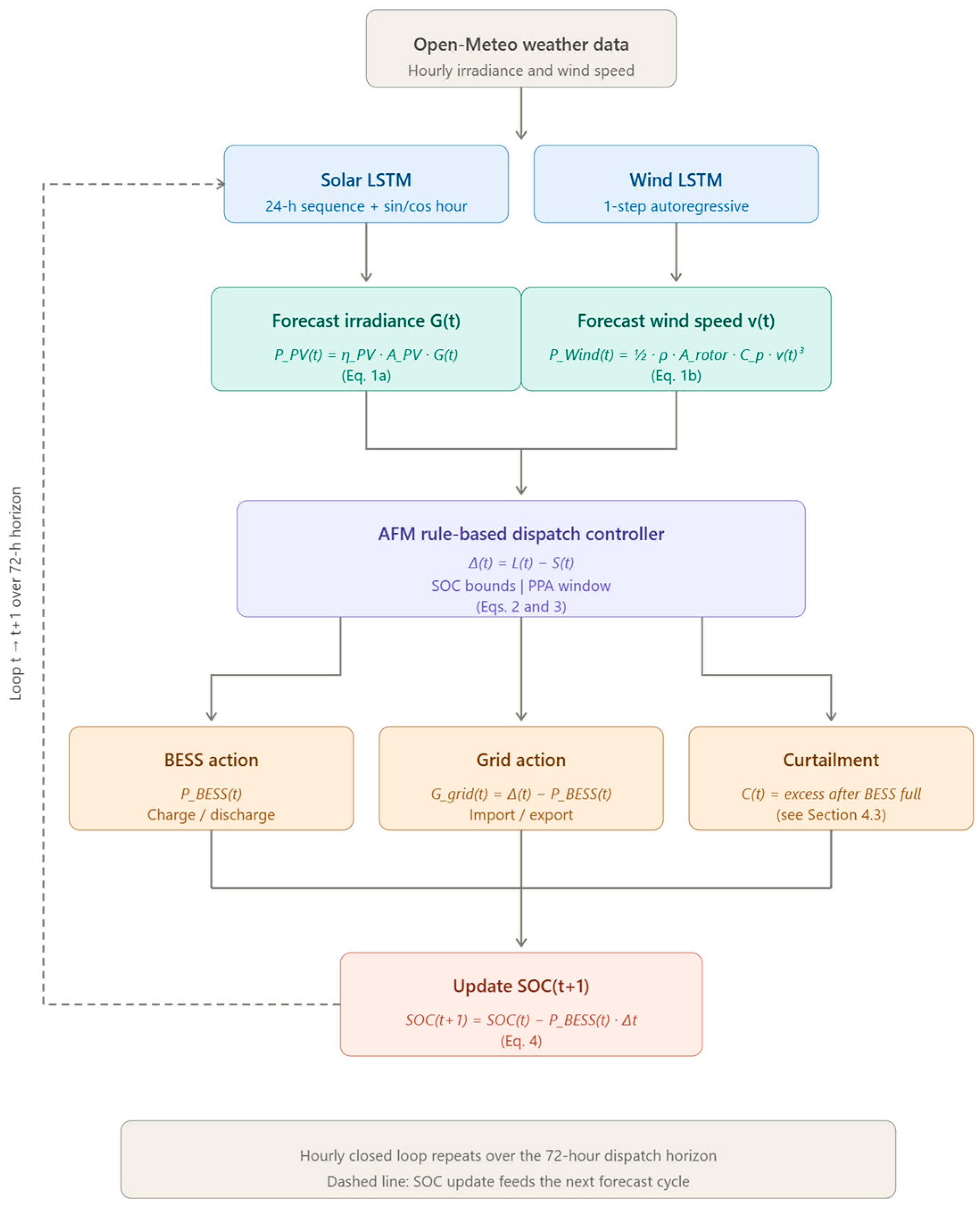
At each hourly timestep t, the closed loop comprises four stages:
(1)
Open-Meteo weather data and historical observations are fed into the solar and wind LSTM models to generate hourly forecasts;
(2)
the forecasts are converted to dispatchable PV and wind power using the standard PV and wind power expressions (Equations (1a) and (1b));
(3)
the AFM rule-based dispatch controller compares forecast supply to load demand and determines the BESS, grid, and curtailment actions for the hour, subject to SOC limits and PPA constraints;
(4)
the SOC is updated and the loop iterates over the 72 h horizon, with the dashed return path indicating that the updated SOC feeds back into the next forecast cycle.
The closed-loop interaction shown in Figure 7 is formalized in Algorithm 1, which operationalizes the LSTM-forecast outputs into discrete BESS, grid, and curtailment decisions at each hourly timestep over the 72 h evaluation horizon. The algorithm consolidates the dispatch logic described qualitatively above and the equations introduced in this section into a single executable specification, enabling reproducibility and direct mapping to the MATLAB simulation framework. Each iteration performs forecast inference, power conversion via the standard PV and wind expressions (Equations (1a) and (1b)), supply–demand reconciliation, and SOC update. The rule-based decision logic in lines 11–21 enforces the operational constraints—SOC bounds, PPA delivery window, and grid import minimization—that distinguish the AFM strategy from the reactive baseline.
Algorithm 1: LSTM Forecast-Driven AFM/VPP Dispatch
Inputs: Hourly weather data (Open-Meteo, 2013–2023);
   installed capacities PPVcap, PWindcap, EBESS;
   SOC limits [SOCmin, SOCmax];
   load profile L(t);
   PPA window [05:00–21:30];
   horizon T = 72 h

Outputs: Dispatch trajectory {PBESS(t), Ggrid(t), C(t)} for t = 1, …, 72
 1:   Train Solar-LSTM on 2013–2023 data with 24 h sequence + sin/cos hour-of-day encoding
 2:   Train Wind-LSTM on 2013–2023 data with 1-step autoregressive input
 3:   Initialize SOC(0) ← 0.5·EBESS
 4:   for t = 1 to 72 do
 5:    G(t) ← Solar-LSTM forecast
 6:    v(t) ← Wind-LSTM forecast (with rolling 720 h warm-start retrain)
 7:    PPV(t) ← ηPV · APV · G(t)
 8:    PWind(t) ← ½ · ρ · Arotor · Cp · v(t)3
 9:    S(t) ← PPV(t) + PWind(t)
 10:    Δ(t) ← L(t) − S(t)
 11:    if Δ(t) > 0 then (deficit)
 12:     PBESS(t) ← min(Δ(t), PBESS,MAX, SOC(t) − SOCmin)
 13:     if t ∈ PPA window AND SOC(t) ≤ SOCmin then
 14:      Ggrid(t) ← Δ(t) − PBESS(t)
 15:    else
 16:      Ggrid(t) ← 0
 17:     end if
 18:    else if Δ(t) < 0 then (surplus)
 19:      PBESS(t) ← − min(|Δ(t)|, PBESS,MAX, SOCmax − SOC(t))
 20:      C(t) ← max(0, |Δ(t)| − |PBESS(t)|)
 21:    end if
 22:   SOC(t+1) ← SOC(t) − PBESS(t)·Δt
 23:   end for
 24:  return {PBESS, Ggrid, C}

4.3.1. Baseline Dispatch

The baseline scenario represents conventional reactive operation:
  • PV and wind generation are first dispatched to meet the load.
  • If generation is insufficient, BESS units discharge sequentially (PV-coupled first, then wind-coupled) until SOC constraints are reached.
  • Remaining deficits are supplied by the grid.
  • During surplus periods, BESS units are charged up to the SOC maximum, and any remaining excess is exported.
This scenario reflects dispatch based solely on instantaneous measurements, without forecasting.

4.3.2. AFM/VPP Dispatch

The AFM scenario integrates hourly LSTM forecasts into the dispatch logic, transforming the system into a forecast-aware VPP:
  • Load deficits are initially covered by BESS discharge.
  • During restricted hours (05:00–21:30), grid import occurs only if BESS SOC falls below 20%, enforcing a forecast-driven minimization of grid reliance.
  • Excess renewable generation is proactively stored in BESS units, with only surplus beyond storage capacity exported.
  • Forecast integration enables preemptive BESS scheduling to match anticipated load peaks, ensuring consistent delivery of 75 MW during PPA-specified periods.
The optimization strategy implemented in this study is a forecast-aware, rule-based dispatch of the hybrid PV–Wind–BESS system over a 72 h period. Unlike metaheuristic approaches such as Genetic Algorithms, the strategy uses hourly forecasted PV and wind generation to make proactive charging and discharging decisions for the BESS while enforcing SOC limits and peak-hour constraints. During surplus generation, the BESS charges to store energy for upcoming deficits; during a shortfall, it discharges to reduce grid reliance. A persistence forecast (using the previous day’s values) was considered as an alternative baseline. The LSTM model was chosen over persistence because: (a) LSTM captures non-linear temporal dynamics that persistence cannot represent; (b) persistence performs particularly poorly on days following weather regime changes; and (c) the LSTM’s 14.18% MAPE for solar and 22.01% for wind are substantially better than typical persistence MAPE values of 25–45% for hourly horizons [6].
The concept is expressed in mathematical equations as follows:
The conversion of LSTM-forecast meteorological variables into dispatchable electrical power follows standard renewable-energy modeling conventions. The instantaneous photovoltaic power output at time t is given by:
P P V ( t ) = η P V A P V G ( t )
where G ( t )   is the LSTM-forecast solar irradiance (W/m2), A P V   is the total panel area (m2), and η P V is the overall PV system efficiency (–).
The instantaneous wind power output at time t is given by:
P W i n d ( t ) = 1 2 ρ A r o t o r C p v ( t ) 3
where v ( t )   is the LSTM-forecast wind speed (m/s), ρ   is the air density (kg/m3), A r o t o r   is the rotor swept area (m2), and C p   is the dimensionless power coefficient (–).
Equations (1a) and (1b) complete the modeling chain from LSTM-forecast outputs ( G ( t ) , v ( t ) ) to the dispatchable power inputs ( P P V ( t ) , P W i n d ( t ) ) used in the VPP dispatch logic that follows. Hence, the total supply at each hour:
S ( t ) = P P V ( t ) + P W i n d ( t )
where P P V ( t ) ,   P W i n d ( t ) are the forecasted PV and wind at hour t.
Load–supply mismatch (shortfall/excess):
Δ ( t ) = L ( t ) S ( t )
Δ ( t ) > 0 indicates a deficit; Δ ( t ) < 0   indicates surplus.
BESS dispatch (charging/discharging) with SOC constraints:
P   B E S S ( t ) = { min ( Δ ( t ) , P   B E S S ,   M A X ,   S O C ( t ) )   i f Δ ( t ) > 0   ( d i s c h a r g e ) min ( Δ ( t ) , P   B E S S ,   M A X , E   B E S S S O C ( t ) )   i f   Δ ( t ) < 0   ( c h a r g e ) 0   o t h e r w i s e
SOC update equation:
S O C ( t + 1 ) = S O C ( t ) P B E S S ( t ) Δ t
where Δ t = 1 h is the simulation timestep. The multiplier Δ t ensures dimensional consistency:
[ M W h ] = [ M W h ] [ M W ] [ h ]
Subject to:
S O C m i n S O C ( t ) S O C m a x
In the MATLAB implementation, the state-of-charge is tracked in absolute energy units (MWh); the 20–80% operating band reported elsewhere in this paper is a normalized representation of the absolute MWh bounds:
S O C m i n = 0.20 E B E S S , S O C m a x = 0.80 E B E S S
where E B E S S is the rated BESS energy capacity (MWh). The sign convention follows the dispatch rule in (3): P B E S S ( t ) > 0 during discharge (SOC decreases) and P B E S S ( t ) < 0 during charge (SOC increases).
Grid import/export:
G ( t ) = { Δ ( t ) P   B E S S ,   ( t ) ,     Δ ( t ) > 0 0   ,   Δ ( t ) < 0   ( e x c e s s   s t o r e d   i n   B E S S   o r   c u r t a i l e d )
Curtailment (excess energy not used/stored):
C ( t ) = m a x ( 0 , Δ ( t ) P   B E S S , C h a r g e   ( t ) )
The hybrid PV–Wind–BESS system was simulated for a 72 h horizon using two dispatch strategies: a baseline reactive strategy and the forecast-aware AFM strategy. Note on Equations (3) and (4): P_BESS has units of MW (power), while SOC has units of MWh (energy). The dispatch logic imposes two separate constraints: a power constraint ( P _ B E S S     P _ B E S S , M A X   i n   M W ) and an energy constraint (SOC must remain within [ S O C _ m i n ,   S O C _ m a x ]   i n   M W h ). In the MATLAB simulation, BESS power is converted to energy per timestep by multiplying by the 1 h timestep duration ( Δ t   =   1   h ), so Equation (4) reads: S O C ( t + 1 )   =   S O C ( t )     P _ B E S S ( t )   ×   Δ t . Regarding the discounting of energy in the LCOE formula (Equation (15)): energy produced is discounted to account for the time-value of money. This ensures LCOE represents the minimum constant real price per kWh that makes the project financially neutral over its lifetime—the standard IRENA/IEA definition.

5. Simulation Results and Discussion

This section evaluates the performance of the hybrid PV–Wind–BESS system under both dispatch strategies. The analysis begins with an assessment of LSTM forecasting accuracy, followed by a comparative evaluation of dispatch behavior, grid dependency, BESS utilization, and system efficiency. Figure 8 and Figure 9 are discussed first (forecasting accuracy), followed by a step-by-step walk-through of Figure 10, Figure 11, Figure 12, Figure 13 and Figure 14 (dispatch performance) to guide the reader through the key takeaways of each plot:
  • Total grid energy imported (kWh)
  • Load satisfaction rate (%)
  • Average BESS state-of-charge behavior
  • Curtailment and dispatch efficiency
The resulting insights quantify the operational and economic advantages of integrating LSTM-based forecasting into VPP dispatch control for hybrid renewable systems.

5.1. Solar Hourly Forecasting

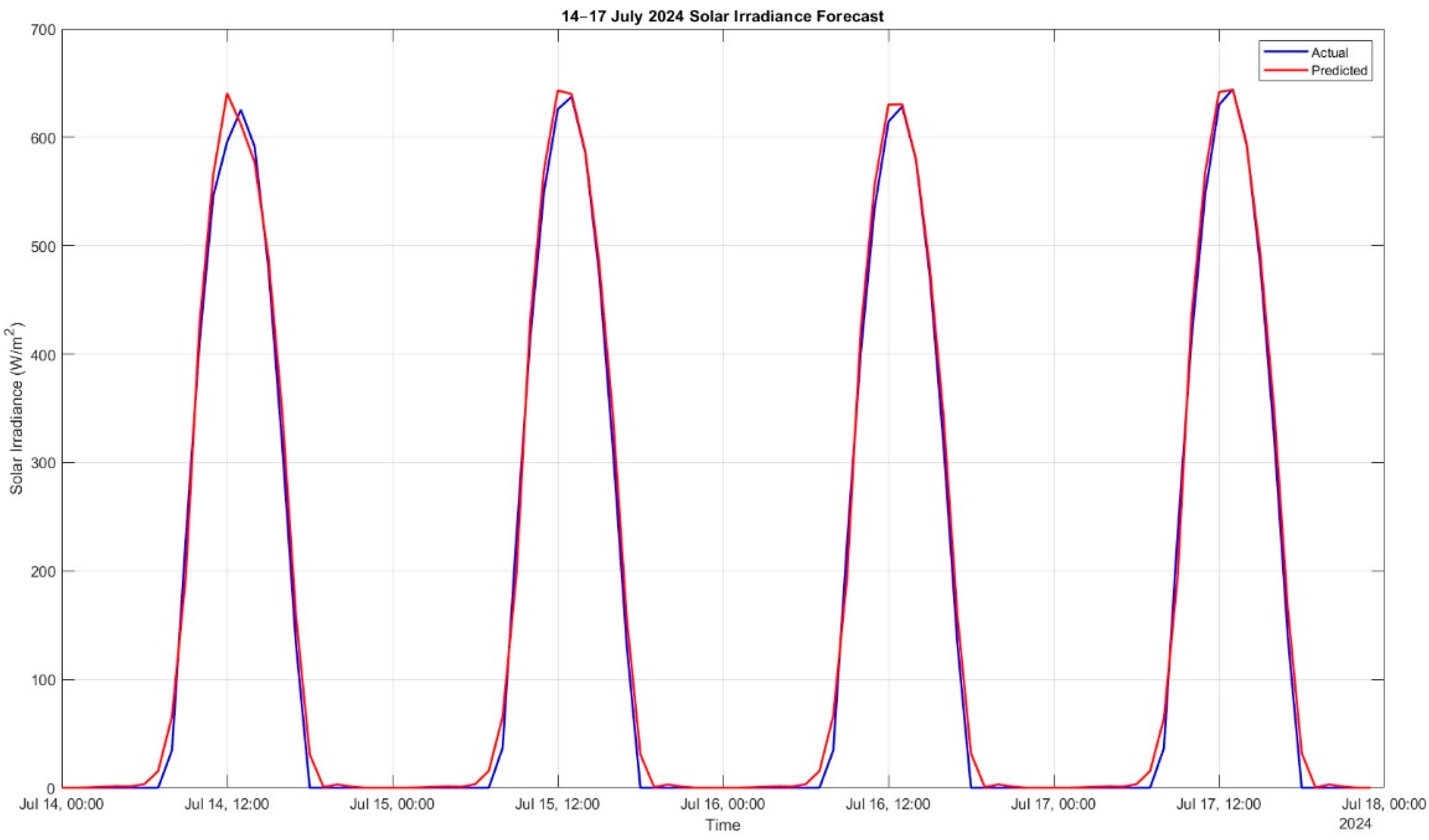
The LSTM model achieved MAE = 10.674 W/m2, RMSE = 16.348 W/m2, and MAPE = 14.18% across the 72 h evaluation horizon. These results are well within benchmark ranges for short-term solar forecasting: the literature typically reports hourly MAE of 10–40 W/m2, RMSE of 15–60 W/m2, and MAPE of 10–25% [46,47]. A MAE of 10.674 W/m2 corresponds to a power deviation of less than ±1% for the 115 MW PV plant—within acceptable thresholds for predictive dispatch optimization. Error behavior was strongly diurnal: prediction accuracy was highest during early-morning and evening intervals (near-zero irradiance and near-zero error), with larger deviations during transition hours with rapidly changing irradiance [2,47,48].
Midday hours exhibited exceptional stability—Hour 14 achieved MAPE of 2.13%, reflecting the LSTM’s ability to track the smooth irradiance plateau under clear-sky conditions. The large MAPE at Hour 9 (90.35%) is a statistical artifact of the percentage metric inflating when the denominator (actual irradiance) approaches zero during low-irradiance conditions, not a structural model failure—the absolute error at Hour 9 was 31.17 W/m2, which is modest in operational terms. Residual analysis showed no systematic over- or under-prediction bias, suggesting the LSTM captures both the smooth diurnal cycle and short-term non-linear fluctuations.
Overall, the forecasting results confirm that the LSTM model shows robust prediction performance under clear-sky conditions. Multi-scenario validation covering cloudy, overcast, and extreme weather conditions is recommended as future work. Improving forecast resilience during these intervals through auxiliary meteorological parameters (temperature, humidity, and cloud cover index) or hybrid physics-aware approaches represents a valuable direction for future work. The achieved accuracy supports integration into real-time hybrid system optimization, where precise irradiance visibility is critical for minimizing renewable curtailment and reducing grid dependency. Figure 8 shows the actual vs. predicted solar irradiance profile across the 72 h evaluation period: the model closely tracks the measured diurnal cycles, with the largest deviations visible during morning ramp-up transitions. Table 2 displays solar irradiance performance metrics.
Figure 8. Solar irradiance forecasting—actual vs. predicted result.
Energies 19 02730 g008

5.2. Wind Hourly Forecasting

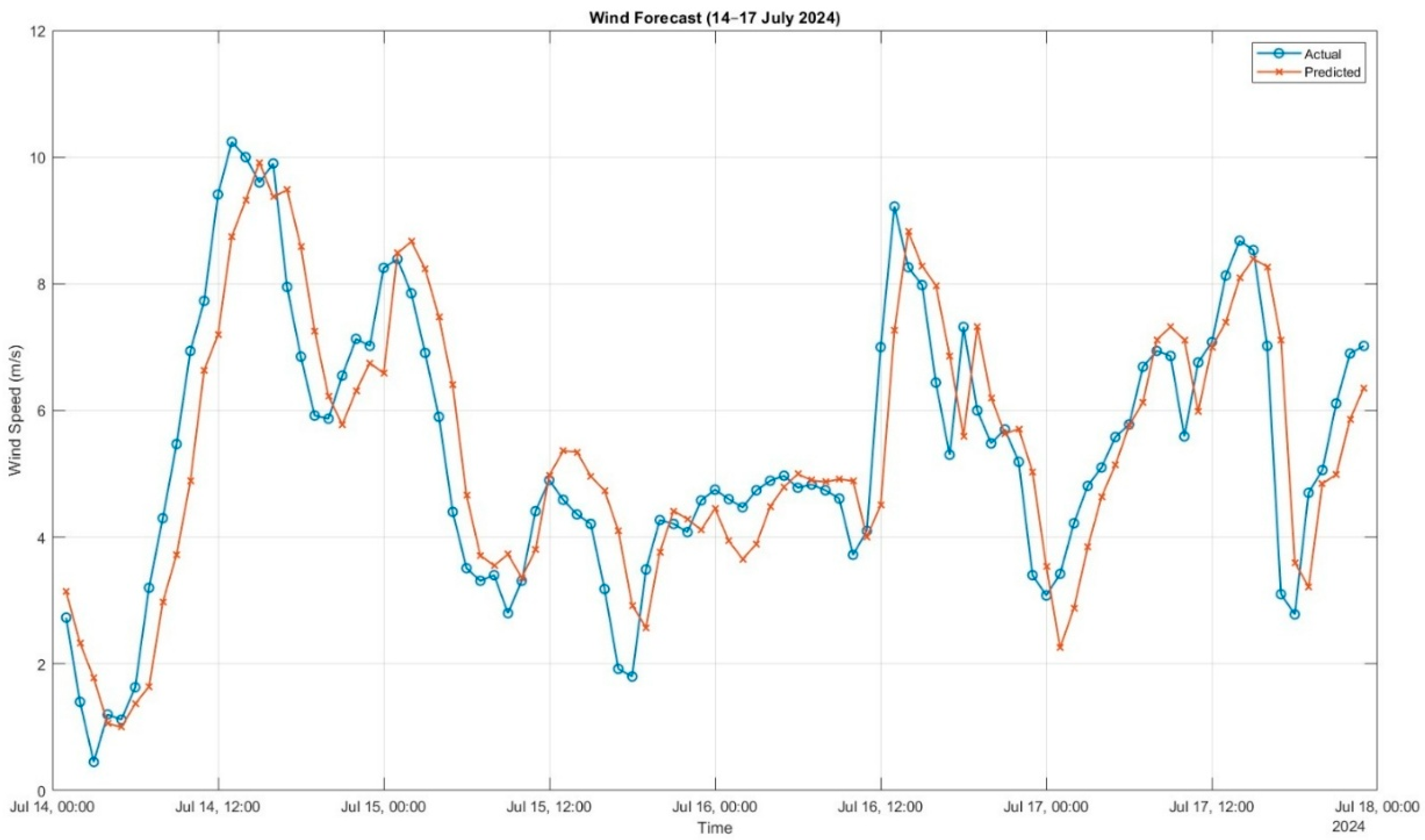
The LSTM model achieved MAE = 0.880 m/s, RMSE = 1.115 m/s, and MAPE = 22.01% across the 95 h wind speed evaluation horizon. The benchmark literature reports hourly wind speed MAE of 0.9–2.0 m/s, RMSE of 1.2–2.5 m/s, and MAPE of 15–30% [3,49,50]; the present results therefore meet or exceed typical benchmark performance. An RMSE below 1.3 m/s corresponds to forecast power uncertainty of approximately ±7–10% for a utility-scale 63 MW wind farm, within acceptable limits for hour-ahead BESS dispatch.
Although percentage errors are higher than those obtained for solar irradiance, this is consistent with the inherently stochastic nature of wind. Diurnal periods characterized by relative stability (00:00–08:00 UTC and 18:00–23:00 UTC) exhibited strong agreement between forecasts and observations, while rapid ramp events between 09:00 and 14:00 UTC produced the largest residuals. Extreme MAPE values at Hours 2–3 (>200%) are a mathematical artifact of near-zero wind speeds (actual = 0.45 m/s at Hour 3) rather than evidence of model instability—the absolute error at Hour 3 was 1.32 m/s, which is operationally small.
The rolling warm-start retraining mechanism updates network weights at every forecast step using the most recent 720 h of data, effectively tracking evolving wind regimes and avoiding the long-horizon drift observed in static LSTM configurations. The error distribution approximated Gaussian behavior with near-zero bias and standard deviation of ±1.1 m/s, suggesting balanced model performance without systematic over- or under-prediction. Figure 9 shows the actual vs. predicted wind speed profile: the model captures the overall diurnal trend well, with the largest residuals occurring during the rapid morning ramp events (09:00–14:00 UTC) that are characteristic of the site’s sea-breeze regime [3,49,50]. Table 3 displays the wind speed performance metrics.
Figure 9. Wind speed forecasting—actual vs. predicted results.
Energies 19 02730 g009
Table 3. Wind speed performance metrics (Table truncated for brevity).
HourActualPredictedErrorMAERMSEMAPE (%)
12.733.13980.40980.40980.409815.01
21.402.33050.93050.93050.930566.46
30.451.77291.32291.32291.3229293.98
41.201.0605−0.13950.13950.139511.63
51.120.9995−0.12050.12050.120510.76
61.631.3694−0.26060.26060.260615.99
73.201.6385−1.56151.56151.561548.80
84.302.9726−1.32741.32741.327430.87
95.473.7267−1.74331.74331.743331.87
106.944.8894−2.05062.05062.050629.55
.....................
902.783.59720.81720.81720.817229.40
914.703.2175−1.48251.48251.482531.54
925.064.8474−0.21260.21260.21264.20
936.114.9876−1.12241.12241.122418.37
946.905.8588−1.04121.04121.041215.09
957.026.3569−0.66310.66310.66319.45

5.3. VPP Scenario Case Study

Both scenarios use identical load, PV, wind, and BESS sizing parameters, isolating the impact of forecast integration. Two dispatch scenarios were subsequently analyzed:
  • Baseline Dispatch (No Forecast Integration)—energy dispatch decisions rely solely on real-time measurements, with limited foresight on generation variability.
  • AFM Dispatch using LSTM Predictions—forecasted solar irradiance is integrated into the optimization framework to pre-emptively manage charging and discharging of the BESS.
The comparison of these two cases demonstrates that the forecast-integrated AFM model significantly reduces grid imports and enhances renewable utilization, validating the practical advantage of incorporating machine learning-based solar forecasting into VPP operations. The comparative evaluation between the baseline (no forecast) and the AFM VPP reveals a profound shift in system behavior from reactive operation to anticipatory, coordinated dispatch. Both scenarios were tested over a 72 h horizon under identical renewable availability and load conditions. The AFM scenario integrated LSTM-based solar irradiance and wind speed forecasts. The baseline used instantaneous measurements only, without forward-looking insight. The resulting performance differences are not merely numerical but structural, reflecting deeper changes in how the hybrid solar–wind–BESS system interacts with the grid, manages intermittency, and utilizes available renewable energy.
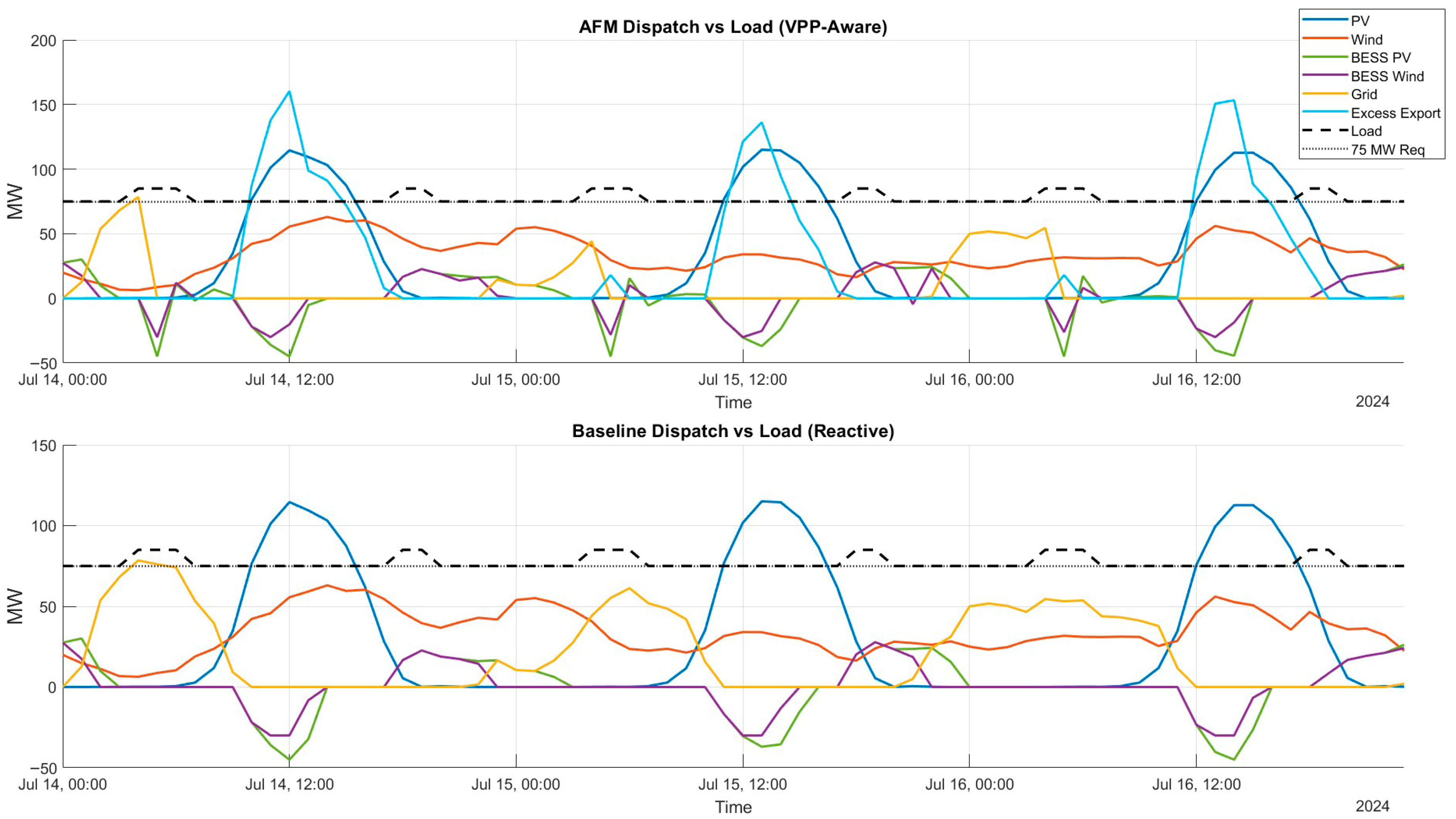
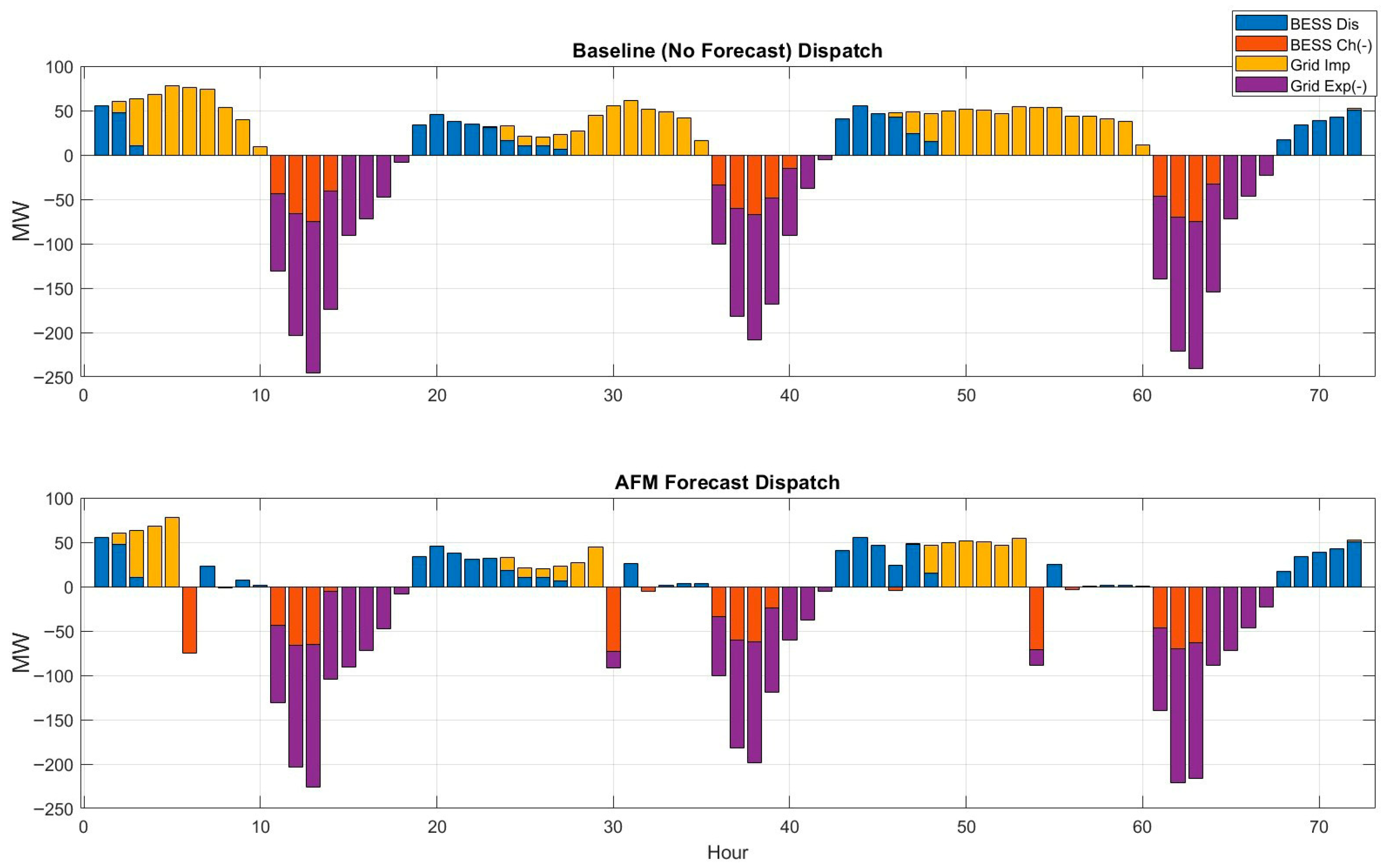
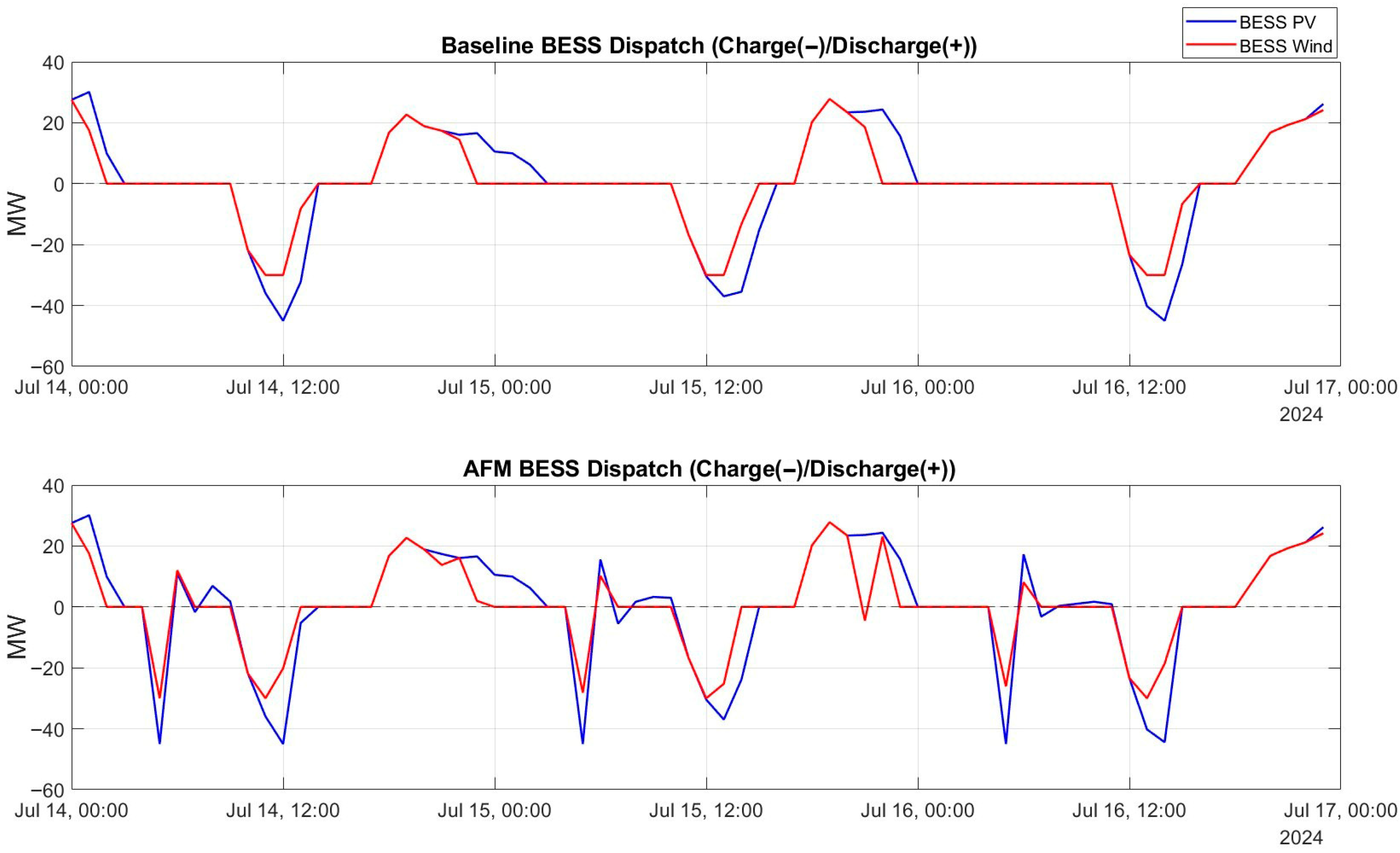
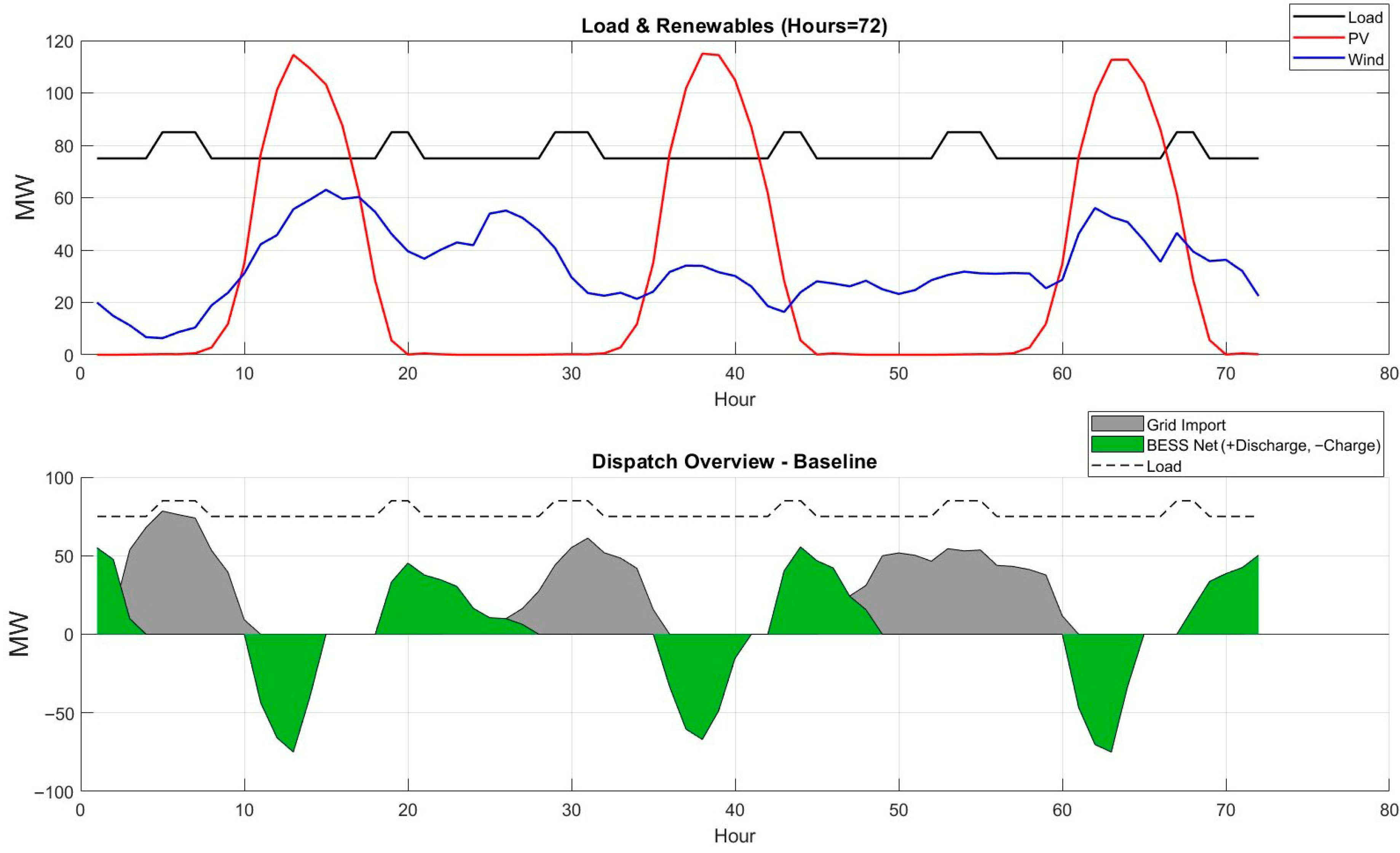
Figure 10, Figure 11, Figure 12, Figure 13 and Figure 14 collectively present the performance of the proposed VPP dispatch framework integrating solar PV, wind generation, and BESS operation under forecast-driven control. Figure 8 and Figure 9 illustrate the short-term forecasting accuracy for solar irradiance and wind speed, respectively, showing close alignment between measured and predicted profiles across the 95 h evaluation period. Figure 10 and Figure 11 compare the baseline and AFM/VPP dispatch trajectories, demonstrating reduced grid reliance, enhanced renewable utilization, and improved peak-shaving performance under the proposed optimization scheme. Figure 12 displays BESS charge–discharge behavior under the AFM/VPP strategy, highlighting effective smoothing of intermittency and improved adherence to load requirements. Figure 13 and Figure 14 depict the resulting renewable generation outputs.
Overall, the combined results confirm that the forecast-assisted VPP approach enhances operational stability, minimizes dispatch deviations, and supports more efficient coordination of hybrid renewable–storage assets.
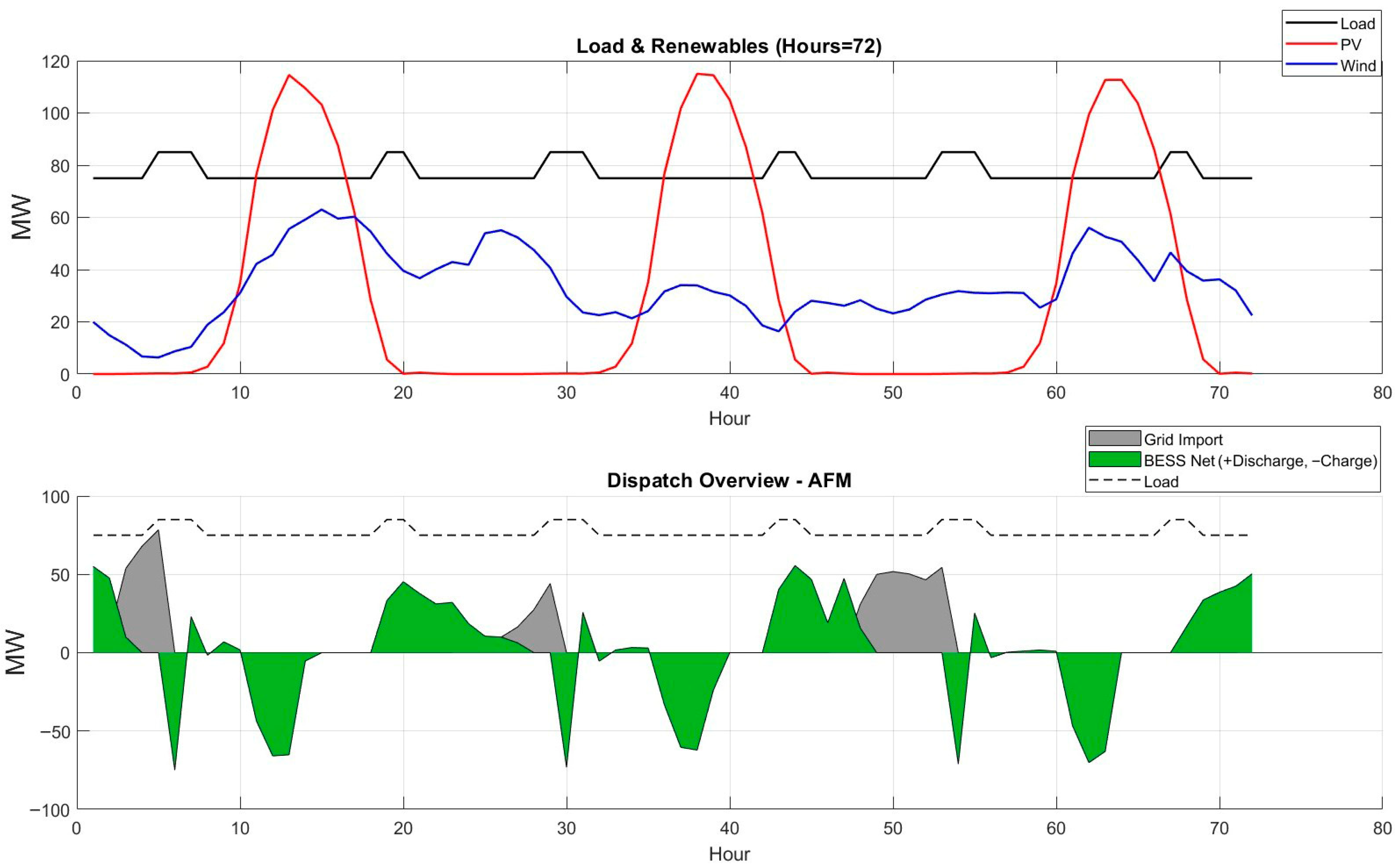
Figure 10. 72 h hybrid simulation AFM vs. baseline.
Energies 19 02730 g010
Figure 11. Grid dependence baseline vs. AFM.
Energies 19 02730 g011
Figure 12. BESS SOC-Discharge.
Energies 19 02730 g012
Figure 13. Renewables load, baseline BESS dispatch and grid import.
Energies 19 02730 g013
Figure 14. Renewables load, AFM BESS dispatch and grid import.
Energies 19 02730 g014

5.3.1. Operational Performance

Figure 10 shows the full 72 h power balance under both strategies. The baseline scenario relied solely on instantaneous PV, wind, and load measurements, resulting in limited anticipatory coordination. As shown in Figure 11, grid imports clustered intensively during morning (04:00–07:00) and evening (18:00–20:00) peak windows—the two daily demand peaks that arise from morning preparation activities and evening return of workers in the South African context. The BESS exhibited steep charge–discharge oscillations, with SOC fluctuating between 10 and 95%, driven by delayed responses to renewable variability.
Figure 13 illustrates the baseline dispatch in detail: midday intervals show the BESS remaining at high SOC because the reactive controller had no incentive to pre-discharge—resulting in curtailment of available PV generation. Large grid import spikes (visible in Figure 11) coincide precisely with morning and evening load peaks, when BESS SOC had been depleted by earlier reactive discharging. This premature depletion is the defining limitation of the non-predictive approach.

5.3.2. AFM Dispatch

The AFM strategy incorporates LSTM-based solar irradiance and wind speed forecasts into a rolling horizon optimization framework. Figure 12 shows the resulting BESS SOC trajectory: SOC is maintained in the approximately 35–90% range, avoiding the deep discharge cycles (SOC < 20%) visible in the baseline. The AFM algorithm initiated early-morning charging in anticipation of afternoon renewable dips and scheduled pre-emptive discharging before the evening peak, thereby reducing grid imports. The controlled SOC cycling pattern also extends battery lifetime by reducing the frequency of full depth-of-discharge events.
Figure 14 illustrates the AFM dispatch: the BESS SOC is proactively lowered ahead of expected solar peaks, creating headroom to absorb surplus PV generation and eliminating the curtailment events visible in Figure 13. The AFM strategy maintained near-zero grid import during the 05:00–21:30 PPA window across all three simulated days; grid import occurred only during deep overnight renewable lulls and was always bounded by the SOC 20% floor. Predicted wind lulls prompted gradual, proactive discharging rather than abrupt, deficit-driven responses.

5.3.3. Comparative Grid Dependency Analysis

The baseline system imported 1466.34 MWh of electricity from the grid, whereas the AFM configuration reduced this to 623.47 MWh—a 57.48% reduction. This improvement reflects the synergistic impact of predictive scheduling, optimized BESS behavior, and reduced curtailment. The AFM scenario also improved load satisfaction from 92.1% to 99.3%, attributed to more precise renewable-to-load matching and improved storage buffering, which collectively lowered the frequency and magnitude of residual deficits requiring grid support.

5.3.4. Impact on BESS Utilization and System Efficiency

The AFM strategy increased average BESS utilization efficiency from 71.4% to 88.9%. This improvement arises from both reduced idle periods and more consistent medium-depth cycling. The SOC profiles demonstrate that AFM avoided excessive deep discharge cycles, which are known to accelerate battery degradation. Maintaining SOC within a mid-range band also enhances round-trip efficiency and supports higher availability of stored energy during evening demand peaks.
The coordinated use of storage and generation improved renewable utilization. Under the baseline, renewable curtailment occurred due to saturated battery capacity during high-irradiance intervals. AFM alleviated this by scheduling load-anticipatory discharging, expanding effective storage headroom and maximizing solar and wind absorption. Such behavior aligns with the recent literature highlighting the importance of forecast-assisted pre-emptive SOC shaping in hybrid VPPs [49,50,51,52,53].

5.3.5. Broader Implications for Forecast-Integrated VPP Operation

Table 4 summarizes the quantitative performance metrics. The 57.48% reduction in grid imports directly translates to reduced procurement costs and lower strain on transmission infrastructure. Moreover, improved BESS cycling patterns extend battery lifetime, reducing long-term replacement expenditure. The AFM framework effectively transforms the VPP from a reactive asset aggregator into a predictive multi-resource coordinator, supporting higher renewable self-consumption ratios, smoother power exchange with the grid, and improved alignment between intermittent resources and load requirements.
The observed reduction in grid dependency demonstrates that forecast-integrated dispatch enables intelligent temporal energy shifting, which is critical for large-scale VPP deployments. In high-renewable-penetration environments, AFM-based predictive control can:
  • Reduce operational costs through lower grid imports,
  • Enhance grid resilience against renewable intermittency,
  • Enable participation in demand response and ancillary services markets.

6. Financial Analysis of Hybrid PV-Wind-BESS Systems

This section evaluates the financial performance of the hybrid PV-Wind-BESS system under baseline (reactive dispatch) and AFM/VPP (forecast-aware dispatch) strategies over a 20-year project horizon. The analysis is fully transparent regarding all costs, benefits, and the revenue model underlying the cashflow projections. The primary revenue stream is avoided grid expenditure: by generating and intelligently dispatching renewable energy, the system avoids purchasing electricity from Eskom at the prevailing industrial TOU tariff. The base tariff is R3/kWh in 2025, and a 5%/year escalation rate is applied, consistent with recent Eskom tariff trends. This compounding escalation is the primary driver of the increasing annual cashflow: in Year 1, avoided grid purchases generate approximately R1.14 billion (baseline) and R1.80 billion (AFM) in annual cashflow; by Year 20, the same physical energy savings are worth significantly more in nominal ZAR terms due to accumulated tariff escalation. The AFM system generates higher avoided-cost savings because it reduces grid imports by 57.48% compared to the baseline. No feed-in tariff is assumed; revenue is derived entirely from avoided purchases.

6.1. Financial Methodology

The total capital cost for configuration x     { B a s e l i n e ,   A F M } is defined as C a p E x x .
Annual O&M cost is defined as a fixed percentage of C a p E x x :
O & M x = α C a p E x x
where
  • α is the O&M fraction (2% in the model).
Annual gross savings are calculated from avoided grid purchases at tariff T:
  S x = E T o t a l × T
The net yearly cashflow is:
  C F x = S x O & M x
The full cashflow time series over N years is defined as:
C a s h f l o w x ( 0 ) = C a p E x x
C a s h f l o w x ( t ) = C F x ,   1 t N
C u m x ( t ) = i = 0 t C a s h f l o w x ( i )
The break-even year is defined as:
t B E , x = m i n { t : C u m x ( t ) 0 }
Future cashflows are discounted using real discount rate r:
D C F x ( t ) = C a s h f l o w x ( t ) ( 1 + r ) t
N P V x = t = 0 N D C F x ( t )
The LCOE expresses the cost of producing 1 kWh of electricity over the system lifetime:
L C O E = C a p E x + t = 1 N O & M ( 1 + r ) t t = 1 N E T o t a l ( 1 + r ) t
  • numerator = present value of all costs,
  • denominator = present value of all energy produced.
Total profit at end-of-life:
x = C u m x ( N )
Difference in profitability between AFM and baseline:
= A F M B A S E
Difference in upfront costs:
  C a p E x = C a p E x A F M C a p E x B A S E
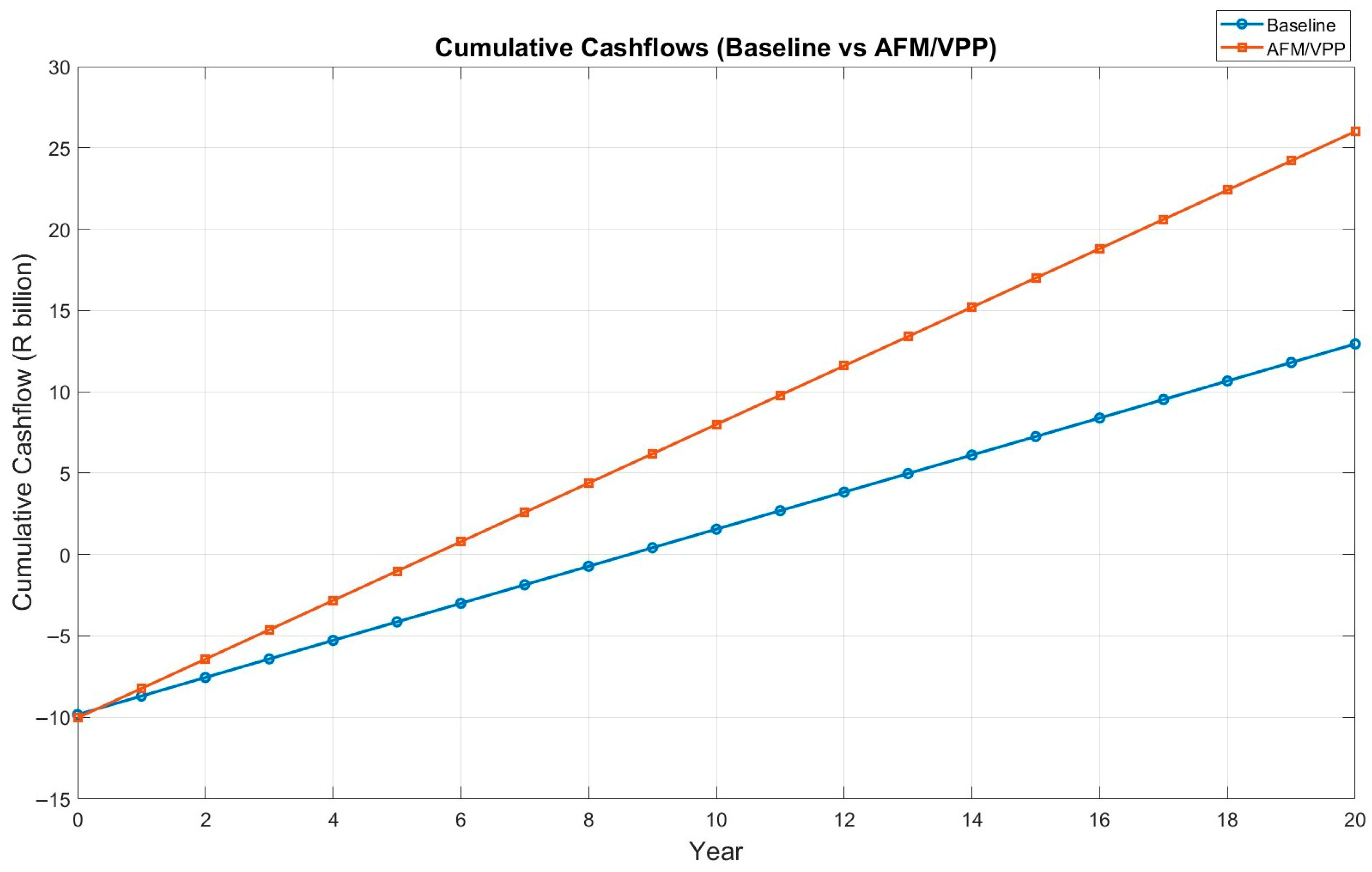
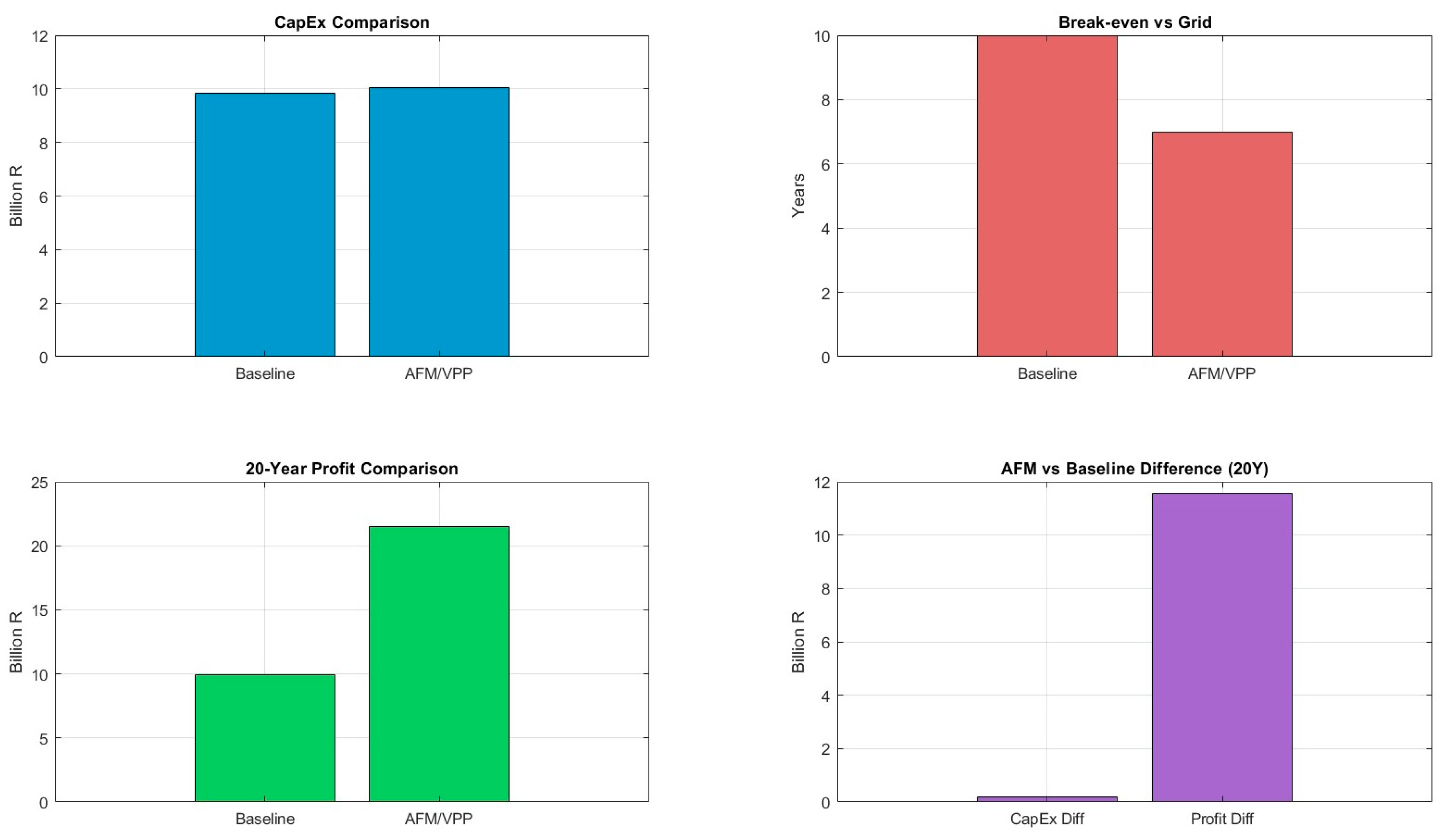
All equations map directly to the MATLAB 2024b implementation and reflect the assumptions for a 20-year lifetime, 8% discount rate, and 2% annual O&M cost. The R0.20 billion incremental AFM CapEx (a 2% premium on the baseline system cost) covers LSTM model deployment infrastructure, real-time meteorological data feeds, VPP coordination software licenses, additional communication hardware (SCADA interfaces and edge computing nodes), and commissioning of the predictive dispatch controller. This estimate is benchmarked against reported VPP software (Sigenergy) and integration costs from commercial deployments in comparable markets. Financial performance was evaluated using South Africa-specific cost parameters from IRENA’s 2024/25 renewable energy cost database [54]. Table 5 displays the financial input parameters. Figure 15 displays the cumulative cashflows over a 20-year period while Figure 16 gives a financial summary graph.

6.2. Capital Expenditure and Cashflow Analysis

The baseline system requires a total capital expenditure (CapEx) of R9.83 billion, whereas the AFM/VPP configuration requires R10.03 billion, representing an incremental investment of only R0.20 billion. Despite this modest increase, the AFM system exhibits substantially higher financial returns. The AFM/VPP system recovers the additional R 0.2 billion CapEx three years earlier than the baseline, demonstrating accelerated payback and reduced investment risk. Table 6 shows the systems’ cost breakdown.

6.3. Levelized Cost of Energy (LCOE)

The AFM framework reduces the LCOE relative to the baseline, as LCOE is calculated as the ratio of NPC to lifetime delivered energy. By displacing 57.48% of grid imports and converting a larger share of PV and wind generation into usable energy, the AFM configuration delivers a lower effective energy cost despite a slightly higher CapEx. This illustrates the value of intelligent control in hybrid renewable–storage architectures, where small increases in CapEx yield disproportionately larger operational cost savings.

6.4. Cumulative Cashflow Trajectory

The AFM/VPP cashflow grows at a faster rate due to compounding savings from avoided grid purchases under escalating tariffs, widening the profit gap throughout the project lifetime. This can be seen in Table 7.

6.5. Cost–Benefit Assessment

Although the AFM/VPP configuration incurs a 2% CapEx increase, the benefits substantially outweigh the additional cost:
  • ~50% reduction in annual grid expenditure
  • Higher revenue from increased renewable availability
  • Full recovery of additional CapEx within six years
  • Long-term profit uplift exceeding R13 billion
The break-even year is computed as:
t B E , x = m i n { t : C u m x ( t ) 0 }  
For the AFM system:
t B E , A F M C a p E x A F M C F A F M = R 10.03   B R 1.802   B / yr 6   years
For the baseline system:
t B E , B A S E C a p E x B A S E C F B A S E = R 9.83   B R 1.138   B / yr 9   years
The three-year acceleration ( Δ t B E = t B E , B A S E t B E , A F M = 3 years) is directly attributable to the 57.48% grid import reduction achieved through LSTM forecast-driven dispatch.
The AFM/VPP system demonstrates superior cost-effectiveness over the project lifetime, combining operational efficiency with significant financial returns. These results confirm that forecast-integrated dispatch substantially improves the economic performance, LCOE, and payback period of large-scale hybrid renewable systems in South Africa.

6.6. Economic Implications of Forecast Model Choice

The financial results presented in Section 6.1, Section 6.2, Section 6.3 and Section 6.4 are conditional on the LSTM-forecast accuracy reported in Section 5 (solar MAPE = 14.18%, wind MAPE = 22.01%). LSTM was selected as the forecasting model in this study on the basis of the comprehensive benchmark conducted by the authors in [6], which evaluated nine forecasting models—SARIMA, SVR, Random Forest, XGBoost, GBQR, ANFIS, BNN, GA-SVM, and LSTM—across statistical, machine-learning, deep-learning, hybrid, and probabilistic families using identical training data, evaluation horizons, and statistical-validation protocols. The study confirmed LSTM as the consistent top performer for both solar irradiance and wind speed, with statistically significant improvements over weaker models (paired t-test, Wilcoxon, and Friedman post hoc, all p < 0.05) and over both Climatology and Seasonal-Naïve baselines. The present economic results, therefore, represent the financial performance achievable when the empirically best-performing forecasting model is coupled to the AFM dispatch logic.
A direct economic comparison across forecasting families was deliberately not re-derived here, because the benchmark already established the relative accuracy ranking. Nevertheless, the dispatch implications of weaker forecasting can be reasoned about quantitatively. The benchmark reported that persistence forecasting—a common naïve baseline that assumes each hour’s value equals that of the previous day—achieves hourly MAPE in the range 25–45% for both resources, roughly 2–3× the LSTM error reported in this study. Forecast errors propagate into dispatch outcomes in three ways:
(i)
under-prediction of renewable supply causes the controller to over-discharge the BESS in anticipation of a deficit that does not materialize, leading to subsequent grid imports during peak-tariff hours;
(ii)
over-prediction causes the controller to leave insufficient SOC headroom to absorb the actual surplus, resulting in renewable curtailment; and
(iii)
systematic forecast bias degrades the ability of the controller to schedule charging cycles within off-peak hours. Each of these effects directly increases either the grid import volume (raising cost) or the curtailment volume (reducing usable energy) that the financial model is built on.
A first-order estimate of the economic impact can be obtained by scaling. If a forecast with persistence-level error (~30% MAPE) was deployed in place of the LSTM, the resulting increase in grid imports—even assuming only a proportional degradation—would substantially erode the 57.48% grid import reduction reported here, with a corresponding reduction in annual avoided-cost savings. Under such a scenario, the AFM/VPP cumulative 20-year profit advantage over the baseline would narrow materially, and the three-year break-even acceleration could be significantly diminished or eliminated entirely. Statistical (SARIMA), classical machine-learning (SVR, Random Forest, and XGBoost), and probabilistic (GBQR and BNN) families lie between persistence and LSTM in the benchmark ranking [6], so their economic outcomes would fall between these bounds. This reasoning further supports the model-selection decision in this study and motivates the full economic benchmarking proposed as future work.
A complete cross-model economic comparison—coupling each of the nine forecasting models from [6] to the same AFM dispatch logic and propagating the resulting hourly forecast errors through the 72 h simulation, the 20-year cashflow, LCOE, and CO2 models—represents a substantial extension that warrants its own dedicated study and is identified as a priority in Section 8.

7. Environmental Performance: CO2 Emissions Analysis

The environmental assessment quantifies the carbon emissions savings of the hybrid PV–Wind–BESS system under baseline and AFM/VPP strategies over a 20-year project horizon. The analysis employs a South African Eskom-based grid emission factor of 0.9 kg CO2/kWh to compute avoided scope 2 emissions. It is acknowledged that this emission factor represents the current coal-dominated grid intensity. As South Africa transitions to greater renewable penetration, the marginal emission factor will decline over the 20-year period, meaning the avoided emission estimates presented here are conservative in the near term but may overstate savings in later years. Annual projections are therefore reported on a constant emission-factor basis, and users of these results should apply time-varying emission factors for more precise lifecycle assessments.
E P V = P P V × 8760 × C F P V
E W i n d = P W i n d × 8760 × C F W i n d
where
  • P P V   and P W i n d   are the installed capacities (MW),
  • C F P V   and C F W i n d   represent capacity factors (–),
  • 8760 is the number of hours per year.
The total annual renewable energy generation is:
E T o t a l =   E P V + E W i n d
The avoided emissions are calculated by multiplying renewable energy output by the grid emission factor:
C A v o i d e d =   E T o t a l × E F G r i d
where
  • E F G r i d is the Eskom grid emission factor ( k g C O 2 / k W h )
If comparing the baseline system to an AFM/VPP-enhanced system (with operational improvements), the relative difference in annual emissions reductions is:
C = C A F M C B a s e
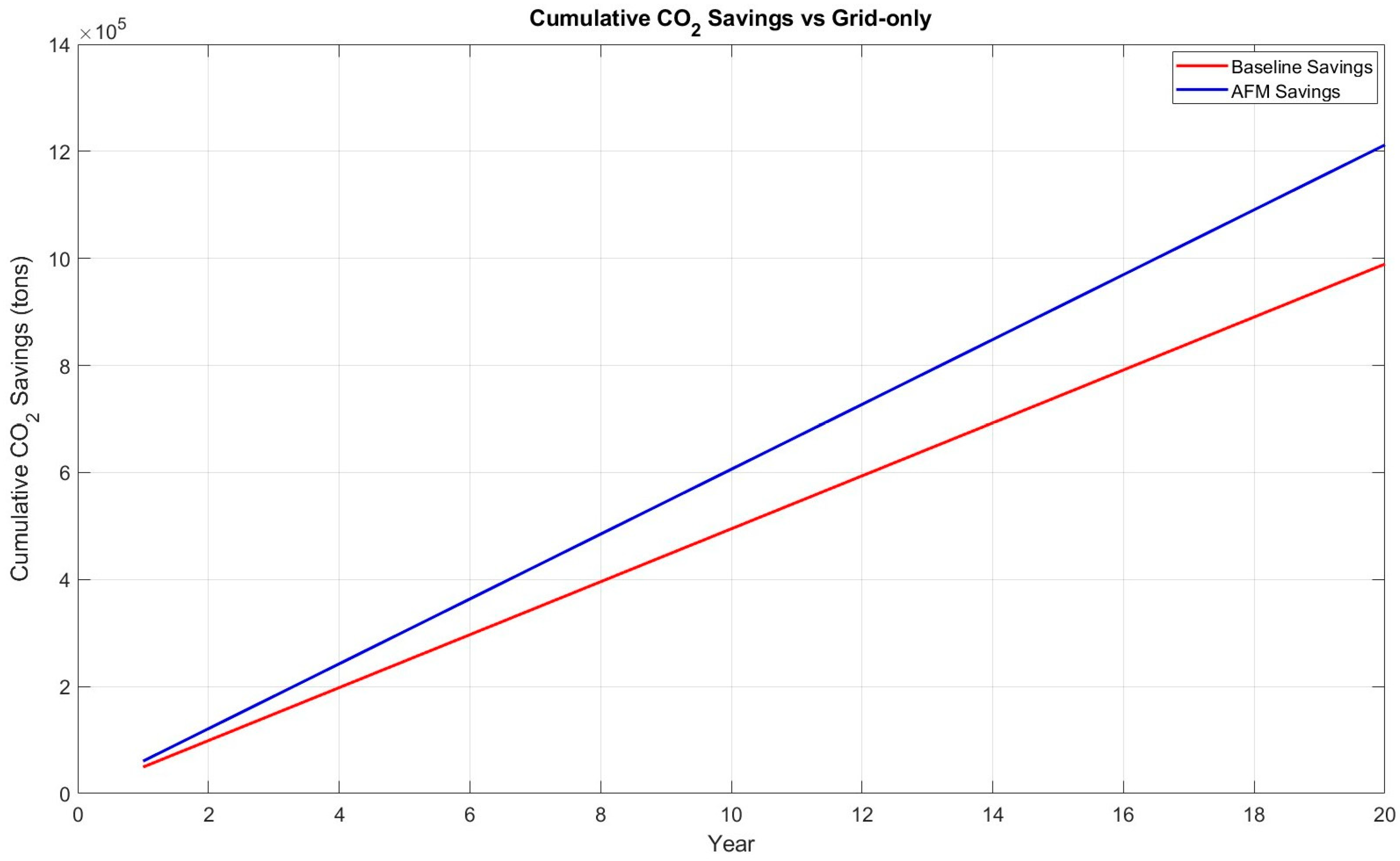
Using the Eskom emission factor, the baseline system, with ~60% grid dependency, results in annual CO2 emissions of approximately 123,680 t, while the AFM/VPP scenario reduces grid imports by nearly 50%, yielding annual emissions of ~61,841 t. Over the 20-year horizon, this corresponds to cumulative avoided emissions of 1.236 million tons of CO2, as summarized in Table 8. Figure 17 displays the cumulative avoided emissions.
The cumulative emissions curve demonstrates linear growth in avoided CO2 over the project lifetime, reflecting the predictable operational performance of the AFM/VPP system. The reduction in emissions is primarily attributable to:
  • Enhanced renewable utilization through forecast-driven dispatch
  • Pre-emptive battery management, reducing curtailment and grid dependency
  • Coordinated load management, ensuring higher renewable self-consumption
The AFM/VPP framework achieves nearly a 50% reduction in scope 2 emissions compared with the baseline, while simultaneously accelerating the financial break-even by three years. Note that the constant emission factor used in this analysis will overstate savings in later years as South Africa’s grid decarbonizes; future work should apply time-varying emission factors. The dual benefit of emissions mitigation and financial gain demonstrates that strategic flexibility and predictive control can simultaneously advance economic and decarbonization objectives in coal-dominated electricity grids. This reduction is equivalent to removing approximately 270,000 average passenger vehicles from the road over 20 years.

8. Conclusions

This study demonstrates that integrating short-term LSTM-based forecasting into a real-time dispatch controller significantly enhances the operational, financial, and environmental performance of hybrid PV–Wind–BESS systems. The proposed AFM/VPP framework employs forecast intelligence to proactively manage BESS state-of-charge and dynamically align renewable generation with load requirements, transitioning system behavior from reactive correction to anticipatory optimization. Operationally, the AFM framework achieved a 57.5% reduction in grid imports, improved load satisfaction from 92.1% to 99.3%, reduced renewable curtailment through forecast-informed storage headroom management, and improved BESS utilization efficiency from 71.4% to 88.9%. The two daily load peaks in the demand profile reflect well-documented morning and evening consumption patterns in South Africa and are handled more effectively by the predictive AFM strategy than by the reactive baseline.
Financially, the AFM/VPP configuration—despite a modest 2% CapEx increase—achieves break-even in Year 6 (three years earlier than the baseline) and delivers R26.01 billion in cumulative 20-year profit versus R12.94 billion for the baseline. The increasing annual cashflow is driven by compounding savings from avoided grid purchases under a 5%/year tariff escalation scenario, and the lower LCOE reflects higher usable energy output through reduced curtailment. Environmentally, the AFM/VPP framework reduces annual CO2 emissions from 123,680 t to 61,841 t, yielding 1.236 million tons of avoided emissions over 20 years (equivalent to removing approximately 270,000 passenger vehicles from the road). CO2 projections assume a constant Eskom emission factor; declining grid intensity as South Africa decarbonizes will require updated assessments.
Considerations should be noted when interpreting these results. The operational validation focuses on a 72 h clear-sky window, providing a clear demonstration case while leaving multi-scenario weather conditions for future evaluation. The two-site VPP configuration provides a tractable test case for the methodology, and broader multi-site deployments are a planned area of expansion. The 20-year CO2 projections assume a constant Eskom emission factor and will be refined using time-varying factors as the South African grid decarbonizes. Likewise, the financial projections are based on representative cost assumptions and can be further refined by incorporating long-term battery degradation effects.
Future work should address:
  • extending the framework to more distributed VPP configurations;
  • comparing AFM dispatch performance against ARIMA and persistence forecast baselines;
  • incorporating probabilistic demand forecasting;
  • evaluating multi-step wind forecasting;
  • validating dispatch performance across cloudy, overcast, and extreme-weather scenarios beyond the present clear-sky window;
  • applying time-varying emission factors for lifecycle CO2 accounting.
These extensions would further validate the AFM controller as a scalable and robust methodology for VPP operation in high-renewable-penetration environments.

Author Contributions

Conceptualization, methodology, software, formal analysis, investigation, and writing—original draft preparation, O.J.; validation, M.F.K. and A.G.S.; writing—review and editing, M.F.K. and A.G.S.; supervision, M.F.K. All authors have read and agreed to the published version of the manuscript. No external funding was received for this project.

Funding

This research received no funding.

Data Availability Statement

Weather resource data can be found on OpenMeto.

Conflicts of Interest

The authors declare no conflicts of interest.

Abbreviations

The following abbreviations are used in this manuscript:
AFMAdvanced Forecasting Model
ANNArtificial Neural Network
BESSBattery Energy Storage System
CapExCapital Expenditure
CFCapacity Factor
CO2Carbon Dioxide
DCLDirect Control Load
DESDistributed Energy Sources
DERsDistributed Energy Resources
DGDistributed Generation
DLDeep Learning
DoDDepth of Discharge
DRDemand Response
DSMDemand-Side Management
ESSEnergy Storage Systems
EVsElectric Vehicles
HMIHuman Machine Interface
ICLIndirect Control Load
ICTInformation and Communication Technologies
IRRInternal Rate of Return
LCOELevelized Cost of Energy
LSTMLong Short-Term Memory Network
MAEMean Absolute Error
MAPEMean Absolute Percentage Error
MC-DropoutMonte Carlo Dropout
MLMachine Learning
MSEMean Squared Error
MWMegawatt
MWhMegawatt-Hour
NWPNumerical Weather Prediction
NPCNet Present Cost
O&MOperation and Maintenance
Peak-hoursUtility-Defined Peak Windows
PPAPower Purchase Agreement
PVPhotovoltaic
RESRenewable Energy Sources
RMSERoot Mean Squared Error
RNNRecurrent Neural Network
SANEDISouth African National Energy Development Institute
SDGSustainable Development Goals
SOCState of Charge
SOC_maxMaximum State of Charge
SOC_minMinimum State of Charge
System CostTotal system cost (CapEx + O&M)
TOUTime Of Use
VPPVirtual Power Plant

Nomenclature

The following Nomenclature are used in this manuscript:
SymbolDescriptionUnits
Forecasting variables
G ( t ) LSTM-forecast solar irradiance at hour t W/m2
v ( t ) LSTM-forecast wind speed at hour t m/s
y ^ i Forecast value at index i
y i Actual (measured) value at index i
n Number of observations in the evaluation horizon
t Discrete time index (hour)h
Δ t Simulation timesteph
T Total simulation horizonh
Power generation and dispatch variables
P P V ( t ) Instantaneous PV power output at hour t MW
P W i n d ( t ) Instantaneous wind power output at hour t MW
P B E S S ( t ) BESS charging ( < 0 )/discharging ( > 0 ) power at hour t MW
P B E S S , M A X Maximum BESS charge/discharge power ratingMW
S ( t ) Total renewable supply at hour t MW
L ( t ) System load demand at hour t MW
Δ ( t ) Load–supply mismatch at hour t   ( > 0 deficit, < 0   surplus)MW
G g r i d ( t ) Grid import/export at hour t MW
C ( t ) Renewable curtailment at hour t MW
Resource and equipment parameters
η P V PV system efficiency
A P V Total PV panel aream2
A r o t o r Wind turbine rotor swept aream2
ρ Air densitykg/m3
C p Wind turbine power coefficient
P P V c a p Installed PV capacityMW
P W i n d c a p Installed wind capacityMW
E B E S S Rated BESS energy capacityMWh
C F P V PV capacity factor
C F W i n d Wind capacity factor
State of charge variables
S O C ( t ) BESS state of charge at hour t MWh
S O C m i n Minimum allowable state of charge ( = 0.20 E B E S S )MWh
S O C m a x Maximum allowable state of charge ( = 0.80 E B E S S )MWh
D o D Depth of discharge%
Energy and emissions variables
E P V Annual PV energy generationMWh/yr
E W i n d Annual wind energy generationMWh/yr
E T o t a l Total annual renewable energy generationMWh/yr
C A v o i d e d Annual avoided CO2 emissionst CO2/yr
Δ C Difference in annual emissions (AFM–Baseline)t CO2/yr
E F G r i d Eskom grid emission factorkg CO2/kWh
Forecast performance metrics
M A E Mean Absolute Error(variable units)
R M S E Root Mean Squared Error(variable units)
M A P E Mean Absolute Percentage Error%
M S E Mean Squared Error (training loss)(variable units)2
Financial variables
C a p E x x Total capital expenditure for configuration x R (ZAR)
O & M x Annual operation and maintenance cost for configuration x R/yr
α O&M fraction (% of CapEx)
T t a r i f f Grid electricity tariffR/kWh
S x Annual gross savings (avoided grid purchases) for configuration x R/yr
C F x Annual net cashflow for configuration x R/yr
C a s h f l o w x ( t ) Cashflow at year t for configuration x R
C u m x ( t ) Cumulative cashflow up to year t for configuration x R
D C F x ( t ) Discounted cashflow at year t for configuration x R
N P V x Net present value for configuration x R
L C O E Levelized Cost of EnergyR/kWh
Π x Total profit at end of project life for configuration x R
Δ Π Difference in lifetime profit (AFM–Baseline)R
Δ C a p E x Difference in capital expenditure (AFM–Baseline)R
t B E , x Break-even year for configuration x yr
r Real discount rate%
N Project lifetimeyr
LSTM model parameters
f t Forget gate output at time t
i t Input gate output at time t
o t Output gate output at time t
c ~ t Candidate cell state at time t
c t Cell state at time t
h t Hidden state at time t
W f , W i , W c , W o , W y Weight matrices for forget, input, candidate, output, and output-mapping gates
b f , b i , b c , b o , b y Bias vectors for the corresponding gates
σ ( ) Sigmoid activation function
t a n h ( ) Hyperbolic tangent activation function
Element-wise (Hadamard) multiplication
Subscripts and superscripts
x Configuration index ( x { Baseline ,   AFM } )
P V Photovoltaic component
W i n d Wind generation component
B E S S Battery Energy Storage System component
G r i d Electrical grid (import/export)
m i n Minimum admissible value
m a x Maximum admissible value
c a p Installed capacity
B E Break-even (financial)
T o t a l Aggregated/total quantity
A v o i d e d Quantity avoided through renewable substitution
t Time index (hourly for dispatch; annual for finance)
i Generic observation index
Indices
t (dispatch)Hour within simulation horizon 1 t 72   h
t (finance)Year within project lifetime 0 t N = 20   y r
i Forecast/observation index 1 i n

References

  1. Jajbhay, O.; Khan, M.F.; Lasabi, O.A. A Hybrid Approach to Virtual Power Plants: Integrating Renewables, BESS and Forecasting in South African Smart Grids. In Proceedings of the 2025 33rd Southern African Universities Power Engineering Conference (SAUPEC); IEEE: Piscataway, NJ, USA, 2025; pp. 1–6. [Google Scholar] [CrossRef]
  2. Hossain, M.L.; Shams, S.M.N.; Ullah, S.M. Time-series and deep learning approaches for renewable energy forecasting in Dhaka: A comparative study of ARIMA, SARIMA, and LSTM models. Discov. Sustain. 2025, 6, 775. [Google Scholar] [CrossRef]
  3. Alguhi, A.A.; Al-Shaalan, A.M. LSTM-Based Prediction of Solar Irradiance and Wind Speed for Renewable Energy Systems. Energies 2025, 18, 4594. [Google Scholar] [CrossRef]
  4. Speer, B.; Miller, M. The Role of Smart Grids in Integrating Renewable Energy; ISGAN Synthesis Report; National Renewable Energy Laboratory: Denver, CO, USA, 2015. Available online: https://docs.nlr.gov/docs/fy15osti/63919.pdf (accessed on 15 January 2024).
  5. Abualigah, L.; Abu Zitar, R.; Almotairi, K.H.; Hussein, A.M.; Elaziz, M.A.; Nikoo, M.R.; Gandomi, A.H. Wind, solar, and photovoltaic renewable energy systems with and without energy storage optimization: A survey of advanced machine learning and deep learning techniques. Energies 2022, 15, 578. [Google Scholar] [CrossRef]
  6. Jajbhay, O.; Khan, M.F.; Swanson, A.G. Comparative Evaluation of AI Forecasting Models for Renewable Energy Prediction in Virtual Power Plant Applications. Energy Convers. Manag. 2026, 357, 121459. [Google Scholar] [CrossRef]
  7. Nejad, M.F.; Saberian, A.; Hizam, H.; Radzi, M.A.M.; Ab Kadir, M.Z.A. Application of smart power grid in developing countries. In Proceedings of the 2013 IEEE 7th International Power Engineering and Optimization Conference (PEOCO), Langkawi Island, Malaysia, 3–4 June 2013; pp. 427–431. [Google Scholar] [CrossRef]
  8. Khan, R.H.; Khan, J.Y. A comprehensive review of the application characteristics and traffic requirements of a smart grid communications network. Comput. Netw. 2013, 57, 825–845. [Google Scholar] [CrossRef]
  9. Haddad, S.; Touafek, K.; Khelifa, A. Investigation of the electrical and thermal performance of a PV/T hybrid system. In Proceedings of the 2015 Tenth International Conference on Ecological Vehicles and Renewable Energies (EVER), Monte-Carlo, Monaco, 31 March–2 April 2015. [Google Scholar] [CrossRef]
  10. Chaitanya, M.N.; Bodaballa, S.; Maniteja, C.; Raju, G.L. A review on initiatives to enable smart grid technologies into Indian utilities. In AIP Conference Proceedings; American Institute of Physics Inc.: College Park, MD, USA, 2024. [Google Scholar] [CrossRef]
  11. Mathe, T. Strategic National Smart Grid Vision for the South African Electricity Supply Industry. South Africa, February 2024. Available online: https://sanedi.org.za/wp-content/uploads/2024/02/FINAL-Strategic-National-Smart-Grid-Vision-for-the-South-African-Electricity-Supply-Industry.pdf (accessed on 17 April 2025).
  12. Feziwe, R.; Phaduli, I.; Magomola, N.; Mnapula, K.; Daya, S. The South African Weather Service Annual Report 2024/25. South Africa, August. 2025. Available online: https://www.weathersa.co.za/Documents/AnnualReports/SAWS_Annual_Report_2024-2025_web_version_06102025100606.pdf (accessed on 23 October 2025).
  13. Liu, R.-S.; Hsu, Y.-F. A scalable and robust approach to demand side management for smart grids with uncertain renewable power generation and bi-directional energy trading. Int. J. Electr. Power Energy Syst. 2018, 97, 396–407. [Google Scholar] [CrossRef]
  14. Tahir, M.F.; Haoyong, C.; Khan, A.; Javed, M.S.; Laraik, N.A.; Mehmood, K. Optimizing size of variable renewable energy sources by incorporating energy storage and demand response. IEEE Access 2019, 7, 103115–103126. [Google Scholar] [CrossRef]
  15. Macedo, M.N.Q.; Galo, J.J.M.; de Almeida, L.A.L.; Lima, A.C.d.C. Demand side management using artificial neural networks in a smart grid environment. Renew. Sustain. Energy Rev. 2015, 41, 128–133. [Google Scholar] [CrossRef]
  16. Sarker, E.; Halder, P.; Seyedmahmoudian, M.; Jamei, E.; Horan, B.; Mekhilef, S.; Stojcevski, A. Progress on the demand side management in smart grid and optimization approaches. Int. J. Energy Res. 2021, 45, 36–64. [Google Scholar] [CrossRef]
  17. Kakran, S.; Chanana, S. Smart operations of smart grids integrated with distributed generation: A review. Renew. Sustain. Energy Rev. 2018, 81, 524–535. [Google Scholar] [CrossRef]
  18. Alasseri, R.; Tripathi, A.; Rao, T.J.; Sreekanth, K. A review on implementation strategies for demand side management (DSM) in Kuwait through incentive-based demand response programs. Renew. Sustain. Energy Rev. 2017, 77, 617–635. [Google Scholar] [CrossRef]
  19. Mehigan, L.; Deane, J.; Gallachóir, B.; Bertsch, V. A review of the role of distributed generation (DG) in future electricity systems. Energy 2018, 163, 822–836. [Google Scholar] [CrossRef]
  20. Huda, A.; Živanović, R. Large-scale integration of distributed generation into distribution networks: Study objectives, review of models and computational tools. Renew. Sustain. Energy Rev. 2017, 76, 974–988. [Google Scholar] [CrossRef]
  21. Rad, H.K.; Moravej, Z. Coordinated transmission substations and sub-transmission networks expansion planning incorporating distributed generation. Energy 2017, 120, 996–1011. [Google Scholar] [CrossRef]
  22. Allan, G.; Eromenko, I.; Gilmartin, M.; Kockar, I.; McGregor, P. The economics of distributed energy generation: A literature review. Renew. Sustain. Energy Rev. 2015, 42, 543–556. [Google Scholar] [CrossRef]
  23. Moghimi, H.; Ahmadi, A.; Aghaei, J.; Rabiee, A. Stochastic techno-economic operation of power systems in the presence of distributed energy resources. Int. J. Electr. Power Energy Syst. 2013, 45, 477–488. [Google Scholar] [CrossRef]
  24. Lopez, J.C.; Rider, M.J.; Wu, Q. Parsimonious Short-Term Load Forecasting for Optimal Operation Planning of Electrical Distribution Systems. IEEE Trans. Power Syst. 2019, 34, 1427–1437. [Google Scholar] [CrossRef]
  25. Escalera, A.; Hayes, B.; Prodanović, M. A survey of reliability assessment techniques for modern distribution networks. Renew. Sustain. Energy Rev. 2018, 91, 344–357. [Google Scholar] [CrossRef]
  26. Negri, S.; Tironi, E.; Danna, D.S. Integrated control strategy for islanded operation in smart grids: Virtual inertia and ancillary services. IEEE Trans. Ind. Appl. 2019, 55, 2401–2411. [Google Scholar] [CrossRef]
  27. Alotaibi, I.; Abido, M.A.; Khalid, M.; Savkin, A.V. A comprehensive review of recent advances in smart grids: A sustainable future with renewable energy resources. Energies 2020, 13, 6269. [Google Scholar] [CrossRef]
  28. Chamorro, H.R.; Orjuela-Cañón, A.D.; Ganger, D.; Persson, M.; Gonzalez-Longatt, F.; Alvarado-Barrios, L.; Sood, V.K.; Martinez, W. Data-driven trajectory prediction of grid power frequency based on neural models. Electronics 2021, 10, 151. [Google Scholar] [CrossRef]
  29. Tuballa, M.L.; Abundo, M.L. A review of the development of smart grid technologies. Renew. Sustain. Energy Rev. 2016, 59, 710–725. [Google Scholar] [CrossRef]
  30. Albadi, M.; El-Saadany, E. A summary of demand response in electricity markets. Electr. Power Syst. Res. 2008, 78, 1989–1996. [Google Scholar] [CrossRef]
  31. Tang, X.; Hasan, K.N.; Milanovic, J.V.; Bailey, K.; Stott, S.J. Estimation and Validation of Characteristic Load Profile Through Smart Grid Trials in a Medium Voltage Distribution Network. IEEE Trans. Power Syst. 2018, 33, 1848–1859. [Google Scholar] [CrossRef]
  32. Darvishi, M.; Tahmasebi, M.; Shokouhmand, E.; Pasupuleti, J.; Bokoro, P.; Raafat, J.S. Optimal Operation of Sustainable Virtual Power Plant Considering the Amount of Emission in the Presence of Renewable Energy Sources and Demand Response. Sustainability 2023, 15, 11012. [Google Scholar] [CrossRef]
  33. Sharma, H.; Imanbayeva, A. Designing of multi-objective optimal virtual power plant model for reliability enhancement in radial network: A case study of Indian power sector. Sci. Rep. 2022, 12, 13382. [Google Scholar] [CrossRef]
  34. Ullah, Z.; Arshad, A.; Nekahi, A. Virtual Power Plants: Challenges, Opportunities, and Profitability Assessment in Current Energy Markets. Electricity 2024, 5, 370–384. [Google Scholar] [CrossRef]
  35. Liu, F.; Dong, T.; Hou, T.; Liu, Y. A Hybrid Short-Term Load Forecasting Model Based on Improved Fuzzy C-Means Clustering, Random Forest and Deep Neural Networks. IEEE Access 2021, 9, 59754–59765. [Google Scholar] [CrossRef]
  36. Ibrahim, M.R.; Haworth, J.; Lipani, A.; Aslam, N.; Cheng, T.; Christie, N. Variational-LSTM autoencoder to forecast the spread of coronavirus across the globe. PLoS ONE 2021, 16, e0246120. [Google Scholar] [CrossRef]
  37. Kaur, D.; Kumar, R.; Kumar, N.; Guizani, M. Smart grid energy management using RNN-LSTM: A deep learning-based approach. In Proceedings of the IEEE Global Communications Conference, GLOBECOM, Waikoloa, HI, USA, 9–13 December 2019; pp. 1–6. [Google Scholar]
  38. Shao, X.; Kim, C.S. Multi-Step Short-Term Power Consumption Forecasting Using Multi-Channel LSTM with Time Location Considering Customer Behavior. IEEE Access 2020, 8, 125263–125273. [Google Scholar] [CrossRef]
  39. Fang, X.; Yuan, Z. Performance enhancing techniques for deep learning models in time series forecasting. Eng. Appl. Artif. Intell. 2019, 85, 533–542. [Google Scholar] [CrossRef]
  40. Kaur, D.; Islam, S.N.; Mahmud, A.; Haque, E.; Dong, Z.Y. Energy forecasting in smart grid systems: Recent advancements in probabilistic deep learning. IET Gener. Transm. Distrib. 2022, 16, 4461–4479. [Google Scholar] [CrossRef]
  41. Wang, Y.; Chen, Q.; Gan, D.; Yang, J.; Kirschen, D.S.; Kang, C. Deep Learning-Based Socio-Demographic Information Identification From Smart Meter Data. IEEE Trans. Smart Grid 2019, 10, 2593–2602. [Google Scholar] [CrossRef]
  42. Zhang, D.; Han, X.; Deng, C. Review on the research and practice of deep learning and reinforcement learning in smart grids. CSEE J. Power Energy Syst. 2018, 4, 362–370. [Google Scholar] [CrossRef]
  43. Hao, W.; Cominola, A.; Castelletti, A. Combining wavelet-enhanced feature selection and deep learning techniques for multi-step forecasting of urban water demand. Environ. Res. Infrastruct. Sustain. 2024, 4, 035005. [Google Scholar] [CrossRef]
  44. EDF Power Solutions Projects Under Construction: Umoyilanga. South Africa August 2025. Available online: https://southafrica.edf-powersolutions.com/construction/umoyilanga/ (accessed on 23 October 2025).
  45. Jajbhay, O.; Khan, F.M.; Swanson, A. Optimizing Wind Energy Integration through Advanced Forecasting Methods for Improved Generation and Storage. In Proceedings of the Cigre Southern Africa 12th Regional Conference, Pretoria, South Africa, 14–17 October 2025. [Google Scholar]
  46. Piotrowski, P.; Rutyna, I.; Baczyński, D.; Kopyt, M. Evaluation metrics for wind power forecasts: A comprehensive review and statistical analysis of errors. Energies 2022, 15, 9657. [Google Scholar] [CrossRef]
  47. Azad, H.B.; Mekhilef, S.; Ganapathy, V.G. Long-term wind speed forecasting and general pattern recognition using neural networks. IEEE Trans. Sustain. Energy 2014, 5, 546–553. [Google Scholar] [CrossRef]
  48. Xiong, B.; Lou, L.; Meng, X.; Wang, X.; Ma, H.; Wang, Z. Short-term wind power forecasting based on Attention Mechanism and Deep Learning. Electr. Power Syst. Res. 2022, 206, 107776. [Google Scholar] [CrossRef]
  49. Hajirahimi, Z.; Khashei, M. Hybrid structures in time series modeling and forecasting: A review. Eng. Appl. Artif. Intell. 2019, 86, 83–106. [Google Scholar] [CrossRef]
  50. Rosewater, D.; Ferreira, S.; Schoenwald, D.; Hawkins, J.; Santoso, S. Battery energy storage state-of-charge forecasting: Models, optimization, and accuracy. IEEE Trans. Smart Grid 2019, 10, 2453–2462. [Google Scholar] [CrossRef]
  51. Guan, C.; Luh, P.B.; Michel, L.D.; Wang, Y.; Friedland, P.B. Very Short-Term Load Forecasting: Wavelet Neural Networks with Data Pre-Filtering. 2013. Available online: http://ieeexplore.ieee.org (accessed on 24 August 2024).
  52. Howlader, H.O.R.; Matayoshi, H.; Senjyu, T. Distributed generation incorporated with the thermal generation for optimum operation of a smart grid considering forecast error. Energy Convers. Manag. 2015, 96, 303–314. [Google Scholar] [CrossRef]
  53. Hernandez, L.; Baladron, C.; Aguiar, J.M.; Carro, B.; Sanchez-Esguevillas, A.J.; Lloret, J.; Massana, J. A survey on electric power demand forecasting: Future trends in smart grids, microgrids and smart buildings. IEEE Commun. Surv. Tutor. 2014, 16, 1460–1495. [Google Scholar] [CrossRef]
  54. Camera, F.L. Renewable Power Generation Costs 2024. Abhu Dhabi, March. 2025. Available online: http://www.irena.org/publications (accessed on 21 November 2025).
Figure 1. Demand-Side Management Techniques.
Energies 19 02730 g001
Figure 2. Benefits of Demand-Side Management.
Energies 19 02730 g002
Figure 3. Classification and framework of DR programs.
Energies 19 02730 g003
Figure 4. Virtual Power Plant Structure.
Energies 19 02730 g004
Figure 5. LSTM forecasting model: architecture and process.
Energies 19 02730 g005
Figure 6. Umoyilanga Hybrid Facility Overview [44].
Energies 19 02730 g006
Figure 7. AFM–VPP interaction loop.
Energies 19 02730 g007
Figure 15. Cumulative Cashflows—20-year period.
Energies 19 02730 g015
Figure 16. Financial summary baseline vs. AFM.
Energies 19 02730 g016
Figure 17. Cumulative CO2 savings.
Energies 19 02730 g017
Table 1. Solar and Wind MATLAB LSTM forecasting model parameters.
Feature/ParameterWind Speed LSTMSolar Irradiance LSTMExplanation/Reasoning
Forecast Horizon15–18 July 2024 (hourly)14–17 July 2024 (hourly)Based on different test windows used in the scripts.
Input FeaturesWind speed only (1 feature)Irradiance, hour-sin, hour-cos (3 features)Solar includes engineered time-of-day features; wind uses raw autoregressive input.
Sequence Length1 h (single-step autoregressive)24 h (daily sequence window)Solar requires daily context; wind behaves as a short-memory stochastic process.
Inactive Period HandlingNot requiredNighttime irradiance naturally becomes zeroSolar generation ceases at night; code uses clipping after prediction.
LSTM Hidden Units100100Both models use 100 units according to final implemented code.
LSTM Output ModeSequenceLastWind predicts step-by-step; solar predicts next hour after consuming full 24 h context.
Normalization MethodZ-score (μ, σ from training set)Z-score (μ, σ from training set)Ensures stable gradients and consistent scaling.
Training StrategyDirect one-step supervised trainingRolling year-ahead cross-validation + final full retrainingSolar uses multi-year CV; wind uses a single continuous training pass.
Training Epochs20050Wind requires longer convergence due to noise; solar stabilizes faster.
Mini-Batch SizeDefault (1 sequence per batch)Default (full sequence training)Matches MATLAB’s default for sequence-to-one LSTM regression.
Evaluation MetricsMAE, RMSE, MAPEMAE, RMSE, MAPEStandard regression performance indicators.
Prediction OutputHourly predicted vs. actual wind speedsHourly irradiance forecast (non-negative clipped)Supports integration into hybrid dispatch model.
Table 2. Solar irradiance performance metrics (Table truncated for brevity).
HourActual (W/m2)Predicted (W/m2)MAEMAPE (%)
934.565.6731.1790.35
10228.6194.1734.4315.06
12546.1565.6619.563.58
14625.2611.8613.342.13
17316.5347.1730.679.69
38637.2639.942.740.43
61614.3629.9915.692.55
82234.6195.6238.9816.62
85629.9641.7011.801.87
90138.5164.0525.5518.45
Table 4. Summary of quantitative performance metrics.
MetricBaseline (No Forecast)AFM (LSTM Forecast Integrated)Improvement
Total Grid Energy Imported (MWh)1466.34623.47−57.48%
Load Satisfaction (%)92.199.3+7.2%
Avg. BESS Utilization Efficiency71.488.9+24.5%
Table 5. Financial Input Parameters.
ParameterValueUnitNotes
PV Capacity Factor0.25-For the Norther Cape, South Africa
Wind Capacity Factor0.35-For the Eastern Cape, South Africa
PV LCOE0.043 × 17.35R/kWhIRENA 2024/25
Wind LCOE0.034 × 17.35R/kWhIRENA 2024/25
BESS Cost192 USD/kWh × 17.35R/kWhIRENA 2024/25
AFM/VPP Integration+2% of total CapExZARSoftware, communications, VPP coordination
O&M Escalation2%/yr%Inflation & service cost increase
Grid TariffR3/kWhZARIndustrial TOU, Eskom 2025
Grid Escalation5%/yr%Annual increase in tariff
Project Life20yrsPV/Wind/BESS lifetime
Discount Rate8%%Weighted-average cost of capital
Table 6. Baseline vs. AFM Cost breakdown.
MetricBaselineAFM/VPPImprovement
Total CapEx (R billion)9.8310.03+0.20
Annual Cashflow (R billion/year)1.1381.802+0.664
Break-even year96−3 years
Total 20-year profit (R billion)12.9426.01+13.07
Table 7. Cumulative cashflow and break-even baseline vs. AFM.
YearBaseline Cumulative Profit (R Billion)AFM/VPP Cumulative Profit (R Billion)
60.001.0
101.557.99
2012.9426.01
Table 8. CO2 20-year projections savings.
YearGrid Baseline (MWh)Grid AFM (MWh)CO2 Baseline (t)CO2 AFM (t)Annual Saving (t)Cumulative Saving (t)
1137,42068,712123,68061,84161,84161,841
5137,42068,712123,68061,84161,841309,205
10137,42068,712123,68061,84161,841618,410
15137,42068,712123,68061,84161,841927,615
20137,42068,712123,68061,84161,8411,236,820
Disclaimer/Publisher’s Note: The statements, opinions and data contained in all publications are solely those of the individual author(s) and contributor(s) and not of MDPI and/or the editor(s). MDPI and/or the editor(s) disclaim responsibility for any injury to people or property resulting from any ideas, methods, instructions or products referred to in the content.