Article

Nanofluid-Driven Heat Transfer Augmentation for Enhanced Geothermal Extraction in U-Shaped Wells


1
State Key Laboratory of Continental Shale Oil, Daqing 163712, China
2
Exploration and Development Research Institute of Daqing Oilfield Co., Ltd., Daqing 163712, China
3
School of Energy and Environmental Engineering, Hebei University of Technology, Tianjin 300401, China
*
Author to whom correspondence should be addressed.
Energies 2026, 19(11), 2706; https://doi.org/10.3390/en19112706
Submission received: 11 May 2026 / Revised: 30 May 2026 / Accepted: 2 June 2026 / Published: 4 June 2026
(This article belongs to the Section H2: Geothermal)

Abstract

U-shaped well geothermal energy exploitation has become a key pathway for sustainable energy development, valued for its clean and stable attributes. However, constrained by the limited heat transfer capacity between the wellbore and traditional circulating water, the thermal extraction efficiency of the circulating fluid in the U-shaped well remains difficult to breakthrough, severely hindering the large-scale application. This work conducts a study on the optimization of the thermal conductivity performance of circulating working fluids based on water-phase dispersed nanoparticles, aiming to explore efficient heat transfer methods for the circulating working fluids in geothermal reservoir U-shaped wells. The finite element simulation is employed to analyze the influence of Al2O3 nanoparticle concentration (0–5%) and injection rate (4000–9000 m3/d) on thermal conductivity performance and flow characteristics. The results demonstrate that the Al2O3-H2O nanofluid with a particle size of 10 nm and a concentration of 5% exhibits the optimal heat transfer performance. Under the optimization objective of maximizing net heat output with the pipe-velocity safety constraint satisfied, when the injection rate is 5000 m3/d, the heat extraction efficiency is improved by 21.31% compared with that of pure water. This work may provide theoretical data for efficient geothermal exploitation.

1. Introduction

Geothermal energy exploitation as a crucial component of low-carbon energy technologies has garnered significant attention in its development and utilization [1,2]. In the field of medium-deep geothermal energy, the closed-loop heat extraction technology with U-shaped wells represents a novel development model that combines high-efficiency heat transfer with the advantage of “heat extraction without water” [3]. This technology achieves heat extraction through sufficient heat transfer (including thermal diffusion and convection) between the circulating working fluid (typically water) in the U-shaped well and the pipe wall [4]. Thus, enhancing the thermal recovery efficiency of geothermal wells has become a key issue in this field [5].
The working fluid thermal physical parameters and fluid flow conditions exert distinct influences on heat transfer and flow field distribution. Specifically, thermal properties dominate the heat transfer efficiency of the heat carrier, while flow conditions govern the spatial distribution of the flow field in U-shaped wells. This dual influence increases the complexity of coupled calculations for the temperature field and flow field [6], thereby causing difficulties in temperature field prediction. Zhang et al. [7] conducted a numerical analysis of the heat transfer performance of single U-shaped vertical buried pipes at different well depths based on a heat transfer model similar to actual scenarios, and obtained the variation relationship between well depth and heat transfer performance. The study shows that with the increase in well depth, the total heat transfer coefficient between the water and reservoir heat exhibits a downward trend, and then gradually slows down. Xiao et al. [8] developed a coupled model of transient heat conduction in soil (or rock) and quasi-steady-state heat transfer in boreholes, with the maximum relative error between the calculation results and experimental results being only 0.62%. Based on the energy analysis method, they found that as the flow velocity increases, the thermal energy first increases and then decreases; the flow velocity corresponding to the maximum energy utilization value is the optimal flow velocity. Different from the above steady-state cases, Heinz et al. [9] obtained a dynamic heat transfer coefficient based on the transient solution describing the degree of local heat transfer and applied this parameter to heat transfer simulation at the engineering scale. In addition, the roughness coefficient of the wellbore wall determines the distribution pattern of the local convective heat transfer coefficient [10], indicating that the pipe diameter and surface roughness play important roles in heat transfer coefficient of U-shaped wells. Frank et al. [11] investigated the effects of solid surface roughness, pipe diameter, and mass transfer characteristics on heat transfer under high-flow velocity conditions.
Based on this, scholars have conducted relevant research on optimizing heat extraction performance. Wang et al. [12] proposed physical models of series and parallel U-shaped wells and performed an economic evaluation of U-shaped closed-loop geothermal systems. The results showed that the economic benefit of the parallel configuration was 5.86% higher than that of the series configuration. Zhang et al. [13] investigated the structural optimization route of U-shape wells in medium and deep geothermal, and the system’s Coefficient of Performance (COP) increased by more than 25%. Wang et al. [14] proposed a novel closed-loop multistage multi-branch U-shaped borehole geothermal system. Based on a three-dimensional unsteady flow and heat transfer model, they found that when the horizontal well was 3000 m and the number of branches was four, the economic benefit was maximized. Liao et al. [15] designed a multi-branch U-shaped well system and evaluated it via a wellbore-formation coupled transient heat transfer model. The study indicated that when the water injection rate was 900 m3/d and the horizontal wellbore length was 5000 m, the energy balance cost reached the minimum. Ma et al. [16] designed a multi-horizontal U-shaped well geothermal system. Through numerical analysis of the temperature field in multi-horizontal wells, they expounded the relationship between the heat extraction efficiency of this geothermal system and factors such as the number and diameter of horizontal wells, determining the optimal spacing of horizontal wells and the number of pipe wells for heat collection performance. Yu et al. [17] proposed a method to improve the heat extraction performance of deep-buried U-shaped wells using high-pressure jet grouting technology. This scheme established artificial jet grouting columns with high thermal conductivity near the horizontal well to increase the heat transfer area and heat transfer performance between the wellbore and surrounding formations. The annual average heat production rate of the optimized U-shaped well was increased by approximately 22%. However, heat transfer between the wellbore and traditional circulating water is often constrained by the heat transfer capacity of the circulating working fluid, causing non-uniform heat flux density and weakening the thermal diffusion effect of the circulating fluid [18,19]. Additionally, fluctuations in the injection conditions of the circulating working fluid under the influence of reservoir temperature gradients make it difficult to control the fluid flow and heat transfer characteristics in the well, leading to unclear influencing laws of thermal recovery efficiency [20]. Modifying the heat transfer performance of circulating working fluids has also been proven to improve thermal recovery efficiency, such as through geopolymer-based materials [21,22], microencapsulated phase change material [23], nanofluids [24], etc.
Existing works show that using nanofluids instead of pure water as circulating working fluid is an effective way to improve the heat extraction of U-shaped closed-loop geothermal wells. Most studies mainly focus on the optimization of well structure, layout and water injection methods. Under geothermal exploitation conditions, the heat transfer mechanism between nanofluids and pipe walls under the coupling effect of wall characteristics and complex flow fields remains unclear [25]. In addition, most works merely emphasize the heat transfer enhancement of nanofluids, while ignoring adverse effects such as increased viscosity and flow resistance caused by nanoparticle addition. The trade-off between heat extraction efficiency and pumping power consumption has not been established. In view of the above issues, there is a need to further explore the influence of multiple flow parameters on the heat transfer of nanofluids. This work explores the heat transfer characteristics between the circulating working fluid and the well wall of U-shaped wells by considering multiple influencing factors, including the type, concentration and flow rate of nanofluids. Al2O3-water nanofluid is used, with nanoparticle concentrations ranging from 0% to 5% and injection flow rates varying from 4000 to 9000 m3/d. The research findings are of great significance for optimizing heat extraction processes and improving overall thermal recovery efficiency.

2. Problem Definition and Mathematical Modeling

2.1. Physical Model

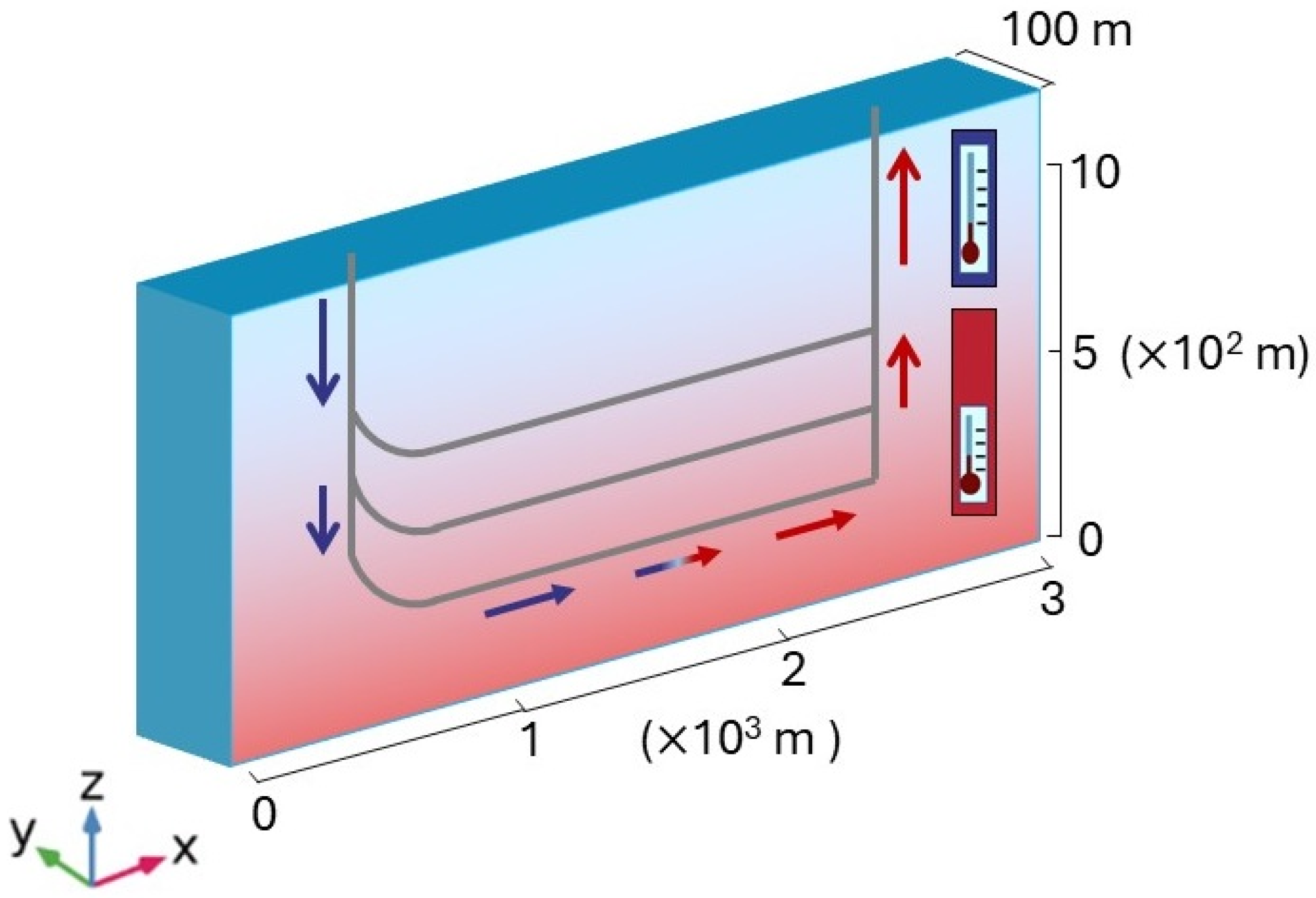
Figure 1 shows the geometric model of the parallel U-shaped well in the geothermal reservoir adopted in this study. This study ignores the pressure and heat losses in the insulated sections of the vertical wells, assumes that the outlet temperature and pressure of the horizontal wells are the same as those at the ground inlet and outlet, and only focuses on the heat transfer in the horizontal wells. The size of the reservoir model is set to 3000 m × 200 m × 1250 m. The well pattern structure consists of two vertical wells and three horizontal wells, each 2000 m long, with the injection well connected to the horizontal wells through arcs with a radius of 250 m. The model also considers the casing and cementing structure of the wells to simulate the actual situation more accurately. This multi-horizontal-section U-shaped well design aims to increase the contact area between the heat transfer working fluid and the rock mass by increasing the number of horizontal wells, thereby improving the overall heat extraction effect.
Some assumptions are employed to simplify this calculation: (1) the thermophysical properties of the wellbores are constant, independent of temperature and pressure, and exhibit isotropy; (2) fluids within the wellbore flow in one dimension with radial temperature gradients neglected; (3) only heat conduction exists between the thermal reservoir and the well wall, and heat convection is ignored; (4) all connections between wellbore sections and the contact between pipe walls and geotechnical materials maintain good thermal continuity; (5) the circulating working fluid remains in a liquid state at all times; (6) the vertical wells have sufficient thermal insulation to neglect pressure and heat losses in the insulated segments; (7) the temperature of the heat reservoir varies with burial depth at a temperature gradient of −0.04 K/m.

2.2. Mathematical Model

The momentum conservation and mass conservation of the flow process in pipelines are described by the Navier–Stokes equation and continuity equation, respectively, with the expressions as follows [26]:
ρ u t + ρ u u = p f D ρ 2 d h u u + F
( A ρ ) t + A ρ u = 0
where ρ represents fluid density, kg·m−3; u is the average velocity of the pipe cross-section, m/s; F represents gravity, N/m3; A represents the cross-sectional area of the wellbore, m2; d h represents the average hydraulic diameter, m.
The second term on the right-hand side of Equation (1) represents the pressure drop caused by viscous shear force. The Darcy friction factor f D could be obtained by the Churchill Equation as follows [27]:
f D = 8 8 R e 12 + A + B 1.5 1 12
A = 2.457 ln 7 R e 0.9 + 0.27 e d 16
B = 37530 R e 16
where R e represents the Reynolds number; e represents the roughness of the inner surface of the pipe, with a value of 0.046 mm.
The heat conduction in the high-temperature heat-storage reservoir is expressed by the heat conduction differential equation [28]:
ρ s c p , s T t k s T = Q
where ρ s denotes the density of the rock reservior, kg/m3; c p , s denotes the specific heat capacity of the rock layer, J/(kg·K); T denotes the temperature of the rock layer, K; k s denotes the thermal conductivity of the rock layer, W/(m·K); Q denotes the heat source, W/m3, and Q = 0 in this work.
The energy conservation equation for fluid flow in the pipeline of the horizontal wellbore is expressed as [29]
ρ A c p T t + ρ A c p u T = A k T + f D ρ A 2 d h u 3 + q ˙ + Q w a l l
where c p denotes the specific heat capacity of the fluid at constant pressure, J/(kg·K); k denotes the thermal conductivity of the fluid, W/(m·K); q ˙ denotes the heat source inside the wellbore, W/m; Q w a l l denotes the heat flux rate per unit length of the wellbore wall, W/m.
The heat transfer intensity between the wellbore and heat reservoir is proportional to the temperature difference. Q w a l l could be calculated by the following equation [30]:
Q w a l l = U e f f T s T
where U e f f represents the effective heat transfer coefficient, W/(m∙K); T s represents the reservoir temperature, K; T represents the fluid temperature, K.
Details of model parameters are listed in Table 1.
All simulations are carried out on the COMSOL Multiphysics 6.1 platform for the coupled non-isothermal pipe flow and solid heat transfer fields. A transient solver is adopted to solve the time-dependent governing equations. The linear algebraic system is solved by the Algebraic Multigrid (AMG) method combined with an incomplete LU factorization preconditioner. Convergence criteria are defined as follows: the relative tolerance is set to 0.01, and the absolute tolerance factor is set to 0.1.

2.3. Grid-Independent Validation

The model was meshed using fixed-size four-node tetrahedral solid elements. Grid independence verification was conducted for the U-shaped well geothermal model, with boundary conditions specified as follows: the injection temperature was set at 293.15 K, the injection rate was 500 m3/d, the production wellhead adopted a constant pressure production mode with a pressure of 101.325 kPa, and the bottom served as a heat source boundary with a temperature of 393.15 K with a gradient of −0.04 K/m.
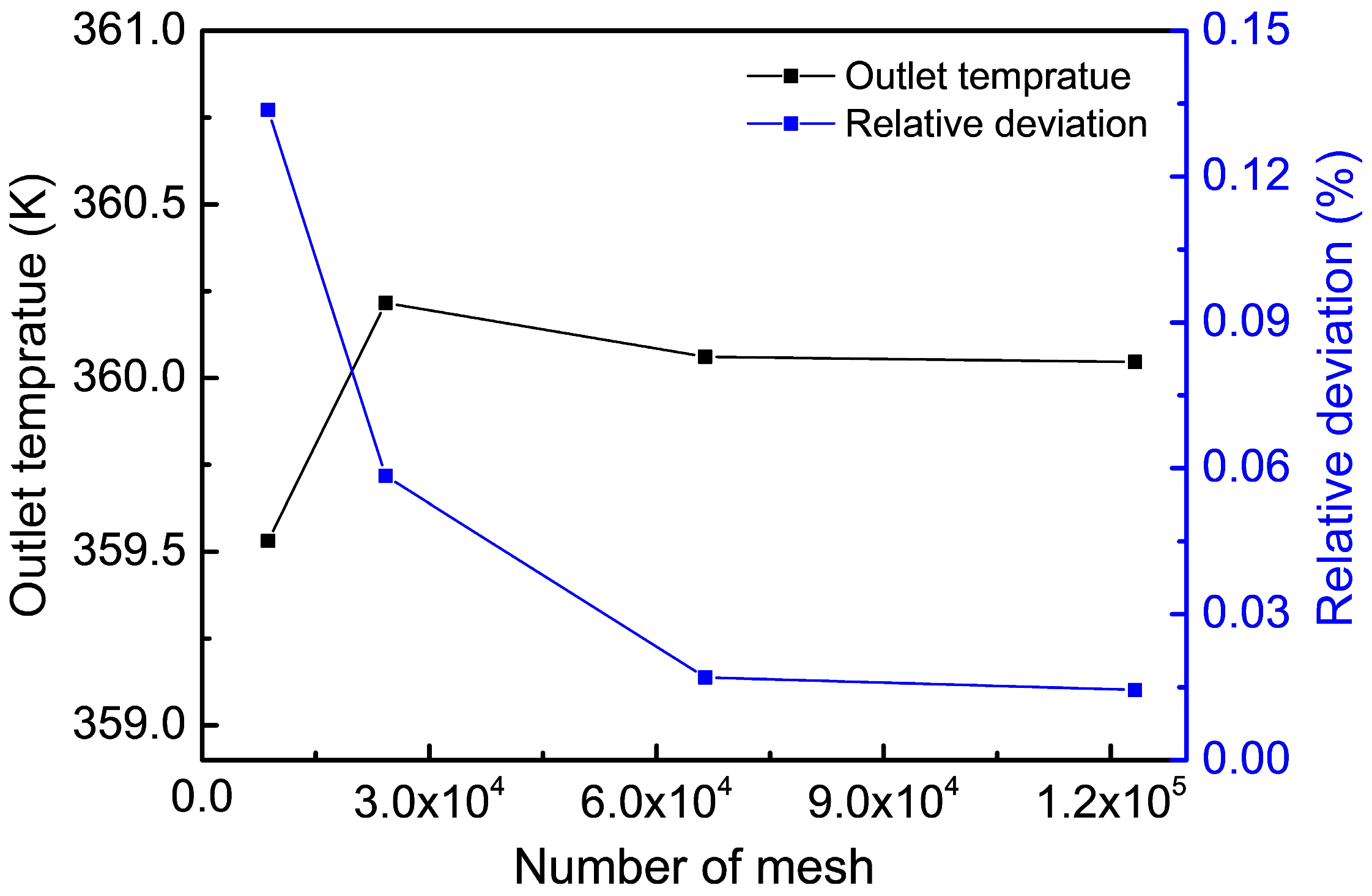
Figure 2 illustrates the water temperature at the outlet under different grid numbers. It can be found that the calculation results with a grid number of 8695 differ significantly from those of other grid numbers, while the outlet temperature stabilizes and gradually approaches 360 K when the grid number exceeds 24,253. Taking 360 K as the reference value for the outlet temperature, the relative errors of target parameters under four groups of grids were also calculated. When the number of grids increased from 8695 to 1,232,016, the relative error of the outlet temperature fluctuated within the range of 0.14−0.01%, and the calculation results of target parameters showed minimal differences when the number of grids increased from 66,453 to 123,201. Hence, the grid number of 66,453 was adopted as the optimal grid density.

2.4. Model Validation

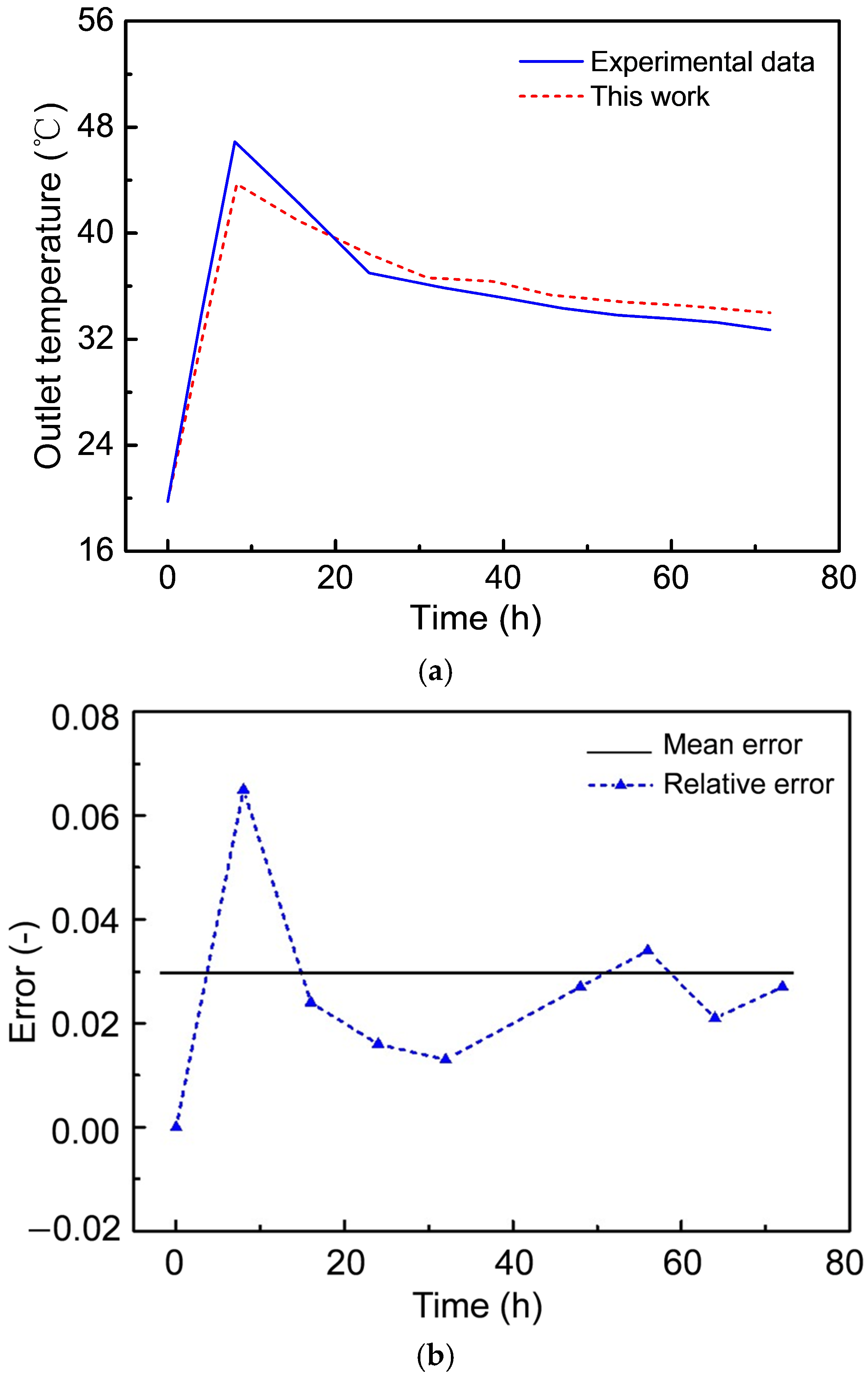
Multilateral horizontal wells only increase the heat transfer length and time of the wellbore without altering the heat transfer law, so field experimental data from a single U-shaped well can also validate the model accuracy. Experimental data on the heat transfer of U-shaped deep-buried pipes published by Li et al. [31] were selected to validate the model in this work, with the outlet water temperature as the target parameter. The vertical well depth is 2505 m, the spacing between production and injection wells is 205 m, the injection well section is 139.7 mm × 9.17 mm, the production well section is 177.8 mm × 8.05 mm, the initial inflow temperature of the fluid is 19.5 °C, and the flow rate is 1131.84 m3/d. The comparison between the calculated results and experimental data of the model outlet temperature is shown in Figure 3. The simulated outlet water temperature of the U-shaped well is in good agreement with the actual production value. The outlet water temperature changes over time, initially rising rapidly, then gradually decreasing and stabilizing after 8 h. The initial error peak is a normal phenomenon in the transient transition stage, resulting from the temporary mismatch between the ideal initial conditions of the numerical model and the flow field development and heat exchange establishment process in the experiment. As the system enters a quasi-steady state, the error quickly drops to the model’s average error level. The model verification shows that the average error of the outlet water temperature of the U-shaped well is 2.89%, which is less than the engineering requirement of 5%, indicating that the model established in this work has good accuracy and that the transient deviation at the initial stage does not affect the overall reliability.

2.5. Comparison and Selection of Nanofluid Types

Nanofluid is defined as a suspension of nanoparticles in a base fluid whose thermophysical properties are determined by the nature of the base fluid, the particle size, geometry, and concentration of the nanoparticles. Table 2 compares the thermophysical properties of various nanofluids and base fluids found in the existing literature. Water exhibits superior performance in geothermal extraction within U-shaped wells in comparison with ethylene glycol-based fluids. The dynamic viscosity of SiO2 and CuO-ZnO nanofluids using ethylene glycol (EG) as the base fluid is significantly higher than that of water-based nanofluids, resulting in increased mobile energy consumption. Under turbulent flow conditions, Al2O3 and ZnO nanoparticles enable fluids with higher convective heat transfer coefficients, while Fe3O4 particles are prone to causing heat transfer degradation and pipeline blockage due to magnetic aggregation and sedimentation, and the high preparation cost of TiO2 particles compromises the economic feasibility of geothermal systems. Although water-based ZnO nanofluids exhibit advantages of low viscosity and high specific heat capacity, they suffer from insufficient chemical stability and high preparation cost. Taking into account key parameters such as thermal conductivity, viscosity, chemical stability, and economic cost, Al2O3-H2O nanofluid exhibits the optimal comprehensive performance in flow and heat transfer within U-shaped wells, featuring remarkable enhancement in thermal conductivity, controllable increase in viscosity, high particle stability, and relatively low cost, thus being selected as the circulating working fluid for the geothermal extraction system in this study.

3. Results and Discussion

3.1. Effect of Nanoparticle Concentration on Heat Transfer

The selection of nanofluid concentration requires balancing heat transfer performance and flow characteristics. As the nanoparticle concentration increases, the heat transfer performance of Al2O3-H2O nanofluid enhances, but excessively high concentrations significantly increase viscosity and flow resistance, even causing particle agglomeration and pipeline blockage. Thus, optimizing the concentration to balance heat transfer and flow characteristics is crucial. This chapter selects Al2O3-H2O nanofluids with a concentration of 1%, 5%, and 10% (particle diameter of 10 nm); previous works have experimentally tested Al2O3-H2O nanofluids at different volume fractions, and the results are shown in Table 3. Assuming them as continuous, uniform, incompressible media with constant thermophysical properties. Numerical calculations are conducted to analyze the temperature variation and pressure drop in horizontal wells, compared with pure water, to determine the optimal concentration.
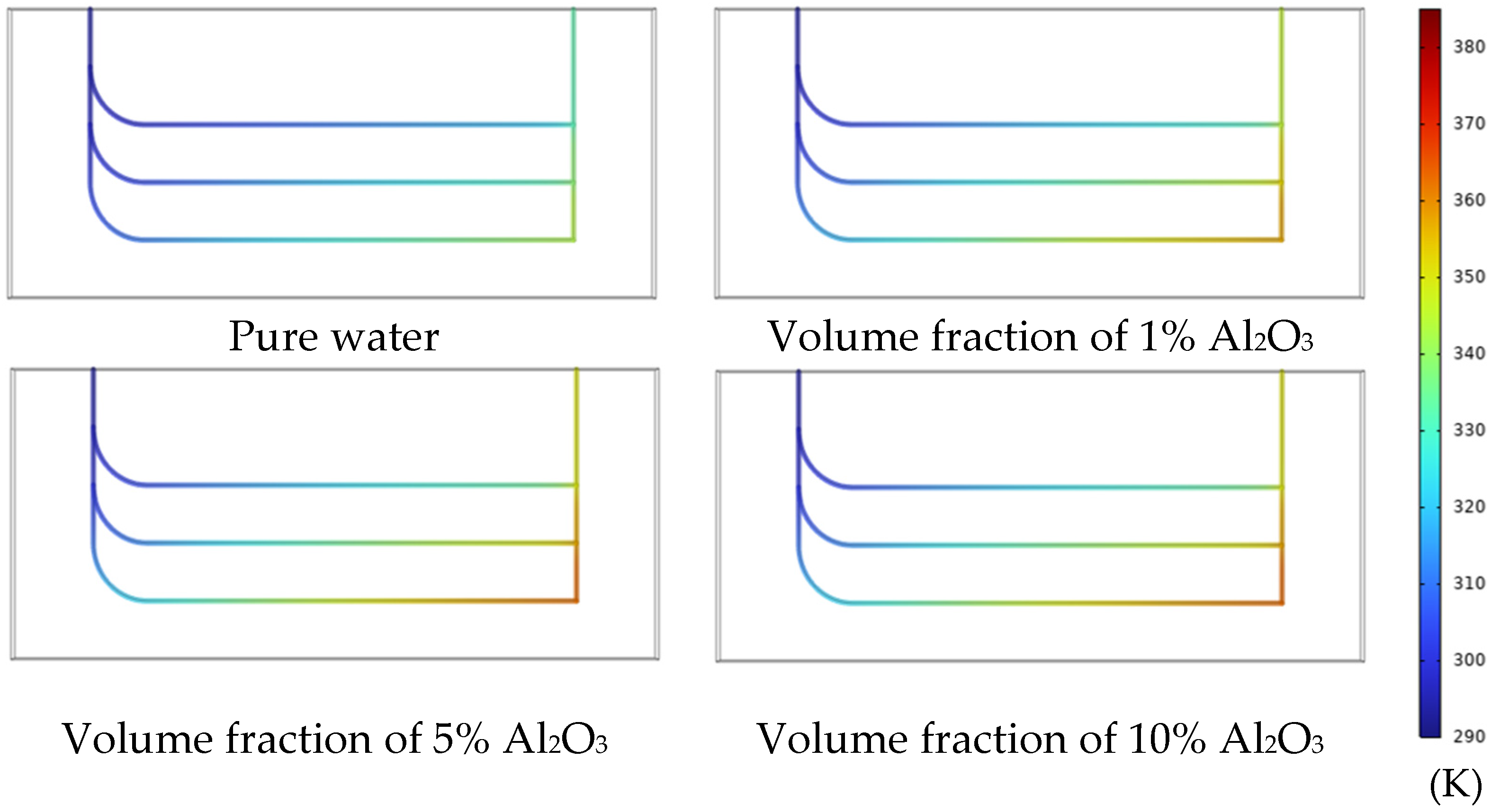
Using the model parameters in Table 1, the boundary conditions are set as follows: injection temperature of 20 °C, injection rate of 7000 m3/day, constant pressure production at the production wellhead (101.325 kPa), heat source boundary at the bottom with a temperature of 120 °C, and a geothermal gradient of −0.04 K/m. Simulations of heat transfer in the multi-horizontal wells are performed using pure water and three nanofluid concentrations; Figure 4 shows the fluid temperature distributions. Compared with pure water, nanofluids significantly improve heat transfer efficiency in the pipeline. Heat transfer is enhanced at the U-bend, with local high-temperature regions expanding into low-temperature zones, and the outlet temperature increases significantly. Within the nanoparticle concentration range of 1–10%, the outlet temperature rises with increasing nanoparticle concentration. However, limited by the reservoir temperature upper limit and fluid boiling point, the heat transfer improvement slows when the concentration increases from 5% to 10%, while excessively high concentrations may deteriorate flow characteristics and weaken heat transfer performance.
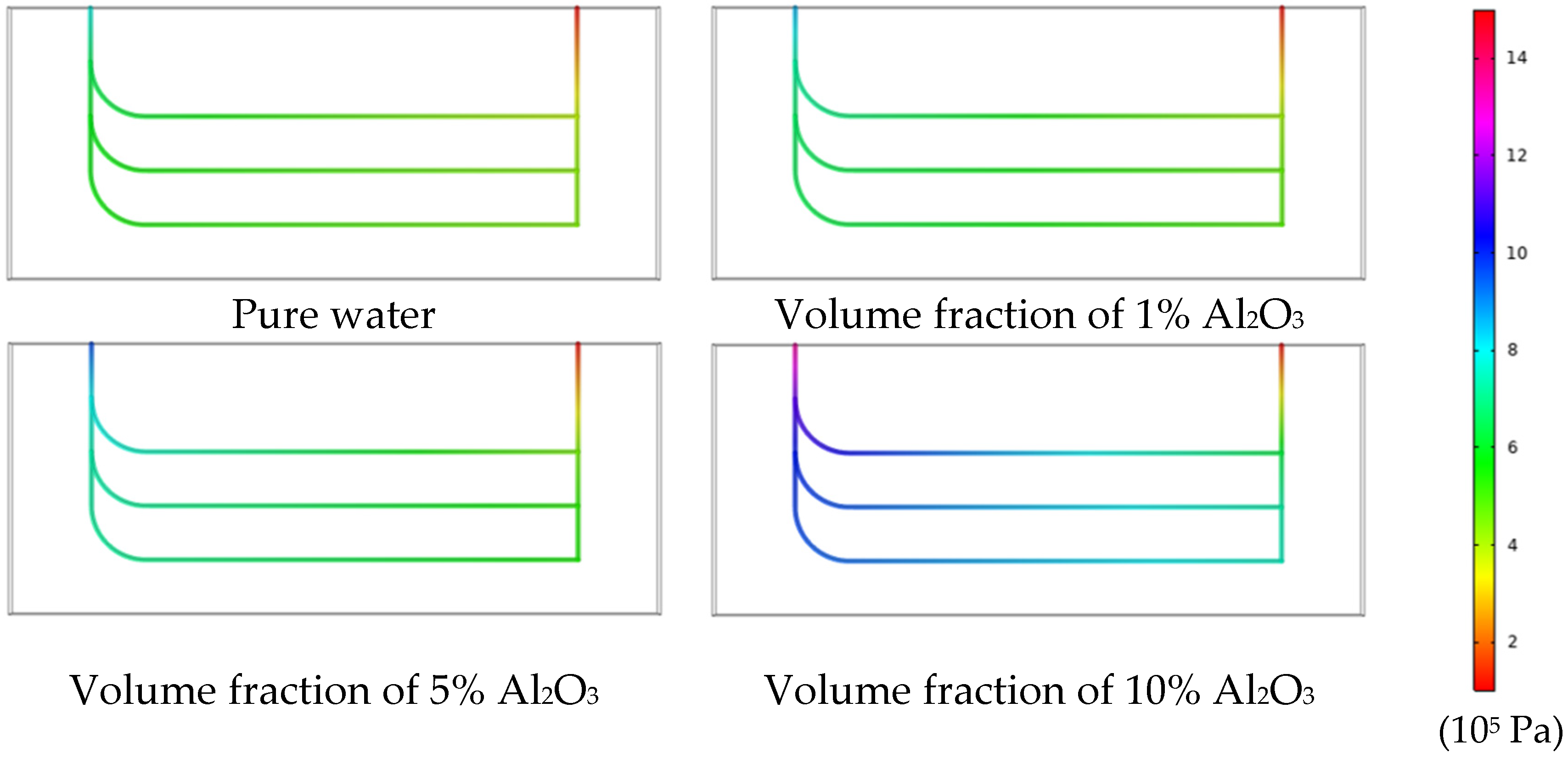
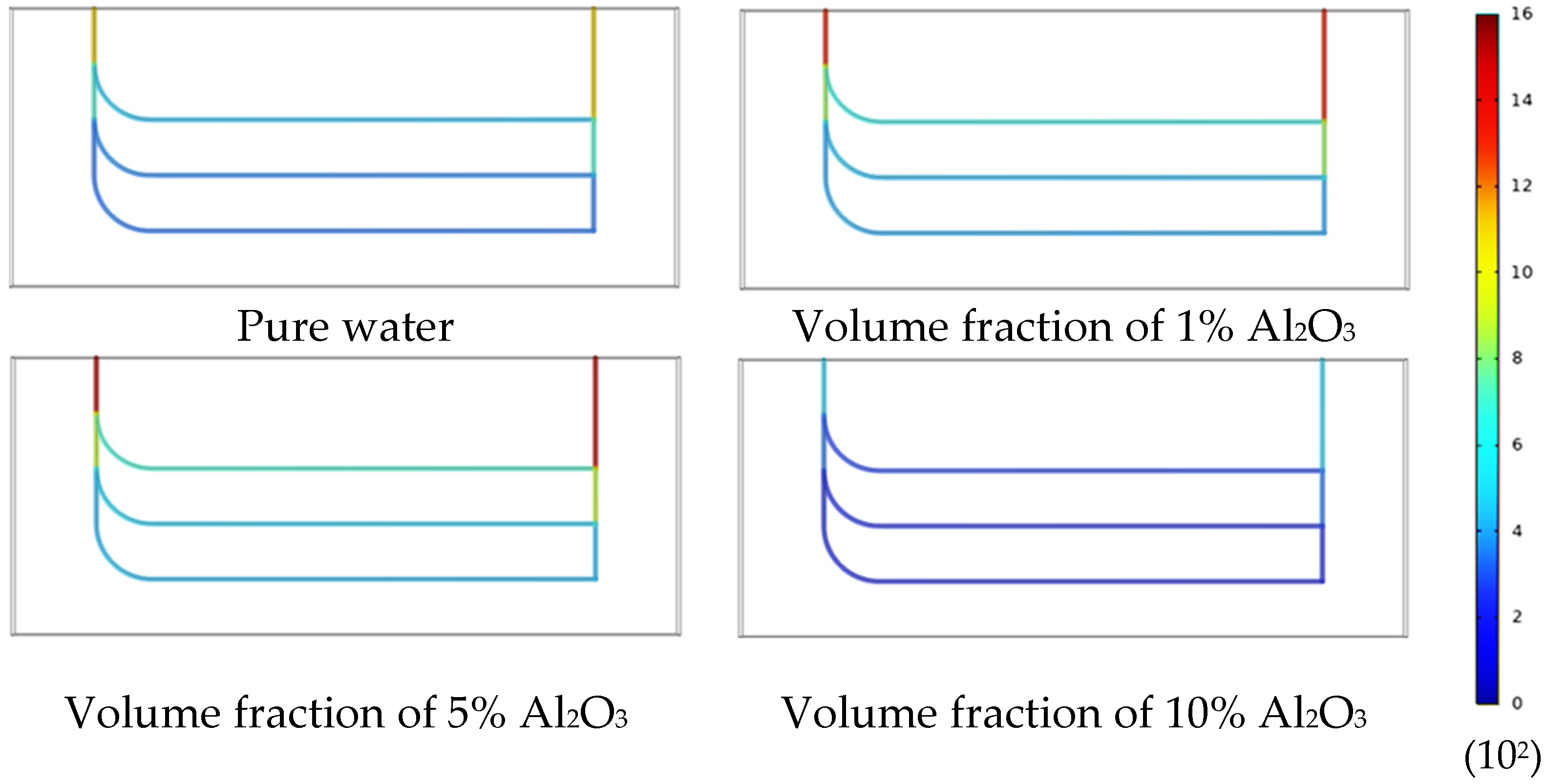
The flow and heat transfer performances were compared using pressure and Nusselt number (Nu, a dimensionless temperature gradient at the fluid near-wall region, where the value reflects the intensity of heat transfer) as indices, as shown in Figure 5 and Figure 6. When the concentration of Al2O3 nanoparticles increased from 0 to 5%, fluid viscosity rose moderately, which slightly increased pipeline pressure. Meanwhile, the Nu number of fluids in horizontal wells increased continuously. On the one hand, high-thermal-conductivity nanoparticles form a dense heat conduction network inside the base fluid; on the other hand, mild viscosity growth does not suppress nanoparticle Brownian motion, and the turbulent disturbance near the wall is strengthened. Both effects jointly enhance convective heat transfer, so the heat transfer improvement is positively correlated with particle concentration within this range. When the concentration further increased to 10%, the fluid viscosity increased drastically. Excessively high viscosity thickens the hydrodynamic and thermal boundary layers near the pipe wall, weakens fluid turbulence and nanoparticle micro-motion, and greatly weakens the convective heat transfer capacity. In addition, high particle concentration intensifies interparticle collision and agglomeration, further destroying the heat transfer network. The sharp rise in flow resistance also changes the flow field distribution, which eventually leads to a dramatic drop in Nu number. In general, a moderate viscosity increase helps maintain particle dispersion and strengthen heat transfer, while excessive viscosity will deteriorate flow characteristics, raise flow resistance and inhibit heat transfer.
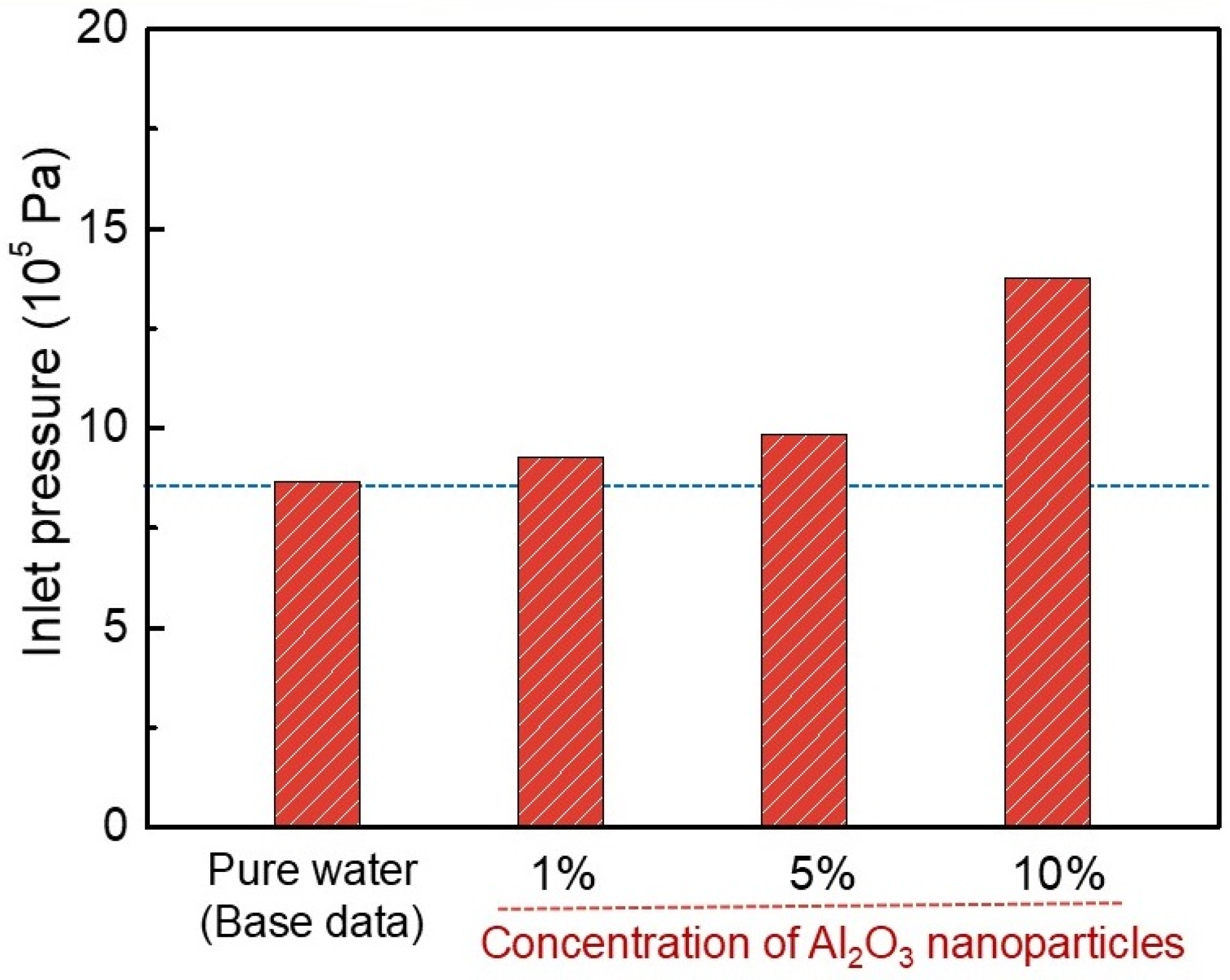
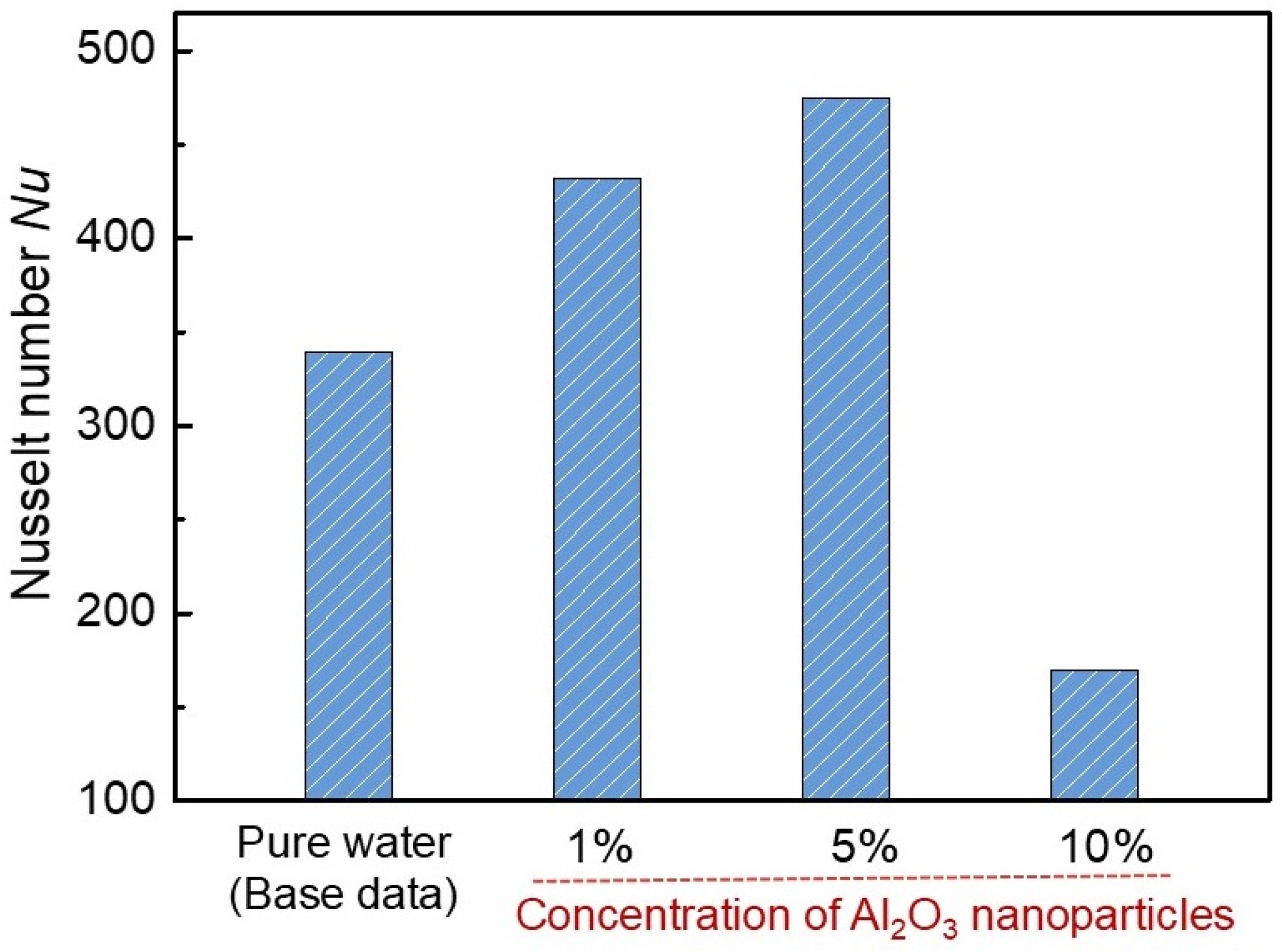
Quantitative analysis of flow parameters for different nanofluids (Figure 7 and Figure 8) demonstrates that the pressure drop of 10% Al2O3-H2O nanofluid is 75% higher than that of pure water, necessitating greater pump power to maintain the flow rate. In contrast, within the concentration range of 1% to 5%, the pressure increases moderately, making it more suitable for engineering applications. As the nanofluid concentration increased from 0 to 5%, the Nu increased synchronously and peaked at 470 at 5% concentration; when the concentration increased to 10%, the average Nu dropped sharply to 169, with deteriorated heat transfer performance. This drastic change can be attributed to two factors: the simplified assumptions adopted in the simulation and the inherent limitations of the nanofluid property model. Three rational simplifications are applied in this work: constant fluid properties (justified by small temperature fluctuations in the well), one-dimensional flow (axial flow predominates in long pipes), and neglected reservoir convection (heat transfer is dominated by conduction in tight formations). The sharp 64% decline in Nu at 10% concentration is mainly caused by the limitation of the adopted property model, which fails to fully describe particle agglomeration and excessive viscosity growth at high particle loadings. This deviation does not affect the reliability of our main conclusions, as the 10% concentration is not recommended for field use and our analysis focuses on the practical range of 0–5%. Considering both pressure drop and heat transfer characteristics, the 5% Al2O3-H2O nanofluid significantly enhances heat transfer while reducing pump power consumption, achieving a balance between flow and heat transfer. The study preliminarily indicates that the Al2O3-H2O nanofluid with a particle size of 10 nm and a concentration of 5% is the optimal fluid parameter for geothermal circulation.

3.2. Effect of Injection Rate on Heat Transfer

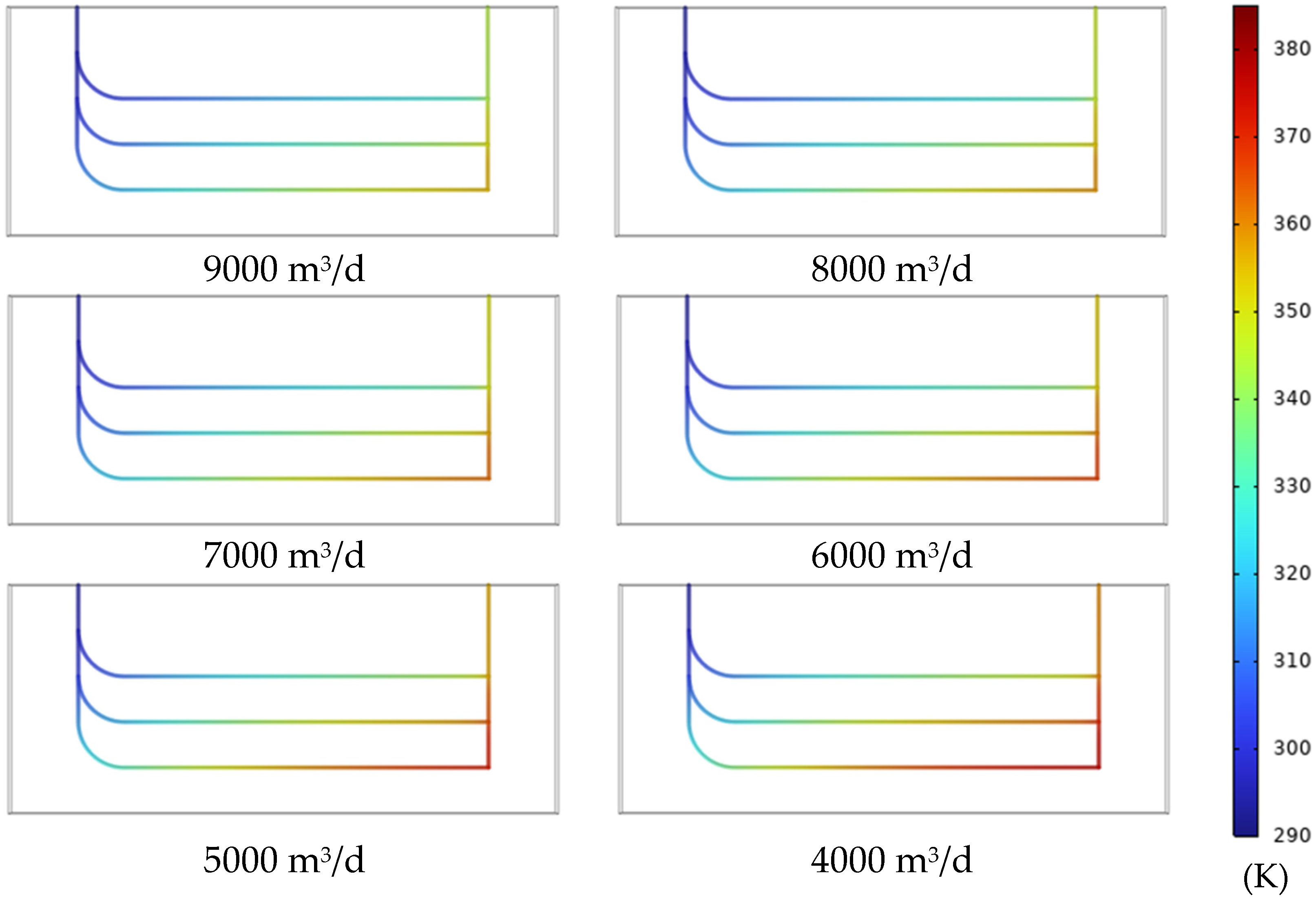
The flow rate optimization of nanofluids represents a critical aspect in geothermal system design. The injection flow rate directly influences fluid velocity and heat transfer duration in pipelines, while being intricately linked to pumping power consumption. We use Al2O3-H2O nanofluid with a concentration of 5% as the working fluid. Flow simulations were conducted for six injection flow rates ranging from 4000 to 9000 m3/d, with temperature distributions of wells presented in Figure 9. These injection flow rates are based on the actual working conditions of the Chaore R3-U1 well group in Daqing Oilfield, and the upper limit is appropriately increased in combination with system equipment redundancy and long-term production demand.
Table 4 listed Al2O3-H2O nanofluid inlet and outlet temperature and pressure. Simulation results demonstrate that decreasing the injection flow rate reduces fluid velocity in the horizontal well, prolonging heat transfer time and elevating the overall cross-sectional temperature of the pipeline, thereby increasing the outlet fluid temperature accordingly. However, reduced flow rates lead to a decrease in high-temperature fluid extraction per unit time, diminishing heat extraction efficiency; meanwhile, significant differences in pumping power exist across different flow rates.

3.3. Quantification of Heat Extraction

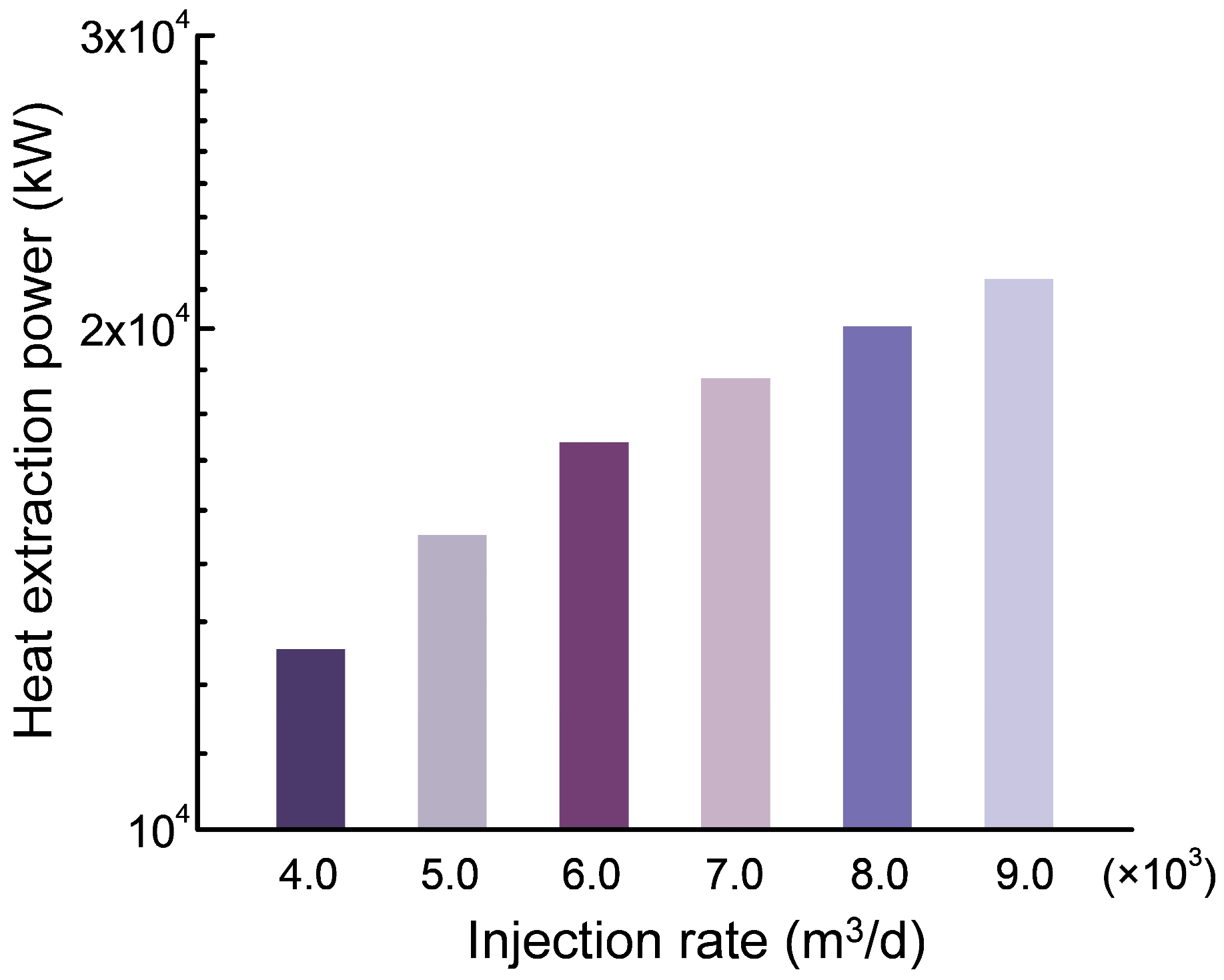
By calculating the heat extraction power, pumping power, and cyclic net heat power under varying flow rate conditions (using net heat power as the evaluation index for system heat extraction capacity), the optimal injection flow rate could be determined.
The heat extraction power is calculated by the following equation [41]:
P h e a t = q v · ρ · c p · T o u t T i n × 10 3
where P h e a t denotes the heat extraction power, kW; q v represents the injection rate, m3/s; T o u t signifies the fluid outlet temperature, K; and T i n indicates the fluid inlet temperature.
The pump extraction power can be calculated using the following equation [42]:
P   p u m p = q v · P i n P o u t × 10 3 η η m
where P   p u m p denotes the pump extraction power, kW; P o u t represents the fluid outlet pressure, Pa; P i n signifies the fluid inlet pressure, Pa; η denotes the pump efficiency (taken as η = 0.75); and η m indicates the motor efficiency (taken as η m = 0.92).
Consequently, the net cyclic heat extraction power is expressed as
P = P h e a t P   p u m p
where P denotes the net cyclic heat extraction power, kW.
The calculation results are shown in Table 5 below.
As shown in Figure 10, the heat extraction power of the U-shaped well exhibits a positive correlation with the injection flow rate. Although the heat transfer time between the fluid and the wellbore shortens under high-flow conditions, leading to a decrease in outlet temperature, the heat extraction amount per unit time significantly increases due to the velocity enhancement. Here, the flow velocity becomes the dominant factor affecting the heat extraction power. The system pump extraction power increases with the flow rate, but its proportion in the heat extraction power is only 0.16–1%, so its influence on the net cyclic heat power could be neglected.
Limited by the wear threshold of carbon steel pipes (according to API RP 14E and field experience, when the flow velocity exceeds 3 m/s, the annual wear amount is 1–2 mm under long-term circulation with low-concentration particle-laden fluids), when the injection flow rates are 5000 m3/d and 6000 m3/d, the corresponding maximum pipe velocities are 2.61 m/s and 3.13 m/s, respectively. Therefore, under the optimization objective of maximum net heat output subject to the pipe-velocity safety constraint, 5000 m3/d is selected as the safe flow threshold, and its net cyclic heat extraction power is 15,154.57 kW.
Under the same working conditions, the outlet temperature of water is 345 K, and the inlet pressure is 4.97 × 10⁵ Pa. The calculated heat extraction power is 12,525.83 kW, the pump extraction power is 33.29 kW, and the cyclic heat extraction power is 12,492.54 kW. Compared with pure water, the Al2O3-H2O nanofluid with a particle size of 10 nm and a concentration of 5% can increase the net cyclic heat extraction power by 21.31%.

3.4. Application in Geothermal Energy

Two key bottlenecks limiting U-shaped geothermal development are the ambiguous wellbore–fluid heat transfer mechanism and the inaccurate quantification of heat extraction performance. In this work, nanofluids are adopted to replace pure water as the circulating working fluid to reveal the coupled flow and heat transfer characteristics of the wellbore-nanofluid system under various flow parameters. The results demonstrate that appropriately concentrated nanofluids can effectively enhance the overall heat extraction performance of closed-loop U-shaped geothermal wells. The Chaore R3-U1 well group in Daqing Oilfield features abundant medium-deep geothermal resources within the depth of 2000–3000 m. This interval consists of stable tight thermal rocks and is technically feasible for U-shaped drilling. The implementation of Al2O3-based nanofluids in this well group can further promote the heat exchange between the wellbore and deep reservoirs. However, this research relies merely on simplified numerical simulations. The long-term dispersion stability of nanofluids under actual high-temperature downhole conditions remains unvalidated, and potential pipe wear and particle deposition during prolonged circulation are not fully considered; further laboratory tests and field trials are required to complement.

4. Conclusions

This work investigates the heat transfer performance of nanofluids in multi-branched horizontal U-shaped wells through finite element simulation. The numerical model exhibits an average outlet temperature error of 2.89%, providing a reliable model for heat transfer calculation in U-shaped wells. Comparative analyses of nanofluid types, particle concentrations, and injection rates show that Al2O3-H2O nanofluid with a particle size of 10 nm and a concentration of 5% demonstrates the optimal heat transfer performance. With the optimization objective defined as maximizing net heat output under the pipe-velocity safety constraint, and taking heat extraction power, pump consumption, and pipeline safety into comprehensive consideration, the optimal injection flow rate is determined to be 5000 m3/d. Under this injection flow rate, the net heat extraction efficiency is improved by 21.31% compared to pure water. This work confirms that nanofluids as circulating working fluids provide feasibility for realizing efficient and green geothermal exploitation.

Author Contributions

Methodology, J.W., S.G. and J.L.; Software, S.G.; Validation, Z.W.; Formal analysis, J.W.; Investigation, J.G.; Resources, J.G.; Data curation, J.G.; Writing—review & editing, J.W.; Project administration, S.W.; Funding acquisition, S.W. All authors have read and agreed to the published version of the manuscript.

Funding

This research was funded by the Fundamental research on enrichment theory and the green effective development of medium–high maturity continental shale oil (No. U24B6004), the Science and Technology Project of Hebei Education Department (BJ2025111), Tianjin Municipal Education Commission Scientific Research Program (2023KJ296) and the Key Laboratory of Ocean Energy Utilization and Energy Conservation (Dalian University of Technology), Ministry of Education (LOEC-202301).

Data Availability Statement

The original contributions presented in the study are included in the article, further inquiries can be directed to the corresponding author.

Conflicts of Interest

Authors Junhui Guo, Jingyi Wang, Shefeng Gu, Jing Li, and Zheng Wang were employed by the company Exploration and Development Research Institute of Daqing Oilfield Co., Ltd. The remaining author declare that the research was conducted in the absence of any commercial or financial relationships that could be construed as a potential conflict of interest.

References

  1. Sun, M.; Liu, T.; Wang, X.; Liu, T.; Li, M.; Chen, G.; Jiang, D. Roles of thermal energy storage technology for carbon neutrality. Carbon Neutrality 2023, 2, 12. [Google Scholar] [CrossRef]
  2. Tester, J.W.; Beckers, K.F.; Hawkins, A.J.; Lukawski, M.Z. The evolving role of geothermal energy for decarbonizing the United States. Energy Environ. Sci. 2021, 14, 6211–6241. [Google Scholar] [CrossRef]
  3. Sun, F.; Yao, Y.; Li, G. Literature review on a U-shaped closed loop geothermal energy development system. Energy Sources Part A Recovery Util. Environ. Eff. 2020, 42, 2794–2806. [Google Scholar]
  4. Shi, D.; Jing, Q.; Gao, T.; Zhang, D.; Xie, Y. Flow and heat transfer mechanism of U-shaped channel considering variable cross-section and rotating effects. Int. Commun. Heat Mass Transf. 2021, 129, 105701. [Google Scholar] [CrossRef]
  5. Piipponen, K.; Martinkauppi, A.; Korhonen, K.; Vallin, S.; Arola, T.; Bischoff, A.; Leppäharju, N. The deeper the better? A thermogeological analysis of medium-deep borehole heat exchangers in low-enthalpy crystalline rocks. Geotherm. Energy 2022, 10, 12. [Google Scholar] [CrossRef]
  6. Liu, J.; Wang, F.; Cai, W.; Wang, Z.; Li, C. Numerical investigation on the effects of geological parameters and layered subsurface on the thermal performance of medium-deep borehole heat exchanger. Renew. Energy 2020, 149, 384–399. [Google Scholar] [CrossRef]
  7. Rui, Z.; Xiao, Y.P. Study on the Effective Well Depth of Single U-Shaped Vertical Buried Pipes Based on Temperature Difference Analysis. ACS Omega 2023, 8, 24964–24979. [Google Scholar]
  8. Dong, X.; Xu, J.X.; Tianduoyi, W.; Chun, C.; Li, L.; Jianhong, L. Research on Design Method for Optimal Flow Rate of U-shaped Geothermal Well Based on Exergy Analysis. Energy Explor. Exploit. 2022, 40, 656–681. [Google Scholar]
  9. Heinze, T.; Hamidi, S.; Galvan, B. A dynamic heat transfer coefficient between fractured rock and flowing fluid. Geothermics 2017, 65, 10–16. [Google Scholar] [CrossRef]
  10. Shen, S.; Xu, J.; Zhou, J.; Chen, Y. Flow and heat transfer in microchannels with rough wall surface. Energy Convers. Manag. 2006, 47, 1311–1325. [Google Scholar] [CrossRef]
  11. Frank, S.; Heinze, T.; Pollak, S.; Wohnlich, S. Transient heat transfer processes in a single rock fracture at high flow rates. Geothermics 2021, 89, 101989. [Google Scholar] [CrossRef]
  12. Wang, T.; Xiao, D.; Wu, K.; Zhu, Q.; Chen, Z. Heat extraction evaluation of series/parallel U-shaped wells in middle-deep geothermal exploitation. Sustain. Energy Technol. Assess. 2025, 73, 104098. [Google Scholar] [CrossRef]
  13. Wenke, Z.; Kexun, W.; Chunmin, G.; Haiqing, Y.; Wenjing, L.; Yuxue, G.; Ping, C. Analysis and optimization of the performance for the ground source heat pump system with the middle-deep U-type well. Appl. Therm. Eng. 2023, 219, 119845. [Google Scholar]
  14. Guoying, W.; Hongwei, M.; Shaowei, L.; Dong, Y.; Xiaokai, X.; Mengxiong, F.; Housheng, J. Thermal power extraction from a deep, closed-loop, multi-level, multi-branch, U-shaped borehole heat exchanger geothermal system. Renew. Energy 2022, 198, 894–906. [Google Scholar]
  15. Youqiang, L.; Xiaohui, S.; Baojiang, S.; Zhiyuan, W.; Jintang, W.; Xuerui, W. Geothermal exploitation and electricity generation from multibranch U-shaped well–enhanced geothermal system. Renew. Energy 2021, 163, 2178–2189. [Google Scholar]
  16. Ma, Y.; Li, X.; Fu, X.; Li, S.; Zhang, L.; Liu, S.; Wang, T. Analysis of thermal production effect of multi-horizontal U-shaped well. Case Stud. Therm. Eng. 2024, 62, 105198. [Google Scholar] [CrossRef]
  17. Han, Y.; Tianfu, X.; Yilong, Y.; Bo, F.; Shuantong, S. Enhanced heat extraction performance from deep buried U-shaped well using the high-pressure jet grouting technology. Renew. Energy 2023, 202, 1377–1386. [Google Scholar]
  18. Li, X.; Chen, Z.; Huang, L.; Li, B.; Yan, J.; Zhang, P.; Liu, Z. Life cycle dynamic formation temperature response and thermal energy extraction of mine geothermal system considering groundwater flow. Int. J. Min. Sci. Technol. 2025, 35, 123456. [Google Scholar] [CrossRef]
  19. Dai, W.; Gang, S.; Song, W.; Hanshen, C. Simplified Heat Transfer Model for Spiral-Coil Energy Pile Groups and the Pile-Pile Thermal Interference. Energy Sci. Eng. 2025, 13, 456–463. [Google Scholar] [CrossRef]
  20. Aliyu, M.D.; Chen, H.-P. Sensitivity analysis of deep geothermal reservoir: Effect of reservoir parameters on production temperature. Energy 2017, 129, 101–113. [Google Scholar] [CrossRef]
  21. Zhang, L.; Wang, Y.; Ding, B.; Gu, J.; Ukrainczyk, N.; Cai, J. Development of geopolymer-based composites for geothermal energy applications. J. Clean. Prod. 2023, 419, 138202. [Google Scholar] [CrossRef]
  22. Denduluri, V.S.; Ulerio, G.; Genedy, M.; Juenger, M.; van Oort, E. Experimental investigation of geopolymers for application in high-temperature and geothermal well cementing. SPE Drill. Complet. 2023, 38, 433–443. [Google Scholar] [CrossRef]
  23. Tafavogh, M.; Zahedi, A. Design and production of a novel encapsulated nano phase change materials to improve thermal efficiency of a quintuple renewable geothermal/hydro/biomass/solar/wind hybrid system. Renew. Energy 2021, 169, 358–378. [Google Scholar] [CrossRef]
  24. Chappidi, S.; Kumar, A.; Singh, J. Geothermal energy extraction from abandoned oil and gas wells using mono and hybrid nanofluids. Geothermics 2023, 114, 102794. [Google Scholar] [CrossRef]
  25. Chang, F.L.; Hung, Y.M. The coupled effects of working fluid and solid wall on thermal performance of micro heat pipes. Int. J. Heat Mass Transf. 2014, 73, 76–87. [Google Scholar] [CrossRef]
  26. Liu, Z.; Li, H.; Sun, M.; Nie, C.; Wang, S.; Hu, C.; Tang, D.; Rao, Z. Polyvinyl alcohol-based phase change aerogel used for safety, thermal-comfortable, and quiet buildings. Energy 2025, 323, 135817. [Google Scholar] [CrossRef]
  27. Churchill, S.W. Comprehensive correlating equations for heat, mass and momentum transfer in fully developed flow in smooth tubes. Ind. Eng. Chem. Fundam. 1977, 16, 109–116. [Google Scholar] [CrossRef]
  28. Yang, X.; Yao, K. Uncertain partial differential equation with application to heat conduction. Fuzzy Optim. Decis. Mak. 2017, 16, 379–403. [Google Scholar] [CrossRef]
  29. Joshi, T.; Parkash, O.; Krishan, G. Estimation of energy consumption and transportation characteristics for slurry flow through a horizontal straight pipe using computational fluid dynamics. Phys. Fluids 2023, 35, 053302. [Google Scholar] [CrossRef]
  30. Li, H.; Sun, M.; Liu, Z.; Nie, C.; Hu, C.; Tang, D.; Rao, Z. Solid–liquid phase change materials meet hydrogels: Syntheses and multifunctional applications. J. Mater. Chem. A 2025, 13, 21245–21267. [Google Scholar] [CrossRef]
  31. Li, C.; Guan, Y.; Wang, X. Study on reasonable selection of insulation depth of the outlet section of vertical deep-buried U-bend tube heat exchanger. Energy Build. 2018, 167, 231–239. [Google Scholar] [CrossRef]
  32. Wang, C.; Rong, D.; Zhang, W.; Gong, B.; Wu, J. The flow and heat transfer performances of magnetic nanofluid in a duct in presence of magnetic fields with different direction. J. Mech. Sci. Technol. 2023, 37, 4899–4909. [Google Scholar] [CrossRef]
  33. Zong, Y.; Cang, D.; Jin, Y.; Wang, R. Characteristics of heat transfer for Al2O3-water two-phase fluids. In Proceedings of the International Technology and Innovation Conference 2009 (ITIC 2009), Xi’an, China, 12–14 October 2009; pp. 1–5. [Google Scholar]
  34. Zhang, X.; Yang, B.; Shi, Y.; Yu, X.; Ma, X. Stability, Thermophysical, Optical and Photothermal Properties of ZnO Nanofluids with Added Anionic/Cationic Mixed Surfactants. ECS J. Solid State Sci. Technol. 2024, 13, 053006. [Google Scholar] [CrossRef]
  35. He, Y.; Jin, Y.; Chen, H.; Ding, Y.; Cang, D.; Lu, H. Heat transfer and flow behaviour of aqueous suspensions of TiO2 nanoparticles (nanofluids) flowing upward through a vertical pipe. Int. J. Heat Mass Transf. 2007, 50, 2272–2281. [Google Scholar] [CrossRef]
  36. Li, J.; Zhai, H.; Shi, L.; Tan, N.; Zhang, Y.; Huang, C. Experimental analysis of convective boiling heat transfer and nanoparticle deposition effect of TiO2-H2O nanofluids in microchannels. Therm. Sci. Eng. Prog. 2024, 47, 102282. [Google Scholar] [CrossRef]
  37. Fu, R.; Hu, X.; Zhang, H.; Yan, Y.; Zhou, W.; Wang, J. Investigation of the influence of Fe3O4-water nanofluids on capillary performance in microgrooves wick. Appl. Therm. Eng. 2021, 182, 115899. [Google Scholar] [CrossRef]
  38. Li, X.F.; Zhu, D.S.; Wang, X.J.; Wang, N.; Gao, J.W.; Li, H. Thermal conductivity enhancement dependent pH and chemical surfactant for Cu-H2O nanofluids. Thermochim. Acta 2008, 469, 98–103. [Google Scholar] [CrossRef]
  39. Dong, J.; Zheng, Q.; Xiong, C.; Sun, E.; Chen, J. Experimental investigation and application of stability and thermal characteristics of SiO2-ethylene-glycol/water nanofluids. Int. J. Therm. Sci. 2022, 176, 107533. [Google Scholar] [CrossRef]
  40. Wang, J.; Zhai, Y. Application of BP neural network based on genetic algorithm optimization in thermal conductivity of nanofluids. Proc. IOP Conf. Ser. Mater. Sci. Eng. 2020, 721, 012031. [Google Scholar] [CrossRef]
  41. Yang, S.-Y.; Yeh, H.-D. Modeling heat extraction from hot dry rock in a multi-well system. Appl. Therm. Eng. 2009, 29, 1676–1681. [Google Scholar] [CrossRef]
  42. Strušnik, D.; Marčič, M.; Golob, M.; Hribernik, A.; Živić, M.; Avsec, J. Energy efficiency analysis of steam ejector and electric vacuum pump for a turbine condenser air extraction system based on supervised machine learning modelling. Appl. Energy 2016, 173, 386–405. [Google Scholar] [CrossRef]
Figure 1. Geometric diagram of parallel U-shaped wells in a thermal reservoir.
Energies 19 02706 g001
Figure 2. Grid independence verification: outlet water temperature with different grid numbers (black line); and relative deviation (blue line).
Energies 19 02706 g002
Figure 3. Validation of the numerical simulation: (a) comparison of experimental results from Li et al. [31] and simulated outlet temperatures; (b) comparison of outlet temperature errors.
Energies 19 02706 g003
Figure 4. Temperature distribution of nanofluids with different concentrations of Al2O3 inside the wells.
Energies 19 02706 g004
Figure 5. Pressure distribution of nanofluids with different concentrations of Al2O3 in the pipeline.
Energies 19 02706 g005
Figure 6. Nusselt number distribution of nanofluids with different concentrations of Al2O3 inside the wells.
Energies 19 02706 g006
Figure 7. Inlet pressure varies with the concentration of nanofluids (the blue horizontal line corresponds to the inlet pressure value of pure water).
Energies 19 02706 g007
Figure 8. The average Nusselt number (Nu) of horizontal wells varies with nanofluid concentration.
Energies 19 02706 g008
Figure 9. Temperature field distribution of nanofluids with different injection rates inside the wells.
Energies 19 02706 g009
Figure 10. Heat extraction power of nanofluids with different injection rates.
Energies 19 02706 g010
Table 1. Details of model parameters.
ParametersValues
Reservoir bottom temperature T s (K)393.15
Reservoir temperature gradient G (K/m)0.04
Reservoir density ρ s   (kg/m3)2300
Reservoir heat capacity c p , s (J/(kg∙K))800
Reservoir thermal conductivity k s (W/(m∙K))2.5
Thermal conductivity of casing k 2 (W/(m∙K))42.2
Pipe surface roughness e (mm)0.046
Table 2. Thermophysical properties of nanofluids.
TypeBase FluidReh
W/(m2∙K)
μ
(10−4 Pa∙s)
c p
J/(kg∙K)
Refs.
Al2O3water3000–80006000–80009.83.58[32,33]
ZnOwater2000–80005000–70006.24.13[34]
TiO2water800–2400750–12009.64.06[35,36]
Fe3O4water1600–20851700–19008.13.89[37]
Cuwater4500–85004000–72505.84.11[38]
SiO2EG/water1200–2000440–600353.14[39]
CuO-ZnOEG/water1500–20001500–3000133.73[40]
Table 3. Thermophysical properties of Al2O3-H2O nanofluids at different volume fractions [33].
Volume Fractions
%
Density
kg/m3
Specific Heat Capacity J/(kg∙K)Thermal Conductivity W/(m∙K)Viscosity
Pa∙s
0998.24182.000.6600.0001005
11027.954043.670.6930.0010000
51146.823575.860.9300.0013500
101295.413042.871.0400.0098000
Table 4. Al2O3-H2O nanofluid inlet and outlet temperature and pressure.
Injection Rate
(m3/d)
Inlet Temperature
(K)
Outlet Temperature
(K)
Inlet Pressure (105 Pa)Outlet Pressure (105 Pa)
9000293.15343.8115.21.01
8000293.15346.7812.31.01
7000293.15350.039.71.01
6000293.15353.527.521.01
5000293.15357.175.611.01
4000293.15360.714.031.01
Table 5. Heat extraction capacity of Al2O3-H2O nanofluid.
Injection Rate
(m3/d)
Heat Extraction Power
(kW)
Pump Extraction Power (kW)Net Heat Output (kW)Pump Extraction Power Ratio (%)
900021,640.6214.221,426.41.00
800020,363.9151.520,212.30.75
700018,898.2102.018,796.10.54
600017,192.365.517,126.80.38
500015,193.238.615,154.60.25
400012,826.620.312,806.30.16
Disclaimer/Publisher’s Note: The statements, opinions and data contained in all publications are solely those of the individual author(s) and contributor(s) and not of MDPI and/or the editor(s). MDPI and/or the editor(s) disclaim responsibility for any injury to people or property resulting from any ideas, methods, instructions or products referred to in the content.