Article

Energy Efficiency and Disinfection Performance of Plasma-Pulse Water Treatment by High-Voltage Underwater Spark Discharge

by
Kulzhan M. Shaimerdenova
1,2,
Nazgul K. Tanasheva
1,2,*,
Saule E. Sakipova
1,2,
Saniya E. Suleimenova
1,2,
Akerke Rakhmankyzy
1,2,
Nurgul N. Shuyushbayeva
3,
Ingkar E. Aldabergen
4,
Aizhan K. Salkeyeva
4 and
Arailym D. Bozayeva
3
1
Department of Engineering Thermophysics, E.A. Buketov Karaganda National Research University, Karaganda 100024, Kazakhstan
2
Scientific Research Center “Alternative Energy”, E.A. Buketov Karaganda National Research University, Karaganda 100024, Kazakhstan
3
Department of Mathematics, Physics and Computer Science, Sh. Ualikhanov Kokshetau University, Kokshetau 020000, Kazakhstan
4
Department of Physics, Abylkas Saginov Karaganda Technical University, Karaganda 100027, Kazakhstan
*
Author to whom correspondence should be addressed.
Energies 2026, 19(11), 2647; https://doi.org/10.3390/en19112647
Submission received: 31 March 2026 / Revised: 19 May 2026 / Accepted: 26 May 2026 / Published: 30 May 2026
(This article belongs to the Section B: Energy and Environment)

Abstract

Plasma-pulse water treatment using a high-voltage underwater spark discharge is a reagent-free approach with potential for simultaneous disinfection and physicochemical modification of water. In this study, a laboratory-scale recirculating reactor (Vtot = 10 L) equipped with a storage capacitor of C = 0.25 μF was operated at U = 15–30 kV and a pulse repetition frequency of about 1.8 Hz to evaluate disinfection performance and system-level energy characteristics for two water matrices, surface wastewater and tap water. The corresponding calculated capacitor-stored energy ranged from 28.1 to 112.5 J per pulse. Microbiological and physicochemical measurements were performed in triplicate. At U = 30 kV, the total microbial count in wastewater decreased from approximately 1 × 10⁵ CFU/mL to below the method detection limit (LOD = 1 CFU/mL) within 2–3 min. For the 2 min/10 L operating mode, the system-level specific energy input was estimated at 6.7 kWh/m3. During the initial treatment period, temperature-compensated conductivity (σ25) decreased by 3–8%, depending on the water matrix, and then increased with prolonged treatment. These results show that the tested reactor can provide rapid reagent-free reduction in culturable microflora under the studied conditions. However, plasma-pulse treatment should be regarded primarily as an advanced treatment, polishing, or pre-treatment option for complex water matrices rather than as a universal replacement for conventional large-volume disinfection technologies.

1. Introduction

Wastewater treatment and disinfection are among the most important environmental tasks required to protect ecosystems and public health, as well as to ensure the safe reuse of treated water [1]. Industrial wastewater usually contains a wide range of pollutants that require effective treatment before discharge. Conventional methods such as sedimentation, filtration, chemical treatment, and chlorination [2] often fail to completely remove persistent organic compounds and pathogenic microorganisms. Consequently, recent research has increasingly focused on innovative reagent-free water treatment technologies, including plasma and plasma pulses [3,4].
One reagent-free approach involves the use of high-voltage pulsed electrical discharges in water to generate non-thermal plasma and shock-wave/cavitation effects directly in the aqueous medium [5]. This non-thermal plasma can effectively decompose persistent organic pollutants and promote their biodegradation through the formation of reactive species [6]. The pulsed discharge method provides significant pollutant reduction without the addition of chemical reagents, making it an environmentally friendly solution for both drinking water and wastewater treatment [7]. Recent studies have also shown that the energy efficiency of plasma water treatment strongly depends on reactor hydrodynamics and the use of post-discharge reactions; in particular, liquid-flow control and intermittent discharge operation were reported to increase the energy efficiency of plasma treatment by approximately 3.5 times [8].
Despite the well-recognized physicochemical activity of plasma discharges and their ability to generate highly reactive species—such as the hydroxyl radical •OH, atomic hydrogen H• and atomic oxygen O•, as well as hydrogen peroxide H2O2, ozone O3, and, in the presence of air, reactive nitrogen-containing species (e.g., NO2 and NO3) and other reactive species—there are still insufficient data on the optimal discharge parameters that ensure maximum disinfection efficiency at minimal energy consumption [5,9]. It should be emphasized that the mechanical contribution (cavitation and shock wave) may play a key role in cell inactivation, whereas chemical pathways involving •OH, H2O2, O3, and RNS may contribute to biomolecular damage and organic-matter transformation; therefore, a clear distinction between the energy-transfer pathways “pulse → water → effect” is critical for comparison with other methods.
These plasma processes belong to the category of advanced oxidation processes (AOPs), which effectively degrade organic pollutants and inactivate pathogenic microorganisms in water [10,11]. Studies show that different types of discharges exhibit different treatment efficiencies [12,13]. For example, Dang et al. [9] demonstrated that pulsed corona discharges above water provide the highest rate of phenol decomposition, followed by spark discharges in water, whereas streamer (non-arc) discharges are the least effective.
Studies have shown that shock waves generated by underwater electrical discharges effectively reduce bacterial viability [14,15]. For example, Loske et al. [14] demonstrated a significant bactericidal effect of underwater shock waves, in which the number of Escherichia coli and other bacteria decreased with increasing numbers of shock pulses and cavitation intensity. In particular, after 350 successful shock-wave pulses, the viability of E. coli decreased by 4.06 log10. Their analysis showed that bacterial death occurred mainly due to the mechanical action of shock waves [14]. More recent experiments confirmed that underwater pulsed discharges at 50 kV can completely inactivate E. coli in water [16]. In addition to microbiological disinfection, powerful pulsed discharges are also applied in related fields such as rock fragmentation and well cleaning. For example, Chang et al. demonstrated that shock waves generated by spark discharges effectively remove deposits in wells, resulting in a 2.9-fold increase in pressure and visual confirmation of nearly complete removal of deposits from well screens [17].
Cavitation effects in pulsed-plasma water treatment are also strongly influenced by hydrodynamic and thermodynamic conditions. Ge et al. [18] showed that cavitation performance in a Venturi-type reactor can be affected by thermodynamic suppression, which is important for process intensification and reactor optimization. Although the present study deals with discharge-induced cavitation rather than purely hydrodynamic cavitation, these findings indicate that treatment efficiency depends not only on the nominal pulse energy but also on flow regime, bubble dynamics, and reactor geometry.
The literature shows growing interest in electrical-discharge methods for water treatment. Locke and co-workers have emphasized the potential of plasma pulses and plasma systems for water treatment. Recent reviews confirm that pulsed electrochemical technologies (P-ETs) can significantly improve wastewater treatment efficiency while simultaneously reducing energy consumption [12]. In [19], a systematic classification of P-ET technologies, including pulsed discharges, is presented as a means of improving wastewater treatment. Kyere-Yeboah and co-workers reported that non-thermal plasma is an effective alternative for the decomposition of persistent pollutants through the in situ generation of reactive species [7]. Moreover, combining plasma discharge with catalysts, such as the addition of H2O2 and Fe2+ ions to water, can significantly increase the degradation rate of organic pollutants through the Fenton effect, which substantially enhances the generation of •OH radicals. For example, Jiang et al. demonstrated the effectiveness of γ-Al2O3 modified with Fe and Cu ions for the degradation of persistent pollutants in petrochemical wastewater, confirming the potential of AOP-based methods for industrial water treatment [20]. Chen and co-workers presented an Fe3O4/SrBi2Ta2O9 nanocomposite that provides effective degradation of antibiotics under milling in an aqueous medium, demonstrating new approaches to the removal of pharmaceutical contaminants [21].
Despite significant progress, questions remain regarding the optimization of pulsed discharge parameters, including voltage, energy, pulse duration, and electrode geometry and material, in order to achieve maximum treatment efficiency at minimum energy cost [22]. At the same time, recent reviews emphasize that the scale-up of non-thermal plasma systems for water and wastewater treatment remains limited by the need to optimize energy consumption, maintain treatment performance in complex water matrices, and adapt reactor design for pilot- and field-scale operation [23]. Several discharge formation regimes in liquids are known, ranging from corona and streamer to spark and arc discharge [9]. To control a strong shock effect, short pulse duration and high instantaneous power are preferred, which can be achieved through a specially designed discharge circuit [24]. Moreover, Yutkin proposed the use of discharge through an air gap to generate a powerful shock wave, known as the classical electrohydraulic effect [25].
The scientific novelty of this study lies in the integrated assessment of a recirculating electrohydraulic-pulse water-treatment system by linking discharge operating conditions with microbial inactivation, conductivity evolution, pulse-dose exposure, and system-level energy demand. In contrast to studies focused mainly on separate microbiological or physicochemical effects [26,27], this work evaluates the coupled response of wastewater and tap water to high-voltage underwater spark discharge in a 10 L recirculating reactor with a reflector-type electrode configuration.
The objective of this study was to evaluate the disinfection performance and energy efficiency of a recirculating plasma-pulse reactor based on an underwater spark discharge. We hypothesized that increasing the discharge energy level would shorten the time required to reduce the total microbial count to the detection limit, whereas the specific electrical conductivity would exhibit a non-monotonic response because of the competing effects of ion removal/precipitation and plasma-chemical formation of dissolved species. Under the experimental conditions used here, the analysis focused on the combined effect of charging voltage, interelectrode gap, and treatment time at a fixed storage capacitance of 0.25 μF.

2. Materials and Methods

2.1. Reactor Configuration and Operating Principle

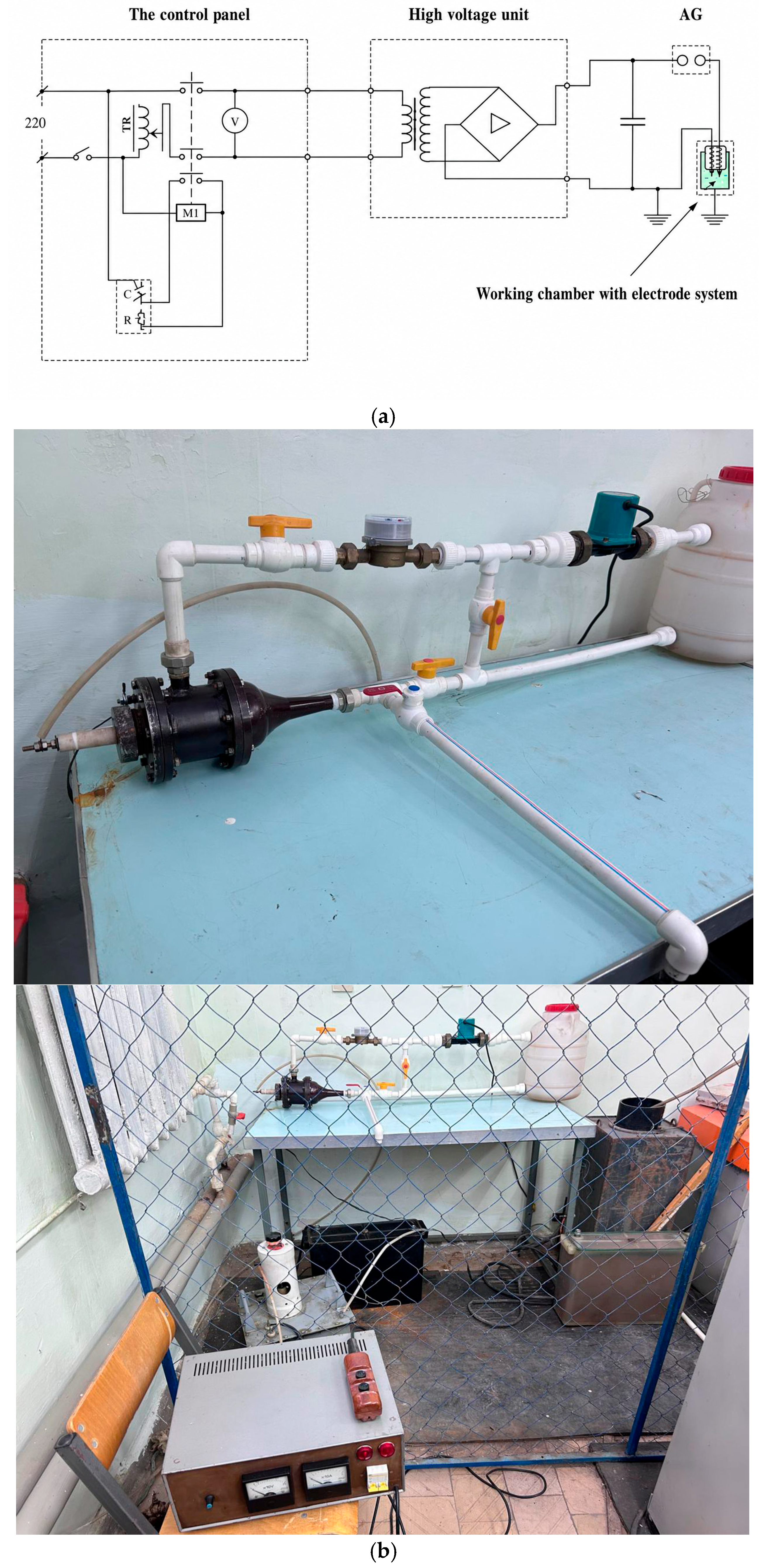
For plasma-pulse water treatment, a laboratory-scale plasma-pulse system based on the electrohydraulic effect was developed [28,29]. The schematic electrical diagram and a photograph of the system are shown in Figure 1. The system includes a high-voltage pulse generator connected to a discharge-electrode assembly with a spark gap, and a working chamber containing the liquid to be treated.
The process begins with charging the capacitor bank to the required voltage. Subsequently, the spark gap is triggered, and the energy stored in the capacitor is discharged through the main discharge gap between the electrodes immersed in water. This process takes several microseconds. A short high-amplitude current pulse (several tens of kA) causes the formation of a plasma discharge channel in the water. A high-temperature vapor–gas mixture forms around the channel, expands, and generates a shock wave in the liquid. After each pulse, the capacitor is recharged, and the discharges are generated at a certain frequency, limited by the power of the supply source and the capacitor charging time.
The spark-gap configuration ensures a stable spark discharge and short pulses. By varying the distance between the electrodes of the discharge electrode, it is possible to regulate the breakdown threshold voltage, the pulse shape, and the discharge characteristics in the liquid within the working gap. The presence of a spark gap makes it possible to generate pulses with a steep front, preventing transition to a prolonged arc and reducing the discharge duration. This significantly enhances the shock effect even in conductive liquids, where, without a spark-gap generator, the discharge would be weak.
The application of a high-voltage pulse to pointed electrodes immersed in water leads to the formation of discharge plasma at their tips. Non-equilibrium plasma is generated by a pulsed electrical discharge with a pulse duration of several hundred nanoseconds. The pulsed nature of energy transfer limits thermal effects, thereby contributing to improved energy efficiency. The discharge forms non-thermal plasma with high reactivity.
Using this approach and the laboratory test bench, a structural diagram of the plasma-pulse system for water-treatment and disinfection studies was developed, as shown in Figure 2.
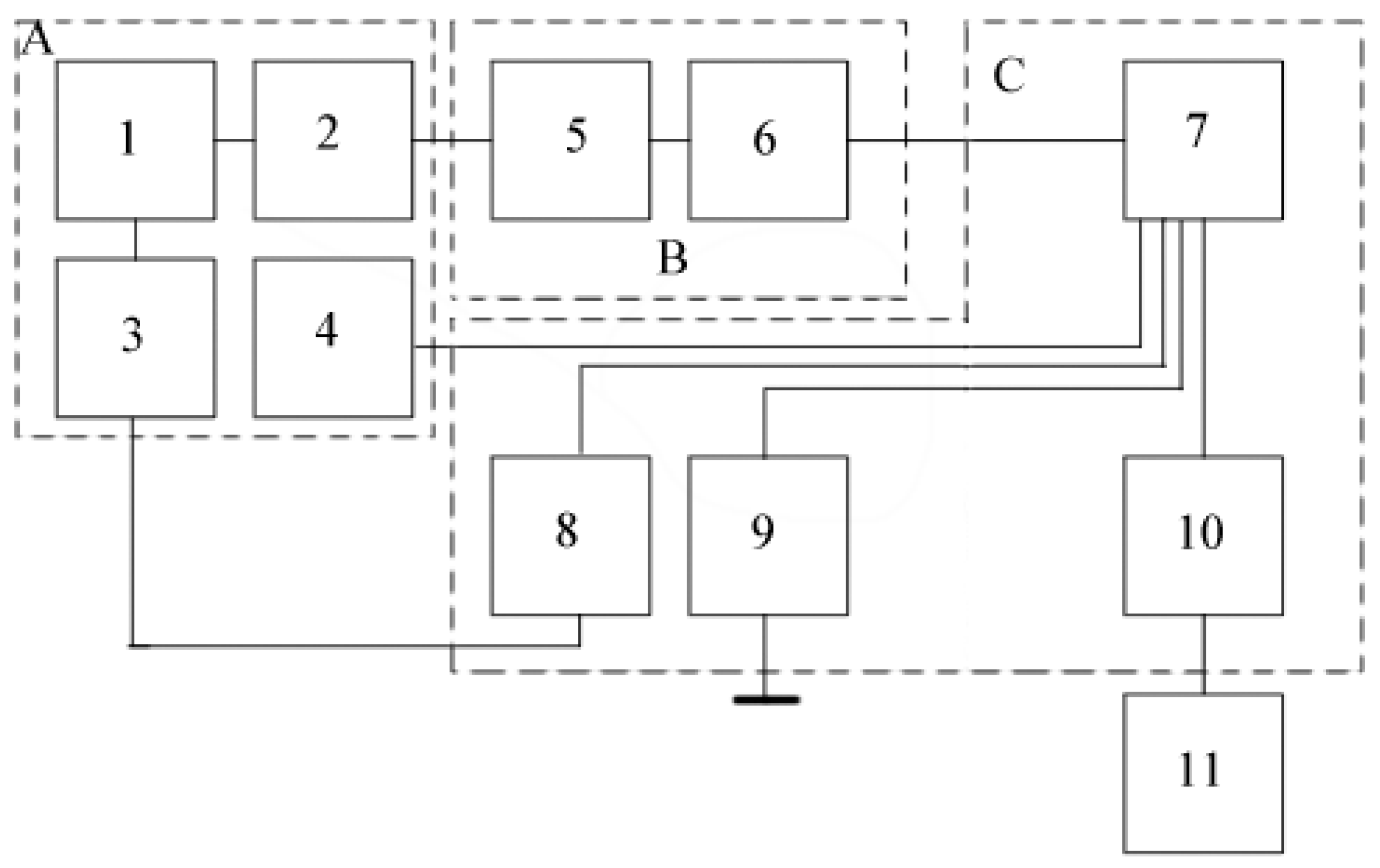
The experimental setup consists of the following main components (Figure 2): (A) control panel; (B) pulse current generator with a spark-gap switch; and (C) energy storage unit with a protection system.
The capacitor (pulse-type, high-voltage) is charged from the 220 V mains through a step-up transformer (5) and a rectifier (6) to the required voltage. The charging circuit includes current-limiting elements (2) and an emergency shutdown system (3) to ensure safety and reliability. The charge stored in the capacitor is discharged through the discharge electrode (10) into the working chamber (11) containing the treated water and immersed electrodes (Figure 3).
In the experiments, an electrode system based on a steel positive electrode and a second reflector electrode was used. The positive electrode was fabricated as a rod (a stud with a threaded section for mounting), and its working end was tapered to a diameter of 2 mm. The radius of curvature at the tip was 1 mm. This electrode geometry provided a local concentration of the electric field in the discharge gap region and promoted reproducible initiation of the pulsed discharge in the liquid medium. The second electrode simultaneously served as the counter-electrode and as a reflector of the shock-acoustic effect; the working-surface diameter was 33 mm. The interelectrode gap between the tip of the positive electrode and the surface of the second electrode was set with an accuracy of 1 mm.
The electrical connection scheme was as follows: the positive electrode was connected to the output of the high-voltage generator using a high-voltage cable, whereas the second electrode was connected to ground and to the negative terminal of the system. Charging of the storage capacitor was carried out through a step-up transformer and a diode bridge; pulse switching was provided by a forming air spark gap, after the breakdown of which the energy was transferred to the working cell, where a discharge occurred between the positive and negative electrodes.
The power supply unit (1) supplies power to the system, converting the standard 220 V input into the required operating voltage. The high-voltage indicator (4) displays the voltage level in the system, warning the operator of high values. The energy storage unit (7) is charged through the transformer and rectifier and accumulates the energy that is then used to generate pulsed discharges. The protection system (8) prevents overloads and short circuits, while the residual voltage discharge system (9) ensures safety after each pulse (Figure 2).
In this study, a special parabolic reflector made of stainless steel was used in the working chamber; it simultaneously served as the second electrode and focused acoustic shock waves at a specific point in the liquid. This enabled a directed shock-wave effect within the treated-water volume, increasing the local pressure. The distance between the tip of the central electrode and the reflector (interelectrode gap l) could be mechanically adjusted within a range from fractions of a millimeter to several millimeters. For the series of experiments described below, the distance between the electrodes was varied from 5 mm to 10 mm.
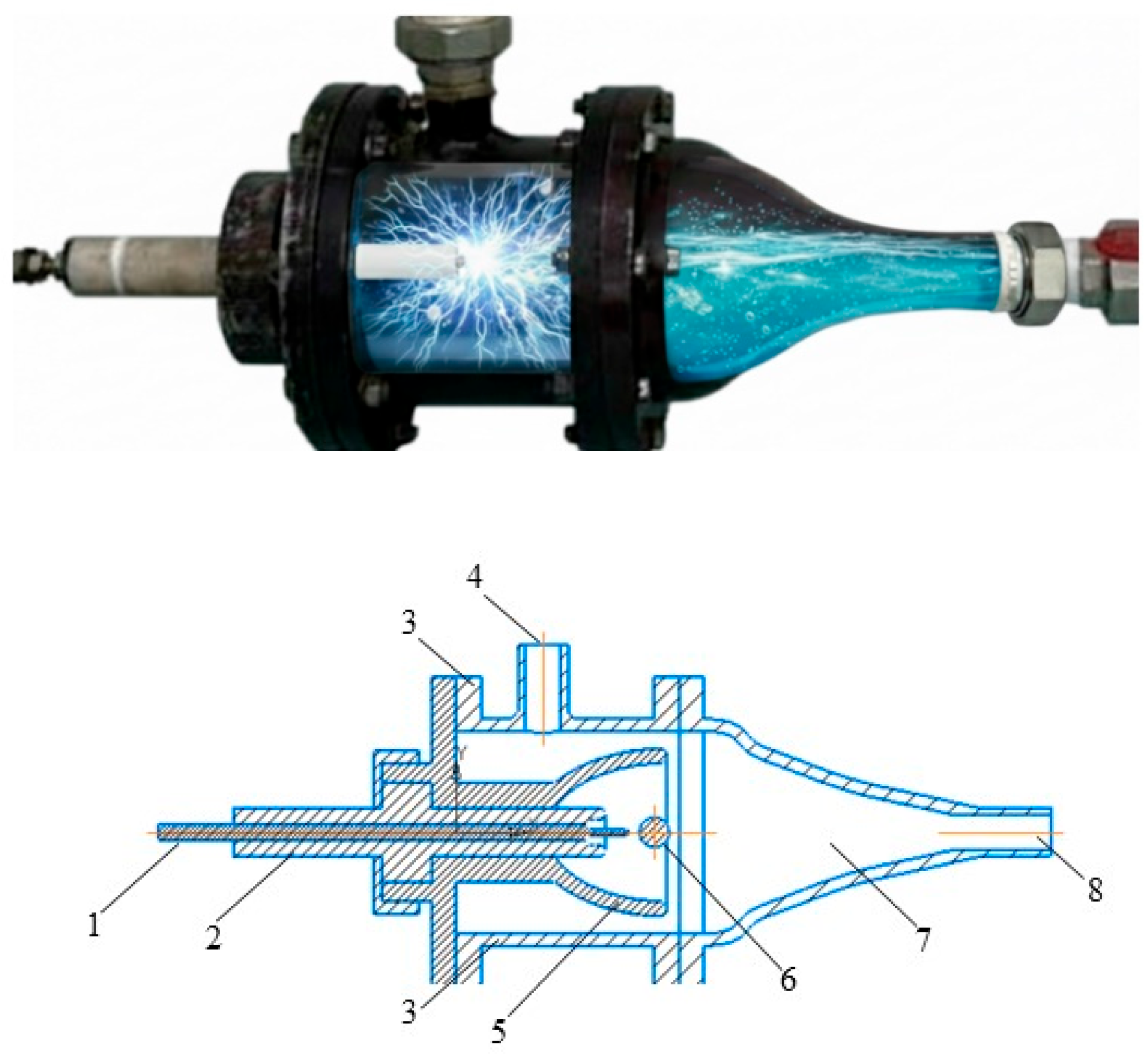
The core component of the system is the high-voltage unit (Figure 3), in the housing of which the electrode systems connected to the electrohydraulic device are mounted.
The process of reagent-free plasma-pulse water treatment in the high-voltage cell is as follows (Figure 3): the feed water is supplied to the treatment chamber (4), where it passes between the positive (1) and negative (6) electrodes, which create a high-voltage pulsed electrical discharge. This discharge can generate non-equilibrium plasma and reactive species, which may contribute to organic-matter transformation and microbial inactivation together with mechanical effects. The housing of the high-voltage element (3) and the insulator (2) provide electrical insulation, tight sealing, and stable operation of the system, while the reflector (5) enhances the electric field in the discharge zone in order to improve treatment efficiency. The cellular diffuser (7) optimizes the flow hydrodynamics, increasing the interaction time between the water and the plasma-forming discharges. After passing through the discharge zone, the treated water is discharged through the outlet (8), with a reduced contaminant load and lower microbiological burden. Overall, this method provides effective water treatment through the action of high-voltage discharges and the generated reactive species without the use of chemical additives.
Table 1 presents the technical characteristics of the plasma-pulse system.
The liquid volume of the high-voltage cell, Vcell, was 1 L, while the total volume of treated water in the recirculation loop was Vtot = 10 L. Water was pumped through the cell at a flow rate of Q = 60 L min−1, which corresponds to a nominal hydraulic residence time in the high-voltage cell of τcell = Vcell/Q = 1 L/60 L min−1 = 0.0167 min, or approximately 1.0 s per pass. The full-loop circulation time was τloop = Vtot/Q = 10 L/60 L min−1 = 0.167 min, or approximately 10 s. The nominal hydraulic and pulse-dose parameters of the system are summarized in Table 2.
The number of passes through the high-voltage cell during one experiment was calculated as Npass = ttreat·Q/Vtot. For the 2 min treatment mode, the water passed through the cell approximately 12 times. At a pulse repetition frequency of approximately 1.8 Hz, this corresponds to approximately 216 pulses and a nominal pulse dose of 21.6 pulses L−1. A steel electrode was used as the electrode material in the experiments.

2.2. Water Matrices and Initial Characteristics

The experiments were carried out on wastewater samples containing indigenous microflora. The volume of treated water in the working chamber was 1 L. To evaluate treatment efficiency, two types of water were used: wastewater and tap water. Their main initial characteristics are presented in Table 3.

2.3. Experimental Procedure

The electrical characteristics of the investigated operating regimes were evaluated from the preset operating parameters, namely, the charging voltage U, the storage capacitance C, the pulse repetition frequency, and the treatment time. To quantitatively characterize the energy level of the regime, the calculated energy stored in the capacitor before discharge was used. Current in the system power-supply circuit was monitored using an E8030-M1 analog panel electromagnetic ammeter of accuracy class 2.5, designed for operation in alternating-current circuits with nominal frequencies of 50 and 180–550 Hz.
Conductivity measurements were carried out with temperature compensation enabled, with the results normalized to 25 °C.
Conductivity and pH measurements were performed using standard laboratory methods with a conductivity meter equipped with temperature compensation and a pH meter, with measurement ranges of 0–2000 μS/cm (±3%) and pH 2–12 (±0.05 pH units), respectively. All experiments were carried out in triplicate (n = 3), and the results are presented as mean values with standard deviation (±SD). Statistical analysis was performed using the t-test with a significance level of p < 0.05. Samples were stored on ice at 4 °C until analysis and were processed within 4 h after collection to prevent microbial growth and changes in physicochemical properties. Water conductivity was measured using a Mark-602 laboratory conductivity meter to assess the degree of water mineralization. A TDS meter was used as an auxiliary instrument to measure the total dissolved solids of the water before and after treatment.
The experiments were performed at different values of the interelectrode gap l (5–10 mm) and different charging voltages U (from 15 to 30 kV) at a constant capacitance of C = 0.25 μF. Each experiment included 108–540 pulsed discharges, depending on the treatment time, with a repetition frequency of approximately 1.8 Hz. The treatment time for each sample was controlled within the range of 1 to 5 min. After treatment, water samples were taken again for microbiological analysis and conductivity measurements.
For safety purposes, the experimenters strictly followed precautionary measures: the system was equipped with a protective interlock for operation with the door open (safety key), all high-voltage parts were shielded and grounded, and the discharges were initiated by the operator from a safe distance. After each discharge series, a pause was made to allow the water to cool, since the arc phase of the discharge could slightly increase the sample temperature.

2.4. Microbiological Analysis

To assess microbiological indicators, analyses of the initial and treated samples were carried out using standardized methods in an accredited sanitary-microbiological laboratory [30].
The total microbial count (TMC, CFU/mL) was determined by the heterotrophic plate count (HPC) method according to Standard Methods 9215B [31], using Nutrient Agar, incubation at 35 °C for 48 h, and serial dilution of samples at 10-1, 10-2, and 10-3. The limit of detection (LOD) for the colony-forming unit count method was calculated from the total volume of the undiluted sample inoculated onto the culture media (1):
LOD (CFU/mL) = 1/Vtotal,
where Vtotal is the total volume of the undiluted sample analyzed, in mL. Values below the LOD were recorded as “<LOD”.
To quantitatively describe microbial inactivation, the log-reduction value (LRV) was calculated as follows [32]:
LRV = log10(N0/Nt),
where N0 is the initial microbial concentration and Nt is the microbial concentration after treatment.
For samples in which the microbial count was below the method detection limit, Nt was conservatively assigned as LOD = 1 CFU/mL. To describe microbial inactivation, a first-order log-linear approximation was applied:
LRV(t) = log10(N0/Nt) = kapp·t
where kapp is the apparent inactivation rate constant, expressed in log10 min−1, and t is the treatment time in minutes. Accordingly, kapp was estimated as follows:
kapp = LRV/t
In addition, pulse-dose-based inactivation was expressed as follows:
LRV(Np) = kN·Np
where Np is the number of pulses and kN is the apparent pulse-dose inactivation coefficient. Since several final microbial counts reached the method detection limit, the calculated LRV, kapp, and kN values were interpreted as conservative lower-bound estimates. For more detailed future modelling, a Weibull-type model may be used to describe non-linear inactivation curves, shoulders, or tailing caused by heterogeneous microbial resistance.
For each sample, 0.1 mL of the undiluted sample was plated onto 10 Petri dishes; the total analyzed volume was 1.0 mL, corresponding to an LOD of 1 CFU/mL.
For chemical analysis of water, a UNICO-2800 laboratory spectrophotometer (UV/visible range) was used. The chemical oxygen demand (COD) was determined by the colorimetric method in accordance with Standard Methods 5220D [33], taking possible chloride interference into account. The UV254 parameter was determined according to Standard Methods 5910B [34] at a wavelength of 254 nm after preliminary filtration of the sample through a 0.45 μm membrane filter; measurements were performed in a quartz cuvette with an optical path length of 1 cm. The concentration of ammonium nitrogen was determined by the photometric phenate method according to Standard Methods 4500-NH3 G [35] at a wavelength of 630–660 nm. The results were expressed in mg/L, and the analysis was performed in at least two parallel determinations.
Removal or transformation efficiency for each chemical indicator was calculated as follows [36]:
R = [(C0 − Ct)/C0] × 100%,
where C0 and Ct are the initial and post-treatment values of the corresponding parameter, respectively. When replicate measurements were available, the results were expressed as mean ± standard deviation (SD), and the difference between untreated and treated samples was evaluated at p < 0.05. COD, color, A254, and NH4+ were used as screening indicators of organic-matter transformation, chromophore degradation, UV-absorbing organic structures, and ammonium conversion, respectively. Since TOC, full UV–Vis spectra, NO2−/NO3−, and total nitrogen were not measured in the present work, the chemical data were interpreted as indicative water-quality changes rather than as a complete carbon or nitrogen mass balance.
During plasma-pulse treatment, the water was circulated through the working chamber by a pump to ensure uniform treatment of the entire volume.

2.5. Energy Assessment

The energy stored in the capacitor was calculated using Equation (7):
E = C U 2 2
The pulsed system can operate in different energy regimes determined by the combination of charging voltage and the capacitance of the energy storage unit.
To evaluate the energy efficiency of the plasma-pulse electrical discharge system, the consumed electrical energy was measured and normalized to the volume of the aqueous solution.
The total electrical energy consumed during one treatment cycle is calculated as follows (8):
Etotal = P·t
The specific energy input for the treatment of 1 m3 (SEI—specific energy input) is determined as follows (9):
S E I = E t o t a l V
To evaluate the efficiency of microbiological inactivation, the EEO (electrical energy per order) parameter is used; it expresses the amount of energy required for each logarithmic reduction in the number of microorganisms (10):
E E O   =   S E I Δ l o g 10
In this study, a distinction was made between capacitor-stored energy, wall-input energy, and delivered discharge energy. The capacitor energy was calculated as Ec = 0.5 CU2, whereas SEI and EEO were estimated from the system-level wall-input energy, Ewall = Pavg·t. Thus, the reported energy metrics characterize the practical electrical demand of the tested system. Since synchronized voltage–current waveforms were not recorded, the actual energy delivered to the discharge channel and liquid, Edel = ∫u(t)i(t)dt, as well as its partitioning into plasma formation, Joule heating, shock waves, cavitation, and thermal losses, could not be quantified.

2.6. Mechanisms of Reactive Species Formation During Plasma Water Treatment

Non-thermal plasma (NTP) has become a promising advanced oxidation technology for water treatment due to its ability to generate a rich mixture of reactive species directly in water without the need for external chemical additives. Unlike conventional disinfection and treatment methods, NTP produces highly reactive oxygen and nitrogen species (ROS/RNS) at near-ambient temperatures, enabling effective decomposition of organic pollutants and inactivation of microorganisms through oxidative and chemical pathways.
Formation of hydroxyl radicals (•OH):
Electron excitation and dissociation of water molecules lead to the formation of the most reactive radicals [37]:
H2O + e → •OH + H•
Formation of hydrogen peroxide (H2O2):
Hydroxyl radicals can recombine to form hydrogen peroxide, a reactive oxygen species that can contribute to further disinfection and oxidation [38]:
2 •OH → H2O2
Ozone formation:
Ozone (O3) is another important species generated during plasma discharge and is highly effective in microbial inactivation [39]:
O2 + O• → O3
Shock waves and cavitation:
Shock waves and cavitation generated by underwater pulsed discharges may contribute to mechanical stress on microbial cells, while plasma-induced reactive species may contribute to oxidative damage. This process can be schematically represented as follows [40]:
Microorganism + shock wave/cavitation → disrupted cell structure
The observed microbial inactivation is consistent with the combined contribution of shock waves, cavitation, and plasma-induced reactive species; however, the individual mechanical and chemical contributions were not quantified in this study. Their separation requires radical-scavenger tests, reactive-species measurements, and time-resolved voltage–current diagnostics.

3. Results and Discussion

3.1. Optimization of Discharge Parameters

To optimize the treatment process in our system, experiments were carried out in which the energy stored in the capacitor and the interelectrode distance were varied while maintaining a constant capacitance. In these experiments, the water samples described above served as the working medium and were subjected to electrohydraulic treatment at different values of the interelectrode gap. The following parameter ranges were varied in the experiments: voltage U = 15–30 kV, capacitance C = 0.25 μF, and interelectrode gap l = 5–10 mm.
The calculated pulse energy E values are presented in Table 4. Because the interelectrode gap and charging voltage were increased simultaneously in this experimental series, the present dataset does not allow the independent effects of gap length and voltage to be separated. Therefore, the observed trends should be interpreted cautiously, because the larger gap coincided with a higher charging voltage and hence a higher stored energy.
The faster inactivation observed at higher-voltage/larger-gap regimes should be interpreted as the effect of a combined high-intensity operating condition.
Based on the classification of electrohydraulic pulse regimes proposed by Yutkin, the following operating regimes can be distinguished:
High-energy regime (U ≥ 50 kV, C ≤ 0.1 μF): a short current pulse (<10 μs) is generated with maximum pressure amplitude and shock-wave intensity.
Medium-energy regime (U = 20–50 kV, C = 0.1–1 μF): provides a moderate shock effect at a higher pulse energy.
Low-energy regime (U < 20 kV, C > 1 μF): is characterized by a longer pulse (>10 μs) with the development of an arc phase, a weaker shock wave, but higher heat release and radical formation.
The system mainly operated in the “medium” regime (U up to 30 kV, C = 0.25 μF), with the possibility of switching to the high-energy regime by reducing the capacitance.
Table 5 presents the results of calculating the energy of a single pulse as a function of voltage.

3.2. Microbial Inactivation Dynamics

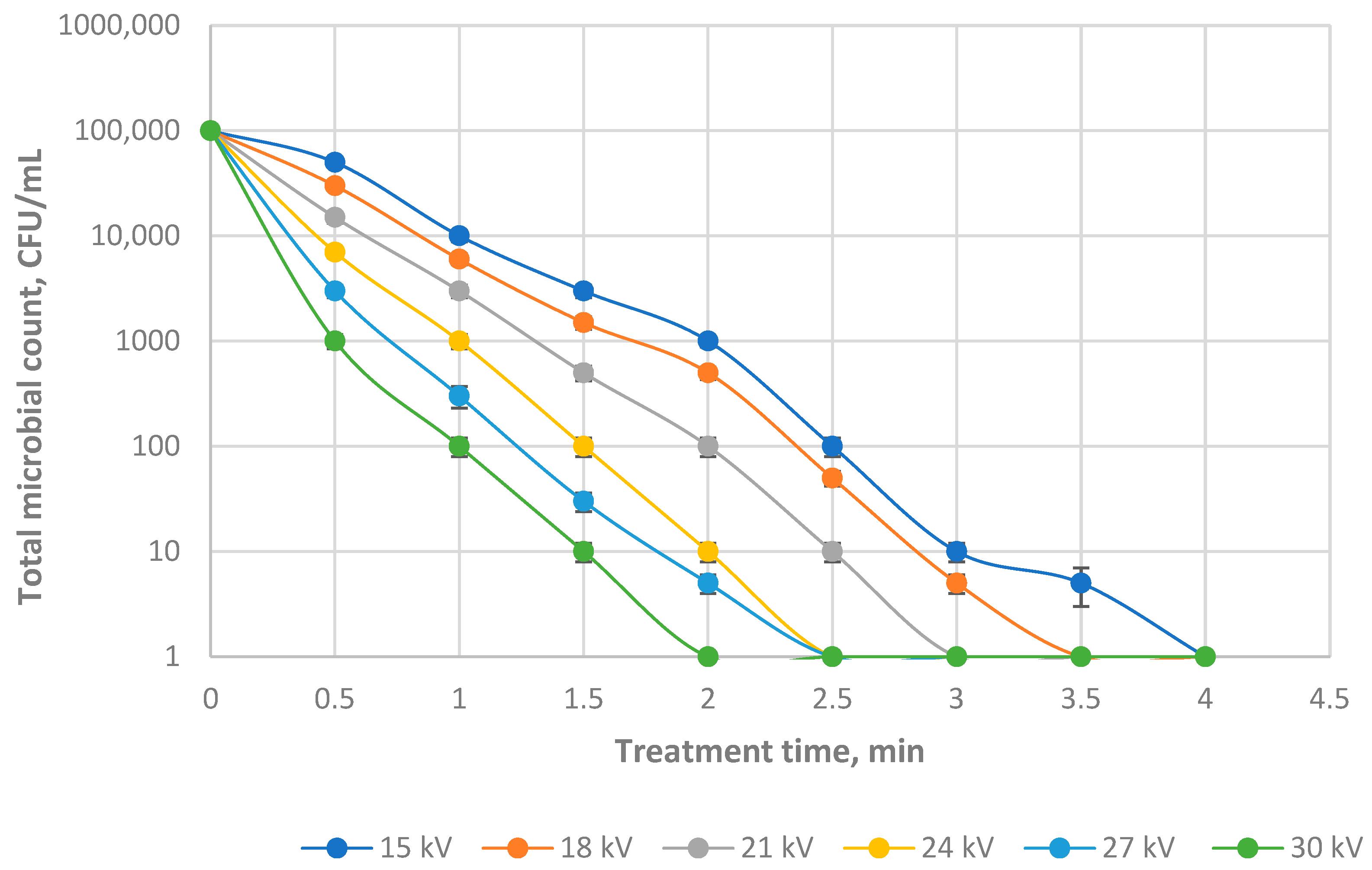
A key indicator of disinfection performance is the extent of microbial inactivation. Experimental data showed that plasma-pulse treatment provided rapid reduction in culturable indigenous microflora in wastewater samples to below the method detection limit under the selected operating conditions (Figure 4).
The microbiological assessment was based on total microbial count determined by the heterotrophic plate count method and a qualitative sanitary-indicator test; therefore, the results characterize the reduction in culturable indigenous microflora under laboratory conditions. Broader validation requires tests with defined indicator organisms, including Escherichia coli, total coliforms, enterococci, resistant model microorganisms, as well as regrowth and viable-but-nonculturable cell assessments. Plasma-pulse treatment reduced the total microbial count from approximately 1 × 10⁵ CFU/mL to below the method detection limit. Under the low-intensity regime (15 kV, C = 0.25 μF, Ec = 28.1 J), this was achieved within 4 min, whereas under the high-intensity regime (30 kV, C = 0.25 μF, Ec = 112.5 J), the same level was reached within 2 min. This corresponds to conservative lower-bound values of LRV ≥ 5 and apparent inactivation rate constants of kapp ≥ 1.25 and ≥2.50 log10 min−1, respectively. Thus, the high-intensity regime provided approximately a twofold increase in the apparent inactivation rate, which is consistent with previous studies showing that higher discharge energy can shorten the time required for microbial inactivation [37,38].
These results should be interpreted as the combined effect of voltage, interelectrode gap, stored energy, pulse exposure, and hydrodynamic contact rather than the isolated influence of a single discharge parameter. Possible deviations from ideal log-linear kinetics may be related to non-uniform exposure in the recirculation loop, particle shielding, heterogeneous microbial resistance, and transient cavitation intensity.
Based on the microbiological data, apparent log-reduction values and log-linear inactivation rate constants were calculated to compare the low- and high-intensity plasma-pulse regimes (Table 6). Since the final TMC values reached the method detection limit, the calculated values should be interpreted as conservative lower-bound estimates.
The results show that the high-intensity plasma-pulse regime reduced culturable microorganisms to below the detection limit approximately twice as fast as the low-intensity regime. However, this difference should be interpreted as the combined effect of charging voltage, interelectrode gap, discharge stability, pulse exposure, and hydrodynamic contact rather than the isolated effect of stored energy alone.
An increase in pulsed discharge energy significantly accelerates the disinfection process, which is consistent with the general trend: higher-energy operating conditions may intensify mechanical and plasma-chemical effects, which can plausibly contribute to faster reduction in culturable microorganisms. It is known that cavitation processes can create extreme local conditions, including high pressures and temperatures in microzones, which are associated with microbial inactivation; however, quantitative linking of “pressure” to cell death in a specific system requires either direct measurements of the acoustic field or a computational model [39]. In our experiments, even the mildest discharges resulted in complete bacterial inactivation after 4 min, whereas high-energy discharges reduced the HPC/TMC value to below the method detection limit (LOD = 1 CFU/mL) in less than 2 min for culturable microflora under the applied assay condition. After 3 min of treatment under any of the tested regimes, no viable microorganisms were detected within the sensitivity limits of the method used; further increase in treatment duration did not improve the result, indicating that an efficiency plateau had been reached. This suggests the existence of an optimal treatment time, which under our conditions was 3 min, beyond which further treatment is not justified in terms of energy consumption.
The key quantitative indicator of disinfection efficiency in this study was the total microbial count (TMC). The results obtained showed that plasma-pulse treatment caused a rapid decrease in microbial contamination, with a more pronounced effect observed under the regime with higher input pulse energy. Under the optimal treatment parameters, the reduction in TMC to a level below the detection threshold was achieved faster than under the milder regime, confirming the influence of discharge energetics on the rate of microflora inactivation. An additional sanitary-indicator test was qualitative in nature and was, therefore, used only as confirmatory evidence of the presence or absence of indicator sanitary microflora, without constructing quantitative curves.
In addition, a qualitative sanitary-microbiological assessment of the water samples was performed based on the indicator criterion of the presence or absence of indicator sanitary microflora. The results of this test were recorded only in qualitative form as “+” (detected) or “−” (not detected). Since this indicator was qualitative in nature, it was not converted into CFU/dm3 and was not used to construct kinetic dependences. In the present study, the quantitative assessment of disinfection efficiency was performed using the total microbial count (TMC).

3.3. Conductivity Evolution During Treatment

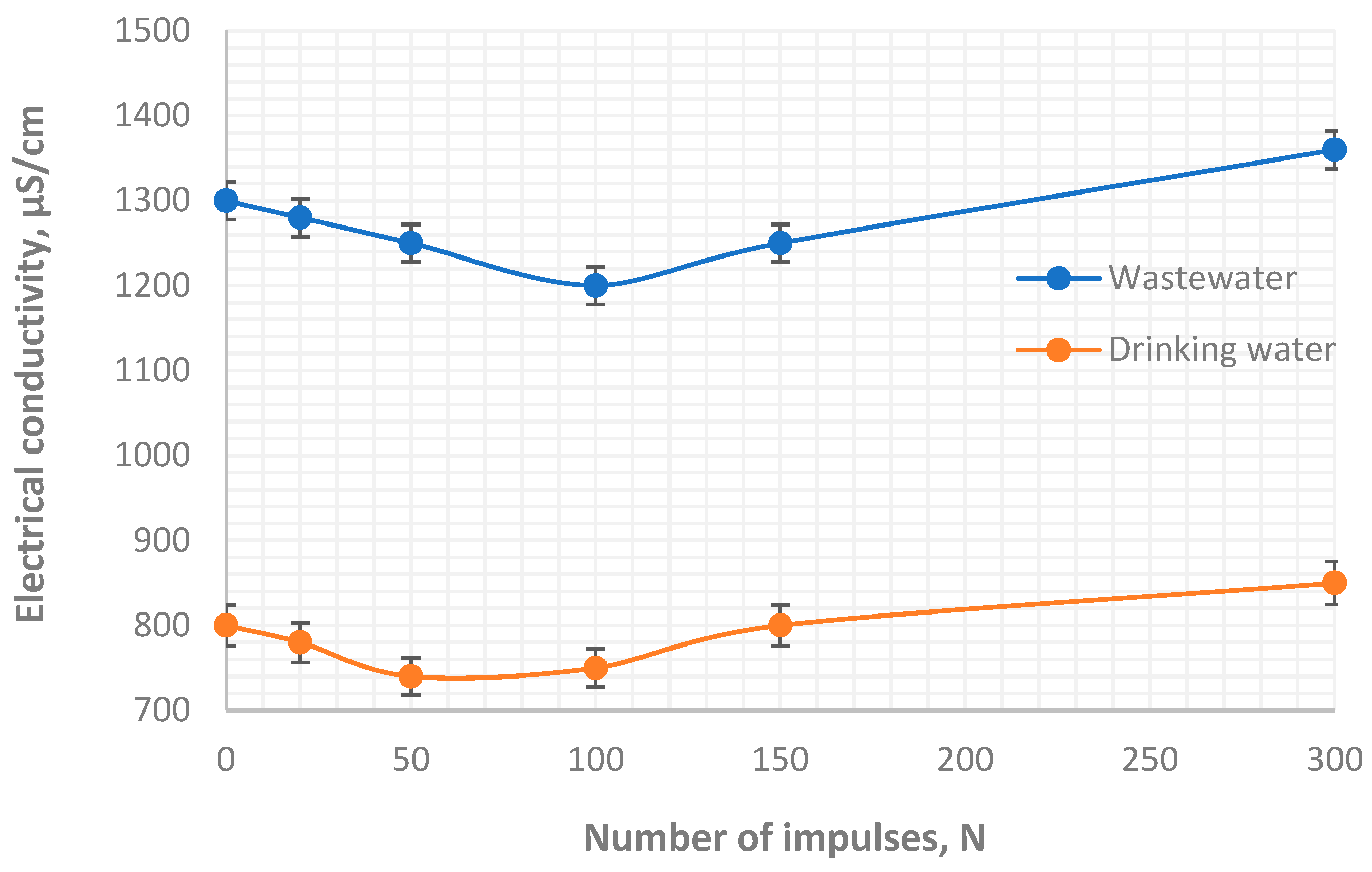
The effect of the specific electrical conductivity of water on the number of pulsed discharges was investigated. Figure 5 shows the dependence of electrical conductivity on the number of pulses for different types of water, including drinking (tap) water and wastewater.
The graph in Figure 5 shows the typical behavior of the electrical conductivity (specific electrical conductivity, SEC) of water samples under successive pulsed electrical discharges. In the initial treatment period, a decrease in conductivity is observed: for relatively clean drinking water, the minimum is reached after approximately 50 pulses, whereas for more mineralized wastewater, it is reached after approximately 100 pulses. It was experimentally established that the maximum decrease in sample conductivity occurs at about 50–60 pulses. Such a decrease in salt content indicates the occurrence of processes that remove some dissolved ions from the water, possibly due to coagulation or salt precipitation under the action of shock waves and cavitation [40,41,42]. At the same time, slight water heating occurs, but its effect is compensated by the decrease in ion concentration (TDS); the measurements were performed with temperature compensation to 25 °C, so the temporary temperature increase did not distort the result.
After reaching the minimum conductivity point, a further increase in the number of pulses leads to a gradual increase in water conductivity (Figure 5). This is due to the fact that more powerful and prolonged pulsed impacts begin to decompose organic substances and microbial cells, releasing additional ions into the solution. Indeed, it was noted that the subsequent increase in conductivity may be explained by an increase in the concentration of microbial fragments due to their degradation, as well as by the formation of smaller ions from organic compounds [43,44]. Under prolonged pulsed treatment, the decomposition of organic matter and microbial cells may release additional ionic species into solution, which can lead to a subsequent increase in conductivity. As a result, after 100–200 pulses, conductivity may return to its initial level or even exceed it. For example, for wastewater, after 100 pulses the decrease in conductivity ceased, and a subsequent increase in SEC was observed. Similar non-linear effects have also been reported by other researchers: during prolonged treatment, conductivity fluctuations were observed depending on the initial condition of the water and the presence of microflora [45,46,47].
For comparison with previous studies, it should be noted that studies on plasma activation of water often report an increase in conductivity under discharge treatment [45]. For example, Van Nguyen et al. [48], when treating surface water with cold plasma, observed an increase in nitrate/nitrite concentrations and a decrease in pH, accompanied by an increase in electrical conductivity, which is considered a side effect. In their experiment, conductivity after treatment increased from 98 to 592 μS/cm, i.e., by more than 500%, which significantly exceeded the initial level. In the present study, the opposite trend was observed during the early treatment stage: the temperature-compensated electrical conductivity decreased by 3–5%. This decrease should be interpreted as an integral physicochemical response of the treated water rather than as direct evidence of specific impurity removal, because conductivity measurements alone cannot identify which ionic species were removed, transformed, or generated during plasma-pulse exposure. A similar decrease in conductivity after electro-pulse treatment has also been reported by other researchers. In particular, it has been reported that electric-discharge treatment of water leads to an increase in pH, an increase in ORP, and a decrease in conductivity, which correlates with improved wastewater treatment efficiency.
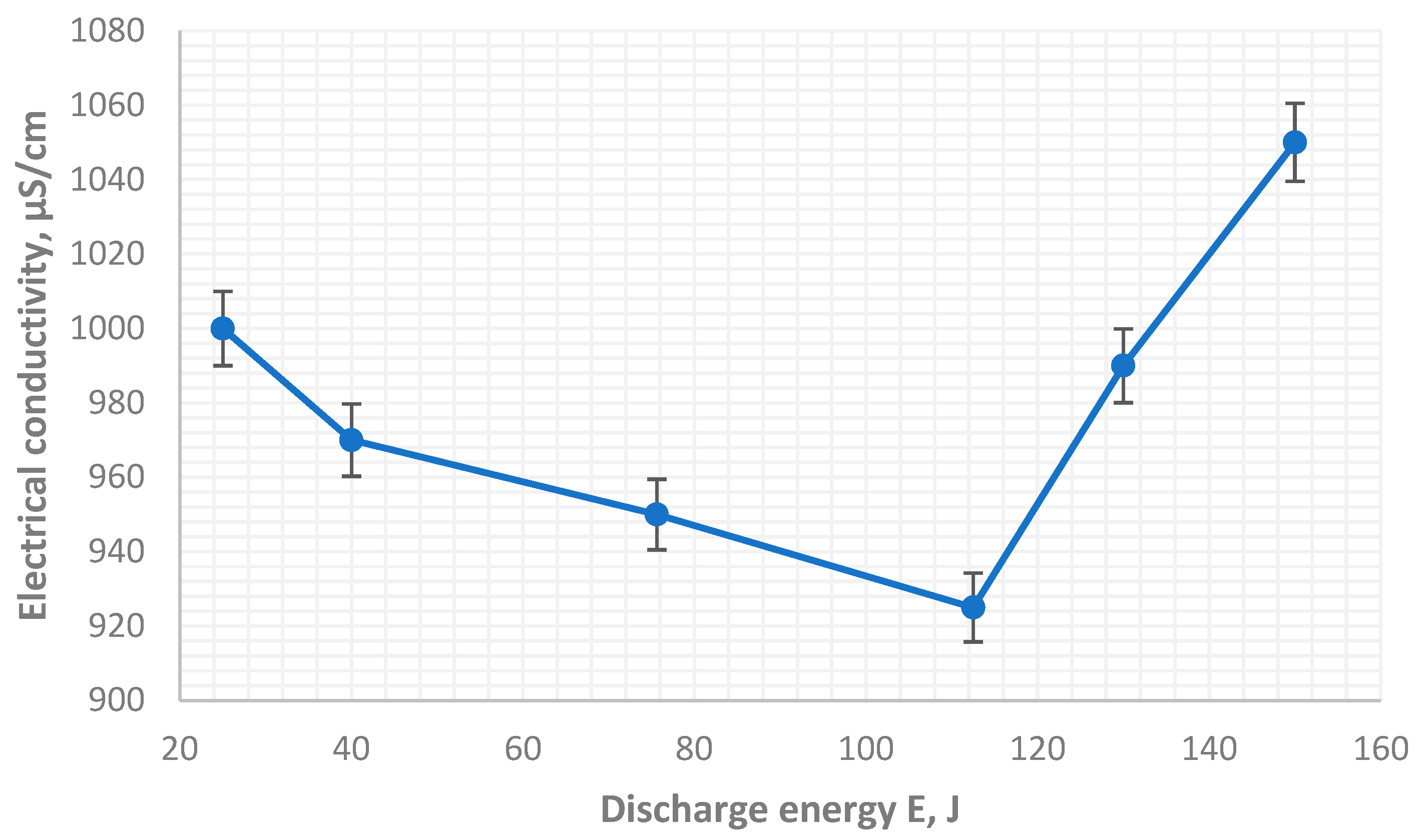
The effect of the specific electrical conductivity of water on the energy of a single pulsed discharge was also investigated (Figure 6).
Figure 6 shows the dependence of water electrical conductivity on the energy of a single high-voltage pulse (at a fixed number of pulses). The non-monotonic conductivity response indicates that plasma-pulse treatment affects the ionic balance of the water through several competing processes. The initial decrease in σ25 may be associated with temporary immobilization, coagulation, precipitation, adsorption, or deposition of ionic species on electrode and reactor surfaces. In contrast, the subsequent increase in conductivity at higher energy input or prolonged exposure may result from plasma-chemical formation of dissolved products, release of ions from disrupted microbial cells and organic matter, formation of nitrogen-containing species, gas dissolution, or electrode erosion. Therefore, σ25 should be considered a general indicator of physicochemical transformation rather than a selective marker of water purification. The curve was U-shaped: as the discharge energy increased from 20–30 J to about 112.5 J per pulse, the electrical conductivity of the treated water decreased and reached a minimum. At higher energy inputs, the conductivity increased again, indicating that there is an optimal discharge-energy range for maximizing the removal of dissolved species. The greatest decrease in TDS (7% of the initial value) was achieved at an energy of about 112–115 J per pulse; at lower energies (30–40 J), conductivity decreased only slightly (by 1–3%), since the discharge probably did not generate a sufficient number of cavitation bubbles and reactive radicals for effective water purification. When the energy was increased to 100 J, the purification effect on salt content weakened: the conductivity of the water increased and could exceed the initial value.
As the results show, increasing the interelectrode gap, and consequently the discharge energy, initially improves the efficiency of water disinfection, but excessively high energy does not lead to proportional improvement.
Physically, this can be explained by the balance between enhancement of the desired effect and undesirable side effects at higher energies. On the one hand, increasing the pulse energy intensifies the shock-wave effect and cavitation generation, which promotes coagulation and precipitation of salts from the solution. In addition, the higher-energy regime may accelerate the reduction in culturable microorganisms under the tested conditions, preventing them from releasing ions into the solution; in other words, this accelerates the achievement of reduction in culturable microorganisms below the detection limit without increasing salt content. On the other hand, at very high energies, the plasma channel in water is strongly heated; a local temperature increase of 1 °C raises electrical conductivity by approximately 2%. Despite the automatic temperature compensation of the instruments, strong discharges may lead to additional heating and evaporation, which complicates accurate measurements. A more important factor is the plasma-chemical formation of new dissolved substances. At high voltages and energies, reactive oxidants such as •OH, O•, and H2O2 may be formed in water and may contribute to organic-matter transformation and the formation of additional dissolved ionic species, for example, transforming nitrogen-containing organic compounds into nitrates [49]. As a result, additional ions (NO3, NO2, etc.) appear, increasing the mineralization of the water [48]. At the same time, electrode erosion and dissolution of gases from the plasma are also possible, which further increase the salt content. These effects lead to an increase in water conductivity at very high pulse energies, counteracting the initial decrease.
The literature data confirm this pattern. For example, studies on plasma oxidation have reported that more intense treatments lead to an increase in nitrate concentration and, consequently, to a significant increase in electrical conductivity and a decrease in the pH of treated water [49]. In the cited study, the increase in conductivity was several hundred percent above the initial level. Our results show more moderate changes: at the optimal discharge energies (112.5 J), conductivity decreases by 5–7%, whereas at the maximum tested energies (130–150 J), it either returns to the initial level or increases slightly (by 2–5%).
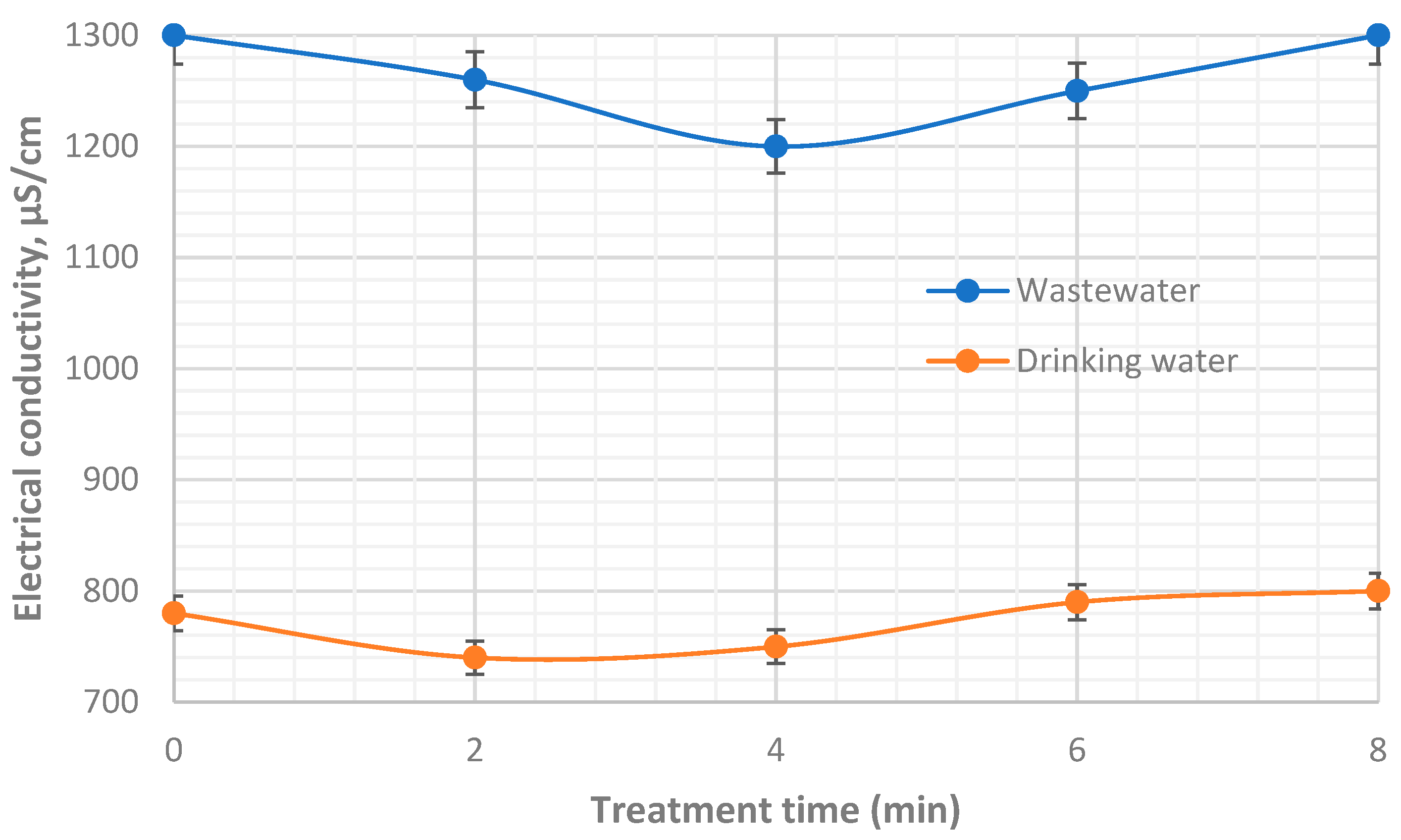
The effect of treatment time on electrical conductivity was also investigated (Figure 7).
Treatment time is closely related to the number of pulses: at a fixed pulse repetition frequency, a longer duration is equivalent to a greater number of pulses [49]. Thus, the pattern of conductivity change is largely similar to the trends shown in Figure 6. As can be seen from Figure 7, during the first 1–4 min of treatment, the electrical conductivity of the water decreases. For wastewater (with a higher initial salt content of 1300 μS/cm), the minimum value (1200 μS/cm, a decrease of 7–8%) is reached after approximately 4 min of treatment, which corresponds to 432 pulses. For tap water (initial conductivity 780 μS/cm), the decrease is less pronounced (about 3–4%), and the minimum value (760 μS/cm) is reached more rapidly, after about 1.5–2 min (approximately 162–216 pulses). In addition, during the first few minutes, the discharges effectively inactivate the water microflora, preventing the further release of metabolic products into the solution.
With longer exposure (more than 4–5 min, >432–540 pulses), the trend changes, and the electrical conductivity begins to increase. The wastewater curve in Figure 7 shows that after 4 min, the conductivity starts to rise, and by the 8th minute, it almost returns to its initial value (1300 μS/cm). For tap water, the increase occurs earlier: after 2 min, the conductivity begins to rise, and after 6–8 min, it returns to the initial level (0.80 mS/cm). Prolonged treatment negates the salt-removal effect. The reasons for this are consistent with those described above: the accumulation of products of organic decomposition, the release of ions from destroyed cells, and intensive plasma-chemical reactions in water begin to prevail over the salt-removal effect. In other words, the system reaches a saturation point, after which further disinfection is accompanied by increased mineralization. In some cases, oscillatory changes in electrical conductivity were observed during prolonged treatment, associated with biological processes in the water, but on average, there is a tendency for conductivity to increase after prolonged discharge treatment.
It should also be noted that the conductivity reduction effect is partly temporary. After the pulsed treatment is stopped, the water gradually restores the lost dissolved substances. For example, recarbonation of water by carbon dioxide from the air is possible, which leads to the dissolution of carbonate precipitates and an increase in TDS. In addition, when the treated water comes into contact with the atmosphere and the container walls, ions from the surrounding environment may enter it, returning the system to an equilibrium state. Therefore, to achieve a stable treatment effect, it may be necessary to combine pulsed treatment with a subsequent filtration stage to remove the precipitate.
In many studies where plasma treatment of water was carried out for a long time, an increase in conductivity over time rather than a decrease was observed. For example, when distilled water was treated with an atmospheric plasma discharge for 30 min, its conductivity increased from zero to 529 μS/cm, accompanied by significant acidification (pH decreased to 3) due to the accumulation of acids (nitrates, nitrites, etc.) [19]. In our case, the initial water had a neutral pH and some alkalinity, and the plasma-pulse treatment occurred in a water volume that initially increased pH and reduced salt content [50]. Thus, short-term treatment produces a positive effect, namely, a decrease in mineralization, whereas very prolonged treatment in the presence of air similarly begins to cause acidification and an increase in electrical conductivity. Under our conditions, the optimal pulsed-treatment time is several minutes, which is sufficient for water disinfection (a >99% reduction in bacterial counts) while simultaneously reducing electrical conductivity by 3–8%. Further increase in duration is impractical from the standpoint of water quality, since the content of dissolved substances begins to rise again. However, the mechanistic interpretation of conductivity changes remains limited by the absence of ion-specific and surface-composition analyses. In the present study, ion chromatography, ICP-MS/ICP-OES analysis of dissolved metals, alkalinity and carbonate/bicarbonate measurements, DOC analysis, pH/ORP evolution, and XRD or SEM-EDS characterization of possible electrode deposits were not performed. Consequently, the proposed pathways of ion immobilization, precipitation, nitrogen-species formation, organic-matter transformation, and electrode-related ion release should be regarded as plausible mechanisms requiring targeted experimental verification.

3.4. Chemical Analysis

To evaluate accompanying physicochemical changes in the wastewater matrix, COD, color, A254, and ammonium concentration were determined before and after plasma-pulse treatment. These indicators were used to assess organic-load reduction, transformation of colored compounds, changes in UV-absorbing organic structures, and ammonium conversion. The data presented in Table 7 correspond to the wastewater experiment performed under the following conditions: U = 30 kV, C = 0.25 μF, interelectrode gap l = 10 mm, pulse frequency f = 1.8 Hz, treatment time t = 2 min, treated volume Vtot = 10 L, and number of pulses N = 216, number of passes through the 1 L high-voltage cell Npass = 12, and calculated capacitor-stored energy Ec = 112.5 J pulse−1. COD, color, A254, and NH4+ were used only as screening indicators of wastewater-quality changes. These measurements do not represent a complete chemical mass balance. Therefore, COD reduction should be interpreted as a decrease in oxidizable matter or organic-matter transformation, not as direct evidence of mineralization. Similarly, the decrease in NH4+ should be interpreted as ammonium transformation rather than nitrogen removal, because NO2, NO3, total nitrogen, and dissolved organic nitrogen were not measured.
COD decreased from 260 to 120 mg O2/L, corresponding to a 53.8% reduction, indicating a substantial decrease in oxidizable organic matter after plasma-pulse treatment. This agrees with previous studies reporting effective plasma-assisted degradation of organic pollutants through reactive oxygen species without chemical reagents [48]. However, since TOC was not measured, COD reduction should be interpreted as organic-matter transformation rather than complete mineralization. The color value decreased by 61.1%, suggesting degradation of colored organic structures and chromophoric groups, which is consistent with plasma-based color-removal studies [51]. A254 decreased by 52.3%, indicating transformation of aromatic, conjugated, and high-molecular-weight UV-absorbing organic compounds; similar decreases in UV absorbance have been linked to radical-induced degradation of complex organic matter [52]. The NH4+ concentration decreased by 52.9%, but this should be interpreted as ammonium transformation rather than direct nitrogen removal, because plasma processes may convert NH4+ into NO2 and NO3 [53]. Therefore, future studies should include TOC, full UV–Vis spectra, ion chromatography for NO2/NO3, and total nitrogen analysis to establish carbon and nitrogen mass balances.

3.5. Energy Metrics

The system-level electrical energy consumption for the 2 min treatment cycle was 0.0667 kWh, based on a nominal power input of 2 kW and a treated water volume of 10 L (0.010 m3). This corresponds to a specific energy input (SEI) of 6.7 kWh/m3 for the tested operating mode.
For the wastewater matrix, the initial total microbial count was approximately 1 × 10⁵ CFU/mL, whereas the final value decreased to below the method detection limit (LOD = 1 CFU/mL) after treatment. Under the conservative assumption Ct = LOD, this corresponds to a minimum 5-log reduction in microbial load. Accordingly, the estimated electrical energy per order (EEO) was 1.34 kWh/m3/order. These values characterize the system-level energy demand of the tested operating mode. It should be noted that the reported SEI and EEO values are based on the total electrical input to the system, whereas the capacitor-stored energy values reported elsewhere in this study characterize the nominal pulse energy before discharge rather than the energy directly measured in the discharge channel or transferred to the liquid.
In studies [54] using pulsed corona discharge in a flow-through mode for drinking water treatment, the reported EEO values ranged from 20 to 86 kWh/m3/order for the removal of pathogens and persistent contaminants. By comparison, the EEO estimated in the present study was 1.34 kWh/m3/order for the tested wastewater matrix and operating conditions. Similarly, studies on cold DBD plasma for the removal of organic pollutants report SEI/EEO values below 10 kWh/m3, depending on the specific pollutant and treatment conditions, reflecting the potential of low-energy methods for certain water-treatment applications [55].
It should be noted that the Ec values used in this work characterize the energy stored in the capacitor before the pulse, rather than the energy directly transferred to the water.
To clarify this distinction, the experimentally tested 30 kV regime was further evaluated by separating the capacitor-stored energy, the system-level wall-input energy, and the actual delivered energy to the discharge channel and liquid. The main energy-balance indicators for the treatment of 10 L of water for 2 min at U = 30 kV, C = 0.25 μF, and f = 1.8 Hz are summarized in Table 8.
It is important to distinguish between capacitor-stored energy, wall-input energy, and energy actually delivered to the liquid. The reported SEI and EEO values are system-level estimates based on nominal wall input. Time-resolved voltage-current waveforms were not measured; therefore, the delivered energy to the discharge channel and liquid could not be directly determined.
Table 8 presents different values of the input parameters. These options provide an understanding of how to optimize the parameters in order to achieve efficient water treatment while balancing energy consumption. Table 9 presents theoretical calculations based on capacitor-stored energy and system-level electrical input; these scenarios were not all experimentally tested in the present study. For engineering interpretation, three different energy levels must be distinguished: (i) capacitor-stored energy, calculated as Ec = 0.5 CU2; (ii) system-level wall-input energy, estimated from the electrical power consumption and treatment time; and (iii) the actual energy delivered to the discharge channel and liquid, which requires time-resolved voltage-current diagnostics. In the present study, Ec and Ewall were evaluated, whereas the delivered discharge energy was not directly measured. Therefore, the reported SEI and EEO values should be interpreted as system-level estimates rather than intrinsic discharge-channel efficiencies.
The theoretical scenario analysis was used only to illustrate the sensitivity of capacitor-stored energy and estimated SEI to voltage and capacitance. These scenarios should not be interpreted as experimentally validated operating regimes. Overall, plasma-pulse water treatment [56,57,58] may require higher specific energy input than some conventional disinfection methods when applied to large-volume municipal water treatment. Therefore, the process should not be considered a direct universal replacement for established disinfection technologies. However, its engineering value lies in its reagent-free operation and in the simultaneous action of shock waves, cavitation, local UV emission, and reactive oxygen and nitrogen species. This combination may be useful for complex wastewater matrices, resistant microorganisms, or persistent organic contaminants, where conventional treatment alone may be insufficient.
The influence of energy input on treatment efficiency may also be associated with changes in plasma-induced cavitation-flow regimes. In this context, data-driven methods such as Dynamic Mode Decomposition (DMD) could be useful for classifying dominant flow structures from high-speed images, acoustic signals, pressure traces, or discharge waveforms [59]. Such analysis would help relate pulse energy, cavitation dynamics, microbial inactivation, conductivity evolution, and energy consumption.
From an engineering perspective, plasma-pulse treatment should be considered primarily as an advanced treatment or pre-treatment stage rather than as a stand-alone large-volume disinfection process. Possible applications include post-biological polishing after A2/O treatment, side-stream treatment of recalcitrant wastewater, or pre-treatment before adsorption/catalytic filtration. The main scale-up bottlenecks include uncertainty in residence-time distribution, hydraulic short-circuiting, electrode depletion and material release, uncertainty in actual delivered discharge energy, heat release, pulse-generator efficiency, and maintenance of stable discharge conditions in complex water matrices. Future pilot-scale studies should, therefore, include tracer-based HRT measurements, CFD analysis of the high-voltage cell, time-resolved voltage-current waveform diagnostics, electrode mass-loss measurements, and ion-specific by-product monitoring.

3.6. Comparison with Literature Sources

Table 10 presents the parameters and water disinfection efficiency achieved in our work and reported in other studies published between 2020 and 2024. The results obtained in our study, namely, complete bacterial inactivation within a few minutes without the use of reagents, are comparable with the findings of other authors. For example, Malyushevskaya et al. [44] showed that electrical discharge in the cavitation regime can significantly enhance the effect of low chlorine doses: at an energy consumption of 25 kJ/L, the addition of only 0.4–0.5 mg/L chlorine ensures reliable water disinfection while shortening the treatment time compared with conventional chlorination. Terato et al. successfully applied high-voltage pulsed discharges for water sterilization: a discharge with cavitation effectively destroyed Escherichia coli, and even the radiation-resistant D. radiodurans showed high sensitivity to plasma treatment [26]. At the same time, spores, for example, those of B. subtilis, proved to be more resistant and required more intensive treatment. These observations confirm that the mechanisms of microbial destruction by plasma are complex: along with oxidative processes, significant disruption of cell membranes occurs due to shock-wave and cavitation effects.
Other authors report comparable disinfection efficiency under somewhat different conditions. In the work of Quintana-Terriza et al. [27], a 4–5 log reduction in the viability of Enterococcus faecalis, a fecal indicator bacterium with high environmental resistance, was achieved after 15 min of plasma treatment at 1–8 kV and 40 Hz. At the same time, more than 85% of the antibiotic tetracycline was degraded in the same system, demonstrating the possibility of simultaneous removal of microorganisms and organic pollutants. On the other hand, Zhou et al. [45] proposed an alternative approach, the so-called locally enhanced electric field treatment (LEEFT) using nanostructured electrodes, in which bacteria can be inactivated at lower voltages, at only a few volts, due to increased field non-uniformity, without reagents. Mechanical and oxidative destruction of bacterial membranes has also been confirmed by other researchers. For example, electroporation methods based on nanoparticle electrodes produce a similar inactivation effect without the use of chemical reagents [44].
An important factor in the efficiency of plasma methods is the generation of reactive radicals. It is known that the concentration of •OH and other oxidants directly depends on the discharge regime. For example, Fang et al. [47] showed that combining electrical discharge with acoustic cavitation increases radical yield and accelerates the degradation of organic pollutants. In a recent study using a gas-liquid Venturi reactor, the introduction of a small oxygen flow rate of 3 L/min led to a sixfold increase in •OH radical yield with only a minimal increase in energy consumption, which significantly enhanced the oxidative capacity of the plasma. As a result, in this hybrid process, nearly complete, 99%, degradation of a persistent organic dye was achieved within 2 min at a specific energy consumption of only 0.26 kWh/m3/order. Our experiments, conducted without gas injection, showed that the oxidants generated by the discharge in water were sufficient for reduction in culturable microorganisms to below the method detection limit, as evidenced by color change and odor removal, as shown in Table 10. Nevertheless, the presented literature data indicate a path for further efficiency improvement; for example, the introduction of oxygen or ozone into the discharge zone may increase •OH yield and reduce the energy cost of disinfection.
As shown in Table 10, plasma and electrical-discharge systems differ substantially in discharge configuration, target microorganisms, water matrix, exposure time, and energy reporting. The present system achieved rapid reagent-free reduction in culturable indigenous microflora in a 10 L recirculating reactor; however, its energy performance should be interpreted as a system-level estimate rather than as directly measured delivered discharge energy. Compared with conventional UV-based disinfection, plasma-pulse treatment is unlikely to be the lowest-energy option for low-turbidity water, but it may be advantageous for complex wastewater matrices where simultaneous microbial inactivation, oxidation, cavitation-induced disruption, and reduced chemical addition are required.


3.7. Engineering Applicability and Comparison with Conventional Disinfection Technologies

Compared with UV irradiation, ozonation, and chlorination, plasma-pulse treatment is unlikely to be the lowest-energy option for low-turbidity drinking water with low organic load (Table 11). Its potential advantage is more realistic in complex matrices, such as turbid wastewater or recalcitrant industrial effluents, where simultaneous mechanical disruption, oxidation, and reagent-free operation are desirable. Therefore, the method should be considered primarily as an advanced treatment, polishing, or pre-treatment stage after biological treatment or before final disinfection, rather than as a stand-alone replacement for conventional large-volume disinfection.

4. Conclusions

The developed plasma-pulse water-treatment technology based on high-voltage electrical discharge demonstrated high disinfection efficiency for wastewater and natural water without the use of chemical reagents. The experimental results show that the optimized discharge parameters (30 kV, capacitance 0.25 μF, 112.5 J per pulse) reduced TMC to the detection limit within 2–3 min under the optimal operating conditions, while the contribution of the interelectrode gap should be interpreted through its effect on the breakdown voltage and pulse energy.
The method combines mechanical effects and plasma-chemical pathways (shock waves and cavitation) and plasma-chemical mechanisms (generation of reactive radicals and oxidizing species) acting on the entire water volume, which ensures a high degree of microbial inactivation and changes in electrical conductivity. The initial 3–8% decrease in temperature-compensated conductivity/TDS should be interpreted as an integral physicochemical response of the treated water rather than as direct evidence of selective demineralization or removal of specific ions. Since ion chromatography, ICP-MS/ICP-OES, and XRD or SEM-EDS analysis of possible deposits were not performed, the proposed mechanisms of ion immobilization, precipitation, plasma-chemical formation of dissolved species, and electrode-related ion release require targeted verification.
The technology was effective for the tested water matrices and eliminated the need for external chemical reagents by generating reactive oxidants directly in the liquid medium, which distinguishes it from conventional approaches such as chlorination, UV treatment, and ozonation.
The main limitation of the present study is its primary focus on microbiological inactivation and system-level energy performance, while comprehensive analysis of organic compounds, inorganic ions, transformation by-products, and other contaminants was outside the experimental scope. In addition, radical-scavenger tests, pulse-waveform-based energy partitioning, and electrode-stability assessment were not performed; therefore, the relative contributions of shock waves, cavitation, plasma-induced reactive species, and possible electrode-related metal release were not quantitatively separated. Although the observed effects are consistent with the combined action of mechanical and plasma-chemical pathways, direct OES, hydrophone measurements, high-speed imaging, EPR, H2O2/O3, NO2/NO3, tert-butanol scavenger tests, voltage–current diagnostics, SEM/EDS electrode analysis, and ICP-MS/ICP-OES metal monitoring are required to verify the mechanism and assess long-term operation.
Future studies should combine microbiological, plasma, acoustic, cavitation, ion-specific, organic-contaminant, and electrical waveform analyses with high-speed imaging, hydrophone diagnostics, and synchrotron X-ray-based particle image velocimetry to quantify multiphase flow effects and clarify their role in microbial inactivation and non-monotonic conductivity behavior. From an engineering perspective, the proposed plasma-pulse system should be positioned primarily as an advanced treatment, polishing, or pre-treatment stage for complex wastewater matrices, rather than as a universal replacement for conventional large-volume disinfection technologies. Although the results demonstrate promising system-level performance under the tested conditions, the physical partitioning of energy, the individual mechanical and plasma-chemical inactivation pathways, and long-term microbiological safety require further validation.

Author Contributions

Conceptualization, K.M.S. and N.K.T.; methodology, K.M.S., N.K.T. and S.E.S. (Saule E. Sakipova); validation, K.M.S., N.K.T., S.E.S. (Saule E. Sakipova) and S.E.S. (Saniya E. Suleimenova); formal analysis, K.M.S., S.E.S. (Saniya E. Suleimenova) and A.R.; investigation, K.M.S., S.E.S. (Saule E. Sakipova), S.E.S. (Saniya E. Suleimenova), A.R., N.N.S. and I.E.A.; resources, N.K.T., A.K.S. and A.D.B.; data curation, K.M.S. and S.E.S. (Saniya E. Suleimenova); writing—original draft preparation, K.M.S. and N.K.T.; writing—review and editing, N.K.T., S.E.S. (Saule E. Sakipova), N.N.S., A.K.S. and A.D.B.; visualization, K.M.S. and I.E.A.; supervision, K.M.S.; project administration, K.M.S.; funding acquisition, K.M.S. All authors have read and agreed to the published version of the manuscript.

Funding

This research was funded by a grant from the Science Committee of the Ministry of Science and Higher Education of the Republic of Kazakhstan (AP26102811 “Development of an innovative plasma pulse treatment plant for aqueous solutions using a high-voltage electric discharge”).

Data Availability Statement

The original contributions presented in the study are included in the article; further inquiries can be directed to the corresponding author.

Conflicts of Interest

The authors declare no conflicts of interest.

Abbreviations

The following abbreviations are used in this manuscript:
UCharging voltage of the storage capacitor, V
CStorage capacitance, F
EC = 1/2 C U2Energy stored in the capacitor before discharge, J
u(t)Instantaneous voltage across the discharge gap, V
fPulse repetition frequency, Hz
NNumber of pulses per experiment
VtotTotal volume of treated water, m3
SEISpecific energy input, kWh/m3
EEOElectrical energy per order of concentration/microbial load reduction, kWh/m3/order
σ25Specific electrical conductivity normalized to 25 °C, μS/cm
TMCTotal microbial count
CODChemical oxygen demand
NTPNon-thermal plasma
ROSReactive oxygen species
RNSReactive nitrogen species
HPCHeterotrophic plate count
SECSpecific electrical conductivity
LEEFTLocally enhanced electric field treatment

References

  1. Kalli, M.; Noutsopoulos, C.; Mamais, D. The fate and occurrence of antibiotic-resistant bacteria and antibiotic resistance genes during advanced wastewater treatment and disinfection: A review. Water 2023, 15, 2084. [Google Scholar] [CrossRef]
  2. Naicker, K.I.; Kaweesa, P.; Daramola, M.O.; Iwarere, S.A. Non-thermal plasma review: Assessment and improvement of feasibility as a retrofitted technology in tertiary wastewater purification. Appl. Sci. 2023, 13, 6243. [Google Scholar] [CrossRef]
  3. Zhang, C.; Chen, P.; He, J.; Zu, D.; Hou, C.H.; Wang, Y.; Ma, J. Dual-stage electrochemical system enabling reagent-free nickel-ammonia decomplexation and resource recovery. Water Res. 2026, 293, 125427. [Google Scholar] [CrossRef]
  4. Codina, A.S.; Sergienko, N.; Borrego, C.M.; Radjenovic, J. Manganese oxide-functionalized graphene sponge electrodes for electrochemical chlorine-free disinfection of tap water. Chem. Eng. J. 2023, 472, 145082. [Google Scholar] [CrossRef]
  5. Ivanov, M.; Vukušić Pavičić, T.; Kraljić, K.; Grgas, D.; Landeka Dragičević, T.; Herceg, Z. Effects of high-voltage electrical discharge plasma on olive mill wastewater treatment. Sustainability 2021, 13, 1552. [Google Scholar] [CrossRef]
  6. Giardina, A.; Lofrano, G.; Libralato, G.; Siciliano, A.; Marotta, E.; Paradisi, C. Air non-thermal plasma, a green approach for the treatment of contaminated water: The case of sulfamethoxazole. Front. Environ. Chem. 2024, 5, 1416702. [Google Scholar] [CrossRef]
  7. Kyere-Yeboah, K.; Bique, I.K.; Qiao, X.C. Advances of non-thermal plasma discharge technology in degrading recalcitrant wastewater pollutants: A comprehensive review. Chemosphere 2023, 320, 138061. [Google Scholar] [CrossRef] [PubMed]
  8. Tachibana, K.; Hanabata, R.; Furuki, T.; Ichiki, R.; Kanazawa, S.; Kocik, M. Development and Evaluation of Newly Designed Coaxial Cylindrical Plasma Reactor with Liquid Flow Control and Post-Discharge Reactions for Water Treatment. Energies 2022, 15, 4028. [Google Scholar] [CrossRef]
  9. Dang, T.H.; Denat, A.; Lesaint, O.; Teissedre, G. Pulsed electrical discharges in water for removal of organic pollutants: A comparative study. Eur. Phys. J. Appl. Phys. 2009, 47, 22818. [Google Scholar] [CrossRef][Green Version]
  10. Zeghioud, H.; Nguyen-Tri, P.; Khezami, L.; Amrane, A.; Assadi, A.A. Review on discharge plasma for water treatment: Mechanism, reactor geometries, active species, and combined processes. J. Water Process Eng. 2020, 38, 101664. [Google Scholar] [CrossRef]
  11. Hübner, U.; Spahr, S.; Lutze, H.; Wieland, A.; Rüting, S.; Gernjak, W.; Wenk, J. Advanced oxidation processes for water and wastewater treatment—Guidance for systematic future research. Heliyon 2024, 10, e30402. [Google Scholar] [CrossRef] [PubMed]
  12. Locke, B.R.; Sato, M.; Sunka, P.; Hoffmann, M.R.; Chang, J.S. Electrohydraulic discharge and nonthermal plasma for water treatment. Ind. Eng. Chem. Res. 2006, 45, 882–905. [Google Scholar] [CrossRef]
  13. Huang, Y.; Yan, H.; Li, S.; Yan, K. Multi-electrode electrohydraulic discharge for sterilization and disinfection. In Proceedings of the 2009 IEEE Pulsed Power Conference (PPC 2009), Washington, DC, USA, 28 June–2 July 2009; IEEE: Piscataway, NJ, USA, 2009; pp. 886–891. [Google Scholar] [CrossRef]
  14. Loske, A.M.; Alvarez, U.M.; Hernández-Galicia, C.; Castaño-Tostado, E.; Prieto, F.E. Bactericidal effect of underwater shock waves on Escherichia coli ATCC 10536 suspensions. Innov. Food Sci. Emerg. Technol. 2002, 3, 321–327. [Google Scholar] [CrossRef]
  15. Bian, D.; Zhao, J.; Niu, S.; Wu, J. Rock fracturing under pulsed discharge homenergic water shock waves with variable characteristics and combination forms. Shock Vib. 2018, 2018, 6236953. [Google Scholar] [CrossRef]
  16. Gurbanov, E.; Gasimova, F.; Rustamova, K.; Aliyev, E.; Alshebli, S.; Alshamsi, M.; Al Ahmad, M. Green electrical disinfection of water. Appl. Water Sci. 2026, 16, 37. [Google Scholar] [CrossRef]
  17. Chung, K.J.; Lee, S.G.; Hwang, Y.S.; Kim, C.Y. Modeling of pulsed spark discharge in water and its application to well cleaning. Curr. Appl. Phys. 2015, 15, 977–986. [Google Scholar] [CrossRef]
  18. Ge, M.; Sun, C.; Zhang, G.; Coutier-Delgosha, O.; Fan, D. Combined suppression effects on hydrodynamic cavitation performance in Venturi-type reactor for process intensification. Ultrason. Sonochem. 2022, 86, 106035. [Google Scholar] [CrossRef]
  19. Liu, F.; Zhou, R.; Zhang, C.; Wu, Z.; Ren, H.; Ng, H.Y. Critical review on the pulsed electrochemical technologies for wastewater treatment: Fundamentals, current trends, and future studies. Chem. Eng. J. 2024, 479, 147588. [Google Scholar] [CrossRef]
  20. Jiang, S.; Wu, C.; Huang, Q.; Yu, Y.; Zhang, P.; Wang, C.; Ou, X.; Xu, M. Fe-Cu-loaded γ-Al2O3 as an efficient heterogeneous Fenton catalyst for the advanced treatment of petrochemical wastewater. Water Cycle 2026, 7, 19–30. [Google Scholar] [CrossRef]
  21. Chen, D.; Li, X.; Ning, L.; Zhou, Z.; Zhou, Z.; Fan, X. A recyclable magnetic piezoelectric composite Fe3O4/SrBi2Ta2O9 for efficient antibiotic removal in water under ball milling. Water Cycle 2026, 7, 48–56. [Google Scholar] [CrossRef]
  22. Zhang, B.; Han, R.; Gao, P.; Yuan, S.; Li, Y.; Zhang, H. Optimization of discharge parameters for high-voltage pulse crushing technology: A review. Miner. Eng. 2025, 228, 109356. [Google Scholar] [CrossRef]
  23. Morenas, B.; Saqib, S.; Mukhtar, A.; Stromberg, J.; Wu, S. Scaling Up Non-Thermal Plasma Technology for Water and Wastewater Treatment: Opportunities and Challenges. Energies 2025, 18, 5692. [Google Scholar] [CrossRef]
  24. Liu, S.W.; Liu, Y.; Ren, Y.J.; Lin, F.C.; Li, H.; Zhao, Y. Analysis of shock wave induced by underwater pulsed discharge using discharge current interception. J. Appl. Phys. 2020, 127, 143301. [Google Scholar] [CrossRef]
  25. Kondrat, O.; Shumilin, T. Electrohydraulic Yutkin effect and electrospark discharges in liquids. Prospect. Dev. Oil Gas Fields 2023, 3, 61–67. [Google Scholar] [CrossRef]
  26. Terato, H.; Tokuyama, Y.; Nishiyama, H.; Matsunaga, T.; Yoshida, Y.; Ihara, S. Sterilizing ability of high-voltage pulsed discharge plasma with cavitation for microorganisms including radio-resistant bacterium in water. Biocontrol Sci. 2022, 27, 41–46. [Google Scholar] [CrossRef] [PubMed]
  27. Quintana-Terriza, J.I.; Fernández-García, C.; García-Muñoz, P.; Rodríguez-Chueca, J. Dual action of plasma discharge: E. faecalis inactivation and tetracycline degradation with eco-safe effluents. Water Res. X 2025, 29, 100429. [Google Scholar] [CrossRef]
  28. Nussupbekov, B.; Khassenov, A.; Nussupbekov, U.; Akhmadiyev, B.; Karabekova, D.; Kutum, B.; Tanasheva, N. Development of technology for obtaining coal-water fuel. East.-Eur. J. Enterp. Technol. 2022, 3, 39–46. [Google Scholar] [CrossRef]
  29. Akhmadiev, B.A.; Tatybekov, A.; Shuyushbayeva, N.N.; Tanasheva, N.K.; Altayeva, G.S.; Stoev, M. Electrohydropulse technology of destruction and crushing of natural stones at different parameters. Bull. Karaganda Univ. Phys. Ser. 2018, 90, 49–55. [Google Scholar]
  30. ISO 11133:2014; Microbiology of Food, Animal Feed and Water—Preparation, Production, Storage and Performance Testing of Culture Media. International Organization for Standardization: Geneva, Switzerland, 2014.
  31. APHA; AWWA; WEF. Standard Methods for the Examination of Water and Wastewater, Method 9215B: Heterotrophic Plate Count, 18th ed.; American Public Health Association: Washington, DC, USA, 1992. [Google Scholar]
  32. Department of Primary Industries, NSW Government. Calculating Log Reduction Values; Recycled Water Information Sheet Number 3; NSW Government: Sydney, Australia, 2015.
  33. Standard Methods 5220D; Chemical Oxygen Demand (COD): Closed Reflux, Colorimetric Method. American Public Health Association, American Water Works Association, Water Environment Federation: Washington, DC, USA, 2017.
  34. Standard Methods 5910B; UV-Absorbing Organic Constituents. American Public Health Association, American Water Works Association, Water Environment Federation: Washington, DC, USA, 2017.
  35. Standard Methods 4500-NH3 G; Nitrogen (Ammonia): Automated Phenate Method. American Public Health Association, American Water Works Association, Water Environment Federation: Washington, DC, USA, 2017.
  36. Ghafoori, S.; Mehrvar, M.; Chan, P.K. Optimization of photo-Fenton-like degradation of aqueous polyacrylic acid using Box–Behnken experimental design. J. Environ. Sci. Health Part A 2014, 92, 97–108. [Google Scholar]
  37. Ansari, M.; Moussavi, G.; Ehrampoosh, M.H.; Giannakis, S. A systematic review of non-thermal plasma (NTP) technologies for synthetic organic pollutants (SOPs) removal from water: Recent advances in energy yield aspects as their key limiting factor. J. Water Process Eng. 2023, 51, 103371. [Google Scholar] [CrossRef]
  38. Ajo, P.; Kornev, I.; Preis, S. Pulsed corona discharge induced hydroxyl radical transfer through the gas-liquid interface. Sci. Rep. 2017, 7, 16152. [Google Scholar] [CrossRef] [PubMed]
  39. Castillo, M.d.R.; Gómez Camarillo, M.E.; Gómez, M.E.; Cruz Gómez, M.J. Cold plasma technology for water treatment: Design, assembly and technical evaluation of a pilot plant. J. Inf. Syst. Eng. Manag. 2025, 10, 737–747. [Google Scholar] [CrossRef]
  40. Thai, V.P.; Dam, T.N.; Takahashi, K.; Sasaki, T.; Kikuchi, T. The generation pathways of OH and H2O2 by plasma-liquid interactions. IOP Conf. Ser. Earth Environ. Sci. 2023, 1278, 012030. [Google Scholar] [CrossRef]
  41. Lee, G.; Choi, S.-W.; Yoo, M.; Chang, H.-J.; Lee, N. Effects of plasma-activated water treatment on the inactivation of microorganisms present on cherry tomatoes and in used wash solution. Foods 2023, 12, 2461. [Google Scholar] [CrossRef] [PubMed]
  42. Almuratova, N.; Dyussenbiyeva, A.; Zharkymbekova, M.; Nurmadiyeva, E.; Kystaubayev, N.; Abdykadyrov, A. Evaluation of the biological efficiency of water disinfection using high-frequency electrical discharge. Water 2025, 17, 3482. [Google Scholar] [CrossRef]
  43. Letuta, S.; Ishemgulov, A.; Davydova, O.; Grigoriev, M. Inactivation of bacteria in biofilms by shock waves. J. Biomed. Photonics Eng. 2024, 10, 040311. [Google Scholar] [CrossRef]
  44. Malyushevskaya, A.P.; Koszelnik, P.; Mitryasova, O.; Yushchishina, A.; Mats, A.; Papciak, D.; Zdeb, M.M. Hybrid water disinfection process using electrical discharges. Processes 2024, 12, 1846. [Google Scholar] [CrossRef]
  45. Zhou, J.; Wang, T.; Xie, X. Locally enhanced electric field treatment (LEEFT) promotes performance of ozonation for bacteria inactivation by disrupting the cell membrane. Environ. Sci. Technol. 2020, 54, 14017–14025. [Google Scholar] [CrossRef]
  46. Chen, Z.R.; Liu, H. Evaluation methods for bacterial inactivation and impairment by nanowire-assisted electroporation. Water Cycle 2026, 7, 1–6. [Google Scholar] [CrossRef]
  47. Fang, Y.; Hariu, D.; Yamamoto, T.; Komarov, S. Acoustic cavitation assisted plasma for wastewater treatment: Degradation of Rhodamine B in aqueous solution. Ultrason. Sonochem. 2019, 52, 318–325. [Google Scholar] [CrossRef]
  48. Nguyen, D.V.; Ho, P.Q.; Pham, T.V.; Nguyen, T.V.; Kim, L. Treatment of surface water using cold plasma for domestic water supply. Environ. Eng. Res. 2019, 24, 412–417. [Google Scholar] [CrossRef]
  49. Plasma Activated Water [PAW] Application Note. Henniker Plasma. Available online: https://plasmatreatment.co.uk/knowledge-base/knowledge-articles/230-plasma-activated-water-paw-application-note (accessed on 30 March 2026).
  50. Mohandoss, S.; Mohan, H.; Balasubramaniyan, N.; Loganathan, S. Non-thermal plasma treatment of dye-contaminated wastewater: A sustainable approach for pollutant degradation and enhanced plant growth. Plasma 2025, 8, 40. [Google Scholar] [CrossRef]
  51. Kim, M.W.; Kim, H.K.; Lee, H.; Kim, K.; Hong, Y.C. Decolorization of industrial dye wastewater using an underwater non-thermal plasma system. J. Water Process Eng. 2024, 67, 106149. [Google Scholar] [CrossRef]
  52. Wright, K. Plasma water treatment and oxidation of organic matter in water. In Proceedings of the 2019 IEEE Pulsed Power & Plasma Science Conference (PPPS), Orlando, FL, USA, 23–28 June 2019; IEEE: Piscataway, NJ, USA, 2019; pp. 35–38. [Google Scholar] [CrossRef]
  53. Bogdanova, M.; Yotinov, I.; Topalova, Y.; Dinova, N.; Kirilova, M.; Bogdanov, T.; Marinova, P.; Benova, E. Cold plasma as an innovative tool for wastewater pre-treatment and post-treatment at Ravda WWTP: Bioindication by means of microbial metabolic potential. Environments 2026, 13, 12. [Google Scholar] [CrossRef]
  54. Singh, R.K.; Philip, L.; Ramanujam, S. Continuous flow pulse corona discharge reactor for the tertiary treatment of drinking water: Insights on disinfection and emerging contaminants removal. Chem. Eng. J. 2019, 355, 269–278. [Google Scholar] [CrossRef]
  55. Maybin, J.-A.; McClenaghan, L.A.; Gilmore, B.F.; Thompson, T.P. Cold plasma for enhanced water purification. Sustain. Microbiol. 2024, 1, qvae032. [Google Scholar] [CrossRef]
  56. Shaimerdenova, K.M.; Suleimenova, S.E.; Tanasheva, N.K.; Nakipova, S.Z.; Abdirova, N.T. Study of electric discharges’ influence on water electrical conductivity and salt content. Bull. Toraighyrov Univ. Phys. Math. Comput. Sci. Ser. 2025, 3, 294–303. [Google Scholar] [CrossRef]
  57. Shuyushbayeva, N.; Stoev, M.; Tanasheva, N.; Altayeva, G.; Sadvakasova, D.; Meirmanova, A. Study of the metal parts of the electrohydropulse drill. Bulg. Chem. Commun. 2020, 52, 144–146. [Google Scholar] [CrossRef]
  58. Tanasheva, N.K.; Minkov, L.L.; Tleubergenova, A.Z.; Sadenova, K.K. Calculation of coal-water fuel combustion technology based on mathematical modeling. Bull. Karaganda Univ. Phys. Ser. 2019, 96, 63–68. [Google Scholar] [CrossRef]
  59. Ge, M.; Manikkam, P.; Ghossein, J.; Subramanian, R.K.; Coutier-Delgosha, O.; Zhang, G. Dynamic mode decomposition to classify cavitating flow regimes induced by thermodynamic effects. Energy 2022, 254, 124426. [Google Scholar] [CrossRef]
  60. Berruti, I.; Nahim-Granados, S.; Abeledo-Lameiro, M.J.; Oller, I.; Polo-López, M.I. UV-C Peroxymonosulfate Activation for Wastewater Regeneration: Simultaneous Inactivation of Pathogens and Degradation of Contaminants of Emerging Concern. Molecules 2021, 26, 4890. [Google Scholar] [CrossRef] [PubMed]
  61. Qadafi, M.; Rosmalina, R.T.; Pitoi, M.M.; Wulan, D.R. Chlorination disinfection by-products in Southeast Asia: A review on potential precursor, formation, toxicity assessment, and removal technologies. Chemosphere 2023, 312, 137817. [Google Scholar] [CrossRef] [PubMed]
  62. Pandian, A.M.K.; Rajamehala, M.; Pradhap Singh, M.V.; Sarojini, G.; Rajamohan, N. Potential risks and approaches to reduce the toxicity of disinfection by-products in drinking water: A review. Sci. Total Environ. 2022, 825, 153323. [Google Scholar] [CrossRef]
  63. González, Y.; Gómez, G.; Moeller-Chávez, G.E.; Vidal, G. UV Disinfection Systems for Wastewater Treatment: Emphasis on Reactivation of Microorganisms. Sustainability 2023, 15, 11262. [Google Scholar] [CrossRef]
  64. Makuei, M.S.; Peleato, N. Manipulation of particle microorganism association for improved UV disinfection of surface waters. Sci. Rep. 2025, 15, 17798. [Google Scholar] [CrossRef]
  65. Zhang, Y.-X.; Xiang, J.-L.; Wang, J.-J.; Du, H.-S.; Wang, T.-T.; Huo, Z.-Y.; Wang, W.-L.; Liu, M.; Du, Y. Ultraviolet-based synergistic processes for wastewater disinfection: A review. J. Hazard. Mater. 2023, 453, 131393. [Google Scholar] [CrossRef]
  66. Morrison, C.M.; Betts, A.R.; Hofmann, R.; Hrudey, S.E.; Andrews, S.A. Critical Review on Bromate Formation during Ozonation and Control Options for Its Minimization. Environ. Sci. Technol. 2023, 57, 11437–11453. [Google Scholar] [CrossRef]
  67. Chen, H.; Zhai, J.; Ji, Y.; Song, W.; Hu, Y.; He, S.; Qian, L.; Wang, S. Review on Process Intensification of Non-Thermal Plasma Oxidation in Multiphase Reactor for Wastewater Treatment: Mass Transfer Enhancement and Waste Energy-Driven Conversion. Water 2026, 18, 649. [Google Scholar] [CrossRef]
Figure 1. Plasma-impulse water treatment installation: (a) schematic of the experimental setup; (b) photograph of the installation.
Energies 19 02647 g001
Figure 2. Structural diagram of the plasma-pulse technology: A—control panel; B—pulse current generator with spark-gap switch; C—energy storage unit with protection system; 1—220 V power supply; 2—current-limiting element; 3—emergency shutdown system; 4—high-voltage indicator; 5—transformer; 6—high-voltage rectifier; 7—energy storage unit; 8—protection system; 9—residual voltage discharge system; 10—discharge electrode; 11—working chamber with an electrode system for water treatment.
Energies 19 02647 g002
Figure 3. High-voltage cell for the experimental impulse setup: 1—electrode (positive); 2—insulator; 3—casing; 4—supply of treated water; 5—reflector; 6—electrode (negative); 7—cell diffuser; 8—outlet of treated water.
Energies 19 02647 g003
Figure 4. Log-scale total microbial count (TMC) during plasma-pulse treatment under low- and high-intensity discharge regimes. Data are presented as mean ± SD, n = 3. Values below the method detection limit were plotted at LOD = 1 CFU/mL for visualization.
Energies 19 02647 g004
Figure 5. Dependence of water electrical conductivity on the number of pulsed discharges for drinking (tap) water and wastewater.
Energies 19 02647 g005
Figure 6. Dependence of water electrical conductivity on discharge energy.
Energies 19 02647 g006
Figure 7. Dependence of water electrical conductivity on treatment time (continuous series of pulses at a frequency of 1.8 Hz).
Energies 19 02647 g007
Table 1. Technical characteristics of the system.
ParameterSymbolValueUnit
Supply voltageU220V
Mains frequencyf50Hz
Nominal system-level power consumptionP2kW
Pulse frequencyf 1.8Hz
System weightm80kg
Volume of treated waterV0.010m3
Treatment time t2min
Table 2. Nominal hydraulic and pulse-dose parameters of the recirculating plasma-pulse treatment system.
Treatment Time, minNumber of PulsesNumber of Passes Through 1 L CellPulse Dose, Pulses L−1
1108610.8
22161221.6
33241832.4
44322443.2
55403054.0
Table 3. Initial characteristics of water samples before treatment.
Water TypeSourceElectrical Conductivity (µS/cm)pHTemperature (°C)Total Microbial Count (TMC), CFU/mLQualitative Sanitary-Indicator Test, Result (+/−)
WastewaterSurface wastewater (stream/ditch)13007.522–251 × 105+
Tap waterCentralized water supply (city tap)7807.218–202.0 × 10²
Table 4. Calculated energy stored in the capacitor before the pulse.
Experimental DataCalculation ResultsInterpretation
l, mmC, 10-6 FU, kVE, J
50.251528.125low-voltage/small-gap regime
61840.5intermediate regime
72155.125intermediate regime
82472intermediate regime
92791.125high-intensity combined regime
1030112.5high-intensity combined regime
Table 5. Calculated capacitor energy Ec as a function of voltage.
(U) (kV) (E) (J)
1528.125
1840.500
2155.125
2472.000
2791.125
30112.500
Table 6. Apparent microbial inactivation parameters under low- and high-intensity plasma-pulse regimes.
Operating RegimeInitial TMC, CFU/mLFinal TMC, CFU/mLTreatment Time, minLRVKapp, Log10 min−1
Low-intensity regime1 × 105<14≥5≥1.25
High-intensity regime1 × 105<12≥5≥2.50
Table 7. Changes in wastewater chemical indicators after plasma-pulse treatment under the 30 kV regime.
ParameterUnitBefore TreatmentAfter TreatmentRemoval Efficiency, %Interpretation
COD (chemical oxygen demand)mg O2/L26012053.8Screening decrease in oxidizable organic matter; not evidence of complete mineralization
Colordegree903561.1Screening indicator of chromophore/color transformation
A254 (specific absorbance at 254 nm)1/cm0.880.4252.3Screening indicator of UV-absorbing organic structures; full UV–Vis spectra required
Ammonium (NH4+)mg/L3.41.652.9Ammonium transformation; not nitrogen removal; requires NO2/NO3, TN, and DON tracking
Note: The values are presented as screening before/after measurements.
Table 8. Energy-balance indicators for the experimentally tested plasma-pulse treatment regime.
Energy MetricFormulaValue for 30 kV, 2 minMeaning
Capacitor-stored pulse energyEc = 0.5 CU2112.5 J/pulseNominal stored energy
Number of pulsesN = f·t2161.8 Hz, 120 s
Total stored pulse energyEc, total = Ec·N0.00675 kWhSum of stored pulse energies
Wall-input energyEwall = P·t0.0667 kWhSystem-level electrical input
SEIwallEwall/V6.67 kWh/m3System-level wall-input SEI
EEOwallSEI/LRV1.33 kWh/m3/orderConservative value
Delivered energy to liquid∫u(t)i(t)dtNot measuredRequires waveform diagnostics
Table 9. Theoretical scenario analysis of capacitor-stored energy and capacitor-stored SEI at f = 1.8 Hz, t = 2 min, and Vtot = 0.010 m3.
Voltage, kVCapacitance, μFPulse Energy, JTotal Energy, kWhSEI, kWh/m3
150.1011.250.0006750.0675
200.1020.000.0012000.1200
300.1045.000.0027000.2700
400.1080.000.0048000.4800
500.10125.000.0075000.7500
150.2528.130.0016880.1688
200.2550.000.0030000.3000
300.25112.500.0067500.6750
400.25200.000.0120001.2000
500.25312.500.0187501.8750
150.5056.250.0033750.3375
200.50100.000.0060000.6000
300.50225.000.0135001.3500
400.50400.000.0240002.4000
500.50625.000.0375003.7500
151.00112.500.0067500.6750
201.00200.000.0120001.2000
301.00450.000.0270002.7000
Table 10. Comparison of plasma/electrical-discharge and conventional water-disinfection processes.
StudyDischarge Conditions/Operating ParametersMatrix/TargetScale and ExposureDisinfection EffectEnergy/Engineering Note
This workSpark discharge; 30 kV, 0.25 μF; 112.5 J/pulse; 10 mm gap; =1.8 HzWastewater; indigenous TMC10 L recirculation; 2–3 minTMC decreased from = 105 CFU/mL to <LOD; LRV ≥ 5SEI = 6.7 kWh/m3; EEO = 1.33 kWh/m3/order; delivered energy not measured
Malyushevskaya et al. [44]Impulse discharge + cavitation; 25 kJ/L; reduced chlorine dose of 0.4 mg/LWater inoculated with E. coliHybrid discharge–chlorination treatmentComplete E. coli inactivation at reduced chlorine doseEfficient for lowering chlorine demand, but the process is not fully reagent-free
Terato et al. [26]High-voltage impulse discharge with cavitation; detailed pulse parameters not specifiedWater with E. coli, B. subtilis, D. radioduransLaboratory batch treatmentE. coli was efficiently killed; spore-forming bacteria were more resistantUseful for comparing microbial resistance, but limited for energy normalization
Zhou et al. [45]LEEFT; short low-voltage pulses of a few volts on nanowire electrodesFlowing water; bacteriaShort exposure in flow-through configurationUp to 99% bacterial inactivation within 20–30 sLow-voltage membrane-damage mechanism; no shock-wave/cavitation effect
Quintana-Terriza et al. [27]Vortex-water plasma discharge; 1–8 kV, 4 mA, 40 Hz; 15 min; 23 WhWastewater; E. faecalis and tetracycline200 mL batch reactor; 15 min4–5 log E. faecalis reduction; 85–99% tetracycline degradationEEO = 1.9–9.6 kWh/m3/order depending on matrix and target compound
Singh et al. [54]Continuous-flow pulse corona discharge; power = 58.7 WLake/river water; indigenous bacteriaContinuous flow; 10–24 minUp to 3-log bacterial reduction and contaminant degradationEEO in the range of tens of kWh/m3; indicates high energy demand for some plasma systems
Berruti et al. [60]UV-C and PMS/UV-C; UV lamp-based process with oxidant additionUrban wastewater; E. coli and other indicatorsPilot-scale UV systemUp to 4.7 log microbial reductionLower EEO than many plasma systems, but requires UV transparency and/or chemical oxidant
Table 11. Engineering comparison of plasma-pulse treatment with conventional disinfection technologies.
TechnologyMain MechanismAdvantagesMain LimitationsBest-Use Scenario
Chlorination [61]Chemical oxidation and residual disinfectionLow cost; mature technology; residual protectionDisinfection by-products; chemical storage and dosingMunicipal water and wastewater disinfection where residual protection is needed
UV irradiation [62,63]DNA/RNA photodamage by UV photonsReagent-free; fast; mature equipmentReduced efficiency in turbid water; particle shielding; no residual effectLow-turbidity water and clarified effluents
Ozonation [64,65]Direct O3 oxidation and indirect •OH oxidationStrong oxidation; effective for color, odor, and micropollutantsEnergy demand; ozone mass-transfer limitations; bromate riskAdvanced oxidation and polishing treatment
UV-C/PMS [66]UV-activated sulfate and hydroxyl radicalsHigh disinfection and contaminant-removal efficiencyRequires oxidant addition; process control is neededAdvanced wastewater regeneration
Plasma-pulse discharge [67]Shock waves, cavitation, local UV, ROS/RNS generationReagent-free; multi-mechanism action; suitable for complex matricesHigh specific energy demand; delivered-energy uncertainty; electrode erosion; scale-up complexityComplex wastewater, resistant microorganisms, and pre-treatment of recalcitrant effluents
Disclaimer/Publisher’s Note: The statements, opinions and data contained in all publications are solely those of the individual author(s) and contributor(s) and not of MDPI and/or the editor(s). MDPI and/or the editor(s) disclaim responsibility for any injury to people or property resulting from any ideas, methods, instructions or products referred to in the content.