Article

Bi-Level Optimization and Economic Analysis of PV-Storage Systems in Industrial Parks
School of Information Engineering, Henan University of Science and Technology, Luoyang 471023, China
*
Author to whom correspondence should be addressed.
Energies 2026, 19(11), 2504; https://doi.org/10.3390/en19112504
Submission received: 27 March 2026 / Revised: 26 April 2026 / Accepted: 20 May 2026 / Published: 22 May 2026
(This article belongs to the Section D: Energy Storage and Application)

Abstract

With the large-scale deployment of distributed photovoltaics (PVs) on the user side, integrated PV-storage systems have become a critical means to reduce electricity costs and enhance energy flexibility. However, the volatility of PV output and the dynamic nature of time-of-use (TOU) pricing render the economic viability of such systems highly dependent on the coordinated optimization of capacity configuration and operational strategies. To address this, a bi-level optimization model is developed. The upper level maximizes the equivalent annual economic benefit by determining the installed capacities of PV and storage, explicitly incorporating power-sensitive operation and maintenance costs. The lower level, formulated as a mixed-integer programming problem, minimizes the daily net electricity cost by optimizing charging/discharging schedules and grid interaction. The model is solved through an iterative hierarchical approach combining the chaotic sparrow search algorithm (CSSA) and the CPLEX solver. A case study using actual data from an industrial park demonstrates that, compared with scenarios without PV-storage and with PV only, the joint PV-storage configuration reduces total electricity costs by 17.3% and 4.5%, respectively. Furthermore, the asymmetric impacts of PV forecast errors on operational economics are quantitatively analyzed: when PV output is underestimated, the failure to pre-reserve accommodation capacity leads to an increase in electricity procurement costs of RMB 1927.84 compared with the ideal scenario. To mitigate this, a risk-aware fault-tolerant scheduling strategy is proposed, which reserves a 5% accommodation margin through conservative biasing, reducing the additional cost caused by forecast errors by 20.14% and significantly enhancing the system’s economic robustness under forecast uncertainty.

1. Introduction

With the large-scale deployment of distributed photovoltaics (PVs) on the user side, integrated PV-storage systems have become an important pathway for users to reduce electricity costs and enhance energy flexibility. The core motivation for users to invest in PV-storage systems lies in reducing electricity procurement costs from the main grid and achieving electricity bill savings through local PV consumption and peak-valley arbitrage of energy storage. However, the volatility and intermittency of PV output, coupled with the dynamic changes in time-of-use pricing mechanisms, make the economic viability of PV-storage systems highly dependent on the collaborative optimization of capacity configuration and operational strategies.
Xu et al. [1] propose an optimal configuration method that takes the minimum annual investment cost of a regional microgrid as the objective function, while taking into account both economic efficiency and the secure and stable operation of the regional grid. Wang et al. [2] address the inherent challenges of intermittent renewable energy generation by proposing an integrated energy optimization strategy that combines coordinated wind and solar dispatch with strategic battery energy storage capacity configuration. A linear programming model for the wind–solar–storage hybrid system is established, incorporating key operational constraints, including load demand, and is optimized using the Artificial Fish Swarm Algorithm (AFSA). This computational approach determines the optimal coordinated operation scheme for wind, solar, and storage components in the integrated energy system, enhancing power supply stability while reducing overall costs. Zhou et al. [3] address the challenges of difficulty in capacity matching and high construction costs in wind–solar–storage multi-energy complementary power generation systems. By determining the types and models of components selected by users, the system calculates and simulates the operational status of each component at each time step, with the aim of refining the reduction in operational costs. Wang et al. [4] establish a railway traction hybrid energy storage system (RTPHESS) model with the objectives of suppressing traction network voltage fluctuations and minimizing the lifecycle cost of the hybrid energy storage system (HESS). On this basis, an improved multi-objective differential evolution algorithm (IMODE) is proposed to optimize the HESS capacity. Ren et al. [5] address the challenges of nonlinearity and stochastic disturbances in system capacity configuration by proposing a Continuous Grey Wolf Optimizer (CGWO) algorithm. The proposed approach provides valuable insights into designing cost-effective and environmentally sustainable energy systems. Hao et al. [6] propose a wind–solar hybrid energy storage system (HESS) to ensure a stable power supply to the grid over extended periods. A multi-objective genetic algorithm (MOGA) and battery state-of-charge (SOC) zoning are introduced to solve the objective function and configuration of the system capacity, respectively. Sun et al. [7] propose a collaborative planning method for user-side distributed photovoltaic-storage integrated systems based on mixed-integer linear programming, aimed at addressing the optimization of photovoltaic and energy storage capacities in large industrial parks using traditional optimization approaches. Yang et al. [8] address the issue of high annual battery usage by designing a method for optimizing the capacity configuration of energy storage in photovoltaic microgrids based on empirical mode decomposition (EMD). An energy management model based on empirical mode decomposition is constructed, treating the photovoltaic power generation unit and the energy storage unit as an integrated entity for optimal configuration. Based on the above, a method for optimizing the capacity configuration of energy storage is developed.
Although the above studies have made significant progress in capacity optimization for PV-storage systems, most of them focus on economic optimality or reliability as single objectives. Importantly, they generally neglect operation and maintenance costs that vary with system usage intensity. Furthermore, few studies have quantitatively investigated the impact of PV forecast errors on the operational economy of PV-storage systems, particularly in the context of time-of-use pricing. To address these gaps, this paper makes three main contributions:
  • A bi-level optimization framework is developed to couple long-term capacity configuration (upper level) with short-term operational scheduling (lower level) for user-side PV-storage systems, overcoming the limitation of single-level approaches that fail to coordinate investment and operation decisions across time scales.
  • Power-sensitive operation and maintenance costs are explicitly incorporated into the upper-level objective, improving the economic realism of lifecycle analysis.
  • The asymmetric impact of PV forecast overestimation and underestimation on system operational costs is quantitatively analyzed, and a risk-aware fault-tolerant scheduling strategy is proposed.
It should be noted that the bi-level optimization model proposed in this study is predicated on a key premise: the industrial park has a strong, low-impedance connection to the main grid, permitting free bidirectional power exchange. Under this assumption, the grid can be treated as a flexible resource with infinite capacity. This model is therefore best suited for industrial parks located in urban or peri-urban areas with robust grid infrastructure. The application and adaptation of this framework to weak-grid or off-grid scenarios are identified as important future research directions.

2. System Description and PV Output Modeling

2.1. Composition of PV-Storage System

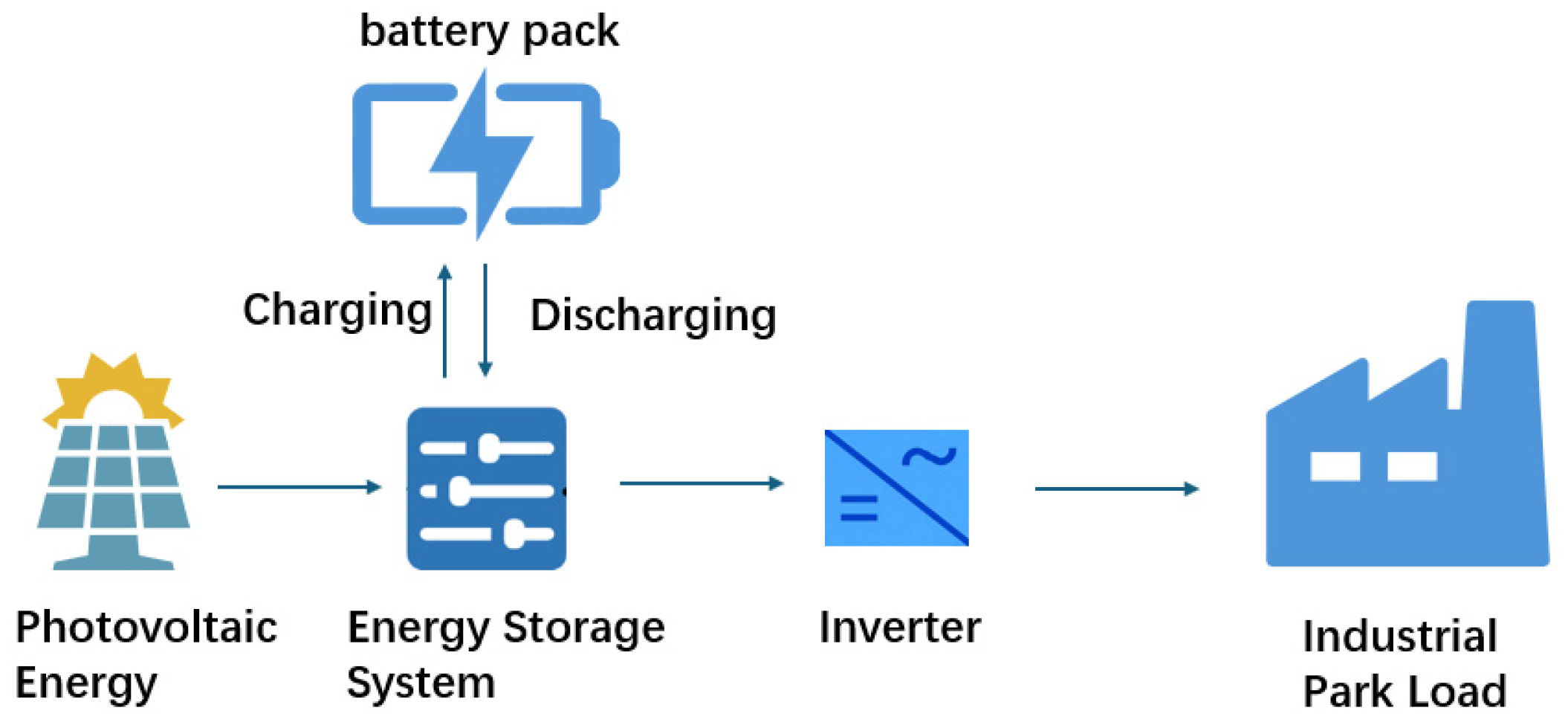
The photovoltaic-storage system consists of five components [9]: photovoltaic modules, energy storage equipment, inverters, an energy management system, and the industrial park load. The system architecture is shown in Figure 1.
The industrial park PV-storage system in this paper adopts the grid-connected operation mode of “self-consumption with surplus electricity fed into the grid.” Given that photovoltaic power generation is characterized by significant instability and volatility, the integration of an energy storage system can address the intermittency of PV generation while effectively improving the PV utilization rate. From an economic perspective, under the premise of satisfying the internal power balance of the industrial park, the PV-storage system can determine whether to purchase electricity from the main grid based on the time-of-use pricing mechanism, and reasonable power purchase decisions can effectively reduce the user’s electricity costs. The scheduling principles are as follows:
  • With the objectives of system economy and low-carbon operation, PV generation is prioritized to meet the local load demand of the park, maximizing the on-site consumption of renewable energy.
  • When the energy storage system reaches its maximum depth of discharge or rated discharge power, and PV output still cannot cover the load, the shortfall is purchased from the main grid to ensure reliable power supply to the load.
  • When PV output exceeds load demand, the surplus power is preferentially used to charge the energy storage system. If the storage system reaches its upper state-of-charge limit, the excess electricity is fed into the grid, following the principle of minimizing interaction power with the main grid to reduce power fluctuations.
  • In addition to storing surplus PV electricity, the energy storage system can also charge from the grid during off-peak price periods and discharge during peak load periods through a “valley charging, peak discharging” strategy, thereby reducing peak load demand and electricity procurement costs. Its charging strategy must comprehensively consider time-of-use electricity prices and forecasted PV output to achieve economical operation.
  • Under the premise of meeting preset power exchange limits, free bidirectional power exchange between the park’s PV-storage system and the main grid is permitted, meaning power can be either purchased from or sold to the grid, thereby enhancing operational flexibility.

2.2. PV Output Model

As a clean and renewable energy source, solar power is playing an increasingly important role in promoting global energy transition and sustainable development. Among various technologies, PV power generation, as a key pathway for efficient utilization of solar energy, has been widely applied and extensively studied across multiple fields. The fluctuation of PV output is primarily influenced by natural factors such as light intensity, ambient temperature, and weather conditions. Meanwhile, the installation scale of PV modules directly determines their power generation capacity: under sufficient sunlight conditions, a larger installation area leads to higher solar energy capture efficiency and greater electrical energy output.
Industrial parks, characterized by abundant spatial resources and concentrated factory buildings, provide ideal conditions for the large-scale deployment of PV systems. By installing PV modules on factory rooftops, not only can efficient utilization of solar energy resources be achieved, improving power generation efficiency, but also the occupation of ground land resources can be effectively avoided, enabling multiple uses of land resources and spatial value enhancement:
P P V ( t ) = P s t c G ( t ) G s t c 1 + α ( T c ( t ) T s t c )
where P P V ( t ) is the actual output power of the PV system at time t ; P s t c is the rated power of the PV module under standard test conditions; G ( t ) is the actual solar irradiance at time t; G s t c is the standard irradiance; α is the power temperature coefficient of the PV module; T c ( t ) is the actual operating temperature of the PV module at time t ; and T s t c is the standard module temperature of 25 ° C .

3. Construction of a Bi-Level Optimization Model

3.1. Upper-Level Model

The optimization decision-making of user-side photovoltaic-storage systems exhibits typical long-term and short-term coupling characteristics [10]. Specifically, the installed capacity of photovoltaics and the rated capacity of energy storage belong to long-term investment decisions, which remain fixed once determined over the project’s lifespan. These decisions are characterized by high investment and irreversibility, directly defining the technical boundaries of system operation and determining the project’s potential economic returns and investment payback period. In contrast, the charging and discharging strategies of energy storage fall under short-term operational decisions, which require real-time dynamic adjustments based on intraday load fluctuation patterns, the stochastic variability of photovoltaic output, and time-of-use electricity pricing signals. These strategies precisely align with electricity demand and market conditions, directly influencing the system’s daily operational costs and real-time revenues, thereby affecting the project’s short-term profitability.
Significant interactive coupling exists between these two decision-making levels. On one hand, capacity configuration decisions establish the physical boundaries for operational scheduling, including key parameters such as the maximum output limit of photovoltaics, the charging and discharging power thresholds of energy storage, and the capacity limits of storage. These parameters determine the operational space for short-term scheduling. On the other hand, the cumulative revenues generated from short-term operations directly determine the recoverability of long-term investment costs and overall economic viability, with the quality of operational scheduling feeding back directly into the calculation of investment returns. Traditional single-level optimization methods struggle to effectively address such cross-timescale decision-making coupling issues, as they cannot balance the rationality of long-term investment with the efficiency of short-term operations, making it difficult to achieve synergistic optimization between long-term planning and short-term operations.
To address this, this paper introduces a bi-level optimization approach for modeling. Bi-level optimization is a mathematical programming method with a hierarchical structure. By establishing two levels of decision-makers and their leader–follower hierarchical relationship, it enables the layered handling of decision-making objectives across different time scales and dimensions. This approach accurately captures the interactive coupling logic between long-term investment and short-term operations, making it well-suited for the synergistic optimization of photovoltaic-storage capacity configuration and scheduling studied in this paper, thereby overcoming the technical challenges of cross-scale decision-making coordination.
The upper-level model undertakes the long-term investment decision-making function, with its core objective being to determine the optimal configuration scheme for photovoltaic (PV) and storage capacity. This encompasses three key decision variables: PV installed capacity, rated energy capacity of storage, and rated power capacity of storage. The decision objective is to maximize the equivalent annual economic benefit of the PV-storage system. This is equivalent to minimizing the net lifecycle cost, which comprehensively accounts for the discounted sum of initial investment costs, operation and maintenance costs, decommissioning costs, and future operational expenses, while also incorporating annual revenues from electricity savings and feed-in tariffs. The constraints are defined based on the specific user scenario, incorporating practical factors such as site installation space limitations, total investment budget constraints, and equipment technical parameter limits, ensuring the feasibility of the configuration scheme. The decision results from the upper-level model serve as physical boundary constraints for the lower-level model, establishing hard technical upper limits for short-term operational scheduling and defining the scope of lower-level dispatch operations.
The lower-level model is responsible for short-term operational decisions. Its core function is to formulate the optimal intraday operational scheduling strategy based on the capacity configuration scheme provided by the upper level, utilizing data such as intraday load profiles, PV output forecasts, and time-of-use electricity price signals. The decision objective is to minimize daily operational costs. This is achieved by optimizing the charging and discharging schedule of the storage system, its charging and discharging power, and the bidirectional power interaction with the grid. The aim is to maximize the self-consumption of PV power, reduce peak-time electricity purchase costs, and exploit profit opportunities from charging storage during off-peak periods and discharging during peak periods. The constraints encompass system power-balance constraints, energy storage system operational constraints (including dynamic state-of-charge changes, charging/discharging power limits, and mutual exclusivity of charging and discharging states), PV output constraints, and power interaction limits with the grid, all of which adhere to actual equipment operational rules and grid management requirements. The optimization results from the lower-level model, including daily operational costs, power purchase and sale profiles, and the storage charging/discharging schedule, are fed back to the upper level. This feedback serves as the core basis for evaluating the economic viability of the capacity configuration scheme and supports iterative optimization at the upper level.
The upper and lower models are deeply coupled through an interactive mechanism where the upper level determines capacity and the lower level computes operational performance. The upper level provides the physical boundaries and parameters for the lower level, while the lower level offers economic feedback and decision-making justification to the upper level. The specific interaction process is as follows: the upper level generates candidate capacity configuration schemes and passes them to the lower level; based on these configuration parameters, the lower level conducts detailed optimal scheduling, calculates the corresponding daily operational costs, and returns these costs to the upper level; subsequently, the upper level calculates the total system cost over the lifecycle based on this information, using it as a fitness value to drive the optimization algorithm to generate new configuration schemes. This cycle repeats until convergence conditions are met, yielding the optimal solution. This hierarchical optimization structure effectively addresses the differences in time scales and the decision-making coupling between long-term investment and short-term operations, circumvents the limitations of single-level optimization, and achieves synergistic optimization for user-side PV-storage systems.

3.2. Upper-Level Optimization Model for PV-Storage System Capacity Configuration

3.2.1. Objective Function of the Upper-Level Optimization Model

The upper-level model focuses on the capacity planning problem of the PV-storage system, aiming to identify the capacity configuration scheme that maximizes economic benefits for an industrial park. To this end, this paper takes the installed capacities of photovoltaics and energy storage as the core decision variables, with the maximization of the equivalent annual economic benefit of the PV-storage system as the upper-level optimization objective. Given that the investments in photovoltaics and energy storage are one-time capital expenditures, this paper adopts the annualized cost method to evenly amortize the total investment cost over the system’s entire life cycle based on a discount rate. The economic performance is then comprehensively evaluated by the difference between the system’s annual operational revenue and its annualized cost:
max D = D s a l e + D s a v e D i n v D o m
where D is the equivalent annual economic benefit of the PV-storage system; D s a l e is the annual revenue from grid-connected PV power sales; D s a v e is the annual savings from electricity procurement; D i n v is the annual investment cost of the PV-storage system; and D o m is the annual operation and maintenance cost of the PV-storage system.
After the photovoltaic power generation meets the real-time load demand of the user and the charging demand of the energy storage system, any surplus electricity is fed into the upper-level grid. The revenue generated from this process is strictly accounted for based on the benchmark feed-in tariff for photovoltaics in the region, which constitutes the surplus electricity feed-in revenue of the system:
D s a l e = t = 1 T m P V ( t ) max P P V ( t ) P c h ( t ) + P d i s ( t ) P l o a d ( t ) , 0 Δ t
where m P V ( t ) is the benchmark feed-in tariff for PV; P c h ( t ) and P d i s ( t ) are the charging and discharging power of the energy storage system at time t ; P l o a d ( t ) is the real-time load power demand at time t; P g r i d s a l e ( t ) is the maximum value obtained in the parentheses is the grid-connected PV power sales; and Δ t is the duration of each time step.
When the photovoltaic-storage system is not configured, all of the user’s electricity demand is met entirely by purchasing power from the main grid, and the corresponding electricity costs are paid according to the industrial time-of-use electricity price. After investing in and constructing the PV-storage system, the user meets part of the load demand through local photovoltaic generation and storage discharge, thereby effectively reducing the amount of electricity purchased from the main grid. The difference in electricity procurement costs before and after configuring the PV-storage system can be regarded as the cost savings achieved by the user-side PV-storage system:
D s a v e = t T m b u y ( t ) P l o a d ( t ) P g r i d b u y ( t ) Δ t
P g r i d b u y ( t ) = P l o a d ( t ) min P p v ( t ) + P d i s ( t ) , P l o a d ( t )
where m b u y ( t ) is the time-of-use electricity purchase price at time; and P g r i d b u y ( t ) is the electricity purchase power.
The equipment investment cost mainly includes the unit price of photovoltaic panels, the unit price of energy storage capacity, and the unit price of energy storage charging/discharging power. Meanwhile, since the service life of photovoltaic equipment is generally longer than that of energy storage equipment, equipment replacement costs need to be considered:
D i n v = ( 1 + 1 1 + r q 1 ( E r a t e d C E S S + P E S S max C E S S , p ) + E P V C P V ) r ( 1 + r ) n ( 1 + r ) n 1
where E r a t e d is rated capacity of the energy storage battery; C E S S is unit capacity cost of the energy storage battery; P E S S max is maximum charging/discharging power of the energy storage system; C E S S , p is unit power cost of the energy storage system; E P V is the installed capacity of the PV system; C P V is unit cost of PV; C P V max is the discount rate; q is the year when the energy storage equipment is replaced; n is planning horizon of the user’s PV-storage system; and r is the annual discount rate.
The operation and maintenance costs of the PV-storage system are closely related to its operational status. Among these, a portion of the operation and maintenance costs is power-sensitive, meaning that the cost increases with the level of equipment operating power, reflecting the additional wear and maintenance requirements under high-intensity operation:
D o m = t = 1 T P P V ( t ) C P V o m + P d i s ( t ) C E S S o m Δ t
where C p v o m is the unit operation and maintenance cost of the photovoltaic system per unit power; and C E S S o m is the unit operation and maintenance cost of the energy storage system per unit power.

3.2.2. Constraints of the Upper-Level Optimization Model

The photovoltaic and storage capacities are limited by available space, grid connection capacity, and equipment technical parameters:
0 < E P V E P V , max 0 < E r a t e d E r a t e d , max P g r i d s a l e ( t ) P g r i d , max s a l e
where E P V , max is the maximum allowable installed capacity of the photovoltaic system; E r a t e d , max is the maximum allowable capacity of the energy storage system; and P g r i d , max s a l e is the maximum power limit for the grid to accommodate photovoltaic generation.

3.3. Lower-Level Optimization Model for PV-Storage System Operational Strategy

3.3.1. Objective Function of the Lower-Level Optimization Model

The lower-level model focuses on the intraday operational scheduling optimization of the PV-storage system. Based on the photovoltaic and energy storage capacities determined by the upper-level model, it formulates the optimal energy storage charging and discharging strategy and grid interaction plan under the time-of-use pricing mechanism. The model aims to minimize the user’s daily net electricity cost, achieving economical system operation through optimal scheduling. The optimization results will be fed back to the upper level to evaluate the economic viability of the capacity configuration scheme:
min F = t = 1 T ( m b u y ( t ) P g r i d b u y ( t ) m P V ( t ) P g r i d s a l e ( t ) ) Δ t

3.3.2. Constraints

The grid interaction power, PV system output, and energy storage dispatch power must satisfy the user’s electricity load demand:
P p v ( t ) + P d i s ( t ) + P g r i d b u y ( t ) = P l o a d ( t ) + P c h ( t ) + P g r i d s a l e ( t )
The energy storage capacity constraint ensures that the operating state of the energy storage system remains within a safe range. The capacity constraint can be expressed as follows:
S O C m i n S O C ( t ) S O C m a x
where S O C ( t ) denotes the SOC at time t , and S O C m i n and S O C m a x represent the lower and upper bounds of the SOC, respectively. In this paper, the SOC ranges from 0.05 to 0.95.
By considering the impact of charging and discharging efficiencies on energy storage capacity, the SOC dynamic equation is formulated as follows:
S O C ( t ) = S O C ( t 1 ) + η c h P c h ( t ) Δ t E r a t e d P d i s ( t ) Δ t η d i s E r a t e d
where S O C t 1 denotes the SOC at time t 1 ; η c h is the charging efficiency; and η d i s is the discharging efficiency.
The energy storage system cannot charge and discharge simultaneously; therefore, charging status indicator u c h ( t ) and discharging status indicator u d i s ( t ) are introduced, both of which are binary variables:
u c h ( t ) + u d i s ( t ) 1
0 P c h ( t ) u c h ( t ) P c h m a x 0 P d i s ( t ) u d i s ( t ) P d i s m a x
where P c h m a x and P d i s m a x are the maximum allowable charging and discharging power of the energy storage system.
During the operation of the energy storage system, compared with instantaneous fluctuations in charging and discharging power, frequent switching of charging/discharging states has a more significant impact on the system’s operational economy and the cycle life of the battery itself. Therefore, effectively reducing unnecessary power throughput through optimized scheduling strategies is of great significance for lowering the operating costs of the energy storage system and extending battery service life:
v c h ( t ) u c h ( t ) u c h ( t 1 ) v c h ( t ) u c h ( t ) v c h ( t ) 1 u c h ( t 1 )
where the binary variable v c h ( t ) is introduced to indicate whether charging starts at time t, and similarly, the binary variable v d i s ( t ) is introduced to indicate whether discharging starts at time t. In these formulations, u c h ( t 1 ) and u d i s ( t 1 ) denote the charging and discharging status indicators in the previous period t 1 , respectively, to capture state transitions between consecutive periods:
v d i s ( t ) u d i s ( t ) u d i s ( t 1 ) v d i s ( t ) u d i s ( t ) v d i s ( t ) 1 u d i s ( t 1 )
t = 1 T v c h ( t ) z t = 1 T v d i s ( t ) z
where z is the maximum allowable number of charging and discharging cycles, which users can adjust according to their actual circumstances.

3.4. Model Solution Method

The bi-level optimization model for PV-storage capacity configuration and scheduling constructed in this paper features an upper level that addresses the nonlinear optimization problem of PV-storage capacity optimization and a lower level that addresses a mixed-integer programming scheduling problem containing binary variables. The two levels are coupled and solved through a hierarchical mechanism of “upper-level determines capacity, lower-level calculates operation, and economic feedback drives iteration.”
The lower-level model is a day-ahead operational scheduling optimization model for the PV-storage system. It aims to minimize the daily net electricity cost and incorporates multiple constraints, including power balance, energy storage operation, and grid interaction. It also involves binary variables such as power purchase/sale status and charging/discharging status, constituting a mixed-integer programming problem. CPLEX is employed to solve it. This solver possesses efficient linearization capabilities and global optimization characteristics, ensuring that the lower-level mixed-integer programming problem obtains a globally optimal solution for a given capacity scheme. It rapidly determines the optimal scheduling results, including the charging/discharging power of the energy storage system and the power purchased from/sold to the grid at each time interval, meeting the requirement of the lower-level model to provide real-time economic feedback to the upper level.
The upper-level model addresses the PV-storage capacity configuration optimization problem. Its decision variables are the installed capacity of photovoltaics, the rated energy capacity of storage, and the rated power capacity of storage, with the objective of maximizing the equivalent annual economic benefit of the system. This constitutes a nonlinear optimization problem with continuous variables. The Chaotic Sparrow Algorithm is selected for solving the problem. This algorithm introduces chaotic mapping to perturb the initial population generation and the position update of the discoverers within the standard sparrow search algorithm, effectively mitigating the issues of local-optima entrapment and low convergence accuracy commonly found in traditional algorithms. It combines strong global search capability, fast convergence speed, and concise parameter settings, requiring no complex gradient calculations. It can efficiently traverse the feasible domain of capacity configurations, making it well-suited for upper-level PV-storage capacity optimization requirements. The algorithm achieves population iteration by simulating the behavioral patterns of sparrow populations, including foraging by discoverers, following by joiners, and early warning by scouts, enabling precise searching for the optimal capacity solution.

3.4.1. Performance Validation of the CSSA

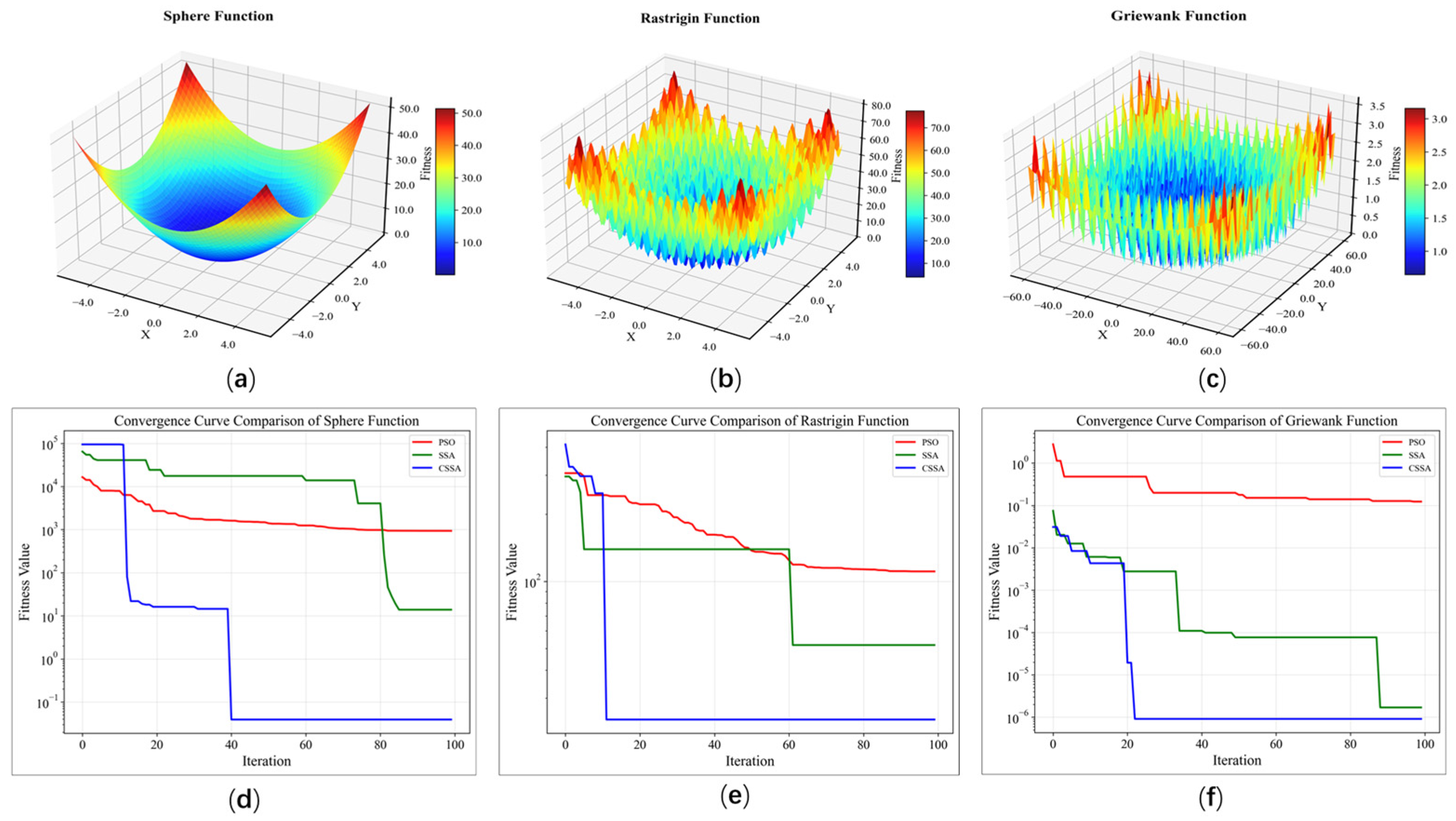
To verify the effectiveness and superiority of the CSSA in solving the upper-level capacity configuration problem, three classical benchmark functions—the unimodal Sphere function and the multimodal Rastrigin and Griewank functions—are employed for the simulation experiments. The parameter settings of these test functions are listed in Table 1. The Sphere function tests the basic optimization capability, while Rastrigin and Griewank examine the algorithm’s ability to escape local optima.
The CSSA is compared with Particle Swarm Optimization (PSO) and the standard Sparrow Search Algorithm (SSA). The three-dimensional landscapes of the three functions are shown in Figure 2a–c, and the convergence curves of the three algorithms on each function are presented in Figure 2d–f. The results indicate the following:
  • On the unimodal Sphere function, PSO converges slowly and tends to become trapped in local optima. The SSA converges, but with limited precision. In contrast, the CSSA, through chaotic initialization, enhances the uniformity of population distribution, significantly accelerates convergence, and rapidly approaches the theoretical optimum from the early iterations, demonstrating strong global search ability and high precision.
  • On the multimodal Rastrigin and Griewank functions, both PSO and SSA are easily disturbed by numerous local optima, leading to premature convergence and stagnation. The CSSA, however, employs a chaotic perturbation strategy during iteration, effectively improving its ability to jump out of local optima. It continuously progresses towards the theoretical optimum and achieves substantially better convergence accuracy than the comparison algorithms.
Overall, the introduction of chaotic mechanisms significantly improves the initial population quality and local-optima avoidance capability of the standard SSA. The CSSA outperforms both PSO and SSA in convergence speed, optimization accuracy, and global search stability, confirming its effectiveness and competitiveness for solving the upper-level capacity configuration problem in the bi-level optimization model proposed in this paper.
Figure 2. 3D landscapes of benchmark functions and convergence curves comparison of different algorithms. (a) Sphere Function. (b) Rastrigin Function. (c) Griewank Function. (d) Convergence Curve Comparison of Sphere Function. (e) Convergence Curve Comparison of Rastrigin Function. (f) Convergence Curve Comparison of Griewank Function.
Energies 19 02504 g002

3.4.2. Solution Procedure

The solution procedure is as follows:
Step 1: Input the technical and economic parameters of the PV-storage system, time-of-use electricity prices, and load and PV forecast data. Initialize the parameters of the Chaotic Sparrow Algorithm: population size, maximum number of iterations, and convergence threshold. Use Circle chaotic mapping to generate the initial population, where each individual represents a set of capacity configurations.
Step 2: Sequentially select individuals from the current population and transfer their corresponding capacity configurations to the lower-level model as boundary constraints for operational scheduling.
Step 3: Based on the capacity configuration passed from the upper level, with the objective of minimizing the daily net electricity cost, call the CPLEX solver to solve the lower-level MILP model and obtain the optimal daily operation strategy. If no solution is found, return to Step 2.
Step 4: Annualize the scheduling strategy results, calculate the equivalent annual economic benefit of the capacity scheme, and assign it as the fitness value of the current individual.
Step 5: After completing the fitness evaluation for all individuals in the population, update the positions of the discoverers, followers, and vigilantes according to the rules of the Chaotic Sparrow Algorithm to generate a new generation of the population. If the convergence condition is not met, return to Step 2; otherwise, proceed to Step 6.
Step 6: Output the individual with the maximum fitness as the optimal capacity configuration, along with its corresponding lower-level optimal scheduling strategy.

4. Case Study

This paper selects 1 year of historical load data and historical photovoltaic data from an industrial park. Under the time-of-use electricity pricing framework, capacity configuration optimization is performed for two scenarios: photovoltaic-only and photovoltaic-plus-storage. The proposed bi-level model is then validated and analyzed to determine the optimal capacity configuration and verify the application of the operating strategy.
For this purpose, the following parameters are adopted: the entire lifecycle of the PV-storage system is set to 20 years, with an operational life of 20 years for the PV equipment and 10 years for the energy storage equipment, and a discount rate of 7%. The unit cost of PV equipment is 3800 RMB/kW, and the unit cost of energy storage equipment is 1400 RMB/kWh. The peak-valley periods are shown in Table 2.

4.1. Analysis and Validation of Configuration Results

To validate the effectiveness of the proposed bi-level optimization model in the configuration and economic dispatch of user-side PV-storage systems, three different scenarios are compared and analyzed: a scenario without a PV-storage system, a scenario with PV only, and a scenario with both PV and energy storage systems. The optimal configuration capacities and operational revenues of the PV-storage system, along with the results, are presented in Table 3.
Table 3 shows that when the user does not have photovoltaic or energy storage equipment installed, all electricity demand is met by the grid, resulting in excessively high electricity purchase costs and significant economic pressure. After choosing to install photovoltaic equipment, part of the user’s energy demand is met by PV output, and the average annual electricity purchase cost decreases from RMB 21.394 million to RMB 16.295 million. This indicates that installing PV equipment can effectively reduce the user’s electricity purchase costs and improve the economic efficiency of the park’s power supply. Specifically, with the installation of PV equipment alone, the annual investment cost is RMB 2.517 million. PV output reduces the user’s electricity purchases, while surplus electricity fed back to the grid generates annual feed-in revenue of RMB 0.446 million, further offsetting electricity expenses. After accounting for the annual investment cost of RMB 2.517 million and the annual operation and maintenance cost of RMB 0.165 million, the user’s net electricity cost decreases from RMB 21.394 million to RMB 18.531 million, a reduction of 13.3%, significantly improving the user’s economic performance.
After adding 9.54 MWh of energy storage equipment, the investment cost increases to RMB 4.036 million, and the overall operation and maintenance cost of the system also rises to RMB 0.213 million. With the large-scale integration of the energy storage system, the operational strategy changes significantly: during peak PV output periods, the storage system prioritizes charging, storing the PV electricity that would otherwise be fed directly into the grid for use during subsequent load peaks or high electricity price periods. Although this considerably reduces the amount of PV electricity fed into the grid, lowering the feed-in revenue from RMB 0.446 million per year in the PV-only scenario to RMB 0.175 million per year, the storage system, by charging during off-peak periods and discharging during peak periods, significantly increases the self-consumption ratio of PV generation and effectively replaces electricity purchased from the grid during peak periods. This further reduces the average annual electricity purchase cost to RMB 13.622 million per year. Overall, although investment and operation and maintenance costs increase, the reduction in electricity purchase costs is more substantial, ultimately reducing the user’s net cost to RMB 17.696 million per year, a further decrease of 4.5% compared with the PV-only scenario. This demonstrates that the introduction of an energy storage system can further optimize the user’s electricity consumption structure, enhancing PV utilization while effectively reducing overall electricity costs.

4.2. Analysis of Operational Optimization Results

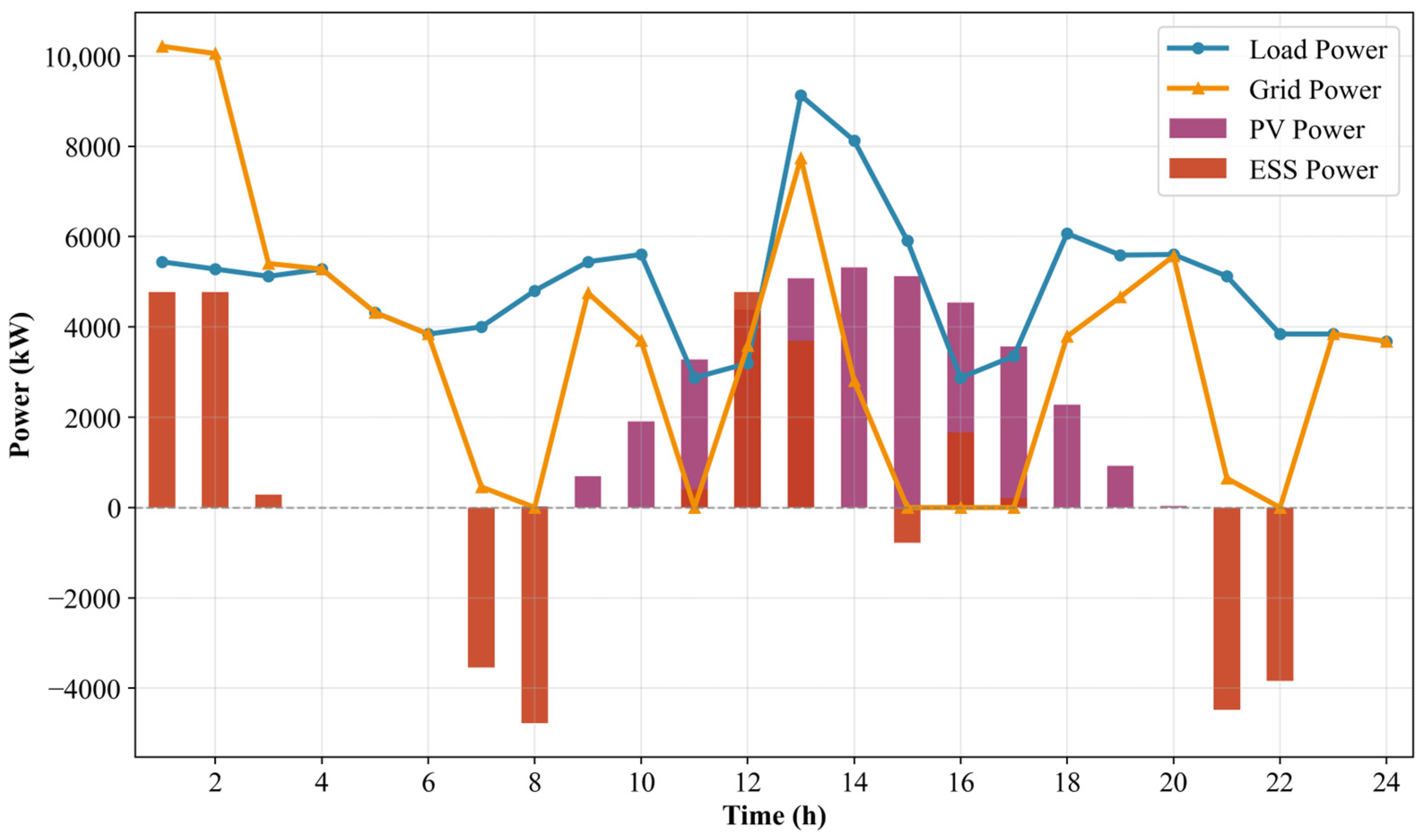
Here, the analysis focuses on the operational optimization results of the user’s overall electricity consumption after the installation of the PV-storage system. The scheduling plan is based on the capacity configuration results derived from the upper-level capacity optimization model, solving for the electricity load and PV output to provide the optimal scheduling scheme for the energy storage system. The optimized operational strategy is shown in Figure 3.
As can be seen from Figure 3, from midnight to 3:00 a.m., there is no photovoltaic output, and the user needs to purchase electricity from the grid to meet their own electricity demand. During this period, the electricity price is at the valley level, the lowest of the day. The energy storage system charges using valley-price electricity, storing power for the next peak period. From 7:00 to 8:00 a.m., the scheduling plan considers it profitable to discharge, so the energy storage system begins to discharge, replacing part of the electricity that would otherwise be purchased from the grid. Starting at 9:00 a.m., photovoltaic output appears, offsetting part of the electricity procurement cost. Between 11:00 a.m. and 12:00 p.m., the user’s electricity demand decreases; photovoltaic output meets the load demand while also charging the storage system. From 12:00 to 2:00 p.m., the user experiences a peak load; however, due to electricity price considerations, the storage system prioritizes charging during this period. At 3:00 p.m., during periods when PV output exceeds the park’s load, the system absorbs the surplus PV electricity, converting what would have been exported to the grid into chemical energy for storage. This minimizes the amount of PV electricity fed into the grid while enabling local storage of clean energy, effectively improving the PV utilization rate. During the peak-price period from 9:00 to 10:00 p.m., the storage system discharges to reduce electricity purchase costs. Overall, the scheduling plan makes use of two peak and valley periods under the time-of-use electricity price. Through a “two-charge, two-discharge” strategy, it effectively reduces the user’s electricity costs while also addressing the issue of PV curtailment.

4.3. Daily Operational Economic Benefit Analysis

Based on a typical day selected from the annual dataset, the daily operational economic data of the PV-storage system are calculated. It can be observed that the joint operation of PV and storage achieves significant results in improving PV utilization and reducing electricity procurement costs.
In terms of PV utilization, the typical daily PV generation is 37,167.22 kWh, all of which is consumed by local loads, achieving zero curtailment. Among this, 621.78 kWh of PV electricity is indirectly supplied to loads through the energy storage system (i.e., charged first and then discharged), while the remainder is directly supplied to base loads. The direct benefit from PV generation amounts to RMB 20,752.75 (calculated based on the PV feed-in tariff or the electricity cost saved through self-consumption), fully demonstrating the role of energy storage integration in enhancing PV utilization. Without storage, surplus electricity during periods of high PV output would need to be fed into the grid at low prices or even curtailed. The presence of storage enables the complete local consumption of PV electricity, maximizing the utilization of clean energy.
From the perspective of energy storage operational performance, the system charges 20,578.63 kWh and discharges 17,417.75 kWh on a typical day, resulting in a charging/discharging efficiency of approximately 84.6%. Economically, the charging cost of the storage system is RMB 6838.7, while the discharging revenue amounts to RMB 16,382.04, yielding a net daily benefit of RMB 9543.34. This benefit stems from the price arbitrage strategy of “charging during valley periods and discharging during peak periods,” validating the regulation value and economic benefits of the energy storage system under the time-of-use pricing mechanism.
Regarding grid electricity purchases, the total base load on the typical day is 118,350.84 kWh. Without the installation of PV and storage equipment, the electricity procurement cost would be RMB 68,289.83. After installing the PV-storage system, the user’s electricity procurement cost decreases to RMB 38,593.73, resulting in savings of RMB 29,696.1.

4.4. Sensitivity of Economic Benefits to Energy Storage Capacity Degradation

The base case analysis in Section 4.1 assumes that the battery operates at 100% of its rated capacity until the predefined 10-year replacement, neglecting the progressive State of Health (SOH) deterioration. To quantify the degree of benefit overestimation caused by this simplification, a sensitivity analysis is conducted under two representative linear degradation scenarios.
Scenario I (moderate degradation): The battery SOH exhibits a linear decline from 100% to 80% over the 10-year service period, resulting in an average available capacity of around 90%.
Scenario II (severe degradation): The battery SOH decreases linearly from 100% to 70% over 10 years, leading to an average available capacity of roughly 85%.
Because the daily operational benefit of energy storage is predominantly driven by the amount of energy shifted from valley to peak periods, we adopt a first-order approximation in which the annual arbitrage revenue scales proportionally with the average available capacity. Table 4 presents the adjusted annual economic figures for the PV-storage scenario (original capacities: 7.86 MW PV, 9.54 MWh BESS).
The results indicate that, under a linear degradation assumption, the omission of SOH leads to an overestimation of the lifecycle benefit by roughly 10–15%, depending on the actual end-of-life retention. It should be stressed that this linear scaling represents a best-case sensitivity; in practice, degradation also increases internal resistance and reduces round-trip efficiency, which would further compress the achievable arbitrage profit. Therefore, the figures reported in the base case should be regarded as an upper bound, and the actual economic return is expected to be lower by at least the margins shown in Table 4.

4.5. Analysis of PV Forecast Errors in the Scheduling Model

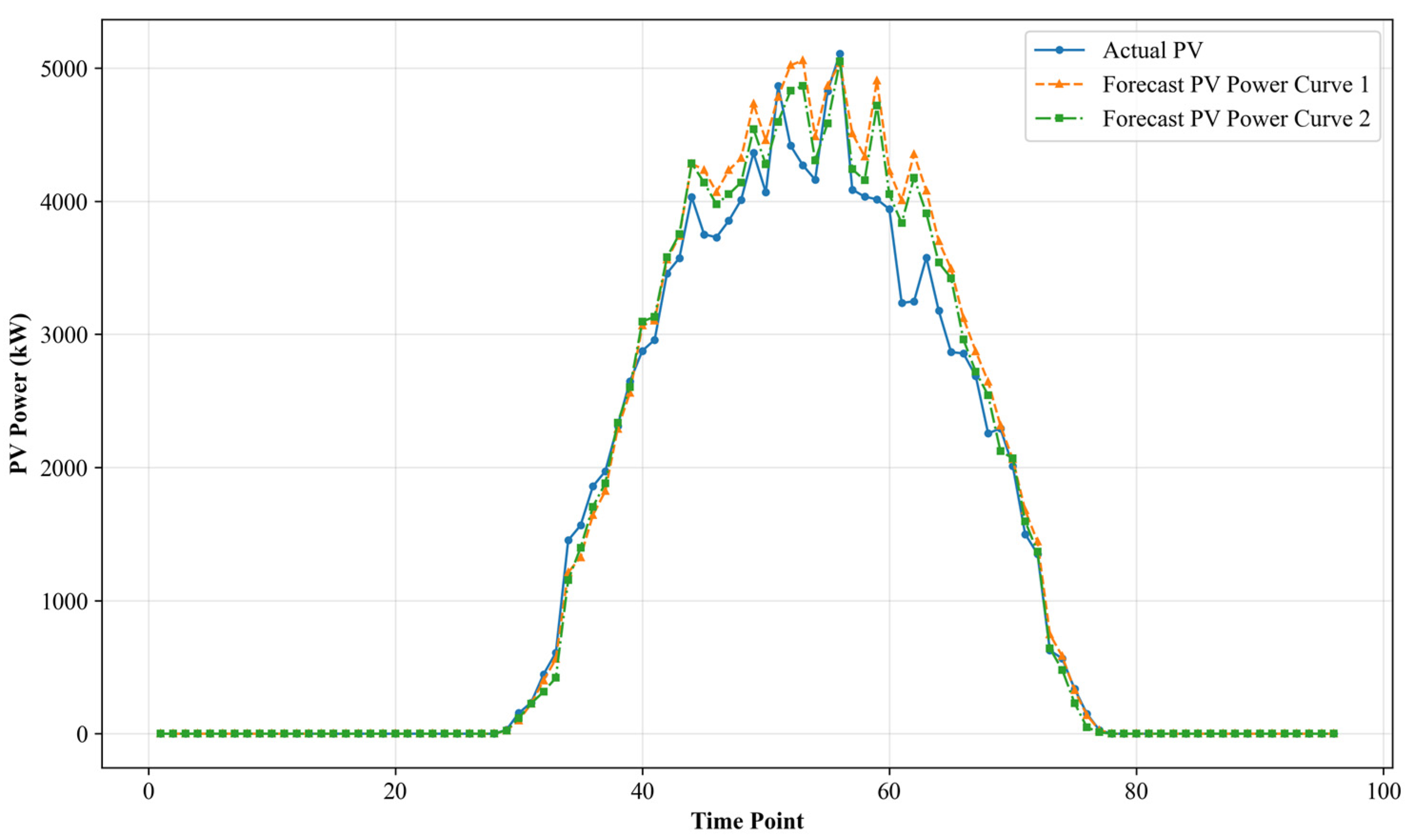
The aforementioned scheduling plan is generated based on historical data, and the resulting benefits assume no forecasting error. However, in actual operation, photovoltaic forecast data must be input in advance to generate the scheduling plan. Therefore, this section conducts a benefit analysis using PV forecast data with different error rates. The forecast data are generated by taking the actual measured PV power as the baseline and adding controllable Gaussian white noise to simulate prediction errors, thereby producing simulated forecast data. Non-negativity constraints are applied to comply with the physical characteristics of PV output. The prediction accuracy can be controlled by adjusting the standard deviation of the noise, which is then used for the subsequent optimization and benefit analysis of the PV-storage system. The generated photovoltaic forecast data are shown in Figure 4.
This paper uses root mean square error (RMSE), mean absolute error (MAE), and the coefficient of determination (R2) as the evaluation metrics for the model. The results of the error metrics are presented in Table 5.
From the error metric results, it can be seen that all indicators of forecast PV power curve 1 are better than those of forecast PV power curve 2.
This section focuses on the error between the dispatched grid power generated based on photovoltaic forecast data of different accuracies and the actual photovoltaic grid power.
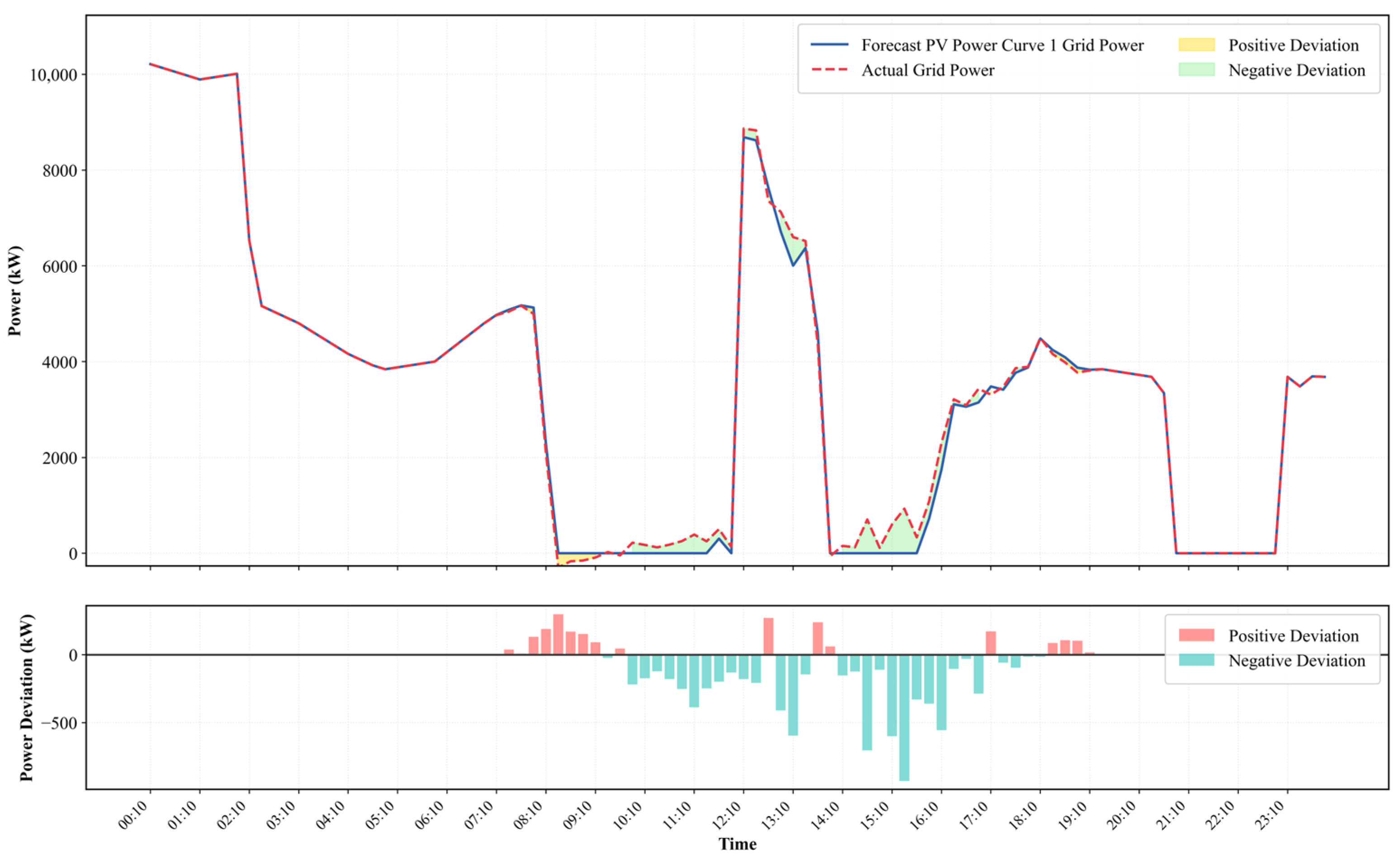
As can be seen from Figure 5, the upper subplot shows a time-series comparison and deviation distribution between the dispatched grid power generated based on forecast PV power curve 1 and the actual grid power, while the lower subplot intuitively presents the magnitude of power deviation over each time period. During the daytime periods when photovoltaic output fluctuates, a clear deviation occurs between the forecast-based dispatched power and the actual power, with the deviation amplitude increasing in tandem with changes in PV output. Positive deviations are concentrated during the initial rise in PV output, where the actual PV output exceeds the forecasted PV power, leading to an overestimation of grid electricity purchase demand. In this case, the user’s electricity cost decreases. Negative deviations are concentrated during periods of strong PV output, where the actual PV output is lower than the forecasted PV power, resulting in an underestimation of grid electricity purchase demand. At 15:00, the deviation reaches its maximum magnitude of 969.56 kW, leading to an increase in electricity purchase costs. Overall, significant deviations occur during periods of intense PV fluctuations, and such deviations directly affect electricity costs, causing them to differ from expectations.
According to the data shown in Table 6, the electricity cost of the scheduling plan based on forecast PV power curve 1 increased by RMB 1156.98.
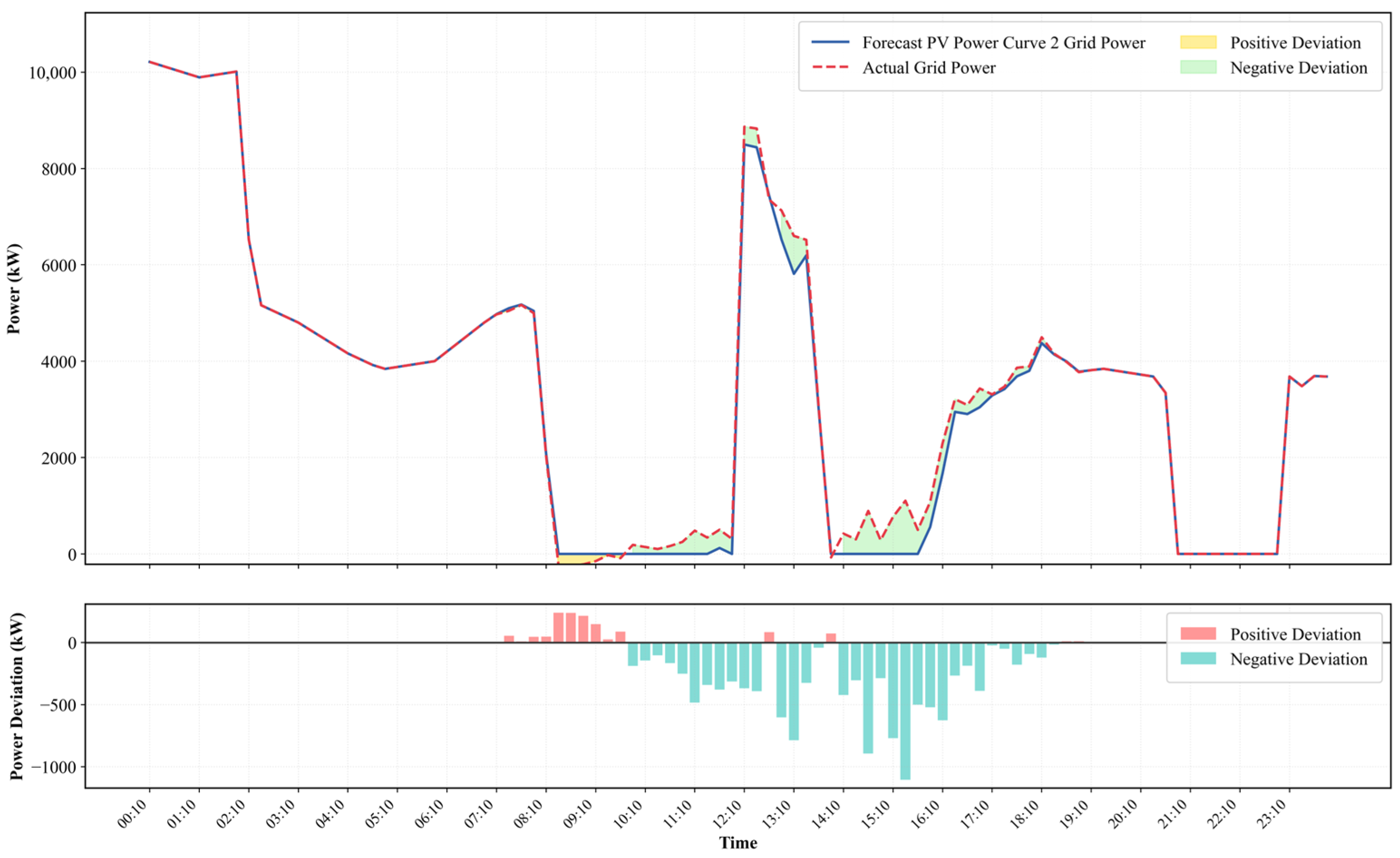
As shown in Figure 6, the error of the generated forecast PV power curve 2 is relatively large; there are still many periods during which the PV output is overestimated. The specific data are shown in Table 7.
Photovoltaic forecast errors have a significant impact on the operational economy of the PV-storage system. When the forecast overestimates PV output, the actual electricity procurement cost increases; when the forecast underestimates PV output, according to the data in Table 7, the actual electricity procurement cost still exceeds the expected value, with an increase of RMB 1927.84. Analysis shows that in the underestimation scenario, although the actual PV output is higher than the forecasted value, the scheduling strategy is formulated based on the forecast and fails to reserve absorption capacity in advance. As a result, the surplus PV generation cannot effectively replace grid electricity purchases, and the expected economic benefits are not realized.

4.6. Risk-Aware Fault-Tolerant Scheduling Strategy and Economic Comparison

To address the scheduling mismatch caused by PV forecast errors, especially the issue of insufficient system absorption capacity, increased curtailment risk, and higher electricity procurement costs resulting from PV underestimation, this section proposes a fault-tolerant scheduling strategy with risk awareness under the condition that the load data is deterministic, and only PV forecast errors exist. Instead of merely tracking the point forecast value of PV, this strategy proactively reserves absorption margin to prioritize mitigating the risk of PV underestimation, thereby improving the adaptability of scheduling to forecast errors and actual economic benefits.

4.6.1. Design of the Risk-Aware Fault-Tolerant Scheduling Strategy

In the lower-level day-ahead optimal scheduling, the load, electricity price, energy storage constraints, and system architecture remain unchanged. Only the PV forecast input is processed with conservative bias to form the fault-tolerant scheduling command:
P P V a d j ( t ) = min ( P P V f o r e ( t ) ( 1 + γ ) , P P V r a t e d )
where P P V a d j ( t ) is the equivalent forecast power used for fault-tolerant scheduling; P P V f o r e ( t ) is the original forecast power; γ is the conservative bias coefficient, reserving a 5% absorption margin; and P P V r a t e d is the rated installed capacity of PV, which limits the adjusted power not to exceed the actual maximum output of the equipment to ensure physical feasibility.
The core logic of this strategy is to rather slightly overestimate than severely underestimate. By forcibly increasing the reserved charging capacity of energy storage, it ensures that the actual excess PV power can be fully absorbed to avoid cost losses caused by insufficient absorption capacity.

4.6.2. Comparative Experiment and Result Analysis

Taking PV forecast curve 2 in Section 4.4 as the input, two comparative schemes are set:
  • Baseline strategy: Scheduling directly using the original PV forecast value;
  • Fault-tolerant strategy: Scheduling using the biased equivalent PV forecast value with upper bound constraint.
The load, energy storage capacity, electricity price structure, optimization objectives and constraints are kept completely consistent. The economic performance of a typical day is compared, and the results are shown in Table 8.
As shown in Table 8, compared with the original scheduling strategy, the risk-aware fault-tolerant scheduling approach with a 5% conservative bias reduces daily grid electricity purchases by 1690.16 kWh and daily electricity procurement costs by RMB 388.35. Notably, the additional cost relative to the ideal scenario is markedly reduced by 20.14%, from RMB 1927.84 to RMB 1539.59. These results demonstrate that the proposed strategy effectively mitigates the adverse economic impact of PV forecast underestimation, enhancing both the system’s PV absorption capability and overall economic robustness.

5. Conclusions

To address the collaborative optimization problem of capacity configuration and operational scheduling for user-side PV-storage systems, this study takes an industrial park as the research object, comprehensively considers investment and operational costs, and analyzes the impact of PV forecast errors on electricity procurement costs. The main quantitative findings are as follows.
1
Economic benefit of PV-storage configuration.
Based on full-year historical data from the industrial park, installing PV alone (7.86 MW) reduces the user’s net annual electricity cost from 21.394 million RMB to 18.531 million RMB, a saving of 13.3%. Adding a 9.54 MWh energy storage system further lowers the net cost to 17.696 million RMB per year, achieving an additional 4.5% reduction compared with the PV-only scenario. The energy storage system enables complete local consumption of PV generation and yields a daily arbitrage profit of 9543 RMB through a “two charge, two discharge” strategy under the time-of-use pricing structure.
2
Asymmetric impact of PV forecast errors.
When PV forecasts contain errors, the effect on operational cost is asymmetric. Underestimation of PV output (actual PV higher than forecast) leads to a larger cost penalty than overestimation. For a typical day, a forecast with RMSE of 260.73 kW increases the daily electricity procurement cost by 1927.84 RMB compared with the ideal perfect forecast case. The proposed risk-aware fault-tolerant scheduling strategy (with a 5% conservative bias reserve) reduces this additional cost by 20.14% (from 1927.84 RMB to 1539.59 RMB per day), demonstrating that proactively reserving absorption capacity effectively mitigates the economic risk of forecast underestimation.
3
Sensitivity to battery degradation.
The base case assumes a fixed 10-year battery life with instant replacement. When progressive capacity fading (SOH decline) is considered under linear degradation profiles (end-of-life SOH 80% or 70%), the annual economic benefit is overestimated by approximately 10–15%. Hence, the reported benefits should be viewed as an upper bound; practical returns will be lower unless a refined aging model is incorporated.
This study assumes a fixed 10-year calendar life with instantaneous battery replacement, ignoring the progressive capacity fading (SOH decline) that occurs in real electrochemical systems. The sensitivity analysis in Section 4.4 shows that the static-capacity assumption may overestimate the annual economic benefit by approximately 10–15% under typical linear degradation profiles, and the actual overestimation is likely larger due to efficiency penalties and reduced capability to serve high-price peak loads. Furthermore, when degradation is explicitly modeled, the optimal installed capacity determined by the upper-level problem may shift upward by a certain margin to compensate for the gradual loss of usable capacity, but a dedicated joint optimization that embeds a refined electrochemical aging model is clearly warranted.
Furthermore, future work will aim to extend the proposed bi-level framework from a strong grid-connected context to weak-grid and islanded microgrid scenarios. To address the harsher operational conditions, fundamental methodological changes are required:
  • Model Reformulation: The lower-level problem must be reformulated as a multi-objective optimization, striking a Pareto-optimal trade-off between minimizing lifecycle costs and minimizing the probability of load shedding (e.g., Loss of Load Probability, LOLP). A pure economic objective function would no longer suffice.
  • Constraint Enhancement: Dynamic constraints, such as frequency and voltage stability, must be explicitly incorporated. This necessitates modeling the grid-forming capabilities of battery inverters to ensure sufficient inertia support and primary frequency regulation, often involving robust constraints for rate-of-change-of-frequency and frequency nadir.
  • Uncertainty Management: Without the main grid as a buffer, uncertainties from both renewable generation and load shift from being purely economic risks to direct physical threats to power supply security. To address this, more advanced techniques like Distributionally Robust Optimization (DRO) or Robust Model Predictive Control (RMPC) are required to generate “immunized” scheduling strategies that ensure system survivability under worst-case power fluctuations.

Author Contributions

Conceptualization, S.C. and D.K.; methodology, S.L.; software, S.C.; validation, S.C., D.K. and S.L.; formal analysis, S.C.; investigation, S.C.; resources, S.C.; data curation, S.C.; writing—original draft preparation, S.C.; writing—review and editing, S.C.; visualization, D.K.; supervision, S.L. All authors have read and agreed to the published version of the manuscript.

Funding

This research received no external funding.

Data Availability Statement

The data supporting the findings of this study are not publicly available due to ongoing research and project-related confidentiality. The data may be made available from the author upon reasonable request.

Conflicts of Interest

The authors declare no conflict of interest.

References

  1. Xu, W.; Lu, Q.; Wang, J. Research on capacity optimization configuration of distributed photovoltaic energy storage system. J. Phys. Conf. Ser. 2025, 2963, 012027. [Google Scholar] [CrossRef]
  2. Wang, Y.; Ji, H.; Luo, R.; Liu, B.; Wu, Y. Energy Optimization Strategy for Wind–Solar–Storage Systems with a Storage Battery Configuration. Mathematics 2025, 13, 1755. [Google Scholar] [CrossRef]
  3. Zhou, D.; Wang, Z.; Xi, K.; Zuo, C.; Jia, Y. Optimization Configuration Analysis of Wind-Solar-Storage System Based on HOMER. Energy Eng. 2025, 122, 2119–2153. [Google Scholar] [CrossRef]
  4. Wang, X.; Wang, X.; Qin, B. Improved multi-objective differential evolution algorithm and its application in the capacity configuration of urban rail photovoltaic hybrid energy storage systems. J. Energy Storage 2024, 98, 113155. [Google Scholar] [CrossRef]
  5. Ren, Z.; Yu, Q.; Lin, D.; Dong, Y. Optimal capacity configuration of a wind-solar-battery-diesel microgrid system using continuous grey wolf optimization. J. Energy Storage 2025, 113, 115630. [Google Scholar] [CrossRef]
  6. Hao, H.; Wen, C.; Xue, F.; Qiu, H.; Yang, N.; Zhang, Y.; Wang, C.; Nyakilla, E.E. Recent Advancements in the Optimization Capacity Configuration and Coordination Operation Strategy of Wind-Solar Hybrid Storage System. Energy Eng. 2024, 122, 285–306. [Google Scholar] [CrossRef]
  7. Sun, S.; Cheng, Y.; Yu, P. Coordinated Planning of Photovoltaic-BESS Hybrid System for Industrial and Commercial Users Considering Scheduling Strategy. Adv. Technol. Electr. Eng. Energy 2022, 41, 81–88. [Google Scholar]
  8. Yang, B.; Liu, Z.; Yang, S.; Cui, C.; Deng, S. Research on the optimal allocation method of PV micro-grid energy storage capacity based on empirical modal decomposition. J. Phys. Conf. Ser. 2023, 2503, 012013. [Google Scholar] [CrossRef]
  9. Smajila, L.; Trevisan, S.; Golzar, F.; Vaidya, K.; Guedez, R. Comparative analysis of techno-economic and techno-environmental approach to optimal sizing and dispatch of hybrid solar–battery systems. Energy Convers. Manag. X 2025, 25, 100858. [Google Scholar] [CrossRef]
  10. Fan, C.; Wang, H.; Zhang, J.; Cheng, P.; Bian, Y. Optimal Energy Storage Allocation for Combined Wind-PV-EVs-ES System Based on Improved Triangulation Topology Aggregation Optimizer. Electronics 2024, 13, 4041. [Google Scholar] [CrossRef]
Figure 1. Architecture diagram of photovoltaic energy storage system.
Energies 19 02504 g001
Figure 3. Economic operation strategy of energy storage.
Energies 19 02504 g003
Figure 4. Comparison curve between actual and predicted photovoltaic power on typical days.
Energies 19 02504 g004
Figure 5. Deviation between forecast PV power curve 1 and actual PV grid power.
Energies 19 02504 g005
Figure 6. Deviation between forecast PV power curve 2 and actual PV grid power.
Energies 19 02504 g006
Table 1. Benchmark test function settings.
Test FunctionTypeDimensionOptimal ValueSearch Range
Sphere FunctionUnimodal300[−100, 100]
Rastrigin FunctionMultimodal300[−5.12, 5.12]
Griewank FunctionMultimodal300[−600, 600]
Table 2. Peak and valley period division.
Time PeriodTimePrice (RMB/kWh)
Off-Peak23:00–07:00
12:00–14:00
0.2953
Shoulder09:00–12:00
14:00–16:00
0.5947
Peak07:00–09:00
16:00–23:00
0.9568
Table 3. Comparison of benefits in different scenarios.
ScenarioPV System Capacity (MW)Energy Storage System Capacity (MWh)Investment Cost (10,000 RMB/year)Operation and Maintenance Cost (10,000 RMB/year)Electricity Procurement Cost (10,000 RMB/year)
No PV-Storage00002139.4
PV Only7.860251.716.51629.5
PV-Storage7.869.54403.621.31362.2
Table 4. Sensitivity of annual electricity procurement cost to battery capacity degradation.
ScenarioEnd-of-Life SOHAvg. Usable Capacity RatioAnnual Electricity Procurement Cost (10,000 RMB/year)Cost Increase vs. Ideal (10,000 RMB/year)
Ideal (base case)100%1.001362.2
Moderate degradation80%0.901388.922.7
Severe degradation70%0.851402.340.1
Table 5. Error metrics for different accuracy levels.
IndexForecast PV Power Curve 1Forecast PV Power Curve 2
MAE (kW)105.5134.61
RMSEkW)201.62260.73
R20.9860.976
Table 6. Comparison between the scheduling plan based on forecast PV power curve 1 and the actual operational results.
IndexScheduling Plan Based on Forecast PV Power Curve 1Actual PV Scheduling PlanUnit
Grid Electricity80,085.5782,924.86kWh
Procurement Cost38,249.0739,406.05RMB
Table 7. Comparison between the scheduling plan based on forecast PV power curve 2 and the actual operational results.
IndexScheduling Plan Based on Forecast PV Power Curve 2Actual PV Scheduling PlanUnit
Grid Electricity81,266.6282,875.14kWh
Procurement Cost37,650.7439,578.58RMB
Table 8. Economic comparison between original scheduling and risk-aware fault-tolerant scheduling.
IndexOriginal SchedulingFault-Tolerant Scheduling (γ = 1.05)Unit
Daily grid electricity purchase81,226.6279,536.46kWh
Daily electricity procurement cost 37,650.7437,262.39RMB
Cost loss compared with ideal scenario 1927.841539.59RMB
Disclaimer/Publisher’s Note: The statements, opinions and data contained in all publications are solely those of the individual author(s) and contributor(s) and not of MDPI and/or the editor(s). MDPI and/or the editor(s) disclaim responsibility for any injury to people or property resulting from any ideas, methods, instructions or products referred to in the content.