Bi-Level Optimization and Economic Analysis of PV-Storage Systems in Industrial Parks

Abstract
1. Introduction
- A bi-level optimization framework is developed to couple long-term capacity configuration (upper level) with short-term operational scheduling (lower level) for user-side PV-storage systems, overcoming the limitation of single-level approaches that fail to coordinate investment and operation decisions across time scales.
- Power-sensitive operation and maintenance costs are explicitly incorporated into the upper-level objective, improving the economic realism of lifecycle analysis.
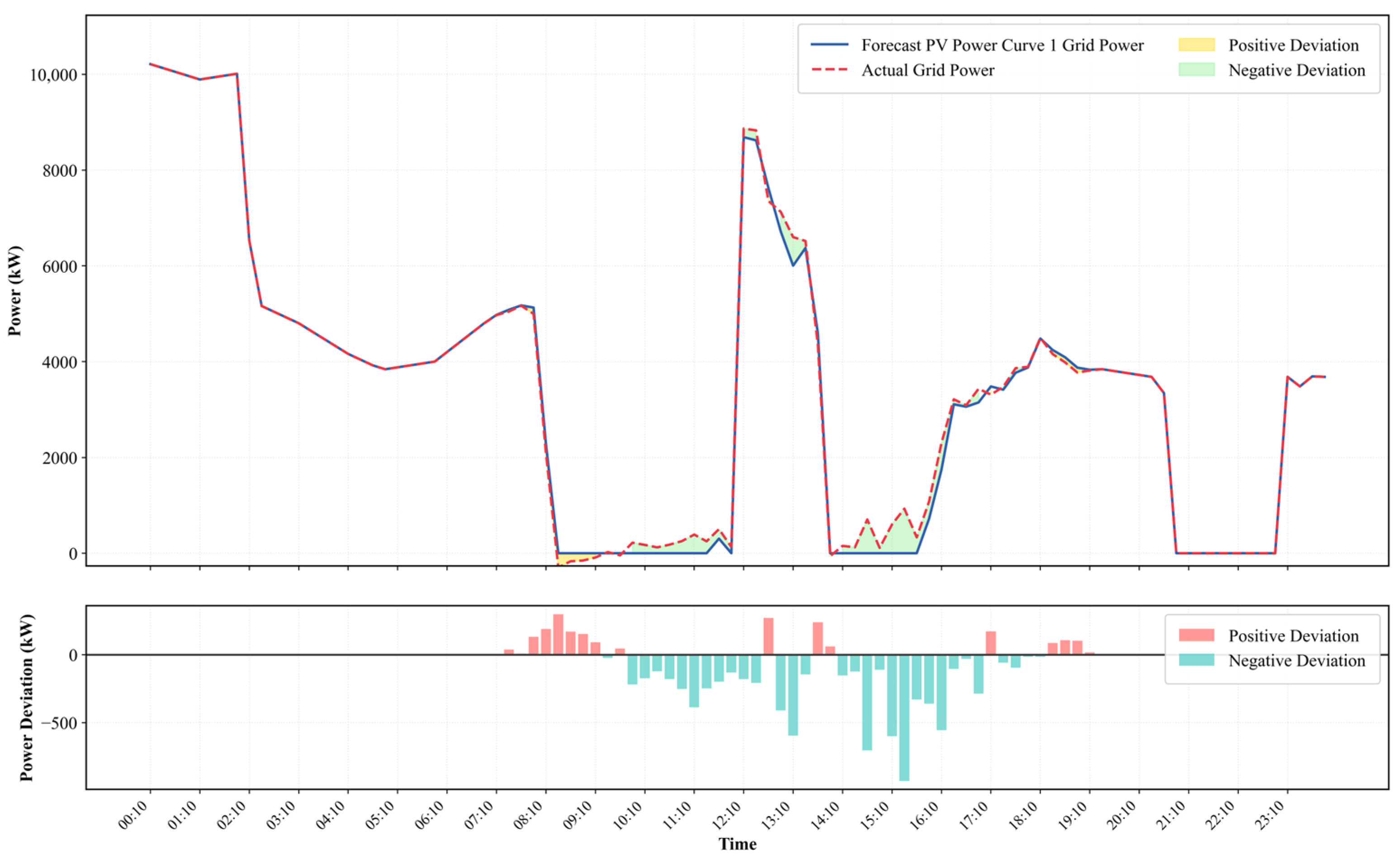
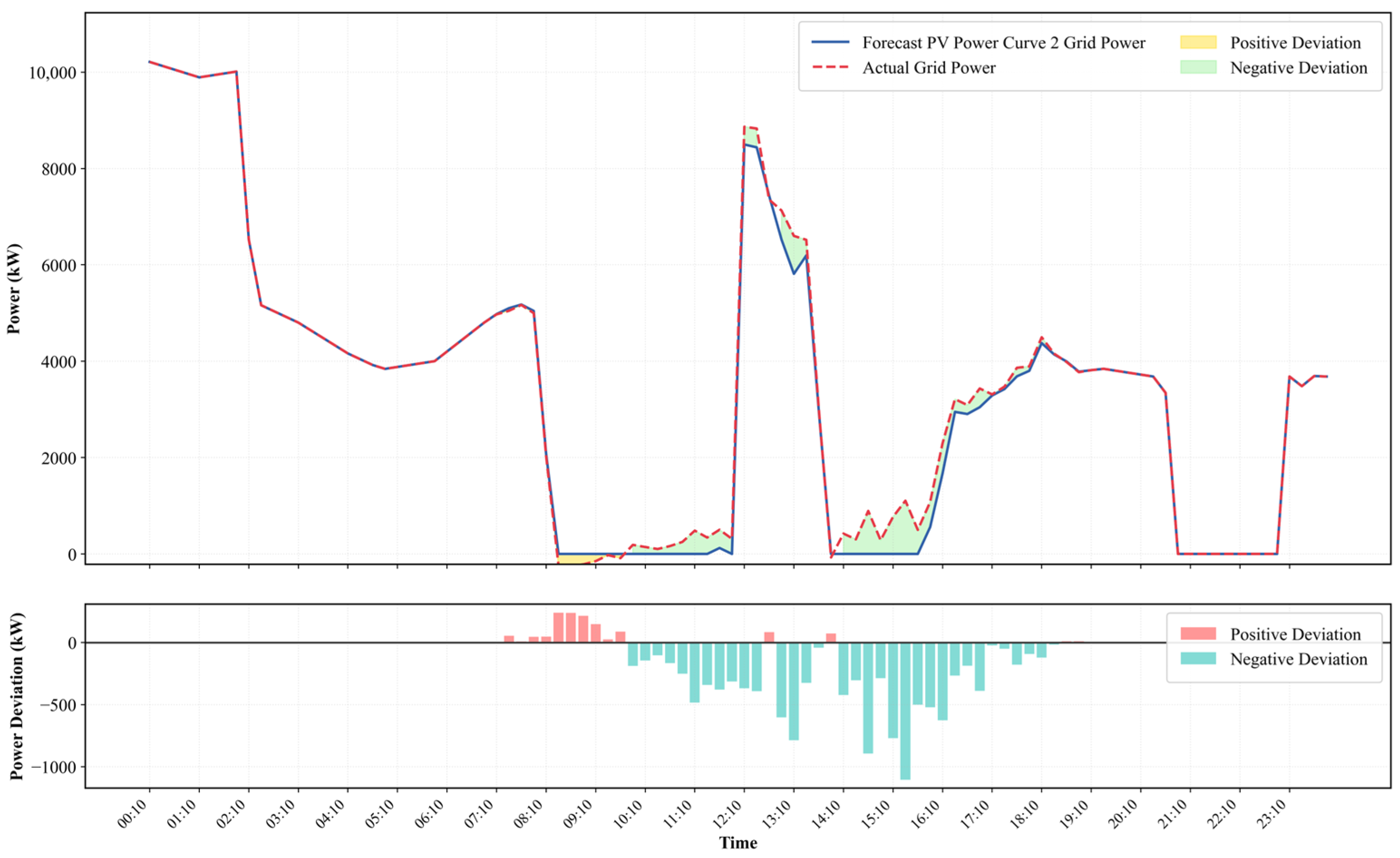
- The asymmetric impact of PV forecast overestimation and underestimation on system operational costs is quantitatively analyzed, and a risk-aware fault-tolerant scheduling strategy is proposed.
2. System Description and PV Output Modeling
2.1. Composition of PV-Storage System
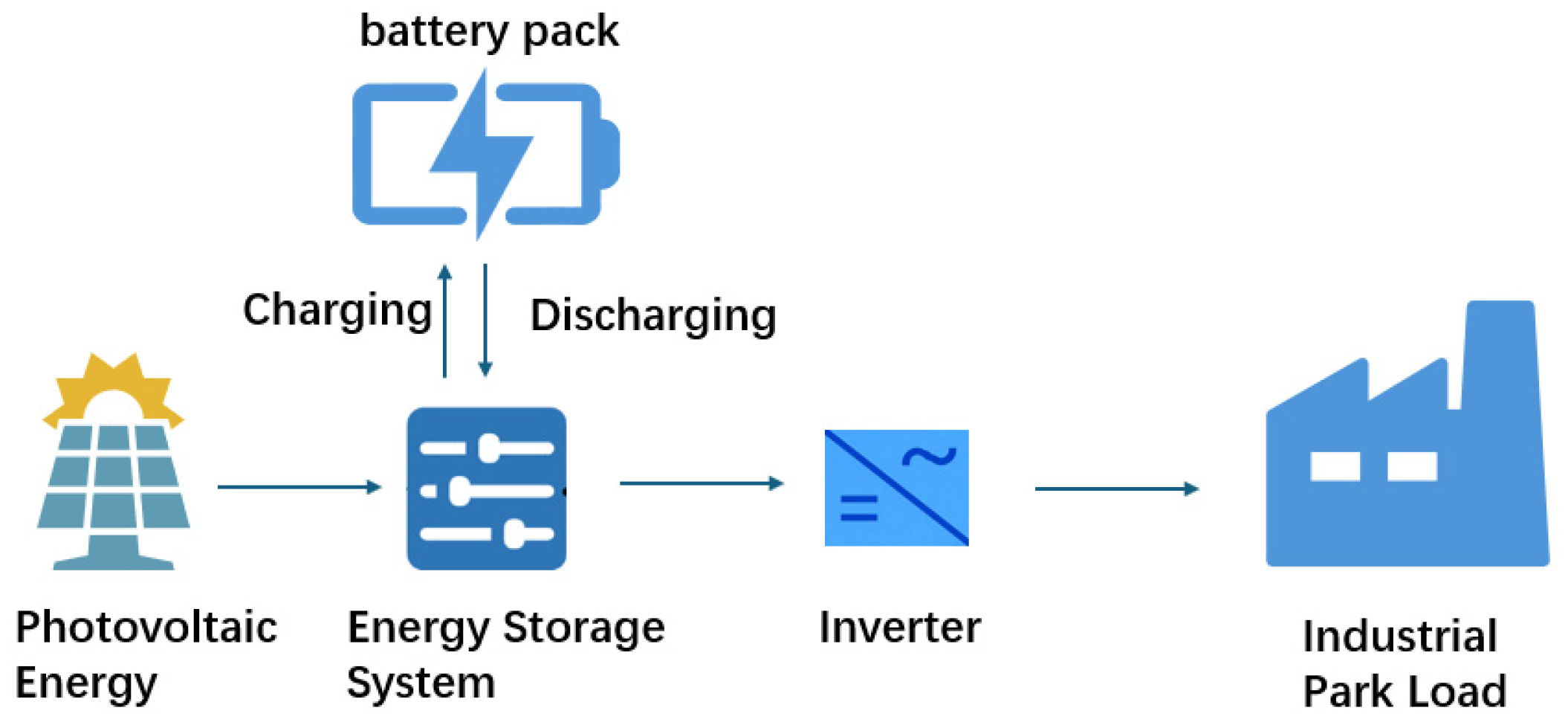
- With the objectives of system economy and low-carbon operation, PV generation is prioritized to meet the local load demand of the park, maximizing the on-site consumption of renewable energy.
- When the energy storage system reaches its maximum depth of discharge or rated discharge power, and PV output still cannot cover the load, the shortfall is purchased from the main grid to ensure reliable power supply to the load.
- When PV output exceeds load demand, the surplus power is preferentially used to charge the energy storage system. If the storage system reaches its upper state-of-charge limit, the excess electricity is fed into the grid, following the principle of minimizing interaction power with the main grid to reduce power fluctuations.
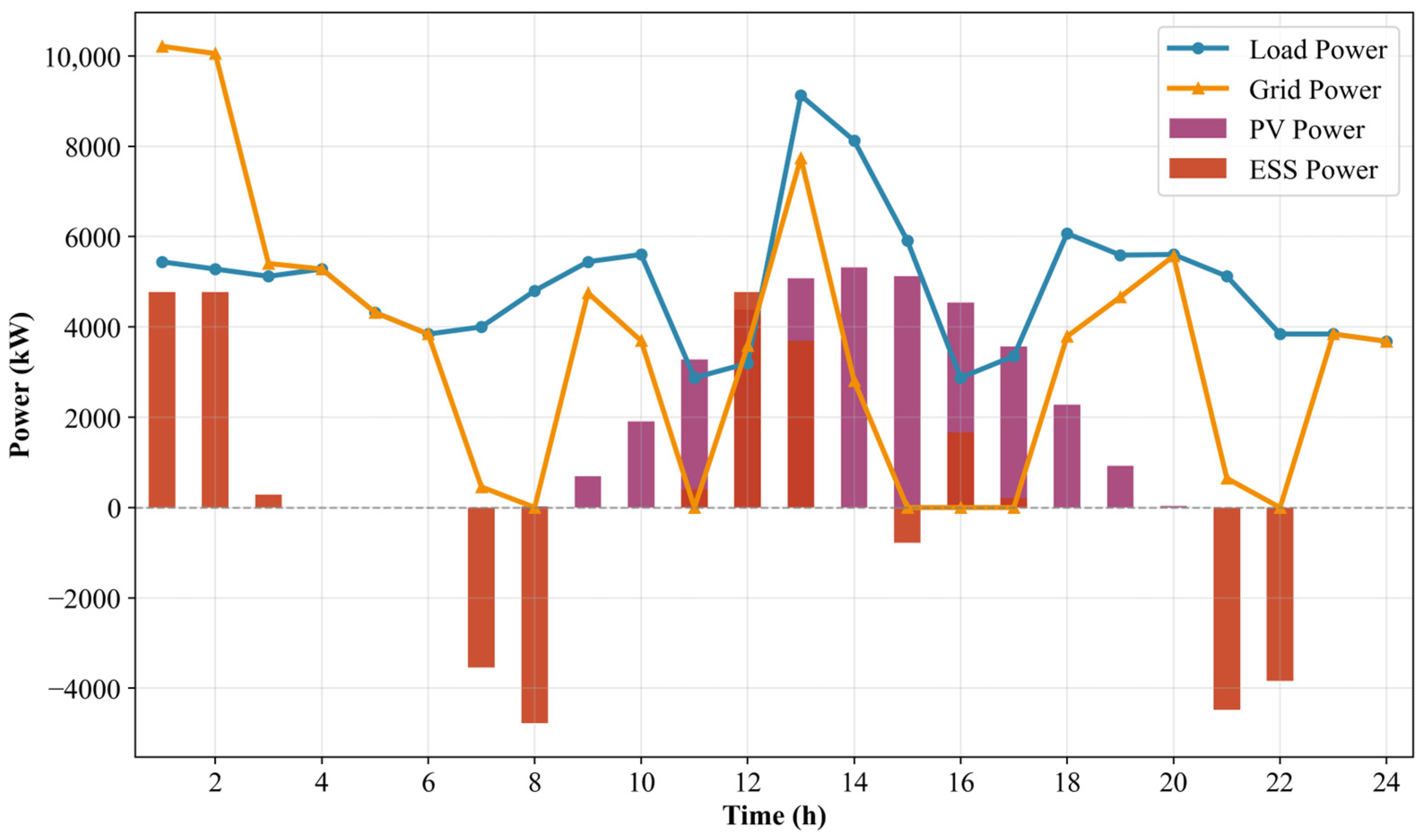
- In addition to storing surplus PV electricity, the energy storage system can also charge from the grid during off-peak price periods and discharge during peak load periods through a “valley charging, peak discharging” strategy, thereby reducing peak load demand and electricity procurement costs. Its charging strategy must comprehensively consider time-of-use electricity prices and forecasted PV output to achieve economical operation.
- Under the premise of meeting preset power exchange limits, free bidirectional power exchange between the park’s PV-storage system and the main grid is permitted, meaning power can be either purchased from or sold to the grid, thereby enhancing operational flexibility.
2.2. PV Output Model
3. Construction of a Bi-Level Optimization Model
3.1. Upper-Level Model
3.2. Upper-Level Optimization Model for PV-Storage System Capacity Configuration
3.2.1. Objective Function of the Upper-Level Optimization Model
3.2.2. Constraints of the Upper-Level Optimization Model
3.3. Lower-Level Optimization Model for PV-Storage System Operational Strategy
3.3.1. Objective Function of the Lower-Level Optimization Model
3.3.2. Constraints
3.4. Model Solution Method
3.4.1. Performance Validation of the CSSA
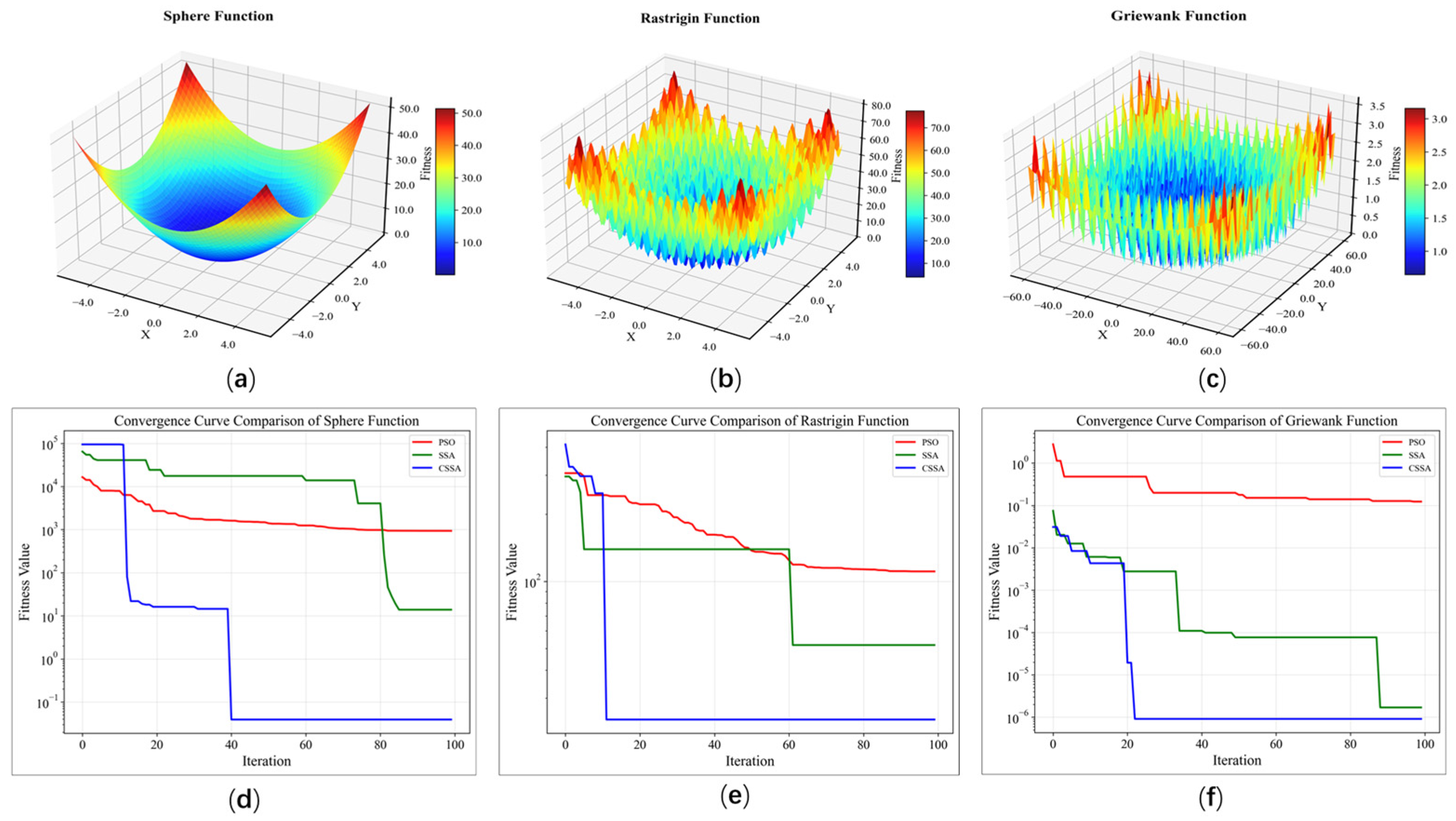
- On the unimodal Sphere function, PSO converges slowly and tends to become trapped in local optima. The SSA converges, but with limited precision. In contrast, the CSSA, through chaotic initialization, enhances the uniformity of population distribution, significantly accelerates convergence, and rapidly approaches the theoretical optimum from the early iterations, demonstrating strong global search ability and high precision.
- On the multimodal Rastrigin and Griewank functions, both PSO and SSA are easily disturbed by numerous local optima, leading to premature convergence and stagnation. The CSSA, however, employs a chaotic perturbation strategy during iteration, effectively improving its ability to jump out of local optima. It continuously progresses towards the theoretical optimum and achieves substantially better convergence accuracy than the comparison algorithms.

3.4.2. Solution Procedure
4. Case Study
4.1. Analysis and Validation of Configuration Results
4.2. Analysis of Operational Optimization Results
4.3. Daily Operational Economic Benefit Analysis
4.4. Sensitivity of Economic Benefits to Energy Storage Capacity Degradation
4.5. Analysis of PV Forecast Errors in the Scheduling Model
4.6. Risk-Aware Fault-Tolerant Scheduling Strategy and Economic Comparison
4.6.1. Design of the Risk-Aware Fault-Tolerant Scheduling Strategy
4.6.2. Comparative Experiment and Result Analysis
- Baseline strategy: Scheduling directly using the original PV forecast value;
- Fault-tolerant strategy: Scheduling using the biased equivalent PV forecast value with upper bound constraint.
5. Conclusions
- 1
- Economic benefit of PV-storage configuration.
- 2
- Asymmetric impact of PV forecast errors.
- 3
- Sensitivity to battery degradation.
- Model Reformulation: The lower-level problem must be reformulated as a multi-objective optimization, striking a Pareto-optimal trade-off between minimizing lifecycle costs and minimizing the probability of load shedding (e.g., Loss of Load Probability, LOLP). A pure economic objective function would no longer suffice.
- Constraint Enhancement: Dynamic constraints, such as frequency and voltage stability, must be explicitly incorporated. This necessitates modeling the grid-forming capabilities of battery inverters to ensure sufficient inertia support and primary frequency regulation, often involving robust constraints for rate-of-change-of-frequency and frequency nadir.
- Uncertainty Management: Without the main grid as a buffer, uncertainties from both renewable generation and load shift from being purely economic risks to direct physical threats to power supply security. To address this, more advanced techniques like Distributionally Robust Optimization (DRO) or Robust Model Predictive Control (RMPC) are required to generate “immunized” scheduling strategies that ensure system survivability under worst-case power fluctuations.
Author Contributions
Funding
Data Availability Statement
Conflicts of Interest
References
- Xu, W.; Lu, Q.; Wang, J. Research on capacity optimization configuration of distributed photovoltaic energy storage system. J. Phys. Conf. Ser. 2025, 2963, 012027. [Google Scholar] [CrossRef]
- Wang, Y.; Ji, H.; Luo, R.; Liu, B.; Wu, Y. Energy Optimization Strategy for Wind–Solar–Storage Systems with a Storage Battery Configuration. Mathematics 2025, 13, 1755. [Google Scholar] [CrossRef]
- Zhou, D.; Wang, Z.; Xi, K.; Zuo, C.; Jia, Y. Optimization Configuration Analysis of Wind-Solar-Storage System Based on HOMER. Energy Eng. 2025, 122, 2119–2153. [Google Scholar] [CrossRef]
- Wang, X.; Wang, X.; Qin, B. Improved multi-objective differential evolution algorithm and its application in the capacity configuration of urban rail photovoltaic hybrid energy storage systems. J. Energy Storage 2024, 98, 113155. [Google Scholar] [CrossRef]
- Ren, Z.; Yu, Q.; Lin, D.; Dong, Y. Optimal capacity configuration of a wind-solar-battery-diesel microgrid system using continuous grey wolf optimization. J. Energy Storage 2025, 113, 115630. [Google Scholar] [CrossRef]
- Hao, H.; Wen, C.; Xue, F.; Qiu, H.; Yang, N.; Zhang, Y.; Wang, C.; Nyakilla, E.E. Recent Advancements in the Optimization Capacity Configuration and Coordination Operation Strategy of Wind-Solar Hybrid Storage System. Energy Eng. 2024, 122, 285–306. [Google Scholar] [CrossRef]
- Sun, S.; Cheng, Y.; Yu, P. Coordinated Planning of Photovoltaic-BESS Hybrid System for Industrial and Commercial Users Considering Scheduling Strategy. Adv. Technol. Electr. Eng. Energy 2022, 41, 81–88. [Google Scholar]
- Yang, B.; Liu, Z.; Yang, S.; Cui, C.; Deng, S. Research on the optimal allocation method of PV micro-grid energy storage capacity based on empirical modal decomposition. J. Phys. Conf. Ser. 2023, 2503, 012013. [Google Scholar] [CrossRef]
- Smajila, L.; Trevisan, S.; Golzar, F.; Vaidya, K.; Guedez, R. Comparative analysis of techno-economic and techno-environmental approach to optimal sizing and dispatch of hybrid solar–battery systems. Energy Convers. Manag. X 2025, 25, 100858. [Google Scholar] [CrossRef]
- Fan, C.; Wang, H.; Zhang, J.; Cheng, P.; Bian, Y. Optimal Energy Storage Allocation for Combined Wind-PV-EVs-ES System Based on Improved Triangulation Topology Aggregation Optimizer. Electronics 2024, 13, 4041. [Google Scholar] [CrossRef]



| Test Function | Type | Dimension | Optimal Value | Search Range |
|---|---|---|---|---|
| Sphere Function | Unimodal | 30 | 0 | [−100, 100] |
| Rastrigin Function | Multimodal | 30 | 0 | [−5.12, 5.12] |
| Griewank Function | Multimodal | 30 | 0 | [−600, 600] |
| Time Period | Time | Price (RMB/kWh) |
|---|---|---|
| Off-Peak | 23:00–07:00 12:00–14:00 | 0.2953 |
| Shoulder | 09:00–12:00 14:00–16:00 | 0.5947 |
| Peak | 07:00–09:00 16:00–23:00 | 0.9568 |
| Scenario | PV System Capacity (MW) | Energy Storage System Capacity (MWh) | Investment Cost (10,000 RMB/year) | Operation and Maintenance Cost (10,000 RMB/year) | Electricity Procurement Cost (10,000 RMB/year) |
|---|---|---|---|---|---|
| No PV-Storage | 0 | 0 | 0 | 0 | 2139.4 |
| PV Only | 7.86 | 0 | 251.7 | 16.5 | 1629.5 |
| PV-Storage | 7.86 | 9.54 | 403.6 | 21.3 | 1362.2 |
| Scenario | End-of-Life SOH | Avg. Usable Capacity Ratio | Annual Electricity Procurement Cost (10,000 RMB/year) | Cost Increase vs. Ideal (10,000 RMB/year) |
|---|---|---|---|---|
| Ideal (base case) | 100% | 1.00 | 1362.2 | — |
| Moderate degradation | 80% | 0.90 | 1388.9 | 22.7 |
| Severe degradation | 70% | 0.85 | 1402.3 | 40.1 |
| Index | Forecast PV Power Curve 1 | Forecast PV Power Curve 2 |
|---|---|---|
| MAE (kW) | 105.5 | 134.61 |
| RMSEkW) | 201.62 | 260.73 |
| R2 | 0.986 | 0.976 |
| Index | Scheduling Plan Based on Forecast PV Power Curve 1 | Actual PV Scheduling Plan | Unit |
|---|---|---|---|
| Grid Electricity | 80,085.57 | 82,924.86 | kWh |
| Procurement Cost | 38,249.07 | 39,406.05 | RMB |
| Index | Scheduling Plan Based on Forecast PV Power Curve 2 | Actual PV Scheduling Plan | Unit |
|---|---|---|---|
| Grid Electricity | 81,266.62 | 82,875.14 | kWh |
| Procurement Cost | 37,650.74 | 39,578.58 | RMB |
| Index | Original Scheduling | Fault-Tolerant Scheduling (γ = 1.05) | Unit |
|---|---|---|---|
| Daily grid electricity purchase | 81,226.62 | 79,536.46 | kWh |
| Daily electricity procurement cost | 37,650.74 | 37,262.39 | RMB |
| Cost loss compared with ideal scenario | 1927.84 | 1539.59 | RMB |
Disclaimer/Publisher’s Note: The statements, opinions and data contained in all publications are solely those of the individual author(s) and contributor(s) and not of MDPI and/or the editor(s). MDPI and/or the editor(s) disclaim responsibility for any injury to people or property resulting from any ideas, methods, instructions or products referred to in the content. |
© 2026 by the authors. Licensee MDPI, Basel, Switzerland. This article is an open access article distributed under the terms and conditions of the Creative Commons Attribution (CC BY) license.
Share and Cite
Chu, S.; Kong, D.; Lu, S. Bi-Level Optimization and Economic Analysis of PV-Storage Systems in Industrial Parks. Energies 2026, 19, 2504. https://doi.org/10.3390/en19112504
Chu S, Kong D, Lu S. Bi-Level Optimization and Economic Analysis of PV-Storage Systems in Industrial Parks. Energies. 2026; 19(11):2504. https://doi.org/10.3390/en19112504
Chicago/Turabian StyleChu, Shilong, Deyang Kong, and Shuai Lu. 2026. "Bi-Level Optimization and Economic Analysis of PV-Storage Systems in Industrial Parks" Energies 19, no. 11: 2504. https://doi.org/10.3390/en19112504
APA StyleChu, S., Kong, D., & Lu, S. (2026). Bi-Level Optimization and Economic Analysis of PV-Storage Systems in Industrial Parks. Energies, 19(11), 2504. https://doi.org/10.3390/en19112504