Taxpayers’ Willingness to Pay for Global Decarbonization via Renewable Energy Official Development Assistance: A Discrete Choice Experiment in South Korea



Abstract
1. Introduction
2. A Review of Related Literature
2.1. Methodological Robustness of DCEs for Multi-Attribute ODA
2.2. Empirical Evidence for RE ODA Attributes
2.3. Research Gap and Contributions
3. Methods
3.1. Method: DCE
3.2. Selection of Attributes
3.3. Design of Choice Sets
3.3.1. Orthogonal Main-Effects Design Rationale
3.3.2. Design and Blocking of Choice Sets
3.4. Implementation of the DCE Survey
3.4.1. Sampling Strategy and Survey Procedure
3.4.2. Mitigation of Hypothetical Bias
3.4.3. Control of Interviewer Bias
4. Analysis of the DCE Data
4.1. Random Utility Maximization Theory and Utility Function
4.2. Estimation of the Utility Function: The MXL Model
5. Results and Discussion
5.1. Data
5.2. Results
5.2.1. Baseline Model Without Covariates
5.2.2. Extended Model with Covariates
5.3. Discussion of the Results
5.3.1. Estimation of MWTP
5.3.2. Estimation of RI
5.3.3. WTP Analysis for Hypothetical Scenarios
- Clear hierarchy emerges: Climate Leader (KRW 21,321) > Economic Expansion (KRW 9880) > Balanced Development (KRW 5917), indicating substantially stronger public preferences for climate-focused RE ODA portfolios than for Balanced Development-oriented alternatives.
- Climate synergies: The Climate Leader scenario demonstrates that public support is the strongest when climate mitigation and expert capacity building are jointly emphasized, reinforcing the dominant relative importance of GHG reductions and expert training identified in Table 8.
- Aggregate implications: Scaling the estimated WTP to approximately 18 million South Korean households yields nearly KRW 384 billion (USD 276.10 million) in annual support for the Climate Leader scenario. This amount represents a meaningful level of public support relative to the current scale of South Korea’s energy sector ODA (USD 232.20 million in 2024), suggesting substantial taxpayer willingness to support climate-oriented RE ODA expansion under appropriate policy framing.
- Heterogeneity considerations: High-income/educated segments (negative ASC interactions) likely amplify WTP across scenarios, suggesting targeted communication strategies.
5.3.4. Policy Priorities
6. Conclusions
6.1. Research Overview and Key Findings
6.2. RI and Scenario Analysis
6.3. Preference Heterogeneity Insights
6.4. Policy Implications
- Portfolio Prioritization: Allocating resources to projects emphasizing GHG reductions and expert training are core key performance indicators. For instance, solar initiatives in Africa/Southeast Asia should contractually specify tCO2e savings and trainee numbers, weighting these 60%+ in evaluations. This aligns with evidenced impacts [5] and maximizes taxpayer welfare.
- Strategic Communication: Sustain support by quantifying co-benefits: “1 MW solar = 1500 tCO2e saved = emissions of 3000 Seoul households annually” alongside “five-firm expansion = USD 10 million export gains.” During budget deliberations, cite MWTP ratios to legitimize green ODA scaling toward the United Nations targets.
- Targeting and Inclusivity: Leverage heterogeneity via differentiated messaging—enterprise opportunities for conservatives and global responsibility for climate-concerned groups. Low electrification valuation implies prioritizing high-emission recipients over pure access cases, optimizing SDG 13 over SDG 7.
- Institutional Mechanisms: Integrate MWTP into Korea International Cooperation and Economic Development Cooperation Fund appraisal frameworks, using RI weights for multi-criteria decision analysis. Pilot “preference-aligned” tenders could test real-world uptake, enhancing political sustainability. The two respectively manage South Korea’s grant-based and concessional loan ODA. The former operates under the Korea Ministry of Foreign Affairs, while the latter falls under the oversight of the Korea Ministry of Finance and Economy, with operational management entrusted to the Export-Import Bank of Korea.
6.5. Study Limitations and Directions for Future Research
6.6. Concluding Contributions
Author Contributions
Funding
Institutional Review Board Statement
Informed Consent Statement
Data Availability Statement
Conflicts of Interest
Abbreviations
| ASC | alternative specific constant |
| BAU | business-as-usual |
| CI | confidence interval |
| DAC | Development Assistance Committee |
| DCE | discrete choice experiment |
| GHG | greenhouse gas |
| MNL | multinomial logit |
| MXL | mixed logit |
| MWTP | marginal willingness to pay |
| RE | renewable energy |
| RI | relative importance |
| ODA | official development assistance |
| SD | standard deviation |
| WTP | willingness to pay |
References
- G20. G20 New Delhi Leaders’ Declaration. In Proceedings of the G20 Summit 2023, New Delhi, India, 9 September 2023. [Google Scholar]
- OECD. Official Development Assistance for the Energy Transition: ODA Levels in 2023—Preliminary Data (Detailed Summary Note); OECD Publishing: Paris, France, 2024; Available online: https://one.oecd.org/document/DCD(2024)31/en/pdf (accessed on 9 May 2026).
- Korea Office for International Development Cooperation. 2024 Korea ODA Whitepaper. 2025. Available online: https://www.odakorea.go.kr/eng/bbs/GalleryList?bbs_id=eng_105 (accessed on 9 May 2026).
- OECD. OECD Creditor Reporting System (CRS) Database; OECD Data Explorer: Paris, France, 2025; Available online: https://data-explorer.oecd.org/vis?lc=en&df[ds]=DcdDisseminateFinalDMZ&df[id]=DSD_CRS%40DF_CRS&df[ag]=OECD.DCD.FSD&dq=DAC..1000.100._T._T.D.Q._T..&lom=LASTNPERIODS&lo=5&to[TIME_PERIOD]=false (accessed on 9 May 2026).
- Chapel, C. Impact of official development assistance projects for renewable energy on electrification in sub-Saharan Africa. World Dev. 2022, 152, 105784. [Google Scholar] [CrossRef]
- Liu, Y.; Dong, K.; Taghizadeh-Hesary, F. How does energy aid mitigate the recipient countries’ carbon emissions? Econ. Anal. Policy 2023, 79, 359–375. [Google Scholar] [CrossRef]
- Paredes Nachón, F.J.; López-Duarte, C.; Vidal-Suárez, M.M. The impact of official development aid flows on business internationalisation. Bus. Strategy Dev. 2024, 7, 388. [Google Scholar]
- Tawiah, V.; Zakari, A.; Wang, Y.; Osei-Tutu, F. Enhancing energy transition: The role of private foreign investment and aid in developing nations. Energy Econ. 2025, 152, 108998. [Google Scholar] [CrossRef]
- Bashir, M.F.; Jamaani, F.; Wang, J.; Huang, H. Analyzing the dynamic impact of energy aid on energy transition in South Asia: Policy implications for renewable adaptive capacity and energy decarbonization. Res. Int. Bus. Financ. 2025, 81, 103218. [Google Scholar] [CrossRef]
- Yoo, S.Y. Importance of Soft Power: An Analysis of Japan’s ODA with National Interests and Its Implications for Developing Countries. Ph.D. Thesis, School of Public Policy, The University of Tokyo, Tokyo, Japan, 2025. [Google Scholar]
- Bau, N.; Dietrich, S. What Geopolitical Returns Does ODA Bring? Kiel Working Paper No. 2305; Kiel Institute for the World Economy: Kiel, Germany, 2025. [Google Scholar]
- McFadden, D. Conditional Logit Analysis of Qualitative Choice Behavior; Academic Press: New York, NY, USA, 1974; pp. 105–142. [Google Scholar]
- Train, K.E. Discrete Choice Methods with Simulation; Cambridge University Press: Cambridge, UK, 2009. [Google Scholar]
- Kim, S.E.; Park, J.H.; Rhee, I.; Yang, J. What do aid recipients want? Public attitudes toward foreign aid in developing countries. World Dev. 2025, 186, 106815. [Google Scholar] [CrossRef]
- Hensher, D.A.; Rose, J.M.; Greene, W.H. Applied Choice Analysis; Cambridge University Press: Cambridge, UK, 2015. [Google Scholar]
- Schlereth, C.; Eckert, C.; Skiera, B. Using discrete choice experiments to estimate willingness-to-pay intervals. Mark. Lett. 2012, 23, 761–776. [Google Scholar] [CrossRef]
- Alesina, A.; Dollar, D. Who gives foreign aid to whom and why? J. Econ. Growth 2000, 5, 33–63. [Google Scholar] [CrossRef]
- Dollar, D. Aid allocation and poverty reduction. In Conflict, Political Accountability and Aid; Routledge: London, UK, 2013; pp. 301–325. [Google Scholar]
- Dreher, A.; Nunnenkamp, P.; Thiele, R. Does US aid buy UN general assembly votes? A disaggregated analysis. Public Choice 2008, 136, 139–164. [Google Scholar] [CrossRef]
- Kablan, S.; Chouard, V. Does climate aid matter for reducing CO2 emissions? The case of foreign aid for renewable energy. Appl. Econ. 2022, 54, 5357–5372. [Google Scholar] [CrossRef]
- Sinanoglu, S. Strategic Humanitarian Aid, Trust in Europe and Support for Authoritarianism; IDOS Discussion Paper 28/2025; German Institute of Development and Sustainability (IDOS): Bonn, Germany, 2025. [Google Scholar]
- OECD. OECD Development Cooperation Peer Reviews. Korea 2024. Available online: https://www.oecd.org/content/dam/oecd/en/publications/reports/2024/05/oecd-development-co-operation-peer-reviews-korea-2024_8adb0d3d/889c6564-en.pdf (accessed on 11 May 2025).
- Bateman, I. Economic Valuation with Stated Preference Techniques: A Manual; Edward Elgar: London, UK, 2002. [Google Scholar]
- Keeney, R.L.; Raiffa, H. Decisions with Multiple Objectives: Preferences and Value Trade-Offs; Cambridge University Press: Cambridge, UK, 1993. [Google Scholar]
- Louviere, J.J.; Hensher, D.A.; Swait, J.D. Stated Choice Methods: Analysis and Applications; Cambridge University Press: Cambridge, UK, 2000. [Google Scholar]
- Carson, R.T.; Louviere, J.J. A common nomenclature for stated preference elicitation approaches. Environ. Resour. Econ. 2011, 49, 539–559. [Google Scholar] [CrossRef]
- Hanemann, W.M. Welfare evaluations in contingent valuation experiments with discrete responses. Am. J. Agric. Econ. 1984, 66, 332–341. [Google Scholar] [CrossRef]
- Viney, R.; Savage, E.; Louviere, J. Empirical investigation of experimental design properties of discrete choice experiments in health care. Health Econ. 2005, 14, 349–362. [Google Scholar] [CrossRef]
- Kessels, R.; Jones, B.; Goos, P. Bayesian optimal designs for discrete choice experiments with partial profiles. J. Choice Model. 2011, 4, 52–74. [Google Scholar] [CrossRef]
- Carlsson, F.; Martinsson, P. Design techniques for stated preference methods in health economics. Health Econ. 2003, 12, 281–294. [Google Scholar] [PubMed]
- Transforming Our World: The 2030 Agenda for Sustainable Development. Available online: https://sdgs.un.org/2030agenda (accessed on 11 May 2025).
- Tourangeau, R.; Rips, L.J.; Rasinski, K. The Psychology of Survey Response; Cambridge University Press: Cambridge, UK, 2000. [Google Scholar]
- Huber, J.; Train, K. On the similarity of classical and Bayesian estimates of individual mean partworths. Mark. Lett. 2001, 12, 259–269. [Google Scholar] [CrossRef]
- Kuhfeld, W.F.; Tobias, R.D.; Garratt, M. Efficient experimental design with marketing research applications. J. Mark. Res. 1994, 31, 545–557. [Google Scholar]
- Kim, G.E.; Kim, J.H.; Yoo, S.H. South Korean consumers’ preferences for eco-friendly gasoline sedans: Results from a choice experiment survey. Transp. Policy 2019, 77, 1–7. [Google Scholar] [CrossRef]
- Yoo, S.H.; Kwak, S.J.; Lee, J.S. Using a choice experiment to measure the environmental costs of air pollution impacts in Seoul. J. Environ. Manag. 2008, 86, 308–318. [Google Scholar] [CrossRef] [PubMed]
- Street, D.J.; Burgess, L. The Construction of Optimal Stated Choice Experiments: Theory and Methods; John Wiley & Sons: Chichester, UK, 2007. [Google Scholar]
- Rose, J.M.; Bliemer, M.C. Stated choice experimental design theory: The who, the what and the why. In Handbook of Choice Modelling; Edward Elgar Publishing: Cheltenham, UK, 2014; pp. 152–177. [Google Scholar]
- Scarpa, R.; Thiene, M. Destination choice models for rock climbing in the Northeastern Alps: A latent-class approach based on intensity of preferences. Land Econ. 2005, 81, 426–444. [Google Scholar] [CrossRef]
- Kuhfeld, W.F. Discrete choice. SAS Tech. Pap. 2010, 2010, 285–663. [Google Scholar]
- Johnson, F.R.; Lancsar, E.; Marshall, D.; Kilambi, V.; Mühlbacher, A.; Regier, D.A.; Bridges, J.F. Constructing experimental designs for discrete-choice experiments: Report of the ISPOR conjoint analysis experimental design good research practices task force. Value Health 2013, 16, 3–13. [Google Scholar]
- Varian, H.R. Microeconomic Analysis, 3rd ed.; W.W. Norton: New York, NY, USA, 1992. [Google Scholar]
- McFadden, D.; Train, K. Mixed MNL models for discrete response. J. Appl. Econom. 2000, 15, 447–470. [Google Scholar] [CrossRef]



| Countries | Total ODA (USD Million) | Energy ODA (USD Million) | Share of Energy ODA in Total ODA (%) |
|---|---|---|---|
| Development Assistance Committee countries | 174,030.10 | 7983.82 | 4.6% |
| South Korea | 3570.64 | 232.20 | 6.5% |
| Germany | 28,897.84 | 2880.60 | 10.0% |
| Japan | 17,084.81 | 1394.57 | 8.2% |
| France | 11,330.53 | 600.56 | 5.3% |
| The United States | 59,089.51 | 773.98 | 1.3% |
| The United Kingdom | 13,004.05 | 451.68 | 3.5% |
| Italy | 3311.86 | 264.59 | 8.0% |
| Canada | 7050.38 | 338.62 | 4.8% |
| Sources | Countries | Methods | Key Attributes |
|---|---|---|---|
| Chapel [5] | Organization for Economic Cooperation and Development (OECD) Development Assistance Committee (DAC) | Project-level empirical analysis | Renewable energy ODA projects significantly increase electrification rates in underserved regions. |
| Liu et al. [6] | OECD DAC | Mediation effect analysis | Energy aid reduces carbon emissions by improving technical efficiency and energy structures. |
| Paredes Nachón et al. [7] | OECD DAC | Panel data analysis | ODA flows act as a catalyst for donor firms to enter recipient markets. |
| Bashir et al. [9] | OECD DAC | Dynamic panel analysis | Renewable energy ODA accelerates decarbonization and strengthens the adaptive capacity of local energy systems. |
| Bau and Dietrich [11] | OECD DAC | Working paper analysis | ODA generates geopolitical influence and builds a pool of international experts for the donor. |
| Kim et al. [14] | The United States and China | Experimental survey research | Recipients favor transparent strategic aid, which positively shifts public perception of the donor. |
| Tawiah et al. [8] | OECD DAC | Econometric modeling | ODA effectively mobilizes private foreign investment, bridging the financial gap for energy transitions. |
| Yoo [10] | Japan | Case and policy analysis | ODA serves as a crucial tool for soft power, enhancing the national brand and geopolitical prestige. |
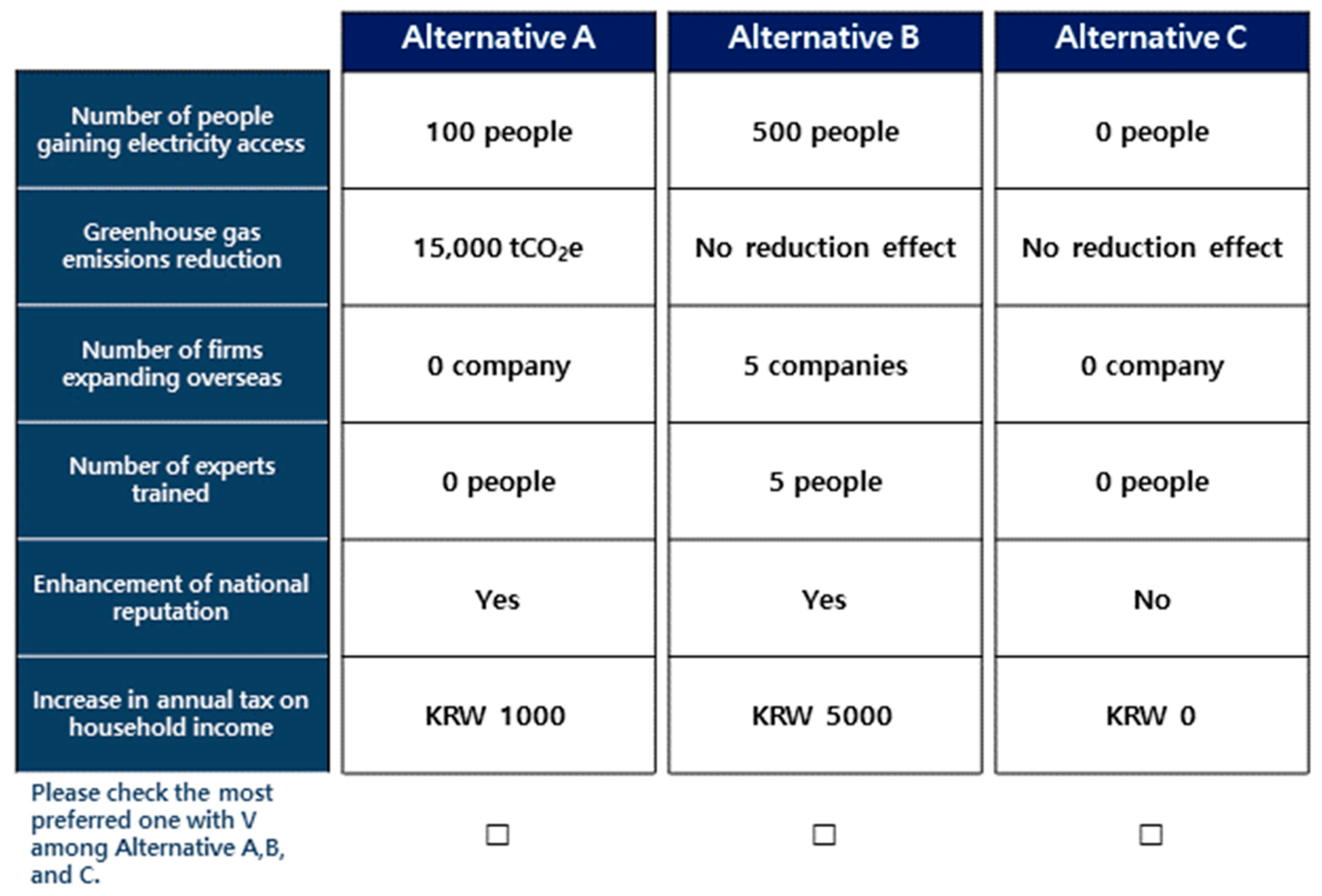
| Attributes | Descriptions | Levels |
|---|---|---|
| Electrification | Number of people gaining electricity access post-project | Level 1: 0 |
| Level 2: 100 people | ||
| Level 3: 500 people | ||
| Level 4: 1500 people | ||
| Reduction | Greenhouse gas emissions avoided via renewable energy transition | Level 1: 0 |
| Level 2: 100 tCO2e | ||
| Level 3: 5000 tCO2e | ||
| Level 4: 15,000 tCO2e | ||
| Expansion | Number of firms expanding overseas via ODA | Level 1: 0 |
| Level 2: 1 company | ||
| Level 3: 2 companies | ||
| Level 4: 5 companies | ||
| Training | Number of experts trained through renewable energy ODA | Level 1: 0 |
| Level 2: 5 people | ||
| Level 3: 10 people | ||
| Level 4: 30 people | ||
| Reputation | Enhancement of national reputation from ODA project | Level 1: No |
| Level 2: Yes | ||
| Price | Increase in annual tax on household income | Level 1: KRW 0 |
| Level 2: KRW 1000 | ||
| Level 3: KRW 2000 | ||
| Level 4: KRW 5000 | ||
| Level 5: KRW 10,000 |
| Variables | Definitions | Mean | Standard Deviation |
|---|---|---|---|
| Age | Age of the respondent | 47.66 | 9.91 |
| Life satisfaction | Overall evaluation of one’s life rated on a 1–9 scale | 5.84 | 1.30 |
| Education | Education level of the respondent in years (6 = elementary school graduate; 9 = middle school graduate; 12 = high school graduate; 14 = junior college graduate; 16 = bachelor’s degree; 18 = graduate degree or higher) | 14.23 | 2.17 |
| Income | Monthly income of the respondent’s household (unit: million Korean won = USD 719 at the time of the survey) | 4.88 | 2.39 |
| Priority | Perceived priority of official development assistance objectives (0 = humanitarian; 1 = national interest) | 0.60 | 0.49 |
| Variables a | Assumed Distributions | Means of the Coefficient Estimate | t-Values | p-Values | 95% Confidence Intervals c |
|---|---|---|---|---|---|
| ASC b | Normal | 0.8324 | 3.16 | 0.0016 | [0.3160, 1.3488] |
| Electrification | Log-normal | 0.2174 | 12.89 | 0.0000 | [0.1843, 0.2505] |
| Reduction | Normal | 0.2121 | 10.65 | 0.0000 | [0.1731, 0.2511] |
| Expansion | Normal | 0.3036 | 4.70 | 0.0000 | [0.1770, 0.4302] |
| Training | Normal | 0.0794 | 6.61 | 0.0000 | [0.0559, 0.1029] |
| Reputation | Log-normal | 0.1572 | 8.13 | 0.0000 | [0.1193, 0.1951] |
| Price | Normal | −0.2610 | −9.64 | 0.0000 | [−0.3141, −0.2079] |
| Simulated log likelihood | −3285.03 | ||||
| Pseudo-R2 | 0.2229 | ||||
| Akaike information criterion | 6584.06 | ||||
| Bayesian information criterion | 6595.27 | ||||
| Variables a | Assumed Distributions | Means of the Coefficient Estimate | t-Values | p-Values | 95% Confidence Intervals c |
|---|---|---|---|---|---|
| ASC b | Normal | 1.8557 | 8.40 | 0.0000 | [1.4226, 2.2888] |
| Electrification | Log-normal | 0.2292 | 6.63 | 0.0000 | [0.2969, 0.1615] |
| Reduction | Normal | 0.6209 | 7.14 | 0.0000 | [0.4505, 0.7913] |
| Expansion | Normal | 0.9013 | 4.20 | 0.0000 | [0.4810, 1.3216] |
| Training | Normal | 0.2260 | 6.29 | 0.0000 | [0.1556, 0.2964] |
| Reputation | Log-normal | 0.5551 | 4.70 | 0.0000 | [0.7866, 0.3236] |
| Price | Normal | −0.2956 | −6.96 | 0.0000 | [−0.3789, −0.2123] |
| ASC × Age | Normal | −0.0964 | −0.13 | 0.8970 | [−1.6070, 1.4142] |
| ASC × Life | Normal | −1.8453 | −2.56 | 0.0106 | [−3.2594, −0.4312] |
| ASC × Education | Normal | −6.7461 | −3.01 | 0.0026 | [−11.1374, −2.3548] |
| ASC × Income | Normal | −0.1262 | −2.66 | 0.0078 | [−0.2192, −0.0332] |
| ASC × Priority | Normal | 3.4875 | 5.25 | 0.0000 | [2.1848, 4.7902] |
| Simulated log likelihood | −3528.21 | ||||
| Pseudo-R2 | 0.1654 | ||||
| Akaike information criterion | 7080.42 | ||||
| Bayesian information criterion | 7099.64 | ||||
| Attributes a | MWTP Estimates per Household per Year | t-Values | 95% Confidence Intervals b |
|---|---|---|---|
| Electrification (unit: 1000 persons) | KRW 833 (USD 0.60) | 9.12 | KRW 657−1016 |
| Reduction (unit: 1000 tCO2e) | KRW 813 (USD 0.58) | 8.39 | KRW 624−1008 |
| Expansion | KRW 1163 (USD 0.84) | 5.19 | KRW 742−1603 |
| Training (unit: 10 persons) | KRW 3042 (USD 2.19) | 5.59 | KRW 1994−4086 |
| Reputation | KRW 602 (USD 0.43) | 5.86 | KRW 399−804 |
| Attributes a | Relative Importance (%) | t-Values | 95% Confidence Intervals (%) b |
|---|---|---|---|
| Electrification | 4.31 | 13.96 | 3.72−4.91 |
| Reduction | 42.06 | 16.15 | 36.83−47.19 |
| Expansion | 20.07 | 6.44 | 13.98−26.11 |
| Training | 31.49 | 8.13 | 23.97−39.16 |
| Reputation | 2.08 | 5.84 | 1.38−2.76 |
| Attributes a | Climate Leader Scenario | Economic Expansion Scenario | Balanced Development Scenario |
|---|---|---|---|
| Electrification | 0 | 0 | 1500 |
| Reduction | 15,000 | 5000 | 5000 |
| Expansion | 0 | 5 | 0 |
| Training | 30 | 0 | 0 |
| Reputation | No | No | Yes |
| Household WTP per year b | KRW 21,321 (USD 15.34) | KRW 9880 (USD 7.11) | KRW 5917 (USD 4.26) |
Disclaimer/Publisher’s Note: The statements, opinions and data contained in all publications are solely those of the individual author(s) and contributor(s) and not of MDPI and/or the editor(s). MDPI and/or the editor(s) disclaim responsibility for any injury to people or property resulting from any ideas, methods, instructions or products referred to in the content. |
© 2026 by the authors. Licensee MDPI, Basel, Switzerland. This article is an open access article distributed under the terms and conditions of the Creative Commons Attribution (CC BY) license.
Share and Cite
Ki, K.-S.; Seol, B.-M.; Yoo, S.-H. Taxpayers’ Willingness to Pay for Global Decarbonization via Renewable Energy Official Development Assistance: A Discrete Choice Experiment in South Korea. Energies 2026, 19, 2371. https://doi.org/10.3390/en19102371
Ki K-S, Seol B-M, Yoo S-H. Taxpayers’ Willingness to Pay for Global Decarbonization via Renewable Energy Official Development Assistance: A Discrete Choice Experiment in South Korea. Energies. 2026; 19(10):2371. https://doi.org/10.3390/en19102371
Chicago/Turabian StyleKi, Kyung-Seok, Bo-Min Seol, and Seung-Hoon Yoo. 2026. "Taxpayers’ Willingness to Pay for Global Decarbonization via Renewable Energy Official Development Assistance: A Discrete Choice Experiment in South Korea" Energies 19, no. 10: 2371. https://doi.org/10.3390/en19102371
APA StyleKi, K.-S., Seol, B.-M., & Yoo, S.-H. (2026). Taxpayers’ Willingness to Pay for Global Decarbonization via Renewable Energy Official Development Assistance: A Discrete Choice Experiment in South Korea. Energies, 19(10), 2371. https://doi.org/10.3390/en19102371