Article

Adaptive Dynamic Programming and Energy Management for Multiple Converters Under Primary Frequency Regulation

1
China Electric Power Research Institute Co., Ltd., Beijing 100192, China
2
College of Electrical and Information Engineering, Hunan University, Changsha 410082, China
3
State Key Laboratory of Internet of Things for Smart City (SKL-IoTSC), University of Macau, Macau 999078, China
4
Key Laboratory of Cleaner Intelligent Control on Coal & Electricity, Ministry of Education, College of Electrical and Power Engineering, Taiyuan University of Technology, Taiyuan 030024, China
*
Author to whom correspondence should be addressed.
Energies 2026, 19(10), 2338; https://doi.org/10.3390/en19102338
Submission received: 2 April 2026 / Revised: 19 April 2026 / Accepted: 29 April 2026 / Published: 13 May 2026

Abstract

There are abundant energy resources in remote areas of China, such as photovoltaics and small hydropower. With uncertain factors such as sunshine and climate, hydroelectric and photovoltaic power generation face prominent problems such as large output power fluctuations, unstable energy transmission, and difficulty in multi-converters’ synchronous control for primary frequency regulation. This article proposes an adaptive dynamic programming (ADP) control method and energy management strategies for multi-converters under primary frequency regulation, in order to address the problems of large-scale access to new energy. Firstly, a parameter online optimization design is proposed based on ADP controller to improve the dynamic performance of the system and the power quality of the output currents of multiple converters. Secondly, in order to achieve energy optimization management of multiple converters, a multimodal collaborative optimization control strategy is proposed to achieve energy optimization control and comprehensive management of the entire system. Finally, the effectiveness of the proposed ADP and energy management strategies are verified by simulation.

1. Introduction

To ensure the safety, reliability, environmental friendliness, economic viability, and sustainable development capacity of power supply under a future high-proportion new energy generation scenario, and to advance the overall goals of energy transformation, most countries have emphasized the need to build a new type of power system with “new energy” as its mainstay. This is also essential for adapting to new situations, new formats, and new models, deepening the revolution in energy production and consumption, and promoting the green and low-carbon transformation of the energy industry. According to the World Energy Statistical Yearbook 2025, the power generation from wind and solar energy increased by 16%, with their share in the global total power generation rising from 13% to 15%. Renewable energy is the fastest-growing energy type globally, with a growth rate as high as 9%. Over the past five years, the average growth rate of renewable energy has been about five times the annual average growth rate of global total energy demand [1,2,3,4,5].
To achieve optimal energy distribution and stable operation of a large number of renewable energy systems under primary frequency regulation, researchers have conducted studies on the parallel operation control of multiple inverters [6,7,8,9,10]. In terms of controlling parallel-operated multiple inverters in AC microgrids, collaborative control methods can be broadly classified into peer-to-peer control, master–slave control, and hierarchical control [11,12,13,14,15]. Distributed adaptive droop control strategies incorporating a current regulator to fine-tune the droop coefficient under varying load conditions were proposed in [16,17,18,19]. In [20,21,22,23], distributed collaborative control strategies based on a leader–follower structure were introduced, where the master inverter managed bus voltage and the slave inverter regulated energy storage battery balance. For the parallel operation of multiple inverters, control strategies combining decentralized logic and virtual negative resistance are presented, which reduced three-phase voltage asymmetry caused by unbalanced loads or other issues [24,25,26,27,28]. References [29,30,31] proposed coordinated control strategies for multiple inverters based on multi-agent/multi-level control. This approach divided microgrid control into multiple levels, each handling control tasks at different time scales, thereby facilitating stable system operation and optimized management [32,33]. However, most existing studies have focused solely on the coordination of the same kind of converters, leaving unaddressed both scenarios involving multiple heterogeneous sources and the issue of flexible adaptation among converters in multi-mode scenarios.
In terms of the joint collaborative control and energy management of different kinds of multiple converters under primary frequency regulation, a large number of advanced control methods and energy management strategies have been applied [34,35,36,37,38]. In [39], an upper-level energy management strategy was present, which established a game-theoretic framework through current and voltage sharing strategies by a distributed iterative learning algorithm based on Bellman’s optimality principle, and implemented it using approximate dynamic programming (ADP) techniques. In [40], a novel ADP control method was proposed based on discrete-time multi-agent systems to address the optimal tracking control problem. In [41], a multi-port energy router was investigated with two AC buses, where loads can be switched or shared between them, and proposed a fuzzy-logic-based hierarchical control strategy. In [42], multi-mode operation control strategies were proposed for a hybrid four-port energy router, taking into account the states and energy flow directions of each port. In [43], a systematic control strategy was proposed for a hybrid five-port energy router, classifying system operation into three modes—islanding, grid-connected, and standby—and presenting a fuzzy-logic-based charging/discharging strategy that incorporates energy storage price optimization. In summary, most existing advanced control methods were primarily designed for single converter [44,45,46,47,48] and cannot be directly applied to multi-converter interconnected systems. Furthermore, existing energy management approaches mainly emphasized upper-level energy management while rarely addressing the lower-level adaptation of multiple converters, thus failing to achieve optimal adaptation for a multi-converter system comprising renewable energy sources, photovoltaics, energy storage, and grid integration [49,50,51].
To tackle the issues of renewable energy integration into the power grid, including significant fluctuations in output power, unstable energy transmission, and difficulties in primary frequency regulation, this paper aims to enable dynamic access and flexible control of various renewable energy sources with multiple converters under primary frequency regulation. The main contributions of this paper are as follows:
(1)
Based on optimal control and ADP, a parameter online optimization design method is proposed to improve the dynamic performance of the system and the power quality of the output currents of multiple converters.
(2)
In order to achieve energy optimization management of multiple converters, a multimodal collaborative optimization control strategy is proposed to achieve energy optimization control and comprehensive management of the entire system.
The structure of this article is as follows. In Section 2, basic knowledge for adaptive dynamic programming control is studied and an ADP online optimization design method for multiple converters is proposed to enable online learning and optimization of the controller. In Section 3, the system is divided into multiple operating modes based on the status of each port, and corresponding control strategies are adopted for each converter under different operating modes to achieve energy optimization control and comprehensive management of the entire system. In Section 4, ADP controllers for DCAC converters, ADP controllers for DCDC converters, and the energy management strategies of multiple converters are discussed under primary frequency regulation. In Section 5, The effectiveness of the proposed ADP and energy management strategies are verified by simulation.

2. Adaptive Dynamic Programming Controller for Multiple Converters

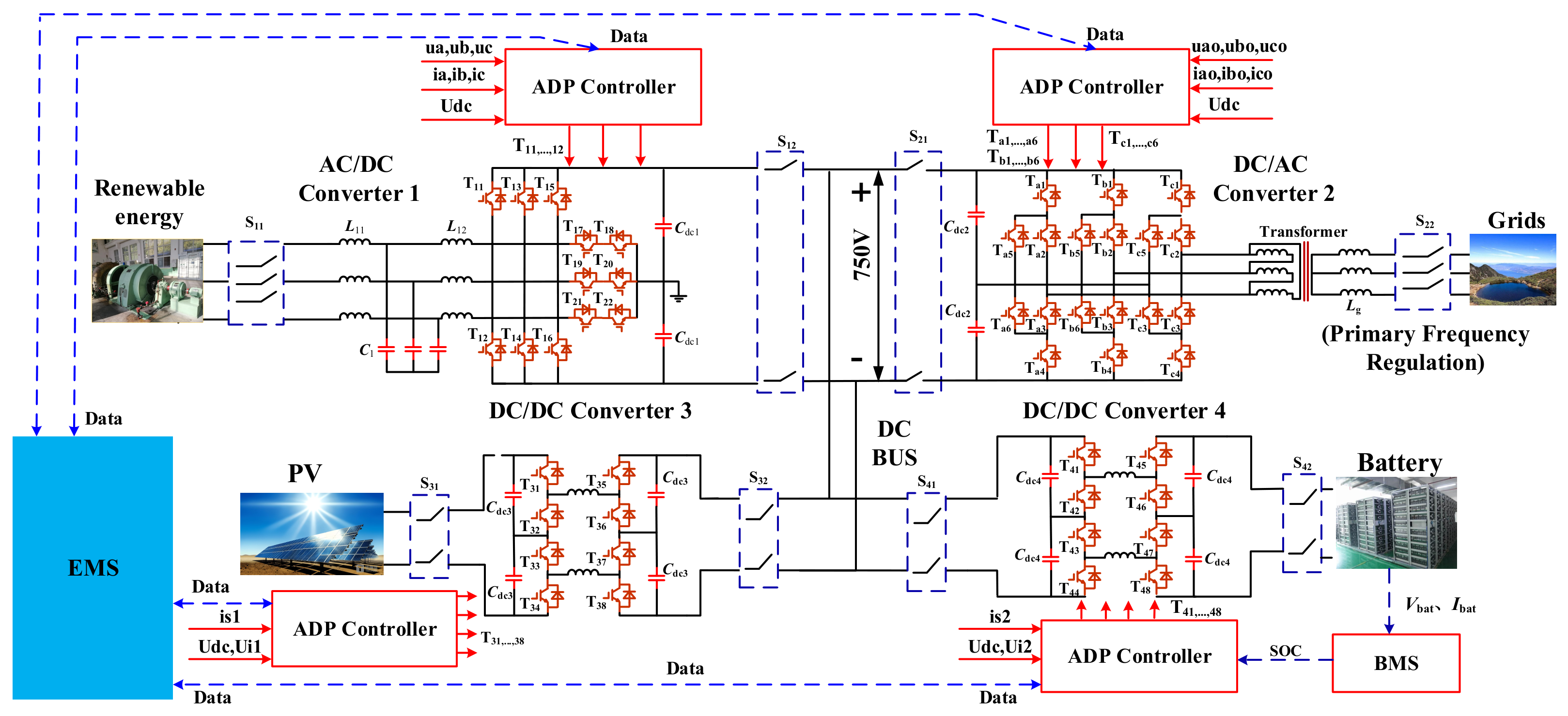
The overall structure multi converters for adaptive dynamic programming and energy management under primary frequency regulation are shown in Figure 1. Based on the theoretical foundation of “optimal quadratic regulator”, an ADP online optimization design method is proposed to enable online learning and optimization of the controller, achieving online design of the controller during synchronous operation of multiple converters.

2.1. Basic Knowledge for Adaptive Dynamic Programming Control

According to the theory of optimal quadratic form, the system state equation can be described as:
x ˙ = A k x + B u k
where x R n is the system state fully available for feedback control design; u R m is the control input; A R n · n and B R n · m are uncertain constant matrices.
To achieve online learning and an iterative solution, a small disturbance signal e needs to be injected into the control input. The control strategy can be expressed as follows:
u k = K k x + e
where e is also referred to as an incentive. According to Equation (1), we derive the performance metric:
d d t ( x T P k x ) = x T ( A k T P k + P k A k ) x + 2 u k T B T P k x = x T Q k x + 2 u k T R K k + 1 x
where Q k = Q + K k T R K k . In (3), x T Q k x can be obtained through real-time data sampling of the system’s state trajectory, K k + 1 is an unknown matrix in R K k + 1 , and it can be solved with P k . So, by (3), without requiring the state matrices Ak and B of the system, P k and K k + 1 can be solved online. Specifically, for any given interval [ t , t + δ t ] , integrating both sides of Formula (3) yields:
x T ( t + δ t ) P k x ( t + δ t ) x T ( t ) P k x ( t ) 2 t t + δ t ( K k x + u k ) T R K k + 1 x d τ = t t + δ t x T Q k x d τ
Thus, after a period of sampling, a set of continuous state data is obtained. By substituting the state data into Formula (4), a system of equations containing P k and K k + 1 are derived. By solving this system of equations, P k and K k + 1 can be calculated. The more detailed calculations of ADP can be referred to in [52].

2.2. ADP Controller Implementation for DCAC Converters

In Figure 1, state equations of the T-type NPC converter can be written as:
i ˙ d i ˙ q u ˙ dc Δ u ˙ dc = R s L ω 0 0 ω R s L 0 0 3 ( S d 1 S d 2 ) 2 C 3 ( S q 1 S q 2 ) 2 C 0 0 3 ( S d 1 + S d 2 ) 2 C 3 ( S q 1 + S q 2 ) 2 C 0 0 i d i q u dc Δ u dc + 1 L 0 0 1 L 0 0 0 0 e d u d   e q u q + 0 0 2 C 0 i DC
where id, iq, udc, Δudc are the state variables of DCAC converters, that is, the d-axis current, the q-axis current, the DC side voltage, and the DC side midpoint voltage difference. Rs and L are the resistance and inductor of the converter. ω is the angular velocity. Sd1, Sd2, Sq1, Sq2 are the switching variables of DCAC converters. ed, eq, ud, uq are the d-axis grid voltage, the q-axis grid voltage, the d-axis converter voltage, and the q-axis converter voltage. iDC is the DC side output voltage.
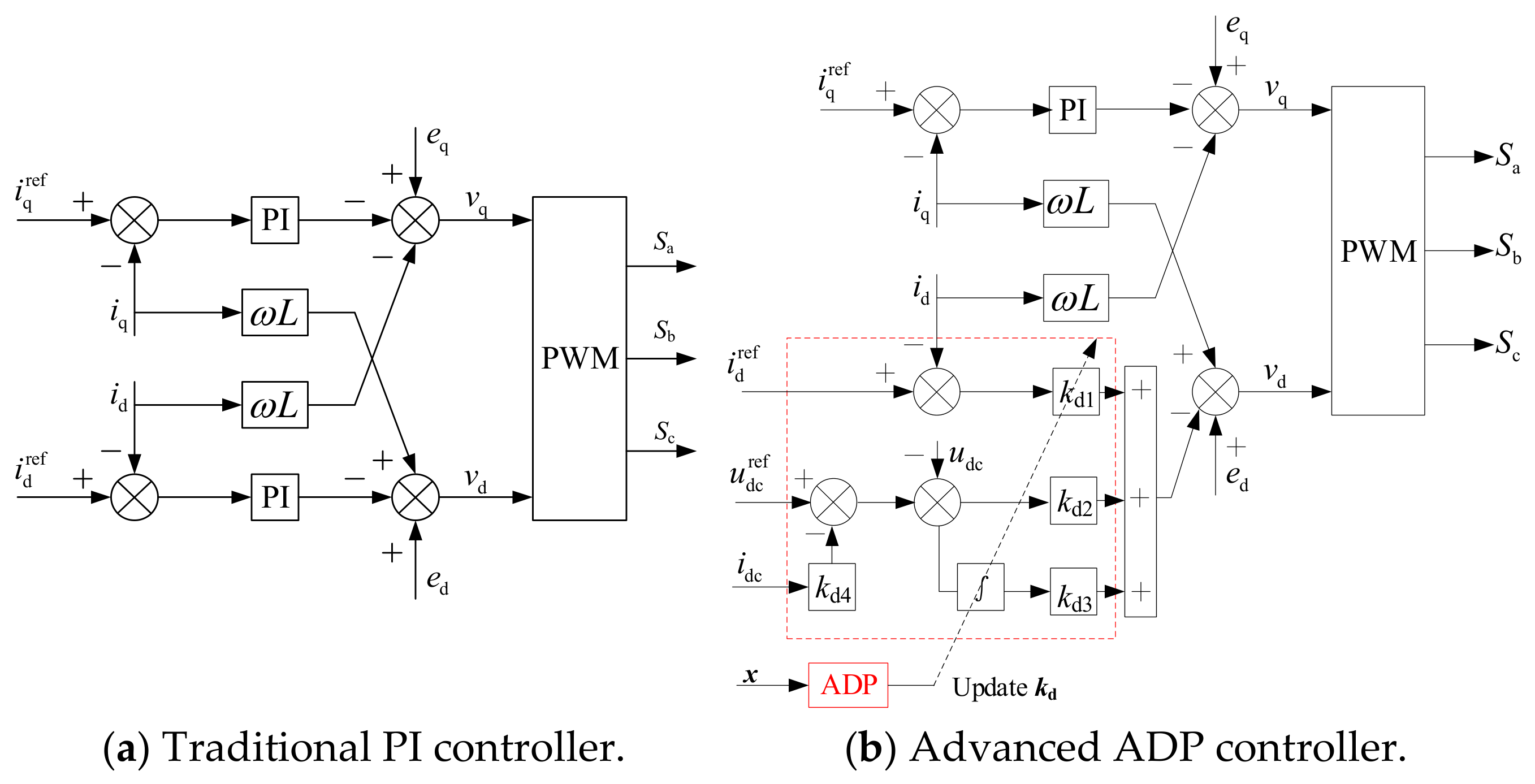
From the above equation, it can be seen that id and iq are coupled. If a feedforward decoupling control method is adopted, the control block diagram shown in Figure 2a can be obtained. Here, idref and iqref are the command values of the converter, PI is the proportional–integral controller of the current loop, and eq is equivalent to the feedforward compensation for the grid voltage.
When system parameters deviate or are uncertain, it becomes challenging to design controllers. In this paper, to optimize controller parameters online, we propose an adaptive dynamic programming-based method, as illustrated in Figure 2b. Taking the d-axis as an example, current and voltage state values can be adopted online. By solving Formula (4), the required kd value can be obtained. Therefore, the control law for the d-axis is expressed as:
u d = [ k d 1 ( i d ref i d ) + k d 2 ( u dc ref u d c k d 4 i dc ) + k d 3 ( x 3 ref x 3 ) ] = k d x
where x ˙ 3 = u dc ref u dc , x3 represents the integral of voltage difference, which can eliminate the static voltage during steady state. The DC side output idc can be feedforward control to improve dynamic performance, or it can be used for droop control to achieve power distribution through parameter kd4. During system iterative calculation, kd4 does not undergo dynamic optimization and is set by the upper computer. Meanwhile, the voltage balancing control on the DC capacitor side can be achieved by injecting zero-sequence current. The implementation method of the traditional two-level converter is consistent with the above, and it lacks the voltage balancing control link, making it easier to implement.

2.3. ADP Controller Implementation for DCDC Converters

In Figure 1, state equations of DCDC converters can be written as:
C 11 d u C 11 d t = i in i L d 11 C 12 d u C 12 d t = i in i L d 12 C 21 d u C 21 d t = i L ( 1 d 21 ) i o C 22 d u C 22 d t = i L ( 1 d 22 ) i o L d i L d t = u C 11 d 11 + u C 12 d 12 u C 21 ( 1 d 21 ) u C 22 ( 1 d 22 )
where C11, C12, C21, C22, L are capacitors and inductors of the DCDC converter. uC11, uC12, uC21, uC22 and iL are the state variables of DCDC converters, that is, the capacitor voltages on input and output sides, and the inductor current, respectively. iin and io are the input and output currents. d11, d12, d21, d22 are the duty cycles of different IGBT switches.
The mathematical model of the main circuit of DCDC converters can be derived from Formula (7) as follows:
C d u dc d t = i L ( 1 d 2 ) i o L d i L d t = V in d 1 u dc ( 1 d 2 )
Under normal conditions, the DCDC converter is linear in Buck mode and can directly adopt the method described in Section 2.1. When the converter operates in Boost mode, its state equation is expressed as follows:
d x 1 d t = 1 C x 2 x 2 u i o d x 2 d t = 1 L x 1 + x 1 u + V in
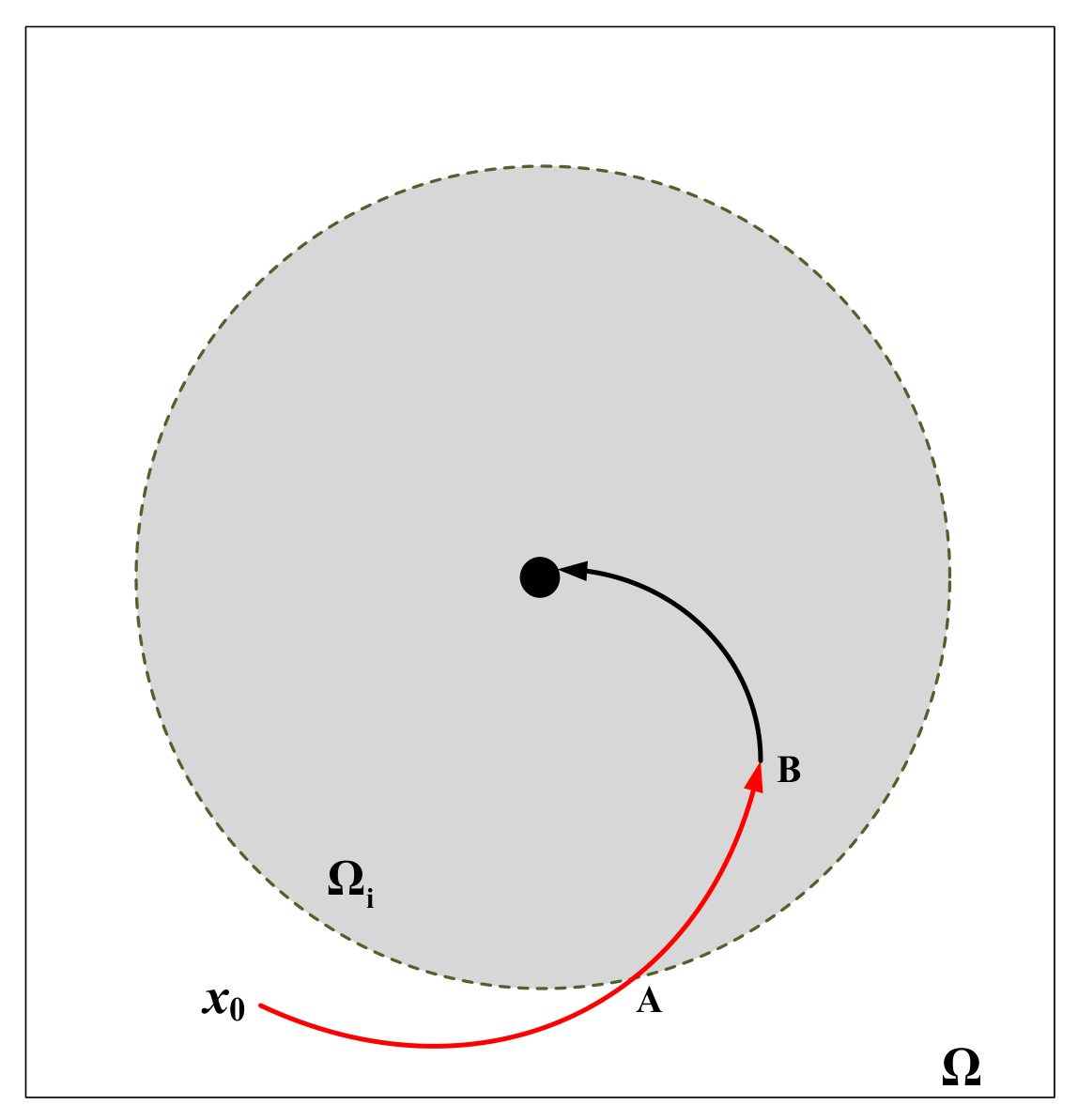
where [x1, x2] = [udc, iL], u = d2. According to Formula (9), it can be seen that the converter operating in Boost mode is nonlinear. To implement the adaptive dynamic programming algorithm, sampling data can be taken within the steady-state region D and iterative optimization can be performed. However, for states outside region D, shown the red arrow in Figure 3, due to the presence of strong nonlinearity, the calculated P and K may not be applicable to states within the region. When the initial value is far from the steady-state value (outside Ωi), Formula (7) should not be solved at this time because the system is nonlinear, and the solution obtained would be inaccurate and may even cause system instability. To ensure system stability, the state variables need to enter Ωi before iterative optimization calculations are performed, shown the black arrow in Figure 3.
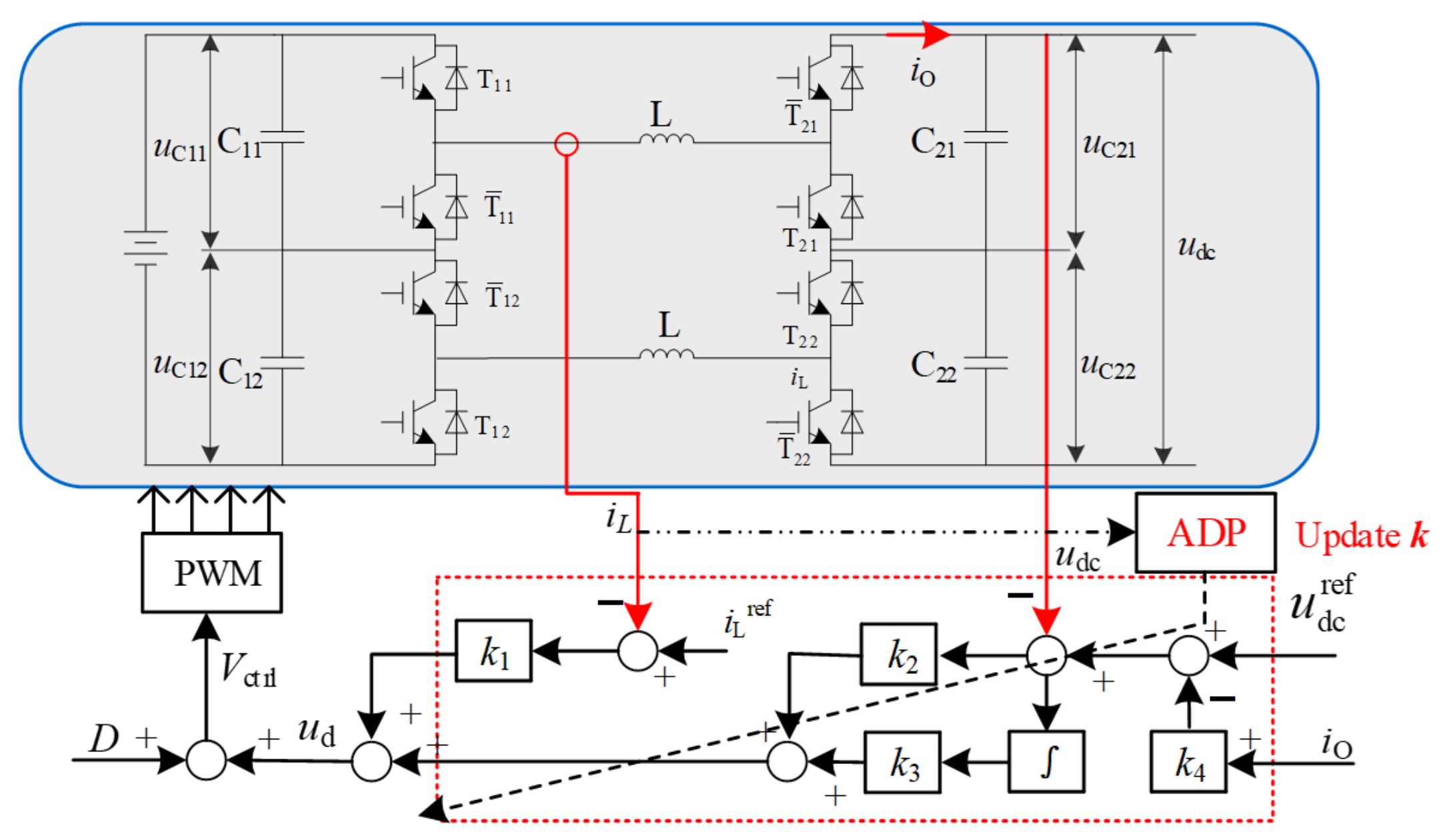
In summary, the control block diagram of the Buck–Boost converter is shown below:
In Figure 4, the values of controller parameters k1, k2, and k3 can be optimized online by measuring the output voltage udc and inductor current iL. Through state feedback, the control output is obtained as follows:
u d = [ k 1 ( i L ref i L ) + k 2 ( u dc ref u dc k 4 i O ) + k 3 ( x 3 ref x 3 ) ] = k x
where x ˙ 3 = u dc ref u dc , x3 represents the integral of voltage difference, which can eliminate the static voltage during steady state. During the system operation, k4 does not undergo dynamic adjustment; instead, it is set by the host computer to achieve power distribution between ports.

3. Energy Management Strategies of Multiple Converters for Primary Frequency Regulation

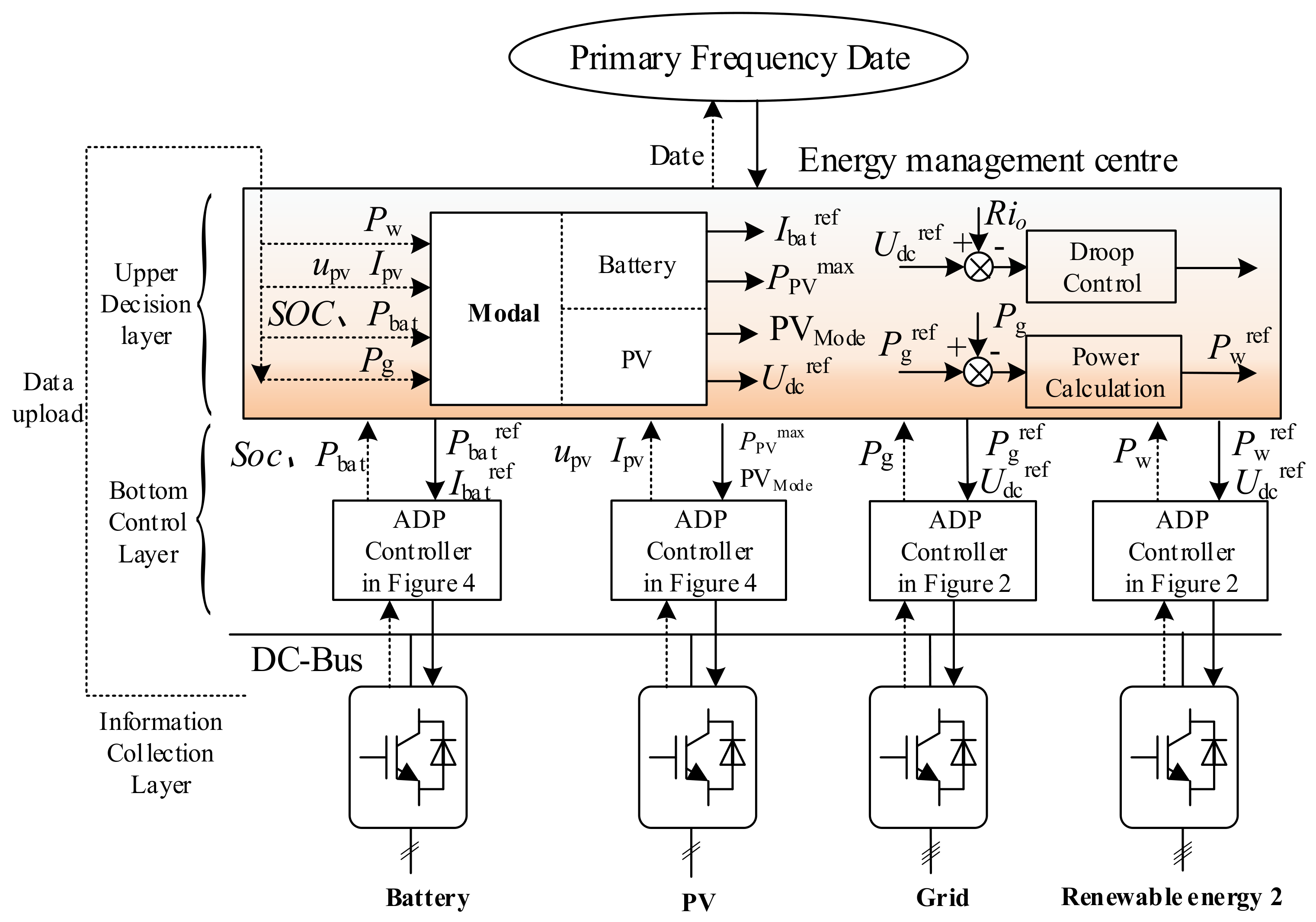
This part analyzes the energy management strategy of primary frequency regulation, achieving energy optimization control. The energy management strategy adopted in this paper is shown in Figure 5, which is mainly divided into the information collection layer, decision-making control layer, and bottom control layer. The information collection layer uploads data from the bottom devices to the decision-making control layer, such as the average state of charge of energy storage units, the power injected into the DC bus by each unit module, including energy storage, photovoltaic, grid, and new energy; the decision-making control layer receives external dispatching instructions from the distribution network and real-time data about the bottom devices issued by the information collection layer, formulates dispatching control and energy management strategies, divides the modes of multi converters, and determines the control methods of the bottom controllers; the bottom control layer executes the control modes and related instructions issued by the decision-making control layer, and performs overall controller parameter optimization design for each port.

3.1. The Mode Classification in Different Operations

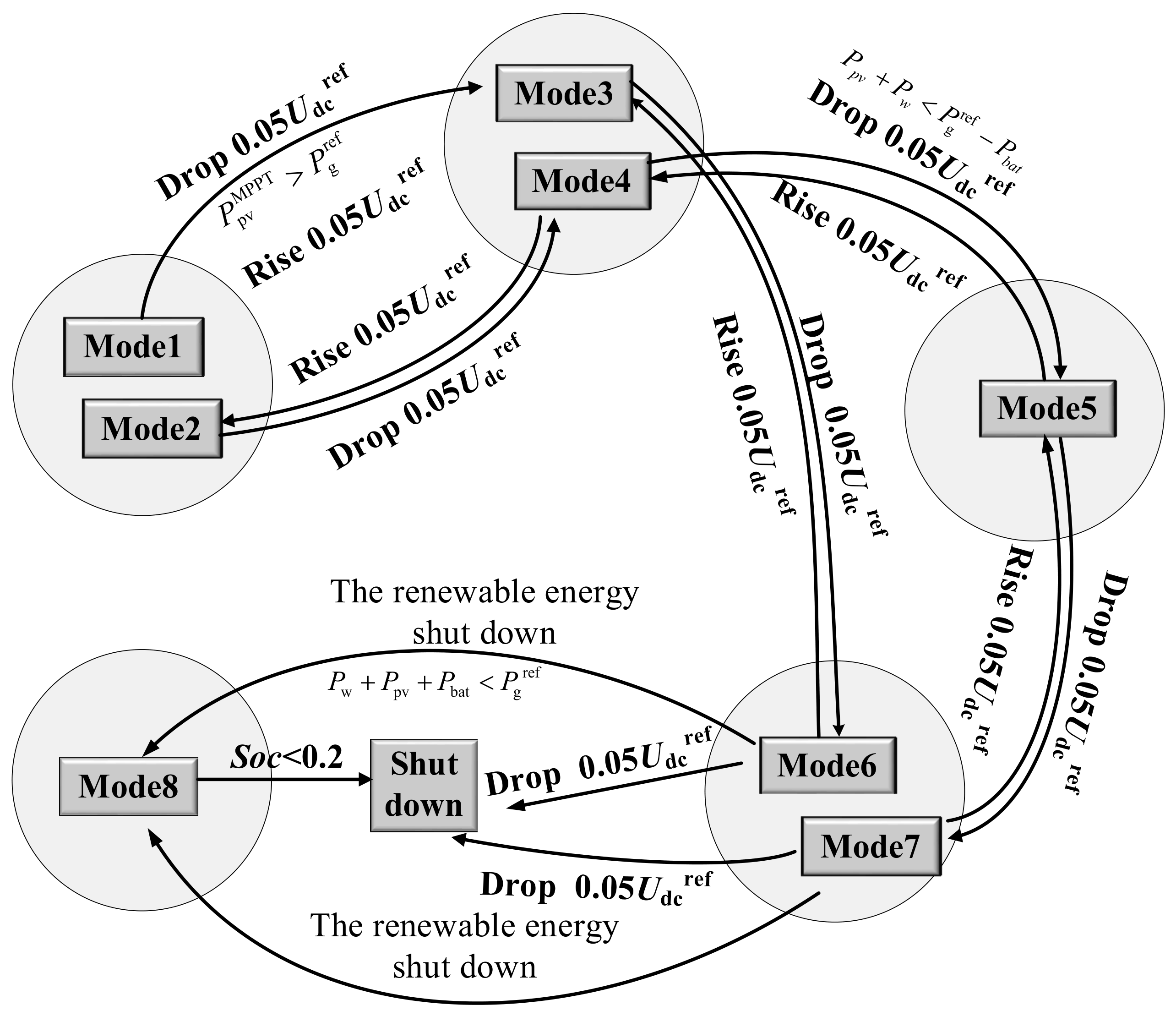
The modal classification of the system is comprehensively determined by considering the SOC state of the energy storage port, the energy access amount Ppv of the photovoltaic port, the energy access amount of other renewable energy port, and the energy output amount of the grid-connected port. Taking into account the characteristics of external sources and grid-connection requirements, the system can be divided into eight modes, as shown in Table 1.
Classification of modes in different operations can be described as:
Mode 1: When SOC is ≥0.9 and P pv MPPT > P g ref , the energy storage port operates in idle mode, while the photovoltaic port switches to CVC mode. The output power is supplied by the hydroelectric port unit and the photovoltaic unit. When the energy injected by the photovoltaic unit drops below a certain threshold, that is, P pv MPPT > P g ref , the interaction between the photovoltaic unit and the grid unit may cause a rapid voltage drop on the DC bus. If the detected voltage drop reaches P pv MPPT > P g ref or P pv MPPT P g ref , the multi-converter is switched to Mode 3.
Mode 2: When SOC is less than 0.9 and P pv MPPT > P g ref + P bat , the energy storage adopts charging mode and the photovoltaic unit adopts CVC mode. When the rising voltage of the DC bus is detected to be 0.05 U dc ref or P pv MPPT P g ref + P bat , switch to mode 4.
Mode 3: When SOC is ≥0.9 and P pv MPPT P g ref , the energy storage unit is in an idle state, and the photovoltaic unit is MPPT-controlled. The grid-connected power is provided by the hydropower port unit and the photovoltaic unit. When the detected bus drop voltage reaches 0.05 U dc ref , switch to mode 6; when the rising voltage of the DC bus reaches 0.05 U dc ref , switch to mode 1.
Mode 4: When SOC is less than 0.9 and P pv MPPT P g ref + P bat , the energy storage unit is in a charging state, the photovoltaic unit is MPPT-controlled, and the grid-connected power is provided by the hydropower port unit and the photovoltaic unit. When the drop voltage of the bus voltage reaches 0.05 U dc ref , switch to mode 5; when the rising voltage of the DC bus reaches 0.05 U dc ref , switch to mode 2.
Mode 5: When SOC is less than 0.9 and P w < P g ref P bat P pv , the new energy is insufficient to charge the energy storage. The energy storage unit changes from charging mode to idle mode, and the photovoltaic unit switches to MPPT mode; if a drop voltage of 0.05 U dc ref is detected on the DC bus, switch to mode 6 or mode 7 based on SOC; if the rising voltage of the DC bus is detected to be 0.05 U dc ref , switch to mode 3 or mode 4 based on SOC.
Mode 6: When SOC is greater than 0.2 and P pv MPPT + P w < P g ref , the energy storage unit is in discharge mode. If a voltage drop of 0.05 U dc ref is detected on the DC bus, a fault signal will be sent and the system will shut down; if the rising voltage of the DC bus is detected to be 0.05 U dc ref , switch the system to mode 5 based on SOC.
Mode 7: When SOC is ≤0.2 and P pv MPPT + P w < P g ref , the energy storage unit is in idle mode. If a voltage drop of 0.05 U dc ref is detected on the DC bus, a fault signal will be sent and the system will shut down; if the rising voltage of the DC bus is detected to be 0.05 U dc ref , switch the system to mode 5 based on SOC.
Mode 8: When SOC is greater than 0.2 and the energy supply at the renewable energy ports is severely insufficient. The energy storage unit is in discharge mode, and the renewable energy port unit is shut down. Power scheduling is achieved by charging and discharging the energy storage unit.
In all, the switching process of different modes can be described in Figure 6.

3.2. Energy Management Strategies for Primary Frequency Regulation

There are two types of energy management strategies for primary frequency regulation at the decision-making and control layer:
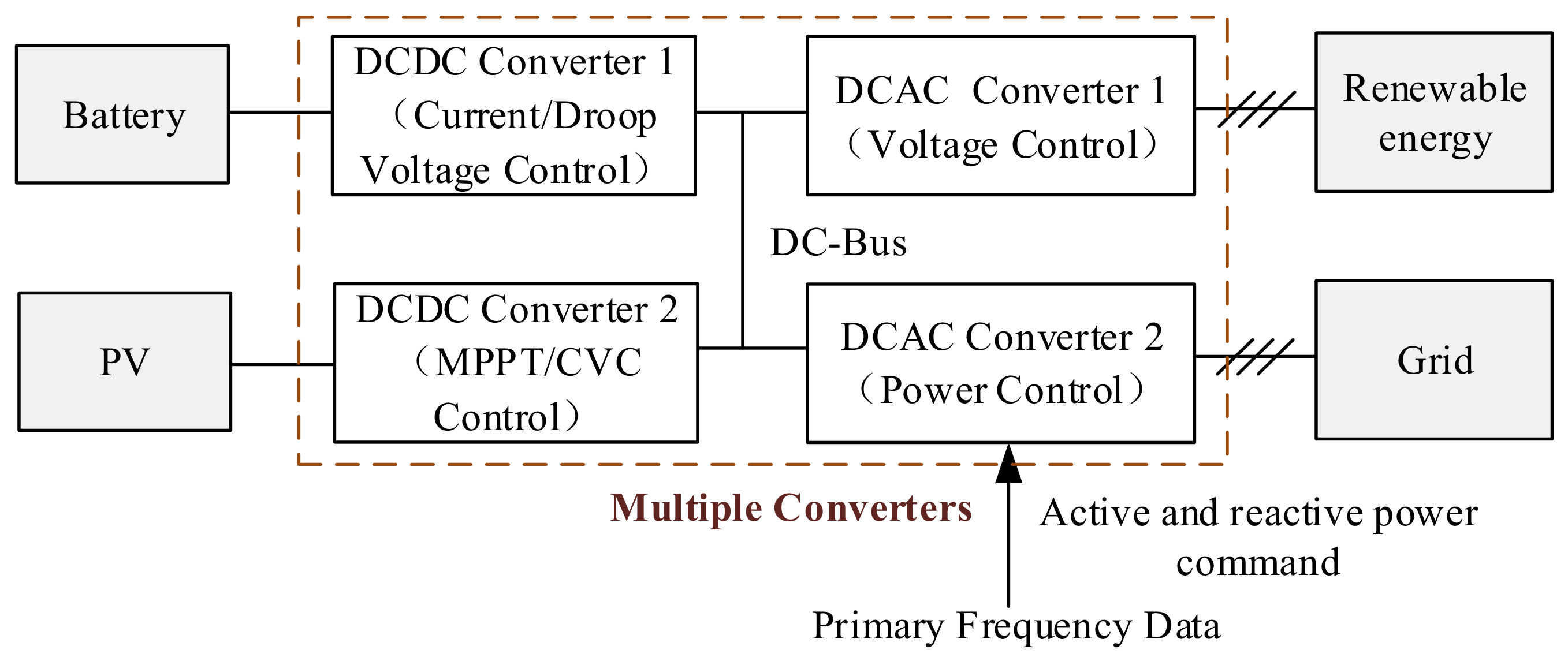
Energy management strategy 1: The DC voltage regulation control is performed by the new energy port; the energy storage adopts constant current mode or droop voltage regulation mode control, and changes the charging and discharging mode of the energy storage battery and the corresponding charging and discharging current commands according to the average state of charge; the photovoltaic port decides to adopt constant voltage control mode (CVC) or maximum power point tracking (MPPT) mode according to the magnitude of the generated power; the grid-connected port adopts constant power control mode, which can directly achieve precise power control, as shown in Figure 7.
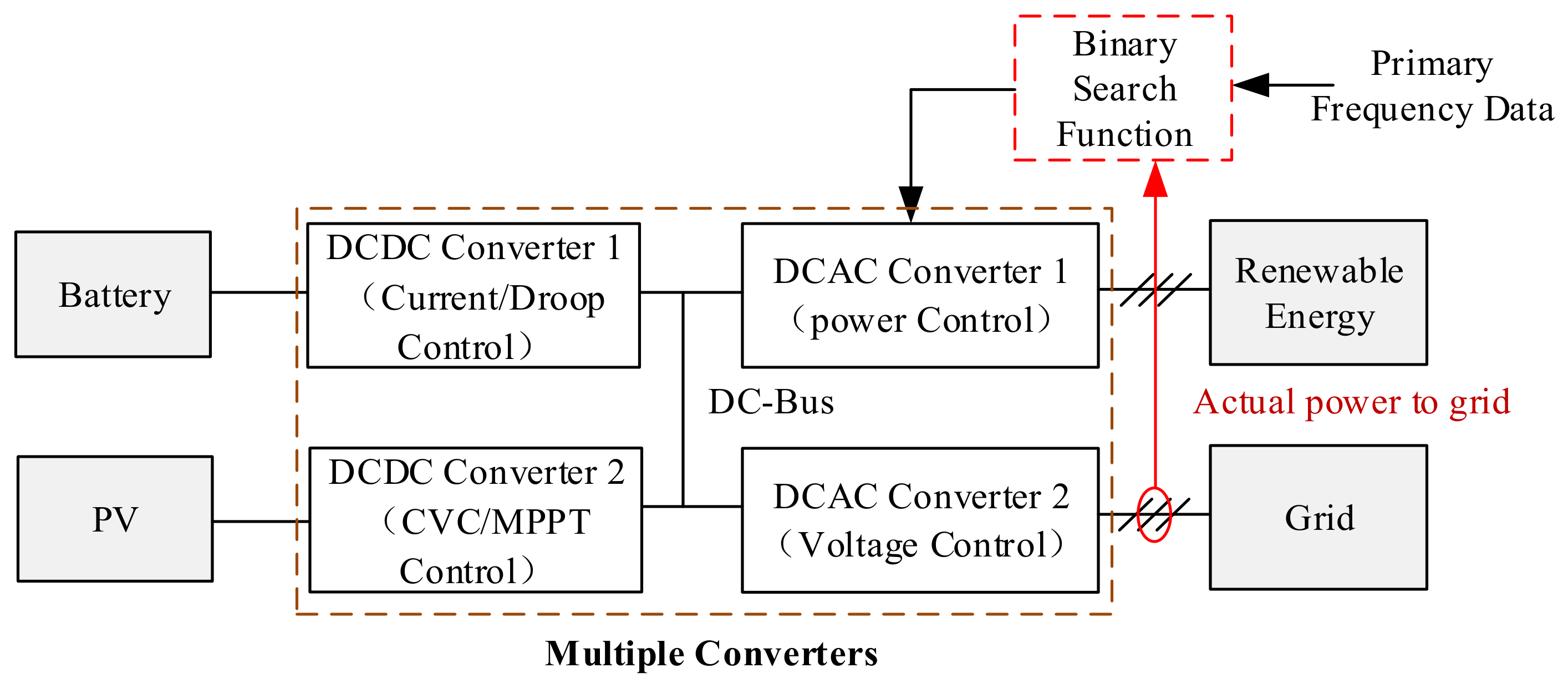
Energy management strategy 2: DC voltage stabilization control through the grid-connected port; energy storage is controlled using either constant current mode or droop voltage regulation mode; the photovoltaic port adopts CVC control or MPPT control mode depending on the magnitude of power generation; the new energy port employs constant power control mode, updating the active power target value based on primary frequency regulation data. As illustrated in Figure 8, the input power of the new energy port is adjusted through a dichotomy control function to achieve precise power control of the grid-connected port.
Due to the dynamic changes in power states at various ports of the system with external conditions and its own physical characteristics in this mode, it is necessary to study the power flow patterns and operational modes under this energy management and scheduling control strategy. Subsequently, research should be conducted to develop control strategies and port power commands for each port under this operational mode, achieving multi-mode collaborative optimization control.

4. Results and Discussion

In order to verify the effectiveness of the proposed ADP control method and energy management strategies, this part conducts simulation verifications on three aspects: ADP controller for DCAC converters, ADP controller for DCDC converters, and energy management strategy of multiple converters for primary frequency regulation.

4.1. ADP Controller for DCAC Converter

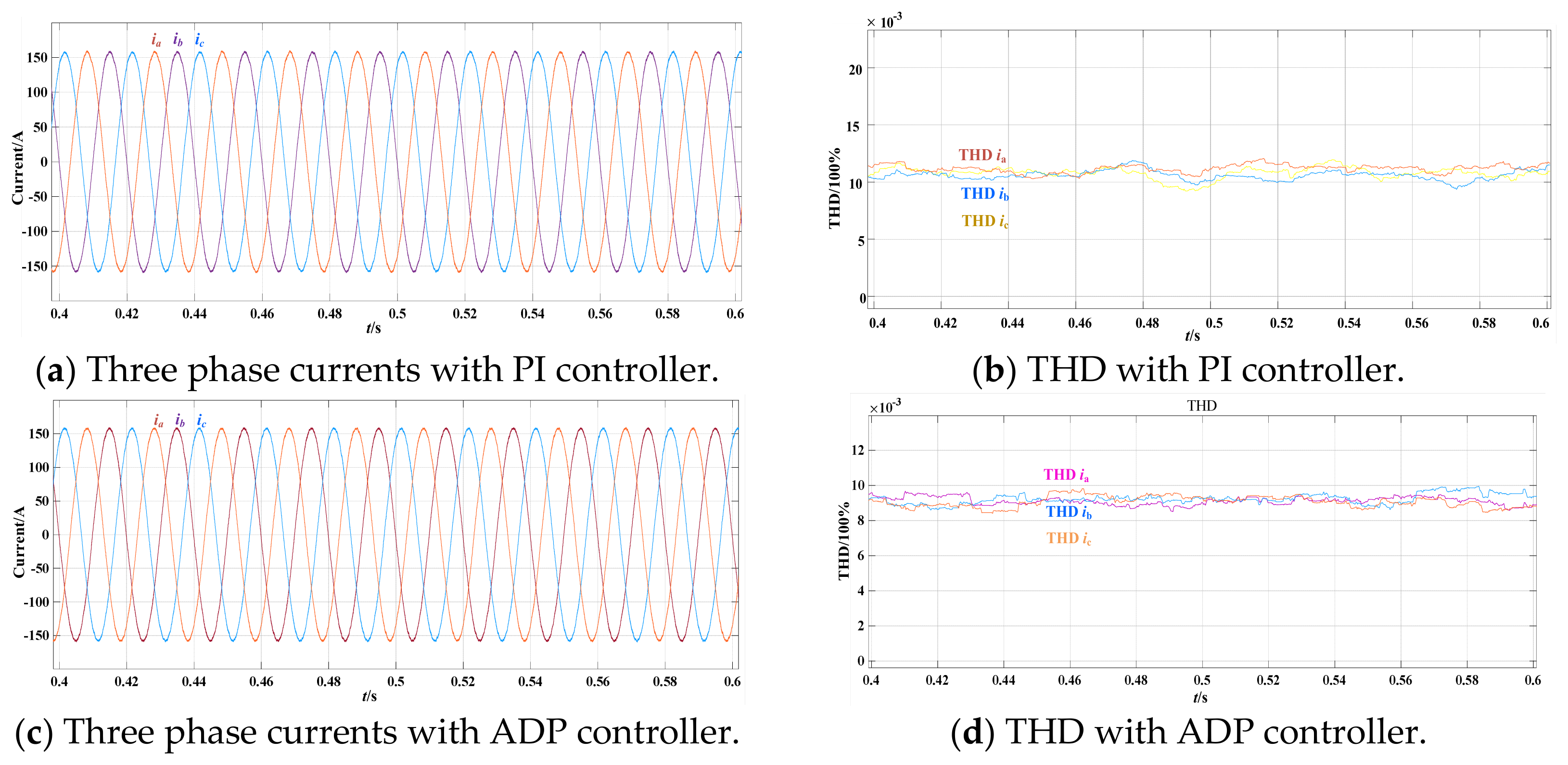
The relevant parameters of DCAC converters are set as follows: grid-side inductance L1 is 0.015 mH, grid-side filtering capacitor C1 is 150 µF, converter-side inductance L2 is 0.05 mH, and DC side capacitance C2 is 2 mF. The range of these parameters are shown in Table 2. To verify the effectiveness of the ADP controller, it is compared with the PI controller. The control parameters of the PI controller are: voltage outer loop proportional coefficient Kpv is 1.2, integral coefficient Kiv is 400, current inner loop selected proportional coefficient Kpi is 5, and integral coefficient Kii is 3000. The operating results are shown in Figure 9.
According to Figure 9, the THD of three-phase AC currents under the PI controller is 1.1%, while the THD of three-phase AC currents under the ADP controller is 0.9%. From this, it can be seen that the three-phase AC current power quality based on the ADP controller is better than that based on the PI controller, and its transient process is analyzed in Section 4.3.

4.2. ADP Controller for DCDC Converter

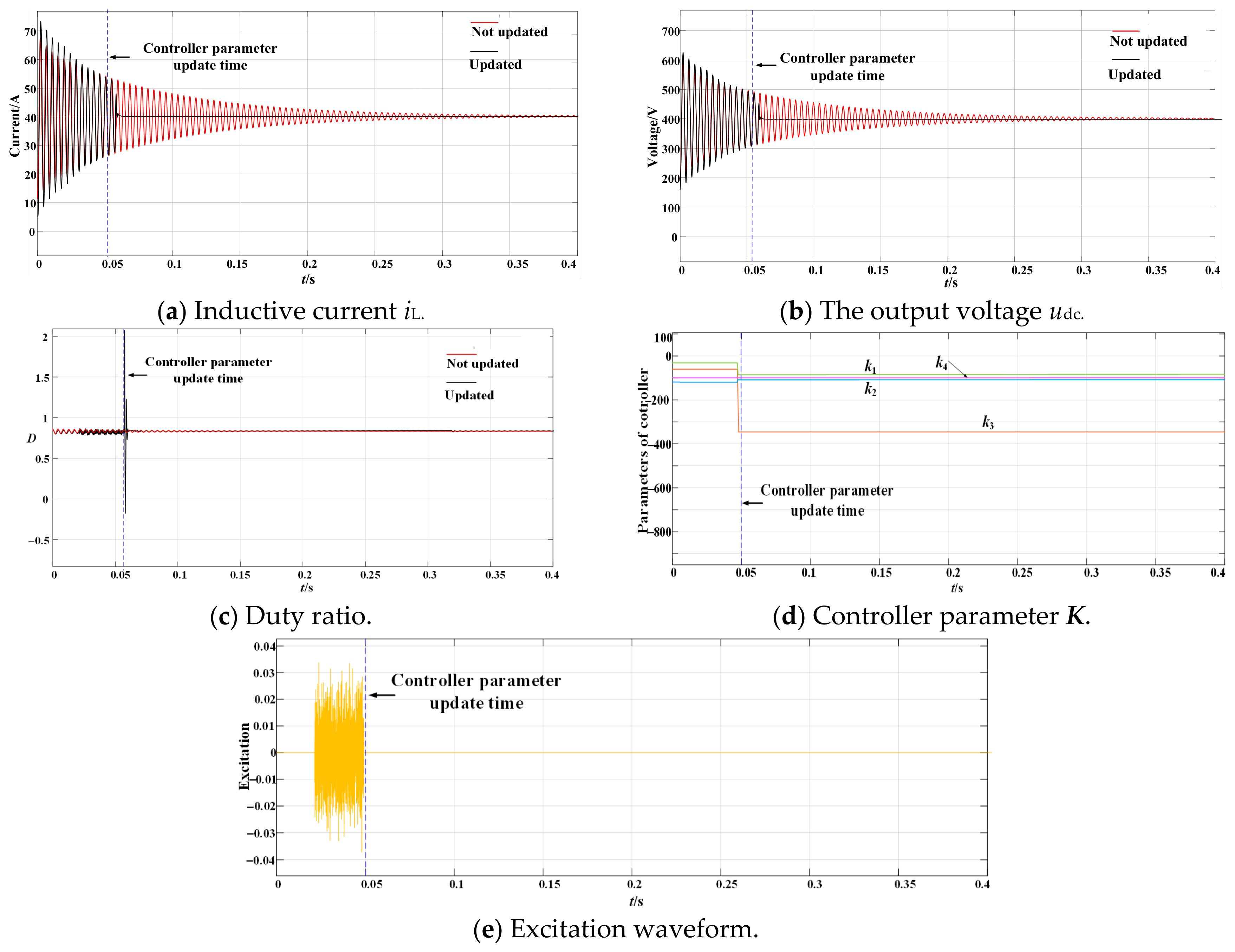
The parameter range of a DCDC converter can refer to Table 3. During simulation, the inductance parameter L is 0.8 mH and the capacitance parameter C is 1.5 mF. The simulation results are shown in Figure 10.
At the beginning of operation, due to an external disturbance, the inductor current iL and output voltage uo both oscillate significantly, as shown in Figure 10a,b. Before the online optimization of the ADP controller, due to the deviation of the system parameters in Table 3, the initial values of the controller parameters did not match the system, resulting in a long adjustment time. At 0.02 s, the system injects excitation, as shown in Figure 10e, and begins sampling and learning. At 0.05 s, sampling stops, and the control system uses these data to solve online using Formula (17) to obtain optimized controller parameters K, as shown in Figure 10d. After the controller parameters are updated, the system quickly stabilizes, as shown in the voltage and current waveforms, as shown in the black waveforms in Figure 10a,b, and the control signal duty cycle also quickly returns to a steady-state value, as shown in Figure 10c. According to the simulation, it can be concluded that online iterative optimization design based on ADP controller is feasible and can achieve steady-state control even when system parameters are offset or unknown.

4.3. Energy Management Strategy for Multiple Converters

In order to verify the applicability of the proposed energy management strategy for primary frequency regulation, simulation verifications are conducted on multi converters by the proposed energy management strategies. The measurement points are the outputs of each converter with the DC bus, shown in Figure 1. The bottom layer controller used an ADP controller with online learning iteration, and the upper layer used droop control to achieve energy management. The dynamic optimization of the bottom layer controller parameters was closely combined with the upper layer energy management.
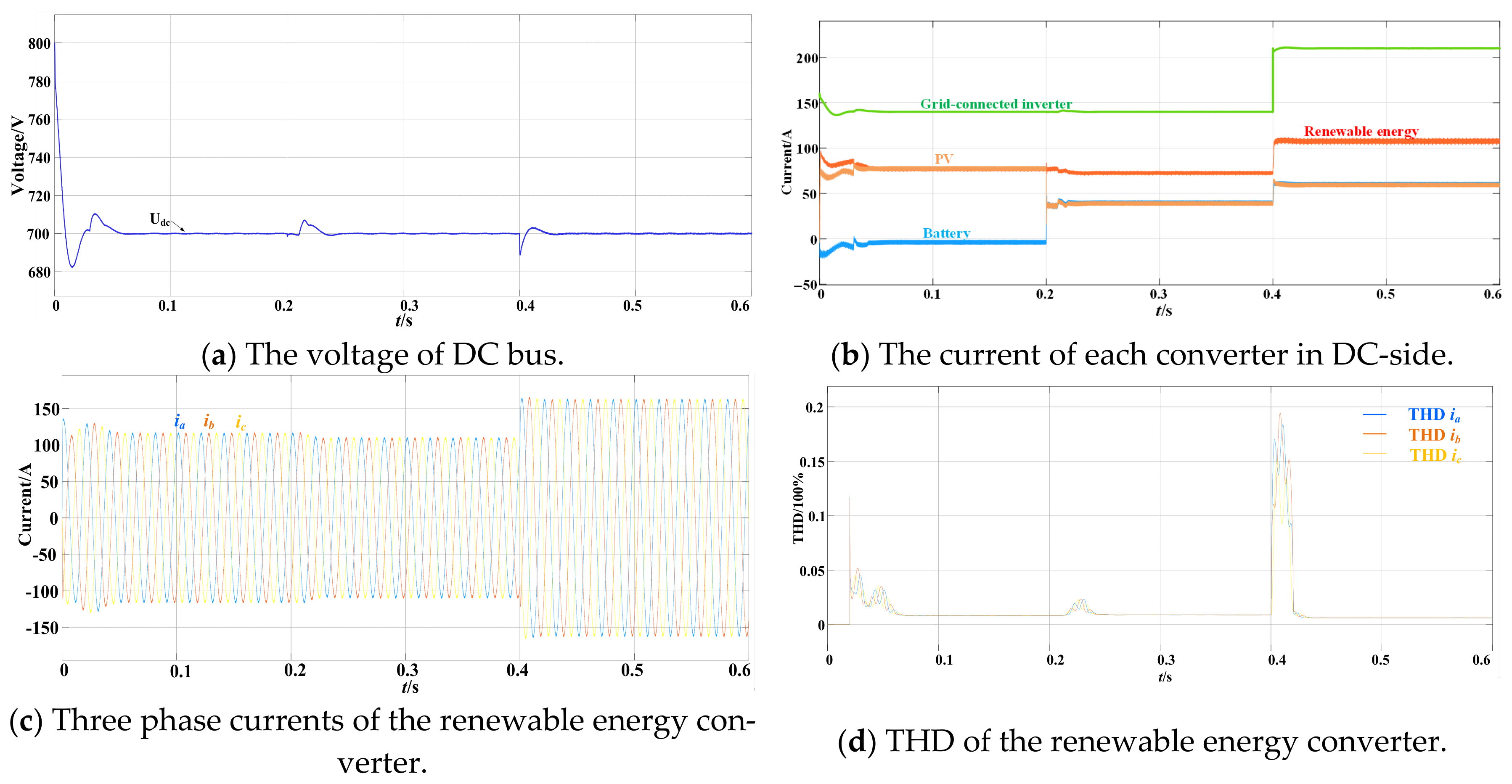
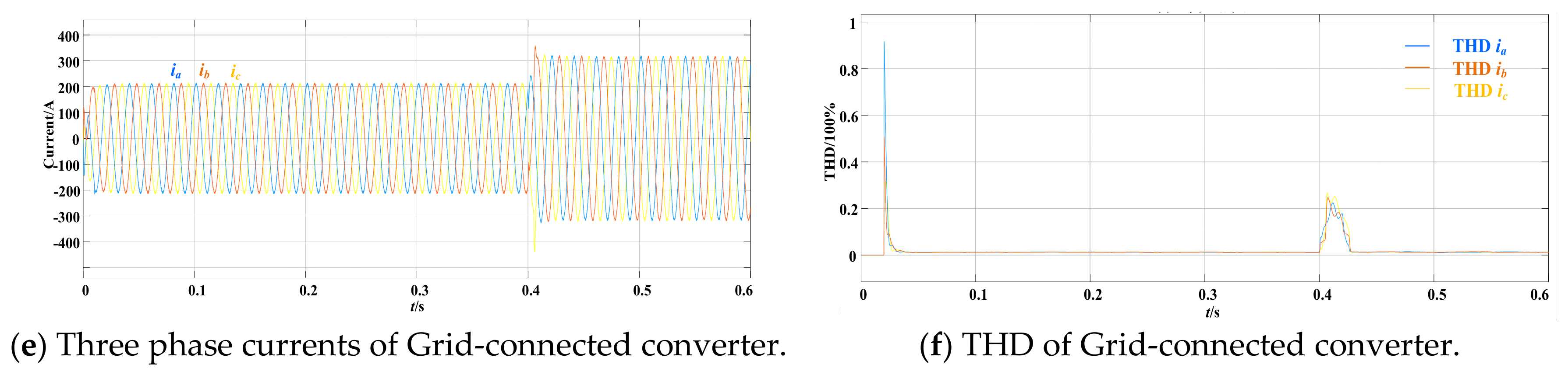
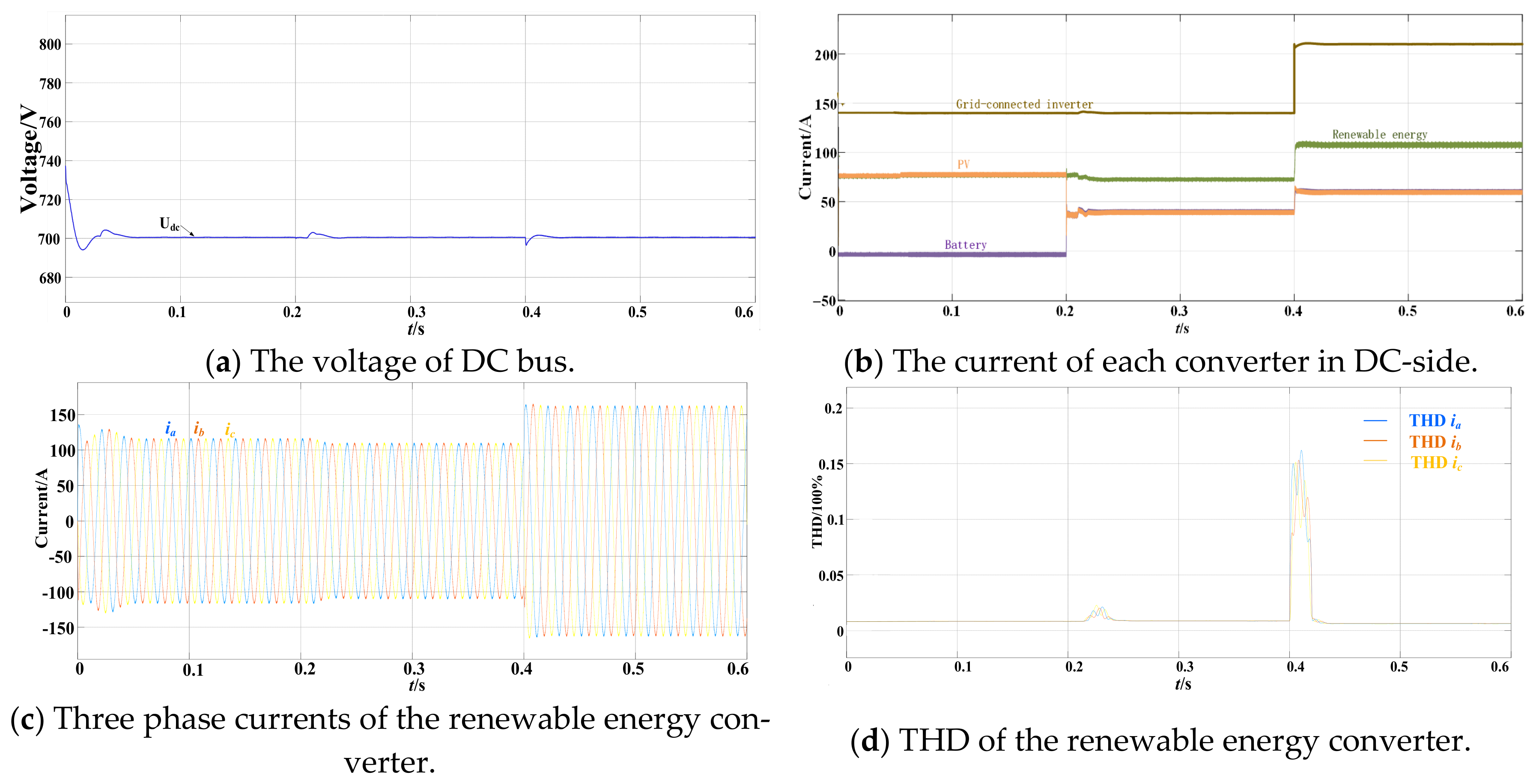
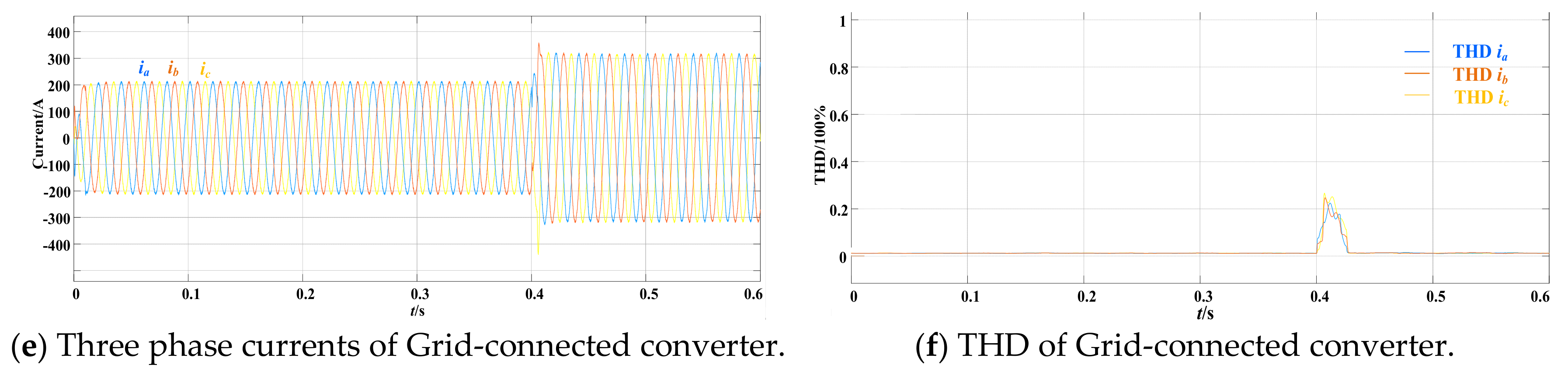
The simulation results by energy management strategy 1 are shown in Figure 11. At the beginning of operation, multiple converters run as a whole in Mode 1 of Table 1, with the grid-connected port operating in constant power mode and an output power of 100 kW. The renewable energy converter and photovoltaic converter are both in constant voltage mode, and the primary frequency regulation droop coefficient is 0.05. The energy storage is in a leisure state. Figure 11a shows the DC bus voltage, which is stable at 700 V. The output current on the DC side of the photovoltaic and hydropower ports is 71.5 A, the DC side current of the grid-connected port is 143 A, and the energy storage is 0 A, as shown in Figure 11b. The AC current and THD of the grid-connected converter and renewable energy converter are shown in Figure 11c–f. It can be seen that the THD is poor during transient state. When the controller parameters are iteratively optimized and the system enters steady state, the power quality is good, with a THD of 1%. At 0.2 s, the system transitions from mode 1 to mode 2, and the energy storage port operates in constant voltage mode. The droop coefficient ratio of the primary frequency regulation for the renewable energy converter, photovoltaic converter, and energy storage converter is 0.05:0.025:0.025, resulting in an output power ratio of 2:1:1 for each port, as shown in Figure 11b. At 0.4 s, the output command on the grid side increased from 100 kW to 150 kW, and the output currents of each port changed. The three-phase AC currents on the renewable energy side and grid side had poor THD during transient state. In order to ensure better power quality and faster dynamic response, the parameters of the two port controllers were optimized. Subsequently, the system entered a new steady-state value, and the THD of the three-phase AC current on both the renewable energy side and the grid side decreased to 1%, thereby achieving optimized control and comprehensive energy management of the multi converters under primary frequency regulation.
The simulation results by energy management strategy 2 are shown in Figure 12. At the beginning of operation, the energy router operates entirely in Mode 1 as shown in Table 1. The grid-connected port operates in constant voltage mode, while the renewable energy converter and photovoltaic converter operate in constant power mode and constant voltage control (CVC) mode, respectively. The energy storage is in an idle state. Figure 12a shows the DC bus voltage, which remains stable at 700 V. Figure 12b presents the DC-side current values of each port. It can be observed that the system successfully achieves power distribution among the ports, and the AC current power quality of both the grid-connected converter and t the renewable energy converter is good, with a total harmonic distortion (THD) of 1%, as shown in Figure 12c–f. At 0.2 s, the system transitions from Mode 1 to Mode 2. The energy storage converter operates in constant current discharge mode. The DC bus voltage experiences a small fluctuation but quickly reaches a new steady state. At 0.4 s, the output power command on the grid side increases from 100 kW to 150 kW. The output currents of all ports change accordingly. During the transient period, the three-phase AC currents on both the hydropower side and the grid side exhibit poor THD. To improve the power quality of the system, the controller parameters of these two converters are optimized. After the parameter update and optimization, the system quickly enters a new steady state. The three-phase AC current power quality on both the hydropower side and the grid side becomes good, with a THD of 1%. Thus, system parameter optimization and comprehensive energy management under energy management strategy 2 are successfully achieved.
Overall, by comparing the above two strategies of multiple converters for primary frequency regulation, it can be observed that regardless of which energy management control strategy is adopted, the ADP controller demonstrates adequate adaptability and enables the synchronous optimal design of multiple controller parameters. Consequently, it achieves the seamless integration and unification of underlying controller parameter adjustment with system-wide energy management.

5. Conclusions

In this paper, an ADP control and energy management method for multiple converters was studied under primary frequency regulation, which closely integrated the dynamic optimization of controller parameters with energy management to achieve flexible adaptation of new energy. Through theoretical analysis and simulation verification, the following conclusions are drawn: (1) In order to achieve energy optimization management of the system, a multimodal collaborative optimization control strategy for multiple converters was proposed. Based on the system state, the system was divided into multiple operating modes, and corresponding control strategies and instructions were adopted for each converter under different operating modes to achieve energy optimization control and comprehensive management of the entire system. (2) When the system parameters of an ACDC converter or a DCDC converter are uncertain or mismatch, using the ADP method for controller parameter optimization design can improve the control performance of the system, achieve fast tracking and control, and optimize power quality. (3) When the mode changes or the system operating state changes, the ADP controller has a certain adaptability and can achieve synchronous optimization design of multiple controller parameters, realizing the integration and unity of parameter adjustment of the underlying controller and the system operating mode.

Author Contributions

Conceptualization, Z.Z. and B.W.; methodology, Z.Z. and X.W.; software, K.L. and X.W.; validation, K.L. and Z.S.; formal analysis, G.D.; investigation, G.D.; resources, Z.Z.; data curation, G.D.; writing—original draft preparation, B.W. and Z.Z.; writing—review and editing, B.W. and Z.Z.; visualization, K.L.; supervision, Z.Z. and X.W.; project administration, Z.S.; funding acquisition, Z.S., G.D. and B.W. All authors have read and agreed to the published version of the manuscript.

Funding

This work was supported in part by the National Key Research and Development Program (2022YFB2404800), and in part by Postdoctoral International Exchange Program-Macao Young Scholars Program (AM2024006), Natural Science Foundation of Changsha City (kq2502266), and the foundation of Key Laboratory of Cleaner Intelligent Control on Coal & Electricity, Ministry of Education, P.R. China (CICCE202509).

Data Availability Statement

The original contributions presented in this study are included in the article. Further inquiries can be directed to the corresponding author.

Conflicts of Interest

The authors Bin Wei, Gaoxian Du, Zhaoqin Sun and Ke Li were employed by the company China Electric Power Research Institute. The remaining authors declare that the research was conducted in the absence of any commercial or financial relationships that could be construed as a potential conflict of interest.

References

  1. Energy Institute. Statistical Review of World Energy, 74th ed.; Energy Institute: London, UK, 2025. [Google Scholar]
  2. Zheng, J.; Zhai, L.; Tao, M.; Tang, W.; Li, Z. Low-Carbon Economic Dispatch in Integrated Energy Systems: A Set-Based Interval Optimization with Decision Support Under Uncertainties. Prot. Control Mod. Power Syst. 2026, 11, 68–87. [Google Scholar] [CrossRef]
  3. Soleimani, A.; Roghanian, P.; Heidari, M.; Heidari, M.; Pinnarelli, A.; Vizza, P.; Mahdavi, M.; Mousavi, S.F. Refining hybrid energy systems: Elevating PV sustainability, cutting emissions, and maximizing battery cost efficiency in remote areas. Energy Nexus 2025, 18, 100452. [Google Scholar] [CrossRef]
  4. Parhamfar, M.; Güven, A.F.; Pinnarelli, A.; Vizza, P.; Soleimani, A. Artificial intelligence in carbon trading: Enhancing market efficiency and risk management. J. Comput. Data Technol. 2025, 1, 19–39. [Google Scholar] [CrossRef]
  5. Xu, G.; Yang, Z. Risk-aware low carbon optimization of hydrogen-oriented multi-energy system with linear approximation of bi-product fuel cell. Energy 2025, 334, 137581. [Google Scholar] [CrossRef]
  6. Deng, Q.; Li, Z.; Liu, J.; Li, S.; Czarkowski, D.; Kazimierczuk, M.K.; Zhou, H.; Hu, W. Multi-Inverter Phase-Shifted Control for IPT With Overlapped Transmitters. IEEE Trans. Power Electron. 2021, 36, 8799–8811. [Google Scholar] [CrossRef]
  7. Said, B.; Bouguenna, F.I.; Ayyoub, Z.; Abdullah, M.; Özüpak, Y.; Bouddou, R.; Soleimani, A.; Pinnarelli, A.; Aslan, E.; Zaitsev, I. Hybrid MPC–Third-Order Sliding Mode Control with MRAS for Fault-Tolerant Speed Regulation of PMSMs Under Sensor Failures. Int. Trans. Electr. Energy Syst. 2025, 2025, 5984024. [Google Scholar] [CrossRef]
  8. Adiche, S.; Toumi, D.; Larbi, M.; Bouddou, R.; Bouchikhi, N.; Soleimani, A.; Pinnarelli, A.; Heidari, M. Robust modified adaptive PI-based controller for managing uncertainties in distributed generation systems of AC microgrids. Results Eng. 2025, 26, 104949. [Google Scholar] [CrossRef]
  9. Lin, P.; Meng, Q.; Zhu, M.; Ghias, A.M.Y.M.; Blaabjerg, F. Dynamic Circuit-Based Unified Power Regulation for Hybrid AC/DC/DS Microgrids: A Comprehensive Approach to Static and Transient Control. IEEE Trans. Ind. Electron. 2026, 73, 522–533. [Google Scholar] [CrossRef]
  10. Qiu, H.; Zhang, J.; Zhou, J.; Shi, G.; Yao, G.; Cai, X. A Novel Delta-Type Transformerless Unified Power Flow Controller with Multiple Power Regulation Ports. IEEE Trans. Power Electron. 2025, 40, 15820–15834. [Google Scholar] [CrossRef]
  11. Wang, C.; Wu, Z.; Li, P. Research on key technologies of microgrid. Trans. China Electro-Tech. Soc. 2014, 29, 1–12. [Google Scholar]
  12. Hosseini Dolatabadi, S.H.; Soleimani, A.; Maghanaki, M.; Ilinca, A. Enhancing photovoltaic farm capacity estimation: A comprehensive analysis with a novel approach. Energy Technol. 2024, 12, 2301294. [Google Scholar] [CrossRef]
  13. Liu, L.; Li, Z.; Kang, H.; Xiao, Y.; Sun, L.; Zhao, H.; Zhu, Z.; Ma, Y. Review of surrogate model assisted multi-objective design optimization of electrical machines: New opportunities and challenges. Renew. Sustain. Energy Rev. 2025, 215, 115609. [Google Scholar] [CrossRef]
  14. Meng, X.; Lin, L.; Li, H.; Mei, H.; Wang, L. Characteristic of Surface Streamer Discharge Under the AC-DC Composite Voltage. IEEE Trans. Dielectr. Electr. Insul. 2025, 32, 1373–1379. [Google Scholar] [CrossRef]
  15. Wang, Y.; Chen, S.; Yang, M.; Liao, P.; Xiao, X.; Xie, X.; Li, Y. Low-frequency oscillation in power grids with virtual synchronous generators: A comprehensive review. Renew. Sustain. Energy Rev. 2025, 207, 114921. [Google Scholar] [CrossRef]
  16. Nasirian, V.; Davoudi, A.; Lewis, F.L.; Guerrero, J.M. Distributed adaptive droop control for DC distribution systems. IEEE Trans. Energy Convers. 2014, 29, 944–956. [Google Scholar] [CrossRef]
  17. Yang, Y.; Yan, G.; Mu, G.; Chen, Z. Hierarchical bidding strategy for heterogeneous P2H loads and wind power: State-driven aggregation and switching time scheduling. Energy 2025, 334, 137766. [Google Scholar] [CrossRef]
  18. Wan, A.; Xiong, Z.; Al-Bukhaiti, K.; Yin, R.; Yuan, J.; Cheng, X.; Ji, X. An integrated TCN-ECA-BiLSTM and TD3 framework for high-accuracy forecasting and optimal load allocation in combined heat and power systems. Energy 2026, 350, 140670. [Google Scholar] [CrossRef]
  19. Mahdavi, M.; Soleimani, A.; Pinnarelli, A.; Heidari, M.; Jurado, F. Cost-based optimization of DG and capacitor placement in distribution networks under dynamic load conditions. Energy Rep. 2025, 13, 5525–5534. [Google Scholar] [CrossRef]
  20. Golsorkhi, M.S.; Shafiee, Q.; Lu, D.D.-C.; Guerrero, J.M. A distributed control framework for integrated photovoltaic battery based islanded microgrids. IEEE Trans. Smart Grid 2017, 8, 2837–2848. [Google Scholar] [CrossRef]
  21. Zhang, C.; Yang, H.; Wang, D.; Zhu, L.; Li, J.; Xie, L.; Zhou, K.; Guo, X.; Wang, Y. An efficient distributionally robust framework for multi-period energy storage planning in renewable-dominated power systems under normal and hurricane conditions. Appl. Energy 2026, 413, 127748. [Google Scholar] [CrossRef]
  22. Jia, H.; Zhang, C.; He, L.; Li, J.; Zhu, L.; Zhou, Q.; Shuai, Z.; Sun, X. A Novel Fault Location Method for Unbalanced Active Distribution Networks with Sparse Hybrid Measurements. IEEE Trans. Smart Grid 2026, 17, 1056–1068. [Google Scholar] [CrossRef]
  23. Tang, Y.; He, K.; Shu, H.; Wang, K.; Lou, W.; Qin, Z.; Han, Y.; Dai, Y. Reliability and safety assessment of distribution networks in mountainous plateau areas subject to low-amplitude lightning. Reliab. Eng. Syst. Saf. 2025, 264, 111305. [Google Scholar] [CrossRef]
  24. Li, Y.; Pei, X.; Wang, H.; Chen, Z.; Kang, Y. Parallel control strategy for aviation static converters based on virtual negative resistance. J. Power Supply 2018, 16, 14–20. [Google Scholar]
  25. Li, S.; Bai, H.; Yao, R.; Wang, Y.; Liu, T. Causes identification and sources localization method for multistage voltage sag under the influence of high penetration of renewable energy sources. Appl. Energy 2026, 402, 126891. [Google Scholar] [CrossRef]
  26. Luo, H.; Li, Q.; Zhou, H.; Sun, W.; Li, W.; Liu, Z.; Ji, Y.; Ding, L. Weak Single Phase-to-Ground Fault Time Detection with Learnable-Parameter-Driven DSP-Enhanced Transformer. IEEE Trans. Smart Grid 2026, 17, 1693–1708. [Google Scholar] [CrossRef]
  27. Li, S.; Zhou, J.; Zhou, F.; Niu, F.; Deng, W. A Reduced Current Ripple Overmodulation Strategy for Indirect Matrix Converter. IEEE Trans. Ind. Electron. 2025, 72, 3768–3777. [Google Scholar] [CrossRef]
  28. Zheng, J.; Sun, J.; Liu, F.; Liu, X.; Peng, J.; Zhang, J.; Zhang, C.; Zhu, L.; Zhu, X.; Huang, C.; et al. Flight verification of cooling self-sustaining high-temperature superconducting motor. Supercond. Sci. Technol. 2024, 37, 07LT02. [Google Scholar] [CrossRef]
  29. Guerrero, J.M.; Chandorkar, M.; Lee, T.-L.; Loh, P.C. Advanced control architectures for intelligent microgrids—Part I: Decentralized and hierarchical control. IEEE Trans. Ind. Electron. 2013, 60, 1254–1262. [Google Scholar] [CrossRef]
  30. Moayedi, S.; Davoudi, A. Distributed tertiary control of DC microgrid clusters. IEEE Trans. Power Electron. 2016, 31, 1717–1733. [Google Scholar] [CrossRef]
  31. Dragičević, T.; Lu, X.; Vasquez, J.C.; Guerrero, J.M. DC Microgrids—Part I: A review of control strategies and stabilization techniques. IEEE Trans. Power Electron. 2016, 31, 4876–4891. [Google Scholar]
  32. Zhou, N.; Luo, L.; Sheng, G.; Jiang, X. Scheduling the Imperfect Maintenance and Replacement of Power Substation Equipment: A Risk-Based Optimization Model. IEEE Trans. Power Deliv. 2025, 40, 2154–2166. [Google Scholar] [CrossRef]
  33. Qiao, T.; Li, W.; Liu, W.; Xu, G.; Jin, H. Design Considerations and Many-Objective Optimization of Synchronous Condenser Used for New Energy Power System Based on Electromagnetic-Thermal Constraints. IEEE Trans. Ind. Electron. 2025, 73, 5293–5304. [Google Scholar] [CrossRef]
  34. Fu, Y.; Li, H.; Yu, P.; Huang, Y.; Zeng, W. DFDR-NLNet: A dual-frequency differentiated representation non-local network for photovoltaic panel segmentation. Appl. Energy 2025, 401, 126761. [Google Scholar] [CrossRef]
  35. Deng, Q.; Li, Z.; Liu, J.; Li, S.; Luo, P.; Cui, K. Data-Driven Modeling and Control Considering Time Delays for WPT System. IEEE Trans. Power Electron. 2022, 37, 9923–9932. [Google Scholar] [CrossRef]
  36. Zhou, Y.; Han, Z.; Zhai, Q.; Wu, L.; Cao, X.; Guan, X. A Data-and-Model-Driven Acceleration Approach for Large-Scale Network-Constrained Unit Commitment Problem with Uncertainty. IEEE Trans. Sustain. Energy 2025, 16, 2299–2311. [Google Scholar] [CrossRef]
  37. Mei, W.; Wang, X.; Lu, Y.; Yu, K.; Li, S. Learning and Current Prediction of PMSM Drive via Differential Neural Networks. IEEE Trans. Circuits Syst. II Express Briefs 2025, 72, 489–493. [Google Scholar] [CrossRef]
  38. Zhang, W.; Wang, S.; Wang, P.; Fu, Q.; Li, X. Design of Accelerometers-based PUF for Internet of Things Security. IEEE Sens. J. 2025, 25, 32984–32992. [Google Scholar] [CrossRef]
  39. Liu, X.-K.; Jiang, H.; Wang, Y.-W.; He, H. A distributed iterative learning framework for DC microgrids: Current sharing and voltage regulation. IEEE Trans. Emerg. Top. Comput. Intell. 2018, 4, 119–129. [Google Scholar] [CrossRef]
  40. Peng, Z. A Research on Adaptive Dynamic Programming Based Distributed Control and Its Application. Ph.D. Thesis, University of Electronic Science and Technology of China, Chengdu, China, 2020. [Google Scholar]
  41. Liu, Y.; Chen, X.; Wu, Y.; Yang, K.; Zhu, J.; Li, B. Enabling the smart and flexible management of energy prosumers via the energy router with parallel operation mode. IEEE Access 2020, 8, 35038–35047. [Google Scholar] [CrossRef]
  42. Zhang, C. Research on Coordinated Control Strategy for Multi-Port Energy Router. Master’s Thesis, Harbin Institute of Technology, Harbin, China, 2019; pp. 58–63. [Google Scholar]
  43. Liu, B.; Wu, W.; Zhou, C.; Mao, C.; Wang, D.; Duan, Q.; Sha, G. An AC–DC Hybrid Multi-Port Energy Router with Coordinated Control and Energy Management Strategies. IEEE Access 2019, 7, 109069–109082. [Google Scholar] [CrossRef]
  44. Shen, Y.; Lu, Q.; Li, Y. Design Criterion and Analysis of Hybrid-Excited Vernier Reluctance Linear Machine with Slot Halbach PM Arrays. IEEE Trans. Ind. Electron. 2023, 70, 5074–5084. [Google Scholar] [CrossRef]
  45. Mishra, A.; Mandal, S.; Dieulot, J.-Y.; Bachute, M.R.; Faizan, M.; Pinnarelli, A.; Heidari, M.; Soleimani, A. Non-linear control of interleaved boost converter using disturbance observer-based approach. IEEE Access 2025, 13, 23833–23840. [Google Scholar] [CrossRef]
  46. Li, H.; Zhang, J.; Zhou, J.; Zang, J.; Shi, G.; Xu, J.; Cai, X. An Isolated Unidirectional DC Transformer with Active Current Reshaping for the Photovoltaic Plant DC Collection System. IEEE Trans. Ind. Electron. 2025, 73, 5481–5493. [Google Scholar] [CrossRef]
  47. Li, N.; Cao, Y.; Liu, X.; Zhang, Y.; Wang, R.; Jiang, L.; Zhang, X. An Improved Modulation Strategy for Single-Phase Three-Level Neutral-Point-Clamped Converter in Critical Conduction Mode. J. Mod. Power Syst. Clean Energy 2024, 12, 981–990. [Google Scholar] [CrossRef]
  48. Gao, S.; Chen, Y.; Song, Y.; Yu, Z.; Wang, Y. An Efficient Half-Bridge MMC Model for EMTP-Type Simulation Based on Hybrid Numerical Integration. IEEE Trans. Power Syst. 2024, 39, 1162–1177. [Google Scholar] [CrossRef]
  49. Zhang, H.; Wang, H.; Zhou, X.; Hu, J.; Zhou, B. Numerical investigation of a three-dimensional integrated system combining an inertial built-in wave energy converter array and a floating breakwater. Energy 2025, 326, 136102. [Google Scholar] [CrossRef]
  50. Junjie, J.; Yongqi, Z.; Zhou, X.; Al-Bukhaiti, K.; Anping, W.; Cheng, X.; Ji, X. Enhanced YOLO-IASE for robust safety inspection in complex substation environments. Signal Image Video Process. 2025, 19, 686. [Google Scholar] [CrossRef]
  51. Junjie, J.; Yongqi, Z.; Anping, W.; Al-Bukhaiti, K.; Huang, J.; Cheng, X. Multi-target detection for safety monitoring in complex substation environments using YOLO-DySE. Signal Image Video Process. 2025, 19, 804. [Google Scholar] [CrossRef]
  52. Jiang, Y.; Jiang, Z.-P. Robust Adaptive Dynamic Programming; John Wiley & Sons, Inc.: Hoboken, NJ, USA, 2017. [Google Scholar]
Figure 1. The overall structure of multiple converters for primary frequency regulation.
Energies 19 02338 g001
Figure 2. Comparison of PI and ADP controllers.
Energies 19 02338 g002
Figure 3. The domain of stability D.
Energies 19 02338 g003
Figure 4. The control diagram of DCDC converters.
Energies 19 02338 g004
Figure 5. Overall control strategy with multiple converters for primary frequency regulation.
Energies 19 02338 g005
Figure 6. The switching process of different modes.
Energies 19 02338 g006
Figure 7. Energy management strategy 1 for multi-converters.
Energies 19 02338 g007
Figure 8. Energy management strategy 2 for multi-converters.
Energies 19 02338 g008
Figure 9. Three phase currents and THD of DCAC converter with PI or ADP controllers.
Energies 19 02338 g009
Figure 10. Waveforms of DCDC converter with PI or ADP controllers.
Energies 19 02338 g010
Figure 11. Results of energy management strategy for primary frequency regulation.
Energies 19 02338 g011aEnergies 19 02338 g011b
Figure 12. Results of energy management strategy 2 for primary frequency regulation.
Energies 19 02338 g012aEnergies 19 02338 g012b
Table 1. Classification of modes in different operations.
ModesDifferent OperationsSOC
Mode 1Renewable energy is abundant, PV is excess, P pv MPPT > P g ref SOC ≥ 0.9
Mode 2Renewable energy is abundant, PV is excess, P pv MPPT > P g ref + P bat SOC < 0.9
Mode 3Renewable energy is abundant, PV is less, P pv MPPT < P g ref SOC ≥ 0.9
Mode 4Renewable energy is abundant, PV is less, P pv MPPT < P g ref + P bat SOC < 0.9
Mode 5Renewable energy is storage, battery cannot be charging P pv MPPT + P w < P g ref + P bat
Mode 6Renewable energy is storage, battery is discharging P pv MPPT + P w < P g ref SOC > 0.2
Mode 7Energy is storage P pv MPPT + P w < P g ref SOC ≤ 0.2
Mode 8Renewable energy is storage and shut down P pv MPPT + P w < P g ref P bat SOC > 0.2
Table 2. Parameters of DCAC converters.
ParametersValues
Grid-side inductance L10.015–0.05 mH
Converter-side inductance L20.05–0.5 mH
Grid-side filtering capacitor C1150–500 µF
DC-side capacitor C22 mF
Switching frequency f4.8 kHz
The rated power 500 kW
Table 3. Parameters of DCDC converters.
ParametersValues
Inductance L0.1–0.8 mH
Capacitor C1.5 mF
Switching frequency f3.6 kHz
The rated power 250 kW
Disclaimer/Publisher’s Note: The statements, opinions and data contained in all publications are solely those of the individual author(s) and contributor(s) and not of MDPI and/or the editor(s). MDPI and/or the editor(s) disclaim responsibility for any injury to people or property resulting from any ideas, methods, instructions or products referred to in the content.