Article

Numerical Investigation on the Aerodynamics of a Dual Vertical Axis Wind Turbine with a New Dual-Deflector


by
Yang Cao
1,
Yongfei Yuan
1,
Zhong Qian
2,
Aihua Wu
1,
Yuan Yang
1,
Zhening Cao
1,
Xiang Chen
1,
Yinuo Cai
1,
Lin Mao
1,
Chengyun Shi
1,
Jia Wang
3,
Chao Chen
3 and
Chenguang Song
1,*
1
School of Mechanical Engineering, Nantong University, No. 9, Seyuan Road, Nantong 226019, China
2
School of Mechanical Engineering, Nantong Institute of Technology, No. 211, Yongxing Road, Nantong 226001, China
3
School of Materials Science and Engineering, Taiyuan University of Technology, No. 79, Yingze West Road, Taiyuan 030024, China
*
Author to whom correspondence should be addressed.
Energies 2026, 19(10), 2284; https://doi.org/10.3390/en19102284
Submission received: 16 April 2026 / Revised: 3 May 2026 / Accepted: 7 May 2026 / Published: 9 May 2026
(This article belongs to the Section A3: Wind, Wave and Tidal Energy)

Abstract

This work investigates the performance degradation of dual vertical axis wind turbines at low tip speed ratios using numerical simulation using two-dimensional computational fluid dynamics (CFD). In order to address this problem, it suggests a unique deflector configuration and arrangement. The results show a 21.33% improvement in self-starting potential at low TSRs when dual-configuration deflectors are deployed close to the twin rotors. Additionally, the average torque coefficient increases by 24.31% and the peak power coefficient increases by 53.12%, indicating a significant improvement in performance at high tip speed ratios. While curved deflectors on both sides provide converging channels that increase flow volume and dynamic pressure in the downwind zone, the central deflector decreases reverse airflow in the midsection. The proposed deflector arrangement also exhibits great potential for the compact layout of wind farm arrays; the accelerated wake recovery characteristic is beneficial to improving the overall efficiency of wind farms. With important ramifications for the advancement of renewable energy technology, this work provides fresh insights into dual vertical axis wind turbine optimization.

1. Introduction

Energy structures are changing in favor of cleaner and renewable sources due to the worsening global energy shortages and environmental pollution problems [1]. In light of this, wind energy as an endless clean energy source has attracted a lot of attention for its development and application, with wind turbines acting as the main components for turning wind energy into electricity [2]. At the moment, wind turbines are mainly divided into two types: vertical axis wind turbines (VAWTs) and horizontal axis wind turbines (HAWTs), each of which has unique structural features and use cases.
VAWT has advantages over HAWT, including low noise levels, low sensitivity to wind direction, and simple construction [3], showing special potential in certain applications. However, the commercialization of VAWT is severely limited by their intrinsic aerodynamic restrictions, such as poor self-starting performance and low efficiency at low wind speeds [4]. The cooperative operation of dual VAWT has received more scholarly attention in recent years. Twin rotors that are properly configured can greatly increase the efficiency of wind energy usage when compared to one rotor [5]. Nevertheless, the twin rotors continue to have self-starting problems, and the intricate aerodynamic interference they produce creates additional difficulties. Many flow control solutions have been developed and implemented to solve the drawbacks of dual VAWT [6,7]. Active flow control methods, such as plasma motion [8], synthetic jets [9], and blow–suck coordination [10], can dynamically adapt to varying wind conditions; however, long-term operation is severely hampered by these technologies’ typical reliance on intricate external control systems and continuous power inputs, which lead to expensive expenditures and challenging maintenance. Furthermore, recent advancements in active performance enhancement for wind farms heavily rely on complex algorithmic control strategies, such as Walrus optimizer-based fractional order PID control [11] and chaos game optimization algorithms [12]. Conversely, passive flow control methods, including vortex generators [13], airfoil modifications [14], and deflectors [15], typically have smaller structures, run softly, and do not need extra electricity to function. Compared to other advanced passive strategies like vortex generators and airfoil modifications—which primarily aim to delay local boundary layer separation on blade surfaces, but often come at the cost of permanently altering the original blade profile and increasing manufacturing complexity—deflectors offer a distinct macroscopic advantage. They uniquely restructure the global incoming flow and mitigate the flow blockage effect upstream of the rotor without compromising the structural integrity of the rotating blades. Due to this superior capacity to optimize flow fields globally, combined with their simplicity of installation and upkeep, deflectors have become a major area of study and present a more practical solution for performance enhancement.
Esmaeel [16] created an ideal groove configuration on the deflector surface for one rotor. This method improved self-starting performance and raised the peak efficiency of Savonius VAWT by an extra 11.2% by creating controlled vortex structures to better flow separation conditions. The use of porous media materials in guiding vanes was investigated by Nimvari [17]. Precise control over flow rate and velocity was obtained by modifying material permeability, providing a novel way to deal with flow obstruction problems brought on by conventional solid guide vanes. In order to achieve multi-objective optimization of the diffuser shape, Ghafoorian [18] created a diffuser design with a semi-directional airfoil using response surface optimization. This method greatly decreased operating aerodynamic noise while increasing aerodynamic efficiency by 28.4%. Iham [19] increased the wind turbine’s working range while preserving steady performance output by using a genetic algorithm for multi-objective optimization of upstream guide vane placement parameters.
For twin rotors. Applied study on upstream guide vanes by Kim and Gharib [20] showed that this flat plate guide vane significantly increases turbine operational efficiency by raising the power coefficient by 15–20%. Jin [21] investigated the impact of upstream flat guide vane characteristics on the power production of twin rotors using three-dimensional CFD models. This study provided data to enable guide vane parameter optimization by revealing the underlying patterns of how each parameter influences turbine power production. A unique guide vane with drainage jet holes was created by Hossein [22]. He carried out multi-parameter optimization design for a twin Savonius turbine using a CFD-Taguchi coupling method. The system performance was greatly improved by actively regulating flow field separation. The torque properties of the rotor were successfully enhanced by the addition of jet holes.
As was previously mentioned, a variety of flow control systems have been created and implemented to overcome the drawbacks in lift-type wind turbine designs. Nevertheless, some approaches have drawbacks of excessive complexity and expense. Among these, deflectors have attracted a lot of scholarly interest as an inexpensive, very effective option. However, there are still a lot of research gaps with twin rotors deflector systems. The majority of research is limited to single-plate deflectors without form improvement. Additionally, very little research has been done on the downwind portion of the twin rotors, with most studies concentrating only on the upwind zone as a breakthrough point. In light of the complex aerodynamic coupling effects between twin rotors, this study proposes an innovative deflector system integrating a central deflector and curved lateral plates. The configuration is engineered to leverage the upwind flow while additionally optimizing the aerodynamic characteristics in the downwind zone, thereby enhancing the self-starting potential and total power output of the twin rotors. Furthermore, a differential analysis is conducted on the various combination modes of these split deflectors, providing a comprehensive evaluation of how different structural arrangements influence the synergistic performance of the turbine system. It should be noted that while true self-starting refers to the acceleration from a stationary state (TSR = 0), this study evaluates the self-starting potential by analyzing the improvement of the average torque coefficient at low operational tip speed ratios.

2. Research Modeling

2.1. Geometric Models

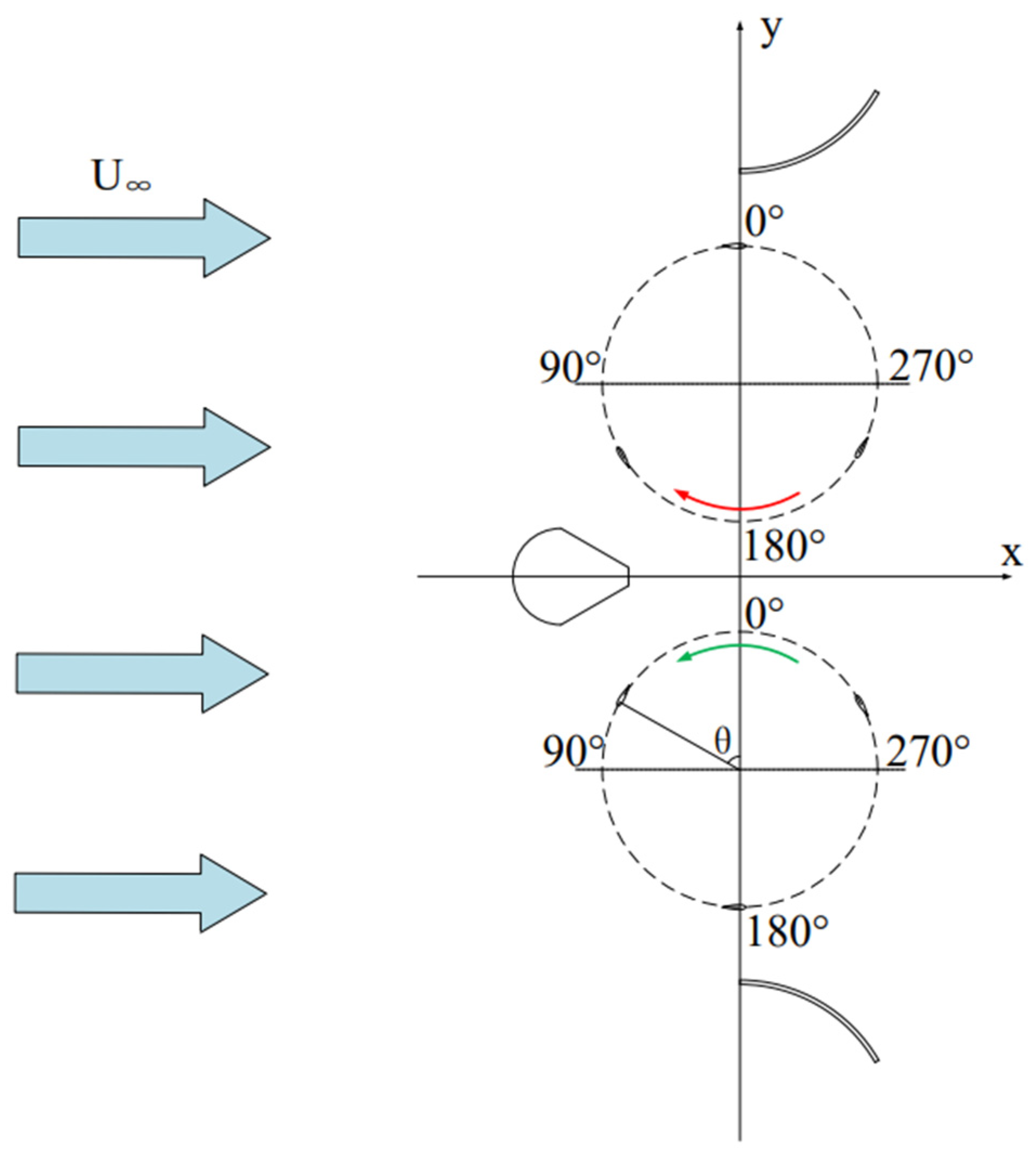
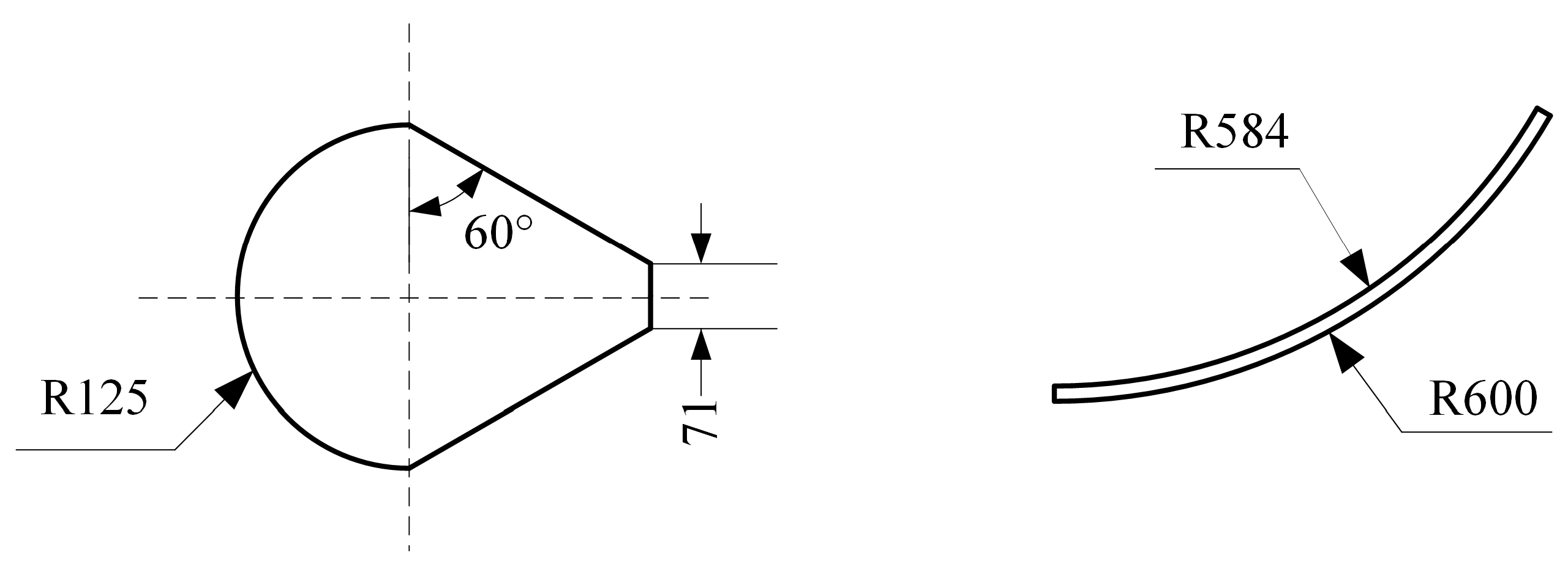
The aerodynamic performance parameters of a dual vertical axis wind turbine with deflectors are the main topic of this article. Figure 1 depicts the simplified model created for this system. A deflector at the centerline, curved deflectors on each turbine’s exterior, and a counter-rotating arrangement of three-bladed Darrieus wind turbines make up the system. NACA 0021 is the chosen airfoil for the wind turbine. Even at high rotational speeds, this airfoil maintains excellent efficiency and a high lift-to-drag ratio. Table 1 provides exact airfoil parameters. Curved deflectors are placed on the fan’s exterior to prevent obstructing the rotor’s rotating space, while the central deflector takes on the shape of a raindrop. Figure 2 displays the parameters for both curved and center deflectors. The twin rotors spacing is fixed at 1.4D in the simulation.

2.2. Theoretical Equation

The continuity equation and momentum equations (N-S equations) can be used to calculate the motion of incompressible Newtonian fluids. In order to get different wind turbine performance characteristics, this study used numerical simulations. The following is the expression for the equations [24]:
ρ t + ( ρ v ) = 0
ρ v t + ( ρ v × v ) = P + τ + ρ f
Equations (1) and (2) represent the Navier–Stokes equations [25], where ρ denotes fluid density, t represents time, v is the velocity vector, P is the surface pressure, τ is the surface stress vector, and f is the volumetric force vector per unit mass.
VAWT usually operates in a high Reynolds number range where there are noticeable turbulence features in the flow field. The shear stress transfer (SST) k-ω turbulence model is the hybrid model used in this investigation. This model combines the independence advantage of the conventional k-ω model in the far field with the robustness of the standard k-ω model in near-wall regions [26]. The following equations can be used to simulate separated flows with reverse pressure gradients [27]:
t ( ρ k ) + x i ( ρ k v i ) = x j ( Γ k k x j ) + G k Y k + S k + G b  
t ( ρ ω ) + x i ( ρ ω v i ) = x j ( Γ ω ω x j ) + G ω Y ω + D ω + S ω + G ω b
Within these equations, G k indicates the production of turbulent kinetic energy originating from the mean velocity gradient, and G ω stands for the production of ω. The parameters Γ k and Γ ω are utilized to define the effective diffusion coefficients for k and ω. Additionally, Y k and Y ω express the turbulence-induced dissipation of k and ω. The cross-diffusion effect is captured by D ω . Buoyancy-related influences are reflected through G b and G ω b , whereas S k and S ω act as optional source terms defined by the user.
The tip speed ratio (TSR), a critical Indicator of the rotor’s rotational condition, is one of the important factors for assessing wind turbine aerodynamic performance. In particular, it is defined as the relationship between the linear velocity at the extremity of the rotating blades and the incoming wind speed [28]:
T S R = ω R U
Within this formulation, ω (rad·s−1) and R (m) respectively indicate the angular speed and the radius of the rotor, while U (m∙s−1) corresponds to the free-stream wind velocity.
Represented by C m and C p respectively, the torque and power coefficients serve as crucial indicators for assessing the aerodynamic capabilities of wind turbines [29]:
C m = M 0.5 ρ A R U 2
C P = ω M 0.5 ρ A U 3 = λ C m
where M is the torque of the wind turbine in N∙m, ρ is the air density in kg∙m−3, A is the swept area of the wind turbine in m2, and R is the radius of the wind turbine in m.
Given that this paper investigates dual vertical axis wind turbine, the average power coefficient C p   ( a v e r a g e ) is introduced.
C P ( a v e r a g e ) = C p 1 + C p 2 2

3. Numerical Methods

3.1. Computational Domain

The two-dimensional simulation used in this study was chosen by striking a balance between objective-driven needs and computing resource optimization. The investigation was carried out in a two-dimensional computational domain. As shown by previous research [30] and our own simulation results, although three-dimensional modeling can fully capture full-scale flow field information, including tip vortices and complicated three-dimensional flow separation, it comes at a high processing cost. In addition to being just as successful in forecasting wind turbine performance, two-dimensional simulations can drastically lower the computational load [31]. As a result, two-dimensional simulation is used in this study to model wind turbines numerically.
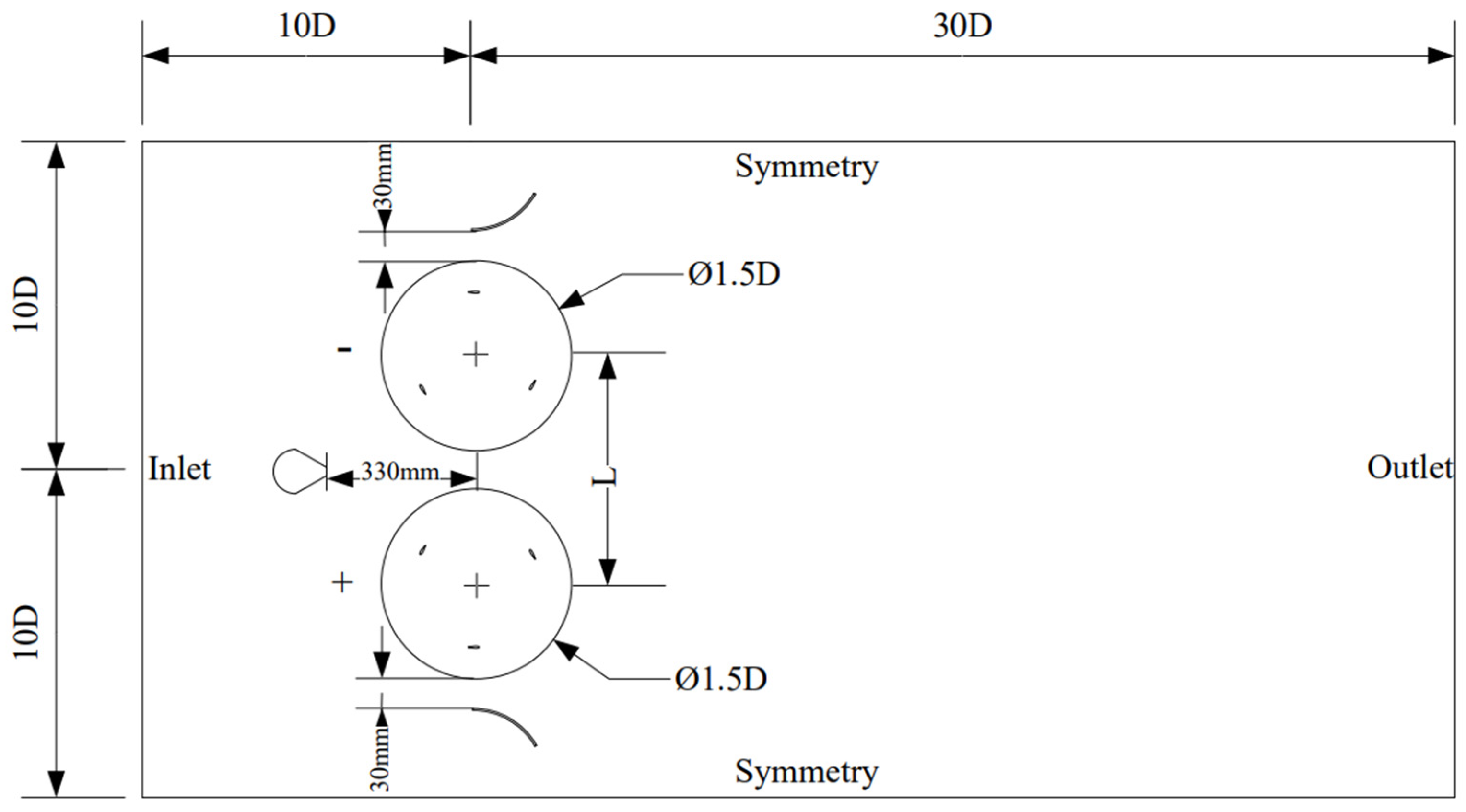
Figure 3 displays the diagram of the computational domain, which consists of one central deflector, two revolving subdomains, two curved deflectors, and one stationary subdomain. The outer stationary domain measures 20D in width and 40D in length. Within this domain, two vertical axis wind turbines are positioned in parallel within their respective rotating subdomains, which have a diameter of 1.5D. The upper turbine rotates clockwise while the lower one rotates counterclockwise, with a center-to-center separation distance L of 1.4D.
To ensure the simulation accuracy, the centers of both turbines are strategically positioned 10D from the inlet, 10D from each lateral side (set as symmetry boundary conditions), and 30D from the outlet. These specific boundary distances are chosen to ensure they are sufficiently far from the turbines to prevent any artificial blockage effects, while the symmetry conditions eliminate artificial wall shear stress and enable unconstrained lateral flow development, allowing the full development of the wake without boundary interference.

3.2. Boundary Conditions

Ansys Fluent 2022 R1 is the simulation program used in this investigation. In terms of domain configuration and mesh production, the solid blade regions were subtracted from the fluid domain following model development to focus exclusively on the fluid–structure interaction. Regarding the boundary condition settings, the two rotating subdomains were defined as interface boundaries to facilitate data exchange, and the wind turbine blades were configured as wall surfaces with a no-slip condition. Finally, the inlet was designated as a velocity inlet with a wind speed of 9 m/s, where the turbulence intensity (TI) was set to 5% and the turbulent length scale was specified as 0.072 m.

3.3. Solver Settings

Because it incorporates the benefits of both the k-ω and k-ε models, the SST k-ω turbulence model was chosen for the reasons mentioned above. Mach levels below 0.3, when the gas flow is deemed incompressible, were used in all numerical experiments [32]. Consequently, the simulation utilized the SIMPLE algorithm to integrate the pressure and velocity fields under the SST k-ω model. Boundary and material conditions were specified as follows: a 0 Pa gauge pressure at the outlet, an air density of 1.225 kg/m3, and a viscosity of 1.79 × 10⁻⁵ Pa·s. To ensure temporal accuracy and stability, a second-order implicit formulation was selected, setting the residual target for iteration convergence to 10−5 [33]. To guarantee convergence, each time step was repeated thirty times. Ten revolutions were calculated, and C P was obtained from the values of C m that were noted in the last two cycles.

3.4. Verification of Mesh Independence

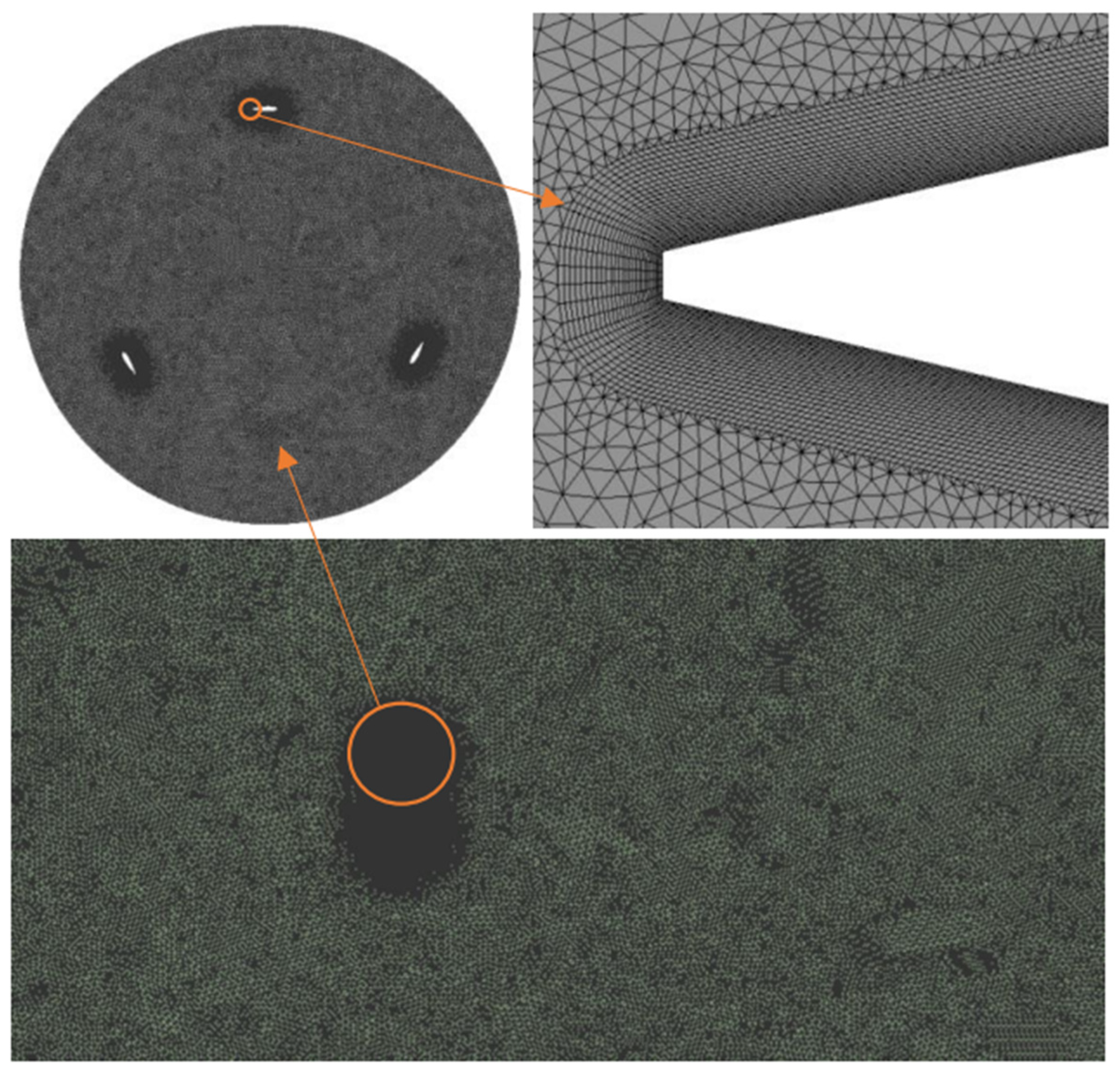
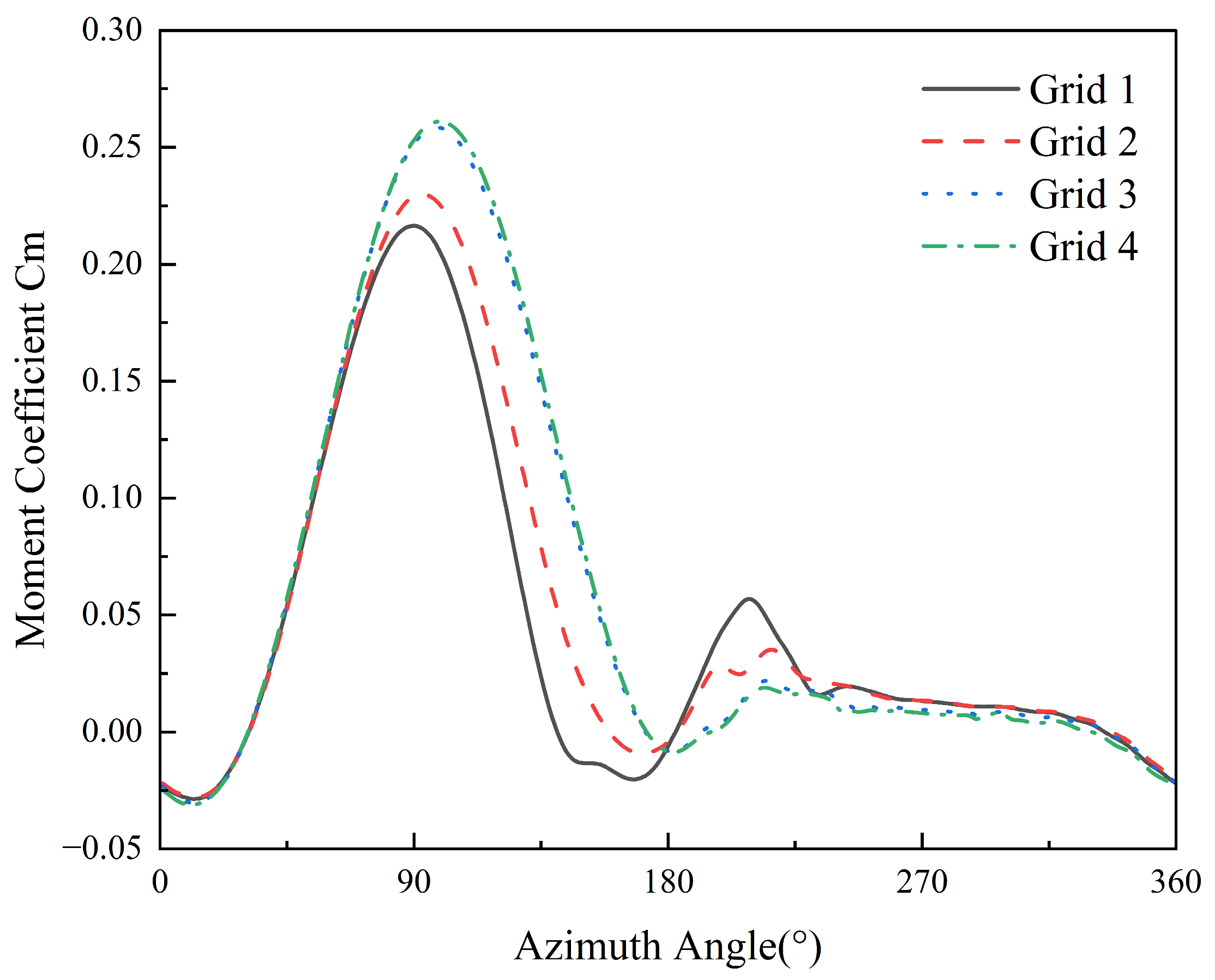
The grid is used to discretize the computational domain and convert governing equations into algebraic systems that can be solved. The correctness of numerical solutions and computational cost are directly impacted by grid quality. In areas with sharp velocity and pressure gradients, a high-quality mesh ensures excellent reliability by precisely capturing flow field features. However, an overabundance of meshes results in the accumulation of computing resources, which raises computational expenses considerably. On the other hand, a lack of meshes prevents a thorough examination of crucial areas. Therefore, choosing the right number of meshes is essential to guaranteeing both affordable computational costs and good dependability of CFD simulation results. Ansys Meshing software was used to create the domain discretization, as seen in Figure 4. The high velocity gradient details of airflow over the blade surface were accurately recorded by adding an expansion layer to the blade surface [34]. To satisfy the low-Reynolds near-wall treatment requirements of the SST k-ω model, the forward design of the boundary layer mesh was completed with the core control target of blade surface y+ < 1, and all corresponding mesh parameters are listed in Table 2. This configuration ensures sufficient near-wall mesh resolution to accurately capture the viscous sublayer flow, laying a reliable foundation for the accuracy of simulation results. Four different mesh densities were independently investigated in this study. Using a homogeneous two-dimensional grid, Table 2 describes the mesh parameters. Excellent mesh quality was indicated by the minimum orthogonality factor exceeding 0.746 and the maximum skewness staying below 0.395.
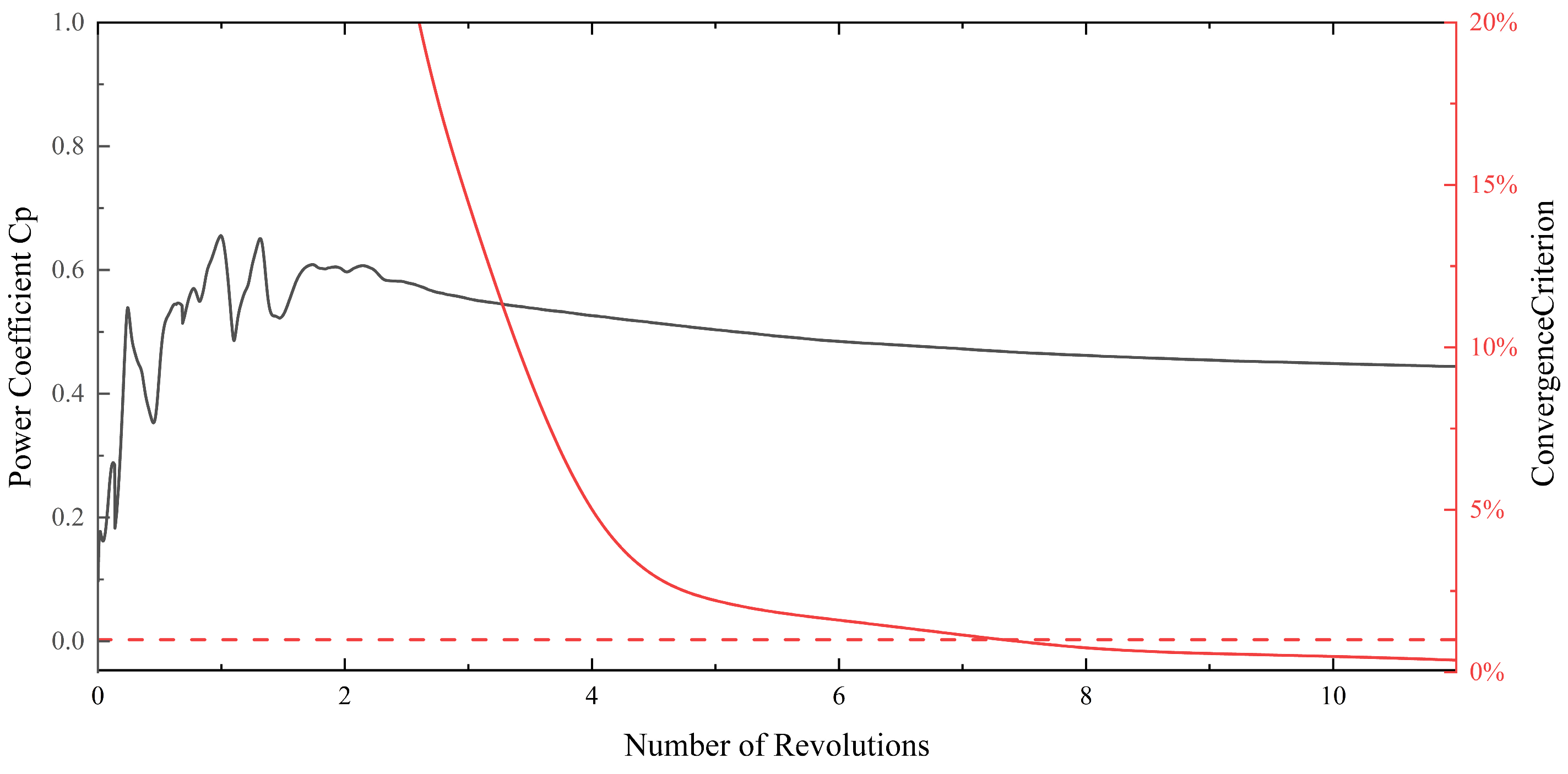
To ensure the accuracy of the simulation results, convergence assessment is required. The power coefficient is monitored in Fluent during the simulation as the wind turbine completes multiple rotation cycles. Once the power coefficient satisfies the convergence criterion specified by the formula, the wind turbine is set to rotate for an additional 5 cycles to eliminate stochastic effects [35].
C o n v e r g e n c e C r i t e r i o n = ( C P ( a v e , n + 1 ) C P ( a v e , n ) ) C P ( a v e , n ) < 1 %
According to the monitored data in Figure 5, the deviation of the power coefficient between the 8th revolution and the 7th revolution is 0.701%, which meets the specified convergence criterion. To further guarantee the stability of the results, the wind turbine is rotated for another 5 cycles, reducing the convergence error to 0.371% and yielding the final convergent solution.
For a single blade with a tip speed ratio of 2.64, Figure 6 displays the torque coefficient change with azimuth angle as determined by tracking four distinct mesh numbers. The torque curves for Mesh 3 and Mesh 4 are very consistent, as the figure makes evident, with just little variations between azimuth angles of 225° and 270°. In contrast, there is a noticeable divergence between azimuths 90° and 180° in the curves for Mesh 1 and Mesh 2. Mesh 4 uses 110% more elements than Mesh 3, according to calculations, although the average torque coefficient changes by just 0.34%. As a result, choosing Mesh 3 as the discretization standard for further research guarantees computational correctness while lowering computational expense.

3.5. Time Step Verification

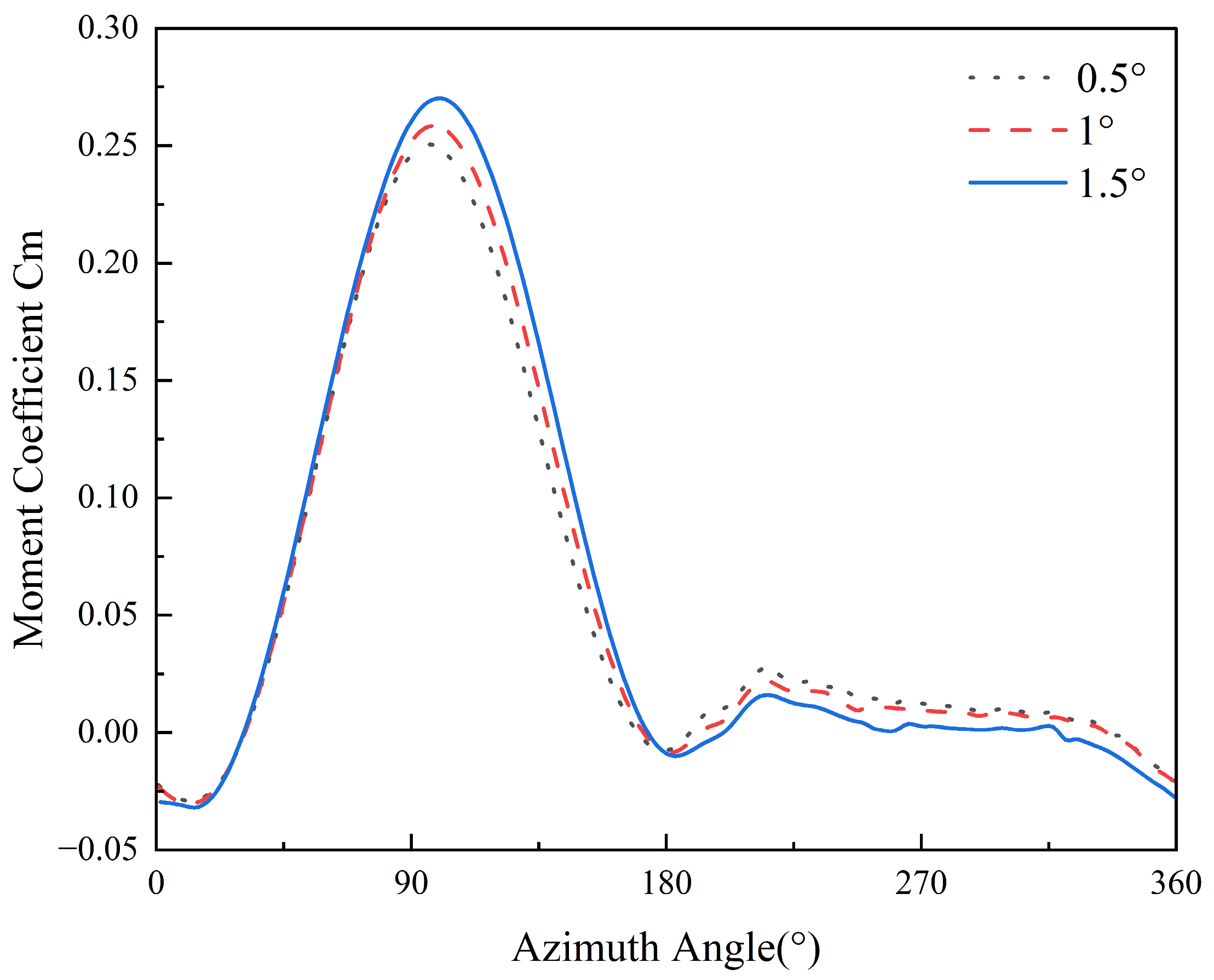
The time step used in simulations is usually the amount of time needed for the azimuth angle of the wind turbine to rise by one increment. While excessively tiny time steps lengthen computation time, excessively large time steps may hinder the resolution of some transient behaviors, jeopardizing the accuracy of final results. As a result, choosing the right time step is crucial [36]. Three time steps are preset in this study, which correspond to the intervals of time needed for the wind turbine to rotate by 0.5°, 1°, and 1.5°, respectively [37]. Table 3 displays certain parameters. The following formula is used to determine the wind turbine speed depending on the time step:
ω = 2 π T
n = 60 ω 2 π
t = 60 α × ( 2 π 360 ) 2 π × n
The link between the azimuth angle at various time steps and the instantaneous torque coefficient of a single blade is depicted in Figure 7. The graphic shows that the instantaneous torque coefficient changes noticeably when the time step is lowered from 1.5° to 1°. Nevertheless, further reducing the time step size yields a mere 0.47% variation in the average torque coefficient. The time step for wind turbine numerical simulations is therefore adjusted to match 1° of turbine rotation in order to guarantee computational correctness while reducing needless computational cost.

3.6. Model Validation

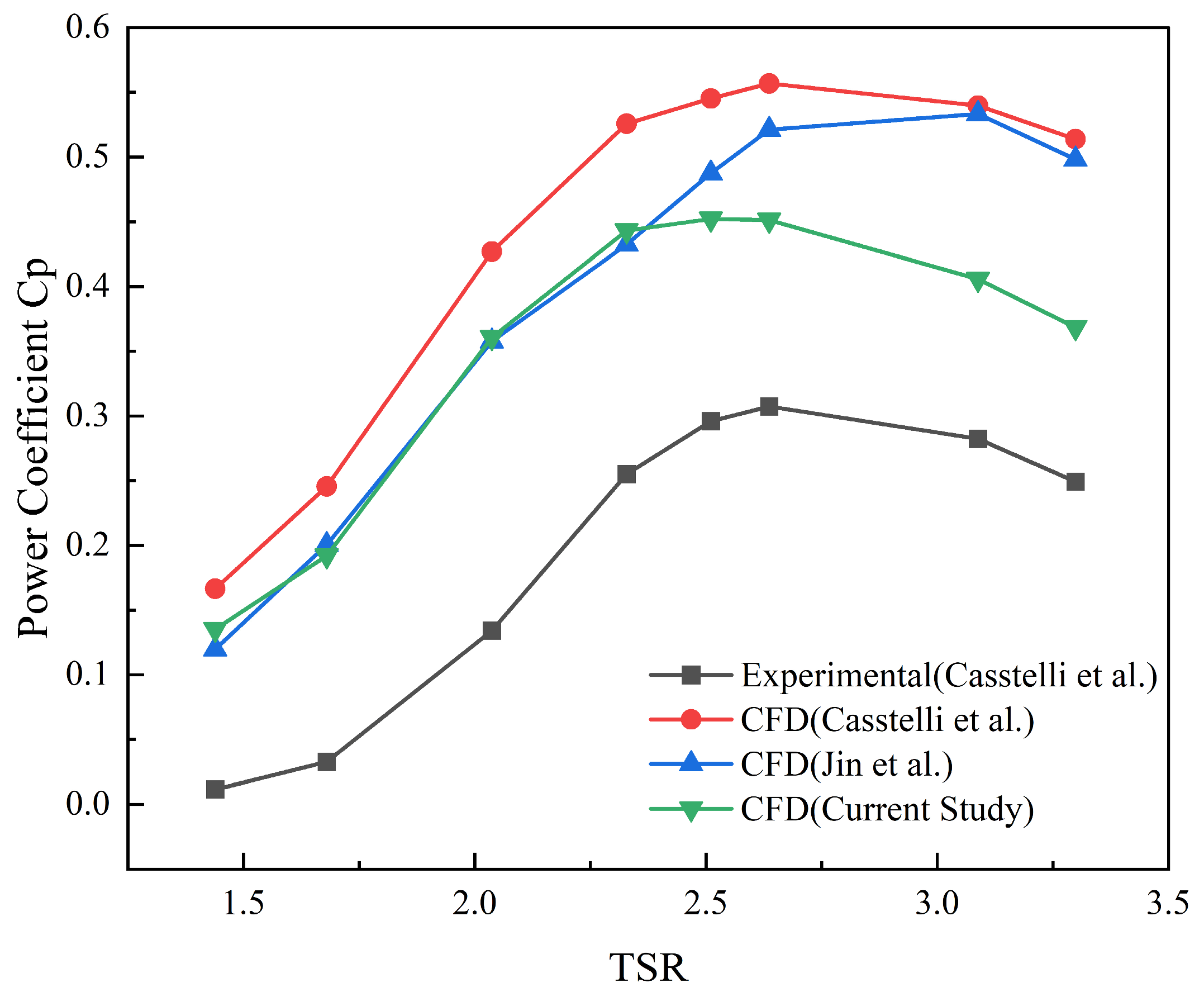
The accuracy and dependability of the two-dimensional computational fluid dynamics model developed in this study must be confirmed by comparing its computational outputs with reliable experimental data after the grid and time step independence has been confirmed. Two simulation results and experimental data from Raciti Castelli [38] and Jin [21], among others, were chosen for this investigation as validation benchmarks. The power coefficient curves from simulations at various tip speed ratios were compared with experimental data and CFD study findings from two more researchers, as illustrated in Figure 8. All things considered, the simulation findings effectively replicate the essential features of the experimental curve.
To quantify the prediction accuracy of the numerical model in this work, the Mean Absolute Error (MAE) was adopted for quantitative evaluation of the simulation results with the experimentally measured power coefficient as the baseline, and a horizontal comparison with published congeneric 2D CFD results under the same working conditions was performed. The results show that the overall MAE between the CFD simulation results of this work and the experimental data is 0.1550, while the overall MAE values of the congeneric simulation results from Raciti Castelli and Jin are 0.2439 and 0.1977, respectively. The comparison indicates that the absolute deviation between the predicted results of the proposed numerical method and the experimental data is significantly lower than that of published studies in the same field, with better prediction accuracy, which fully verifies the reliability of the numerical model in this work.
We still note that the two-dimensional CFD forecasts are somewhat higher than the experimental observations, despite the general trend being consistent. The two-dimensional simplified model’s intrinsic limitations, which ignore important phenomena in the three-dimensional flow field including tip vortex-induced drag and tangential flow, are reflected in this departure. In reality, these effects lower the actual power output and consume energy. Second, structural simplifications were required for this study, which eliminated attachments like support arms. The higher anticipated values were also caused by the absence of mechanical friction losses as a result of this omission. Additionally, measurement errors and uncertainties may affect experimental data. In conclusion, this model’s development and validation yield accurate numerical forecasts for further in-depth examination.

4. Results and Discussion

This section illustrates the benefits of the suggested deflector design after numerical simulations of a dual vertical axis wind turbine fitted with different kinds of deflectors. The inlet wind speed is consistently set at 9 m/s with a turbulence severity of 5% in the two-dimensional simulations that follow. Every other parameter is still the same as it was in the previous section on numerical simulation validation.

4.1. Dual Vertical Axis Wind Turbine

Two-dimensional unsteady flow field simulations were first carried out at rated wind speed for isolated VAWT and dual VAWT models in order to set performance benchmarks for later aerodynamic enhancement research. For both configurations, performance curves were acquired throughout various TSR ranges (1.44–3.30).
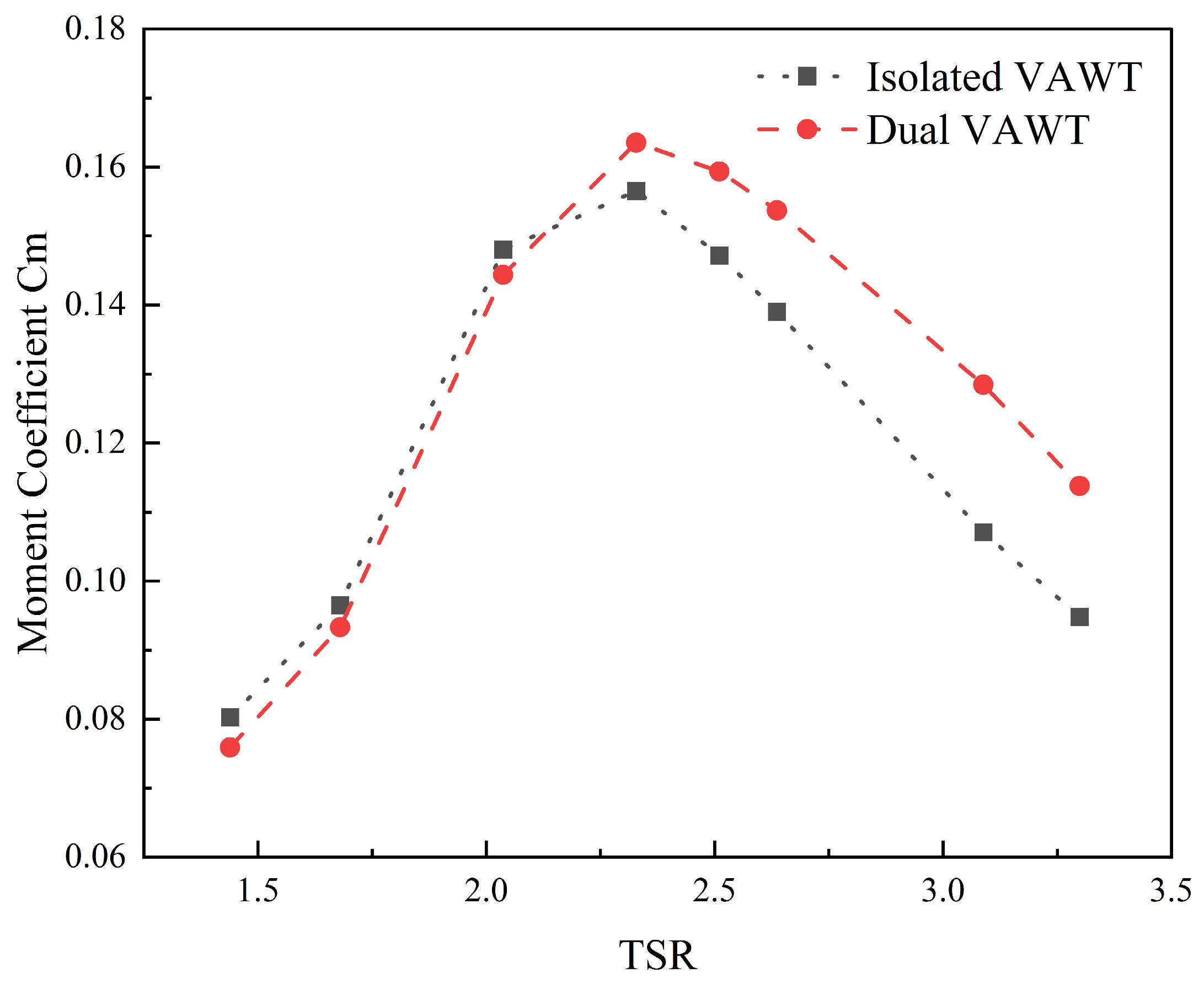
As seen in Figure 9, a comparison of the average torque coefficient between isolated VAWT and dual VAWT under different TSRs is presented [23]. Simulation results reveal that the twin rotors system’s performance improvement has a substantial TSR dependency. With a maximum peak boost of almost 20%, the twin rotors power coefficient significantly outperforms the one rotor system in the medium-to-high TSR range (TSR > 2.33). However, the twin rotors system suffers from performance degradation in the low TSR range (TSR < 2.04), with output power even slightly lower than that of the one rotor system. This phenomenon, which results from a fundamental change in the nature of aerodynamic interference between the twin rotors as TSR fluctuates, is consistent with findings published in the literature [39].
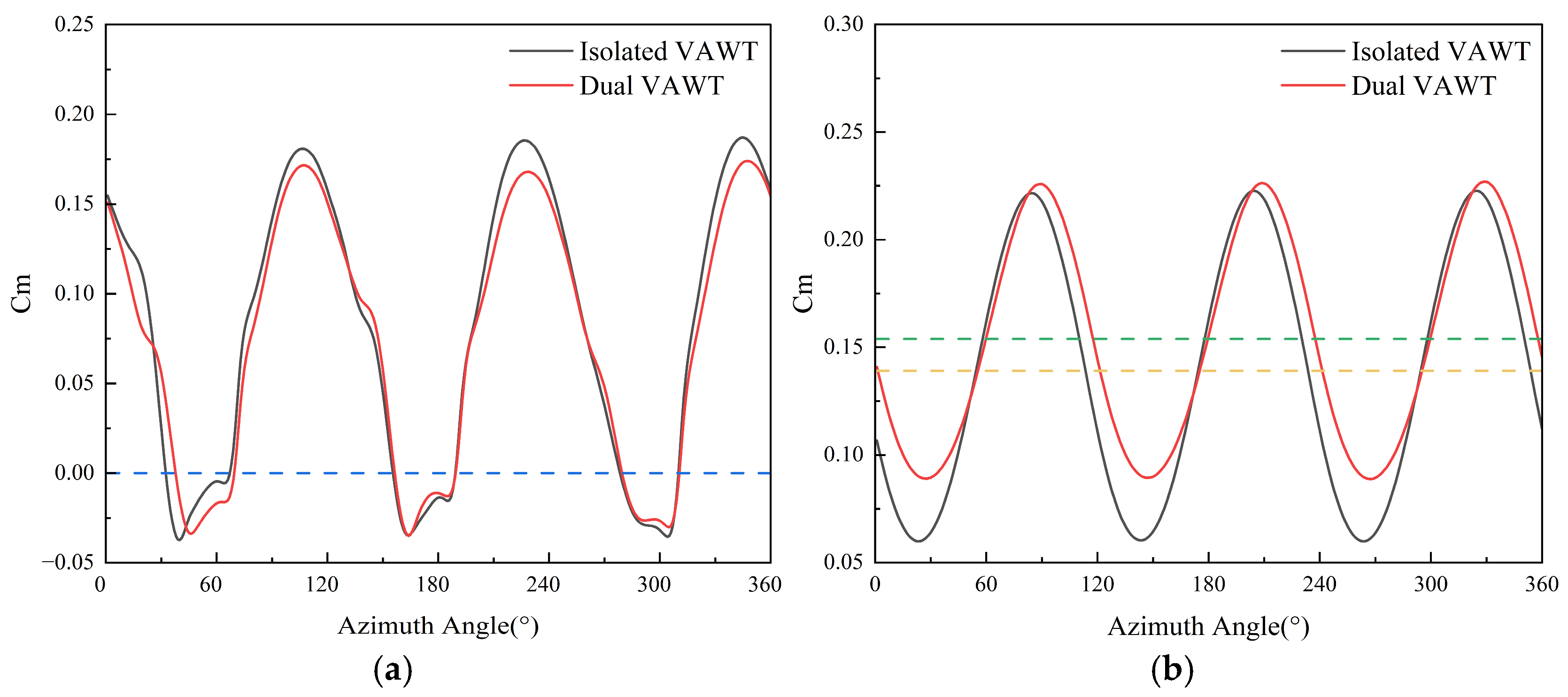
For one rotor and twin rotors, Figure 10 illustrates how the blade torque coefficient changes with azimuth angle throughout a single rotating cycle for tip speed ratios of 1.44 and 2.64. The blue dashed line in Figure 10a represents the reference line at Cm = 0. The green and yellow dashed lines in Figure 10b denote the cycle-averaged torque coefficients of the corresponding turbine configurations. At TSR = 1.44, the negative torque regions of the two configurations present similar distribution patterns, and the discrepancy is only concentrated in the peak values of the positive torque zones. The one rotor may achieve a maximum Cm of 0.185 at an azimuth angle of 228°, but the twin rotors can only achieve a maximum Cm of 0.168 at the same azimuth angle, representing a 10.12% higher peak torque for one rotor. On the other hand, the torque valley difference becomes prominent at TSR = 2.64. The aerodynamic interaction between twin rotors produces more beneficial effects with the increase in tip speed ratio, and the overall torque fluctuation is significantly reduced. Reduced system fatigue loads and more stable wind turbine operation result from a decrease in overall torque fluctuations. Numerically, the average torque coefficient of the twin rotors system is increased by 10.66% compared with the one rotor arrangement.
When opposed to one rotor designs, the twin rotors architecture generally shows drawbacks at low tip speed ratios (TSR), with some self-starting issues. This is caused by intricate aerodynamic interference between the twin rotors, which lowers the blades’ peak torque. This also illustrates Darrieus turbines’ intrinsic drawback at low tip speed ratios, which researchers frequently refer to as the static dead band. The potential of the blades to start themselves is further hampered in this area by inadequate or even negative torque [40]. In order to improve the self-starting potential of dual VAWT while also increasing overall aerodynamic efficiency, this research suggests a unique deflector layout.

4.2. Dual Vertical Axis Wind Turbine with Deflector

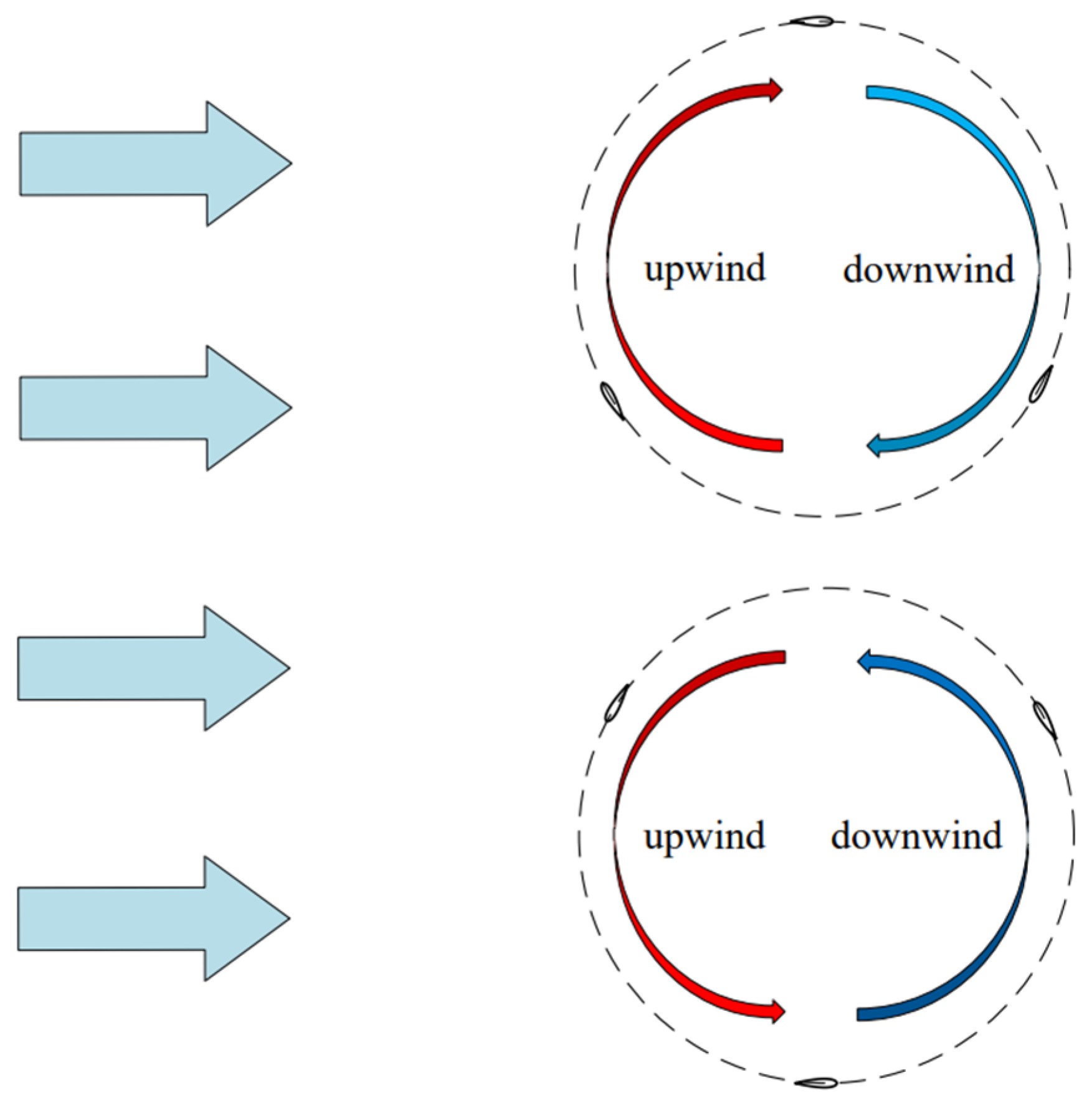
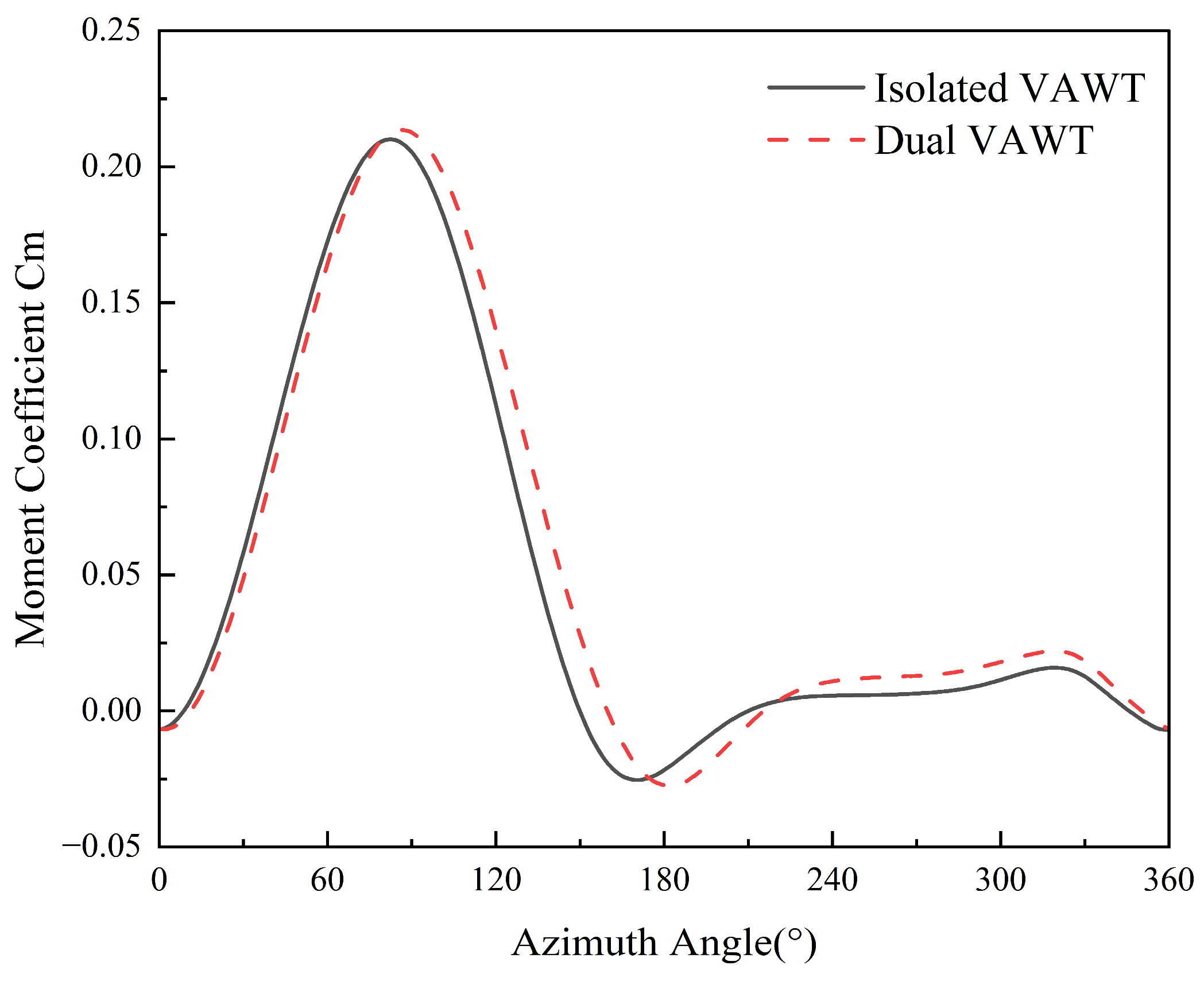
As seen in Figure 11, the area within a wind turbine’s single revolution can be separated into the upwind and downwind zones. Additionally, because of wind energy dissipation, lift-type vertical axis wind turbines create substantially less torque in the leeward zone than in the windward zone. The fluctuation of the instantaneous torque coefficient per blade with azimuth angle for isolated VAWT and dual VAWT throughout a single cycle at a TSR of 2.64 is seen in Figure 12. Traditional research on deflector arrangement has mostly concentrated on using the upwind zone, with little consideration paid to the downwind sector. Lateral curved deflectors and central deflectors have been introduced to increase the power generation capacity of wind turbines in both upwind and downwind zones. Like the majority of research, the central deflector seeks to improve power production in the upwind area. The lateral curved deflectors reroute wind flow into parts of the downwind region, making these previously unutilized sections usable.
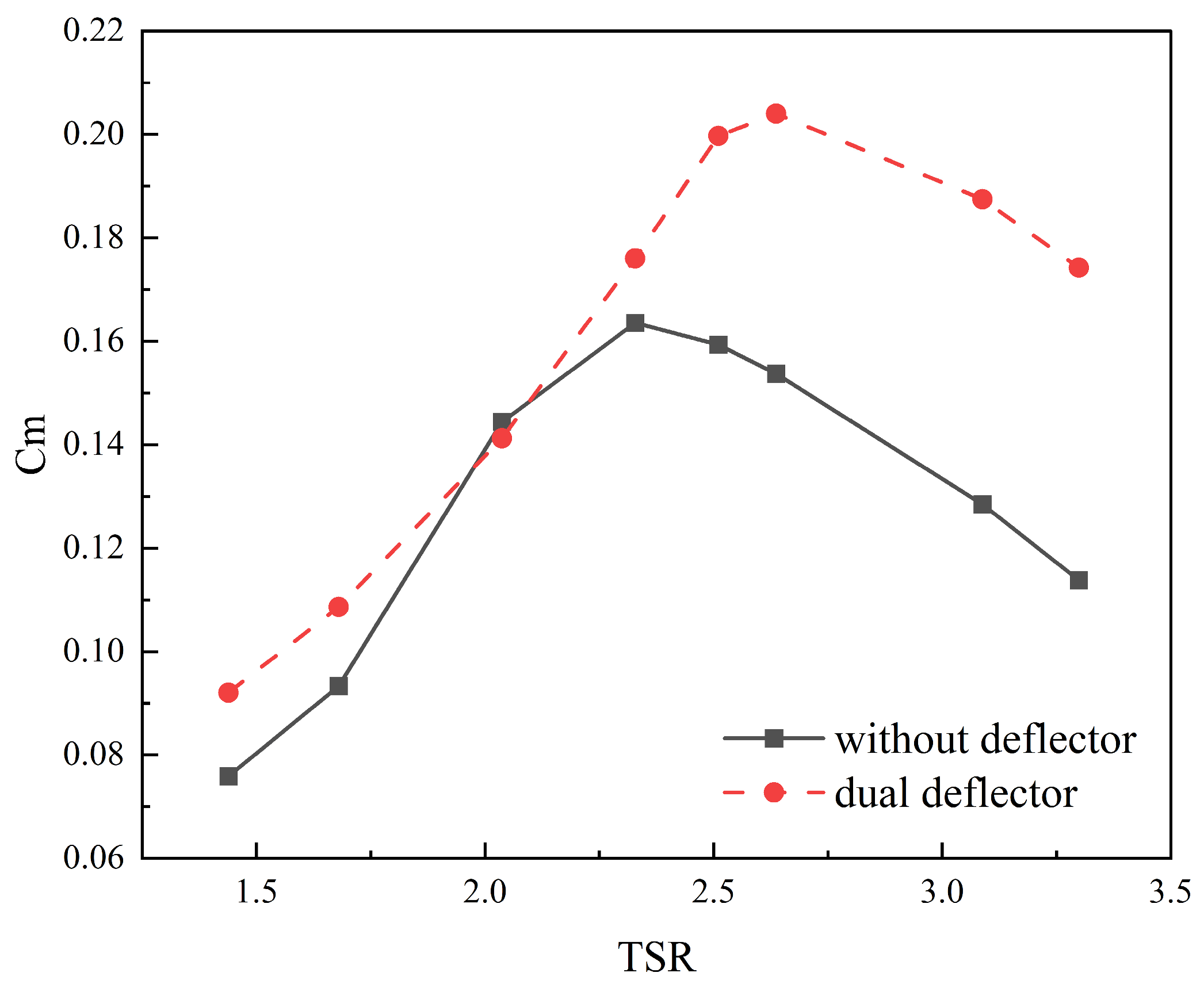
The evolution of the average torque coefficient for the dual deflector system in comparison to the original twin rotors under various tip speed ratios is shown graphically in Figure 13. The dual deflector not only greatly raises the torque ceiling for the TSR > 2.33 region, but it also moves the ideal operating point in the direction of higher regions. At a tip speed ratio of 2.33, the initial system achieved a peak Cm of roughly 0.164. Following the installation of the deflectors, the optimal TSR moved to 2.64 and the peak increased to 0.204, or roughly 24.7%. The combined structure successfully corrects inflow circumstances, allowing the rotor to maintain an ideal angle of attack range at high speeds and postponing performance degradation in the high-speed range, as evidenced by the rightward shift in peak values.
The dual deflector showed a notable torque recovery impact in the Darrieus dead band. The system increased torque by 21.1% at TSR = 1.44, with Cm increasing from 0.076 to 0.092. The central deflector mitigates the effects of aerodynamic dampening at low speeds by reducing reverse airflow in the mid-range. The curved deflectors create a beneficial working condition by accelerating forward airflow on both sides. Wake interactions at certain frequencies may be the cause of a small performance crossover seen at TSR = 2.04. This does not, however, change the prevailing tendency of strategically placing deflectors to increase overall aerodynamic efficiency over the whole working range.
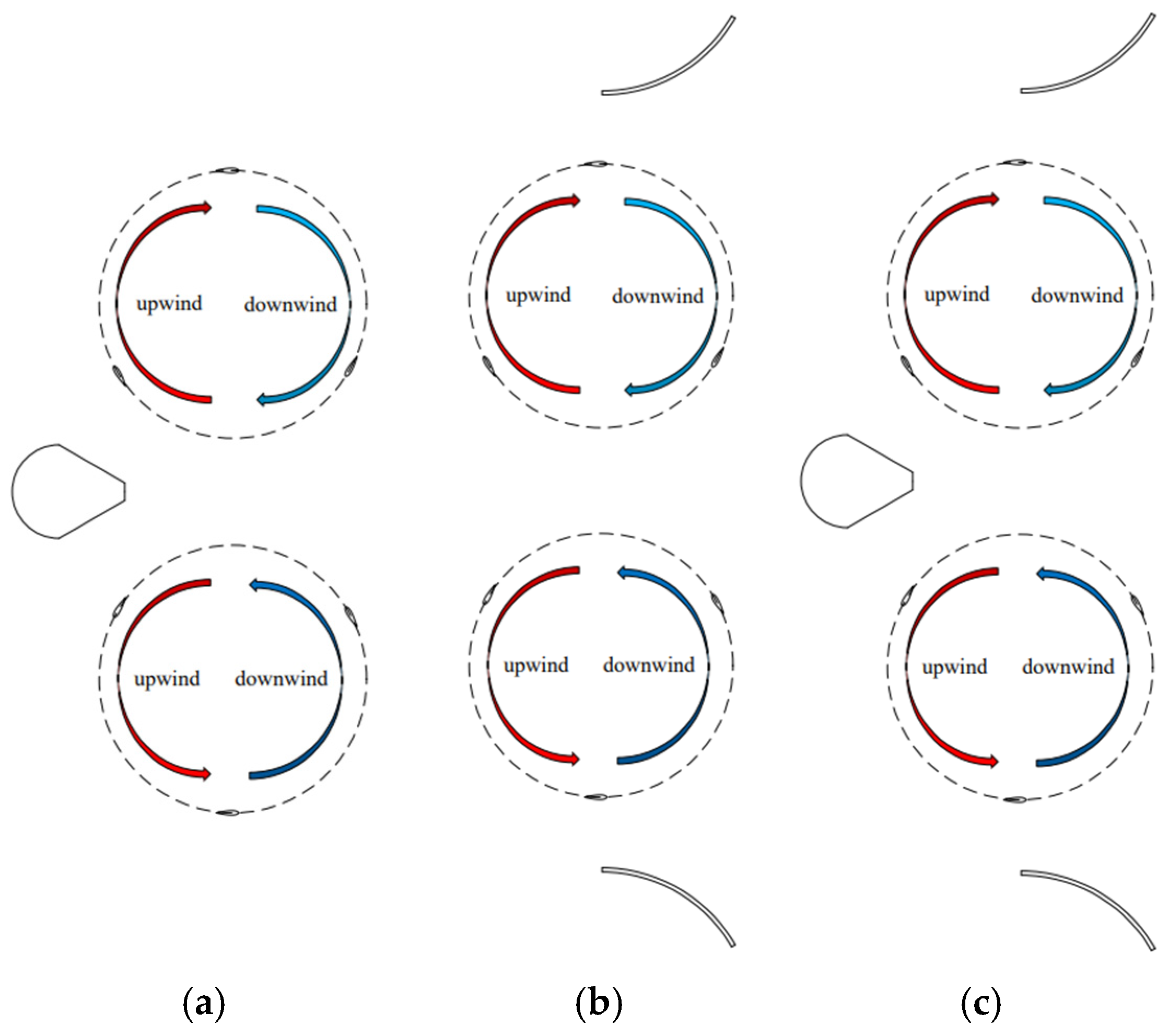
The dual deflector was disassembled to produce three configurations in order to further examine the fundamental causes of the twin rotors’ enhanced aerodynamic performance. The central deflector arrangement (a), the curved deflectors design (b), and the dual deflector configuration (c) are depicted in Figure 14.
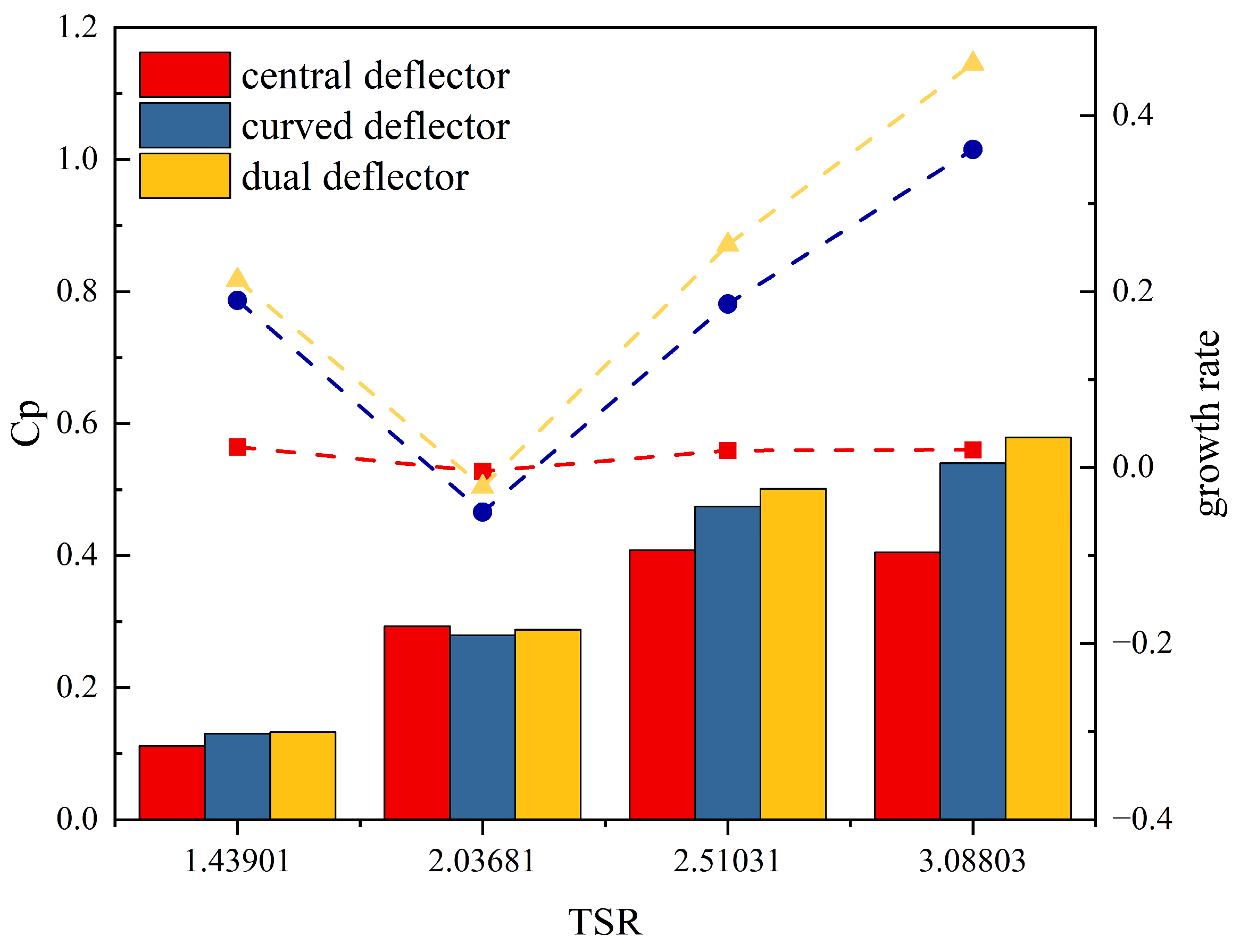
The overall power coefficients produced by three distinct deflector designs placed close to the twin rotors are displayed in Figure 15, along with the rise in average power coefficient over the original system. Significantly, the power output arrangement with only outer curved deflectors performed better than the one with only central deflectors at various tip speed ratios. The free flow that would have normally avoided the rotor perimeter was forced back into the swept surface by the outer curved deflectors, which essentially acted as a converging nozzle. This action significantly raised the mass flow rate through the blades in the downwind area. Interestingly, the curved deflectors arrangement alone produced a 5.06% power reduction at TSR = 2.04. This location also aligns with the unsatisfactory twin rotors torque coefficient region depicted in Figure 13, where this problem is lessened by the central deflector. The dual deflector system exhibits greater performance over the whole working range by combining the benefits of both layouts. It greatly outperforms any single deflector setup in terms of performance enhancement.
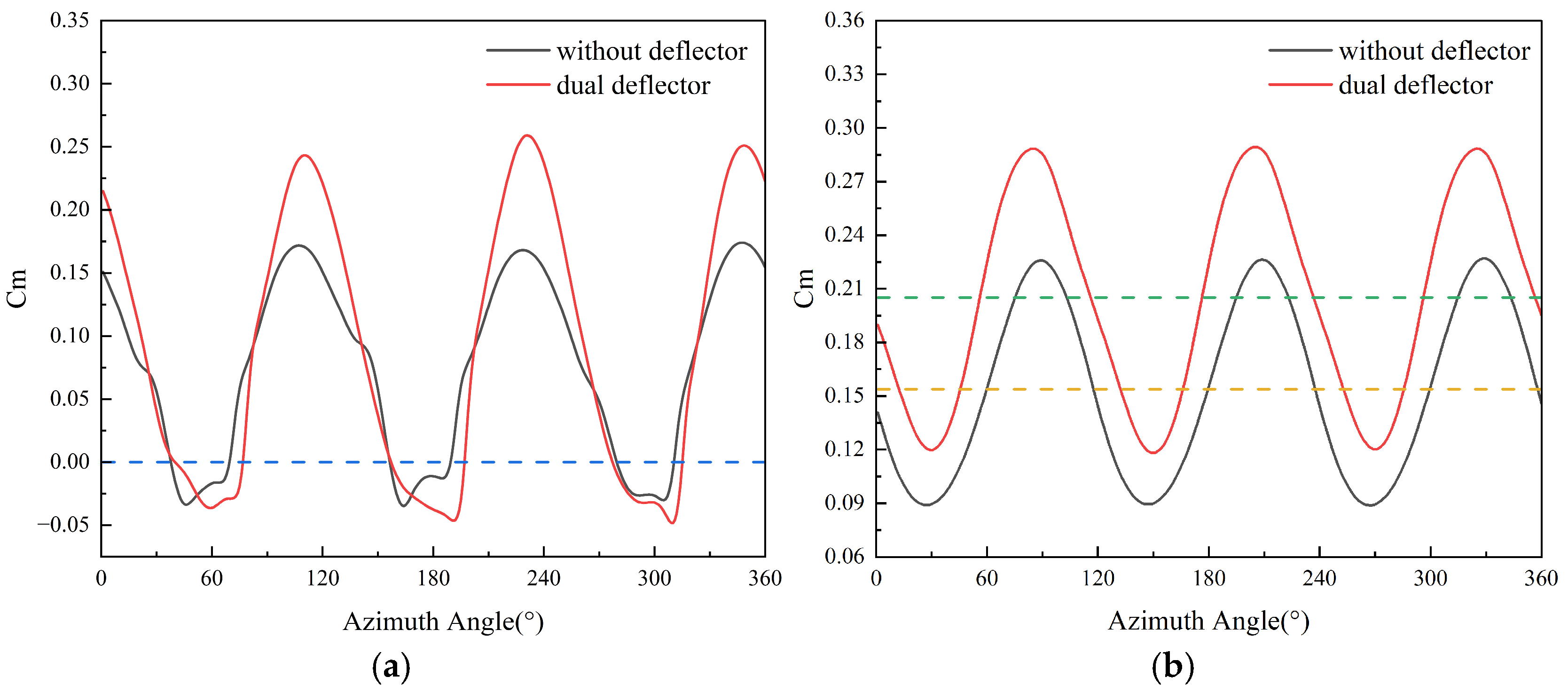
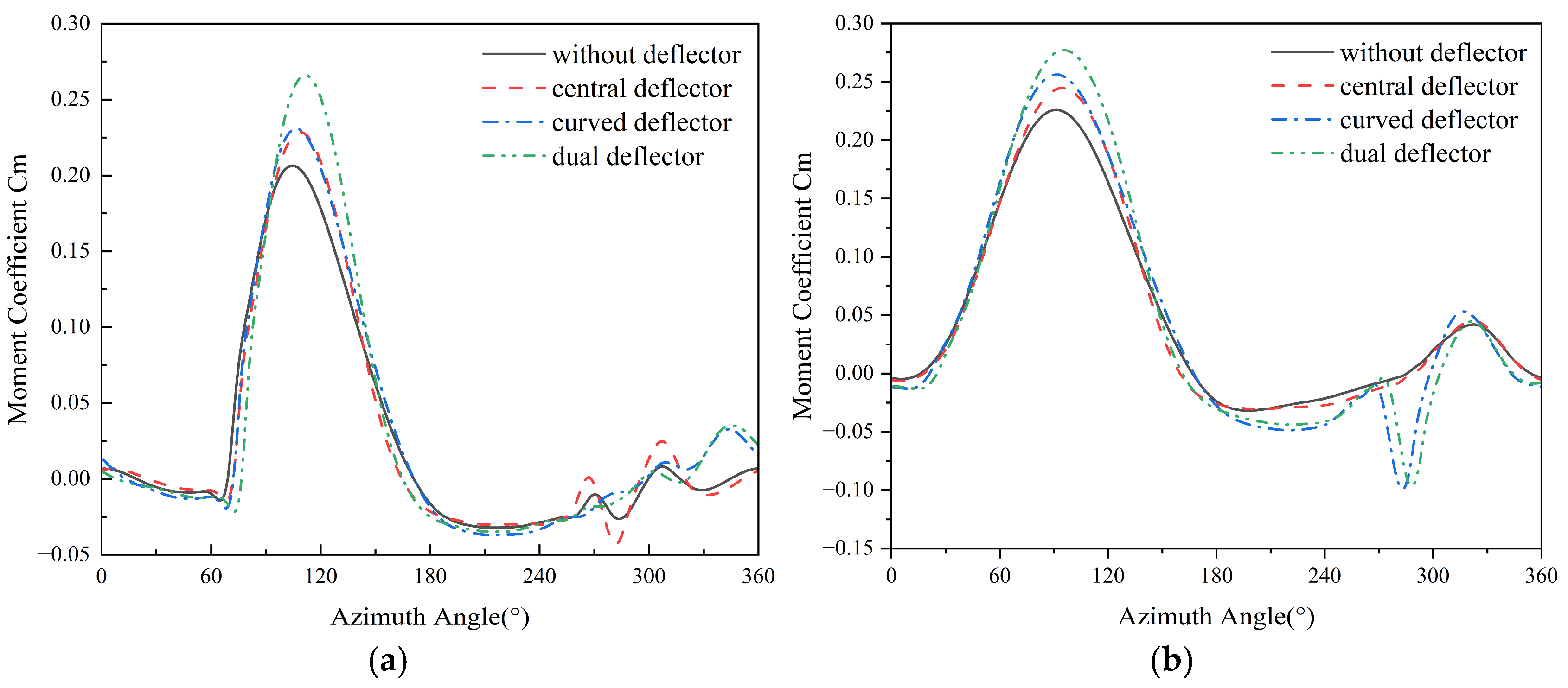
The moment coefficients of the twin rotors system with and without dual deflector at various azimuth angles when the TSR is 1.44 and 2.64 are displayed in Figure 16. Blade stall limits the plate-free system at low speeds, and its torque peak is approximately 0.18. The peak torque in the positive torque area rises to 0.243 with the addition of twin deflectors, a notable 35% increase. The system has exceptional starting torque because the central deflector corrects the intake angle of attack while the curved deflectors suppress fluid escape. The performance-optimized center of gravity shift greatly increases peak and trough torque when running in the high-speed range. The torque coefficient of the plate-free system is 0.089 at azimuth 270°, whereas the dual deflector system raises it to 0.12, as seen in Figure 16b.
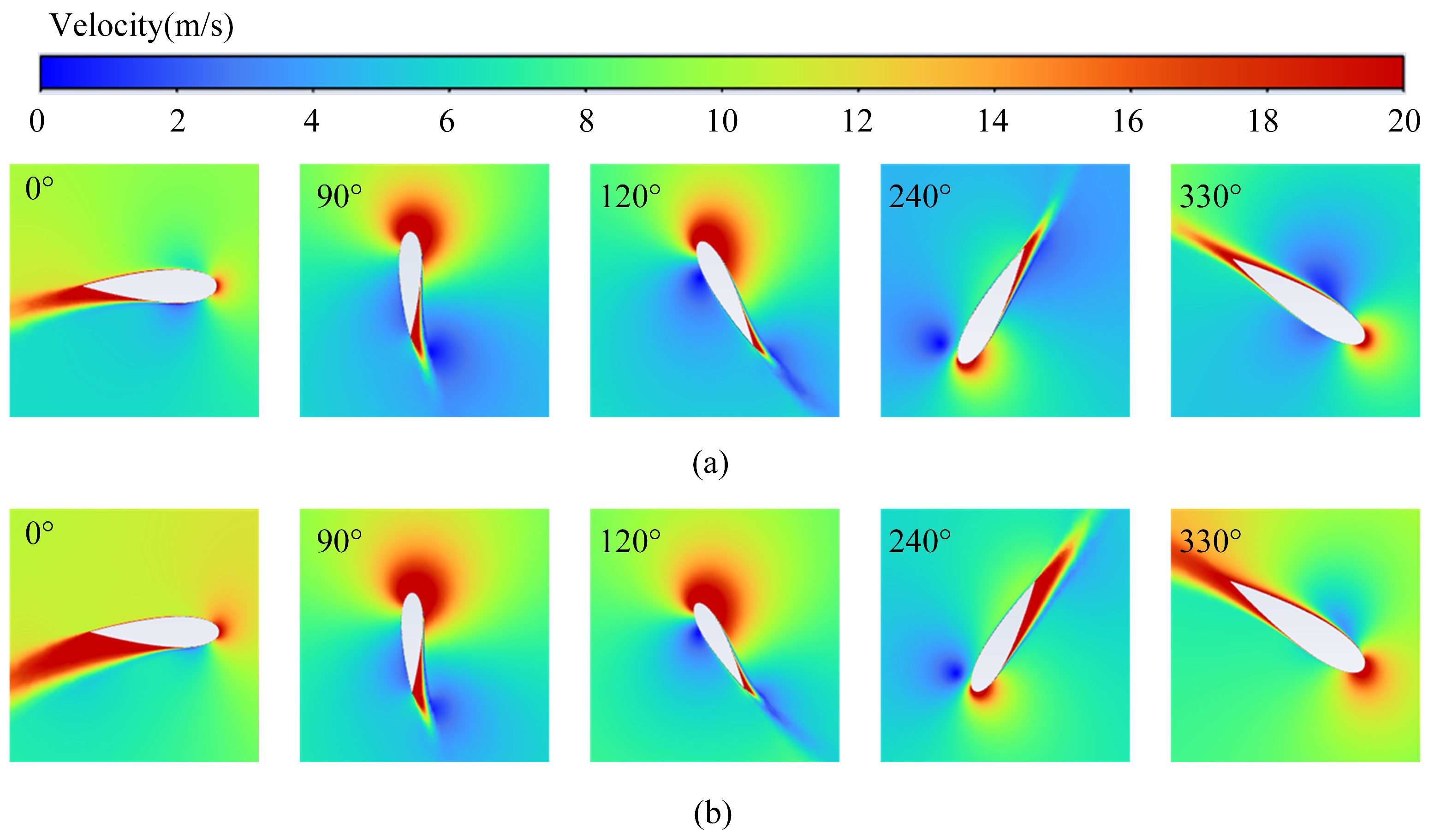
An in-depth examination of the aerodynamic behavior surrounding the turbine is necessary in order to fully assess the dual deflector system’s flow field regulating mechanism at various rotational speeds. Velocity contour charts for the dual deflector and without deflector systems at various azimuth angles are shown in Figure 17. To clarify the flow control effect, Figure 17a presents the baseline case without deflectors, while Figure 17b shows the dual-deflector case, covering key azimuth angles including the upwind sector (0°, 90°, 120°) and downwind sector (240°, 330°). It is clear that putting deflectors close to the fan accelerates the airflow. Quantitative comparison of the two cases reveals that, under the incoming wind speed of 9 m/s, the acceleration effect varies significantly with azimuth angle: at the critical upwind angles (0°, 90°, 120°), the local velocity at the blade leading edge increases from 15.2 to 17.5 m/s in the baseline case to 16.8–19.2 m/s in the dual-deflector case, with an average enhancement of ~10% and a maximum increase of 10.9% at 90°; at the downwind/sidewind angles (240°, 330°), the minimum velocity in the blade wake rises from only 2.8 m/s in the baseline case to 4.2 m/s, representing a 50% increase, which effectively weakens the low-speed recirculation zone. The steered flow in the surrounding area is up to 20% higher than the incident wind due to the creation of low-velocity zones where the entering wind collides with the deflectors [17]. Incoming airflow avoids the central deflector because of its blocking effect. As a result, the wind is directed toward the turbine blades at a more ideal angle, increasing the local flow velocity. On both sides of the turbine, the curved deflectors create constriction channels that restrict airflow and increase wind speeds in the downwind portion of the turbine. The dual deflector configuration improves performance in the turbine’s upwind and downwind sectors, providing a more thorough improvement throughout these crucial zones.
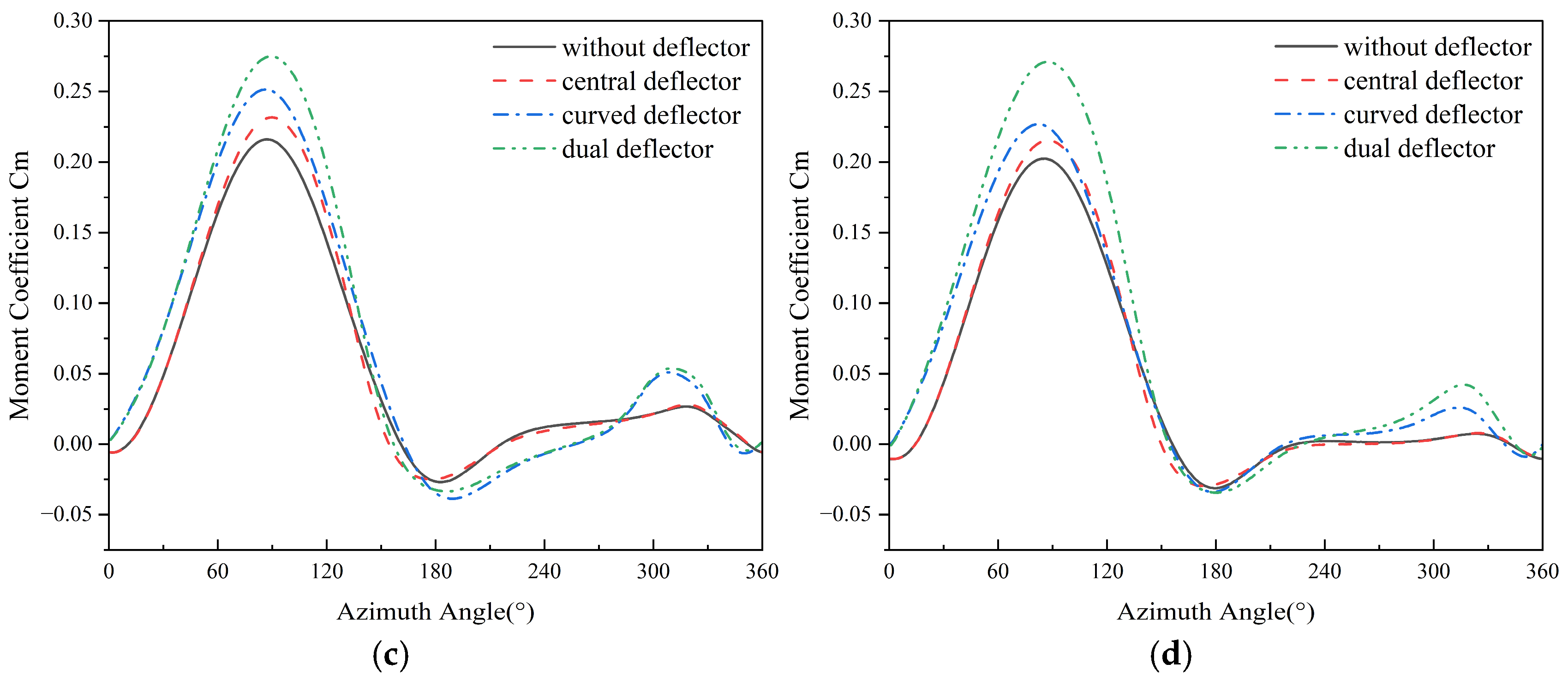
The single blade torque coefficient’s dynamic response as a function of TSR is shown in Figure 18. Both the central deflector arrangement and the curved deflectors configuration show a notable increase in peak torque at an upwind angle θ ≈ 120° during the initiation phase at low tip speed ratio (TSR = 1.44). Both layouts reduce dynamic stall at low speeds through flow field compression and the constraint effect, giving the wind turbine better starter torque.
The suppression Impact of the central deflector arrangement on aerodynamic drag rapidly saturates as the TSR rises, even nearing the performance of the no-deflector condition at the optimal working state TSR = 2.51 and in the high-speed range TSR = 3.09. On the other hand, total performance optimization starts to be dominated by the arrangement of curved deflectors. It considerably lifts the negative torque trough toward zero at the leeward side around θ ≈ 300°; some phase angles even achieve stronger positive power output. The dual deflector system provides exceptional aerodynamic performance output at various phase angles within a cycle by combining the benefits of both types of deflectors. Interestingly, both the dual deflector and curved deflector variants show some negative torque augmentation between azimuth angles 270° and 300° at TSR = 2.04. At this tip speed ratio, the twin deflector system’s power output is less than that of the plate-free system due to the significant negative torque region.
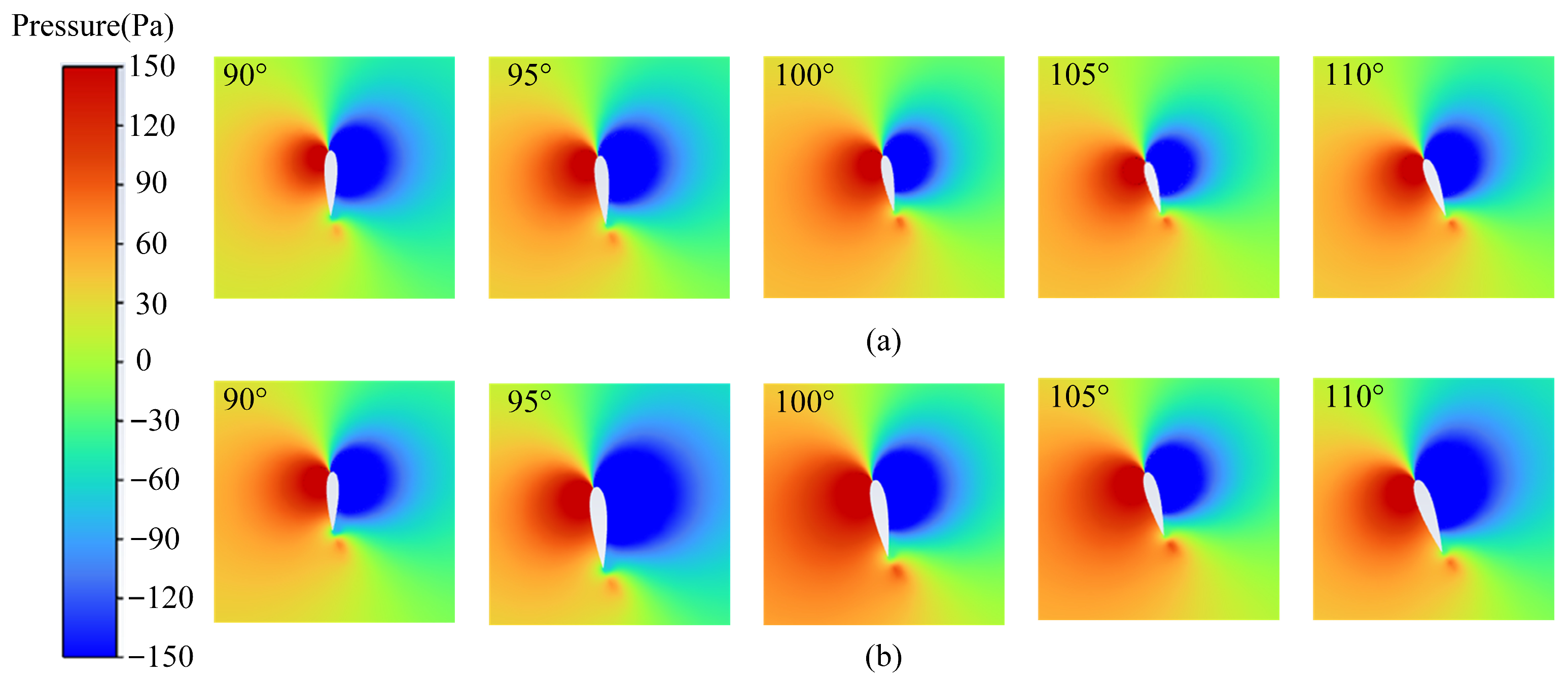
Figure 19 shows pressure contour plots for the central deflector and no-deflector systems at various azimuth angles in order to examine the curve differences. To clarify the pressure distribution characteristics at high angles of attack, Figure 19a presents the baseline case without deflectors, while Figure 19b shows the case with the central deflector, covering the critical azimuth range of 90° to 110°. The pressure color scale ranges from −150 Pa to 150 Pa, with red indicating high pressure and blue indicating low pressure. The enlargement of high-pressure zones is the most noticeable difference for the azimuth shown. The area around the blade in (b) shows higher positive pressure intensity than the system without the deflector. Quantitative analysis based on the pressure contours reveals that, in the central deflector case (b), the maximum positive pressure on the blade pressure surface reaches ~138 Pa, which is 10.4% higher than the baseline case (a) (~125 Pa); meanwhile, the minimum negative pressure on the suction surface drops to ~−128 Pa, representing a 21.9% decrease compared to the baseline (~−105 Pa). As a result, the average pressure difference across the blade airfoil increases by approximately 15.7%, from ~230 Pa in the baseline case to ~266 Pa in the central deflector case. This finding demonstrates that the incident flow is accelerated by the center deflector, greatly raising dynamic pressure. More torque is produced as a result of a more noticeable pressure differential between the upper and lower blade surfaces.
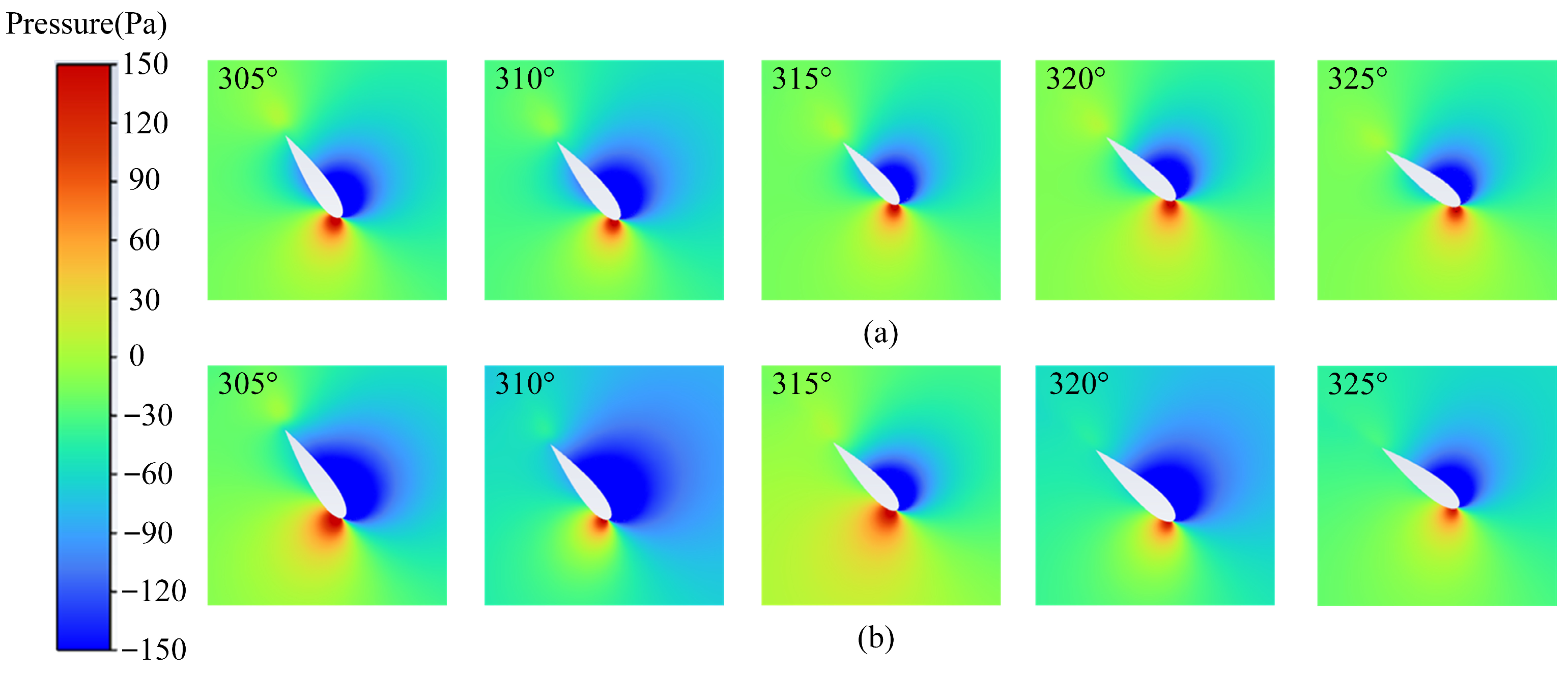
Figure 20 shows pressure contour plots for the system without a deflector and the system with curved deflectors at various azimuth angles in relation to the function of the curved deflectors. To reveal the torque recovery mechanism in the downwind zone, Figure 20 focuses on the critical azimuth range of 305° to 325°, with the pressure color scale ranging from −150 Pa to 150 Pa. This mostly relates to the situation where the blade reaches its second peak torque at azimuth angles in the downwind zone, as seen in Figure 18c. A distinct expansion of the negative pressure zone is shown in the picture. Quantitative analysis based on the pressure contours indicates that the minimum static pressure on the blade suction side drops to ~−115 Pa in the curved deflector case, which is 25.0% lower than that in the no-deflector case (~−92 Pa). Meanwhile, the low-pressure region below −90 Pa on the suction surface expands from approximately 35% of the blade area to 55%, representing a significant expansion of the high-lift zone. The airflow freely expands as it travels through the blades in systems without deflectors, enabling a speedy recovery of pressure. Curved deflectors, on the other hand, prevent airflow from diffusing outward and force it to pass through the small space between the deflector and the blade. The narrow flow passage is controlled within 0.12D, which further elevates the local flow velocity. The corresponding side of the blade experiences a rapid decrease in static pressure as a result of the rise in flow velocity. Consequently, the average pressure difference across the airfoil increases by 20.0%, from ~165 Pa in the baseline case to ~198 Pa in the curved deflector case. The torque recovery seen at this azimuth is directly caused by the deepened low-pressure zone on the suction side, which increases the pressure differential across the airfoil.
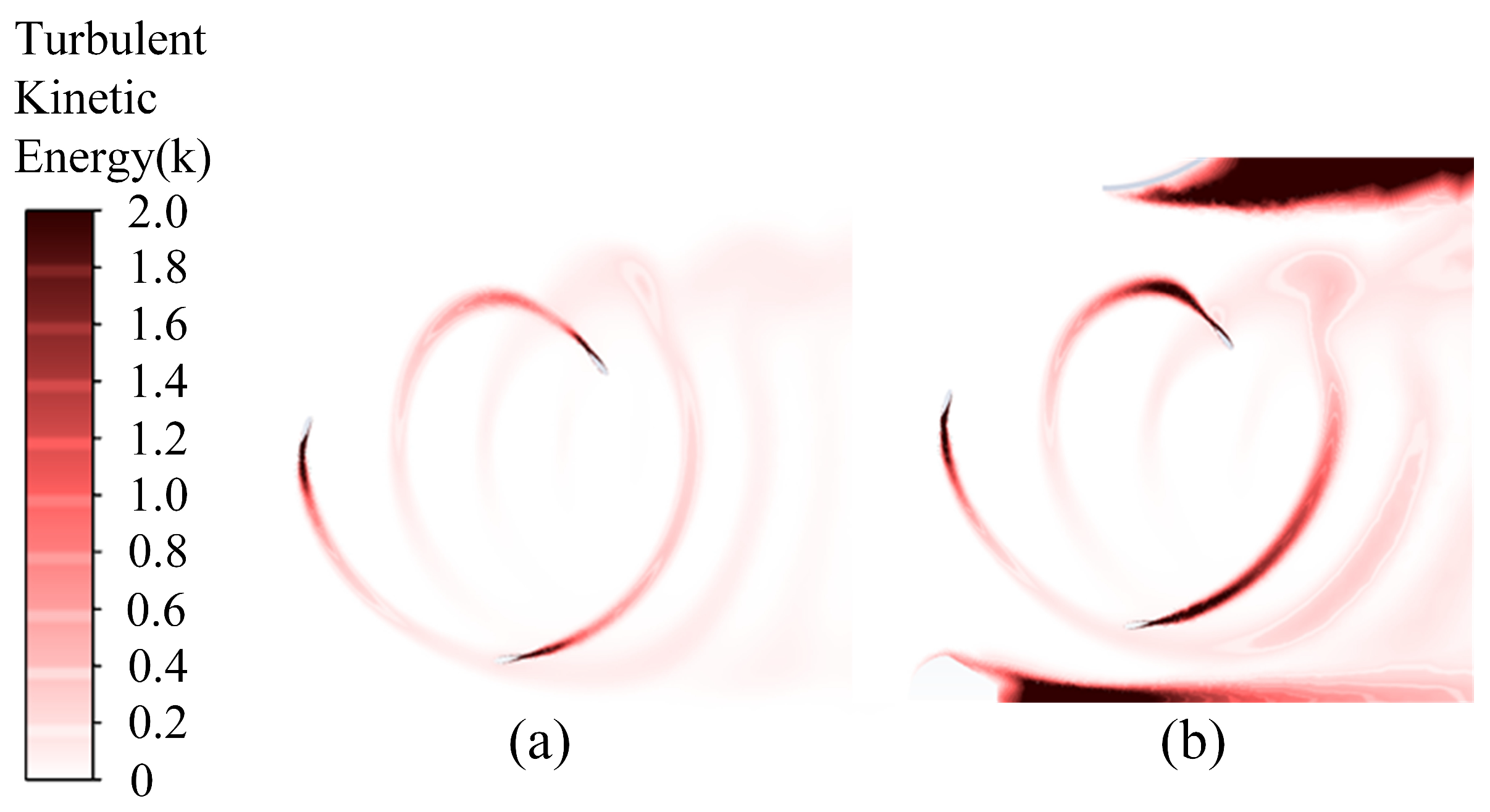
Figure 21 shows the turbulent kinetic energy contour map at the 190° azimuth angle with respect to the negative torque region shown in Figure 18c. The torque curve between 180° and 270° azimuth angles is barely affected by the center deflector, according to a comparison of the contour plot and the instantaneous torque fluctuations during a single blade cycle. There is a noticeable deepening of negative torque in configurations with curved deflectors, suggesting that the wake produced by the central deflector is not the cause of the performance decline. In contrast to the blade in the no-deflector configuration, which only displays a thin wake, the blade in the dual deflector configuration produces a thicker and more intense turbulent wake at azimuth 310°. This phenomenon shows that the angle of attack rapidly changes as the blade moves through this area. Although the boundary layer on the blade surface produces a lot of lift, it is located in an unstable area. The turbulence cloud map, which corresponds to azimuth angles between 180° and 270°, illustrates how flow separation happens to some extent as the blade leaves this high-velocity channel, intensifying the production of negative torque.
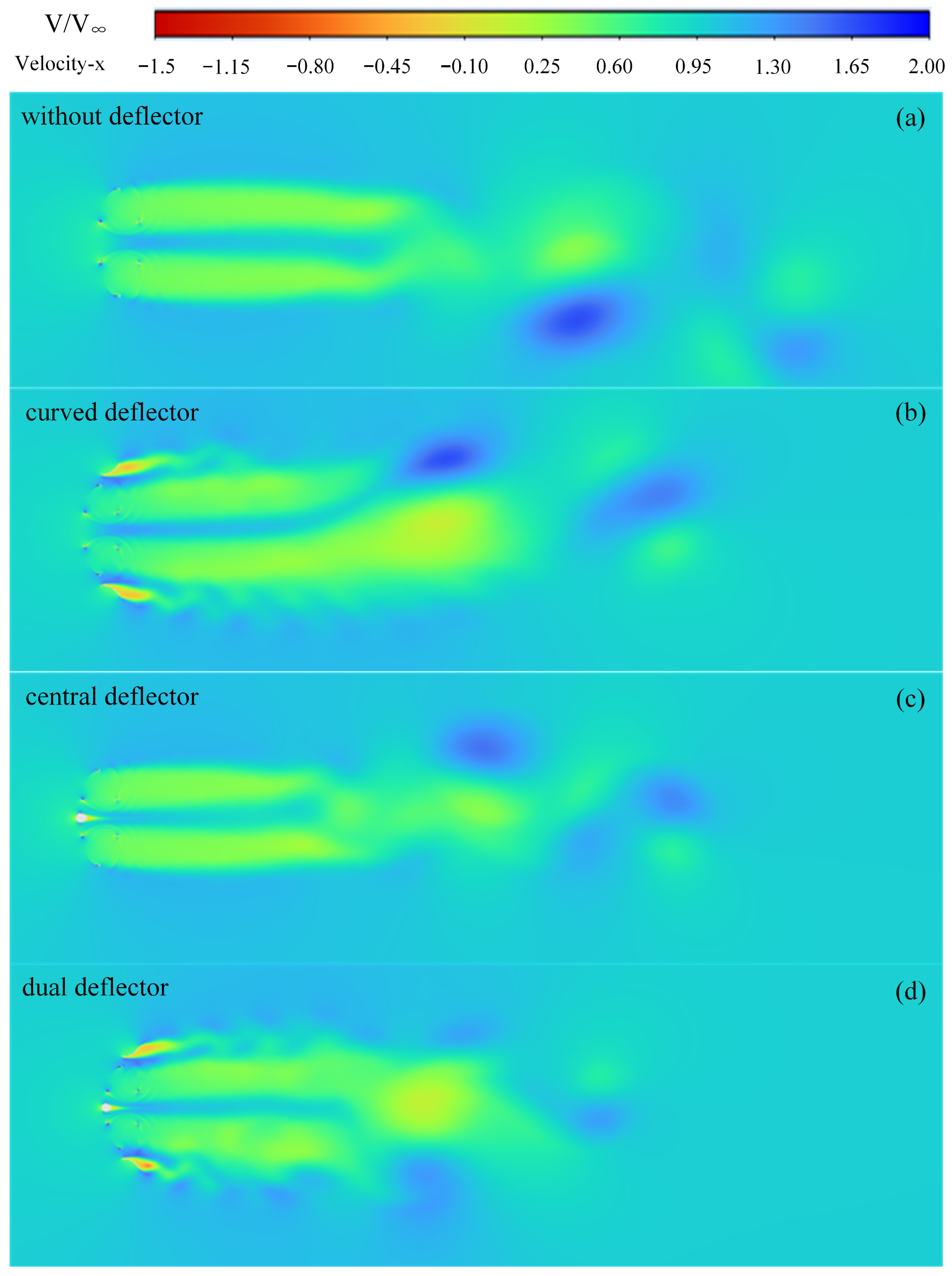
Normalized velocity contour maps of the wake under various setups are shown in Figure 22. In the reference arrangement without deflector, two distinct, elongated low-velocity wakes are detected downstream of the rotor. Wake recovery is delayed due to the great persistence of these wakes, which extend to the far-field border with little dissipation. The wake configurations with deflectors, on the other hand, exhibit notable modifications. A limited low-velocity recirculation zone is created behind the center deflector in Figure 22b. The wakes of both rotors deviate toward the centerline as a result of this zone’s inward attraction effect on the wake of the neighboring rotor. The wakes collide and combine at an earlier streamwise position than in the no-deflector design. Figure 22c localized high-velocity jets are produced in the near-wake area by the contraction channel created by the curved deflectors. The continuous low-velocity wake seen in the no-deflector design is disrupted by these jets, which pump high-momentum fluid straight into the rotor wake. As a result, over a shorter downstream distance, the fluid quickly returns to ambient velocity colors. By combining these two processes, the dual deflector structure demonstrates a potentially more efficient wake recovery effect within the 2D domain. However, because the current 2D modeling inherently omits crucial three-dimensional wake physics—such as tip vortices and spanwise flow variations—the implication that this design could significantly reduce wake losses in dense wind farm arrays is presently proposed as a research hypothesis. Further validation through comprehensive 3D simulations or physical experiments is required to substantiate these layout-scale aerodynamic benefits.

5. Conclusions

The trustworthiness of the CFD model was validated in this study by first comparing CFD calculations for lift-type wind turbines with experimental data, which showed consistent trends and reduced errors compared to earlier simulations. Several guiding vane system designs were then suggested in order to improve the power coefficient and the twin rotors system’s potential for self-starting. Analysis was done on the wake circumstances, torque variation, and power coefficient. The following are the findings of this investigation:
Due to aerodynamic interference between the two rotors, the twin rotors architecture shows a 5.77% loss in starting torque when compared to the one rotor design at low tip speed ratios. Reverse airflow in the intermediate zone is decreased by using a central deflector. Contraction channels are produced by curved deflectors on both sides, which raise flow in the downwind region. When compared to the plate-free system, the dual deflector configuration’s self-starting potential is greatly increased by 21.33% because of the combined effect of these two strategies.
The curved deflectors take center stage at high tip speed ratios. Through flow field compression and confinement effects, the blades in the downwind region obtain a more favorable working environment, attaining a second torque output peak near azimuth 300°. The introduction of the deflector yielded a 24.31% enhancement in the average torque coefficient, while simultaneously boosting the power coefficient by up to 53.12% over the bare turbine setup.
Regarding the wake characteristics, the recirculation zone induced by the central deflector accelerates the merging of wake flows, while high-speed jet streams generated by the curved side deflectors effectively disrupt the near-wake region. Collectively, these flow characteristics facilitate a faster wake recovery in the downstream region. Although this finding implies the potential to adopt more compact layout designs for wind farms, such an engineering implication remains a preliminary research hypothesis. Restricted by the inherent limitations of the current two-dimensional numerical model, three-dimensional simulations and physical model tests are still required in further research to validate the aerodynamic advantages at the wind farm array scale.
In conclusion, by suggesting a new deflector configuration that improves the self-starting potential of twin rotors and raises total power production, this study promotes research in the field of dual vertical axis wind turbines. Although the deflector combinations were broken down in this study, changes to the deflector’s shape and arrangement characteristics were not investigated. In order to advance the sustainable development of wind power production technology, future research should examine how different deflector specifications and mounting configurations affect the performance of dual vertical axis wind turbine architectures.

Author Contributions

Conceptualization, Y.C. (Yang Cao), Y.Y. (Yongfei Yuan) and C.S. (Chenguang Song); Methodology, Y.Y. (Yongfei Yuan) and J.W.; Software, Y.Y. (Yongfei Yuan), X.C., L.M. and C.C.; Validation, Z.Q., A.W. and Y.Y. (Yuan Yang); Formal analysis, Y.Y. (Yongfei Yuan), Z.Q., A.W. and Z.C.; Investigation, Y.Y. (Yongfei Yuan), J.W. and C.S. (Chenguang Song); Resources, Y.C. (Yang Cao), Z.Q. and C.C.; Data curation, Z.C., X.C., Y.C. (Yinuo Cai) and C.S. (Chengyun Shi); Writing—original draft, Y.C. (Yang Cao), Y.Y. (Yongfei Yuan) and C.C.; Writing—review and editing, L.M. and C.S. (Chenguang Song); Visualization, Y.C. (Yang Cao), Y.Y. (Yongfei Yuan) and A.W.; Supervision, Y.C. (Yang Cao), Y.C. (Yinuo Cai), C.S. (Chengyun Shi), J.W. and C.S. (Chenguang Song); Project administration, Y.C. (Yang Cao), Y.Y. (Yuan Yang), J.W. and C.C.; Funding acquisition, Y.C. (Yang Cao) and C.S. (Chenguang Song). All authors have read and agreed to the published version of the manuscript.

Funding

This work was completed under the supports of National Natural Science Foundation of China for the grants (Nos. 52506252 and 51376096).

Data Availability Statement

The original contributions presented in this study are included in the article. Further inquiries can be directed to the corresponding author.

Conflicts of Interest

The authors declare that they have no known competing financial interests or personal relationships that could have appeared to influence the work reported in this paper.

References

  1. Abdolahifar, A.; Zanj, A. Addressing VAWT Aerodynamic Challenges as the Key to Unlocking Their Potential in the Wind Energy Sector. Energies 2024, 17, 5052. [Google Scholar] [CrossRef]
  2. Ghiasi, P.; Najafi, G.; Ghobadian, B.; Jafari, A.; Mamat, R.; Ghazali, M.F. CFD-Study of the H-Rotor Darrius wind turbine performance in Drag-Lift and lift Regime: Impact of Type, thickness and chord length of blades. Alex. Eng. J. 2022, 67, 51–64. [Google Scholar] [CrossRef]
  3. Chong, W.-T.; Muzammil, W.K.; Wong, K.-H.; Wang, C.-T.; Gwani, M.; Chu, Y.-J.; Poh, S.-C. Cross axis wind turbine: Pushing the limit of wind turbine technology with complementary design. Appl. Energy 2017, 207, 78–95. [Google Scholar] [CrossRef]
  4. Hammad, M.A.; Mahmoud, A.M.; Abdelrhman, A.M.; Sarip, S. Performance enhancement of H-Type Darrieus VAWT using a hybrid method of blade pitch angle regulation. Energies 2024, 17, 4044. [Google Scholar] [CrossRef]
  5. Jin, G.; Zong, Z.; Jiang, Y.; Zou, L. Aerodynamic analysis of side-by-side placed twin vertical-axis wind turbines. Ocean Eng. 2020, 209, 107296. [Google Scholar] [CrossRef]
  6. Tayebi, A.; Torabi, F. Flow control techniques to improve the aerodynamic performance of Darrieus vertical axis wind turbines: A critical review. J. Wind Eng. Ind. Aerodyn. 2024, 252, 105820. [Google Scholar] [CrossRef]
  7. Wong, K.H.; Chong, W.T.; Sukiman, N.L. Performance enhancements on vertical axis wind turbines using flow augmentation systems: A review. Renew. Sustain. Energy Rev. 2017, 73, 904–921. [Google Scholar] [CrossRef]
  8. Chavoshi, M.Z.; Ebrahimi, A. Plasma actuator effects on the flow physics of dynamic stall for a vertical axis wind turbine. Phys. Fluids 2022, 34, 75131. [Google Scholar] [CrossRef]
  9. Wang, P.; Liu, Q.; Li, C.; Miao, W.; Luo, S.; Sun, K.; Niu, K. Effect of trailing edge dual synthesis jets actuator on aerodynamic characteristics of a straight-bladed vertical axis wind turbine. Energy 2021, 238, 121792. [Google Scholar] [CrossRef]
  10. Liu, Q.; Miao, W.; Bashir, M.; Xu, Z.; Yu, N.; Luo, S.; Li, C. Aerodynamic and aeroacoustic performance assessment of a vertical axis wind turbine by synergistic effect of blowing and suction. Energy Convers. Manag. 2022, 271, 116289. [Google Scholar] [CrossRef]
  11. Shaheen, M.a.M.; Hasanien, H.M.; Mekhamer, S.F.; Talaat, H.E.A. Walrus optimizer-based optimal fractional order PID control for performance enhancement of offshore wind farms. Sci. Rep. 2024, 14, 17636. [Google Scholar] [CrossRef]
  12. Shaheen, M.A.M.; Hasanien, H.M.; Mekhamer, S.F.; Talaat, H.E.A. A chaos game optimization algorithm-based optimal control strategy for performance enhancement of offshore wind farms. Renew. Energy Focus 2024, 49, 100578. [Google Scholar] [CrossRef]
  13. Yan, Y.; Avital, E.; Williams, J.; Cui, J. CFD analysis for the performance of micro-vortex generator on aerofoil and vertical axis turbine. J. Renew. Sustain. Energy 2019, 11, 43302. [Google Scholar] [CrossRef]
  14. Acarer, S. Peak lift-to-drag ratio enhancement of the DU12W262 airfoil by passive flow control and its impact on horizontal and vertical axis wind turbines. Energy 2020, 201, 117659. [Google Scholar] [CrossRef]
  15. Chen, W.-H.; Lam, T.T.; Chang, M.-H.; Jin, L.; Chueh, C.-C.; Augusto, G.L. Optimizing H-Darrieus Wind Turbine Performance with Double-Deflector Design. Energies 2024, 17, 503. [Google Scholar] [CrossRef]
  16. Fatahian, E.; Ismail, F.; Ishak, M.H.H.; Chang, W.S. Aerodynamic performance improvement of Savonius wind turbine through a passive flow control method using grooved surfaces on a deflector. Ocean Eng. 2023, 284, 115282. [Google Scholar] [CrossRef]
  17. Nimvari, M.E.; Fatahian, H.; Fatahian, E. Performance improvement of a Savonius vertical axis wind turbine using a porous deflector. Energy Convers. Manag. 2020, 220, 113062. [Google Scholar] [CrossRef]
  18. Ghafoorian, F.; Mirmotahari, S.R.; Wan, H. Numerical study on aerodynamic performance improvement and efficiency enhancement of the savonius vertical axis wind turbine with semi-directional airfoil guide vane. Ocean Eng. 2024, 307, 118186. [Google Scholar] [CrossRef]
  19. Zidane, I.F.; Ali, H.M.; Swadener, G.; Eldrainy, Y.A.; Shehata, A.I. Effect of upstream deflector utilization on H-Darrieus wind turbine performance: An optimization study. Alex. Eng. J. 2022, 63, 175–189. [Google Scholar] [CrossRef]
  20. Kim, D.; Gharib, M. Efficiency improvement of straight-bladed vertical-axis wind turbines with an upstream deflector. J. Wind Eng. Ind. Aerodyn. 2013, 115, 48–52. [Google Scholar] [CrossRef]
  21. Jin, X.; Wang, Y.; Ju, W.; He, J.; Xie, S. Investigation into parameter influence of upstream deflector on vertical axis wind turbines output power via three-dimensional CFD simulation. Renew. Energy 2017, 115, 41–53. [Google Scholar] [CrossRef]
  22. Fatahian, H.; Mishra, R.; Jackson, F.F.; Fatahian, E. Design optimization of an innovative deflector with bleed jets to enhance the performance of dual Savonius turbines using CFD-Taguchi method. Energy Convers. Manag. 2023, 296, 117655. [Google Scholar] [CrossRef]
  23. Zhang, W.; Cao, Y.; Qian, Z.; Wang, J.; Zhu, Y.; Yang, Y.; Wang, Y.; Wu, G. Research on Aerodynamic performance of Asynchronous-Hybrid Dual-Rotor Vertical-Axis wind turbines. Energies 2024, 17, 4424. [Google Scholar] [CrossRef]
  24. Rezaeiha, A.; Kalkman, I.; Blocken, B. CFD simulation of a vertical axis wind turbine operating at a moderate tip speed ratio: Guidelines for minimum domain size and azimuthal increment. Renew. Energy 2017, 107, 373–385. [Google Scholar] [CrossRef]
  25. Maalouly, M.; Souaiby, M.; ElCheikh, A.; Issa, J.S.; Elkhoury, M. Transient analysis of H-type Vertical Axis Wind Turbines using CFD. Energy Rep. 2022, 8, 4570–4588. [Google Scholar] [CrossRef]
  26. Barnes, A.; Marshall-Cross, D.; Hughes, B.R. Towards a standard approach for future Vertical Axis Wind Turbine aerodynamics research and development. Renew. Sustain. Energy Rev. 2021, 148, 111221. [Google Scholar] [CrossRef]
  27. Fertahi, S.E.-D.; Samaouali, A.; Kadiri, I. CFD comparison of 2D and 3D aerodynamics in H-Darrieus prototype wake. E-Prime—Adv. Electr. Eng. Electron. Energy 2023, 4, 100178. [Google Scholar] [CrossRef]
  28. Posa, A. Dependence of the wake recovery downstream of a Vertical Axis Wind Turbine on its dynamic solidity. J. Wind Eng. Ind. Aerodyn. 2020, 202, 104212. [Google Scholar] [CrossRef]
  29. Ghareghani, M.S.M.; Abdolahifar, A.; Karimian, S.M.H. Numerical investigation on the helix angle to smoothen aerodynamic torque output of the 3-PB Darrieus vertical axis wind turbine. J. Wind Eng. Ind. Aerodyn. 2023, 234, 105323. [Google Scholar] [CrossRef]
  30. Posa, A. Secondary flows in the wake of a vertical axis wind turbine of solidity 0.5 working at a tip speed ratio of 2.2. J. Wind Eng. Ind. Aerodyn. 2021, 213, 104621. [Google Scholar] [CrossRef]
  31. Alexander, A.S.; Santhanakrishnan, A. Mechanisms of power augmentation in two side-by-side vertical axis wind turbines. Renew. Energy 2019, 148, 600–610. [Google Scholar] [CrossRef]
  32. Balduzzi, F.; Bianchini, A.; Maleci, R.; Ferrara, G.; Ferrari, L. Critical issues in the CFD simulation of Darrieus wind turbines. Renew. Energy 2015, 85, 419–435. [Google Scholar] [CrossRef]
  33. Shukla, S.; Ramanan, C.J.; Bora, B.J.; Deo, A.; Alom, N. Numerical analysis of vertical axis wind turbine blades in ANSYS Fluent. Mater. Today Proc. 2022, 59, 1781–1785. [Google Scholar] [CrossRef]
  34. Tong, G.; Li, Y.; Tagawa, K.; Feng, F. Effects of blade airfoil chord length and rotor diameter on aerodynamic performance of straight-bladed vertical axis wind turbines by numerical simulation. Energy 2022, 265, 126325. [Google Scholar] [CrossRef]
  35. Hijazi, A.; ElCheikh, A.; Elkhoury, M. Numerical investigation of the use of flexible blades for vertical axis wind turbines. Energy Convers. Manag. 2023, 299, 117867. [Google Scholar] [CrossRef]
  36. Lam, H.F.; Peng, H.Y. Measurements of the wake characteristics of co- and counter-rotating twin H-rotor vertical axis wind turbines. Energy 2017, 131, 13–26. [Google Scholar] [CrossRef]
  37. Yang, Y.; Cao, Y.; Qian, Z.; Wang, J.; Zhu, Y.; Chen, X.; Zhang, W.; Wang, Y.; Wu, G.; Chen, S. A study on the effect of turbulence intensity on Dual Vertical-Axis wind turbine aerodynamic performance. Energies 2024, 17, 4124. [Google Scholar] [CrossRef]
  38. Castelli, M.R.; Englaro, A.; Benini, E. The Darrieus wind turbine: Proposal for a new performance prediction model based on CFD. Energy 2011, 36, 4919–4934. [Google Scholar] [CrossRef]
  39. Yadav, S.; Veeravalli, S.V.; Singh, S.N. Effect of rotor spacing, overlapping and non-overlapping, on the performance of a coupled counter-rotating twin-rotor VAWT using CFD. Renew. Energy 2023, 221, 119811. [Google Scholar] [CrossRef]
  40. Baker, J.R. Features to aid or enable self starting of fixed pitch low solidity vertical axis wind turbines. J. Wind Eng. Ind. Aerodyn. 1983, 15, 369–380. [Google Scholar] [CrossRef]
Figure 1. Wind turbine schematic diagram simplified in two dimensions.
Energies 19 02284 g001
Figure 2. Parameters of the central deflector and curved deflector.
Energies 19 02284 g002
Figure 3. Schematic diagram of the computational domain for a twin vertical axis wind turbine.
Energies 19 02284 g003
Figure 4. Mesh division.
Energies 19 02284 g004
Figure 5. Power coefficient and convergence behavior of the wind turbine at TSR = 2.64.
Energies 19 02284 g005
Figure 6. Instantaneous torque coefficient and azimuth angle corresponding to a single blade in one revolution for different mesh numbers at TSR = 2.64.
Energies 19 02284 g006
Figure 7. Instantaneous torque coefficient and azimuth angle corresponding to a single blade during one revolution at different time steps when TSR = 2.64.
Energies 19 02284 g007
Figure 8. Comparison of power coefficients between simulation results and experimental values at different TSRs. The figure includes experimental and CFD results reported by Castelli et al. [38], CFD results from Jin et al. [21], and the CFD predictions of the current study.
Energies 19 02284 g008
Figure 9. Comparison of average torque coefficients for single and twin wind turbines under different TSRs.
Energies 19 02284 g009
Figure 10. Moment coefficients of one rotor and twin rotors blades at different azimuth angles. (a) TSR = 1.44 (the blue dashed line represents the reference line at Cm = 0); (b) TSR = 2.64 (the green and yellow dashed lines denote the cycle-averaged torque coefficients of the corresponding turbine configurations).
Energies 19 02284 g010
Figure 11. Zone division for one rotation of a wind turbine.
Energies 19 02284 g011
Figure 12. Variation in instantaneous torque coefficient with azimuth angle for single and dual wind turbine blades at TSR = 2.64.
Energies 19 02284 g012
Figure 13. Comparison of torque coefficients for dual vertical axis wind turbine with and without deflectors under different TSRs.
Energies 19 02284 g013
Figure 14. Arrangement of three types of deflectors: (a) central deflector; (b) curved deflector; (c) dual deflector.
Energies 19 02284 g014
Figure 15. Power coefficients and growth rates of three deflectors configurations under different TSR conditions. The red, blue and yellow dashed lines respectively denote the average power coefficient improvement of the central, curved and dual deflectors versus the original system.
Energies 19 02284 g015
Figure 16. Moment coefficients of twin rotors system with and without dual deflectors at different azimuth angles: (a) TSR = 1.44 (the blue dashed line represents the reference line at Cm = 0); (b) TSR = 2.64 (where the dashed lines denote the cycle-averaged torque coefficients of the corresponding turbine configurations).
Energies 19 02284 g016
Figure 17. Velocity contour maps of wind turbines at different azimuth angles: (a) without deflector; (b) dual deflector.
Energies 19 02284 g017
Figure 18. Variation in single blade torque coefficient with azimuth angle under different TSR conditions: (a) TSR = 1.43 (b) TSR = 2.03 (c) TSR = 2.51 (d) TSR = 3.08.
Energies 19 02284 g018aEnergies 19 02284 g018b
Figure 19. Pressure contour maps of wind turbines at different azimuth angles: (a) without deflector; (b) central deflector.
Energies 19 02284 g019
Figure 20. Pressure contour maps of wind turbines at different azimuth angles: (a) without deflector; (b) curved deflector.
Energies 19 02284 g020
Figure 21. Turbulent kinetic energy contour map: (a) without deflector (b) dual deflector.
Energies 19 02284 g021
Figure 22. Normalized velocity contour map of wake flows for different configurations. (a) without deflector; (b) curved deflector; (c) central deflector; (d) dual deflector.
Energies 19 02284 g022
Table 1. Relevant geometric characteristic parameters of wind turbine [23].
SpecificationsDarrieus
Blade profileNACA0021
Turbine diameter [m]1.03
Blade chord [m]0.0858
Number of blades3
Solidity ratio0.25
Table 2. Grid size parameters.
Grid FeaturesGrid 1Grid 2Grid 3Grid 4
Blade surface mesh length [mm]0.12860.094710.05220.03781
First layer grid height on the blade surface [mm]0.039430.031510.014520.01422
Boundary layer growth rate 1.11.081.051.03
Number of boundary layers12152830
Overall growth rate1.21.151.11.08
Minimum orthogonal mass0.7460.7480.7570.756
Maximum skewness0.3950.3860.3840.372
Number of grids182,122238,736532,2441,116,920
Average torque coefficient per blade0.4200.4870.5730.575
Table 3. Time step corresponding to one rotational step of the wind turbine.
Time Step (s)Rotation Angle (°)Steps per Cycle Duration
0.0001894060.5720
0.0003788121360
0.0005682181.5240
Disclaimer/Publisher’s Note: The statements, opinions and data contained in all publications are solely those of the individual author(s) and contributor(s) and not of MDPI and/or the editor(s). MDPI and/or the editor(s) disclaim responsibility for any injury to people or property resulting from any ideas, methods, instructions or products referred to in the content.