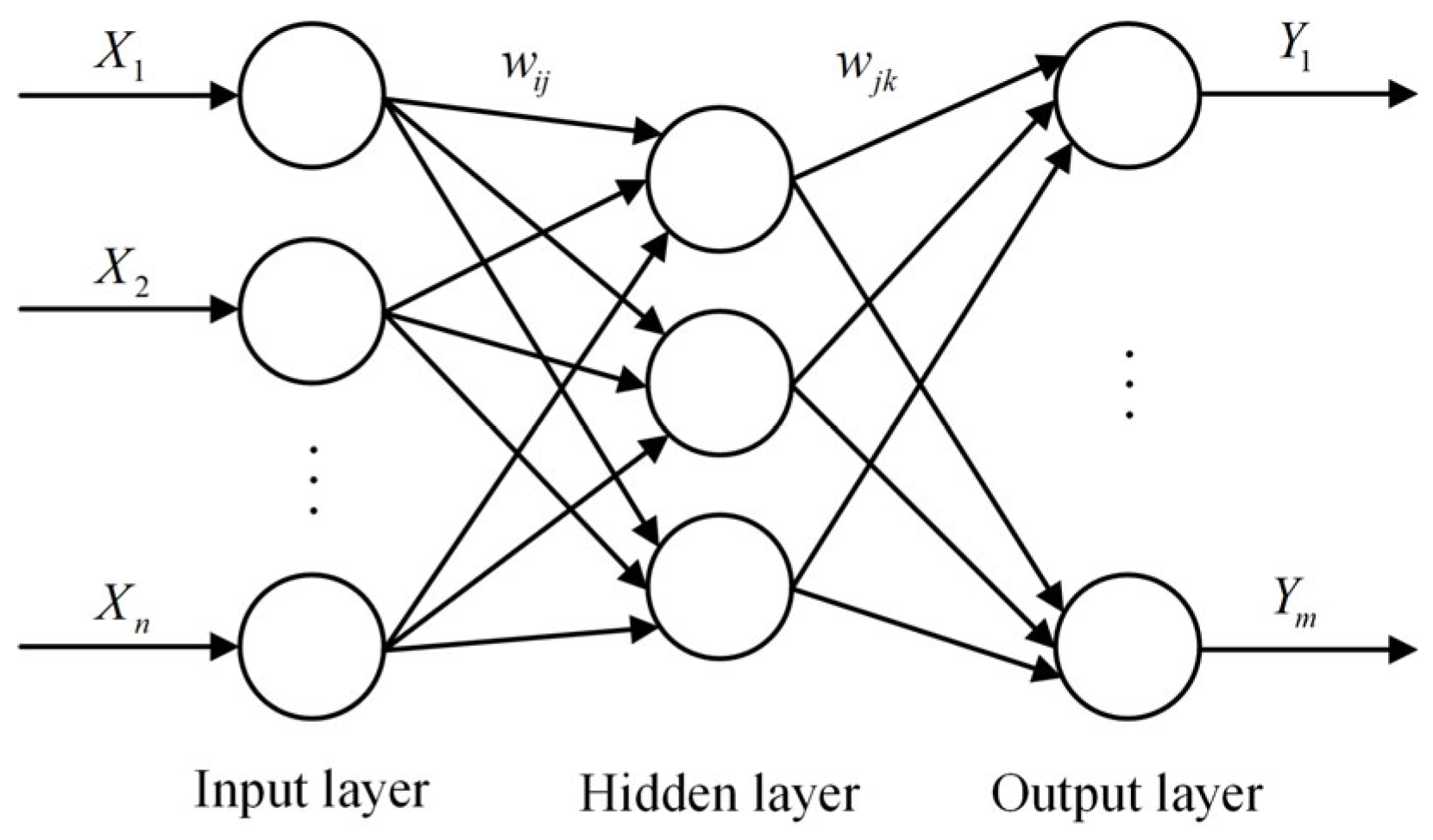
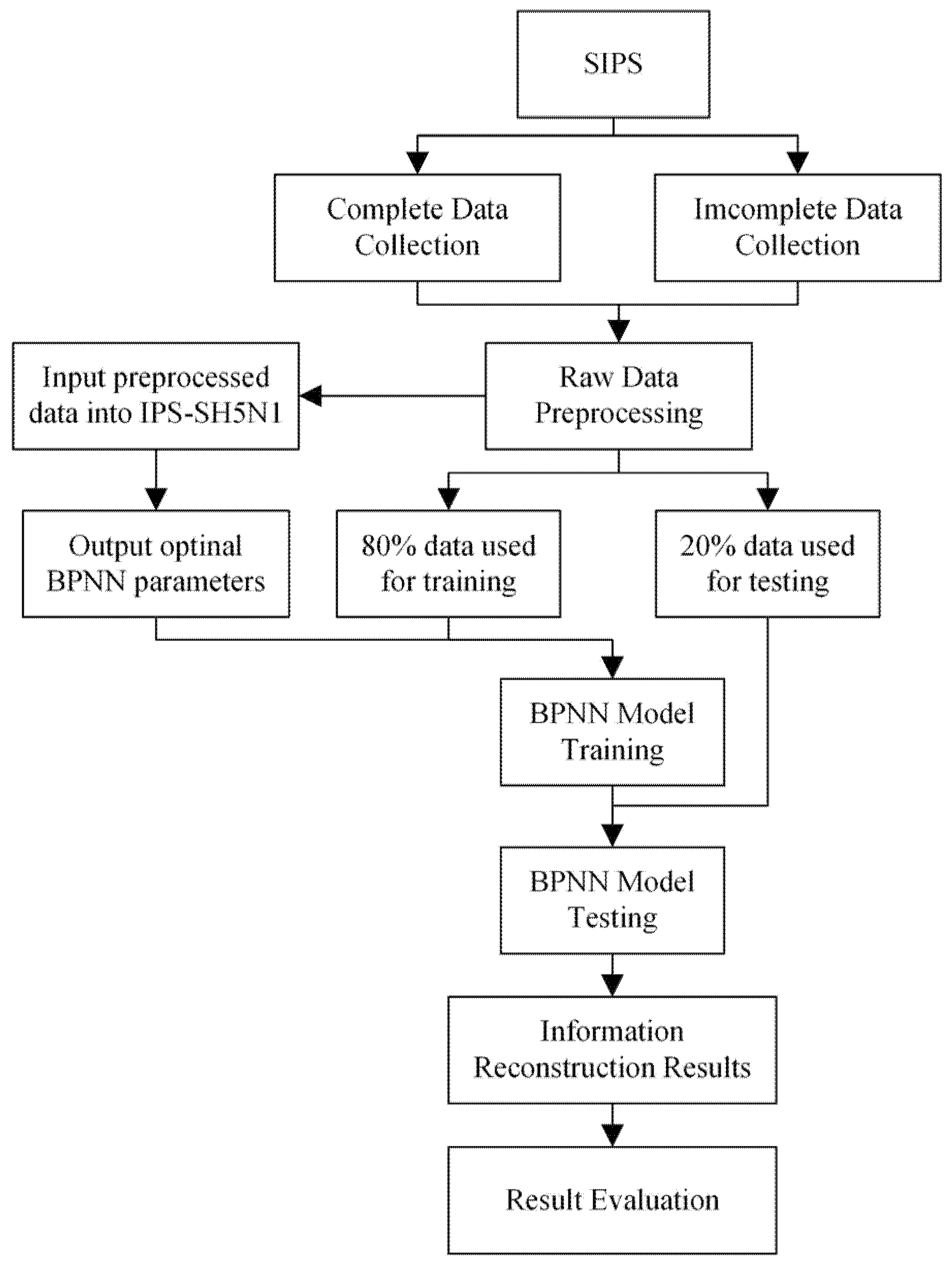
The IPS-SH5N1 optimization algorithm is adaptively optimized based on the SH5N1 meta-heuristic optimization algorithm and is specifically designed to address the problem of incomplete information in the damage scenario of the integrated power system (IPS) shipboard distribution network. It aims to achieve the globally optimal configuration of the weights and thresholds of the BPNN for node parameter mapping of the entire system by simulating the completion rules of incomplete data and the reconstruction characteristics of state information in the ship power system. Meanwhile, it accurately quantifies the interference intensity of incomplete features under three core damage modes, namely data loss, noise interference, and structural damage, on system state monitoring and solves the defects of the BPNN such as being prone to local optima, slow convergence speed, and poor adaptability to information-incomplete scenarios.
Compared with the SH5N1 optimization algorithm, the IPS-SH5N1 optimization algorithm deeply integrates the inherent operating characteristics of the ship’s integrated power system with the incomplete data characteristics under three core damage modes. Through an adaptive search strategy and parameter adjustment mechanism, it achieves accurate completion of the ship’s incomplete data and efficient reconstruction of system state information, providing a targeted optimized solution for information reconstruction tasks in the emergency damage disposal and intelligent operation and maintenance of the ship’s integrated power system.
3.2.1. SH5N1 Optimization Algorithm [38]
Experimental results in reference [
38] show that the SH5N1 optimization algorithm achieves significantly superior overall performance compared with 10 mainstream optimization algorithms. In tests on 33 standard benchmark functions, it ranks first in solution accuracy, optimization success rate and computational efficiency. It can effectively solve highly difficult optimization problems that other algorithms fail to handle and also demonstrates strong adaptability in high-dimensional scenarios and engineering design problems. Therefore, the SH5N1 optimization algorithm is adopted to optimize the initial weights and thresholds of the BPNN.
The SH5N1 optimization algorithm maps the search space of BPNN weights and thresholds to the host environment for virus transmission, treats the weight and threshold solutions to be optimized as individual viruses, and achieves a dynamic balance between global exploration and local exploitation of the optimal weights and thresholds for the BPNN by simulating viral infection and transmission, adaptive mutation, and environmental adaptation behaviors. The algorithm stores the positions of all virus individuals in a two-dimensional matrix
, where
denotes the serial number of a virus individual and
represents the dimension of the search space. The core mechanism consists of four parts: permutation mutation, position update, dynamic parameter adjustment, population position calibration, and global optimal update. The core parameters of the algorithm are shown in
Table 1.
The core mathematical models and mechanisms are as follows:
Permutation mutation is the core of algorithms to avoid local optima. Through three index permutations and shifts of the optimal weight and threshold positions of the BPNN, three independent optimal position matrices
,
, and
are generated, preventing excessive reliance on a single global optimal solution.
Among them, is a random integer within interval [1, n], and represents the dimension of the search space; is the rotation offset reference value, a reference parameter used for generating the rotation index, and is employed to rearrange the indices of the search dimensions, . In addition, , , and are random integers ranging from 1 to 3, realizing the cyclic shift of the index vector. The symbol % denotes the modulo operation. is the rotated index array. The rotated index is obtained by adding a random offset to and then taking the modulus with respect to the number of dimensions, which is used to rearrange the original search dimension indices and generate index offsets for different search paths. is the permuted position index array, used to extract different search path matrices from the local optimal population. Based on the index vectors , , , the corresponding rows of the population local optimal solution matrix are retrieved to generate three optimal position matrices for BPNN weights and thresholds , , and .
- 2.
Position Update Mechanism
The algorithm judges the suitability of the current environment by comparing the virus attack probability
with the infection rate threshold
. It updates the positions of virus individuals in two modes, “favorable environment (local exploitation)” and “unfavorable environment (global exploration)”, so as to achieve a preliminary balance between exploration and exploitation. The core position update formula is shown in Equation (8):
where
is a random number within the range [0,1], simulating the random attacking behavior of viruses against hosts;
is the
-dimensional value of the global optimal position;
is the
-dimensional value of the local optimal position of the
-th virus individual; and
is a random number matrix within the range [0,1], which introduces random disturbances for position updates to avoid solidification of the search process.
When viruses encounter extremely unfavorable environments such as strong host immune responses, the algorithm triggers an adaptive mutation mechanism. Through the mutation and recombination of viral genes, large-scale jumps in the search space are realized, further enhancing the algorithm’s ability to escape local optima. The trigger condition for the mutation mechanism is the viral adaptive probability
≤
, where
is a random number within the range [0,1], simulating the environmental adaptability of viruses.
where
represents the original position of the virus individual before mutation,
is the exploration–exploitation balance coefficient,
is a random number within the range [0,1],
is the weight coefficient, and the values of
and
are updated in real time through a dynamic parameter adjustment mechanism.
- 3.
Dynamic Parameter Adjustment Mechanism
The SH5N1 algorithm realizes the smooth transition between global exploration and local exploitation during the iteration process through three core dynamic parameters, the weight coefficient , the balance coefficient , and the adaptive coefficient , avoiding the problems of excessive exploration in the early stage and excessive exploitation in the later stage of the algorithm.
The weight coefficient
is used to control the exploitation intensity of the algorithm and decays exponentially with the increase in the number of iterations.
where
and
are the upper and lower limits of the weight coefficient, respectively, taking
= 0.9 and
= 0.1.
The balance coefficient
is used to offset the excessive convergence tendency of the weight coefficient.
where
is a random number within the range [0,1] and
gradually decays as the number of iterations increases; it takes a larger value in the early stage to encourage global exploration and a smaller value in the later stage to ensure the stability of local exploitation.
The adaptive coefficient
is used to control the selection probability of mutation results.
where
is a random number in the range [0,1]. In the early stage of iteration, the value of
is relatively small, making the algorithm more prone to mutation and improving population diversity; in the late stage of iteration,
approaches 1, and only mutation results with better fitness are accepted, ensuring the convergence stability of the algorithm.
- 4.
Population Position Calibration and Global Optimum Update Mechanism
After each position update and mutation operation, the algorithm performs final calibration on the positions of virus individuals to avoid invalid search, as shown in Equation (14):
where
represents the mutation coefficient vector of the entire population and
represents the mutation coefficient vector of the current virus individual.
Through a random selection mechanism, it is determined whether to update the mutated individual to the global optimal solution, as shown in Equation (15).
where
represents the fitness function,
represents the position of the mutated virus individual, and
is a random number within the range [0,1]. The mutated individual is updated as the global optimal solution only when the trigger condition is satisfied and its fitness is superior; otherwise, the individual with the minimum fitness in the population is selected as the global optimal solution.
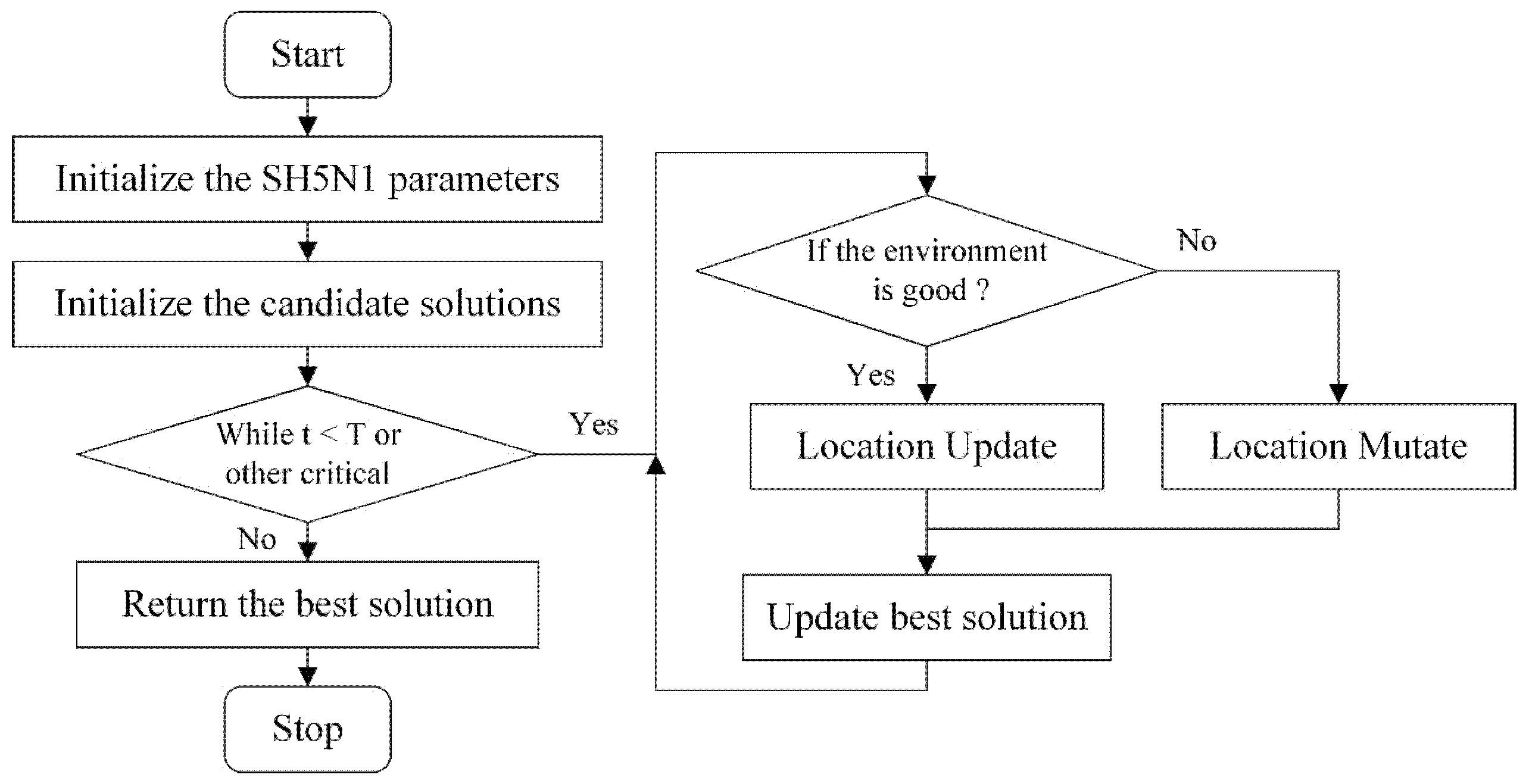
In summary, the iterative process of the SH5N1 algorithm is shown in
Figure 3.
3.2.2. Adaptive Optimization Considering the Reconstruction Requirement of Incomplete Information for Ship IPS Distribution Network
Although the SH5N1 optimization algorithm has excellent global optimization capability, it has three core adaptation defects when directly applied to the reconstruction of incomplete data for ship IPS and the optimization of BPNN weights and thresholds:
The core control parameters and take fixed values, which cannot adapt to the optimization requirements under different damage degrees, easily leading to slow convergence in mild damage scenarios and premature convergence in severe damage scenarios;
It adopts full-dimensional undifferentiated permutation mutation without considering the importance difference of BPNN weights and thresholds, which destroys the effective information of core dimensions, increases a large number of invalid calculations, and results in the low efficiency of high-dimensional optimization;
It adopts completely random population initialization without integrating the prior knowledge of BPNN structure and IPS system operation, leading to low early-stage optimization efficiency and many convergence iterations.
To address the three core adaptation defects of the original algorithm, this paper completes adaptive optimization by combining the inherent operating characteristics of ship IPS and the damage mode of incomplete data, forming a dedicated IPS-SH5N1 optimization algorithm, with the specific design as follows.
Define the system damage degree index
to quantify the severity of system incomplete data, as shown in Equation (16):
where
represents the total number of sensor nodes in the system,
represents the number of data-missing nodes,
represents the number of data-distorted nodes, and the larger the value of
, the more severe the system damage.
Based on the damage degree
, the core control parameters
and
are dynamically and adaptively updated, as shown in Equations (17) and (18):
where
= 0.95,
= 0.6,
= 0.8, and
= 0.2.
The core logic of this mechanism is as follows: the higher the damage degree , the smaller the value of , and the easier the algorithm is to trigger the global exploration mode, which is suitable for high-difficulty optimization tasks; the larger the value of , the higher the mutation trigger probability, improving the algorithm’s ability to escape from local optima. In the later stage of iteration, gradually increases and gradually decreases, strengthening the local exploitation capability to ensure convergence accuracy and stability.
- 2.
Directional Mutation and Search Mechanism for Core Dimensions of BPNN
The weights between the input layer and the hidden layer that are strongly correlated with incomplete damage features are divided into core optimization dimensions, while the remaining bias thresholds and non-core weights are classified as non-core dimensions. An importance mask matrix
for BPNN weights and thresholds (where D represents the total dimension of BPNN weights and thresholds) is constructed to realize directional mutation optimization with decoupled core and non-core dimensions, as shown in Equation (19).
The following is based on the mask matrix, conduct targeted optimization on the permutation mutation, position update, and variation mechanisms of the original algorithm.
When generating the optimal position matrix for , , and , keep the values of non-core dimensions unchanged and only perform permutation operations on core dimensions.
During position update and variation, only implement step-size scaling and random perturbation on core dimensions. The optimized variation formula is shown in Equation (20):
The more severe the damage, the larger the mutation step size and the stronger the global exploration capability. This mechanism avoids invalid mutations in non-core dimensions, preserves effective weight information, and reduces the computational load of a single iteration.
- 3.
Population Initialization Mechanism with Prior Fusion
By integrating the prior structural information of the BPNN and the prior operation information of the IPS system, a hierarchical population initialization strategy is constructed, as shown in Equation (21):
where
is the reference value of Xavier initialization based on the BPNN structure;
is the BPNN weight threshold obtained by pre-training the steady-state data of the system before damage, which possesses prior information of system operation; D is the total dimension of the weight threshold; and
and
are the upper and lower limits of parameter search. This strategy enables the algorithm to approach the optimal solution region at the early stage of iteration, reducing the number of convergence iterations, while retaining 10% random individuals to ensure population diversity.