


Design of Energy Management Strategy for Integrated Energy System Including Multi-Component Electric–Thermal–Hydrogen Energy Storage


Abstract
1. Introduction
2. Integrated Energy System Model
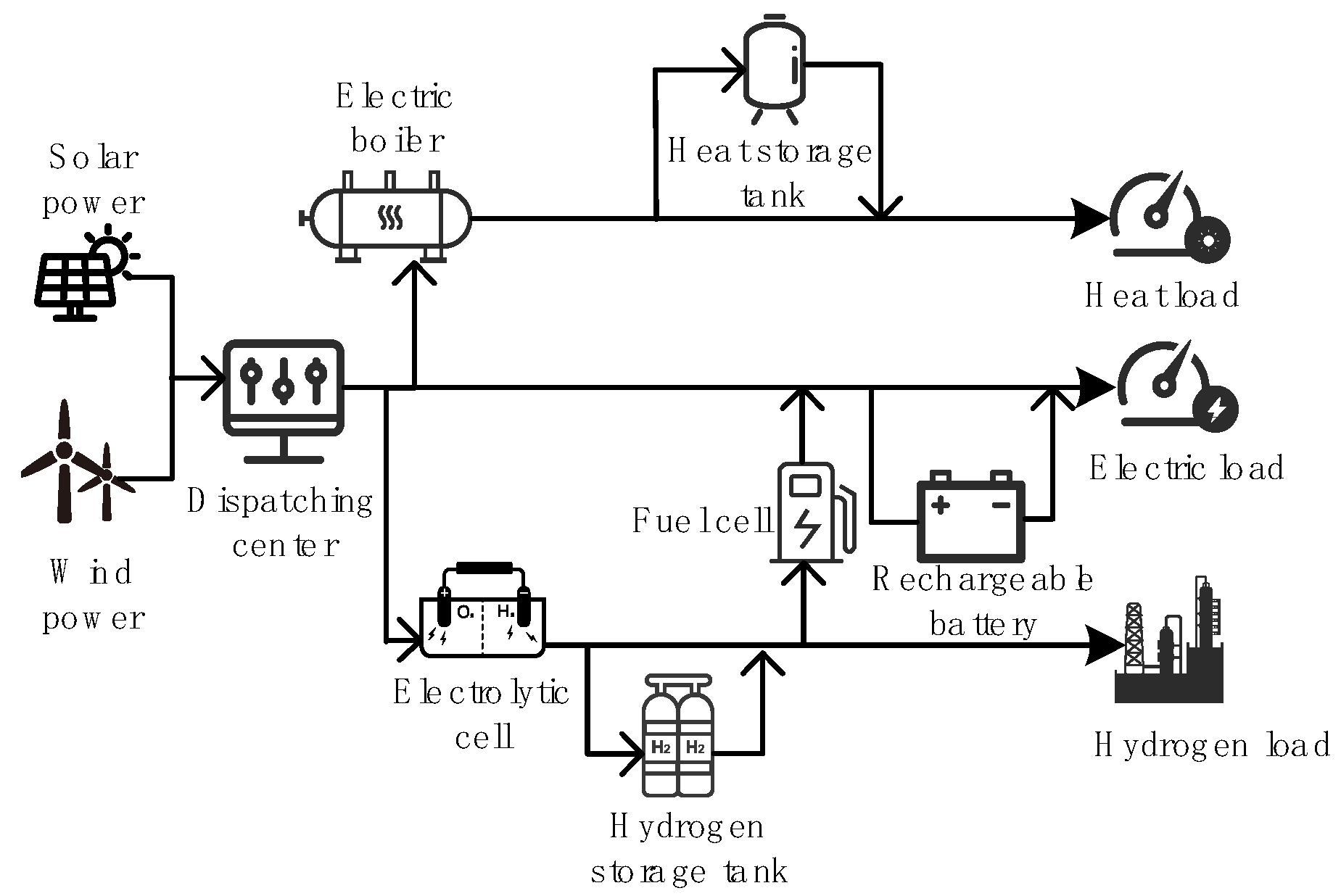
2.1. Electric–Thermal–Hydrogen Integrated Energy System
2.2. Mathematical Model
2.2.1. Wind Turbine
2.2.2. Photovoltaic Array
2.2.3. Hydrogen Production Device
2.2.4. Energy Storage Battery
2.2.5. Thermal Storage Device
2.2.6. Hydrogen Storage Device
3. Enhanced Radar Chart-Based Multi-Objective Optimization Strategy
3.1. Optimization Indicators
3.1.1. Establishment of Optimization Indicators
- Load satisfaction rate
- 2.
- Absorption rate
- 3.
- Life of energy storage equipment
3.1.2. Standardization of Optimization Indicators
- Load satisfaction rate (X1)
- 2.
- New energy consumption rate (X2)
- 3.
- Number of charge and discharge of energy storage battery (X3)
3.1.3. Determining the Weights of Optimization Indicators
3.2. Objective Function
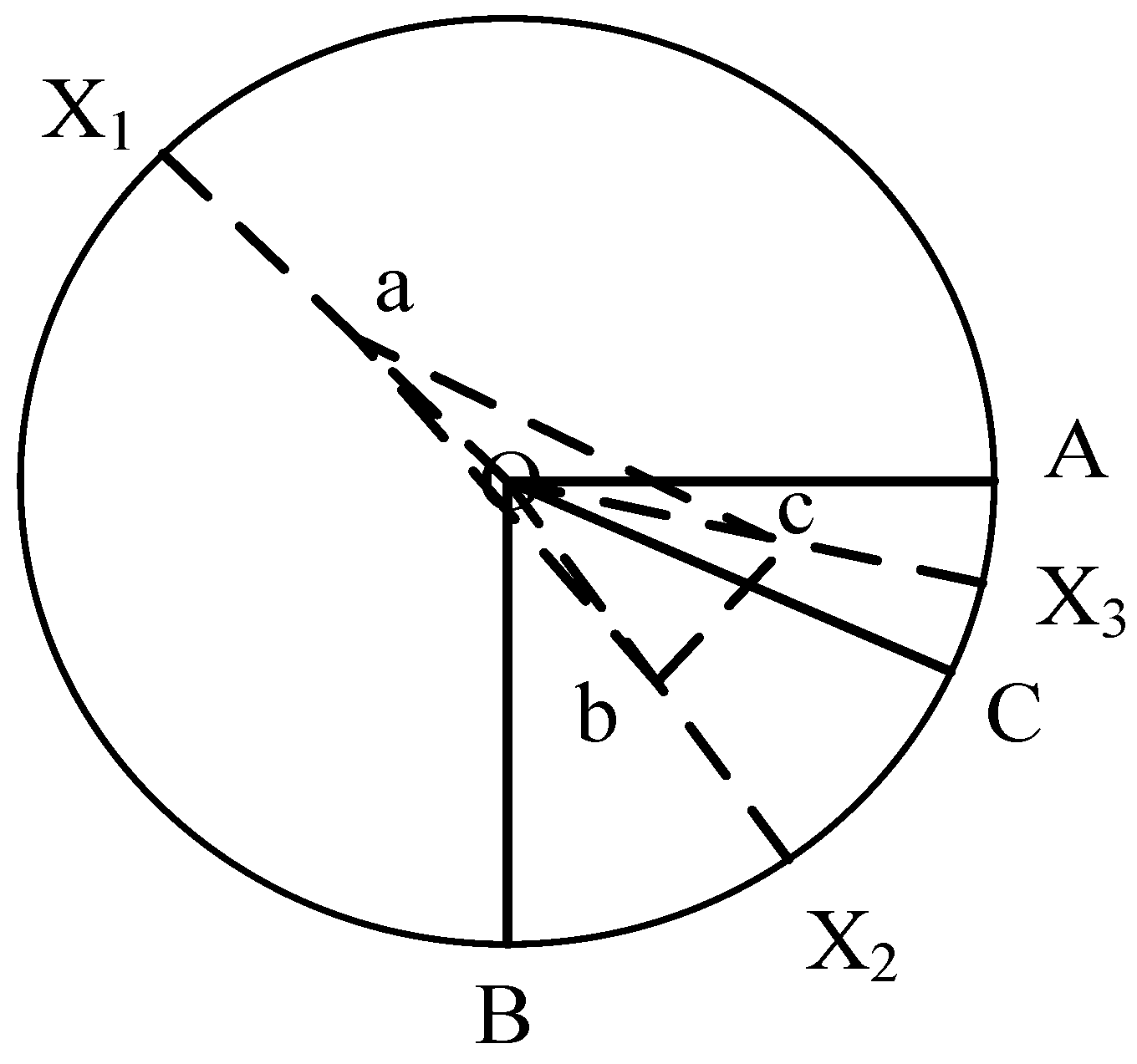
- Division of the unit circle: from the center of the circle O lead ray OA, cross the unit circle at point A, starting from OA, clockwise direction to do X1, X2, X3 occupied by the sector, OB, OC line segment separate;
- Make the angular bisector of each region, respectively, marked as OX1, OX2, OX3, that is, the corresponding line segment of the optimization index;
- Take the specific value of the optimized index after unitization as the length of the distance from the origin of each index, mark each length as X1, X2, X3, and make three points a, b, and c, respectively, on the optimized index line segment;
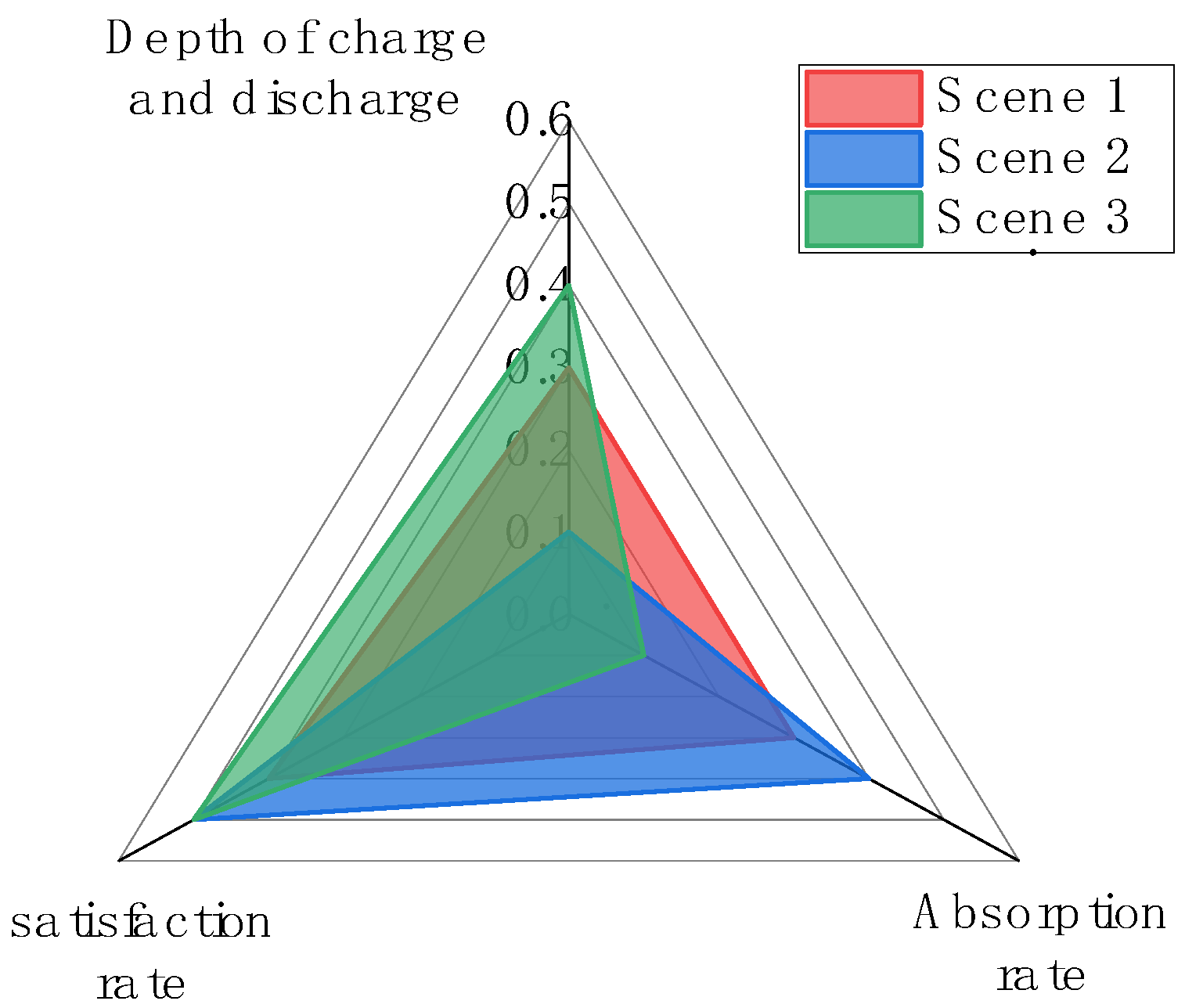
- The three points are connected to obtain triangle ABC, which is the objective function image of the radar chart as shown in Figure 2.
3.3. Constraints and Limitations
- System power balancewhere represents the power generation of the photovoltaic unit at time t; represents the power generation of the wind unit; represents the charge and discharge power of the battery, positive for charging, negative for releasing electricity; represents the input power of the electric heating device; represents the input power of the electrolytic cell; represents the output power of the fuel cell; and is the power consumed by the electrical load. can be positive or negative, whereas the rest of the power values are positive.
- 2.
- The power limit of wind and photovoltaic power generation units are as follows:
- 3.
- The input power limit of energy conversion equipment is as follows:
- 4.
- The energy storage device output power limit is as follows:
- 5.
- The energy storage state limit of energy storage equipment is as follows:
3.4. Solving Algorithm
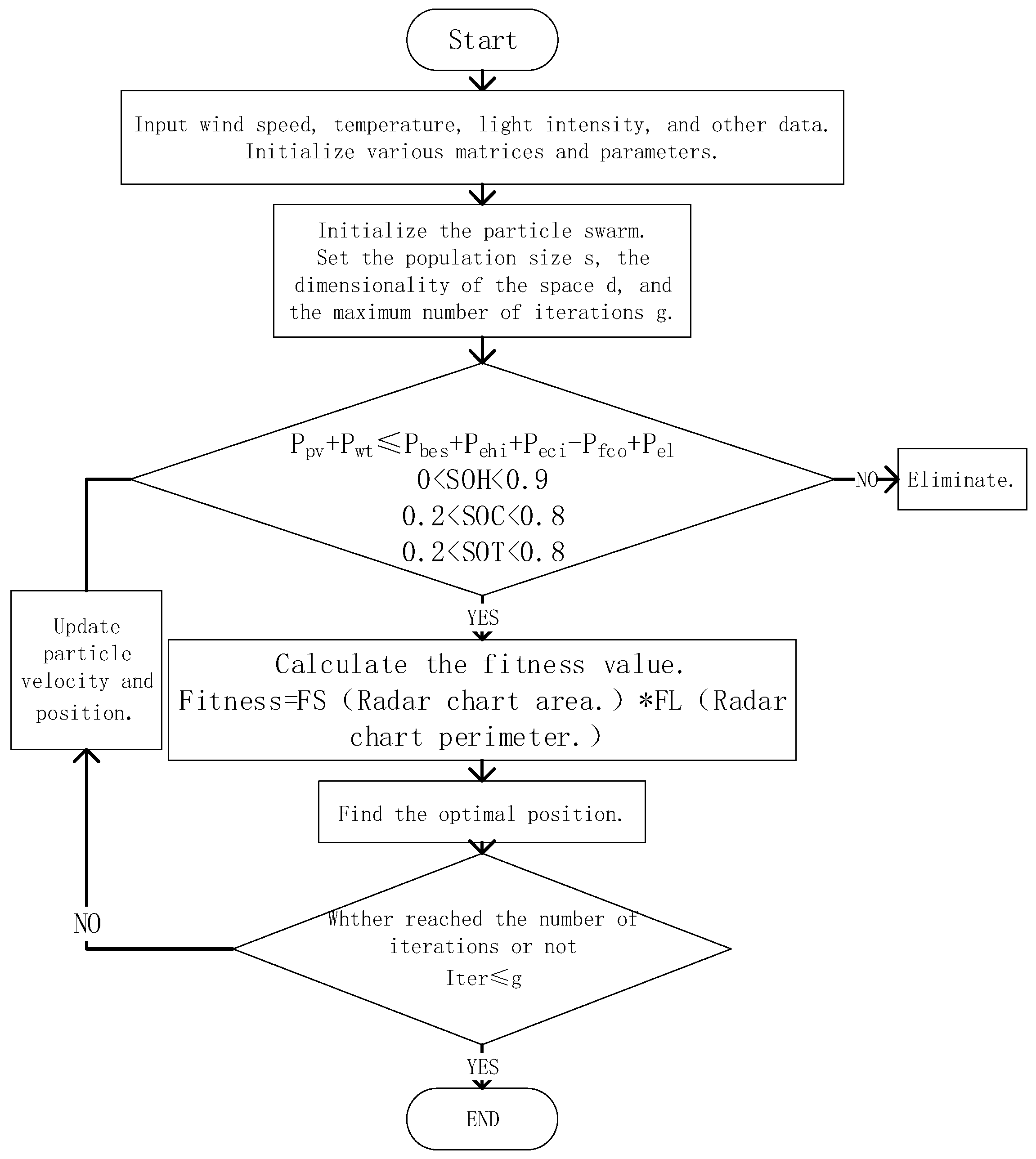
- Define the population parameters
- 2.
- Population initialization
- 3.
- Calculate fitness
- 4.
- Compare the fitness
- 5.
- Update the population position and speed and do boundary processing.
- 6.
- Replace the updated population into the calculation, and repeat steps 3 and 4.
- 7.
- Repeat steps 4–6 until the number of iterations reaches the preset g.
- 8.
- Output the optimal individual position.
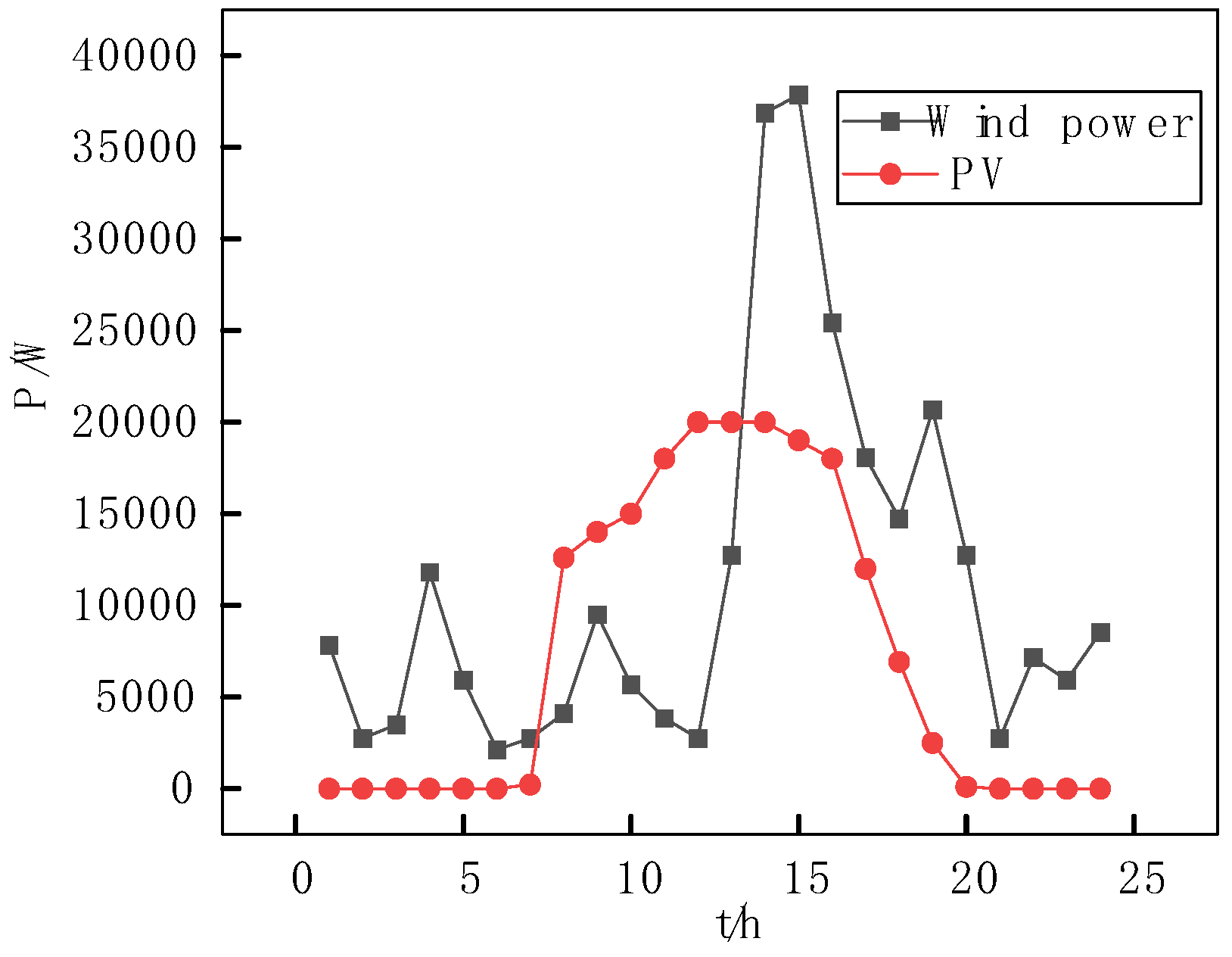
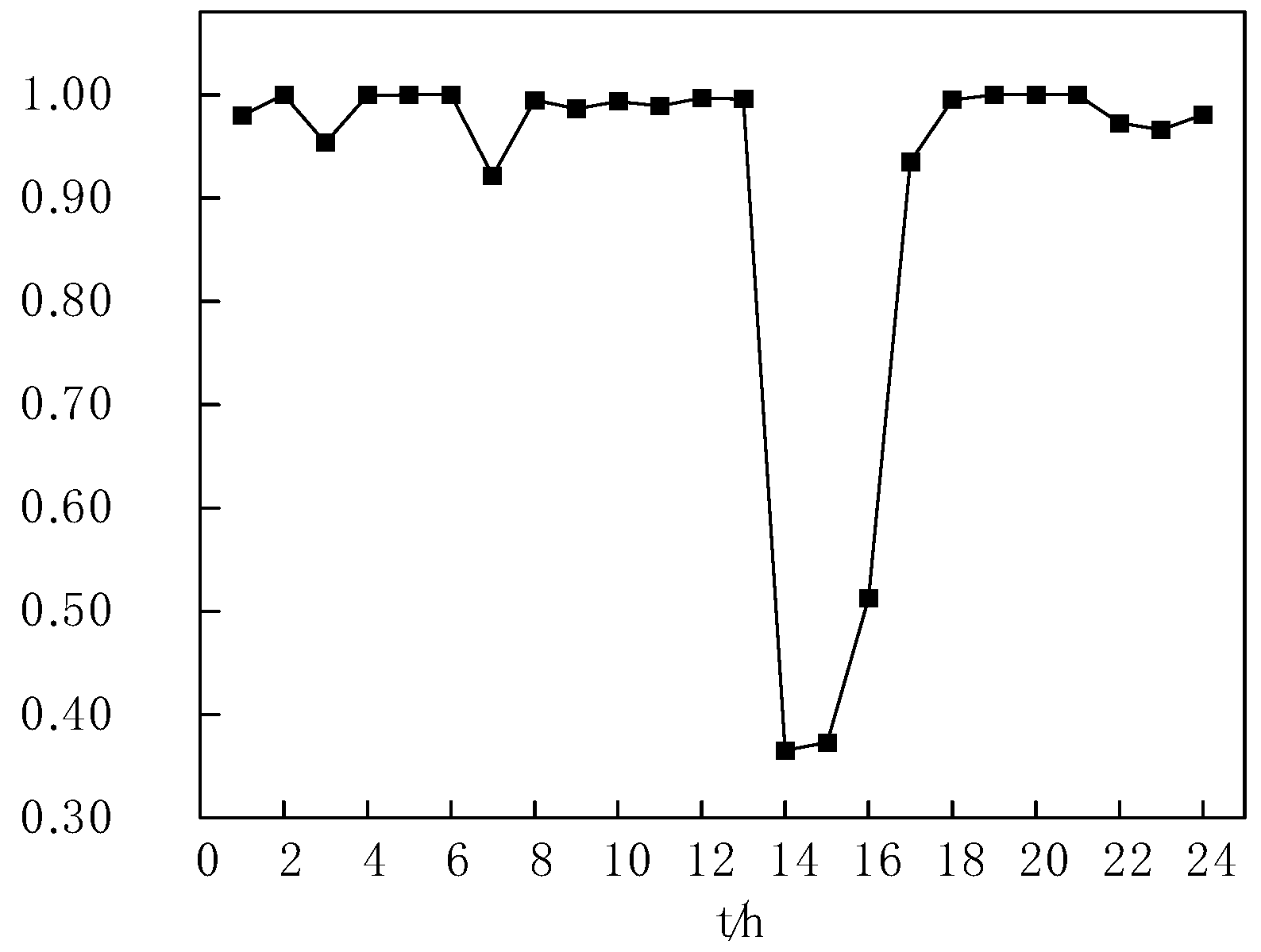
4. Case Analysis
5. Conclusions
- This strategy can effectively ensure the stability of load supply in integrated energy systems, and by changing the weights of multiple objectives, it can achieve result optimization under different performance requirements and attain various optimization effects.
- The proposed strategy demonstrates the ability to rapidly optimize based on predefined indicator weights. In comparison with the SPEA2 algorithm, which generates multiple solution sets, it possesses unique advantages in application scenarios that require a single optimal solution with high real-time performance.
Author Contributions
Funding
Data Availability Statement
Conflicts of Interest
References
- Østergaard, A.P.; Duic, N.; Kalogirou, S. Sustainable development using integrated energy systems and solar, biomass, wind, and wave technology. Renew. Energy 2024, 235, 121359. [Google Scholar] [CrossRef]
- Zou, C.; Xiong, B.; Xue, H.; Zheng, D.; Ge, Z.; Wang, Y.; Jiang, L.; Pan, S.; Wu, S. The role of new energy in carbon neutral. Pet. Explor. Dev. Online 2021, 48, 480–491. [Google Scholar] [CrossRef]
- Laimon, M.; Yusaf, T. Towards energy freedom: Exploring sustainable solutions for energy independence and self-sufficiency using integrated renewable energy-driven hydrogen system. Renew. Energy 2024, 222, 119948. [Google Scholar] [CrossRef]
- Li, X.; Chen, Y.; Li, H.; Liu, L.; Huang, J.; Guo, P. Two-stage robust optimization of integrated electricity-heat energy system considering carbon trading for low-carbon economic dispatch. Electr. Power Constr. 2024, 45, 58–69. [Google Scholar]
- Mokaramian, E.; Shayeghi, H.; Sedaghati, F.; Safari, A.; Alhelou, H.H. A CVaR-Robust-Based Multi-Objective Optimization Model for Energy Hub Considering Uncertainty and E-Fuel Energy Storage in Energy and Reserve Markets. IEEE Access 2021, 9, 109447–109464. [Google Scholar] [CrossRef]
- Hosseini, S.M.; Carli, R.; Dotoli, M. Robust Energy Scheduling of Interconnected Smart Homes with Shared Energy Storage under Quadratic Pricing. In Proceedings of the 2019 IEEE 15th International Conference on Automation Science and Engineering (CASE), Vancouver, BC, Canada, 22–26 August 2019; pp. 966–971. [Google Scholar]
- Zhang, D.; Yuan, Y.; Wang, X.; He, J.; Dong, H. Economic dispatch of an integrated energy system with electricity, heat and gas interconnection considering generalized energy storage and photovoltaic power plants. Power Syst. Autom. 2021, 45, 33–42. [Google Scholar]
- Jiang, T.; Min, Y.; Zhou, G.; Chen, L.; Chen, Q.; Xu, F. Dispatch model for integrated heat and power systems considering internal composition of CHP plants. CSEE J. Power Energy Syst. 2021, 7, 396–407. [Google Scholar]
- Chen, Z.; Lin, X.; Chen, L.; Xv, Y.; Li, T.; Huang, C. Multi-objective fuzzy day-ahead optimal scheduling model for community-level integrated energy system. Guangdong Electr. Power 2019, 32, 93–99. [Google Scholar]
- Wang, L.; Jiang, T.; Song, D.; Cui, Y.; Hu, Y.; Chai, X.; Tang, Y. Multi-objective optimal scheduling of regional integrated energy system based on flexible heat-to-power ratio. Power Syst. Prot. Control. 2021, 49, 151–159. [Google Scholar]
- Ding, L.; Cui, Y.; Yan, G.; Huang, Y.; Fan, Z. Distributed energy management of multi-area integrated energy system based on multi-agent deep reinforcement learning. Int. J. Electr. Power Energy Syst. 2024, 157, 109867. [Google Scholar] [CrossRef]
- Han, F.-J.; Wang, C. Matlab-based distributed photovoltaic grid-connected power generation system on distribution network power quality. Electr. Meas. Instrum. 2015, 52, 16–21. [Google Scholar]
- Du, B.; Zhu, S.; Zhu, W.; Lu, X.; Li, Y.; Xie, C.; Zhao, B.; Zhang, L.; Xu, G.; Song, J. Energy management and performance analysis of an off-grid integrated hydrogen energy utilization system. Energy Convers. Manag. 2024, 299, 117871. [Google Scholar] [CrossRef]
- Xiong, Y.; He, T.; Zhu, W.; Liao, Y.; Xu, Q.; Niu, Y.; Chen, Z. The state of charge predication of lithium-ion battery energy storage system using contrastive learning. Sustain. Energy Technol. Assess. 2024, 71, 103989. [Google Scholar] [CrossRef]
- Yang, D.; Ma, Y. Application of Combination Weighting Based On G1-MSE in QFD. J. Phys. Conf. Ser. 2021, 2037, 012050. [Google Scholar] [CrossRef]
- Wang, J.; Li, X.; Liu, L.; Pan, A.; Jia, D. Research on the evaluation method for virtual power plant technology promotion and application benefits. J. Phys. Conf. Ser. 2022, 2358, 012014. [Google Scholar] [CrossRef]
- Duan, B.; Wang, Q.; Zeng, X.; Gong, Y.; Song, D.; Wang, J. Calibration methodology for energy management system of a plug-in hybrid electric vehicle. Energy Convers. Manag. 2016, 136, 240–248. [Google Scholar] [CrossRef]
- Zhao, J.-Y.; Nian, H.; Ma, R.-S.; Song, T.; Shi, S.; Fan, C.; Pang, B. Multi-objective optimal configuration of combined heat and power microgrid system based on improved radar graph model. Power Autom. Equip. 2020, 40, 31–45. [Google Scholar]
- Wei, H.; Wang, W.-S.; Kao, X.-X. A novel approach to hybrid dynamic environmental-economic dispatch of multi-energy complementary virtual power plant considering renewable energy generation uncertainty and demand response. Renew. Energy 2023, 219, 119406. [Google Scholar] [CrossRef]
- Zhang, Y.; Cui, W. A Multi-Objective Optimization Approach for Elevator Group Control Systems Based on Particle Swarm Algorithm. J. Circuits Syst. Comput. 2023, 33, 2450138. [Google Scholar] [CrossRef]
- Liu, W.; Wan, Y.; Xiong, Y.; Tao, Z.; Zhu, Y. Key Technologies for Hydrogen Production by Water Electrolysis under the Carbon Neutrality Target and Analysis of Cost Levelization. Trans. China Electrotech. Soc. 2022, 37, 2888–2896. [Google Scholar]

| Fixtures | Maximum Input Power | Conversion Efficiency |
|---|---|---|
| Electrolyzer | 24 kW | 0.7 |
| Electric boiler | 24 kW | 0.95 |
| Fuel cell | 1500 L/h | 0.95 |
| Energy Storage Devices | Numerical Value | |
|---|---|---|
| Energy storage battery | Single energy storage battery capacity | 12,000 Ah |
| Number of batteries | 8 | |
| Maximum charge and discharge power | 12 kW | |
| Heat storage tank | Capacity | 1,000,000,000 J |
| Maximum charge and discharge power | 12 kW | |
| Hydrogen storage tank | Capacity | 200,000 L |
| Maximum charge and discharge power | 1500 L/h |
| Scenario One | Scenario Two | Scenario Three | Scenario Four | |
|---|---|---|---|---|
| Battery charging and discharging times | 5.42 | 5.68 | 4.70 | 4.52 |
| Reabsorption | 0.913 | 0.916 | 0.898 | 0.906 |
| Satisfy rate | 0.932 | 0.928 | 0.921 | 0.915 |
Disclaimer/Publisher’s Note: The statements, opinions and data contained in all publications are solely those of the individual author(s) and contributor(s) and not of MDPI and/or the editor(s). MDPI and/or the editor(s) disclaim responsibility for any injury to people or property resulting from any ideas, methods, instructions or products referred to in the content. |
© 2024 by the authors. Licensee MDPI, Basel, Switzerland. This article is an open access article distributed under the terms and conditions of the Creative Commons Attribution (CC BY) license (https://creativecommons.org/licenses/by/4.0/).
Share and Cite
Peng, B.; Li, Y.; Liu, H.; Kang, P.; Bai, Y.; Zhao, J.; Nian, H. Design of Energy Management Strategy for Integrated Energy System Including Multi-Component Electric–Thermal–Hydrogen Energy Storage. Energies 2024, 17, 6184. https://doi.org/10.3390/en17236184
Peng B, Li Y, Liu H, Kang P, Bai Y, Zhao J, Nian H. Design of Energy Management Strategy for Integrated Energy System Including Multi-Component Electric–Thermal–Hydrogen Energy Storage. Energies. 2024; 17(23):6184. https://doi.org/10.3390/en17236184
Chicago/Turabian StylePeng, Bo, Yunguo Li, Hengyang Liu, Ping Kang, Yang Bai, Jianyong Zhao, and Heng Nian. 2024. "Design of Energy Management Strategy for Integrated Energy System Including Multi-Component Electric–Thermal–Hydrogen Energy Storage" Energies 17, no. 23: 6184. https://doi.org/10.3390/en17236184
APA StylePeng, B., Li, Y., Liu, H., Kang, P., Bai, Y., Zhao, J., & Nian, H. (2024). Design of Energy Management Strategy for Integrated Energy System Including Multi-Component Electric–Thermal–Hydrogen Energy Storage. Energies, 17(23), 6184. https://doi.org/10.3390/en17236184


