You are currently viewing a new version of our website. To view the old version click .
Energies
  • Article
  • Open Access

15 October 2024

EOS: Impact Evaluation of Electric Vehicle Adoption on Peak Load Shaving Using Agent-Based Modeling


,
and
1
Department of Electrical and Computer Engineering, New York Institute of Technology, New York, NY 10023, USA
2
Department of Electrical and Computer Engineering, New Jersey Institute of Technology, Newark, NJ 07102, USA
*
Authors to whom correspondence should be addressed.
This article belongs to the Special Issue Planning and Operation of Distributed Energy Resources in Smart Grids II

Abstract

The increasing adoption of electric vehicles (EVs) by the general population creates an opportunity to deploy the energy storage capability of EVs for performing peak energy shaving in their households and ultimately in their neighborhood grid during surging demand. However, the impact of the adoption rate in a neighborhood might be counterbalanced by the energy demand of EVs during off-peak hours. Therefore, achieving optimal peak energy shaving is a product of a sensitive balancing process that depends on the EV adoption rate. In this paper, we propose EOS, an agent-based simulation model, to represent independent household energy usage and estimate the real-time neighborhood energy consumption and peak shaving energy amount of a neighborhood. This study uses Residential Energy Consumption Survey (RECS) and the American Time Use Survey (ATUS) data to model realistic real-time household energy use. We evaluate the impact of the EV adoption rates of a neighborhood on performing energy peak shaving during sudden energy surges. Our findings reveal these trade-offs and, specifically, a reduction of up to 30% of the peak neighborhood energy usage for the optimal neighborhood EV adoption rate in a 1089 household neighborhood.

1. Introduction

Cities around the globe face a continuously increasing demand for energy to power new devices. Consequently, energy generation and the power distribution grid must adapt to meet the increasing demand. However, sudden surges of energy consumption (or peak hours) not only challenge the grid infrastructure but also energy pricing [1] and the metering accuracy [2] during such extraordinary events. Excessive peak demands may limit the accessibility to energy for some consumers and cause power outages. Providing additional grid infrastructure to overcome these challenges is often too costly to justify, particularly for surges which last short periods of time [3]. Therefore, a cost-effective solution is needed to satisfy the demand during such consumption surges.
Fortunately, the adoption of electric vehicles (EVs) in households continues to increase, raising the opportunity to repurpose their batteries as energy sources during peak hours. Consumers may charge the EVs’ batteries during off-peak hours and use the stored energy during peak hours [4]. This raises the question of what the trade-offs between peak shaving and the adoption rate of EVs in a neighborhood are.
Much research has focused on scheduling offloading of peak-hour demand for a supply but with a special focus on alternative energy sources [5,6]. Much of that work is based on the synthetically generated energy use of smart homes, mostly motivated by privacy concerns and business interests, as daily residential energy usage data are difficult to obtain. Moreover, some studies resort to using statistical models to simulate household energy usage, leaving concerns about representing actual scenarios [7]. Access to actual data can now be achieved so that other work on existing surveys, such as data from the Residential Energy Consumption Survey (RECS) [8] and the American Time Use Survey (ATUS) [9], can simulate the energy usage of a sample neighborhood for a given day based on respondent data. Yet, the question of how a neighborhood EV adoption rate affects the strategy of using EV batteries as alternative energy for peak shaving remains an open question.
In this paper, we study the use of EV batteries to supply peak-hour energy demand and examine the feasibility of and trade-off with the neighborhood EV adoption rate. For this, we propose an agent-based model tool, EOS, to evaluate daily neighborhood energy usage and test the effectiveness of peak-hour energy shaving for various EV adoption rates and neighborhood energy demands. The energy demand profile of each agent is derived from the RECS and ATUS survey data to provide realistic real-time neighborhood energy use. This study aims to provide a tool which unveils the trade-offs between the EV adoption rate in a neighborhood, helps alleviate strain on the grid infrastructure, and satisfies the demand during peak hours based on actual consumption data.
EOS models each household as an individual agent which has its own unique daily activity schedules based on respondent data from ATUS. The amount of energy used by each household per minute of the day is determined from RECS data. EOS’s visualization interface shows in real time the total amount of energy used by each household in a 1089 household neighborhood. This sum is plotted to visualize the daily neighborhood energy demand. A desired number of randomly chosen households are assigned ownership of an EV. As the rate of household EV adoption increases, these households may use the batteries of their EVs as a supplemental energy source during peak hours, generating demand for recharging overnight. EOS was implemented in NetLogo 6.2.2 with a visualization interface which showed real-time energy usage of each household and the neighborhood. The impact of various EV adoption rates and the levels of peak load shaving are estimated through EOS large-scale simulations. These simulations also help examine the method’s feasibility and trade-offs between the adjusted neighborhood peak load demand and EV charging during off-peak hours. EOS allows us to evaluate real-time neighborhood energy consumption based on actual household energy consumption survey data for longer estimation periods. The results show a reduction of up to 30% peak shaving from the daily neighborhood energy demand profile, with 35% household EV ownership in the neighborhood providing a balanced energy profile.
The remainder of this paper is organized as follows. Section 2 presents the existing approaches to peak energy shaving. Section 3 introduces the proposed EOS agent-based model. Section 4 presents the evaluation of the proposed EOS through simulation and provides a detailed result analysis. Section 5 summarizes our findings, contributions, and possible extensions of this work.

3. The Proposed Agent-Based Model: EOS

In this section, we introduce the design of the proposed EOS agent-based model developed to simulate daily neighborhood energy usage. We also detail the process of how EOS can be configured to test the impact that utilizing EV batteries for load peak shaving has on the amount of energy demanded from the grid during peak hours.

3.1. Agent-Based Model Design and Validation

EOS was implemented in NetLogo version 6.2.2, a multi-agent programmable modeling environment. NetLogo operates using mobile agents, known as turtles, which traverse a grid of stationary agents known as patches. As the simulation progresses, both the turtle and patch agents regularly make decisions based on any number of factors as they follow programmed instructions. NetLogo collects data on the actions of every agent and allows for the visualization of their interactions, the connections between them, and the evolution of the overall environment space over time. This approach provides a real-time simulation of the environment and the impact of the agents’ decisions on the environment.
EOS was established with a two-dimensional environment space with ( x , y ) coordinates, each representing a household. To simulate a neighborhood comparable to an average US suburb [33], we tested a neighborhood with a 33 × 33 grid for a total of 1089 households, where 16 x , y 16 . This interface ensembled a 33 × 33 grid of 1089 individual patches representing our test neighborhood, yielding a sample size comparable to the average suburb size in the US [33]. EOS has a time resolution of one minute to match the resolution of the ATUS respondent data. Table 1 lists the variables used in our model. Here, t represents the time in minutes, n represents the unique identification number for each household, where 1 n N , and N = 1089 is the number of households in the neighborhood. An N × T (T = 2880) matrix D represents the processed neighborhood power usage data, with each row representing a household and each column containing the household’s energy usage data for every minute of the day. P n [ t ] denotes the amount of power used by household n at time t, P H [ t ] represents the total amount of power being used by the neighborhood at time t, where P H [ t ] = n = 1 N P n [ t ] , P m a x represents the maximum of P H [ t ] , Ψ represents the percentage of households in the neighborhood that own EVs (i.e., the neighborhood EV adoption rate), Φ is the cutoff power, which represents the percentage of the maximum neighborhood power usage to shave down, and ε is a binary variable to indicate whether a household owns an EV(s). In addition, β n [ t ] denotes the amount of power household n draws from its battery at time t, β H [ t ] represents the amount of power being drawn from EV batteries by the entire neighborhood at time n, and β m a x represents the cumulative total of β H [ t ] .
Table 1. Variables used for agent-based model design.
To initialize the simulation, the processed data file containing the daily energy usage of each household was registered in D ( P n [ 0 ] = 0 , initially). The patches were assigned colors based on a green-scale gradient, where a darker shade of green indicates higher power usage. This experiment was run to represent a full day of responses from ATUS on a by-minute basis. Each patch loaded the corresponding power usage P n [ t ] per minute from the matrix D .
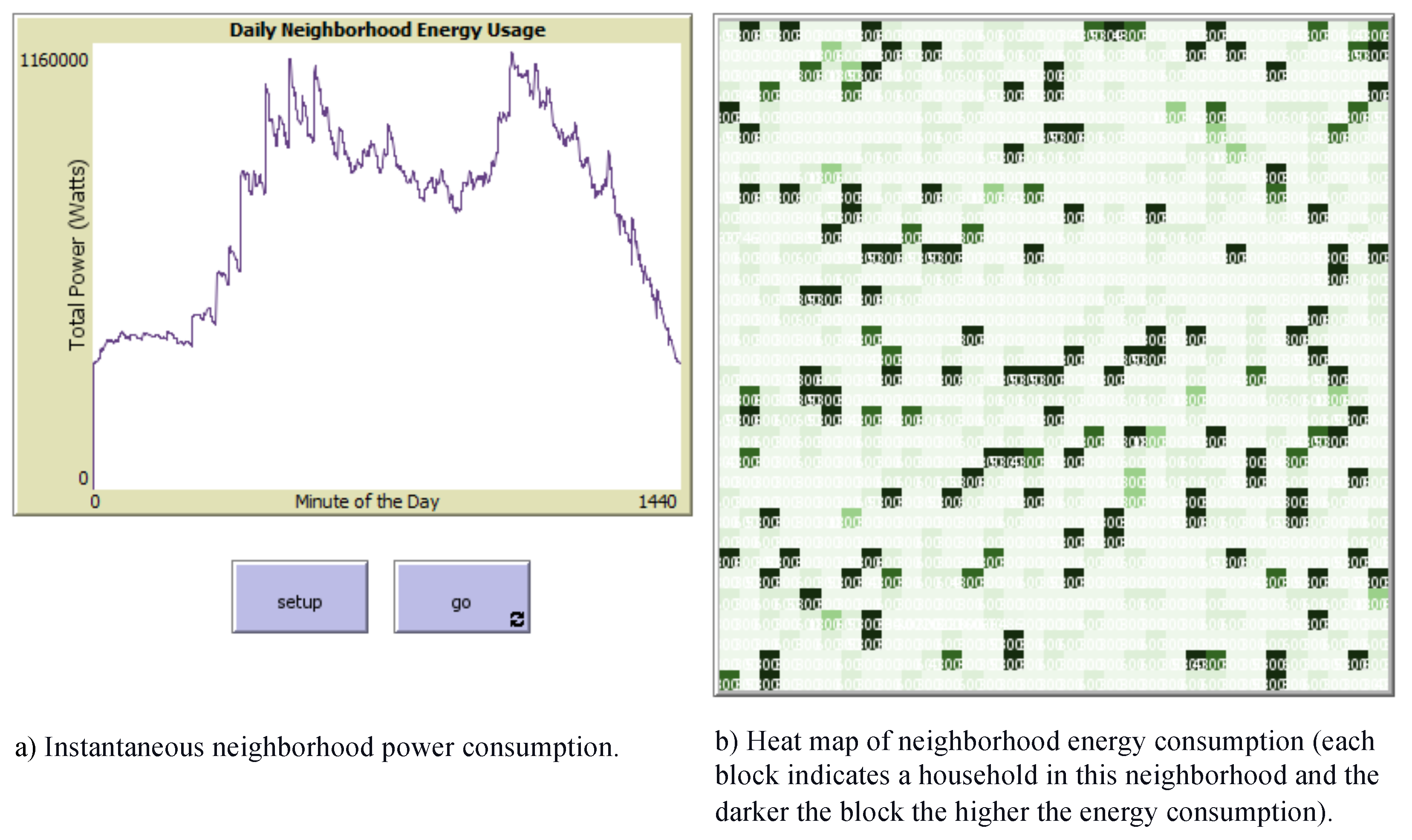
The environment space provides visualization of the neighborhood’s real-time energy usage as a heat map, as shown in Figure 1b. The figure depicts how much energy each household uses at that minute. Figure 1a shows the total amount of instantaneous energy used by all households per minute ( n P n [ t ] ). This figure also shows that spikes in energy usage occurred around 8:00 a.m., when households likely use electric devices before leaving for work, and at 5:00 p.m., when people return home from work. These are the spikes that need to be mitigated using EV batteries in this study.
Figure 1. EOS graphical interface, showing visualization of neighborhood energy usage.

3.2. Data Preparation

In this section, we introduce the data sets used in this project and the data preparation process. Due to the unavailability of daily residential energy usage data, we needed to combine information found in the ATUS and RECS using the methods described in Section 3.2.2 to simulate a daily energy usage profile for our sample neighborhood.

3.2.1. Data Sets

RECS is administered by the US Energy Information Administration (EIA) every 4 years [9]. It is designed to analyze the energy usage habits of respondent US households over the course of a given year. The survey collects data from a nationally representative sample of housing units, including household demographics, energy use patterns, and housing unit characteristics. These data are used by EIA to estimate energy consumption and expenditure [8]. While RECS provides an in-depth analysis of a household’s yearly energy usage, it lacks time series data which can be used to model how energy is consumed by households throughout the day.
ATUS is a survey administered by the Bureau of Labor Statistics every year. It collects nationally representative estimates of how, where, and with whom Americans spend their time, and it is the only federal survey providing data on the full range of non-market activities, from childcare to volunteering [9].
ATUS uses a three-tiered activity coding system to sort possible daily tasks, an example of which is shown in Table 2. Here, the ATUS code for Browsing the Internet is 120308, which is the aggregate of the code for the major, second-, and third-tier categories it falls under. While ATUS provides a comprehensive analysis of how respondents spend their time throughout the day, it does not provide information about the amount of energy used during different activities. To obtain this information, we needed to consider both RECS and ATUS, simultaneously.
Table 2. Sample three-tiered activity code lexicon.

3.2.2. Data Processing

Owing to the nature of privacy laws and business concerns within the energy sector, genuine household daily energy usage data are difficult to obtain. In the absence of such information, past studies have examined many ways to simulate daily energy consumption profiles from data which are publicly available. Diao et al. [34] modeled the energy consumption in residential buildings using a bottom-up analysis based on occupant behavior pattern clustering and stochastic simulation. This study introduces a useful approach which links data from the RECS and ATUS surveys. Here, the authors identified the tasks in ATUS, which required electrical devices, and then used the RECS data to find the average amount of power these devices consumed while in use. Following this method, we obtained an average power consumption value for each ATUS activity category and the constant background power being consumed by appliances which run 24 h, such as refrigerators. We obtained an energy usage profile for each ATUS respondent over a given day. In this project, we built on this approach, utilizing the daily energy usage profiles created to model an entire neighborhood based on the daily activity data of ATUS respondents.

3.3. Hypothesis Testing: Using EVs to Supplement Peak Neighborhood Power

To test our hypothesis, we tuned the parameters of the model to show that the spikes in peak hour energy usage could be reduced by utilizing the EV batteries. We analyzed the results of neighborhood energy consumption from two consecutive days of household activities by repeating the ATUS data for each day.
The updated model allows the user to input desired values for Φ and Ψ and establish the neighborhood energy usage cutoff value and the percentage of households that own EVs, respectively. Similar initiation steps to those in the original model are followed as described in Section 3.1. Here, the initial power usage of each household P X [ 0 ] , as well as the initial amount of power that each household draws from the battery of its EV β X [ 0 ] , were set to zero. This experiment was run to evaluate the EV charging needs for a two-day period.
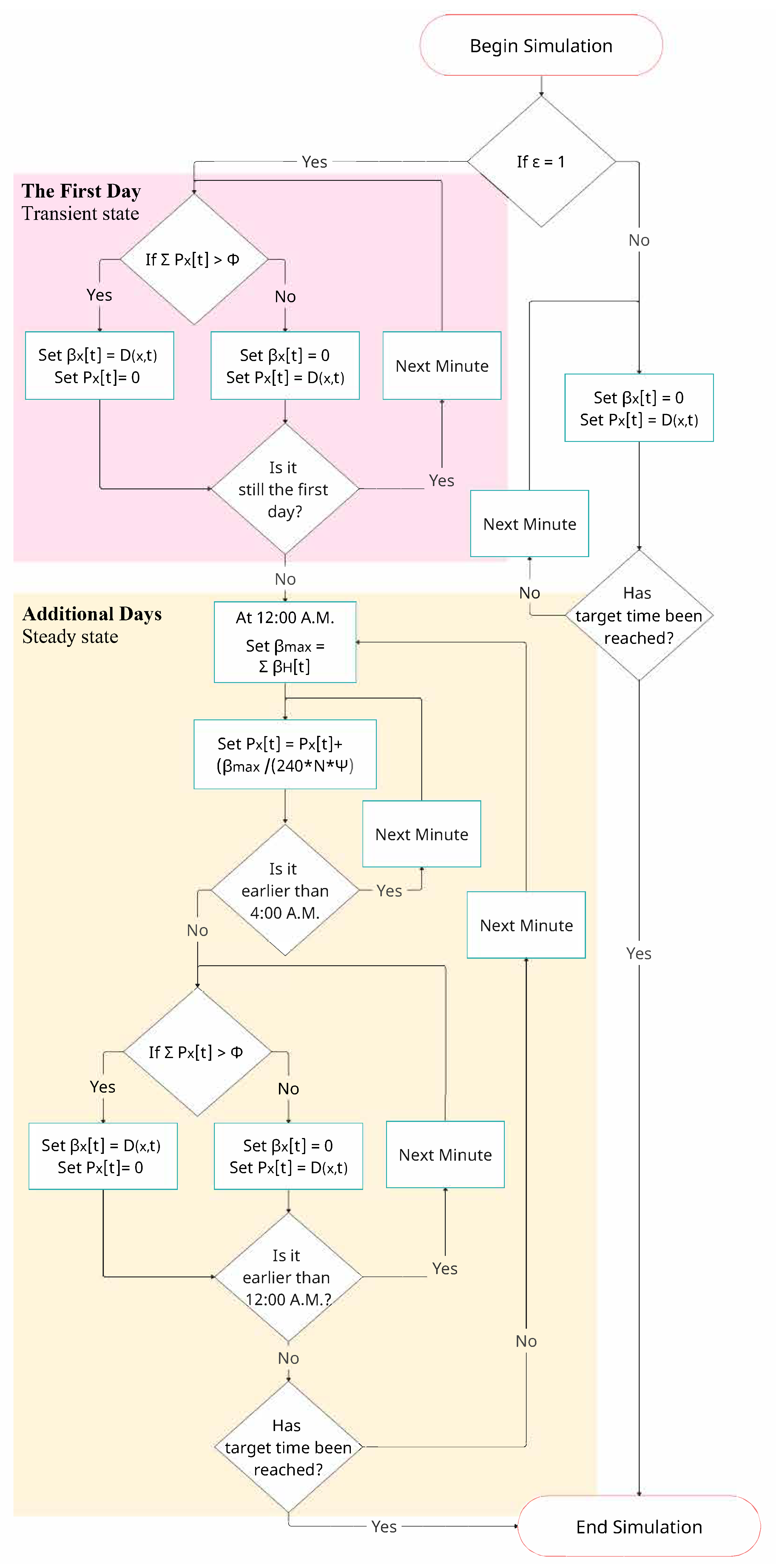
Figure 2 shows the algorithm the agent follows to determine their energy usage from the grid and the EV battery at each minute. During the first day, if a household owns an EV, then when P H [ t ] is greater than Φ , they draw power from their batteries rather than from the grid. They accomplish this by setting β n [ t ] equal to D [ n , t ] and P n [ t ] equal to zero. When P H [ t ] is not greater than Φ , they instead continuously draw power from the grid and set P n [ t ] equal to D [ n , t ] and β n [ t ] to zero. At the end of the first day (t = 1440), β m a x is set equal to
t = 1 1440 β H [ t ]
which is the total amount of energy drawn from the batteries of all EVs during the first day.
Figure 2. EOS decision-making process for households to use EV for peak demand shaving.
The depleted batteries of these EVs are recharged overnight between 12:00 a.m. and 4:00 a.m. To accomplish this, the patches are set to
P n [ t ] = D [ n , t ] + β m a x 240 Ψ N
This process resulted in additional demand to recharge the EV batteries during off-peak hours. The model repeated the same procedure for the following days. Households that did not own EVs had
P n [ t ] = D [ n , t ]
and β n [ t ] = 0 .
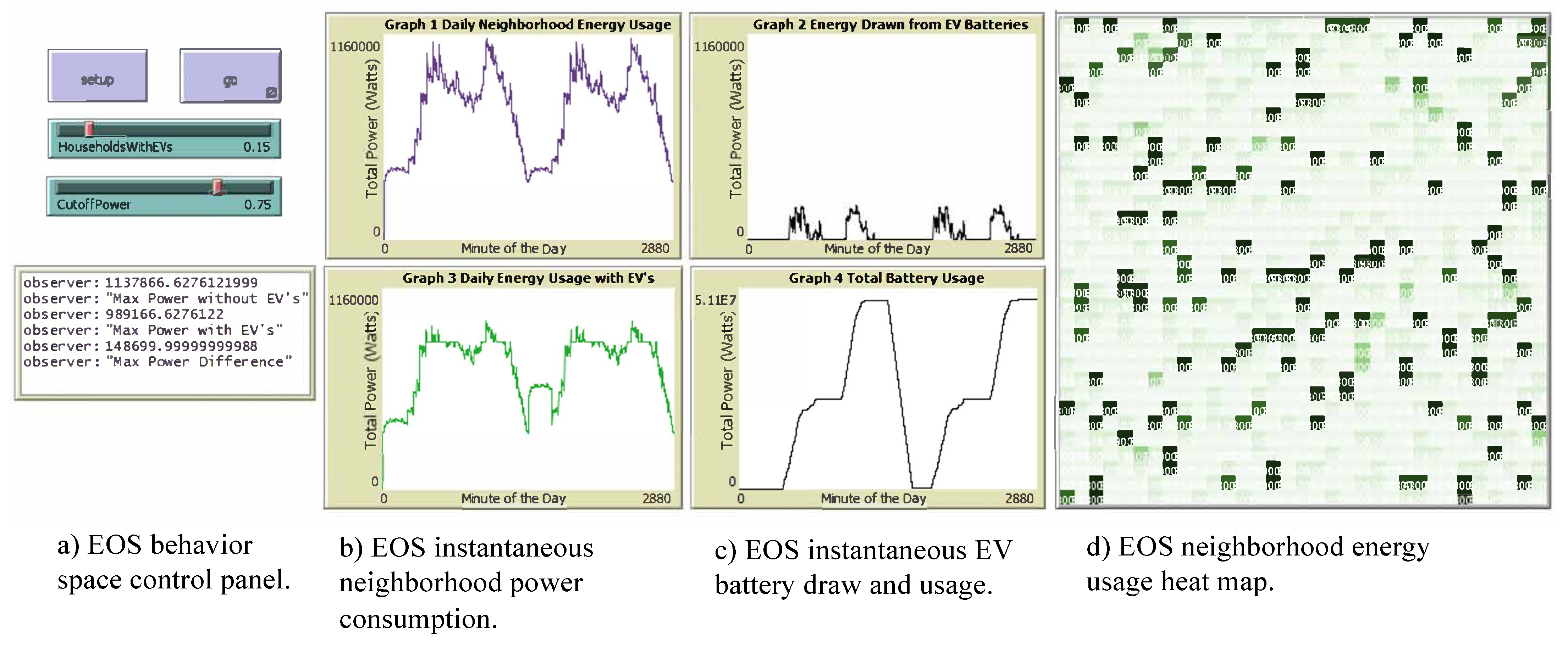
Figure 3 shows the interface of EOS. Here, four graphs are presented to highlight the different features of the simulation. Graph 1 shows the natural two-day neighborhood energy usage profile without the updates to our model, similar to the output graph in Figure 1. Graph 3 shows the impact the updates to our model had on this energy usage profile. Graph 2 shows how much energy was drawn from EV batteries each minute, and Graph 4 shows the cumulative amount of energy drawn from EVs in the neighborhood up until that time. The value was returned to zero overnight during the recharge phase. At the completion of the simulation, the output window displays the maximum amount of power used by the neighborhood without having EVs present, the maximum amount of power with EVs present, our model adjustments in place, and the difference between the two values.
Figure 3. EOS graphical interface.

3.4. Behavior Space Set-Up

To observe how this tool performs under different starting conditions, we utilized NetLogo’s Behavior Space to create experiments that ran the simulation under our desired parameters. Each experiment used a constant cutoff power value Φ , which ranged from 100 to 60% of the maximum neighborhood power usage in 5% decrements. Each experiment with a Ψ ranging from 0 to 50% of households in 5% increments was run 10,000 times.

4. Results and Analysis

In this section, we present the results of the model run under different parameters and provide insight into the implications of these results. The parameters used to test our hypothesis included Ψ , which increased from 0 to 50%, and Φ , which decreased from 95 to 60% of the maximum value of neighborhood power usage in 5% decrements. Within these ranges, the full scope of potential benefits and eventual drawbacks were observed, and values beyond those selected offered no further insight. For each of these 88 unique sets of parameters, each experiment was run 10,000 times and recorded the obtained P m a x . We plotted the means and standard deviations of these values for each set of data.

4.1. Simulation Results

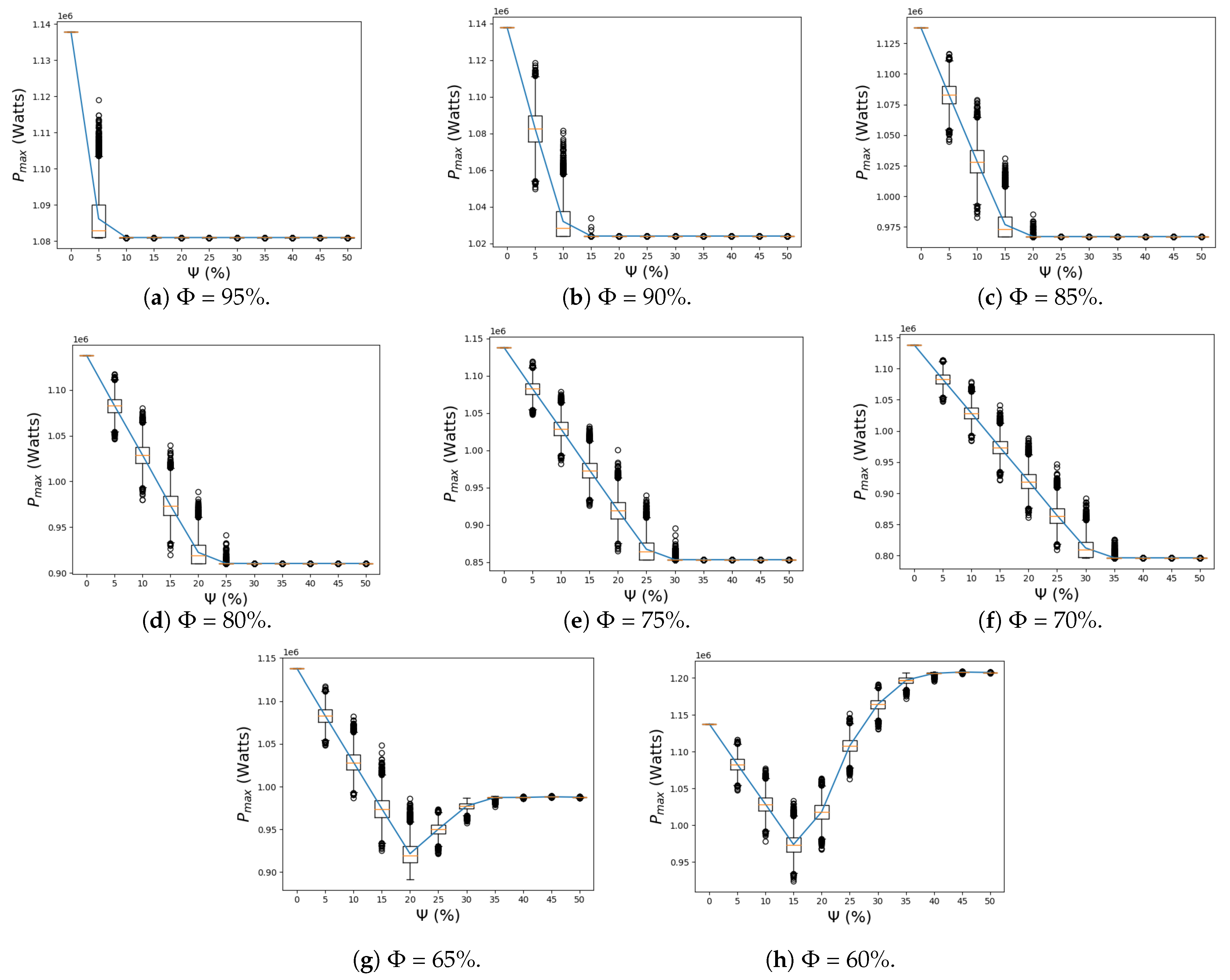
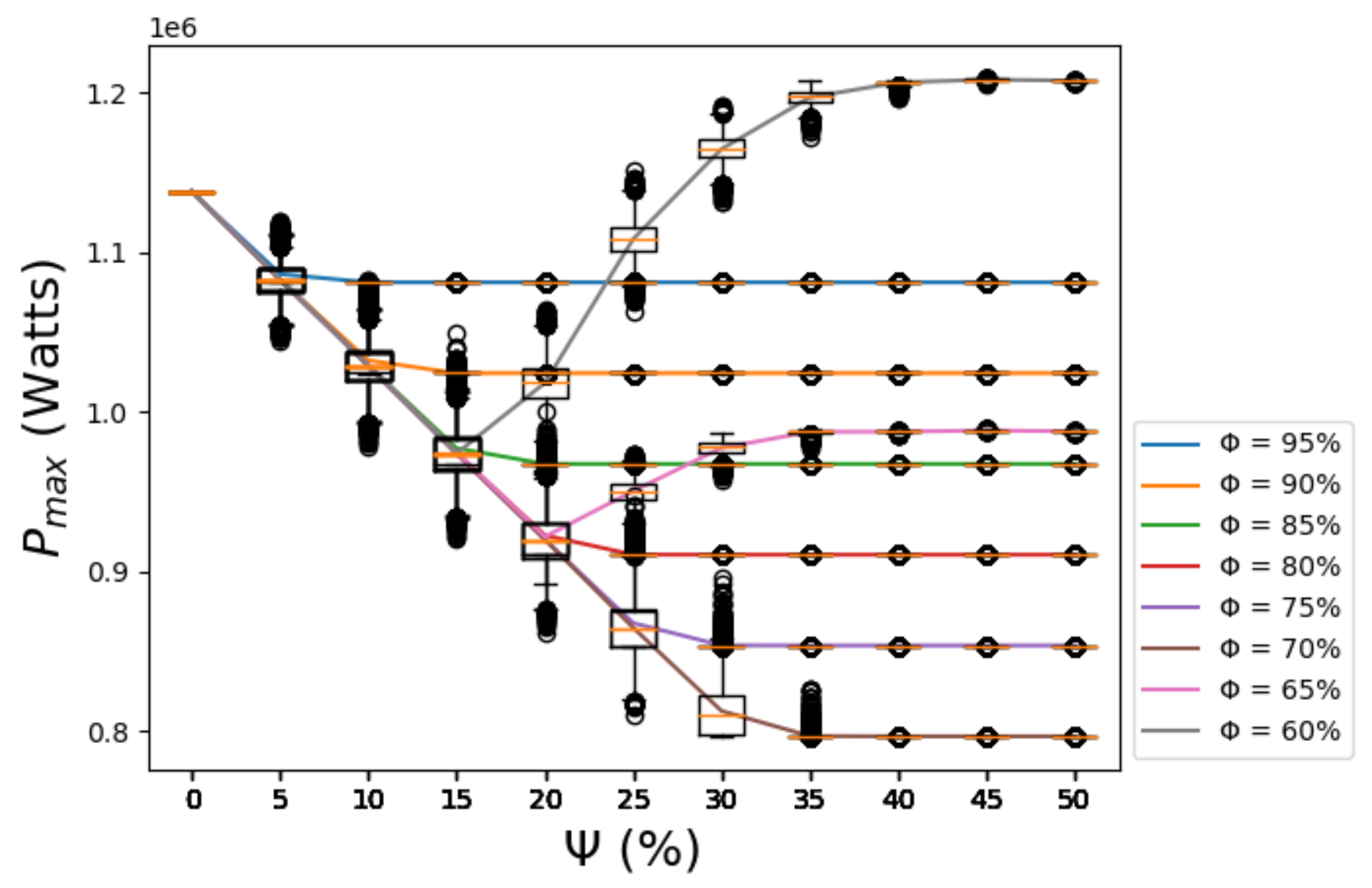
Figure 4 shows the simulation results of the neighborhood power demand under various cutoff power and EV adoption rates. Here, we see a trend manifested throughout the first six of them, with Φ ranging from 95 to 70%. For these cutoff values, the maximum neighborhood power usage decreased linearly as the percentage of households owning EVs increased. This linear regression continued until the maximum power usage equaled Φ , at which point it remained constant. Figure 4a–f show the resultant maximum neighborhood power demand for these first six cutoff values.
Figure 4. Statistical results of neighborhood power demand with increasing EV adoption rate for various peak shaving scenarios.
When the cutoff value became smaller than 70% of the maximum, a different trend emerges. As shown in Figure 4g, with Φ = 65 % , there is a linear regression for percentages of Ψ from 0 to 20%. However, at 25% EV adoption, P m a x began to trend upward, and its value increased for a period before becoming constant at 30% EV adoption. At this cutoff value, the lowest result for the maximum neighborhood energy usage seen is approximately 0.92 megawatts, similar to the results seen for Φ = 70 % and Ψ = 20 % . However, whereas P m a x continues to decrease as Ψ rises beyond 20% for Φ = 70 % , this is not exhibited for Φ = 65 % . Instead, the amount of energy required to recharge the batteries of the EVs here become so great that it creates a new maximum peak between 12:00 a.m. and 4:00 a.m.
For Φ = 60 % , the regression stops at 15% of EV adoption and then sharply increases, as shown in Figure 4h. For Ψ > 25 % , the new peak maximum values seen overnight during the EV recharge cycle become greater than P m a x seen under normal conditions. Figure 5 compares the performance of the neighborhood energy demand under different EV adoption rates and cutoff powers. It shows the optimal peak-shaving strategy a neighborhood can implement at a certain EV adoption rate.
Figure 5. Neighborhood power demand with varying EV adoption rate and peak shaving scenarios.
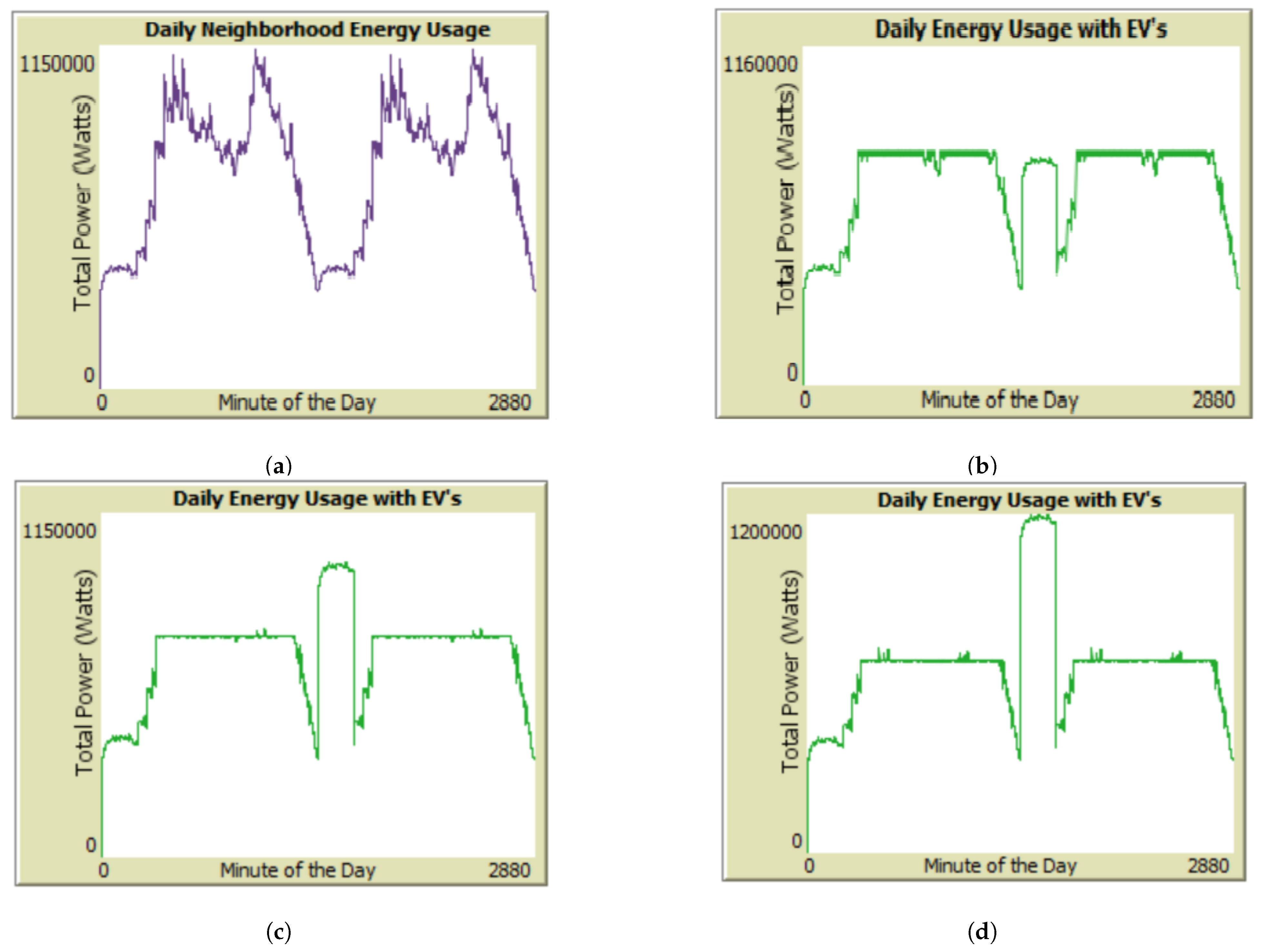
Figure 6 shows the effect that different cutoff powers of maximum neighborhood power demand have on the neighborhood energy demand for a constant EV adoption rate. Figure 6a shows the normal two-day demand based on ATUS respondents without any usage of EV batteries. Figure 6b shows the results for a neighborhood with Φ = 70 % and Ψ = 35 % . Here, load peak shaving helps lower peak-hour spikes and stabilize the overall demand.
Figure 6. Impact of EV adoption rate on peak demand shaving: (a) no EVs in the neighborhood, (b) Φ = 70% and Ψ = 35%, (c) Φ = 65% and Ψ = 35% and (d) Φ = 60% and Ψ = 35%.
Figure 6c shows the effect that lowering Φ to 65% and leaving Ψ at 35% have on the neighborhood demand. While the demand during the day is lower than that in Figure 6b, a new peak appears during the recharge cycle overnight. Although greater than the desired cutoff value, this peak is still smaller than the maximum power usage seen under normal conditions.
Figure 6d shows the resultant neighborhood energy demand for Φ = 60 % and Ψ = 35 % . In this case, the amount of energy needed to recharge the EVs overnight creates a peak greater than the one we are trying to mitigate. This result indicates that with this EV adoption rate, shaving the peak energy by 40% is no longer a viable option for this neighborhood.

4.2. Results Analysis

The results show that utilizing the batteries of EVs to supplement household energy demands can have a significant impact on the reduction in energy demand during peak hours. For a 1089 household neighborhood, we successfully reduced the maximum energy usage value by 30% when 35% of the neighborhood adopted EVs. This was the largest achieved reduction in our sample neighborhood, as adding more EVs or attempting to shift demand further would result in new spikes being created.
For this size neighborhood, when attempting to achieve a cutoff of more than 30% of the maximum usage value, the new energy usage peak was created overnight, when the EV battery recharge began to overtake the reduction seen during normal peak hours. Figure 6c, as a case of Figure 4g, shows a case of mild EV saturation, where the reduction stopped at 20% EV adoption and the maximum values seen from there increased rather than decreased. As a result, when attempting to cut the maximum power usage by 35%, it is advisable to keep the EV adoption rate at 20% for this neighborhood. As the EV adoption rate increased, the energy demand increased during off-peak hours to charge the EVs.
Figure 6d, as a case of Figure 4h, shows a case of extreme EV saturation. Here, the maximum values of power usage obtained eventually overtook the original maximum value of 1.13 megawatts. In this scenario, as the level of EV adoption rose, the amount of energy needed to recharge the EVs overnight became so large that the amount of drawn power became greater than the original peak we were aiming to reduce. At this point, EVs were no longer helping to reduce the maximum values of power usage seen and were rather creating peaks which were greater than what the supplier previously needed to provide, thus further straining the utility. Figure 6 shows this effect, depicting the normal neighborhood energy demand, the demand when operating under the optimal parameters, demand with a case of mild EV saturation, and finally demand with a case of EV oversaturation.

5. Conclusions

In this paper, we analyzed the impact of the ratio of EV adoption versus their use in a smart city for peak power shaving during surging demand and the cost of the energy demand for recharging EVs from the same grid. The contributions of this paper are twofold: (a) the proposal of EOS, an agent-based model simulator, to test the effect of using EV batteries to supplement a neighborhood peak hour energy demand and (b) the modeling of peak shaving as a function of the EV adoption rate in a neighborhood grid. EOS permits the testing of power usage strategies based on the agent’s behavior with synthesized public survey data for modeling a realistic household energy usage profile. EOS accurately represented the cumulative power consumption profile of our sample neighborhood and visually displayed how each household’s energy usage changed over time and how the neighborhood’s total energy usage evolved. With EOS, we showed how the batteries of EVs supplement household energy demands, alleviating the grid supply during peak usage hours without overloading the grid at the time of EV recharge. With the integration of 2009 ATUS and RECS data into EOS, we observed a 30% reduction in the peak neighborhood energy usage reached during such surges. This reduction was obtained under the optimal 35% of the neighborhood owning EVs and the desired cutoff level for neighborhood energy usage at 70% of its peak (i.e., shaving of 30% of the power peak). EOS can be adapted to test peak shaving strategies of different sizes of neighborhoods and EV adoption rates. It can be used by energy suppliers, municipalities, policymakers, as well as communities to visualize and analyze their strategies for renewable energy adoption and their impacts on the current grid systems. For future work, more extensive data on neighborhood energy expenditure, social behavior, and tests with larger regions or grids remain of interest to demonstrate the scalability and robustness of EOS.

Author Contributions

Conceptualization, Z.D.; methodology, Z.D. and W.J.H.; investigation, W.J.H., Z.D. and R.R.-C.; original draft preparation, W.J.H., Z.D. and R.R.-C.; editing, Z.D. and R.R.-C.; supervision, Z.D. and R.R.-C. All authors have read and agreed to the published version of the manuscript.

Funding

This material was based upon work partially supported by the National Science Foundation under Grant No. 1856032 and a NJIT 2023 Seed Grant.

Data Availability Statement

Data available in a publicly accessible repository. The data are available at https://github.com/ceciliadongnyit/EOS, accessed on 30 September 2024.

Conflicts of Interest

The authors declare no conflicts of interest. The funders had no role in the design of the study; in the collection, analyses, or interpretation of data; in the writing of the manuscript; or in the decision to publish the results.

References

  1. Torriti, J. Understanding the timing of energy demand through time use data: Time of the day dependence of social practices. Energy Res. Soc. Sci. 2017, 25, 37–47. [Google Scholar] [CrossRef]
  2. Medina, J.; Rojas-Cessa, R. AMI-Chain: A scalable power-metering blockchain with IPFS storage for smart cities. Internet Things 2024, 25, 101097. [Google Scholar] [CrossRef]
  3. Marris, E. Upgrading the grid: Electricity grids must cope with rising demand and complexity in a changing world. Emma Marris explores the intricacies involved in controlling the power supply. Nature 2008, 454, 570–574. [Google Scholar] [CrossRef] [PubMed]
  4. Zhu, Y.; Xu, Q.; Liu, Y. Peak Shaving Strategy of Electric Vehicle in Industrial Park Considering Differentiated Subjective Willingness. In Proceedings of the 2024 IEEE 7th International Electrical and Energy Conference (CIEEC), Harbin, China, 10–12 May 2024; pp. 4004–4009. [Google Scholar]
  5. Kahrobaee, S.; Rajabzadeh, R.A.; Soh, L.K.; Asgarpoor, S. A multiagent modeling and investigation of smart homes with power generation, storage, and trading features. IEEE Trans. Smart Grid 2012, 4, 659–668. [Google Scholar] [CrossRef]
  6. Kahrobaee, S.; Rajabzadeh, R.A.; Soh, L.K.; Asgarpoor, S. Multiagent study of smart grid customers with neighborhood electricity trading. Electr. Power Syst. Res. 2014, 111, 123–132. [Google Scholar] [CrossRef]
  7. Deng, R.; Yang, Z.; Chow, M.Y.; Chen, J. A survey on demand response in smart grids: Mathematical models and approaches. IEEE Trans. Ind. Inform. 2015, 11, 570–582. [Google Scholar] [CrossRef]
  8. U.S. Bureau of Labor Statistics. Residential Energy Consumption Survey—Overview. 2022. Available online: https://www.eia.gov/consumption/residential (accessed on 30 September 2024).
  9. U.S. Bureau of Labor Statistics. American Time Use Survey—Overview. 2021. Available online: https://www.bls.gov/news.release/pdf/atus.pdf (accessed on 30 September 2024).
  10. Karakaya, E.; Hidalgo, A.; Nuur, C. Motivators for adoption of photovoltaic systems at grid parity: A case study from Southern Germany. Renew. Sustain. Energy Rev. 2015, 43, 1090–1098. [Google Scholar] [CrossRef]
  11. Graber, S.; Narayanan, T.; Alfaro, J.; Palit, D. Solar microgrids in rural India: Consumers’ willingness to pay for attributes of electricity. Energy Sustain. Dev. 2018, 42, 32–43. [Google Scholar] [CrossRef]
  12. Nasir, M.; Iqbal, S.; Khan, H.A.; Vasquez, J.C.; Guerrero, J.M. Sustainable rural electrification through solar PV DC microgrids—An architecture-based assessment. Processes 2020, 8, 1417. [Google Scholar] [CrossRef]
  13. Alyousef, A.; Adepetu, A.; de Meer, H. Analysis and model-based predictions of solar PV and battery adoption in Germany: An agent-based approach. Comput.-Sci.-Res. Dev. 2017, 32, 211–223. [Google Scholar] [CrossRef]
  14. Barbour, E.; Parra, D.; Awwad, Z.; González, M.C. Community energy storage: A smart choice for the smart grid? Appl. Energy 2018, 212, 489–497. [Google Scholar] [CrossRef]
  15. Peters, I.; Breyer, C.; Jaffer, S.; Kurtz, S.; Reindl, T.; Sinton, R.; Vetter, M. The role of batteries in meeting the PV terawatt challenge. Joule 2021, 5, 1353–1370. [Google Scholar] [CrossRef]
  16. Madduri, P.A.; Poon, J.; Rosa, J.; Podolsky, M.; Brewer, E.A.; Sanders, S.R. Scalable DC microgrids for rural electrification in emerging regions. IEEE J. Emerg. Sel. Top. Power Electron. 2016, 4, 1195–1205. [Google Scholar] [CrossRef]
  17. Abu-Sharkh, S.; Arnold, R.; Kohler, J.; Li, R.; Markvart, T.; Ross, J.; Steemers, K.; Wilson, P.; Yao, R. Can microgrids make a major contribution to UK energy supply? Renew. Sustain. Energy Rev. 2006, 10, 78–127. [Google Scholar] [CrossRef]
  18. Pinto, T.; Morais, H.; Oliveira, P.; Vale, Z.; Praça, I.; Ramos, C. A new approach for multi-agent coalition formation and management in the scope of electricity markets. Energy 2011, 36, 5004–5015. [Google Scholar] [CrossRef]
  19. Soltani-Sobh, A.; Heaslip, K.; Stevanovic, A.; Bosworth, R.; Radivojevic, D. Analysis of the electric vehicles adoption over the United States. Transp. Res. Procedia 2017, 22, 203–212. [Google Scholar] [CrossRef]
  20. Srivastava, A.K.; Annabathina, B.; Kamalasadan, S. The challenges and policy options for integrating plug-in hybrid electric vehicle into the electric grid. Electr. J. 2010, 23, 83–91. [Google Scholar] [CrossRef]
  21. Darabi, Z.; Ferdowsi, M. Impact of plug-in hybrid electric vehicles on electricity demand profile. In Smart Power Grids 2011; Springer: Berlin/Heidelberg, Germany, 2012; pp. 319–349. [Google Scholar]
  22. Song, Y.; Li, P.; Zhao, Y.; Lu, S. Design and integration of the bi-directional electric vehicle charger into the microgrid as emergency power supply. In Proceedings of the 2018 International Power Electronics Conference (IPEC-Niigata 2018-ECCE Asia), Niigata, Japan, 20–24 May 2018; pp. 3698–3704. [Google Scholar]
  23. Wang, D.; Coignard, J.; Zeng, T.; Zhang, C.; Saxena, S. Quantifying electric vehicle battery degradation from driving vs. vehicle-to-grid services. J. Power Sources 2016, 332, 193–203. [Google Scholar] [CrossRef]
  24. Mahmood, I.; tul ain, Q.; Nasir, H.A.; Javed, F.; Aguado, J.A. A hierarchical multi-resolution agent-based modeling and simulation framework for household electricity demand profile. Simulation 2020, 96, 655–678. [Google Scholar] [CrossRef]
  25. Tian, S.; Chang, S. An agent-based model of household energy consumption. J. Clean. Prod. 2020, 242, 118378. [Google Scholar] [CrossRef]
  26. Rasoulkhani, K.; Logasa, B.; Reyes, M.P.; Mostafavi, A. Agent-based modeling framework for simulation of complex adaptive mechanisms underlying household water conservation technology adoption. In Proceedings of the 2017 Winter Simulation Conference (WSC), Las Vegas, NV, USA, 3–6 December 2017; pp. 1109–1120. [Google Scholar]
  27. Karfopoulos, E.; Tena, L.; Torres, A.; Salas, P.; Jorda, J.G.; Dimeas, A.; Hatziargyriou, N. A multi-agent system providing demand response services from residential consumers. Electr. Power Syst. Res. 2015, 120, 163–176. [Google Scholar] [CrossRef]
  28. Railsback, S.F.; Lytinen, S.L.; Jackson, S.K. Agent-based simulation platforms: Review and development recommendations. Simulation 2006, 82, 609–623. [Google Scholar] [CrossRef]
  29. Derkenbaeva, E.; Hofstede, G.J.; van Leeuwen, E.; Vega, S.H. Simulating households’ energy transition in Amsterdam: An agent-based modeling approach. Energy Convers. Manag. 2023, 294, 117566. [Google Scholar] [CrossRef]
  30. Du, H.; Han, Q.; Sun, J.; de Vries, B. Analysing interventions for energy-efficient appliances and heating & cooling systems adoption: An agent-based model. Energy Sustain. Dev. 2024, 80, 101449. [Google Scholar]
  31. Bedi, G.; Venayagamoorthy, G.K.; Singh, R.; Brooks, R.R.; Wang, K.C. Review of Internet of Things (IoT) in Electric Power and Energy Systems. IEEE Internet Things J. 2018, 5, 847–870. [Google Scholar] [CrossRef]
  32. Venayagamoorthy, G.K.; Mitra, P.; Corzine, K.; Huston, C. Real-time modeling of distributed plug-in vehicles for V2G transactions. In Proceedings of the 2009 IEEE Energy Conversion Congress and Exposition, San Jose, CA, USA, 20–24 September 2009; pp. 3937–3941. [Google Scholar] [CrossRef]
  33. Kolko, J. Neighborhood Data Show That U.S. Suburbanization Continues (Wonkish). 2023. Available online: https://jedkolko.com/2016/03/25/neighborhood-data-show-that-u-s-suburbanization-continues/ (accessed on 30 September 2024).
  34. Diao, L.; Sun, Y.; Chen, Z.; Chen, J. Modeling energy consumption in residential buildings: A bottom-up analysis based on occupant behavior pattern clustering and stochastic simulation. Energy Build. 2017, 147, 47–66. [Google Scholar] [CrossRef]
Disclaimer/Publisher’s Note: The statements, opinions and data contained in all publications are solely those of the individual author(s) and contributor(s) and not of MDPI and/or the editor(s). MDPI and/or the editor(s) disclaim responsibility for any injury to people or property resulting from any ideas, methods, instructions or products referred to in the content.

Article Metrics

Citations

Article Access Statistics

Multiple requests from the same IP address are counted as one view.