


Abstract
In an era of big data, organizations increasingly aim to adopt data-driven decision-making processes to enhance their performance. This paper investigates the data-driven decision-making process by developing a framework tailored for application in the energy sector. The proposed framework integrates interdisciplinary approaches to comprehensively address the “data, information, knowledge” triad, applying it to both operational and maintenance decision-making. Designed to be managerially focused rather than technically oriented, the framework aims to engage all employees, including those without technical backgrounds, enabling them to effectively contribute to the decision-making process from their respective roles. To demonstrate the practical application of the proposed framework, this paper presents a case study of an energy organization managing a wind farm project, which implemented the framework to improve its decision-making process. The case study examines how the organization identified its objectives and information needs, formulated key performance questions for each stakeholder, explicitly defined and measured the key performance indicators, employed data collection and organization methods, managed the progression from data to information to knowledge, and transformed the acquired knowledge into informed decisions. By adopting this pragmatic framework, energy organizations are anticipated to solve problems, predict trends, and discover new opportunities, thereby enhancing their efficiency and predictability.
1. Introduction
Organizations are called upon to make decisions daily, most of which relate to routine matters. However, some crucial strategic policy decisions require the necessary information and tools to support the relevant decision-making process [1]. At the same time, they strive to effectively utilize a large volume of available data [2]. To respond to these challenges, organizations are trying to transform themselves into data-driven entities and improve the quality of their decisions [3].
Organizations operating in the field of renewable energy sources, as well as those in various other industries, are facing similar challenges. The growth in the renewable energy sector, particularly wind energy, is significant and expected to continue into the future [4]. However, the broader issue of energy efficiency extends beyond the renewable sector. As [5] highlight in their study on energy efficiency advancements in India, the efficiency of electricity generation and distribution, along with the judicious use of electricity, can lead to a decline in the energy intensity of economic output. This is particularly relevant during the Operation and Maintenance (O&M) period of a wind farm, where the ability to effectively control wind energy production and the farm’s components can have far-reaching implications for energy efficiency across various sectors [6]. In the context of large-scale Hybrid Electric Vehicles, [7] introduce the concept of model predictive to mean field game for energy management strategies. The proposed approach shows improved performance in dealing with uncertainty and computational burden, demonstrating the potential of advanced computational strategies in enhancing energy efficiency. Ref. [8] also emphasize the importance of the correct use of scientific and technical solutions for the operation and optimal operating modes of the power supply system to increase the efficiency of enterprises. Furthermore, [9] show how various energy efficiency policies can affect the process of decision-making for and investment in energy efficiency in the industry. This broader focus on efficiency can facilitate more effective decision-making in the electric power industry at various levels, contributing to overall energy sustainability.
In order to realize these efficiency gains and make informed decisions, it is essential to harness the power of data. Large amounts of data are collected from various sources, providing information on more than one hundred parameters over ten-time intervals [10]. The sheer volume and complexity of this data make it difficult to manually analyze and interpret, hence, the need for advanced analytical tools. Data mining has been recognized as a valuable tool to support decision-making [11,12]. It can help predict energy production, optimize maintenance schedules, and identify potential issues or failures, thereby enabling organizations to maximize their energy efficiency and make effective decisions in the electric power industry.
Considering the significance of the aforementioned trends, various approaches have been devised in the energy sector to address data-driven decision-making processes. These approaches typically acknowledge the value of data mining techniques for predicting and identifying areas of concern (e.g., [10]). Moreover, some approaches extend beyond predictive maintenance, encompassing the crucial operational phase of an energy project (e.g., [6]). Furthermore, a majority of the approaches in the energy sector rely on sophisticated computational techniques and algorithms (e.g., [4,13]). However, their predominantly technical nature necessitates the involvement of highly skilled technical personnel in the decision-making process. This requirement poses a challenge, as not all employees within an energy organization possess an extensive technical background.
Pertinent approaches have been proposed in various fields, contributing valuable non-technical aspects to the data-driven decision-making process. For instance, approaches from the business, education, and other domains emphasize the importance of inclusivity, support, and user-friendliness throughout the decision-making process, advocating for straightforward and easily applicable steps (e.g., [1,11,14,15,16]). These approaches also expressly acknowledge and promote the role of human factors in decision-making in conjunction with information technology and processes (e.g., [3,16,17]). Additionally, they underscore the necessity for feedback following the implementation of decisions (e.g., [3,15,18]).
To sum up, various approaches in both the energy sector and other fields address individual aspects of the decision-making process. However, no existing approach comprehensively meets all specifications required for a good fit within an energy organization. Recognizing this gap, the current paper endeavors to develop a pragmatic framework for a data-driven decision-making process, specifically tailored for application in the energy sector. This framework builds upon the strengths of existing energy sector approaches and incorporates additional elements from other fields to address any shortcomings. Subsequently, a case study involving the implementation of the proposed framework in a renewable energy project (i.e., a wind farm) is presented for validation. The project is examined during its O&M period from the owner/investor’s perspective for an entire year (i.e., 2020). The case study explores how the organization determined objectives and information needs, developed key performance questions (KPQs), defined and measured key performance indicators (KPIs), employed data collection and organization methods, progressed from data to knowledge, and converted this knowledge into informed decisions. Consequently, the energy organization under study was able to engage in evidence-based decision-making.
The field of wind energy was chosen as the object of study for several reasons. First, wind energy is one of the fastest-growing renewable energy sources worldwide [19,20], making it a highly relevant and timely area of study. Second, wind energy projects involve complex and dynamic decision-making processes due to factors such as variable wind speeds, the need for regular maintenance, and the integration of power grids [21,22]. These complexities make wind energy a suitable context for testing a comprehensive data-driven decision-making framework. Furthermore, wind energy projects generate a vast amount of data, including wind speed and direction, power output, and operational parameters [10,23]. This abundance of data provides ample opportunities for applying advanced data analysis techniques and deriving actionable insights, which are key components of the proposed framework.
While this study focuses on wind energy, the proposed framework is designed to be adaptable and applicable to other renewable energy sources. The decision-making process in renewable energy projects, regardless of the specific type of energy source, involves similar steps such as defining objectives and information needs, collecting and analyzing data, and making informed decisions. Therefore, the principles and methods outlined in the proposed framework can be applied to other renewable energy contexts, such as solar or hydro energy projects (see [24]). However, it should be noted that while the overall process may be similar, the specific data sources, key performance indicators, and data analysis techniques may vary depending on the type of renewable energy. For instance, a solar energy project may involve different types of data (e.g., solar irradiance, panel temperature) and different operational considerations compared to a wind energy project. Therefore, when applying the proposed framework to other renewable energy sources, it may be necessary to adapt certain elements to fit the specific context and characteristics of the energy source.
The structure of the remainder of this paper is as follows: Section 2 provides a concise review of existing research on decision-making and data mining in wind energy projects. Section 3 delineates the methodology followed in the study for the design and validation of the proposed data-driven decision-making framework. Section 4 offers a critical examination of various data-driven decision-making approaches across multiple sectors, aiming to identify the desired specifications for a pragmatic framework tailored for application in the energy sector. Section 5 presents the proposed framework for the data-driven decision-making process, which is validated through a case study of a wind farm in Section 6. Section 7 delves into a comprehensive discussion on the benefits and wider implications of implementing the proposed data-driven decision-making framework, as evidenced by the experience of the wind farm under study. Finally, Section 8 presents the study’s conclusions and offers directions for future research.
2. Decision-Making and Data Mining in Wind Energy Projects
The significance of effective decision-making in the energy sector, particularly within the realm of wind energy, is evident during both the design and O&M phases of a project. During the design period of a wind farm project, effective decision-making is crucial for determining the installation location. This process typically involves multi-criteria analyses due to the numerous factors influencing power plant site selection [25,26,27]. For example, [28] proposed a framework that quantitatively and qualitatively considers environmental, technological, economic, and social parameters, assigning weights to prioritize potential installation sites in Saudi Arabia and neighboring Gulf countries. A similar case study is documented in the literature for northeastern Poland [29]. The latter approach found the success of the decision-making process to be contingent upon the optimal selection of a multi-criteria analysis method. Some methods rely on utility functions or relationship outranking, while others are based on distances or decision support. Regardless, the careful selection of a wind farm’s location is imperative, as the project’s viability is heavily contingent upon it [30,31].
During the O&M period of a wind farm, the planning and scheduling of maintenance activities are crucial for extending the project’s lifespan [32]. The objective is to enhance maintenance services while simultaneously reducing the associated costs [33,34]. The primary data source for such improvements is the SCADA system of wind turbines, which includes signals and alarms of generators, known as Product Use Information (PUI). In conjunction with appropriate data analysis methods, this information can facilitate better decision-making [35,36,37]. Specifically, for offshore wind farms, the cost of O&M services can be optimized through improved data management and integrated software solutions [38,39,40]. In such cases, weather, journey, and vessel data are integrated to evaluate the cost of each maintenance action, enabling optimized job scheduling [41].
Another area emphasizing the significance of effective decision-making in wind farms pertains to energy markets [42]. Daily forecasting of wind production is required, which is incorporated into the energy planning conducted by the respective energy exchange. Consequently, decisions regarding market bids for next-day delivery, based on forecasted energy production, are characterized by uncertainty [43]. The efficiency (or inefficiency) of these decisions impacts prices and shapes liberalized electricity markets [44].
To facilitate decision-making, data mining techniques have been employed in the wind energy sector within a predictive engineering framework [10]. Modeling wind energy—through wind speed forecasting, wind power production forecasting and optimization, and fault diagnosis of wind turbines—poses significant research challenges [45].
Owing to the stochastic nature of wind and the influence of seasonal and climatic variations, wind speed forecasting is an especially challenging parameter to estimate [46,47,48]. It is crucial to consider the operation of wind energy facilities during different periods of the year and in different climatic conditions to develop a more effective decision-making methodology [49,50]. Data mining techniques, when adapted to account for these variations, have demonstrated promise for short-term wind speed forecasting [51,52]. Consequently, various artificial learning-based algorithms have been developed [53], which can be further refined to incorporate seasonal and climatic factors. Examples include artificial neural networks [54,55], convolutional neural networks [56,57], and long short-term memory networks [58,59], which employ diverse statistical methods and time indicators to assess their accuracy. Hybrid models, combining two or more algorithms, are also frequently utilized [47,60,61,62]. These models could be enhanced by incorporating data related to different periods of the year and various climatic conditions, thereby improving the accuracy and reliability of wind speed forecasting and the overall decision-making process in the wind energy sector.
Furthermore, data mining techniques facilitate wind power production forecasting (both short and long-term) and optimization [63,64]. Statistical, physics-based, and spatial models have been developed for wind power production forecasting [65,66,67], while wind turbine power curve monitoring supports the optimization process [68]. Notably, in daily energy planning by power transmission operators, wind power production forecasting is crucial for the safety of countries’ power grid systems. In this regard, a study by [69] identified adaptive neuro-fuzzy inference systems, neural networks, and multilayer perceptrons as highly accurate solutions. The optimization of wind power production is also a significant research area. Employing data mining algorithms in tandem with evolutionary strategy algorithms can maximize turbine power output by optimizing blade pitch and yaw angle [70].
The O&M cost of a wind turbine, being the predominant expense for wind farm development, has led to modern wind turbines being equipped with Condition Monitoring Systems (CMS) for fault detection [71]. Parameters such as drive train vibration, oil pressure, bearing temperature, and step-up transformer temperature are continuously monitored via SCADA for fault prediction and diagnosis [72,73,74]. Decision tree learning algorithms are often employed to investigate common faults and abnormal events, such as excessive vibrations [75]. Another example includes monitoring a wind turbine’s pitch system using a strategy based on small-world neural networks, as the pitch system is crucial for ensuring both the turbine’s braking and the power grid system’s stability [76]. Data mining methods are also utilized for preprocessing data from wind turbines. The preprocessing of wind data encompasses steps from collecting raw data to obtaining filtered data, which serves as the foundation for effective decision-making [77].
In conclusion, data mining methods are increasingly employed in wind power plants, primarily for forecasting and monitoring generating unit operations. As wind production continues to penetrate the energy mix, these techniques are expected to find a growing number of applications.
3. Materials and Methods
The methodology of this study was structured as a four-step process, with each step building upon the previous one to ensure a comprehensive and robust approach to the design and validation of the proposed framework for data-driven decision-making processes in the energy sector. These steps encompassed: (a) the identification of desired specifications, (b) the identification of suitable approaches, (c) the synthesis of these approaches into a comprehensive framework and the definition of the decision-making process within this framework, and (d) the implementation and validation of the framework through a case study. Each step was crucial in developing a framework that is both theoretically sound and practically applicable in the energy sector. The following paragraphs outline each step in further detail:
Identification of desired specifications: The first step involved systematically identifying the desired specifications for a pragmatic data-driven decision-making framework tailored for the energy sector. This process was achieved through a systematic four-stage procedure that included a comprehensive literature review, qualitative assessment of articles, forward and backward citation tracking, and purposeful selection of publications based on their contribution to our research objectives. The outcome of this step was a set of desired specifications that integrate key elements such as data mining techniques, accessibility, the careful selection and utilization of data sources, feedback mechanisms, and convenient visualization of information. The details of this step are elaborated in Section 4.
Identification of suitable approaches: Building upon the identified desired specifications, we then sought to identify specific approaches that collectively fulfilled all the critical desired specifications. This step involved a critical examination of various data-driven decision-making approaches across multiple sectors. The result was the selection of four approaches that collectively met all the critical desired specifications. These approaches were selected for their unique contributions to the data-driven decision-making process. The details of this step are elaborated at the beginning of Section 5.
Synthesis of approaches and definition of the decision-making process: The third step involved synthesizing the identified approaches to create an efficient framework tailored to the needs of an energy organization. This framework, designed as a continuous loop, consists of six sequential steps: defining project objectives and information needs, collecting and organizing data, transforming data into information, transforming information into knowledge, making and implementing decisions, and obtaining feedback and evaluating decisions. Each step was further delineated into specific elements to ensure a comprehensive understanding of the process. Technological solutions were identified as critical enablers of this process. The synthesis of approaches built upon the strengths of existing energy sector approaches and incorporated additional elements from other fields to address any shortcomings. The details of this step are elaborated in Section 5.
Implementation and validation through a case study: The final step involved the implementation and validation of the proposed methodology through a case study of a wind farm project (as detailed in Section 6). This case study explored the application of the proposed framework during the O&M period from the owner/investor’s perspective over the course of an entire year. The case study provided insights into the practical application of each step of the framework. The data for this case study was primarily sourced from the wind farm’s SCADA system, which provided real-time, continuous monitoring of various technical KPIs. Data was recorded every ten minutes to capture the dynamic nature of the wind farm’s operation. An internal team of specialized engineers was responsible for data collection and immediate evaluation. To validate the structured data, unstructured data such as emails, videos, photos, and oral communication were also utilized. Network operator data served as an additional source for verifying fundamental performance indicators. The data collected from the SCADA system and other sources were subjected to rigorous analysis to transform it into actionable information and knowledge. This process involved the use of various data mining techniques, including decision trees, classification techniques, association analysis, and sequential patterns (further details are provided in Section 6.3).
4. Desired Specifications for a Pragmatic Data-Driven Decision-Making Framework in the Energy Sector
This section provides a critical review of various existing approaches for data-driven decision-making processes in energy and other sectors. To collect the necessary bibliographic information, we applied a four-stage procedure. In the first stage, we identified articles in the Scopus Database containing relevant keywords (e.g., data-driven decision-making process, approach, framework, or model) in their titles or abstracts. In the second stage, we qualitatively assessed these articles, excluding those that did not explicitly present an original approach. In the third stage, we employed forward and backward citation tracking, as recommended by [78], to enhance the quality of the publications analyzed. By doing so, we selectively retrieved additional articles presenting data-driven decision-making approaches of interest. Forward and backward citations were checked using the Google Scholar Database, expanding the number of potential publications and enabling us to include sources not present in the Scopus Database. In the final stage, we purposefully selected a sample of the retrieved publications based on the usefulness of their individual specifications in contributing to our research objectives. Consequently, we retained 6 approaches tailored specifically for the energy sector and 12 approaches proposed in other sectors. The latter were intentionally selected for their managerial focus rather than technical orientation.
Table 1 summarizes the findings from the literature review, emphasizing the primary contributions and limitations of each analyzed approach. The objective of this analysis was to determine the desired specifications for a pragmatic framework for a data-driven decision-making process, tailored for application in the energy sector.

Table 1.
Contributions and limitations of data-driven decision-making approaches.
Given the findings from the literature review, we identify the desired specifications for a pragmatic framework for data-driven decision-making processes, tailored for application in the energy sector, as follows.
The framework should integrate the triptych “data, information, knowledge” and further elaborate on the application of acquired knowledge to actual decision-making [3,15,16]. It should comprehensively utilize data mining techniques to support decision-making, eschewing a focus on only a single or a few specific techniques [13,16]. Additionally, the framework should encompass both the O&M periods of an energy project, as maintenance—whether scheduled, preventive, or corrective—ensures the proper and smooth operation of such projects [6,13].
Accessibility is vital, as the proposed framework should be available to all involved employees, irrespective of their background or hierarchical level [16]. Most existing approaches in the energy sector are technical in nature (e.g., [6,13,32]), primarily catering to technically specialized staff possessing deep knowledge of energy technologies and computational methods. However, energy organizations typically employ individuals with diverse scientific backgrounds, such as engineers, physicists, meteorologists, accountants, environmentalists, energy analysts, and economists. Consequently, the proposed framework should adopt a more “managerial” than “technical” approach [14,15,16], enabling all involved employees to contribute to the decision-making process and incorporate insights from their respective backgrounds.
The careful selection and thorough utilization of data sources that best contribute to achieving organizational objectives for energy projects are essential [16,18,81]. The framework should incorporate a systematic evaluation of decisions made and acknowledge the importance of feedback for optimizing each action [3,15,18]. Furthermore, it should encourage the contribution and collaboration of both human factors and technological tools for effective decision-making [16,17].
Lastly, the framework should prioritize the convenient visualization of information, facilitating sharing with stakeholders of an energy organization, both internally and externally [10,11,79].
5. The Proposed Framework for Data-Driven Decision-Making Process
From the preceding literature review, it becomes apparent that no single existing approach satisfies all the desired specifications for data-driven decision-making processes. However, a synthesis of these approaches could yield an efficient framework tailored to the needs of an energy organization. In this regard, four approaches—namely, [3,13,15,16]—collectively appear to fulfill all the critical desired specifications identified in Section 4.
The approach of [13] enhances the data-driven decision-making process in the energy sector by employing a range of data mining techniques to transform data into valuable information and knowledge. Their approach addresses both O&M periods of energy projects while emphasizing the effective visualization of information for sharing with stakeholders. The approach of [15] further the process by systematically collecting and organizing data, ensuring accessibility for all employees irrespective of their background or hierarchy level, and incorporating systematic evaluation and feedback mechanisms to optimize decision-making outcomes. The approach of [16] advances the data-driven decision-making process by collecting and organizing data systematically, utilizing data mining techniques to generate useful information, and ensuring accessibility for all employees, ultimately contributing to the achievement of predefined organizational objectives for energy projects. Lastly, the approach of [3] enhances the process by focusing on the actual decision-making stage, incorporating systematic evaluation of decisions and feedback mechanisms for optimization, and facilitating collaboration between human factors and technological tools. Table 2 presents the specifications that each approach best fulfills.
Table 2.
Critical specifications in four selected approaches.
Building upon the synthesis of the aforementioned approaches, we present a proposed framework for data-driven decision-making processes tailored for application in the energy sector. This framework, illustrated in Figure 1, is designed as a continuous loop consisting of six sequential steps:
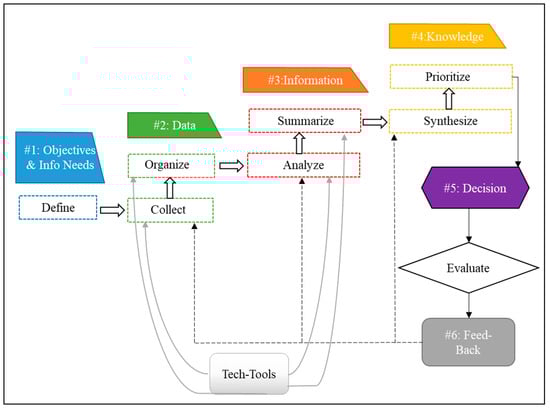
Figure 1.
The proposed framework for data-driven decision-making process.
- Step #1: Define project objectives and information needs [16].
- Step #2: Collect and organize data [15,16].
- Step #3: Transform data into information [13,16].
- Step #4: Transform information into knowledge [13].
- Step #5: Make and implement decisions [3,15].
- Step #6: Obtain feedback and evaluate decisions [3,15].
Technological solutions serve as critical enablers of this process. The most effective tools employed in the energy sector include business analytics, data warehouses, and business intelligence solutions (for further details, see [83,84]).
While the individual components of the framework are well-established methods within the field, the uniqueness of the framework lies in its overall structure and the way it applies these various techniques. The framework’s innovative configuration and application of these components provide a novel approach to data-driven decision-making in the energy sector, distinguishing it from other methodologies in the field. Each step of the framework is briefly described below and is further exemplified through the case study introduced in Section 6.
5.1. Define Project Objectives and Information Needs
The first step of the proposed framework involves defining the objectives of the energy project and the corresponding information required to facilitate informed decisions aimed at achieving these objectives. This step is further divided into five elements:
- i.
- Define the organizational objectives and key performance areas (KPAs) for the energy project.
- ii.
- Link the data with the project objectives to ensure that the organization extracts valuable and sufficient data to meet its information needs; to this end, the required data (usually in the form of specific KPIs per KPA should be identified.
- iii.
- Define the target audience for the information (i.e., interested stakeholders) per KPI.
- iv.
- Formulate KPQs for each interested stakeholder.
- v.
- Understand the overarching goals guiding the decisions to be made.
5.2. Collect and Organize Data
The second step of the proposed framework entails systematically collecting and organizing the required data. This step is further divided into three elements:
- i.
- Define the data sources and data collection methods: In the case of the energy sector, internal data are typically obtained from SCADA systems. External data come from various sources, such as legislation, weather forecasts, network operator data, etc. To account for different periods of the year and climatic conditions, data related to seasonal variations (e.g., wind speed, temperature, precipitation, etc.) should also be collected and considered.
- ii.
- Define the frequency of data collection: This mainly depends on the nature of the energy installation. However, it should also take into account the seasonal and climatic variations. For instance, data collection might be more frequent during periods of high wind activity or extreme weather conditions to capture the impact of these factors on the wind farm’s operation.
- iii.
- Assign responsibilities for data collection. Data collectors can be internal or external service providers. Outsourcing data collection has become increasingly common, with new data collection and field services companies specializing in the energy sector continually emerging.
5.3. Transform Data into Information
The third step of the proposed framework involves analyzing and summarizing data, ultimately transforming it into information. Due to the vast amount of data generated continuously, big data analytics are essential for turning data into insights that enable more efficient decision-making processes. The analytical tools developed for data management are diverse and include data mining techniques (e.g., classification trees to predict power plant operation modes based on physical characteristics), regression analysis (e.g., estimating the relationships between wind velocity and energy production in a wind farm), image analytics (e.g., investigating the cause of a problem, such as detecting wind turbine blade damage), video analytics (e.g., wind farm surveillance), text analytics (e.g., preventive maintenance reports for a wind farm), and artificial intelligence and advanced analytics (e.g., machine learning techniques to effectively forecast weather changes).
5.4. Transform Information into Knowledge
The fourth step of the proposed framework entails synthesizing and prioritizing available information, ultimately transforming it into knowledge. To achieve this, it is vital to synthesize the typically dispersed information to capture the big picture and understand its content to draw meaningful conclusions. Equally important is visualizing the retrieved information and sharing it with interested stakeholders. The methods used to communicate this output are rapidly evolving in the energy field due to the extraordinary advances in recently developed visualization tools.
In the context of wind energy, this step should also involve a detailed analysis of how key performance indicators (KPIs) vary across different seasons and under different climatic conditions. For instance, wind speed and power output may fluctuate significantly between summer and winter months, or under different weather conditions such as calm days versus stormy days. These variations can have significant implications for the operation of the wind farm and the decision-making process. Therefore, the information synthesis process should include a thorough examination of these seasonal and climatic variations, and how they impact the KPIs. Moreover, the visualization of this information should also reflect these variations. For example, the visualization tools could include graphs or charts that show how the KPIs change over different months or under different weather conditions. This would provide a clear and intuitive way for stakeholders to understand how the operation of the wind farm is affected by different periods of the year and climatic conditions.
5.5. Make and Implement Decisions
The fifth step of the proposed framework involves transforming knowledge into smart decisions by integrating human and machine intelligence and subsequently implementing these decisions. Several critical factors contribute to the success of this step, fostering a data-driven decision-making culture within an energy organization. These factors include promoting activities focused on knowledge and continuous learning, staffing the organization with professionals who endorse data-based decision-making, investing in data analytics training across the organization, creating appropriate infrastructure to support IT tools, leveraging the human experience and maturity in managing data, disseminating available information within the organization, and rewarding employees who base their decisions on data.
5.6. Obtain Feedback and Evaluate Decisions
The sixth step of the proposed framework entails obtaining feedback from the implemented decisions and evaluating these decisions. After a decision has been made and a considerable period has elapsed, the organization gathers feedback to assess the decision. Feedback serves as a learning tool in this context. Through feedback, the organization can identify any shortcomings and enhance future initiatives.
6. Implementation of the Proposed Framework: A Study of a Wind Farm
The framework proposed in this study was applied to a renewable energy project involving a wind farm to illustrate the proposed data-driven decision-making process. The examined wind farm is located in the Greek Interconnected Island System and comprises two wind turbines. Each turbine has a power capacity of 900 kW, resulting in a total installed capacity of 1.8 MW for the wind farm. Each wind turbine is connected to the medium voltage network of the wind farm through a 1000 kVA, 0.7/15 kV transformer. The medium voltage electrical network of the wind farm consists of a single radial underground line, terminating in a medium voltage coupling substation situated within the control building installed inside the wind park. The wind park’s power is injected into the local 15 kV distribution network. The interconnection network between the control building and the existing local distribution network spans approximately 30 m. Data transmission, including various wind turbine parameters, such as wind speed and direction, is implemented through the underground communication network (fiber optic cables) connected to the SCADA system (located at the control building).
While the wind farm commenced operations in 2019, this case study examines its asset management and O&M activities for 2020. It should be noted that the investigation of the design period of this project (e.g., decisions on the optimal power plant location) is beyond the scope of this study. Figure 2 summarizes the main entities and services of this wind farm.
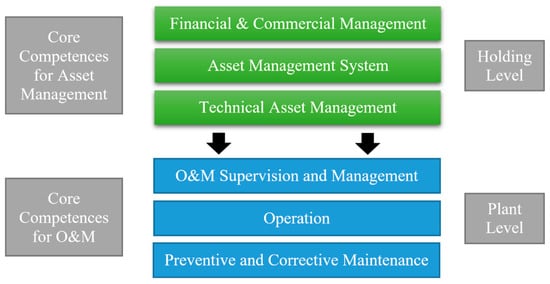
Figure 2.
Asset management and O&M activities.
The following sections present each step of the proposed framework as applied to the wind farm.
6.1. Define Project Objectives and Information Needs
The objectives of the examined renewable energy project, from the perspective of the wind farm owner/investor, are summarized as follows:
- Remote monitoring of the project: error recognition and reporting; remote control (where technically feasible); root cause analysis; continuous communication with all involved parties.
- Technical management of the project: installation supervision; ensuring health and safety for the workforce; addressing environmental concerns; conducting tenders for O&M supplies; communicating with contractors and public authorities.
- Coordination of maintenance and repair actions: planning for regular/preventive maintenance, including generation units, electrical and mechanical installations, and balance of plants; addressing faults and coordinating the repair process; working with vendors and warehousing; supervising and monitoring contractors.
- Performance management of the project: producing technical project reports; analyzing data and processes for performance optimization; implementing corrective actions when performance falls below the accepted (contractual) criteria.
To address the aforementioned objectives, the following KPAs were identified: performance; reliability; maintenance; finance; health, safety, and environmental aspects; and social aspects. The requisite data (in the form of KPIs) for each KPA are presented in Table 3 (all KPIs refer to the year 2020).
Table 3.
Key performance indicators for each key performance area.
During the O&M period of the wind farm, various stakeholders are involved, each with unique informational needs for strategic decision-making. The stakeholders of the wind farm, defined as the target audience of the information, were identified through in-depth interviews with key personnel from the organization managing the wind farm project. These stakeholders include the owner/investor, the O&M Department, the top-level management, the O&M contractor, the insurance provider, the utility and grid operator, the public authorities, and the end users. Table 4, constructed based on these interviews, shows the stakeholders interested in each KPI, excluding the owner/investor and the O&M Department, as they are evidently interested in all KPIs.
Table 4.
Interested stakeholders for each key performance indicator.
Subsequently, the KPQs per interested stakeholder were formulated, as presented in Table 5 (all questions refer to the year 2020).
Table 5.
Key performance questions for each interested stakeholder.
Ultimately, the overarching goals guiding the decisions to be made were identified as follows:
- To improve the maintenance schedule of the wind farm.
- To monitor the O&M contractor more closely in case of faults.
- To evaluate the O&M contractor’s services.
- To hire specialized staff or invest in external consultants to upgrade the quality of the wind farm’s operation.
- To develop training programs for the staff.
- To invest in new equipment that will improve the wind farm’s performance.
- To enhance communication with the local grid operator, always guided by electricity network stability.
- To organize corporate social responsibility actions.
- To implement projects or proceed with sponsorships in the local communities.
6.2. Collect and Organize Data
The primary source of data for the examined project was the wind farm’s SCADA system. This user-friendly application offers the organization the possibility of live monitoring of the wind farm’s operation. It enabled the organization to access data on a 24/7/365 basis in real-time and obtain an overview of the project’s status in terms of several technical KPIs (e.g., wind speed, power produced, grid voltage and current, power factor, wind direction). Importantly, this data collection was conducted throughout different periods of the year, capturing the operation of the wind farm under various seasonal and climatic conditions. This allowed for a more comprehensive understanding of how these factors influence the wind farm’s performance and decision-making processes. By selecting each wind turbine, the organization also gained access to alarms and warnings of the production unit. An additional source was the network operator data, available monthly and used to verify the fundamental performance indicators of the SCADA system. Through the SCADA system, the organization collected structured data in the form of documents, reports, and records. Unstructured data, such as emails, videos, photos, or oral communication, were also employed within the organization to validate the structured data.
Given that the wind farm is a constantly operating entity, its monitoring necessitated a narrow time frame. In this case, the SCADA system recorded data on a ten-minute basis. The team responsible for data collection was internal, consisting of engineers with specialized experience in the field of wind energy who could immediately evaluate the data they received.
6.3. Transform Data into Information
Data originating from the SCADA system are abundant, necessitating the elimination of redundant data (e.g., records obtained during maintenance periods) and the handling of incorrect data (e.g., records that are either missing or reported as zero; or records denoting zero energy production despite the wind speed being above the cut-in limit). This task was the most time-consuming in this step, as human intervention was required. Such interventions were prevalent in several cases, such as when comparing the actual and the rated power curve of a wind turbine. The historical data also needed to be normalized and mapped to a specific range. Typical examples include the calculation of technical availability or energy production on an hourly, monthly, or annual basis.
Up to this point, the organization focused on selecting only the appropriate data required for the KPIs calculation. The next phase involved applying data mining techniques to extract patterns. Decision trees were applied for failure analysis, especially in the case of vibration problems of a wind turbine. Classification techniques were used to estimate reliability factors during the operation period of a wind turbine. These techniques were applied for wind turbine condition monitoring, focusing on the generator, power converter, or blades. Association analysis was used to evaluate the power grid characteristics, such as voltage and frequency, which affect wind farm operation. Sequential patterns were applied to investigate the correspondence of wind direction with the wind turbine’s yaw system. The aforementioned techniques allowed the organization to transform data into information and foster problem-solving by making fact-based, rational decisions.
6.4. Transform Information into Knowledge
In this step, the organization measured and interpreted the KPIs to draw valuable conclusions that would lead to effective decision-making. The interpretation of each KPI took into account the operation of the wind farm in different periods of the year and under different climatic conditions. Table 6 presents the interpretation of each KPI (all KPIs refer to the year 2020).
Table 6.
Measurement and interpretation of key performance indicators.
The retrieved information from the KPIs measurement was also clearly visualized to effectively communicate with the organization’s stakeholders. Some indicative KPIs are schematically depicted in Figure 3 (also considering the operation of the wind farm in different periods of the year and under different climatic conditions).
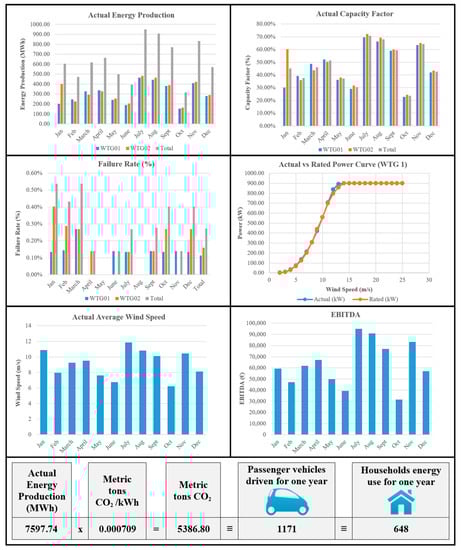
Figure 3.
KPIs visualization examples.
6.5. Make and Implement Decisions
Based on the knowledge gained in the previous step, the organization proceeded with the following decisions:
- Conduct further investigation into the causes of WTG No. 1’s low technical availability and failures that led to reduced reliability in January.
- Continue monitoring the actual power curve of the WTGs to detect deviations from the rated power curve.
- Perform scheduled maintenance in June and October when low energy production is observed.
- Carry out only corrective maintenance works in July and August when the highest energy production is observed.
- Maintain the same O&M contractor for maintenance services.
- Closely monitor the O&M contractor for timely execution of their scheduled works, which may require hiring an engineer.
- Improve supervision of annual expenses to avoid further budget deviations.
- Enhance efforts to ensure compliance with environmental, health, and safety regulations and policies.
- Organize and implement additional corporate social responsibility activities.
6.6. Obtain Feedback and Evaluate Decisions
After implementing the aforementioned decisions, primarily during the year 2021, the energy organization received feedback to enhance future initiatives and behaviors. The evaluation of the decisions was conducted after a reasonable period had elapsed, allowing for the assessment of each decision’s positive or negative consequences. In this particular case, the feedback was consistently positive, indicating that the implementation of the proposed framework contributed positively to effective decision-making.
7. Discussion
This section discusses the various benefits and implications of the proposed data-driven decision-making framework as observed in the energy organization under study.
The energy organization under study reaped several benefits by implementing the proposed framework. Firstly, the organization became more efficient at both operational and strategic levels. By identifying KPQs for each interested stakeholder (primarily at the operational level) and overarching goals (mainly at the strategic level), the organization established a comprehensive roadmap for efficient operation (Step #1; Elements #iv–v). The framework also facilitated systematic measurement and monitoring of the organization’s operational effectiveness by establishing appropriate KPAs and KPIs (Step #1; Elements #i–ii).
Implementing the framework also enhanced the organization’s reliability, transparency, and predictive capabilities. Reliability stems from the impartial nature of the proposed process, which is based on actual data (Step #2), thereby eliminating disputes. Transparency is achieved by visualizing and sharing retrieved information throughout the energy organization’s hierarchy and with external stakeholders (Step #4), inviting responsible feedback from all interested parties. Applying data mining techniques to extract patterns (Step #3) further empowered the organization to forecast future events or trends based on actual data. This predictive capacity encouraged the organization to continuously explore new strategies and opportunities to address adverse events.
The framework also emphasized the human factor, placing it at the center of decision-making, implementation, and evaluation processes (Steps #5–6). It was crucial for the energy organization to employ highly qualified and trained executives and staff. Within this context, the framework promoted distinct roles, active participation, and interdepartmental communication at all organizational levels. This non-technical and user-friendly framework facilitated collaboration among O&M staff, energy analysts, engineers, computer scientists, data analysts, accountants, economists, meteorologists, environmentalists, and physicists, leading to enhanced creativity and idea generation.
Lastly, the framework prompted the organization to pursue continuous improvement by integrating a feedback mechanism (Step #6). Feedback not only ensured a two-way communication process, providing valuable information for all involved parties, but also contributed to refining future decision-making.
All these benefits were achieved without necessitating significant financial resources. A modest investment was required for a specialized data mining tool to synthesize and analyze information, transforming it into knowledge (Steps #3–4). However, the resulting benefits quickly justified and reimbursed the cost of this investment.
In addition to these benefits, the implementation of the proposed framework can potentially yield significant economic effects. For instance, the enhanced efficiency and predictability facilitated by the framework can lead to cost savings in operations and maintenance, as well as improved financial planning. Furthermore, the increased transparency and reliability can foster trust among stakeholders, potentially attracting more investment and fostering sustainable growth. These economic benefits can be particularly significant for industrial facilities where energy costs constitute a substantial portion of operating expenses.
The data-driven decision-making framework presented in this study has several implications for developers of wind farms and other renewable energy projects, as well as for organizations across various industries. By implementing the proposed framework, organizations can enhance their overall performance and achieve their strategic goals more effectively.
Firstly, the proposed framework ensures impartial monitoring, leading to fact-based decision-making. For instance, in a wind farm, crucial performance and reliability KPIs, such as actual energy production and failure rate, can be monitored to make informed decisions on operational efficiency and project trustworthiness. Through the case study, a comprehensive list of KPIs is provided, which has significant implications for effectively monitoring and evaluating various aspects of organizational performance. The framework addresses both operational and strategic issues, such as continuously monitoring the actual power curve of wind turbines and determining the optimal timeframe for scheduled maintenance.
Secondly, enhanced communication and transparency are achieved through the visualization and sharing of information among all levels of an organization’s hierarchy and external stakeholders. This improved communication fosters collaborative decision-making and a shared understanding of goals and objectives.
The framework’s ability to exploit data mining techniques enables organizations to identify patterns and trends, enhancing their predictive capabilities and allowing for proactive decision-making. For instance, prediction analysis and decision trees can be utilized to identify potential wind turbine issues, while sequential patterns can be applied to investigate the correspondence between wind direction and turbine yaw systems.
Furthermore, the framework emphasizes the human factor in decision-making, encouraging active participation, interdepartmental collaboration, and continuous learning. This focus fosters increased creativity, innovation, and overall organizational agility. By integrating a feedback mechanism into the decision-making process, organizations can evaluate the effectiveness of their decisions and foster a culture of continuous improvement. Additionally, the framework’s scalability and adaptability make it a versatile tool for organizations of varying sizes and industries. Lastly, the cost-effectiveness of the framework, as demonstrated in the case study, renders it a practical solution for organizations seeking to improve their decision-making processes with minimal financial resources. By considering these implications, managers and decision-makers can leverage the data-driven decision-making framework to enhance their organization’s performance, efficiency, and adaptability in an increasingly competitive and data-driven business environment.
To provide a comprehensive overview of the pivotal outcomes resulting from the implementation of the proposed framework in the case study, Table 7 has been compiled. This table enumerates the key results of the study and includes, where feasible, their estimated numerical values. Furthermore, it elucidates the methodologies employed in measuring or estimating these values.
Table 7.
Summary of key results and their estimations.
8. Conclusions and Future Work
This paper investigated the data-driven decision-making process, aiming to develop a pragmatic framework tailored for application in the energy sector. The proposed framework, which represents an integrated process combining the fundamental pillars of data, information, and knowledge, exploits data mining techniques for decision-making. While the individual components of the framework—data collection, analysis techniques, and decision-making processes—are well-established methods, the framework’s uniqueness lies in its overall structure and the innovative way it applies these techniques. Applied to a renewable energy project at a wind farm for validation, the framework yielded multiple benefits for the energy organization, including efficiency, transparency, reliability, predictability, and a strong focus on the human factor in decision-making. The framework’s structure and methodology can be adapted to other organizations within the renewable energy sector and even extended to different industries, emphasizing the importance of data-driven decision-making across various contexts. Moreover, the case study demonstrated that the framework could be implemented with minimal financial resources, rendering it accessible and practical for a wide range of organizations.
In acknowledging the inherent limitations of this study, the first point of consideration is that the findings are based on a single case study, which could potentially limit their generalizability. Moreover, the framework, with its emphasis on managerial aspects, may not be fully applicable in scenarios requiring in-depth technical knowledge. Lastly, the study does not extensively consider the potential impact of external factors, such as changes in regulatory policies or market conditions, on the decision-making process.
The development effort towards the proposed framework lays the foundation for future research in several directions. Firstly, it would be valuable to investigate the applicability of the framework in other industries with similar structural features, such as oil and gas, ports and transportation, technology, and telecommunications, thereby broadening its scope and impact. Secondly, examining the long-term effects of implementing the framework could provide insights into the evolution of an organization’s decision-making processes and outcomes over an extended period. Future research could also explore potential refinements or extensions to the framework, incorporating additional elements or techniques that could further enhance decision-making capabilities. In this context, it would be interesting to investigate the framework’s potential critical success factors, including support from advanced data analytic tools, organizations’ fact-based culture, and disciplined cooperation of all involved in the decision-making process. Moreover, the exploration of the role of emerging technologies, such as artificial intelligence and machine learning, in further optimizing the data-driven decision-making process could offer new avenues for improving and expanding the applicability of the proposed framework. Specifically, the utilization of intelligent data processing methods, such as neural networks, warrants further exploration. These advanced computational models, when combined with artificial intelligence and machine learning technologies, could potentially revolutionize the way decisions are made in the energy sector.
Author Contributions
Conceptualization, K.K., P.Τ.C., E.A.D. and D.A.G.; Methodology, K.K., P.Τ.C., E.A.D. and D.A.G.; Validation, K.K., P.Τ.C., E.A.D. and D.A.G.; Investigation, K.K., P.Τ.C., E.A.D. and D.A.G.; Resources, K.K., P.Τ.C., E.A.D. and D.A.G.; Writing—original draft, K.K., P.Τ.C., E.A.D. and D.A.G.; Writing—review & editing, K.K., P.Τ.C., E.A.D. and D.A.G.; Visualization, K.K., P.Τ.C., E.A.D. and D.A.G.; Project administration, P.Τ.C.; Funding acquisition, P.Τ.C. All authors have read and agreed to the published version of the manuscript.
Funding
The publication of this paper has been partly supported by the University of Piraeus Research Center.
Data Availability Statement
The research data, sourced from an energy organization for our case study, are not publicly available due to privacy constraints.
Conflicts of Interest
The authors declare no conflict of interest.
References
- Jagtap, S.B.; Fadewar, H.S.; Shinde, G.N. Knowledge and data mining in decision making process: A business model. Int. J. Parallel Distrib. Syst. 2011, 1, 1–4. [Google Scholar]
- Provost, F.; Fawcett, T. Data science and its relationship to big data and data-driven decision making. Big Data 2013, 1, 51–59. [Google Scholar] [CrossRef] [PubMed]
- Jia, L.; Hall, D.; Song, J. The conceptualization of data-driven decision making capability. In Proceedings of the Twenty-first Americas Conference on Information Systems, Fajardo, Puerto Rico, 13–15 August 2015. [Google Scholar]
- Canizo, M.; Onieva, E.; Conde, A.; Charramendieta, S.; Trujillo, S. Real-time predictive maintenance for wind turbines using big data frameworks. In Proceedings of the IEEE International Conference on Prognostics and Health Management (ICPHM), Dallas, TX, USA, 19–21 June 2017; pp. 70–77. [Google Scholar]
- Jain, M. Estimates of energy savings from energy efficiency improvements in India using Index Decomposition Analysis. Energy Sustain. Dev. 2023, 74, 285–296. [Google Scholar] [CrossRef]
- Castellani, F.; Garinei, A.; Terzi, L.; Astolfi, D.; Moretti, M.; Lombardi, A. A new data mining approach for power performance verification of an on-shore wind farm. Diagnistyka 2013, 14, 35–42. [Google Scholar]
- Xu, F.; Shen, T.; Nonaka, K. Decentralized optimal energy efficiency improvement strategy for large-scale connected HEVs. IFAC-PapersOnLine 2022, 55, 360–365. [Google Scholar] [CrossRef]
- Klyuev, R.V.; Bosikov, I.I.; Gavrina, O.A. Improving the efficiency of relay protection at a mining and processing plant. J. Min. Inst. 2021, 248, 300–311. [Google Scholar] [CrossRef]
- Hasanbeigi, A.; Menke, C.; Du Pont, P. Barriers to energy efficiency improvement and decision-making behavior in Thai industry. Energy Effic. 2010, 3, 33–52. [Google Scholar] [CrossRef]
- Kusiak, A.; Verma, A. Prediction of status patterns of wind turbines: A data-mining approach. J. Sol. Energy Eng. 2011, 133, 011008. [Google Scholar] [CrossRef]
- García, J.C.; Zanfrillo, A.I. Data Mining application to decision-making processes in University Management. INFOCOMP J. Comput. Sci. 2007, 6, 57–65. [Google Scholar]
- Haris, N.A.; Abdullah, M.; Othman, A.T.; Rahman, F.A. Optimization and data mining for decision making. In Proceedings of the IEEE World Congress on Computer Applications and Information Systems (WCCAIS), Hammamet, Tunisia, 17–19 January 2014; pp. 1–4. [Google Scholar]
- Kusiak, A.; Verma, A. A data-mining approach to monitoring wind turbines. IEEE Trans. Sustain. Energy 2012, 3, 150–157. [Google Scholar] [CrossRef]
- Abdel-Fattah, M.A.; Helmy, Y.; Hassan, T.M. A strategic roadmap for maximizing big data return. Int. J. Integr. Eng. 2019, 11, 47–60. [Google Scholar] [CrossRef]
- Mandinach, E.B.; Honey, M.; Light, D. A theoretical framework for data-driven decision making. In Proceedings of the Annual Meeting of the American Educational Research Association, San Francisco, CA, USA, 7–11 April 2006. [Google Scholar]
- Marr, B. From Data to Decisions: A Five Step Approach to Data-Driven Decision Making; Chartered Professional Accountants Canada: Toronto, ON, Canada, 2020. [Google Scholar]
- Agerskans, N. A Framework for Achieving Data-Driven Decision Making in Production Development. Master’s Thesis, School of Innovation, Design and Engineering, Malardalen University, Västerås, Sweden, 2019. [Google Scholar]
- Chui, M.M. The promise of data driven decision making in transforming school management and decision making. Int. J. Sci. Res. Publ. 2016, 6, 158–161. [Google Scholar]
- Guo, Y.; Wang, H.; Lian, J. Review of integrated installation technologies for offshore wind turbines: Current progress and future development trends. Energy Convers. Manag. 2022, 255, 115319. [Google Scholar] [CrossRef]
- Summerfield-Ryan, O.; Park, S. The power of wind: The global wind energy industry’s successes and failures. Ecol. Econ. 2023, 210, 107841. [Google Scholar] [CrossRef]
- Salvador, C.B.; Arzaghi, E.; Yazdi, M.; Jahromi, H.A.; Abbassi, R. A multi-criteria decision-making framework for site selection of offshore wind farms in Australia. Ocean. Coast. Manag. 2022, 224, 106196. [Google Scholar] [CrossRef]
- Uckun, C.; Botterud, A.; Birge, J.R. An improved stochastic unit commitment formulation to accommodate wind uncertainty. IEEE Trans. Power Syst. 2015, 31, 2507–2517. [Google Scholar] [CrossRef]
- Reder, M.D.; Gonzalez, E.; Melero, J.J. Wind turbine failures-tackling current problems in failure data analysis. J. Phys. Conf. Ser. 2016, 753, 072027. [Google Scholar] [CrossRef]
- Liao, S.; Liu, H.; Liu, B.; Zhao, H.; Wang, M. An information gap decision theory-based decision-making model for complementary operation of hydro-wind-solar system considering wind and solar output uncertainties. J. Clean. Prod. 2022, 348, 131382. [Google Scholar] [CrossRef]
- Abdel-Basset, M.; Gamal, A.; Chakrabortty, R.K.; Ryan, M. A new hybrid multi-criteria decision-making approach for location selection of sustainable offshore wind energy stations: A case study. J. Clean. Prod. 2021, 280, 124462. [Google Scholar] [CrossRef]
- Feng, J. Wind farm site selection from the perspective of sustainability: A novel satisfaction degree-based fuzzy axiomatic design approach. Int. J. Energy Res. 2021, 45, 1097–1127. [Google Scholar] [CrossRef]
- Xu, Y.; Li, Y.; Zheng, L.; Cui, L.; Li, S.; Li, W.; Cai, Y. Site selection of wind farms using GIS and multi-criteria decision making method in Wafangdian, China. Energy 2020, 207, 118222. [Google Scholar] [CrossRef]
- Rehman, A.U.; Abidi, M.H.; Umer, U.; Usmani, Y.S. Multi-criteria decision-making approach for selecting wind energy power plant locations. Sustainability 2019, 11, 6112. [Google Scholar] [CrossRef]
- Laska, G. Wind energy and multi-criteria analysis in making decisions on the location of wind farms. Procedia Eng. 2017, 182, 418–424. [Google Scholar] [CrossRef]
- Rediske, G.; Burin, H.P.; Rigo, P.D.; Rosa, C.B.; Michels, L.; Siluk, J.C.M. Wind power plant site selection: A systematic review. Renew. Sustain. Energy Rev. 2021, 148, 111293. [Google Scholar] [CrossRef]
- Spyridonidou, S.; Vagiona, D.G. Systematic review of site-selection processes in onshore and offshore wind energy research. Energies 2020, 13, 5906. [Google Scholar] [CrossRef]
- Nabati, E.G.; Thoben, K.D. Data driven decision making in planning the maintenance activities of offshore wind energy. Procedia CIRP 2017, 59, 160–165. [Google Scholar] [CrossRef]
- Izquierdo, J.; Márquez, A.C.; Uribetxebarria, J.; Erguido, A. On the importance of assessing the operational context impact on maintenance management for life cycle cost of wind energy projects. Renew. Energy 2020, 153, 1100–1110. [Google Scholar] [CrossRef]
- Yu, Q.; Patriksson, M.; Sagitov, S. Optimal scheduling of the next preventive maintenance activity for a wind farm. Wind Energy Sci. 2021, 6, 949–959. [Google Scholar] [CrossRef]
- Delgado, I.; Fahim, M. Wind turbine data analysis and LSTM-based prediction in SCADA system. Energies 2020, 14, 125. [Google Scholar] [CrossRef]
- Jin, X.; Xu, Z.; Qiao, W. Condition monitoring of wind turbine generators using SCADA data analysis. IEEE Trans. Sustain. Energy 2020, 12, 202–210. [Google Scholar] [CrossRef]
- Santolamazza, A.; Dadi, D.; Introna, V. A data-mining approach for wind turbine fault detection based on SCADA data analysis using artificial neural networks. Energies 2021, 14, 1845. [Google Scholar] [CrossRef]
- Ren, Z.; Verma, A.S.; Li, Y.; Teuwen, J.J.; Jiang, Z. Offshore wind turbine operations and maintenance: A state-of-the-art review. Renew. Sustain. Energy Rev. 2021, 144, 110886. [Google Scholar] [CrossRef]
- Taboada, J.V.; Diaz-Casas, V.; Yu, X. Reliability and maintenance management analysis on offshore wind turbines (OWTs). Energies 2021, 14, 7662. [Google Scholar] [CrossRef]
- Zhong, S.; Pantelous, A.A.; Goh, M.; Zhou, J. A reliability-and-cost-based fuzzy approach to optimize preventive maintenance scheduling for offshore wind farms. Mech. Syst. Signal Process. 2019, 124, 643–663. [Google Scholar] [CrossRef]
- Lazakis, I.; Khan, S. An optimization framework for daily route planning and scheduling of maintenance vessel activities in offshore wind farms. Ocean. Eng. 2021, 225, 108752. [Google Scholar] [CrossRef]
- Dehghani, H.; Vahidi, B.; Hosseinian, S.H. Wind farms participation in electricity markets considering uncertainties. Renew. Energy 2017, 101, 907–918. [Google Scholar] [CrossRef]
- Jónsson, T. Forecasting and Decision Making in Electricity Markets with Focus on Wind Energy. Ph.D. Thesis, Technical University of Denmark, Kongens Lyngby, Denmark, 2012. [Google Scholar]
- Olsina, F.; Röscher, M.; Larisson, C.; Garcés, F. Short-term optimal wind power generation capacity in liberalized electricity markets. Energy Policy 2007, 35, 1257–1273. [Google Scholar] [CrossRef]
- Li, W. Predictive Engineering in Wind Energy: A Data-Mining Approach. Master’s Thesis, Graduate College of The University of Iowa, Iowa City, IA, USA, 2010. [Google Scholar]
- Cassola, F.; Burlando, M. Wind speed and wind energy forecast through Kalman filtering of numerical weather prediction model output. Appl. Energy 2012, 99, 154–166. [Google Scholar] [CrossRef]
- Ruiz-Aguilar, J.J.; Turias, I.; González-Enrique, J.; Urda, D.; Elizondo, D. A permutation entropy-based EMD–ANN forecasting ensemble approach for wind speed prediction. Neural Comput. Appl. 2021, 33, 2369–2391. [Google Scholar] [CrossRef]
- Wang, H.Z.; Wang, G.B.; Li, G.Q.; Peng, J.C.; Liu, Y.T. Deep belief network based deterministic and probabilistic wind speed forecasting approach. Appl. Energy 2016, 182, 80–93. [Google Scholar] [CrossRef]
- Tautz-Weinert, J.; Yurusen, N.Y.; Melero, J.J.; Watson, S.J. Sensitivity study of a wind farm maintenance decision: A performance and revenue analysis. Renew. Energy 2019, 132, 93–105. [Google Scholar] [CrossRef]
- Ulazia, A.; Ibarra-Berastegi, G.; Sáenz, J.; Carreno-Madinabeitia, S.; González-Rojí, S.J. Seasonal correction of offshore wind energy potential due to air density: Case of the Iberian Peninsula. Sustainability 2019, 11, 3648. [Google Scholar] [CrossRef]
- Kusiak, A.; Zheng, H.; Song, Z. Short-term prediction of wind farm power: A data mining approach. IEEE Trans. Energy Convers. 2009, 24, 125–136. [Google Scholar] [CrossRef]
- Yu, C.; Li, Y.; Xiang, H.; Zhang, M. Data mining-assisted short-term wind speed forecasting by wavelet packet decomposition and Elman neural network. J. Wind. Eng. Ind. Aerodyn. 2018, 175, 136–143. [Google Scholar] [CrossRef]
- Ibrahim, M.; Alsheikh, A.; Al-Hindawi, Q.; Al-Dahidi, S.; ElMoaqet, H. Short-time wind speed forecast using artificial learning-based algorithms. Comput. Intell. Neurosci. 2020, 2020, 8439719. [Google Scholar] [CrossRef]
- Guo, Z.; Zhao, W.; Lu, H.; Wang, J. Multi-step forecasting for wind speed using a modified EMD-based artificial neural network model. Renew. Energy 2012, 37, 241–249. [Google Scholar] [CrossRef]
- Ramasamy, P.; Chandel, S.S.; Yadav, A.K. Wind speed prediction in the mountainous region of India using an artificial neural network model. Renew. Energy 2015, 80, 338–347. [Google Scholar] [CrossRef]
- Acikgoz, H.; Budak, U.; Korkmaz, D.; Yildiz, C. WSFNet: An efficient wind speed forecasting model using channel attention-based densely connected convolutional neural network. Energy 2021, 233, 121121. [Google Scholar] [CrossRef]
- Harbola, S.; Coors, V. One dimensional convolutional neural network architectures for wind prediction. Energy Convers. Manag. 2019, 195, 70–75. [Google Scholar] [CrossRef]
- Chen, G.; Tang, B.; Zeng, X.; Zhou, P.; Kang, P.; Long, H. Short-term wind speed forecasting based on long short-term memory and improved BP neural network. Int. J. Electr. Power Energy Syst. 2022, 134, 107365. [Google Scholar] [CrossRef]
- Xie, A.; Yang, H.; Chen, J.; Sheng, L.; Zhang, Q. A short-term wind speed forecasting model based on a multi-variable long short-term memory network. Atmosphere 2021, 12, 651. [Google Scholar] [CrossRef]
- Altan, A.; Karasu, S.; Zio, E. A new hybrid model for wind speed forecasting combining long short-term memory neural network, decomposition methods and grey wolf optimizer. Appl. Soft Comput. 2021, 100, 106996. [Google Scholar] [CrossRef]
- Han, Q.; Meng, F.; Hu, T.; Chu, F. Non-parametric hybrid models for wind speed forecasting. Energy Convers. Manag. 2017, 148, 554–568. [Google Scholar] [CrossRef]
- Huang, X.; Wang, J.; Huang, B. Two novel hybrid linear and nonlinear models for wind speed forecasting. Energy Convers. Manag. 2021, 238, 114162. [Google Scholar] [CrossRef]
- Azimi, R.; Ghofrani, M.; Ghayekhloo, M. A hybrid wind power forecasting model based on data mining and wavelets analysis. Energy Convers. Manag. 2016, 127, 208–225. [Google Scholar] [CrossRef]
- Sun, G.; Jiang, C.; Cheng, P.; Liu, Y.; Wang, X.; Fu, Y.; He, Y. Short-term wind power forecasts by a synthetical similar time series data mining method. Renew. Energy 2018, 115, 575–584. [Google Scholar] [CrossRef]
- González-Sopeña, J.M.; Pakrashi, V.; Ghosh, B. An overview of performance evaluation metrics for short-term statistical wind power forecasting. Renew. Sustain. Energy Rev. 2021, 138, 110515. [Google Scholar] [CrossRef]
- Howland, M.F.; Dabiri, J.O. Wind farm modeling with interpretable physics-informed machine learning. Energies 2019, 12, 2716. [Google Scholar] [CrossRef]
- Ye, L.; Zhao, Y.; Zeng, C.; Zhang, C. Short-term wind power prediction based on spatial model. Renew. Energy 2017, 101, 1067–1074. [Google Scholar] [CrossRef]
- Schlechtingen, M.; Santos, I.F.; Achiche, S. Using data-mining approaches for wind turbine power curve monitoring: A comparative study. IEEE Trans. Sustain. Energy 2013, 4, 671–679. [Google Scholar] [CrossRef]
- Colak, I.; Sagiroglu, S.; Yesilbudak, M. Data mining and wind power prediction: A literature review. Renew. Energy 2012, 46, 241–247. [Google Scholar] [CrossRef]
- Kusiak, A.; Zheng, H.; Song, Z. Power optimization of wind turbines with data mining and evolutionary computation. Renew. Energy 2010, 35, 695–702. [Google Scholar] [CrossRef]
- Hameed, Z.; Hong, Y.S.; Cho, Y.M.; Ahn, S.H.; Song, C.K. Condition monitoring and fault detection of wind turbines and related algorithms: A review. Renew. Sustain. Energy Rev. 2009, 13, 1–39. [Google Scholar] [CrossRef]
- Kusiak, A.; Li, W. The prediction and diagnosis of wind turbine faults. Renew. Energy 2011, 36, 16–23. [Google Scholar] [CrossRef]
- Wang, K.S.; Sharma, V.S.; Zhang, Z.Y. SCADA data based condition monitoring of wind turbines. Adv. Manuf. 2014, 2, 61–69. [Google Scholar] [CrossRef]
- Zhao, Y.; Li, D.; Dong, A.; Kang, D.; Lv, Q.; Shang, L. Fault prediction and diagnosis of wind turbine generators using SCADA data. Energies 2017, 10, 1210. [Google Scholar] [CrossRef]
- Abdallah, I.; Dertimanis, V.; Mylonas, H.; Tatsis, K.; Chatzi, E.; Dervili, N.; Worden, K.; Maguire, E. Fault diagnosis of wind turbine structures using decision tree learning algorithms with big data. In Safety and Reliability—Safe Societies in a Changing World; Haugen, S., Barros, A., Gulijk, C., Kongsvik, T., Vinnem, J.E., Eds.; CRC Press: Boca Raton, FL, USA, 2018; pp. 3053–3061. [Google Scholar]
- Li, M.; Wang, S. Dynamic fault monitoring of pitch system in wind turbines using selective ensemble small-world neural networks. Energies 2019, 12, 3256. [Google Scholar] [CrossRef]
- Thomas, O. Data mining approach to wind data preprocessing. Int. J. Adv. Res. Comput. Commun. Eng. 2017, 6, 393–400. [Google Scholar]
- Webster, J.; Watson, R.T. Analyzing the past to prepare for the future: Writing a literature review. MIS Q. 2002, 26, 13–23. [Google Scholar]
- Cay, D.; Karabece, K.; Gürbüz, T. Data supported decision-making for renewable energy solutions. In Proceedings of the World Congress on Engineering and Computer Science, San Francisco, CA, USA, 21–23 October 2015; Volume 1. [Google Scholar]
- Anderson, J.; Kotsiopulos, A. Enhanced decision making using data mining: Applications for retailers. J. Text. Appar. Technol. Manag. 2002, 2, 1–14. [Google Scholar]
- Dogan, O.; Asan, H.; Ayc, E. Use of data mining techniques in advance decision making processes in a local firm. Eur. J. Bus. Econ. 2015, 10, 16–19. [Google Scholar] [CrossRef]
- James Bell Associates. Guide to Data-Driven Decision Making: Using Data to Inform Practice and Policy Decisions in Child Welfare Organizations; James Bell Associates (JBA) on behalf of the Children’s Bureau, Administration for Children and Families (ACF); U.S. Department of Health and Human Services (HHS): Washington, DC, USA, 2018. [Google Scholar]
- Chongwatpol, J. Managing big data in coal-fired power plants: A business intelligence framework. Ind. Manag. Data Syst. 2016, 116, 1779–1799. [Google Scholar] [CrossRef]
- Gokce, H.U.; Gokce, K.U. Multi-dimensional energy monitoring, analysis and optimization system for energy efficient building operations. Sustain. Cities Soc. 2014, 10, 161–173. [Google Scholar] [CrossRef]
- EPA. AVERT, U.S. National Weighted Average CO2 Marginal Emission Rate, Year 2019 Data; U.S. Environmental Protection Agency: Washington, DC, USA, 2020. [Google Scholar]
Disclaimer/Publisher’s Note: The statements, opinions and data contained in all publications are solely those of the individual author(s) and contributor(s) and not of MDPI and/or the editor(s). MDPI and/or the editor(s) disclaim responsibility for any injury to people or property resulting from any ideas, methods, instructions or products referred to in the content. |
© 2023 by the authors. Licensee MDPI, Basel, Switzerland. This article is an open access article distributed under the terms and conditions of the Creative Commons Attribution (CC BY) license (https://creativecommons.org/licenses/by/4.0/).