In some situations, recurrence of hallux abducto valgus after surgery is associated with medial migration of the first metatarsal. Whether this increase in the intermetatarsal angle is a consequence of undercorrection or of other unrecognized factors, the lack of a soft-tissue stabilizer on the lateral aspect of the first metatarsal may enable the postoperative migration of the bony segments.
The first metatarsal does not have a direct ligamentous attachment to the second metatarsal. The deep transverse intermetatarsal ligament is attached to both the first and second metatarsophalangeal joint capsules
via the plantar plate and to the fibular sesamoid [
1,
2]. However, this construct is rather primitive and provides little restraint to the medial migration of the first metatarsal after hallux valgus surgery. Furthermore, this anatomical arrangement may be compromised by the performance of a lateral soft-tissue release, which is usually a component of bunion surgery.
In 1928, McBride [
3] first described a technique for the correction of hallux valgus that included tendon transfer of the adductor hallucis tendon into the dorsum of the first metatarsal head, presumably to decrease the tendency for postoperative deviation and to impart some stability to the lateral aspect of the joint. In 1950, Joplin [
4] described a technique that was primarily used for splayfoot deformity. He used tendon transfer of both the extensor digitorum longus to the fifth toe and the adductor hallucis. Both tendons were transferred into the first metatarsal head. The procedures of McBride [
3] and Joplin [
4,
5] were used to reduce and maintain the first/second intermetatarsal and hallux abductus angles.
In 1971, McGlamry and Feldman [
6] described a technique that was a variation of the adductor hallucis tendon transfer. The transfer was performed by directing the tendon deep to the extensor tendons and into the medial dorsal capsule of the first metatarsophalangeal joint. Their intention was to assist in the derotation of the sesamoid or sesamoids into their respective grooves on the plantar aspect of the first metatarsal.
Although all of these techniques may be vital components of the correction of hallux valgus, none of them provide a direct and mechanically sound attachment to the lateral aspect of the first metatarsal head. The aim of this article is to describe adductor hallucis tendon ligamentation, a technique that produces direct stability between the first and second metatarsals.
Technique
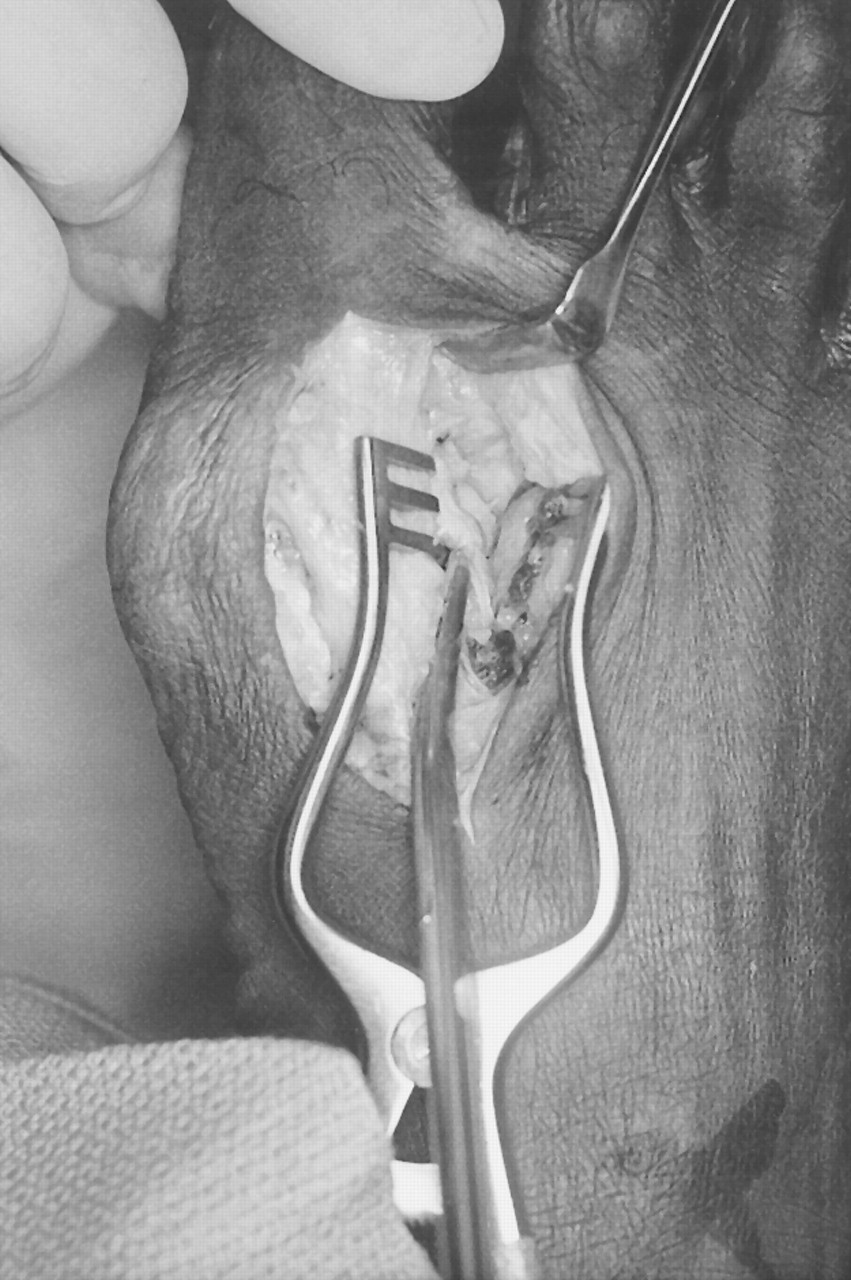
The surgical approach and resection of the medial eminence are performed first according to surgeon preference. Dissection and incision through the first interspace exposes the conjoined tendon of the adductor hallucis (
Fig. 1). The adductor tendon is dissected free from its attachment on the proximal phalanx. It is then dissected in a proximal direction past the fibular sesamoid and is tagged with 2-0 nylon sutures.
Figure 1.
Dissection of the first interspace to the adductor hallucis tendon. Metzembaum scissors are shown retracting the adductor hallucis tendon just proximal to the lateral aspect of the first metatarsophalangeal joint.
Figure 1.
Dissection of the first interspace to the adductor hallucis tendon. Metzembaum scissors are shown retracting the adductor hallucis tendon just proximal to the lateral aspect of the first metatarsophalangeal joint.
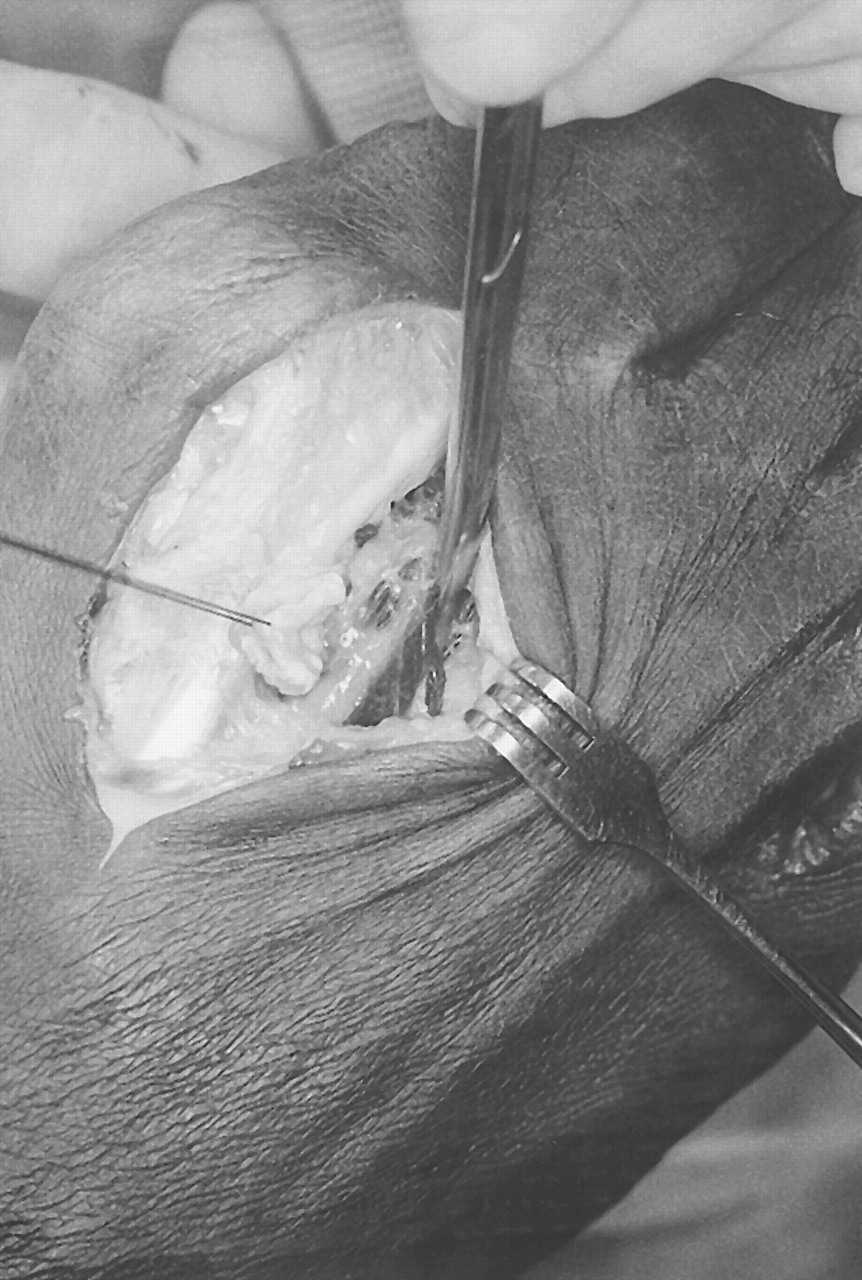
Before performing the appropriate osteotomy (either proximal or distal), the tendon is placed at the desired areas for tenodesis and is marked on the second metatarsal. The first dorsal interosseous muscle is partially dissected from the second metatarsal at this area (
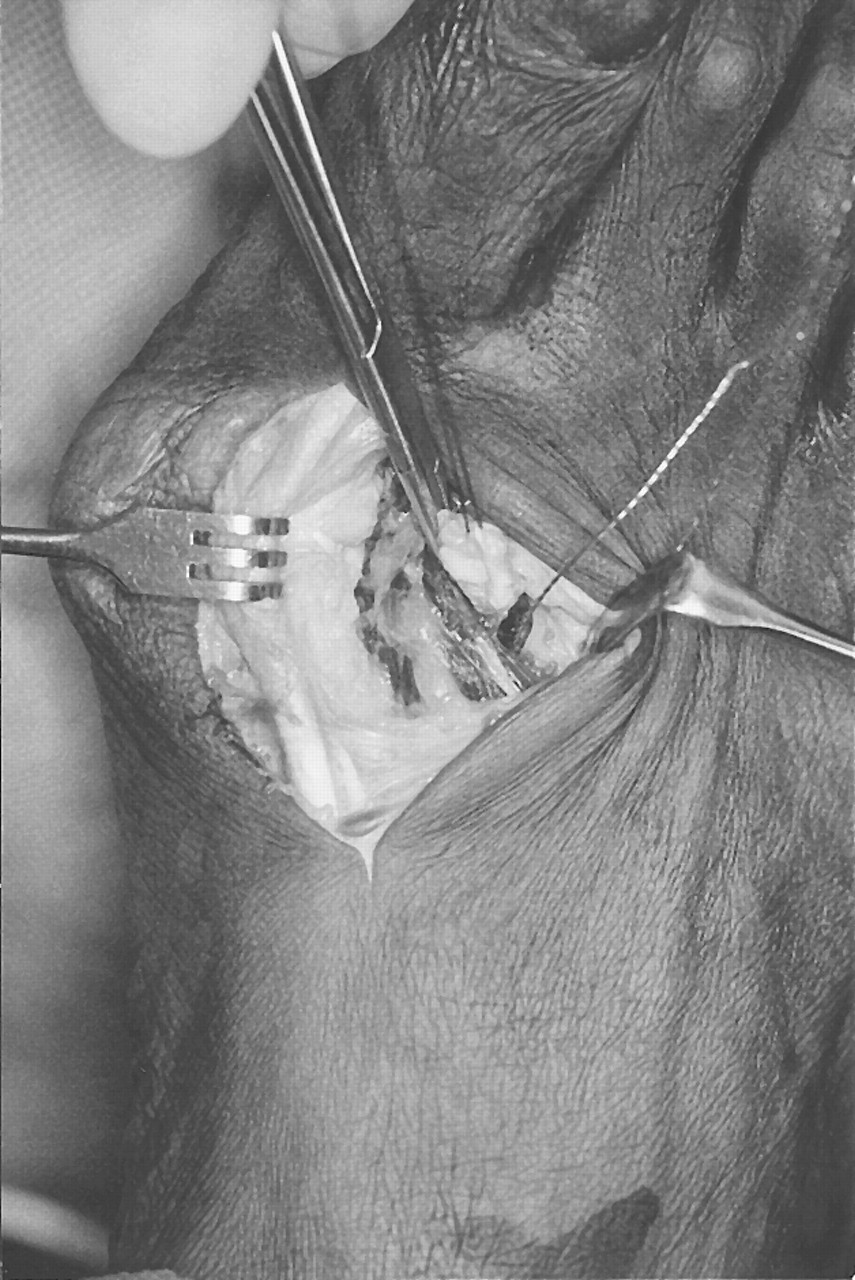
Fig. 2). A Shannon-type bur is used to create a vertically oriented groove from dorsal to plantar on the medial aspect of the second metatarsal shaft. The tendon is now directed plantar and then lateral to the first dorsal interosseous muscle. A braided monofilament wire is placed in a cerclage manner around the second metatarsal (
Fig. 3). The tendon is secured against the second metatarsal, at the previously created vertical groove, by tightening the braided monofilament wire. The end of the wire is buried into the second metatarsal bone
via a small, drilled hole. As much of the dissected distal portion of the adductor hallucis tendon as possible should remain exposed from its site of tenodesis on the second metatarsal for ligamentation into the first metatarsal.
Figure 2.
The adductor hallucis tendon is tagged with 2-0 nylon sutures and reflected. The first dorsal interosseous muscle is retracted from the second metatarsal.
Figure 2.
The adductor hallucis tendon is tagged with 2-0 nylon sutures and reflected. The first dorsal interosseous muscle is retracted from the second metatarsal.
Figure 3.
The adductor hallucis tendon is between the first dorsal interosseous muscle and the second metatarsal. The tendon is tagged with 2-0 nylon sutures. Note the groove in the medial aspect of the second metatarsal. The braided monofilament wire is placed in a cerclage fashion in the groove in the second metatarsal.
Figure 3.
The adductor hallucis tendon is between the first dorsal interosseous muscle and the second metatarsal. The tendon is tagged with 2-0 nylon sutures. Note the groove in the medial aspect of the second metatarsal. The braided monofilament wire is placed in a cerclage fashion in the groove in the second metatarsal.
There are two options available depending on the osteotomy site (proximal or distal). The first option involves a moderate first/second metatarsal angle with proposed distal osteotomy. The second option is used in conjunction with a proximal osteotomy.
The first option incorporates the method of Vega and Jackson-Smith [
7], which uses a groove created within a concurrently performed distal osteotomy. Most commonly, a chevron osteotomy with a long dorsal arm is fashioned, but other configurations may be used [
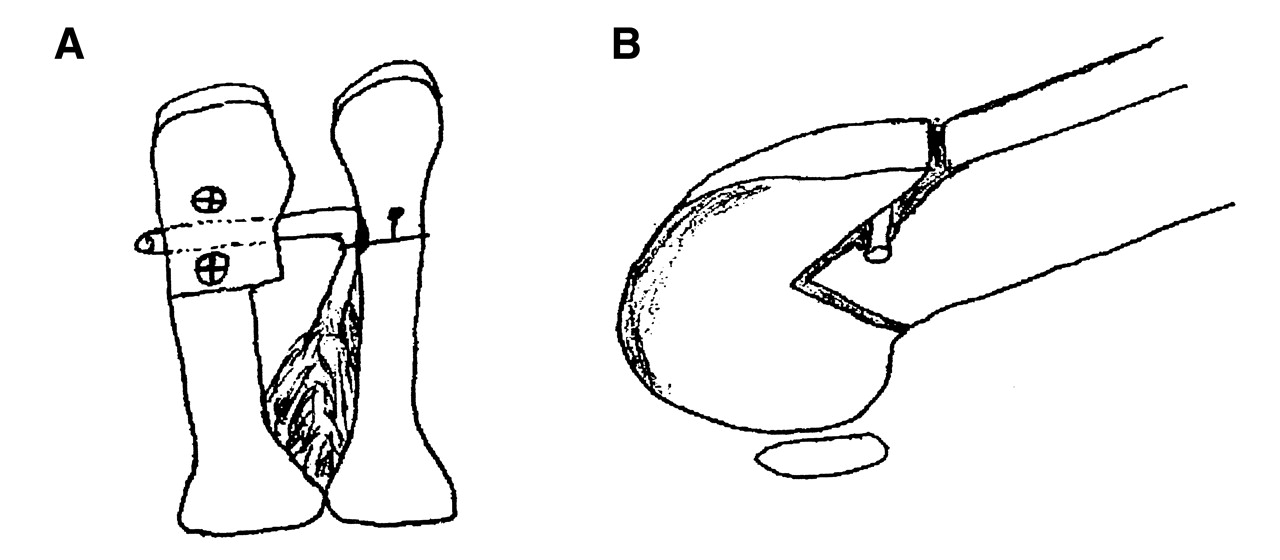
8]. A groove oriented from medial to lateral is created within the dorsal arm of the osteotomy using a Shannon-type bur. The tendon is interposed between the capital fragment and the shaft of the first metatarsal. The tendon must lie within the groove in the osteotomy for good bone-to-bone contact (
Fig. 4). Before internal fixation, the tendon is pulled into a taut position. The capital fragment is now manipulated laterally. The capital fragment is manually impacted carefully into the shaft of the first metatarsal. Internal fixation is then achieved. The author prefers two 2.7-mm screws, running dorsal to plantar, for rigid fixation of the chevron osteotomy with a long dorsal arm. The remaining tendon is sutured into the medial capsule of the first metatarsophalangeal joint using nonabsorbable sutures. The author prefers 2-0 nylon sutures.
Figure 4.
Tendon transfer with a distal osteotomy. A, Dorsal view; B, medial view.
Figure 4.
Tendon transfer with a distal osteotomy. A, Dorsal view; B, medial view.
The second option uses a Mitek GII anchor (Mitek Products, Westwood, Massachusetts) and is preferred when a proximal osteotomy is performed. Most ligamentation is performed before the proximal metatarsal osteotomy. After the adductor hallucis tendon is completely redirected against the medial aspect of the second metatarsal, the lateral aspect of the first metatarsal is prepared for anchor implantation. The anchor hole is drilled, and the bone immediately surrounding the drill hole is prepared for tenodesis by roughening it with a bur. The anchor is inserted. The proximal osteotomy is now performed. The osteotomy is carefully closed, and reduction is assessed. All bone correction, excluding internal fixation, should be performed before suturing the adductor hallucis tendon into the first metatarsal. The adductor hallucis tendon is then sutured while in a taut position against the lateral aspect of the first metatarsal. Care must be taken not to overtighten the adductor hallucis tendon, as this may lead to overcorrection and hallux varus. The correction is assessed by loading the foot in the neutral position after completion of each step. Internal fixation is the final step before closure.
Discussion
Adductor hallucis tendon ligamentation is an alternative procedure to provide additional strength in hallux valgus surgery. The author believes that ligamentation has a distinct advantage over traditional adductor hallucis tendon transfers. These traditional techniques approach the first metatarsal at an oblique angle. This oblique angle reduces the mechanical advantage of the adductor hallucis tendon transfer. Ligamentation of the adductor hallucis tendon provides better stability by means of its perpendicular orientation. Using simple vector analysis, it is easy to discern the mechanical properties of each construct.
Ligamentation of the adductor hallucis tendon is a dependable option in the correction of hallux abducto valgus, providing an excellent outcome with good long-term results.