


Abstract
Background: Childhood is a critical period for neuromotor development, during which footwear may influence the sensory and mechanical context of walking. This study examined whether footwear condition was associated with changes in scalp-level EEG activity during walking in 37 typically developing children aged 6–7 years. Methods: Participants completed repeated 10 m walking trials under three randomized conditions: barefoot, barefoot-style footwear, and conventional structured footwear. EEG was recorded using a mobile 14-channel Emotiv EPOC X system. The primary outcome was the global Theta/Alpha ratio averaged across scalp electrodes. Results: Footwear condition significantly affected the global Theta/Alpha ratio (F (2,72) = 14.57, p < 0.001). Conventional structured footwear produced higher Theta/Alpha values than both barefoot walking and barefoot-style footwear, whereas no significant differences were found between barefoot and barefoot-style conditions. Mean paired differences were 1.08 for conventional versus barefoot and 0.99 for conventional versus barefoot-style footwear. Similar directional effects were observed across electrode groupings. No significant differences were identified in absolute theta, alpha, or beta power, global Beta/Alpha ratio, or Shannon entropy. Conclusions: Conventional structured footwear was associated with increased scalp-level Theta/Alpha activity during walking in children, suggesting possible footwear-related modulation of attentional or motor-control demands.
1. Introduction
Childhood represents a critical period for the development of sensorimotor function, during which locomotor patterns progressively stabilize while neural systems supporting movement remain highly plastic [1,2]. By approximately 7 years of age, gait exhibits increasingly adult-like characteristics, although the cortical and subcortical networks involved in balance regulation, sensory integration, and motor adaptation continue to mature [2,3]. In this developmental context, plantar sensory input plays an important role in the online regulation of posture and locomotion [3].
Footwear represents a relevant environmental factor capable of modifying both the mechanical and sensory context in which gait is performed. As the primary interface between the body and the ground, footwear may alter plantar input, modify foot motion, and influence how sensorimotor information is used during walking [4,5]. Previous work has largely focused on biomechanical outcomes, showing that footwear can influence spatiotemporal gait parameters, plantar pressure distribution, and musculoskeletal development [5,6]. In particular, walking barefoot or in minimalist footwear has been associated with a more natural sensory environment, increased activation of intrinsic foot muscles, enhanced proprioceptive input, and alterations in gait patterns, whereas more conventional footwear may attenuate or filter plantar feedback [5,7]. What remains poorly understood is whether such footwear-related changes in sensory context are accompanied by measurable differences in cortical activity during locomotion [8,9].
Recent advances in mobile electroencephalography (EEG) have enabled the investigation of brain activity during real-world motor tasks, including walking, overcoming the limitations of traditional stationary neuroimaging techniques [9,10]. In gait-related EEG research, oscillatory activity in the theta, alpha, and beta ranges has been linked to attentional demand, sensorimotor integration, balance control, and the degree to which locomotion relies on automatic versus cognitively mediated processes [11]. Specifically, theta activity has been associated with attentional and executive processes during gait, whereas alpha activity is commonly interpreted in relation to task engagement, cortical inhibition, and changes in sensorimotor processing [8].
Despite growing interest in mobile EEG during locomotion, little is known about whether footwear-related changes in the foot–ground interface are associated with measurable differences in gait-related EEG activity in children. This is an important gap because childhood is a developmental period in which locomotor control is still being refined and may remain sensitive to changes in sensory input from the foot. However, mobile EEG during walking is affected by movement-related artifacts and substantial inter-individual variability. Therefore, the present study focused on a restricted primary EEG outcome rather than on an unconstrained search across multiple spectral features.
To address this, we adopted an interdisciplinary approach combining mobile EEG with controlled variations in footwear conditions. The aim of this study was to examine whether different footwear conditions modulate EEG-derived oscillatory activity during walking in children aged 6–7 years, an age at which gait is relatively stable but neural plasticity remains high [4,5]. Specifically, we compared frequency-band activity and their ratios across barefoot, barefoot-style, and conventional footwear conditions, with the aim of identifying patterns consistent with changes in attentional demand and sensorimotor integration.
For readers less familiar with EEG terminology, scalp EEG activity is commonly described according to frequency bands. In simplified terms, theta activity (approximately 4–7 Hz) has been associated with attentional engagement and cognitive or motor-control demands, whereas alpha activity (approximately 8–12 Hz) is commonly related to cortical inhibition and changes in sensory and attentional processing. Beta activity (approximately 13–30 Hz) is generally associated with active sensorimotor processing and motor control. These functional associations are context-dependent, however, and no individual frequency band provides a direct measure of a specific cognitive or motor function.
The Theta/Alpha ratio describes the relative balance between theta- and alpha-band activity; therefore, a higher value indicates relatively greater theta activity in relation to alpha activity rather than necessarily an absolute increase in theta activity. Similarly, the Beta/Alpha ratio represents the relative contribution of beta activity compared with alpha activity. These ratios provide summary measures of the balance between frequency bands but should not be interpreted as direct measures of attention, motor control, or neurological efficiency.
The primary aim was to test whether footwear condition modulates the global scalp-level Theta/Alpha ratio during walking. This ratio was selected as the primary outcome because previous mobile EEG research suggests that the relative balance of theta and alpha activity may vary with attentional and cognitive-motor demands during gait [8,11,12].
We hypothesized that conventional structured footwear would be associated with a higher global Theta/Alpha ratio than barefoot walking and barefoot-style footwear. This pattern would be compatible with greater attentional or supervisory involvement during walking, although such an interpretation requires cautious consideration in the absence of concurrent biomechanical or behavioral measurements. As a secondary hypothesis, we expected barefoot-style footwear to resemble barefoot walking more closely than conventional structured footwear.
Secondary analyses examined whether the primary effect was present across predefined scalp electrode clusters. Other EEG-derived metrics, including absolute spectral power, Beta/Alpha ratio, Shannon entropy, and hemispheric asymmetry, were treated as exploratory and hypothesis-generating.
2. Materials and Methods
2.1. Study Design
This study used a within-subject repeated-measures design to examine whether footwear condition was associated with changes in scalp-level EEG spectral activity during walking in children. Each participant completed walking trials under three experimental conditions: barefoot, barefoot-style footwear, and conventional structured footwear. The order of the three conditions was randomized for each participant to reduce potential order, fatigue, and carryover effects.
The primary outcome was defined a priori as the global Theta/Alpha ratio averaged across all available scalp electrodes. Secondary outcomes included the Theta/Alpha ratio within predefined scalp electrode clusters. Other EEG metrics, including absolute spectral power, Beta/Alpha ratio, Shannon entropy, hemispheric asymmetry indices, and multivariate classification analyses, were considered exploratory.
Each child served as their own control, allowing condition-related differences to be examined while reducing between-subject variability. This design was not a longitudinal intervention and should therefore be interpreted as an acute within-session comparison of footwear conditions rather than a before–after study.
2.2. Participants
Participants were recruited by convenience sampling from a primary school in Granada, Spain. Eligible participants were boys and girls aged 6–7 years. This age range was selected because it represents a relatively homogeneous developmental period in which gait is becoming increasingly stable, while sensorimotor and cortical systems involved in movement control continue to mature.
Because no instrumented biomechanical assessment was included, typical development was determined from parental/school reports and the absence of known neurological, orthopedic, or developmental disorders. Therefore, this study should not be interpreted as formally verifying mature gait patterns in each participant.
Inclusion criteria were: (i) age between 6 and 7 years; (ii) typical motor and neurological development according to parent, school, or medical reports; (iii) ability to understand and follow simple instructions; and (iv) no regular use of barefoot-style footwear during the previous six months.
Exclusion criteria were as follows: previous diagnosis of a neurodevelopmental disorder, such as ADHD, autism spectrum disorder, or motor coordination disorder; orthopedic or neuromuscular conditions affecting gait; recent lower-limb surgery within the previous six months; medication affecting alertness, attention, or muscle tone; intolerance to the EEG headset; or scalp lesions preventing electrode contact.
2.3. Ethical Approval
This study was conducted in accordance with the Declaration of Helsinki and was approved by the Ethics Committee of the University of Malaga (CEUMA 71-2025-H). Written informed consent was obtained from parents or legal guardians, and age-appropriate verbal assent was obtained from each child before participation.
2.4. Sample Size Calculation
The sample size was calculated using G*Power (version 3.1.9.7) for the primary within-subject comparison of the global Theta/Alpha ratio across three footwear conditions. A repeated-measures ANOVA framework was used for planning purposes, assuming a medium effect size (f = 0.25), α = 0.05, and statistical power of 0.80. This yielded a minimum required sample of 28 participants. To account for potential data loss due to movement artifacts, poor EEG contact, or incomplete trials, 37 children were recruited.
This calculation was intended only for the primary analysis of the global Theta/Alpha ratio. It was not designed to provide adequate power for exploratory analyses, including regional scalp-cluster analyses, hemispheric asymmetry indices, multivariate classification, or correlation analyses. These analyses were therefore interpreted as hypothesis-generating.
The number of walking trials was selected to balance the need for repeated walking epochs with feasibility and tolerability in 6–7-year-old children. Each condition included repeated 10 m walking segments, but this study was not powered on the basis of recording duration or the number of artifact-free EEG epochs. Future studies should formally determine the recording duration required for stable spectral estimates in pediatric mobile EEG.
2.5. Footwear Characteristics
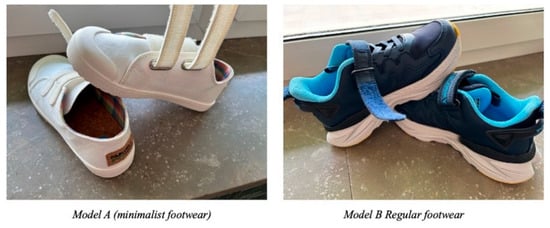
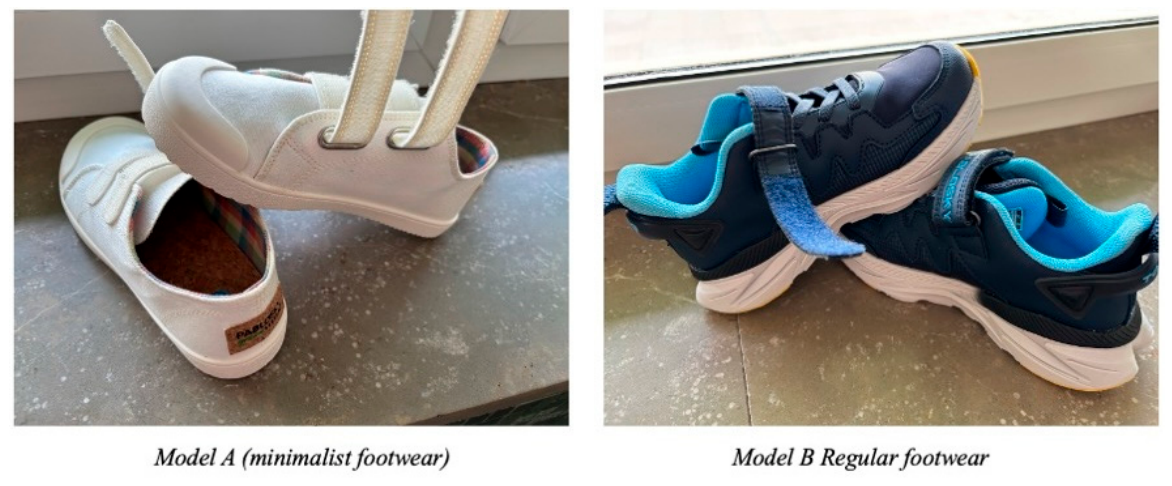
Two children’s shoe models from Pablosky were selected to represent two distinct footwear conditions: barefoot-style footwear and conventional structured footwear (Figure 1). The barefoot condition was also included as a no-shoe reference condition.
Figure 1.
Experimental footwear conditions.
The barefoot-style model was selected to represent minimally structured footwear. It had an ultra-thin sole of approximately 3 mm, high longitudinal and transverse flexibility, no internal motion-control reinforcements, zero drop, no rigid heel counter, no arch elevation, and a wide toe box. These characteristics are consistent with commonly described minimalist or barefoot-style footwear features in children.
The conventional structured model was selected to represent standard school/casual footwear. It had a thicker and more rigid sole, approximately 12 mm at the heel and 7 mm at the forefoot, a 5 mm heel-to-toe drop, reduced forefoot flexibility, greater torsional resistance, a reinforced heel counter, lateral support, and a narrower toe box.
Because the footwear models differed across several design features, including sole thickness, flexibility, heel counter structure, toe-box width, and drop, the present study cannot isolate the independent effect of heel-to-toe drop alone. The conventional condition should therefore be interpreted as a structured-footwear condition rather than as a pure drop manipulation.
2.6. Procedure
The task was explained to each child using age-appropriate instructions. After fitting the EEG headset, participants completed a short familiarization period with the walking corridor and, where applicable, the footwear condition before data collection began. Footwear size and fit were individually checked for each participant before testing. The ap-propriate shoe size was initially selected according to the child’s usual footwear size. Fit was then verified using the removable insole, ensuring approximately 10 mm of additional space beyond the longest toe to avoid compression and allow adequate toe clearance. All required shoe sizes were available to ensure an appropriate individual fit. Before EEG data collection, each child completed a standardized 5 min familiarization period walking freely in the school playground under each footwear condition. Participants were not habitual users of barefoot-style footwear, as regular use of this type of footwear during the previous six months was an exclusion criterion. Therefore, the familiarization period was intended to reduce the immediate novelty of the experimental footwear but should not be considered equivalent to habitual or long-term adaptation.
For each condition, participants completed five 10 m walking trials along a straight corridor while EEG was recorded continuously. Only straight-line walking periods were retained for analysis. Turns, pauses, and periods immediately before gait initiation or after gait termination were excluded.
A rest period was provided between conditions to reduce fatigue and distraction. The same experimental environment and instructions were used across conditions. Walking speed was not externally paced, and participants were instructed to walk at their usual comfortable speed.
No instrumented gait, plantar-pressure, or electromyographic data were collected. Therefore, neurophysiological interpretations were not directly linked to concurrent biomechanical measurements.
2.7. EEG Recording
Scalp EEG was recorded using the Emotiv EPOC X, a wireless 14-channel EEG system with two reference electrodes, CMS and DRL. Felt sensors soaked in saline solution were used according to the manufacturer’s instructions.
EEG signals were acquired using EmotivPRO (version 4.12.6) software. Signals were transmitted wirelessly to a computer and recorded at an internal sampling rate of 2048 Hz, then downsampled to 128 Hz after application of the device’s internal anti-aliasing and notch-filtering procedures.
The 14 active electrodes were positioned according to the international 10–20 system at AF3, F7, F3, FC5, T7, P7, O1, O2, P8, T8, FC6, F4, F8, and AF4. The CMS and DRL reference electrodes were positioned according to the manufacturer’s montage.
Before each recording, electrode contact and signal quality were checked using the EmotivPRO signal-quality interface. Recordings were started only after acceptable global and channel-level signal quality had been achieved.
EEG signals were recorded continuously during walking. Because mobile EEG during gait is susceptible to movement-related artifacts, the analyses focused on artifact-cleaned spectral estimates derived from stable straight-line walking epochs.
2.8. EEG Preprocessing and Spectral Analysis
EEG preprocessing was performed in EEGLAB v2024.0 within MATLAB (R2026b (26.2)). Data were band-pass filtered between 1 and 45 Hz and re-referenced using an average or robust average reference approach. Channels with prolonged flat signals or excessive high-frequency noise were identified using EEGLAB’s clean_rawdata plugin and removed before interpolation/re-referencing when appropriate. Severe transient artifacts were attenuated using Artifact Subspace Reconstruction. Independent Component Analysis was then applied to identify non-neural components. Components classified as ocular, muscular, cardiac, line noise, or channel noise using ICLabel were reviewed and removed.
Spectral power was estimated from artifact-cleaned straight-line walking epochs using 4 s windows. Relative power was calculated for theta (4–7 Hz), alpha (8–12 Hz), beta (13–30 Hz), and gamma (30–45 Hz). Delta activity was not included in the primary analyses because low-frequency EEG during active locomotion is particularly vulnerable to movement-related artifacts.
Following preprocessing, approximately 85% of the recorded straight-line walking EEG data were retained for analysis (barefoot: 86%; barefoot-style: 85%; conventional: 84%). Participants contributed a median of 18 [IQR 16–20] artifact-clean 4 s windows per condition. The median number of rejected/interpolated channels was 1 [IQR 0–2], and 3 [IQR 2–4] independent components per participant were removed as non-neural components. No participant was excluded from the primary analysis because of insufficient EEG data.
The primary spectral ratio was the Theta/Alpha ratio. The Beta/Alpha ratio and Shannon entropy were treated as exploratory metrics. Shannon entropy was computed from the normalized spectral power distribution as an index of spectral dispersion.
2.9. Scalp Electrode Clusters
For secondary scalp-level analyses, electrodes were grouped into predefined scalp electrode clusters rather than interpreted as source-localized brain regions. The clusters were defined as follows: frontal, temporal, and parieto-occipital.
These clusters were used only to describe scalp-level topographical patterns. Because of the low-density 14-channel montage, no source localization or current source density analysis was performed, and the results should not be interpreted as activity arising from specific cortical regions.
2.10. Statistical Analysis
Statistical analyses were conducted using a hierarchical analysis plan to reduce the risk of inflated type I error due to multiple testing.
The primary analysis tested the effect of footwear condition on the global Theta/Alpha ratio, averaged across all available scalp electrodes. A repeated-measures linear model was used with footwear condition as the within-subject factor. When the omnibus condition effect was statistically significant, planned pairwise comparisons were performed for barefoot versus barefoot-style, barefoot versus conventional, and barefoot-style versus conventional footwear.
Secondary analyses examined whether the Theta/Alpha effect was present across predefined scalp electrode clusters. These analyses used the same within-subject framework, with p-values adjusted for multiple comparisons across clusters using the Holm–Bonferroni procedure.
Exploratory analyses were performed for absolute theta, alpha, and beta power, the global Beta/Alpha ratio, Shannon entropy, and hemispheric asymmetry indices. Hemispheric asymmetry analyses are reported in the Supplementary Material. All exploratory analyses were considered hypothesis-generating and were not used to support confirmatory conclusions.
Because EEG spectral variables are often skewed and repeated-measures ANOVA does not require raw variables to be normally distributed, model assumptions were evaluated using residual diagnostics and inspection of influential observations. When appropriate, sensitivity analyses using log-transformed ratios or non-parametric paired comparisons were considered.
For the primary and secondary analyses, effect sizes and 95% confidence intervals were reported alongside p-values. For omnibus repeated-measures models, generalized eta-squared or partial eta-squared was reported. For pairwise within-subject contrasts, paired mean differences and standardized within-subject effect sizes were reported.
Non-significant results were not interpreted as evidence of no effect. Where the absence of meaningful differences was relevant, equivalence testing would be required; otherwise, such findings were reported as a lack of statistical evidence for a condition effect.
All statistical tests were two-sided. The nominal alpha level for the primary outcome was 0.05. Adjusted p-values were used for secondary and exploratory families of tests where applicable.
3. Results
3.1. Primary Analysis: Global Theta/Alpha Ratio
The primary analysis examined whether footwear condition affected the global scalp-level Theta/Alpha ratio during walking. A repeated-measures analysis showed a significant main effect of footwear condition on the global Theta/Alpha ratio, F(2,72) = 14.57, p < 0.001.
Descriptive values showed that the mean global Theta/Alpha ratio was 3.64 ± 1.23 in the barefoot condition (A), 3.74 ± 1.09 in the barefoot-style footwear condition (B), and 4.72 ± 1.53 in the conventional structured footwear condition (C) (Table 1).
Table 1.
Descriptive statistics for the global Theta/Alpha ratio by footwear condition.
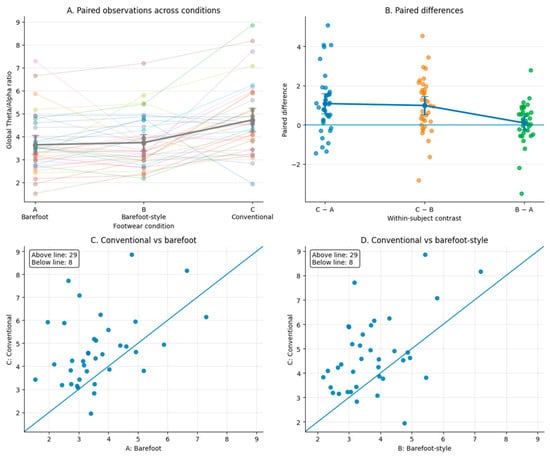
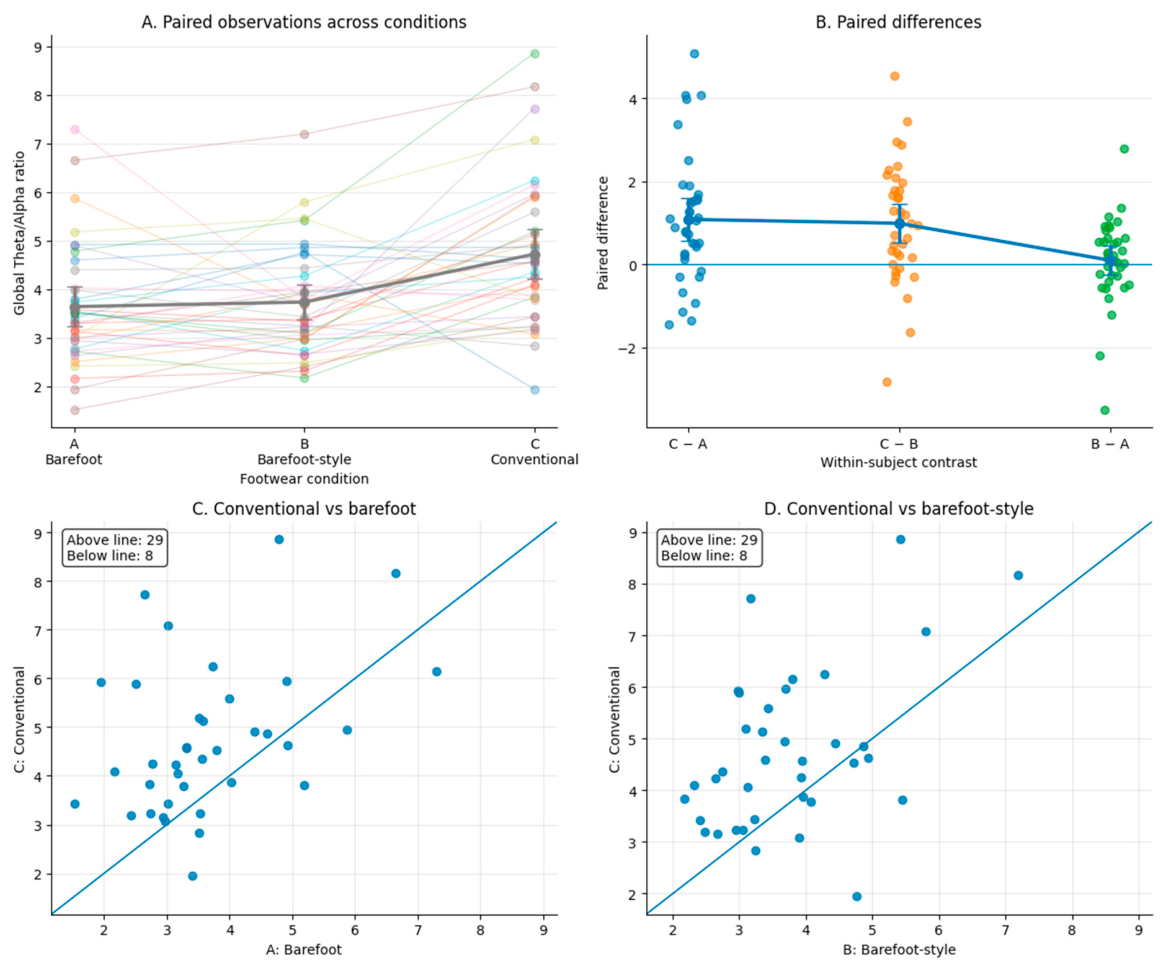
Individual within-subject trajectories are shown in Figure 2A.
Figure 2.
Global Theta/Alpha ratio across footwear conditions. (A) Within-subject paired observations for the global Theta/Alpha ratio across the three footwear conditions: barefoot (A), barefoot-style footwear (B), and conventional structured footwear (C). Thin lines represent individual children, and thick symbols indicate the mean with 95% confidence intervals. (B) Distribution of within-subject paired differences for the global Theta/Alpha ratio (C − A, C − B, and B − A). Each point represents one participant; larger symbols indicate the mean difference with 95% confidence intervals. (C) Paired observation plot comparing conventional structured footwear (C) and barefoot (A), with the identity line shown. Points above the line indicate higher Theta/Alpha values in C than in A. (D) Paired observation plot comparing conventional structured footwear (C) and barefoot-style footwear (B), with the identity line shown. Points above the line indicate higher Theta/Alpha values in C than in B.
Planned pairwise comparisons indicated that conventional structured footwear (C) showed significantly higher Theta/Alpha values than both barefoot (A) and barefoot-style footwear (B). The mean paired difference for C − A was 1.08 (95% CI: 0.56 to 1.60; Holm-adjusted p = 0.000438; Cohen’s dz = 0.70), and the mean paired difference for C − B was 0.99 (95% CI: 0.51 to 1.46; Holm-adjusted p = 0.000438; Cohen’s dz = 0.70). In contrast, the comparison between barefoot-style footwear and barefoot (B − A) showed a small mean paired difference of 0.09 (95% CI: −0.25 to 0.44; Holm-adjusted p = 0.578; Cohen’s dz = 0.09), indicating no statistical evidence of a difference between these two conditions (Table 2).
Table 2.
Planned within-subject pairwise comparisons for the global Theta/Alpha ratio.
The paired-difference distribution is shown in Figure 2B, which displays the direction and magnitude of individual within-subject differences. Paired observation plots with identity lines are presented in Figure 2C,D. In both comparisons, 29 of 37 children showed higher Theta/Alpha values in the conventional structured footwear condition than in the barefoot condition and the barefoot-style condition, respectively.
3.2. Exploratory Analyses of Additional EEG Metrics
Exploratory analyses examined whether footwear condition was associated with differences in other EEG-derived metrics. There was no statistical evidence for a main effect of footwear condition on absolute theta power (F = 1.46, p = 0.240), alpha power (F = 1.14, p = 0.326), beta power (F = 1.12, p = 0.332), the global Beta/Alpha ratio (F = 0.65, p = 0.524), or Shannon entropy (F = 2.03, p = 0.137). These results were exploratory and were not interpreted as evidence of equivalence between conditions.
3.3. Secondary Scalp-Cluster Analyses
Secondary scalp-cluster analyses were conducted to examine whether the global Theta/Alpha effect showed a consistent scalp-level distribution across predefined electrode groupings. These analyses are reported in the Supplementary Material because they were intended to describe scalp-level patterns rather than to provide source-localized inference.
Briefly, the condition effect on Theta/Alpha was observed across frontal, temporal, and parieto-occipital scalp electrode clusters (Supplementary Table S1; Supplementary Figure S1). These clusters should be interpreted strictly as scalp-level electrode groupings and not as anatomically localized cortical regions.
3.4. Descriptive Scalp Topography
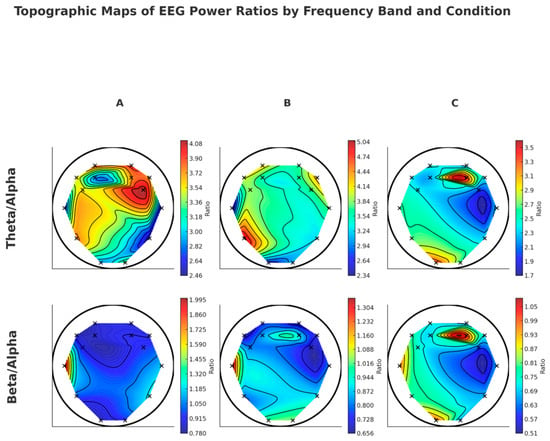
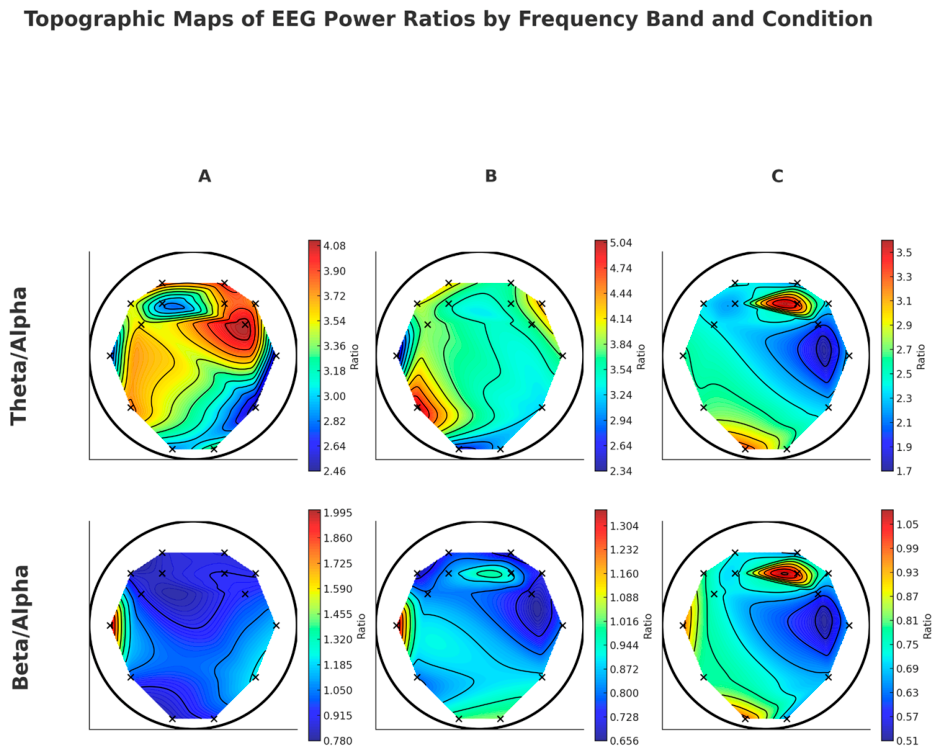
Descriptive topographical plots of Theta/Alpha and Beta/Alpha ratios across footwear conditions are presented in Figure 3. These maps provide a scalp-level visualization of the distribution of EEG ratios by footwear condition. They are intended as descriptive summaries only and should not be interpreted as evidence of activity originating from specific cortical sources. Given the low-density 14-channel montage, no source localization or current source density analysis was performed.
Figure 3.
Descriptive scalp-level topography of Theta/Alpha and Beta/Alpha ratios by footwear condition. Scalp-level topographical maps showing the distribution of Theta/Alpha and Beta/Alpha ratios for each footwear condition. These maps are provided as descriptive visualizations only and should not be interpreted as evidence of localized cortical sources. (A) barefoot condition; (B) barefoot-style footwear and (C) conventional footwear.
3.5. Supplementary Exploratory Analyses
Additional exploratory hemispheric asymmetry analyses are reported in the Supplementary Material. Hemispheric asymmetry values were generally close to zero across conditions, without a consistent footwear-related lateralized scalp-level pattern (Supplementary Figure S2).
4. Discussion
The present study examined whether footwear condition was associated with changes in scalp-level EEG spectral organization during walking in typically developing children. The principal finding was that conventional structured footwear was associated with a higher global Theta/Alpha ratio than both barefoot walking and barefoot-style footwear, whereas barefoot and barefoot-style footwear showed no statistical evidence of a difference. This effect was observed while exploratory analyses of absolute theta, alpha, and beta power did not provide statistical evidence for condition-related differences. Therefore, the present findings are more consistent with a change in the relative balance between frequency components than with a broad change in absolute spectral power.
Secondary scalp-cluster analyses showed that the direction of the Theta/Alpha effect was broadly consistent across predefined frontal, temporal, and parieto-occipital electrode clusters. These analyses should be interpreted as descriptive scalp-level patterns rather than evidence of source-localized regional brain activity. In mobile EEG studies of gait and balance, changes in theta- and alpha-band activity have been associated with attentional monitoring, locomotor adaptation, task engagement, and sensorimotor processing [12,13]. However, the Theta/Alpha ratio is not a direct or specific measure of attentional demand, gait automaticity, or motor efficiency. Therefore, the higher Theta/Alpha ratio observed with conventional structured footwear should primarily be interpreted as a difference in scalp-level spectral organization between footwear conditions. Greater attentional involvement or altered sensorimotor regulation represents one possible interpretation, but this cannot be established from the present data because no concurrent behavioral, cognitive, or biomechanical measures were collected.
The functional significance of this finding deserves particular consideration. A higher Theta/Alpha ratio should not, by itself, be interpreted as either beneficial or detrimental. One possibility is that structured footwear modifies the sensory and mechanical information available during walking, resulting in a different pattern of cortical engagement. However, greater cortical involvement does not necessarily imply poorer motor control, just as similarity between barefoot and barefoot-style footwear does not demonstrate a neurological advantage. At this developmental stage, the observed differences may reflect short-term adaptation to different foot–ground interfaces rather than differences in neuromotor efficiency. Because the present study assessed only acute responses and did not include measures of gait performance, cognitive demand, or longitudinal development, the direction and clinical significance of the EEG effect remain uncertain.
These findings can be considered in relation to the role of plantar sensory feedback in locomotor control. Afferent input from the plantar surface contributes to the online regulation of posture and movement, particularly during development when sensorimotor integration is still maturing [1,2]. Experimental manipulation of plantar sensory input has been shown to modify neuromuscular responses during gait, highlighting the importance of foot–ground interaction in shaping motor-control strategies [14]. Structured footwear, characterized in this study by greater sole thickness and stiffness, reduced flexibility, a narrower toe box, reinforced heel counter, and heel-to-toe drop, may alter the sensory and mechanical context of walking. The present design does not allow us to isolate which of these footwear features contributed most strongly to the EEG effect. Conversely, barefoot and barefoot-style conditions may provide a more similar foot–ground interaction than conventional structured footwear. The absence of statistical evidence for a difference between these two conditions is compatible with this interpretation, but it should not be taken as evidence of equivalence.
Furthermore, the absence of a statistically significant difference between barefoot and barefoot-style footwear should not be interpreted as evidence of equivalence. Although their similar Theta/Alpha values are compatible with a more similar EEG response under these two conditions than with conventional structured footwear, the present study was not designed or powered as an equivalence trial.
The exploratory observation that barefoot walking showed higher Beta/Alpha values in the temporal scalp cluster may provide a complementary hypothesis for future research. Beta-band activity has been linked to sensorimotor integration, motor planning, and the processing of afferent information during movement [11]. However, because this analysis was exploratory and based on a low-density scalp montage, it should not be interpreted as evidence for localized temporal cortical processing. Rather, it suggests that barefoot walking may affect additional EEG ratios that warrant targeted examination in future studies. This interpretation is broadly consistent with studies showing that changes in plantar input, such as textured insoles or barefoot exposure, can modify balance and gait-related outcomes in children [15,16,17].
Exploratory hemispheric asymmetry analyses did not reveal a consistent lateralized scalp-level pattern. This suggests that the primary Theta/Alpha effect was not accompanied by an obvious left–right asymmetry in the present montage, although the analysis was not powered to test subtle lateralization effects. This supports the interpretation that the observed effect is a modest group-level association rather than a reliable individual-level marker.
Several limitations should be acknowledged. First, the use of a low-density mobile EEG system limits spatial resolution and precludes source localization. Therefore, scalp electrode clusters and topographical maps should be interpreted as descriptive scalp-level patterns only. Second, although participants were familiarized with the task and footwear conditions, this study assessed acute within-session effects. Therefore, novelty or short-term adaptation effects cannot be excluded. Third, the lack of concurrent behavioral and biomechanical measurements, including walking speed, spatiotemporal gait parameters, plantar pressure, and electromyography, limits the ability to link the EEG findings to specific changes in gait mechanics, sensory feedback, or motor control. Importantly, because walking speed, cadence, stride length, and gait variability were not objectively recorded, we cannot exclude the possibility that condition-related differences in gait behavior contributed to the observed EEG differences. Consequently, the present data cannot determine whether the Theta/Alpha effect reflects a direct alteration in neural control associated with footwear, an indirect consequence of footwear-related changes in gait mechanics, or a combination of both.
Fourth, this study was powered for the primary global Theta/Alpha analysis, but not for exploratory analyses such as hemispheric asymmetry, multivariate classification, or correlations. These results should therefore be considered hypothesis-generating. Finally, because the conventional footwear differed from the barefoot-style footwear across multiple design features, including stiffness, sole thickness, heel counter, toe-box width, and drop, the present study cannot attribute the EEG effect to heel-to-toe drop alone. Although footwear fit was individually verified and participants completed a standardized 5 min familiarization period before testing, they were not habitual users of barefoot-style footwear. Therefore, the familiarization procedure was intended to minimize immediate novelty effects but cannot be considered equivalent to longer-term adaptation. Acute responses to unfamiliar footwear may consequently have contributed to the observed EEG patterns, and future studies should examine whether these findings persist after longer habituation periods.
Future studies should integrate EEG with kinematics, electromyography, plantar pressure, and behavioral measures of gait stability or task performance. Such multimodal approaches would allow direct testing of whether footwear-related changes in Theta/Alpha are associated with measurable changes in plantar feedback, gait mechanics, postural control, or attentional load. Longitudinal or repeated-exposure designs would also be useful to determine whether the observed EEG pattern reflects an acute response to footwear condition, a novelty effect, or a stable feature of walking with structured footwear.
Taken together, these findings suggest that footwear condition is associated with measurable differences in scalp-level EEG spectral organization during walking in children. Conventional structured footwear was associated with higher global Theta/Alpha values than barefoot and barefoot-style footwear. This pattern is compatible with altered attentional or sensorimotor regulation during gait, but further multimodal studies are required before conclusions can be drawn regarding attentional demand, automaticity, or motor efficiency.
5. Conclusions
Footwear condition was associated with differences in scalp-level EEG spectral organization during walking in children aged 6–7 years. Conventional structured footwear showed a higher global Theta/Alpha ratio than barefoot and barefoot-style footwear, while no statistical evidence of a difference was observed between the latter two conditions. These findings demonstrate an acute electrophysiological association with footwear condition but do not establish whether the observed pattern reflects differences in attention, sensorimotor control, gait mechanics, or other factors. They should not be interpreted as evidence that one footwear condition is neurologically superior or as evidence of long-term developmental effects. Future studies combining mobile EEG with objective gait, plantar-pressure, and behavioral measures and longer-term exposure are required to establish the functional significance of these findings.
Supplementary Materials
The following supporting information can be downloaded at: https://www.mdpi.com/article/10.3390/japma116060093/s1, Supplementary: Table S1. Secondary scalp-cluster analysis of Theta/Alpha ratio. Supplementary: Table S2. CONSORT 2025 Checklist [18]. Supplementary: Figure S1. Theta/Alpha ratio across predefined scalp electrode clusters. Supplementary: Figure S2. Exploratory hemispheric asymmetry of EEG ratios.
Author Contributions
Conceptualization: C.M.-C., E.C.-L. and G.G.-N.; methodology: C.M.-C., E.C.-L., L.P.-P. and A.R.-C.; intervention: C.M.-C.; assessment: E.C.-L.; data analysis: L.P.-P., A.R.-C.; writing—original draft: C.M.-C., E.C.-L.; writing—review and editing: C.M.-C., L.P.-P., A.R.-C. and G.G.-N. All authors have read and agreed to the published version of the manuscript.
Funding
This research received no external funding.
Institutional Review Board Statement
This study was carried out in full accordance with the provisions of the Declaration of Helsinki regarding ethical principles for medical research involving human subjects and was approved by the Ethics Committee. It was approved by the Ethics Committee of the University of Malaga CEUMA 71-2025-H. Clinical Registration: This study was approved by the Ethics Committee of the University of Malaga (CEUMA 71-2025-H; approval date: 1 June 2025) and registered with ClinicalTrials.gov under the registration number NCT07151352 (Date: 8 June 2025).
Informed Consent Statement
Written informed consent has been obtained from the patient(s) to publish this paper.
Data Availability Statement
The data supporting the findings of this study are not publicly available due to privacy and ethical restrictions.
Acknowledgments
The authors would like to thank Pablosky Company for providing the footwear models used in this study and Colegio Escolapios de Granada for their collaboration and support during participant recruitment and data collection.
Conflicts of Interest
The authors declare no conflicts of interest.
Abbreviations
ADHD—Attention Deficit Hyperactivity Disorder ASD—Autism Spectrum Disorder ASR—Artifact Subspace Reconstruction CMS—Common Mode Sense (EEG reference electrode) CQ—Contact Quality DRL—Driven Right Leg (EEG reference electrode) EEG—electroencephalography EEGLAB—EEG Laboratory (MATLAB toolbox) EMG—Electromyography EPOC—Emotiv EPOC system EQ—EEG Quality Gate FFT—Fast Fourier Transform HSD—Honestly Significant Difference (Tukey test) ICA—Independent Component Analysis ID—Identification LDA—Linear Discriminant Analysis PCA—Principal Component Analysis SD—standard deviation SVM—Support Vector Machine.
References
- Fandakova, Y.; Hartley, C.A. Mechanisms of learning and plasticity in childhood and adolescence. Dev. Cogn. Neurosci. 2020, 42, 100764. [Google Scholar] [CrossRef] [Scilit] [PubMed]
- Tierney, A.L.; Nelson, C.A., III. Brain Development and the Role of Experience in the Early Years. Zero Three 2009, 30, 9–13. [Google Scholar] [PubMed]
- Mizushima, J.; Seki, K.; Keogh, J.W.L.; Maeda, K.; Shibata, A.; Koyama, H.; Ohyama-Byun, K. Kinematic characteristics of barefoot sprinting in habitually shod children. PeerJ 2018, 6, e5188. [Google Scholar] [CrossRef] [Scilit] [PubMed]
- Okai-Nobrega, L.A.; Santos, T.R.T.; Lage, A.P.; Araújo PADe Souza, T.R.; Fonseca, S.T. Effects of Biomimetic Shoes on Healthy Young Children’s Gait. Rev. Bras. Ortop. 2023, 59, 435–442. [Google Scholar] [CrossRef] [Scilit] [PubMed]
- Wegener, C.; Hunt, A.E.; Vanwanseele, B.; Burns, J.; Smith, R.M. Effect of children’s shoes on gait: A systematic review and meta-analysis. J. Foot Ankle Res. 2011, 4, 3. [Google Scholar] [CrossRef] [Scilit] [PubMed]
- Moya-Cuenca, C.; Gijón-Nogueron, G.; Chicharro-Luna, E. Barefoot or Shod? The Impact of Footwear on Children’s Gait: A Systematic Review with an Exploratory Meta-Analysis. Appl. Sci. 2026, 16, 286. [Google Scholar] [CrossRef] [Scilit]
- Hollander, K.; De Villiers, J.E.; Venter, R.; Sehner, S.; Wegscheider, K.; Braumann, K.M.; Zech, A. Foot Strike Patterns Differ between Children and Adolescents Growing up Barefoot vsShod. Int. J. Sports Med. 2017, 39, 97–103. [Google Scholar] [CrossRef] [Scilit] [PubMed]
- Richer, N.; Bradford, J.C.; Ferris, D.P. Mobile neuroimaging: What we have learned about the neural control of human walking, with an emphasis on EEG-based research. Neurosci. Biobehav. Rev. 2024, 162, 105718. [Google Scholar] [CrossRef] [Scilit] [PubMed]
- Gramann, K.; Ferris, D.P.; Gwin, J.; Makeig, S. Imaging natural cognition in action. Int. J. Psychophysiol. 2014, 91, 22–29. [Google Scholar] [CrossRef] [Scilit] [PubMed]
- Oknina, L.; Strelnikova, E.; Lin, L.F.; Kashirina, M.; Slezkin, A.; Zakharov, V. Alterations in functional connectivity of the brain during postural balance maintenance with auditory stimuli: A stabilometry and electroencephalogram study. Biomed. Phys. Eng. Express 2025, 11, 035006. [Google Scholar] [CrossRef] [Scilit] [PubMed]
- Kahya, M.; Liao, K.; Gustafson, K.M.; Akinwuntan, A.E.; Manor, B.; Devos, H. Cortical Correlates of Increased Postural Task Difficulty in Young Adults: A Combined Pupillometry and EEG Study. Sensors 2022, 22, 5594. [Google Scholar] [CrossRef] [Scilit] [PubMed]
- Sipp, A.R.; Gwin, J.T.; Makeig, S.; Ferris, D.P. Loss of balance during balance beam walking elicits a multifocal theta band electrocortical response. J. Neurophysiol. 2013, 110, 2050–2060. [Google Scholar] [CrossRef] [Scilit] [PubMed]
- Jacobsen, N.A.; Ferris, D.P. Electrocortical activity correlated with locomotor adaptation during split-belt treadmill walking. J. Physiol. 2023, 601, 3921–3944. [Google Scholar] [CrossRef] [Scilit] [PubMed]
- Robb, K.A.; Hyde, J.D.; Perry, S.D. The role of enhanced plantar-surface sensory feedback on lower limb EMG during planned gait termination. Somatosens. Mot. Res. 2021, 38, 146–156. [Google Scholar] [CrossRef] [Scilit] [PubMed]
- Banwell, H.A.; Tsiros, M.; Coventry, J.; Ryan, N.; Williams, C.M. Textured insoles may improve some gross motor balance measures but not endurance measures in children with motor coordination issues. A randomised controlled feasibility trial. J. Foot Ankle Res. 2024, 17, e12036. [Google Scholar] [CrossRef] [Scilit] [PubMed]
- Nakano, H.; Murata, S.; Abiko, T.; Mitsumaru, N.; Kubo, A.; Hachiya, M.; Matsuo, D.; Kawaguchi, M. Effects of Long-Term Use of Insoles with a Toe-Grip Bar on the Balance, Walking, and Running of Preschool Children: A Randomized Controlled Trial. BioMed. Res. Int. 2020, 2020, 1940954. [Google Scholar] [CrossRef] [Scilit] [PubMed]
- Zech, A.; Venter, R.; de Villiers, J.E.; Sehner, S.; Wegscheider, K.; Hollander, K. Motor skills of children and adolescents are influenced by growing up barefoot or shod. Front. Pediatr. 2018, 6, 115. [Google Scholar] [CrossRef] [Scilit] [PubMed]
- Hopewell, S.; Chan, A.W.; Collins, G.S.; Hróbjartsson, A.; Moher, D.; Schulz, K.F.; Tunn, R.; Aggarwal, R.; Berkwits, M.; Berlin, J.A.; et al. CONSORT 2025 statement: Updated guideline for reporting randomised trials. BMJ 2025, 388, e081123. [Google Scholar] [CrossRef] [Scilit] [PubMed]

Disclaimer/Publisher’s Note: The statements, opinions and data contained in all publications are solely those of the individual author(s) and contributor(s) and not of MDPI and/or the editor(s). MDPI and/or the editor(s) disclaim responsibility for any injury to people or property resulting from any ideas, methods, instructions or products referred to in the content. |
© 2026 by the authors. Published by MDPI on behalf of the American Podiatric Medical Association. Licensee MDPI, Basel, Switzerland. This article is an open access article distributed under the terms and conditions of the Creative Commons Attribution (CC BY) license.