Lesser toe deformities, which include hammertoes, claw toes, mallet toes, and retracted toes, are common foot abnormalities frequently encountered in older adults and may be attributed to various factors including ill-fitting footwear, trauma, inflammatory arthropathy, congenital conditions, and neuromuscular abnormalities. Hammertoes and claw toes are the two most common forms of lesser toe deformity [
1].
The toes are important in the push-off phase of gait, during which a significant amount of load is transferred to the toes. Consequently, altered joint motion as occurs in toe deformities interferes with the onward advancement of the body during gait and may potentially contribute to functional disability and falls in older adults [
2]. Furthermore, the toes also play an important role during dorsiflexion at the metatarsophalangeal joints (MPJs) carried out by the extensor digitorum longus. The second toe is the most common of the lesser digits to develop deformity such as hammertoe or claw toe [
3].
A hammertoe involves an extended metatarsophalangeal joint (MPJ) along with a flexed proximal interphalangeal joint (PIPJ); the distal interphalangeal joint may be either neutral or in hyperextension. A claw toe also involves an extended MPJ along with flexion of both the PIPJ and the distal interphalangeal joint [
4]. Toe deformity may be asymptomatic, but may also cause varying degrees of pain. In hammer and claw toes, pain may be present at the dorsum of the PIPJ, at the apex of the toe and the metatarsal heads. This pain usually intensifies by pressure within footwear but may also be felt when walking barefoot. Symptoms may consist of a sharp pain while walking, which may even continue with rest or diminish into a dull ache of the soft tissues. This sensation is often described as “walking on stones [
5].”
Lesser toe deformity may be a substantial cause of falls in older adults because of reduced somatosensory input provided by the lesser digits and the altered functional stability at the push-off phase of gait [
6]. Lesser toe deformity also influences the subjects’ ability in ascending and descending stairs. To date, little is known about the biomechanical changes that might contribute to this increased risk.
Lesser toe deformity can be managed in a nonsurgical manner, especially when surgical procedures are inadvisable in older adults. Excess pressure can be relieved by reduction of hyperkeratotic lesions, alterations in footwear, orthotic insoles, and padding. Shoes with a deeper toe box can help in reducing pressure at the dorsal aspect of the deformed toe. A shoe with a stiff rocker bottom sole may help in reducing pressure at the metatarsal heads during the late stance phase. Full-length orthotics may also help in reducing pressure at the metatarsal heads [
7]. Padding is commonly used for digital deformities to produce functional correction. Customized pads are generally preferred to ready-made pads, as they can be shaped to the individual’s toes. Also, silicone is generally chosen over felt padding, as the latter only serves for short-term use [
8].
The “toe prop,” also known as the “crest pad,” is made to fit into the crescent space between the plantar MPJs and the toe apices. The toe prop extends the lesser toes by producing an upward pushing force; thus, pressure is redistributed from the toe apex onto the padded plantar aspect of the toe. It is useful in lengthening claw and hammertoes and in decreasing the dorsiflexion of the proximal phalanx. When the digital deformity is of the rigid type, the toe prop can provide protection by redistributing plantar forces [
9].
Although the application of toe props in flexible toe deformity has been described in the literature, their efficiency in use for rigid toe deformity remains unclear. No studies have yet been conducted to compare the actual effect of the toe prop between flexible and rigid toe deformities, thus making this study the first of its kind.
In view of the above, this study sought to evaluate the effectiveness of custom-made molded silicone toe props in distributing apical and MPJ peak plantar pressures and force-time integral in toe deformities, including hammertoes and claw toes, and to observe any difference in pressures between flexible and rigid toe deformities when applying this silicone modality. A further understanding of pressure reduction, comfort, and effect of silicone toe props could shed light on clinical practice in the management of digital foot pain, especially in older adults.
Subject Selection and Methods
Subject Selection
A prospective quasi-experimental pretest/posttest study was conducted. Twenty participants were recruited randomly from local podiatry clinics. This study was approved by the university research ethics committee, and all participants provided informed consent. All investigations were carried out in accordance with the principles of the Declaration of Helsinki. Participants eligible for this study were Maltese subjects, aged older than 55 years, who presented with a hammer or claw toe deformity in their second toe. Patients were excluded if they presented with foot ulceration; were unable to walk unassisted; had a history of foot surgery; presented with overlapping or retracted toes that prevented toe apices from contacting the ground; were living with diabetes, and/or peripheral neuropathy, and/or rheumatoid arthritis; or showed unwillingness to participate and follow the study protocol.
Methods
Patient Characteristics. After informed consent, patients’ characteristics were gathered using a self-designed data collection sheet structured for the purpose of gathering data from participants, including gender and age.
The Kelikian Push-Up Test. To determine whether the participant presented with a flexible or rigid toe, the Kelikian push-up test was performed. This test is an important and recognized test used by various health-care professionals [
10]. The Kelikian push-up test is used to examine the flexibility of a digital deformity, by applying a pushing force on the relevant plantar metatarsal head. If the dorsiflexion at the MPJ reduces both during the test and on weightbearing, the toe deformity is considered flexible. In contrast, if there is no reduction in deformity with the push-up test, the toe deformity is considered as rigid.
Debridement of Plantar Hyperkeratotic Lesions. Debridement of any hyperkeratotic lesions on the plantar aspect of the foot and apices of toes was performed. This was conducted because the literature reports that hyperkeratotic lesions increase plantar pressures [
11].
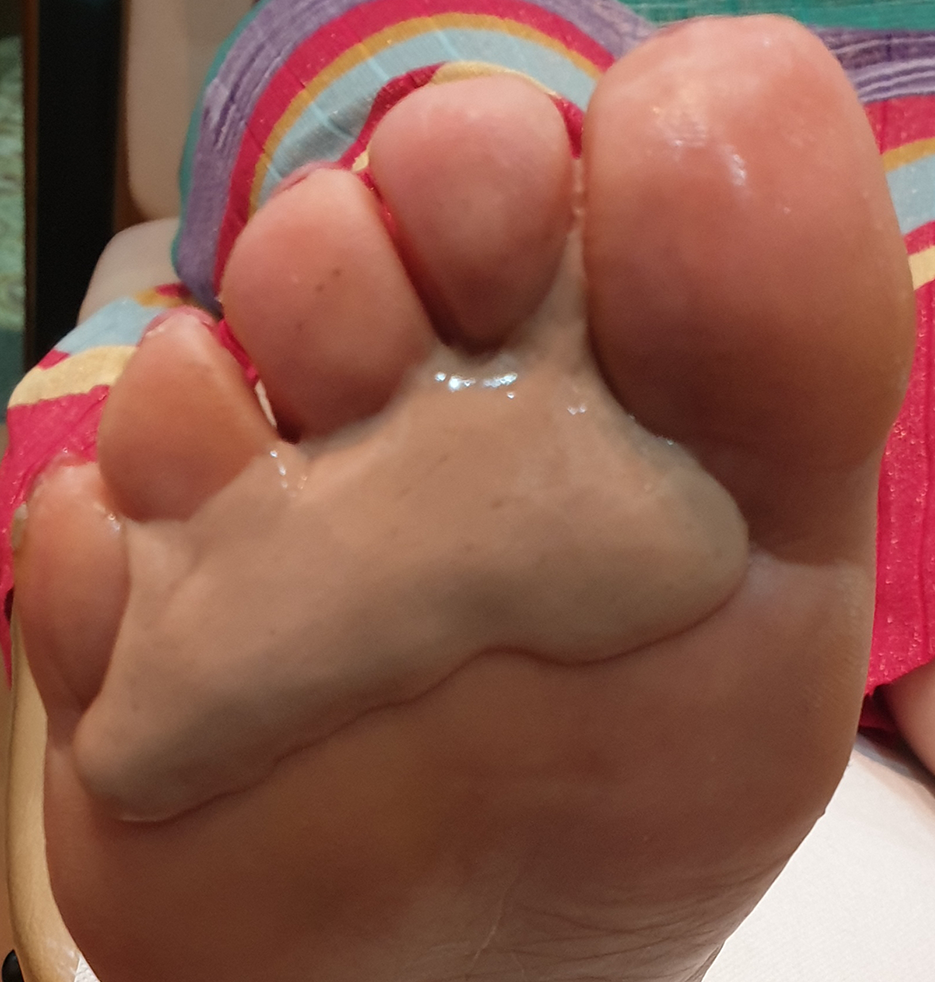
Manufacture of the Molded Silicone Toe Prop. Silicone molded toe props were custom-made, individually molded directly onto the digits. Silicone Shore A 30 (Medici Technology LLC, Oakland, California) was used in this study. Silicone molds were manufactured for the second, third, and fourth digits, with the silicone distributed evenly onto the apices of the distal phalanges with no added bulk under the proximal phalanges (
Fig. 1). Silicone putty has long been used as an impression material to accommodate, protect, and slow down deformity in fingers and toes. It is commonly applied to the forefoot to reduce shearing stresses caused by footwear, thus preventing lesions and providing relief to the individual. All toe props were molded by the same researcher to minimize variance.
Figure 1.
Silicone toe prop after being molded for hammertoes at the second, third, and fourth digits.
Figure 1.
Silicone toe prop after being molded for hammertoes at the second, third, and fourth digits.
Pressure Mapping Protocol. Peak plantar pressures beneath the foot were recorded using a pressure platform (HR Mat; Tekscan, Boston, Massachusetts). Initially, the participants were asked to stand on the mat to calibrate the system according to their body mass according to the manufacturer’s instructions. The study protocol was discussed with the participants before data collection. A period of acclimatization was included for the participants to understand the two-step walking protocol that was adopted. This protocol has been reported to be reliable and not very time consuming to implement, requiring the participants to make contact with the platform on the second step. Each participant was instructed to stand on both feet exactly two steps before stepping on the pressure platform. The participants started walking by stepping first with one foot on the ground and the next step on the platform and continued walking for the next three steps. Several practice trials were performed to familiarize the participants with the procedure and encourage natural gait, avoiding targeting. When the participants felt confident with their walking pattern, the dynamic plantar pressures were recorded. Thin cotton socks were worn during the recording process, mainly to ensure that the silicone device was kept in place.
This procedure was repeated eight times at the areas of interest. Each trial produced eight stance phases for each foot. The mean value of the “best” five stance phases (ie, those stance phases in which the patient walked without hesitation or stopping on the pressure plate) for each foot was used for evaluation. Each foot measurement was divided into two regions: the apex of the second digit and the second to fourth MPJ region. A polygon shape was drawn to mask the second to fourth MPJ region, whereas a circle was drawn to mask the second apex.
Statistical Analysis
Statistical analyses were carried using IBM SPSS Version 22 (IBM Corp, Armonk, New York). Quantitative variables were expressed as mean value ± SD and qualitative variables were expressed as percentages. Normalcy for data was tested statistically using the Kolmogorov-Smirnov test and Shapiro-Wilk tests, with values of P > 0.05 indicating normality. Parametric tests were used for data that met the assumptions, and the nonparametric equivalent was used when the assumption was met as discussed further below under “Results.”
The units for each measurement were kilopascals for peak plantar pressure and newtons per second for force-time integral. Peak plantar pressure denoted the highest pressure that is applied during the stance phase, whereas the force-time integral denoted the amount of force that was being applied during contact of the foot with the ground. These variables were assessed in five trials for each participant before the toe prop and after the toe prop was placed under the toes.
Results
Patient Demographics
The study sample consisted of 15 women and five men with a mean ± age of 66.65 ± 6.45 years. Ten subjects had flexible toes and 10 subjects had rigid toes, eight of whom had hammertoe deformities and two of whom had claw toe deformities in each group.
Percentage Reduction in Peak Plantar Pressure and Force-Time Integral Within Each Group
The one-sample
t test and binomial test were used to determine the mean percentage reduction within each separate group (flexible/rigid). The former is a parametric test that is used when the percentage reduction follows a normal distribution, whereas the latter is a nonparametric test that is used when the percentage reduction is skewed.
Tables 1 and
2 illustrate the mean average percentage reduction in peak plantar pressure and force-time integral between individuals within each group.
Table 1.
One-Sample t Test and Binomial Test Results for Percentage Reduction in Peak Plantar Pressure and Force-Time Integral in the Flexible Group
Table 1.
One-Sample t Test and Binomial Test Results for Percentage Reduction in Peak Plantar Pressure and Force-Time Integral in the Flexible Group
Table 2.
One-Sample t Test and Binomial Test Results for Percentage Reduction in Peak Plantar Pressure and Force-Time Integral in the Rigid Group
Table 2.
One-Sample t Test and Binomial Test Results for Percentage Reduction in Peak Plantar Pressure and Force-Time Integral in the Rigid Group
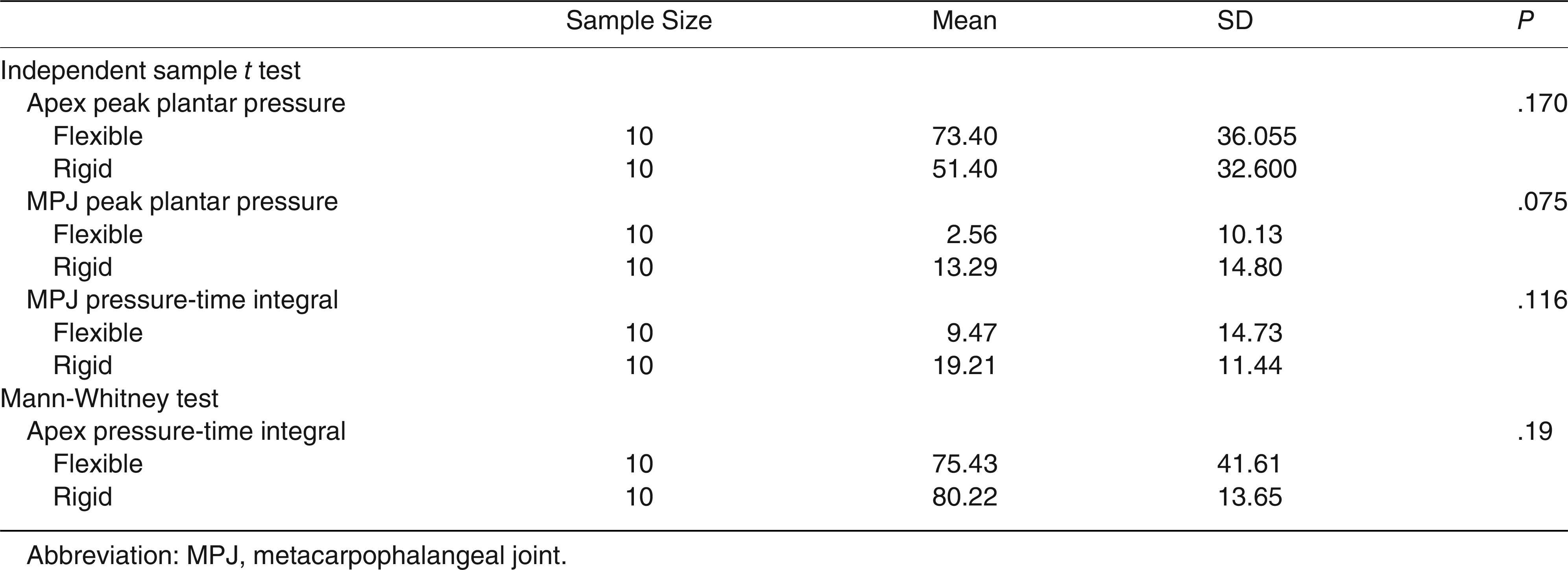
Comparing the Percentage Reduction Between the Flexible and Rigid Groups
The independent sample
t test and the Mann-Whitney test were used to compare the mean percentage reduction between two independent groups (flexible versus rigid deformities) (
Table 3).
Table 3.
Independent Sample t Test and Mann-Whitney Test Results When Comparing Peak Plantar Pressure and Force-Time Integral Between the Flexible and Rigid Groups
Table 3.
Independent Sample t Test and Mann-Whitney Test Results When Comparing Peak Plantar Pressure and Force-Time Integral Between the Flexible and Rigid Groups
The mean percentage reduction in apex peak plantar pressure for the flexible group (73.4%) exceeds the corresponding mean percentage reduction for the rigid group (51.4%). However, this difference is not found to be significant (P = .170). The mean percentage reduction in peak plantar pressure at the MPJ region for the rigid group (13.29%) exceeds the corresponding mean percentage reduction for the flexible group (2.56%). However, the difference was not significant (P = .075) The mean percentage reduction in force-time integral at the MPJ region for the rigid group (19.21%) exceeds the corresponding mean percentage reduction for the flexible group (9.47%). However, this difference is not significant (P = .116).
The mean percentage reduction in force-time integral at the apex for the rigid group (80.22%) exceeds the corresponding mean percentage reduction for the flexible group (75.43%). However, this difference was also not significant (P = .190).
Discussion
The results from this study highlight a significant reduction in peak plantar pressure and digital pressure-time integral at the apex of the second digit in both flexible and rigid toe deformities when using molded silicone toe props. This result is congruent with the results of a similar study conducted by Johnson et al, [
1] where the authors concluded that the use of silicone toe props is the most suitable treatment for lesions on the apex of the second digit. However, this study did not differentiate between flexible and rigid toe deformities, which makes our study methodology significantly different. In addition, the two studies used different pressure sensor types. To avoid the possibility of increasing pressure by using individual sensors on the apices, a pressure platform system was used in our study, which also facilitated the collection of pressure data under the MPJs. Because there is currently a paucity of evidence regarding effectiveness of custom-molded silicone orthodigital appliances, our study provides further evidence supporting the usefulness of these devices to offload pressure in both rigid and flexible deformities.
At the MPJ level, pressures were significantly reduced in the rigid toe deformity, but no significant difference was found in toes with a flexible deformity. This observation is the first of its kind, because previous literature [
2] also did not differentiate between flexible or rigid toe deformities and did not measure pressure at the MPJs. This implies that a silicone toe prop may be used to reduce MPJ pressures when, traditionally, clinicians use these devices only for toe pressure reduction. This would possibly reduce the need for using other offloading methods, such as plantar metatarsal pads which, in high-risk patients, may present some risk because of adhesives used to adhere the pad to the skin. Thus, one device—the toe prop—can offer pressure reduction in two areas (ie, at the apex and the corresponding MPJ), most significantly in the case of rigid toe deformity. The authors concluded that minimal research has been conducted looking into the effect of the toe prop on apical pressure, and the practice of apical lesion management with a toe prop is mainly based on tradition and is not evidence based. However, plantar pressure analysis technology used in this study has been shown to have the potential to assist in optimizing the design of interventions to redistribute pressures such as custom-molded silicone toe props, among others, thereby alleviating foot symptoms and improving mobility.
The reduction of apical pressure in older adults is of extreme importance and warrants attention by all foot specialists because, as reported above, the pressure can cause callosities and other hyperkeratotic lesions arising from other mechanical causes [
12], leading to pain, which further leads to falls, ulcerations, and other comorbidities frequently encountered by older adults [
1]. Significant skin lesions can compromise gait and possibly affect quality of life [
13]. The authors recommend that custom-molded toe props may be a viable option to reduce pain and possibly the formation of apical ulcerations in older adults who are not candidates for lesser toe surgery because of other complications present that may impede more complex interventions. Toe props are simple chairside appliances that can be easily molded within minutes during a consultation visit and are a relatively cheap and noninvasive option. Toe props should be thought of as the first-line option to reduce apical and MPJ pressures and pain in older adults before appropriate surgical intervention is considered, or should be considered during the waiting time before surgery to relieve pain.
Limitations
The main limitation of this study is the sample size (n = 20); however, this was because of the tight exclusion criteria. This study was conducted on “healthy” adults, thus making it difficult to find such participants without adjunct comorbidities.
Conclusions
Custom-made silicone molded toe props were found to be effective in reducing peak pressure and pressure-time integral on the apex of the second digit and MPJ in participants with both flexible and rigid claw or hammertoe deformity. Lesser toe deformities may be the cause of falls in older adults and thus need to be addressed appropriately. It can therefore be recommended that the silicone custom-made toe prop is used as a primary treatment for apical lesions associated with elevated peak plantar digital pressure and pressure-time integrals. Further studies are warranted to assess the effect of custom-molded silicone toe props in adults.