Eosinophilic granulomatosis with polyangiitis (EGPA) is a rare systemic vasculitis. Although previously known as Churg-Strauss syndrome, it was renamed in 2012 as an initiative of the American College of Rheumatology (ACR) and other societies to transition away from using eponyms for the vasculitides [
1]. Eosinophilic granulomatosis with polyangiitis is an “eosinophil-rich and granulomatous inflammation involving the respiratory tract, and necrotizing vasculitis affecting small to medium sized vessels, and is associated with asthma and eosinophilia.” [
2,
3,
4]. Eosinophilic granulomatosis with polyangiitis is a rare and likely underreported disease, with an overall prevalence of 10 to 14 per 1 million adults [
4,
5,
6]. This syndrome primarily affects middle-aged adults, with no clear preference to gender or ethnic group [
5,
7].
Literature on lower extremity manifestations and management of EGPA is sparse because of the rarity of this condition and lower extremity presentation. The goal of this case presentation is to present the lower extremity manifestations and management of EGPA and the treatment of associated pathology. By presenting this case, it is our hope that we can add to the body of knowledge on this atypical condition and possibly provide guidance to clinicians managing lower extremity pathology caused by EGPA.
Case Report
A 36-year-old man presented with a complaint of numbness and burning pain in his right foot and anterior leg. This issue was of 2 months’ duration with acute onset and was worse at night. Within 1 week of onset, the pain became a sharp and tearing feeling, eventually evolving to complete loss of sensation to the right leg and foot. He reported trouble ambulating because of frequent tripping in addition to weakness to the right lower extremity that impaired his activities of daily living. The patient denied a history of trauma, travel, or recent infection.
His medical history was significant for hypertension, adult-onset asthma, allergic rhinitis, and depression. The patient reported worsening of asthma 4 months previously that was unresponsive to his previous asthma medication. He related being prescribed 5 mg of prednisone for asthma by his primary care doctor to address the worsening asthma; however, he admitted to being noncompliant with this medication. He was prescribed nortriptyline and topiramate; however, these failed to provide relief.
His social history was pertinent, as the patient was an Iraqi War veteran, and reported exposure to burning oil fields in Iraq. He had a 19-year history of alcohol use, although he stopped 4 months before presentation. He quit smoking 5 years previously. He denied a history of illicit drug use.
Review of systems was pertinent for a 20-pound weight loss over the prior 3 months secondary to loss of appetite. He had been experiencing a 2-week history of abdominal pain with associated nausea and vomiting, and intermittent diarrhea; in addition, the patient related occasionally noticing bright red blood in his stool. In addition, he related intermittent shortness of breath caused by his worsened asthma, in addition to skin changes and recent morning stiffness and pain in the knee and elbow joints. Skin lesions were reported to improve with steroid regimens in the past; however, they never completely resolved.
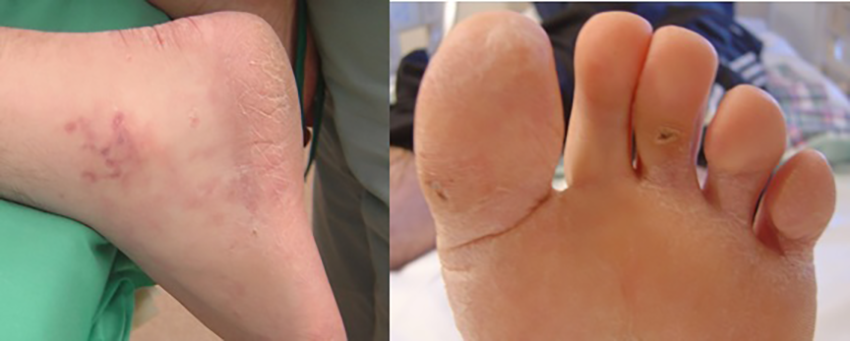
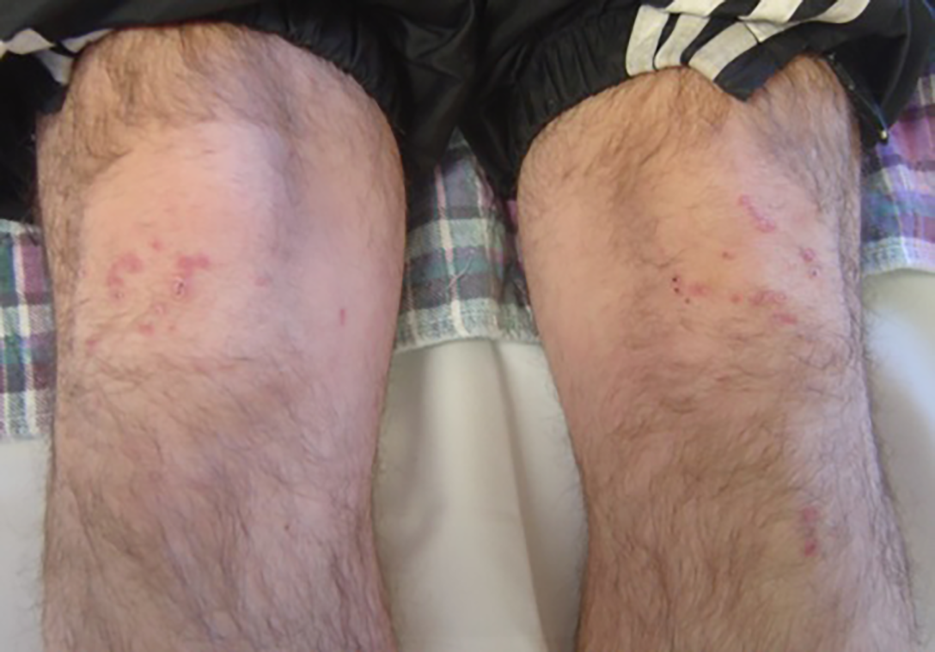
Physical examination was noteworthy for small erythematous maculopapular lesions present over the lateral malleolus, plantar toes, and the dorsum of the foot bilaterally (
Fig. 1). These lesions were also present over the extensor surfaces of the bilateral knees (
Fig. 2), arms, hands, and the neck. Light-touch sensory deficits were noted on the right lower extremity at the common and deep peroneal nerves, the sural nerve, and posterior tibial nerve. Sensory deficits over the deep peroneal nerve distribution were noted to the left foot. The patellar reflex was +4 bilaterally; the Achilles reflex was 0 on the right and +3 on the left. Manual muscle testing noted a 1/5 strength to the lateral and anterior compartment musculature on the right leg; however, the posterior muscle group on the right leg and all compartments on the left leg were 5/5 strength. A footdrop deformity to the right lower extremity was noted, and no muscular deficits were noted to the left lower extremity.
Figure 1.
Several small erythematous, maculopapular lesions were present on the patient’s feet and ankles.
Figure 1.
Several small erythematous, maculopapular lesions were present on the patient’s feet and ankles.
Figure 2.
Erythematous maculopapular lesions on the extensor surfaces of the patient’s knees. Similar lesions were noted on the extensor surfaces of his elbows, fingers, knees, leg, and neck.
Figure 2.
Erythematous maculopapular lesions on the extensor surfaces of the patient’s knees. Similar lesions were noted on the extensor surfaces of his elbows, fingers, knees, leg, and neck.
Laboratory studies were ordered. Pertinent results included elevated inflammatory markers with an erythrocyte sedimentation rate of greater than 140 mm/hour and a C-reactive protein value of 19.6 mg/liter. On presentation, eosinophils were elevated to 38.5% (reference range, 0.0%–5.9%). He stated this has been chronically elevated, with 61.5% as the highest result in the past; in addition, eosinophils were also present in the urine. Rheumatoid factor was mildly increased at 25 IU/mL. Immunoglobulin (Ig) E was elevated up to 1336 IU/mL, whereas IgG, IgM, and IgA values were within normal limits. Tests for cryoglobulins and cryofibrinogens were negative, along with antinuclear antibodies, p–antineutrophil cytoplasmic antibodies, and c–antineutrophil cytoplasmic antibodies. Complement 3 and 4 levels were within normal limits. Other laboratory panels were unremarkable.
Electrocardiography displayed sinus tachycardia with no wave changes. Echocardiography revealed a mildly enlarged left ventricle with moderate to severely depressed systolic function, as the ejection fraction was 30% to 35%. Chest radiographs displayed opacities consistent with pulmonary infiltrates. Pulmonary function tests were consistent with severe asthma. A head computed tomographic scan displayed evidence of paranasal sinusitis.
Electromyograms and nerve conduction studies were performed. They revealed severe right common peroneal and tibial axonal mononeuropathies, mild subacute right peroneal division sciatic axonal neuropathy, and a right sural neuropathy. There was also evidence for left mild to moderately severe, subacute common peroneal axonal neuropathy that spared the tibialis anterior muscle and an acute axonal lesion involving the left tibial nerve. These findings were consistent with mononeuropathy multiplex.
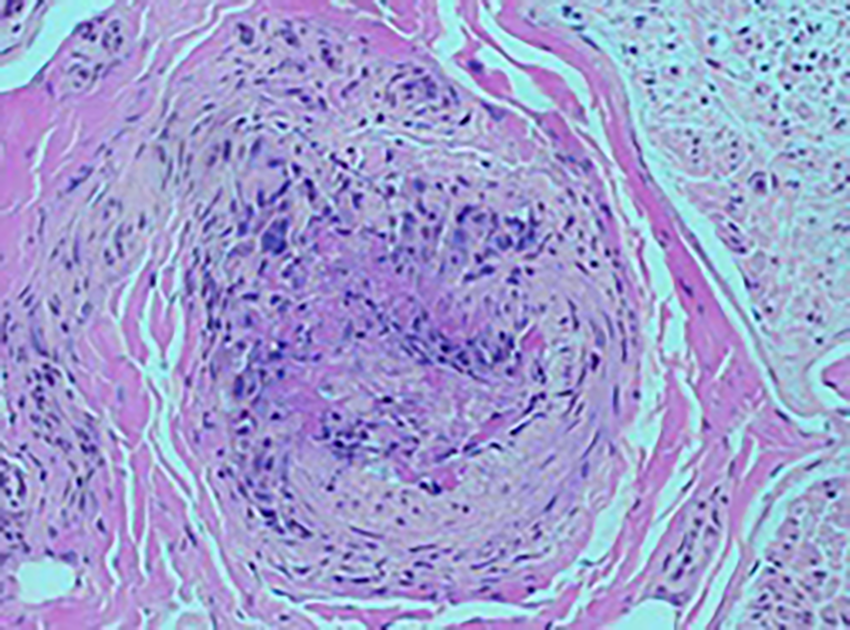
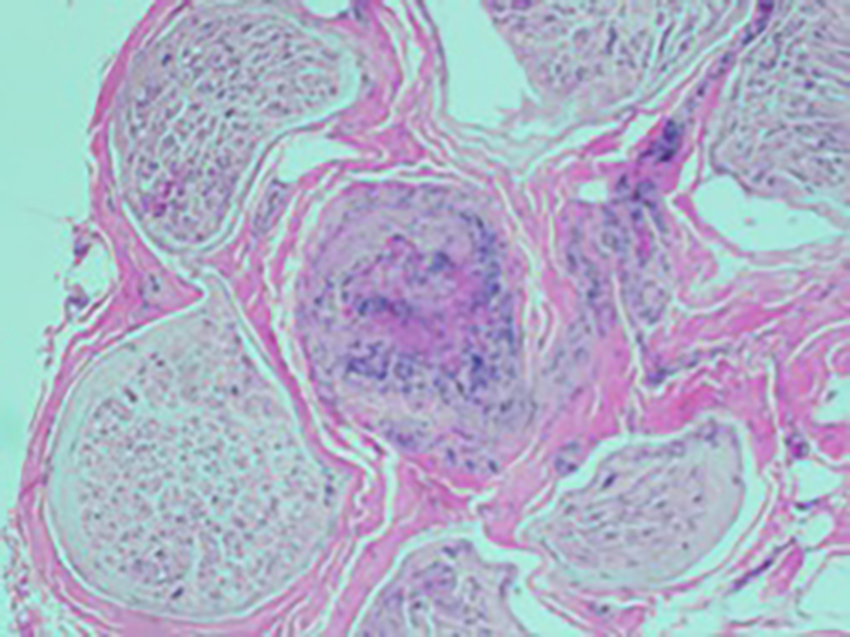
Soft-tissue punch biopsy specimens were taken from multiple locations. Skin biopsy specimens were taken from the left dorsal hand, left foot and ankle, and posterior neck. Biopsy sites were chosen to prefer newer lesions and more prominent lesions. The biopsy specimens displayed focal perivascular infiltrate of histiocytes and eosinophils admixed with extravasated red blood cells. Colon and rectal biopsy specimens both exhibited acute and chronic inflammation along with hypereosinophilia. Surgical biopsies of the right sural nerve and right gastrocnemius muscle were also performed within the operating room under general anesthesia. The muscle biopsy specimen displayed (
Fig. 3A) eosinophilic granulomas involving small muscular arteries; in addition, the sural nerve biopsy specimen had evidence of necrotizing vasculitis in the vasa nervorum and loss of axonal density (
Fig. 4A).
Figure 3.
Histopathology from gastrocnemius biopsy specimen, which was notable for eosinophilic granulomas involving small muscular arteries and necrotizing vasculitis.
Figure 3.
Histopathology from gastrocnemius biopsy specimen, which was notable for eosinophilic granulomas involving small muscular arteries and necrotizing vasculitis.
Figure 4.
Histopathology slide of sural nerve biopsy specimen. Necrotizing vasculitis of the vasa nervorum, axonal degeneration, loss of axonal density, and extravascular eosinophils were noted.
Figure 4.
Histopathology slide of sural nerve biopsy specimen. Necrotizing vasculitis of the vasa nervorum, axonal degeneration, loss of axonal density, and extravascular eosinophils were noted.
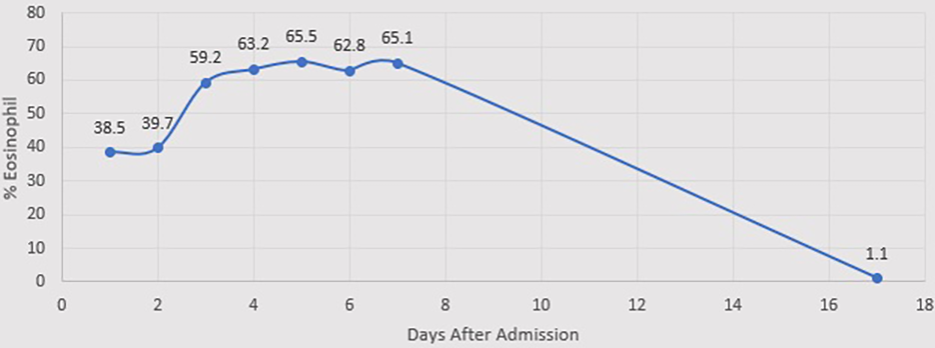
Based on the history, physical examination, and further work-up, the patient was diagnosed with EGPA. He was treated with high-dose prednisone, which caused a rapid decline in the hypereosinophilia (
Fig. 5). The steroid therapy stabilized his respiratory symptoms, and the skin lesions resolved; however, the neuropathic symptoms and weakness remained. The patient was ultimately fitted for an ankle foot orthosis to improve gait disturbances related to the footdrop condition. In addition, he was ordered to continue physical therapy for strengthening and for gait training. Rheumatology referrals were ordered for continued management of this condition. At 1-year follow-up, he related continued neuropathy symptoms and weakness; however, he related improved gait with the orthosis. Surgical intervention for the footdrop is deferred, as the patient was responding to bracing therapy, and still presents for regular follow-up for monitoring and brace adjustment as needed.
Figure 5.
Percentage eosinophil count on each day of admission. Eosinophilia was 38.5% at admission and would reach 65.1% at its highest. Within 9 days of steroid therapy initiation, eosinophil levels were within the normal range.
Figure 5.
Percentage eosinophil count on each day of admission. Eosinophilia was 38.5% at admission and would reach 65.1% at its highest. Within 9 days of steroid therapy initiation, eosinophil levels were within the normal range.
Discussion
In this case, we presented EGPA manifestations in the foot, an issue sparely covered in the literature, with a modicum of articles in the dermatology and internal medicine literature. At this time of this writing, EGPA was not covered in the foot and ankle literature. In this case, our patient experienced the classic hallmarks of the disease: adult-onset asthma with allergic rhinitis, eosinophilia, and changes related to EGPA-associated vasculitis.
The diagnosis of eosinophilic granulomatosis with polyangiitis is based on clinical criteria, as there is no laboratory or radiologic studies or findings specific to this condition. Although there are numerous published diagnostic criteria sets for EGPA, the ACR criteria are most used [
8]. Eosinophilic granulomatosis with polyangiitis is presumptive if a patient meets four of the six ACR criteria: asthma, greater than 10% eosinophils on differential leukocyte count, mononeuropathy or polyneuropathy, radiographic transient pulmonary opacities, paranasal sinus abnormalities, and biopsy specimen showing accumulation of eosinophils in extravascular areas. The work-up showed that this patient exhibited all six of the ACR criteria.
Eosinophilic granulomatosis with polyangiitis typically follows three phases of development: the prodromal, eosinophilic infiltrative, and vasculitic phases [
9]. The prodromal phase often involves asthma and allergic rhinitis. Asthma normally precedes vasculitis by months to years, beginning mildly and increasing in frequency and severity [
6,
9,
10]. An index of suspicion could be warranted when patients relate a history of adult-onset asthma and allergic rhinitis when presenting with lower extremity complaints consistent with autoimmune conditions, as our patient did.
During the eosinophilic infiltrative phase, systemic symptoms occur, which make this phase the most common to diagnose the disease. Constitutional symptoms may develop, including malaise, weight loss, and fever. As this stage progresses, it can affect the cardiopulmonary, renal, gastrointestinal, musculoskeletal, and nervous systems, but most often involves the skin. This may manifest as palpable purpura, erythema, or urticaria in 70% of patients [
9]. At the peak of the syndrome, eosinophils may reach an excess of 60%. During the patient’s clinical history, the clinical course very closely resembled the signs and symptoms associated with this stage of the disease.
The vasculitic stage is distinguished by recurrence of allergic disease and asthma along with long-term life-threatening vasculitis of the small and medium vessels. The vasculitis can affect the vasa nervorum, leading to damage to the peripheral nervous system; this may lead to chronic disability, as demonstrated in our patient [
4,
8]. In a study by Nishi et al, [
11] the authors related that involvement of neuropathy is far more common in the lower extremity, with a mononeuropathy multiplex distribution approximately 90% of the time compared with a polyneuropathy distribution in approximately 3.7% to 12.7% percent of their cases. Other case studies on describing neuropathy secondary to EGPA commonly relate a unilateral presentation of sensory and motor symptoms [
3,
11,
12,
13]. The most affected nerve is the common peroneal nerve, with lower extremity manifestations [
3,
11]. Bilateral distributions of sensorimotor neuropathy can occur if EGPA is longstanding [
11]. Unilateral sensorimotor neuropathy manifestations in the presence of adult-onset asthma and sinusitis could raise an index of suspicion for the foot and ankle specialist examining patients with these complaints. At the time of this writing, the patient had not regained his baseline neuromotor function and was still reliant on bracing for management of the footdrop caused by this EGPA. The prognosis for him to regain function is uncertain.
Confirming the diagnosis is important to initiate immune therapy to treat EGPA. Without treatment, there is only a 25% 5-year survival rate. The 1-year survival rate rises to 90% and clinical relapse is rare when EGPA is properly treated. The leading cause of death in EGPA is myocarditis and myocardial infarction secondary to coronary arteritis, although renal failure, cerebral hemorrhage, gastrointestinal bleeding, and status asthmaticus are other causes of mortality [
4,
5,
8]. As in this case, it was the podiatric surgery service that made the diagnosis of EGPA. Eosinophilic granulomatosis with polyangiitis symptoms can appear in the foot and ankle. Although literature regarding pedal manifestations of EGPA is sparse, it is still incumbent on the foot and ankle specialist to be able to recognize this disease and initiate a multidisciplinary approach in treatment of EGPA.