More than a decade ago, an article entitled “The Flat-Footed Child—To Treat or Not to Treat: What Is the Clinician to Do?” presented a pragmatic and evidence-based clinical pathway for clinicians to use for pediatric flatfoot [
1]. Debate and argument followed this publication [
1,
2,
3]. This article has more than 100 citations listed with Google Scholar, which indicates both impact and engagement with the topic since publication in 2008. Now, in 2020, a novel concept of the “boomerang” pediatric flat foot, presents clinicians with greater clarity, and quells concerns about missing harmful pediatric foot problems, or “the one more likely to come back” (
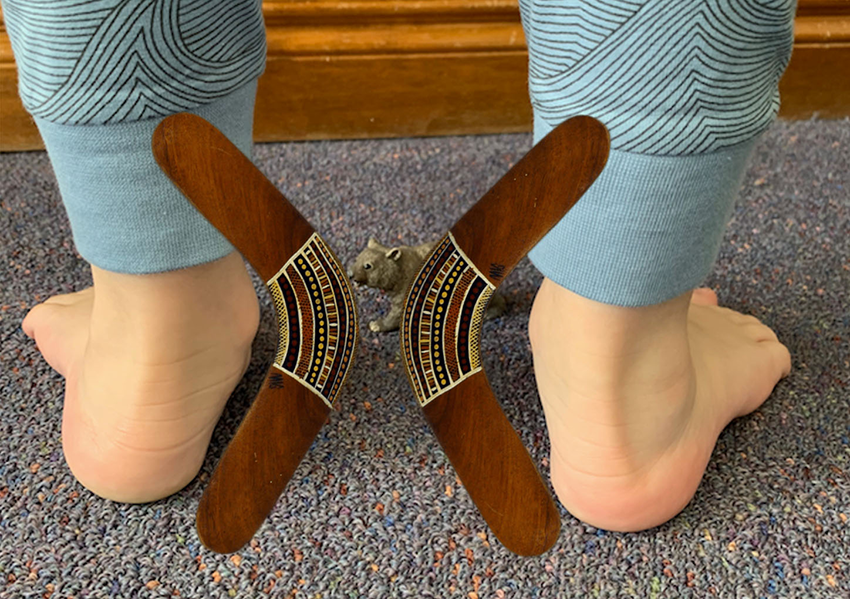
Fig. 1).
Figure 1.
Gait observation of the boomerang pediatric flat foot. The 3 A’s for gait concerns (ie, abducted, apropulsive, and awkward). Endurance and balance may also be reduced in children with boomerang flatfeet, as compared with same-age peers with nonboomerang feet. Full consideration should be given to wider diagnoses. Clinically, the boomerang represents the following: 1) medial prominence of the talonavicular joint, and convexity of the medial border; 2) the proximal boomerang arm represents the valgus heel; and 3) the distal boomerang arm represents to abducted forefoot. Reduced ankle joint dorsiflexion is concurrent.
Figure 1.
Gait observation of the boomerang pediatric flat foot. The 3 A’s for gait concerns (ie, abducted, apropulsive, and awkward). Endurance and balance may also be reduced in children with boomerang flatfeet, as compared with same-age peers with nonboomerang feet. Full consideration should be given to wider diagnoses. Clinically, the boomerang represents the following: 1) medial prominence of the talonavicular joint, and convexity of the medial border; 2) the proximal boomerang arm represents the valgus heel; and 3) the distal boomerang arm represents to abducted forefoot. Reduced ankle joint dorsiflexion is concurrent.
Historically, flatfoot formed an exclusion criterion for military service, and this well-known fact has perpetuated an association between flat feet and disability, with some 30 to 40% medical military discharges cited as being attributable to foot pain [
4,
5]. Ilfeld [
4] further reported that many army recruits with foot pain had flat feet, suggesting that flat feet cause disability. This point was further reinforced by the observation that basic arch supports returned many flat-footed recruits to active service. However, it was also reported that many soldiers with flat feet had no pain; however, this observation has rarely been cited. Thus, by omission, flat feet became overly associated with pain. Despite this tenuous association, the very possibility of flat feet causing pain and limiting independent mobility has understandably concerned parents and clinicians when observing children with flat feet. The notion of prevention is naturally attractive.
Undeniably, some flat feet do induce morbidity, yet others function symptom-free, and most children’s flat feet are painless. Thus, the dilemma is knowing which feet are potentially problematic to justify attention, and which feet can be averted from unnecessary treatment.
Young children are developmentally expected to have flat feet, which reduce in “flatness” with age [
6], and are flexible, functional, and pain-free. There are known systemic diagnoses that need to be considered when growth, familial, and developmental ranges are not usual at any given age [
1,
7].
Greater clarity has been provided by recent studies that have provided normative data for pediatric foot posture [
8,
9], refuted the previously cited [
10,
11,
12] relationship between increased body mass index and flat feet [
13,
14], and prospectively shown that the majority of flat feet do “straighten” with age [
6]. Nevertheless, in 2020, pediatric flat feet still are a frequent clinical presentation to a range of medical and allied health clinicians [
15] because of parental (and physician) concern and confusion regarding normality [
16], with most treatment cited as unnecessary [
17], and level I evidence negating custom/bespoke foot orthoses in the absence of pain [
18,
19].
Discussion
Signs of Boomerang Flatfeet
Contemporary research has identified three factors that delineate symptomatic and asymptomatic flat feet in children. Anatomically, the heel position and the height/congruence of the medial longitudinal arch form the basis of most measures of foot posture [
20,
21,
22,
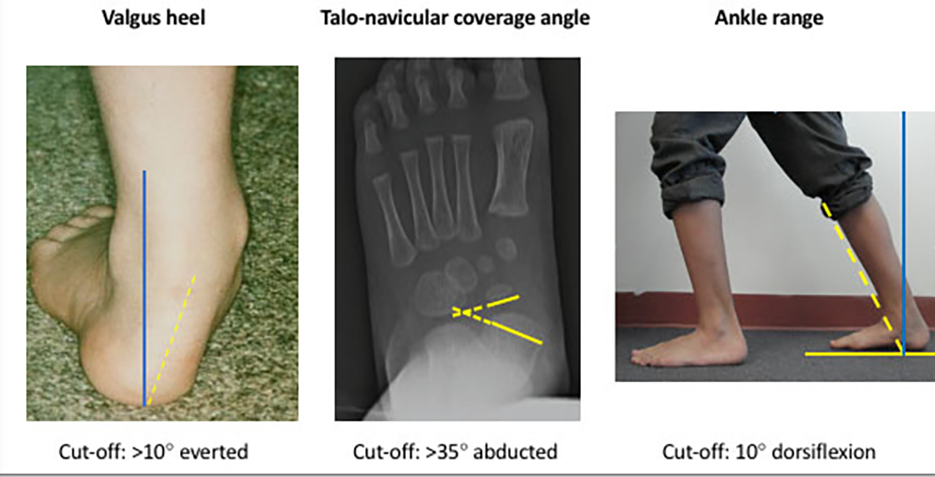
23], and with the addition of ankle range, propagate detection of the boomerang pediatric flat foot, as illustrated in
Figure 2.
Figure 2.
Boomerang pediatric flat feet. Checking for boomerang flat feet involves the three factors shown to delineate symptomatic from asymptomatic flat feet in children, and applicable cutoff levels.
Figure 2.
Boomerang pediatric flat feet. Checking for boomerang flat feet involves the three factors shown to delineate symptomatic from asymptomatic flat feet in children, and applicable cutoff levels.
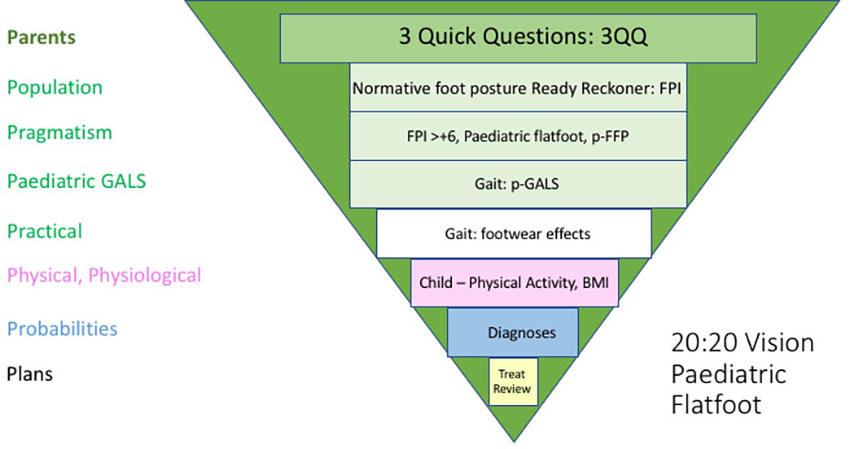
Figure 3.
The 20/20 vision for pediatric flat feet. Eight steps (the “eight P’s strategy”) to improve the approach to community pediatric flat feet concerns the following: 1) parents (can use the plain language three quick questions instrument to triage pain, symmetry, and age-based flat feet); 2) population (Foot Posture Index normative data are available for clinicians); 3) pragmatism (when the Foot Posture Index is greater than +6, clinicians can use the pediatric flatfoot proforma, which directs diagnosis and treatment according to age and symptoms); 4) pediatric Gait, Arms, Legs, and Spine (validated gait assessment and screening is availed for clinicians); 5) practical (gait needs to be assessed with and without regular footwear.); 6) physical, physiologic (consideration for body mass index, and physical activity for age are important for a child’s overall health); 7) probabilities (most pediatric flat feet are not pathologic, but consideration must be given to more serious diagnoses if feet are painful, asymmetric, rigid, or if the child is unwell or limps); and 8) plans (any intervention requires applicable outcome measures, and review of foot posture and gait according to growth and age need valid baseline assessment for comparisons over time).
Figure 3.
The 20/20 vision for pediatric flat feet. Eight steps (the “eight P’s strategy”) to improve the approach to community pediatric flat feet concerns the following: 1) parents (can use the plain language three quick questions instrument to triage pain, symmetry, and age-based flat feet); 2) population (Foot Posture Index normative data are available for clinicians); 3) pragmatism (when the Foot Posture Index is greater than +6, clinicians can use the pediatric flatfoot proforma, which directs diagnosis and treatment according to age and symptoms); 4) pediatric Gait, Arms, Legs, and Spine (validated gait assessment and screening is availed for clinicians); 5) practical (gait needs to be assessed with and without regular footwear.); 6) physical, physiologic (consideration for body mass index, and physical activity for age are important for a child’s overall health); 7) probabilities (most pediatric flat feet are not pathologic, but consideration must be given to more serious diagnoses if feet are painful, asymmetric, rigid, or if the child is unwell or limps); and 8) plans (any intervention requires applicable outcome measures, and review of foot posture and gait according to growth and age need valid baseline assessment for comparisons over time).

Valgus Heel.
Investigation of flat feet in 97 children aged 5 to 18 years, using the Oxford Foot Model, classified feet as follows: asymptomatic neutral, asymptomatic mild flatfoot, asymptomatic flatfoot, or symptomatic flatfoot. Rearfoot eversion (average resting calcaneal heel position [RCSP], 10° eversion) and forefoot abduction (average, 5° to 10° abduction) were significantly greater in symptomatic children [
24].
Talonavicular Joint Coverage Angle.
The differing alignment of foot segments, between symptomatic and asymptomatic children, was investigated retrospectively in 135 children by Moraleda et al. All participants (average age, 11 years) were recruited from three groups: asymptomatic flat feet (n = 45); symptomatic flat feet with conservative treatment (n = 45); and symptomatic flat feet with surgical treatment (n = 45). Radiographs of all feet were analyzed and compared across groups, with differences between asymptomatic and symptomatic flatfeet found in measures of talonavicular coverage (large effect size [0.59]) and lateral calcaneal–fifth metatarsal angle (small effect size [0.10]). There was a 10° difference in talonavicular joint coverage angles between asymptomatic (average, 25°) and symptomatic flat feet (>35°) [
25].
These findings were replicated by Yan et al in 100 children, aged 7 to 14 years (symptomatic flat feet, 50; asymptomatic flat feet, 50), where the lateral displacement of the navicular, measured as talonavicular coverage angle, related to symptoms (average, 25° in asymptomatic and 38° in symptomatic patients) [
26].
Ankle Dorsiflexion Range.
Kim et al [
27] investigated the gait of 26 symptomatic children with flat feet (age, 7–13 years) and performed a comparison with a healthy control group (n = 50). Most patients with symptomatic flat feet also limped, had average ankle dorsiflexion (knee extended) approximating 5.6° (10° in the controls), had 30% ankle moment inefficiency, and had 45% power inefficiency during gait, compared to the healthy controls. Furthermore, gait showed that patients with symptomatic flat feet had increased rearfoot valgus, and a shortened lever arm for ankle dorsiflexion, both potentiating increased forefoot abduction (increased talonavicular angle), midfoot break, and thus kinetic disadvantage [
27].
Identifying Problematic Pediatric Flat Feet
If sensible detection of the boomerang flat foot was adopted, identified children could be triaged for further assessment and treatment and the nonboomerang cases reassured accordingly. Given that overdiagnosis and overtreatment pervade health care in the 21st century [
28,
29], it is highly relevant to avert unnecessary attention from pediatric flat feet, by accurate diagnoses. Screening programs for pediatric (flat) feet have been aligned with World Health Organization principles, and shown to be unjustified at a community health level [
30].
The issue of unnecessary treatment of pediatric flat feet has been previously reported. Pfeiffer et al [
17] investigated 835 children aged 3 to 7 years and reported flatfoot in 44%. This study further reported that less than 1% cases were pathologic, and yet 10% wore foot orthoses; thus, 90% of treatment was deemed unnecessary. Furthermore, this study found that children’s flat feet reduced with age, from 54% at 3 years of age, to 24% at 6 years of age.
In community medicine, the foot has been reported as the most common paediatric musculoskeletal problem in general practice, [
16] yet normal feet found to account for 39.2% of the specialist referrals for paediatric flatfoot concerns [
17]. Concern about normal musculoskeletal variation is a continuing problem, with a recent evaluation of 2,321 children referred to a pediatric orthopedic specialty clinic finding that one-third of children were normal for age, including 40% with developmentally normal flat feet [
31].
How Can We Better Manage Pediatric Flat Feet Concerns in the Community?
Availing parents’ access to an interpretable version of the norms of foot growth and development could enable fundamental triage at home, and avert persistent and unwarranted concerns about children’s flat feet, especially in the first decade of life (see Further Resources).
The three quick questions [
32] instrument translates assessment to assist both parents and clinicians to triage the most common pediatric lower limb presentations in primary care (ie, intoeing gait, genu varum/valgum, and flat feet). As a coarse filter, the three quick questions instrument is helpful; however, there remains need for a considered and evidence-based approach to the pediatric flat foot that is not painful and yet appears flatter than the normal foot for age, concerning parents and clinicians alike [
33] (
Fig. 3).
Consulting the Foot Posture Index (FPI) normative data [
9] enables clinicians to benchmark the child against same-age values (mean ± SD). Normative data show that foot posture is variable across childhood, with the mean FPI = 4 ± 3 (range, –4 to +12). The FPI normative data have been translated for the clinical setting as a Ready Reckoner, providing mean FPI scores (±1 SD, ±2 SD), for each year of age (see Further Resources).
Even more compelling is the recent prospective study clearly demonstrating less pediatric flatfoot with increasing age, from 3-year follow-up data. The all-age mean percentage change in foot posture category showed an increase in supinated and especially in neutral feet (supinated,+0.7; neutral, +3.5), with concurrent reduction in pronated and highly pronated feet (pronated,–2.2; highly pronated, –2.0) as children aged 3 years [
6].
The pediatric flatfoot proforma (p-FFP) [
33] was developed to direct management for flatfoot cases, where FPI > +6 [
34]. This tool filters cases on the basis of age and symptoms, with focus on differential diagnoses for children whose feet are flatter than expected, but not painful. The p-FFP takes a pragmatic approach to intervention, directing clinicians to monitor and use simple inexpensive interventions (eg, structured footwear, generic foot orthoses, stretching, and strengthening exercises) for asymptomatic children aged 8 to 10 years and older, whose feet appear flatter than is expected for age.
Both the normative data [
9] and the p-FFP [
7] rely on FPI scores that are not readily available to parents and many nonpodiatric clinicians. Making normative data more accessible for parents and more clinicians alike might be facilitated by the use of RCSP, recently cited to correlate well with the FPI. In a study of 208 participating children aged 8 to 13 years, the FPI and RCSP were found to correlate (
r = 0.71); furthermore, flatfoot was identified similarly (ie, FPI, 26%; RCSP, 23% [left foot]) [
35]. The RCSP draws on the long-known involvement of the heel position (in addition to the medial arch) as an indicator of a flat foot [
36,
37]. There may be potential to use the RCSP as a simple proxy indicator for the FPI, which could avail easier access to the FPI normative data for parents, and a range of clinicians. This is a current inquiry (
www.evidenceessentials.com). In addition to the three signs of boomerang flat feet, overarching guidance directs that alert be given to children who present with foot pain, left-right foot asymmetry, age older than 10 years, and limp, and is generally unwell or refuses to weightbear [
32].
Wider Considerations of the Child
The locus of controversy surrounding pediatric flat feet and treatment has intensified focus on flat feet in older children (ie, 8 to 12 years) who present without pain. The camps continue to exhibit duality: treat to prevent future problems [
40], versus there is no evidence for custom/bespoke foot orthoses in the absence of pain (treat according to gait [ie, footwear, strengthening, stretching, prefabricated foot orthoses] and recheck wider diagnoses) [
35,
41,
42].
Where some of the confusion and resulting controversy seems to stem from is the need to more broadly consider the child who presents with unexpectedly flat feet and attempt to elucidate the factors associated with flatter feet at an older age. This juncture beckons clinicians to reconsider diagnoses, and check for potentiating factors, namely, joint hypermobility (connective tissue laxity and/or hypotonia, benign or syndromic [eg, Marfan, Ehlers Danlos syndrome, trisomy 21, osteogenesis imperfecta]) [
33], deference to family history, delays in early development, foot strength, and physical activity. Such an approach will likely clarify wider diagnoses, and explain the less usual flatfoot presentations.
A further issue for diagnostic confusion is the blurred relationship between children’s body mass and flat feet. Again, two camps have arisen, with one supporting a relationship between heavier children and flatter feet, and one not. Intuitively, the notion of heavier children having flattened feet is appealing and is a repeated conclusion of many studies [
10,
11,
12]. However, closer examination of the research shows that the origin of this divide is based on differing methodology. The studies using footprint-based measures have supported a relationship between heavier children and flat feet, whereas more recent studies using the FPI refute this relationship [
13,
14].
Footprints are commonly used as a basis of foot assessment, and determine foot structure based on footprint area (flatter feet produce footprints with greater area). By contrast, the FPI and the RCSP rate foot position. Thus, the different conclusions about the relationship between increased body mass and flat feet have largely arisen from different methodologies, as recent comparison of measure types (footprints and FPI) from same subjects has shown [
39]. In essence, heavier children may have been skewed as having flatter (“fatter”) feet, because of greater weightbearing spread of foot adipose [
34].
An emerging theme for research is the correlation between diminished foot strength and pediatric flatfoot. Children with flat feet have been shown to have weaker toe grip strength than those with a normal arch [
40]. Thus, consideration may be afforded to increased body mass index as a proxy for weaker feet, which are then flatter (because of fatter footprints). This distinction is important when planning primary care, as nutritional support and physical activity need priority, given the health risks of pediatric obesity.
If Flat Feet Do Not Hurt, Do They Matter?
Functionally, gait observation is the most important aspect of assessment and complements a thorough clinical history. Every pediatric assessment for flatfoot should include clinical evaluation of gait, and every gait assessment should consider the effects of footwear. Footwear type and construction vary; thus, different footwear can alter gait differently, and in some instances can be the underlying problem. The basic biomechanical functions of the foot enable adaption with weight-bearing (pronation), stabilizing for body mass carriage and heel lift (supination) to propel body mass forward on a stable forefoot, into swing phase, and the next step taken. Proximal factors (eg, leg abduction/adduction) will alter gait patterns, and normal range varies considerably (eg, gait angle range, –5° to +15°) across the population [
41,
42].
Use of a validated gait assessment [
43,
44] is applicable for school-age children as a quick screening examination to detect problems in the musculoskeletal system (ie, the Gait, Arms, Legs, and Spine evaluation). The pediatric Gait, Arms, Legs, and Spine evaluation begins with questions about pain and stiffness, ability to dress, ability to manage stairs, and then considers both appearance (ie, swelling, deformity, abnormal posture) and movement (ie, restricted, painful).
It is also relevant for clinicians to appreciate the angle of gait progression, as foot motion in the transverse plane has been demonstrably associated with symptomatic pediatric flat feet, with symptomatic flat feet having significantly increased forefoot abduction throughout gait, as compared to children with asymptomatic feet [
45].
Evidence for Intervention for Pediatric Flat Feet
The best available evidence for conservative interventions for pediatric flatfoot has been analyzed as a Cochrane Library systematic review in 2010, and updated in 2022 [
18,
19,
46]. The review from 2010 concluded that, in the absence of pain, the use of expensive, custom, or bespoke foot orthoses for healthy children with flexible flat feet had no supporting evidence. Clinical judgment needs to incorporate best available evidence for patient care, as directed by thorough assessment, based on sound history; gait evaluation (
Fig. 3); and individual children’s physiology, social circumstances, and general health needs.
Do We Worry Too Much About Children’s Flat Feet?
It appears so, and this may be traced back to the misinterpreted findings derived from 20th century military recruit studies[
4]. No clinician or parent wants to neglect any condition that will cause a child harm; thus, the temptation to treat, “just in case,” may be well-intentioned, but overlooks the harms of unnecessary treatment, the least of which is financial cost, for no benefit.
The idea that “it is better to do something than nothing” seems assiduous. However, the reality of “the harms of too much medicine” must be appreciated and continually acknowledged in 21st century health care [
47,
48]. Consumer education and empowerment to this effect are increasingly available through sites such as Choosing Wisely Australia, which aims to identify common interventions that are shown to be baseless and wasteful [
49,
50].
Conclusions
Regarding the significance of flat feet in children, 20/20 vision for clinicians and parents in 2022 requires best-available evidence to be structured for accessible use. The norms of pediatric foot development are now benchmarked, with reduction of flatfoot expected as children grow. Simple triage sifts most likely problems from normal range variations, and three specific foot attributes enable clinicians to identify the boomerangs: the children whose feet will probably cause future pain.
Easy and validated gait assessment contextualizes the effects of foot posture. In the absence of pain but the presence of inefficient gait, both wider diagnoses and application of fundamental interventions (ie, footwear, strengthening, low-cost prefabricated foot orthoses) need to be considered. Childhood obesity, physical inactivity, and resulting deficits to child health and quality of life need to be appreciated by every podiatrist who consults in the pediatric health-care setting.
Financial Disclosure: None reported.
Conflict of Interest: None reported.