


Abstract
Background: The aim of this study was to observe the pressure changes in the felt padding used to off-load pressure from the first metatarsal head, the effects obtained by different designs, and the loss of effectiveness over time. Method: With a study population of 17 persons, two types of 5-mm semicompressed felt padding were tested: one was C-shaped, with an aperture cutout at the first metatarsophalangeal joint, and the other was U-shaped. Pressures on the sole of the foot were evaluated with a platform pressure measurement system at three time points: before fitting the felt padding, immediately afterward, and 3 days later. Results: In terms of decreased mean pressure on the first metatarsal, significant differences were obtained in all of the participants (P < .001). For plantar pressures on the central metatarsals, the differences between all states and time points were significant for the C-shaped padding in both feet (P < .001), but with the U-shaped padding the only significant differences were between no padding and padding and at day 3 (P = .01 and P = .02). Conclusions: In healthy individuals, the U-shaped design, with a padding thickness of 5 mm, achieved a more effective and longer-lasting reduction in plantar pressure than the C-shaped design.
Many devices are currently available for reducing or redistributing plantar pressures to treat foot ulcers or painful areas. Diabetic foot ulceration is a common, yet in many cases eminently preventable, complication that affects 1 in 20 patients with diabetes [1]. Those most commonly used devices are total-contact casts, [2–4] removable cast walkers, [5,6] and postsurgical shoes [4]. Other options include silicone orthoses, [2] thermoformed foot supports, [7] and felt padding [8].
To date, the use of felt padding to off-load plantar pressure has received very little attention, although it is not a novel therapy [9]. This padding is composed of thin sheets of white fibrous polyurethane material, amalgamated by hypoallergenic adhesives, and is placed over the plantar surface to protect and cushion the zone. Its thickness ranges from 1 to 10 mm2, and it must be replaced every 3 to 4 days because it lacks elastic memory and so over time the felt becomes compressed and loses effectiveness. Its outstanding characteristics are ease of handling, low cost, and good results, such as in decreasing wound radius [10].
Various studies have recommended the use of felt padding for the treatment of foot ulcers. Zimny et al. [10] noted that padding reduces pressure at the site of ulceration. Fleischli et al. [11] compared totalcontact casts, forefoot off-loading shoes, rigid-soled postsurgical shoes, selective off-loading with felt and polyethylene foam padding, and removable walking casts. Of these five approaches, felt padding was graded fourth in effectiveness.
The primary aim of the present study was to observe the effectiveness and knowledge of felt padding in off-loading pressure from the first metatarsal head and the central metatarsals, and the secondary objectives were to compare the outcomes achieved with different designs and to determine the loss of effectiveness over time.
Materials and Methods
- Participants
A within-subjects, repeated measures design was used. Seventeen participants (ten males and seven females) without foot ulcers were recruited to the study. The study was conducted jointly by researchers from the University of Valencia, University of Malaga, and Catolica de Murcia (Spain). The study protocol was in accordance with standard ethical and human research principles. Written informed consent for participation and publication, including the publication of photographs, was given by each patient. Ethical approval was granted by CEUMA 2013-0012-H; University of Malaga.
- Sample Size
This exploratory, prespecified study was conducted assuming an 80% probability of detecting a mean 6 SD clinically meaningful difference between interventions of 100 6 10 kPa in mean plantar pressure (a = 0.05). The concept of clinically meaningful difference is based on the authors’ (G.G.N. and M.P.R.) opinions and has been used in previous research in this field [12].
The inclusion criteria were good general health, the absence of foot ulcers, and age 16 to 65 years. The exclusion criteria were pregnancy, body weight greater than 100 kg, allergy to felt or the adhesive used, the presence of dysmetria, hallux limitus or rigidus (as measured by Jack’s test), [13]. hypermobility of the first metatarsophalangeal joint (as measured by the Beighton score), and any of the following foot disorders: pes planus, pes cavus, plantar heel pain, metatarsalgia, hallux valgus/varus/limitus/rigidus, and lesser toe deformities such as hammer toe, claw toe, or mallet toe.
Plantar pressures were evaluated using the Footwork2platform (AM Cube Company, Berkshire, UK) pressure measurement system. Data were collected at 300 MHz, with a platform thickness of 0.5 cm and 6024 sensors per platform.
- Intervention
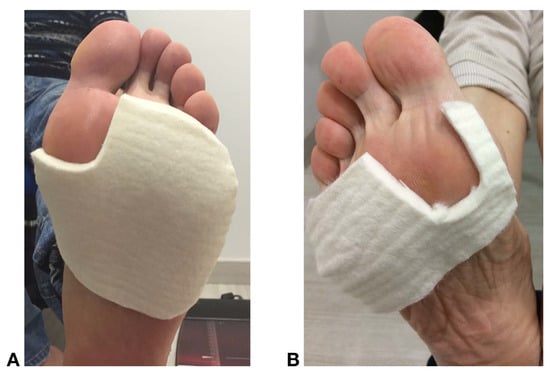
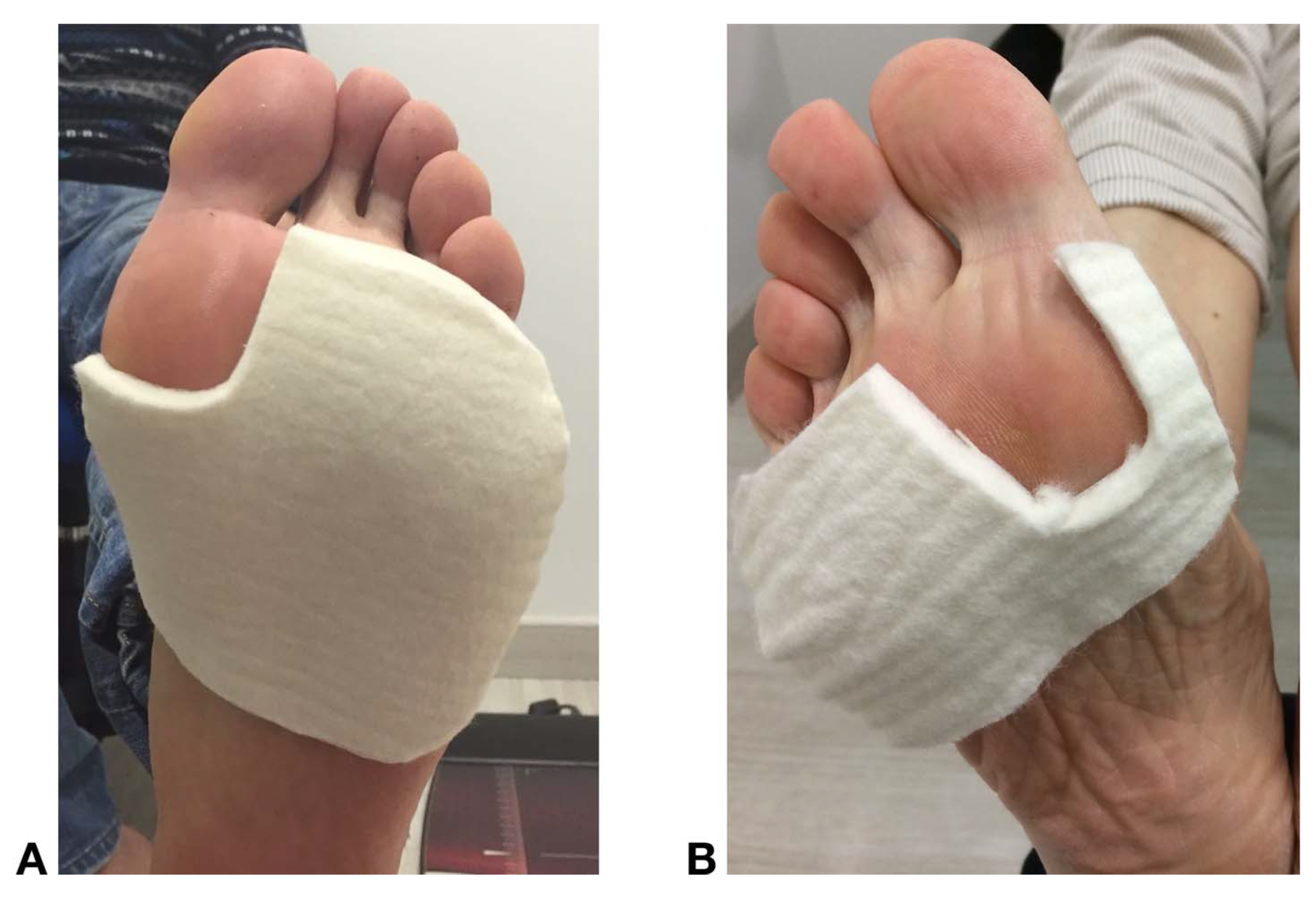
The intervention consisted of applying 5-mm semicompressed felt padding to the plantar area, consistent with other studies [14]. Two types of felt padding were tested: one with a C-shaped aperture cutout at the first metatarsophalangeal joint, to simulate an active ulcer location, and the other with a U-shaped cutout (Fig. 1). The semicompressed felt padding was adhered directly to the plantar surface of the foot. Semicompressed felt padding was selected for analysis because it is commonly used in clinical practice to off-load an area of the foot as a short-term measure.
Figure 1.
C-shaped felt padding (A) and U-shaped felt padding (B).
- Procedure
Pressure was measured at the first metatarsal head and at the central (second, third, and fourth) metatarsal heads of each foot. The test was performed according to the static foot posture before attaching the padding, immediately afterward, and after 3 days. The two designs were evaluated on different days, allowing a washout time of 1 week between one design and the other. The design used for each participant was randomized by computer software. The platform pressures were measured three times in each participant, and the mean value was taken. In the analysis of variations in foot pressure, the software divided the area of analysis into the first metatarsal head of each foot and the central metatarsal heads of each foot, obtaining the mean pressure on each foot in these areas.
- Statistical Analysis
A statistical software program (IBM SPSS Statistics for Windows, Version 23.0; IBM Corp, Armonk, New York) was used to perform the statistical calculations, applying descriptive, inferential, and normality statistical tests. The normality of the data frequency distribution was determined by the Shapiro-Wilk test. The differences between the types of padding and locations were determined by obtaining the Footwork scores three times. Between-group differences in variables at each time point were explored by analysis of covariance, using baseline data as a covariate. In the correlations and inferential proofs used, the criterion for statistical significance was P < .05. Although both feet were measured, for further statistical analysis only one foot (the right, chosen at random) was included in the statistical analyses.
Results
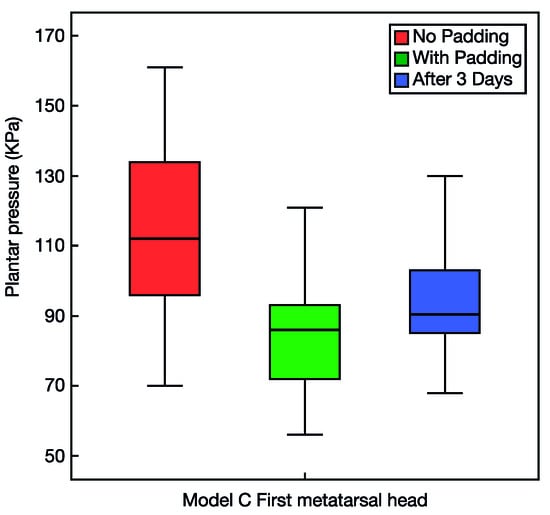
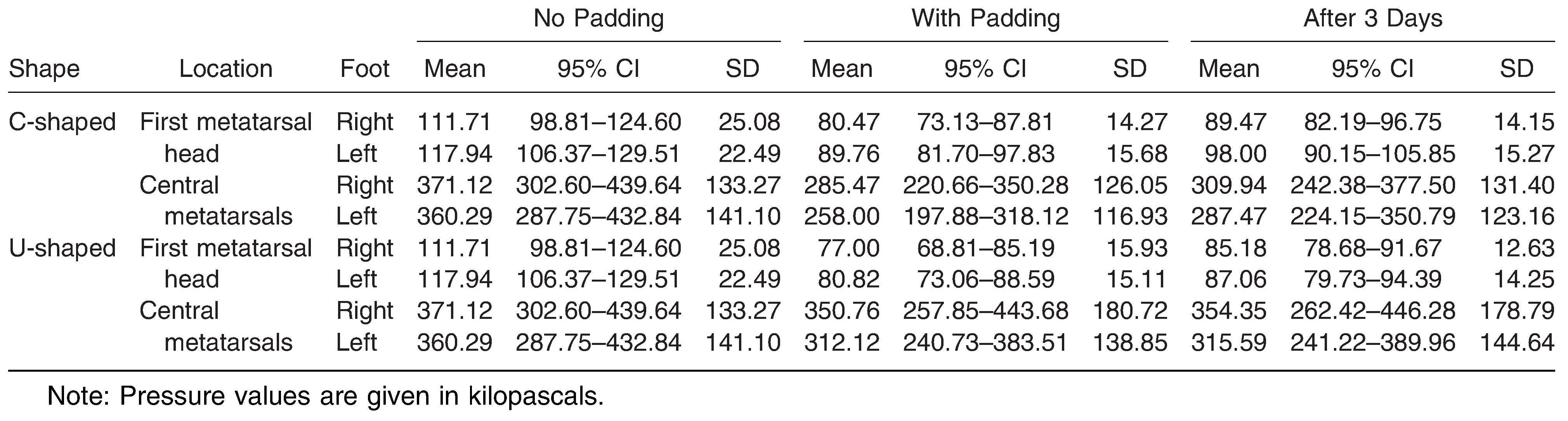
Analysis of the results for the 17 study participants showed that the mean 6 SD padding-free pressure (111.71 6 25.08 kPa in the right foot [RF] and 117.94 6 22.49 kPa in the left foot [LF]) was higher than that for each of the padding designs, both in the immediate postfitting measurement (C-shaped: 80.47 6 14.27 kPa RF and 89.76 6 15.68 kPa LF) and after 3 days (C-shaped: 89.47 6 14.15 kPa RF and 98 6 15.27 kPa LF) at the level of the first metatarsal head (Table 1). Nevertheless, the effect decreased over time (Fig. 2).
Table 1.
Pressure Values Obtained at the Three Time Points
Figure 2.
Box-and-whisker plot of changes in the first metatarsal head with C-shaped felt padding. The box represents median, lower, and upper quartiles and the lower and upper inner fence. Points represent extreme values over the upper inner fence or under the lower one.
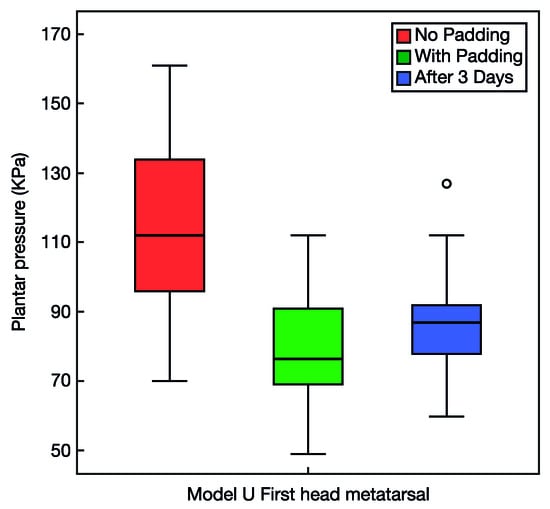
The U-shaped design presented a higher degree of pressure off-loading, both in the first measurement (77.00 6 15.93 kPa RF and 80.82 6 15.11 kPa LF) and after 3 days (85.18 6 12.63 kPa RF and 87.06 ± 14.25 kPa LF) (Table 1) (Fig. 3).
Figure 3.
Box-and-whisker plot of changes in the first metatarsal head with U-shaped felt padding. The box represents median, lower, and upper quartiles and the lower and upper inner fence. Points represent extreme values over the upper inner fence or under the lower one.
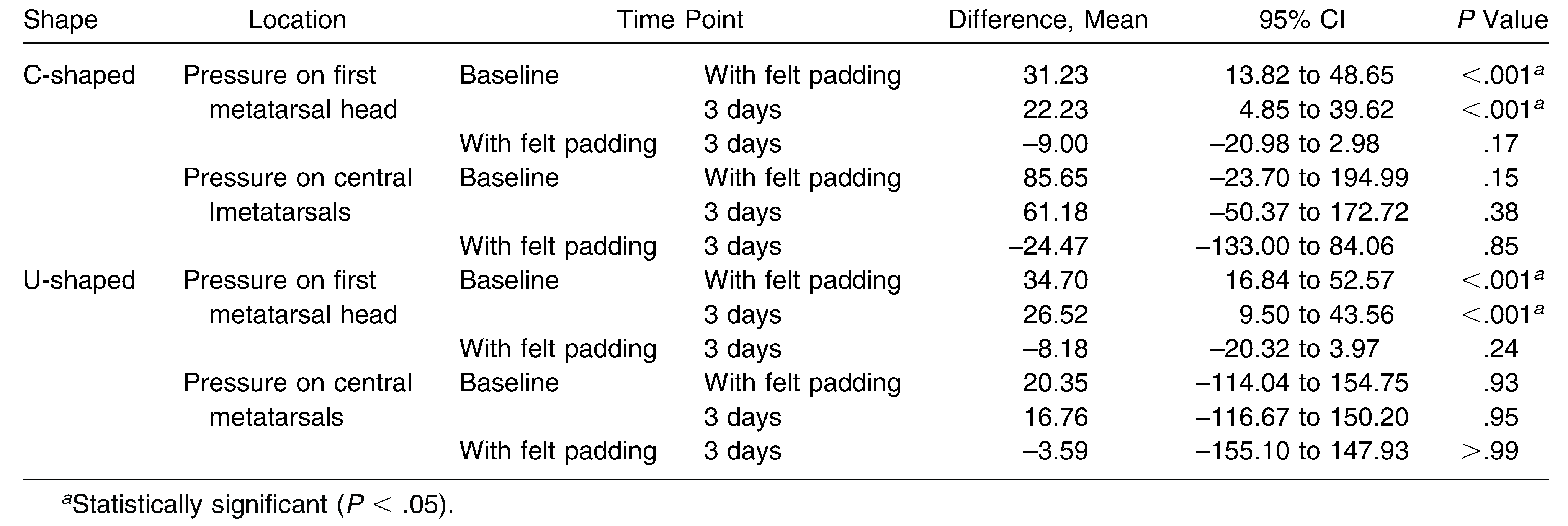
With respect to plantar pressure on the first metatarsal head, the differences were significant for C- and U-shaped padding related to time (baseline against with felt padding and 3 days later) (P < .001), but there were no significant differences between with felt padding and 3 days later (Cshaped: P = .17 and U-shaped: P = .24) (Table 2).
Table 2.
Comparison of Pressure Values at the Three Time Points
There were no significant differences between shapes (P = .95 with felt padding and P = .76 at 3 days).
Discussion
The aim of this study was to determine which type of pressure off-loading design, using felt padding, would be more effective in decreasing and distributing plantar pressures in the forefoot for the first metatarsal and central metatarsal heads. The C- and U-shaped pads for the first metatarsal head tried to decrease plantar pressure by use of a cutout, but in the central metatarsal heads, slower decrease only plantar pressure by use of a soft material such as felt padding.
The U- and C-shaped designs chosen for the analysis have been described in previous studies of pressure off-loading padding for the first metatarsal head [11,15]. According to the data obtained, plantar pressure was relieved by both padding designs, at both time points (immediately after fitting and after 3 days). However, the U-shaped design obtained a decrease in mean plantar pressure of 31.07% in the RF and 31.48% in the LF at the first measurement, notably higher than the corresponding results for the C-shaped design: 27.97% in the RF and 23.9% in the LF. After 3 days, the mean plantar pressure with U-shaped padding had increased by 8.06% in the RF and 7% in the LF compared with 7.32% (RF) and 5.29% (LF) for C-shaped padding. Nevertheless, the actual off-loading achieved with the padding was less than that reported for other devices, such as nonremovable walkers or total-contact casts, which obtain up to 87% of pressure reduction [4].
The present research findings corroborate those of Tong and Ng, [15] who reported an initial decrease in mean plantar pressure with padding of 37% over the first metatarsal head in healthy individuals, and those of Zimny et al, [10] who observed a decrease in mean plantar pressure with felted foam therapy (17.24%) in the presence of neuropathic ulcers in persons with diabetes mellitus at baseline (46.24%) and 3 days after application (29% and 30.37% respectively). Although the level of pressure offload obtained was less than in the present data, Zimny et al observed greater durability of the effect (15.87%). Note, too, that the padding used in the two studies cited exceeded 6 mm in thickness, whereas that used in the present study was only 5 mm thick, because there are studies, such as that by Curran et al, [14] that showed effectiveness to decrease plantar pressure on the first metatarsal head, although the work by Armstrong et al. [16] found that pressure at the periphery of the felt padding is increased and that this could be detrimental. The U-shaped design has been used in studies of diabetic individuals for the treatment of neuropathic ulcers, [17] with a padding thickness always greater than 5 mm; this padding is not used for the first metatarsal head but is usually the method of choice for off-loading pressure from the second to fourth metatarsal heads [18].
The present study was subject to certain limitations. The only values considered were mean plantar pressures in a standing posture with and without padding, but no account was taken of dynamics, which might enable plantar pressures to be identified for different parts of the foot and according to the gait cycle. It would be desirable to extend this study to individuals with tissue injury in a specific area of the plantar surface and, moreover, to compare the U- and C-shaped padding designs discussed herein with other means of pressure offloading, such as total-contact casts or custom insoles. In addition, more complex gait quantification should be conducted, including dynamic plantar pressures or three-dimensional kinematic measures of gait. Other methodological questions, such as a larger sample size and the incorporation of a control group, should also be considered. In short, future research in this area should take the form of a longitudinal study taking into account the previously mentioned limitations, with a larger study sample and sex homogeneity.
This study could have clinical implications for the treatment of plantar ulcers. The use of padding facilitates the redistribution of pressure throughout the foot and could be used in preventing and treating tissue injury in patients, whether special risks are present or not (such as rheumatoid arthritis, diabetes mellitus, or hypermobility of the first radius). Furthermore, the U-shaped design reduces pressure on the metatarsal head and provides greater durability.
Conclusions
The use of felt padding decreased plantar pressure on the first metatarsal, and decreased in pressure on the central metatarsals were statistically significant between baseline and both posterior measures. In healthy individuals, the U-shaped design produces a greater and longer-lasting pressure reduction than the C-shaped design.
Financial Disclosure
None reported.
Conflicts of Interest
None reported.
References
- HOWARD, IM. The prevention of foot ulceration in diabetic patients. Phys Med Rehabil Clin N Am 2009, 20, 595. [Google Scholar] [CrossRef] [Scilit] [PubMed]
- Gallego Este´ vez, R; Camp Fauli´, A; Viel i Blasco, C. Alternativas para la descarga de la u´ lcera neuropa´tica en el pie diabe´tico. Av En Diabetol 2010, 26, 457. [Google Scholar] [CrossRef] [Scilit]
- BOULTON, AJ. Pressure and the diabetic foot: clinical science and offloading techniques. Am J Surg 2004, 187, 17S. [Google Scholar] [CrossRef] [Scilit] [PubMed]
- CAVANAGH, PR; BUS, SA. Off-loading the diabetic foot for ulcer prevention and healing. JAPMA 2010, 100, 360. [Google Scholar] [CrossRef] [Scilit] [PubMed]
- BUS, SA. The role of pressure offloading on diabetic foot ulcer healing and prevention of recurrence. Plast Reconstr Surg 2016, 138, 179S. [Google Scholar] [CrossRef] [Scilit] [PubMed]
- ARMSTRONG, DG; LAVERY, LA; WU, S; et al. Evaluation of removable and irremovable cast walkers in the healing of diabetic foot wounds: a randomized controlled trial. Diabetes Care 2005, 28, 551. [Google Scholar] [CrossRef] [Scilit] [PubMed]
- CAMERON-FIDDES, V; SANTOS, D. The use of ‘‘off-the-shelf’’ foot orthoses in the reduction of foot symptoms in patients with early rheumatoid arthritis. Foot (Edinb) 2013, 23, 123. [Google Scholar] [CrossRef] [Scilit] [PubMed]
- RASPOVIC, A; LANDORF, K; GAZAREK, J; et al. Reduction of peak plantar pressure in people with peripheral neuropathy: an evaluation of the DH PressureRelief ShoeTM. J Foot Ankle Res 2012, 5, 25. [Google Scholar] [CrossRef] [Scilit] [PubMed]
- RASPOVIC, A; WALLER, K; WONG, WM. The effectiveness of felt padding for offloading diabetes-related foot ulcers, at baseline and after one week of wear. Diabetes Res Clin Pract 2016, 121, 166. [Google Scholar] [CrossRef] [Scilit] [PubMed]
- ZIMNY, S; SCHATZ, H; PFOHL, U. The effects of applied felted foam on wound healing and healing times in the therapy of neuropathic diabetic foot ulcers. Diabet Med 2003, 20, 622. [Google Scholar] [CrossRef] [Scilit] [PubMed]
- FLEISCHLI, JG; LAVERY, LA; VELA, SA; et al. Comparison of strategies for reducing pressure at the site of neuropathic ulcers. JAPMA 1997, 87, 466. [Google Scholar] [CrossRef] [Scilit] [PubMed]
- RASPOVIC, A; LANDORF, KB. A survey of offloading practices for diabetes-related plantar neuropathic foot ulcers. J. Foot Ankle Res 2014, 7, 35. [Google Scholar] [PubMed]
- HALSTEAD, J; REDMOND, AC. Weight-bearing passive dorsiflexion of the hallux in standing is not related to hallux dorsiflexion during walking. J Orthop Sports Phys Ther 2006, 36, 550. [Google Scholar] [CrossRef] [Scilit] [PubMed]
- CURRAN, MJ; RATCLIFFE, C; CAMPBELL, J. A comparison of types and thicknesses of adhesive felt padding in the reduction of peak plantar pressure of the foot: a case report. J Med Case Rep 2015, 9, 203. [Google Scholar] [CrossRef] [Scilit] [PubMed]
- TONG, JW; NG, EY. Preliminary investigation on the reduction of plantar loading pressure with different insole materials (SRP–Slow Recovery Poron, P–Poron, PPF–Poron+Plastazote, firm and PPS–Poron+Plastazote, soft). Foot (Edinb) 2010, 20, 1. [Google Scholar] [CrossRef] [Scilit] [PubMed]
- ARMSTRONG, DG; LISWOOD, PJ; TODD, WF. Potential risks of accommodative padding in the treatment of neuropathic ulcerations. Ostomy Wound Manage 1995, 41, 44. [Google Scholar] [PubMed]
- CURRAN, MJ; RATCLIFFE, C; CAMPBELL, J. A comparison of types and thicknesses of adhesive felt padding in the reduction of peak plantar pressure of the foot: a case report. J Med Case Rep 2015, 9, 203. [Google Scholar] [CrossRef] [Scilit] [PubMed]
- GATT, A; BRIFFA, A; CHOCKALINGAM, N; et al. The applicability of plantar padding in reducing peak plantar pressure in the forefeet of healthy adults: implications for the foot at risk. JAPMA 2016, 106, 246. [Google Scholar] [CrossRef] [Scilit] [PubMed]

© 2019 American Podiatric Medical Association