We describe the development and implementation of an office-based emergencies minicourse. This course was developed for and presented to the Temple University School of Podiatric Medicine class of 2012 in March 2011. A need for such training was initially identified in the fall of 2010 by the administrative leadership of Temple University School of Podiatric Medicine. The program we developed included a didactic session and four clinical skills stations targeting third-year podiatric medical students. The primary author (D.A.W.) has experience in curricular development and is involved in teaching in the preclinical and clinical curriculum at the Temple University School of Medicine. Another author (M.C.) has extensive experience in coordinating and training in standardized patient (SP) programs. The clinical portion of the curriculum used the William Maul Measey Institute for Clinical Simulation and Patient Safety, Temple University School of Medicine.
Curricular Development
The curricular development phase of this program began with a review of the medical literature. In the winter of 2010, a PubMed search of
office emergencies, office-based emergencies, office emergencies curriculum, and
office-based emergencies curriculum was initiated. We found that the general topic of office-based emergencies has been reviewed mostly in the dental and pediatric literature. [
1,
2,
3,
4,
5,
6,
7,
8,
9,
10] These articles, and those published in other specialty journals, primarily focus on the incidence of office-based emergencies in dental practice and other practice settings along with office preparedness and general recommendations for office-based emergency response equipment. [
11,
12,
13,
14,
15,
16,
17,
18] In a PubMed search, no publications were found on office-based emergencies curriculum for podiatric medical students. In fact, no published articles were found describing the development or implementation of such a curriculum. A search of MedEdPORTAL, the Association of American Medical Colleges online educational repository, identified one peer-reviewed publication focusing on using simulation to teach cardiovascular emergencies to first-year dental students. [
19] In the preparation of this manuscript, a more recent online and PubMed search of the previously mentioned terms in June 2011 yielded one additional MedEdPORTAL publication focusing on the use of simulation in teaching about the management of medical emergencies in the dental office. [
20] An extensive review of the literature did not provide us with much of a framework for developing the program. In turn, we had to consider a variety of factors as we moved forward in developing this minicourse.
One factor was who we were going to be teaching. We tailored the didactic and clinical skills station objectives to the level of a third-year podiatric medical student with limited clinical experience. Understanding your learners and teaching to their level is paramount to developing a successful program. A key to designing a curriculum such as this is to develop achievable objectives. The objectives discussed in the ‘‘Practical Implementation’’ section later herein focus primarily on reviewing certain topics and skills for the students. Early on, owing to the logistics of class size and faculty resources, we decided that the objectives for this program were not designed for assessment purposes. The goal was simply to provide a general review and furthering of an understanding of how to care for a patient presenting to the office with selected medical emergencies. However, the objectives can be modified to include assessment of certain actions or skills depending on the level of the learner.
As the structure of this minicourse began to materialize, we felt that it was also important to take into consideration the future practice environment and the scope of practice of the participants in this course. A recently published practice survey [
21] identified that half of all podiatric physicians are in solo practice and that most are employed in a suburban or urban practice setting. Because the typical office-based podiatric physician does not use moderate sedation, this minicourse did not focus on the complications and inherent issues surrounding unexpected emergencies associated with moderate sedation. The scope of practice, access to emergency response personnel, and the distance to the closest hospital emergency department may have a direct effect on the extent of emergency response equipment maintained in the office.
In deciding what topics to cover, we considered the health and medical history of the outpatient population. With an ever-aging population, it is more often the rule than the exception for patients being cared for in the outpatient setting to have medical comorbidities. Common chronic medical conditions seen in the outpatient setting include hypertension, diabetes, chronic obstructive pulmonary disease, ischemic heart disease, congestive heart failure, and cerebral vascular disease. The importance of this is that some patients cared for in the outpatient setting could experience an unexpected office emergency related to or as a complication of one or more of these preexisting medical conditions.
As we reviewed the literature, we soon realized that with the constraints of this minicourse, it was going to be impossible to create a master list of problems/conditions inclusive of all possible medical emergencies and, in turn, to develop an achievable curriculum based on such a list that could address the management of all possible scenarios. Taking this into account, we developed a draft list of key patient concerns and conditions that were believed to be high-yield items and were teachable in the context of the office-based emergencies minicourse.
The concerns/conditions were divided into two broad categories. The first category consists of iatrogenic complications/emergencies that could develop as a result of an office-based intervention or procedure: allergic reaction/anaphylaxis, bleeding, local anesthetic toxicity/adverse effects, and vasovagal syncope. The second category consists of emergencies not related to an office-based intervention or procedure: cardiac emergencies, diabetic complications, neurologic emergencies, and pulmonary emergencies. It is from these two broad categories that we moved forward and ultimately defined the curriculum. This list was refined by consensus opinion of the authors until the topics for the didactic presentation and clinical skills stations were finalized.
Logistic Considerations
In addition to the challenges of identifying topics and developing the curriculum, certain logistic issues needed to be addressed as we developed this minicourse. First, the size of the group (class of 108 students) to be taught is a limiting factor and for this program was a large determinant of the size of each group and how the clinical stations were designed. In addition to group size, faculty availability has to be factored into the equation. For this minicourse, we had four faculty members who were available to teach the clinical skills stations. The facilities/ teaching space along with the type and features of available simulation equipment will also largely dictate how the course is designed and implemented. Finally, facility and faculty fees along with the cost if an SP is incorporated into the clinical skills stations need to be considered. All of these factors played an important role in shaping the course.
Practical Implementation
For the inaugural course, we first developed a 2-hour lecture focusing on office-based emergencies. The lecture objectives were to provide background information and to serve as an introduction to the course. The main focus of the lecture was to review an approach to managing selected medical emergencies in the office setting. The presentation included a review of some topics that we believed were best delivered in this format and were not going to be covered in the clinical skills stations: allergic reaction/anaphylaxis, local anesthetic toxicity/adverse effects, and elevated blood pressure. The didactic presentation was given to the entire class approximately 1 week before the clinical skills stations. The topics covered in the didactic presentation are listed in
Table 1.
For the clinical skills stations, we divided the class of 108 students into four separate groups of 26 to 28 students. Each group was assigned to either a morning session (9 AM to noon) or an afternoon session (1–4 PM). Each group of students was further subdivided into four smaller, equal-sized groups as they rotated through the four clinical skills stations. There was one faculty member to six to seven students. The entire class completed the clinical skills stations over 2 consecutive days. A few days before the clinical skills stations, the faculty instructors met to review the objectives of each station, how the station would be taught, and the specific teaching points to be covered. On the day of the clinical skills stations, we began with an introductory presentation to the group of students before they were randomly assigned to each of the four skills stations. The presentation was brief (10– 15 min) and included the agenda for the day and some general objectives for the day’s activities, such as building on the lecture material, providing a hands-on approach to learning along with an opportunity for small group discussion, focusing on what to do when faced with selected emergencies, and allowing an opportunity to ask questions. The students rotated between each station every 30 to 35 min.
After all of the stations were completed, the students were brought back together for a brief wrap-up session. The objectives of the clinical skills stations are presented in
Table 2. Resources used for implementation of this minicourse include a conference room, a debriefing room, an SP examination room, an SP, blood pressure cuffs, stethoscopes, the Student Auscultation Manikin (Cardionics Inc, Webster, Texas), a high-fidelity simulator (SimMan; Laerdal Medical, Wappingers Falls, New York), the Laerdal Airway Management Trainer (Laerdal Medical), an automated external defibrillator trainer, a laptop computer, a dry erase board/ markers, a nasal cannula, a non-rebreather face mask, and nasopharyngeal/oral airways.
Teaching the Clinical Skills Stations
Station 1: Heart Sounds, Lung Sounds, and Blood Pressure Measurement
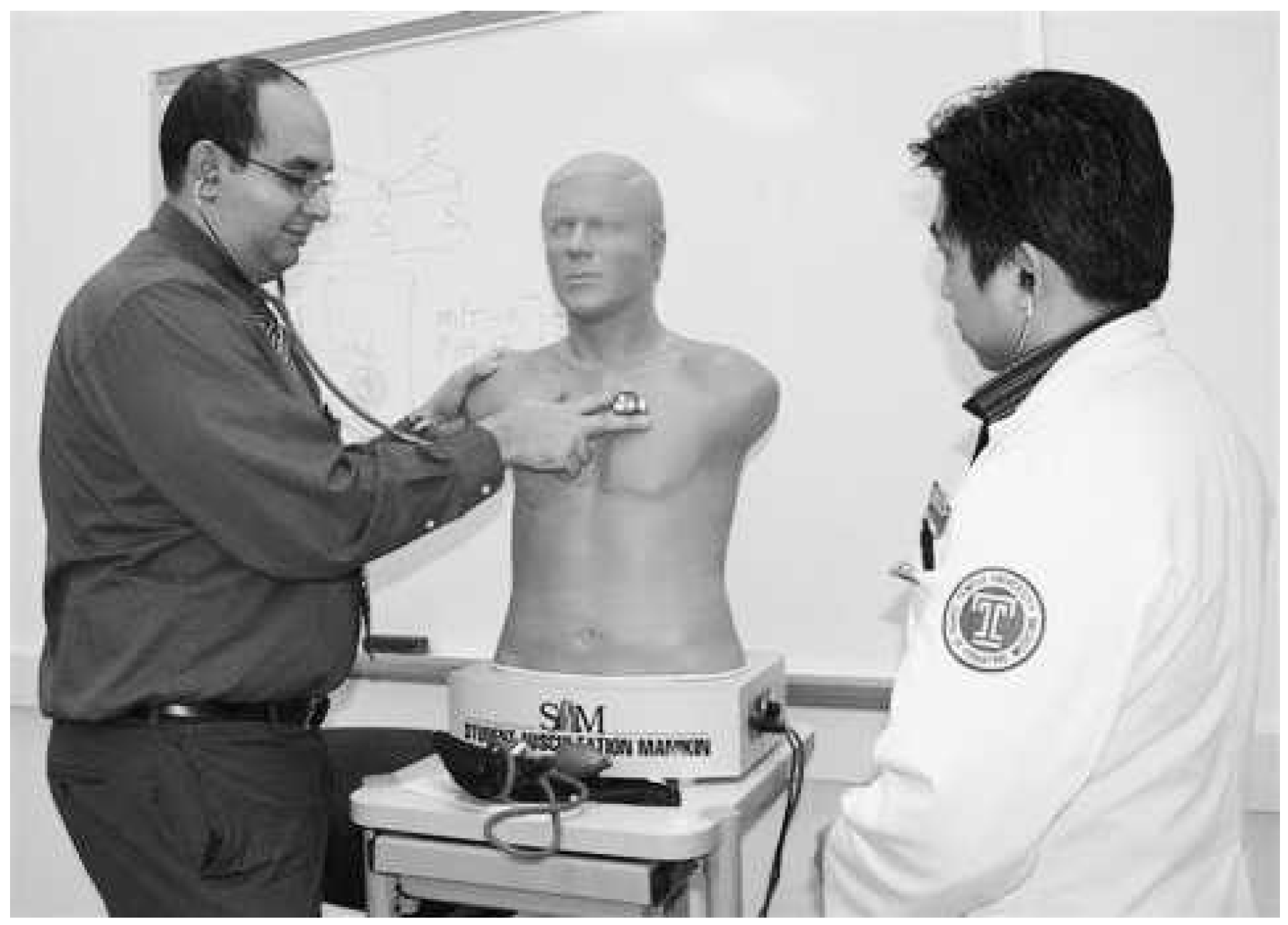
We organized this station to start with a 5-min PowerPoint presentation reviewing the techniques of cardiac and pulmonary auscultation and proper stethoscope placement. On a dry erase board, we then briefly reviewed basic cardiac anatomy as it relates to normal heart sounds and systolic and diastolic murmurs. We then paired students together to perform cardiac and pulmonary auscultation on each other; in addition, we used the Student Auscultation Manikin to demonstrate normal and adventitious breath sounds (wheezing) along with normal heart sounds and common heart murmurs, such as mitral regurgitation and aortic stenosis (
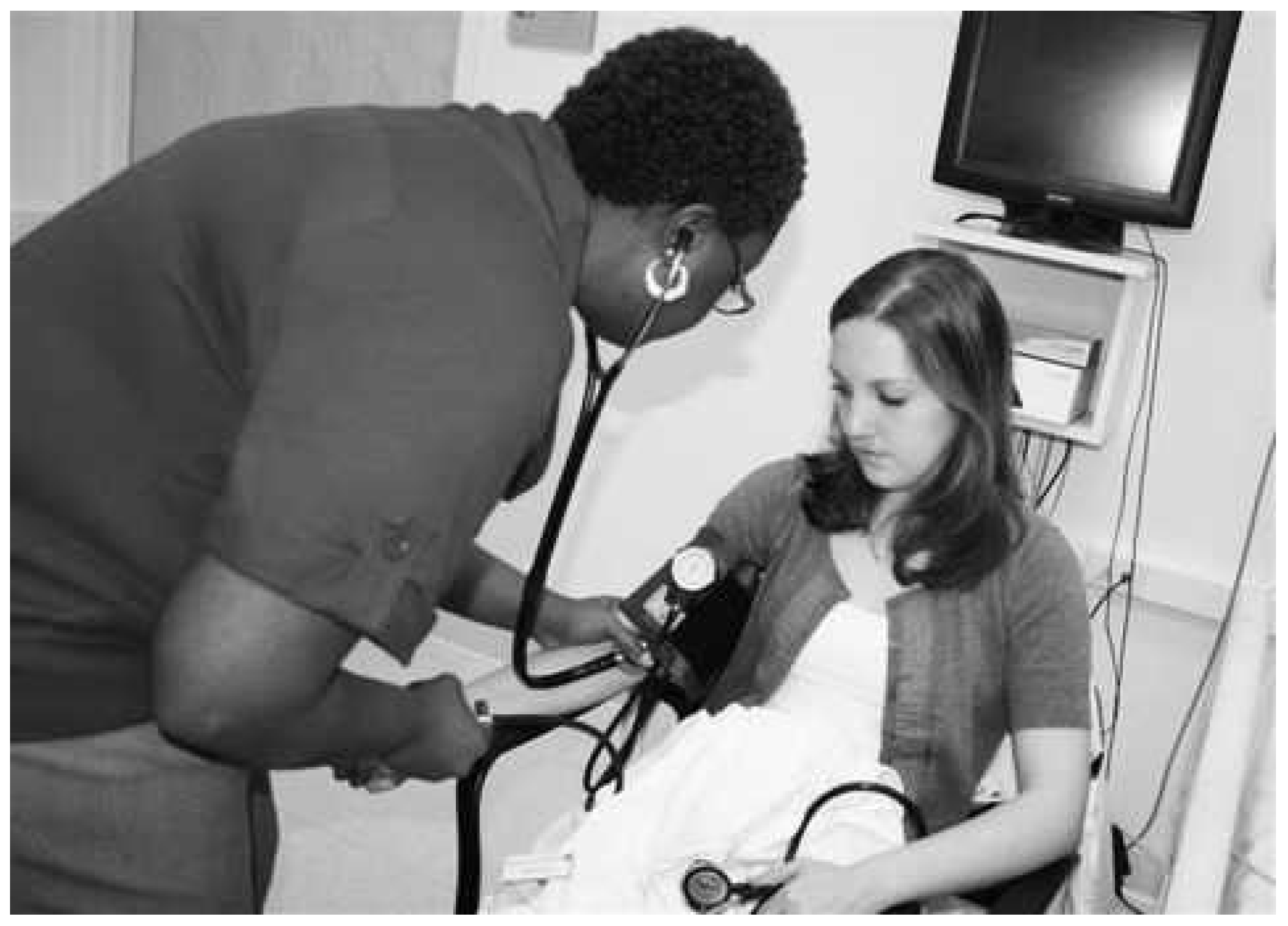
Figure 1). After the auscultation experience, a demonstration was provided on how to measure blood pressure using the palpation and auscultation methods. All of the students then had the opportunity to perform both techniques while being directly observed by a faculty member (
Figure 2). Of note, a couple of students were found to have mildly elevated blood pressure measurements. These students were referred for outpatient follow-up with their primary care physicians.
Station 2: Basic Airway Management, Chest Pain, and Shortness of Breath
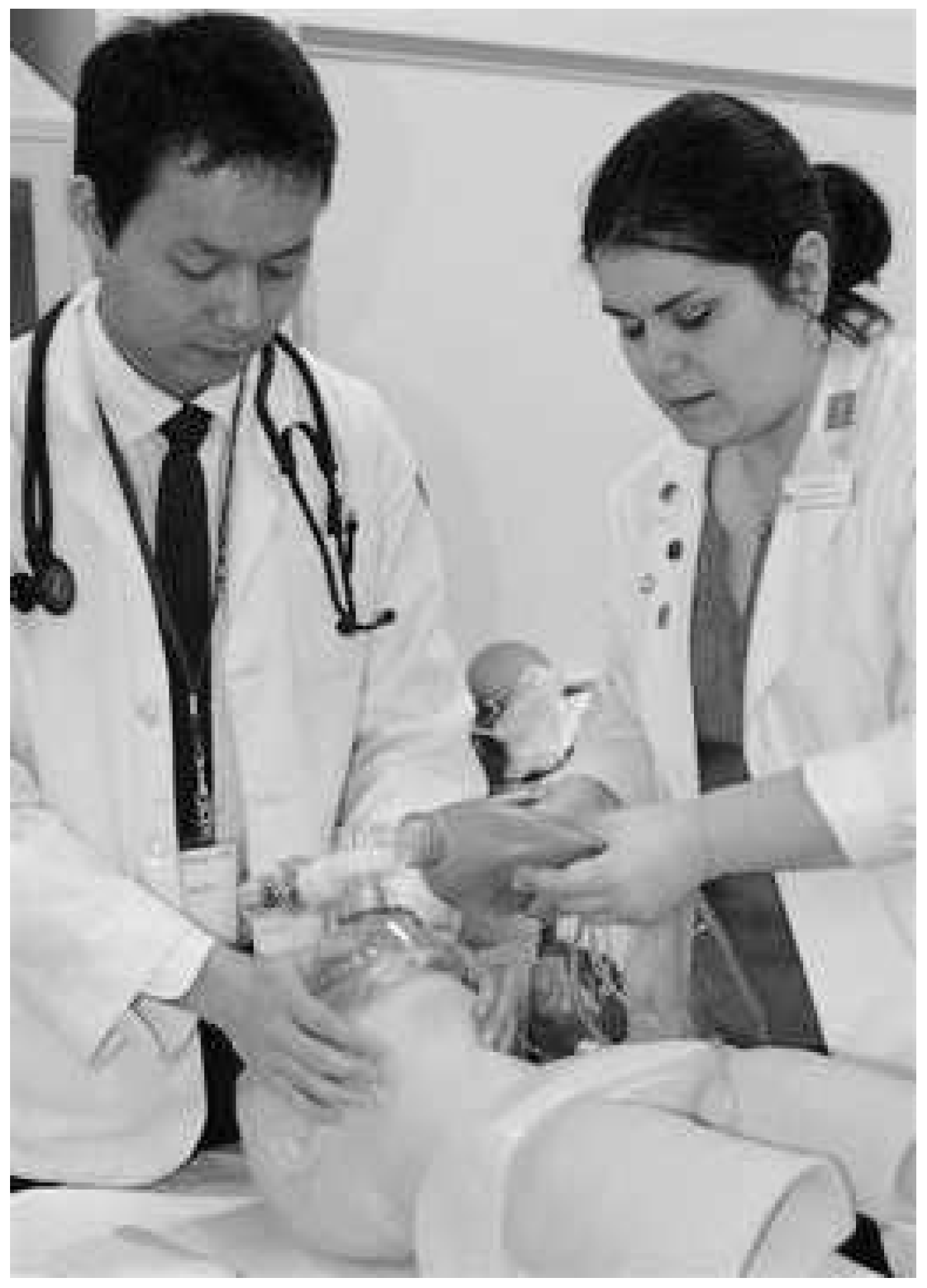
This station began with a small group discussion on airway management and oxygen delivery devices. Passive oxygen administration devices discussed in this station included the application of a nasal cannula and a non-rebreather face mask. A Laerdal Airway Management Trainer was used to allow the students to practice techniques of bag valve mask ventilation (
Figure 3). In addition, indications for use were reviewed and techniques of placement of airway adjuncts, such as nasopharyngeal and oral airways, were demonstrated. All of the students had the opportunity to use the airway trainer to apply learned techniques.
After the techniques of basic airway management were reviewed and practiced, the students were presented with a simulated patient scenario involving a patient who develops chest pain and shortness of breath during a routine office visit. For this scenario, we used a SimMan. The faculty preceptor used the remote audio capabilities from the control room of the simulation center to interact with the students while observing the scenario in real time through a one-way mirror. The faculty member played the role of the simulated patient. The scenario was designed to allow the students the opportunity to practice many of the skills that were reviewed earlier in this and other stations (application of oxygen delivery devices, listening to heart and lung sounds, and measuring blood pressure). In addition, based on the students’ performance throughout the scenario, the faculty preceptor could program SimMan to decompensate, requiring the students to start cardiopulmonary resuscitation, further reinforcing skills such as bag valve mask ventilation and chest compressions. At the conclusion of the scenario, the faculty preceptor returns to the simulation room to debrief the students and answer any questions. The debriefing session focused on the students’ performance and provided an approach to managing this type of medical emergency. A further discussion ensued regarding common causes of chest pain and shortness of breath and an approach to managing these issues in the office setting. Last, indications and contraindications for assisting patients in administering their own sublingual nitroglycerin tablets were reviewed with the students.
Station 3: Neurologic Emergencies
This station combined small group discussion with two SP encounters. Approximately 1 week before the session, the SP was provided with a brief patient script outlining two specific patient scenarios: altered mental status (hypoglycemia) and loss of consciousness (syncope). Training for the SP was conducted by one of the authors (M.C.). A few days before the session, two of the authors (D.A.W. and G.C.) met with the SP to reinforce expected behaviors and actions to portray during the student-SP encounters.
This station started with the group of podiatric medical students (6–7 students) and a faculty facilitator in the debriefing room, which is across the hall from the SP examination rooms. Two students from the group of six to seven students were selected to perform a focused history and physical examination on an SP presenting for routine foot care. The students were instructed that the SP will be role playing an office patient and that they should view themselves as the primary care giver and should approach the SP as they would any other office patient. The SP examination rooms are outfitted with audiovisual capabilities, which allow those in the debriefing room to watch and hear the student-SP encounter in real time.
For the first case, the SP portrayed a diabetic patient who was hypoglycemic. The SP exhibited anxiousness, confusion, and diaphoresis (spray bottle of water mixed with a little mineral oil) and was slow to respond to simple questions. This student-SP encounter was allowed to continue for 3 to 5 min. The students watching the encounter in the debriefing room were encouraged to make observations and critique the scenario in real time. The faculty preceptor can cut the scenario short or can extend it if needed depending on how the scenario progresses and how the students respond to the SP. At the conclusion of this encounter, the two students were brought back into the debriefing room, and a discussion ensued focusing on what behaviors were observed and the response of the students to these observations. With the entire group, the facilitator briefly discussed the scenario and outlined an approach to the management of altered mental status in addition to referring the students back to material previously covered in the lecture.
For the second student-SP encounter, we had two new students participate. The setup was the same other than the SP role played a different scenario. For this case, the SP portrayed a patient who has a syncopal episode approximately 30 sec into the encounter. Because of time constraints, this student-SP encounter was allowed to continue for approximately 4 to 5 min. This case focused on the student’s response to an abrupt change in the patient’s condition. At the conclusion of the scenario, the two students were brought back into the debriefing room for a more in-depth discussion emphasizing aspects of the management of neurologic emergencies, such as seizures, stroke, syncope, and altered mental status associated with hypoglycemia. Care is also taken by the faculty member to emphasize material that has been, or will be, covered in other stations (attention to airway, breathing, and circulation).
This station has built-in flexibility allowing for variable group dynamics and opportunities for discussion. In most groups, there is time for a third student-SP encounter. In this final scenario, two new students are given the opportunity to apply the approach outlined in the group discussion. The third scenario is a repeat of the first case (hypoglycemia). This approach can help further solidify the material covered in the session rather than developing and presenting a third case. After this final encounter, the group is brought together for a final questionanswer session and a brief summary with takeaway points. This station provides students with the opportunity to participate in a realistic emergency scenario simulating the stress and uncertainty of an acute event in an office setting.
Station 4: Cardiopulmonary Resuscitation
This station started with a brief review and interactive discussion (5 min) of the lecture material pertaining to cardiopulmonary resuscitation. The faculty preceptor then reviewed the basic principles and technique of adult cardiopulmonary resuscitation based on the 2010 American Heart Association guidelines. [
22] Students were also provided with a brief tutorial for using a semiautomatic external defibrillator, including the proper application of the defibrillator pads. Emphasis was placed on the American Heart Association ‘‘chain of survival’’: early access, early cardiopulmonary resuscitation for the victim of sudden cardiac arrest, early defibrillation, and early advanced cardiac life support by prehospital care providers.
After the initial review and discussion, the students were divided into two groups, and a simulated patient encounter of an acute coronary syndrome was depicted. Each group was presented with a simulated patient scenario using SimMan and had to respond to the emergency depicted. The faculty preceptor role played the simulated patient from the control room. This station also used the remote audio capabilities of the simulation center to interact with the students while observing the scenario in real time through a one-way mirror. The students were not assigned individual roles (team leader, team member) during the scenario, allowing the students an opportunity to self-select their own group leader and work out the group dynamics among themselves.
After completing the scenario, the faculty preceptor debriefed the students on their performance. Positive and constructive feedback was provided. For consistency, a similar scenario was repeated for the second group of students. At the conclusion of the second case, a final debriefing session ensued. The discussion focused on recognition of the unresponsive patient, early activation of the 911 emergency response system, performing high-quality cardiopulmonary resuscitation, and early application of an automated external defibrillator. Students were also encouraged to develop an emergency response plan when they began each scenario and to focus on how they would involve other office personnel when responding to an office emergency.
Summary
The design and implementation of an office-based emergencies curriculum is achievable. Universally, the students reported that the minicourse was an educational and valuable experience, achieved the learning objectives, and better prepared them for handling office-based emergencies. Targeting the objectives to the level of the learner and factoring in class size and resources such as faculty availability and simulation facilities will all play a role in designing and implementing such a program at a different institution. Keeping this in mind, the objectives of this course and the course itself can easily be modified for different-level learners: fourth-year students, podiatric medical residents, and attending physicians or learners in other disciplines.