Article

Trade Specialization and Export Risk Exposure in Central Asia: A Multi-Index Assessment of Mineral, Chemical, Textile and Metallurgical Sectors (2017–2024)


1
Faculty of International Relations, Al-Farabi Kazakh National University, Almaty 050040, Kazakhstan
2
Higher School of Economics and Management, Turan University, Almaty 050013, Kazakhstan
3
Department of World Economy and World Finance, Faculty of International Economic Relations, Financial University under the Government of the Russian Federation, 125993 Moscow, Russia
*
Author to whom correspondence should be addressed.
J. Risk Financial Manag. 2026, 19(5), 359; https://doi.org/10.3390/jrfm19050359
Submission received: 2 April 2026 / Revised: 2 May 2026 / Accepted: 12 May 2026 / Published: 15 May 2026

Abstract

This study assesses export concentration risk in four Central Asian economies (Kazakhstan, Kyrgyzstan, Tajikistan, and Uzbekistan) by examining trade specialization patterns in 31 mineral, chemical, textile, and metallurgical product groups over 2017–2024. Using a multi-index framework based on Revealed Symmetric Comparative Advantage (RSCA), Relative Trade Advantage (RTA), and the Lafay Index (LI), the paper distinguishes structurally embedded competitive advantages from export signals that are weak, import-dependent, or potentially transient. The revised analysis adds explicit data consistency checks, a clarified classification rule, and robustness tests based on sign concordance, majority-index rules, and RSCA-only thresholds. The results show that Central Asia’s risk profile is highly persistent but heterogeneous: Tajikistan is exposed to extreme single-commodity risk in aluminium and cotton-related segments; Kazakhstan remains vulnerable to mineral-fuel concentration and energy-price volatility; Uzbekistan has broader but still labour-intensive textile specialization; and Kyrgyzstan shows ambiguous competitiveness that may partly reflect re-export and transit-related trade. Fully competitive product groups are confined mainly to resource- and labour-intensive activities, while chemicals and technologically complex manufacturing remain non-competitive across the region. The findings support risk-differentiated policy responses, including commodity-price hedging, counter-cyclical stabilization tools, downstream processing, textile upgrading, and regional value-chain development.

1. Introduction

The relationship between export structure and macroeconomic vulnerability has long been a central concern in international finance and development economics. For resource-dependent economies, a narrow export base concentrated in primary commodities and low-value-added goods amplifies exposure to external shocks, including commodity price volatility, geopolitical disruptions, and sudden changes in global demand (Costinot et al., 2012; Siggel, 2006). Central Asia—comprising Kazakhstan, Kyrgyzstan, Tajikistan, and Uzbekistan—presents a particularly instructive case. Despite relatively robust economic growth in recent years (OECD, 2025), the region’s export structure remains heavily concentrated in mineral, textile, and metallurgical products, with limited industrial diversification and persistently low intra-regional trade shares (Eurasian Development Bank, 2022; Yusupov, 2025).
This apparent paradox—high growth alongside persistent structural fragility—raises a fundamental question regarding the sustainability of existing export specialization patterns and their associated risk profiles. As Hinloopen and van Marrewijk (2001) demonstrate, observed trade flows may reflect not only genuine cost advantages but also policy-induced distortions, re-export chains, or temporary geopolitical arrangements. In Central Asia, recent developments have intensified these risks: following 2022, re-export flows from Kyrgyzstan to Russia reached up to 80% of its exports, while remittances accounted for over 50% of Tajikistan’s GDP, creating substantial exposure to secondary sanctions and external volatility (Barisitz, 2025).
Against this background, the present study addresses the following research question: To what extent do Central Asian economies exhibit sustainable (as opposed to transient) competitive advantages in international trade, and how can these advantages be assessed as sources of export concentration risk? To guide the empirical analysis, we formulate three hypotheses linking the alignment of trade indices to export concentration risk, sectoral specialization patterns, and intra-regional diversification.
Unlike previous studies that focus on single-country evidence or broad sectoral aggregates (Lücke & Rothert, 2006; Das, 2018; Bozduman & Erkan, 2022), this paper provides a harmonized, product-level assessment of export risk exposure across four Central Asian economies. This study makes three main contributions to the literature. First, it operationalizes export concentration risk through the joint use of RSCA, RTA, and LI: RSCA captures the strength of revealed export specialization, RTA tests whether this specialization remains after import dependence is considered, and LI evaluates whether the product group contributes positively to the trade balance. Second, the paper links the alignment and misalignment of these indices to risk categories, thereby distinguishing durable competitiveness from temporary export surges, re-export effects, and import-dependent positions. Third, it translates the empirical taxonomy into country-specific risk-management recommendations, including hedging instruments, fiscal stabilization, downstream processing, and regional value-chain diversification. This framing is relevant not only for trade policy but also for investors, creditors, and sovereign-risk analysts because narrow export bases can amplify exchange-rate volatility, commodity-price exposure, and financing costs.
The remainder of this paper is structured as follows. Section 2 reviews the theoretical and empirical literature on comparative advantage and export risk. Section 3 describes the data and the multi-index methodology (RSCA, RTA, and LI). Section 4 presents the empirical results, classification, and robustness checks. Section 5 discusses the risk-management implications. Section 6 concludes with policy implications, limitations, and avenues for future research.

2. Literature Review

To address the empirical puzzle and methodological challenges outlined above, it is necessary to revisit the theoretical foundations of comparative advantage and critically assess the existing empirical literature that has sought to operationalize these concepts in the context of Central Asia. From a theoretical perspective, this analysis is grounded in the concept of comparative advantage, a cornerstone of international trade theory since the work of Ricardo (1817). Its further development within the neoclassical tradition is associated with the factor endowment model, initially formulated by Heckscher (1949), advanced by Ohlin (1933), and formalized by Samuelson (1948). While this framework explains the general patterns of specialization and gains from trade, it provides limited guidance for identifying which specific sectors or product groups countries should specialize in. As noted by Lücke and Rothert (2006), comparative advantage theory lacks normative prescriptions regarding sectoral specialization. Consequently, identifying actually realized, rather than theoretically potential, specialization requires systematic empirical analysis based on post-trade data. The challenge, however, lies in the fact that observed trade flows may reflect not only underlying factor endowments but also policy interventions, historical path dependence, and temporary market conditions (Costinot et al., 2012).
To address this challenge, a large body of empirical literature has relied on the Revealed Comparative Advantage index introduced by Balassa (1965). R C A measures the intensity of a country’s export specialization in a given product relative to the world average, with values above unity indicating the presence of a comparative advantage. Its simplicity and transparency have made it the most widely used indicator in international trade research (Sanidas & Shin, 2010). In the context of Central Asia, early applications by Lücke and Rothert (2006) identified specialization patterns rooted in factor prices, transport costs, and historical production structures. Subsequent studies have extended this line of inquiry. For instance, Das (2018) employed R C A to assess export specialization across the region, confirming the persistent dominance of commodities and low-processing goods. More recently, Taghiyev (2025) applied RCA at a highly disaggregated level to Kyrgyzstan’s fruit and vegetable exports, demonstrating the index’s capacity to differentiate between stable and volatile competitive positions within narrow product categories.
Despite its widespread use, the RCA index suffers from several well-documented limitations that are particularly salient for resource-dependent economies. First, as Siggel (2006) emphasizes, R C A does not distinguish between natural advantages (stemming from technological efficiency or factor endowments) and acquired advantages (resulting from subsidies, tariffs, or non-tariff barriers). Second, Hinloopen and van Marrewijk (2001) highlight the static nature of the index, which captures specialization at a given point in time but fails to reflect structural dynamics. Third, the original RCA is asymmetric, ranging from zero to infinity, which complicates intertemporal and cross-country comparisons. To address the latter issue, Dalum et al. (1998) proposed the Revealed Symmetric Comparative Advantage ( R S C A ), which transforms R C A into a symmetric scale from −1 to +1, where positive values unambiguously signal comparative advantage. This transformation has gained traction in recent Central Asian studies. Bułkowska (2025), for example, used R S C A to assess the competitiveness of Polish agri-food exports to the region, demonstrating its utility for cross-country benchmarking. Moreover, as Mirzaei et al. (2012) argue, R S C A is particularly valuable for detecting instability in export specialization—a critical feature for economies where trade patterns may be volatile due to external shocks or policy shifts. In a similar vein, Tang et al. (2026) recently employed R S C A as a mid-range indicator within a multi-index framework, integrating it with trade balance and market share measures to assess the sustainability of export competitiveness.
An additional limitation of both R C A and R S C A is their exclusive focus on exports, which can be misleading in contexts where imports play a significant role in shaping trade outcomes. For small open economies with high re-export activity or intra-firm trade, a purely export-based measure may overstate genuine competitiveness. To address this, Vollrath (1991) proposed the Relative Trade Advantage ( R T A ) index, which subtracts an import-based measure from the export-based R C A , thereby capturing net trade advantages. Positive R T A values indicate that a country’s export specialization exceeds its import dependence, providing a more balanced assessment. However, as Ballance et al. (1987) and Fertő and Hubbard (2003) demonstrate, R C A and R T A can yield inconsistent signals for the same product groups, underscoring the need for additional verification through alternative indicators. This inconsistency is particularly relevant for Central Asian economies, where trade patterns are often shaped by complex re-export chains and informal economic linkages.
A further step toward capturing the structural depth of comparative advantages is offered by the Lafay Index ( L I ) , introduced by Lafay (1992). Unlike R C A and R T A , L I incorporates both export and import flows while controlling for intra-industry trade and cyclical fluctuations. It calculates a weighted measure of the contribution of each product group to the overall trade balance, with positive values indicating sustained competitive advantages. The L I has proven especially useful in analyzing post-Soviet economies. Ortikov et al. (2022) applied L I in combination with the Trade Balance Index and product mapping techniques to assess Uzbekistan’s agricultural trade, revealing a concentrated specialization in low-value-added products. Benešová et al. (2020) employed L I within a multi-dimensional framework that included cluster analysis and multidimensional scaling to classify product groups across post-Soviet countries, demonstrating the index’s capacity to capture structural stability amid geopolitical turbulence. Similarly, Rasekhi et al. (2021) combined L I with RCA and trade similarity indices to quantify unrealized trade potential between Iran and CIS countries, showing that positive L I values correspond to substantial latent trade capacities. These applications underscore the diagnostic value of L I , though, as Zaghini (2003) and Alessandrini et al. (2007) caution, its sensitivity to the chosen time horizon necessitates careful interpretation, particularly when analyzing short-term fluctuations.
Despite the growing sophistication of empirical work on Central Asian trade, several interconnected gaps remain. Existing studies are predominantly country-specific (Taghiyev, 2025 for Kyrgyzstan; Stephens & Tajekeev, 2023 for Uzbekistan; Bozduman & Erkan, 2022 for Kazakhstan) or rely on aggregated sectoral data that obscure product-level heterogeneity (Lücke & Rothert, 2006; Das, 2018). Moreover, most analyses employ only one or two indices, typically R C A or its symmetric variant, without systematically integrating import-adjusted measures or controlling for intra-industry trade. There is also a notable lack of comparative multi-country studies based on harmonized national statistics that cover the post-pandemic period and the recent geopolitical upheavals. Even in studies that adopt more refined methodologies, such as Ortikov et al. (2022) or Stephens and Tajekeev (2023), the analytical focus remains on a single country, and the combination of indices is not fully exploited to classify product groups by sustainability.
The limitations identified in the existing literature point to the need for a more comprehensive analytical framework that integrates multiple indices within a unified classification scheme. Such an approach has been advanced by Erokhin et al. (2020), who developed a five-stage methodology for assessing competitiveness in Central Asian agri-food value chains. Their framework sequentially applies R C A , R T A , and L I , followed by a classification of products into four categories—fully competitive, marginally competitive, conditionally competitive, and non-competitive—based on the alignment of index values. This multi-index approach enables researchers to move beyond simple identification of specialization toward a nuanced evaluation of the stability, depth, and underlying drivers of comparative advantages. By integrating export-based measures with import-adjusted indicators and controlling for intra-industry trade, such a framework offers a more robust basis for policy recommendations aimed at fostering regional integration and export diversification.
This study builds directly on these methodological advances. By applying the multi-index framework of Erokhin et al. (2020) to four Central Asian economies across key mineral, chemical, textile, and metallurgical product groups, it provides the first systematic comparative analysis of sustainable competitive advantages in the region using harmonized post-pandemic trade data. In doing so, it addresses the gaps identified in the existing literature and offers an empirically grounded foundation for differentiated trade policies that can strengthen intraregional value chains and enhance economic resilience.
In addition to the traditional trade literature, recent contributions in financial economics have emphasized the role of export concentration as a source of idiosyncratic country risk. A narrow export base increases the volatility of foreign exchange earnings, reduces the effectiveness of monetary policy, and amplifies the impact of external demand shocks (Alessandrini et al., 2007; Zaghini, 2003). For emerging economies, high product-level concentration is associated with lower credit ratings and higher sovereign spreads (Mirzaei et al., 2012). The Lafay Index, in particular, has been used to assess the contribution of individual product groups to trade balance stability, making it directly relevant for risk assessment (Lafay, 1992; Benešová et al., 2020). ElHajj and Hammoud (2023), published in this journal, demonstrated how artificial intelligence and machine learning can mitigate financial risks in trading and risk management; however, the structural risk arising from persistent export concentration—particularly in resource-dependent regions such as Central Asia—remains underexplored. This study extends this line of inquiry by applying a risk-based classification to Central Asian export structures, thereby complementing the existing literature on financial risk mitigation with a focus on structural trade vulnerabilities.
The theoretical implication for the present study is that comparative advantage should not be interpreted as a purely static export-ranking concept. In resource-dependent and transit-oriented economies, a positive export signal may reflect natural endowments, policy-induced distortions, logistics advantages, re-export chains, or short-lived geopolitical rerouting. For this reason, the empirical strategy treats competitiveness as robust only when export specialization, net trade position, and contribution to the trade balance point in the same direction. This interpretation connects the classical trade literature with financial-risk analysis by treating persistent specialization as both a source of income generation and a potential channel of macro-financial vulnerability.
Based on the literature, we formulate:
H1. 
Product groups with aligned positive RSCA, RTA, and LI values exhibit lower export concentration risk.
H2. 
Resource- and labour-intensive sectors are more likely to demonstrate sustainable comparative advantages than technology-intensive sectors in Central Asia.
H3. 
Persistent comparative advantages are negatively associated with intra-regional trade diversification.

3. Materials and Methods

3.1. Symmetric Transformation of Comparative Advantage: RSCA Index

The first step of the empirical strategy is to calculate the Revealed Comparative Advantage (RCA) index for four Central Asian countries—Kazakhstan, Kyrgyzstan, Tajikistan, and Uzbekistan—across 31 product categories classified according to the Commodity Nomenclature of Foreign Economic Activity/Harmonized System codes (25, 26, 27, 28, 29, 39, 50–63, and 72–76, 78–83). RCA is used because it is transparent, comparable across countries, and directly linked to the revealed-trade tradition in the literature. Since the original RCA is asymmetric and difficult to compare over time and across countries, the symmetric Revealed Symmetric Comparative Advantage (RSCA) transformation is used in the main tables. Average RSCA values for 2017–2024 are reported in Table 1.
The standard formulas used for the calculation of these indices are provided below.
R C A i j = E x p o r t i j E x p o r t i n E x p o r t c a j E x p o r t c a n                                                           R S C A i j = R C A 1 R C A + 1
where, i —denotes the Central Asian country under consideration, j —represents a specific product classified according to the corresponding code of the Commodity Nomenclature of Foreign Economic Activity and exported to global markets, n —refers to the set of all exported products across the full range of commodity codes supplied to all trading partners, and c a —denotes the aggregate of the four Central Asian countries. As is well established, positive values of the R S C A index indicate the presence of a comparative advantage, whereas negative values imply its absence. Hinloopen and van Marrewijk (2001) propose a classification of Revealed Comparative Advantage (RCA) values, according to which values in the range of 0 to 1 indicate no comparative advantage, values between 1 and 2 reflect weak comparative advantages, values between 2 and 4 correspond to moderate comparative advantages, and values exceeding 4 indicate strong comparative advantages. The transformation of these thresholds into the symmetric R S C A scale suggests that values in the range of 0 to 0.333 correspond to weak comparative advantages, values between 0.333 and 0.6 indicate moderate comparative advantages, and values exceeding 0.6 reflect strong comparative advantages.

3.2. Assessing Net Trade Advantage: RTA Index

The second step introduces the Relative Trade Advantage (RTA) index. This indicator is included because an export-only measure can overstate competitiveness in small open economies where imports, transit trade, and re-export activities are important. RTA adjusts export specialization for the corresponding import position and therefore provides a net-trade interpretation of comparative advantage. In the context of Central Asia, this is particularly important for product groups where positive export signals may coexist with high dependence on imported intermediate or final goods.
R T A i j = E x p o r t i j E x p o r t i n E x p o r t c a j E x p o r t c a n I m p o r t i j I m p o r t i n I m p o r t c a j I m p o r t c a n
where i —denotes the Central Asian country under consideration, j —represents a product corresponding to a specific code in the Commodity Nomenclature of Foreign Economic Activity exported to the markets of all trading partner countries, n —refers to the set of all exported products across all relevant commodity codes supplied to all partners, and, c a —denotes the aggregate of the four Central Asian countries. Positive values of the R T A index indicate the presence of relative trade advantages, reflecting the extent to which a country’s export specialization exceeds its import dependence for the corresponding product group. Conversely, negative values signify a predominance of the import component and the formation of relative trade disadvantages. Unlike the R C A index, which considers only export flows, the R T A index provides a more balanced assessment of a country’s foreign trade position by incorporating the import component. This feature is particularly important for the Central Asian countries under study, which exhibit high dependence on imported intermediate and final goods.
It should be noted that an R T A value close to zero indicates the absence of pronounced trade advantages or disadvantages, whereas an increase in the absolute value of the index reflects the strengthening of the respective specialization. Therefore, the combined use of the R T A index with the R S C A indicator allows for a more comprehensive evaluation of the structure and sustainability of foreign trade advantages.

3.3. Assessing Trade Concentration: Lafay Index

The third step uses the Lafay Index (LI) to assess whether a product group contributes positively or negatively to a country’s overall trade balance. LI is included because it captures the structural trade-balance role of each product group rather than only its relative export intensity. This makes it useful for risk assessment: a product group may show revealed export specialization, but if it does not generate a positive trade-balance contribution, its ability to reduce external vulnerability is limited.
The calculation of the index was performed using the following formula:
L I i j = 100 · [ E x p o r t i j I m p o r t i j E x p o r t i j + I m p o r t i j j = 1 N ( E x p o r t i j I m p o r t i j ) j = 1 N ( E x p o r t i j + I m p o r t i j ) ] · E x p o r t i j + I m p o r t i j j = 1 N ( E x p o r t i j + I m p o r t i j )
where i —denotes the Central Asian country under consideration, j —represents a product according to the code of the Commodity Nomenclature of Foreign Economic Activity, and N —refers to the set of all exported and imported products across the relevant commodity codes. The economic interpretation of the index is based on the sign and magnitude of the obtained values. Positive L I values indicate the presence of competitive advantages and reflect the contribution of the corresponding product group to a positive trade balance. Conversely, negative values signal relative non-competitiveness and dependence on imports for the given product. It should be noted that the absolute value of the index reflects the intensity of the trade advantage or disadvantage, whereas values close to zero indicate a balance between export and import flows. Therefore, the use of the Lafay Index in conjunction with the R S C A and R T A indicators provides a more comprehensive understanding of the structure and character of foreign trade specialization in the four Central Asian countries.

3.4. Ranking Based on Competitiveness Indicators

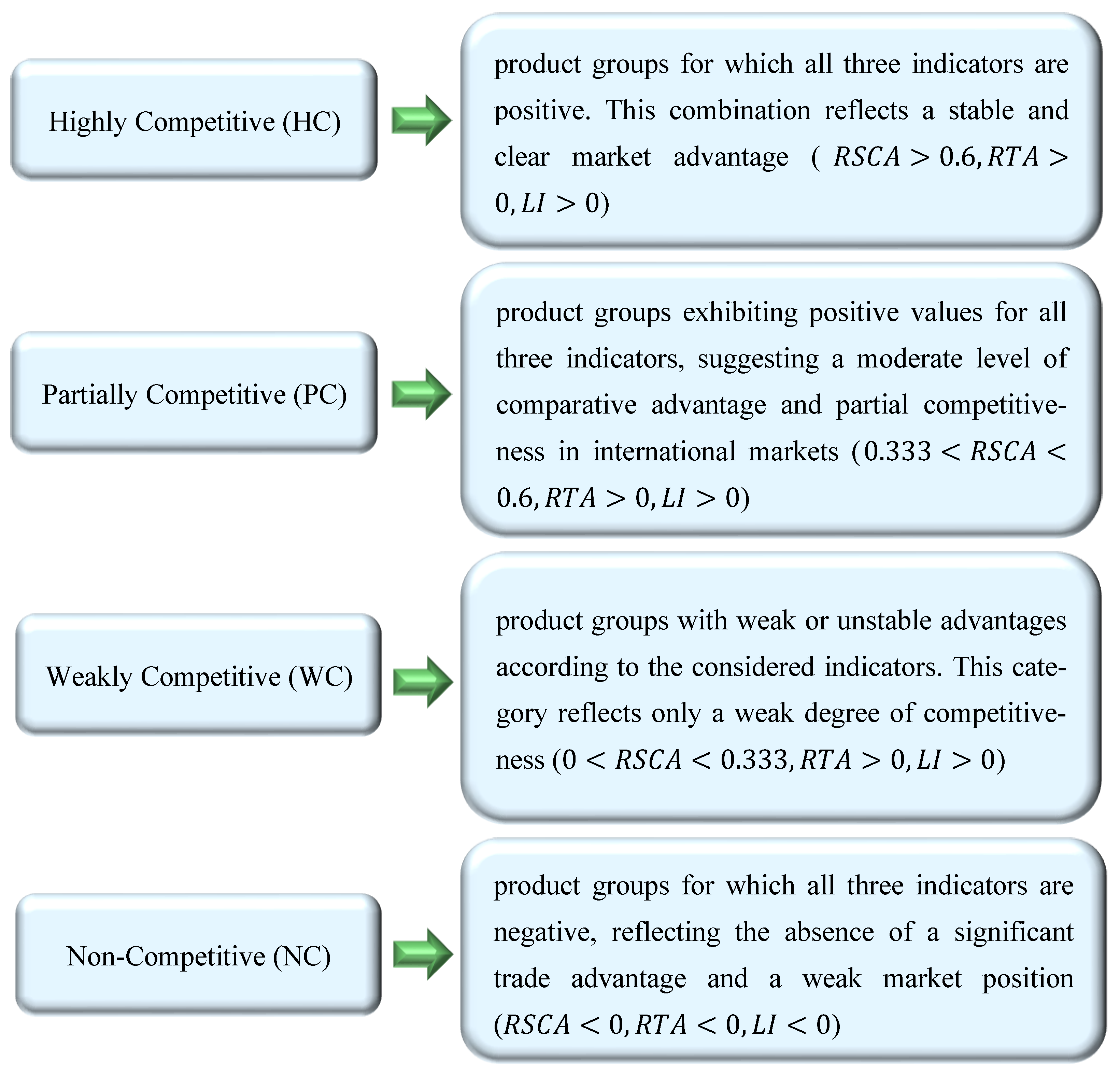
The trade competitiveness and risk classification of product groups were assessed by combining the sign and the strength of RSCA with the direction of RTA and LI. This clarification is important because a product can have positive net-trade and trade-balance indicators but still represent only weak competitiveness if the RSCA value is close to zero. The baseline rule is therefore defined as follows: highly competitive (HC) product groups have strong RSCA values (RSCA > 0.6) together with positive RTA and LI; partially competitive (PC) groups have moderate RSCA values (0.333 < RSCA < 0.6) and positive RTA and LI; weakly competitive (WC) groups have weak RSCA values (0 < RSCA < 0.333) and at least one supporting positive net-trade or trade-balance indicator; and non-competitive (NC) groups have no sustainable evidence of competitiveness, typically because RSCA is negative and/or the import-adjusted and trade-balance indicators are negative. The classification algorithm is summarised in Figure 1. Product groups with mixed or ambiguous signals across RSCA, RTA, and LI remain unclassified and are marked by a dash.

3.5. Data Harmonization and Consistency Checks

The empirical dataset combines national statistical sources for Kazakhstan, Kyrgyzstan, Tajikistan, and Uzbekistan with UN Comtrade cross-checks. All product groups were harmonized to the selected HS/CN FEA categories before calculating the indices. Product labels were standardized across national classifications, export and import flows were checked for sign consistency, and country-product observations with unusually large changes were compared with UN Comtrade mirror data where available. The final calculations use average values for 2017–2024 to reduce the influence of single-year shocks, including the COVID-19 disruption and the post-2022 redirection of trade flows. This averaging strategy improves comparability but is treated as a limitation because it can smooth important annual dynamics.
The consistency checks followed three steps. First, product codes were matched across national and international sources to avoid mixing HS categories with different commodity coverage. Second, export and import values were screened for missing observations, zero flows, and extreme outliers relative to each country’s total trade. Third, the signs of RSCA, RTA, and LI were compared to identify cases where export-side specialization was not supported by net-trade or trade-balance evidence. Such cases were interpreted cautiously and were not classified as fully competitive.

3.6. Robustness Strategy and Alternative Specifications

To address the sensitivity of index-based classifications, the revised study applies three robustness checks. The first check is a strict sign-concordance rule, under which a product group is considered robust only when RSCA, RTA, and LI are all positive. The second check is a majority-index rule, under which products with two positive indicators are treated as having a potential but not fully confirmed advantage. The third check is an RSCA-only threshold specification, which tests whether the export-specialization signal alone would change the country-level conclusions. These checks do not establish causality, but they test whether the main risk taxonomy is driven by a single indicator or by consistent evidence across alternative specifications.
Additional details are available in the Supplementary Materials.

4. Results: Evidence from Central Asian Countries

The results presented in Table 1 reveal a pronounced differentiation of comparative advantages among the Central Asian countries across key product groups, including mineral, chemical, textile, and metallurgical goods, for the period 2017–2024. The R S C A value structure indicates that comparative advantages exhibit a distinctly sectoral character and vary substantially across countries. Within the mineral goods group, Tajikistan demonstrates the most pronounced comparative advantages. For product categories such as salt, sulfur, stone and building materials, as well as ores, slag, and ash, R S C A values exceed 0.6, indicating strong comparative advantages. Kazakhstan shows only weak comparative advantages for select mineral resource categories, whereas Kyrgyzstan and Uzbekistan display negative index values for most of the analyzed items. In the mineral fuels category, none of the countries demonstrate significant comparative advantages, although Kazakhstan shows a slight positive value, while the remaining countries exhibit persistent comparative disadvantages.
In the chemical products group, comparative advantages are notably weaker. Kazakhstan exhibits only weak comparative advantages in inorganic and organic chemistry, whereas Kyrgyzstan, Tajikistan, and Uzbekistan generally record negative R S C A values. Exceptions include plastics and related products, where Kyrgyzstan displays weak comparative advantages, and Uzbekistan demonstrates moderate advantages, thereby forming a more diversified industrial export structure.
The most pronounced specialization among Central Asian countries is observed in the textile products group. Uzbekistan, in particular, shows sustained moderate to strong comparative advantages across almost all textile product categories, including silk, cotton, synthetic fibers, carpets, knitted fabrics, and ready-made garments, with R S C A values for several items exceeding 0.6, indicating a well-established export specialization. Tajikistan also demonstrates strong comparative advantages in cotton and non-knitted garments, while Kyrgyzstan exhibits strong advantages in wool and woolen products, as well as in non-knitted apparel. Conversely, Kazakhstan shows persistent comparative disadvantages across almost all textile product categories. In the metals and metal products group, the most pronounced comparative advantages are similarly concentrated in specific Central Asian countries. Tajikistan exhibits strong comparative advantages in aluminum and other non-ferrous metals, as well as in other basic metals. Uzbekistan demonstrates moderate comparative advantages in copper, nickel, and zinc, reflecting the gradual development of export specialization in the metallurgical sector. Kyrgyzstan shows weak comparative advantages for certain metals and metal products, whereas Kazakhstan demonstrates either weak comparative advantages or comparative disadvantages across most of the analyzed items.
The results presented in Table 2 further confirm the significant cross-country differentiation of relative trade advantages among the four Central Asian countries. The distribution of R T A values reflect a highly uneven formation of trade specialization in the region and a pronounced sectoral orientation of the export positions of individual countries.
Within the mineral products group, Tajikistan exhibits the highest relative trade advantages. For product categories such as salt, sulfur, stone and building materials, as well as ores, slag, and ash, R T A values reach very high levels, indicating pronounced export specialization and a substantial excess of exports over imports in these positions. Kazakhstan demonstrates moderate relative trade advantages in mineral fuels, as well as in salt, sulfur, stone, and building materials, whereas Kyrgyzstan and Uzbekistan record negative index values for most positions within the mineral products group.
In the chemical products group, sustained relative trade advantages are limited. Positive R T A values are observed for Kazakhstan in organic chemicals, for Kyrgyzstan in plastics and organic chemical products, and for Uzbekistan in plastics, where the index reaches relatively high levels. At the same time, Tajikistan displays negative values for most analyzed positions, indicating a marked import dependence in the chemical sector.
The most pronounced trade specialization among the four Central Asian countries is observed in the textile products group. As expected, Uzbekistan demonstrates consistently high R T A values across almost all textile product categories, including silk, cotton, synthetic fibers, carpets, knitted fabrics, and ready-made garments. Particularly high index values are observed for cotton, carpets, knitted fabrics, and ready-made clothing, confirming the country’s well-established export specialization in the textile industry. Tajikistan also exhibits very high R T A values for cotton and selected apparel items, indicating strong specialization in specific segments of textile exports. Kyrgyzstan records high index values for wool, synthetic fibers, and selected apparel, reflecting a narrow but stable trade specialization within the textile sector. Conversely, Kazakhstan, as expected, displays negative R T A values across most textile product positions and does not possess significant trade advantages in this group.
In the metals and metal products group, the highest relative trade advantages are concentrated in Tajikistan. Particularly high index values are recorded for aluminum, lead, and other primary metals, demonstrating the country’s strong export specialization in specific segments of the non-ferrous metallurgy sector. Kyrgyzstan exhibits positive index values for a number of metals and metal products, including nickel, lead, tools, and other basic metal items, indicating the formation of moderate trade specialization. Uzbekistan shows positive R T A values for copper, nickel, and zinc, gradually strengthening its positions in selected metallurgical export segments. Kazakhstan demonstrates negative index values for most metallurgical products, with the exception of iron and steel, where moderate relative trade advantages are observed.
According to the results presented in Table 3, Kazakhstan’s most pronounced specialization is associated with mineral fuels. The index value for this category far exceeds those of the other Central Asian countries, reflecting the dominant role of the fuel and energy sector in the country’s foreign trade. Positive values are also observed for ores, slag and ash, as well as for iron, steel, and copper. This structure indicates a predominance of raw material–oriented exports and a relatively weak role of processing industries, particularly in the textile and chemical sectors, where most product positions exhibit negative index values.
Tajikistan is characterized by a narrower but relatively stable specialization structure. The highest index values are observed for aluminum and cotton, where indicators significantly surpass the levels of other Central Asian countries. Positive values are also recorded for ores and building materials, as well as for certain types of metals. This configuration reflects the concentration of competitive advantages in a limited number of product categories and limited diversification of the export structure. Uzbekistan’s foreign trade structure displays a broader set of positive index values. The most notable competitive positions are concentrated in the textile industry, primarily in cotton, knitted fabrics, ready-made garments, and selected other textile products. Additional positive values are observed for copper and zinc, as well as for mineral fuels, although the level of specialization in these categories is considerably lower compared to the textile sector. This structure indicates a gradual expansion of sectoral specialization and a more balanced distribution of foreign trade advantages. In contrast, Kyrgyzstan exhibits a substantially more moderate specialization pattern. Positive index values are observed for ores, cotton, copper, and certain types of apparel; however, their magnitude remains comparatively low and does not form a stable sectoral dominance. In the chemical and textile industries, most product positions show negative values, indicating limited competitive positions within the processing sectors.
The analysis of the classification of product groups by competitiveness levels across the four Central Asian countries (see Table 4) revealed substantial inter-country differentiation, driven by sectoral specialization and the structure of foreign trade. Within the mineral products category, Kazakhstan exhibits predominantly weak competitiveness across key positions, including energy resources and construction materials, whereas Tajikistan demonstrates strong competitiveness in ores, slag, and mineral raw materials, reflecting the export orientation of its extractive sector. Meanwhile, Uzbekistan falls into the non-competitive category for most mineral positions, and Kyrgyzstan occupies an intermediate position, exhibiting weak competitiveness in selected raw materials. Further analysis of the chemical industry indicates a dominance of non-competitive positions across all examined countries, reflecting limited development of processing industries and a low level of integration into global value chains. The absence of product groups with high or moderate competitiveness in this sector underscores technological lag and dependence on imports of complex chemical products.
Shifting focus to the textile sector reveals more pronounced specialization among certain countries, with Tajikistan and Uzbekistan showing high competitiveness in cotton, as well as in several finished textile products, including garments and carpets. Kyrgyzstan stands out with high competitiveness in knitted apparel, confirming the development of its garment industry and its orientation toward the export of finished products with relatively high added value. Conversely, Kazakhstan falls into the non-competitive category for nearly all textile positions, reflecting weak diversification and limited development of this sector. At the same time, Kyrgyzstan’s weak competitiveness in selected textile products reflects the transitional nature of its textile industry. The examination of metallurgical products complements the overall picture, showing that Kazakhstan maintains weak competitiveness in ferrous metals while simultaneously exhibiting non-competitive positions in non-ferrous metals, including aluminum and nickel. Tajikistan demonstrates high competitiveness in aluminum and other base metals, associated with the presence of specialized production capacities. Uzbekistan is largely characterized by non-competitive positions in metallurgy, with only a few segments showing weak competitiveness, such as copper and zinc. Kyrgyzstan displays limited representation, maintaining weak competitiveness in only a few metals, for instance, lead.
Comparing results across all product groups indicates that high competitiveness in the examined Central Asian countries is concentrated primarily in raw material–intensive and labor-intensive sectors, whereas processing and technologically complex industries remain largely non-competitive. This structure underscores the continued raw material orientation of these economies and highlights the need for deeper industrial diversification to enhance the resilience of foreign trade.
More importantly, the results show that the risk interpretation depends on the alignment of the indices rather than on any single index value. Where RSCA is positive but RTA or LI is weak or negative, the product group should be interpreted as an export-side signal rather than a stable competitive advantage. This distinction is especially relevant for Kyrgyzstan, where some apparel and synthetic-fibre positions look stronger under export-based measures but are less convincing once import dependence and trade-balance contribution are considered. Conversely, Kazakhstan’s mineral fuels generate a very large LI value but only a weak RSCA value, indicating that the sector is central to the trade balance while still representing a concentrated and commodity-price-sensitive form of specialization rather than broad industrial competitiveness.
The classification in Table 4 should therefore be read as a risk taxonomy rather than only as a competitiveness ranking. HC products represent comparatively lower export-risk positions because their export specialization, net-trade position, and trade-balance contribution are mutually supportive and the RSCA signal is strong. PC products have a moderate but not fully dominant advantage. WC products are elevated-risk positions because they show only weak revealed specialization or incomplete support from the other indices. NC products are high-risk or import-dependent positions, while unclassified products require cautious interpretation because the indices do not point in a sufficiently consistent direction.

Robustness Checks

The robustness checks confirm that the main country-level conclusions are not driven by a single indicator. Under the strict sign-concordance rule, the most robust competitive positions remain concentrated in Tajikistan’s aluminium, ores, cotton, and selected base metals; Uzbekistan’s cotton, silk, knitted fabrics, garments, carpets, and other textile products; and a limited number of raw-material or low-processing products in Kazakhstan and Kyrgyzstan. Under the majority-index rule, additional weak or emerging advantages appear, but they do not alter the core risk profile: chemicals remain broadly non-competitive, technologically complex manufacturing is absent, and durable advantages remain concentrated in resource- and labour-intensive sectors.
The RSCA-only threshold specification produces a broader list of apparent export advantages, especially in textiles and selected metals. However, several of these signals are not supported by RTA or LI. This confirms the value of the multi-index design: relying only on export shares would overstate competitiveness in re-export-sensitive or import-dependent segments. The conclusion that Central Asia’s export risk exposure is structurally concentrated therefore remains robust across the alternative classification rules.

5. Discussion

The risk-based classification in Table 4 shifts the interpretation of the results from a descriptive ranking of sectors to a structural-risk assessment. The central finding is that Central Asian competitiveness is not evenly distributed across the production chain. It is concentrated either at the upstream resource stage, where countries are exposed to global commodity cycles, or in labour-intensive textile segments, where margins and upgrading capacity are limited. This pattern is consistent with factor-endowment theory, but it also reveals a risk-management problem: the same specializations that generate export revenues can amplify vulnerability when they are narrow, carbon-intensive, or dependent on a small number of destination markets.
Tajikistan represents the clearest case of single-commodity and narrow-sector risk. Aluminium, cotton, ores, and selected base metals display strong index alignment, but this strength is concentrated in a small number of product groups. Such a structure can stabilize export revenues when global prices are favourable, yet it also exposes the country to aluminium-price cycles, energy-cost shocks, and transition risks linked to carbon-intensive smelting. From a risk-management perspective, the priority is not only to diversify away from aluminium but also to move along the value chain into aluminium-based components, semi-finished products, and industrial inputs. Commodity-price hedging may reduce short-term revenue volatility, while downstream industrial policy can reduce long-term concentration risk.
Kazakhstan’s profile is different: the dominant risk is not a single manufacturing commodity but fuel-based dependence. Mineral fuels generate a large trade-balance contribution, yet the competitiveness classification remains weak because the revealed specialization is narrow and highly sensitive to oil prices, transport routes, and decarbonization policies. The theoretical implication is that natural-resource advantage does not automatically translate into diversified competitiveness. Practical policy measures should therefore combine counter-cyclical fiscal rules and sovereign-wealth-fund stabilization with investment in petrochemicals, fertilizers, and other downstream activities that can transform energy endowments into higher-value and less volatile export streams.
Uzbekistan shows a more diversified but still vulnerable pattern. Its positive signals are concentrated across several textile categories, including cotton, silk, carpets, knitted fabrics, and garments. This lowers single-product risk compared with Tajikistan, but the country remains exposed to labour-cost pressures, cotton-price movements, water constraints, and demand shifts in low- and medium-value textile markets. The main policy implication is to shift from volume-based textile exports toward higher-value apparel, branded products, technical textiles, and chemical-textile linkages, supported by certification, design capabilities, and logistics improvements.
Kyrgyzstan remains the most ambiguous case. Some textile and metal categories show positive export-side signals, but the alignment across RSCA, RTA, and LI is weaker than in the more robust cases. This suggests that part of the observed advantage may be connected to transit, re-export, or temporary geopolitical rerouting rather than deeply embedded production capacity. The policy priority is therefore to reduce regulatory and sanctions-related risks by improving customs transparency, documenting origin, strengthening domestic processing, and supporting firms that can demonstrate genuine value added rather than pass-through trade.
Taken together, these four country profiles illustrate a spectrum of export risk exposure in Central Asia, ranging from extreme single-commodity dependence (Tajikistan) and energy price vulnerability (Kazakhstan) to moderate labour-intensive concentration (Uzbekistan) and transient, re-export-driven advantages (Kyrgyzstan). The common thread across all four economies is the absence of competitiveness in technologically complex sectors—particularly chemicals and sophisticated manufacturing—which remain non-competitive in every country. This structural feature, also noted by Lücke and Rothert (2006) and Das (2018) in earlier studies, limits the region’s ability to move up the value chain and to diversify export risk. Consequently, the findings underscore the need for differentiated policy responses tailored to each country’s specific risk profile, while also highlighting the potential for regional cooperation to exploit complementarities—for instance, between Uzbekistan’s textiles and Kazakhstan’s energy and chemical inputs—as a means to build more resilient intra-regional value chains.
The findings provide support for H1 (product groups with aligned positive indices exhibit lower risk) and H2 (resource- and labour-intensive sectors dominate sustainable advantages), while H3 (negative association between persistent advantages and intra-regional diversification) is partially supported given the low intra-regional trade shares observed.

Policy Implications for Hedging and Diversification

The empirical taxonomy translates into differentiated policy instruments. Product groups with strong aligned advantages require risk-hedging and value-chain upgrading rather than simple expansion. Weak or ambiguous positions require verification of domestic value added before they are used as the basis for industrial policy. Non-competitive but strategically important sectors require selective capability building, especially where they can support downstream diversification. The linkage between each country’s risk profile and recommended policy measures is summarised in Table 5.

6. Conclusions

This study assessed the sustainability of trade specialization in Central Asia as a proxy for export concentration risk. The multi-index framework shows that the region’s strongest advantages are not distributed across technologically complex sectors but remain concentrated in resource-intensive and labour-intensive product groups. This pattern confirms that revealed comparative advantage can be simultaneously a source of export revenue and a channel of macro-financial vulnerability.
The main conclusions are country-specific. Kazakhstan faces fuel-related concentration risk and requires mechanisms that transform energy revenues into diversified industrial capacity. Tajikistan has the highest single-commodity exposure, especially through aluminium and cotton-related segments. Uzbekistan has a broader textile portfolio, but its competitiveness remains concentrated in labour-intensive and relatively low-value-added activities. Kyrgyzstan’s results are less stable across indices, indicating that re-export and transit effects may partly obscure genuine production-based competitiveness.
The policy message is therefore risk-differentiated. For strongly specialized commodity exporters, diversification should not only mean adding new sectors; it should also mean hedging price risk, building fiscal buffers, and expanding downstream processing. For textile-oriented exporters, the priority is value-chain upgrading through certification, design, branding, and technical textiles. For ambiguous or re-export-sensitive positions, governments should first verify domestic value added and strengthen compliance systems before promoting the sector as a competitive advantage. At the regional level, linking Kazakhstan’s energy and chemical inputs with Uzbekistan’s textile capacity and Tajikistan’s metallurgical base could reduce dependence on extra-regional partners and create more resilient value chains.

6.1. Limitations

This study has several limitations that should be considered when interpreting the results. First, the analysis covers 31 selected product groups and therefore does not capture all possible competitive niches; a more disaggregated HS-6 analysis may identify narrower opportunities that are hidden at the HS-2 or HS-4 level. Second, the use of average values for 2017–2024 improves comparability but can smooth annual shocks, including the pandemic period and the post-2022 redirection of trade flows. Third, country-level data are uneven in coverage and reporting quality, especially for re-exports and mirror trade, which may affect the interpretation of Kyrgyzstan’s and, to a lesser extent, Uzbekistan’s results. Fourth, the sectoral focus on mineral, chemical, textile, and metallurgical goods excludes services, agriculture outside the selected HS codes, and higher-technology manufacturing segments. Fifth, the study is diagnostic rather than causal: the indices identify patterns of specialization and risk exposure, but they do not estimate the macroeconomic effect of shocks on output, exchange rates, fiscal balances, or sovereign spreads.

6.2. Future Research Directions

Future research should extend the analysis in four directions: (1) use annual panel data and dynamic econometric models to test the persistence and determinants of competitiveness; (2) apply HS-6 data to identify hidden niches within broad sectors; (3) integrate carbon intensity, water use, logistics costs, and exchange-rate volatility to connect trade specialization with transition and macro-financial risks; and (4) compare intra-regional and extra-regional trade flows to determine whether Central Asian value chains are genuinely deepening or whether the observed patterns mainly reflect external demand and transit shocks.

Supplementary Materials

The following supporting information can be downloaded at: https://www.mdpi.com/article/10.3390/jrfm19050359/s1.

Author Contributions

A.O. conceptualized the overall study and prepared the manuscript; A.A. (Akimzhan Arupov) revised the manuscript draft and performed data analysis; M.A. conducted the interpretation of results; A.A. (Azizam Arupova) and V.A. contributed to the discussion of findings and the formulation of the study’s conclusions. Additionally, all authors jointly participated in discussing the findings and refining the conclusions. All authors have read and agreed to the published version of the manuscript.

Funding

This research is funded by the Science Committee of the Ministry of Science and Higher Education of the Republic of Kazakhstan (Grant No. AP26101487, “Development of Sustainable Competitive Advantages of the Republic of Kazakhstan in Central Asia in the Context of New Economic Challenges”).

Institutional Review Board Statement

Not applicable.

Informed Consent Statement

Not applicable.

Data Availability Statement

The trade data used in this study were obtained from national statistical sources of Kazakhstan, Kyrgyzstan, Tajikistan, and Uzbekistan, as well as from the UN Comtrade database. All sources are cited in the references (NSCKR, 2026; SRCMFRK, 2026; ASUPRT, 2026; NSCRU, 2026; UN Comtrade, 2026). The aggregated indices (RSCA, RTA, LI) presented in the tables are available from the corresponding author upon reasonable request.

Conflicts of Interest

The authors declare no conflicts of interest.

References

  1. Alessandrini, M., Fattouh, B., & Scaramozzino, P. (2007). The changing pattern of foreign trade specialization in Indian manufacturing. Oxford Review of Economic Policy, 23(2), 270–291. [Google Scholar] [CrossRef]
  2. ASUPRT. (2026). Agency on statistics under the President of the Republic of Tajikistan: Analytical tables. Available online: https://www.stat.tj/en/analytical-tables/ (accessed on 29 March 2026).
  3. Balassa, B. (1965). Trade liberalization and revealed comparative advantage. The Manchester School of Economic and Social Studies, 33, 99–123. [Google Scholar] [CrossRef]
  4. Ballance, R., Forstner, H., & Murray, T. (1987). Consistency tests of alternative measures of comparative advantage. The Review of Economics and Statistics, 69(1), 157–161. [Google Scholar] [CrossRef]
  5. Barisitz, S. (2025). Robust growth in Central Asia 2019–2024: In the face of uncertainties, the pandemic and protracted war in the neighborhood. OeNB Occasional Paper No. 10. Available online: https://www.econstor.eu/bitstream/10419/312865/1/1915165792.pdf (accessed on 8 March 2026).
  6. Benešová, I., Smutka, L., Hinke, J., & Laputková, A. (2020). Competitiveness of mutual agrarian foreign trade of the post-Soviet countries. E&M Economics and Management, 23(3), 49–66. [Google Scholar] [CrossRef]
  7. Bozduman, T., & Erkan, B. (2022). Analysis of product concentrations of fragile economies. International Journal of Disciplines Economics & Administrative Sciences Studies, 8(46), 680–686. [Google Scholar] [CrossRef]
  8. Bułkowska, M. (2025). Competitiveness of Polish agri-food exports in Central Asia in 2019–2023. Annals of the Polish Association of Agricultural and Agribusiness Economists, 27(2), 9–22. [Google Scholar] [CrossRef]
  9. Costinot, A., Donaldson, D., & Komunjer, I. (2012). What goods do countries trade? A quantitative exploration of Ricardo’s ideas. Review of Economic Studies, 79(2), 581–608. [Google Scholar] [CrossRef]
  10. Dalum, B., Laursen, K., & Villumsen, G. (1998). Structural change in OECD export specialization patterns: De-specialization and ‘stickiness’. International Review of Applied Economics, 12(3), 447–467. [Google Scholar] [CrossRef]
  11. Das, R. U. (2018). The Central Asian Republics. In The Asia-Pacific trade agreement (pp. 209–264). United Nations. [Google Scholar] [CrossRef]
  12. ElHajj, M., & Hammoud, J. (2023). Unveiling the influence of artificial intelligence and machine learning on financial markets: A comprehensive analysis of ai applications in trading, risk management, and financial operations. Journal of Risk and Financial Management, 16(10), 434. [Google Scholar] [CrossRef]
  13. Erokhin, V., Diao, L., & Du, P. (2020). Sustainability-related implications of competitive advantages in agricultural value chains: Evidence from Central Asia–China trade and investment. Sustainability, 12(3), 1117. [Google Scholar] [CrossRef]
  14. Eurasian Development Bank. (2022). The economy of Central Asia: A fresh perspective. Available online: https://eabr.org/upload/iblock/1fe/EDB_2022_Report-3_The-Economy-of-CA_eng.pdf (accessed on 10 March 2026).
  15. Fertő, I., & Hubbard, L. J. (2003). Revealed comparative advantage and competitiveness in Hungarian agri-food sector. The World Economy, 26(2), 247–259. [Google Scholar] [CrossRef]
  16. Heckscher, E. F. (1949). The effect of foreign trade on the distribution of income. In Readings in the theory of international trade (pp. 272–300). Blakiston Co. [Google Scholar]
  17. Hinloopen, J., & van Marrewijk, C. (2001). On the empirical distribution of the Balassa index. Weltwirtschaftliches Archiv, 137(1), 1–35. [Google Scholar] [CrossRef]
  18. Lafay, G. (1992). The measurement of revealed comparative advantages. In M. G. Dagenais, & P. A. Plunet (Eds.), International trade modelling (pp. 209–236). Chapman & Hall. [Google Scholar]
  19. Lücke, M., & Rothert, J. (2006). Central Asia’s comparative advantage in international trade. Kiel Institute for the World Economy. Available online: https://www.files.ethz.ch/isn/48177/kepp06.pdf (accessed on 19 March 2026).
  20. Mirzaei, F., Mostafavi, S. M., & Yazdani, S. (2012). Export comparative advantage analysis of Iranian hen egg by RCA and RSCA criteria. Modern Economy, 3, 553–556. [Google Scholar] [CrossRef][Green Version]
  21. NSCKR. (2026). National Statistical Committee of the Kyrgyz Republic: Foreign and mutual trade of goods. Available online: https://stat.gov.kg/ru/publications/vneshnyaya-i-vzaimnaya-torgovlya-tovarami-kyrgyzskoj-respubliki/ (accessed on 29 March 2026).
  22. NSCRU. (2026). National Statistics Committee of the Republic of Uzbekistan: Foreign economic activity. Available online: https://stat.uz/en/official-statistics/merchandise-trade (accessed on 29 March 2026).
  23. OECD. (2025). Enhancing the competitiveness of the Trans-Caspian transport corridor in Central Asia. OECD Publishing. Available online: https://www.oecd.org/en/publications/enhancing-the-competitiveness-of-the-trans-caspian-transport-corridor-in-central-asia_f261e7fa-en.html (accessed on 11 March 2026).
  24. Ohlin, B. (1933). Interregional and international trade. Harvard University Press. Available online: https://ia902909.us.archive.org/17/items/in.ernet.dli.2015.112870/2015.112870.Interregional-And-International-Trade-Volxxxix.pdf (accessed on 20 March 2026).
  25. Ortikov, A., Smutka, L., & Benešová, I. (2022). The agrarian potential of Uzbekistan in the post-Soviet countries: The comparative advantages of various trade groups. In Agrarian perspectives XXXI (pp. 173–187). Czech University of Life Sciences Prague. Available online: https://www.researchgate.net/profile/Ahmed-Altouma/publication/365834541 (accessed on 20 March 2026).
  26. Rasekhi, S., Saedi, R., Yademellat, N., & Hoseini, S. A. (2021). Trade potentials of Iran and CIS. Journal of International Marketing Modeling, 2(1), 18–30. [Google Scholar] [CrossRef]
  27. Ricardo, D. (1817). On the principles of political economy and taxation. Available online: https://competitionandappropriation.econ.ucla.edu/wp-content/uploads/sites/95/1970/01/Principles-of-Political-Economy-and-Taxation-1817.pdf (accessed on 11 March 2026).
  28. Samuelson, P. A. (1948). International trade and the equalisation of factor prices. The Economic Journal, 58(230), 163–184. [Google Scholar] [CrossRef]
  29. Sanidas, E., & Shin, Y. (2010). Comparison of revealed comparative advantage indices with application to East Asian countries. Available online: https://www.researchgate.net/publication/266469545 (accessed on 11 March 2026).
  30. Siggel, E. (2006). International competitiveness and comparative advantage: A survey and a proposal for measurement. Journal of Industry, Competition and Trade, 6, 137–159. [Google Scholar] [CrossRef]
  31. SRCMFRK. (2026). State Revenue Committee of the Ministry of Finance of the Republic of Kazakhstan: Foreign trade indicators. Available online: https://kgd.gov.kz/ru/exp_trade_files (accessed on 29 March 2026).
  32. Stephens, A. R., & Tajekeev, Z. (2023). The Central Asian tiger: Export specialization in Uzbekistan. European Journal of Applied Economics, 20(1), 22–38. [Google Scholar] [CrossRef]
  33. Taghiyev, J. (2025). Competitiveness of Kyrgyzstan’s agri-food exports. SSRN. Available online: https://ssrn.com/abstract=5883762 (accessed on 11 March 2026).
  34. Tang, S.-Y., Yu, Y. C., Han, W. C., Fu, C., & Lou, B. G. (2026). The international trade competitiveness of China’s licorice exports. Agriculture, 16(3), 318. [Google Scholar] [CrossRef]
  35. UN Comtrade. (2026). UN Comtrade database. Available online: https://comtradeplus.un.org/TradeFlow (accessed on 29 March 2026).
  36. Vollrath, T. L. (1991). A theoretical evaluation of alternative measures of revealed comparative advantage. Weltwirtschaftliches Archiv, 127(2), 265–280. [Google Scholar] [CrossRef]
  37. Yusupov, Y. (2025). Not at full trade turnover: Why Central Asian countries need to diversify foreign trade. POLITIK Central Asia. Available online: https://politik.uz/ekonomika/ne-na-polnyh-tovarooborotah-pochemu-stranam-czentralnoj-azii-neobhodimo-diversificzirovat-vneshnyuyu-torgovlyu-i-chto-etomu-prepyatstvuet (accessed on 29 March 2026).
  38. Zaghini, A. (2003). Trade advantages and specialisation dynamics in acceding countries. ECB Working Paper No. 249. Available online: https://www.ecb.europa.eu/pub/pdf/scpwps/ecbwp249.pdf (accessed on 19 March 2026).
Figure 1. Note: RSCA denotes revealed symmetric comparative advantage, RTA denotes relative trade advantage, and LI denotes the Lafay Index. Source: Authors’ development.
Jrfm 19 00359 g001
Table 1. Average values of the symmetric revealed comparative advantage (RSCA) for selected mineral, chemical, textile, and metallurgical product groups in Central Asian countries, 2017–2024.
ProductsKazakhstanKyrgyzstanTajikistanUzbekistan
Mineral products (including fuel and energy goods):
Salt, sulphur, earths, stone, plastering materials, lime and cement0.041−0.0200.607−0.482
Ores, slag and ash0.0520.1520.711−0.942
Mineral fuels, mineral oils and products of their distillation; bituminous substances; mineral waxes0.109−0.791−0.777−0.670
Chemical and related industrial products (including rubbers and plastics):
Inorganic chemicals; organic or inorganic compounds of precious metals, of rare-earth metals, of radioactive elements or of isotopes0.119−0.963−0.692−0.820
Organic chemicals0.065−0.509−0.988−0.306
Plastics and articles thereof−0.4520.317−0.8210.536
Textiles and textile products:
Silk−0.984−0.733−0.0290.681
Wool, fine or coarse animal hair; horsehair yarn and woven fabric−0.2610.635−0.4300.266
Cotton−0.835−0.1250.7740.620
Other vegetable textile fibres; paper yarn and woven fabrics of paper yarn−0.725−0.935−0.4740.646
Man-made filaments; strip and the like of man-made textile materials−0.4460.715−0.5910.296
Man-made staple fibres−0.9240.114−0.9600.649
Wadding, felt and nonwovens; special yarns; twine, cordage, ropes and cables and articles thereof−0.629−0.765−0.8950.623
Carpets and other textile floor coverings−0.813−0.427−0.4580.658
Special woven fabrics; tufted textile fabrics; lace; tapestries; trimmings; embroidery−0.897−0.142−0.9650.601
Impregnated, coated, covered or laminated textile fabrics; textile articles of a kind suitable for industrial use−0.157−0.279−0.9580.078
Knitted or crocheted fabrics−0.992−0.188−0.8610.672
Articles of apparel and clothing accessories, knitted or crocheted−0.9480.520−0.6950.635
Articles of apparel and clothing accessories, not knitted or crocheted−0.7440.7570.8290.409
Other made-up textile articles; sets; worn clothing and worn textile articles; rags−0.6470.101−0.2560.600
Metals and articles made thereof:
Iron and steel0.104−0.498−0.670−0.656
Articles of iron or steel0.033−0.051−0.389−0.192
Copper and articles thereof−0.323−0.069−0.8650.290
Nickel and articles thereof−0.469−0.031−1.0000.331
Aluminium and articles thereof−0.239−0.1080.910−0.454
Lead and articles thereof−0.1010.267−0.087−0.480
Zinc and articles thereof−0.112−0.965−0.9830.256
Tin and articles thereof−0.017−0.758−0.788−0.979
Other base metals; cermets; articles thereof−0.175−0.9760.852−0.266
Tools, implements, cutlery, spoons and forks, of base metal; parts thereof of base metal−0.0420.488−0.470−0.395
Miscellaneous articles of base metal−0.2180.477−0.5890.229
Note: The product group names corresponding to the HS codes were obtained from the “The Dollar Business” database (https://ae.thedollarbusiness.com/hscodes (accessed on 11 March 2026)). Yellow and green cells denote weak and moderate/strong comparative advantage, respectively. Source: Authors’ calculations based on (NSCKR, 2026; SRCMFRK, 2026; ASUPRT, 2026; NSCRU, 2026; UN Comtrade, 2026).
Table 2. Average values of the relative trade advantage (RTA) for selected mineral, chemical, textile, and metallurgical product groups in Central Asian countries, 2017–2024.
ProductsKazakhstanKyrgyzstanTajikistanUzbekistan
Mineral products (including fuel and energy goods):
Salt, sulphur, earths, stone, plastering materials, lime and cement0.381−0.2073.980−1.078
Ores, slag and ash−0.3611.3916.730−0.692
Mineral fuels, mineral oils and products of their distillation; bituminous substances; mineral waxes0.471−1.780−1.572−0.769
Chemical and related industrial products (including rubbers and plastics):
Inorganic chemicals; organic or inorganic compounds of precious metals, of rare-earth metals, of radioactive elements or of isotopes−0.040−0.438−2.848−0.287
Organic chemicals0.0600.286−0.289−0.636
Plastics and articles thereof−0.7441.264−0.5152.565
Textiles and textile products:
Silk−0.216−8.8580.9985.255
Wool, fine or coarse animal hair; horsehair yarn and woven fabric−0.3323.8051.0980.815
Cotton−0.978−0.6717.8053.572
Other vegetable textile fibres; paper yarn and woven fabrics of paper yarn−0.142−0.214−1.4072.581
Man-made filaments; strip and the like of man-made textile materials−0.1887.153−0.0021.099
Man-made staple fibres−0.529−0.635−0.7833.813
Wadding, felt and nonwovens; special yarns; twine, cordage, ropes and cables and articles thereof−0.845−1.131−0.4533.611
Carpets and other textile floor coverings−1.278−1.542−0.5004.741
Special woven fabrics; tufted textile fabrics; lace; tapestries; trimmings; embroidery−0.6140.449−0.3243.493
Impregnated, coated, covered or laminated textile fabrics; textile articles of a kind suitable for industrial use−0.2530.001−0.8750.811
Knitted or crocheted fabrics−0.159−4.361−0.0584.149
Articles of apparel and clothing accessories, knitted or crocheted−1.3492.4900.1734.386
Articles of apparel and clothing accessories, not knitted or crocheted−1.4337.08312.4302.341
Other made-up textile articles; sets; worn clothing and worn textile articles; rags−1.3220.923−0.1573.954
Metals and articles made thereof:
Iron and steel0.434−0.366−1.020−1.186
Articles of iron or steel−0.1290.3100.007−0.115
Copper and articles thereof−0.7220.472−0.2801.875
Nickel and articles thereof−0.9792.124−0.0432.479
Aluminium and articles thereof−0.1980.32823.733−0.880
Lead and articles thereof−0.1861.9835.048−0.397
Zinc and articles thereof−0.433−0.455−0.2301.214
Tin and articles thereof−0.2313.3590.355−0.734
Other base metals; cements; articles thereof−0.577−0.54119.133−0.019
Tools, implements, cutlery, spoons and forks, of base metal; parts thereof of base metal−0.2044.4250.336−0.221
Miscellaneous articles of base metal−0.0993.5760.0430.870
Note: The product group names corresponding to the HS codes were obtained from the “The Dollar Business” database. Green cells show RSCA and RTA alignment; yellow cells indicate a relative trade advantage. Source: Authors’ calculations based on (NSCKR, 2026; SRCMFRK, 2026; ASUPRT, 2026; NSCRU, 2026; UN Comtrade, 2026).
Table 3. Average Lafay Index (LI) values for selected mineral, chemical, textile, and metallurgical product groups in Central Asian countries, 2017–2024.
ProductsKazakhstanKyrgyzstanTajikistanUzbekistan
Mineral products (including fuel and energy goods):
Salt, sulphur, earths, stone, plastering materials, lime and cement0.3200.1631.453−0.201
Ores, slag and ash1.4572.67611.374−0.517
Mineral fuels, mineral oils and products of their distillation; bituminous substances; mineral waxes27.232−2.884−1.8212.200
Chemical and related industrial products (including rubbers and plastics):
Inorganic chemicals; organic or inorganic compounds of precious metals, of rare-earth metals, of radioactive elements or of isotopes1.625−0.163−0.841−0.017
Organic chemicals−0.275−0.071−0.065−0.353
Plastics and articles thereof−1.948−0.554−0.812−0.395
Textiles and textile products:
Silk−0.001−0.0510.0310.213
Wool, fine or coarse animal hair; horsehair yarn and woven fabric−0.006−0.0050.001−0.001
Cotton0.0300.7086.4774.570
Other vegetable textile fibres; paper yarn and woven fabrics of paper yarn−0.007−0.004−0.031−0.046
Man-made filaments; strip and the like of man-made textile materials−0.121−0.530−0.105−0.176
Man-made staple fibres−0.099−0.616−0.101−0.082
Wadding, felt and nonwovens; special yarns; twine, cordage, ropes and cables and articles thereof−0.109−0.114−0.0390.031
Carpets and other textile floor coverings−0.081−0.092−0.0340.109
Special woven fabrics; tufted textile fabrics; lace; tapestries; trimmings; embroidery−0.025−0.085−0.008−0.009
Impregnated, coated, covered or laminated textile fabrics; textile articles of a kind suitable for industrial use−0.065−0.055−0.049−0.068
Knitted or crocheted fabrics−0.020−0.713−0.0050.461
Articles of apparel and clothing accessories, knitted or crocheted−0.7330.2480.0401.651
Articles of apparel and clothing accessories, not knitted or crocheted−0.721−0.0290.4880.145
Other made-up textile articles; sets; worn clothing and worn textile articles; rags−0.2920.014−0.0780.340
Metals and articles made thereof:
Iron and steel1.238−0.630−1.641−2.566
Articles of iron or steel−2.027−0.778−0.550−1.431
Copper and articles thereof1.2911.1060.1282.844
Nickel and articles thereof−0.0170.0050.000−0.001
Aluminium and articles thereof−0.069−0.0205.099−0.447
Lead and articles thereof0.0910.1000.1390.009
Zinc and articles thereof0.3290.0030.0020.638
Tin and articles thereof−0.011−0.0020.000−0.006
Other base metals; cermets; articles thereof0.088−0.0051.7350.068
Tools, implements, cutlery, spoons and forks, of base metal; parts thereof of base metal−0.167−0.070−0.045−0.120
Miscellaneous articles of base metal−0.163−0.476−0.054−0.181
Note: The product group names corresponding to the HS codes were obtained from the “The Dollar Business” database. Green cells show full alignment of RSCA, RTA, and LI; yellow cells mark product groups holding a competitive trade advantage. Source: Authors’ calculations based on (NSCKR, 2026; SRCMFRK, 2026; ASUPRT, 2026; NSCRU, 2026; UN Comtrade, 2026).
Table 4. Classification of selected mineral, chemical, textile, and metallurgical products by competitiveness levels in Central Asian countries.
ProductsKazakhstanKyrgyzstanTajikistanUzbekistan
Mineral products (including fuel and energy goods):
Salt, sulphur, earths, stone, plastering materials, lime and cementWCHCNC
Ores, slag and ashWCHCNC
Mineral fuels, mineral oils and products of their distillation; bituminous substances; mineral waxesWCNCNC
Chemical and related industrial products (including rubbers and plastics):
Inorganic chemicals; organic or inorganic compounds of precious metals, of rare-earth metals, of radioactive elements or of isotopesNCNCNC
Organic chemicalsNCNC
Plastics and articles thereofNCNC
Textiles and textile products:
SilkNCNCHC
Wool, fine or coarse animal hair; horsehair yarn and woven fabricNC
CottonHCHC
Other vegetable textile fibres; paper yarn and woven fabrics of paper yarnNCNCNC
Man-made filaments; strip and the like of man-made textile materialsNCNC
Man-made staple fibresNCNC
Wadding, felt and nonwovens; special yarns; twine, cordage, ropes and cables and articles thereofNCNCNCHC
Carpets and other textile floor coveringsNCNCNCHC
Special woven fabrics; tufted textile fabrics; lace; tapestries; trimmings; embroideryNCNC
Impregnated, coated, covered or laminated textile fabrics; textile articles of a kind suitable for industrial useNCNC
Knitted or crocheted fabricsNCNCNCHC
Articles of apparel and clothing accessories, knitted or crochetedNCHCHC
Articles of apparel and clothing accessories, not knitted or crochetedNCHCPC
Other made-up textile articles; sets; worn clothing and worn textile articles; ragsNCWCNCHC
Metals and articles made thereof:
Iron and steelWCNCNCNC
Articles of iron or steelNC
Copper and articles thereofWC
Nickel and articles thereofNC
Aluminium and articles thereofNCHCNC
Lead and articles thereofWC
Zinc and articles thereofWC
Tin and articles thereofNCNC
Other base metals; cermets; articles thereofNCHC
Tools, implements, cutlery, spoons and forks, of base metal; parts thereof of base metalNCNC
Miscellaneous articles of base metalNC
Note: HC = highly competitive, PC = partially competitive, WC = weakly competitive, and NC = non-competitive. Source: Authors’ compilation.
Table 5. Risk interpretation and actionable policy instruments by country.
CountryMain Empirical Risk ProfileRisk-Management InterpretationActionable Policy Instruments
KazakhstanWeak mineral-fuel specialization; non-competitive chemicals and textiles.Oil-price, transit-route, and carbon-transition exposure.Fiscal buffers; oil-price hedging; downstream petrochemicals and fertilizers; non-oil export credit.
TajikistanStrong but narrow advantages in aluminium, cotton, ores, and base metals.Single-commodity and energy-cost exposure; sensitivity to aluminium prices.Aluminium-price hedging; downstream aluminium products; energy-efficiency upgrades; adjacent manufacturing.
UzbekistanBroad textile advantage; weak competitiveness in complex manufacturing.Cotton, water, labour-cost, and low-margin textile-market risk.Branded garments; technical textiles; certification; design and logistics capabilities.
KyrgyzstanMixed apparel and metal signals; possible re-export effects.Regulatory, sanctions, and partner-demand risk.Origin verification; customs transparency; support for firms with domestic value added.
Note: The table links the multi-index classification to policy instruments. It should be read as a risk-management framework rather than as a ranking of overall economic performance.
Disclaimer/Publisher’s Note: The statements, opinions and data contained in all publications are solely those of the individual author(s) and contributor(s) and not of MDPI and/or the editor(s). MDPI and/or the editor(s) disclaim responsibility for any injury to people or property resulting from any ideas, methods, instructions or products referred to in the content.