Article

Public Pensions, Trade Unions, and Employment in Manufacturing

1
Department of Business, Business College of Athens, 12244 Athens, Greece
2
Department of Business Administration, Open University of Cyprus, Nicosia 2252, Cyprus
3
Faculty of Economics, Prague University of Economics and Business, 130 67 Prague, Czech Republic
4
Department of Economics and Finance, Hang Seng University of Hong Kong, Hong Kong
*
Author to whom correspondence should be addressed.
J. Risk Financial Manag. 2026, 19(4), 276; https://doi.org/10.3390/jrfm19040276
Submission received: 7 February 2026 / Revised: 3 April 2026 / Accepted: 6 April 2026 / Published: 10 April 2026
(This article belongs to the Special Issue Pensions and Retirement Planning)

Abstract

Demographic decline in many Organization for Economic Co-operation and Development (OECD) countries is widely considered the principal source of hurling public pension disbursements, whilst trade unions are often blamed for staunch antagonism towards any transformations that might alleviate the fiscal encumbrance. If financialization is state-acquiesced, with the state being considered fundamental for market integration and social regulation of markets to protect against market failures, how then should inter-generational equity be addressed? This work tests the hypothesis that deindustrialization (measured as the declining proportion of employment in manufacturing) and lower trade-union density are quintessential channels through which demographic change translates into ascending pension outlays. Using OECD data from 1960 to 2013, we utilize longitudinal and panel quantile statistical methods to dissect these links across assorted pension system clusters (total, mandatory private, mandatory public, mandatory public & voluntary, and mandatory public & private). This study highlights the mediating role of labor market structure in pension financing.
JEL Classification:
E24; J51; C23

1. Introduction

Increased longevity and the abating ratio of employed contributors to retired beneficiaries have long threatened the financial sustainability of pay-as-you-go (PAYG) defined-benefit (DB) public systems (Feldstein, 1996; Disney, 2000; Muller, 2002; Tanzi, 2002). To circumvent this unsustainable trajectory, countries have resorted to using supplementary pension schemes to cut down the pressure on public finances. Such reforms are intended to ensure the pension system remains viable whilst providing adequate pensions for the elderly (Adascalitei & Domonkos, 2015).
To ensure pensions are adequate, policymakers usually live off privately funded pensions, giving them the necessary leeway for implementing reforms that strengthen the sustainability of public systems (Feldstein, 1996; Brooks, 2002). Within this landscape, the mounting task of defined-contribution1 (DC) pensions contrasts with defined-benefit (DB) fully funded pensions, which propound a lifetime-guaranteed formula-based benefit.
Pension systems promise financial security and adequate income for retirees while remaining financially sustainable, ensuring individuals will not outlive their assets. In PAYG DB pension arrangements, the state assumes this risk, whilst it is borne by the employer. Sheltering people from impecuniousness following retirement is the overarching responsibility of the state in most western systems (Boeri et al., 2001; Wiß, 2018). Realizing this objective requires governments to balance financial and fiscal sustainability, accounting for passable retirement proceeds, redistributing resources from high- to low-income retirees, maximizing density, and preserving both inter- and intra-generational equity. By contrast, in DC plans, risks and rewards are shouldered by the individual, not by the sponsor (Cannon & Tonks, 2013).
In this setting, the manufacturing sector constitutes a fundamental contributor to public pension systems. This gives rise to the first cardinal research question: to what magnitude do individuals working in the manufacturing sector, as well as those self-employed, financially burden public pension systems in terms of public disbursements for pension provision? Furthermore, it is of quintessential importance to recognize that any inquiry on pensions must account for trade unions, an institution advocating universal pension density.
Collective bargaining has recently confronted multiple, interlocking challenges driven by globalization, such as manufacturing sector contraction and population aging. A critical empirical question is whether trade union density responds to shifts in the structure of employment (in the service, manufacturing, and self-employment sectors). Ultimately, these shifts feed back into the welfare state. The literature provides mixed evidence for the effect of social expenditure on union density (Hooghe & Oser, 2016).
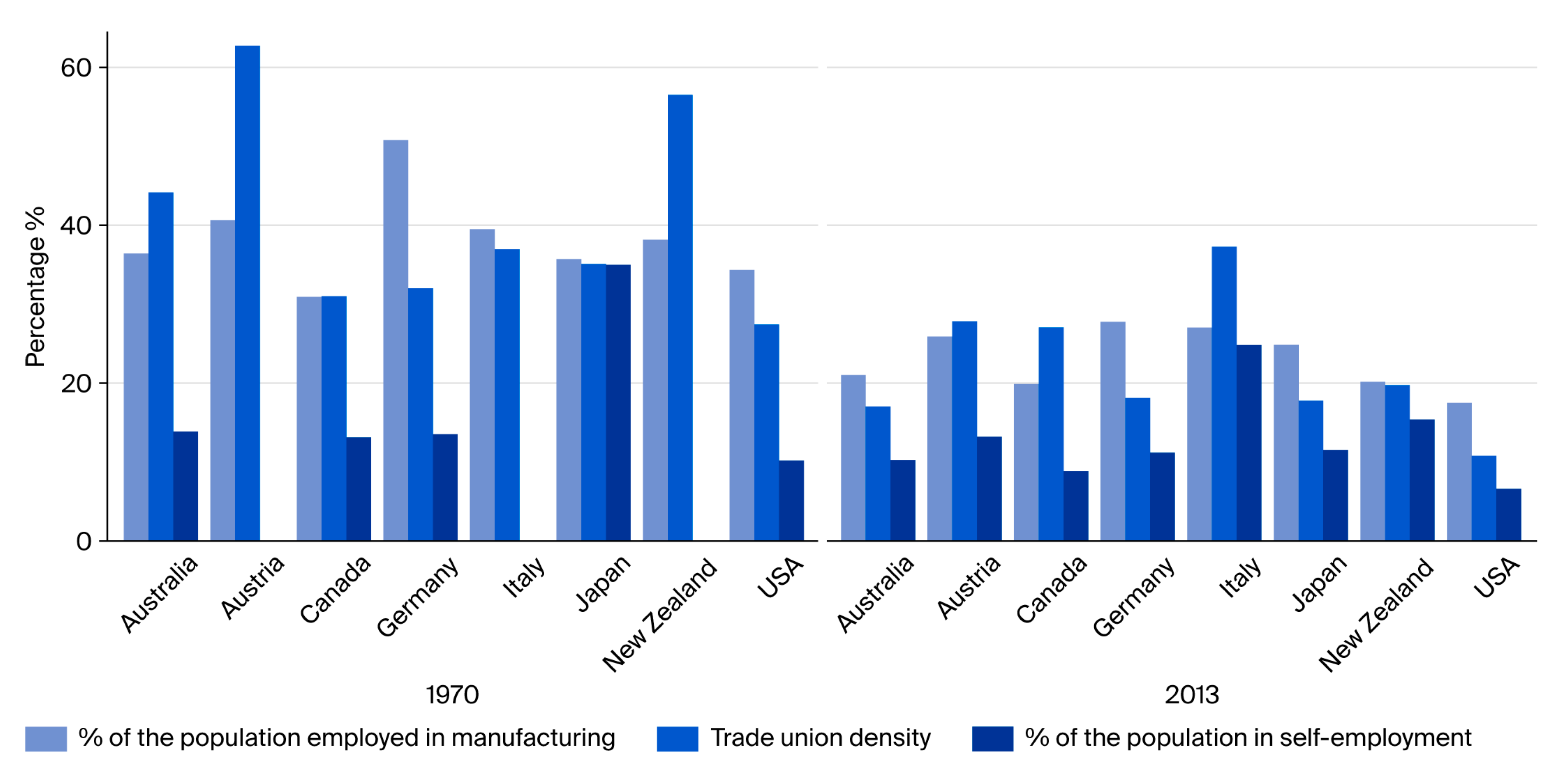
Parlevliet’s (2017) investigation revealed that the practice of collective learning can attenuate opposition to reforms, as individuals update expectancies and preferences considering new information; cognizant individuals will likely indorse structural-policy adjustments (Cukierman & Tommasi, 1998). The contemporary narrative seems to be polarized around two stylized mechanisms: top-down entrenchment, often based on governmental austerity, versus bottom-up resistance to reform guided by organized labor, often neglecting the underlying mechanisms that mediate these behaviors (Figure 1). Figure 1 presents a descriptive benchmark comparison and illustrates the long-run labor market transformations observed across OECD countries. It provides us with the insight that deindustrialization and weakening collective labor organization had been weakening over the last years and possibly mediate the relationship between demographic aging and pension expenditure.
Existing pension research emphasized aging, institutional design and reform politics, while labor market transformation is treated as a separate discussion, rather than a mediating mechanism. To our knowledge, the literature has not adequately examined whether union declines and deindustrialization explain pension expenditure across heterogeneous pension system architectures. The sample of OECD countries provide an appropriate setting because they combine population aging, long time-series data, comparable indicators, and a variation in pension institutions.
This paper contributes to the literature on trade unions by establishing a link (albeit not a causal one) between trade union density and employment in the manufacturing sector. It likewise adds to the public pension literature by building a connection between employment in the manufacturing sector and public pension expenditure.
Using OECD data from 1960 to 2013, we pursue two main goals. First, we examine the effect of the population employed in the manufacturing sector on public pension provisions in OECD countries. Second, we investigate whether trade union density shapes public pension expenditure or whether this is solely an outcome of shifting employment patterns.
The remainder of this paper is structured as follows. We embark on a literature review of the transition from DB to DC pensions, followed by a discussion of trade unions and their influence on pension reforms. We then present the research design, the data and empirical strategy employed, and the results, alongside robustness checks. The subsequent section contextualizes the findings within a broader setting. This work concludes with a summary of contributions and implications.

2. Literature Review

2.1. The Pension Landscape

The 2008 financial crisis and COVID-19 have revived attention regarding the importance of public pensions. Many countries have embarked on reforms aimed at strengthening individual savings accounts (Adascalitei & Domonkos, 2015) and expanded investments in private pension schemes (Reece & Sam, 2012). Brooks (2002) believes that structural pension reforms are the product of demographic pressures and financial restraints, predominantly inter-generational risk and income. The looming retirement of the baby boomer generation presaged the fiscal shortfalls of public pension systems, while sluggish economic growth and industrial restructuring continue to strain social budgets. To bolster funding of public social security programs, governments have incrementally adjusted pension parameters, including raising the statutory retirement age and increasing contribution rates and benefits. Díaz-Giménez and Díaz-Saavedra (2025) argue that pensions became unsustainable, mainly because governments failed to redesign them early for aging populations. At the same time, a second pillar of private pensions has been formed to mitigate the state’s long-term unfunded liabilities, which increase steadily as populations age (Feldstein, 1996). Yet, in the short-to-medium term, the transition from a public to private provision exacts a high financial toll on governments in the form of payroll contributions from public sources to private funds. Despite these pressures, the first-pillar systems continue to enjoy broad public support worldwide (Boeri et al., 2001).
The transition from the first to the second pillar has been linked with financialization, i.e., the expansion of finance into social life, framed around the notion of individual self-empowerment (Van der Zwan, 2014). The shift from DB to DC schemes reflects employers’ unwillingness to absorb deficits or pay for automatic indexation during inflationary periods (De Deken, 2013). Financialization urges trade unions to utilize collective bargaining to address members’ concerns (Johnston et al., 2011), rather than act as partisans for insiders (Rueda, 2005). Interestingly, the DB-to-DC shift has been embraced by trade unions, employers’ associations, social advocacy groups, and the finance sector (Ebbinghaus, 2019). This accommodation has not occurred without contestation or periodic backlash. In particular, the Global Financial Crisis (GFC) exposed the vulnerability of DC arrangements to financial market volatility, prompting renewed criticism and regulatory scrutiny. Privatization shifts responsibility from governments to private actors, whilst marketization entails a stronger actuarial link between contributions and an increased dependency on private savings (Ebbinghaus, 2015). However, trade unions are not solely concerned with the second pillar of occupational pensions (e.g., negotiating plans without minimum return guarantees). Instead, their primary concern remains defending the first pillar of public pensions, which may face retrenchment as supplementary pillars expand (Wiß, 2018). As Grech (2013) notes, demographic aging has been central to the shift from PAYG to pre-funded pensions, in which retirement income is financed through capital accumulation and asset returns rather than inter-generational transfers, and organized labor is expected to resist any cutbacks. Ultimately, the more the state or collective regulation intervenes, the broader the density of supplementary pensions and the greater the scope for pooling risks and guarantee rights (Bridgen & Meyer, 2009).
The sensitivity of pension systems to financial market turbulence depends primarily on the scope and composition of asset portfolios. Retrenchment does not imply that the state withdraws entirely from pension provision; rather, its role increasingly takes the form of regulation. Trade unions and employers’ associations continue playing an important role alongside the state (Ebbinghaus & Wiß, 2011); this role has not regressed, even after the 2008 financial crisis (Wiß, 2019). Governments, nevertheless, have the incentive to promote pension financialization to reduce public expenditure and simultaneously strengthen the financial sector (Naczyk & Hassel, 2019). This shift is often justified by the expectations of job creation and economic growth (Boyer, 2000), as the old model of growth based on consumption and wage expansion has become less sustainable (Baccaro & Pontusson, 2016). Matsaganis (2007) argues that opposition to pension reforms from trade unions reflects a concern with embedded inegalitarian tendencies. One common strategy for addressing pension sustainability is raising the statutory retirement age (Cremer et al., 2008); another one concerns reducing the quantity of PAYG transfers (Cristea & Thalassinos, 2016).
Overall, the members of individual DC pension plans are exposed to more risks than participants in DB plans. This heightened exposure occurs because individual DC arrangements directly link retirement income to the value of accumulated assets. Nevertheless, when managed prudently, DC arrangements may yield greater long-term returns than PAYG DB systems. By contrast, collectively funded PAYG arrangements allow an enormous scope for risk pooling and burden sharing, though they remain vulnerable to periods of reduced contributions, low returns on assets, and unexpectedly high claims. Based on the above, the following research hypothesis is proposed:
H1:
A declining share of employment in the manufacturing sector within total employment is associated with higher public pension spending (as a share of GDP).

2.2. Is There a Link with Trade Unions?

The engrossment of trade unions in welfare reforms, intensely reshaping public pension systems, has attracted an increasing amount of scholarly attention (Tasdemir, 2016). Ebbinghaus and Wiß (2011) distinguishes between the forms and mechanisms through which trade unions exert influence on pension reforms. Baccaro and Simoni (2008) note that governments’ keenness to implicate unions depends chiefly on comparative political strength, while Culpepper and Regan (2014) ascribe the debility of trade union power to the erosion of the social pact. Trade unions are not inherently detrimental to employment (Checchi & Nunziata, 2011; Bassanini & Duval, 2009). While some have stressed that trade unions act as a form of insurance against unemployment risk (Burda, 1990), this perspective does not explain the persistent decline in trade union density.
Trade unions have been reported to contribute to welfare through improving occupational health and safety (Donado & Walde, 2012), thereby facilitating allocation of risk between firms and employees (Malcomson, 1983), stipulating the conditions of workforce training (Acemoglu & Pischke, 1999), and molding broader social policy (Pontusson, 2013). Trade unions representing highly skilled workers, particularly those in the manufacturing industry, have historically defended generous public pensions. However, they still played some role in workplace reform. Confronted with governments’ increasing commitment to pension retrenchment and privatization, trade unions have attempted to counter the expansion of individual retirement savings plans managed by commercial providers and seek to expand not-for-profit occupational pension plans negotiated through industry-level collective agreements. Kadefors et al. (2025) outline that as aging forced pension reforms, unions had the most influence in Norway because they were included in tripartite co-operation. In Germany and Sweden, unions were mostly shut out of pension reform and could not defend existing arrangements effectively. Based on the discussion so far, the following research hypothesis is proposed:
H2:
An increase in trade union members as a percentage of the labor force is associated with higher public pension spending (as a share of GDP) and employment in manufacturing.

3. Data

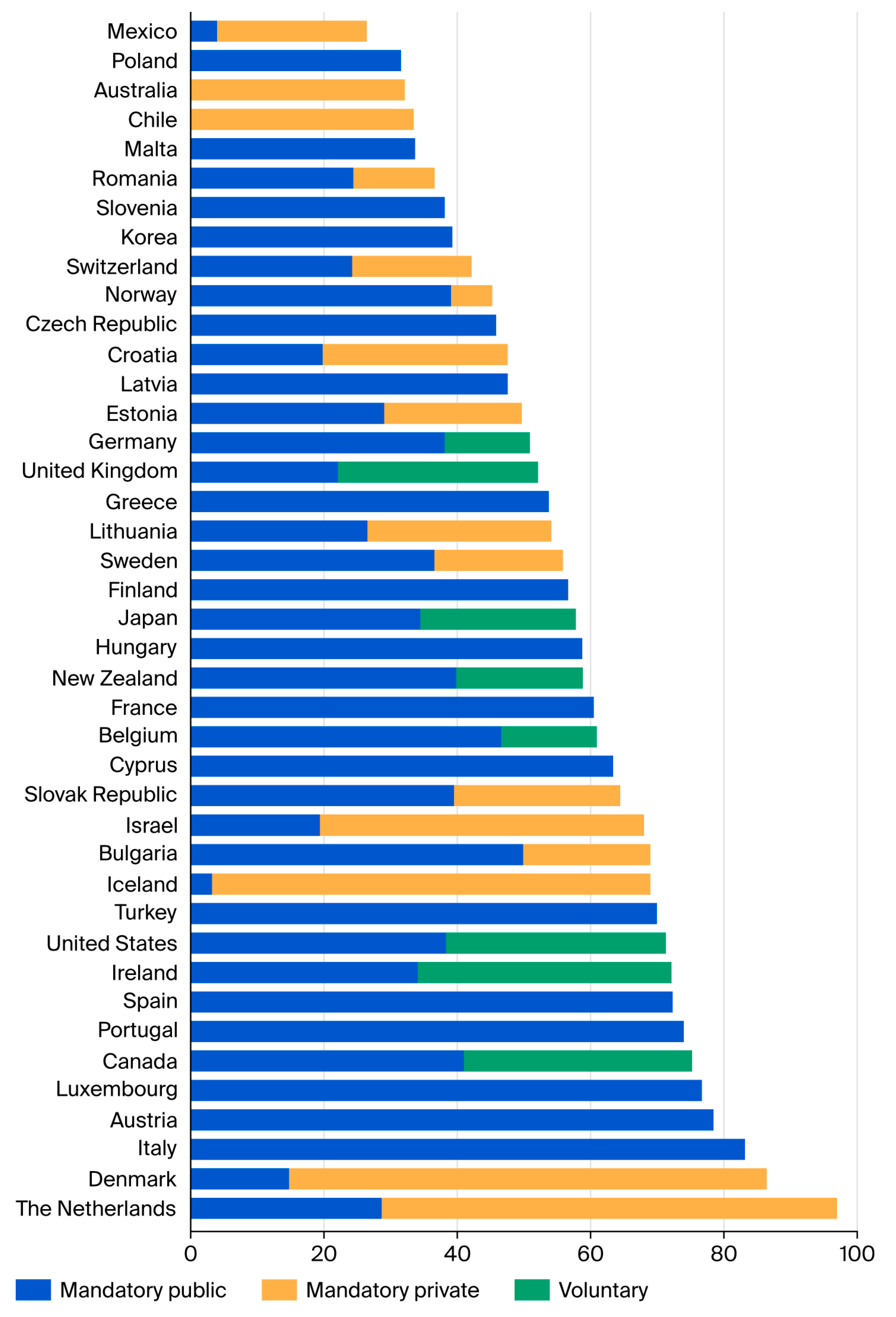
To test our hypotheses, we make use of the OECD dataset for the 1960–2013 period. We extricate data on trade union density, the percentage of the populace employed in the manufacturing sector, the percentage of the populace employed in the services sector, the percentage of the populace self-employed, and the percentage of the GDP allotted to social security fund expenditure. These variables are applied for 29 countries, as depicted in Figure 2. While the OECD encompasses 36 member countries, our analysis is limited to 29 countries due to the consistent availability of comparable data throughout the study period. The data were merged to present a longitudinal dataset.
The best possible separation can be extracted from the gross replacement rates. These are different for mandatory public, mandatory private, mandatory public plus voluntary, and mandatory public plus private regimes; gross replacement rates from the mandatory and private regimes and some voluntary pension schemes are shown in Figure 2, where gross replacement rates measure the percentage of gross pension entitlement divided by gross pre-retirement earnings. The gross replacement rate depicts the level of pensions in retirement relative to earnings when working, and a high gross replacement rate indicates strong income maintenance in retirement, reflecting a pension system that substantially smooths earnings over a lifetime. Conversely, low replacement rates imply a sharper decline in income upon retirement.
There is significant cross-country variation. For the 2018 data, the average is 57.5%. At the bottom of the range, Mexico offers future replacement rates of 26.4% to individuals starting work today. The Netherlands is at the top of the range, offering replacement rates of 96.9%, which is almost 100%. Other countries with high projected replacement rates are Denmark with 86.4% and Italy at 83.1%. Interestingly, Denmark, the Netherlands, and Iceland have the higher gross private pension replacement rates at 71.6%, 68.2%, and 65.8%, respectively. Meanwhile, for mandatory public pensions, Italy is ranked at the top with 83.1%, followed by Austria with 78.4%, Luxembourg with 76.7%, Portugal with 74%, Spain with 72.3%, and Turkey with 69.9%. Several countries have fully PAYG public systems with gross replacement rates ranging from 31.6% (Poland) to 83.1% (Italy). Chile offers only a mandatory fully private pension with a 33.5% gross replacement rate. Voluntary (corresponding primarily to third-pillar individually and occupationally funded pensions) schemes account for half of the gross replacement rates in Ireland (with 38%), Canada (with 34.2%), the United States (with 33%), the United Kingdom (with 30%), and Japan (with 23.1%). Several countries have mixed (or hybrid) pension systems, combining both public and private components. These include the Slovak Republic (with 39.6% public and 24.8% private replacement rates), Estonia (29.1% and 20.6%), Lithuania (26.6% and 27.5%), Switzerland (24.2% and 17.9%), and Croatia (19.8% and 27.8%) (Figure 2).
The above classification assisted us by providing more than one column for our model to investigate the behavior of the percentage of the population in manufacturing and its effect on social security fund expenditure.

Self-Employment

The stylized image of a typical worker progressing to retirement rarely encompasses an abrupt cessation of employment, and yet a variety of workers take bridge jobs. Whilst some workers retire following the culmination of their careers, this is frequently not the norm (Ruhm, 1990, Cahill et al., 2011). Rarely, superannuated workers re-enter the labor force, and non-covered workers take on bridge jobs, including entrepreneurial positions (Kerr & Armstrong-Strassen, 2011). An early study that appraised the phenomenon of self-employment following retirement demonstrated that many individuals expect that they will not receive a satisfactory annuity (Fuchs, 1982). Without an adequate pension, budget constraints pose a significant problem regarding household income after retirement, thus triggering a period of transition from retirement2 to self-employment (Zissimopoulos & Karoly, 2009). Entrepreneurship assuages unemployment (Copeland & Daly, 2012), succoring3 the welfare state via taxation (Stenkula, 2012) as senior entrepreneurs disburse taxes on their earnings which, in turn, uplifts the public state whilst hiring employees and aiding job creation (Halvorsen & Morrow-Howell, 2016).

4. Methodology

In this work, we examine the impact of the employment rate percentage for those employed in the manufacturing sector in OECD countries on public pension provisions. The purpose is to encapsulate the changing structural impact of the proportion of the population in the services and manufacturing sectors and those unemployed on trade union density, helping to pinpoint whether trade union density influences public pension expenditure. To explore the impact of the employment rate and trade union density on social security fund expenditure, the following specification is applied:
D S S F E i t = f D I N D i t ,   S E E i t ,   T U D i t , α i t
where DSSFE is the change in social security fund expenditure, SEE is the percentage of the population who are self-employed, TUD is trade union density, and DIND is the change in percentage of employment in manufacturing. In addition, we rerun the model in Equation (1) for different pension regimes.
A potential econometric concern is that trade union density may be endogenous in the pension expenditure equation. This may arise for at least two reasons. First, reverse causality is possible; while trade union density may shape pension politics and social expenditure, changes in pension institutions and labor market conditions may also affect union membership. Second, trade union density is closely related to employment structure, especially manufacturing employment, raising the possibility of simultaneity between these variables. For the robustness check, Equation (1) is estimated while controlling for the endogeneity of the variable trade union density.4 The two-stage least-square estimates are derived by Baltagi and Chang (2000).
The variables are measured in terms of time and tend to exhibit strong trends, thus making them non-stationary. Stationarity, in our case, is achieved by differencing the variables that exhibit stationarity trends. In this subsection, the order of integration of the variables was determined by panel unit root tests for the appropriate modeling strategy in the subsequent empirical model. We employed a second-generation unit root test developed by Pesaran (2007), known as CIPS, to account for cross-dependence. Broadly speaking, we want our long-term variables to be stationary, with their mean and variance being constant over time and the value of covariance between two time periods depending only upon the distance between the two periods.
Along with the unit root test analysis, we differentiate the variables that are non-stationary and maintain the levels for the variables for which unit root tests do not report any stochastic trends. Stochastic trends could result in our variables generating spurious results, and this is something we wanted to avoid. We estimated the equations above by implementing the fixed-effects estimators; fixed-effect estimation was chosen based on both theoretical and practical concerns. Unlike fixed effects, a random effect does not remove any omitted-variables bias, and it is more “efficient,” assuming there is no omitted-variables bias.5 The critical assumption of a random effect is that fixed unobservable effects are uncorrelated with our independent variables and almost always implausible.
One concern in this regard is that panel estimation might not have captured heterogeneous impacts and non-linearity between labor market conditions and labor union density. Therefore, quantile regression analysis was also used to gain a better understanding of the underlying relationship between labor market conditions and labor union density. Another advantage of quantile regression analysis is that it considers the entire conditional distribution of the dependent variable rather than focusing on its mean (Coad & Rao, 2008; Koenker & Bassett, 1978). Additionally, in quantile regression analysis, one does not assume that the error terms are identically distributed at all points of the conditional distribution. Relaxing this assumption permits firm heterogeneity to be taken into account and accounts for the likelihood that estimated slope parameters may change at different quantiles of the conditional productivity distribution (Coad & Rao, 2008). To this end, researchers usually employ the τ t h   q u a n t i l e   ( 0 < τ < 1 ) of the conditional distribution for the dependent variable y (i.e., trade union density), given a set of control drivers x : y i t = x i t β τ + ε τ i t with Q u a n t τ y i t x i t = x i t β τ , where β is the vector of the parameters to be estimated and ε is the vector of residuals.

5. Empirical Analysis

5.1. Results of Panel Unit Root Tests

The results of the five unit root tests at different levels and the first-difference data series are shown in Table 1, where the results of Pesaran’s (2007) CIPS panel unit root test at different levels and first differences are reported. The null hypothesis of a unit root cannot be rejected for any of the variables, as all p-values exceed conventional significance levels. This finding indicates that all series are non-stationary in terms of levels, implying that they are integrated into order one, I(1). After the first differences were determined, the null hypothesis was strongly rejected at the 1% significance level for all series.

5.2. Panel Data Estimation with Quantile Robustness Checks

The findings from the baseline (fixed effects) regressions for the impact of labor market condition on labor union density are reported in Table 2.
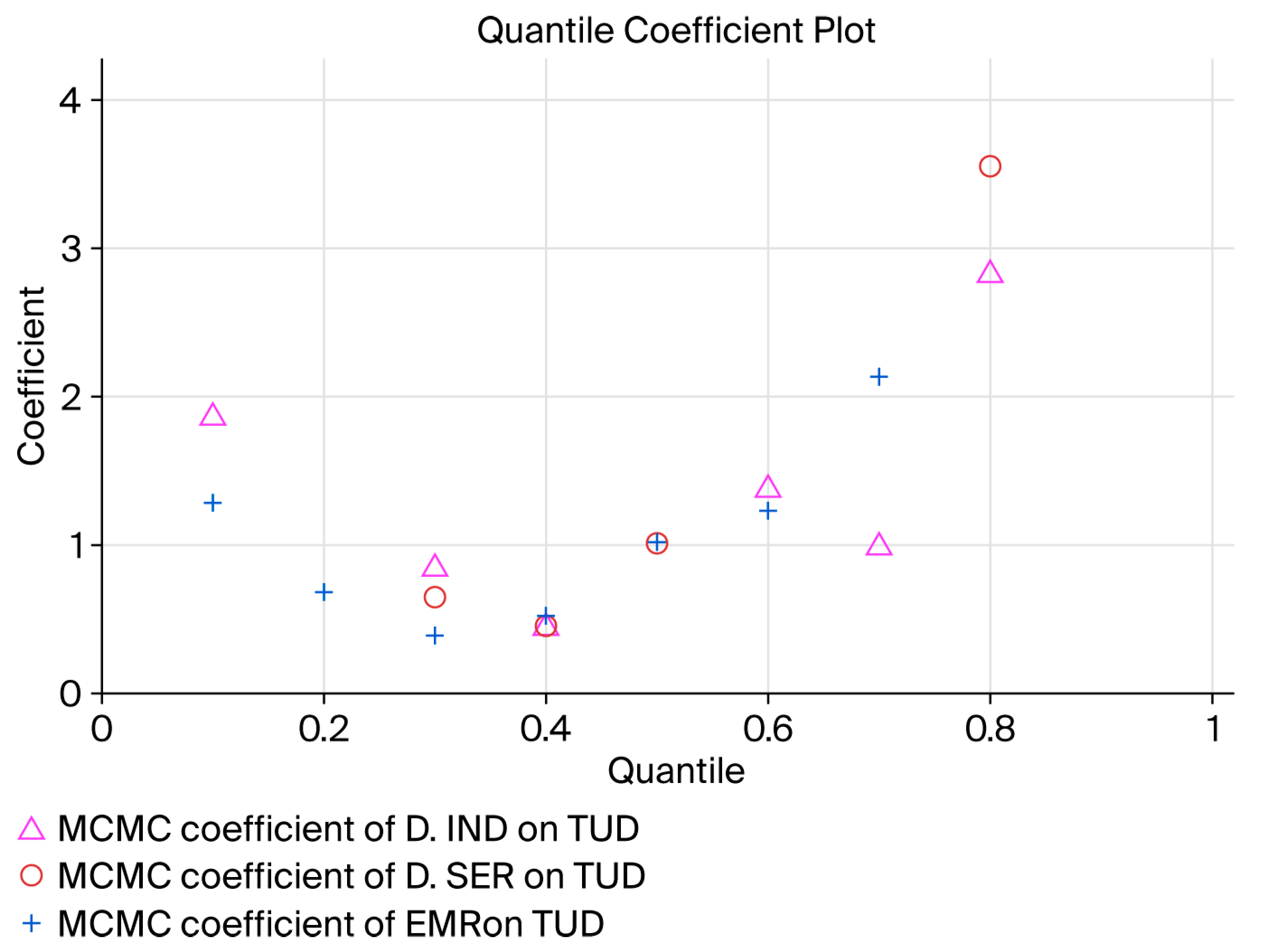
Table 2 reports on the findings regarding the direct impact of labor market conditions on labor union density. The directions of the relationships are all positive and significant, and a high level of change in labor market conditions yields a higher level of labor union density. Specifically, the influence of the percentage of the population working in the manufacturing sector on trade union density corresponds to 2.078 (p-value < 0.10), effectively answering Hypothesis 2 to a partial degree. Similarly, the effect is also positive for the percentage of the population working in the services sector (2.381, p-value < 0.01). To ensure robustness, we decided to employ a panel regression approach in order to observe how the coefficient changes under different quantiles. The quantile results, presented in Figure 3, indicate the influence of the regressors on trade union density across different quantiles6. The results are reported for the 10-, 50-, 70-, and 95-percent quantiles. More specifically, Figure 3 indicates that labor market conditions positively affect labor union density in every quantile.
The findings from the baseline (fixed effects) regressions regarding the impact of labor market conditions and trade union density on changes in social security fund expenditure are reported in Table 3. For labor market conditions, we included the percentage of the population working in the manufacturing sector and the percentage of the population self-employed. The results indicate there is a negative relationship (−0.351, p-value < 0.01) between the percentage of the population working in the manufacturing sector and the percentage of the social security fund expenditure as a percentage of GDP. There are no statistically meaningful relationships to report for the percentage of the self-employed population and trade union density, thus partially rejecting Hypothesis 2.
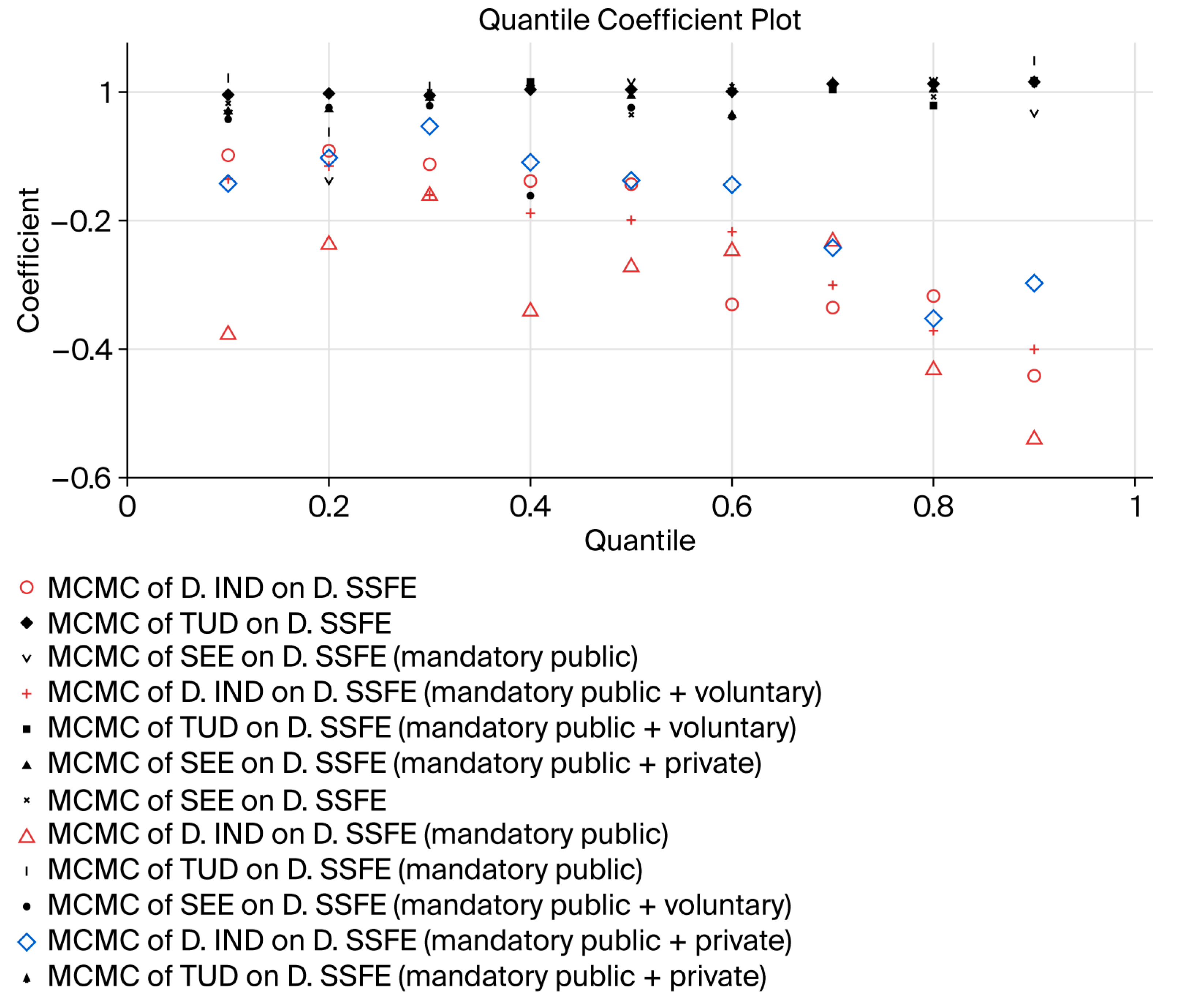
To further test Hypothesis 1, we decided to cluster our country sample into four groups. The pension groups we introduce are mandatory private, mandatory public, mandatory public-plus-voluntary, and mandatory public-plus-private pension schemes. The results support the notion that there is a negative relationship between the percentage of the population working in the manufacturing sector and social security fund expenditure. Specifically, the decline in the population working in the manufacturing sector has elevated costs in countries under the mandatory public pension regime (−0.436, p-value < 0.01), the mandatory public and voluntary regime (−0.411, p-value < 0.01), and the regime in which countries allow mandatory public and private pensions (−0.368, p-value < 0.01). The results do not provide any evidence of an influence from the self-employment sector. To enhance our argument further, we evaluated how the variables behaved in different quantiles. The results reported in Figure 4 indicate that our variable, the percentage of the population in the manufacturing sector, is negative in every quantile (red circle, red star, red triangle, and blue rhombus). Thus, the results demonstrate that the employment rate in the manufacturing sector has a negative impact on changes in social security fund expenditure, except in mandatory-private-scheme countries.
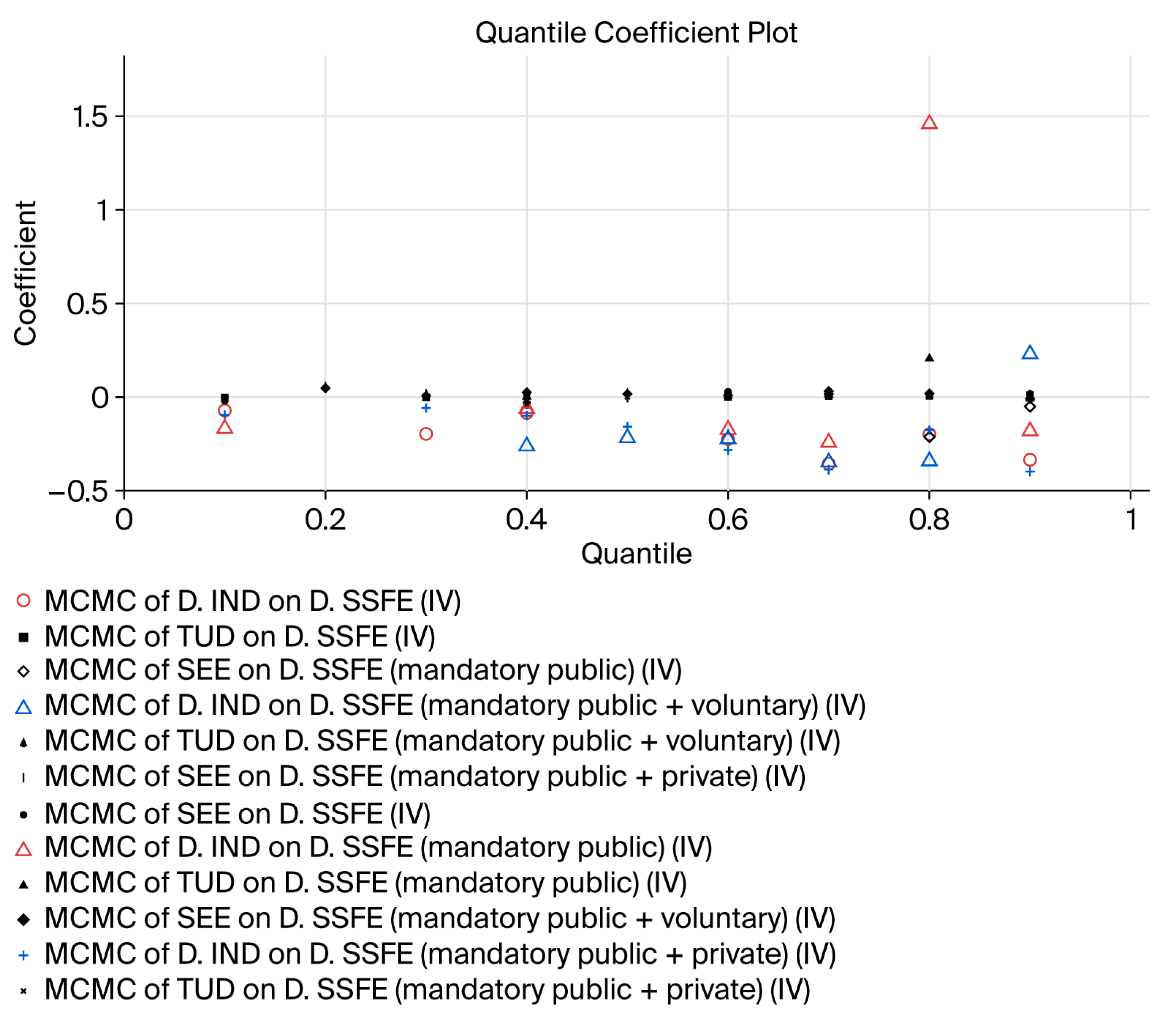
Robustness checks are reported in Table 4. The results indicate that a change in manufacturing sector employment is negatively significant between the percentage of employment in the manufacturing sector and social security fund expenditure as a percentage of GDP for countries under a mandatory public pension scheme (−0.485, p-value < 0.01). The negative relationship is further supported by the quantile coefficient plot, where we applied the panel quantile regression (red triangles) (Figure 5).

6. Discussion

Employment in the manufacturing sector to sustain pension systems falls between 20% and 30% (Table 5). This situation is aggravated by the aging populations in many established economies. This trend can also be found in some emerging economies, such as China, but not in India, Brazil, or Mexico, where population growth is increasing (Fourné et al., 2014).
Potential public policy reforms aimed at countering the pension crisis are presented in Table 5. Based on our results, we argue that greater priority should be assigned to personal empowerment in financial matters (Lusardi & Mitchell, 2014). The financial complexity of retirement savings can be daunting and often discourages employees from enrolling in employer-sponsored saving plans in a timely manner (Beshears et al., 2013). Benartzi and Thaler (2007) argue that the majority of employees have little to no training in making-saving decisions. Rather, they are passive investors and are slow to join advantageous plans, often making infrequent changes and therefore adopt naïve diversification strategies when trading7 on the stock market. In contrast, active savers can derive more advantages from their pensions (Chetty et al., 2014).
For example, institutions are increasingly finding that national treatment of pension savings and their stakeholders by middle-class voters or organized labor market unions serve as formidable hurdles to the European integration of pension provisions. The increasing prevalence and emergence of large and long-lasting public deficits has led to the development of broad and deep financial markets that have called for a liberalization of international savings. Consequently, it may be erroneous to attribute all the interdependent and complementary transformations that take place in the hierarchy of institutional forms exclusively to finance.

7. Conclusions

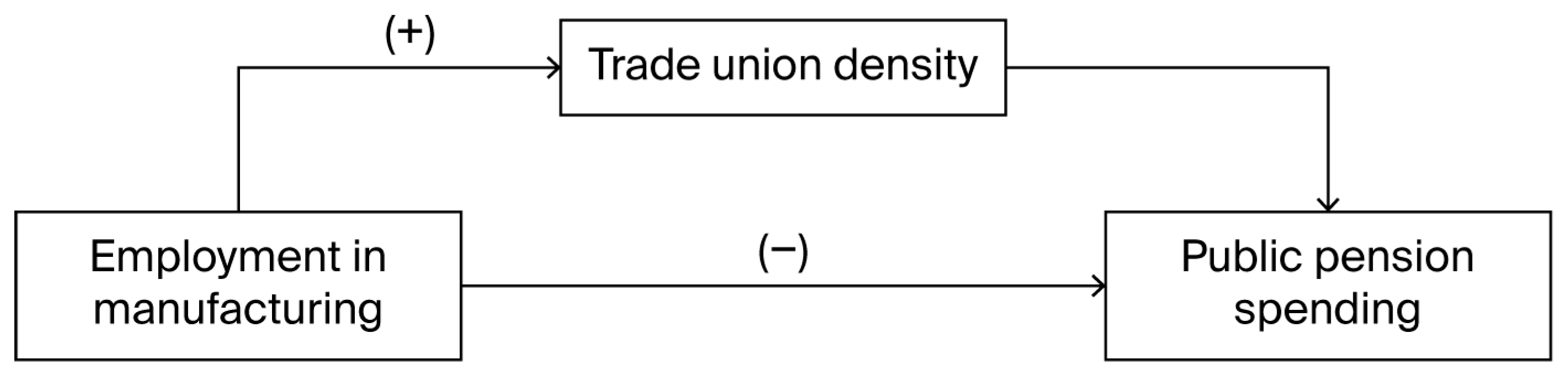
The results of our enquiries shed light on two questions. Manufacturing is a linear, positive, and strong predictor of trade union density, implying the decline in trade union density has transpired alongside tumbling rates of employment in the manufacturing sector, as depicted in the general framework (Figure 6).
When we examined the drivers of rising public pensions, we found that greater employment in the manufacturing sector is coupled with more favorable public pension finances. This relationship holds consistently across country groups that employ legally mandatory public pension, mandatory public plus voluntary, and combined mandatory public–private pension schemes, it but does not hold for countries operating under mandatory private pension regimes.
Over-specifying our model to account for potential endogeneity of manufacturing employment with respect to trade union density, we failed to find any statistically significant effects of trade union density on public pension finances. Instead, the manufacturing employment share remains the lone direct predictor of public pension fiscal outcomes according to our specifications.
In this work, we attempted to link trade union density with the decline in employment in the manufacturing sector and argue that this decline is significantly responsible for rising public pension expenditure. The results demonstrate that trade unions did not exert any influence on public pension finance, while the percentage of the population working in the manufacturing sector did. Notably, the percentage of the population working in self-employment had a positive influence on public pension expenditure, but it was not as strong as the percentage of the population working in the manufacturing sector. To achieve this empirical result, a longitudinal statistical analysis was performed, and longitudinal quantile regression plots were generated to enhance the robustness of the argument.

Author Contributions

Conceptualization, E.A.; methodology, N.A.; software, C.K.L.; validation, N.A.; formal analysis, E.A. and C.K.L.; investigation, E.A.; resources, C.K.L.; data curation, N.A.; writing—original draft preparation, E.A.; writing—review and editing, E.A., N.A. and C.K.L.; visualization, E.A.; supervision, E.A.; project administration, E.A. All authors have read and agreed to the published version of the manuscript.

Funding

This research received no external funding.

Institutional Review Board Statement

Not applicable.

Informed Consent Statement

Not applicable.

Data Availability Statement

Data cannot be shared due to contractual agreements.

Conflicts of Interest

The authors confirm that there are no conflicts of interest pertaining to this research.

Notes

1
A fixed sum is capitalized and then becomes available at the superannuation age.
2
This is true provided the cash-out is enough to finance the new business.
3
Henrekson (2005) suggests the opposite: that the welfare state must facilitate entrepreneurship.
4
The instrumental variables for trade union density are change in the employment rate in the manufacturing sector, change in the employment rate in the services sector, and the rate of unemployment.
5
We are aware that failure to reject the null hypothesis of the Hausman test does not imply that there is no bias in the random-effect estimator.
6
We used the method developed by Machado and Silva (2019) for estimation purposes.
7
These inconsistent financial strategies are often characterized by investment biases such as a lack of diversification, excessive trading, and dispositional effects (Cronqvist & Siegel, 2014).

References

  1. Acemoglu, D., & Pischke, J. S. (1999). The structure of wages and investment in general training. Journal of Political Economy, 107(3), 539–572. [Google Scholar] [CrossRef]
  2. Adascalitei, D., & Domonkos, S. (2015). Reforming against all odds: Multi-pillar pension systems in the Czech Republic and Romania. International Social Security Review, 68(2), 85–104. [Google Scholar] [CrossRef]
  3. Baccaro, L., & Pontusson, J. (2016). Rethinking comparative political economy: The growth model perspective. Politics & Society, 44(2), 175–207. [Google Scholar]
  4. Baccaro, L., & Simoni, M. (2008). Policy concentration in Europe: Understanding government choice. Comparative Political Studies, 41(10), 1323–1348. [Google Scholar] [CrossRef]
  5. Baltagi, B. H., & Chang, Y.-J. (2000). Simultaneous equations with incomplete panels. Econometric Theory, 16(2), 269–279. [Google Scholar] [CrossRef]
  6. Bassanini, A., & Duval, R. (2009). Unemployment, institutions, and reform complementarities: Re-assessing the aggregate evidence for OECD countries. Oxford Review of Economic Policy, 25(1), 40–59. [Google Scholar] [CrossRef]
  7. Benartzi, S., & Thaler, R. (2007). Heuristics and biases in retirement savings behaviour. Journal of Economic Perspectives, 21(3), 81–104. [Google Scholar] [CrossRef]
  8. Beshears, J., Choi, J. J., Laibson, D., & Madrian, B. C. (2013). Simplification and saving. Journal of Economic Behavior & Organization, 95(1), 130–145. [Google Scholar] [CrossRef]
  9. Boeri, T., Borsch-Supan, A., & Tabellini, G. (2001). Would you like to shrink the welfare state? A survey of European citizens. Economic Policy, 16(32), 8–50. [Google Scholar] [CrossRef]
  10. Boyer, R. (2000). Is a finance-led growth regime a viable alternative to Fordism? A preliminary analysis. Economy and Society, 29(1), 111–145. [Google Scholar] [CrossRef]
  11. Bridgen, P., & Meyer, T. (2009). Social rights, social justice and pension outcomes in four multi-pillar systems. Journal of Comparative Social Welfare, 25(2), 129–137. [Google Scholar] [CrossRef]
  12. Brooks, S. M. (2002). Social protection and economic integration: The politics of pension reform in an era of capital mobility. Comparative Political Studies, 35(5), 491–523. [Google Scholar] [CrossRef]
  13. Burda, M. C. (1990). Membership, seniority and wage-setting in democratic labour unions. Economica, 57(228), 455–466. [Google Scholar] [CrossRef]
  14. Cahill, K. E., Giandrea, M. D., & Quinn, J. F. (2011). Re-entering the labour force after retirement. Monthly Labor Review, 134(6), 34–42. [Google Scholar]
  15. Cannon, E., & Tonks, I. (2013). The value and risk of defined contribution pension schemes: International evidence. Journal of Risk and Insurance, 80(1), 95–119. [Google Scholar] [CrossRef]
  16. Checchi, D., & Nunziata, L. (2011). Models of unionism and unemployment. European Journal of Industrial Relations, 17(2), 141–152. [Google Scholar] [CrossRef]
  17. Chetty, R., Friedman, J. N., Leth-Petersen, S., Nielsen, T. H., & Olsen, T. (2014). Active vs. passive decisions and crowd-out in retirement savings accounts: Evidence from Denmark. The Quarterly Journal of Economics, 129(3), 1141–1219. [Google Scholar] [CrossRef]
  18. Coad, A., & Rao, R. (2008). Innovation and firm growth in high-tech sectors: A quantile regression approach. Research Policy, 37(4), 633–648. [Google Scholar] [CrossRef]
  19. Copeland, P., & Daly, M. (2012). Varieties of poverty reduction: Inserting the poverty and social exclusion target into Europe 2020. Journal of European Social Policy, 22(3), 273–287. [Google Scholar] [CrossRef]
  20. Cremer, H., Lozachmeur, J. M., & Pestieau, P. (2008). Social security and retirement decision: A positive and normative approach. Journal of Economic Surveys, 22(2), 213–233. [Google Scholar] [CrossRef]
  21. Cristea, M., & Thalassinos, I. E. (2016). Private pension plans: An important component of the financial market. International Journal of Economics and Business Administration, 4(1), 110–115. [Google Scholar] [CrossRef]
  22. Cronqvist, H., & Siegel, S. (2014). The genetics of investment biases. Journal of Financial Economics, 113(2), 215–234. [Google Scholar] [CrossRef]
  23. Cukierman, A., & Tommasi, M. (1998). When does it take a Nixon to go to China? American Economic Review, 88(1), 180–197. [Google Scholar]
  24. Culpepper, P. D., & Regan, A. (2014). Why don’t governments need trade unions anymore? The death of social pacts in Ireland and Italy. Socio-Economic Review, 12(4), 723–745. [Google Scholar] [CrossRef]
  25. De Deken, J. (2013). Towards an index of private pension provision. Journal of European Social Policy, 23(3), 270–286. [Google Scholar] [CrossRef]
  26. Disney, R. (2000). Crises in public pension programmes in OECD: What are the reform options? The Economic Journal, 110(461), 1–23. [Google Scholar] [CrossRef]
  27. Díaz-Giménez, J., & Díaz-Saavedra, J. (2025). Public pensions reforms: Financial and political sustainability. European Economic Review, 175, 104988. [Google Scholar] [CrossRef]
  28. Donado, A., & Walde, K. (2012). How trade unions increase welfare. The Economic Journal, 122(563), 990–1009. [Google Scholar] [CrossRef]
  29. Ebbinghaus, B. (2015). The privatization and marketization of pensions in Europe: A double transformation facing the crisis. European Policy Analysis, 1(1), 56–73. [Google Scholar] [CrossRef]
  30. Ebbinghaus, B. (2019). Multipillarisation remodelled: The role of interest organizations in British and German pension reforms. Journal of European Public Policy, 26(4), 521–539. [Google Scholar] [CrossRef]
  31. Ebbinghaus, B., & Wiß, T. (2011). Taming pension fund capitalism in Europe: Collective and state regulation in times of crisis. Transfer: European Review of Labour and Research, 17(1), 15–28. [Google Scholar] [CrossRef]
  32. Feldstein, M. (1996). The missing piece in policy analysis: Social security reform. The American Economic Review, 86(2), 1–14. [Google Scholar]
  33. Fourné, S. P., Jansen, J. J., & Mom, T. J. (2014). Strategic agility in MNEs. California Management Review, 56(3), 13–38. [Google Scholar] [CrossRef]
  34. Fuchs, V. (1982). Self-employment and labor force participation of older males. Journal of Human Resources, 17(3), 339–357. [Google Scholar] [CrossRef]
  35. Grech, A. G. (2013). Assessing the sustainability of pension reforms in Europe. Journal of International and Comparative Social Policy, 29(2), 143–162. [Google Scholar] [CrossRef]
  36. Halvorsen, C. J., & Morrow-Howell, N. (2016). A conceptual framework on self-employment in later life: Toward a research agenda. Work, Aging and Retirement, 3(4), 313–324. [Google Scholar] [CrossRef]
  37. Henrekson, M. (2005). Entrepreneurship: A weak link in the welfare state? Industrial and Corporate Change, 14(3), 437–467. [Google Scholar] [CrossRef]
  38. Hooghe, M., & Oser, J. (2016). Trade union density and social expenditure: A longitudinal analysis of policy feedback effects in OECD countries, 1980–2010. Journal of European Public Policy, 23(10), 1520–1542. [Google Scholar] [CrossRef]
  39. Johnston, A., Kornelakis, A., & d’Acri, C. R. (2011). Social partners and the welfare state: Recalibration, privatization or collectivization of social risks? European Journal of Industrial Relations, 17(4), 349–364. [Google Scholar] [CrossRef]
  40. Kadefors, R., Arman, R., & Wikström, E. (2025). Trade unions and the demographic challenge: Their role in pension system and work life reforms. Economic and Industrial Democracy. [Google Scholar] [CrossRef]
  41. Kerr, G., & Armstrong-Strassen, M. (2011). The bridge to retirement: Older workers’ engagement in post-career entrepreneurship and wage-and-salary employment. The Journal of Entrepreneurship, 20(1), 55–75. [Google Scholar] [CrossRef]
  42. Koenker, R., & Bassett, G., Jr. (1978). Regression quantiles. Econometrica, 46(1), 33–50. [Google Scholar] [CrossRef]
  43. Lusardi, A., & Mitchell, O. S. (2014). The economic importance of financial literacy: Theory and evidence. Journal of Economic Literature, 52(1), 5–44. [Google Scholar] [CrossRef]
  44. Machado, J. A. F., & Silva, J. M. C. (2019). Quantiles via moments. Journal of Econometrics, 213(1), 145–173. [Google Scholar] [CrossRef]
  45. Malcomson, J. M. (1983). Trade union and economic efficiency. The Economic Journal, 93(1), 51–65. [Google Scholar] [CrossRef]
  46. Matsaganis, M. (2007). Union structures and pension outcomes in Greece. British Journal of Industrial Relations, 45(3), 537–555. [Google Scholar] [CrossRef]
  47. Muller, K. (2002). From the state to the market? Pension reform paths in Central-Eastern Europe and the former Soviet Union. Social Policy & Administration, 36(2), 142–155. [Google Scholar]
  48. Naczyk, M., & Hassel, A. (2019). Insuring individuals… and politicians: Financial services providers, stock market risk and the politics of private pension guarantees in Germany. Journal of European Public Policy, 26(4), 579–598. [Google Scholar] [CrossRef]
  49. Parlevliet, J. (2017). What drives public acceptance of reforms? Longitudinal evidence from a Dutch pension reform. Public Choice, 173(1–2), 1–23. [Google Scholar] [CrossRef]
  50. Pesaran, M. H. (2007). A simple panel unit root test in the presence of cross-section dependence. Journal of Applied Econometrics, 22(2), 265–312. [Google Scholar] [CrossRef]
  51. Pontusson, J. (2013). Unionization, inequality and redistribution. British Journal of Industrial Relations, 51(4), 797–825. [Google Scholar] [CrossRef]
  52. Reece, C., & Sam, A. G. (2012). Impact of pension privatization on foreign direct investment. World Development, 40(2), 291–302. [Google Scholar] [CrossRef]
  53. Rueda, D. (2005). Insider-outsider politics in industrialized democracies: The challenge to social democratic parties. American Political Science Review, 99(1), 61–74. [Google Scholar] [CrossRef]
  54. Ruhm, C. J. (1990). Bridge jobs and partial retirement. Journal of Labor Economics, 8(4), 482–501. [Google Scholar] [CrossRef]
  55. Stenkula, M. (2012). Taxation and entrepreneurship in a welfare state. Small Business Economics, 39(1), 77–97. [Google Scholar] [CrossRef]
  56. Tanzi, V. (2002). Globalization and the future of social protection. Scottish Journal of Political Economy, 49(1), 116–127. [Google Scholar] [CrossRef]
  57. Tasdemir, A. G. (2016). Social dialogue and public pension reform in Greece and Turkey. European Journal of Industrial Relations, 22(2), 149–165. [Google Scholar] [CrossRef]
  58. Van der Zwan, N. (2014). Making sense of financialization. Socio-Economic Review, 12(1), 99–129. [Google Scholar] [CrossRef]
  59. Wiß, T. (2018). Divergent occupational pensions in Bismarckian countries: The case of Germany and Austria. Transfer: European Review of Labour and Research, 24(1), 91–107. [Google Scholar] [CrossRef]
  60. Wiß, T. (2019). Reinforcement of pension financialisation as a response to financial crises in Germany, the Netherlands and the United Kingdom. Journal of European Public Policy, 26(4), 501–520. [Google Scholar] [CrossRef]
  61. Zissimopoulos, J. M., & Karoly, L. A. (2009). Labor-force dynamics at older ages: Movements into self-employment for workers and nonworkers. Research on Aging, 31(1), 89–111. [Google Scholar] [CrossRef] [PubMed]
Figure 1. The change in the % of the population in the manufacturing sector and those who are self-employed, plus the trade union density, from 1970 to 2013.
Jrfm 19 00276 g001
Figure 2. Gross pension replacement rates from the mandatory public, voluntary, and private schemes.
Jrfm 19 00276 g002
Figure 3. The quantile figure shows how the effect of trade union density changes across different parts of the distribution, not just at the average, and what changes is the strength of the coefficient.
Jrfm 19 00276 g003
Figure 4. Quantile figures, where quantile estimates show how the effects of the regressors differ with different levels of change in social security fund expenditure as opposed to only at the mean and across different insurance regimes.
Jrfm 19 00276 g004
Figure 5. Quantile figures, where the quantile regression estimates presented illustrate how the effects of the explanatory variables vary across the conditional distribution of manufacturing sector employment.
Jrfm 19 00276 g005
Figure 6. The finalized theoretical framework with the accepted hypotheses.
Jrfm 19 00276 g006
Table 1. Panel unit root tests (statistics and probabilities in parentheses).
MethodTUDINDSEREMRSSFESEE
Null: Unit roots (assumes there is an individual unit root process)
Levels
CIPS0.234 (0.593)1.387 (0.919)0.241 (0.595)1.340 (0.910)−0.889 (0.187)2.382 (0.991)
First Differences
CIPS−10,425 *** (0.000)−10.425 *** (0.000)−4.786 *** (0.000)−2.492 *** (0.006)−6.606 *** (0.000)−8.653 *** (0.000)
*** indicates the rejection of the null hypothesis of a unit root at the 1% significance level. Since p > 0.05, we cannot reject the null hypothesis at any level. Consequently, a unit root is present, indicating that all variables tested are non-stationary. All variables became stationary after first differencing.
Table 2. Fixed-effects estimation.
VariablesTUD
D. IND2.078 * (1.175)
D. SER2.381 *** (0.776)
D. EMR0.820 ** (0.367)
Constant32.84 *** (3.871)
Observations647
Number of ID29
Robust standard errors are in parentheses. *** p < 0.01, ** p < 0.05, and * p < 0.1, and D refers to first differences.
Table 3. Fixed-effects estimations.
VariablesD. SSFED. SSFE
(Mandatory Private)
D. SSFE
(Mandatory Public)
D. SSFE
(Mandatory Public + Voluntary)
D. SSFE
(Mandatory Public + Private)
D. IND−0.351 *** (0.09)−0.0741 (0.243)−0.436 *** (0.089)−0.411 *** (0.117)−0.368 *** (0.101)
SEE0.003 (0.005)−0.090 (0.269)0.001 (0.005)0.005 (0.005)0.003 (0.005)
TUD−0.002 (0.003)0.024 (0.035)−0.000 (0.003)0.002 (0.003)−0.002 (0.003)
Constant−0.047 (0.156)0.718 (2.725)−0.077 (0.174)−0.196 (0.154)−0.069 (0.160)
Observations49630187374452
Number of ID282122026
Robust standard errors are in parentheses. *** p < 0.01, D. refers to first differences.
Table 4. Fixed-effects estimation (IV).
VariablesD. SSFED. SSFE
(Mandatory Private)
D. SSFE
(Mandatory Public)
D. SSFE
(Mandatory Public +
Voluntary)
D. SSFE
(Mandatory Public +
Private)
D.IND−0.029 (0.369)0.901 (1.501)−0.485 *** (0.119)−0.130 (0.392)−0.120 (0.331)
SEE−0.216 (0.149)−3.344 (4.554)−0.092 (0.062)−0.150 (0.097)−0.163 * (0.093)
TUD0.235 (0.155)0.508 (0.676)0.171 (0.136)0.205 (0.150)0.212 (0.135)
Constant−3.213 (2.344)30.790 (42.170)−1.896 (2.229)−2.492 (2.139)−3.369 (2.439)
Observations47130162349427
Number of ID282122026
Robust standard errors in parentheses. *** p < 0.01, and * p < 0.1. D. refers to first differences.
Table 5. Pension crisis countermeasures.
Addressing the worker/retiree ratioRaising the retirement age, adopting an open-borders immigration policy, promoting self-employment post-retirement, providing subsidies to increase fertility.
Reducing obligationsSwapping from defined-benefit to defined-contribution pension schemes, reducing the level of periodic payments by adjusting the
formula in DB pensions, setting a ceiling for top pensions
(golden pensions).
Increasing resources to fund pensionsIncreasing contribution rates, raising taxes.
Tackling undeclared workReducing the number of companies hiring workers without paying them social security.
Increasing employment in the industrial sectorRedefining the percentage of employment in the industrial sector.
Disclaimer/Publisher’s Note: The statements, opinions and data contained in all publications are solely those of the individual author(s) and contributor(s) and not of MDPI and/or the editor(s). MDPI and/or the editor(s) disclaim responsibility for any injury to people or property resulting from any ideas, methods, instructions or products referred to in the content.