


Bitcoin Halving: How Effective Is It in Driving Cryptocurrency Market Dynamics?

 ,
,  ,
,
Abstract
1. Introduction
The Present Study
2. Method
Respondents Demographic Profile
3. Results of Partial Least Square (PLS) Analysis
3.1. Direct Effect Analysis
3.2. Indirect Effect Analysis
4. Discussion
5. Conclusions
6. Limitations
Author Contributions
Funding
Institutional Review Board Statement
Informed Consent Statement
Data Availability Statement
Conflicts of Interest
Appendix A. Questionnaire Items
- Bitcoin Halving (BIH).
- Active Bitcoin miners have a positive impact on the cryptocurrency market.
- Bitcoin prices will definitely increase after a Bitcoin halving occurs.
- Market sentiment is always positive before a Bitcoin halving takes place.
- The halving protocol increases investor confidence and contributes to greater cryptocurrency stability.
- Bitcoin halving can cause the prices of other cryptocurrencies to increase tenfold after the event.
- Government Regulations (GR).
- Regulations regarding cryptocurrency are clear and easy to understand.
- The institutions overseeing cryptocurrency are overly strict.
- Through the established regulations on cryptocurrency, the government ensures public protection from cryptocurrency-related fraud.
- The existing cryptocurrency regulations need to be re-evaluated.
- Government regulations can significantly increase cryptocurrency prices after a halving occurs.
- Market Sentiment (MS).
- News about cryptocurrency influences investors’ investment decisions.
- Professional statements affect investors’ psychology.
- Global events, such as wars or pandemics, negatively impact cryptocurrency.
- Developer news can serve as an important signal in buy or sell decisions.
- Positive market sentiment can significantly increase cryptocurrency prices.
- Cryptocurrency Performance (CPER).
- The success of a cryptocurrency in achieving strong performance enhances its positive image in the eyes of the public.
- Positive cryptocurrency performance strengthens investor confidence in the asset’s growth potential.
- Strong performance of a cryptocurrency can serve as evidence of the development team’s commitment and capability.
- Government policies have a significant influence on cryptocurrency performance.
- Cryptocurrency performance can significantly increase its market price.
- Cryptocurrency Prices (CP).
- Closing price can provide information on the appropriate timing to buy or sell an asset.
- High trading volume during a certain period may indicate strong market interest.
- High volatility can signal the need to sell an asset.
- Network hash rate can be used as an indicator of security.
- The launching price can influence the extent of price increases during a Bitcoin halving.
References
- Abdul Karim, Z., Muhamad Fahmi, F. S. R., Abdul Karim, B., & Shokr, M. A. (2022). Market sentiments and firm-level equity returns: Panel evidence of Malaysia. Economic Research-Ekonomska Istraživanja, 35(1), 5253–5272. [Google Scholar] [CrossRef]
- Agarwal, P. K., & Pradhan, H. K. (2019). Mutual fund performance in changing economic conditions: Evidence from an emerging economy. Cogent Economics & Finance, 7(1), 1687072. [Google Scholar] [CrossRef]
- Alfina, Hartini, S., & Mardhiyah, D. (2023). FOMO related consumer behaviour in marketing context: A systematic literature review. Cogent Business & Management, 10(3), 2250033. [Google Scholar] [CrossRef]
- Almeida, J., & Gonçalves, T. C. (2023). A systematic literature review of investor behavior in the cryptocurrency markets. Journal of Behavioral and Experimental Finance, 37, 100785. [Google Scholar] [CrossRef]
- Anamika, Chakraborty, M., & Subramaniam, S. (2023). Does sentiment impact cryptocurrency? Journal of Behavioral Finance, 24(2), 202–218. [Google Scholar] [CrossRef]
- Ballis, A., & Verousis, T. (2022). Behavioural finance and cryptocurrencies. Review of Behavioral Finance, 14(4), 545–562. [Google Scholar] [CrossRef]
- Ben Osman, M., Galariotis, E., Guesmi, K., Hamdi, H., & Naoui, K. (2024). Are markets sentiment driving the price bubbles in the virtual? International Review of Economics & Finance, 89, 272–285. [Google Scholar] [CrossRef]
- Ben Osman, M., Hela, O., Khaled, M., & Kamel, G. (2025). Does investor sentiment drive the Bitcoin price? Digital Finance, 7(3), 507–534. [Google Scholar] [CrossRef]
- Bonaparte, Y., & Bernile, G. (2023). A new “Wall Street Darling?” effects of regulation sentiment in cryptocurrency markets. Finance Research Letters, 52, 103376. [Google Scholar] [CrossRef]
- Caferra, R. (2022). Sentiment spillover and price dynamics: Information flow in the cryptocurrency and stock market. Physica A: Statistical Mechanics and Its Applications, 593, 126983. [Google Scholar] [CrossRef]
- Chan, J. Y.-L., Phoong, S. W., Phoong, S. Y., Cheng, W. K., & Chen, Y.-L. (2023). The bitcoin halving cycle volatility dynamics and safe haven-hedge properties: A MSGARCH approach. Mathematics, 11(3), 698. [Google Scholar] [CrossRef]
- Cho, D., Ramachandran, G., Jurdak, R., & Kanhere, S. S. (2025). Bitcoin halving events: Historical analysis and strategic insights for miners. In Communications in computer and information science (pp. 38–54). Springer. [Google Scholar] [CrossRef]
- Cumming, D., Fuchs, J., & Momtaz, P. P. (2025). Market reactions to cryptocurrency regulation: Risk, return and the role of enforcement quality. British Journal of Management, 36(4), 1709–1745. [Google Scholar] [CrossRef]
- de Salis, E. A. V., & dos Maciel, L. S. (2023). How does price (in)efficiency influence cryptocurrency portfolios performance? The role of multifractality. Quantitative Finance, 23(11), 1637–1658. [Google Scholar] [CrossRef]
- Dwyer, G. P. (2015). The economics of Bitcoin and similar private digital currencies. Journal of Financial Stability, 17, 81–91. [Google Scholar] [CrossRef]
- Fabus, J., Kremenova, I., Stalmasekova, N., & Kvasnicova-Galovicova, T. (2024). An empirical examination of Bitcoin’s halving effects: Assessing cryptocurrency sustainability within the landscape of financial technologies. Journal of Risk and Financial Management, 17(6), 229. [Google Scholar] [CrossRef]
- Frederiks, A. J., Costa, S., Hulst, B., & Groen, A. J. (2024). The early bird catches the worm: The role of regulatory uncertainty in early adoption of blockchain’s cryptocurrency by fintech ventures. Journal of Small Business Management, 62(2), 790–823. [Google Scholar] [CrossRef]
- Grossman, J. H. (2019). Passing cash from bank notes to bitcoin: Standardizing money. Journal of Cultural Economy, 12(4), 299–316. [Google Scholar] [CrossRef]
- Gupta, S., Himanshu, H., Dhingra, S., & Aggarwal, R. (2023). What explains the sudden surge in cryptocurrency? A consumption value theory perspective. Digital Policy, Regulation and Governance, 25(6), 634–652. [Google Scholar] [CrossRef]
- Gurdgiev, C., & O’Loughlin, D. (2020). Herding and anchoring in cryptocurrency markets: Investor reaction to fear and uncertainty. Journal of Behavioral and Experimental Finance, 25, 100271. [Google Scholar] [CrossRef]
- Güler, D. (2023). The impact of investor sentiment on Bitcoin returns and conditional volatilities during the era of COVID-19. Journal of Behavioral Finance, 24(3), 276–289. [Google Scholar] [CrossRef]
- Hair, J. F., Hult, G. T. M., Ringle, C. M., & Sarstedt, M. (2022). A primer on partial least squares structural equation modeling (PLS-SEM) (3rd ed.). SAGE Publications Inc. Available online: https://uk.sagepub.com/en-gb/eur/a-primer-on-partial-least-squares-structural-equation-modeling-pls-sem/book270548 (accessed on 24 July 2025).
- Hamza, S. (2020). The effect of tweets made by cryptocurrency opinion leaders on Bitcoin prices. Saudi Journal of Economics and Finance, 4(12), 569–589. [Google Scholar] [CrossRef]
- Hariguna, T., Ruangkanjanases, A., Madon, B. B., & Alfawaz, K. M. (2023). Assessing determinants of continuance intention toward cryptocurrency usage: Extending expectation confirmation model with technology readiness. Sage Open, 13(1), 21582440231160439. [Google Scholar] [CrossRef]
- Javaid, M., Haleem, A., Singh, R. P., Suman, R., & Khan, S. (2022). A review of Blockchain Technology applications for financial services. BenchCouncil Transactions on Benchmarks, Standards and Evaluations, 2(3), 100073. [Google Scholar] [CrossRef]
- Jegerson, D., Mertzanis, C., & Khan, M. (2025). Investigating the unexpected determinants of cryptocurrency adoption in the UAE. International Journal of Emerging Markets, 20(6), 2524–2544. [Google Scholar] [CrossRef]
- Jiménez, I., Mora-Valencia, A., & Perote, J. (2024). Bitcoin halving and the integration of cryptocurrency and forex markets: An analysis of the higher-order moment spillovers. International Review of Economics & Finance, 92, 302–315. [Google Scholar] [CrossRef]
- Kamath, A. N., Shenoy, S. S., Abhilash, A., & Kumar N, S. (2024). Does investor sentiment affect the Indian stock market? Evidence from Nifty 500 and other selected sectoral indices. Cogent Economics & Finance, 12(1), 2303896. [Google Scholar] [CrossRef]
- Kim, K., Lee, S.-Y. T., & Assar, S. (2022). The dynamics of cryptocurrency market behavior: Sentiment analysis using Markov chains. Industrial Management & Data Systems, 122(2), 365–395. [Google Scholar] [CrossRef]
- Krain, L., Zuo, X., & Karl, W. (2025). Cryptos have rough volatility and correlated jumps. Digital Finance, 7(2), 275–294. [Google Scholar] [CrossRef]
- Lashkaripour, M. (2024). Some stylized facts about bitcoin halving. Finance Research Letters, 69, 106198. [Google Scholar] [CrossRef]
- Liu, W., Zhao, X., Li, W., & Wang, Y. (2025). The effect of the cryptocurrency halving event. Pacific-Basin Finance Journal, 94, 102913. [Google Scholar] [CrossRef]
- Manurung, R., & Paath, D. K. (2020). Pengaruh regulasi digital cryptocurrency model Bitcoin terhadap sistem pembayaran pada UMKM. @is The Best: Accounting Information Systems and Information Technology Business Enterprise, 5(2), 151–165. [Google Scholar] [CrossRef]
- Mattke, J., Maier, C., Reis, L., & Weitzel, T. (2019). Bitcoin investment: A mixed methods study of investment motivations. European Journal of Information Systems, 30, 261–285. [Google Scholar] [CrossRef]
- Momtaz, P. P. (2021). The pricing and performance of cryptocurrency the pricing and performance of cryptocurrency. The European Journal of Finance, 27, 367–380. [Google Scholar] [CrossRef]
- Motsi-Omoijiade, I. D. (2022). Cryptocurrency regulation. Routledge. [Google Scholar] [CrossRef]
- Naeem, M. A., Mbarki, I., & Shahzad, S. J. H. (2021). Predictive role of online investor sentiment for cryptocurrency market: Evidence from happiness and fears. International Review of Economics & Finance, 73, 496–514. [Google Scholar] [CrossRef]
- Paul, P. K. (2021). Blockchain technology and its types—A short review. International Journal of Applied Science and Engineering, 9(2), 1–12. [Google Scholar] [CrossRef]
- Peng, S., Prentice, C., Shams, S., & Sarker, T. (2024). A systematic literature review on the determinants of cryptocurrency pricing. China Accounting and Finance Review, 26(1), 1–30. [Google Scholar] [CrossRef]
- Pratama, G. (2023). Cryptocurrency-based financial science strategy in world influence using causal diagram and machine learning. Quantitative Economics and Management Studies, 4(6), 1183–1193. [Google Scholar] [CrossRef]
- Ramadhani, M. D. W., & Andrianingsih, V. (2024). Factors that influence students’ interest in investing in cryptocurrency (case study of management study program students, faculty of economics and business, Wiraraja Madura University). Journal MISSY (Management and Business Strategy), 5(1), 34–41. [Google Scholar] [CrossRef]
- Richter, N. F., Hauff, S., Ringle, C. M., & Gudergan, S. P. (2022). The use of partial least squares structural equation modeling and complementary methods in international management research. Management International Review, 62(4), 449–470. [Google Scholar] [CrossRef]
- Ringle, C. M., Da Silva, D., & Bido, D. D. S. (2014). Structural equation modeling with the SmartPLS. Revista Brasileira de Marketing, 13(2), 56–73. [Google Scholar] [CrossRef]
- Savero, J. E., Pranatawijaya, V. H., & Christian, E. (2024). Analisis sentimen pengguna media sosial x terhadap perubahan harga Bitcoin: Pendekatan machine learning. KONSTELASI: Konvergensi Teknologi Dan Sistem Informasi, 4(1), 196–208. [Google Scholar] [CrossRef]
- Schaupp, L. C., Festa, M., Knotts, K. G., & Vitullo, E. A. (2022). Regulation as a pathway to individual adoption of cryptocurrency. Digital Policy, Regulation and Governance, 24(2), 199–219. [Google Scholar] [CrossRef]
- Sedlmeir, J., Zhou, Y., Papageorgiou, O., & Fridgen, G. (2024). The imminent (and avoidable) security risk of Bitcoin halving. SSRN Electronic Journal. [Google Scholar] [CrossRef]
- Silva, E. C., & Mira da Silva, M. (2022). Research contributions and challenges in DLT-based cryptocurrency regulation: A systematic mapping study. Journal of Banking and Financial Technology, 6(1), 63–82. [Google Scholar] [CrossRef]
- Soin, A., Putnins, T., & Staples, M. (2025). Digital assets: Vulnerabilities and their classification. Digital Finance, 7(3), 373–428. [Google Scholar] [CrossRef]
- Stensås, A., Nygaard, M. F., Kyaw, K., & Treepongkaruna, S. (2019). Can Bitcoin be a diversifier, hedge or safe haven tool? Cogent Economics & Finance, 7(1), 1593072. [Google Scholar] [CrossRef]
- Stupak, V. (2025). Economic risk and cryptocurrency: What drives global digital asset adoption? Journal of Risk and Financial Management, 18(8), 453. [Google Scholar] [CrossRef]
- Subawa, N. S., Widhiasthini, N. W., & Mimaki, C. A. (2020, February 25–27). An empirical study of e-marketplace acceptance in MSMEs under the constructs of effort expectancy, social influence and facilitating condition factors. The 2020 The 6th International Conference on E-Business and Applications (pp. 116–120), Kuala Lumpur, Malaysia. [Google Scholar] [CrossRef]
- Ti, A., & Husodo, Z. A. (2024). Navigating volatility spillover amidst investor extreme fear in stablecoin and financial markets. Cogent Economics & Finance, 12(1), 2408276. [Google Scholar] [CrossRef]
- Tripathi, G., Ahad, M. A., & Casalino, G. (2023). A comprehensive review of blockchain technology: Underlying principles and historical background with future challenges. Decision Analytics Journal, 9, 100344. [Google Scholar] [CrossRef]
- Vanderkooi, D., Mashatan, A., & Turetken, O. (2024). Introducing technological disruption: How breaking media attention on corporate events impacts online sentiment. Journal of Business Analytics, 7(2), 63–82. [Google Scholar] [CrossRef]
- Wang, M., Verma, R., Wang, J., Ngene, G., & Sylla, C. (2025). Do global uncertainty factors matter more to cryptocurrency? Journal of Risk and Financial Management, 18(11), 628. [Google Scholar] [CrossRef]
- Widhiasthini, N. W., Subawa, N. S., Fong Emmerson, M., Yanti, N. K. W., Utami, M. S. M., Kusuma, P. S. A. J., Dewi, P. P., & Sudharma, K. J. A. (2024). Public regulation urgency in cryptocurrency based on administrative reform for Bali sustainable tourism. Cogent Social Sciences, 10(1), 2312657. [Google Scholar] [CrossRef]
- Xiong, X., & Luo, J. (2024). Global trends in cryptocurrency regulation: An overview. In Mathematical research for blockchain economy. MARBLE 2024 (pp. 71–92). Lecture Notes in Operations Research. Springer. [Google Scholar] [CrossRef]

| Indicators | Loadings | AVE | α | CR | VIF |
|---|---|---|---|---|---|
| Bitcoin Halving | |||||
| BIH1 | 0.852 | 0.672 | 0.878 | 0.911 | 2.654 |
| BIH2 | 0.797 | 2.748 | |||
| BIH3 | 0.846 | 2.330 | |||
| BIH4 | 0.804 | 2.833 | |||
| BIH5 | 0.796 | 2.090 | |||
| Cryptocurrency Price | |||||
| CP1 | 0.851 | 0.694 | 0.890 | 0.919 | 2.627 |
| CP2 | 0.846 | 2.541 | |||
| CP3 | 0.840 | 2.311 | |||
| CP4 | 0.837 | 2.496 | |||
| CP5 | 0.832 | 2.403 | |||
| Cryptocurrency Performance | |||||
| CPER1 | 0.828 | 0.707 | 0.897 | 0.924 | 2.131 |
| CPER2 | 0.830 | 2.168 | |||
| CPER3 | 0.854 | 2.381 | |||
| CPER4 | 0.814 | 2.026 | |||
| CPER5 | 0.840 | 2.268 | |||
| Government Regulation | |||||
| GR1 | 0.846 | 0.731 | 0.908 | 0.931 | 2.395 |
| GR2 | 0.871 | 2.979 | |||
| GR3 | 0.848 | 2.483 | |||
| GR4 | 0.828 | 2.207 | |||
| GR5 | 0.881 | 3.202 | |||
| Market Sentiment | |||||
| MS1 | 0.853 | 0.696 | 0.891 | 0.920 | 2.370 |
| MS2 | 0.848 | 2.359 | |||
| MS3 | 0.833 | 2.272 | |||
| MS4 | 0.806 | 2.065 | |||
| MS5 | 0.830 | 2.174 |
| BIH | CPER | CP | GR | MS | |
|---|---|---|---|---|---|
| BIH | |||||
| CPER | 0.767 | ||||
| CP | 0.818 | 0.839 | |||
| GR | 0.831 | 0.842 | 0.877 | ||
| MS | 0.712 | 0.720 | 0.771 | 0.726 |
| BIH | CPER | CP | GR | MS | |
|---|---|---|---|---|---|
| BIH | 0.820 | ||||
| CPER | 0.684 | 0.833 | |||
| CP | 0.730 | 0.753 | 0.841 | ||
| GR | 0.748 | 0.758 | 0.793 | 0.855 | |
| MS | 0.636 | 0.644 | 0.692 | 0.655 | 0.834 |
| CPER | CP | GR | MS | |
|---|---|---|---|---|
| R-Square | 0.489 | 0.690 | 0.571 | 0.742 |
| Q-Square | 0.304 | 0.452 | 0.340 | 0.434 |
| f-Square | ||||
| BIH | 0.956 | 0.028 | 1.329 | 0.076 |
| GR | 0.115 | 0.083 | ||
| MS | 0.046 | |||
| CPER | 0.067 | 0.115 | ||
| Model Fit | SRMR Saturated | SRMR Estimated | ||
| 0.059 | 0.081 | |||
| Hypothesis Paths | Coefficients | T Statistic | p Value | Results | |
|---|---|---|---|---|---|
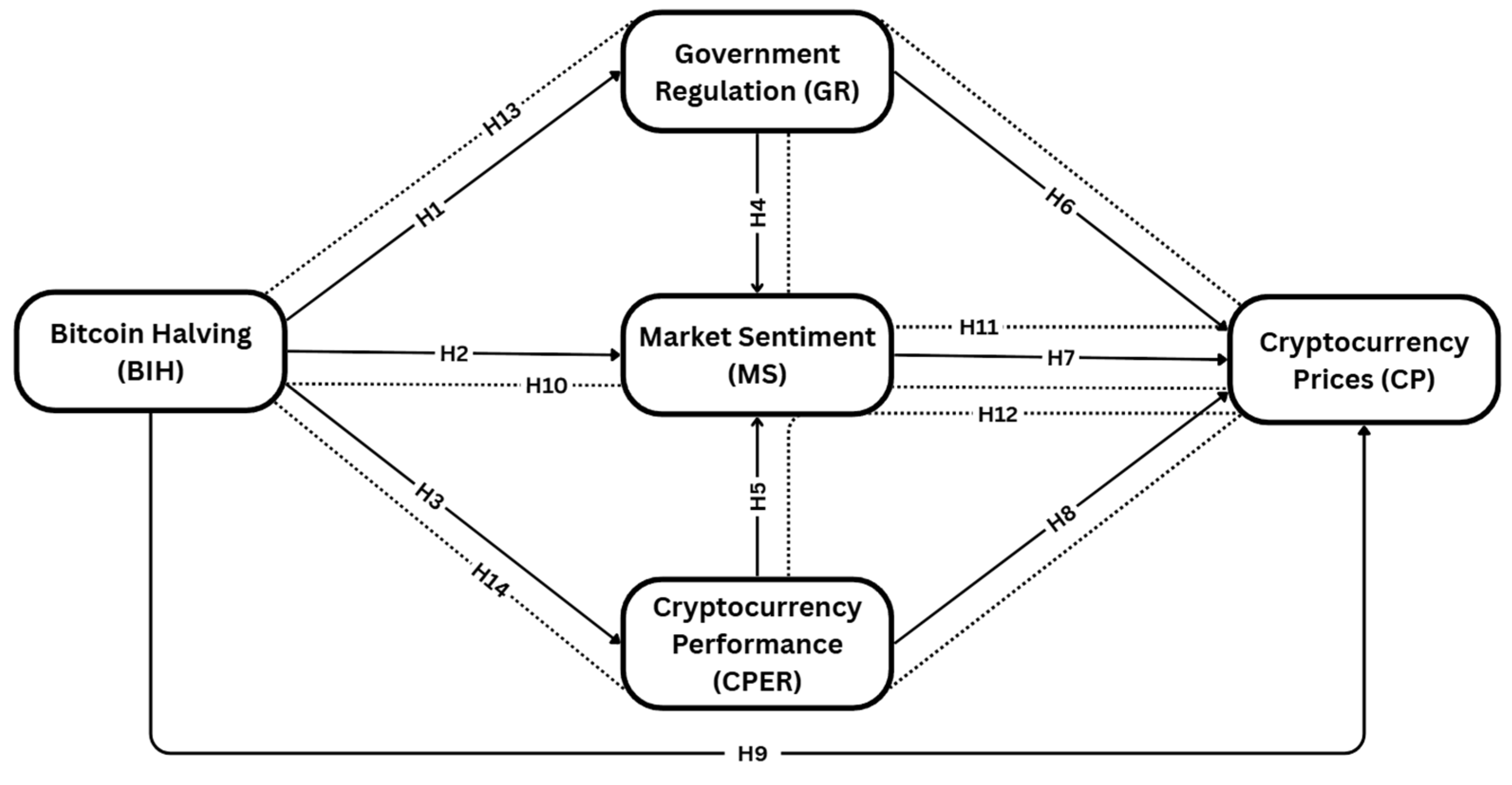
| H1 | BIH → GR | 0.755 | 23.539 | 0.000 ** | Supported |
| H2 | BIH → MS | 0.240 | 2.247 | 0.025 * | Supported |
| H3 | BIH → CPER | 0.699 | 18.964 | 0.000 ** | Supported |
| H4 | GR → MS | 0.318 | 3.002 | 0.003 * | Supported |
| H5 | CPER → MS | 0.344 | 4.475 | 0.000 ** | Supported |
| H6 | GR → CP | 0.356 | 4.046 | 0.000 ** | Supported |
| H7 | MS → CP | 0.195 | 2.088 | 0.037 * | Supported |
| H8 | CPER → CP | 0.253 | 3.294 | 0.001 ** | Supported |
| H9 | BIH → CP | 0.136 | 2.280 | 0.023 * | Supported |
| Hypothesis Paths | Coefficients | T Statistic | p Value | Results | |
|---|---|---|---|---|---|
| H10 | BIH → MS → CP | 0.047 | 2.358 | 0.018 * | Supported |
| H11 | GR → MS → CP | 0.062 | 1.311 | 0.190 | Rejected |
| H12 | CPER → MS → CP | 0.067 | 1.595 | 0.111 | Rejected |
| H13 | BIH → GR → CP | 0.269 | 4.081 | 0.000 ** | Supported |
| H14 | BIH → CPER → CP | 0.177 | 3.241 | 0.001 ** | Supported |
| Mediation Pathways | Coefficients and Significance | Results | |||
|---|---|---|---|---|---|
| (A) | (B) | (C) | (D) | ||
| BIH → MS → CP | 0.047 (Sig. 0.018) | 0.136 (Sig. 0.023) | 0.240 (Sig. 0.025) | 0.195 (Sig. 0.037) | Partial Mediation |
| GR → MS → CP | 0.062 (Non-Sig. 0.190) | 0.356 (Sig. 0.000) | 0.318 (Sig. 0.003) | 0.195 (Sig. 0.037) | Full Mediation |
| CPER → MS → CP | 0.067 (Non-Sig. 0.111) | 0.253 (Sig. 0.001) | 0.344 (Sig. 0.000) | 0.195 (Sig. 0.037) | Full Mediation |
| BIH → GR → CP | 0.269 (Sig. 0.000) | 0.136 (Sig. 0.023) | 0.755 (Sig. 0.000) | 0.356 (Sig. 0.000) | Partial Mediation |
| BIH → CPER → CP | 0.177 (Sig. 0.001) | 0.136 (Sig. 0.023) | 0.699 (Sig. 0.000) | 0.253 (Sig. 0.001) | Partial Mediation |
Disclaimer/Publisher’s Note: The statements, opinions and data contained in all publications are solely those of the individual author(s) and contributor(s) and not of MDPI and/or the editor(s). MDPI and/or the editor(s) disclaim responsibility for any injury to people or property resulting from any ideas, methods, instructions or products referred to in the content. |
© 2025 by the authors. Licensee MDPI, Basel, Switzerland. This article is an open access article distributed under the terms and conditions of the Creative Commons Attribution (CC BY) license (https://creativecommons.org/licenses/by/4.0/).
Share and Cite
Subawa, N.S.; Mimaki, C.A.; Mahendra, I.M.O.; Utami, M.S.M. Bitcoin Halving: How Effective Is It in Driving Cryptocurrency Market Dynamics? J. Risk Financial Manag. 2026, 19, 2. https://doi.org/10.3390/jrfm19010002
Subawa NS, Mimaki CA, Mahendra IMO, Utami MSM. Bitcoin Halving: How Effective Is It in Driving Cryptocurrency Market Dynamics? Journal of Risk and Financial Management. 2026; 19(1):2. https://doi.org/10.3390/jrfm19010002
Chicago/Turabian StyleSubawa, Nyoman Sri, Caren Angellina Mimaki, I Made Oka Mahendra, and Made Srinitha Millinia Utami. 2026. "Bitcoin Halving: How Effective Is It in Driving Cryptocurrency Market Dynamics?" Journal of Risk and Financial Management 19, no. 1: 2. https://doi.org/10.3390/jrfm19010002
APA StyleSubawa, N. S., Mimaki, C. A., Mahendra, I. M. O., & Utami, M. S. M. (2026). Bitcoin Halving: How Effective Is It in Driving Cryptocurrency Market Dynamics? Journal of Risk and Financial Management, 19(1), 2. https://doi.org/10.3390/jrfm19010002

