Article

Regime-Switching Affine Term Structure Models with Jumps: Evidence from South African Bond Yields

School of Economics and Finance, University of the Witwatersrand, Johannesburg 2000, South Africa
*
Author to whom correspondence should be addressed.
J. Risk Financial Manag. 2025, 18(12), 681; https://doi.org/10.3390/jrfm18120681 (registering DOI)
Submission received: 3 November 2025 / Revised: 26 November 2025 / Accepted: 27 November 2025 / Published: 1 December 2025
(This article belongs to the Special Issue Modelling for Positive Change: Economics and Finance)

Abstract

We present a unified framework for modelling the term structure of interest rates using affine term structure models (ATSMs) with jumps and regime switches. The novelty lies in combining affine jump diffusion models with regime switching dynamics within a unified framework, allowing for state-dependent jump behaviour while preserving analytical tractability. This integration enables the model to simultaneously capture nonlinear market regimes and discontinuous movements in interest rates—features that traditional affine models or regime switching models alone cannot jointly represent. Estimation is carried out using the Unscented Kalman Filter (UKF) with the belief that it is capable of handling nonlinearity and therefore should estimate the non-Gaussian dynamics well. The yield curve fit demonstrates that both models fit our data well. RMSEs show that the regime switching affine jump diffusion (RS-AJD) model outperforms the affine jump diffusion (AJD) in-sample.

1. Introduction

Bond yields and their returns are not normally distributed, thus overruling the concept of symmetry around the mean. They retain non-normal features, such as fat tails, skewness, and volatility clustering (Piazzesi, 2010).
ATSMs augmented with jumps or regime switching dynamics offer enhanced flexibility to capture these stylised facts observed in interest rate data (Piazzesi, 2010; Singleton, 2006). When used to fit the term structure of interest rates, these models often lead to a reduction in the Root Mean Squared Error (RMSE) and produce residuals that more closely approximate Gaussian white noise. This improvement reflects better model specification and a more accurate representation of interest rate dynamics. Standard Gaussian ATSMs often fall short in capturing abrupt market movements or structural shifts. Incorporating jumps or regime switching mechanisms allows the model to internalise these dynamics, thereby improving both in-sample fit and the statistical properties of residuals (Dai & Singleton, 2000; Duffie & Kan, 1996).
Jumps are popularly associated with scheduled macroeconomic news release, typically the Central Banks announcing the interest rates changes. ATSM class is not completely affine except for special cases as found in Hamilton (1989), Dai and Singleton (2000), and Ang and Bekaert (2002). This class of regime switching models exhibits commonly two regimes, high-persistence low-volatility and a low-persistence high-volatility (Piazzesi, 2010).
The extension of affine diffusion models to AJD is accomplished by including a Levy type jump to them. Duffie et al. (2000) discusses the AJD in terms of no-arbitrage, analytical tractibility, and their impact regarding accuracy with which they price bonds and their derivatives. Cont et al. (2004) discusses various Levy processes, their nature, whether finite or infinite jumps, and their impact on the diffusion. The associated stylised facts for these AJD is also exhibited by volatilty skews and the behaviour of options. Another important aspect to the term structure modelling and pricing of jump models is the market price of risk, in particular, consideration for compensation from the jump risk. Regime switching models are expected to be free from arbitrage, analytically tractable, and offer closed-form solutions.
A growing body of literature considers the treatment of regime detection through the implementation of Markov-modulated models; see Hu (2022), Qin et al. (2024), Ding et al. (2025), among others for more details. Regarding jumps within regime switching models, we consider the approach involving a marked point process by Landen (2000). This procedure determines the intensity kernel and regime-based risk compensation. Our study seeks to link the jumps to regimes even though they arise from different circumstances. Our focus has more to do with the ability of jumps and regime switching models to fit the term structure of interest rates when non-Gaussian dynamics are present. The effectiveness of these models should be confirmed by a reduction of the Root Mean Square Errors (RMSEs) and improvement from non-Gaussian residuals shifting more towards Gaussian.
In this study, we consider a continuous-time modelling in regimes, contrary to previous work involving mostly discrete-time—Dai et al. (2007), Ang and Timmermann (2012), among others. We also consider a non-Gaussian approach, unlike the Gaussian assumption made by Dai et al. (2007). Bandara and Munclinger (2011) also follow the continuous-time approach but their estimation strategy differs from ours as they use the Kalman filter. We estimate the model using the UKF for its known capability to handle nonlinearity.
We follow the AJD from the empirical work by Duffie et al. (2000), and the canonical form of parameters by Dai and Singleton (2000), from which we adopt the closed-form and tractability in pricing of bonds and derivatives. The bond yields derived from these models are tested for fitting our data when jumps are introduced. The same process is extended to regime switching models from which we expect regime switching analogue to the AJD, with certain parameter restrictions. We consider an affine process X whose characteristic function takes the form
E E t e i u X T = exp ϕ ( t , u ) + ψ ( t , u ) X t ,
where X t is the state vector at time t, u is a complex or real vector argument in the characteristic function, ϕ and ψ are complex valued functions, and ⊤ is a transpose operation for a matrix u . The parameters within ϕ are expected to vary with regimes while those within ψ do not.
Our argument regarding the affine jump diffusion and subsequently the regime switching affine models is triggered by the definition and characterisation of the regular affine process from Duffie et al. (2002). A generator-based approach is then followed on how a Markov process X evolves over time (Duffie et al., 2002; Keller-Ressel et al., 2011). In the context of regime switching models, the generator should also define the dynamics that characterise both the continuous-time and discrete-time stochastic dynamics. The final output is the regime-specific characteristic function and a set of regime-specific ordinary differential equations (ODE)s or Ricatti-type equations from which a Duffie and Kan (1996) style zero-coupon bond price P maturing at time τ ; hence, the yield y t ( τ ) = l o g P ( τ , T ) τ is derived. Extension of the regular affine process to the regime switching formulation is the condition for a regime switching affine models (Van Beek et al., 2020). In addition, we follow Landen (2000) by incorporating the kernel intensity for regimes to ensure that for analogous with the jump kernel intensity, the model enables the pricing of regime risk.
Our key contributions are threefold. First, we formally demonstrate that the regular affine process specification naturally extends RS-AJD models. Second, we employ the UKF for efficient state estimation and model calibration, which enables accurate yield curve fitting in the presence of latent factors and nonlinearities. Third, empirical results show that the fitted models produce residuals that closely approximate Gaussian white noise, as confirmed through residual diagnostics and Q-Q plots—indicating improved model specification and robustness in capturing interest rate dynamics. Unlike the three-factor yield curve model based on the Diebold-Li extension of Nelson–Siegel as recently applied by Choudhary (2022) on the SA yields, AJD and RS-AJD have an advantage of econometric tractability as they simultaneously study the term structure and time series dynamics whilst also incorporating the jumps and regime switches.
The remainder of the paper is structured as follows: Section 2 discusses briefly a literature review; Section 3 describes the model framework and estimation strategy; Section 4 discusses data collection; Section 5 discusses the scenarios; Section 6 discusses the model implementation; Section 7 discuses the analysis of results; and Section 8 concludes.

2. Literature Review

The modelling of term structure of interest rates has undergone significant development over the past three decades, with ATSMs emerging as a dominant framework due to their analytical tractability and empirical flexibility. Early models such as Vasicek (1977) and Cox et al. (1981) provided foundational single-factor Gaussian and square-root processes, but these were insufficient to capture the richness of the yield curve observed in empirical data. The extension to multi-factor affine models was formalised by Duffie and Kan (1996), who derived the zero-coupon bond equation as an exponentially affine function of the state variable X.
Dai and Singleton (2000) introduced the specification analysis for ATSMs, which determines whether they are well-defined for bond pricing, “admissibility”. They defined the A M ( N ) family of affine models, where N is the number of factors and M N denotes the number of volatility components. Within this structure, the A 0 ( N ) models represent the purely Gaussian and homoskedastic affine class, where the state variable X does not affect its volatility at time t. A M ( N ) models with M > 0 are characterised by the assumption that one of the Xs determines the conditional volatility of all three state variables. This specification introduces the short rate dynamics such as mean reversion, central tendency, and stochastic volatility, leading to a shift in the normal distribution.
Affine term structure models permit deviations from normality primarily through the incorporation of stochastic volatility and the introduction of jump components. Distinguishing between these sources of non-normality using only first and second moments—such as mean and variance—is inherently challenging, as both features can produce similar effects on volatility clustering and heavy-tailed behaviour in returns. Regime switching models also produce non-normal return distributions and are consistent with empirical evidence of nonlinearities in the conditional first moments of financial time series. By allowing parameters such as drift or volatility to shift across latent regimes, these models can capture structural breaks, asymmetries, and time-varying risk premia that are otherwise difficult to model within standard linear frameworks; see Piazzesi (2010) and references therein.
Singleton (2006) investigated the recurrent non-normal features observed in yield return distributions, particularly during periods of peak or quite financial market volatility. These deviations from Gaussianity are often attributed to time-varying volatility and sudden, infrequent price movements. The latter is typically modelled via classical jump processes, such as Poisson jumps, or more generally through Lévy-type processes. Other approaches include drawing shocks from mixtures of distributions or introducing regime switching structures that allow for discrete shifts in model parameters. Jump processes capture abrupt discontinuities, whereas regime switching models emphasise shifts between persistent economic states. Singleton (2006) further explored how these mechanisms interact with stochastic volatility—initially in discrete-time settings and subsequently within continuous-time affine frameworks that incorporate both stochastic volatility and jump components. Together, these enhancements aimed to replicate the observed skewness, kurtosis, and tail behaviour in bond yield and return distributions, especially across different market conditions.
Duffie et al. (2000) presented an AJD that provides an analytical treatment of a class of transforms, including various Laplace and Fourier transforms as special cases, that allow a solution for a range of valuation and econometric problems. This AJD is a process for which the drift vector, instantaneous covariance matrix, and jump intensities all have affine dependence on the state vector X. They extended the existing literature on affine asset pricing models by deriving a closed-form expression for an extended transform of an AJD process X, and showed that this transform leads to analytically tractable pricing relations for a wide variety of valuation problems. Piazzesi (2000) applies the extended transform differently in the treatment of term structure models with releases of macro-economic information and with central-bank interest rate targeting.
Regime switching affine models should inherit similar characteristics to AJD, including tractability and close-form solutions. The work of Van Beek et al. (2020) addressed this issue by evaluating the prevalence of the regular affine process and parameter restrictions within regime switching. They prove that the joint process of the Markov chain and the conditionally affine part is a process with an affine structure on an enlarged state space, conditionally on the starting state of the Markov chain. The process leads to regime-specific characteristic functions and the solution of ODE as it is the case with the regular affine process. Essentially, a pricing solution based on an affine process is extended to a regime switching affine process without sacrificing the analytical tractability of the affine process. They consider among several empirical option pricing applications, a diffusion type short rate model of Landen (2000), which falls within the category of hidden Markov models. In this model, the underlying Markov process is assumed to have a stochastic differential driven by Wiener processes and a marked point process. They also consider the bond valuation application of Elliot and Siu (2013) on short rate models, who establish a Markov-modulated exponential-affine bond price formula with coefficients given in terms of fundamental matrix solutions of linear matrix differential equations.
Zhu et al. (2015) developed Feynman–Kac formulas for a class of regime switching jump diffusion processes. In these models, the jump part is driven by a Poisson random measure associated with a general Lévy process and the switching part depends on the jump diffusion processes.
In this paper we adapt the regular affine process by Duffie et al. (2002) and their formulations together with those from Keller-Ressel et al. (2011). The AJD part is extended to the regime part accordingly to evaluate the regime-specific formulation of the characteristic function, the generators, and the bond pricing equation. Our objective is to model first, the AJD, followed by the regime switching models in the realm of the regular affine process. In contrast with Dai et al. (2007) who assume a Gaussian distribution and discrete-time process, we assume that the yields and their returns are non-normal.
A growing body of literature highlights the limitations of standard Kalman filtering in the context of nonlinear and non-Gaussian dynamics, particularly in fixed income modelling. Christoffersen et al. (2013) show that the UKF significantly outperforms the Extended Kalman Filter (EKF) in affine term structure models due to its ability to better handle nonlinearities without requiring Jacobian computations; see also Hirsa (2024). Their findings support the UKF as a viable estimation tool for fixed income applications.
More recently, Doshi et al. (2024) demonstrate the effectiveness of modelling financial variables within an AJD environment estimated using nonlinear filtering techniques, the UKF, while B. Wu et al. (2024) propose a multi-factor, mean-reverting affine framework for pricing volatility-based instruments such as variance swaps. These contributions confirm the relevance of AJD in capturing the structural complexity and tail behaviour of financial time series. The affine property of the jump diffusion state dynamics is preserved conditional on each regime, satisfying the standard affine admissibility conditions. The model therefore retains a RS-AJD structure governed by a latent Markov chain. Consequently, the application of the UKF—previously validated in standard AJD and multi-factor nonlinear environments—naturally extends to the regime switching context. Our study contributes to the literature by combining these frameworks and empirically demonstrating the implementation of RS-AJD and estimation and filtration via UKF.
Chourdakis (2002) explains the need for estimation methods that can accommodate both jumps and regime switching in continuous-time models, noting that traditional Gaussian-based filters may fail to capture the irregularities introduced by such dynamics. Although developed outside of finance, the Generalized Maximum-likelihood UKF (GM-UKF) introduced in the robust control literature Liu et al. (2017) offers further motivation by demonstrating how robust filtering approaches can mitigate the impact of non-Gaussian noise—precisely the type of issue that arises in affine jump diffusion models with regime switching. Building on these insights, we adopt a UKF-based estimation strategy tailored to capture the nonlinear, regime-dependent, and non-Gaussian features of the term structure under jump risk and switching dynamics.

3. Model Establishment

Affine processes are a class of Markov chain characterised by the property that their logarithmic characteristic functions are affine in the initial state. They are typically defined through their infinitesimal generators, which involve parameters such as drift, diffusion, and jump intensity functions, each depending affinely on the current state. Under suitable regularity conditions, the evolution of the characteristic function is governed by a system of Riccati-type ODEs parameterised by time and initial conditions (Duffie et al., 2002; Keller-Ressel et al., 2011).
A natural extension of this framework is the regime switching affine process, in which the model parameters—and hence the generator—are modulated by an underlying finite-state Markov chain. This regime-specific structure enables the model to capture structural changes in the dynamics, such as shifts in volatility, mean reversion, or jump activity, driven by the regime variable. The process is expected to exhibit the affine behaviour, conditioned on the current regime, while preserving analytical tractability through a system of ODEs that characterise the evolution of the characteristic function under each regime (Van Beek et al., 2020).
The Markov-modulated component builds upon the marked point process framework of Landen (2000), adapted here to ATSMs with jumps and regime dependence.
Proposition 1 
(Affine Process). Let ( X t ) t 0 be a time-homogeneous Markov process with state space R d , adapted to a filtered probability space ( Ω , F , { F t } , P ) , and satisfying the Feller property (a central regularity condition in the theory of affine processes, particularly when ensuring existence, uniqueness, and well-behaved semigroups). The process X t is said to be affine if there exist deterministic functions
ϕ : R + × C d C , ψ : R + × C d C d ,
such that the conditional characteristic function of X t , given X 0 = x , admits the exponential-affine form:
E e u X t | X 0 = x = exp ϕ ( t , u ) + ψ ( t , u ) x , for all u C d .
Proposition 2 
(Affine Jump Diffusion). Let X t R d be a time-homogeneous Markov process satisfying the following SDE:
d X t = a + b X t d t + Σ V t d W t + R d ξ μ ˜ X ( d t , d ξ ) ,
where
  • a R d is a constant drift vector and b R d × d a loading matrix;
  • Σ R d × d is the volatility matrix;
  • V t is a non-negative affine process driving stochastic volatility;
  • W t R d is a standard Brownian motion;
  • μ X ( d t , d ξ ) is the jump Poisson random measure associated with X t ;
  • μ ˜ X ( d t , d ξ ) = μ X ( d t , d ξ ) ν ( d ξ ) d t is the compensated jump measure;
  • ν ( d ξ )  is the Lévy measure, governing the distribution of jump sizes ξ R d .
The diffusion term Σ V t d W t introduces stochastic volatility while preserving the affine structure. This framework allows the derivation of bond price equations via generalised Riccati equations. As shown in Duffie and Kan (1996), models in the affine class admit bond price expressions that are exponentially affine in the state variables under an affine short rate specification.

3.1. Regime Switching Affine Processes

The classical AJD framework, as developed by Duffie et al. (2000), provides a powerful and tractable class of models where characteristic functions admit closed-form or semi-closed-form solutions. Empirical evidence suggests that financial markets exhibit distinct regimes characterised by shifts in volatility, jump intensity, mean reversion levels (Ang & Bekaert, 2002; Ang & Timmermann, 2012; Hamilton, 1989), among others. These regime shifts cannot be captured adequately by a single affine jump diffusion process.
The AJD is extended to RS-AJD as a continuous-time Markov chain on a specific state space that switches between the states. Importantly, this extension preserves the affine structure, thereby retaining analytical tractability while allowing for richer dynamics that reflect regime changes (Van Beek et al., 2020).
We now extend Proposition 2 to its regime switching counterpart as follows:
Proposition 3 
(Regime Switching Affine Jump Diffusion (RS-AJD)). Let  Z t { 1 , , S }  be a continuous-time, finite-state Markov chain with generator matrix  A ( Z ) = ( q i j ) , where  q i i = j i q i j .
Let  X t R d  satisfy the stochastic differential equation:
d X t = a ( Z t ) + b ( Z t ) X t d t + Σ ( Z t ) V t d W t + E ξ μ ˜ X ( d t , d ξ ) ,
where
  • a ( z ) R d is a drift vector in regime Z t , and b ( z ) R d × d is a loading matrix in regime Z t ;
  • Σ ( z ) R d × d is the regime-dependent volatility matrix;
  • V t is a non-negative stochastic process governing volatility;
  • W t R d is a standard Brownian motion;
  • μ ˜ X ( d t , d ξ ) = μ X ( d t , d ξ ) ν ( Z t , d ξ ) d t is the compensated jump measure under regime Z t ;
  • ν ( Z t , d ξ ) is the regime-specific Lévy measure governing jump intensity and size distribution;
  • E R d denotes the support of jump sizes ξ.
The regime process Z t is a pure jump Markov chain with jump measure μ Z ( d t , d z ) on { 1 , , S } , and compensator:
ν Z ( d t , d z ) = j Z t q Z t , j δ j ( d z ) d t ,
where δ j denotes the Dirac measure at point j { 1 , , S } .
The compensated jump measure of Z is defined by
μ ˜ Z ( d t , d z ) : = μ Z ( d t , d z ) ν Z ( d t , d z ) .
The stochastic integral representation of Z t is
Z t = Z 0 + 0 t { 1 , , S } ( z Z s ) μ Z ( d s , d z ) ,
and the semimartingale decomposition of Z t is
d Z t = { 1 , , S } ( z Z t ) μ ˜ Z ( d t , d z ) + { 1 , , S } ( z Z t ) ν Z ( d t , d z ) .
Thus, the full process ( X t , Z t ) is a Markov semi-martingale with regime-dependent drift, diffusion, and jump components.
Proof. 
See Appendix A.    □

3.2. Generator of the Regime Switching Affine Process

The infinitesimal generator provides a compact way to describe the local behaviour of a Markov process (Duffie et al., 2000). In our model, the joint process ( X t , Z t ) is a RS-AJD, with
X t R d , Z t { 1 , , S } .
Fix Z t = z , and let f : R d R be a twice continuously differentiable function. The conditional infinitesimal generator G z of the state process X t under fixed regime z acts on f as
G z f ( x ) = ( a z + b z x ) f ( x ) + 1 2 Tr Σ z V ( x ; z ) Σ z 2 f ( x ) + R d f ( x + y ) f ( x ) f ( x ) y 1 { y < 1 } λ z ( x ) ν z ( d y ) ,
where
  • f ( x ) = f x 1 f x d is the gradient of f.
  • 2 f ( x ) = 2 f x 1 2 2 f x 1 x d 2 f x d x 1 2 f x d 2 is the Hessian of f.
The volatility scaling matrix describing state-dependent volatility scaling under regime z is specified as
V ( x ; z ) = diag α 0 ( i ) ( z ) + j = 1 d α j ( i ) ( z ) x ( j ) i = 1 , , d
where
  • α 0 ( i ) ( z ) R is the constant term (intercept) for the i-th component of the volatility scaling in regime z.
  • α j ( i ) ( z ) R is the loading (sensitivity) of the i-th volatility component to the j-th state variable x ( j ) , under regime z.
  • i { 1 , , d } indexes the volatility components, i.e., the diagonal entries of V ( x ; z ) .
  • j { 1 , , d } indexes the state variables.
This generator captures the combined effects of drift, diffusion, and jumps under a given regime. The jump intensity λ z ( x ) and the Lévy measure ν z may vary with the regime, allowing for flexible modelling of rare or discontinuous events.

3.2.1. Joint Generator for ( X t , Z t )

To describe the full process ( X t , Z t ) , we combine the regime-specific generator G z with the generator matrix Q = [ q z z ] of the finite-state Markov chain Z t , where q z z 0 for z z and q z z = z z q z z . Then for any function f : R d × { 1 , , S } R , the joint infinitesimal generator A is given by
A f ( x , z ) = G z f ( · , z ) ( x ) + z z q z z f ( x , z ) f ( x , z ) .
The first term G z f ( · , z ) ( x ) describes the evolution of X t under a fixed regime z, while the second term accounts for regime switching jumps governed by the generator matrix Q.1
The affine structure of the RS-AJD model ensures that expectations of exponential-affine functions—such as characteristic functions or bond prices—can be computed from a system of ODEs. Specifically, for a short rate of the form
r t = δ 0 ( Z t ) + δ 1 ( Z t ) X t ,
with regime-dependent parameters δ 0 ( Z t ) R , δ 1 ( Z t ) R d , pricing a zero-coupon bond reduces to solving a system of regime-specific Riccati equations derived from the generator  A .
This generator-based formulation plays a central role in deriving semi-analytical solutions for prices, expectations, and moment-generating functions in a regime-specific and computationally tractable manner.
Under the risk-neutral measure Q , define the zero-coupon bond price as
P ( t , T ) = E Q exp t T r s d s X t = x , Z t = z .
Let
f ( t , x , z ) : = P ( t , T ) .
Then f satisfies the partial integro-differential equation (PIDE)
f t ( t , x , z ) + A f ( t , x , z ) r ( x , z ) f ( t , x , z ) = 0 , f ( T , x , z ) = 1 .
We postulate the affine
f ( t , x , z ) = exp A z ( τ ) + B z ( τ ) x , τ = T t ,
with deterministic functions A z ( τ ) R , B z ( τ ) R d , and terminal conditions
A z ( 0 ) = 0 , B z ( 0 ) = 0 , z { 1 , , S } .
Subsrituting the affine (11) into the PIDE, applying the generator A , and matching coefficients in powers of x yields a system of coupled ODEs (Riccati equations) for { A z ( τ ) , B z ( τ ) } z = 1 S :
d A z d τ ( τ ) = δ 0 ( z ) a z B z ( τ ) 1 2 Tr Σ z V B z ( τ ) ; z Σ z R d e B z ( τ ) y 1 B z ( τ ) y 1 { y < 1 } λ z ( · ) ν z ( d y ) z z q z z exp A z ( τ ) A z ( τ ) + ( B z ( τ ) B z ( τ ) ) x 1 ,
d B z d τ ( τ ) = δ 1 ( z ) b z B z ( τ ) .
Here V ( · ; z ) is the affine function of B z ( τ ) corresponding to regime z, and the sum over z reflects regime transitions through the Markov generator Q. A z ( 0 ) = B z ( 0 ) = 0 are the terminal conditions.

3.2.2. Bond Yields and Term Structure

From the solution of A z ( τ ) and B z ( τ ) , the zero-coupon bond price in regime z takes the exponential-affine form (Landen, 2000; L. Wu & Zeng, 2004)
P ( t , T ) = exp A z ( τ ) + B z ( τ ) X t
when the current regime is z. More generally, if a regime is not observed or transitions are probabilistic, priced value becomes a regime-weighted mixture:
P ( t , T ) = z = 1 S π z ( τ ) exp A z ( τ ) + B z ( τ ) X t ,
where π z ( τ ) = P ( Z t = z ) or an equivalent regime probability.
The continuously compounded yield is
y ( t , T ) = 1 T t log P ( t , T ) ,
which retains an affine form in the state vector X t and depends on regime probabilities.
Given that the process X t is a semi-martingale, it admits a well-defined stochastic integral formulation, allowing us to work within a no-arbitrage pricing framework. For tractability, we assume that the market price of risk is zero, implying that the physical measure P coincides with the risk-neutral measure Q . Under this assumption, the model dynamics can be interpreted directly under Q , and no change-of-measure adjustment is necessary for pricing.

3.3. Joint Dynamics of State and Regime Processes

Following the specification of Landen (2000) and L. Wu and Zeng (2004), we consider a joint affine jump diffusion system for the latent state process X t R d and the discrete-valued regime process Z t { 0 , 1 , , m 1 } . These processes evolve in continuous-time and interact dynamically through their drift, volatility, and jump intensities.

3.3.1. State Process X t

The dynamics characterised in Proposition 3 can alternatively be expressed in the form of a SDE for the state process X t , which evolves under a regime-dependent affine jump diffusion specification:
d X t = a ( Z t ) + b ( Z t ) X t d t + Σ ( Z t ) V t d W t + E X ξ μ ˜ X ( d t , d ξ ) ,
where
  • μ ˜ X ( d t , d ξ ) is a compensated marked point process driving jumps in X t .
  • ξ E X R d denotes the jump size in the state space.

3.3.2. Regime Process Z t

The evolution of the regime Z t is modelled via a marked point process:
d Z t = E Z ζ ( z ) μ ˜ Z ( d t , d z ) ,
where
  • E Z = { ( i , j ) N 2 : i j , i , j { 0 , , m 1 } } is the mark space of regime transitions.
  • ζ ( z ) = j for z = ( i , j ) , mapping the transition to the new regime index.
  • μ ˜ Z ( d t , d z ) is a compensated marked point process governing regime jumps.

3.3.3. State-Dependent Regime Transition Intensity

The stochastic intensity of regime switching is allowed to depend on the current state X t . The compensator (or intensity measure) of the regime-jump process is given by
ν ˜ Z ( d t , d z ) = h ˜ ( z ; X t ) · 1 { Z t = i } · ν Z ( d z ) d t ,
where
  • z = ( i , j ) E Z denotes a transition from regime i to j.
  • h ˜ ( z ; X ) is a measurable state-dependent transition intensity.
  • ν Z ( d z ) is a reference measure over the mark space E Z .
We follow L. Wu and Zeng (2004) in assuming that the transition intensity is exponentially affine in the state
h ˜ ( z ; X ) = exp h ˜ 0 ( z ) + h ˜ 1 ( z ) X ,
where h ˜ 0 ( z ) R and h ˜ 1 ( z ) R d are parameters specific to the transition z = ( i , j ) . This choice ensures both tractability and consistency with the affine term structure framework.
Equation (17) describes a multi-factor affine jump diffusion process for the latent state variables X t , whose parameters depend on the prevailing regime Z t . Simultaneously, (18) captures endogenous regime transitions via a marked jump process, where the intensity of switching from regime i to j is driven by the current economic state X t through an exponential-affine function (20).
This joint specification allows regime switching to be triggered endogenously by macro-financial conditions, thereby embedding jump risks and regime-dependent dynamics within a unified affine framework.

3.4. Estimation Framework

We consider modelling the term structure of interest rates using a nonlinear state-space framework, where observed yields y t R n are driven by latent factors X t R d . This section outlines the estimation strategy based on the UKF for two affine models, the AJD and the RS-AJD.

3.4.1. State-Space Modelling and UKF Estimation of Affine Yield Curve Models

UKF have been used together with the AJD to address both the filtration problem and parameter estimation. Recent advances in the literature (Cheng et al., 2024; Christoffersen et al., 2013; Deng, 2023; Lv et al., 2025) emphasise the need for flexible estimation frameworks that can accommodate nonlinearities and deviations from Gaussian assumptions. Christoffersen et al. (2013) show that the UKF offers significant improvements over the EKF when applied to affine term structure models, due to its ability to more accurately approximate nonlinear transformations without requiring Jacobians. Their findings support the UKF as a practical and robust estimation strategy in fixed income applications.
In light of this, and the fact that our models incorporate both jumps and regime switching dynamics, we adopt the UKF to estimate latent states and parameters. The UKF is particularly suitable here, as it efficiently handles the nonlinear, non-Gaussian features that arise from jump components and regime-dependent behaviour.2

3.4.2. State (Transition) Equation

The state variables transition equations take the Euler–Maruyama approximation form of respective SDEs. The latent factor process X t R d follows a discrete-time approximation of a jump diffusion process:
X t + 1 = X t + μ ( X t ) Δ t + σ ( X t ) Δ t ε t + J t ,
where
  • μ ( X t ) is the drift function.
  • σ ( X t ) is the diffusion (volatility) function.
  • ε t N ( 0 , I d ) is standard Gaussian noise.
  • J t = k = 1 N t ξ k is the jump component, where N t Poisson ( λ Δ t ) and the jump sizes ξ k N ( 0 , Σ J ) are i.i.d. and independent of ε t and X t .
In the UKF implementation, the jump component is approximated as Gaussian with
E [ J t ] = 0 , Cov ( J t ) = λ Δ t Σ J ,
which is incorporated into the process noise covariance.
The transition function used in the UKF is
f ( X t ) = X t + μ ( X t ) Δ t
with total process noise covariance
Q t = σ ( X t ) σ ( X t ) Δ t + λ Δ t Σ J .

3.4.3. Measurement Equation

The observed yield vector y t R n is modelled as an affine function of the latent state:
y t = A + B X t + ε t ( y ) ,
where
  • A R n is a vector of intercept terms.
  • B R n × d is the factor loading matrix.
  • ε t ( y ) N ( 0 , R ) is measurement noise.
The measurement function for the UKF is:
h ( X t ) = A + B X t .

3.4.4. Latent Factors

In both the AJD and RS-AJD specifications, the latent state vector is defined as
X t = x t ( L ) x t ( S ) x t ( C ) ,
where x t ( L ) , x t ( S ) , and x t ( C ) represent the level, slope, and curvature factors of the yield curve, respectively. These three latent components capture the dominant cross-sectional movements in yields across maturities and provide an economically interpretable representation of the term structure dynamics.

3.4.5. UKF in Regime Switching Jump Diffusion (RS-AJD) Model

To capture the structural changes in yield dynamics, we extend the model to include a hidden regime index Z t { 1 , , K } , which evolves as a first-order Markov chain. The latent state evolves according to:
X t + 1 = X t + μ ( Z t ) ( X t ) Δ t + σ ( Z t ) ( X t ) Δ t ε t + J t ( Z t ) ,
where the regime-specific components are:
  • μ ( k ) ( X t ) = M ( k ) X t is an affine drift function in regime k,
  • σ ( k ) ( X t ) = S ( k ) X t is an affine diffusion function in regime k,
  • J t ( k ) = i = 1 N t ( k ) ξ i ( k ) is the jump term in regime k,
  • ξ i ( k ) N ( 0 , ( σ jump ( k ) ) 2 I d ) is the jump sizes,
  • ε t N ( 0 , I d ) is a standard Gaussian innovation.
The Markov transition rule for the regime index is
P ( Z t + 1 = j Z t = i ) = p i j , with P = [ p i j ] .
The measurement equation remains
y t = A + B X t + ε t ( y ) .

3.4.6. UKF Implementation

The UKF approximates the filtering problem by propagating a set of sigma points through the nonlinear state and measurement functions. The method is described fully in Hirsa (2024). We implement it in this study for both the AJD and RS-AJD models. The UKF is a nonlinear extension of the classical Kalman filter that avoids the need for linearising the system dynamics—as done in the Extended Kalman Filter. Instead, it uses a deterministic sampling approach based on sigma points, which are carefully chosen points around the mean of the state distribution. These points are propagated through the nonlinear functions—state transition and measurement functions—to capture the posterior mean and covariance up to second-order accuracy.
As discussed in Christoffersen et al. (2013), the UKF is particularly well-suited for yield curve modelling when the measurement equation is affine—linear in latent states, but the state dynamics are nonlinear. The sigma points provide a computationally efficient means of approximating the distribution of the latent states without resorting to more complex simulation-based methods such as particle filtering. This balance between accuracy and computational tractability makes the UKF attractive for large-scale term structure models, particularly when estimating latent factor dynamics under jump diffusion or regime switching specifications.
The approach is also relatively easy to implement and tune, with hyperparameters (e.g., α , κ , β ) controlling the spread and weighting of the sigma points, thus offering robustness against non-Gaussian features or local nonlinearities in the system. The UKF estimates the latent states { X t } t = 1 T by recursively applying a prediction-update cycle based on a deterministic set of sigma points. The following steps outline the UKF implementation for both the AJD and RS-AJD models:
  • Initialization: Set initial state estimate X ^ 0 | 0 , covariance matrix P 0 | 0 , and model parameters θ . Given the observed yield data { y t } t = 1 T , begin filtering from t = 1 .
  • Sigma Point Generation: At time t 1 , construct 2 d + 1 sigma points χ t 1 | t 1 ( i ) from the current estimate X ^ t 1 | t 1 and covariance P t 1 | t 1 :
    χ t 1 | t 1 ( 0 ) = X ^ t 1 | t 1 , χ t 1 | t 1 ( i ) = X ^ t 1 | t 1 ± ( d + λ ) P t 1 | t 1 i , i = 1 , , d ,
    where λ = α 2 ( d + κ ) d and α , κ are UKF tuning parameters.
  • Prediction Step: Propagate each sigma point through the nonlinear transition function f ( Z t ) ( · ) , which may depend on the regime Z t :
    χ t | t 1 ( i ) = f ( Z t ) χ t 1 | t 1 ( i ) , i = 0 , , 2 d .
    Compute the predicted mean and covariance:
    X ^ t | t 1 = i = 0 2 d w i ( m ) χ t | t 1 ( i ) ,
    P t | t 1 = i = 0 2 d w i ( c ) χ t | t 1 ( i ) X ^ t | t 1 χ t | t 1 ( i ) X ^ t | t 1 + Q ( Z t ) ,
    where Q ( Z t ) is the process noise covariance (including diffusion and jumps), and w i ( m ) , w i ( c ) are UKF weights.
  • Measurement Prediction: Pass predicted sigma points through the measurement function:
    γ ( i ) = h χ t | t 1 ( i ) = A + B χ t | t 1 ( i ) ,
    Then compute
    y ^ t | t 1 = i = 0 2 d w i ( m ) γ ( i ) ,
    P y y = i = 0 2 d w i ( c ) γ ( i ) y ^ t | t 1 γ ( i ) y ^ t | t 1 + R ,
    P x y = i = 0 2 d w i ( c ) χ t | t 1 ( i ) X ^ t | t 1 γ ( i ) y ^ t | t 1 .
  • Update Step: Compute the Kalman gain and update state estimates:
    K t = P x y P y y 1 ,
    X ^ t | t = X ^ t | t 1 + K t y t y ^ t | t 1 ,
    P t | t = P t | t 1 K t P y y K t .
  • Iterate: Repeat the above steps for all t = 1 , , T to obtain the filtered state estimates X ^ t | t and covariances P t | t .
  • X t : Latent factor vector.
  • y t : Observed yield vector.
  • X ^ t | t : Filtered state estimate.
  • P t | t : Filtered state covariance.
  • Q ( Z t ) : Regime-dependent process noise.
  • R: Measurement noise covariance.
A detailed pseudocode of this procedure is provided in Appendix B.

3.4.7. Parameter Estimation via Maximum Likelihood

There are four parameters that are affine in X for the AJD model according to the formulation in Proposition 2 and the measurement (23). For the regime switching model, we assume two regimes z = 2 resulting in two sets of four each 2 × 4 = 8 parameters. We describe the parameters for each model as follows:
  • AJD model: The parameter vector
    θ = μ , σ , λ , Σ J , A , B , R
    consists of four latent process parameters drift μ , diffusion volatility σ , jump intensity λ , and jump size standard deviation Σ J , along with noise parameters A, B, and measurement noise covariance R.
  • RS-AJD model: The parameter vector
    θ z = μ 0 , σ 0 , λ 0 , Σ J , 0 , μ 1 , σ 1 , λ 1 , Σ J , 1 , A , B , R
    includes separate process parameters for each regime z = 0 , 1 , capturing regime-dependent dynamics.
These parameters are estimated by maximising the UKF-based log-likelihood, which can be expressed as
L ( θ ) = 1 2 t = 1 T log P y y , t + ( y t y ^ t | t 1 ) P y y , t 1 ( y t y ^ t | t 1 ) + n y log ( 2 π ) ,
where y t is the observed yield vector at time t, y ^ t | t 1 is the UKF one-step-ahead prediction, P y y , t is the predicted observation covariance, and n y is the dimension of the observation vector.
For the RS-AJD model, the likelihood is computed conditional on the regime sequence, with parameters θ z applied according to the regime z t at each time step.
Optimization is performed using gradient-based local algorithms, e.g., L-BFGS-B, or global methods, Differential Evolution (DE), depending on initialisation and model complexity.

4. Data Collection

We retrieved the weekly South African (SA) Government bond prices and yields from the Thomson Reuters database for the period October 2015 to September 2024, over 3 months, 5, 10, 12, 20, 25, and 30 year maturities. This sample encompasses a range of market and monetary policy events with episodes of heightened volatility and discontinuous yield adjustments. It provides the necessary variation to identify both the continuous and jump components of the term structure as well as distinct interest rate regimes. The choice of weekly data is informed by weekly auctions held by the Treasury. Technically, weekly frequency is suitable for smoothing transitory market noise while retaining sensitivity to regime shifts and jump events.
SA bonds have fewer short maturities but instead their bond portfolios consist of longer maturities. For the out-sample forecast, we used one year weekly bond yields for the period October 2023 to Septermber 2024.
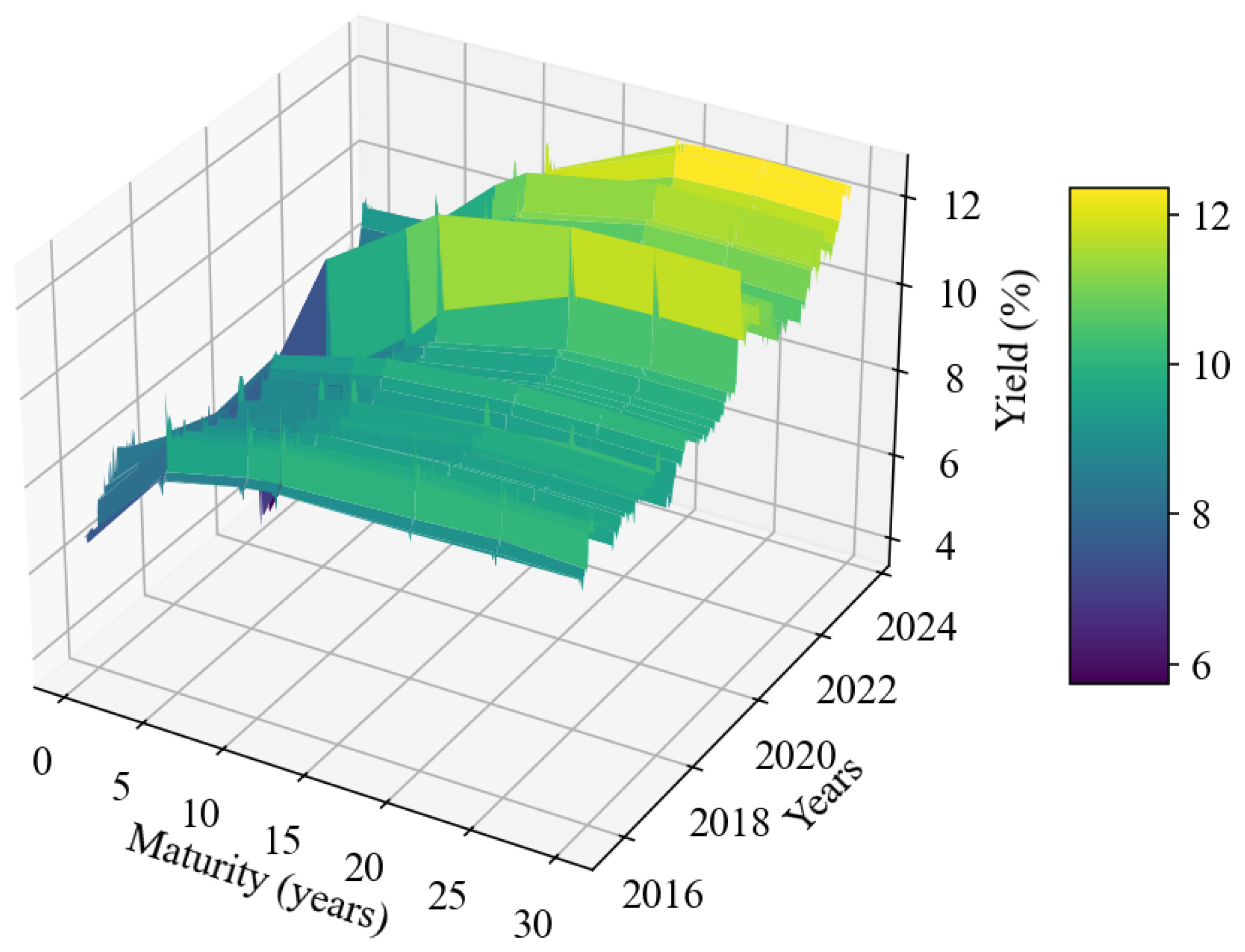
The yield surface in Figure 1 presents both the cross-section and time series of yields. It demonstrates a clear upward trend in yield levels from 2015 to 2024. In the earlier years (2015–2016), yields were comparatively low, averaging around 8%, but began rising steadily, reaching a local peak around 2020. By 2024, yields remain elevated compared to the beginning of the period, suggesting a steep rate increase.
Along the maturity dimension, the term structure typically exhibits an upward-sloping pattern from short to intermediate maturities, with yields increasing steeply between 0 and 5 years. A modest hump is visible around the 15-year maturity mark, beyond which yields stabilise or slightly decline, indicating a flattening yield curve at the long end.

5. Scenario Determination

This study examines the affine jump diffusion models designed to capture key features of the term structure of interest rates, with a particular focus on the impact of regime shifts. Starting from the baseline AJD model, valued for its analytical tractability and ability to incorporate jump risk (Duffie et al., 2000), we extend the framework to a RS-AJD model. This extension allows for jump intensities, volatilities, and other parameters to vary across latent regimes, reflecting changes in market conditions that influence the yield curve. Estimation is performed using the Unscented Kalman Filter, well-suited for nonlinear state-space models prevalent in term structure modelling (Julier & Uhlmann, 1997). Our approach aims to assess how accounting for regime-dependent dynamics improves the modelling and forecasting of interest rate term structures, which is of fundamental importance in finance for pricing, risk management, and portfolio allocation.

6. Model Implementation

We begin with the AJD model as the baseline single-regime specification, which captures jump dynamics in the short rate process within a continuous-time framework. This model is then extended to a RS-AJD framework, allowing for parameters such as drift, volatility, and jump intensity to vary across two latent regimes ( z = 2 ) governed by a generator matrix A ( z ) .
Both models are discretised using the Euler–Maruyama scheme to approximate the continuous-time stochastic differential equations for numerical simulation and likelihood evaluation. For the models, we assume the presence of the stylised facts for asset returns and non-Gaussianity (Cont, 2001). As a result, we estimate the parameters, hidden states, and regime paths using the UKF.
Estimation involves jointly inferring the model parameters and the regime transition matrix from observed yield curve data across N = 7 maturities. We compare the fit and forecasting performance of (i) non-Gaussian AJD models with jumps and (ii) the regime switching RS-AJD extensions. This hierarchical modelling approach balances tractability with flexibility, enabling us to capture regime-dependent shifts in the term structure dynamics that are crucial for accurate pricing, risk assessment, and empirical analysis.

7. Analysis of Results

7.1. Yield Fit

In this section, we compare the AJD and RS-AJD models in terms of their post-calibration model fit. We explore the residual diagnostics to determine the goodness of model specification through an improvement from exhibiting non-Gaussian towards more Gaussian properties. Finally, we compare the average yield curve fit and the RMSE of both in- and out-samples.

7.1.1. AJD Model

Table 1 presents the results of the UKF estimation for the AJD latent factors yields from which we obtain the following insights:
  • Parameters
  • The estimated drift coefficient is μ = 0.0224 , up from the initial guess of 0.01 , indicating a moderate mean-reverting behaviour in the latent factor dynamics.
  • The diffusion coefficient is σ = 0.0154 , a reduction from the initial guess of 0.05 , implying monthly innovations of approximately 1.54% in the factors—suggesting smoother continuous evolution than initially assumed.
  • The jump intensity is estimated at λ j = 0.0119 , significantly lower than the initial guess of 0.5 , implying that jumps occur roughly once every 84 time steps ( 1 / λ j 84 ). This confirms that jumps are rare, but their inclusion is justified for capturing occasional abrupt shifts.
  • The jump size standard deviation is Σ J = 0.0169 , compared to the initial value of 0.2 . This shows that while jumps are infrequent, their magnitude is non-negligible and comparable to the continuous volatility ( σ ), underscoring their importance in yield curve dynamics.
  • Likelihood and Optimisation:
  • The final log-likelihood achieved is 1432.20 , indicating a well-fitted model.
  • Both global, Differential Evolution (DE), and local, Maximum Likelihood Estimation (LMLE), optimisation converged to nearly identical parameter vectors:
    DE : θ = [ 0.0224 , 0.0154 , 0.0119 , 0.0169 ] , MLE : θ = [ 0.0224 , 0.0154 , 0.0119 , 0.0169 ]
  • The near-perfect match between DE and MLE suggests robust numerical stability and optimiser convergence.
  • Noise Structures:
  • The process noise vector A ranges from 0.0048 to 0.0280, with higher variance at short maturities of A 1 = 0.0280 , reflecting greater uncertainty in short-term rates.
  • The measurement noise covariance R is fixed at 0.01 · I , a conservative but reasonable assumption of 1% observation error variance.
The UKF estimation procedure yields statistically stable and economically interpretable parameter estimates.
Table 1. A summary of UKF Maximum Likelihood Estimates for the AJD model parameters. The table reports the drift ( μ ), diffusion ( σ ), jump intensity ( λ j ), and jump size standard deviation ( Σ J ), along with the optimised log-likelihood. The process noise vector A and factor loadings matrix B are reported separately.
ParameterEstimated Value
μ 0.0224
σ 0.0154
λ j 0.0119
Σ J 0.0169
Log-likelihood−1432.20
ASee Table 2
BSee Table 3
R 0.01 · I
Table 2. Estimated elements of the process noise covariance vector A, representing idiosyncratic volatility across the seven observed yield maturities. Higher values at short maturities (e.g., A 1 ) reflect greater uncertainty in short-term rates.
A 1 A 2 A 3 A 4 A 5 A 6 A 7
0.02800.01960.00720.00600.00480.00680.0075
Table 3. Estimated factor loading matrix B linking the three latent factors level, slope, and curvature to the seven yield maturities. Each row corresponds to one maturity, and columns correspond to factor sensitivities.
Factor 1Factor 2Factor 3
−1.3167−4.04772.2051
−0.24540.45312.7503
−0.58790.75911.6816
−0.71020.89511.0274
−0.89730.98130.1737
−0.88940.98860.0847
−0.85141.04710.1341
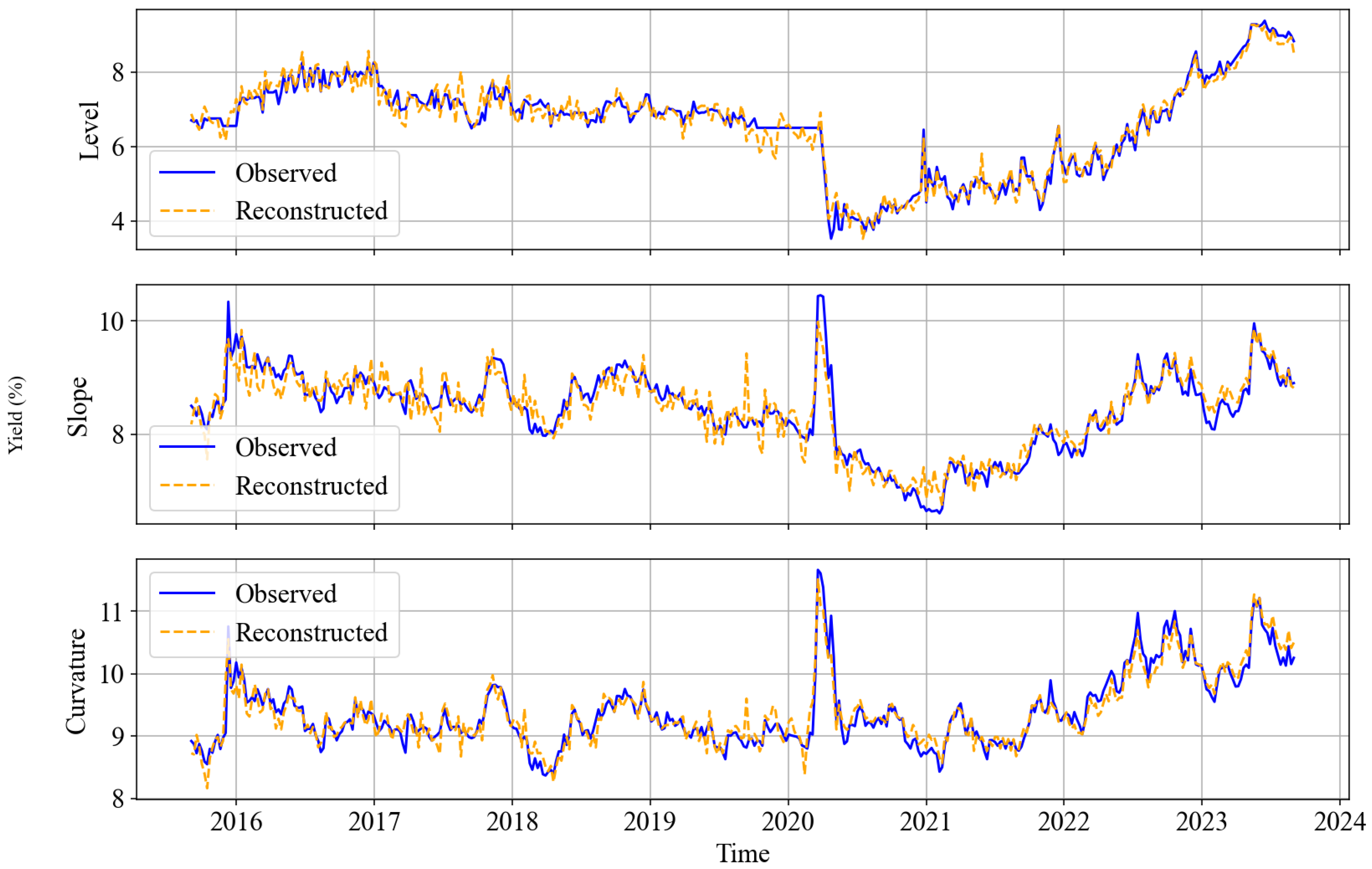
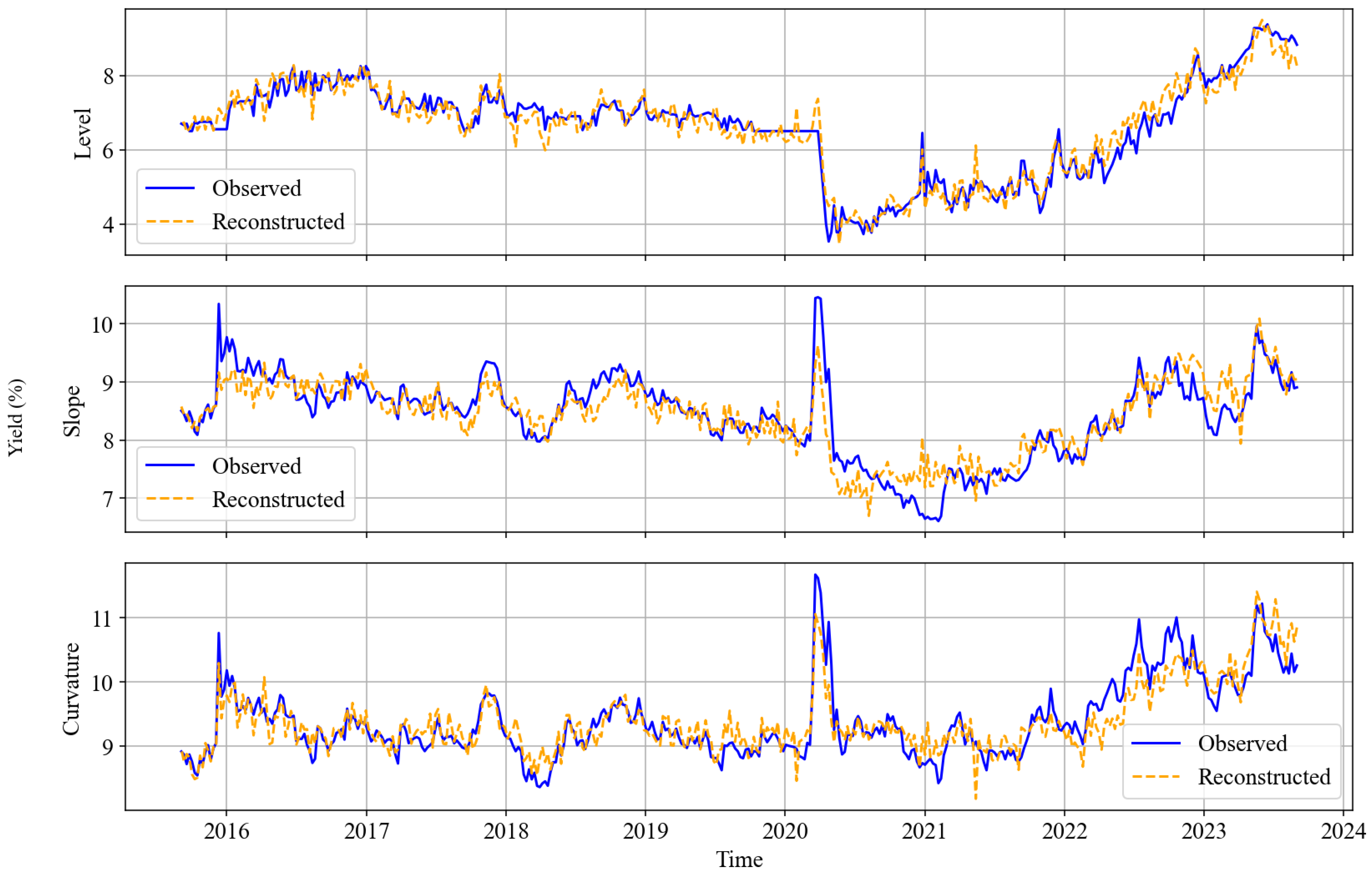
Figure 2 presents the post-calibration results by plotting the fitted yield factors against observed outcomes. The factors from UKF are reconstructed yields, and observed yields are represented by yellow and blue lines, respectively. A match between both data sets was observed by closeness and a very small deviation from one another.
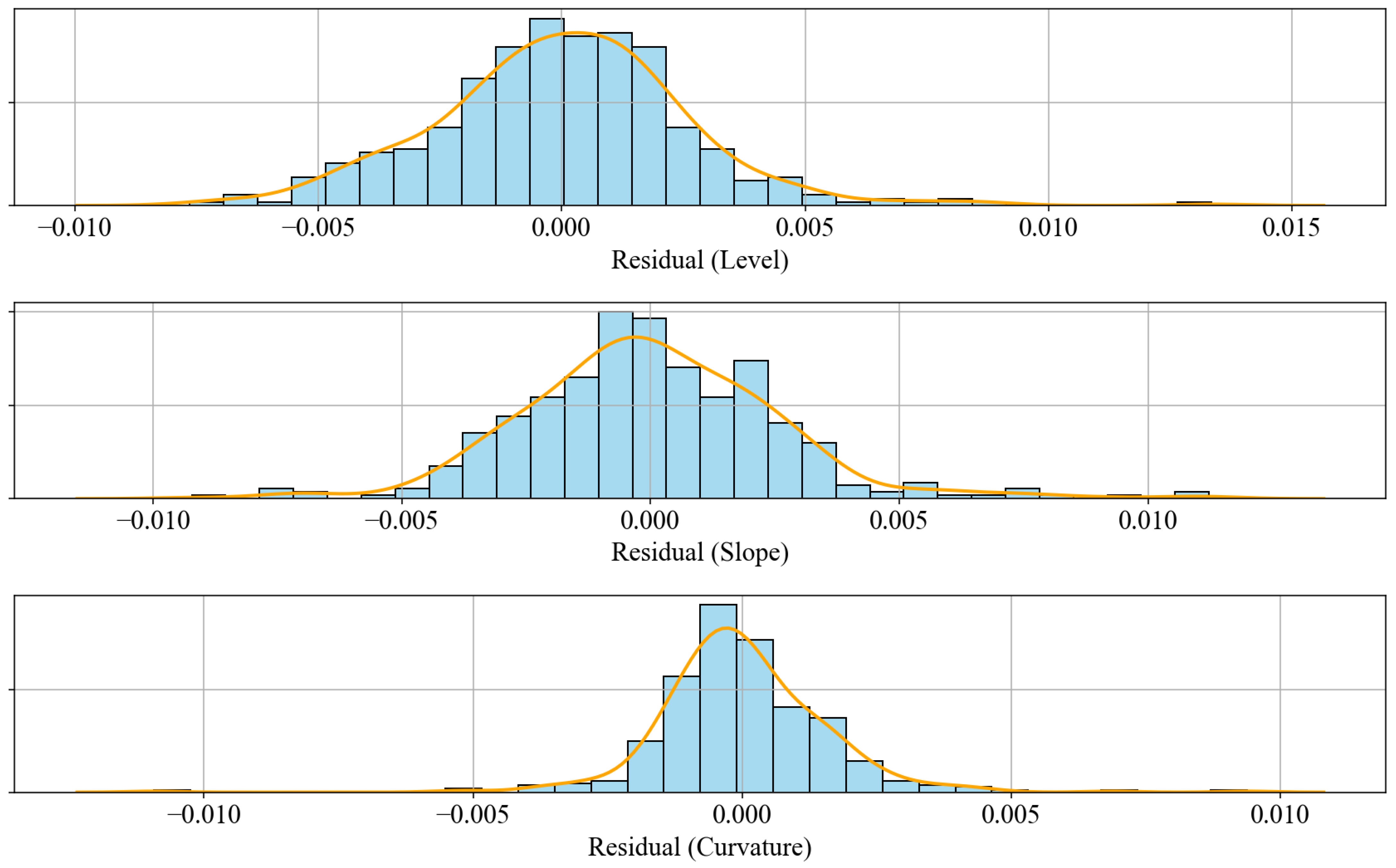
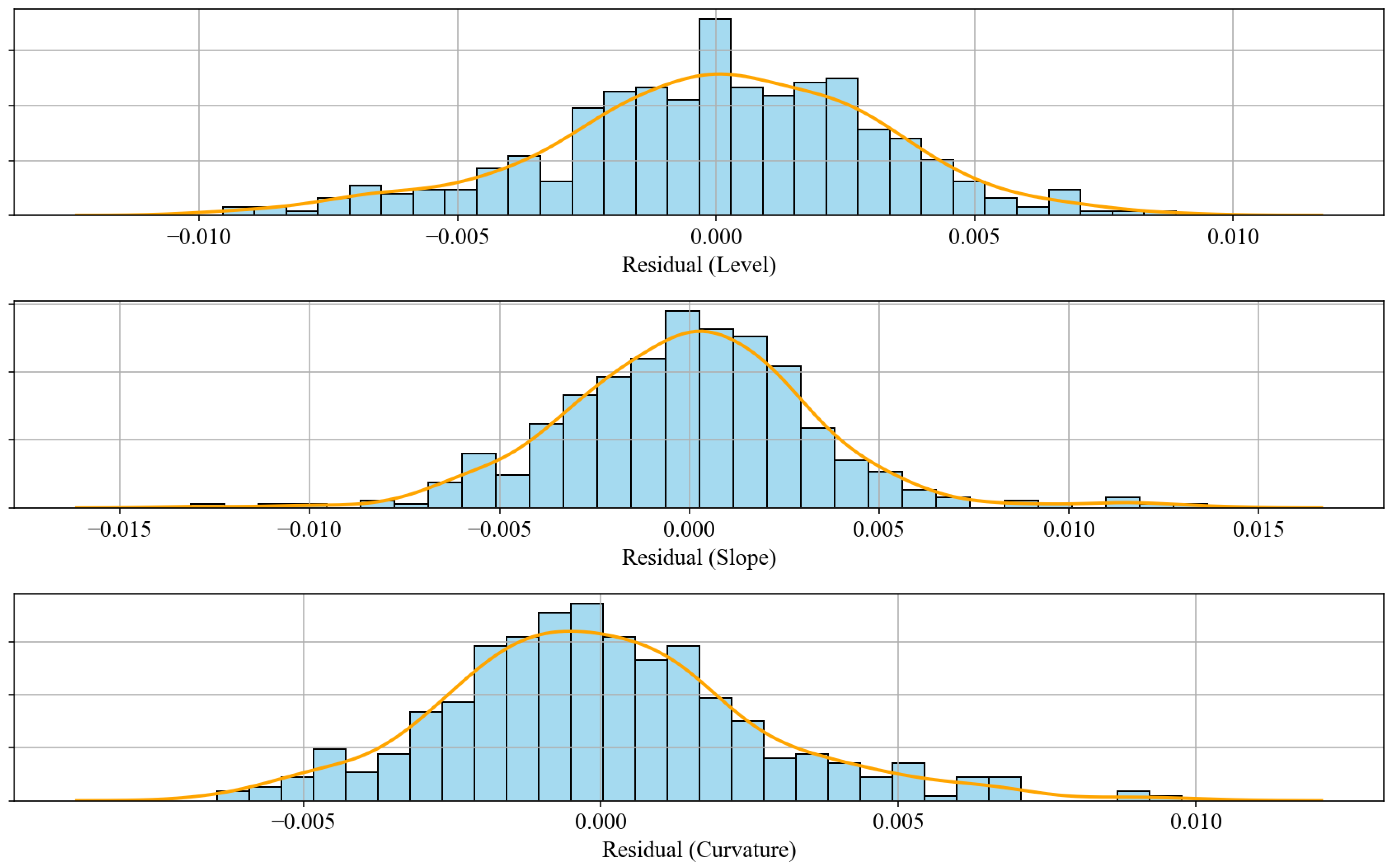
The residuals were computed as the difference between the fitted yields and the observed values across the three latent factors—level, slope, and curvature. The Gaussian innovation assumptions may not hold strictly in a jump diffusion context unless the model fits the data perfectly. To evaluate the distributional properties of the residuals, we present histogram and probability density estimates in Figure 3. These visualisations allow us to assess deviations from normality, particularly skewness and excess kurtosis.
The histograms reveal residual distributions that are centred approximately around zero, indicating an unbiased fit. There is clear evidence of fat tails and moderate skewness across all three factors. The level residuals show a slight positive skew, with outliers ranging from approximately 0.010 to 0.015 . The slope factor exhibits more pronounced tails, with residuals spanning from 0.010 up to 0.11 . For the curvature factor, residuals are more symmetric and fall within a narrower range of approximately 0.005 to 0.05 , suggesting closer adherence to normality.
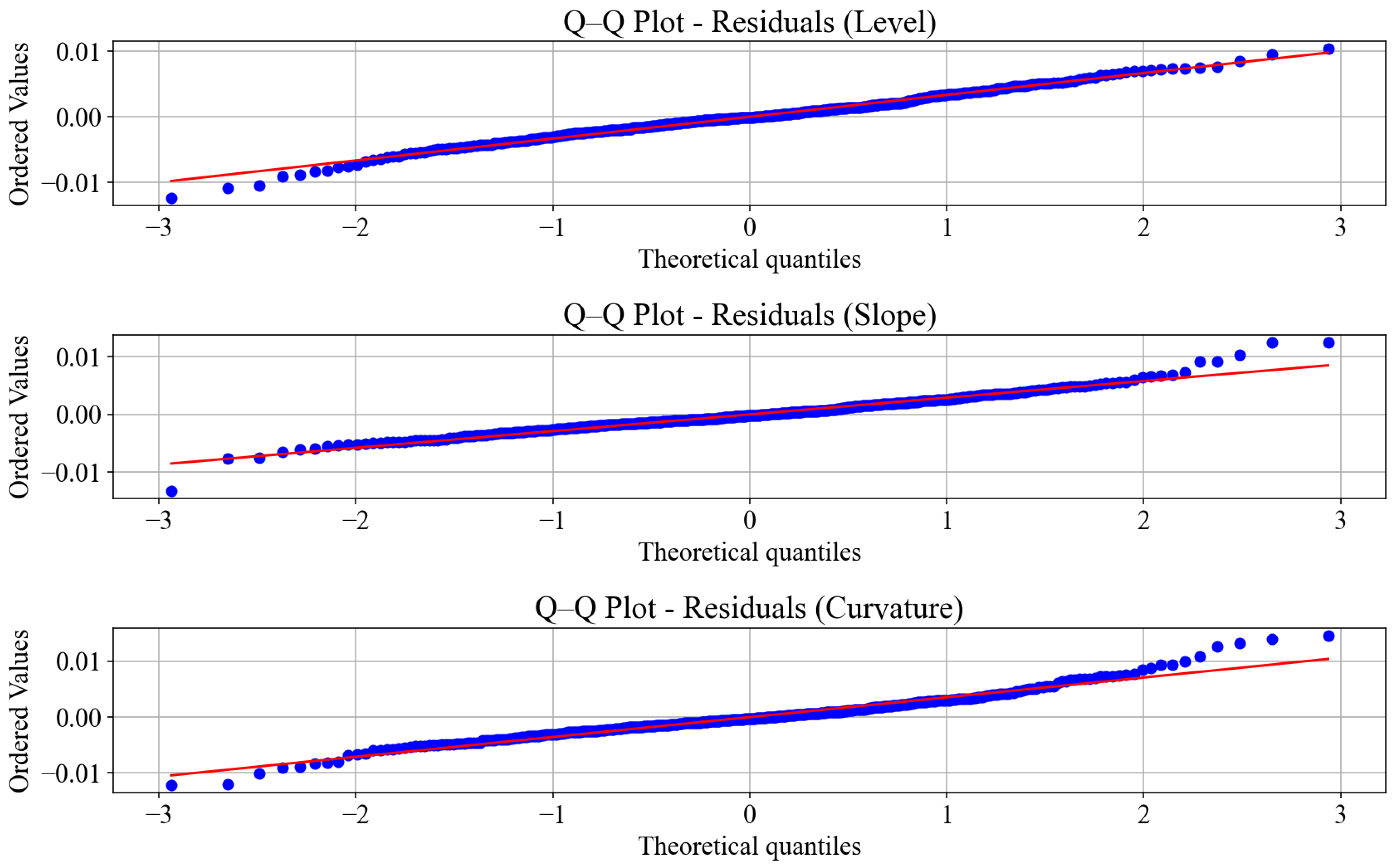
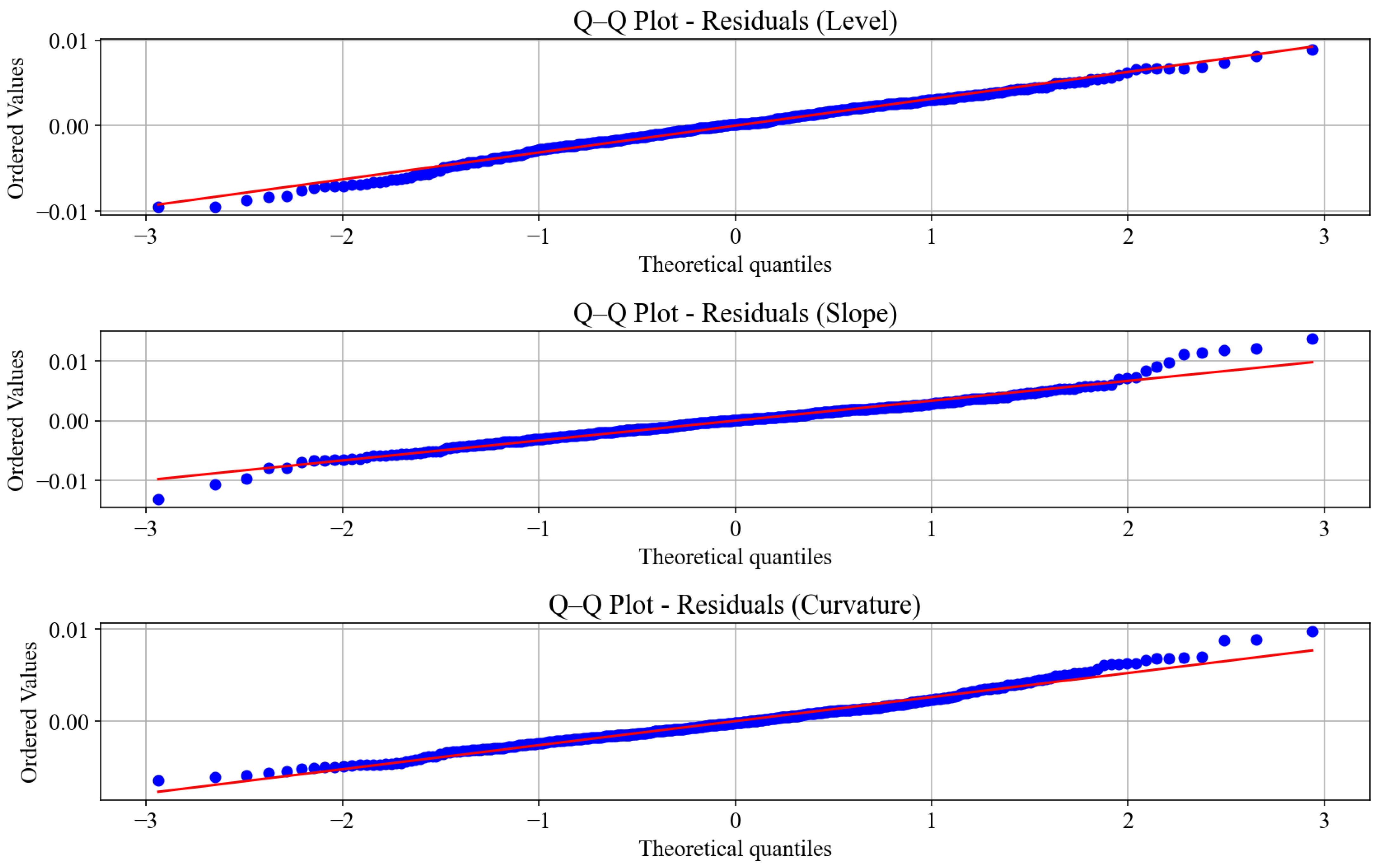
As an additional assessment for normality, Figure 4 presents the Q-Q plots for the residuals of each factor. The plots largely follow the 45-degree line, which supports the assumption of Gaussian innovations. Visible deviations at the tails confirm the presence of outliers, consistent with the observed kurtosis in the histogram plots. These results suggest that while the UKF-AJD model combination achieves a close fit, a small but notable departure from Gaussian behaviour in the residuals remains—particularly in the slope and level factors.
  • The level factor exhibits persistent autocorrelation, with values around 0.34 at lag 1 and still above 0.20 at lag 5.
  • The slope factor shows the strongest autocorrelation, starting at 0.45 and remaining above 0.20 for several lags, indicating that some trend or memory remains unexplained by the model.
  • The curvature factor performs slightly better in this regard, but still shows non-negligible autocorrelation in early lags, such as, for example, 0.39 at lag 1.
These patterns suggest that, while the UKF-AJD combination provides a good fit in terms of RMSE and residual distribution shape, it may fail to fully reduce autocorrelation from the latent factor dynamics, especially for the level and slope factors.
We did not explore other Lévy functions but only focussed purely on a Poisson jump and the marked point process was implemented through a kernel-compensated formulation for its analytical tractability. This approach presents some limitations for the jump model, as exhibited in the high autocorrelation for residuals. The regime switching model does not improve this situation either. Extensions to the jump model, such as Merton, Variance Gamma, Normal Inverse Gaussian, hyperbolic and generalized hyperbolic, should be considered (Cont et al., 2004; Ornthanalai, 2014).

7.1.2. RS-AJD Model

Table 4 presents the UKF estimation results and optimised parameters for the latent factors of yields. From these results we obtain the following insights:
Parameters
  • The model includes two regimes with distinct dynamics. The estimated parameters are
    θ = [ μ 0 , σ 0 , λ 0 , Σ J , 0 , μ 1 , σ 1 , λ 1 , Σ J , 1 ] = [ 0.0626 , 0.1658 , 0.8908 , 0.2354 , 0.0184 , 0.1707 , 0.7094 , 0.2018 ]
  • Regime 0 exhibits high volatility with σ 0 = 0.1658 and large jump size standard deviation Σ J , 0 = 0.2354 . The high jump intensity λ 0 = 0.8908 suggests that jumps occur at almost every time step, consistent with turbulent market periods. The drift coefficient μ 0 = 0.0626 indicates moderate mean reversion.
  • Regime 1 represents a lower-volatility environment. While σ 1 = 0.1707 is comparable to Regime 0, the jump intensity is slightly lower at λ 1 = 0.7094 , with jump size standard deviation Σ J , 1 = 0.2018 . The drift μ 1 = 0.0184 is also lower, capturing more stable dynamics.
  • The regime switching structure enables the model to transition between market states, providing greater flexibility in capturing yield curve dynamics.
Likelihood and Optimisation:
  • The final log-likelihood achieved is = 4048.55 , which is considerably worse than the AJD model ( = 1432.20 ), indicating poorer in-sample fit despite higher flexibility.
  • Both global DE and local LMLE3 optimizations converged to identical parameter estimates:
    DE : θ = [ 0.0626 , 0.1658 , 0.8908 , 0.2354 , 0.0184 , 0.1707 , 0.7094 , 0.2018 ]
    MLE : θ = [ 0.0626 , 0.1658 , 0.8908 , 0.2354 , 0.0184 , 0.1707 , 0.7094 , 0.2018 ]
  • The close match confirms numerical stability and robustness of the likelihood surface under regime switching.
Noise Structures:
  • The process noise structure adapts to the regime through σ r , λ r , and Σ J , r . Frequent and sizable jumps in Regime 0 increase the volatility of latent factors.
  • The measurement noise covariance R is fixed at R = 0.01 · I , representing a 1% standard deviation in observation noise across yields.
  • Despite a higher parameter count, the UKF filtering process remains numerically stable and produces interpretable estimates under both regimes.
Table 4. Summary of UKF Maximum Likelihood Estimates for 2-regime RS-AJD model. Parameters for both regimes are shown.
ParameterEstimated Value
μ 0 0.0626
σ 0 0.1658
λ j 0 0.8908
Σ J 0 0.2354
μ 1 0.0184
σ 1 0.1707
λ j 1 0.7094
Σ J 1 0.2018
Log-likelihood−4048.55
ASee Table 5
BSee Table 6
R 0.01 · I
Table 5. Estimated elements of the process noise covariance vector A for RS-AJD, representing idiosyncratic volatility across the seven observed yield maturities. Higher values at short maturities (e.g., A 1 ) reflect greater uncertainty in short-term rates.
A 1 A 2 A 3 A 4 A 5 A 6 A 7
−0.01960.02990.01580.0091−0.00050.00060.0022
Table 6. Estimated factor loading matrix B for the RS-AJD model. It links the three latent factors level, slope, and curvature to the seven yield maturities. Each row corresponds to one maturity, and columns correspond to factor sensitivities.
Factor 1Factor 2Factor 3
0.0461−0.2774−0.1952
0.0547−0.2645−0.4328
−0.1715−0.1075−0.1287
−0.2856−0.01910.0500
−0.44950.11880.3535
−0.45780.13250.3827
−0.44680.12720.3691
We compare the single-regime AJD model to the two-regime RS-AJD model using the Akaike Information Criterion (AIC) and Bayesian Information Criterion (BIC), as shown in Table 7. While the RS-AJD model achieves a higher log-likelihood, both AIC and BIC strongly favor the standard AJD model due to its parsimony. This result highlights that the added complexity of the regime switching structure does not improve in-sample fit sufficiently to justify the increase in parameterisation.
Figure 5 presents the PCA from observed yields versus those reconstructed from the UKF. They are both plotted against the time series period 2016–2024. The plot exhibits a match between both data series while accompanied by lower RMSEs.
In Figure 6, the histograms and KDE plots for the PCA components of the residuals are presented. The densities appear approximately symmetric and centred around zero, suggesting that the UKF-filtered model captures the core dynamics of the system reasonably well. Some deviations from normality were observed, particularly in the tails.  
  • Level: The residuals are roughly symmetric around zero, spanning the range [−0.010, 0.010]. Skewness is slightly negative −0.2987, and kurtosis is close to the Gaussian benchmark 3.2255, indicating mild left-tailed behaviour but otherwise near-normal distribution.
  • Slope: The residuals exhibit slightly positive skewness 0.2614 and excess kurtosis 4.8901, indicating a heavier right tail and increased peakness. This may reflect occasional abrupt shifts in slope dynamics.
  • Curvature: The residuals have moderate positive skewness 0.5169, with a pronounced thin outlier on the right tail (observed between 0.05 and 0.10). Kurtosis is above normal at 3.7214, confirming the presence of outliers and heavier tails.  
These diagnostic statistics suggest that while the RS-AJD model captures the overall dynamics effectively, it could benefit from enhancements to accommodate occasional extreme observations, particularly in the slope and curvature factors.
We assess the residual distributional assumptions by examining Q-Q plots in Figure 7 for each of the latent yield curve factors for the RS-AJD model. The quantiles of residuals were compared against a standard normal distribution. Across all three factors level, slope, and curvature, the residual quantiles generally fall along the 45-degree line, suggesting approximate normality in the central regions. Noticeable deviations are observed in the tails, with both left and right ends exhibiting outliers. These departures indicate that the residuals are not perfectly Gaussian and suggest the presence of heavier tails than the normal distribution. All residuals lie within the [−3, +3] range, consistent with mild tail behaviour, but the observed scatter of extreme values supports the interpretation of a non-Gaussian component in the data.
Taken together with the skewness and kurtosis statistics, the Q-Q plots reinforce the conclusion that while the residuals exhibit quasi-normal behaviour in the bulk of the distribution, tail risks remain. This may justify the evaluation of different jump types or more flexible error structures in future model extensions.
Residual Autocorrelation
In Table 8, the residual autocorrelation functions (ACFs) display notable persistence over the first five lags for both the AJD and RS-AJD models. In the AJD model, the lag-1 autocorrelations range from 0.34 (level) to 0.45 (slope), suggesting modest residual memory. In contrast, the RS-AJD model exhibits stronger autocorrelation, particularly in the slope and curvature factors. The lag-1 ACF reaches as high as 0.71 for the slope and 0.62 for curvature, indicating that residual dynamics are more persistent under the regime switching framework.
These results highlight that the RS-AJD model explicitly incorporates non-Gaussian and regime-dependent features. It captures the complex dynamics of the yield curve while it may still leave some structured autocorrelation unexplained, especially in higher-order latent components. This suggests potential model refinements by incorporating other Lévy types such as Normal Inverse Gaussian, Variance Gamma, or hyperbolic and generalized hyperbolic (Cont et al., 2004; Ornthanalai, 2014).
  • Level: RS-AJD lag autocorrelations are roughly 50% higher than in AJD, indicating more persistent residual structure.
  • Slope: Residual autocorrelation in RS-AJD is extremely high (Lag 1: 0.705 vs. 0.448), suggesting underfitting of dynamic slope changes.
  • Curvature: RS-AJD residuals also exhibit stronger autocorrelation, with lag values more than doubling those of AJD.
High autocorrelation and non-Gaussian properties for the residual may also be due to some shortcomings of the UKF. UKF can lead to some numerical instabilities and also uncertainties pertaining to the reliable estimation of the diffusion parameters. If the residuals show strong autocorrelation or clear non-Gaussian features, that usually points to model misspecification or, in many cases, to filter tuning or implementation problems rather than an inherent filtering issue (Dempster et al., 2018; Rypdal, 2018).
Additional tests for normality were conducted using the Shapiro–Wilk, Jarque–Bera (JB), and Kolmogorov–Smirnov (KS) tests. Table 9 presents a comparison of normality diagnostics for the latent factors extracted under the AJD and the RS-AJD specifications. Under the AJD framework, the Shapiro–Wilk test rejects normality for all three factors at the 1% significance level. The JB statistics further indicate pronounced deviation from normality, particularly for the curvature factor, where extreme excess kurtosis is evident (JB = 152.985, p < 0.001). In contrast, the RS-AJD specification produces latent factors that exhibit markedly improved distributional behaviour. For the level factor, the JB test fails to reject normality at the 10% level (p = 0.091), while the KS test fails to reject normality for all three factors (p > 0.217, 0.726, and 0.560 for level, slope, and curvature, respectively). These results suggest that allowing for regime-dependent dynamics and jump intensities significantly improves the model’s ability to account for nonlinearities and tail behaviour in the term structure. Overall, the RS-AJD model produces latent factors that are substantially closer to Gaussian innovations than those implied by the single-regime AJD model, providing strong empirical support for the inclusion of regime switching in modelling yield curve dynamics.

7.1.3. Model Comparison

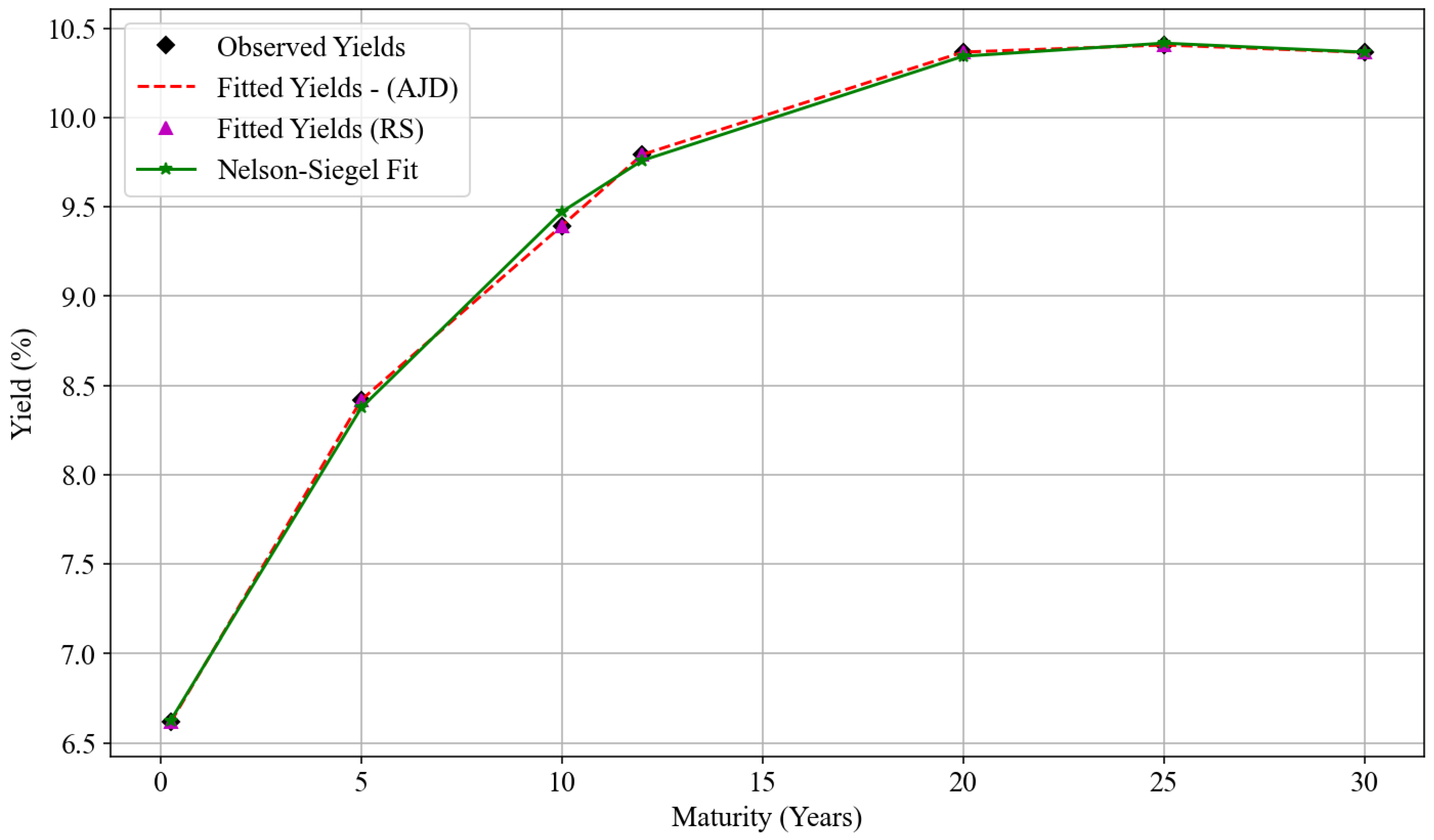
Figure 8 shows the average yield curves produced by each model. Both the AJD and RS-AJD models match the observed average yields nearly exactly at all maturities, demonstrating excellent cross-sectional fit. The Nelson–Siegel (NS) benchmark provides a comparably strong, though slightly less precise, fit. Time series residuals for the AJD and RS-AJD models exhibit statistically significant autocorrelation, suggesting potential unmodelled dynamics. Another possibility emanates from the tension between the cross-section and time series of interest rates—possibly consistent with Unspanned Stochastic Volatility (USV) in the latent structure. Collin-Dufresne et al. (2009) highlight the issue of high autocorrelation, which may imply model misspecification despite a reasonable unbiased yield fit exhibited by their model; see also Molibeli and van Vuuren (2025) for the USV and the tension between a cross-section and time series of interest rates. This gap motivates future work in extending the model with richer latent state dynamics and improved filtering.
Table 10 reports the RMSE, expressed in basis points, for both in-sample and out-of-sample periods under the AJD and RS-AJD specifications across maturities ranging from 3 months to 30 years.
In-sample results indicate that the RS-AJD model provides a superior fit at the short and medium ends of the yield curve. At the 3-month, 5-year, and 10-year maturities, the RS-AJD model reduces RMSE from 38.24 to 31.40 bps, 49.80 to 33.42 bps, and 32.63 to 26.20 bps, respectively. These improvements suggest that allowing for regime switching enhances the model’s ability to capture short- and medium-term yield dynamics, which are typically more sensitive to changes in monetary policy and market sentiment. At the longer maturities, the two models exhibit very similar in-sample performance, indicating that long-end yields are more stable and less sensitive to regime-dependent dynamics.
Out-of-sample performance reveals a different but equally important pattern. While the RMSE levels are larger in the forecast horizon for both models—reflecting the inherent difficulty of long-horizon yield forecasting—the RS-AJD model remains fully competitive with the standard AJD specification. Across all maturities, the difference in forecast RMSE between the two models is marginal, typically less than two basis points. This suggests that the increased flexibility introduced by regime switching does not lead to overfitting and does not degrade out-of-sample stability.
Taken together, these findings indicate that the RS-AJD model achieves a clear improvement in in-sample fit, particularly at economically important short-to-intermediate maturities, while maintaining comparable out-of-sample accuracy relative to the simpler AJD benchmark. This provides empirical support for the inclusion of regime switching dynamics, as it enhances the model’s explanatory power without sacrificing forecasting robustness.

8. Conclusions

In this study, jumps and regime switching dynamics were introduced within the affine term structure framework to address the empirically observed non-normality in bond yields and their returns. The resulting models were calibrated using the UKF, and their performance was assessed through RMSE metrics, residual diagnostics, and visual inspection of fitted versus observed yield curves.
The inclusion of jumps and regimes was justified by a clear improvement in model fit, evidenced by lower in-sample and out-of-sample RMSE values and the model’s ability to reproduce key stylised facts, such as skewness and excess kurtosis. Residual diagnostics including Q-Q plots, autocorrelation, and distributional measures showed a movement toward Gaussianity, supporting the notion that the models capture critical nonlinearities and discontinuities in the yield process.
Some limitations remain. The jump component was modelled using a simple Poisson process with constant intensity and alternative Lévy-based jump processes—the variance gamma, normal inverse Gaussian, or Merton jump processes were not considered. Additionally, the marked point process was implemented through a kernel-compensated formulation, which, although analytically tractable, may not fully capture the complex jump dynamics observed in the data. Future work could explore these richer jump specifications to potentially improve model fit and better characterise the jump behaviour.
Despite a strong post-calibration fit from both models, residuals exhibit statistically significant autocorrelation, suggesting missing dynamics. We hypothesise that this may be due to simplified jump modelling and fixed regime transitions. Inherent tensions between a cross-section and time series of interest rates could be another possible cause for this misspecification. Future work could extend the framework to incorporate Lévy-type jumps and stochastic regime transitions, and employ advanced filtering methods—such as expectation maximisation (EM) and the Particle filter—to improve state estimation.


Author Contributions

Conceptualisation, M.M. and G.v.V.; methodology, G.v.V.; software, M.M.; validation, M.M. and G.v.V.; formal analysis, M.M. and G.v.V.; investigation, M.M. and G.v.V.; resources, M.M. and G.v.V.; data curation, M.M. and G.v.V.; writing—original draft preparation, M.M.; writing—review and editing, G.v.V.; visualisation, M.M.; supervision, G.v.V.; project administration, G.v.V. All authors have read and agreed to the published version of the manuscript.

Funding

This research received no external funding.

Institutional Review Board Statement

Not applicable.

Informed Consent Statement

Not applicable.

Data Availability Statement

The data that support the findings of this study are available from the authors upon reasonable request.

Conflicts of Interest

The authors declare no conflicts of interest.

Abbreviations

The following abbreviations are used in this manuscript:
AJDAffine Jump Diffusion
ATSMsAffine Term Structure Models
BICBayesian Information Criterion
BDFSBalduzzi P, Das SR, Foresi S
DMDiebold–Mariano
DKDuffie and Kahn
DTSMsDynamic Term Structure Models
ODEOrdinary Differential Equation
PCAPrincipal Component Analysis
RMSERoot Mean Square Error
RS-AJDRegime Switching Affine Jump Diffusion
SASouth African
SMESimulated Method of Estimation
SDEStochastic Differential Equation
SVStochastic Volatility
UKFUnscented Kalman Filter
USVUnspanned Stochastic Volatility

Appendix A. Proof of Proposition 3

We prove the affine transform formula for the regime switching affine jump diffusion (RS-AJD) model by constructing an exponential-affine martingale M t adapted to the joint process ( X t , Z t ) .
Fix T > 0 and u C d . Let E R d be the mark space for jumps of X, and { 1 , , S } be the state space for Z.
Define deterministic functions for each regime i { 1 , , S }
φ i : [ 0 , T ] × C d C d , θ i : [ 0 , T ] × C d C ,
to be specified as solutions to suitable generalized Riccati equations with terminal conditions:
φ i ( 0 , u ) = u , θ i ( 0 , u ) = 1 .
Define the joint process:
M t : = θ Z t ( T t , u ) · exp φ Z t ( T t , u ) X t .
Our goal is to show that M t is a local martingale with respect to the natural filtration generated by ( X t , Z t ) .
Recall the dynamics of X t and Z t :
d X t = a ( Z t ) + b ( Z t ) X t d t + Σ ( Z t ) V t d W t + E ξ μ ˜ X ( d t , d ξ ) , d Z t = { 1 , , S } ( z Z t ) μ ˜ Z ( d t , d z ) + { 1 , , S } ( z Z t ) ν Z ( d t , d z ) .
Here μ ˜ X ( d t , d ξ ) = μ X ( d t , d ξ ) ν X ( t , d ξ ) d t is the compensated jump measure of X, and
ν Z ( d t , d z ) = j Z t q Z t , j δ j ( d z ) d t ,
with μ ˜ Z ( d t , d z ) = μ Z ( d t , d z ) ν Z ( d t , d z ) the compensated jump measure of Z.
Applying Itô’s formula and the product rule for jump processes:
d M t = M t d θ Z t ( T t , u ) θ Z t ( T t , u ) + d φ Z t ( T t , u ) X t + d φ Z · ( T · , u ) X · , log θ Z · ( T · , u ) t .
Since θ i and φ i depend on regime Z t , which jumps, both parts contribute jumps. We decompose increments into the following:
  • Continuous part from X t ;
  • Jump part from X t ;
  • Jump part from Z t .
(i)
Continuous part from X t
Using the SDE for X t in regime i : = Z t
d X t = a i + b i X t d t + Σ i V t d W t + E ξ μ ˜ X ( d t , d ξ ) .
By Itô’s lemma (excluding jumps)
d φ i X t = φ ˙ i X t + φ i ( a i + b i X t ) + 1 2 φ i Σ i diag ( V t ) Σ i φ i d t + φ i Σ i V t d W t .
(ii)
Jump part from X t
The jump part contributes increments
Δ X t = ξ with intensity measure ν X ( t , d ξ ) d t .
The exponential term changes by
exp φ i ( X t + ξ ) exp ( φ i X t ) = exp ( φ i X t ) e φ i ξ 1 .
Hence, the compensated jump integral term in d M t for X t is
E e φ i ξ 1 μ ˜ X ( d t , d ξ ) .
The predictable compensator contributes to the drift term
E e φ i ξ 1 ν X ( t , d ξ ) d t .
(iii)
Jump part from Z t
At a regime jump from i : = Z t to j, the process M t jumps by
M t = θ j ( T t , u ) e φ j ( T t , u ) X t vs . M t = θ i ( T t , u ) e φ i ( T t , u ) X t .
The increment is
Δ M t = M t θ j ( T t , u ) θ i ( T t , u ) e ( φ j ( T t , u ) φ i ( T t , u ) ) X t 1 .
The compensated jump measure for Z t is μ ˜ Z ( d t , d z ) with compensator ν Z ( d t , d z ) .
The predictable compensator term contributes to the drift
j i q i j θ j ( T t , u ) e φ j ( T t , u ) X t θ i ( T t , u ) e φ i ( T t , u ) X t d t .
To ensure M t is a local martingale (i.e., drift terms vanish), the functions φ i ( t , u ) , θ i ( t , u ) satisfy the generalised Riccati ODE system, for i = 1 , , S :
d d t φ i ( t , u ) = b i φ i ( t , u ) + 1 2 φ i ( t , u ) Σ i A i Σ i φ i ( t , u ) + E e φ i ( t , u ) ξ 1 φ i ( t , u ) h ( ξ ) ν i ( d ξ ) , d d t θ i ( t , u ) = θ i ( t , u ) · a i φ i ( t , u ) + α 0 ( i ) · 1 2 Σ i φ i ( t , u ) 2 + E e φ i ( t , u ) ξ 1 λ i ( · ) ν i ( d ξ ) + j i q i j θ j ( t , u ) e φ j ( t , u ) φ i ( t , u ) x θ i ( t , u ) ,
with terminal conditions
φ i ( 0 , u ) = u , θ i ( 0 , u ) = 1 .
Here h ( ξ ) is the truncation function (e.g., h ( ξ ) = ξ 1 ξ < 1 ), A i is the affine volatility structure matrix, and λ i the jump intensity function in regime i.

Conclusions

Under suitable integrability and regularity conditions, the process M t is a local martingale with
E x , i e u X T = M 0 = θ i ( T , u ) · e φ i ( T , u ) x ,
yielding the affine transform formula for the RS-AJD model.

Appendix B. UKF Algorithm

Algorithm A1 Unscented Kalman Filter (UKF) for Affine Term Structure Models
Require: Initial state estimate X ^ 0 | 0 , covariance P 0 | 0 , model parameters θ
  1:
  for each time step t = 1 to T do
  2:
        Sigma Point Generation:
  3:
        Compute 2 n + 1 sigma points χ t 1 ( i ) from X ^ t 1 | t 1 , P t 1 | t 1
  4:
        Prediction Step:
  5:
        for each sigma point χ ( i )  do
  6:
              Propagate via transition function: χ t | t 1 ( i ) = f ( χ t 1 ( i ) )
  7:
        end for
  8:
        Compute predicted mean: X ^ t | t 1 = w i ( m ) χ t | t 1 ( i )
  9:
        Compute predicted covariance: P t | t 1 = w i ( c ) ( χ t | t 1 ( i ) X ^ t | t 1 ) ( · ) T + Q
10:
        Update Step:
11:
        for each sigma point χ ( i )  do
12:
              Map to observation space: γ ( i ) = h ( χ t | t 1 ( i ) )
13:
        end for
14:
        Compute predicted measurement: y ^ t | t 1 = w i ( m ) γ ( i )
15:
        Compute innovation covariance: P y y = w i ( c ) ( γ ( i ) y ^ t | t 1 ) ( · ) T + R
16:
        Compute cross-covariance: P x y = w i ( c ) ( χ t | t 1 ( i ) X ^ t | t 1 ) ( γ ( i ) y ^ t | t 1 ) T
17:
        Compute Kalman gain: K t = P x y P y y 1
18:
        Update state estimate: X ^ t | t = X ^ t | t 1 + K t ( y t y ^ t | t 1 )
19:
        Update covariance: P t | t = P t | t 1 K t P y y K t
20:
end for

Notes

1
The term generator is used in two related but distinct senses: A denotes the infinitesimal generator of the joint continuous-time Markov process ( X t , Z t ) , whereas Q refers to the generator matrix of the finite-state Markov chain Z t . Both describe short-term transition behaviour, but in different mathematical contexts.
2
This motivates our use of the UKF as a more flexible estimation strategy, especially in light of the nonlinearities and regime-dependent jump dynamics. See also Chourdakis (2002), who highlights the challenges in estimating affine models with jumps and regime switching. Robust UKF variants such as the Generalized Maximum-likelihood UKF (GM-UKF) have also shown promise in mitigating non-Gaussian residuals, even outside finance (Liu et al., 2017), further reinforcing the UKF’s applicability in this context.
3
The local optimisation employed the L-BFGS-B algorithm from the scipy.optimize library, which supports limited-memory quasi-Newton updates under bound constraints.

References

  1. Ang, A., & Bekaert, G. (2002). Regime switches in interest rates. Journal of Business & Economic Statistics, 20(2), 163–182. [Google Scholar] [CrossRef]
  2. Ang, A., & Timmermann, A. (2012). Regime changes and financial markets. Annual Review of Financial Economics, 4(1), 313–337. [Google Scholar] [CrossRef]
  3. Bandara, W., & Munclinger, R. (2011). Term structure modelling with structural breaks: A simple arbitrage-free approach. Available at SSRN 1974033. Available online: https://papers.ssrn.com/sol3/papers.cfm?abstract_id=1974033 (accessed on 10 September 2025).
  4. Cheng, G., Liu, J., Zhang, W., & Song, S. (2024, May 25–27). Gaussian filter estimation framework for nonlinear systems with multiple non-ideal scenarios. 2024 36th Chinese Control and Decision Conference (CCDC) (pp. 2793–2799), Xi’an, China. [Google Scholar]
  5. Choudhary, R. (2022). Analysing the spillover effects of the south african reserve bank’s bond purchase programme. Economic Research and Statistics Department, South African Reserve Bank. [Google Scholar]
  6. Chourdakis, K. (2002). Continuous time regime switching models and applications in estimating processes with stochastic volatility and jumps (U of London Queen Mary Economics Working Paper No. 464). Elsevier. [Google Scholar]
  7. Christoffersen, P., Dorion, C., Jacobs, K., & Karoui, L. (2013). Nonlinear kalman filtering in affine term structure models: Internet appendix (Rotman School of Management Working Paper No. 2322760). Elsevier. [Google Scholar]
  8. Collin-Dufresne, P., Goldstein, R. S., & Jones, C. S. (2009). Can interest rate volatility be extracted from the cross section of bond yields? Journal of Financial Economics, 94(1), 47–66. [Google Scholar] [CrossRef]
  9. Cont, R. (2001). Empirical properties of asset returns: Stylized facts and statistical issues. Quantitative Finance, 1(2), 223. [Google Scholar] [CrossRef]
  10. Cont, R., Tankov, P., & Voltchkova, E. (2004). Option pricing models with jumps integro-differential equations and inverse problems. École Polytechnique. [Google Scholar]
  11. Cox, J. C., Ingersoll, J. E., Jr., & Ross, S. A. (1981). A re-examination of traditional hypotheses about the term structure of interest rates. The Journal of Finance, 36(4), 769–799. [Google Scholar] [CrossRef]
  12. Dai, Q., & Singleton, K. J. (2000). Specification analysis of affine term structure models. The Journal of Finance, 55(5), 1943–1978. [Google Scholar] [CrossRef]
  13. Dai, Q., Singleton, K. J., & Yang, W. (2007). Regime shifts in a dynamic term structure model of US treasury bond yields. The Review of Financial Studies, 20(5), 1669–1706. [Google Scholar] [CrossRef]
  14. Dempster, M., Medova, E. A., Osmolovskiy, I., & Ustinov, P. (2018). A practical robust long-term yield curve model. In High-performance computing in finance (pp. 273–314). Chapman and Hall/CRC. [Google Scholar]
  15. Deng, W. (2023). A gaussian-process framework for nonlinear statistical inference using modern machine learning models [Unpublished doctoral dissertation, Harvard University]. [Google Scholar]
  16. Ding, Y., Kambouroudis, D., & McMillan, D. G. (2025). Forecasting realised volatility using regime-switching models. International Review of Economics & Finance, 101, 104171. [Google Scholar] [CrossRef]
  17. Doshi, H., Kim, H. J., & Seo, S. B. (2024). Options on interbank rates and implied disaster risk. Available at SSRN 3469087. Available online: https://papers.ssrn.com/sol3/Papers.cfm?abstract_id=3469087 (accessed on 25 October 2025).
  18. Duffie, D., Filipovic, D., & Schachermayer, W. (2002). Affine processes and application in finance (Tech. Rep.). National Bureau of Economic Research. [Google Scholar]
  19. Duffie, D., & Kan, R. (1996a). A yield-factor model of interest rates. Mathematical Finance, 6(4), 379–406. [Google Scholar] [CrossRef]
  20. Duffie, D., Pan, J., & Singleton, K. (2000). Transform analysis and asset pricing for affine jump-diffusions. Econometrica, 68(6), 1343–1376. [Google Scholar] [CrossRef]
  21. Elliot, R. J., & Siu, T.-K. (2013). Affine jump-diffusions with regime switching: Applications in finance. Applied Mathematical Finance, 20(5), 385–418. [Google Scholar]
  22. Hamilton, J. D. (1989). A new approach to the economic analysis of nonstationary time series and the business cycle. Econometrica: Journal of the Econometric Society, 57, 357–384. [Google Scholar] [CrossRef]
  23. Hirsa, A. (2024). Computational methods in finance. Chapman and Hall/CRC. [Google Scholar]
  24. Hu, Q. G. (2022). A markov regime switching model for asset allocation. Available at SSRN 4094459. Available online: https://papers.ssrn.com/sol3/papers.cfm?abstract_id=4094459 (accessed on 12 September 2025).
  25. Julier, S. J., & Uhlmann, J. K. (1997). New extension of the Kalman filter to nonlinear systems. In Signal processing, sensor fusion, and target recognition vi (Vol. 3068, pp. 182–193). SPIE. [Google Scholar]
  26. Keller-Ressel, M., Schachermayer, W., & Teichmann, J. (2011). Affine processes are regular. Probability Theory and Related Fields, 151(3), 591–611. [Google Scholar] [CrossRef]
  27. Landen, C. (2000). Bond pricing in a hidden Markov model of the short rate. Finance and Stochastics, 4(4), 371–389. [Google Scholar] [CrossRef]
  28. Liu, X., Chen, B., Xu, B., Wu, Z., & Honeine, P. (2017). Maximum correntropy unscented filter. International Journal of Systems Science, 48(8), 1607–1615. [Google Scholar] [CrossRef]
  29. Lv, W., Liu, C., Xu, Y., Lu, R., & Shi, L. (2025). Gaussian framework for nonlinear state estimation with stochastic event-trigger and packet losses. Automatica, 175, 112220. [Google Scholar] [CrossRef]
  30. Molibeli, M., & van Vuuren, G. (2025). USV-affine models without derivatives: A bayesian time-series approach. Journal of Risk and Financial Management, 18(7), 395. [Google Scholar] [CrossRef]
  31. Ornthanalai, C. (2014). Levy jump risk: Evidence from options and returns. Journal of Financial Economics, 112(1), 69–90. [Google Scholar] [CrossRef]
  32. Piazzesi, M. (2000). Essays in monetary policy and asset pricing. Stanford University. [Google Scholar]
  33. Piazzesi, M. (2010). Affine term structure models. In Handbook of financial econometrics: Tools and techniques (pp. 691–766). Elsevier. [Google Scholar]
  34. Qin, S., Tan, Z., & Wu, Y. (2024). On robust estimation of hidden semi-Markov regime-switching models. Annals of Operations Research, 338(2), 1049–1081. [Google Scholar] [CrossRef]
  35. Rypdal, K. (2018). Empirical growth models for the renewable energy sector. Advances in Geosciences, 45, 35–44. [Google Scholar] [CrossRef]
  36. Singleton, K. J. (2006). Empirical dynamic asset pricing: Model specification and econometric assessment. Princeton University Press. [Google Scholar]
  37. Van Beek, M., Mandjes, M., Spreij, P., & Winands, E. (2020). Regime switching affine processes with applications to finance. Finance and Stochastics, 24(2), 309–333. [Google Scholar] [CrossRef]
  38. Vasicek, O. (1977). An equilibrium characterization of the term structure. Journal of Fnancial Economics, 5(2), 177–188. [Google Scholar] [CrossRef]
  39. Wu, B., Chen, P., & Ye, W. (2024). Variance swaps with mean reversion and multi-factor variance. European Journal of Operational Research, 315(1), 191–212. [Google Scholar] [CrossRef]
  40. Wu, L., & Zeng, Y. (2004). Regime-switching affine term structure models. Journal of Fixed Income, 14(3), 58–70. [Google Scholar]
  41. Zhu, C., Yin, G., & Baran, N. A. (2015). Feynman–Kac formulas for regime-switching jump diffusions and their applications. Stochastics: An International Journal of Probability and Stochastic Processes, 87(6), 1000–1032. [Google Scholar] [CrossRef]
Figure 1. Yield surface: weekly government bond yields over time and maturities showing the evolution of the term structure across different maturities and time. Data consists of weekly observations from government bonds across seven maturities, covering the period from 2015 to 2024. Data source: Thomson Reuters.
Jrfm 18 00681 g001
Figure 2. Raw yields and model fitted yields (%) are plotted against time over years. They are each broken down into level, slope and curvature. Both the raw and model fitted yield factors were constructed from the PCA.
Jrfm 18 00681 g002
Figure 3. Histograms and probability densities of AJD residuals. The probability densities are based on the kernel density estimates (KDEs) of the residuals for each PCA factor. Individual subplots represent the factors of level, slope, and curvature.
Jrfm 18 00681 g003
Figure 4. Q-Q plots of AJD residuals for PCA components level, slope, and curvature. A blue line represents the actual observations while the red line theoretically implies symmetry about the mean and therefore normality. Any deviation from the red line may be indicative of a fat tail—skewness and kurtosis.
Jrfm 18 00681 g004
Figure 5. PCA factors level, slope, and curvature plotted over time in years. The RS-AJD model fitted (reconstructed from UKF) yields (%) are compared to the observed yields.
Jrfm 18 00681 g005
Figure 6. Histograms and probability densties of RS-AJD residuals. The probability densities are based on the Kernel density estimates (KDEs) of the residuals for each PCA factor. Individual subplots represent the factors level, slope, and curvature.
Jrfm 18 00681 g006
Figure 7. QQ plots of RS-AJD residuals for PCA components level, slope, and curvature. A blue line represents the actual observations while the red line theoretically implies symmetry about the mean and therefore normality. Any deviation from the red line may be indicative of a fat tail—skewness and kurtosis.
Jrfm 18 00681 g007
Figure 8. Average yield curve across maturities. The AJD, RS-AJD, and NS models are calibrated to the same data. Both the AJD and RS-AJD models perfectly fit the average yields, while the NS model shows minor deviations. The visual similarity across models demonstrates strong cross-sectional fit.
Jrfm 18 00681 g008
Table 7. Model selection via Akaike (AIC) and Bayesian (BIC) Information Criteria using T = 418 observations. Lower values indicate preferred models after accounting for complexity.
ModelLog-LikelihoodNo of ParamsAICBIC
AJD 1432.20 42872.402888.54
RS-AJD 4048.55 88113.108145.38
Table 8. Comparison of ACF values of residuals (AJD vs RS-AJD) for first five lags.
ModelFactorLag 1Lag 2Lag 3Lag 4Lag 5
AJDLevel0.3440.2900.2790.2380.221
Slope0.4480.3480.2530.2070.216
Curvature0.3950.2160.1710.1110.093
RS-AJDLevel0.5290.4030.3770.3250.294
Slope0.7050.6620.6000.5040.480
Curvature0.6150.5260.4780.3940.381
Table 9. Normality comparison of latent factors for AJD versus RS-AJD. It presents a breakdown of the level, slope, and curvature in terms of the test statistics and p-values (in brackets), for Shapiro–Wilk, JB, and KS.
FactorAJDRS-AJD
Shapiro-WilkJarque-BeraKSShapiro-WilkJarque-BeraKS
Level0.957  (0.000)24.360  (0.000)0.130  (0.000)0.945  (0.002)4.801  (0.091)0.113  (0.217)
Slope0.964  (0.000)3.136  (0.209)0.102  (0.000)0.972  (0.063)10.364  (0.006)0.074  (0.726)
Curvature0.952  (0.000)152.985  (0.000)0.063  (0.067)0.958  (0.009)16.335  (0.000)0.084  (0.560)
Table 10. In-sample and out-of-sample RMSE in basis points for the AJD and RS-AJD models across maturities. RS-AJD generally provides a better in-sample fit at short and medium maturities. Out-of-sample RMSEs are virtually identical across both models, indicating comparable forecasting performance.
Maturity (Years)In-Sample RMSE (bps)Out-of-Sample RMSE (bps)
AJD ModelRS-AJDAJD ModelRS-AJD
0.2538.2431.40647.82649.84
549.8033.42840.26841.17
1032.6326.20953.97954.77
1226.9025.83999.271000.05
2025.5926.631058.021058.80
2525.5325.701061.391062.12
3025.1224.851058.441059.18
Disclaimer/Publisher’s Note: The statements, opinions and data contained in all publications are solely those of the individual author(s) and contributor(s) and not of MDPI and/or the editor(s). MDPI and/or the editor(s) disclaim responsibility for any injury to people or property resulting from any ideas, methods, instructions or products referred to in the content.