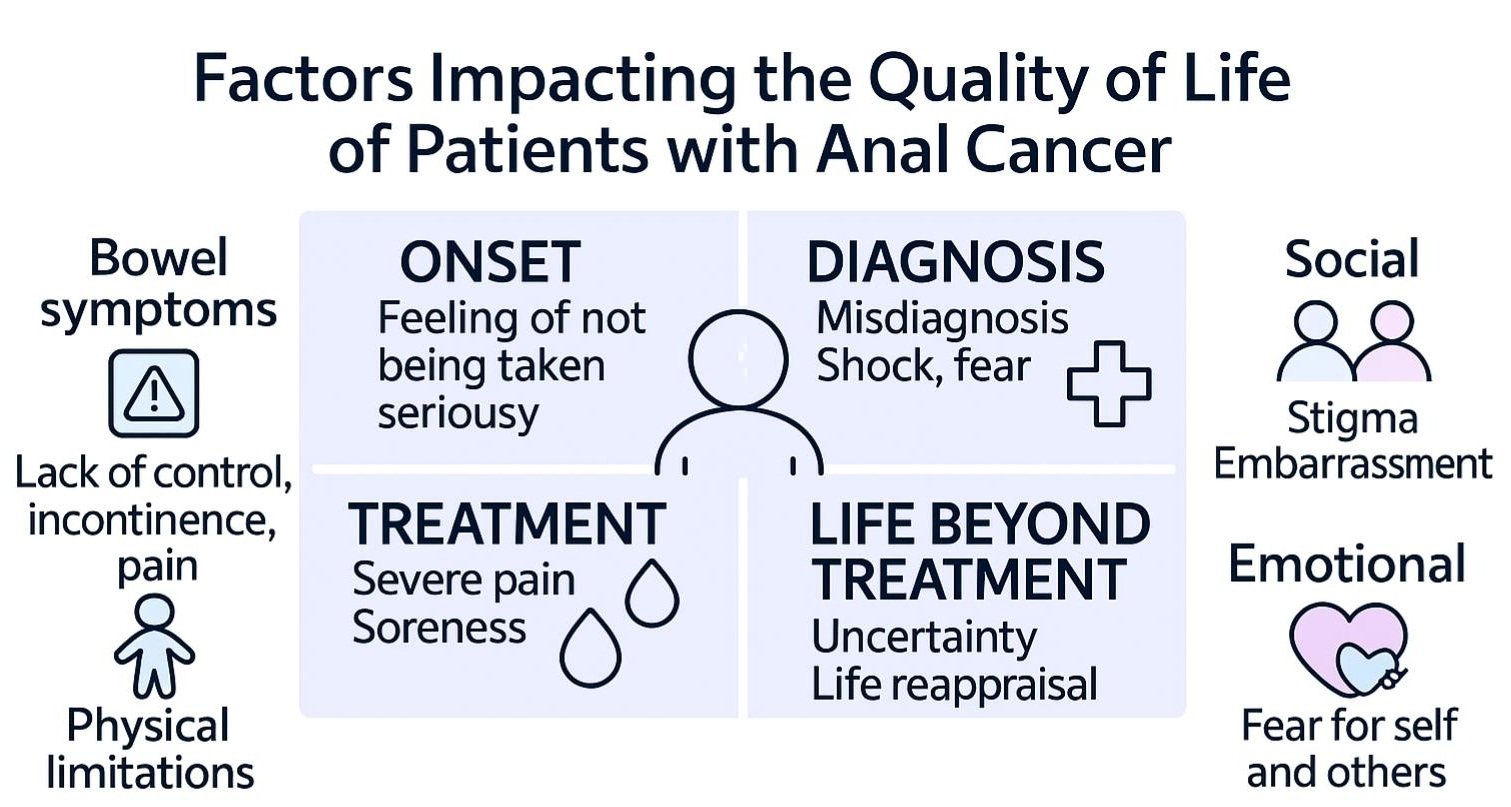
Quality of Life and Healthcare Experiences of Patients with Anal Cancer: A Mixed-Methods Study

 ,
,  , , , , , ,
  ,
,  and
on behalf of the EORTC Quality of Life Group
and
on behalf of the EORTC Quality of Life Group
Simple Summary
Abstract
1. Introduction
2. Methods
2.1. Setting, Population, and Data Collection
2.2. Semi-Structured Interviews
2.3. Questionnaire Application
2.4. Analysis
3. Results
3.1. Social Demographic and Clinical Characteristics
3.2. Interviews
3.2.1. Thematic Analysis
3.2.2. Time-Structured Themes
3.2.3. Illness Onset
3.3. Diagnosis
3.4. Treatment
3.5. Life Beyond Treatment
3.5.1. General Themes
3.5.2. Social Support
3.5.3. Impact on Others
3.5.4. Illness and the Social Self
3.5.5. Experiences with Health Care and Information Received
3.5.6. Positive Reappraisal
3.5.7. Questionnaires
4. Discussion
Strengths and Limitations
5. Conclusions
Author Contributions
Funding
Institutional Review Board Statement
Informed Consent Statement
Data Availability Statement
Acknowledgments
Conflicts of Interest
References
- Cancer Research UK. Anal Cancer Incidence Statistics. Available online: https://www.cancerresearchuk.org/health-professional/cancer-statistics/statistics-by-cancer-type/anal-cancer/incidence (accessed on 5 December 2025).
- National Cancer Institute. SEER Cancer Stat Facts: Anal Cancer. Available online: https://seer.cancer.gov/statfacts/html/anus.html (accessed on 6 December 2025).
- International Agency for Research on Cancer. GLOBOCAN 2020: Anal Cancer Fact Sheet. Available online: https://gco.iarc.who.int/media/globocan/factsheets/cancers/10-anus-fact-sheet.pdf (accessed on 6 January 2026).
- Wiltink, L.M.; White, K.; King, M.T.; Rutherford, C. Systematic review of clinical practice guidelines for colorectal and anal cancer: The extent of recommendations for managing long-term symptoms and functional impairments. Support. Care Cancer 2020, 28, 2523–2532. [Google Scholar] [CrossRef]
- Benson, A.B.; Venook, A.P.; Al-Hawary, M.M.; Azad, N.; Chen, Y.-J.; Ciombor, K.K.; Cohen, S.; Cooper, H.S.; Deming, D.; Garrido-Laguna, I.; et al. Anal Carcinoma, Version 2.2023, NCCN Clinical Practice Guidelines in Oncology. J. Natl. Compr. Cancer Netw. 2023, 21, 653–677. [Google Scholar] [CrossRef] [PubMed]
- Sodergren, S.C.; Vassiliou, V.; Dennis, K.; Tomaszewski, K.A.; Gilbert, A.; Glynne-Jones, R.; Nugent, K.; Sebag-Montefiore, D.; Johnson, C.D.; On behalf of the EORTC Quality of Life Group. Systematic review of the quality of life issues associated with anal cancer and its treatment with radiochemotherapy. Support. Care Cancer 2015, 23, 3613–3623. [Google Scholar] [CrossRef] [PubMed]
- Wilson, I.B.; Cleary, P.D. Linking clinical variables with health-related quality of life: A conceptual model of patient outcomes. JAMA 1995, 273, 59–65. [Google Scholar] [CrossRef] [PubMed]
- Whistance, R.N.; Conroy, T.; Chie, W.; Costantini, A.; Sezer, O.; Koller, M.; Johnson, C.; Pilkington, S.; Arraras, J.; Ben-Josef, E.; et al. Clinical and psychometric validation of the EORTC QLQ-CR29 questionnaire module to assess health-related quality of life in patients with colorectal cancer. Eur. J. Cancer 2009, 45, 3017–3026. [Google Scholar] [CrossRef]
- Eypasch, E.; Williams, J.I.; Wood-Dauphinee, S.; Ure, B.M.; Schmulling, C.; Neugebauer, E.; Troidl, H. Gastrointestinal Quality of Life Index: Development, validation and application of a new instrument. Br. J. Surg. 1995, 82, 216–222. [Google Scholar] [CrossRef]
- Aaronson, N.K.; Ahmedzai, S.; Bergman, B.; Bullinger, M.; Cull, A.; Duez, N.J.; Filiberti, A.; Flechtner, H.; Fleishman, S.B.; De Haes, J.C.J.M.; et al. The European Organization for Research and Treatment of Cancer QLQ-C30: A Quality-of-Life Instrument for Use in International Clinical Trials in Oncology. JNCI J. Natl. Cancer Inst. 1993, 85, 365–376. [Google Scholar] [CrossRef]
- Cella, D.F.; Tulsky, D.S.; Gray, G.; Sarafian, B.; Linn, E.; Bonomi, A.; Silberman, M.; Yellen, S.B.; Winicour, P.; Brannon, J. The Functional Assessment of Cancer Therapy scale: Development and validation of the general measure. J. Clin. Oncol. 1993, 11, 570–579. [Google Scholar] [CrossRef]
- Sterner, A.; Derwinger, K.; Staff, C.; Nilsson, H.; Angenete, E. Quality of life in patients treated for anal carcinoma—A systematic literature review. Int. J. Color. Dis. 2019, 34, 1517–1528. [Google Scholar] [CrossRef]
- Padilla, C.S.; Bergerot, C.D.; Dijke, K.; Roets, E.; Boková, G.; Innerhofer, V.; Sodergren, S.C.; Mancari, R.; Bergamini, C.; Way, K.M.; et al. Health-Related Quality of Life (HRQoL) Assessments in Research on Patients with Adult Rare Solid Cancers: A State-of-the-Art Review. Cancers 2025, 17, 387. [Google Scholar] [CrossRef]
- Sodergren, S.C.; Johnson, C.D.; Gilbert, A.; Darlington, A.-S.; Cocks, K.; Guren, M.G.; del Campo, E.R.; Brannan, C.; Christensen, P.; Chu, W.; et al. International Validation of the EORTC QLQ-ANL27, a Field Study to Test the Anal Cancer-Specific Health-Related Quality-of-Life Questionnaire. Int. J. Radiat. Oncol. 2022, 115, 1155–1164. [Google Scholar] [CrossRef]
- Sodergren, S.C.; Johnson, C.D.; Gilbert, A.; Tomaszewski, K.A.; Chu, W.; Chung, H.T.; Dennis, K.; Desideri, I.; Glynne-Jones, R.; Guren, M.G.; et al. Phase I–III development of the EORTC QLQ-ANL27, a health-related quality of life questionnaire for anal cancer. Radiother. Oncol. 2018, 126, 222–228. [Google Scholar] [CrossRef] [PubMed]
- Corrigan, K.L.; De, B.; Rooney, M.K.; Ludmir, E.B.; Das, P.; Smith, G.L.; Taniguchi, C.M.; Minsky, B.D.; Koay, E.J.; Koong, A.C.; et al. Patient-Reported Outcomes After Chemoradiation in Patients with Anal Cancer: A Qualitative Analysis. Adv. Radiat. Oncol. 2022, 7, 100986. [Google Scholar] [CrossRef]
- Oggesen, B.T.; Hamberg, M.L.S.; Thomsen, T.; Rosenberg, J. Exploring Patients’ Perspectives on Late Complications after Colorectal and Anal Cancer Treatment: A Qualitative Study. Curr. Oncol. 2023, 30, 7532–7541. [Google Scholar] [CrossRef] [PubMed]
- Mortensen, G.L.; Lundby, L. Patients use normalisation techniques to cope with the quality-of-life effects of anal cancer. Dan. Med. J. 2015, 62, A5020. [Google Scholar] [PubMed]
- van Dongen, J.; de Heus, E.; Eickholt, L.; Schrieks, M.; Zantingh, I.; Brouwer, O.R.; Oonk, M.H.M.; Grotenhuis, B.A.; Ezendam, N.P.M.; Duijts, F.A. Challenges and controversies patients and (health care) professionals experience in managing vaginal, vulvar, penile or anal cancer: The SILENCE study. Eur. J. Cancer Care 2022, 31, e13676. [Google Scholar] [CrossRef]
- Bingmer, K.; Ofshteyn, A.; Stein, S.L.; Steinhagen, E. Delayed Diagnosis of Anal Cancer. J. Gastrointest. Surg. 2020, 24, 212–217. [Google Scholar] [CrossRef]
- Chiu, S.; Joseph, K.; Ghosh, S.; Cornand, R.-M.; Schiller, D. Reasons for delays in diagnosis of anal cancer and the effect on patient satisfaction. Can. Fam. Physician 2015, 61, e509–e616. [Google Scholar]
- Padilla, C.S.; Tesselaar, M.E.; van der Graaf, W.T.; Husson, O. Measuring health-related quality of life in solid rare cancer patients: A study protocol. Rare 2023, 2, 100012. [Google Scholar] [CrossRef]
- Smith, J.A.; Flowers, P.; Larkin, M. Interpretative Phenomenological Analysis: Theory, Method and Research; SAGE Publications: Thousand Oaks, CA, USA, 2009. [Google Scholar]
- Noble, H.; Heale, R. Triangulation in research, with examples. Evid. Based Nurs. 2019, 22, 67–68. [Google Scholar] [CrossRef]
- Conrad, F.; Blair, J.; Tracy, E. Verbal reports are data! A theoretical approach to cognitive interviews. In Proceedings of the Federal Committee on Statistical Methodology Research Conference, Arlington, VA, USA, 15–17 November 1999. [Google Scholar]
- Willis, G.B. Analysis of the Cognitive Interview in Questionnaire Design; Oxford University Press: New York, NY, USA, 2015; p. viii, 261. [Google Scholar]
- Sprangers, M.A.G.; Cull, A.; Bjordal, K.; Groenvold, M.; Aaronson, N.K. The European Organization for Research and treatment of cancer approach to quality of life assessment: Guidelines for developing questionnaire modules. Qual. Life Res. 1993, 2, 287–295. [Google Scholar] [CrossRef]
- Wheelwright, S.; Bjordal, K.; Bottomley, A.; Gilbert, A.; Martinelli, F.; Pe, M.; Sztankay, M.; Cocks, K.; Coens, C.; Darlington, A.-S.; et al. EORTC Quality of Life Group Guidelines for Developing Questionnaire Modules, 5th ed.; EORTC: Brussels, Belgium, 2021. [Google Scholar]
- Braun, V.; Clarke, V. Reflecting on reflexive thematic analysis. Qual. Res. Sport Exerc. Health 2019, 11, 589–597. [Google Scholar] [CrossRef]
- Braun, V.; Clarke, V. Using thematic analysis in psychology. Qual. Res. Psychol. 2006, 3, 77–101. [Google Scholar] [CrossRef]
- Sodergren, S.; Gilbert, A.; Darlington, A.-S.; Vassiliou, V. Anal Cancer: Putting Health-Related Quality of Life at the Forefront. Clin. Oncol. 2019, 31, 69–71. [Google Scholar] [CrossRef]
- Driehuis, E.; de Heus, E.; Schrieks, M.; Engelen, V.; Buffart, T.E.; Vink, G.R.; Duijts, S.F.A. Quality of life of patients with rare cancer: A comparison with patients with colorectal cancer and the association with disease trajectory-related factors. J. Cancer Surviv. 2022, 17, 986–996. [Google Scholar] [CrossRef]
- Padilla, C.S.; de Heus, E.; Reuvers, M.J.P.; Schrieks, M.; Engelen, V.; Grunhagen, D.; Tesselaar, M.E.T.; van der Graaf, W.T.A.; Duijts, S.F.A.; Husson, O. Diagnostic trajectories of patients with rare cancer in The Netherlands: Results from a nationwide cross-sectional survey. Support. Care Cancer 2024, 32, 807. [Google Scholar] [CrossRef] [PubMed]
- van der Graaf, W.T.A.; Heiss, N.S.; Hynes, C.L.; Keller, S.P.; Weinman, A.; Blay, J.Y.; Franco, P.; Giles, R.H.; Lacombe, D.; Schlatter, P. Overcoming the barriers to treatment of rare cancer patients in the era of precision oncology: A call to action. Cancer Treat. Rev. 2025, 140, 103013. [Google Scholar] [CrossRef] [PubMed]
- Antoni Van Leeuwenhoek Nederlands Kanker Instituut. Over de Campagne—Geen Rol Meer. 2024. Available online: https://www.geenrolmeer.nl/over-de-campagne/ (accessed on 21 April 2026).
- Midtgaard, J.; Hansen, M.J.; Grandjean, B. Modesty and recognition—A qualitative study of the lived experience of recovery from anal cancer. Support. Care Cancer 2009, 17, 1213–1222. [Google Scholar] [CrossRef] [PubMed]
- Putta, S.; Andreyev, H. Faecal Incontinence: A Late Side-effect of Pelvic Radiotherapy. Clin. Oncol. 2005, 17, 469–477. [Google Scholar] [CrossRef]
- Witty, K.; Branney, P.; Evans, J.; Bullen, K.; White, A.; Eardley, I. The impact of surgical treatment for penile cancer—Patients’ perspectives. Eur. J. Oncol. Nurs. 2013, 17, 661–667. [Google Scholar] [CrossRef]
- Niu, L.; Cui, Y.; Shih, Y.-A.; Fan, W.; Bao, Y.; Li, X.; Li, C. Medical-Seeking Behavior, Psychological Experiences, and Treatment Expectations of Patients with Penile Cancer Before Operation. Cancer Nurs. 2025, 10-1097. Available online: https://journals.lww.com/cancernursingonline/fulltext/9900/medical_seeking_behavior,_psychological.416.aspx (accessed on 21 January 2026). [CrossRef] [PubMed]
- Paulson, A.E.; Stein, A.; Kendal, J.K.; Bernthal, N.M.; Wessel, L.E. Most Patients with Bone Sarcomas Seek Emotional Support and Information About Other Patients’ Experiences: A Thematic Analysis. Clin. Orthop. Relat. Res. 2023, 482, 161–171. [Google Scholar] [CrossRef] [PubMed]
- Ueland, V.; Dysvik, E.; Hemberg, J.; Furnes, B. Cancer survivorship: Existential suffering. Int. J. Qual. Stud. Health Well-Being 2021, 16, 2001897. [Google Scholar] [CrossRef]
- Langegard, U.; Ahlberg, K. Consolation in Conjunction with Incurable Cancer. Oncol. Nurs. Forum 2009, 36, E99–E106. [Google Scholar] [CrossRef]
- Lazarus, R.; Folkman, S. Stress, Appraisal, and Coping; Springer: New York, NY, USA, 1984. [Google Scholar]
- Bayraktar, S.; Ozkan, M. Unchanging dynamics in posttraumatic growth in cancer patients: Ways of coping and illness perception. Front. Psychol. 2023, 14, 1223131. [Google Scholar] [CrossRef] [PubMed]
- Heus, E.; Zwan, J.M.; Husson, O.; Frissen, A.; Herpen, C.M.L.; Merkx, M.A.W.; Duijts, S.F.A. Unmet supportive care needs of patients with rare cancer: A systematic review. Eur. J. Cancer Care 2021, 30, e13502. [Google Scholar] [CrossRef]
- Larkin, M.; Shaw, R.; Flowers, P. Multiperspectival designs and processes in interpretative phenomenological analysis research. Qual. Res. Psychol. 2018, 16, 182–198. [Google Scholar] [CrossRef]
- Lin, C.; Slama, J.; Gonzalez, P.; Goodman, M.; Xia, N.; Kreimer, A.; Wu, T.; Hessol, N.; Shvetsov, Y.; Ortiz, A.; et al. Cervical determinants of anal HPV infection and high-grade anal lesions in women: A collaborative pooled analysis. Lancet Infect 2019, 19, 880–891. [Google Scholar] [CrossRef]
- Råbu, M.; Binder, P.-E. The Single Case Study is a Crucial Bridge between Research and Practice. J. Contemp. Psychother. 2024, 55, 119–126. [Google Scholar] [CrossRef]

| I. Sociodemographic Characteristics | Patients (n = 21) | |
|---|---|---|
| n | (%) | |
| Age | ||
| Mean (SD) | 61.9 (SD 9.3) | |
| Range | 49–77 | |
| Sex | ||
| Male | 6 | 28.6 |
| Female | 15 | 71.4 |
| Civil status | ||
| Single | 5 | 23.8 |
| Partner | 16 | 76.2 |
| Living situation | ||
| Alone | 5 | 23.8 |
| Not alone | 16 | 76.2 |
| Highest level of education a | ||
| Low | 0 | 0 |
| Medium | 8 | 38.1 |
| High | 13 | 61.9 |
| Employment status b | ||
| Not actively employed | 14 | 66.7 |
| Actively employed | 7 | 33.3 |
| Country | ||
| The Netherlands | 6 | 28.6 |
| UK | 7 | 33.3 |
| Brazil | 1 | 4.8 |
| Austria | 6 | 28.6 |
| Turkey | 1 | 4.8 |
| Travel time to hospital | ||
| <15 min | 3 | 14.3 |
| 15–30 min | 3 | 14.3 |
| 30–1 h | 12 | 57.1 |
| 1–2 h | 3 | 14.3 |
| 2+ h | 0 | 0 |
| Travel distance to hospital | ||
| <10 km | 5 | 23.8 |
| 10–25 km | 3 | 14.3 |
| 25–50 km | 7 | 33.3 |
| 50–100 km | 6 | 28.6 |
| 100+ km | 0 | 0 |
| II. Clinical characteristics | ||
| Time since cancer diagnosis (months) | ||
| Mean (SD) | 17.6 (SD 17.4) | |
| Range | 1–70 | |
| Type of disease | ||
| Localised disease | 19 | 90.5 |
| Metastatic disease | 2 | 9.5 |
| Presence of metastasis | ||
| No | 19 | 90.5 |
| Yes | 2 | 9.5 |
| Number of metastases | ||
| 0 | 19 | 90.5 |
| 1–3 | 1 | 4.8 |
| 4 or more | 1 | 4.8 |
| Comorbidities c | ||
| 0 | 12 | 57.1 |
| 1 | 7 | 33.3 |
| 2 or more | 2 | 9.5 |
| Treatment goal | ||
| Curative | 19 | 90.5 |
| Palliative | 2 | 9.5 |
| Treatment modality | ||
| Chemotherapy d | 15 | 71.4 |
| Radiotherapy e | 15 | 71.4 |
| Surgery | 3 | 14.3 |
| Resection | 1 | 4.8 |
| Other f | 8 | 38.1 |
| ECOG Status g | ||
| 0 | 12 | 57.1 |
| 1 | 6 | 28.6 |
| 2 | 3 | 14.3 |
| Illness Trajectory Stage | Theme | Subthemes |
|---|---|---|
| Illness onset | Symptoms | Common symptoms Overlapping symptoms |
| Trajectory | Actions taken Frustration of not being taken seriously | |
| Diagnosis | Symptoms | Progressive worsening |
| Trajectory | Diagnostic procedures Time to establish diagnosis Misdiagnosis | |
| Emotional responses | Shock Stress Fear (for oneself and others) Despair | |
| Coping strategies | Practical actions Avoidance Acceptance | |
| Treatment | Side effects | Common side effects |
| Treatment routine | Challenges | |
| Disruption to daily activities | ||
| Emotional functioning | ||
| Social functioning | ||
| Coping strategies | Medication Reframing perspective Support from others Positive lifestyle changes | |
| Life beyond treatment | Challenges | Emotional distress: uncertainty, fear Physical challenges Role function limitations Disruption to daily activities Sexual dysfunction |
| Coping & recovery strategies | Gratitude Trauma growth Practical actions | |
| Changed life perspective | Post-trauma decisions | |
| Return to normality |
| Theme | Subtheme |
|---|---|
| Social support | Support offered Strengthened relationships |
| Impact on others | Emotional reactions |
| Illness and the social self | Disclosure to others Stigma Embarrassment Social identity Social comparison Social functioning |
| Experiences with health care/information provision | Positive experiences Negative at onset: incorrect information Recommendations |
| Positive reappraisal | Received health care Body’s ability to heal Strengthened relationships |
| 1 Not Relevant n (%) | 2 Somewhat Relevant n (%) | 3 Relevant n (%) | 4 Very Relevant n (%) | Mean | SD | Cut-Off 1.5 (y/n) | |
|---|---|---|---|---|---|---|---|
| Item 1: trouble doing strenuous activities, like carrying a heavy bag | 7 (33.3) | 5 (23.8) | 4 (19) | 5 (23.8) | 2.33 | 1.20 | Yes |
| Item 2: trouble taking a long walk | 6 (28.6) | 4 (19) | 7 (33.3) | 4 (19) | 2.43 | 1.12 | Yes |
| Item 3: trouble taking a short walk | 11 (52.4) | 4 (19) | 3 (14.3) | 3 (14.3) | 1.90 | 1.14 | Yes |
| Item 4: need to stay in bed or a chair during the day | 9 (42.9) | 6 (28.6) | 2 (9.5) | 4 (19) | 2.05 | 1.16 | Yes |
| Item 5: need help with eating, dressing, washing or using the toilet | 12 (57.1) | 6 (28.6) | 1 (4.8) | 2 (9.5) | 1.67 | 0.97 | Yes |
| Item 6: limited in doing either work or other daily activities | 6 (28.6) | 5 (23.8) | 4 (19) | 6 (28.6) | 2.48 | 1.21 | Yes |
| Item 7: limited in pursuing hobbies or other leisure time activities | 6 (28.6) | 6 (28.6) | 7 (33.3) | 2 (9.5) | 2.24 | 1.00 | Yes |
| Item 8: short of breath | 10 (47.6) | 5 (23.8) | 4 (19) | 2 (9.5) | 1.90 | 1.04 | Yes |
| Item 9: pain | 1 (4.8) | 0 | 5 (23.8) | 15 (71.4) | 3.62 | 0.74 | Yes |
| Item 10: need to rest | 2 (9.5) | 5 (23.8) | 5 (23.8) | 7 (33.3) | 2.90 | 1.00 | Yes |
| Item 11: trouble sleeping | 4 (19) | 3 (14.3) | 7 (33.3) | 7 (33.3) | 2.81 | 1.12 | Yes |
| Item 12: felt weak | 2 (9.5) | 5 (23.8) | 10 (47.6) | 4 (19) | 2.76 | 0.89 | Yes |
| Item 13: lacked appetite | 4 (19) | 7 (33.3) | 6 (28.6) | 4 (19) | 2.48 | 1.03 | Yes |
| Item 14: nausea | 8 (38.1) | 3 (14.3) | 7 (33.3) | 3 (14.3) | 2.24 | 1.14 | Yes |
| Item 15: vomited | 9 (42.9) | 7 (33.3) | 3 (14.3) | 2 (9.5) | 1.90 | 1.00 | Yes |
| Item 16: constipation | 5 (23.8) | 7 (33.3) | 9 (42.9) | 2.95 | 1.20 | Yes | |
| Item 17: diarrhoea | 1 (4.8) | 1 (4.8) | 9 (42.9) | 10 (47.6) | 3.33 | 0.80 | Yes |
| Item 18: tiredness | 1 (4.8) | 5 (23.8) | 5 (23.8) | 10 (47.6) | 3.14 | 0.96 | Yes |
| Item 19: pain interfere with daily activities | 3 (14.3) | 3 (14.3) | 6 (28.6) | 9 (42.9) | 3.00 | 1.10 | Yes |
| Item 20: difficulty in concentrating on things, like reading a newspaper or watching television | 5 (23.8) | 9 (42.9) | 3 (14.3) | 4 (19) | 2.29 | 1.06 | Yes |
| Item 21: feel tense | 5 (23.8) | 6 (28.6) | 4 (19) | 6 (28.6) | 2.52 | 1.17 | Yes |
| Item 22: worry | 5 (23.8) | 6 (28.6) | 2 (9.5) | 8 (38.1) | 2.62 | 1.24 | Yes |
| Item 23: irritable | 8 (38.1) | 6 (28.6) | 4 (19) | 3 (14.3) | 2.10 | 1.09 | Yes |
| Item 24: depressed | 6 (28.6) | 6 (28.6) | 4 (19) | 5 (23.8) | 2.38 | 1.16 | Yes |
| Item 25: difficulty remembering things | 10 (47.6) | 5 (23.8) | 2 (9.5) | 4 (19) | 2.00 | 1.18 | Yes |
| Item 26: physical condition or medical treatment interfered with family life | 5 (23.8) | 6 (28.6) | 6 (28.6) | 4 (19) | 2.43 | 1.08 | Yes |
| Item 27: physical condition or medical treatment interfered with social activities | 3 (14.3) | 7 (33.3) | 5 (23.8) | 6 (28.6) | 2.67 | 1.06 | Yes |
| Item 28: physical condition or medical treatment caused financial difficulties | 12 (57.1) | 3 (14.3) | 4 (19) | 2 (9.5) | 1.81 | 1.08 | Yes |
| Item 29: rate overall health | 1 (4.8) | 13 (61.9) | 7 (33.3) | 3.29 | 0.56 | Yes | |
| Item 30: rate overall quality of life | 2 (9.5) | 12 (57.1) | 7 (33.3) | 3.24 | 0.62 | Yes |
| 1 Not Relevant n (%) | 2 Somewhat Relevant n (%) | 3 Relevant n (%) | 4 Very Relevant n (%) | Mean | SD | Cut-Off 1.5 (y/n) | |
|---|---|---|---|---|---|---|---|
| Item 31: leakage of stools or mucus from anal opening (back passage) | 3 (14.3) | 6 (28.6) | 12 (57.1) | 3.43 | 0.75 | Yes | |
| Item 32: experienced frequent bowel movements | 2 (9.5) | 1 (4.8) | 7 (33.3) | 11 (52.4) | 3.29 | 0.96 | Yes |
| Item 33: bowel movements have been painful | 2 (9.5) | 5 (23.8) | 14 (66.7) | 3.48 | 0.93 | Yes | |
| Item 34: pain/discomfort around anal opening (back passage) | 1 (4.8) | 2 (9.5) | 3 (14.3) | 15 (71.4) | 3.52 | 0.87 | Yes |
| Item 35: pain while sitting | 3 (14.3) | 2 (9.5) | 4 (19) | 12 (57.1) | 3.19 | 1.12 | Yes |
| Item 36: uncomfortable in certain positions (e.g., lying down) | 6 (28.6) | 3 (14.3) | 7 (33.3) | 5 (23.8) | 2.52 | 1.17 | Yes |
| Item 37: soreness in the areas that have been treated | 6 (28.6) | 15 (71.4) | 3.71 | 0.46 | Yes | ||
| Item 38: itchy or irritated skin in the areas that have been treated | 1 (4.8) | 2 (9.5) | 8 (38.1) | 10 (47.6) | 3.29 | 0.85 | Yes |
| Item 39: need to urinate frequently | 5 (23.8) | 3 (14.3) | 5 (23.8) | 8 (38.1) | 2.76 | 1.22 | Yes |
| Item 40: swelling in legs or ankles | 10 (47.6) | 7 (33.3) | 3 (14.3) | 1 (4.8) | 1.76 | 0.89 | Yes |
| Item 41: problems going out of the house because needed to be close to a toilet | 5 (23.8) | 3 (14.3) | 2 (9.5) | 11 (52.4) | 2.90 | 1.30 | Yes |
| Item 42: need to clean themselves more often | 6 (28.6) | 5 (23.8) | 6 (28.6) | 4 (19) | 2.38 | 1.12 | Yes |
| Item 43: problems planning activities in advance (e.g., meeting friends) | 7 (33.3) | 4 (19) | 4 (19) | 6 (28.6) | 2.43 | 1.25 | Yes |
| Item 44: problems with gas (flatulence) | 3 (14.3) | 6 (28.6) | 6 (28.6) | 6 (28.6) | 2.71 | 1.06 | Yes |
| Item 45: urge to move bowels. hurry to get to the toilet | 4 (19) | 2 (9.5) | 5 (23.8) | 10 (47.6) | 3.00 | 1.18 | Yes |
| Item 46: feeling of being unable to completely empty bowels | 4 (19) | 6 (28.6) | 4 (19) | 7 (33.3) | 2.67 | 1.15 | Yes |
| Item 47: sore skin around stoma | 17 (81) | 2 (9.5) | 1 (4.8) | 1.35 | 0.88 | No | |
| Item 48: leakage of stools from stoma bag | 18 (85.7) | 1 (4.8) | 1 (4.8) | 1.25 | 0.79 | No | |
| Item 49: unintentional release of gas/flatulence from stoma bag | 16 (76.2) | 2 (9.5) | 2 (9.5) | 1.50 | 1.05 | Yes | |
| Item 50: sexually active | 7 (33.3) | 4 (19) | 5 (23.8) | 5 (23.8) | 2.38 | 1.20 | Yes |
| Item 51: extent of interested in sex | 7 (33.3) | 5 (23.8) | 5 (23.8) | 4 (19) | 2.29 | 1.15 | Yes |
| Item 52: disease or treatment affected sex life (for the worse) | 7 (33.3) | 5 (23.8) | 6 (28.6) | 3 (14.3) | 2.24 | 1.09 | Yes |
| Item 53: pain during intercourse | 10 (47.6) | 4 (19) | 3 (14.3) | 4 (19) | 2.05 | 1.20 | Yes |
| Item 54: difficulty getting or maintaining an erection | 16 (76.2) | 2 (9.5) | 1 (4.8) | 2 (9.5) | 1.48 | 0.98 | No |
| Item 55: vagina felt dry | 8 (38.1) | 5 (23.8) | 2 (9.5) | 6 (28.6) | 2.29 | 1.27 | Yes |
| Item 56: vagina felt narrow/tight | 9 (42.9) | 5 (23.8) | 3 (14.3) | 4 (19) | 2.10 | 1.18 | Yes |
| Item 57: pain in vagina | 10 (47.6) | 5 (23.8) | 3 (14.3) | 3 (14.3) | 1.95 | 1.12 | Yes |
| EORTC Questionnaire. Item No. | Description | Number of Patients (%) |
|---|---|---|
| EORTC QLQ-C30: Item 9 | How relevant is to be asked if you had pain? | 10 (47.6%) |
| EORTC QLQ-C30: Item 16 | How relevant is to be asked if you have been constipated? | 8 (38.1%) |
| EORTC QLQ-C30: Item 17 | How relevant is to be asked if you had diarrhoea? | 8 (38.1%) |
| EORTC QLQ-C30: Item 18 | How relevant is to be asked if you are tired? | 7 (33.3%) |
| EORTC Questionnaire. Item No. | Description | Number of Patients (%) |
|---|---|---|
| EORTC QLQ-ANL27: Item 37 | How relevant is to be asked if you had soreness in the areas that have been treated? | 13 (61.9%) |
| EORTC QLQ-ANL27: Item 31 | How relevant is to be asked if you had leakage of stools or mucus from your anal opening (back passage)? | 12 (57.1%) |
| EORTC QLQ-ANL27: Item 34 | How relevant is to be asked if you had pain/discomfort around your anal opening (back passage)? | 12 (57.1%) |
| EORTC QLQ-ANL27: Item 33 | How relevant is to be asked if your bowel movements have been painful? | 10 (47.6%) |
| EORTC QLQ-ANL27: Item 35 | How relevant is to be asked if you had pain while sitting? | 9 (42.9%) |
| EORTC QLQ-ANL27: Item 32 | How relevant is to be asked if you have experienced frequent bowel movements? | 8 (38.1%) |
| EORTC QLQ-ANL27: Item 45 | How relevant is to be asked if you felt the urge to move your bowels. did you have to hurry to get to the toilet? | 8 (38.1%) |
| EORTC QLQ-ANL27: Item 38 | How relevant is to be asked if you had itchy or irritated skin in the areas that have been treated? | 6 (28.6%) |
| EORTC QLQ-ANL27: Item 39 | How relevant is to be asked if you had to urinate frequently? | 6 (28.6%) |
Disclaimer/Publisher’s Note: The statements, opinions and data contained in all publications are solely those of the individual author(s) and contributor(s) and not of MDPI and/or the editor(s). MDPI and/or the editor(s) disclaim responsibility for any injury to people or property resulting from any ideas, methods, instructions or products referred to in the content. |
© 2026 by the authors. Licensee MDPI, Basel, Switzerland. This article is an open access article distributed under the terms and conditions of the Creative Commons Attribution (CC BY) license.
Share and Cite
Moura, A.F.; Padilla, C.S.; Vorbach, S.M.; Holthuis, E.I.; van Triest, B.; Bergerot, C.D.; Vassiliou, V.; Celik, E.; Akkaya, K.; Cicin, I.; et al. Quality of Life and Healthcare Experiences of Patients with Anal Cancer: A Mixed-Methods Study. Curr. Oncol. 2026, 33, 266. https://doi.org/10.3390/curroncol33050266
Moura AF, Padilla CS, Vorbach SM, Holthuis EI, van Triest B, Bergerot CD, Vassiliou V, Celik E, Akkaya K, Cicin I, et al. Quality of Life and Healthcare Experiences of Patients with Anal Cancer: A Mixed-Methods Study. Current Oncology. 2026; 33(5):266. https://doi.org/10.3390/curroncol33050266
Chicago/Turabian StyleMoura, Andreia F., Catarina S. Padilla, Samuel M. Vorbach, Emily I. Holthuis, Baukelien van Triest, Cristiane D. Bergerot, Vassilios Vassiliou, Emir Celik, Kübra Akkaya, Irfan Cicin, and et al. 2026. "Quality of Life and Healthcare Experiences of Patients with Anal Cancer: A Mixed-Methods Study" Current Oncology 33, no. 5: 266. https://doi.org/10.3390/curroncol33050266
APA StyleMoura, A. F., Padilla, C. S., Vorbach, S. M., Holthuis, E. I., van Triest, B., Bergerot, C. D., Vassiliou, V., Celik, E., Akkaya, K., Cicin, I., van der Graaf, W. T. A., Husson, O., & Sodergren, S. C., on behalf of the EORTC Quality of Life Group. (2026). Quality of Life and Healthcare Experiences of Patients with Anal Cancer: A Mixed-Methods Study. Current Oncology, 33(5), 266. https://doi.org/10.3390/curroncol33050266