


Simple Summary
Although it is well known that BRCA1/2 carriers have an increased risk of contralateral breast cancer (CBC), differences in tumor subtype and CBC risk between BRCA1 and BRCA2 carriers remain largely unknown. This study included 738 unselected Chinese patients with breast cancer who carried BRCA1/2 pathogenic variants and were treated at our institution. After a median follow-up of 9.0 years, the 10-year cumulative CBC risk was significantly higher in BRCA1 than in BRCA2 carriers (18.9% vs. 11.7%; p = 0.01) in the entire cohort, and among patients aged 40 years or younger, the 10-year cumulative CBC risk in BRCA1 and BRCA2 carriers was 27.5% and 12.5%, respectively (p = 0.007). In addition, among BRCA1 carriers who developed CBC, the majority of both primary and contralateral breast tumors were triple-negative breast cancers. Our findings indicate that BRCA1 carriers have a higher CBC risk than BRCA2 carriers, providing useful data to inform the optimal management of CBC risk in BRCA1/2 carriers.
Abstract
Background: The high risk of contralateral breast cancer (CBC) in carriers of germline BRCA1/2 pathogenic variants (PVs) is well established, whereas differences in tumor subtype and risk of CBC between BRCA1 and BRCA2 carriers remain largely unknown. Methods: This cohort study included 738 unselected Chinese patients with breast cancer who carried BRCA1/2 PVs (289 BRCA1 and 449 BRCA2 carriers) and were treated at Peking University Cancer Hospital between October 2003 and August 2021. Tumor subtypes and the cumulative incidence of CBC were analyzed in both BRCA1 and BRCA2 carriers. Results: After a median follow-up of 9.0 years, 52 (18.0%) of 289 BRCA1 carriers and 49 (10.9%) of 449 BRCA2 carriers had developed CBC. The 10-year cumulative incidence of CBC was significantly higher in BRCA1 than in BRCA2 carriers (18.9% vs. 11.7%; p = 0.01). Among patients aged 40 years or younger, the 10-year cumulative incidence of CBC was higher in BRCA1 carriers than in BRCA2 carriers (27.5% vs. 12.5%; p = 0.007; adjusted hazard ratio, 2.58 [95% CI, 1.06–6.29]; p = 0.04). In addition, among BRCA1 carriers who developed CBC, the majority of primary tumors (62.7%) were triple-negative breast cancers (TNBCs). Among these patients with primary TNBC, approximately 77.4% of contralateral breast tumors were also TNBC. In contrast, primary and contralateral tumors in BRCA2 carriers were predominantly hormone receptor-positive (72.9% and 66.7%, respectively). Conclusions: BRCA1 carriers have a higher CBC risk than BRCA2 carriers. TNBC is the predominant phenotype of both primary and subsequent contralateral tumors in BRCA1 carriers. These findings provide useful data to inform the optimal management of CBC risk in BRCA1/2 carriers.
1. Introduction
Women with breast cancer who carry germline pathogenic variants (PVs) in BRCA1 and BRCA2 have an increased risk of developing contralateral breast cancer (CBC). We [1] and others [2,3,4,5,6,7,8,9,10,11,12,13] have reported 10-year cumulative CBC risks ranging from 16% to 42% in BRCA1/2 carriers. This risk can be further influenced by age at the first breast cancer diagnosis, family history of breast cancer, and other clinical characteristics. We recently developed a CBC risk prediction model, BRCA-CRisk, which provides a useful tool for assessing individual CBC risk [14]. Accurate assessment of CBC risk in patients with BRCA1/2 PVs is important for decisions about risk-reducing surgery or intensive surveillance. Studies of CBC risk in BRCA1/2 carriers generally combine BRCA1 and BRCA2 carriers. It is well documented that tumors in patients with BRCA1 PVs have a distinct subtype distribution compared with those in BRCA2 carriers, with approximately two-thirds of tumors in BRCA1 carriers being triple-negative breast cancers (TNBCs). A younger age at the first breast cancer diagnosis is also more common in this group. These intrinsic differences between BRCA1 and BRCA2 carriers raise the possibility that patterns of CBC risk may differ between the two groups. However, studies addressing this issue remain limited.
In this study, we aimed to compare CBC risk between BRCA1 and BRCA2 carriers identified in a large consecutive series of unselected patients with breast cancer. We further explored potential CBC risk factors that may contribute to the difference in risk between the two groups and investigated differences in the subtypes of primary and subsequent contralateral tumors between BRCA1 and BRCA2 carriers.
2. Materials and Methods
2.1. Study Population
A total of 827 BRCA1/2 carriers were identified among 15,212 patients from a large series of 18,254 consecutive unselected patients with breast cancer treated at the Breast Center of Peking University Cancer Hospital between October 2003 and August 2021. Of these, 89 carriers were excluded for the following reasons: (1) stage IV disease at diagnosis (n = 7); (2) synchronous contralateral breast cancer (n = 27) or contralateral risk-reducing mastectomy within 3 months of the first breast cancer diagnosis (n = 2); (3) loss to follow-up within 3 months of the first breast cancer diagnosis (n = 14); or (4) initial diagnosis and treatment at another hospital (n = 39). Finally, 738 BRCA1/2 carriers (289 BRCA1 and 449 BRCA2 carriers) were included in this study. More than 95% of patients and their clinicians were unaware of the patients’ BRCA1/2 mutation status at the time of the primary breast cancer diagnosis.
2.2. BRCA1/2 Variant Sequencing
Genomic DNA was isolated from peripheral blood specimens. Blood samples were collected at the time of breast cancer diagnosis and stored in the biobank at our institution. Germline variants in BRCA1 and BRCA2 were determined for research purposes across coding exons and adjacent exon–intron junctions using Sanger sequencing [15], multigene panel sequencing [16,17], and/or multiplex ligation-dependent probe amplification [18], as described in our previous studies. Only variants classified as pathogenic or likely pathogenic according to the ENIGMA_BRCA1/2 Gene Variant Classification Criteria (https://enigmaconsortium.org/) and the American College of Medical Genetics and Genomics recommendations were included in our study (Supplementary Data).
2.3. Pathological Assessment
Estrogen receptor (ER), progesterone receptor (PR), and human epidermal growth factor receptor 2 (HER2) status were evaluated using tumor specimens obtained either by core-needle biopsy before neoadjuvant therapy or by surgical resection. ER or PR expression was considered positive when more than 1% of tumor cells showed positive nuclear staining. Tumors with a HER2 staining score of 0 or 1+, or a score of 2+ with a negative fluorescence in situ hybridization (FISH) result, were classified as HER2-negative. Tumors with a score of 3+, or a score of 2+ with a positive FISH result, were classified as HER2-positive, based on the American Society of Clinical Oncology/College of American Pathologists Clinical Practice Guidelines [19,20]. Hormone receptor (HR) status was considered positive if either ER or PR was positive. Based on HR and HER2 status, tumor subtypes were categorized as HR+/HER2−, triple-negative breast cancer (TNBC), and HER2+.
2.4. Statistical Analysis
Continuous variables with a normal distribution were reported as means and standard deviations (SDs); otherwise, they were reported as medians and interquartile ranges (IQRs). Continuous variables were compared using a t-test, and categorical variables were compared using Pearson’s chi-square test. Follow-up started on the date of the first breast cancer diagnosis. Contralateral breast cancer in this study was defined as CBC diagnosed at least 3 months after the first primary breast cancer diagnosis. Death from any cause before CBC was treated as a competing event. Patients were censored at the date of the last follow-up or contralateral prophylactic mastectomy (n = 8). The cumulative incidence of CBC was estimated using the cumulative incidence function (Aalen–Johansen estimator), which accounts for death as a competing event. Gray’s test was used to compare the cumulative incidence between BRCA1 and BRCA2 carriers. Cause-specific Cox regression, in which competing deaths were censored at the date of death, was used to compare CBC risks between BRCA1 and BRCA2 carriers across subgroups. The following factors were included in the cause-specific Cox regression analyses based on clinical relevance: age at first diagnosis, menopausal status, family history of breast cancer, mutation site, tumor size, lymph node involvement, estrogen receptor, progesterone receptor, HER2 status, surgery, chemotherapy, endocrine therapy and radiotherapy. Mutations in BRCA1 or BRCA2 were grouped into two regions (for BRCA1, 5′ to c.4071 and c.4072 to 3′; for BRCA2, 5′ to c.6401 and c.6402 to 3′) based on differences in contralateral breast cancer risk, as described in our previous study [14]. Variables that were significant in univariate analyses were entered into the adjusted Cox model (p < 0.05). All hazard ratios were cause-specific hazard ratios and presented with 95% confidence intervals (CIs). For each of the 12 subgroup variables, the BRCA1 vs. BRCA2 hazard ratios in the two strata were compared by a likelihood-ratio test in a cause-specific Cox model, unadjusted and adjusted for the remaining covariates (Table S3). Missing covariate values were not imputed; every model was fitted on the patients with complete data for the covariates included in that particular model. Statistical analyses were performed using R software (version 4.4.1, R Foundation, Vienna, Austria). Statistical significance was defined as a two-sided p value < 0.05.
3. Results
3.1. Clinical Characteristics of the Entire Cohort of BRCA1/2 Carriers
A total of 738 unselected patients with breast cancer carrying BRCA1/2 PVs (289 BRCA1 and 449 BRCA2 carriers) were enrolled in this cohort; their clinical characteristics are presented in Table 1. As expected, BRCA1 carriers were younger at the first breast cancer diagnosis than BRCA2 carriers (median age, 43 vs. 46 years; p < 0.001). Approximately 38.8% of BRCA1 carriers were diagnosed at age 40 years or younger, compared with 28.7% of BRCA2 carriers (p = 0.006) (Table 1). Moreover, BRCA1 carriers were more likely to have triple-negative breast cancer (TNBC) (56.0% vs. 14.4%; p < 0.001) and grade III tumors (40.4% vs. 17.8%; p < 0.001) than BRCA2 carriers (Table 1).
Table 1.
Characteristics of the entire cohort.
3.2. Cumulative Risk of CBC in BRCA1 and BRCA2 Carriers
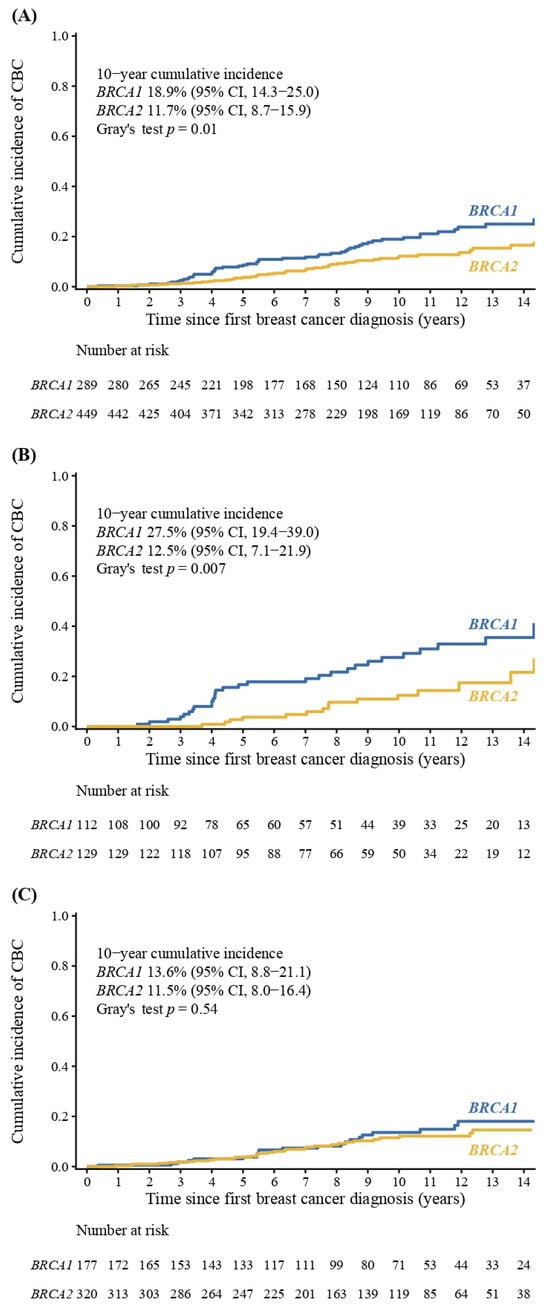
During a median follow-up of 9.0 years (IQR, 5.6–12.1 years) after the first breast cancer diagnosis, 52 (18.0%) of 289 BRCA1 carriers and 49 (10.9%) of 449 BRCA2 carriers developed CBC. The 10-year cumulative incidence of CBC was 18.9% (95% CI, 14.3% to 25.0%) in BRCA1 carriers and 11.7% (95% CI, 8.7% to 15.9%) in BRCA2 carriers. The cumulative incidence of CBC was significantly higher in BRCA1 carriers than in BRCA2 carriers (Gray’s test, p = 0.01; Figure 1A). The cohort of BRCA1/2 carriers was stratified by age at the first breast cancer diagnosis, using a cutoff of 40 years (≤40 years). Among patients diagnosed at age 40 years or younger, the 10-year cumulative incidence of CBC was markedly higher in BRCA1 carriers than in BRCA2 carriers (27.5% vs. 12.5%; p = 0.007) (Figure 1B). By contrast, among patients diagnosed after age 40 years, the 10-year cumulative incidence of CBC was comparable between BRCA1 and BRCA2 carriers (13.6% vs. 11.5%; p = 0.54) (Figure 1C).
Figure 1.
Cumulative incidence of contralateral breast cancer in BRCA1 and BRCA2 carriers. (A) The entire cohort, (B) patients whose first breast cancer was diagnosed at age 40 years or younger, and (C) patients whose first breast cancer was diagnosed after age 40 years.
3.3. Factors Associated with Differences in CBC Risk Between BRCA1 and BRCA2 Carriers
We then explored risk factors associated with differences in CBC risk between BRCA1 and BRCA2 carriers. In univariate analyses, younger age at diagnosis (≤40 years), mutation sites outside the 3′ region, tumor size ≤ 2 cm, negative lymph node status, negative progesterone receptor (PR) status, and receipt of adjuvant chemotherapy and radiotherapy were significantly associated with a higher CBC risk in BRCA1 carriers than in BRCA2 carriers (Table 2). Among patients diagnosed at age 40 years or younger, BRCA1 carriers had a significantly higher CBC risk than BRCA2 carriers after adjustment for the above risk factors (adjusted cause-specific hazard ratio, 2.58 [95% CI, 1.06–6.29]; p = 0.04) (Table 2). However, the interaction between gene and age at first diagnosis did not reach statistical significance (p for interaction = 0.10; Table S3). Interestingly, we noted that approximately 39% of BRCA1 carriers were diagnosed at age 40 years or younger and accounted for 56% of CBC cases in that group; the corresponding proportions in BRCA2 carriers were 29% and 33%.
Table 2.
Comparison of contralateral breast cancer risk between BRCA1 and BRCA2 carriers across subgroups.
3.4. Subtypes of Primary and Contralateral Breast Tumors in BRCA1 and BRCA2 Carriers
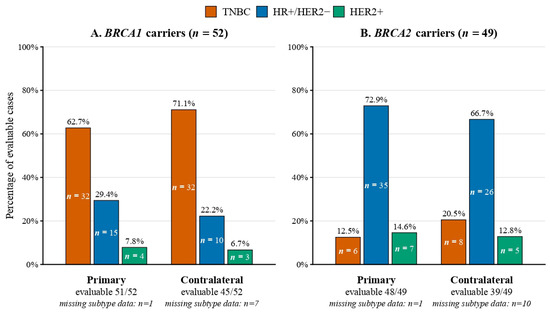
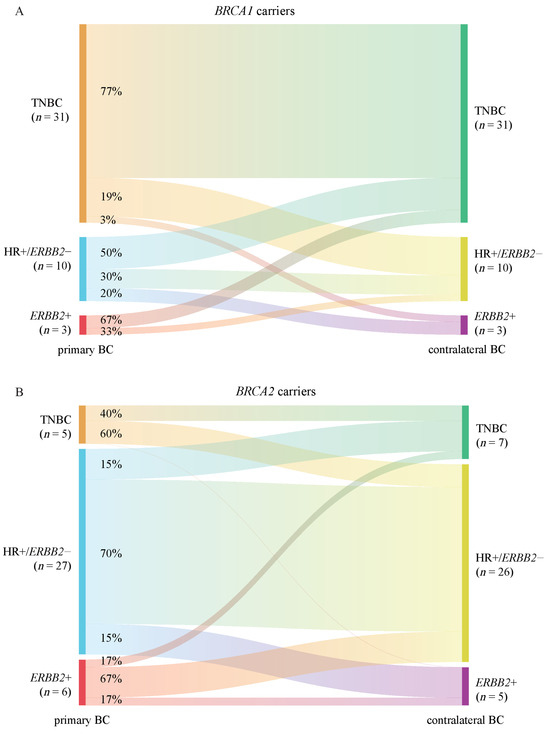
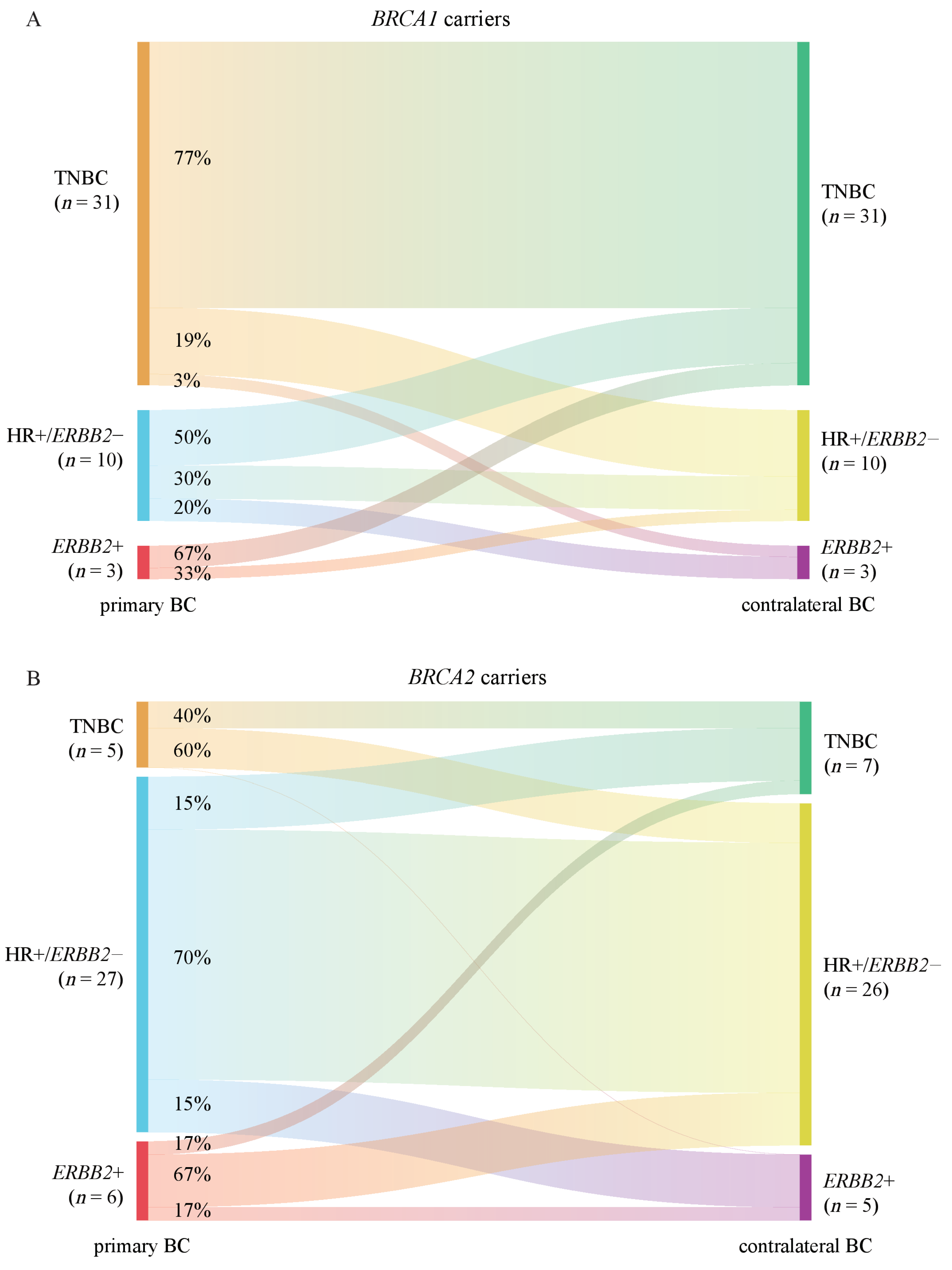
In this cohort, 52 BRCA1 and 49 BRCA2 carriers developed CBC; the clinicopathological characteristics of the primary tumors of BRCA1/2 carriers who developed CBC are presented in Table S1. Among BRCA1 carriers with CBC, the predominant primary tumor subtype was TNBC, accounting for 62.7% (32 cases), followed by HR+/HER2− (29.4%) and HER2+ (7.8%). The predominant contralateral tumor subtype was also TNBC (71.1%), followed by HR+/HER2− (22.2%) and HER2+ (6.7%) (Figure 2A). We then investigated the association between primary and contralateral tumor subtypes among the 52 BRCA1 carriers. Of these, 31 BRCA1 carriers had primary TNBC; when these 31 patients developed contralateral breast cancer, 77.4% of the contralateral tumors were TNBC (Figure 3A and Table S2). Among BRCA2 carriers with CBC, the predominant primary tumor subtype was HR+/HER2−, accounting for 72.9% (35 cases), followed by HER2+ (14.6%) and TNBC (12.5%). The predominant contralateral tumor subtype was also HR+/HER2− (66.7%), followed by TNBC (20.5%) and HER2+ (12.8%) (Figure 2B). We then investigated the association between primary and contralateral tumor subtypes among the 49 BRCA2 carriers. Of these, 27 BRCA2 carriers had HR+/HER2− primary tumors; when these 27 patients developed contralateral breast cancer, 70.4% of the contralateral tumors were of the HR+/HER2− subtype (Figure 3B and Table S2).
Figure 2.
Distribution of primary and contralateral tumor subtypes among patients who developed contralateral breast cancer. (A) BRCA1 carriers. (B) BRCA2 carriers. Bar heights show the percentage of evaluable cases, with the number of cases shown inside each bar; the number of evaluable cases and the number with missing subtype data are indicated below each group.
Figure 3.
Concordance between primary and contralateral breast cancer subtypes. (A) BRCA1 carriers. (B) BRCA2 carriers.
4. Discussion
In this study, we found that BRCA1 carriers had a significantly higher risk of CBC than BRCA2 carriers. Furthermore, primary and subsequent contralateral tumors in BRCA1 carriers were predominantly TNBC. Among patients with a TNBC primary tumor who developed CBC, more than 77% of contralateral tumors were also TNBC. In contrast, primary and subsequent contralateral breast tumors in BRCA2 carriers were predominantly hormone receptor-positive. Importantly, BRCA1 carriers not only have a high risk of CBC but also have a high probability of developing the aggressive TNBC phenotype in their contralateral tumors.
The strengths of our BRCA1/2 carrier cohort include the availability of detailed clinicopathological and treatment information, the identification of unselected BRCA1/2 carriers from a large consecutive series of patients with breast cancer, a relatively large sample size, and long-term follow-up. These features allowed us to estimate CBC risks comprehensively in the BRCA1 and BRCA2 groups separately and explore potential factors associated with the differences in CBC risk.
Previous studies primarily investigated whether germline mutations in BRCA1/2 confer a high risk of CBC and demonstrated that BRCA1/2 carriers indeed have a higher CBC risk than non-carriers [3,4,5,6,7,9,10,11,12,13,21,22]. Some studies paid little attention to differences in CBC risk between BRCA1 and BRCA2 carriers because they either combined BRCA1 and BRCA2 carriers or had small sample sizes. Yadav et al. [11] recently reported that the 10-year cumulative risk of CBC was higher in BRCA1 carriers than in BRCA2 carriers (23.1% vs. 16.9%). Kuchenbaecker et al. [10] also reported that the 20-year cumulative risk of CBC was lower in BRCA2 carriers than in BRCA1 carriers (26% vs. 40%; hazard ratio = 0.62) in a large international prospective cohort study with a median follow-up of 5 years. However, the authors could not investigate the underlying factors contributing to this difference because the necessary clinicopathological and treatment information was unavailable. Consistent with this finding, our study demonstrated that BRCA1 carriers had a 1.7-fold higher risk of CBC than BRCA2 carriers. Although BRCA1 and BRCA2 both contribute to the repair of DNA double-strand breaks through the homologous recombination pathway, they may have distinct functions. Therefore, the distinct patterns of CBC in BRCA1 and BRCA2 carriers may reflect the different roles of the two proteins in DNA double-strand break repair: BRCA1 promotes DNA end resection and checkpoint activation, whereas BRCA2 loads RAD51, via PALB2, to mediate homologous recombination [23,24,25].
It is well documented that many factors are associated with CBC risk in BRCA1/2 carriers, including family history of breast cancer, younger age at the first breast cancer diagnosis, mutation location, and endocrine therapy [1,6,9,10,14,21,26]. In this study, we aimed to investigate which factors may contribute to the higher CBC risk in BRCA1 carriers than in BRCA2 carriers. We found that several factors may be associated with a higher risk of CBC in BRCA1 carriers. Overall, the 10-year cumulative incidence of CBC was 28% in BRCA1 carriers versus 13% in BRCA2 carriers among patients whose first breast cancer was diagnosed at age 40 years or younger. By contrast, the 10-year cumulative incidence of CBC was 14% in BRCA1 carriers versus 12% in BRCA2 carriers among patients diagnosed after age 40 years. Age at primary tumor diagnosis appeared to be more closely associated with CBC risk in BRCA1 carriers. One previous study [10] indicated that age at the first breast cancer diagnosis is a strong risk factor in BRCA1/2 carriers, especially BRCA1 carriers, with 10-year cumulative CBC risks of 26% in BRCA1 carriers versus 17% in BRCA2 carriers among patients whose first breast cancer was diagnosed before age 41 years. In our cohort, 39% of BRCA1 carriers and 29% of BRCA2 carriers were diagnosed with their first breast cancer at age 40 years or younger. These younger patients accounted for 56% of CBC cases in BRCA1 carriers and 33% in BRCA2 carriers. One recent study [27], which included more than 5000 young BRCA1/2 carriers with breast cancer diagnosed at age 40 years or younger, showed that risk-reducing mastectomy was associated with significantly improved overall survival in these young BRCA1/2 carriers (adjusted hazard ratio = 0.65).
We also evaluated the association between primary and contralateral breast cancer subtypes in BRCA1 and BRCA2 carriers. In the entire cohort of BRCA1 and BRCA2 carriers, TNBC and HR+/HER2− were the predominant primary tumor subtypes in BRCA1 and BRCA2 carriers, respectively. TNBC accounted for 63% of CBC cases in BRCA1 carriers, whereas the HR+/HER2− subtype accounted for 73% of CBC cases in BRCA2 carriers. When BRCA1 carriers with TNBC developed CBC, more than 77% of contralateral tumors were TNBC. In contrast, primary and contralateral tumors in BRCA2 carriers were predominantly of the HR+/HER2− subtype (over 70%). Our study indicated that BRCA1 carriers have a high probability of developing a contralateral tumor with a TNBC phenotype.
Our study has limitations. First, its retrospective design means that some CBC events may have been missed. Second, although the sample size was relatively large, particularly for BRCA2 carriers, the small number of CBC events in some subgroups limited the corresponding analyses. For example, only 5% of patients in our cohort underwent oophorectomy. This is not surprising because more than 95% of patients and their clinicians were unaware of the patients’ BRCA1/2 status at the time of the primary breast cancer diagnosis. Therefore, we did not analyze the association between oophorectomy and CBC risk.
5. Conclusions
Our study demonstrated that BRCA1 carriers have a significantly higher risk of CBC than BRCA2 carriers. Furthermore, TNBC is the predominant subtype in both primary and contralateral tumors in BRCA1 carriers. Our findings provide useful data to inform the optimal management of CBC risk in BRCA1 and BRCA2 carriers.
Supplementary Materials
The following supporting information can be downloaded at https://www.mdpi.com/article/10.3390/curroncol33110678/s1, Supplementary Data: BRCA1/2 PVs detected in this study; Table S1: Clinical characteristics of primary tumors in BRCA1/2 carriers who developed contralateral breast cancer. Table S2: Comparison of primary and contralateral tumor subtypes in BRCA1 and BRCA2 carriers with contralateral breast cancer; Table S3: Interaction between gene (BRCA1 vs. BRCA2) and clinicopathological subgroups for the risk of contralateral breast cancer.
Author Contributions
Y.X. (Yuntao Xie) and Y.X. (Ye Xu) designed and supervised the study; J.S., H.L. and D.L. analyzed and interpreted the data; J.C., L.H., Y.X. (Ye Xu), J.Z., L.Y. and Y.X. (Yuntao Xie) contributed patients with breast cancer and clinical data; J.S. and H.L. drafted the paper; Y.X. (Yuntao Xie) and Y.X. (Ye Xu) revised the paper. All authors approved the final version. J.S. and H.L. contributed equally to this work and share first authorship. Y.X. (Ye Xu) and Y.X. (Yuntao Xie) contributed equally to this work and share corresponding authorship. All authors have read and agreed to the published version of the manuscript.
Funding
This study was supported by the National Natural Science Foundation of China (grant numbers 92359201, 82272932, 82372717, and 82272927) and the Young Backbone Talent Projects under the Beijing High-Level Innovation and Entrepreneurship Talent Support Program (grant number G202532281).
Institutional Review Board Statement
This study was approved by the Research and Ethics Committee of Peking University Cancer Hospital (approval no. 2021KT65; approval date: 30 April 2021).
Informed Consent Statement
The requirement for informed consent was waived because of the retrospective nature of the study.
Data Availability Statement
The data supporting this study’s findings are available on request from the corresponding author.
Conflicts of Interest
The authors declare no competing interests.
List of Abbreviations
| CBC | contralateral breast cancer |
| CI | confidence interval |
| ER | estrogen receptor |
| FISH | fluorescence in situ hybridization |
| HER2 | human epidermal growth factor receptor 2 |
| HR | hormone receptor |
| IQR | median and interquartile range |
| PR | progesterone receptor |
| PVs | pathogenic variants |
| SD | standard deviation |
| TNBC | triple-negative breast cancer |
References
- Su, L.; Xu, Y.; Ouyang, T.; Li, J.; Wang, T.; Fan, Z.; Fan, T.; Lin, B.; Xie, Y. Contralateral breast cancer risk in BRCA1 and BRCA2 mutation carriers in a large cohort of unselected Chinese breast cancer patients. Int. J. Cancer 2020, 146, 3335–3342. [Google Scholar] [CrossRef] [Scilit] [PubMed]
- Hamann, U.; Sinn, H.P. Survival and tumor characteristics of German hereditary breast cancer patients. Breast Cancer Res. Treat. 2000, 59, 185–192. [Google Scholar] [CrossRef] [Scilit] [PubMed]
- Robson, M.E.; Chappuis, P.O.; Satagopan, J.; Wong, N.; Boyd, J.; Goffin, J.R.; Hudis, C.; Roberge, D.; Norton, L.; Begin, L.R.; et al. A combined analysis of outcome following breast cancer: Differences in survival based on BRCA1/BRCA2 mutation status and administration of adjuvant treatment. Breast Cancer Res. 2004, 6, R8–R17. [Google Scholar] [CrossRef] [Scilit] [PubMed]
- Brekelmans, C.T.; Tilanus-Linthorst, M.M.; Seynaeve, C.; vd Ouweland, A.; Menke-Pluymers, M.B.; Bartels, C.C.; Kriege, M.; van Geel, A.N.; Burger, C.W.; Eggermont, A.M.; et al. Tumour characteristics, survival and prognostic factors of hereditary breast cancer from BRCA2-, BRCA1- and non-BRCA1/2 families as compared to sporadic breast cancer cases. Eur. J. Cancer 2007, 43, 867–876. [Google Scholar] [CrossRef] [Scilit] [PubMed]
- Malone, K.E.; Begg, C.B.; Haile, R.W.; Borg, A.; Concannon, P.; Tellhed, L.; Xue, S.; Teraoka, S.; Bernstein, L.; Capanu, M.; et al. Population-based study of the risk of second primary contralateral breast cancer associated with carrying a mutation in BRCA1 or BRCA2. J. Clin. Oncol. 2010, 28, 2404–2410. [Google Scholar] [CrossRef] [Scilit] [PubMed]
- Metcalfe, K.; Gershman, S.; Lynch, H.T.; Ghadirian, P.; Tung, N.; Kim-Sing, C.; Olopade, O.I.; Domchek, S.; McLennan, J.; Eisen, A.; et al. Predictors of contralateral breast cancer in BRCA1 and BRCA2 mutation carriers. Br. J. Cancer 2011, 104, 1384–1392. [Google Scholar] [CrossRef] [Scilit] [PubMed]
- Rhiem, K.; Engel, C.; Graeser, M.; Zachariae, S.; Kast, K.; Kiechle, M.; Ditsch, N.; Janni, W.; Mundhenke, C.; Golatta, M.; et al. The risk of contralateral breast cancer in patients from BRCA1/2 negative high risk families as compared to patients from BRCA1 or BRCA2 positive families: A retrospective cohort study. Breast Cancer Res. 2012, 14, R156. [Google Scholar] [CrossRef] [Scilit] [PubMed]
- Molina-Montes, E.; Perez-Nevot, B.; Pollan, M.; Sanchez-Cantalejo, E.; Espin, J.; Sanchez, M.J. Cumulative risk of second primary contralateral breast cancer in BRCA1/BRCA2 mutation carriers with a first breast cancer: A systematic review and meta-analysis. Breast 2014, 23, 721–742. [Google Scholar] [CrossRef] [Scilit] [PubMed]
- van den Broek, A.J.; van’t Veer, L.J.; Hooning, M.J.; Cornelissen, S.; Broeks, A.; Rutgers, E.J.; Smit, V.T.; Cornelisse, C.J.; van Beek, M.; Janssen-Heijnen, M.L.; et al. Impact of Age at Primary Breast Cancer on Contralateral Breast Cancer Risk in BRCA1/2 Mutation Carriers. J. Clin. Oncol. 2016, 34, 409–418. [Google Scholar] [CrossRef] [Scilit] [PubMed][Green Version]
- Kuchenbaecker, K.B.; Hopper, J.L.; Barnes, D.R.; Phillips, K.A.; Mooij, T.M.; Roos-Blom, M.J.; Jervis, S.; van Leeuwen, F.E.; Milne, R.L.; Andrieu, N.; et al. Risks of Breast, Ovarian, and Contralateral Breast Cancer for BRCA1 and BRCA2 Mutation Carriers. JAMA 2017, 317, 2402–2416. [Google Scholar] [CrossRef] [Scilit] [PubMed]
- Yadav, S.; Boddicker, N.J.; Na, J.; Polley, E.C.; Hu, C.; Hart, S.N.; Gnanaolivu, R.D.; Larson, N.; Holtegaard, S.; Huang, H.; et al. Contralateral Breast Cancer Risk Among Carriers of Germline Pathogenic Variants in ATM, BRCA1, BRCA2, CHEK2, and PALB2. J. Clin. Oncol. 2023, 41, 1703–1713. [Google Scholar] [CrossRef] [Scilit] [PubMed]
- Reiner, A.S.; Watt, G.P.; Malone, K.E.; Lynch, C.F.; John, E.M.; Knight, J.A.; Woods, M.; Liang, X.; Tischkowitz, M.; Conti, D.V.; et al. Breast Cancer Susceptibility Gene Sequence Variations and Development of Contralateral Breast Cancer. JAMA Netw. Open 2024, 7, e2452158. [Google Scholar] [CrossRef] [Scilit] [PubMed]
- Yoon, K.H.; Chae, S.; Kang, E.; Shin, H.C.; Kim, J.H.; Kim, I.A.; Park, S.Y.; Kim, S.W.; Kim, E.K. Contralateral Breast Cancer and Ipsilateral Breast Tumor Recurrence in BRCA1/2 Carriers and Non-Carriers at High-Risk of Hereditary Breast Cancer. J. Breast Cancer 2019, 22, 587–598. [Google Scholar] [CrossRef] [Scilit] [PubMed]
- Sun, J.; Chu, F.; Pan, J.; Zhang, Y.; Yao, L.; Chen, J.; Hu, L.; Zhang, J.; Xu, Y.; Wang, X.; et al. BRCA-CRisk: A Contralateral Breast Cancer Risk Prediction Model for BRCA Carriers. J. Clin. Oncol. 2023, 41, 991–999. [Google Scholar] [CrossRef] [Scilit] [PubMed]
- Zhang, J.; Sun, J.; Chen, J.; Yao, L.; Ouyang, T.; Li, J.; Wang, T.; Fan, Z.; Fan, T.; Lin, B.; et al. Comprehensive analysis of BRCA1 and BRCA2 germline mutations in a large cohort of 5931 Chinese women with breast cancer. Breast Cancer Res. Treat. 2016, 158, 455–462. [Google Scholar] [CrossRef] [Scilit] [PubMed]
- Sun, J.; Meng, H.; Yao, L.; Lv, M.; Bai, J.; Zhang, J.; Wang, L.; Ouyang, T.; Li, J.; Wang, T.; et al. Germline Mutations in Cancer Susceptibility Genes in a Large Series of Unselected Breast Cancer Patients. Clin. Cancer Res. 2017, 23, 6113–6119. [Google Scholar] [CrossRef] [Scilit] [PubMed]
- Sun, J.; Yao, L.; Chen, J.; Hu, L.; Zhang, J.; Xu, Y.; Xie, Y. Predicting the likelihood of BRCA1/2 germline pathogenic variants in unselected patients with breast cancer: Analysis of more than 10,000 individuals. J. Med. Genet. 2025, 62, 62–68. [Google Scholar] [CrossRef] [Scilit] [PubMed]
- Su, L.; Zhang, J.; Meng, H.; Ouyang, T.; Li, J.; Wang, T.; Fan, Z.; Fan, T.; Lin, B.; Xie, Y. Prevalence of BRCA1/2 large genomic rearrangements in Chinese women with sporadic triple-negative or familial breast cancer. Clin. Genet. 2018, 94, 165–169. [Google Scholar] [CrossRef] [Scilit] [PubMed]
- Wolff, A.C.; Hammond, M.E.H.; Allison, K.H.; Harvey, B.E.; Mangu, P.B.; Bartlett, J.M.S.; Bilous, M.; Ellis, I.O.; Fitzgibbons, P.; Hanna, W.; et al. Human Epidermal Growth Factor Receptor 2 Testing in Breast Cancer: American Society of Clinical Oncology/College of American Pathologists Clinical Practice Guideline Focused Update. J. Clin. Oncol. 2018, 36, 2105–2122. [Google Scholar] [CrossRef] [Scilit] [PubMed]
- Allison, K.H.; Hammond, M.E.H.; Dowsett, M.; McKernin, S.E.; Carey, L.A.; Fitzgibbons, P.L.; Hayes, D.F.; Lakhani, S.R.; Chavez-MacGregor, M.; Perlmutter, J.; et al. Estrogen and Progesterone Receptor Testing in Breast Cancer: ASCO/CAP Guideline Update. J. Clin. Oncol. 2020, 38, 1346–1366. [Google Scholar] [CrossRef] [Scilit] [PubMed]
- Graeser, M.K.; Engel, C.; Rhiem, K.; Gadzicki, D.; Bick, U.; Kast, K.; Froster, U.G.; Schlehe, B.; Bechtold, A.; Arnold, N.; et al. Contralateral breast cancer risk in BRCA1 and BRCA2 mutation carriers. J. Clin. Oncol. 2009, 27, 5887–5892. [Google Scholar] [CrossRef] [Scilit] [PubMed]
- Metcalfe, K.; Lynch, H.T.; Ghadirian, P.; Tung, N.; Olivotto, I.; Warner, E.; Olopade, O.I.; Eisen, A.; Weber, B.; McLennan, J.; et al. Contralateral breast cancer in BRCA1 and BRCA2 mutation carriers. J. Clin. Oncol. 2004, 22, 2328–2335. [Google Scholar] [CrossRef] [Scilit] [PubMed]
- Roy, R.; Chun, J.; Powell, S.N. BRCA1 and BRCA2: Different roles in a common pathway of genome protection. Nat. Rev. Cancer 2011, 12, 68–78. [Google Scholar] [CrossRef] [Scilit] [PubMed]
- Lord, C.J.; Ashworth, A. PARP inhibitors: Synthetic lethality in the clinic. Science 2017, 355, 1152–1158. [Google Scholar] [CrossRef] [Scilit] [PubMed]
- Scully, R.; Panday, A.; Elango, R.; Willis, N.A. DNA double-strand break repair-pathway choice in somatic mammalian cells. Nat. Rev. Mol. Cell Biol. 2019, 20, 698–714. [Google Scholar] [CrossRef] [Scilit] [PubMed]
- Reiner, A.S.; Sisti, J.; John, E.M.; Lynch, C.F.; Brooks, J.D.; Mellemkjaer, L.; Boice, J.D.; Knight, J.A.; Concannon, P.; Capanu, M.; et al. Breast Cancer Family History and Contralateral Breast Cancer Risk in Young Women: An Update From the Women’s Environmental Cancer and Radiation Epidemiology Study. J. Clin. Oncol. 2018, 36, 1513–1520. [Google Scholar] [CrossRef] [Scilit] [PubMed]
- Blondeaux, E.; Sonnenblick, A.; Agostinetto, E.; Bas, R.; Kim, H.J.; Franzoi, M.A.; Bernstein-Molho, R.; Linn, S.; Kwong, A.; Pogoda, K.; et al. Association between risk-reducing surgeries and survival in young BRCA carriers with breast cancer: An international cohort study. Lancet Oncol. 2025, 26, 759–770. [Google Scholar] [CrossRef] [Scilit] [PubMed]

Disclaimer/Publisher’s Note: The statements, opinions and data contained in all publications are solely those of the individual author(s) and contributor(s) and not of MDPI and/or the editor(s). MDPI and/or the editor(s) disclaim responsibility for any injury to people or property resulting from any ideas, methods, instructions or products referred to in the content. |
© 2026 by the authors. Licensee MDPI, Basel, Switzerland. This article is an open access article distributed under the terms and conditions of the Creative Commons Attribution (CC BY) license.