


Simple Summary
Pain is one of the most feared consequences of cancer, and how well it is controlled may depend on a patient’s circumstances as much as their disease. We interviewed 272 adults with cancer and pain attending an oncology outpatient clinic in Türkiye. Two-thirds rated their worst pain in the previous week as 4 or more out of 10, and almost one-third rated it 7 or more. Nearly everyone took a painkiller, but mostly non-opioid ones: only 17 patients reported morphine or a fentanyl patch, and although strong painkiller use rose as pain became more severe, it stayed low. Patients whose own income fell below the national minimum wage more often reported stronger pain, and those who said pain had left them completely cut off from others more often reported a severe effect on quality of life. Asking about money worries and isolation may help identify patients who need closer attention.
Abstract
Background: Cancer pain is frequently undertreated, and its burden may track social and economic circumstances as well as clinical need; evidence from middle-income health systems is limited. Methods: Cross-sectional survey with prospective enrolment at a tertiary oncology outpatient clinic in Türkiye (January–April 2025). 272 adults with cancer reporting pain completed a 43-item investigator-developed questionnaire administered face to face; chi-square tests and multivariable logistic regression were used. Results: Worst pain in the preceding week was moderate-to-severe (NRS ≥ 4) in 66.5% and severe (NRS ≥ 7) in 29.8%. Reported regimens were predominantly non-opioid: a grouped paracetamol/NSAID category formed part of the regimen for 80.9%, tramadol for 30.1% and a strong opioid for 6.2%. Strong-opioid use rose across mild, moderate and severe pain bands (2.3%, 5.1%, 12.5%; exact p = 0.005) but remained low. After adjustment for available covariates, personal income below the minimum wage was associated with moderate-to-severe pain (OR 2.26, 95% CI 1.28–4.00) and self-reported complete social isolation with severe self-attributed quality-of-life impact (OR 8.75, 3.24–23.64). Conclusions: Higher pain severity, low income and social disruption co-occurred. Because outcomes were single pain-attributed items and disease stage was unrecorded, these associations are descriptive.
1. Introduction
Cancer pain is not simply a physical sensation—it is a highly prevalent, feared and disabling symptom that interferes with the lives of patients across the cancer continuum. Its experience is inherently multidimensional, formed by a multifaceted interplay of biological, psychological and social forces [1,2].
Large-scale evidence shows that many cancer patients experience depression and anxiety, and umbrella syntheses report frequent co-occurrence of pain and psychological distress [3,4]. Pain-related distress often causes sleep disruption, reduced motivation, irritability, narrowed attention and anticipatory fear of recurrence. These factors may contribute to central sensitisation and to a diminished sense of perceived control [5]. Population-based analyses of cancer survivors show that pain is strongly associated with diminished quality of life and increased psychological distress [6], underscoring that ‘pain interference’—what pain prevents a person from doing—may be as consequential as pain intensity itself.
Cancer pain also has profound social dimensions. It can reconfigure family dynamics, shift caregiving responsibilities and restrict participation in roles such as parenting, partnership, employment, education and community life [7]. A recent systematic review found that clinical factors, psychological status, coping style and—critically—social support and interaction influence social isolation among cancer patients [8], indicating that isolation is modifiable and clinically relevant rather than inevitable. Socioeconomic pressures can further intensify symptom burden [9,10].
Despite available analgesic approaches, cancer pain remains undertreated because of persistent inequities and incomplete implementation of best practices [11,12]. Addressing cancer pain calls for not only evidence-based medical management but also recognition of psychological meaning and social context, reinforcing that effective pain care must be multidimensional [13,14].
Growing evidence shows that structured psychological and psychosocial interventions reduce distress, enhance coping and improve quality of life in people with cancer, also benefiting pain-related functioning [15,16]. Interventions explicitly focused on meaning and values reflect recognition that the suffering component of pain depends on interpretation, loss of valued roles and threatened identity, not on nociception alone [17].
Psychosocial care that emphasises social support is also clinically important. Studies in cancer and palliative care populations report that greater perceived social support is associated with lower pain intensity and lower physical symptom severity [18,19], and that perceived support mediates the effect of psychosocial intervention on quality of life [20]. These results support a plausible mechanism by which social resources may buffer pain-related distress and prevent dysfunction. Contemporary cancer pain management is therefore most effective when it integrates biomedical optimisation with psychologically informed care and sensitivity to social context.
Most of the evidence on these relationships comes from high-income health systems. Türkiye is an upper-middle-income country with universal social health insurance, in which analgesic prescribing and reimbursement are governed centrally by the Social Security Institution (SGK) through the Health Implementation Communiqué (SUT). Access to strong opioids in this setting is shaped less by cost at the point of dispensing than by the structure of prescribing: specific agents are reimbursed under defined conditions, red- and green-prescription requirements add administrative steps, and algology (pain medicine) services are concentrated in tertiary centres. Turkish studies report that awareness of and referral to algology services is limited [21] and that oncology physicians themselves describe reluctance to initiate strong opioids, citing concern about dependence, regulatory burden and side effects [22]. Socioeconomic position may compound these structural barriers, since patients with lower income and less formal education have fewer resources for repeated clinic visits, less capacity to navigate referral pathways and, in survey data from other settings, a higher burden of chronic pain [10,23,24]. How these influences combine in routine Turkish oncology practice has not been described. The present study therefore examined, in a tertiary oncology outpatient clinic, how pain severity relates to self-reported quality of life and social functioning, what analgesic classes patients report using, and whether these patterns differ by income and education.
2. Materials and Methods
2.1. Study Design and Reporting
This was a cross-sectional survey of adult cancer patients with pain. Eligible patients were enrolled prospectively and consecutively within the investigator’s outpatient clinic sessions across the study period. The manuscript follows the STROBE recommendations for reporting cross-sectional studies.
2.2. Ethics
The study protocol was reviewed and approved by the Non-Interventional Clinical Research Ethics Committee of Gaziantep City Hospital, Gaziantep, Türkiye (approval date 18 December 2024; approval number 105/2024). All procedures were performed in accordance with the ethical standards of the institutional research committee and with the Declaration of Helsinki. Written informed consent was obtained from every participant before any study procedure. Participation was voluntary, could be withdrawn at any time, and did not affect clinical management. Responses were pseudonymised at data entry and analysed in aggregate.
2.3. Setting and Study Period
The study was conducted at the medical oncology outpatient clinic of Gaziantep City Hospital, Gaziantep, Türkiye, a tertiary care institution. Recruitment and data collection ran from 30 January 2025 to 30 April 2025 (91 days), following ethics committee approval on 18 December 2024.
2.4. Participants
2.4.1. Eligibility Criteria
- Confirmed diagnosis of cancer (any type and stage);
- Age ≥ 18 years;
- Reported pain and/or was engaged in a pain-management process, including receiving pain-related treatment;
- Provided written informed consent.
2.4.2. Exclusion Criteria
- Inability to provide information on pain experience or pain management because of impaired consciousness or severe cognitive impairment;
- Concurrent treatment for another severe health condition that could substantially confound symptom reporting during the study period;
- Insufficient communication capacity for questionnaire participation (e.g., substantial language barrier or severe sensory impairment preventing completion).
2.5. Participant Flow
During the study period, 300 eligible patients were approached consecutively within 34 outpatient recruitment sessions. Sixteen declined participation (284 consented; consent rate 94.7%) and 12 questionnaires were excluded because they remained incomplete, leaving 272 questionnaires in the analytic dataset, corresponding to 90.7% of all patients approached. The 12 incomplete interviews were discontinued either at the participant’s request or because the participant became fatigued or was called for a scheduled clinical appointment. These forms were not retained, so no demographic or clinical data are available for the 12 excluded participants and their characteristics cannot be compared with those of the analysed sample; this is acknowledged in the Limitations.
2.6. Sample Size
The required sample size was determined a priori using G*Power 3.1.9.6 (Heinrich Heine University Düsseldorf, Düsseldorf, Germany). The calculation assumed a chi-square test of association for the primary comparison (pain intensity category × quality-of-life impact, a 3 × 4 contingency table, df = 6), with an anticipated effect size of w = 0.23, α = 0.05 and power (1 − β) = 0.80, yielding a minimum of 258 participants. This corresponds to a small-to-medium effect by Cohen’s conventions (w = 0.10 small, 0.30 medium, 0.50 large). To allow for non-response and incomplete questionnaires, recruitment proceeded beyond the minimum target and the final sample of 272 exceeded this requirement. Achieved (post hoc) power is not reported: for the observational associations examined here the precision of each estimate is conveyed by its confidence interval, which is reported throughout.
2.7. Survey Instrument
The investigators developed a questionnaire comprising 43 substantive items, preceded by a separate written consent item, on the basis of a literature review. The tool captured the multidimensional experience of cancer pain as a personal experience determined by biological, psychological and social elements. Because the questionnaire was developed for this study and is not a standardised scale, all items and response options were chosen specifically for this research and the identical version was administered to every participant. The full instrument, in the Turkish original as administered and the English translation, is provided as Supplementary File S1.
Content validity was reviewed by three medical oncology specialists, and the instrument was pilot-tested in 10 patients who were not included in the analytic sample; items found ambiguous at pilot testing were reworded before the main study. The questionnaire is a structured inventory of predominantly single-choice items covering distinct content domains, rather than a summative scale with a common response metric: no item set was designed to be added into a total or subscale score. Internal consistency (Cronbach’s α) was therefore not computed, since the coefficient is not interpretable for items of this form. The complete 43-item instrument (plus the separate consent item) is provided in Turkish and in English translation as Supplementary File S1.
The questionnaire consisted of four sections:
- Demographic information: sex, age, education level and income status.
- Pain experience: perceived source of pain, pain location, pain intensity (0–10 numeric rating), temporal pattern, triggers, duration, pain descriptors, behavioural response to pain and interference with daily activities.
- Pain management and treatment: analgesic use (type, frequency, perceived effect), other pain-relief methods and preferences, perceived efficacy of pain treatment, education about pain management, individualised planning, barriers, cost burden, satisfaction and involvement of health care professionals.
- Psychological and social status: self-reported emotional conditions related to pain, impact on quality of life and social functioning, difficulties with role functioning, use of professional psychological support, helpful support types and strategies to reduce the psychological effects of pain.
2.8. Data Collection Procedure
All questionnaires were administered face-to-face by a single investigator (MFS), a medical oncologist working at the study centre during the recruitment period, who read each item aloud and recorded the response in a structured database. Administration by one interviewer removed between-interviewer variation and allowed comprehension to be checked item by item, which was important in a cohort in which 60.7% had primary education or less. Recruitment took place during that investigator’s outpatient clinic sessions, and enrolment was consecutive within each session. The sessions were determined by the investigator’s clinical rota. Reconstructed from the hospital clinic records for the recruitment period, 34 outpatient sessions were available across the 91 days, a mean of approximately 2.6 sessions per week, with a mean of approximately 9 patients approached per session (300 approached in total) and 8 analysed per session. Because the sessions covered some but not all clinic days, consecutive enrolment applies within sessions rather than across the study period as a whole, and selection by day or session cannot be excluded. Because participants were interviewed by an oncologist working in the clinic where they received their care, items on satisfaction with pain management and on the adequacy of information received may have been subject to social desirability bias; this is discussed in the Limitations. The investigator checked each form for completeness before the participant left the clinic; forms that remained incomplete were not entered into the analytic dataset. Mean completion time was approximately 10 min. To limit bias, participation was voluntary, confidentiality was emphasised and patients were told their responses would be analysed in aggregate.
2.9. Variables and Operational Definitions
- Categorical variables: sex, education, income, cancer type, treatment modality, treatment phase, diagnosis timing and all single-choice questionnaire items.
- Ordinal variables: items with ordered response options, such as interference, satisfaction or perceived impact.
- Pain intensity was recorded on an 11-point numeric rating scale (NRS; 0 = no pain, 10 = unbearable pain). The printed item did not carry a recall window. The single interviewer asked every participant to rate the worst pain they had experienced in the preceding seven days, and this instruction was given verbally and in the same wording to each participant. Pain intensity in this study therefore refers to worst pain over seven days, not to pain at the moment of interview. Because the anchor was conveyed verbally rather than printed on the form, it cannot be verified from the instrument itself; this is acknowledged in the Limitations.
Income was captured with a single item asking participants how they would describe their income status, with three response options anchored to the statutory national minimum wage: below the minimum wage, at the minimum wage level, or above it. The anchor was carried by the response options rather than by the question stem, and the interviewer asked participants to consider their own net monthly income rather than total household earnings. No absolute income figure was collected, so the variable indicates economic position relative to a national benchmark rather than measured income. During the data collection period the minimum wage was 26,005.50 TRY gross/22,104.67 TRY net per month, approximately 600 USD at the average USD/TRY rate for January–April 2025 (36.7 TRY per USD). For regression modelling, income was dichotomised as below the minimum wage (n = 119, 43.8%) versus at or above it (n = 153, 56.3%). Because only 8 participants (2.9%) reported an income above the minimum wage, the reference category should be read as ‘at the minimum wage level’ rather than as a higher-income group: the contrast is a narrow one within a predominantly low-income cohort and is not a socioeconomic gradient. Education was recorded in five ordered categories (not literate, primary, middle, high school, university) and was dichotomised for modelling as primary school or less versus middle school or above.
Analgesic use was recorded with a single item listing drug classes. One response option grouped paracetamol with non-steroidal anti-inflammatory drugs (NSAIDs) under a single heading, as printed in the instrument. Individual agents were not recorded, so exposure to paracetamol cannot be separated from exposure to a true NSAID; paracetamol is not an NSAID, and this option is therefore reported throughout as a grouped non-opioid analgesic category rather than as NSAID use. Where a participant reported more than one class, the combination was entered as a single coded response; class-level frequencies were derived by counting every participant whose recorded response contained that class, so these frequencies sum to more than 100%. For analysis, regimens were classified as non-opioid only, weak opioid (tramadol) without a strong opioid, or strong opioid-containing (morphine or transdermal fentanyl, alone or in combination). Three participants who reported not currently using an analgesic nevertheless identified an analgesic class; on questioning, these participants used a non-opioid analgesic intermittently rather than regularly. They were retained in the class-level denominators and excluded from the denominator for perceived analgesic effect, which applies to regular users.
For inferential analyses, clinically meaningful thresholds were applied to NRS-based groups: moderate-to-severe pain (NRS ≥ 4) and severe pain (NRS ≥ 7). These thresholds match established conventions in cancer pain research and guidelines [11].
2.10. Data Management and Quality Control
Survey data were entered into a spreadsheet and checked for completeness and consistency. Because forms were checked for completeness at the point of administration and incomplete forms were not entered, the analytic dataset contained no missing values for the variables analysed; imputation was therefore not required. Where the denominator of an item is smaller than the full sample (for example, perceived analgesic effect, which applies only to analgesic users), the applicable denominator is stated with the result.
2.11. Statistical Analysis
Descriptive statistics, chi-square tests and the maximum-likelihood logistic regression models were computed in IBM SPSS Statistics version 28.0 (IBM Corp., Armonk, NY, USA). The Firth penalised-likelihood models with profile-likelihood confidence intervals, the variance inflation factors and the Monte-Carlo approximation to the exact test for the analgesic-class table were computed in Python 3.13 (Python Software Foundation) using NumPy and SciPy, because these procedures are not implemented in SPSS; the analysis code is available from the corresponding author on request. Continuous variables were summarised as mean ± standard deviation and/or median with interquartile range, and categorical variables as counts (n) and percentages (%). Distributional characteristics of continuous variables were evaluated by visual inspection and appropriate normality tests; nonparametric procedures were applied when normality criteria were not met.
Pain intensity was grouped as mild (0–3), moderate (4–6) and severe (7–10); a binary cut-off for clinically significant pain (NRS ≥ 4) was also used. Categorical associations were tested with Pearson’s chi-square test. Where more than 20% of expected counts fell below five, Fisher’s exact test was used for 2 × 2 tables and a Monte-Carlo approximation to the exact test with 200,000 replicates for larger tables; the same Monte-Carlo procedure was also applied to the analgesic-class table as a confirmation, although no expected count there fell below five. A linear trend in strong-opioid use across the three ordered pain bands was tested with the Cochran–Armitage test. Because multiple bivariate comparisons were performed, these analyses are considered exploratory and hypothesis-generating; no formal correction for multiplicity was applied, and the bivariate p values should be interpreted accordingly.
Logistic regression models were fitted for (i) moderate-to-severe pain (NRS ≥ 4) and (ii) severe versus non-severe self-attributed quality-of-life impact. Covariates for both models were specified on clinical and literature grounds before any model was fitted and were restricted to variables available in the dataset; no data-driven selection procedure was used, and no variable was added or removed on the basis of its p value. Model 1 included sex, age band, income, education, time since diagnosis and treatment phase (181 events for 6 predictors, 30.2 events per variable). Model 2 included pain intensity, any emotional impact attributed to pain, complete social isolation attributed to pain, receipt of professional psychological support and education (76 events for 5 predictors, 15.2 events per variable). Results are reported as odds ratios (ORs) with 95% confidence intervals (CIs). Multicollinearity was assessed by variance inflation factors, which did not exceed 1.27 in Model 1 or 1.07 in Model 2. Because two covariates rested on small reference strata (patients not currently in active treatment, n = 22; patients reporting no emotional impact, n = 19), both models were re-fitted using Firth penalised likelihood with profile-likelihood confidence intervals as a sensitivity analysis. Because disease stage, performance status and comorbidity were not recorded, a pre-specified sensitivity analysis added a tumour-group proxy for expected pain burden (lung, pancreatic, gastro-oesophageal, head and neck, hepatobiliary and central nervous system primaries versus all others) and, for Model 1, exposure to a chemotherapy-containing regimen. This proxy is not a substitute for staging, and the models are accordingly described as adjusted for the covariates available rather than as identifying independent determinants. All tests were two-sided, with p < 0.05 considered statistically significant.
2.12. Use of Generative Artificial Intelligence
A generative AI tool (Claude, Opus 5; Anthropic, San Francisco, CA, USA) was used during the preparation and revision of this manuscript for the following purposes: drafting and revising text in the Simple Summary, Abstract, Introduction, Discussion and Limitations; re-analysing the study dataset to verify every reported descriptive and inferential statistic against the source data, and performing the analyses reported here (variance inflation factors, Firth penalised-likelihood regression with profile-likelihood confidence intervals, the Monte-Carlo exact test, the Cochran–Armitage trend test, the analgesic-class reclassification, the option-level frequencies for multiple-response items and the tumour-group and education adjustments); checking and formatting the reference list; translating the study questionnaire into English; and generating Figure 1 and Figure 2 from the dataset. All AI-assisted analyses were reproduced from the original data file, all AI-drafted text was reviewed and edited by the authors, and every reference was verified against PubMed by the corresponding author. The study design, data collection and the final interpretation of the findings are the authors’ own.
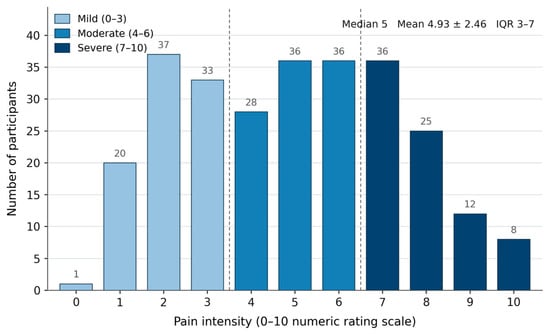
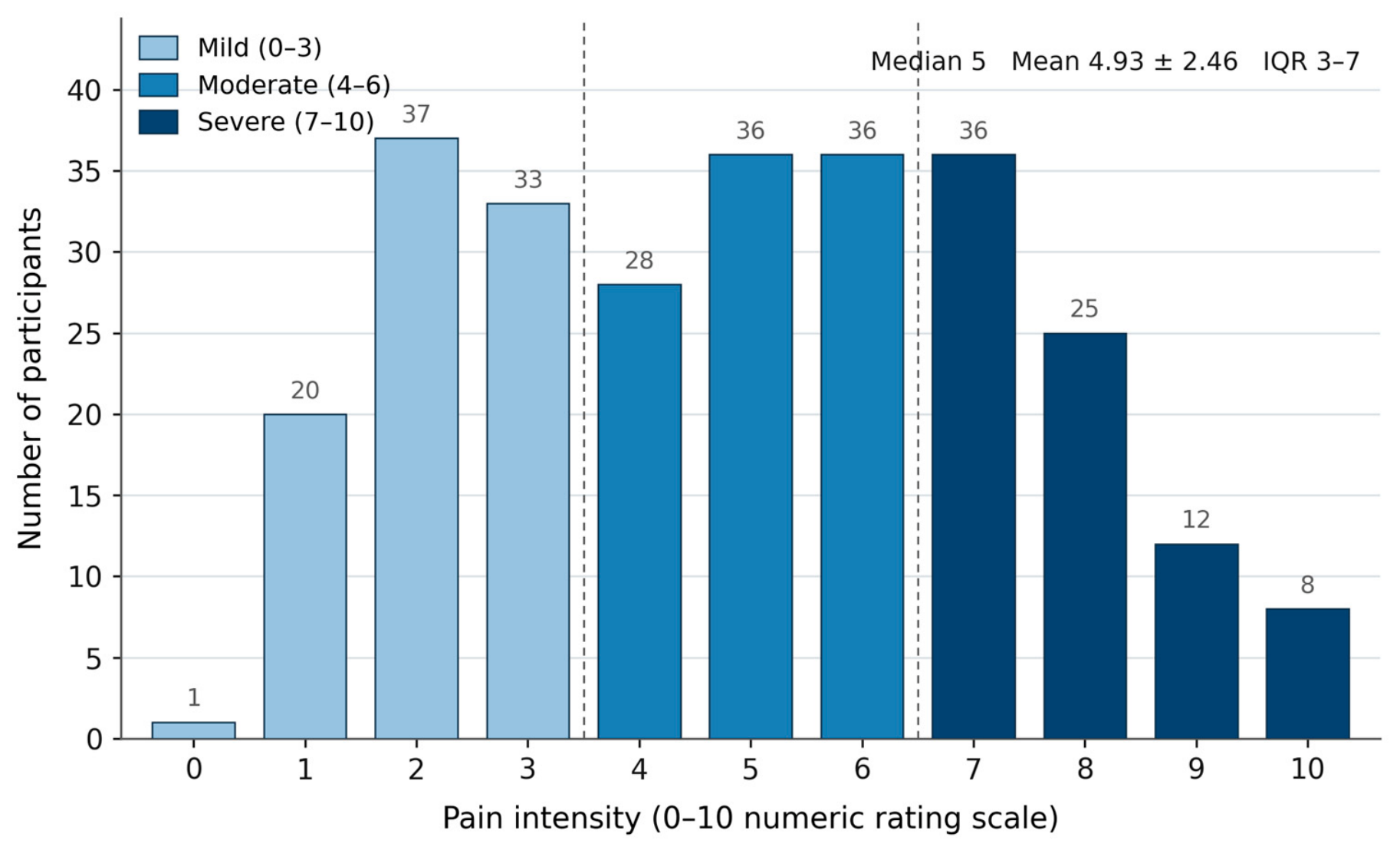
Figure 1.
Distribution of pain intensity scores on the 0–10 numeric rating scale, n = 272. Bars are shaded by pain intensity band: mild (0–3, n = 91), moderate (4–6, n = 100), severe (7–10, n = 81).
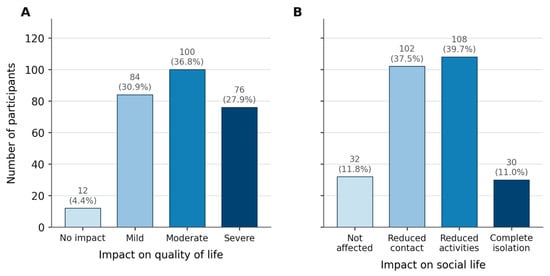
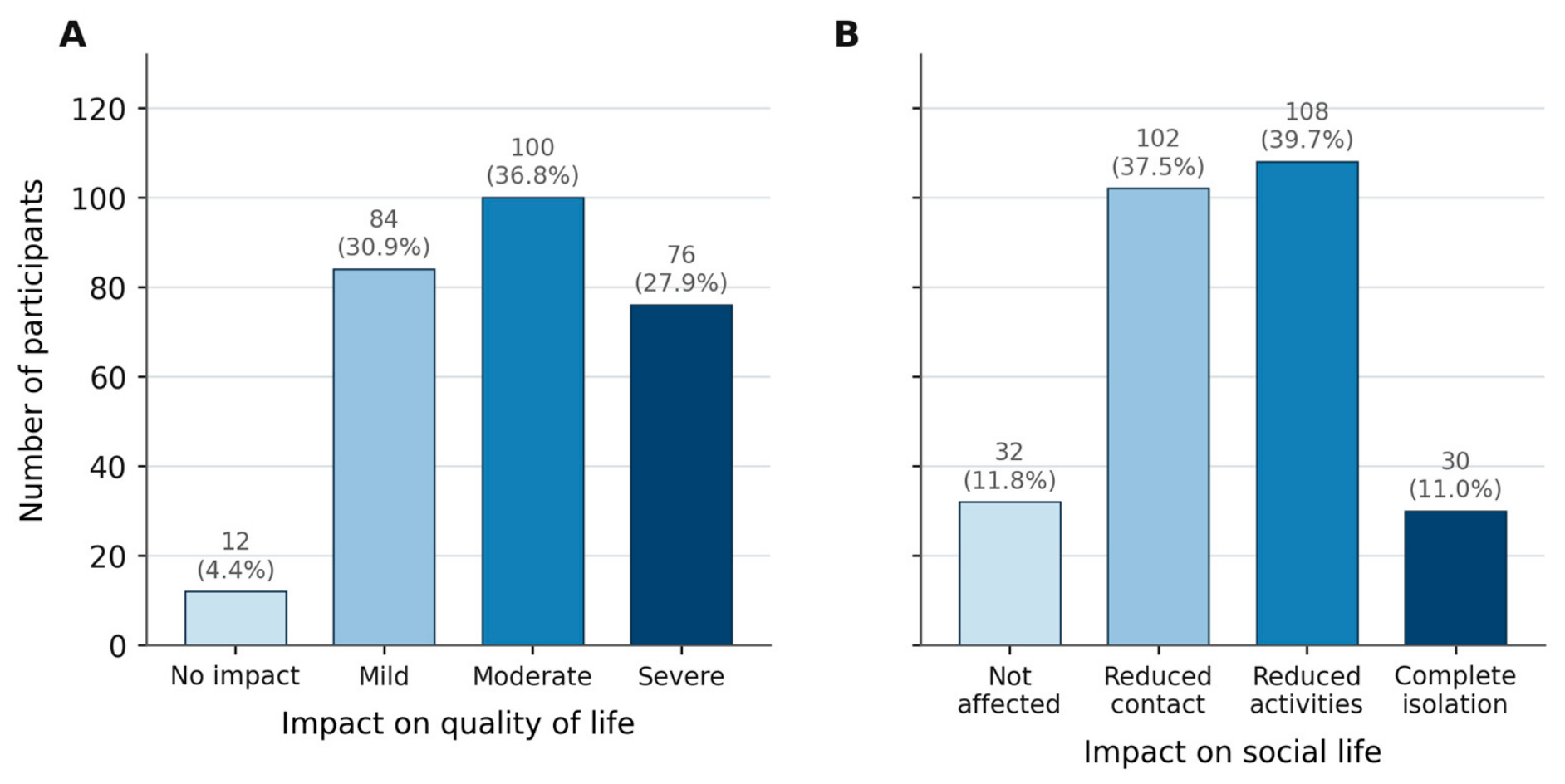
Figure 2.
Self-reported impact of pain on (A) quality of life and (B) social life, n = 272. In panel (B), ‘Reduced contact’ denotes reduced contact with family or friends and ‘Reduced activities’ denotes reduced participation in social activities. Both panels share the same vertical scale.
3. Results
3.1. Participant Characteristics
The analysis included 272 adult patients with confirmed cancer diagnoses receiving pain-related care in a tertiary medical oncology outpatient setting. Women comprised 53.3% (n = 145). The most common age groups were 65 years or older (26.8%, n = 73) and 55–64 years (23.2%, n = 63). Educational attainment was concentrated at primary school level or below: 40.1% (n = 109) had primary school education and 20.6% (n = 56) were illiterate. Just over half of participants reported an income at the national minimum wage (53.3%, n = 145), 43.8% (n = 119) reported an income below it, and 2.9% (n = 8) an income above it. A large majority, 91.9% (n = 250), were undergoing active treatment, and 36.8% (n = 100) had been diagnosed more than one year previously. Breast cancer (30.9%, n = 84) and lung cancer (28.7%, n = 78) were the most frequent cancer types. Chemotherapy was the predominant treatment modality: 205 participants (75.4%) recorded chemotherapy as their only modality and 247 (90.8%) a chemotherapy-containing regimen (Supplementary Tables S1 and S5).
3.2. Pain Experience
Mean worst pain intensity over the preceding seven days was 4.93 ± 2.46 on the 0–10 NRS (median 5, IQR 3–7). Overall, 66.5% of participants reported moderate-to-severe pain (NRS ≥ 4) and 29.8% reported severe pain (NRS ≥ 7) (Figure 1). Most patients (86.4%, n = 235) were aware of the source of their pain. The most frequently endorsed pain sites were the chest (41.9%, n = 114) and the abdomen (33.5%, n = 91); because this item permitted more than one site, these are option-level frequencies and do not sum to 100% (Supplementary Table S5). Pain occurred frequently in 46.3% (n = 126) and was constant in 10.7% (n = 29). Pain interfered with daily activities at least moderately in a substantial proportion of participants (moderate 35.3%, n = 96; severe 21.3%, n = 58). Pain was most commonly worst at midday (45.2%, n = 123) and was most frequently reported as exacerbated by movement (46.0%, n = 125) or stress (36.0%, n = 98). Typical pain duration was several hours (45.6%, n = 124), and the most common descriptors were sharp or stabbing (44.1%, n = 120) and burning (29.4%, n = 80). Nearly half of participants responded to pain primarily by taking medication (48.9%, n = 133) (Supplementary Table S2).
3.3. Pain Management and Treatment
Nearly all patients reported using analgesics (98.9%, n = 269). Among these 269 regular users, the perceived effect was rated as effective by 50.6% (n = 136), partly effective by 33.5% (n = 90), very effective by 13.4% (n = 36) and of no effect by 2.6% (n = 7). The most frequently recorded regimen was the grouped non-opioid category alone (64.7%, n = 176), followed by tramadol alone (14.0%, n = 38) and the non-opioid category with tramadol (13.2%, n = 36). Counting every recorded response that contained a given class, the grouped paracetamol/NSAID category formed part of the regimen for 220 participants (80.9%) and tramadol for 82 (30.1%), whereas a strong opioid was reported by 17 (6.2%): morphine by 5 (1.8%) and transdermal fentanyl by 13 (4.8%). Because the questionnaire grouped paracetamol with NSAIDs in a single response option and individual agents were not recorded, true NSAID exposure cannot be separated from paracetamol exposure within this 80.9%, and the figure should be read as non-opioid analgesic use rather than as NSAID use. Most participants relied on prescribed medication for pain relief (97.8%, n = 266), with 10.3% (n = 28) also reporting over-the-counter analgesics. Overall effectiveness of pain treatment, as perceived by the participant, was rated moderately effective by 43.8% (n = 119), effective by 42.3% (n = 115), very effective by 13.2% (n = 36) and ineffective by 0.7% (n = 2); this item records patient perception and is not a clinician assessment of treatment adequacy.
Reported regimen class varied with pain severity (Table 1). Among participants with mild pain (NRS 0–3), 2.3% reported a strong opioid-containing regimen, rising to 5.1% in the moderate band (NRS 4–6) and 12.5% in the severe band (NRS 7–10), while non-opioid-only regimens fell from 75.0% to 51.2% across the same bands (Monte-Carlo exact p = 0.005 for the 3 × 3 table; Cochran–Armitage test for trend in strong-opioid use z = 2.72, p = 0.007). Among the 81 participants whose worst pain in the preceding week was 7 or above, 10 (12.3%) reported a strong opioid, 29 (35.8%) reported tramadol without a strong opioid and 41 (50.6%) reported a non-opioid analgesic alone.
Table 1.
Reported analgesic regimen class by pain severity band (n = 267 participants whose recorded response could be classified; 5 participants reported an unspecified ‘other’ analgesic and are excluded).
Most patients (79.8%, n = 217) reported having received sufficient information about pain management from their physician or health care team, and 40.4% (n = 110) used alternative methods to cope with pain. Analgesics were taken only when pain increased by 56.3% (n = 153), while 32.7% (n = 89) used them daily. The most frequently reported major challenge in pain management was analgesic side effects (48.5%, n = 132), followed by persistent pain (30.1%, n = 82). An individualised pain plan was reported by 48.5% (n = 132), 33.1% (n = 90) reported having no plan, and 18.4% (n = 50) were unsure whether one existed. Satisfaction with pain management was very satisfied in 17.6% (n = 48), satisfied in 41.9% (n = 114), moderate in 36.8% (n = 100) and dissatisfied in 3.7% (n = 10). Pain management support most commonly involved a physician alone (45.6%, n = 124) or a physician and nurse (41.2%, n = 112). Shared decision-making on analgesic dose adjustment was reported as present (50.0%, n = 136), absent (31.3%, n = 85) or intermittent (18.8%, n = 51). Medication costs were most commonly perceived as the highest-cost component (47.4%, n = 129) (Supplementary Table S3).
3.4. Psychological and Social Status
Pain was reported to have affected quality of life in most patients (mild, moderate and severe combined 95.6%), with 27.9% (n = 76) reporting a severe impact. Counting every emotional state contained in the recorded response, the most frequently endorsed states attributed to pain were stress (53.3%, n = 145), anxiety (49.6%, n = 135), hopelessness (29.0%, n = 79) and depression (25.7%, n = 70); 7.0% (n = 19) reported no emotional impact. Social life was most commonly affected through reduced social activities (39.7%, n = 108) or reduced contact with family or friends (37.5%, n = 102), while 11.0% (n = 30) reported that pain had left them completely isolated. Only 18.4% (n = 50) reported receiving professional psychological support. At option level, the most frequently endorsed domains of difficulty were sleep disturbance (65.8%, n = 179), appetite loss (46.7%, n = 127), inability to perform daily tasks (34.2%, n = 93) and impaired concentration (30.9%, n = 84). The most frequently endorsed helpful support was family or social support (36.8%, n = 100), followed by psychological counselling (30.9%, n = 84). Among the listed strategies for reducing the psychological effects of pain, 23.2% (n = 63) reported meditation and 20.2% (n = 55) breathing exercises, while 26.8% (n = 73) endorsed none of the listed methods. The perceived contribution of psychological support to pain management was most often rated as beneficial (40.4%, n = 110) or moderate (37.9%, n = 103) (Supplementary Table S4 and Figure 2). Option-level endorsement frequencies for every item that permitted more than one response are given in Supplementary Table S5.
3.5. Associations and Multivariable Analyses
Pain intensity category (0–3, 4–6, 7–10) was strongly associated with self-reported quality-of-life impact (χ2 = 93.79, p < 0.001). Severe quality-of-life impact was reported by 8.8% of those with NRS 0–3, 24.0% of those with NRS 4–6 and 54.3% of those with NRS 7–10. Pain intensity category was also significantly associated with social-life impact (χ2 = 42.72, p < 0.001), with complete isolation increasing from 4.4% (NRS 0–3) to 17.3% (NRS 7–10) (Table 2 and Table 3).
Table 2.
Association between pain intensity category (NRS) and quality-of-life impact, n = 272. Values are n (row %).
Table 3.
Association between pain intensity category (NRS) and social-life impact, n = 272. Values are n (row %).
In a logistic regression model for moderate-to-severe pain (NRS ≥ 4) including sex, age band, income, education, time since diagnosis and treatment phase, personal income below the minimum wage was associated with higher odds of moderate-to-severe pain compared with income at or above it (OR 2.26, 95% CI 1.28–4.00; p = 0.005). Female sex (OR 1.74, 1.01–2.98; p = 0.045) and age 55 years or older (OR 1.97, 1.09–3.55; p = 0.025) were also associated with the outcome. Education, which was added at the reviewers’ suggestion because of its close relationship with income in this cohort (Spearman ρ = 0.36, p < 0.001), entered in the opposite direction: primary education or less was associated with lower odds of reporting moderate-to-severe pain (OR 0.51, 0.27–0.94; p = 0.032). Including education strengthened rather than attenuated the income estimate, which rose from 1.94 (1.12–3.37) in a model without education to 2.26 (1.28–4.00) with it (Table 4).
Table 4.
Logistic regression for moderate-to-severe pain (NRS ≥ 4), n = 272, 181 events.
In a separate logistic regression model for severe self-attributed quality-of-life impact, pain intensity (OR 1.62 per 1-point increase on the NRS, 95% CI 1.39–1.90; p < 0.001), self-reported complete social isolation attributed to pain (OR 8.75, 3.24–23.64; p < 0.001) and primary education or less (OR 2.16, 1.09–4.28; p = 0.027) were each associated with the outcome, while any emotional impact and receipt of professional psychological support were not (Table 5). Because both the outcome item and the isolation item ask the participant to attribute a consequence to pain, and both were answered in the same sitting, this coefficient is not interpreted as an estimate of a causal effect of isolation on quality of life (see Section 4.7).
Table 5.
Logistic regression for severe self-attributed quality-of-life impact (severe vs. non-severe), n = 272, 76 events.
In the pre-specified sensitivity analyses, both principal estimates were essentially unchanged. Adding the tumour-group proxy for expected pain burden (121 participants, 44.5%, had a primary in the higher-burden group) gave an odds ratio of 2.26 (1.27–4.01) for income below the minimum wage and 8.76 (3.24–23.67) for complete social isolation; adding chemotherapy exposure as well gave 2.24 (1.26–3.98) for income. The tumour-group term itself was not significant in either model (OR 1.68, 0.88–3.20 for NRS ≥ 4; OR 1.01, 0.53–1.94 for severe quality-of-life impact). Re-fitting both models with Firth penalised likelihood and profile-likelihood confidence intervals gave the same conclusions (income OR 2.21, 1.27–3.92, p = 0.005; isolation OR 7.93, 3.14–21.74, p < 0.001). When income was added to Model 2, it too was associated with severe quality-of-life impact (OR 3.30, 1.62–6.69; p = 0.001) and the education term was attenuated to 1.52 (0.73–3.16), consistent with income and education marking a single underlying socioeconomic dimension in this cohort.
4. Discussion
In this tertiary oncology outpatient population, moderate-to-severe pain was common and co-occurred with low income and with self-reported social disruption. About two-thirds of participants rated their worst pain in the preceding week as 4 or above and nearly one-third as 7 or above; personal income below the minimum wage and self-reported complete social isolation each remained associated with the respective outcomes after adjustment for the covariates available. Because the design is cross-sectional and both principal outcomes are consequences that participants themselves attributed to pain, these findings describe patterns of co-occurrence rather than demonstrated determinants. They remain clinically relevant, since cancer pain persists across the disease trajectory and is closely linked to reduced quality of life [1,11,25].
4.1. Pain Severity
Two-thirds of this cohort reported moderate-to-severe pain. This figure should not be read against pooled prevalence estimates from unselected oncology populations, such as the approximately 40% reported in a large systematic review and meta-analysis [1], because eligibility here required current pain or ongoing pain management and the denominator is therefore already selected. What the distribution does show is the severity mix within a pain-affected outpatient population: nearly one in three participants scored 7 or above, a threshold at which guidelines call for escalation of analgesia [11]. A national outpatient series from Türkiye provides the closest available local comparison [26].
A likely explanation for the higher burden in this cohort is the sampling context: patients with pain who were receiving pain-related treatment in a tertiary setting were deliberately enrolled, which naturally increases the number of higher-severity cases. This pattern corresponds with guideline discussions and reviews showing that clinic-based samples of symptomatic patients often show higher pain intensity and interference than broader oncology populations [11,25].
4.2. Pain–Quality-of-Life Coupling
A strong, stepwise association was observed between pain intensity category and self-reported quality-of-life impact. This finding is consistent with clinical and empirical literature demonstrating that pain severity and pain interference are major determinants of quality of life in advanced cancer and survivorship contexts. The magnitude of this gradient supports the view that pain control should be evaluated not only by intensity reduction but also by improvements in daily functioning and participation, as reflected in modern cancer pain treatment frameworks [11,25,27].
4.3. Social Functioning and Isolation
A marked association also emerged between pain intensity and social-life impact, including a higher rate of complete isolation among people with severe pain. This corresponds to systematic reviews showing that social isolation in cancer is influenced by physical symptom burden, psychological state, coping ability and social support [8]. Recent evidence shows that loneliness and social isolation are prevalent in cancer and are linked not only to distress and symptoms but also to downstream outcomes, including mortality [7,28], which underlines the clinical value of addressing social isolation.
In this cohort, self-reported complete social isolation was also strongly associated with severe self-attributed quality-of-life impairment. Both items ask the participant to attribute a consequence to pain and they were answered in the same sitting, so the association is best read as showing that these two self-attributed consequences travel together, and that patients who describe themselves as cut off from others are also those who describe pain as dominating their lives. Neither the direction of the relationship nor its independence from the underlying disease can be established from these data. Objective social network size, pre-existing social support and loneliness were not measured, and the finding should not be read as evidence that social disconnection causes pain or its impact.
4.4. Psychological Distress and Pain
Participants frequently reported stress and anxiety related to pain, while only a minority received professional psychological support. This gap reflects findings in the wider psycho-oncology literature, which documents that anxiety and depression are common in cancer populations and require systematic assessment and management [29].
Mechanistically, current research supports a two-way relationship in which depression and anxiety can increase pain severity and persistence, through amplification of fear, catastrophic thinking and attention to threat, while ongoing pain increases distress [30]. These data are consistent with a biopsychosocial model in which pain intensity, emotional distress and social functioning interact, sometimes forming a self-perpetuating cycle that increases suffering and functional loss [4].
4.5. Pain Management Patterns
Nearly all participants used analgesics, predominantly from the grouped non-opioid category, and many identified side effects as a major challenge. This observation is consistent with recent reviews [25,31]. Current guidelines endorse multimodal pain management, including appropriate opioid use for moderate-to-severe cancer pain, adjuvants for neuropathic pain, and integration of supportive and palliative care [11,31]. At the same time, many participants used analgesics only during severe pain episodes, and a large proportion cited barriers such as side effects and persistent pain, pointing to the need for structured assessment, anticipatory side-effect management and individualised pain plans [11,25,31].
The analgesic profile of this cohort deserves particular attention, and also particular caution. Although 81 participants (29.8%) rated their worst pain in the preceding week as 7 or above, only 10 of them reported a strong opioid, and only 17 participants (6.2%) in the whole cohort did so; a grouped paracetamol/NSAID option formed part of the reported regimen for 80.9% and tramadol for 30.1%. Strong-opioid use did rise across the three pain bands, which argues against indiscriminate prescribing and suggests some responsiveness to severity, but it remained low in absolute terms even among participants in the severe band, half of whom reported a non-opioid analgesic alone. We do not interpret this as demonstrated under-prescribing or as a confirmed problem of opioid access. The survey did not verify reported agents, doses or duration against prescription records; it did not capture contraindications, previous intolerance, adjuvant analgesics or patient refusal; it did not record referral to or treatment by an algology service; and pain was rated on a single occasion, so a worst-pain score of 7 or above in the preceding week does not by itself establish that a strong opioid was indicated at the time of interview. Nor can failure to recognise a drug class be separated from its genuine absence, particularly in a cohort in which 60.7% had primary education or less. What these data support is a hypothesis to be tested against prescription and referral records: that in this population the analgesic ladder stops at the weak-opioid step more often than guidelines for moderate-to-severe cancer pain would predict [11,12]. Such a pattern would be consistent with system-level barriers described in Türkiye, including limited awareness of and referral to algology services [21] and reported reluctance among oncology physicians to initiate strong opioids [22].
After adjustment for the covariates available, personal income below the minimum wage was associated with greater odds of reporting moderate-to-severe pain. This is consistent with the literature on financial toxicity and symptom burden, in which out-of-pocket expenses and limited resources are tied to poorer symptom management and reduced well-being [23,24], and with national survey data showing that lower household income is associated with chronic and high-impact chronic pain among cancer survivors [10]. Two qualifications are essential. First, because 97.1% of participants reported an income at or below the minimum wage, the comparison is between two narrowly separated strata within a low-income cohort and not across a social gradient; the estimate should not be described as an effect of socioeconomic disadvantage in general. Second, income and education were closely related here, and the two entered the pain model in opposite directions, which is more plausibly explained by differential reporting of symptom intensity than by a protective effect of limited schooling. Disentangling economic position from reporting behaviour requires measures of pain that do not depend on a single self-rated scale.
In this dataset, medication costs were the component most frequently identified as the highest-cost element of pain management (47.4%). This supports practical recommendations to incorporate brief financial screening and navigation into symptom control pathways, particularly in tertiary oncology settings where complex regimens and cumulative costs are common [23]. The relevance of this finding is shaped by the local reimbursement context: in Türkiye, analgesic prescribing and reimbursement are governed by the Social Security Institution (SGK) through the Health Implementation Communiqué (SUT), which determines patient co-payment and the conditions under which specific agents are reimbursed. Out-of-pocket burden therefore falls unevenly on patients with income at or below the minimum wage, which is a plausible pathway linking the income difference observed here to the pain reported.
4.6. Clinical Implications
This evidence indicates that routine pain care in oncology must address pain, function and psychosocial context together rather than intensity alone, because pain severity was closely tied to quality-of-life impairment and social disruption in this group. This approach is consistent with modern cancer pain guidance, which calls for systematic assessment and multimodal, individualised management [11].
The strong link between pain severity and social isolation suggests that outpatient symptom reviews should include a brief isolation or loneliness screen. Identifying and supporting at-risk patients through social work, family engagement or organised support is important given the influence of psychosocial factors on isolation in cancer [8].
Given the high rate of reported stress and anxiety and the low use of professional psychological support, oncology clinics should adopt a stepped-care approach (screen → brief intervention → referral) for distress and coping, consistent with clinical guidance and with evidence that psychological interventions improve patient outcomes [15,29]. In addition, the association between low income and clinically significant pain justifies incorporating financial screening and navigation into pain management [23].
Because medication side effects were a key obstacle to effective pain management, clinics should standardise anticipatory side-effect management, reinforce patient education and document individualised pain plans, as recommended in guideline-based cancer pain management [11].
4.7. Strengths and Limitations
Enrolment was prospective and took place in a real-world tertiary oncology outpatient clinic in an upper-middle-income health system, a setting from which data on the social patterning of cancer pain are scarce. All questionnaires were administered face to face by a single oncologist investigator, which removed between-interviewer variation, allowed each item to be explained where comprehension was uncertain, and produced a complete analytic dataset in a population with limited formal education. The instrument captured clinical, pharmacological and psychosocial domains within a single administration. The full item-level response distributions, the option-level frequencies for every multiple-response item and the instrument itself are provided as Supplementary Materials, so that every estimate reported here can be independently checked.
The findings must be read as descriptive and hypothesis-generating, and the most important reason concerns measurement. The two principal outcome items asked participants how their quality of life and their social life had been affected by pain, and the exposure was pain intensity reported by the same participant in the same sitting, so the observed gradients are partly built into the wording: a respondent who rates pain highly is by construction more likely to endorse a strong effect of that pain. This applies with particular force to the association between complete isolation and severe quality-of-life impact, since both items ask about the consequences of pain and are close in meaning; 73.3% of participants who reported complete isolation also reported severe quality-of-life impact. These are therefore self-attributed impacts, not validated measures of quality of life or of social support, and no odds ratio reported here should be read as a causal estimate. A further measurement limitation concerns the pain score itself: the recall anchor, namely worst pain over the preceding seven days, was conveyed verbally by the interviewer and was not printed on the form, so it cannot be verified from the instrument. The questionnaire was also investigator-developed rather than standardised, its central constructs were single items rather than multi-item scales, content validity was reviewed by three medical oncologists without an algology, palliative care or psycho-oncology specialist or a patient representative, and because the instrument is not summative its internal consistency could not be assessed. Future work in this setting should use validated instruments such as the Brief Pain Inventory, the EORTC QLQ-C30 and a validated loneliness scale.
Disease extent was not recorded. The dataset contains treatment phase, cancer type and time since diagnosis, but no stage, metastatic status, performance score or comorbidity index. Because disease extent is among the strongest determinants of both cancer pain and social withdrawal, and is itself related to economic strain through loss of earnings and treatment duration, it is a plausible common cause of the associations reported here. The regression models are therefore described as adjusted for the covariates available rather than as establishing independence, and the word ‘independent’ is not used of these estimates. The pre-specified sensitivity analyses go some way towards addressing this: adjustment for the one dimension of disease burden that could be measured, a tumour group with higher expected pain burden, left both principal estimates virtually unaltered, as did the addition of education and the Firth re-fits. A tumour-group proxy is not a substitute for staging, however, and residual confounding by stage within tumour type remains the principal threat to the interpretation offered here.
Analgesic use was self-reported, was not verified against prescription records, and was recorded at the level of drug class rather than individual agent. One response option grouped paracetamol with NSAIDs, so exposure to a true NSAID cannot be separated from exposure to paracetamol, and the 80.9% figure is therefore a non-opioid analgesic frequency rather than an NSAID frequency. Doses, duration, adjuvant analgesics and the clinical reasons for a given regimen were not captured, the response options were unevenly recognisable in that proprietary names were supplied for tramadol and fentanyl but not for morphine, and treatment through an algology service was not asked about. Under-prescribing therefore cannot be distinguished from opioids that were offered and declined, from contraindications, or from recognition failure. The system-level interpretation offered in Section 4.5 is a hypothesis generated by these data and requires confirmation against prescription and referral records.
The sampling frame limits both precision and reach. Eligibility required current pain or ongoing pain management, so this is a cohort of cancer outpatients with pain and its pain prevalence cannot be compared with estimates from unselected oncology populations. Because every questionnaire was administered in person by one investigator alongside clinical duties, approximately 300 patients were approached across 34 outpatient sessions over 91 days, a mean of about 9 per session. Enrolment was consecutive within each session rather than across the study period, and because those sessions covered some but not all clinic days, selection by day or session cannot be excluded. No data were retained for the 12 participants whose questionnaires remained incomplete, so they cannot be compared with the analysed sample. Participants were interviewed by an oncologist working in the clinic where they received care, so social desirability may have inflated reported satisfaction with pain management and the adequacy of information received, and may have discouraged criticism of the care team. The study was conducted at a single centre in Gaziantep, a province whose socioeconomic and demographic profile differs from that of Türkiye as a whole and which hosts a large displaced population; residency and health-insurance status were not recorded, although both are directly relevant to the access arguments discussed above. Economic position was captured by a single item relative to the minimum wage and financial burden by a single cost-perception item, with no absolute income figure, employment status, work ability or validated financial toxicity instrument such as the COST/FACIT-COST. Finally, the four-level quality-of-life outcome was dichotomised at the severe category, which discards information that a proportional-odds model would have used; the binary models were retained for interpretability, the covariates were pre-specified but the models were not pre-registered, and the inferential analyses as a whole should be regarded as exploratory.
5. Conclusions
In this cross-sectional survey of 272 cancer outpatients with pain, higher pain severity co-occurred with self-reported impairment of quality of life and of social functioning, with personal income below the national minimum wage and with low educational attainment. Reported analgesic regimens were predominantly non-opioid; strong-opioid use increased across pain bands but remained low in absolute terms, and half of the participants in the severe band reported a non-opioid analgesic alone.
These findings are descriptive. They do not establish that pain was inadequately treated, nor that income or isolation caused the pain that participants reported; they identify a group of outpatients in whom pain, economic strain and social disruption coincide, and in whom closer clinical attention is warranted. Two steps follow directly and require no new resources: a brief enquiry about financial strain and about social isolation can be added to routine outpatient pain assessment, and the reported analgesic pattern should be checked against local prescription and referral records before any conclusion about opioid access is drawn. Beyond that, longitudinal studies using measures that are not attributed to pain, such as the Brief Pain Inventory, the EORTC QLQ-C30 and a validated loneliness scale, together with recorded disease stage and performance status, are needed to determine which of these relationships is causal and which is modifiable. Intervention studies could then test whether stepped-care approaches that combine optimisation of analgesia with brief psychosocial support improve outcomes in this population [11,29].
Supplementary Materials
The following supporting information can be downloaded at: https://www.mdpi.com/article/10.3390/curroncol33110677/s1. Table S1: Demographic and clinical characteristics of participants; Table S2: Pain experience; Table S3: Pain management and treatment; Table S4: Psychological and social status; Table S5: Option-level endorsement frequencies for every item that permitted more than one response; Table S6: Reported analgesic regimen class by pain severity band; Supplementary File S1: Study questionnaire (English translation and the original Turkish version).
Author Contributions
Conceptualization, M.F.S.; methodology, M.F.S.; investigation, M.F.S., S.S. and E.H.; data curation, M.F.S., S.S. and E.H.; resources, S.S. and E.H.; formal analysis, M.F.S.; software, M.F.S.; validation, M.F.S.; visualization, M.F.S.; project administration, M.F.S.; supervision, M.F.S.; writing—original draft preparation, M.F.S.; writing—review and editing, M.F.S., S.S. and E.H. All questionnaires were administered by M.F.S. All authors have read and agreed to the published version of the manuscript.
Funding
This research received no external funding.
Institutional Review Board Statement
The study was conducted in accordance with the Declaration of Helsinki and approved by the Non-Interventional Clinical Research Ethics Committee of Gaziantep City Hospital, Gaziantep, Türkiye (approval number 105/2024, 18 December 2024).
Informed Consent Statement
Written informed consent was obtained from all participants involved in the study prior to enrolment.
Data Availability Statement
The data presented in this study are available on reasonable request from the corresponding author. They are not publicly available because of patient privacy restrictions. Complete item-level response distributions are provided in the Supplementary Materials.
Acknowledgments
The authors thank the patients who gave their time to this study, and the two reviewers whose comments substantially improved the manuscript. During the preparation and revision of this manuscript, the authors used Claude (Opus 5; Anthropic, San Francisco, CA, USA; accessed September–November 2026) for the purposes of drafting and revising text, re-analysing the study data to verify reported statistics and to perform the sensitivity, exact and trend analyses reported here, checking and formatting references, translating the study questionnaire into English, and generating figures. The authors have reviewed and edited the output and take full responsibility for the content of this publication.
Conflicts of Interest
The authors declare no conflicts of interest.
References
- Snijders, R.A.H.; Brom, L.; Theunissen, M.; van den Beuken-van Everdingen, M.H.J. Update on prevalence of pain in patients with cancer 2022: A systematic literature review and meta-analysis. Cancers 2023, 15, 591. [Google Scholar] [CrossRef] [Scilit]
- Zhang, H. Cancer pain management—New therapies. Curr. Oncol. Rep. 2022, 24, 223–226. [Google Scholar] [CrossRef] [Scilit]
- Getie, A.; Ayalneh, M.; Bimerew, M. Global prevalence and determinant factors of pain, depression, and anxiety among cancer patients: An umbrella review of systematic reviews and meta-analyses. BMC Psychiatry 2025, 25, 156. [Google Scholar] [CrossRef] [Scilit]
- Novy, D.M.; Aigner, C.J. The biopsychosocial model in cancer pain. Curr. Opin. Support. Palliat. Care 2014, 8, 117–123. [Google Scholar] [CrossRef] [Scilit]
- Nishigami, T.; Manfuku, M.; Lahousse, A. Central sensitization in cancer survivors and its clinical implications: State of the art. J. Clin. Med. 2023, 12, 4606. [Google Scholar] [CrossRef] [Scilit]
- Jiang, C.; Wang, H.; Wang, Q.; Luo, Y.; Sidlow, R.; Han, X. Prevalence of chronic pain and high-impact chronic pain in cancer survivors in the United States. JAMA Oncol. 2019, 5, 1224–1226. [Google Scholar] [CrossRef] [Scilit]
- Mckeown, L.; Dempster, M.; Groarke, J.; Graham-Wisener, L. A narrative review of cancer-related loneliness in those living with and beyond cancer, and their close persons. Postgrad. Med. J. 2026, 102, 206–213. [Google Scholar] [CrossRef] [Scilit]
- Wang, C.; Qiu, X.; Yang, X.; Mao, J.; Li, Q. Factors influencing social isolation among cancer patients: A systematic review. Healthcare 2024, 12, 1042. [Google Scholar] [CrossRef] [Scilit]
- Zou, J.; Luo, Q.; Yang, Y.; Li, N.; Zhang, J.; Zhang, Z. Financial toxicity, family resilience and symptom burden in liver cancer patients: A cross-sectional study. Front. Psychol. 2026, 16, 1747893. [Google Scholar] [CrossRef] [Scilit]
- Valvi, N.; Tamargo, J.A.; Braithwaite, D.; Fillingim, R.B.; Karanth, S.D. Household income is associated with chronic pain and high-impact chronic pain among cancer survivors: A cross-sectional study using NHIS data. Cancers 2024, 16, 2847. [Google Scholar] [CrossRef] [Scilit]
- Fallon, M.; Giusti, R.; Aielli, F.; Hoskin, P.; Rolke, R.; Sharma, M.; Ripamonti, C.I.; ESMO Guidelines Committee. Management of cancer pain in adult patients: ESMO Clinical Practice Guidelines. Ann. Oncol. 2018, 29, iv166–iv191. [Google Scholar] [CrossRef] [Scilit]
- Paice, J.A.; Bohlke, K.; Barton, D.; Craig, D.S.; El-Jawahri, A.; Hershman, D.L.; Kong, L.R.; Kurita, G.P.; LeBlanc, T.W.; Mercadante, S.; et al. Use of opioids for adults with pain from cancer or cancer treatment: ASCO guideline. J. Clin. Oncol. 2023, 41, 914–930. [Google Scholar] [CrossRef] [Scilit]
- Rosa, W.E.; Knaul, F.M.; Touchton, M.; Bhadelia, A.; Humphreys, K.; Radbruch, L.; Rajagopal, M.R. Towards opioid access without excess. Lancet Public Health 2025, 10, e422–e427. [Google Scholar] [CrossRef] [Scilit]
- World Health Organization. WHO Guidelines for the Pharmacological and Radiotherapeutic Management of Cancer Pain in Adults and Adolescents; World Health Organization: Geneva, Switzerland, 2018. [Google Scholar]
- Paslaru, A.M.; Plesea-Condratovici, A.; Moroianu, L.-A.; Isailă, O.-M.; Rebegea, L.F.; Pavel, L.L.; Ciubară, A. Mind over malignancy: A systematic review and meta-analysis of psychological distress, coping, and therapeutic interventions in oncology. Medicina 2025, 61, 1086. [Google Scholar] [CrossRef] [Scilit]
- Dils, A.T.; O’Keefe, K.; Dakka, N.; Azar, M.; Chen, M.; Zhang, A. The efficacy of cognitive behavioral therapy for mental health and quality of life among individuals diagnosed with cancer: A systematic review and meta-analysis. Cancer Med. 2024, 13, e70063. [Google Scholar] [CrossRef] [Scilit]
- Winger, J.G.; Kelleher, S.A.; Ramos, K.; Check, D.K.; Yu, J.A.; Powell, V.D.; Lerebours, R.; Olsen, M.K.; Keefe, F.J.; Steinhauser, K.E.; et al. Meaning-centered pain coping skills training for patients with metastatic cancer: Results of a randomized controlled pilot trial. Psychooncology 2023, 32, 1096–1105. [Google Scholar] [CrossRef] [Scilit]
- Yang, Y.; Cui, M.; Zhao, X.; Wang, S.; Wang, Y.; Wang, X. Cancer pain intensity and perceived social support in palliative care: 1-week prospective study. BMJ Support. Palliat. Care 2024, 13, e894–e897. [Google Scholar] [CrossRef] [Scilit]
- Zeilani, R.S.; Younis, W.Y.; Albusoul, R.; Hasanien, A.; Hamdan-Mansour, A. The buffering role of social support on the severity of physical symptoms among patients living with cancer. Int. J. Palliat. Nurs. 2023, 29, 204–215. [Google Scholar] [CrossRef] [Scilit]
- Liu, S.; Cai, Y.; Yao, S.; Chai, J.; Jia, Y.; Ge, H.; Huang, R.; Li, A.; Cheng, H. Perceived social support mediates cancer and living meaningfully intervention effects on quality of life after breast cancer surgery. Future Oncol. 2024, 20, 1675–1687. [Google Scholar] [CrossRef] [Scilit]
- Tanyel Saraçoğlu, T.; Erken, B.; Karali Bingül, D.G.; Onmaz, H.İ. A barrier to adequate cancer-related pain treatment in Türkiye: Awareness of algology. Agri 2025, 37, 100–105. [Google Scholar] [CrossRef] [Scilit]
- Turan, S.A.; Yentek Balkanay, A.; Aydın, Ş. Prevalence of reluctance to prescribe opioids among physicians in oncology departments: A descriptive cross-sectional study from Turkey. J. Pain Palliat. Care Pharmacother. 2024, 38, 123–130. [Google Scholar] [CrossRef] [Scilit]
- Filetti, M.; Lombardi, P.; Gentile, G.; Toccaceli, P.; Fumi, G.; Vacca, D.; Colpani, E.; Ravoni, G.; Mazzuca, F.; Daniele, G.; et al. The financial toll of cancer: Uncovering the links between financial toxicity and symptom burden. Oncologist 2025, 30, oyaf131. [Google Scholar] [CrossRef] [Scilit]
- Durbin, S.M.; Lundquist, D.; Pelletier, A.; Petrillo, L.A.; Bame, V.; Turbini, V.; Heldreth, H.; Lynch, K.; Boulanger, M.; Lam, A.; et al. Financial toxicity in early-phase cancer clinical trial participants. Cancer 2025, 131, e35586. [Google Scholar] [CrossRef] [Scilit]
- Mestdagh, F.; Steyaert, A.; Lavand’homme, P. Cancer pain management: A narrative review of current concepts, strategies, and techniques. Curr. Oncol. 2023, 30, 6838–6858. [Google Scholar] [CrossRef] [Scilit]
- Aslan, F.E.; Kayis, A.; Inanir, I.; Onturk, Z.K.; Olgun, N.; Karabacak, U. Prevalence of cancer pain in outpatients registered to a cancer therapy center in Turkey. Asian Pac. J. Cancer Prev. 2011, 12, 1373–1375. [Google Scholar]
- Sarkar, S.R.; Bhuiyan, A.K.M.M.R.; Alam, A.; Chowdhury, M.K. Impact of pain on the quality of life of advanced cancer patients in a palliative care setup in Bangladesh. Medicine 2025, 104, e44176. [Google Scholar] [CrossRef] [Scilit]
- Cheng, S.; Yi, J.; Pace, K.; Santiago, A.; Johnny, C.; Nunez, J.-J.; Jomy, J.; Raman, S. Impact of loneliness on cancer mortality: A systematic review and meta-analysis. BMJ Oncol. 2025, 4, e000840, Correction in BMJ Oncol. 2026, 5, e000840corr1. [Google Scholar] [CrossRef] [Scilit]
- Grassi, L.; Caruso, R.; Riba, M.B.; Lloyd-Williams, M.; Kissane, D.; Rodin, G.; McFarland, D.; Campos-Ródenas, R.; Zachariae, R.; Santini, D.; et al. Anxiety and depression in adult cancer patients: ESMO Clinical Practice Guideline. ESMO Open 2023, 8, 101155. [Google Scholar] [CrossRef] [Scilit]
- Shim, E.-J.; Ha, H.; Yeom, C.-W.; Son, K.-L.; Kim, W.-H.; Hahm, B.-J. Depression and cancer pain: Mediating roles of anxiety and pain beliefs. J. Pain Symptom Manag. 2025, 70, 481–489. [Google Scholar] [CrossRef] [Scilit]
- Daud, M.L.; De Simone, G.G. Management of pain in cancer patients—An update. Ecancermedicalscience 2024, 18, 1821. [Google Scholar] [CrossRef] [Scilit]

Disclaimer/Publisher’s Note: The statements, opinions and data contained in all publications are solely those of the individual author(s) and contributor(s) and not of MDPI and/or the editor(s). MDPI and/or the editor(s) disclaim responsibility for any injury to people or property resulting from any ideas, methods, instructions or products referred to in the content. |
© 2026 by the authors. Licensee MDPI, Basel, Switzerland. This article is an open access article distributed under the terms and conditions of the Creative Commons Attribution (CC BY) license.