Pituitary Neuroendocrine Tumors Extending Primarily Below the Sella and into the Clivus: A Distinct Growth Pattern with Specific Challenges


 ,
,
Simple Summary
Abstract
1. Introduction
2. Methods
2.1. Data Collection
2.2. Statistical Analysis
3. Results
3.1. Epidemiological Data
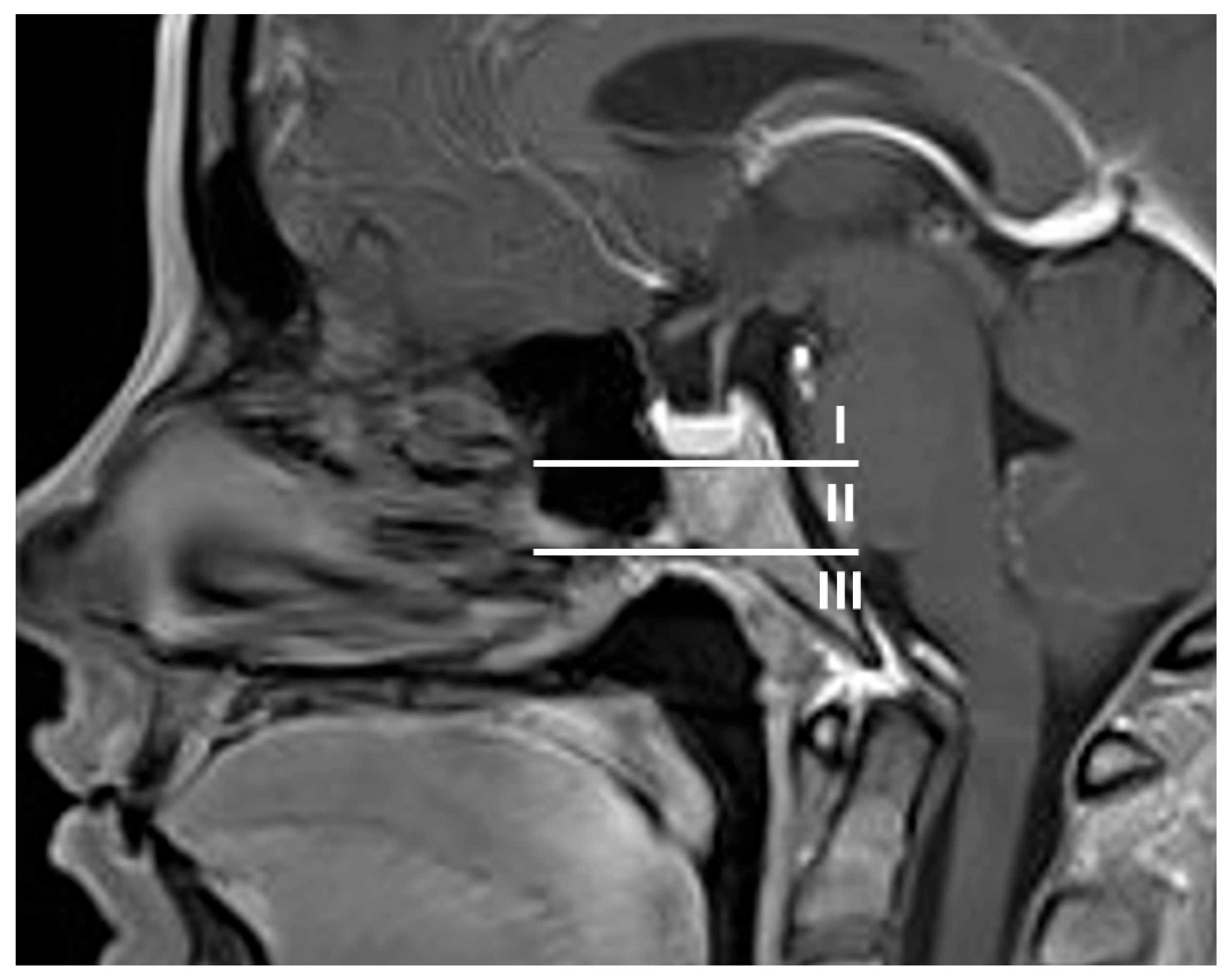
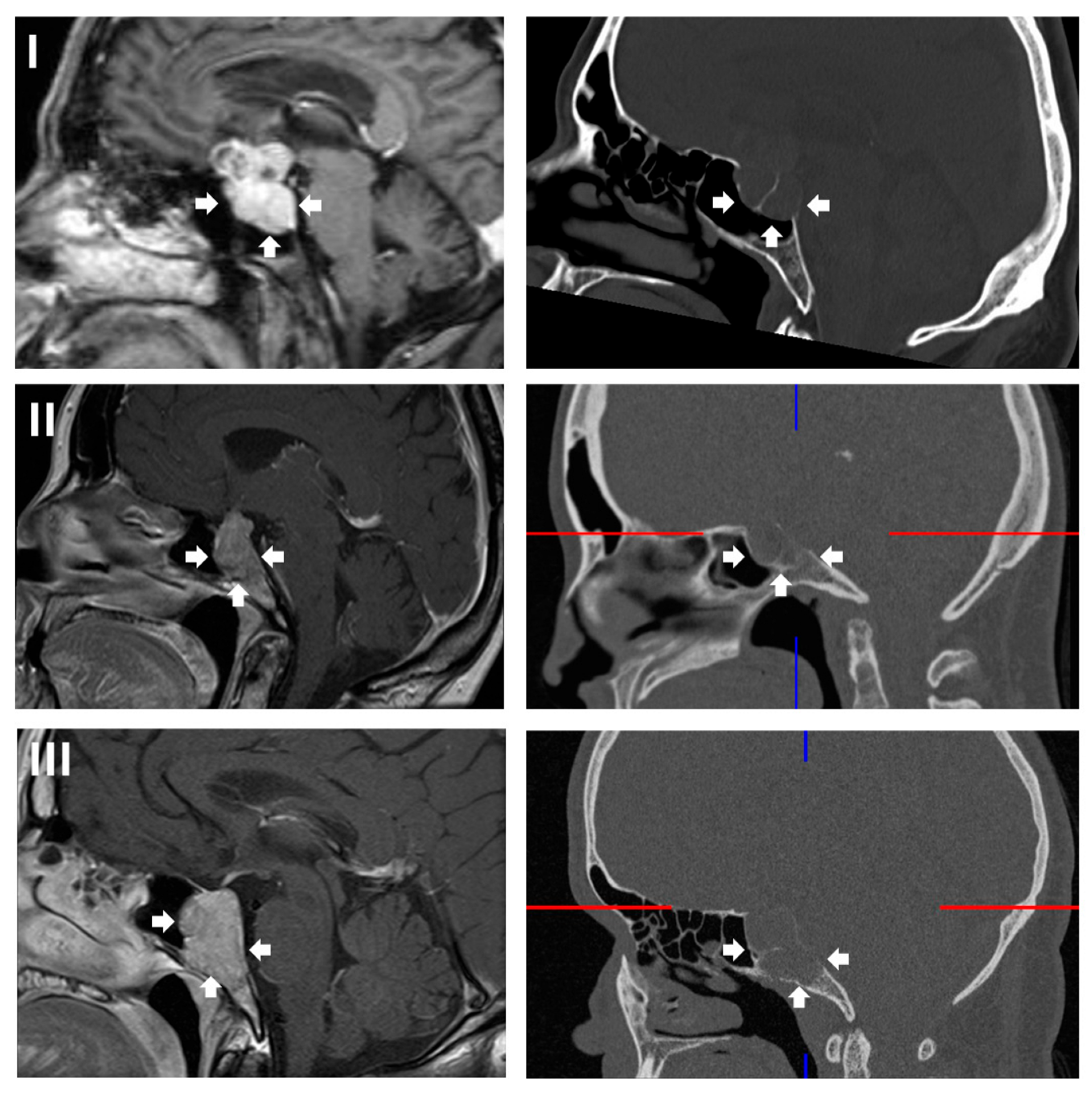
3.2. Growth Pattern
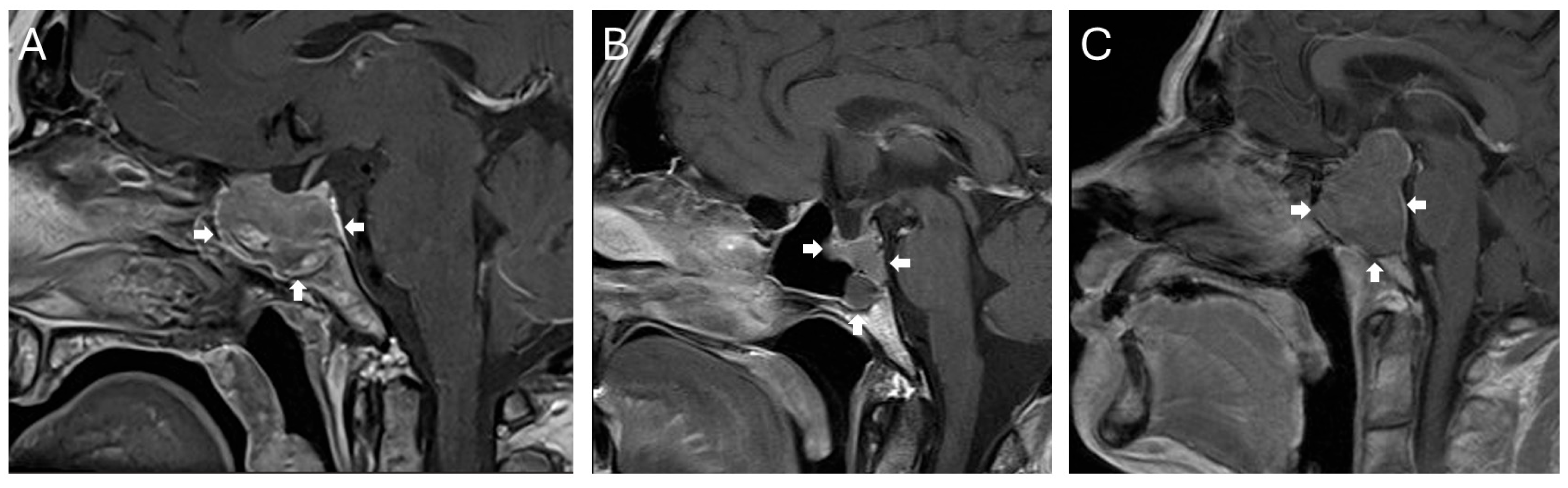
3.3. Surgical Results
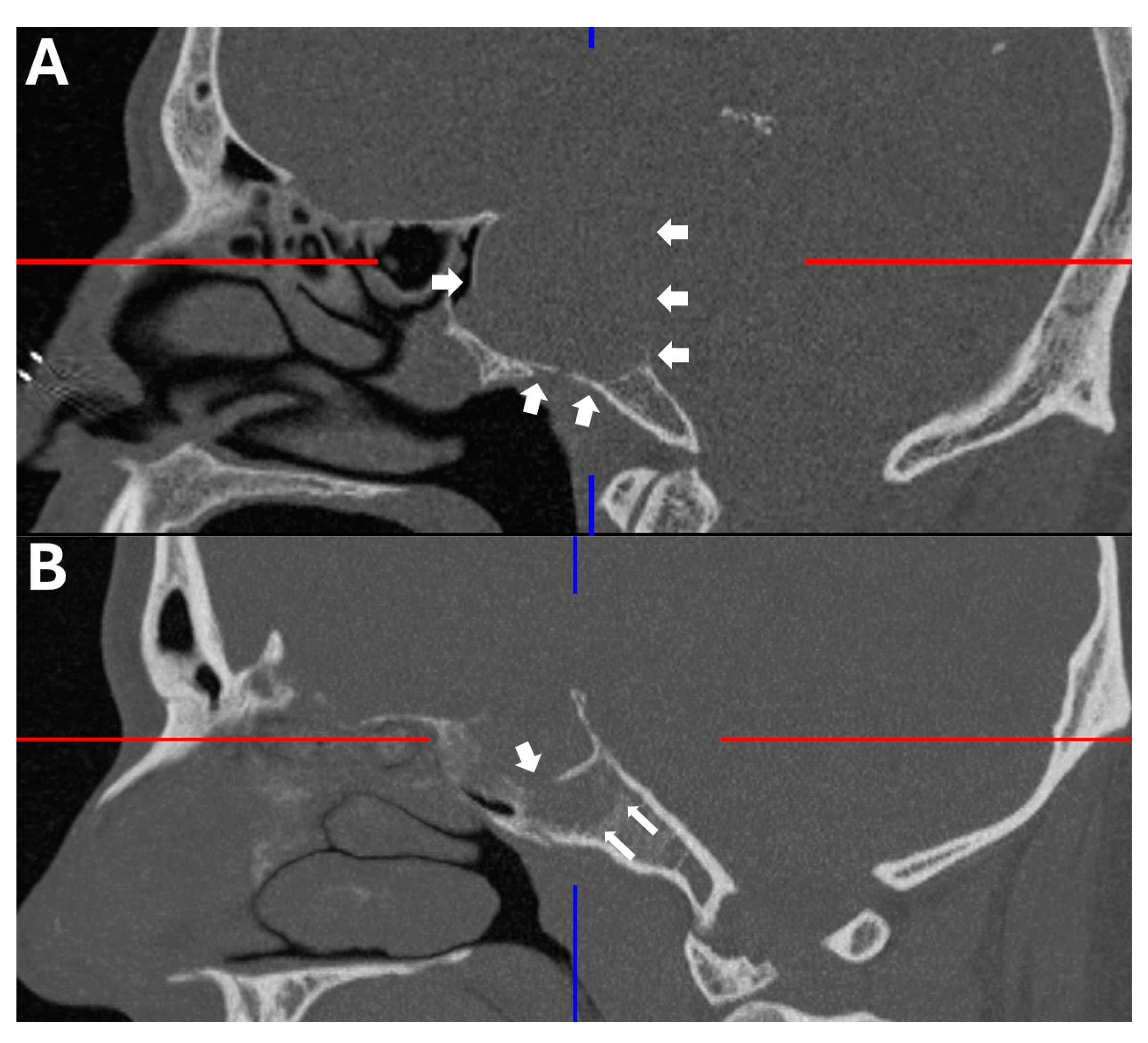
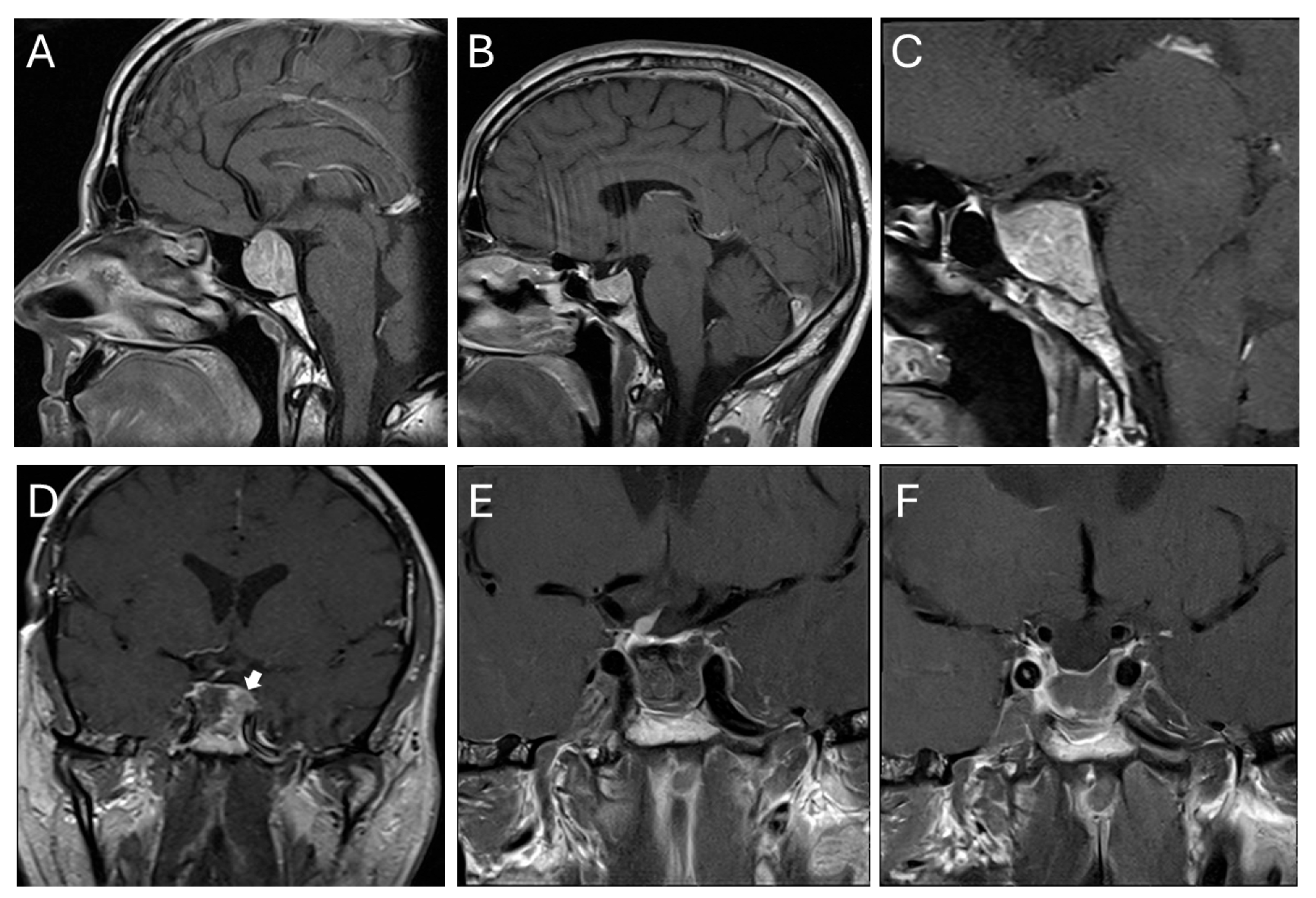
3.4. Illustrative Case
4. Discussion
5. Conclusions
Author Contributions
Funding
Institutional Review Board Statement
Informed Consent Statement
Data Availability Statement
Conflicts of Interest
References
- Campero, A.; Martins, C.; Yasuda, A.; Rhoton, A.L., Jr. Microsurgical anatomy of the diaphragma sellae and its role in directing the pattern of growth of pituitary adenomas. Neurosurgery 2008, 62, 717–723; discussion 717–723. [Google Scholar] [CrossRef]
- Cushing, H. The craniopharyngiomas. In Intracranial Tumors: Notes Upon a Series of Two Thousand Verified Cases with Surgical Mortality Percentages Pertaining Therero; Charles C. Thomas: Springfield, IL, USA, 1932; Volume III. [Google Scholar]
- de Notaris, M.; Solari, D.; Cavallo, L.M.; D’Enza, A.I.; Ensenat, J.; Berenguer, J.; Ferrer, E.; Prats-Galino, A.; Cappabianca, P. The “suprasellar notch,” or the tuberculum sellae as seen from below: Definition, features, and clinical implications from an endoscopic endonasal perspective. J. Neurosurg. 2012, 116, 622–629. [Google Scholar] [CrossRef]
- Schaeffer, J. Some points in the regional anatomy of the optic pathway, with special reference to tumors of the hypophysis cerebri and resulting ocular changes. Anat. Rec. 1924, 28, 243–279. [Google Scholar] [CrossRef]
- Busch, W. Morphology of sella turcica and its relation to the pituitary gland. Virchows Arch. Pathol. Anat. Physiol. Klin. Med. 1951, 320, 437–458. [Google Scholar] [CrossRef]
- Jefferson, G. Extrasellar Extensions of Pituitary Adenomas: (Section of Neurology). Proc. R. Soc. Med. 1940, 33, 433–458. [Google Scholar] [CrossRef]
- Knosp, E.; Steiner, E.; Kitz, K.; Matula, C. Pituitary adenomas with invasion of the cavernous sinus space: A magnetic resonance imaging classification compared with surgical findings. Neurosurgery 1993, 33, 610–617; discussion 617–618. [Google Scholar] [CrossRef]
- Micko, A.; Oberndorfer, J.; Weninger, W.J.; Vila, G.; Hoftberger, R.; Wolfsberger, S.; Knosp, E. Challenging Knosp high-grade pituitary adenomas. J. Neurosurg. 2020, 132, 1739–1746. [Google Scholar] [CrossRef]
- Destrieux, C.; Kakou, M.K.; Velut, S.; Lefrancq, T.; Jan, M. Microanatomy of the hypophyseal fossa boundaries. J. Neurosurg. 1998, 88, 743–752. [Google Scholar] [CrossRef] [PubMed]
- Constanzo, F.; Rychen, J.; Lee, C.K.; Decker, J.H.; Fischbein, N.; Johnstone, T.; Ljubimov, V.; Vigo, V.; Fernandez-Miranda, J.C. Patterns of invasion of the medial wall of the cavernous sinus by pituitary adenomas. J. Neurosurg. 2025, 143, 895–906. [Google Scholar] [CrossRef] [PubMed]
- Nishioka, H.; Fukuhara, N.; Horiguchi, K.; Yamada, S. Aggressive transsphenoidal resection of tumors invading the cavernous sinus in patients with acromegaly: Predictive factors, strategies, and outcomes. J. Neurosurg. 2014, 121, 505–510. [Google Scholar] [CrossRef]
- Meij, B.P.; Lopes, M.B.; Ellegala, D.B.; Alden, T.D.; Laws, E.R., Jr. The long-term significance of microscopic dural invasion in 354 patients with pituitary adenomas treated with transsphenoidal surgery. J. Neurosurg. 2002, 96, 195–208. [Google Scholar] [CrossRef]
- Erdheim, J. Über Hypophysenganggeschwülste und Hirncholesteatome; Kaiserliche Akademie der Wissenschaften: Wien, Austria, 1904. [Google Scholar]
- Chen, X.; Dai, J.; Ai, L.; Ru, X.; Wang, J.; Li, S.; Young, G.S. Clival invasion on multi-detector CT in 390 pituitary macroadenomas: Correlation with sex, subtype and rates of operative complication and recurrence. Am. J. Neuroradiol. 2011, 32, 785–789. [Google Scholar] [CrossRef] [PubMed]
- Wu, X.; Ding, H.; Yang, L.; Chu, X.; Xie, S.; Bao, Y.; Wu, J.; Yang, Y.; Zhou, L.; Li, M.; et al. Invasive Corridor of Clivus Extension in Pituitary Adenoma: Bony Anatomic Consideration, Surgical Outcome and Technical Nuances. Front. Oncol. 2021, 11, 689943. [Google Scholar] [CrossRef] [PubMed]
- Hlavac, M.; Knoll, A.; Mayer, B.; Braun, M.; Karpel-Massler, G.; Etzrodt-Walter, G.; Coburger, J.; Wirtz, C.R.; Pala, A. Ten years’ experience with intraoperative MRI-assisted transsphenoidal pituitary surgery. Neurosurg. Focus. 2020, 48, E14. [Google Scholar] [CrossRef]
- Pala, A.; Etzrodt-Walter, G.; Karpel-Massler, G.; Pedro, M.T.; Mayer, B.; Coburger, J.; Wirtz, C.R.; Hlavac, M. Characterization of tumor remnants in intraoperative MRI-assisted microscopic and endoscopic transsphenoidal resection of less invasive pituitary adenomas. Neurosurg. Rev. 2022, 45, 1701–1708. [Google Scholar] [CrossRef] [PubMed]
- Pala, A.; Knoll, A.; Schneider, M.; Etzrodt-Walter, G.; Karpel-Massler, G.; Wirtz, C.R.; Hlavac, M. The Benefit of Intraoperative Magnetic Resonance Imaging in Endoscopic and Microscopic Transsphenoidal Resection of Recurrent Pituitary Adenomas. Curr. Oncol. 2022, 29, 392–401. [Google Scholar] [CrossRef]
- Dickerman, R.D.; Oldfield, E.H. Basis of persistent and recurrent Cushing disease: An analysis of findings at repeated pituitary surgery. J. Neurosurg. 2002, 97, 1343–1349. [Google Scholar] [CrossRef]
- Edal, A.L.; Skjodt, K.; Nepper-Rasmussen, H.J. SIPAP--a new MR classification for pituitary adenomas. Suprasellar, infrasellar, parasellar, anterior and posterior. Acta Radiol. 1997, 38, 30–36. [Google Scholar] [CrossRef]
- Demir, M.K.; Ertem, O.; Kilic, D.; Akinci, O.; Ecertastan, O.; Konya, D.; Kilic, T. Ectopic Pituitary Neuroendocrine Tumors/Adenomas Around the Sella Turcica. Balkan Med. J. 2024, 41, 167–173. [Google Scholar] [CrossRef]
- Himstead, A.S.; Wells, A.C.; Kurtz, J.S.; Moldenhauer, M.R.; Davies, J.L.; Fote, G.M.; Bitner, B.F.; Chu, E.; Mohyeldin, A.; Hsu, F.P.K.; et al. Silent Corticotroph Adenomas Demonstrate Predilection for Sphenoid Sinus, Cavernous Sinus, and Clival Invasion Compared with Other Subtypes. World Neurosurg. 2024, 191, e41–e47. [Google Scholar] [CrossRef]
- Tajudeen, B.A.; Kuan, E.C.; Adappa, N.D.; Han, J.K.; Chandra, R.K.; Palmer, J.N.; Kennedy, D.W.; Wang, M.B.; Suh, J.D. Ectopic Pituitary Adenomas Presenting as Sphenoid or Clival Lesions: Case Series and Management Recommendations. J. Neurol. Surg. B Skull Base 2017, 78, 120–124. [Google Scholar] [CrossRef]
- Dawson, B.H. The blood vessels of the human optic chiasma and their relation to those of the hypophysis and hypothalamus. Brain 1958, 81, 207–217. [Google Scholar] [CrossRef]
- Daniel, P.M. Anatomy of the hypothalamus and pituitary gland. J. Clin. Pathol. Suppl. 1976, 7, 1–7. [Google Scholar] [CrossRef]
- Daniel, P.M.; Prichard, M.M. Studies of the hypothalamus and the pituitary gland with special reference to the effects of transection of the pituitary stalk. Acta Endocrinol. Suppl. (Copenh) 1975, 201, 1–216. [Google Scholar]
- McConnell, E.M. The arterial blood supply of the human hypophysis cerebri. Anat. Rec. 1953, 115, 175–203. [Google Scholar] [CrossRef] [PubMed]
- Adams, J.H.; Daniel, P.M.; Prichard, M.M. Volume of the infarct in the anterior lobe of the monkey’s pituitary gland shortly after stalk section. Nature 1963, 198, 1205–1206. [Google Scholar] [CrossRef]
- Powell, D.F.; Baker, H.L., Jr.; Laws, E.R., Jr. The primary angiographic findings in pituitary adenomas. Radiology 1974, 110, 589–595. [Google Scholar] [CrossRef] [PubMed]
- Ito, M.; Mitobe, Y.; Hiraka, T.; Kanoto, M.; Sonoda, Y. Changes in vascular supply pattern associated with growth of nonfunctioning pituitary adenomas. Surg. Neurol. Int. 2022, 13, 481. [Google Scholar] [CrossRef] [PubMed]
- Hlavac, M.; Knoll, A.; Etzrodt-Walter, G.; Sommer, F.; Scheithauer, M.; Coburger, J.; Wirtz, C.R.; Pala, A. Intraoperative MRI in transsphenoidal resection of invasive pituitary macroadenomas. Neurosurg. Rev. 2019, 42, 737–743. [Google Scholar] [CrossRef]
- Sylvester, P.T.; Evans, J.A.; Zipfel, G.J.; Chole, R.A.; Uppaluri, R.; Haughey, B.H.; Getz, A.E.; Silverstein, J.; Rich, K.M.; Kim, A.H.; et al. Combined high-field intraoperative magnetic resonance imaging and endoscopy increase extent of resection and progression-free survival for pituitary adenomas. Pituitary 2015, 18, 72–85. [Google Scholar] [CrossRef]
- Wu, X.; Xiao, L.M.; Peng, H.Y.; Wang, P.; Xing, S.Z.; Liang, L.; Wu, B.W.; Pan, L.S.; Liu, Z.Q.; Xie, S.H.; et al. Pituitary adenoma extended to the basilar sinus: Lessons from anatomical and radiological studies (Experimental Research). Neurosurg. Rev. 2025, 48, 677. [Google Scholar] [CrossRef] [PubMed]
- Xu, Y.; Asmaro, K.; Lee, C.K.; Vigo, V.; Mohyeldin, A.; Nunez, M.A.; Cohen-Gadol, A.A.; Fernandez-Miranda, J.C. Lateral compartment of the cavernous sinus from the endoscopic endonasal approach: Anatomical considerations and surgical relevance to adenoma surgery. J. Neurosurg. 2025, 142, 475–487. [Google Scholar] [CrossRef] [PubMed]
- Trouillas, J.; Roy, P.; Sturm, N.; Dantony, E.; Cortet-Rudelli, C.; Viennet, G.; Bonneville, J.F.; Assaker, R.; Auger, C.; Brue, T.; et al. A new prognostic clinicopathological classification of pituitary adenomas: A multicentric case-control study of 410 patients with 8 years post-operative follow-up. Acta Neuropathol. 2013, 126, 123–135. [Google Scholar] [CrossRef] [PubMed]



| Pat | Age | Sex | Preop Pit Def | Postop Pit Def | Preop Vis Def | Postop Vis Def |
|---|---|---|---|---|---|---|
| 1 | 50 | F | No | Total | No | No |
| 2 | 46 | M | Partial | Total | No | No |
| 3 | 31 | M | Partial | No | No | No |
| 4 | 50 | F | Not tested | Partial | Near blind left | No |
| 5 | 68 | F | Partial | Total | Temp defect | Concentric defect |
| 6 | 74 | M | Partial | Total | Bitemp defect | Bitemp defect |
| 7 | 71 | M | Partial | Total | Bitemp defect | No |
| 8 | 75 | F | No | Partial | Not related | Not related |
| 9 | 64 | M | Partial | Total | Temp defect | No |
| 10 | 47 | F | Partial | Partial | No | No |
| 11 | 58 | M | No | No | No | No |
| 12 | 52 | M | No | Partial | No | No |
| 13 | 48 | M | Total | Total | No | No |
| Tumor Pathology | Number of Patients (n = 13) |
|---|---|
| Null cell adenoma | 7 |
| Silent somatotrope adenoma | 1 |
| Silent corticotrope adenoma | 2 |
| Silent gonadotrope adenoma | 2 |
| Prolactinoma | 1 |
| Pat | Region of Clival Infiltration | Sellar Destruction | Diaphragma Intraop. | Mod. Knosp Grade | Sphenoid Sinus Infiltration |
|---|---|---|---|---|---|
| 1 | I–II | Focal | Intact | 4 | Yes |
| 2 | I–II | Focal | Intact | 2 | Yes |
| 3 | I–III | Focal | Intact | 3b | Yes |
| 4 | I | Diffuse | Intact | 4 | Yes |
| 5 | I–II | Diffuse | Intact | 3 | Yes |
| 6 | I–II | Diffuse | Intact | 4 | Yes |
| 7 | I | Diffuse | Intact | 2 | No |
| 8 | I–III | Focal | Intact | 3b | Yes |
| 9 | I–III | Diffuse | Intact | 2 | Yes |
| 10 | I–II | Focal | Perforated | 1 | No |
| 11 | I–III | Focal | Intact | 3a | Yes |
| 12 | I–III | Focal | Intact | 3a | No |
| 13 | I–II | Diffuse | Intact | 2 | No |
Disclaimer/Publisher’s Note: The statements, opinions and data contained in all publications are solely those of the individual author(s) and contributor(s) and not of MDPI and/or the editor(s). MDPI and/or the editor(s) disclaim responsibility for any injury to people or property resulting from any ideas, methods, instructions or products referred to in the content. |
© 2026 by the authors. Licensee MDPI, Basel, Switzerland. This article is an open access article distributed under the terms and conditions of the Creative Commons Attribution (CC BY) license.
Share and Cite
Sannwald, L.W.; Kreße, N.; Grübel, N.; Knoll, A.; Roßkopf, J.; Hlavac, M.; Wirtz, C.R.; Pala, A. Pituitary Neuroendocrine Tumors Extending Primarily Below the Sella and into the Clivus: A Distinct Growth Pattern with Specific Challenges. Curr. Oncol. 2026, 33, 36. https://doi.org/10.3390/curroncol33010036
Sannwald LW, Kreße N, Grübel N, Knoll A, Roßkopf J, Hlavac M, Wirtz CR, Pala A. Pituitary Neuroendocrine Tumors Extending Primarily Below the Sella and into the Clivus: A Distinct Growth Pattern with Specific Challenges. Current Oncology. 2026; 33(1):36. https://doi.org/10.3390/curroncol33010036
Chicago/Turabian StyleSannwald, Lennart W., Nina Kreße, Nadja Grübel, Andreas Knoll, Johannes Roßkopf, Michal Hlavac, Christian R. Wirtz, and Andrej Pala. 2026. "Pituitary Neuroendocrine Tumors Extending Primarily Below the Sella and into the Clivus: A Distinct Growth Pattern with Specific Challenges" Current Oncology 33, no. 1: 36. https://doi.org/10.3390/curroncol33010036
APA StyleSannwald, L. W., Kreße, N., Grübel, N., Knoll, A., Roßkopf, J., Hlavac, M., Wirtz, C. R., & Pala, A. (2026). Pituitary Neuroendocrine Tumors Extending Primarily Below the Sella and into the Clivus: A Distinct Growth Pattern with Specific Challenges. Current Oncology, 33(1), 36. https://doi.org/10.3390/curroncol33010036