The Effect of Sleep Environment on Sleep Quality and Behavior in Firefighters: A Cross-Sectional Study


 and
and
Highlights
- Sleep deprivation in first responders is a significant occupational hazard linked to chronic systemic inflammation, cardiovascular disease, and metabolic dysfunction.
- Impaired cognitive function from poor sleep quality compromises both firefighter safety and public emergency response effectiveness.
- This study identifies that operational “on-call” stressors significantly override the benefits of private sleeping quarters, as individual dorms showed no improvement over communal bunks.
- While home sleep is superior to on-duty sleep, even off-duty sleep quality in this population frequently fails to meet clinical “good sleep” thresholds.
- Departmental resources should prioritize station-wide noise reduction protocols and “safety nap” policies rather than investing solely in physical remodeling of sleeping quarters.
- Behavioral interventions, such as Cognitive Behavioral Therapy for Insomnia (CBT-I) tailored for first responders, are recommended to address the high rate of sleep medication use and chronic arousal.
Abstract
1. Introduction
2. Materials and Methods
2.1. Participants
2.2. Procedure
2.3. Measures
2.4. Statistical Analysis
3. Results
3.1. General Physical Health
3.2. Overall Sleep Quality
3.3. Associations Between Sleep Location and Sleep Quality
3.4. Associations Between Sleep Environment and Sleep Quality
4. Discussion
5. Conclusions
Author Contributions
Funding
Institutional Review Board Statement
Informed Consent Statement
Data Availability Statement
Conflicts of Interest
Abbreviations
| PSQI | Pittsburgh Sleep Quality Index |
References
- Kales, S.N.; Smith, D.L. Firefighting and the Heart. Circulation 2017, 135, 1296–1299. [Google Scholar] [CrossRef]
- Carey, M.G.; Al-Zaiti, S.S.; Dean, G.E.; Sessanna, L.; Finnell, D.S. Sleep Problems, Depression, Substance Use, Social Bonding, and Quality of Life in Professional Firefighters. J. Occup. Environ. Med. 2011, 53, 928. [Google Scholar] [CrossRef]
- Billings, J.M. Firefighter sleep: A pilot study of the agreement between actigraphy and self-reported sleep measures. J. Clin. Sleep Med. 2022, 18, 109–117. [Google Scholar] [CrossRef]
- Lim, D.-K.; Baek, K.-O.; Chung, I.-S.; Lee, M.-Y. Factors Related to Sleep Disorders among Male Firefighters. Ann. Occup. Environ. Med. 2014, 26, 11. [Google Scholar] [CrossRef]
- Mehrdad, R.; Haghighi, K.S.; Esfahani, A.H.N. Sleep Quality of Professional Firefighters. Int. J. Prev. Med. 2013, 4, 1095–1100. [Google Scholar]
- AlDabal, L.; BaHammam, A.S. Metabolic, Endocrine, and Immune Consequences of Sleep Deprivation. Open Respir. Med. J. 2011, 5, 31–43. [Google Scholar] [CrossRef] [PubMed]
- Knutson, K.L.; Van Cauter, E. Associations between Sleep Loss and Increased Risk of Obesity and Diabetes. Ann. N. Y. Acad. Sci. 2008, 1129, 287–304. [Google Scholar] [CrossRef]
- Luyster, F.S.; Strollo, P.J., Jr.; Zee, P.C.; Walsh, J.K. Sleep: A health imperative. Sleep 2012, 35, 727–734. [Google Scholar] [CrossRef] [PubMed]
- Majde, J.A.; Krueger, J.M. Links between the innate immune system and sleep. J. Allergy Clin. Immunol. 2005, 116, 1188–1198. [Google Scholar] [CrossRef]
- Soteriades, E.S.; Smith, D.L.; Tsismenakis, A.J.; Baur, D.M.; Kales, S.N. Cardiovascular Disease in US Firefighters: A Systematic Review. Cardiol. Rev. 2011, 19, 202. [Google Scholar] [CrossRef] [PubMed]
- Zimmerman, F.H. Cardiovascular Disease and Risk Factors in Law Enforcement Personnel: A Comprehensive Review. Cardiol. Rev. 2012, 20, 159. [Google Scholar] [CrossRef]
- Bonnet, M.H.; Arand, D.L. Clinical effects of sleep fragmentation versus sleep deprivation. Sleep Med. Rev. 2003, 7, 297–310. [Google Scholar] [CrossRef] [PubMed]
- Kaipust, C.M.; Jahnke, S.A.; Poston, W.S.C.; Jitnarin, N.; Haddock, C.K.; Delclos, G.L.; Day, R.S. Sleep, Obesity, and Injury Among US Male Career Firefighters. J. Occup. Environ. Med. 2019, 61, e150. [Google Scholar] [CrossRef]
- Stout, J.W.; Beidel, D.C.; Brush, D.; Bowers, C. Sleep disturbance and cognitive functioning among firefighters. J. Health Psychol. 2021, 26, 2248–2259. [Google Scholar] [CrossRef] [PubMed]
- Vincent, G.; Ferguson, S.A.; Tran, J.; Larsen, B.; Wolkow, A.; Aisbett, B. Sleep Restriction during Simulated Wildfire Suppression: Effect on Physical Task Performance. PLoS ONE 2015, 10, e0115329. [Google Scholar] [CrossRef]
- Lusa, S.; Häkkänen, M.; Luukkonen, R.; Viikari-Juntura, E. Perceived physical work capacity, stress, sleep disturbance and occupational accidents among firefighters working during a strike. Work Stress 2002, 16, 264–274. [Google Scholar] [CrossRef]
- Jeon, Y.; Choi, H. Influencing Factors for Sleep Quality among Firefighters: Based on Objective and Subjective Evaluation. J. Korean Acad. Community Health Nurs. 2022, 33, 396. [Google Scholar] [CrossRef]
- Watkins, S.L.; Shannon, M.A.; Hurtado, D.A.; Shea, S.A.; Bowles, N.P. Interactions between home, work, and sleep among firefighters. Am. J. Ind. Med. 2021, 64, 137–148. [Google Scholar] [CrossRef]
- Hunnicutt, L.E.; Corgan, M.; Brown, S.R.; Nygaard, A.; Meares, G.L.; Collier, S.R. Sleep Differences in Firefighters: Barracks vs. Home. Int. J. Environ. Res. Public Health 2024, 21, 1155. [Google Scholar] [CrossRef]
- Buysse, D.J.; Reynolds, C.F.; Monk, T.H.; Berman, S.R.; Kupfer, D.J. The Pittsburgh sleep quality index: A new instrument for psychiatric practice and research. Psychiatry Res. 1989, 28, 193–213. [Google Scholar] [CrossRef] [PubMed]
- NCHS: Data Query System Application. Overweight and Obesity. 2025. Available online: https://www.cdc.gov/nchs/dqs/topics/overweight-obesity.html (accessed on 10 January 2026).
- Jaeger, B.C.; Chen, L.; Foti, K.; Hardy, S.T.; Bress, A.P.; Kane, S.P.; Huang, L.; Herrick, J.S.; Derington, C.G.; Poudel, B.; et al. Hypertension Statistics for US Adults: An Open-Source Web Application for Analysis and Visualization of National Health and Nutrition Examination Survey Data. Hypertension 2023, 80, 1311–1320. [Google Scholar] [CrossRef]
- Romero Cabrera, J.L.; Sotos-Prieto, M.; García Ríos, A.; Moffatt, S.; Christophi, C.A.; Pérez-Martínez, P.; Kales, S.N. Sleep and Association with Cardiovascular Risk Among Midwestern US Firefighters. Frontiers 2021, 12, e772848. [Google Scholar] [CrossRef] [PubMed]
- Zhang, J.; Tan, K.; Xiao, X.; Tang, Y.; Tong, J.; Ling, L. Current situation and relationship between occupational stress, burn-out and sleep quality among ambulance drivers: A cross-sectional study. BMJ Open 2024, 14, e089252. [Google Scholar] [CrossRef]
- Caputo, L.M.; Hawkes, A.P.; Gosche, E.E.; Vellman, P.W.; Lange, N.R.; Salottolo, K.M.; Coniglio, R.; Mains, C.W. The impact of changing work schedules on American firefighters’ sleep patterns and well-being. Signa Vitae 2015, 10, 25–37. [Google Scholar] [CrossRef]
- Patterson, P.D.; Weaver, M.D.; Guyette, F.X.; Martin-Gill, C. Should public safety shift workers be allowed to nap while on duty? Am. J. Ind. Med. 2020, 63, 843–850. [Google Scholar] [CrossRef]
- Alves, S.; Vaz, J.; Fernandes, A. Exploring Clinical Trials to Manage Firefighters’ Sleep Quality: A PRISMA Compliant Systematic Review. Int. J. Environ. Res. Public Health 2023, 20, 3862. [Google Scholar] [CrossRef] [PubMed]
- Jang, E.H.; Hong, Y.; Kim, Y.; Lee, S.; Ahn, Y.; Jeong, K.S.; Jang, T.-W.; Lim, H.; Jung, E.; Shift Work Disorder Study Group; et al. The Development of a Sleep Intervention for Firefighters: The FIT-IN (Firefighter’s Therapy for Insomnia and Nightmares) Study. Int. J. Environ. Res. Public Health 2020, 17, 8738. [Google Scholar] [CrossRef] [PubMed]


| Characteristic | M ± SD |
|---|---|
| Age (years) | 4089 ± 11.05 |
| Body Mass Index (kg/m2) | 29.01 ± 3.84 |
| Resting Blood Pressure (mmHg) | |
| SBP | 128.06 ± 9.63 |
| DBP | 76.70 ± 7.40 |
| Percent Body Fat (%) | 22.61 ± 6.35 |
| Waist-to-Hip Ratio | 0.92 ± 0.07 |
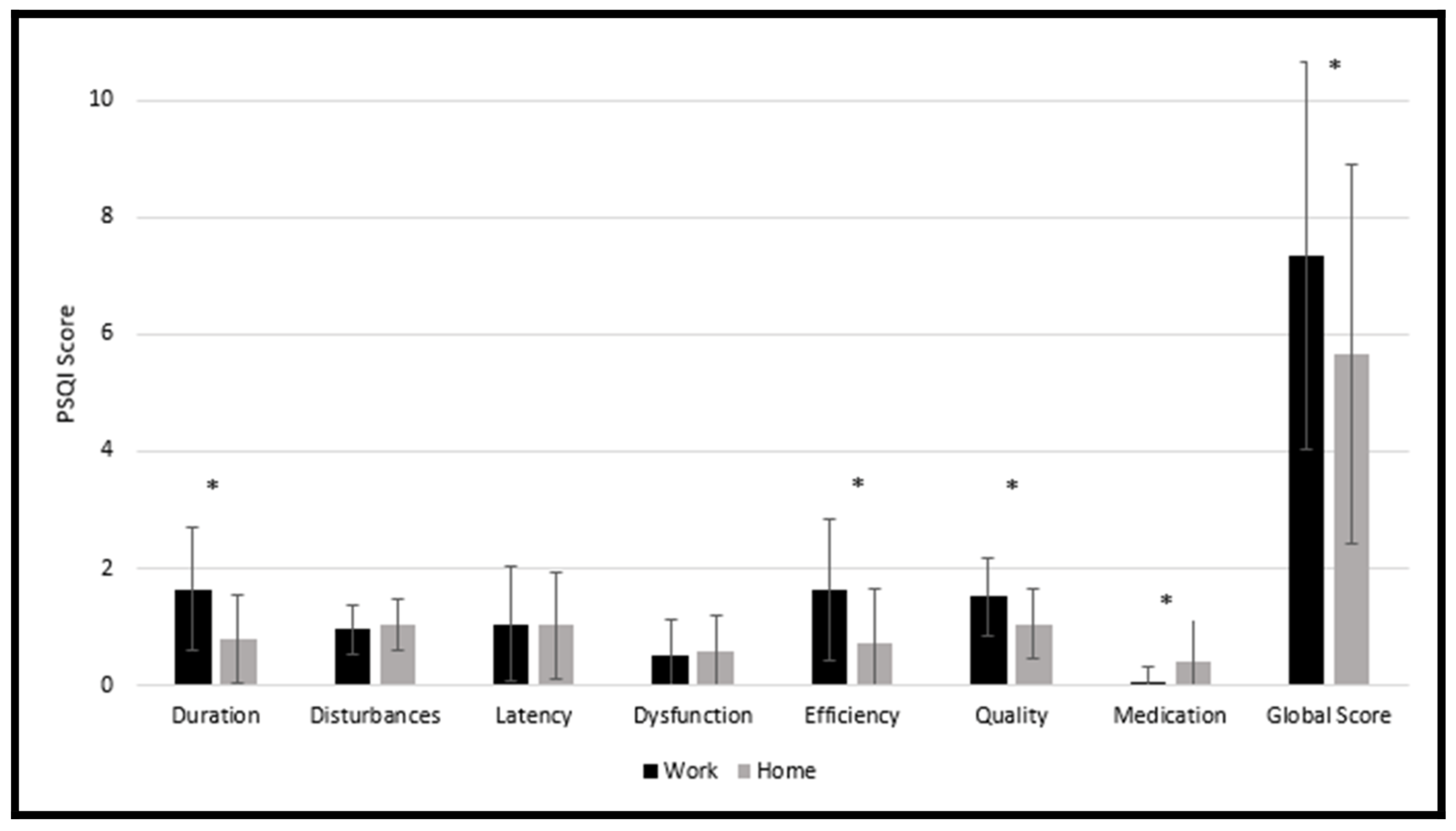
| PSQI Component | Work M ± SD | Home M ± SD | p-Value | Effect Size (r) |
|---|---|---|---|---|
| Sleep Duration | 1.64 ± 1.05 | 0.80 ± 0.75 | <0.001 ** | 0.42 |
| Sleep Disturbances | 0.95 ± 0.43 | 1.03 ± 0.43 | 0.10 | 0.39 |
| Sleep Latency | 1.05 ± 0.99 | 1.02 ± 0.92 | 0.28 | 0.27 |
| Daytime Dysfunction | 0.52 ± 0.60 | 0.58 ± 0.63 | 0.00 | 0.20 |
| Sleep Efficiency | 1.62 ± 1.21 | 0.72 ± 0.93 | <0.001 ** | 0.32 |
| Sleep Quality | 1.51 ± 0.67 | 1.05 ± 0.59 | <0.001 ** | 0.41 |
| Sleep Medication | 0.05 ± 0.28 | 0.39 ± 0.84 | 0.002 * | 0.27 |
| PSQI Total | 7.34 ± 3.30 | 5.66 ± 3.24 | <0.001 ** | 0.44 |
Disclaimer/Publisher’s Note: The statements, opinions and data contained in all publications are solely those of the individual author(s) and contributor(s) and not of MDPI and/or the editor(s). MDPI and/or the editor(s) disclaim responsibility for any injury to people or property resulting from any ideas, methods, instructions or products referred to in the content. |
© 2026 by the authors. Licensee MDPI, Basel, Switzerland. This article is an open access article distributed under the terms and conditions of the Creative Commons Attribution (CC BY) license.
Share and Cite
Zera, J.N.; Esper, E.; Simonson, A.P.; Clausen, A.N.; Paterno, S. The Effect of Sleep Environment on Sleep Quality and Behavior in Firefighters: A Cross-Sectional Study. Int. J. Environ. Res. Public Health 2026, 23, 692. https://doi.org/10.3390/ijerph23060692
Zera JN, Esper E, Simonson AP, Clausen AN, Paterno S. The Effect of Sleep Environment on Sleep Quality and Behavior in Firefighters: A Cross-Sectional Study. International Journal of Environmental Research and Public Health. 2026; 23(6):692. https://doi.org/10.3390/ijerph23060692
Chicago/Turabian StyleZera, Jacquelyn N., Erica Esper, Anna Peluso Simonson, Ashley N. Clausen, and Serena Paterno. 2026. "The Effect of Sleep Environment on Sleep Quality and Behavior in Firefighters: A Cross-Sectional Study" International Journal of Environmental Research and Public Health 23, no. 6: 692. https://doi.org/10.3390/ijerph23060692
APA StyleZera, J. N., Esper, E., Simonson, A. P., Clausen, A. N., & Paterno, S. (2026). The Effect of Sleep Environment on Sleep Quality and Behavior in Firefighters: A Cross-Sectional Study. International Journal of Environmental Research and Public Health, 23(6), 692. https://doi.org/10.3390/ijerph23060692