Adaptation of Trajectory of Illness Framework to Assess the Experiences of Youths Living with Type 1 Diabetes Mellitus in the Rural Areas of Limpopo Province, South Africa

 , , and
Highlights
- Explores the lived experiences of youths managing Type 1 Diabetes Mellitus in rural Limpopo province, highlighting challenges in long-term illness management.
- Addresses disparities in access to diabetes care and support services in underserved rural communities in Limpopo province.
- Provides insight into how the Trajectory of Illness Framework can be adapted to understand chronic disease experiences among rural youths.
- Identifies critical gaps in healthcare delivery, psychosocial support, and disease education for youths living with chronic conditions.
- Emphasizes the need for context-specific interventions to improve diabetes management and continuity of care in rural settings.
- Supports the development of youth-centred health policies and integrated care models to enhance long-term outcomes for individuals with Type 1 Diabetes Mellitus.
Abstract
1. Introduction
1.1. Study Objective
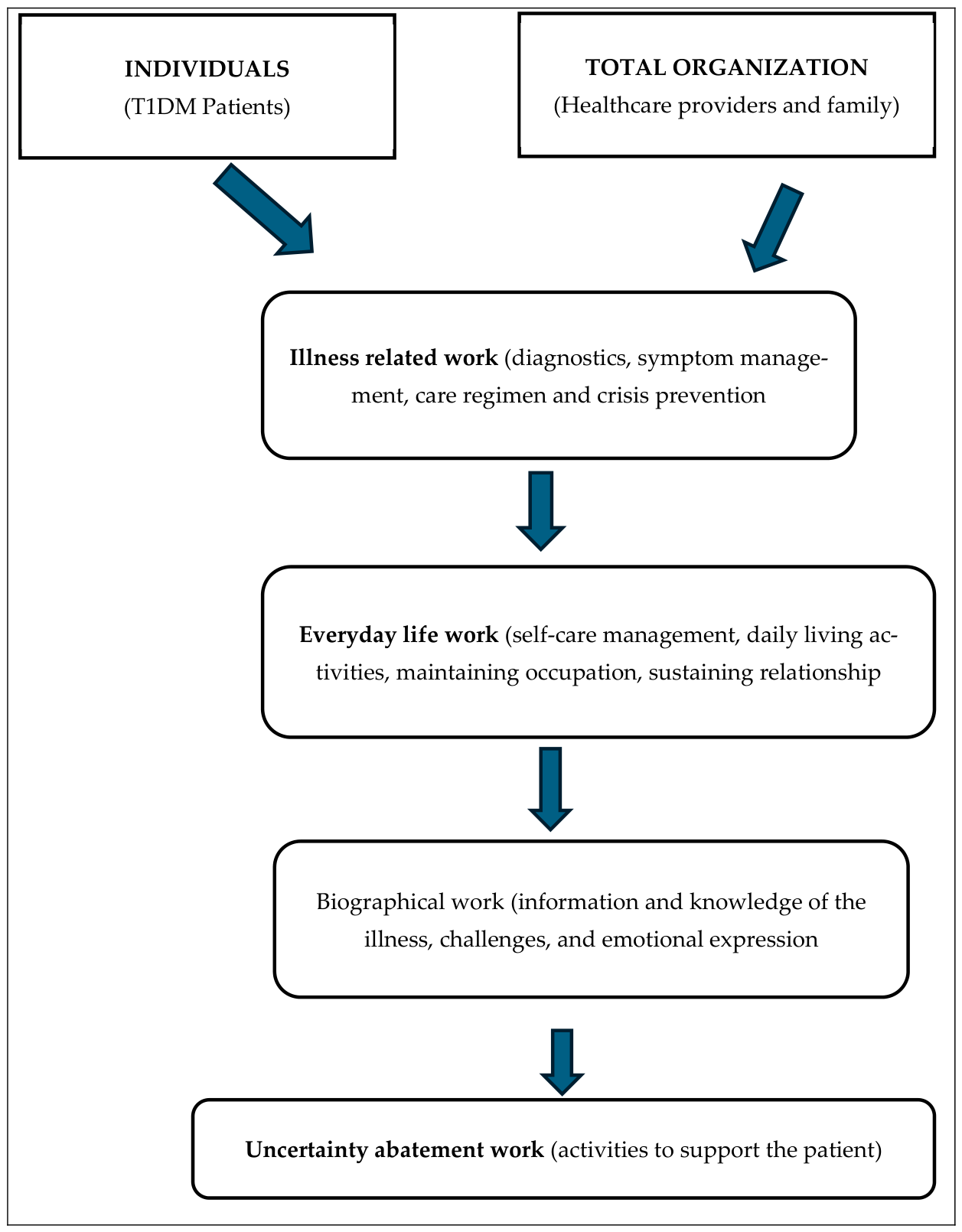
1.2. Theoretical Framework
- Illness-related work
- Everyday life work
- Biographical work
- Uncertainty work
2. Research Methods and Materials
2.1. Research Design
2.2. Setting
2.3. Participants
2.4. Data Collection
- Illness onset (trajectory phase):
- Illness work (management of the condition):
- Biographical disruption (impact on identity and daily life):
- Social and environmental context (external influences):
- Trajectory management and adaptation over time:
2.5. Data Analysis
2.6. Ethical Considerations
2.7. Trustworthiness
3. Results
3.1. Illness-Related Work Experiences
3.1.1. Experience of Diabetes Symptoms
I was really dizzy and vomiting a lot and after a few days started having piles. When I went to the bathroom, I did not have a bowel movement, but instead I was only passing blood (PA).
“I started getting weaker every day with frequent hunger and thirst, then started vomiting” (PD).
The teacher noticed that she was not feeling well, and before long, she began to shake violently and then collapsed. At that point, they quickly took her to the clinic for medical attention (PE).
The girl suddenly threw up a lot and then fell to the ground, so her family quickly took her to the doctor’s office (PK).
“I felt hungry even when I ate and drank a lot of water and lost weight” (PC).
“My mother said she noticed that my urine was shiny and sticky on the toilet for days, having wet palms recently” (PC).
3.1.2. Experience of Being Diagnosed with Diabetes
I went to the clinic, and the nurse checked me thoroughly. She took my blood pressure, tested my urine, weighed me, and even pricked my finger to check my blood glucose levels. After all the tests, she told me that I have diabetes because my glucose levels were high and it even appeared in my urine (PE).
I was in a really bad way, so they put in a drip and called an ambulance. Next thing I knew, I was going to be taken to the hospital. But even with all the medical attention, I was not getting any better at that point (PF).
I spent two days in the hospital and had an IV drip throughout the time. I also got three shots every day (PH).
I was in the hospital for three days because my blood sugar levels were too high. Doctors and nurses cared for me, giving me fluids by drip and some medication to help control my glucose (PK).
3.1.3. Experience of Diabetes Complications
I once had a really scary experience with my diabetes treatment. My doctor increased my doses of medication and just two days later I ended up in a diabetic coma because my blood glucose levels had fallen way too low. It was so bad that I had to be admitted to the intensive care unit, which was a very frightening ordeal (PJ).
I was hospitalized with ketoacidosis because I hadn’t received the treatment I needed and I didn’t follow my diet (PH).
‘I once lost sight for months’ (PL).
3.1.4. Psychological Experiences Related to Diabetes
It was really difficult for me to see my cousin go through a hard time, it hurt me deeply (PK).
I was taken aback at first, but as the day went on, I realized that diabetes runs in my family, so it was not entirely unexpected (PG).
I was not shocked when I found out, to be honest, because diabetes has been part of my family for a while now (PF).
I was taken aback when I heard the news for the first time, it was a real shock to me (PD).
I was really sad when I found out that I had diabetes, it was the last thing I expected to happen to me (PH).
3.2. Everyday Life Work Experiences
3.2.1. Management of the Treatment
“They said I must store them in the fridge and discard them if they change colour” (PB).
“When I go to school I use an ice pack, wrap it with a plastic and store in a bag then inject in a toilet” (PB).
“I inject on the thigh, but when I get hurt on the thigh, I then inject the arm” (PA).
“I change between my thigh and my abdomen” (PC).
“I clean the skin, like I wipe and pinch the skin then inject, it has been for years, but I still feel pain” (PB).
“I sometimes have bleeding when I inject, I have scars on the legs but on the arm, I am able to do it nicely” (PA).
“I inject 30 min before eating, so I, I eat at 6 in the morning, my lunch is at 1, and eat supper at 7, all this time I inject actrapid five units, and only inject protophane six units at 9 p.m.” (PB).
3.2.2. Glucose Level Management
“yes, they gave me the machine on the 4th of October, and I check before meals” (PA).
“it happened the other day while I went to check up at the clinic, I did not have food, it was low, it was 2 and they said if it drops to 1 it will be diabetic coma again” (PA).
“I made sugar mixed with water, and it picked up to 3, and they gave me treatment and went back home ” (PA).
“I do not know if it is high or low but whenever I feel somehow like eeeh dizzy or weak I just eat some snack, and I become fine in about 10 min” (PB).
3.2.3. Dietary Management
“I eat in the morning, I eat at half past five, at six I inject, at half past five they say I must eat two slices of bread with low-fat milk, and at nine I eat soft porridge or the Weetabix, at twelve I eat porridge, at two I don’t eat, I will eat at half past five, at six I inject and then I will eat at half past seven so that at eight I will inject” (PA).
“I eat as they told me” (PA).
“since I am not working, I just eat what is available at home, but I make sure that I do not eat a lot at once but eat five to six times in a day” (PB).
“yes, most of the food on the list we eat them at home not as drawn, but they are there” (PC).
“and at home they are buying the recommended diet for me but not always but most of the time they do” (PC).
3.2.4. Maintaining Occupation and Sustaining a Relationship
“I am attending school, and for my injection that I get at 2, the teachers gave me a cooler box, and they bring me ice to store my treatment and after school I take my treatment, and every morning they bring ice packs” (PA).
“I put my treatment in the managers’ refrigerator” (PD).
I inject myself in the principal’s office (PA).
I told the manager about my condition and luckily, I was not fired but was then moved to the admin section (PD).
“They wouldn’t let me use the fridge, saying it is only for people in charge” (PF).
“I was fired because I was frequently sick at work and it was due to hard work” (PG).
3.3. Biographical Work Experiences
3.3.1. Diabetes Educational Sources and Barriers
When it comes to completing the basics, I usually start by searching online and then fill in the gaps with information from nurses (PL).
When I am unsure about something related to my condition, I usually turn to Google to learn more about it. At the same time, my family members also learn from the information I find, which is really helpful to all of us (PE).
I don’t really look for information elsewhere because nurses and doctors are already teaching me everything I need to know about T1DM (PA).
I don’t usually look for information because I am the one teaching others about diet, exercise, and treatment, and I work with all the staff at the clinic (PK).
“I have learned that intense exercise can actually help control my blood sugar levels, which is really interesting” (PF).
“I am not really sure how much porridge is okay for me to have, apparently it is a pretty small amount” (PG).
“My family would not know how to react if I suddenly collapsed, except to rush me to the hospital” (PI).
3.3.2. Treatment-Related Barriers
“If my treatment gets messed up in the afternoon, I end up missing those doses and have to wait until I can get to the clinic the next day” (PD).
“When I am in pain, I sometimes forget to take my medication” (PE).
“When I am visiting someone and staying for a while, I would rather not take my medication than tell them I have diabetes” (PB).
“If I travel long distances, I usually miss my doses, I feel like people will see me” (PD).
3.3.3. Psychosocial-Related Barriers
I get asked if having diabetes makes me less afraid of dying (PJ).
When I am carrying my cooler bag, people often give me sympathetic looks and start feeling sorry for me (PI).
Some individuals assume I am using drugs when in reality I am just taking my prescribed medication (PH).
I never had any interaction with a psychologist, no one ever mentioned one to me (PJ).
“I was never referred to a psychologist” (PF).
I only met him once when he came to the clinic (PE).
3.4. Uncertainty Abatement Work Experiences
3.4.1. Financial Support
“I don’t know if it is possible but also all the diabetes patients could get grant money to be able to buy the recommended food and machine” (PB).
“and also give us food parcel maybe through the social workers or maybe collect the food same time with the treatment at the clinic so that we can comply to the diet, like they cannot give us them all but at least beans and fish” (PC).
3.4.2. Educational Support
“secondly, I would say raise public awareness, and also have educational sessions for families to help us cope” (PB).
“I wish they can give us information to have at home so that we can read because sometimes you feel somehow and you just wait to see if you will get worse or not” (PF).
4. Discussion
5. Recommendations
6. Strengths and Limitations
7. Conclusions
Author Contributions
Funding
Institutional Review Board Statement
Informed Consent Statement
Data Availability Statement
Acknowledgments
Conflicts of Interest
References
- Chiang, J.L.; Maahs, D.M.; Garvey, K.C.; Hood, K.K.; Laffel, L.M.; Weinzimer, S.A.; Wolfsdorf, J.I.; Schatz, D. Type 1 diabetes in children and adolescents: A position statement by the American Diabetes Association. Diabetes Care 2018, 41, 2026–2044. [Google Scholar] [CrossRef] [PubMed]
- Hilliard, M.E.; Wu, Y.P.; Rausch, J.; Dolan, L.M.; Hood, K.K. Predictors of deteriorations in diabetes management and control in adolescents with type 1 diabetes. J. Adolesc. Health 2013, 52, 28–34. [Google Scholar] [CrossRef]
- Rechenberg, K.; Whittemore, R.; Holland, M.; Grey, M. General and diabetes-specific stress in adolescents with type 1 diabetes. Diabetes Res. Clin. Pract. 2017, 130, 1–8. [Google Scholar] [CrossRef]
- Monaghan, M.; Helgeson, V.; Wiebe, D. Type 1 diabetes in young adulthood. Curr. Diabetes Rev. 2015, 11, 239–250. [Google Scholar] [CrossRef] [PubMed]
- Scholes, C.; Mandleco, B.; Roper, S.; Dearing, K.; Dyches, T.; Freeborn, D. A qualitative study of young people’s perspectives of living with type 1 diabetes: Do perceptions vary by levels of metabolic control? J. Adv. Nurs. 2013, 69, 1235–1247. [Google Scholar] [PubMed]
- Freeborn, D.; Dyches, T.; Roper, S.O.; Mandleco, B. Identifying challenges of living with type 1 diabetes: Child and youth perspectives. J. Clin. Nurs. 2013, 22, 1890–1898. [Google Scholar] [CrossRef]
- Hagger, V.; Hendrieckx, C.; Sturt, J.; Skinner, T.C.; Speight, J. Diabetes distress among adolescents with type 1 diabetes: A systematic review. Curr. Diabetes Rep. 2016, 16, 9. [Google Scholar] [CrossRef]
- Ahola, A.J.; Saraheimo, M.; Freese, R.; Mäkimattila, S.; Forsblom, C.; Groop, P.-H.; FinnDiane Study Group. Fear of hypoglycaemia and self-management in type 1 diabetes. J. Clin. Transl. Endocrinol. 2016, 4, 13–18. [Google Scholar]
- Beran, D.; Yudkin, J.S.; De Courten, M. Access to care for patients with insulin-requiring diabetes in developing countries: Case studies of Mozambique and Zambia. Diabetes Care 2005, 28, 2136–2140. [Google Scholar] [CrossRef]
- Njabou Katte, J.C. Type 1 Diabetes in Sub-Saharan Africa: Understanding Aetiology and Survival. Ph.D. Thesis, University of Exeter, Exeter, UK, 2023. [Google Scholar]
- Yetim, A.; Alikaşifoğlu, M.; Baş, F.; Eliaçık, K.; Çığ, G.; Erginöz, E.; Ercan, O.; Bundak, R. Glycemic control and health behaviors in adolescents with type 1 diabetes. Turk. J. Pediatr. 2018, 60, 244–254. [Google Scholar] [CrossRef]
- Efe, Y.S.; Erdem, E. A comparison of aggression and self-injury among type 1 diabetic and healthy adolescents: A sample from Turkey. Arch. Psychiatr. Nurs. 2018, 32, 174–179. [Google Scholar] [CrossRef] [PubMed]
- Chatterjee, S.; Bakhla, A.K.; Biswas, P.; Singha, S.; Dubey, S.; Sharma, C.B.; Chowdhury, S. Psychosocial morbidity among children with type-1 diabetes mellitus. J. Fam. Med. Prim. Care 2020, 9, 652–656. [Google Scholar] [CrossRef]
- Kumar, N.; Singh, Y.; Singh, S.; Rana, V. Quality of life of type 1 diabetic Indian children and adolescents-Cross sectional study. Int. J. Health Sci. Res. 2020, 10, 1–9. [Google Scholar]
- Capistrant, B.; Friedemann-Sánchez, G.; Pendsey, S. Diabetes stigma, parent depressive symptoms and Type-1 diabetes glycemic control in India. Soc. Work Health Care 2019, 58, 919–935. [Google Scholar] [CrossRef]
- Naughton, M.J.; Ruggiero, A.M.; Lawrence, J.M.; Imperatore, G.; Klingensmith, G.J.; Waitzfelder, B.; McKeown, R.E.; Standiford, D.A.; Liese, A.D.; Loots, B.; et al. Health-related quality of life of children and adolescents with type 1 or type 2 diabetes mellitus: SEARCH for Diabetes in Youth Study. Arch. Pediatr. Adolesc. Med. 2008, 162, 649–657. [Google Scholar] [CrossRef]
- Hood, K.K.; Peterson, C.M.; Rohan, J.M.; Drotar, D. Association between adherence and glycemic control in pediatric type 1 diabetes: A meta-analysis. Pediatrics 2009, 124, e1171–e1179. [Google Scholar] [CrossRef] [PubMed]
- Wysocki, T.; Harris, M.A.; Buckloh, L.M.; Mertlich, D.; Lochrie, A.S.; Mauras, N.; White, N.H. Randomized trial of behavioral family systems therapy for diabetes: Maintenance of effects on diabetes outcomes in adolescents. Diabetes Care 2007, 30, 555–560. [Google Scholar]
- Fisher, L.; Hessler, D.M.; Polonsky, W.H.; Mullan, J. When is diabetes distress clinically meaningful? Establishing cut points for the Diabetes Distress Scale. Diabetes Care 2012, 35, 259–264. [Google Scholar] [CrossRef]
- Rankin, D.; Harden, J.; Waugh, N.; Noyes, K.; Barnard, K.D.; Lawton, J. Parents’ information and support needs when their child is diagnosed with type 1 diabetes: A qualitative study. Health Expect. 2016, 19, 580–591. [Google Scholar]
- Patton, S.R.; Clements, M.A.; Fridlington, A.; Cohoon, C.; Turpin, A.L.; DeLurgio, S.A. Frequency of mealtime insulin bolus as a proxy measure of adherence for children and youths with type 1 diabetes mellitus. Diabetes Technol. Ther. 2013, 15, 124–128. [Google Scholar] [CrossRef] [PubMed]
- Haugstvedt, A.; Wentzel-Larsen, T.; Rokne, B.; Graue, M. Perceived family burden and emotional distress: Similarities and differences between mothers and fathers of children with type 1 diabetes in a population-based study. Pediatr. Diabetes 2011, 12, 107–114. [Google Scholar] [CrossRef] [PubMed]
- Pacaud, D.; Yale, J.F.; Stephure, D.; Trussell, R.; Davies, H.D. Problems in transition from pediatric care to adult care for individuals with diabetes. Can. J. Diabetes 2005, 29, 13–18. [Google Scholar]
- Oosthuizen, S. The Experiences of Young People Living with Type 1 Diabetes in the Western Cape Public Health System: A Thematic Analysis. Ph.D. Thesis, Stellenbosch University, Stellenbosch, South Africa, 2024. [Google Scholar]
- Fakudze, S.; Mamba, W. Experiences and coping strategies of adolescents living with Type 1 Diabetes Mellitus: A Descriptive phenomenological study. Nurs. Health Sci. J. 2025, 5, 2. [Google Scholar]
- Wiener, C.L.; Dodd, M.J. Coping amid uncertainty: An illness trajectory perspective. Sch. Inq. Nurs. Pract. 1993, 7, 17. [Google Scholar]
- Guest, G.; Bunce, A.; Johnson, L. How many interviews are enough? An experiment with data saturation and variability. Field Methods 2006, 18, 59–82. [Google Scholar] [CrossRef]
- Morrow, R.; Rodriguez, A.; King, N. Colaizzi’s descriptive phenomenological method. Psychologist 2015, 28, 643–644. [Google Scholar]
- Lincoln, Y.; Guba, E. Naturalistic Inquiry; Sage: Beverly Hills, CA, USA, 1985; Volume 75. [Google Scholar]
- Tuohy, E.; Rawdon, C.; Gallagher, P.; Glacken, M.; Murphy, N.; Swallow, V.; Lambert, V. Children and young people’s experiences and perceptions of self-management of type 1 diabetes: A qualitative meta-synthesis. Health Psychol. Open 2019, 6, 2055102919877105. [Google Scholar] [CrossRef]
- Montali, L.; Zulato, E.; Cornara, M.; Ausili, D.; Luciani, M. Barriers and facilitators of type 1 diabetes self-care in adolescents and young adults. J. Pediatr. Nurs. 2022, 62, 136–143. [Google Scholar] [CrossRef]
- Yildiz, G.K.; Besirik, S.A.; Azak, M. From Diagnosis To Daily Life: Adolescents Navigating Psychosocial Challenges in Type 1 Diabetes–A Qualitative Study. J. Child Fam. Stud. 2026, 35, 726–736. [Google Scholar] [CrossRef]
- Mabizela, S.; Deacon, E.; Van Rensburg, E.; Bekker, C.I. Protective factors in resilient South African youth with type 1 diabetes: A qualitative study. Afr. J. Prim. Health Care Fam. Med. 2025, 17, 4935. [Google Scholar] [CrossRef]
- Hapunda, G.; Abubakar, A.; van de Vijver, F.; Pouwer, F. Living with type 1 diabetes is challenging for Zambian adolescents: Qualitative data on stress, coping with stress and quality of care and life. BMC Endocr. Disord. 2015, 15, 20. [Google Scholar] [CrossRef]
- Hung, L.-C.; Huang, C.-Y.; Lo, F.-S.; Cheng, S.-F. The self-management experiences of adolescents with type 1 diabetes: A descriptive phenomenology study. Int. J. Environ. Res. Public Health 2020, 17, 5132. [Google Scholar] [CrossRef]
- Desse, T.A.; Namara, K.M.; Manias, E. Patient-perceived challenges to type 2 diabetes self-management in sub-Saharan Africa: A qualitative exploratory study. Sci. Diabetes Self-Manag. Care 2024, 50, 456–468. [Google Scholar] [CrossRef] [PubMed]


| Participants’ Pseudonyms | Gender | Age | Educational Level | Year Diagnosis | Duration of Diagnosis | Location |
|---|---|---|---|---|---|---|
| Participant A | Female | 17 | Grade 10 | 2024 | 10 months | Ga-Chuene |
| Participant B | Male | 19 | Matric | 2020 | 4 years | Ga Masha |
| Participant C | Male | 16 | Grade 11 | 2023 | 1 year | Ga Rantho |
| Participant D | Female | 29 | Tertiary level | 2024 | 6 months | Sevenstad |
| Participant E | Female | 18 | Matric | 2022 | 2 years | Morarela |
| Participant F | Female | 15 | Grade 8 | 2019 | 5 years | Marble hall |
| Participant G | Male | 30 | Degree | 2018 | 6 years | Marulaneng |
| Participant H | Female | 24 | Matric | 2024 | 3 months | Mahwelereng |
| Participant I | Female | 27 | Tertiary | 2021 | 3 years | Ngoabe |
| Participant J | Male | 30 | Matric | 2011 | 13 years | Malebitsa |
| Participant K | Male | 23 | Degree | 2022 | 2 years | Glen Cowie |
| Participant L | Male | 14 | Grade 8 | 2019 | 5 years | Ga Mphahlele |
| Theme | Sub-Themes |
|---|---|
| 3.1 Illness-related work experiences | 3.1.1 Diabetes Symptoms experiences 3.1.2 Diagnosis experiences 3.1.3 Complications experiences 3.1.4 Psychological experiences |
| 3.2 Everyday life work experiences | 3.2.1 Treatment management 3.2.2 Glucose level management 3.2.3 Dietary management 3.2.4 Maintaining occupation and sustaining a relationship |
| 3.3 Biographical work experiences | 3.3.1 Diabetic Educational Sources and Barriers 3.3.2 Treatment-related barriers 3.3.3 Psychosocial barriers |
| 3.4 Uncertainty abatement work experiences | 3.4.1 Financial support 3.4.2 Educational support |
Disclaimer/Publisher’s Note: The statements, opinions and data contained in all publications are solely those of the individual author(s) and contributor(s) and not of MDPI and/or the editor(s). MDPI and/or the editor(s) disclaim responsibility for any injury to people or property resulting from any ideas, methods, instructions or products referred to in the content. |
© 2026 by the authors. Licensee MDPI, Basel, Switzerland. This article is an open access article distributed under the terms and conditions of the Creative Commons Attribution (CC BY) license.
Share and Cite
Motsepe, T.J.; Sumbane, G.O.; Mutshatshi, T.E.; Mokhwelepa, L.W. Adaptation of Trajectory of Illness Framework to Assess the Experiences of Youths Living with Type 1 Diabetes Mellitus in the Rural Areas of Limpopo Province, South Africa. Int. J. Environ. Res. Public Health 2026, 23, 684. https://doi.org/10.3390/ijerph23050684
Motsepe TJ, Sumbane GO, Mutshatshi TE, Mokhwelepa LW. Adaptation of Trajectory of Illness Framework to Assess the Experiences of Youths Living with Type 1 Diabetes Mellitus in the Rural Areas of Limpopo Province, South Africa. International Journal of Environmental Research and Public Health. 2026; 23(5):684. https://doi.org/10.3390/ijerph23050684
Chicago/Turabian StyleMotsepe, Thembi Julia, Gsakani Olivia Sumbane, Takalani Edith Mutshatshi, and Leshata Winter Mokhwelepa. 2026. "Adaptation of Trajectory of Illness Framework to Assess the Experiences of Youths Living with Type 1 Diabetes Mellitus in the Rural Areas of Limpopo Province, South Africa" International Journal of Environmental Research and Public Health 23, no. 5: 684. https://doi.org/10.3390/ijerph23050684
APA StyleMotsepe, T. J., Sumbane, G. O., Mutshatshi, T. E., & Mokhwelepa, L. W. (2026). Adaptation of Trajectory of Illness Framework to Assess the Experiences of Youths Living with Type 1 Diabetes Mellitus in the Rural Areas of Limpopo Province, South Africa. International Journal of Environmental Research and Public Health, 23(5), 684. https://doi.org/10.3390/ijerph23050684