


Highlights
Public health relevance—How does this work relate to a public health issue?
- Digital eye strain is highly prevalent among university students due to prolonged digital device use.
- This study highlights the impact of digital lifestyles on visual health in young adults.
Public health significance—Why is this work of significance to public health?
- Multiple modifiable factors, including behavioral, ergonomic, and environmental factors, are associated with digital eye strain.
- The findings provide important epidemiological evidence in a university population.
Public health implications—What are the key implications or messages for practitioners, policy makers and/or researchers in public health?
- Promoting healthy digital behaviors and improving environmental conditions may help reduce digital eye strain.
- The results support the development of preventive strategies and public health policies in the digital era.
Abstract
Objective: To study the prevalence and associated factors of digital eye strain among university students. Methodology: A cross-sectional survey and analytical study was conducted on 387 university students, ranging from 1st to 4th year, aged 18–23 years. The participants were digital device users who had not been medically diagnosed with any eye diseases affecting their use of digital devices. Statistical analyses were performed using the Descriptive Statistics, Chi-square test, and Fisher’s exact test. Results: The prevalence of digital eye strain among university students was found to be 80.40%. The most common symptoms were headache (80.62%), burning sensation in the eyes (75.19%), and eye pain (71.06%). The study found that 30.49% were male and 69.51% were female, with an average age of 20.07 ± 0.07 years. It was found that gender (p < 0.05, Phi = 0.14), vision problems (p < 0.05, Phi = 0.20), wearing light-filtering glasses (p < 0.05, Phi = 0.12), average daily smartphone screen time (p < 0.05, Phi = 0.19), avoiding digital devices before sleep (p < 0.05, Phi = 0.22), glare (p < 0.05, Phi = 0.19), wind exposure to the eyes (p < 0.05, Phi = 0.20), and ambient air conditions (p < 0.05, Phi = 0.15) were significantly associated with digital eye strain (p < 0.05); however, the strength of these associations was small (Phi = 0.12–0.22), indicating limited practical impact. Conclusions: Digital eye strain is highly prevalent among university students. Although several factors were statistically associated with digital eye strain, the small effect sizes suggest that each factor contributes only modestly. These findings highlight the multifactorial nature of digital eye strain and the importance of considering combined behavioral, environmental, and ergonomic influences.
1. Introduction
Prolonged digital device use has been strongly associated with digital eye strain (DES), also known as Computer Vision Syndrome (CVS). The DES is defined as the development or exacerbation of recurrent ocular symptoms and/or signs specifically related to digital screen viewing. DES encompasses a broad range of visual and ocular symptoms, including dry eyes, blurred vision, frequent blinking, headaches, ocular discomfort, redness, itching, tearing, photophobia, difficulty focusing, eyelid heaviness, foreign body sensation, halos around lights, and diplopia [1,2,3]. High prevalence rates of DES have been reported among university students in several countries, including Egypt (87.9%) [4], Romania (86.1%) [5], India (77.5%) [6], Saudi Arabia (72.4%) [1], and China (63.5%) [7]. Overall, approximately 70–90% of university students worldwide experience symptoms related to prolonged digital device use [8].
Recent evidence from epidemiological studies and systematic reviews further highlights the global burden of digital eye strain (DES) among young adults. A systematic review and meta-analysis reported an overall prevalence of approximately 66–69%, with higher rates observed among university students, reaching up to 76.1% [9]. Individual studies conducted in different regions have also reported consistently high prevalence rates, such as 76.1% in Saudi Arabia [10], 68.5% in India [11], and over 70% in several university populations worldwide [12]. These findings are further supported by recent cross-sectional studies demonstrating high DES prevalence among university students in various settings, reinforcing the widespread nature of this condition [4,13,14].
In addition to its high prevalence, behavioral factors play a critical role in the development of digital eye strain. Prolonged screen exposure, particularly continuous use without adequate rest breaks, has been consistently identified as a major risk factor [15,16]. Excessive daily screen time, especially from smartphones, increases visual demand and reduces blink rate, leading to tear film instability and ocular surface discomfort [17]. Furthermore, screen use during nighttime, particularly before sleep, may exacerbate symptoms by disrupting circadian rhythms and impairing ocular recovery, partly due to blue light exposure affecting melatonin secretion [18].
Environmental and ergonomic conditions also contribute significantly to the occurrence and severity of digital eye strain. Factors such as screen glare, improper lighting, and low ambient humidity have been shown to increase visual discomfort and fatigue [17]. Direct airflow from fans or air conditioning may accelerate tear evaporation, further contributing to dry eye symptoms [19]. Moreover, suboptimal ergonomic conditions, including inappropriate viewing distance, screen positioning, and poor posture, may increase both visual strain and musculoskeletal load during prolonged digital device use [16].
Given the multifactorial nature of digital eye strain, several preventive strategies have been recommended. Behavioral modifications, such as limiting continuous screen time, increasing blink frequency, and adopting the 20-20-20 rule, are commonly suggested to reduce visual fatigue [13]. In addition, optimizing ergonomic conditions, including appropriate screen height, viewing distance, and lighting, may help minimize visual demand [17]. Environmental adjustments, such as reducing glare and maintaining adequate humidity, are also important for preserving ocular surface health [19]. However, despite these recommendations, adherence to preventive strategies remains inconsistent among university students.
Despite this growing body of evidence, the reported prevalence varies widely across studies, ranging from approximately 25% to over 90%, depending on differences in study populations, measurement tools, and patterns of digital device use [20]. These variations underscore the importance of context-specific investigations to better understand the determinants of DES in different populations.
The global evidence indicating a high prevalence of digital eye strain (DES), limited research has been conducted among university students in Thailand. Furthermore, while previous studies have largely focused on estimating prevalence, fewer investigations have systematically examined the behavioral, ergonomic, and environmental factors contributing to DES within this population. Given the high level of digital exposure among Thai young adults, identifying both the magnitude of DES and its associated risk factors is essential for developing targeted preventive and ergonomic intervention strategies.
Although several validated instruments for assessing DES, such as the Computer Vision Syndrome Questionnaire (CVS-Q), have been widely used in previous studies, important gaps remain in the literature. In particular, most studies have primarily focused on prevalence or isolated risk factors, with limited integration of multiple domains influencing DES. Moreover, there is a scarcity of studies that comprehensively evaluate these multidimensional factors among university students in Thailand.
Therefore, this study aimed to determine the prevalence of digital eye strain and to identify factors associated with DES among university students. The findings of this study are expected to provide foundational epidemiological data and inform preventive measures to reduce digital device–related ocular strain in higher education settings.
2. Materials and Methods
2.1. Study Population
This study employed a survey-based design with a cross-sectional analytical approach to investigate the prevalence of digital eye strain (DES) and its associated factors among university students. The study was conducted in accordance with the Declaration of Helsinki and approved by the Institutional Review Board (Ethics Committee) of Walailak University (WUEC-25-113-01, April 2025). All participants provided written informed consent prior to participation. The study population consisted of undergraduate students enrolled at Walailak University. Inclusion criteria were: (1) students in years 1–4 of undergraduate study, aged between 18 and 23 years; (2) regular use of digital devices (e.g., smartphones, computers, or tablets); and (3) ability to read and comprehend Thai. Exclusion criteria included a prior medical diagnosis of ocular or neurological conditions that could independently affect visual function or digital device use, such as diabetic retinopathy, glaucoma, cataract, increased intracranial pressure, macular degeneration, or optic neuritis [21].
The required sample size was calculated using Taro Yamane’s formula for finite populations: n = N/(1 + Ne2), where n is the required sample size, N is the total population size, and e is the margin of error. Based on the total number of undergraduate students meeting the study criteria at Walailak University and a margin of error of 5%, the minimum required sample size was estimated to be 387 participants. To enhance representativeness, the final sample was proportionally allocated according to academic year as follows: 109 first-year students (28.23%), 96 second-year students (24.94%), 100 third-year students (25.72%), and 82 fourth-year students (21.10%).
2.2. Procedure
Data were collected using a structured self-administered questionnaire, which was distributed online through Google Forms. The questionnaire consisted of seven dimensions: (1) participant screening information; (2) personal factors (e.g., sex, age, visual problems, and use of corrective lenses); (3) digital device characteristics (e.g., type of device, viewing distance, screen position, and screen settings); (4) behavioral factors (e.g., duration of screen use, rest breaks, and screen time patterns); (5) environmental factors (e.g., lighting conditions, glare, airflow, and ambient air conditions); (6) knowledge related to the prevention of digital eye strain (DES); and (7) frequency and severity of DES symptoms. This multidimensional structure allowed for a comprehensive assessment of factors associated with digital eye strain. The Thai version of the questionnaire, including detailed items and scoring procedures, is provided in the Supplementary Materials (Supplementary File S1).
Digital eye strain (DES) symptoms were assessed using the Computer Vision Syndrome Questionnaire (CVS-Q), a validated instrument that evaluates both the frequency and intensity of ocular symptoms associated with digital device use. Each symptom score was calculated as the product of frequency and intensity and subsequently recoded according to the standard scoring system.
For use in this study, the questionnaire was translated into Thai and evaluated for content validity by three experts, including two specialists in ergonomics and one specialist in occupational health and safety. The Index of Item–Objective Congruence (IOC) was applied, with an acceptable threshold set at ≥0.50, and the questionnaire was revised according to expert recommendations.
Prior to the main data collection, a pilot test was conducted with 10 university students who regularly used digital devices but were not included in the study sample to assess clarity, comprehensibility, and appropriateness. A second pilot test was then conducted with 30 university students to further evaluate clarity, appropriateness, and inter-rater agreement. Following these refinements, the finalized questionnaire was distributed online for data collection, and the collected data were subsequently subjected to statistical analysis [22].
Knowledge on the prevention of digital eye strain was assessed using five items covering key preventive practices, including appropriate screen use, regular rest breaks, environmental adjustments, and visual health behaviors. Each correct response was scored as 1 point, resulting in a total score ranging from 0 to 5, with higher scores indicating greater knowledge. The items were developed based on established recommendations for reducing digital eye strain.
Digital eye strain (DES) was assessed using the Computer Vision Syndrome Questionnaire (CVS-Q). Symptom scores were calculated as the product of frequency and intensity and subsequently recoded according to the standard scoring system. A total score of ≥6 was considered indicative of DES, with severity classified as mild (6–12), moderate (13–18), and severe (19–32), based on the original validation study [2].
2.3. Statistical Analysis
All statistical analyses were performed using IBM SPSS Statistics for Windows, Version 26.0 (IBM Corp., Armonk, NY, USA). Statistical significance was set at p < 0.05. Descriptive statistics were used to summarize participant characteristics and study variables. Frequencies and percentages were calculated for categorical variables, while means and standard deviations were reported for continuous variables. The prevalence of digital eye strain (DES) was determined and expressed as a percentage.
Associations between DES and potential risk factors—including personal factors, digital device characteristics, behavioral factors, and environmental factors—were examined using the Chi-square test. Fisher’s exact test was applied when expected cell counts were less than five.
3. Result
A total of 387 university students participated in this study. Data were collected via an online questionnaire between 7 August and 11 August 2025. The response rate was 100%.
3.1. Personal Factors
The personal characteristics of the participants are presented in Table 1.
Table 1.
Personal Factors (n = 387).
3.2. Digital Device Characteristics
From the survey on digital device characteristics among university students, the devices included desktop computers, laptops, tablets/iPads, smartphones, and others such as Apple Watches, smartwatches, and pen displays. The findings revealed that the most commonly used digital device was the smartphone (n = 382, 98.70%), followed by tablets/iPads (n = 356, 91.99%) and laptops (n = 218, 56.33%), respectively.
Most participants had a viewing distance between the desktop computer (55.20%) or laptop (58.26%) screens and their eyes of approximately one arm’s length, with the screen positioned at eye level. In contrast, the viewing distance for tablet/iPad (55.90%) and smartphone (53.14%) use was approximately 30 cm, with the screens positioned below eye level.
In addition, all devices were used with eye protection mode (dark mode) and were covered with either clear film or tempered glass. Most participants also reported adjusting screen brightness and font size appropriately.
3.3. Behavioral Factors
The behavioral factors related to digital device usage among university students are presented in Table 2. In addition, the eye rest behaviors of university students, including rest frequency and duration, are summarized in Table 3.
Table 2.
Behavioral factors of digital device usage.
Table 3.
Behavioral factors for eye rest.
3.4. Environmental Factors
The environmental factors related to digital device use among university students are presented in Table 4.
Table 4.
Environmental factors (n = 387).
3.5. Prevalence of Digital Eye Strain
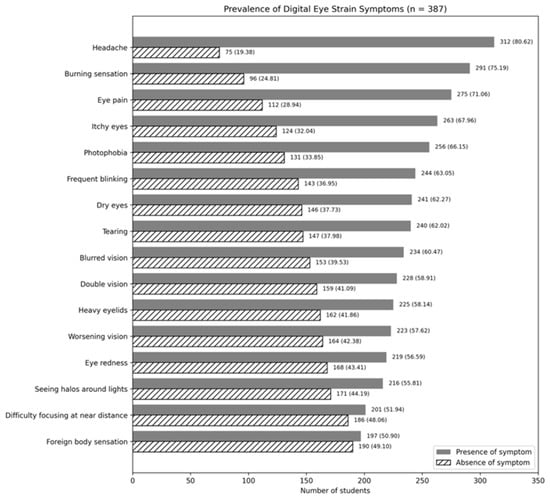
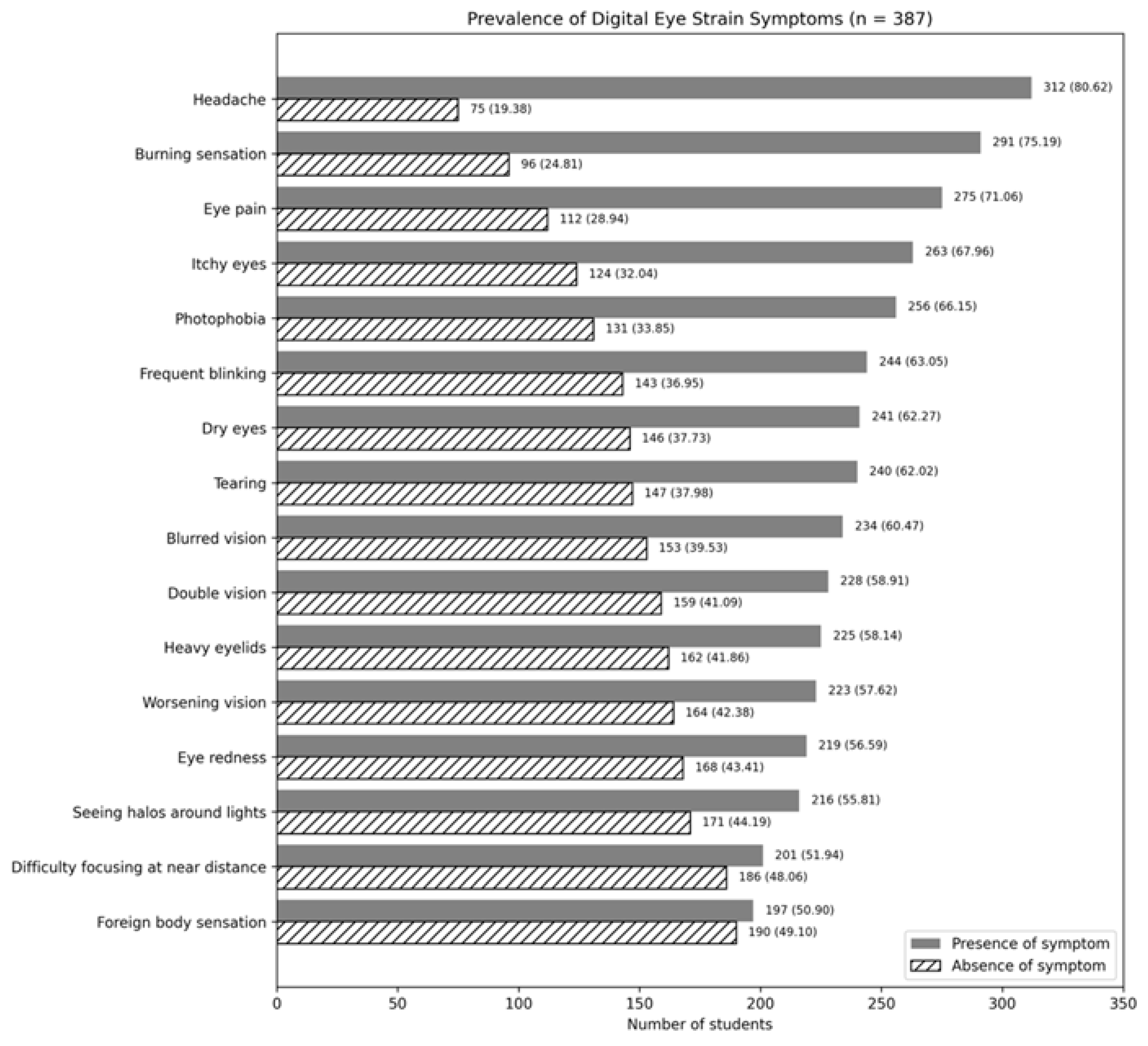
Based on the defined criteria, 311 students (80.40%) were classified as having digital eye strain, while 76 students (19.60%) were classified as not having digital eye strain. The most frequently reported symptoms were headache (312 students, 80.62%), burning sensation (291 students, 75.19%), and eye pain (275 students, 71.06%), as shown in Figure 1.
Figure 1.
Prevalence of individual digital eye strain symptoms among university students (n = 387).
3.6. Association Between Factors and Digital Eye Strain
The strength of associations was interpreted using Phi coefficients, where values of approximately 0.10, 0.30, and 0.50 represent small, medium, and large effect sizes, respectively. In this study, the significant associations observed (Phi = 0.12–0.22) indicated small to modest effect sizes. The factors associated with digital eye strain are presented in Table 5.
Table 5.
Factors associated with digital eye strain.
4. Discussion
4.1. Prevalence of Digital Eye Strain Among University Students
From the survey of 387 university students, 311 students (80.40%) were classified as having digital eye strain (DES), while 76 students (19.60%) did not have DES. The most commonly reported symptoms were headache (312 students, 80.62%), burning sensation (291 students, 75.19%), and eye pain (275 students, 71.06%).
The prevalence observed in this study is relatively high compared with findings reported in other university populations. Previous studies have reported prevalence rates ranging from approximately 50% to 90% among university students and young adults. For example, a study conducted among university students in Riyadh, Saudi Arabia reported a prevalence of 76.1%, with headache being the most commonly reported symptom.
The higher prevalence observed in the present study may be attributed to several factors. Increased screen exposure, particularly prolonged smartphone use, may contribute to a greater risk of ocular symptoms. In addition, academic workload and online learning environments may lead to extended periods of near work without adequate rest breaks. Environmental and ergonomic factors, such as suboptimal lighting conditions, inappropriate viewing distance, and screen positioning, may further exacerbate digital eye strain.
These findings are consistent with previous studies indicating that prolonged visual engagement with digital devices, particularly at near distances, increases accommodative demand and continuous binocular coordination, leading to eye muscle fatigue and associated symptoms such as headache [10].
4.2. Association Between Personal Factors and Digital Eye Strain
The findings of this study showed that sex was significantly associated with digital eye strain (p < 0.05). Although several factors were significantly associated with digital eye strain, the magnitude of these associations was generally small to moderate, the small effect sizes observed in this study suggest limited clinical impact when factors are considered individually, reinforcing the importance of multifactorial assessment. This suggests that digital eye strain is influenced by multiple interacting behavioral, ergonomic, and environmental factors rather than a single dominant determinant, highlighting the need for a comprehensive approach to prevention.
The previous study reported that females tend to use mobile phones more frequently and spend longer periods looking at screens for entertainment and communication activities [23]. The visual problems were significantly associated with digital eye strain (p < 0.05). Visual problems are an important factor related to eye strain, particularly from continuous digital device use. Sheppard et al. (2018) reported that digital eye strain results from prolonged near focusing combined with abnormalities in accommodation and convergence, leading to symptoms such as eye pain, blurred vision, and burning sensation [24].
Furthermore, this study found that wearing glasses with blue light filtering properties was significantly associated with digital eye strain (p < 0.05). However, this finding should be interpreted with caution, as it does not indicate a causal relationship. It is possible that individuals experiencing digital eye strain are more likely to use blue light filtering glasses in an attempt to reduce their symptoms, suggesting potential reverse causation rather than a direct effect of blue light exposure.
The role of blue light filtering in reducing digital eye strain remains controversial. Although blue light emitted from digital screens has been suggested to contribute to ocular discomfort and potential retinal stress [25,26], evidence regarding its effectiveness in alleviating digital eye strain symptoms remains inconsistent. Instead, digital eye strain is more strongly associated with factors such as reduced blink rate, tear film instability, and prolonged near work.
4.3. Association Between Digital Device Characteristics and Digital Eye Strain
This study found that digital device characteristics were not significantly associated with digital eye strain (p > 0.05). The few studies supported this concept, indicating that eye strain does not result from a single factor but rather from multiple complex factors. These include usage behaviors, such as prolonged digital device use without taking breaks and reduced blink rate. Such behaviors cause the eye muscles to work continuously for near focusing and also accelerate ocular surface dryness, which are the primary causes of digital eye strain [3,16].
4.4. Association Between Behavioral Factors of Digital Device Use and Digital Eye Strain
The duration of smartphone use and average daily screen time were significantly associated with digital eye strain (p < 0.05). In addition, avoiding digital device use within 1–2 h before bedtime was also significantly associated with digital eye strain (p < 0.05). These findings are consistent with previous evidence indicating that prolonged screen exposure and excessive smartphone use are important behavioral risk factors for digital eye strain. Continuous use of digital devices increases visual demand and is associated with a reduced blink rate, leading to tear film instability and ocular surface dryness. Furthermore, screen exposure before bedtime may negatively affect sleep quality and circadian rhythm. Blue light emitted from digital screens has been shown to suppress melatonin secretion, a hormone that regulates sleep–wake cycles, thereby disrupting normal sleep patterns. Insufficient sleep and inadequate ocular recovery may increase susceptibility to digital eye strain and exacerbate symptom severity on the following day [27].
These findings highlight the importance of modifying behavioral factors, including limiting prolonged screen time and reducing digital device use before bedtime, as key strategies for preventing digital eye strain.
4.5. Association Between Environmental Factors and Digital Eye Strain
Environmental and ergonomic factors also play an important role in the development of digital eye strain. In this study, screen glare was significantly associated with digital eye strain (p < 0.05), consistent with previous findings indicating that glare reduces visual contrast and increases visual demand, leading to ocular discomfort and fatigue [24].
In addition, direct airflow from a fan or air conditioner blowing toward the eyes was significantly associated with digital eye strain (p < 0.05). This may be explained by increased tear evaporation and reduced tear film stability, resulting in symptoms such as dry eyes, burning sensation, and irritation during prolonged digital device use [28].
Furthermore, ambient environmental conditions, including air quality and humidity, were also significantly associated with ocular health (p < 0.05). Previous studies have suggested that maintaining appropriate environmental conditions, particularly adequate humidity, can help preserve tear film integrity and reduce the risk of ocular surface damage associated with prolonged screen exposure [16]. In addition, inappropriate lighting conditions and suboptimal workstation ergonomics, such as improper screen position and viewing angle, may further contribute to visual strain by increasing visual effort and postural discomfort during prolonged digital device use.
These findings highlight the importance of optimizing environmental and ergonomic conditions, including reducing glare, controlling airflow direction, and maintaining appropriate humidity, to minimize the risk of digital eye strain, particularly in prolonged digital work environments.
From a practical perspective, the findings of this study highlight several strategies that may help reduce the risk of digital eye strain. These include adopting the 20-20-20 rule (taking a 20 s break every 20 min to look at an object 20 feet away), optimizing ergonomic screen positioning (e.g., maintaining appropriate viewing distance and screen height), and performing regular blinking exercises to maintain tear film stability. In addition, limiting continuous screen exposure and reducing digital device use before bedtime may help prevent visual fatigue and improve ocular comfort. These strategies may be particularly beneficial for university students engaged in prolonged digital device use.
5. Conclusions
5.1. Summary of Findings
This study investigated the prevalence and associated factors of digital eye strain among 387 university students. The findings revealed that 311 students (80.40%) experienced digital eye strain, while 76 students (19.60%) did not. The most frequently reported symptoms were headache in 312 students (80.62%), burning sensation in 291 students (75.19%), and eye pain in 275 students (71.06%).
The results of this study provide important evidence regarding the prevalence and factors associated with digital eye strain among university students. Although several factors were statistically associated with digital eye strain, the magnitude of these associations was small, suggesting that each factor individually contributes only modestly to the overall risk. This supports the concept that digital eye strain is a multifactorial condition influenced by the combined effects of behavioral, environmental, and individual factors.
These findings may increase students’ awareness of digital eye strain and its potential impact. The data obtained can be utilized to develop preventive strategies, guide appropriate management approaches, and promote ocular health among students experiencing these symptoms. Furthermore, the baseline information generated from this study may serve as a foundation for future in-depth research.
5.2. Limitations and Recommendations for Future Research
5.2.1. Limitations
This study has several limitations. First, the use of self-reported questionnaires to assess digital device use and digital eye strain (DES) may introduce measurement bias and response inaccuracies. In particular, the reliance on self-reported data without objective clinical assessment may lead to misclassification of the presence and severity of ocular symptoms.
In addition, the use of an online questionnaire (Google Forms) limited control over the conditions under which participants completed the survey, including the timing and environment of responses, which may have affected data reliability.
Another limitation of this study is the use of bivariate analysis without multivariate adjustment. As a result, potential confounding factors were not controlled, and the observed associations may be influenced by underlying variables not accounted for in the analysis. Therefore, the findings should be interpreted with caution, particularly regarding their generalizability and the ability to infer independent effects of each factor.
Despite these limitations, this study provides important baseline evidence on the prevalence and associated factors of digital eye strain among university students.
5.2.2. Recommendations for Future Research
Future research should incorporate objective clinical assessments (e.g., ophthalmic examinations, tear film stability, blink rate, or accommodative function) to validate self-reported symptoms and improve diagnostic accuracy. In addition, future studies should employ multivariate analytical approaches, such as multiple logistic regression, to better account for confounding variables and strengthen the validity of the findings. Furthermore, longitudinal or experimental study designs are recommended to establish causal relationships and evaluate the effectiveness of targeted interventions, such as screen time regulation, ergonomic adjustments, and environmental modifications.
Moreover, mixed-method approaches, including qualitative interviews, may provide deeper insights into behavioral patterns and contextual factors influencing digital eye strain.
Supplementary Materials
The following supporting information can be downloaded at: https://www.mdpi.com/article/10.3390/ijerph23050542/s1, Supplementary File S1: Questionnaire used in this study.
Author Contributions
Conceptualization, P.S.; Methodology, P.S., N.N., R.I., C.T. and O.Y.; Software, P.S., N.N. and R.I.; Validation, P.S. and N.N.; Formal analysis, P.S. and N.N.; Investigation, P.S., N.N. and R.I.; Resources, P.S.; Data curation, P.S., N.N. and R.I.; Writing—original draft, P.S., N.N., R.I., C.T., O.Y., N.J., T.S. and S.F.Y.; Writing—review & editing, P.S., R.I., C.T., O.Y., N.J., T.S. and S.F.Y.; Visualization, P.S.; Supervision, P.S.; Project administration, P.S.; Funding acquisition, P.S. All authors have read and agreed to the published version of the manuscript.
Funding
This research received no external funding.
Institutional Review Board Statement
The study was conducted in accordance with the Declaration of Helsinki and approved by the Ethics Committee in Human Research Walailak University (protocol code WUEC-25-113-01 and 9 April 2025 of approval).
Informed Consent Statement
Informed consent was obtained from all subjects involved in the study.
Data Availability Statement
The data presented in this study are available on request from the corresponding author.
Conflicts of Interest
The authors declare no conflicts of interest.
References
- Al Rashidi, S.H.; Alhumaidan, H. Computer vision syndrome prevalence, knowledge and associated factors among Saudi Arabia University Students: Is it a serious problem? Int. J. Health Sci. 2017, 11, 17–19. [Google Scholar]
- Mohan, A.; Sen, P.; Sen, C.; Shah, E.; Jain, S. Prevalence and risk factor assessment of digital eye strain among children using online e-learning during the COVID-19 pandemic: Digital eye strain among kids (DESK study-1). Indian J. Ophthalmol. 2021, 69, 140–144. [Google Scholar] [CrossRef] [Scilit]
- Portello, J.K.; Rosenfield, M.; Bababekova, Y.; Estrada, J.M.; Leon, A. Computer-related visual symptoms in office workers. Ophthalmic Physiol. Opt. 2012, 32, 375–382. [Google Scholar] [CrossRef] [Scilit] [PubMed]
- Iqbal, M.; Said, O.; Ibrahim, O.; Soliman, A. Visual sequelae of computer vision syndrome: A cross-sectional case-control study. J. Ophthalmol. 2021, 2021, 6630286. [Google Scholar] [CrossRef] [Scilit]
- Moldovan, H.-R.; Voidazan, S.-T.; Moldovan, G.; Vlasiu, M.-A.; Moldovan, G.; Panaitescu, R. Accommodative asthenopia among Romanian computer-using medical students-A neglected occupational disease. Arch. Environ. Occup. Health 2020, 75, 235–241. [Google Scholar] [CrossRef] [Scilit] [PubMed]
- Kharel Sitaula, R.; Khatri, A. Knowledge, Attitude and practice of Computer Vision Syndrome among medical students and its impact on ocular morbidity. J. Nepal. Health Res. Counc. 2018, 16, 291–296. [Google Scholar] [CrossRef] [Scilit]
- Wang, L.; Wei, X.; Deng, Y. Computer vision syndrome during SARS-CoV-2 outbreak in university students: A comparison between online courses and classroom lectures. Front. Public Health 2021, 9, 696036. [Google Scholar] [CrossRef] [Scilit] [PubMed]
- Huyhua-Gutierrez, S.C.; Zeladita-Huaman, J.A.; Díaz-Manchay, R.J.; Dominguez-Palacios, A.B.; Zegarra-Chapoñan, R.; Rivas-Souza, M.A.; Tejada-Muñoz, S. Digital Eye Strain among Peruvian Nursing Students. Prevalence and Associated Factors. Int. J. Environ. Res. Public Health 2023, 20, 5067. [Google Scholar] [CrossRef] [Scilit]
- Ccami-Bernal, F.; Soriano-Moreno, D.R.; Romero-Robles, M.A.; Barriga-Chambi, F.; Tuco, K.G.; Castro-Diaz, S.D.; Nuñez-Lupaca, J.N.; Pacheco-Mendoza, J.; Galvez-Olortegui, T.; Benites-Zapata, V.A. Prevalence of computer vision syndrome: A systematic review and meta-analysis. J. Optom. 2024, 17, 100482. [Google Scholar] [CrossRef] [Scilit]
- Almudhaiyan, T.M.; Aldebasi, T.; Alakel, R.; Marghlani, L.; Aljebreen, A.; Moazin, O.M. The prevalence and knowledge of digital eye strain among the undergraduates in Riyadh, Saudi Arabia. Cureus 2023, 15, e37081. [Google Scholar] [CrossRef] [Scilit]
- AlQarni, A.M.; AlAbdulKader, A.M.; Alghamdi, A.N.; Altayeb, J.; Jabaan, R.; Assaf, L.; A Alanazi, R. Prevalence of digital eye strain among university students and its association with virtual learning during the COVID-19 pandemic. Clin. Ophthalmol. 2023, 17, 1755–1768. [Google Scholar] [CrossRef] [Scilit]
- Yurtcanlı, C.H.K.; Hıdıroğlu, S.; Erdağ, F.; Taş, Ç.; Karavuş, M. The distribution of eye symptoms related to the use of digital devices among university students in Istanbul, Türkiye. Ophthalmol. J. 2024, 9, 165–170. [Google Scholar] [CrossRef] [Scilit]
- Logaraj, M.; Madhupriya, V.; Hegde, S. Computer vision syndrome and associated factors among medical and engineering students in chennai. Ann. Med. Health Sci. Res. 2014, 4, 179–185. [Google Scholar] [CrossRef] [Scilit]
- Mowatt, L.; Gordon, C.; Santosh, A.B.R.; Jones, T. Computer vision syndrome and ergonomic practices among undergraduate university students. Int. J. Clin. Pract. 2018, 72, e13035. [Google Scholar] [CrossRef] [Scilit]
- Coles-Brennan, C.; Sulley, A.; Young, G. Management of digital eye strain. Clin. Exp. Optom. 2019, 102, 18–29. [Google Scholar] [CrossRef] [Scilit] [PubMed]
- Pucker, A.D.; Kerr, A.M.; Sanderson, J.; Lievens, C. Digital eye strain: Updated perspectives. Clin. Optom. 2024, 16, 233–246. [Google Scholar] [CrossRef] [Scilit] [PubMed]
- Rosenfield, M. Computer vision syndrome: A review of ocular causes and potential treatments. Ophthalmic Physiol. Opt. 2011, 31, 502–515. [Google Scholar] [CrossRef] [Scilit]
- Heo, J.-Y.; Kim, K.; Fava, M.; Mischoulon, D.; Papakostas, G.I.; Kim, M.-J.; Kim, D.J.; Chang, K.-A.J.; Oh, Y.; Yu, B.-H.; et al. Effects of smartphone use with and without blue light at night in healthy adults: A randomized, double-blind, cross-over, placebo-controlled comparison. J. Psychiatr. Res. 2017, 87, 61–70. [Google Scholar] [CrossRef] [Scilit] [PubMed]
- Uchino, M.; Schaumberg, D.A. Dry Eye Disease: Impact on Quality of Life and Vision. Curr. Ophthalmol. Rep. 2013, 1, 51–57. [Google Scholar] [CrossRef] [Scilit]
- Kaur, K.; Gurnani, B.; Nayak, S.; Deori, N.; Kaur, S.; Jethani, J.; Singh, D.; Agarkar, S.; Hussaindeen, J.R.; Sukhija, J.; et al. Digital eye strain- a comprehensive review. Ophthalmol. Ther. 2022, 22, 1655–1680. [Google Scholar] [CrossRef] [Scilit]
- Sengsoon, P.; Intaruk, R. Immediate effects of light mode and dark mode features on visual fatigue in tablet users. Int. J. Environ. Res. Public Health 2025, 22, 609. [Google Scholar] [CrossRef] [Scilit]
- Srirug, P.; Jongjit, K.; Muansri, O.; Somton, Y.; Kongbankhong, N.; Sengsoon, P. Prevalence and factor associated work-related musculoskeletal disorders of students in virtual classroom. Heliyon 2023, 9, e18461. [Google Scholar] [CrossRef] [Scilit] [PubMed]
- A Altalhi, A.; Khayyat, W.; Khojah, O.; Alsalmi, M.; Almarzouki, H. Computer vision syndrome among health sciences students in Saudi Arabia: Prevalence and risk factors. Cureus 2020, 12, e7060. [Google Scholar] [CrossRef] [Scilit] [PubMed]
- Sheppard, A.L.; Wolffsohn, J.S. Digital eye strain: Prevalence, measurement and amelioration. BMJ Open Ophthalmol. 2018, 3, e000146. [Google Scholar] [CrossRef] [Scilit] [PubMed]
- Algvere, P.V.; Marshall, J.; Seregard, S. Age-related maculopathy and the impact of blue light hazard. Acta Ophthalmalogica Scand. 2006, 84, 4–15. [Google Scholar] [CrossRef] [Scilit]
- Margrain, T.H.; Boulton, M.; Marshall, J.; Sliney, D.H. Do blue light filters confer protection against age-related macular degeneration? Prog. Retin. Eye Res. 2004, 23, 523–531. [Google Scholar]
- Suh, Y.-W.; Na, K.-H.; Ahn, S.-E.; Oh, J. Effect of ambient light exposure on ocular fatigue during sleep. J. Korean Med. Sci. 2018, 33, e248. [Google Scholar] [CrossRef] [Scilit]
- McCulley, J.P.; Uchiyama, E.; Aronowicz, J.D.; Butovich, I.A. Impact of evaporation on aqueous tear loss. Trans. Am. Ophthalmol. Soc. 2006, 104, 121–128. [Google Scholar]

Disclaimer/Publisher’s Note: The statements, opinions and data contained in all publications are solely those of the individual author(s) and contributor(s) and not of MDPI and/or the editor(s). MDPI and/or the editor(s) disclaim responsibility for any injury to people or property resulting from any ideas, methods, instructions or products referred to in the content. |
© 2026 by the authors. Licensee MDPI, Basel, Switzerland. This article is an open access article distributed under the terms and conditions of the Creative Commons Attribution (CC BY) license.