


Is There a Sampling Bias in Research on Work-Related Technostress? A Systematic Review of Occupational Exposure to Technostress and the Role of Socioeconomic Position

Abstract
1. Introduction
1.1. The Technostress Model
1.2. Socioeconomic Position: A Social Determinant of Individual Techno-Stressors?
2. Methodology
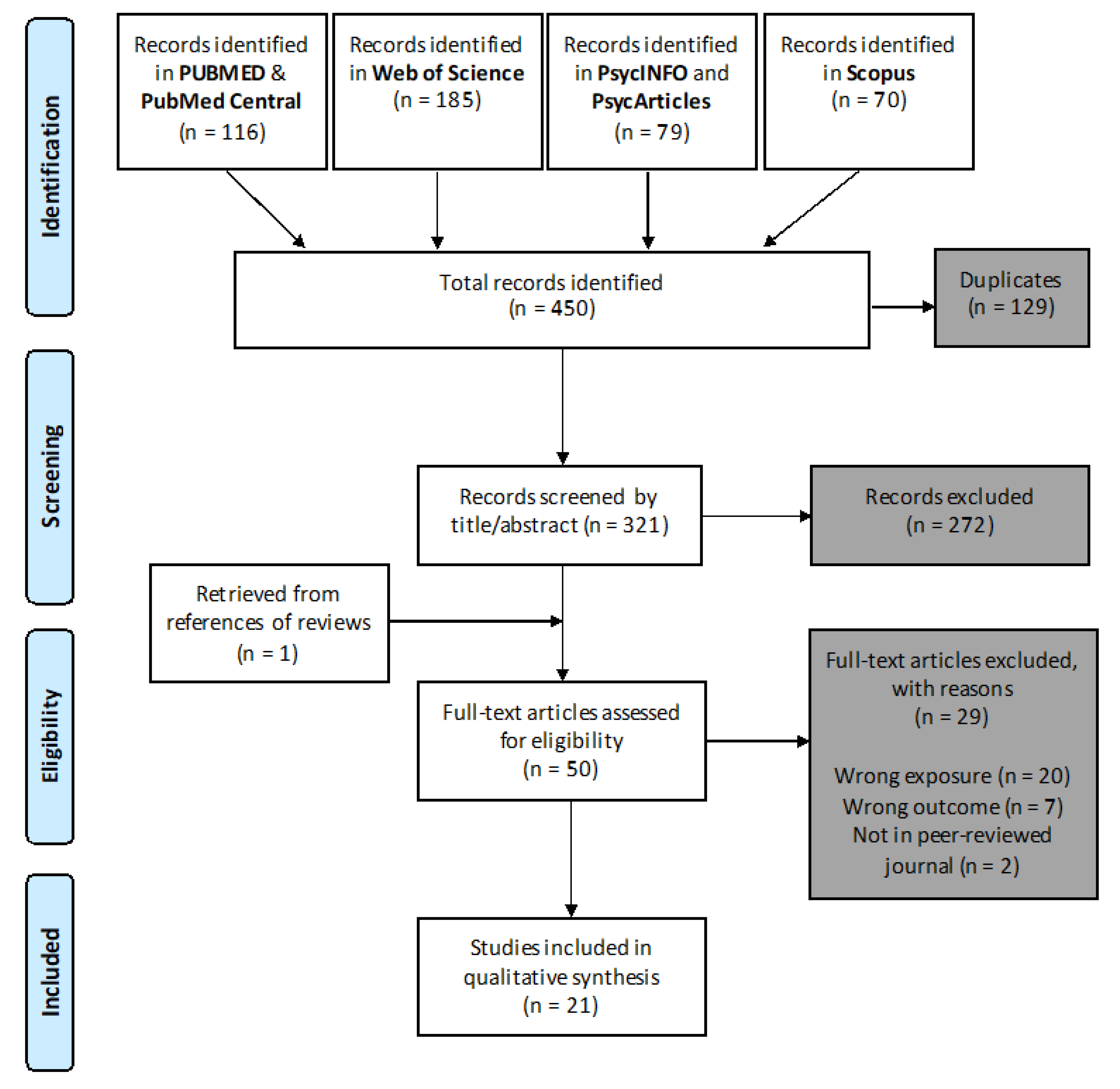
2.1. Search Strategy and Study Selection
2.2. Data Collection and Quality Appraisal
- study population (sample description, country of data collection, participant characteristics and occupational setting),
- study design,
- details of the exposure, i.e., measure of technostress,
- outcome measures,
- indicators of SEP (incl. income, education, socioeconomic status, job position, etc.),
- results regarding differences by SEP,
- confounders.
3. Results
3.1. Quality Appraisal
3.2. Study Characteristics
3.3. The Role of SEP in Effects of Work-Related Technostress on Health and Work Outcomes
3.3.1. Socioeconomic Position Operationalised as Education
3.3.2. Socioeconomic Position Operationalised as Job Position
3.3.3. Socioeconomic Position
3.4. Socioeconomic Sampling Bias in Subsample of Included Studies
4. Discussion
4.1. The Role of SEP and Socioeconomic Sampling Bias in Technostress Studies
4.2. A research Agenda to Conceptualise Socioeconomic Differences in the Context of Technostress
4.3. Limitations
5. Conclusions
Author Contributions
Funding
Institutional Review Board Statement
Informed Consent Statement
Data Availability Statement
Acknowledgments
Conflicts of Interest
Appendix A

| First Author and Year | Study Title | Journal Discipline | Techno- Overload | Techno- Invasion | Techno- Insecurity | Techno- Complexity | Techno- Uncertainty |
|---|---|---|---|---|---|---|---|
| Al-Ansari and Alshare [48] | The Impact of Technostress Components on the Employees Satisfaction and Perceived Performance: The Case of Qatar | Information Systems | x | x | x | x | x |
| Alam [51] | Techno-stress and productivity: Survey evidence from the aviation industry | Information Systems | x | x | x | ||
| Ayyagari, Grover and Purvis [37] | Technostress: Technological antecedents and implications. | Information Systems | x | x | x | ||
| Day, Paquet, Scott and Hambley [45] | Perceived Information and Communication Technology (ICT) Demands on Employee Outcomes: The Moderating Effect of Organisational ICT Support. | psychology | x | ||||
| Florkowski [46] | HR technologies and HR-staff technostress: an unavoidable or combatable effect? | Information Systems | x | ||||
| Gaudioso, et al. [72] | The mediating roles of strain facets and coping strategies in translating techno-stressors into adverse job outcomes. | psychology | x | x | |||
| Goetz and Boehm [36] | Am I outdated? The role of strengths use support and friendship opportunities for coping with technological insecurity. | Information Systems | x | ||||
| Jena [42] | Technostress in ICT enabled collaborative learning environment: An empirical study among Indian academician | Information Systems | x | x | |||
| Khedhaouria and Cucchi [38] | Technostress creators, personality traits, and job burnout: A fuzzy-set configurational analysis. | Information Systems | x | x | x | ||
| Kim, Lee, Yun and Im [49] | An examination of work exhaustion in the mobile enterprise environment. | social sciences | x | x | x | x | |
| Lee [73] | Does stress from cell phone use increase negative emotions at work? | psychology | x | ||||
| Ragu-Nathan, Tarafdar, Ragu-Nathan and Tu [5] | The Consequences of Technostress for End Users in Organisations: Conceptual Development and Empirical Validation | Information Systems | x | x | x | x | x |
| Srivastava, Chandra and Shirish [39] | Technostress creators and job outcomes: theorising the moderating influence of personality traits. | Information Systems | x | x | x | x | x |
| Stadin, Nordin, Broström, Magnusson Hanson, Westerlund and Fransson [35] | Information and communication technology demands at work: the association with job strain, effort-reward imbalance and self-rated health in different socioeconomic strata | public health | x | x | x | x | x |
| Stadin, Nordin, Brostrom, Hanson, Westerlund and Fransson [34] | Repeated exposure to high ICT demands at work, and development of suboptimal self-rated health: findings from a 4-year follow-up of the SLOSH study | public health | x | x | x | x | x |
| Suh and Lee [43] | Understanding teleworkers’ technostress and its influence on job satisfaction | Information Systems | x | x | |||
| Tarafdar, Tu, Ragu-Nathan and Ragu-Nathan [8] | The impact of technostress on role stress and productivity | Information Systems | x | x | x | x | x |
| Tarafdar, Tu and Ragu-Nathan [40] | Impact of technostress on end-user satisfaction and performance | Information Systems | x | x | x | x | x |
| Tarafdar, Pullins and Ragu-Nathan [50] | Technostress: negative effect on performance and possible mitigations | Information Systems | x | x | x | x | x |
| Vayre and Vonthron [41] | Identifying Work-Related Internet’s Uses—at Work and Outside Usual Workplaces and Hours—and Their Relationships With Work–Home Interface, Work Engagement, and Problematic Internet Behaviour | psychology | x | ||||
| Wu, Wang, Mei and Liu [44] | Technology-induced job anxiety during non-work time: Examining conditional effect of techno-invasion on job anxiety. | Information Systems | x |
Appendix B
| AND |
|
References
- Wajcman, J. Pressed for Time: The Acceleration of Life in Digital Capitalism; The University of Chicago Press: Chicago, IL, USA, 2015; pp. 1–215. [Google Scholar]
- Wajcman, J. Automation: Is it really different this time? Br. J. Sociol. 2017, 68, 119–127. [Google Scholar] [CrossRef]
- Graham, M.; Hjorth, I.; Lehdonvirta, V. Digital labour and development: Impacts of global digital labour platforms and the gig economy on worker livelihoods. Transf. Eur. Rev. Labour Res. 2017, 23, 135–162. [Google Scholar] [CrossRef]
- Wood, A.J.; Graham, M.; Lehdonvirta, V.; Hjorth, I. Good gig, bad gig: Autonomy and algorithmic control in the global gig economy. Work Employ. Soc. 2019, 33, 56–75. [Google Scholar] [CrossRef] [PubMed]
- Ragu-Nathan, T.S.; Tarafdar, M.; Ragu-Nathan, B.S.; Tu, Q. The consequences of technostress for end users in organizations: Conceptual development and empirical validation. Inf. Syst. Res. 2008, 19, 417–433. [Google Scholar] [CrossRef]
- La Torre, G.; Esposito, A.; Sciarra, I.; Chiappetta, M. Definition, symptoms and risk of techno-stress: A systematic review. Int. Arch. Occup. Environ. Health 2019, 92, 13–35. [Google Scholar] [CrossRef] [PubMed]
- Berg-Beckhoff, G.; Nielsen, G.; Larsen, E.L. Use of information communication technology and stress, burnout, and mental health in older, middle-aged, and younger workers—Results from a systematic review. Int. J. Occup. Environ. Health 2017, 23, 160–171. [Google Scholar] [CrossRef]
- Tarafdar, M.; Tu, Q.; Ragu-Nathan, B.S.; Ragu-Nathan, T.S. The impact of technostress on role stress and productivity. J. Manag. Inf. Syst. 2007, 24, 301–328. [Google Scholar] [CrossRef]
- Lambert, W.W.; Lazarus, R.S. Psychological stress and the coping process. Am. J. Psychol. 1970, 83, 634. [Google Scholar] [CrossRef]
- Haipeter, T. Digitalisation, unions and participation: The German case of ‘industry 4.0’. Ind. Relat. J. 2020, 51, 242–260. [Google Scholar] [CrossRef]
- EU-OSHA. Foresight on New and Emerging Occupational Safety and Health Risks Associated with Digitalisation by European Risk Observatory; European Agency for Safety and Health at Work: Bilbao, Spain, 2018.
- Galobardes, B. Indicators of socioeconomic position (part 1). J. Epidemiol. Community Health 2006, 60, 7–12. [Google Scholar] [CrossRef]
- Arcaya, M.C.; Arcaya, A.L.; Subramanian, S.V. Inequalities in health: Definitions, concepts, and theories. Glob. Health Action 2015, 8, 27106. [Google Scholar] [CrossRef] [PubMed]
- Beckfield, J.; Olafsdottir, S.; Bakhtiari, E. Health inequalities in global context. Am. Behav. Sci. 2013, 57, 1014–1039. [Google Scholar] [CrossRef]
- Lynch, J.; Kaplan, G. Socioeconomic Position; Social Epidemiology; Oxford University Press: New York, NY, USA, 2000; Volume 2000. [Google Scholar]
- MacKenbach, J.P.; Stirbu, I.; Roskam, A.-J.R.; Schaap, M.M.; Menvielle, G.; Leinsalu, M.; Kunst, A.E. Socioeconomic inequalities in health in 22 European countries. N. Engl. J. Med. 2008, 358, 2468–2481. [Google Scholar] [CrossRef] [PubMed]
- Hoven, H.; Siegrist, J. Work characteristics, socioeconomic position and health: A systematic review of mediation and moderation effects in prospective studies. Occup. Environ. Med. 2013, 70, 663–669. [Google Scholar] [CrossRef]
- Ahonen, E.Q.; Fujishiro, K.; Cunningham, T.; Flynn, M. Work as an inclusive part of population health inequities research and prevention. Am. J. Public Health 2018, 108, 306–311. [Google Scholar] [CrossRef]
- Tarafdar, M.; Tu, Q.; Ragu-Nathan, T.S.; Ragu-Nathan, B.S. Crossing to the dark side. Commun. ACM 2011, 54, 113–120. [Google Scholar] [CrossRef]
- Krishnan, S. Personality and espoused cultural differences in technostress creators. Comput. Hum. Behav. 2017, 66, 154–167. [Google Scholar] [CrossRef]
- Granulo, A.; Fuchs, C.; Puntoni, S. Psychological reactions to human versus robotic job replacement. Nat. Hum. Behav. 2019, 3, 1062–1069. [Google Scholar] [CrossRef]
- Schwabe, H.; Castellacci, F. Automation, workers’ skills and job satisfaction. PLoS ONE 2020, 15, e0242929. [Google Scholar] [CrossRef] [PubMed]
- Arnold, D.; Butschek, S.; Steffes, S.; Müller, D. Digitalisierung am Arbeitsplatz; Bundesministeriums Arbeit und Soziales: Nürnberg, Germany, 2017. [Google Scholar]
- Califf, C.B.; Sarker, S.; Sarker, S. The bright and dark sides of technostress: A mixed-methods study involving healthcare IT. MIS Q. 2020, 44, 809–856. [Google Scholar] [CrossRef]
- Borle, P.; Boerner-Zobel, F.; Voelter-Mahlknecht, S.; Hasselhorn, H.M.; Ebener, M. The social and health implications of digital work intensification. Associations between exposure to information and communication technologies, health and work ability in different socio-economic strata. Int. Arch. Occup. Environ. Health 2020, 1–14. [Google Scholar] [CrossRef]
- Marchiori, D.M.; Mainardes, E.W.; Rodrigues, R.G. Do individual characteristics influence the types of technostress reported by workers? Int. J. Hum. Comput. Interact. 2019, 35, 218–230. [Google Scholar] [CrossRef]
- Moher, D.; Liberati, A.; Tetzlaff, J.; Altman, D.G.; The PRISMA Group. Preferred reporting items for systematic reviews and meta-analyses: The PRISMA statement. PLoS Med. 2009, 6, e1000097. [Google Scholar] [CrossRef]
- Bramer, W.M.; Giustini, D.; De Jonge, G.B.; Holland, L.; Bekhuis, T. De-duplication of database search results for systematic reviews in EndNote. J. Med. Libr. Assoc. 2016, 104, 240–243. [Google Scholar] [CrossRef] [PubMed]
- Mattioli, S.; Zanardi, F.; Baldasseroni, A.; Schaafsma, F.; Cooke, R.M.T.; Mancini, G.; Fierro, M.; Santangelo, C.; Farioli, A.; Fucksia, S.; et al. Search strings for the study of putative occupational determinants of disease. Occup. Environ. Med. 2009, 67, 436–443. [Google Scholar] [CrossRef]
- Fischer, T.; Riedl, R. Technostress research: A nurturing ground for measurement pluralism? Commun. Assoc. Inf. Syst. 2017, 40, 375–401. [Google Scholar] [CrossRef]
- Nimrod, G. Technostress: Measuring a new threat to well-being in later life. Aging Ment. Health 2017, 22, 1086–1093. [Google Scholar] [CrossRef] [PubMed]
- Ipsen, C.; Karanika-Murray, M.; Nardelli, G. Addressing mental health and organisational performance in tandem: A challenge and an opportunity for bringing together what belongs together. Work Stress 2020, 34, 1–4. [Google Scholar] [CrossRef]
- Herzog, R.; Álvarez-Pasquin, M.J.; Díaz, C.; Del Barrio, J.L.; Estrada, J.M.; Gil, Á. Are healthcare workers’ intentions to vaccinate related to their knowledge, beliefs and attitudes? A systematic review. BMC Public Health 2013, 13, 154. [Google Scholar] [CrossRef]
- Stadin, M.; Nordin, M.; Broström, A.; Hanson, L.L.M.; Westerlund, H.; Fransson, E.I. Repeated exposure to high ICT demands at work, and development of suboptimal self-rated health: Findings from a 4-year follow-up of the SLOSH study. Int. Arch. Occup. Environ. Health 2019, 92, 717–728. [Google Scholar] [CrossRef]
- Stadin, M.; Nordin, M.; Broström, A.; Hanson, L.L.M.; Westerlund, H.; Fransson, E.I. Information and communication technology demands at work: The association with job strain, effort-reward imbalance and self-rated health in different socio-economic strata. Int. Arch. Occup. Environ. Health 2016, 89, 1049–1058. [Google Scholar] [CrossRef] [PubMed]
- Goetz, T.M.; Boehm, S.A. Am I outdated? The role of strengths use support and friendship opportunities for coping with technological insecurity. Comput. Hum. Behav. 2020, 107, 106265. [Google Scholar] [CrossRef]
- Ayyagari, R.; Grover, V.; Purvis, R. Technostress: Technological antecedents and implications. MIS Q. 2011, 35, 831–858. [Google Scholar] [CrossRef]
- Khedhaouria, A.; Cucchi, A. Technostress creators, personality traits, and job burnout: A fuzzy-set configurational analysis. J. Bus. Res. 2019, 101, 349–361. [Google Scholar] [CrossRef]
- Srivastava, S.C.; Chandra, S.; Shirish, A. Technostress creators and job outcomes: Theorising the moderating influence of personality traits. Inf. Syst. J. 2015, 25, 355–401. [Google Scholar] [CrossRef]
- Tarafdar, M.; Tu, Q.; Ragu-Nathan, T.S. Impact of technostress on end-user satisfaction and performance. J. Manag. Inf. Syst. 2010, 27, 303–334. [Google Scholar] [CrossRef]
- Vayre, E.; Vonthron, A.-M. Identifying work-related internet’s uses—At work and outside usual workplaces and hours—And their relationships with work–home interface, work engagement, and problematic internet behavior. Front. Psychol. 2019, 10, 2118. [Google Scholar] [CrossRef]
- Jena, R. Technostress in ICT enabled collaborative learning environment: An empirical study among Indian academician. Comput. Hum. Behav. 2015, 51, 1116–1123. [Google Scholar] [CrossRef]
- Suh, A.; Lee, J. Understanding teleworkers’ technostress and its influence on job satisfaction. Internet Res. 2017, 27, 140–159. [Google Scholar] [CrossRef]
- Wu, J.; Wang, N.; Mei, W.; Liu, L. Technology-induced job anxiety during non-work time: Examining conditional effect of techno-invasion on job anxiety. Int. J. Netw. Virtual Organ. 2020, 22, 162. [Google Scholar] [CrossRef]
- Day, A.; Paquet, S.; Scott, N.; Hambley, L. Perceived information and communication technology (ICT) demands on employee outcomes: The moderating effect of organizational ICT support. J. Occup. Health Psychol. 2012, 17, 473–491. [Google Scholar] [CrossRef] [PubMed]
- Florkowski, G.W. HR technologies and HR-staff technostress: An unavoidable or combatable effect? Empl. Relat. 2019, 41, 1120–1144. [Google Scholar] [CrossRef]
- Al-Ansari, M.A.; Alshare, K. The impact of technostress components on the employees satisfaction and perceived performance. J. Glob. Inf. Manag. 2019, 27, 65–86. [Google Scholar] [CrossRef]
- Kim, H.J.; Lee, C.C.; Yun, H.; Im, K.S. An examination of work exhaustion in the mobile enterprise environment. Technol. Forecast. Soc. Chang. 2015, 100, 255–266. [Google Scholar] [CrossRef]
- Tarafdar, M.; Pullins, E.B.; Ragu-Nathan, T.S. Technostress: Negative effect on performance and possible mitigations. Inf. Syst. J. 2015, 25, 103–132. [Google Scholar] [CrossRef]
- Alam, M.A. Techno-stress and productivity: Survey evidence from the aviation industry. J. Air Transp. Manag. 2016, 50, 62–70. [Google Scholar] [CrossRef]
- Bondanini, G.; Giorgi, G.; Ariza-Montes, A.; Vega-Muñoz, A.; Andreucci-Annunziata, P. Technostress dark side of technology in the workplace: A scientometric analysis. Int. J. Environ. Res. Public Health 2020, 17, 8013. [Google Scholar] [CrossRef]
- Henrich, J.; Heine, S.J.; Norenzayan, A. The weirdest people in the world? Behav. Brain Sci. 2010, 33, 61–83. [Google Scholar] [CrossRef] [PubMed]
- Clancy, K.B.; Davis, J.L. Soylent is people, and WEIRD is white: Biological anthropology, whiteness, and the limits of the WEIRD. Annu. Rev. Anthropol. 2019, 48, 169–186. [Google Scholar] [CrossRef]
- Tsuboi, S.; Yoshida, H.; Ae, R.; Kojo, T.; Nakamura, Y.; Kitamura, K. Selection bias of internet panel surveys. Asia Pac. J. Public Health 2012, 27, NP2390–NP2399. [Google Scholar] [CrossRef]
- Bethlehem, J. Selection bias in web surveys. Int. Stat. Rev. 2010, 78, 161–188. [Google Scholar] [CrossRef]
- Colombier, N.; Martin, L.; Pénard, T. Usages des tic, conditions de travail et satisfaction des salariés. Réseaux 2007, 25, 115–146. [Google Scholar] [CrossRef]
- Baruch, Y. Teleworking: Benefits and pitfalls as perceived by professionals and managers. New Technol. Work Employ. 2000, 15, 34–49. [Google Scholar] [CrossRef]
- Boswell, W.R.; Olson-Buchanan, J.B. The use of communication technologies after hours: The role of work attitudes and work-life conflict. J. Manag. 2007, 33, 592–610. [Google Scholar] [CrossRef]
- Wang, X.; Li, B. Technostress among university teachers in higher education: A study using multidimensional person-environment misfit theory. Front. Psychol. 2019, 10, 1791. [Google Scholar] [CrossRef] [PubMed]
- Popkin, G. How scientists can team up with big tech. Nature 2019, 565, 665–667. [Google Scholar] [CrossRef]
- Wajcman, J.; Dodd, N. The Sociology of Speed: Digital, Organizational, and Social Temporalities, 1st ed.; Oxford University Press: Oxford, UK, 2017. [Google Scholar]
- Chen, L. Validating the technostress instrument using a sample of Chinese knowledge workers. J. Int. Technol. Inf. Manag. 2015, 24, 65–81. [Google Scholar]
- Tarafdar, M.; Cooper, C.L.; Stich, J. The technostress trifecta—Techno eustress, techno distress and design: Theoretical directions and an agenda for research. Inf. Syst. J. 2019, 29, 6–42. [Google Scholar] [CrossRef]
- Darin-Mattsson, A.; Fors, S.; Kåreholt, I. Different indicators of socioeconomic status and their relative importance as determinants of health in old age. Int. J. Equity Health 2017, 16, 173. [Google Scholar] [CrossRef] [PubMed]
- Turrell, G. Income non-reporting: Implications for health inequalities research. J. Epidemiol. Community Health 2000, 54, 207–214. [Google Scholar] [CrossRef] [PubMed]
- Ivanova, M.; Bronowicka, J.; Kocher, E.; Degner, A. The App as a Boss? Control and Autonomy in Application-Based Management; Viadrina: Frankfurt (Oder), Germany, 2018. [Google Scholar]
- Star, S.L. Power, technology and the phenomenology of conventions: On being allergic to onions. Sociol. Rev. 1990, 38, 26–56. [Google Scholar] [CrossRef]
- Star, S.L.; Strauss, A. Layers of silence, arenas of voice: The ecology of visible and invisible work. Comput. Support. Coop. Work (CSCW) 1999, 8, 9–30. [Google Scholar] [CrossRef]
- Morgan, T.; Williams, L.A.; Gott, M. A feminist quality appraisal tool: Exposing gender bias and gender inequities in health research. Crit. Public Health 2016, 27, 263–274. [Google Scholar] [CrossRef]
- Tams, S.; Hill, K. Helping an old workforce interact with modern IT: A NeuroIS approach to understanding technostress and technology use in older workers. Inf. Syst. Neurosci. 2017, 16, 19–26. [Google Scholar] [CrossRef]
- Riedl, R. On the biology of technostress. ACM SIGMIS Database Database Adv. Inf. Syst. 2012, 44, 18–55. [Google Scholar] [CrossRef]
- Gaudioso, F.; Turel, O.; Galimberti, C. The mediating roles of strain facets and coping strategies in translating techno-stressors into adverse job outcomes. Comput. Hum. Behav. 2017, 69, 189–196. [Google Scholar] [CrossRef]
- Lee, J. Does stress from cell phone use increase negative emotions at work? Soc. Behav. Pers. Int. J. 2016, 44, 705–715. [Google Scholar] [CrossRef]
| Inclusion Criteria | Exclusion Criteria | |
|---|---|---|
| Population | Working adults. | Non-work-related samples and workers below the age of 18. |
| Intervention/ Exposure | Technostress at work. | Does not measure work-related exposure to at least one techno-stressor. |
| Comparator | Any comparator including no intervention. | |
| Outcome | Mental health or work outcomes (e.g., job burnout and job satisfaction) | Does not measure mental health or personal work outcomes. Measures technostress and ICT use as outcomes. |
| Study design | Observational studies with a cross-sectional or, preferably, longitudinal design. Quantitative studies. | Non-empirical studies (commentaries, policy briefs, review articles). Qualitative studies. Unclear study design. |
| Others | No English translation available. Not published in peer-review academic journal before 8 June 2020. |
| First Author and Year | Discipline | Sample Type | Country Data | N (RR)a | Occupational Sample Setting | Gender (% Men) | Age |
|---|---|---|---|---|---|---|---|
| Al-Ansari and Alshare 2019 | Information Systems | convenience | Qatar | 410 (-) | work-related ICT users with daily use | 33% | <31 (37%); 31–40 (32%); >41 (31%) |
| Alam 2016 | Information Systems | convenience | Pakistan | 203 (68%) | aviation industry | 82% | Not reported |
| Ayyagari et al., 2011 | Information Systems | randomised (commercial online panel) | USA | 661 (-) | employees with access to internet-enabled ICT | 52% | Mean: 49 Median 52 |
| Day et al., 2012 | psychology | convenience | Canada | 258 (-) | mixed sample of occupations (e.g., engineers, accountants, management, psychologist, IT specialist) | 47% | Mean: 35 |
| Florkowski 2019 | Information Systems | convenience | USA | 177 (22%) | 169 companies with human resources technologies | not reported | Not reported |
| Gaudioso et al., 2017 | psychology | convenience | USA | 242 (16%) | 1 large government-related organisation | 28% | Modal age bracket: 45–54 years |
| Goetz and Boehm 2020 | Information Systems | randomised (commercial online panel) | Germany | 8019 (59%) | employees with access to internet-enabled ICT | 51% | Mean: 44.3 (range: 18–77) |
| Jena 2015 | Information Systems | convenience | India | 216 (54%) | academics in multiple higher education organisations | 54% | >35 (53%); <35 (47%) |
| Khedhaouria and Cucchi 2019 | Information Systems | convenience | France | 465 (46%) | senior managers in various economic sectors (industry, commerce and services) | 50% | Mean: 39 (range: 24–62) |
| Kim et al., 2015 | social sciences | convenience | South Korea | 210 (-) | companies with mobile enterprise system | 70% | >40 (60%) |
| Lee 2016 | psychology | convenience | South Korea | 222 (-) | 3 companies | 81% | 20–29 (1.7%), 30–34 (17.6%), 35–39 (17.1%), 40–44 (35.1%), 45–59 (22.5%) |
| Ragu-Nathan et al., 2008 | Information Systems | convenience | USA, India | 608 (89%) | white collar employees in 5 organisations (government, manufacturing and financial) | 63% | below 45 (>50%) |
| Srivastava et al., 2015 | Information Systems | convenience | international | 152 (22%) | senior managers and executives | 76% | Mean 37.96 (SD: 6.73) |
| Stadin et al., 2016 | public health | randomised (nationally representative) | Sweden | 14,757 (53%) | national representative sample | 43% | Range: 20–75 |
| Stadin et al., 2019 | public health | randomised (nationally representative) | Sweden | 4468 (61%) | national representative sample | 43% | Mean: 47.3 Most 40–59 |
| Suh and Lee 2017 | Information Systems | convenience | South Korea | 258 (86%) | 2 global IT companies with telework programs | 57% | Not reported |
| Tarafdar et al., 2015 | Information Systems | convenience | UK | 237 (47%) | sales professionals from 3 companies | 17% | Not reported |
| Tarafdar et al., 2007 | Information Systems | convenience | USA | 233 (73%) | 2 public sector organisations | 17% | Not reported |
| Tarafdar et al., 2011 | Information Systems | convenience | USA | 233 (73%) | 2 public-sector organisations (middle-management positions) | 66% | Range: 26–56 |
| Vayre and Vonthron 2019 | psychology | convenience | France | 502 (67%) | senior managers and executives | 50% | Mean: 40 |
| Wu et al. 2020 | Information Systems | randomised (commercial online panel) | China | 374 (62%) | managers and general staff in manufacturing and IT industries | 42% | 26–35 (75%) |
| First Author and Year | Techno-Stressor(s) | Outcome | SEP Measure | SEP Distribution | Findings Regarding SEP a | NOS Score b |
|---|---|---|---|---|---|---|
| Stadin et al., 2016 | Technostress (operationalised as ICT demands) | self-rated health | socioeconomic position (SEP) | 23.0% high 48.4% intermediate 28.6% low | - Techno-overload was most prevalent among participants with high SEP (59.8%), followed by participants with intermediate SEP (54.9 %) and low SEP (29.1 %). - The strength of effect of technostress on self-rated health did not show statistically significant differences by SEP. - When the analysis was stratified by SEP, the association was somewhat stronger between ICT demands and suboptimal self-rated health among participants with intermediate SEP (OR 1.62 (CI 1.42–1.86)), followed by participants with low SES (OR 1.39 (CI 1.18–1.63)) and high SEP ((OR 1.36 (CI 1.10–1.68)), adjusted for age, sex, lifestyle and body mass index (BMI)). Similar and consistent patterns were observed in the crude and all adjusted analyses. However, test for statistical interaction between ICT demands and SEP was not statistically significant in any of those models. - People with low SEP, men, and younger people were less likely to respond. | 9 |
| Stadin et al., 2019 | Technostress (operationalised as ICT demands) | self-rated health | socioeconomic position (SEP) | 23.2% high 47.4% intermediate 29.4% low | - Repeated exposure to high techno-overload was most prevalent among participants with high (40%), followed by participants with intermediate (35.5%) and low SEP (12.5%). - The SEP-stratified crude analysis showed that repeated exposure to high ICT demands at work was associated with increased risk of developing suboptimal self-rated health among participants with high SEP (OR 1.76 (CI 1.10–2.84)), followed by participants with low SEP (OR 1.61 (CI 1.03–2.52)). When the analyses were additionally adjusted for age, sex, health behaviours, BMI, job strain and social support, the OR among participants with low SEP was slightly increased (OR 1.67 (CI 1.04–2.66)) but attenuated and was not statistically significant among participants with high SEP (OR 1.56 (CI 0.94–2.60)). The risk was lower and not significant among participants with intermediate SEP either in the crude analysis (OR 1.24 (CI 0.91–1.69)) or in the analysis adjusted for age, sex, health behaviours, BMI, job strain and social support (OR 1.07 (CI 0.77–1.49)). - A test for statistical interaction between ICT demands at work and SEP in the total study population, was not statistically significant in any of the regression models. - People with low SEP, men, and younger people were less likely to respond. | 9 |
| Goetz and Boehm 2020 | Techno-Insecurity | self-rated health | education, job position | 31.4% university degree 21.0% higher education entrance qualification 39.3% secondary school leaving certificate 8.4% lower vocational background | - Significant direct and negative effect of techno-insecurity assessed at time 1 on general health at time 2 (B = −0.27, p < 0.001; F = 81.47, df = 3, p < 0.01). - Techno-insecurity was not correlated with educational level (M = 4.75; SD = 1.00; r = −0.00; n.s.). | 8 |
| Ragu-Nathan et al., 2008 | Technostress | job satisfaction | education | 18% Master’s degree 59% Bachelor’s degree 10% Two-year college 7% High school 6% other | - technostress decreased as age, education, and computer confidence increased (individual differences were only tested on technostress overall, not individual technostress creators). | 8 |
| Ayyagari et al., 2011 | Techno-Overload, Techno-Insecurity, Techno-Invasion | strain | education | 22.3% Postgraduate 11.0% Graduate School 42.3% Graduated College 17.0% Some College 7.2% High School | -not specified or reported | 8 |
| Srivastava et al., 2015 | Technostress | burnout, work engagement | - | - | -not specified or reported | 7 |
| Day et al., 2012 | Technostress (operationalised as ICT demands) | stress, strain | education | 53% university degree 34.5% graduate or professional degree | -sample characteristics | 7 |
| Vayre and Vonthron 2019 | Techno-Invasion | work engagement | job position | 57.6% CEO, senior executive, executive officer 42.4% Middle manager | -There were no significant differences between the four categories of daily work-related uses according to individual characteristics. -work engagement: executive officers, CEOs, or senior executives were more dedicated to their work than middle managers (M = 15.92; SD = 3.14 vs. M = 14.78; SD = 3.75). | 7 |
| Gaudioso et al., 2017 | Techno-Overload, Techno-Invasion | work exhaustion | - | - | -not specified or reported | 7 |
| Kim et al., 2015 | Techno-Overload, Techno-Invasion, Techno-Insecurity, Techno-Complexity | job satisfaction, work exhaustion | job position | 7.6% Senior manager 31.4% General manager 17.6% Manager 21.9% Assistant manager 21.5% Staff | -sample characteristics | 6 |
| Khedhaouria and Cucchi 2019 | Techno-Overload, Techno-Invasion, Techno-Insecurity | burnout | job position | Senior managers vs. employees | -Respondents who occupied senior management positions intensively used ICT for their professional tasks and were more exposed to job strain than employees. | 6 |
| Wu et al., 2020 | Techno-Invasion | negative emotion | education, job position | 91.4% university degree 49% mid-level management 18% general staff | -sample characteristics | 6 |
| Alam 2016 | Techno-Overload, Techno-Complexity, Techno-Uncertainty | productivity | job position | 90 pilots 113 supporting/ maintenance crew of varying age, experience and job categories | -not specified or reported | 5 |
| Tarafdar et al., 2015 | Technostress | productivity | education | 70% university degree | -Education levels were positively related with productivity. | 5 |
| Suh and Lee 2017 | Techno-Overload, Techno-Invasion, Techno-Insecurity | job satisfaction, strain | education | 15% above postgraduate 20% postgraduate 65% college | -sample characteristics | 5 |
| Lee 2016 | Techno-Overload | negative emotion | education, job position | education: 76.1% higher education 23.9% high school degree Job position: 64.9% middle managers, 29.7% were assistant managers 5.4% entry level | -sample characteristics | 4 |
| Florkowski 2019 | Techno-Insecurity | job satisfaction, stress | job position | - | -not specified or reported | 4 |
| Tarafdar et al., 2007 | Technostress | productivity | education | 14% Master’s 46% Bachelor’s 16% High school 19% Two-year college 5% others | -not specified or reported | 4 |
| Tarafdar et al., 2011 | Technostress | productivity | education | 14% Master’s 46% Bachelor’s 16% High school 19% Two-year college 5% others | -not specified or reported | 4 |
| Al-Ansari and Alshare 2019 | Technostress | job satisfaction, organisational commitment, perceived performance | education | 70% Bachelor’s degree | -not specified or reported | 3 |
| Jena 2015 | Techno-Overload, Techno-Invasion | job satisfaction, organisational commitment, perceived performance, negative emotion | - | not reported | -not specified or reported | 3 |
| First Author and Year | Sample Type | Country Data | Gender (% Men) | University Graduates (Study) | University Graduates (National) ** | % Gap | SEP Bias |
|---|---|---|---|---|---|---|---|
| Stadin et al., 2016 | randomised (nationally representative) | Sweden | 43% | 22% *** | 23% (2014) | −1.0% | mixed SEP |
| Stadin et al., 2019 | randomised (nationally representative) | Sweden | 43% | 23% *** | 22% (2013) | 1.0% | mixed SEP |
| Goetz and Boehm 2020 | randomised (commercial online panel) | Germany | 51% | 31% | 25% (2018) | 6.0% | high SEP |
| Day et al.,* 2012 * | convenience | Canada | 47% | 53% | 26% (2016) | 27.0% | high SEP |
| Tarafdar et al., 2007 * | convenience | USA | 31% | 60% | 32% (2013) | 28.0% | high SEP |
| Tarafdar et al., 2011 * | convenience | USA | 31% | 60% | 32% (2013) | 28.0% | high SEP |
| Tarafdar et al., 2015 * | convenience | UK | 31% | 70% | 34% (2017) | 36.0% | high SEP |
| Suh and Lee 2017 | convenience | South Korea | 31% | 65% | 29% (2015) | 36.0% | high SEP |
| Ayyagari et al., 2011 * | randomised (commercial online panel) | USA | 31% | 75% | 32% (2013) | 43.0% | high SEP |
| Ragu-Nathan et al., 2008 * | convenience | USA | 31% | 77% | 32% (2013) | 45.0% | high SEP |
| Lee 2016 | convenience | South Korea | 31% | 76% | 29% (2015) | 47.0% | high SEP |
| Al-Ansari and Alshare 2019 | convenience | Qatar | 31% | 70% | 19% (2017) | 51.0% | high SEP |
| Wu et al., 2020 | randomised (commercial online panel) | China | 31% | 91% | 3.5% (2010) | 87.5% | high SEP |
Publisher’s Note: MDPI stays neutral with regard to jurisdictional claims in published maps and institutional affiliations. |
© 2021 by the authors. Licensee MDPI, Basel, Switzerland. This article is an open access article distributed under the terms and conditions of the Creative Commons Attribution (CC BY) license (http://creativecommons.org/licenses/by/4.0/).
Share and Cite
Borle, P.; Reichel, K.; Voelter-Mahlknecht, S. Is There a Sampling Bias in Research on Work-Related Technostress? A Systematic Review of Occupational Exposure to Technostress and the Role of Socioeconomic Position. Int. J. Environ. Res. Public Health 2021, 18, 2071. https://doi.org/10.3390/ijerph18042071
Borle P, Reichel K, Voelter-Mahlknecht S. Is There a Sampling Bias in Research on Work-Related Technostress? A Systematic Review of Occupational Exposure to Technostress and the Role of Socioeconomic Position. International Journal of Environmental Research and Public Health. 2021; 18(4):2071. https://doi.org/10.3390/ijerph18042071
Chicago/Turabian StyleBorle, Prem, Kathrin Reichel, and Susanne Voelter-Mahlknecht. 2021. "Is There a Sampling Bias in Research on Work-Related Technostress? A Systematic Review of Occupational Exposure to Technostress and the Role of Socioeconomic Position" International Journal of Environmental Research and Public Health 18, no. 4: 2071. https://doi.org/10.3390/ijerph18042071
APA StyleBorle, P., Reichel, K., & Voelter-Mahlknecht, S. (2021). Is There a Sampling Bias in Research on Work-Related Technostress? A Systematic Review of Occupational Exposure to Technostress and the Role of Socioeconomic Position. International Journal of Environmental Research and Public Health, 18(4), 2071. https://doi.org/10.3390/ijerph18042071

