Eccentric-Oriented Strength Training in Anterior Cruciate Ligament Rehabilitation: A Scoping Review



Abstract
1. Introduction
2. Materials and Methods
2.1. Study Design
2.2. Search Strategy
2.3. Eligibility Criteria
2.4. Protocol and Registration
2.5. Study Selection
2.6. Data Charting
2.7. Data Synthesis
2.8. Quality Assessment and Critical Appraisal
3. Results
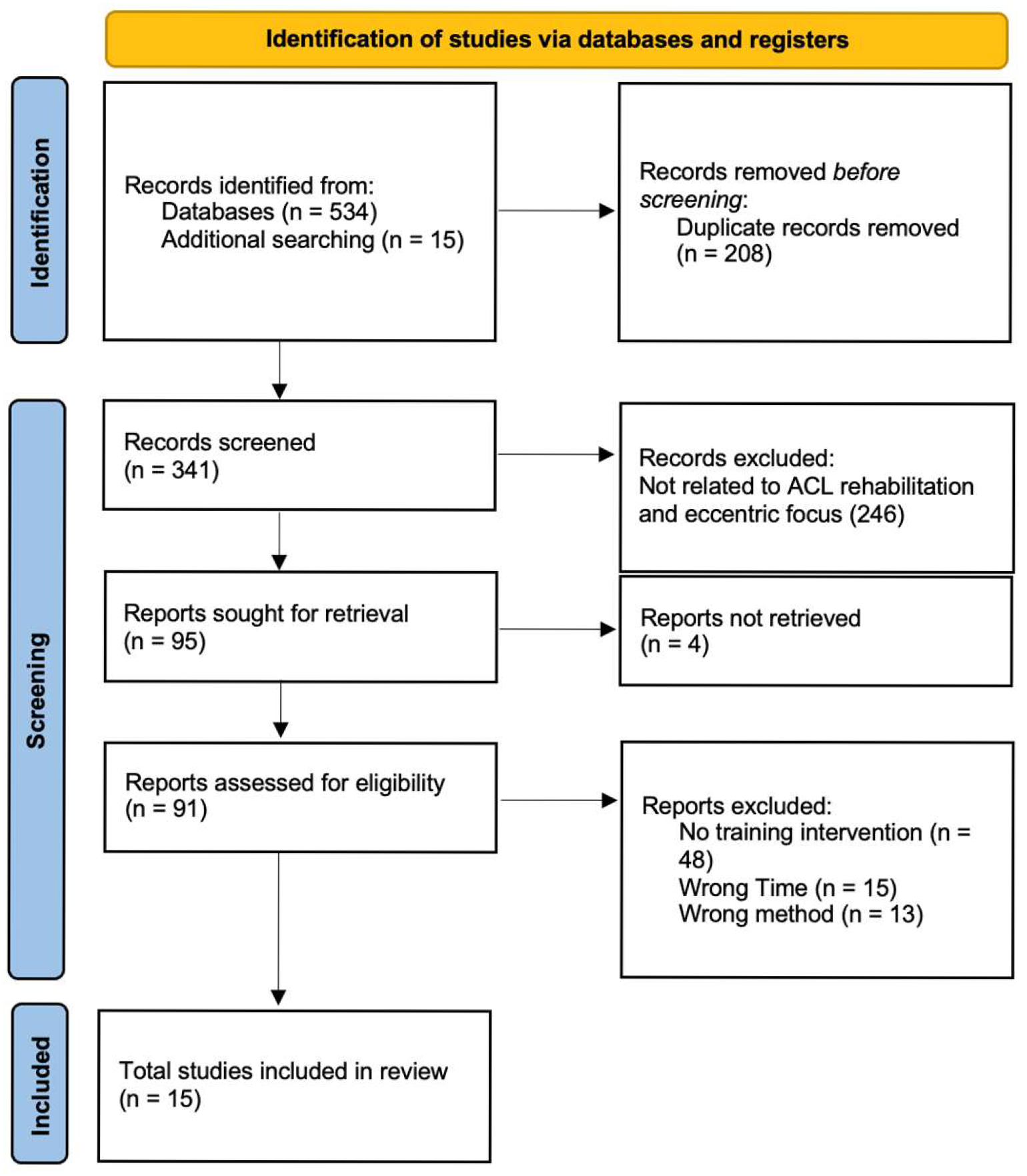
3.1. Search Results
3.2. Quality and Risk-of-Bias Assessment
4. Discussion
5. Conclusions
Supplementary Materials
Author Contributions
Funding
Institutional Review Board Statement
Informed Consent Statement
Data Availability Statement
Acknowledgments
Conflicts of Interest
Abbreviations
| ACL | Anterior cruciate ligament |
| ACLR | Anterior cruciate ligament reconstruction |
| RFD | Rate of force development |
| NMES | Neuromuscular electrical stimulation |
| RTS | Return to sport |
References
- Della Villa, F.; Di Paolo, S.; Buckthorpe, M. Editorial Commentary: Video Analysis of Football (Soccer) Injury Can Guide Rehabilitation and Recovery. Arthroscopy 2025, 41, 3663–3665. [Google Scholar] [CrossRef] [PubMed]
- Handford, M.; Bright, T.; Mundy, P.; Lake, J.; Theis, N.; Hughes, J. A Conceptual Framework of Different Eccentric Training Methods. Strength Cond. J. 2023, 46, 148–158. [Google Scholar] [CrossRef]
- Buckthorpe, M.; Gokeler, A.; Herrington, L.; Hughes, M.; Grassi, A.; Wadey, R.; Patterson, S.; Compagnin, A.; La Rosa, G.; Della Villa, F. Optimising the Early-Stage Rehabilitation Process Post-ACL Reconstruction. Sports Med. 2024, 54, 49–72. [Google Scholar] [CrossRef] [PubMed]
- Buckthorpe, M.; Della Villa, F. Optimising the ‘Mid-Stage’ Training and Testing Process After ACL Reconstruction. Sports Med. 2020, 50, 657–678. [Google Scholar] [CrossRef]
- Kotsifaki, A.; Van Rossom, S.; Whiteley, R.; Korakakis, V.; Bahr, R.; Sideris, V.; Jonkers, I. Single leg vertical jump performance identifies knee function deficits at return to sport after ACL reconstruction in male athletes. Br. J. Sports Med. 2022, 56, 490. [Google Scholar] [CrossRef]
- Kotsifaki, R.; Korakakis, V.; King, E.; Barbosa, O.; Maree, D.; Pantouveris, M.; Bjerregaard, A.; Luomajoki, J.; Wilhelmsen, J.; Whiteley, R. Aspetar clinical practice guideline on rehabilitation after anterior cruciate ligament reconstruction. Br. J. Sports Med. 2023, 57, 500. [Google Scholar] [CrossRef]
- Grindem, H.; Snyder-Mackler, L.; Moksnes, H.; Engebretsen, L.; Risberg, M.A. Simple decision rules can reduce reinjury risk by 84% after ACL reconstruction: The Delaware-Oslo ACL cohort study. Br. J. Sports Med. 2016, 50, 804. [Google Scholar] [CrossRef]
- Cheung, E.C.; DiLallo, M.; Feeley, B.T.; Lansdown, D.A. Osteoarthritis and ACL Reconstruction—Myths and Risks. Curr. Rev. Musculoskelet. Med. 2020, 13, 115–122. [Google Scholar] [CrossRef]
- Gerber, J.; Marcus, R.; Dibble, L.; Greis, P.; Burks, R.; LaStayo, P. Effects of Early Progressive Eccentric Exercise on Muscle Size and Function After Anterior Cruciate Ligament Reconstruction: A 1-Year Follow-up Study of a Randomized Clinical Trial. Phys. Ther. 2008, 89, 51–59. [Google Scholar] [CrossRef]
- Palmieri-Smith, R.M.; Thomas, A.C.; Wojtys, E.M. Maximizing Quadriceps Strength After ACL Reconstruction. Clin. Sports Med. 2008, 27, 405–424. [Google Scholar] [CrossRef]
- Paterno, M.; Schmitt, L.; Ford, K.; Rauh, M.; Myer, G.; Huang, B.; Hewett, T.E. Biomechanical Measures During Landing and Postural Stability Predict Second Anterior Cruciate Ligament Injury After Anterior Cruciate Ligament Reconstruction and Return to Sport. Am. J. Sports Med. 2010, 38, 1968–1978. [Google Scholar] [CrossRef] [PubMed]
- Zhong, J.; Yu, T.; Xiao, Y.; Wu, H. Accentuated eccentric loading in lower-body resistance training: A systematic review of acute and chronic adaptations on strength, power, and speed outcomes. Front. Physiol. 2026, 16, 1720205. [Google Scholar] [CrossRef] [PubMed]
- Colard, J.; Betus, Y.; Tallio, T.; Bizet, B.; Nordez, A.; Jubeau, M.; Cattagni, T. Eccentric training at long muscle lengths induces greater corticospinal and spinal reflex plasticity than eccentric training at short muscle lengths. Exp. Physiol. 2025, 110, 1990–2006. [Google Scholar] [CrossRef]
- Stasinaki, A.N.; Zaras, N.; Methenitis, S.; Bogdanis, G.; Terzis, G. Rate of force development and muscle architecture after fast and slow velocity eccentric training. Sports 2019, 7, 41. [Google Scholar] [CrossRef] [PubMed]
- Hu, Z.; Liu, Y.; Huang, K.; Huang, H.; Li, F.; Yuan, X. Comparing the Effect of Isoinertial Flywheel Training and Traditional Resistance Training on Maximal Strength and Muscle Power in Healthy People: A Systematic Review and Meta-Analysis. Life 2024, 14, 908. [Google Scholar] [CrossRef]
- Tricco, A.C.; Lillie, E.; Zarin, W.; O’Brien, K.K.; Colquhoun, H.; Levac, D.; Moher, D.; Peters, M.D.; Horsley, T.; Weeks, L.; et al. PRISMA extension for scoping reviews (PRISMA-ScR): Checklist and explanation. Ann. Intern. Med. 2018, 169, 467–473. [Google Scholar] [CrossRef] [PubMed]
- Ong, M.T.Y.; Chan, J.S.Y.; Man, G.C.W.; Qiu, J.; He, X.; Wang, Q.; Yung, P.S.H. Effect of eccentric isokinetic exercise on muscle strength and functional recovery after anterior cruciate ligament reconstruction. Asia-Pac. J. Sports Med. Arthrosc. Rehabil. Technol. 2024, 35, 20–26. [Google Scholar] [CrossRef]
- Vidmar, M.F.; Baroni, B.M.; Michelin, A.F.; Mezzomo, M.; Lugokenski, R.; Pimentel, G.L.; Silva, M.F. Isokinetic eccentric training is more effective than constant load eccentric training for quadriceps rehabilitation following anterior cruciate ligament reconstruction: A randomized controlled trial. Braz. J. Phys. Ther. 2020, 24, 424–432. [Google Scholar] [CrossRef]
- Henderson, F.J.; Konishi, Y.; Shima, N.; Shimokochi, Y. Effects of 8-Week Exhausting Deep Knee Flexion Flywheel Training on Persistent Quadriceps Weakness in Well-Trained Athletes Following Anterior Cruciate Ligament Reconstruction. Int. J. Environ. Res. Public Health 2022, 19, 13209. [Google Scholar] [CrossRef]
- Naczk, A.; Wieczorek, K.; Kaczorowski, P.; Gramza, P.; Gajewska, E.; Naczk, M. Effects of early inertial exercises on morphological and functional recovery after ACL reconstruction. Sci. Rep. 2026, 16, 8644. [Google Scholar] [CrossRef]
- Milandri, G.; Sivarasu, S. A Randomized Controlled Trial of Eccentric Versus Concentric Cycling for Anterior Cruciate Ligament Reconstruction Rehabilitation. Am. J. Sports Med. 2021, 49, 363546520987566. [Google Scholar] [CrossRef]
- Kasmi, S.; Zouhal, H.; Hammami, R.; Clark, C.C.; Hackney, A.C.; Hammami, A.; Chtara, M.; Chortane, S.G.; Salah, F.Z.B.; Granacher, U.; et al. The Effects of Eccentric and Plyometric Training Programs and Their Combination on Stability and the Functional Performance in the Post-ACL-Surgical Rehabilitation Period of Elite Female Athletes. Front. Physiol. 2021, 12, 688385. [Google Scholar] [CrossRef] [PubMed]
- Kasmi, S.; Sariati, D.; Hammami, R.; Clark, C.C.T.; Chtara, M.; Hammami, A.; Salah, F.Z.B.; Saeidi, A.; Ounis, O.B.; Granacher, U.; et al. The effects of different rehabilitation training modalities on isokinetic muscle function and male athletes’ psychological status after anterior cruciate ligament reconstructions. BMC Sports Sci. Med. Rehabil. 2023, 15, 43. [Google Scholar] [CrossRef] [PubMed]
- Gerber, J.; Marcus, R.; Dibble, L.; Greis, P.; LaStayo, P. Early Application of Negative Work via Eccentric Ergometry Following Anterior Cruciate Ligament Reconstruction: A Case Report. J. Orthop. Sports Phys. Ther. 2006, 36, 298–307. [Google Scholar] [CrossRef]
- Gerber, J.P.; Marcus, R.L.; Dibble, L.E.; Greis, P.E.; Burks, R.T.; LaStayo, P.C. Effects of early progressive eccentric exercise on muscle structure after anterior cruciate ligament reconstruction. J. Bone Jt. Surg. 2007, 89, 559–570. [Google Scholar] [CrossRef]
- Coury, H.J.C.G.; Brasileiro, J.S.; Salvini, T.F.; Poletto, P.R.; Carnaz, L.; Hansson, G.A. Change in knee kinematics during gait after eccentric isokinetic training for quadriceps in subjects submitted to anterior cruciate ligament reconstruction. Gait Posture 2006, 24, 370–374. [Google Scholar] [CrossRef]
- Lepley, L.; Wojtys, E.; Palmieri-Smith, R. Combination of Eccentric Exercise and Neuromuscular Electrical Stimulation to Improve Quadriceps Function Post-ACL Reconstruction. Knee 2014, 22, 270–277. [Google Scholar] [CrossRef]
- Norte, G.E.; Glaviano, N.R.; Sherman, D.A.; Rush, J.L.; Murray, A.M. Four-week Nordic hamstring exercise intervention for individuals with ACL reconstruction via hamstrings tendon autograft: Feasibility of a pilot randomized controlled trial. Pilot. Feasibility Stud. 2025, 11, 37. [Google Scholar] [CrossRef]
- Stojanović, M.D.M.; Andrić, N.; Mikić, M.; Vukosav, N.; Vukosav, B.; Zolog-Șchiopea, D.N.; Tăbăcar, M.; Melinte, R.M. Effects of Eccentric-Oriented Strength Training on Return to Sport Criteria in Late-Stage Anterior Cruciate Ligament (ACL)-Reconstructed Professional Team Sport Players. Medicina 2023, 59, 1111. [Google Scholar] [CrossRef] [PubMed]
- Brasileiro, J.; Pinto, O.; Avila, M.; Salvini, T. Functional and morphological changes in the quadriceps muscle induced by eccentric training after ACL reconstruction. Rev. Bras. Fisioter. 2011, 15, 284–290. [Google Scholar] [CrossRef]
- Patra, R.C.; Gupta, S.; Yashudas, A.; Mahajan, S. Effects of isoinertial training on muscle power, endurance, isometric strength, and balance: Randomized clinical trial in patients with post-ACL reconstruction. Trials 2025, 26, 257. [Google Scholar] [CrossRef]
- Page, M.J.; McKenzie, J.E.; Bossuyt, P.M.; Boutron, I.; Hoffmann, T.C.; Mulrow, C.D.; Shamseer, L.; Tetzlaff, J.M.; Akl, E.A.; Brennan, S.E.; et al. The PRISMA 2020 statement: An updated guideline for reporting systematic reviews. BMJ 2021, 372, n71. [Google Scholar] [CrossRef]


| Author (Year) | Study Design | Eccentric Modality | Duration | Main Outcomes | Key Findings |
|---|---|---|---|---|---|
| Ong et al. (2024) [17] | Non-RCT—prospective cohort study | Isokinetic eccentric exercise | 6 weeks | Isokinetic peak torque, functional tests | Improved strength and functional recovery |
| Vidmar et al. (2020) [18] | RCT | Isokinetic eccentric vs. constant-load eccentric | 6 weeks | Quadriceps isometric and eccentric isokinetic strength, hypertrophy, hop tests | Isokinetic eccentric training reported improvements |
| Milandri & Sivarasu (2021) [21] | RCT | Eccentric vs. concentric cycling | 6–8 weeks | Strength, gait biomechanics | Eccentric cycling was associated with greater improvements |
| Kasmi et al. (2021) [22] | RCT | Eccentric vs. plyometric vs. combined training | 6 weeks | Stability, knee function, RSI, hop test | Combined eccentric–plyometric training was associated with improvements in stability and functional performance |
| Gerber et al. (2007) [25] | RCT | Early progressive eccentric exercise | 12 weeks | Muscle size, strength, function | Increased hypertrophy and strength |
| Brasileiro et al. (2011) [30] | Non-RCT—clinical trial | Eccentric quadriceps training | 12 weeks | Muscle morphology, strength | Increased muscle volume and strength |
| Coury et al. (2006) [26] | Non-RCT | Isokinetic eccentric training | 6 weeks | Gait kinematics | Improved knee kinematics |
| Lepley et al. (2014) [27] | Non-RCT | Eccentric + NMES | 6 weeks | Quadriceps function | Combined therapy was associated with improved quadriceps function |
| Norte et al. (2025) [28] | RCT | Nordic hamstring exercise | 4 weeks | Hamstring strength | Feasible and improved hamstring strength |
| Gerber et al. (2006) [24] | Case report | Eccentric ergometry (negative work) | Early phase | Strength | Safe and feasible |
| Stojanović et al. (2023) [29] | RCT | Flywheel vs. traditional | 6–8 weeks | Strength, hop tests, RTS criteria | Reported improvements in strength and a higher proportion meeting RTS criteria |
| Patra et al. (2025) [31] | RCT | Flywheel vs. traditional | 6 weeks | Strength, strength endurance, isometric strength, balance | Was associated with improvements in eccentric strength and endurance strength |
| Henderson et al. (2022) [19] | Non-RCT | Flywheel Bulgarian squat | 8 weeks | RFD, MVIC, CAR | Was associated with RFD (early force production); MVIC improved mainly in weaker individuals; no change in CAR |
| Kasmi et al. (2023) [23] | RCT | Eccentric + plyometric training (COMB) | 6 weeks | Isokinetic peak torque, KOOS, IKDC, TSK-CF | Combined training was associated with improvements in strength and psychological outcomes compared to eccentric or plyometric alone |
| Naczk et al. (2026) [20] | RCT | Inertial (eccentric overload, flywheel) training | 12 weeks | Isokinetic strength, inertial strength, muscle mass, balance | Improved interlimb symmetry and muscle mass; no additional effect on isokinetic strength vs. standard rehab |
| Author (Year) | Study Design | n (Groups) | Age (Mean ± SD) | Sex | Time After ACLR | Graft Type |
|---|---|---|---|---|---|---|
| Ong et al. (2024) [17] | Non-RCT prospective cohort study | EXP: 18/CON: 18 | EXP: 26.3 ± 6.7; CON: 25.6 ± 4.3 | EXP: 14 M 4 F, CON: 17 M, 1 F | 18.8 ± 3.1 vs. 19.9 ± 3.4 weeks | Hamstring |
| Vidmar et al. (2020) [18] | RCT | EXP: 15/CON 15 | EXP: 26.9 ± 5.8; CON: 24.3 ± 4.6 | Male only | ~6 weeks (start), ~3 months (post-test) | Hamstring |
| Milandri & Sivarasu (2021) [21] | RCT | 30 EXP: 15/CON: 15 | EXP: 37.4 ± 10.7 CON: 28.6 ± 6.8 | Male only | 10–16 weeks | Hamstring |
| Kasmi et al. (2021) [22] | RCT | 40 (10/10/10/10) | 20.3 ± 3.2 | Female only | 14 weeks | BPTB |
| Gerber et al. (2007) [25] | RCT | EXP: 20/CON: 20 | 18–50 years (range) | Mixed | 3 weeks (start) | HT + BTB |
| Brasileiro et al. (2011) [30] | Non-RCT—clinical trial | 9 | 31.3 ± 5.8 | Male only | 9.4 ± 0.7 months | BPTB |
| Coury et al. (2006) [26] | Non-RCT | EXP: 5/CON: 10 | 32 ± 7.8 | Male only | 9 ± 1.3 months | BPTB |
| Lepley et al. (2014) [27] | Non-RCT | 36 EXP/10 CON | 21.9 ± 4.9 | 17 F/29 M | 6 days (NMES), 6 weeks (ECC start) | BPTB + HT |
| Norte et al. (2025) [28] | RCT | EXP: 19/CON: 6 | EXP: 22.8 ± 3.0; CON: 21.8 ± 3.3 | 14 F/11 M | 49.4 ± 26.5 vs. 43.2 ± 23.1 months | Hamstring |
| Gerber et al. (2006) [24] | Case report | 1 | 26 | Male only | 3 weeks | HT -> BPTB revision |
| Stojanović et al. (2023) [29] | RCT | 22 (EXP: 11/CON: 11) | 19.9 ± 4.4 | 14 M/8 F | 5–6 months | BPTB |
| Patra et al. (2025) [31] | RCT | 96 (EXP: 47/CON: 49) | NR | 88 M/8 F | 3 weeks | NR |
| Henderson et al. (2022) [19] | Non-RCT | 11 | 20.8 ± 2.7 | Mixed | 546 ± 308 days | HT + BPTB + QT |
| Kasmi et al. (2023) [23] | RCT | 40 (10/10/10/10) | 20.3 ± 3 | Male only | ~14 weeks | BPTB |
| Naczk et al. (2026) [20] | RCT | 24 (12/12) | 36.7 ± 11.1 | 5 F/19 M | 2 weeks (baseline), from week 7 | Hamstring (ST + gracilis) |
| Rehabilitation Phase | Included Studies | Focus in Studies | What Is Still Missing |
|---|---|---|---|
| Early (0–12 weeks) | Gerber et al. 2006 [24]; Gerber et al. 2007 [25]; Vidmar et al. (2020) [18]; Lepley et al. 2014 [27]; Patra et al. 2025 [31]; Naczk et al. 2026 [20] | Quadriceps activation; prevention of muscle atrophy; graft-related muscle deficits; controlled eccentric loading (isokinetic, ergometry, NMES) | Limited assessment of functional force production; minimal evaluation of multi-joint strength; absence of kinetic or performance-based measures |
| Mid (3–6 months) | Ong et al. 2024 [17]; Kasmi et al. 2021 [22]; Kasmi et al. 2023 [23]; Milandri & Sivarasu 2021 [21] | Quadriceps and hamstring strength; introduction of eccentric cycling and combined eccentric–plyometric training; hop performance | Limited evaluation of other muscle groups (calf, hip abductors/adductors, gluteus muscles); lack of comprehensive strength profiling; limited jump mechanics and force-time analysis |
| Late (>6 months/RTS/post-rehabilitation) | Coury et al. 2006 [26]; Stojanović et al. 2023 [29]; Norte et al. 2025 [28]; Brasileiro et al. 2011 [30]; Henderson et al. 2022 [19] | Return-to-sport criteria; flywheel training; Nordic hamstring; functional symmetry and performance | Very limited number of flywheel studies; scarce prospective data on reinjury risk; limited biomechanical and longitudinal outcomes |
| Study | Phase | Training Type | Frequency | Volume (Sets × Reps) | Load/Intensity | Progression |
|---|---|---|---|---|---|---|
| Gerber et al. (2007) [25] | Early (3 weeks) | Progressive eccentric (negative work) | 3–5×/week | 3–4 sets × 8–12 reps | High-load eccentric (supramaximal possible) | Gradual increase in resistance over 12 weeks |
| Gerber et al. (2006) [24] | Early (3 weeks) | Eccentric ergometry | 3–5×/week | 5–30 min/session | Progressive negative work (ergometer) | Duration + intensity increased |
| Lepley et al. (2014) [27] | Early (~6 weeks) | Eccentric + NMES | 3×/week | 3–4 sets × 8–12 reps | ~60–70% MVC + NMES | Constant load, neural stimulus via NMES |
| Patra et al. (2025) [31] | Early (3 weeks) | Flywheel (squat, lunge) | 2×/week | 3 × 10 per exercise | 0.02 → progressive inertia | Weekly increase (0.005–0.01 kg·m2) |
| Vidmar et al. (2020) [18] | Early–mid | Isokinetic eccentric | 2×/week | 3–4 sets × 10 reps | Controlled velocity | Constant velocity |
| Naczk et al. (2026) [20] | Early–mid (~7 weeks) | Flywheel | 2–3×/week | Not fixed (multi-set) | 60 → 80% uninvolved limb | +10% every 2 weeks |
| Milandri & Sivarasu (2021) [21] | Mid | Eccentric cycling | 2–3×/week | ~3–4 × 8–12 min blocks | Submaximal (RPE) | Load via resistance control |
| Kasmi et al. (2023) [23] | Mid (~14 weeks) | ECC vs. PLYO vs. COMB | 2×/week | ~2–3 sets × multiple exercises | Moderate–high | Progressive overload |
| Kasmi et al. (2021) [22] | Mid (~14 weeks) | ECC vs. PLYO vs. COMB | 2×/week | ~2–3 sets | Moderate–high | Progressive overload |
| Stojanović et al. (2023) [29] | Mid–late | Flywheel | 2–3×/week | 2 × 6 → 3 × 10 | High inertia (0.075 kg·m2) | Volume progression |
| Ong et al. (2024) [17] | Early–mid | Isokinetic eccentric | 2–3×/week | 3–4 × 6–10 reps | 60–180°/s | Velocity-based |
| Coury et al. (2006) [26] | Late | Isokinetic eccentric | 2×/week | 3 × 10 reps | 30°/s maximal | Constant |
| Brasileiro et al. (2011) [30] | Late | Isokinetic eccentric | 2×/week | 3 × 10 reps | 30°/s maximal | Constant |
| Henderson et al. (2022) [19] | Late | Flywheel Bulgarian squat | 2×/week | 1 set to failure | 0.025–0.075 kg·m2 | Inertia progression |
| Norte et al. (2025) [28] | Late | Nordic hamstring | 2×/week | 3 × 6–10 reps | Bodyweight | Increasing reps |
| Study | Random Allocation | Allocation Concealed | Baseline Comparability | Blinding Subjects | Blinding Therapists | Blinding Assessors | Follow-Up > 85% | Intention-to-Treat | Between-Group Comparison | Point Estimates & Variability | Total Score (/10) |
|---|---|---|---|---|---|---|---|---|---|---|---|
| Milandri & Sivarasu (2021) [21] | 1 | 1 | 1 | 0 | 0 | 0 | 1 | 0 | 1 | 1 | 6 |
| Vidmar et al. (2020) [18] | 1 | 0 | 1 | 0 | 0 | 1 | 1 | 0 | 1 | 1 | 6 |
| Patra et al. (2025) [31] | 1 | 1 | 1 | 0 | 0 | 1 | 1 | 0 | 1 | 1 | 7 |
| Gerber et al. (2007) [25] | 1 | 0 | 1 | 0 | 0 | 1 | 1 | 0 | 1 | 1 | 6 |
| Norte et al. (2025) [28] | 1 | 1 | 1 | 0 | 0 | 1 | 1 | 0 | 1 | 1 | 7 |
| Stojanović et al. (2023) [29] | 1 | 0 | 1 | 0 | 0 | 1 | 1 | 0 | 1 | 1 | 6 |
| Kasmi et al. (2023) [23] | 1 | 0 | 1 | 0 | 0 | 1 | 1 | 0 | 1 | 1 | 6 |
| Kasmi et al. (2021) [22] | 1 | 0 | 1 | 0 | 0 | 1 | 1 | 0 | 1 | 1 | 6 |
| Naczk et al. (2026) [20] | 1 | 1 | 1 | 0 | 0 | 1 | 1 | 0 | 1 | 1 | 7 |
| Study | Confounding | Selection of Participants | Classification of Intervention | Deviations from Intervention | Missing Data | Measurement of Outcomes | Reporting Bias | Overall Risk |
|---|---|---|---|---|---|---|---|---|
| Ong et al. (2024) [17] | Moderate | Moderate | Low | Moderate | Low | Low | Low | Moderate |
| Coury et al. (2006) [26] | Moderate | Moderate | Low | Moderate | Low | Moderate | Moderate | Moderate |
| Lepley et al. (2014) [27] | Moderate | Moderate | Low | Moderate | Low | Low | Moderate | Moderate |
| Henderson et al. (2022) [19] | Moderate | Moderate | Low | Moderate | Low | Low | Low | Moderate |
| Brasileiro et al. (2011) [30] | High | Moderate | Low | Moderate | Low | Moderate | Moderate | High |
Disclaimer/Publisher’s Note: The statements, opinions and data contained in all publications are solely those of the individual author(s) and contributor(s) and not of MDPI and/or the editor(s). MDPI and/or the editor(s) disclaim responsibility for any injury to people or property resulting from any ideas, methods, instructions or products referred to in the content. |
© 2026 by the authors. Published by MDPI on behalf of the Lithuanian University of Health Sciences. Licensee MDPI, Basel, Switzerland. This article is an open access article distributed under the terms and conditions of the Creative Commons Attribution (CC BY) license.
Share and Cite
Žigmund, B.; Zemková, E. Eccentric-Oriented Strength Training in Anterior Cruciate Ligament Rehabilitation: A Scoping Review. Medicina 2026, 62, 1109. https://doi.org/10.3390/medicina62061109
Žigmund B, Zemková E. Eccentric-Oriented Strength Training in Anterior Cruciate Ligament Rehabilitation: A Scoping Review. Medicina. 2026; 62(6):1109. https://doi.org/10.3390/medicina62061109
Chicago/Turabian StyleŽigmund, Boris, and Erika Zemková. 2026. "Eccentric-Oriented Strength Training in Anterior Cruciate Ligament Rehabilitation: A Scoping Review" Medicina 62, no. 6: 1109. https://doi.org/10.3390/medicina62061109
APA StyleŽigmund, B., & Zemková, E. (2026). Eccentric-Oriented Strength Training in Anterior Cruciate Ligament Rehabilitation: A Scoping Review. Medicina, 62(6), 1109. https://doi.org/10.3390/medicina62061109