Association Between Bioelectrical Impedance-Derived Phase Angle and Functional Status in Post-Stroke Patients: A Retrospective Analysis

Abstract
1. Introduction
2. Materials and Methods
2.1. Study Design and Data Source
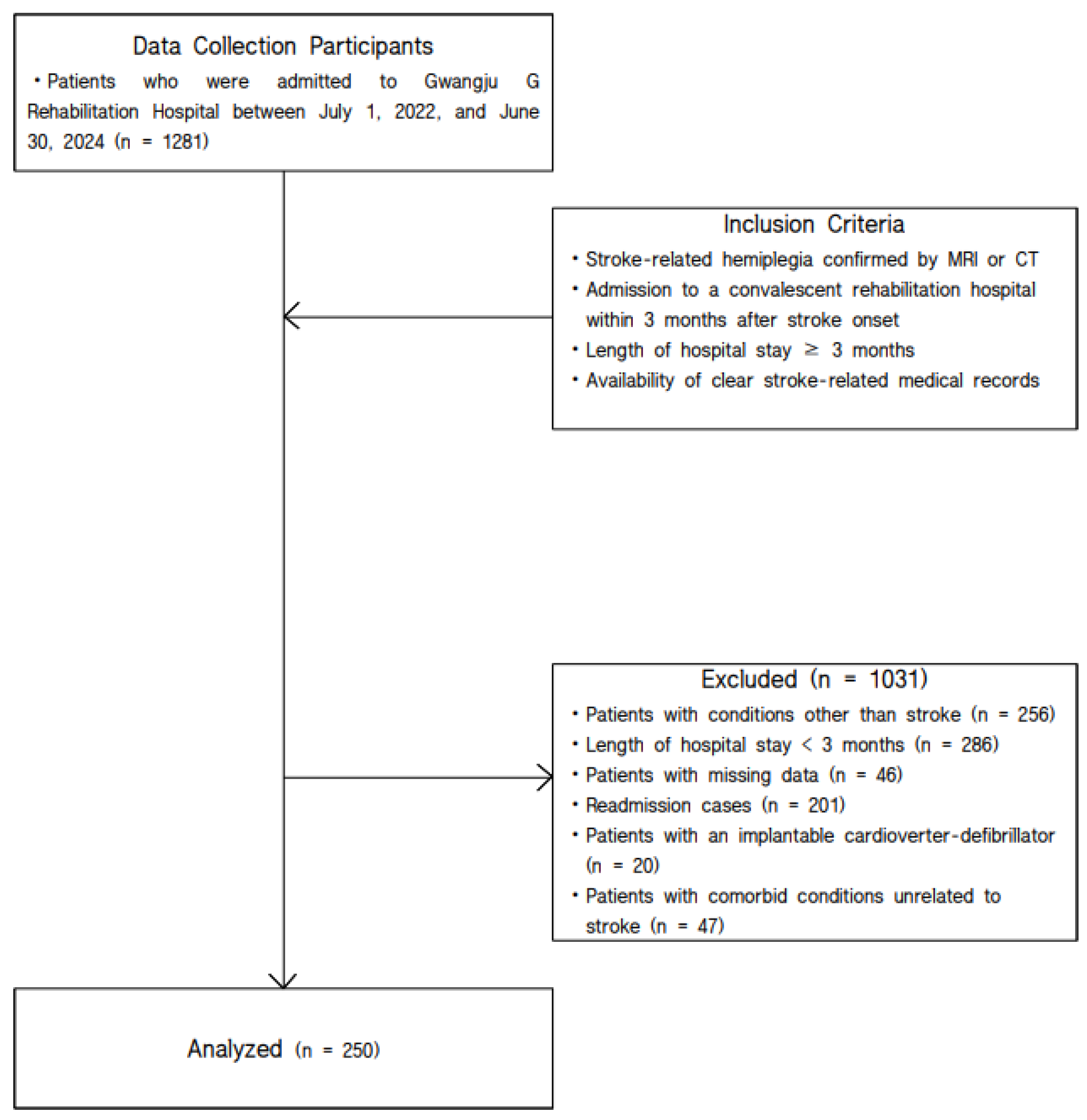
2.2. Study Participants
2.3. Subsection
2.3.1. Body Composition Measurement
2.3.2. Functional Assessments
2.4. Statistical Analysis
3. Results
3.1. General Characteristics of the Participants
3.2. Comparison of Functional Outcomes According to Phase Angle Groups
3.3. Associations Between Phase Angle and Functional Variables
4. Discussion
5. Conclusions
Author Contributions
Funding
Institutional Review Board Statement
Informed Consent Statement
Data Availability Statement
Conflicts of Interest
Abbreviations
| ADL | Activities of daily living |
| BIA | Bioelectrical impedance analysis |
| PhA | Phase angle |
| BBS | Berg balance scale |
| FAC | Functional ambulation category |
| K-MBI | Korean version of the modified Barthel index |
| OR | Odds ratio |
| aOR | Adjusted odds ratio |
| CI | Confidence interval |
References
- Murphy, S.J.; Werring, D.J. Stroke: Causes and clinical features. Medicine 2020, 48, 561–566. [Google Scholar] [CrossRef] [PubMed]
- GBD 2021 Stroke Risk Factor Collaborators. Global, regional, and national burden of stroke and its risk factors, 1990–2021: A systematic analysis for the Global Burden of Disease Study 2021. Lancet Neurol. 2024, 23, 973–1003. [CrossRef]
- Einstad, M.S.; Saltvedt, I.; Lydersen, S.; Ursin, M.H.; Munthe-Kaas, R.; Ihle-Hansen, H.; Knapskog, A.B.; Askim, T.; Beyer, M.K.; Næss, H.; et al. Associations between post-stroke motor and cognitive function: A cross-sectional study. BMC Geriatr. 2021, 21, 103. [Google Scholar] [CrossRef] [PubMed]
- Chun, J.Y.; Kim, B.G.; Park, C.B.; Cho, W.S. Association of Lower-Limb Muscle Strength Asymmetry and Functional Factors in Patients with Stroke. J. Int. Acad. Phys. Ther. Res. 2023, 14, 2951–2956. [Google Scholar] [CrossRef]
- Shin, S.; Lee, Y.; Chang, W.H.; Sohn, M.K.; Lee, J.; Kim, D.Y.; Shin, Y.I.; Oh, G.J.; Lee, Y.S.; Joo, M.C.; et al. Multifaceted Assessment of Functional Outcomes in Survivors of First-time Stroke. JAMA Netw. Open 2022, 5, e2233094. [Google Scholar] [CrossRef]
- Kim, S.Y.; Cho, W.S.; Park, C.B.; Kim, B.G. Effect of Sarcopenia on Functional Recovery in Acute Stroke Patients Admitted for Standard Rehabilitation Program. Medicina 2024, 60, 1716. [Google Scholar] [CrossRef] [PubMed]
- Aguiar, L.T.; Camargo, L.B.A.; Estarlino, L.D.; Teixeira-Salmela, L.F.; Faria, C.D.C.M. Strength of the lower limb and trunk muscles is associated with gait speed in individuals with sub-acute stroke: A cross-sectional study. Braz. J. Phys. Ther. 2018, 22, 459–466. [Google Scholar] [CrossRef]
- Rodrigues, L.P.; Camerin, C.; Bittencourt, R.D. Gait, balance and functional independence level in stroke patients. Clin. Biomed. Res. 2022, 42, 308–312. [Google Scholar] [CrossRef]
- Yamamoto, H.; Takeda, K.; Koyama, S.; Morishima, K.; Hirakawa, Y.; Motoya, I.; Sakurai, H.; Kanada, Y.; Kawamura, N.; Kawamura, M.; et al. Relationship between upper limb motor function and activities of daily living after removing the influence of lower limb motor function in subacute patients with stroke: A cross-sectional study. Hong Kong J. Occup. Ther. 2020, 33, 12–17. [Google Scholar] [CrossRef]
- Chen, H.; Fu, C.; Fang, W.; Wang, Z.; Zhang, D.; Zhang, H. Influence of nutritional status on rehabilitation efficacy of patients after stroke-a scoping review. Front. Neurol. 2025, 16, 1502772. [Google Scholar] [CrossRef]
- Huang, S.; Fan, H.; Shi, Y.; Hu, Y.; Gu, Z.; Chen, Y. Immune biomarkers are associated with poststroke fatigue at six months in patients with ischemic stroke. J. Clin. Neurosci. 2022, 101, 228–233. [Google Scholar] [CrossRef]
- Irisawa, H.; Mizushima, T. Correlation of Body Composition and Nutritional Status with Functional Recovery in Stroke Rehabilitation Patients. Nutrients 2020, 12, 1923. [Google Scholar] [CrossRef]
- Guerrini, A.; Siotto, M.; Germanotta, M.; Cipollini, V.; Cortellini, L.; Pavan, A.; Insalaco, S.; Khazrai, Y.M.; Aprile, I. Muscle quality improvement in subacute post-stroke patients after rehabilitation: Usefulness of segmental phase angle from bioelectrical impedance analysis. Clin. Nutr. 2024, 43, 224–231. [Google Scholar] [CrossRef] [PubMed]
- Choi, A.Y.; Lim, J.H.; Kim, B.G. Effects of muscle strength exercise on muscle mass and muscle strength in patients with stroke: A systematic review and meta-analysis. J. Exerc. Rehabil. 2024, 20, 146–157. [Google Scholar] [CrossRef] [PubMed]
- Gheri, C.F.; Scalfi, L.; Luisi, M.L.E.; Di Vincenzo, O. Bioelectrical impedance analysis (BIA) phase angle in stroke patients: A systematic review. Clin. Nutr. 2024, 43, 63–72. [Google Scholar] [CrossRef]
- Yoneda, K.; Yoshimura, Y.; Wakabayashi, H.; Matsumoto, A.; Nagano, F.; Shimazu, S.; Kido, Y.; Bise, T.; Hamada, T.; Shiraishi, A. Increased Phase Angle Reflects Improvement in Activities of Daily Living and Muscle Health in Post-Stroke Rehabilitation. Ann. Geriatr. Med. Res. 2025, in press. [Google Scholar] [CrossRef]
- Lukaski, H.C.; Garcia-Almeida, J.M. Phase angle in applications of bioimpedance in health and disease. Rev. Endocr. Metab. Disord. 2023, 24, 367–370. [Google Scholar] [CrossRef]
- Ohtsubo, T.; Nozoe, M.; Kanai, M.; Ueno, K.; Nakayama, M. Effects of muscle mass and muscle quality estimated by phase angle on functional outcomes in older patients undergoing rehabilitation: A prospective cohort study. Nutr. Clin. Pract. 2023, 38, 148–156. [Google Scholar] [CrossRef]
- Norman, K.; Herpich, C.; Müller-Werdan, U. Role of phase angle in older adults with focus on the geriatric syndromes sarcopenia and frailty. Rev. Endocr. Metab. Disord. 2023, 24, 429–437. [Google Scholar] [CrossRef]
- Przysada, G.; Czenczek-Lewandowska, E.; Wyszyńska, J.; Weres, A.; Baran, J.; Kwolek, A.; Leszczak, J. Effect of Post-Stroke Rehabilitation on Body Mass Composition in Relation to Socio-Demographic and Clinical Factors. Int. J. Environ. Res. Public Health 2020, 17, 5134. [Google Scholar] [CrossRef] [PubMed]
- Guerrini, A.; Siotto, M.; Cocco, C.; Germanotta, M.; Cipollini, V.; Cortellini, L.; Pavan, A.; Lattanzi, S.; Insalaco, S.; Khazrai, Y.M.; et al. Usefulness of body composition assessment by bioelectrical impedance vector analysis in subacute post-stroke patients in rehabilitation. Sci. Rep. 2025, 15, 1774. [Google Scholar] [CrossRef] [PubMed]
- Lisabeth, L.D.; Reeves, M.J.; Baek, J.; Skolarus, L.E.; Brown, D.L.; Zahuranec, D.B.; Smith, M.A.; Morgenstern, L.B. Factors influencing sex differences in poststroke functional outcome. Stroke 2015, 46, 860–863. [Google Scholar] [CrossRef]
- Sato, Y.; Yoshimura, Y.; Abe, T.; Nagano, F.; Matsumoto, A.; Wakabayashi, H. Change in phase angle is associated with improvement in activities of daily living and muscle function in patients with acute stroke. Eur. Geriatr. Med. 2023, 14, 1333–1341. [Google Scholar] [CrossRef] [PubMed]
- Amakasu, K.; Inoue, T.; Watanabe, Y. Low phase angle: A predictor of functional status and discharge disposition in acute stroke older patients. Clin. Nutr. ESPEN 2024, 61, 197–202. [Google Scholar] [CrossRef]
- Tanaka, H.; Kitamura, G.; Tamura, M.; Nankaku, M.; Taniguchi, M.; Shide, K.; Fujita, M.; Ida, M.; Oshima, S.; Kikuchi, T.; et al. Phase angle and nutrition in the acute phase are associated with the subsequent recovery of activities of daily living ability after stroke. Clin. Neurol. Neurosurg. 2025, 258, 109168. [Google Scholar] [CrossRef]
- Yang, J.; Kim, J.; Chun, B.C.; Lee, J.M. Cook with Different Pots, but Similar Taste? Comparison of Phase Angle Using Bioelectrical Impedance Analysis According to Device Type and Examination Posture. Life 2023, 13, 1119. [Google Scholar] [CrossRef]
- Sato, Y.; Yoshimura, Y.; Abe, T. Phase Angle as an Indicator of Baseline Nutritional Status and Sarcopenia in Acute Stroke. J. Stroke Cerebrovasc. Dis. 2022, 31, 106220. [Google Scholar] [CrossRef]
- Chen, L.K.; Woo, J.; Assantachai, P.; Auyeung, T.W.; Chou, M.Y.; Iijima, K.; Jang, H.C.; Kang, L.; Kim, M.; Kim, S.; et al. Asian Working Group for Sarcopenia: 2019 Consensus Update on Sarcopenia Diagnosis and Treatment. J. Am. Med. Dir. Assoc. 2020, 21, 300–307.e2. [Google Scholar] [CrossRef]
- Blum, L.; Korner-Bitensky, N. Usefulness of the Berg Balance Scale in stroke rehabilitation: A systematic review. Phys. Ther. 2008, 88, 559–566. [Google Scholar] [CrossRef]
- Mehrholz, J.; Wagner, K.; Rutte, K.; Meissner, D.; Pohl, M. Predictive validity and responsiveness of the functional ambulation category in hemiparetic patients after stroke. Arch. Phys. Med. Rehabil. 2007, 88, 1314–1319. [Google Scholar] [CrossRef] [PubMed]
- Jung, H.Y.; Park, B.K.; Shin, H.S.; Kang, Y.K.; Pyun, S.B.; Paik, N.J.; Kim, S.H.; Kim, T.H.; Han, T.R. Development of the Korean version of Modified Barthel Index (K-MBI): Multi-center study for subjects with stroke. Ann. Rehabil. Med. 2007, 31, 283–297. [Google Scholar]
- Akamatsu, Y.; Kusakabe, T.; Arai, H.; Yamamoto, Y.; Nakao, K.; Ikeue, K.; Ishihara, Y.; Tagami, T.; Yasoda, A.; Ishii, K.; et al. Phase angle from bioelectrical impedance analysis is a useful indicator of muscle quality. J. Cachexia Sarcopenia Muscle 2022, 13, 180–189. [Google Scholar] [CrossRef] [PubMed]
- Yamada, Y.; Yoshida, T.; Murakami, H.; Kawakami, R.; Gando, Y.; Ohno, H.; Tanisawa, K.; Konishi, K.; Julien, T.; Kondo, E.; et al. Phase angle obtained via bioelectrical impedance analysis and objectively measured physical activity or exercise habits. Sci. Rep. 2022, 12, 17274. [Google Scholar] [CrossRef]
- Yamanaka, A.; Yasui-Yamada, S.; Furumoto, T.; Kubo, M.; Hayashi, H.; Kitao, M.; Wada, K.; Ohmae, N.; Kamimura, S.; Shimada, A.; et al. Association of phase angle with muscle function and prognosis in patients with head and neck cancer undergoing chemoradiotherapy. Nutrition 2022, 103–104, 111798. [Google Scholar] [CrossRef] [PubMed]
- Matias, C.N.; Nunes, C.L.; Francisco, S.; Tomeleri, C.M.; Cyrino, E.S.; Sardinha, L.B.; Silva, A.M. Phase angle predicts physical function in older adults. Arch. Gerontol. Geriatr. 2020, 90, 104151. [Google Scholar] [CrossRef] [PubMed]
- Sato, M.; Ishizaka, M.; Endo, Y.; Hirose, M.; Ohira, K.; Kubo, A. Sex-based differences in body composition and functional independence affecting discharge destination in patients undergoing convalescent rehabilitation. J. Phys. Ther. Sci. 2025, 37, 367–371. [Google Scholar] [CrossRef]
- Lai, S.M.; Duncan, P.W.; Dew, P.; Keighley, J. Sex differences in stroke recovery. Prev. Chronic. Dis. 2005, 2, A13. [Google Scholar]
- Mavridis, A.; Reinholdsson, M.; Sunnerhagen, K.S.; Abzhandadze, T. Predictors of functional outcome after stroke: Sex differences in older individuals. J. Am. Geriatr. Soc. 2024, 72, 2100–2110. [Google Scholar] [CrossRef]
- Wiley, E.; Noguchi, K.S.; Moncion, K.; Stratford, P.W.; Tang, A. Sex Differences in Functional Capacity in Older Adults with Stroke: An Analysis of Data from the National Health and Aging Trends Study. Phys. Ther. 2022, 102, pzac077. [Google Scholar] [CrossRef]
- de Moraes, A.M.; Quinaud, R.T.; Ferreira, G.O.C.; Lima, A.B.; Carvalho, H.M.; Guerra-Júnior, G. Age-, sex-, and maturity-associated variation in the phase angle after adjusting for size in adolescents. Front. Nutr. 2022, 9, 939714. [Google Scholar] [CrossRef]
- Wilhelm-Leen, E.R.; Hall, Y.N.; Horwitz, R.I.; Chertow, G.M. Phase angle, frailty and mortality in older adults. J. Gen. Intern. Med. 2014, 29, 147–154. [Google Scholar] [CrossRef] [PubMed]


| Variables | Male | Female | ||||||
|---|---|---|---|---|---|---|---|---|
| Total | High PhA | Low PhA | p | Total | High PhA | Low PhA | p | |
| Stroke Etiology (ischemic/ hemorrhagic) | 65/54 | 27/17 | 38/37 | 0.258 | 74/57 | 33/27 | 41/30 | 0.752 |
| Affected side (right/left /bilateral /quadriplegia) | 48/61/1/9 | 23/20/0/1 | 25/41/1/8 | 0.107 | 61/60/0/11 | 34/24/0/4 | 27/36/0/7 | 0.073 |
| Sarcopenia (Yes/No) | 53/66 | 11/33 | 42/33 | 0.001 * | 59/72 | 16/44 | 43/28 | <0.001 * |
| Age (years) | 65.09 ± 12.26 | 59.84 ± 11.39 | 68.08 ± 11.79 | <0.001 * | 68.46 ± 14.51 | 63.28 ± 14.15 | 72.83 ± 13.41 | <0.001 * |
| Height (cm) | 169.13 ± 7.20 | 170.11 ± 8.12 | 168.56 ± 6.60 | 0.258 | 157.66 ± 6.40 | 158.02 ± 7.40 | 157.35 ± 5.46 | 0.556 |
| Weight (kg) | 65.91± 12.70 | 70.12 ± 12.42 | 63.45 ± 12.30 | 0.005 * | 57.32 ± 10.71 | 59.23 ± 9.15 | 55.71 ± 11.69 | 0.061 |
| BMI (kg/m2) | 22.86 ± 3.67 | 24.22 ± 3.25 | 22.07 ± 3.70 | 0.002 * | 23.02 ± 4.26 | 23.65 ± 4.29 | 22.49 ± 4.20 | 0.123 |
| Variables | Male | Female | ||||
|---|---|---|---|---|---|---|
| High PhA | Low PhA | p | High PhA | Low PhA | p | |
| BBS (Score) | 27.11 ± 19.41 | 16.21 ± 17.33 | 0.002 * | 21.80 ± 18.35 | 12.18 ± 15.73 | 0.002 * |
| FAC (Score) | 1.82 ± 1.69 | 0.95 ± 1.34 | 0.002 * | 1.28 ± 1.45 | 0.80 ± 1.20 | 0.040 * |
| K-MBI (Score) | 48.50 ± 23.64 | 33.20 ± 22.64 | 0.001 * | 42.88 ± 26.04 | 30.06 ± 21.04 | 0.002 * |
| Variables | Male | Female | ||||||
|---|---|---|---|---|---|---|---|---|
| Crude OR (95% CI) | p | aOR (95% CI) | p | Crude OR (95% CI) | p | aOR (95% CI) | p | |
| BBS < 41 | 0.30 (0.12–0.73) | 0.008 * | 0.30 (0.12–0.77) | 0.008 * | 0.48 (0.19–1.20) | 0.115 | 0.68 (0.10–4.60) | 0.687 |
| FAC < 3 | 0.27 (0.11–0.65) | 0.008 * | 0.27 (0.11–0.65) | 0.005 * | 0.58 (0.23–1.49) | 0.258 | 2.12 (0.29–15.71) | 0.454 |
| K-MBI < 75 | 0.33 (0.08–1.41) | 0.138 | 0.33 (0.08–1.33) | 0.138 | 0.08 (0.01–0.66) | 0.019 * | 0.06 (0.01–0.71) | 0.022 * |
Disclaimer/Publisher’s Note: The statements, opinions and data contained in all publications are solely those of the individual author(s) and contributor(s) and not of MDPI and/or the editor(s). MDPI and/or the editor(s) disclaim responsibility for any injury to people or property resulting from any ideas, methods, instructions or products referred to in the content. |
© 2026 by the authors. Published by MDPI on behalf of the Lithuanian University of Health Sciences. Licensee MDPI, Basel, Switzerland. This article is an open access article distributed under the terms and conditions of the Creative Commons Attribution (CC BY) license.
Share and Cite
Kim, S.; Kim, B.; Park, S. Association Between Bioelectrical Impedance-Derived Phase Angle and Functional Status in Post-Stroke Patients: A Retrospective Analysis. Medicina 2026, 62, 357. https://doi.org/10.3390/medicina62020357
Kim S, Kim B, Park S. Association Between Bioelectrical Impedance-Derived Phase Angle and Functional Status in Post-Stroke Patients: A Retrospective Analysis. Medicina. 2026; 62(2):357. https://doi.org/10.3390/medicina62020357
Chicago/Turabian StyleKim, Soyeong, Byeonggeun Kim, and Seju Park. 2026. "Association Between Bioelectrical Impedance-Derived Phase Angle and Functional Status in Post-Stroke Patients: A Retrospective Analysis" Medicina 62, no. 2: 357. https://doi.org/10.3390/medicina62020357
APA StyleKim, S., Kim, B., & Park, S. (2026). Association Between Bioelectrical Impedance-Derived Phase Angle and Functional Status in Post-Stroke Patients: A Retrospective Analysis. Medicina, 62(2), 357. https://doi.org/10.3390/medicina62020357