Article

Characterization of Arthrospira platensis NH Draft Genome

1
Institute of Life Sciences, Vietnam Academy of Science and Technology, Ho Chi Minh City 70000, Vietnam
2
Biotechnology Department, Graduate University of Science and Technology, Vietnam Academy of Science and Technology, Ha Noi 10000, Vietnam
3
Faculty of Biology and Biotechnology, University of Science, Vietnam National University, Ho Chi Minh 70000, Vietnam
4
Life Science Department, University of New Hampshire at Manchester, Manchester, NH 03101, USA
*
Author to whom correspondence should be addressed.
Curr. Issues Mol. Biol. 2026, 48(5), 461; https://doi.org/10.3390/cimb48050461
Submission received: 13 March 2026 / Revised: 21 April 2026 / Accepted: 24 April 2026 / Published: 29 April 2026

Abstract

This study aimed to characterize the draft genome of Arthrospira platensis NH isolated in Vietnam and evaluate its phylogenetic position within cyanobacteria. Phylogenetic analysis based on 16S rRNA gene sequences confirmed that A. platensis NH belongs to the Arthrospira clade. The assembled genome comprises 5,548,511 bp and contains 4728 genes, including 4683 protein-coding sequences, 42 tRNA genes, and 3 rRNA genes. Genome mapping revealed conserved gene organization with an overall GC content of 44.45%. A comparative genomic analysis with other Arthrospira strains (A. platensis NIES-39 and C1) demonstrated high sequence conservation, supporting their close genetic relationships. Secondary structure prediction showed that all 42 tRNA types adopt typical cloverleaf structures, while the ribosomal RNA genes (16S, 23S, and 5S rRNA) exhibit conserved base composition. An analysis of 16S rRNA sequences from 13 cyanobacterial taxa identified 230 polymorphic sites, providing informative markers for phylogenetic divergence among genera. Collectively, these results establish a comprehensive genomic and phylogenetic framework for A. platensis NH and provide insights into its genetic relationships and potential biotechnological applications.

1. Introduction

The cyanobacterium Arthrospira platensis is widely recognized for its exceptionally high contents of proteins, essential amino acids, vitamins, and photosynthetic pigments, making it a valuable nutritional resource for both humans and animals [1]. Naturally occurring in soda lakes, Arthrospira is commonly cultivated in large-scale open ponds under strongly alkaline conditions, which effectively limit microbial contamination and favor stable biomass production [2]. Unlike many plant-based food sources, Arthrospira-derived products retain much of their nutritional value even after exposure to high-temperature processing [3,4,5]. These characteristics have stimulated growing interest in the genomic features of A. platensis, particularly in relation to its biotechnological and environmental applications.
Although the cyanobacterium Arthrospira platensis (widely known under the commercial name “Spirulina”) is one of the most extensively studied cyanobacteria due to its economic importance, its taxonomy has historically been controversial. In an important previous taxonomic revision of the genus Arthrospira, Komárek and Lund (1990) reclassified planktonic forms of Spirulina (such as S. maxima and S. fusiformis) into the genus Arthrospira [6]. More recently, studies have partially resolved these taxonomic problems by separating commercially grown taxa into a newly established genus. Specifically, Nowicka-Krawczyk et al. (2019) demonstrated that Arthrospira and the newly erected genus Limnospira are distinct monophyletic genera [7]. These two genera can be morphologically distinguished from each other by the presence of aerotopes in Limnospira, providing a clear basis for transferring aerotope-bearing Arthrospira strains into this new genus [7]. Recent studies have further refined this taxonomy by integrating molecular, morphological, and ecological data, supporting the reassignment of Arthrospira platensis to Limnospira platensis and highlighting the ecological specialization of these taxa in alkaline and saline environments [8].
The genome of Arthrospira platensis has been widely characterized, exhibiting sizes ranging from approximately 5.5 Mb in local isolates to nearly 6.8 Mb in reference strains such as NIES-39, with a relatively conserved GC content of around 44% [9,10]. These genomes typically consist of a single circular chromosome harboring 4500–6500 predicted protein-coding genes, 40–50 tRNA genes, and multiple rRNA operons. While the core genomic architecture is highly conserved, strain-specific genomic regions and islands contribute to variability in metabolic pathways, pigment biosynthesis, and tolerance to environmental stressors [11,12].
The previous study showed that the complete genome decoding of the reference strain NIES-39 has identified a genome size of approximately 6.8 Mb, characterized by an abundance of repetitive elements and group II introns [3]. Furthermore, comparative genomic analyses across various strains—such as the YZ strain or the O9.13F strain isolated from alkaline, winter-freezing lakes in Siberia—have highlighted remarkable genome plasticity and genetic diversity, primarily driven by lateral gene transfer and sequence duplication [13]. Most recently, in-depth studies have focused on mapping the methylome and identifying core genetic defense systems of L. platensis, including restriction-modification (R-M) and CRISPR-Cas systems, aiming to overcome barriers to genetic engineering in this organism [14]. Despite the wealth of global genomic data, publications regarding the genome sequences of indigenous strains isolated from tropical waters in Vietnam remain limited, thereby affirming the necessity and urgency of this research [8].
In Vietnam, Arthrospira has been extensively cultivated for food and nutritional purposes; however, to date, no complete or draft genome sequence originating from Vietnamese A. platensis strains has been publicly deposited. In this study, we report the draft genome sequence of Arthrospira platensis NH, isolated from central Vietnam. Furthermore, we assessed its phylogenetic placement using 16S rRNA analysis and provided comparative genomic insights into features underlying its physiology, environmental adaptation, and biotechnological potential.

2. Materials and Methods

2.1. Culture Conditions and Maintenance

The sample of Arthrospira platensis NH was collected from Ninh Hoa city, Khanh Hoa Province, Vietnam. Morphological characteristics and cell viability were evaluated using a Cytell fluorescence microscope (GE Healthcare, Arlington Heights, IL, USA), confirming the spiral structure and high viability of this Arthrospira platensis strain.
Arthrospira platensis NH cultures were maintained in alkaline nutrient medium based on Zarrouk’s formulation, adjusted to maintain high pH and support robust growth under controlled laboratory conditions [15]. Cultures were incubated at an optimal temperature of 30 °C under a 2000 lux light regime, with a light:dark period of 12:12 h, with gentle mixing on an orbital shaker at 100 RPM to maintain a homogeneous suspension and prevent settling. To maintain physiological stability, cultures were subcultured every 5–7 days upon reaching an OD680nm of 1.0, using a 10% (v/v) inoculum in fresh medium. Culture integrity and growth performance were periodically monitored [16].

2.2. DNA Extraction and Sequencing

Genomic DNA of Arthrospira platensis NH was extracted using the phenol–chloroform method following standard protocols. DNA quality and purity were assessed using a NanoDrop spectrophotometer (Thermo Fisher Scientific, Inc., Waltham, MA, USA), yielding an A260/280 ratio of 1.82. DNA concentration was quantified using a Qubit fluorometer (Thermo Fisher Scientific, Inc., Waltham, MA, USA) and measured at 66 ng/µL. Fragment size distribution was evaluated using a TapeStation system (Agilent Technologies, Santa Clara, CA, USA), which indicated high-molecular-weight DNA with an average fragment length of approximately 20 kb, suitable for paired-end library preparation. Sequencing libraries were prepared using the Illumina Nextera XT DNA Library Preparation Kit (Illumina, Inc., San Diego, CA, USA) according to the manufacturer’s instructions. Paired-end sequencing (2 × 150 bp) was performed on the Illumina NovaSeq 6000 platform. The sequencing run generated high-quality reads corresponding to an estimated average genome coverage of approximately 150×.

2.3. De Novo Assembly

Genomic DNA was sequenced on the Illumina platform, and raw sequencing data were initially processed with fastp v0.23.1 [17] to remove adapters, trim low-quality bases, and filter reads containing uncertain or unidentified nucleotides (“N”), both pre- and post-cleanup read summaries indicated a %Q30 > 80%, confirming the data is of sufficient quality to initiate de novo assembly. The resulting clean reads were then assembled de novo using Unicycler v0.4.8 [18]. Assembly quality was evaluated with QUAST v5.2.0 [19]. The assembly was further validated, and sequencing reads were aligned back to the contigs to identify unusually low-coverage regions that could indicate potential misassemblies. Genome completeness and contamination were assessed using CheckM v1.2.1 [20]. ANI calculations were performed using FastANI v1.34 with default fragment length (1 kb) and minimum alignment thresholds, following the standard FastANI workflow [21]. BUSCO v5.5.0 was run in genome mode with default parameters on the draft assembly [22].

2.4. Bioinformatics Analysis

The assembled genome of Arthrospira platensis NH was annotated using Prokka v1.14.6 [23], a pipeline optimized for the rapid and accurate annotation of prokaryotic genomes. Parameters were adjusted according to the genomic features of cyanobacteria to ensure accurate gene prediction and functional assignment. GTDB-Tk (v2.1.1) [24] was used exclusively for genome-based taxonomic assignment of strain NH within the Genome Taxonomy Database framework. This analysis was performed to confirm species-level classification and was not intended for genome-wide phylogenomic tree reconstruction.
The graphical genetic map of Arthrospira platensis NH was generated using CGView [25]. By integrating the assembled genome sequence with the annotation file obtained from Prokka, gene positions and functional categories were extracted and visualized in a circular genome atlas. This atlas highlights essential genomic features, including coding sequences, RNA genes, nucleotide composition, GC content, and GC skew, thereby providing a comprehensive overview of the genome organization and intrinsic structural properties of the DNA. In addition, the secondary structures of transfer RNAs (tRNAs) were predicted using tRNAscan-SE v2.0 [26]. This tool allowed for the accurate detection of tRNA genes and characterization of their canonical cloverleaf secondary structures.
All predicted genes in the Arthrospira platensis NH genome were functionally annotated using eggNOG-mapper [27], which leverages the eggNOG database of orthologous groups for large-scale functional inference. This approach enabled comprehensive annotation by assigning genes to Clusters of Orthologous Groups (COGs) and predicting Gene Ontology (GO) terms, KEGG pathways, and protein domains (e.g., Pfam) [28].

2.5. Phylogenetic Analysis

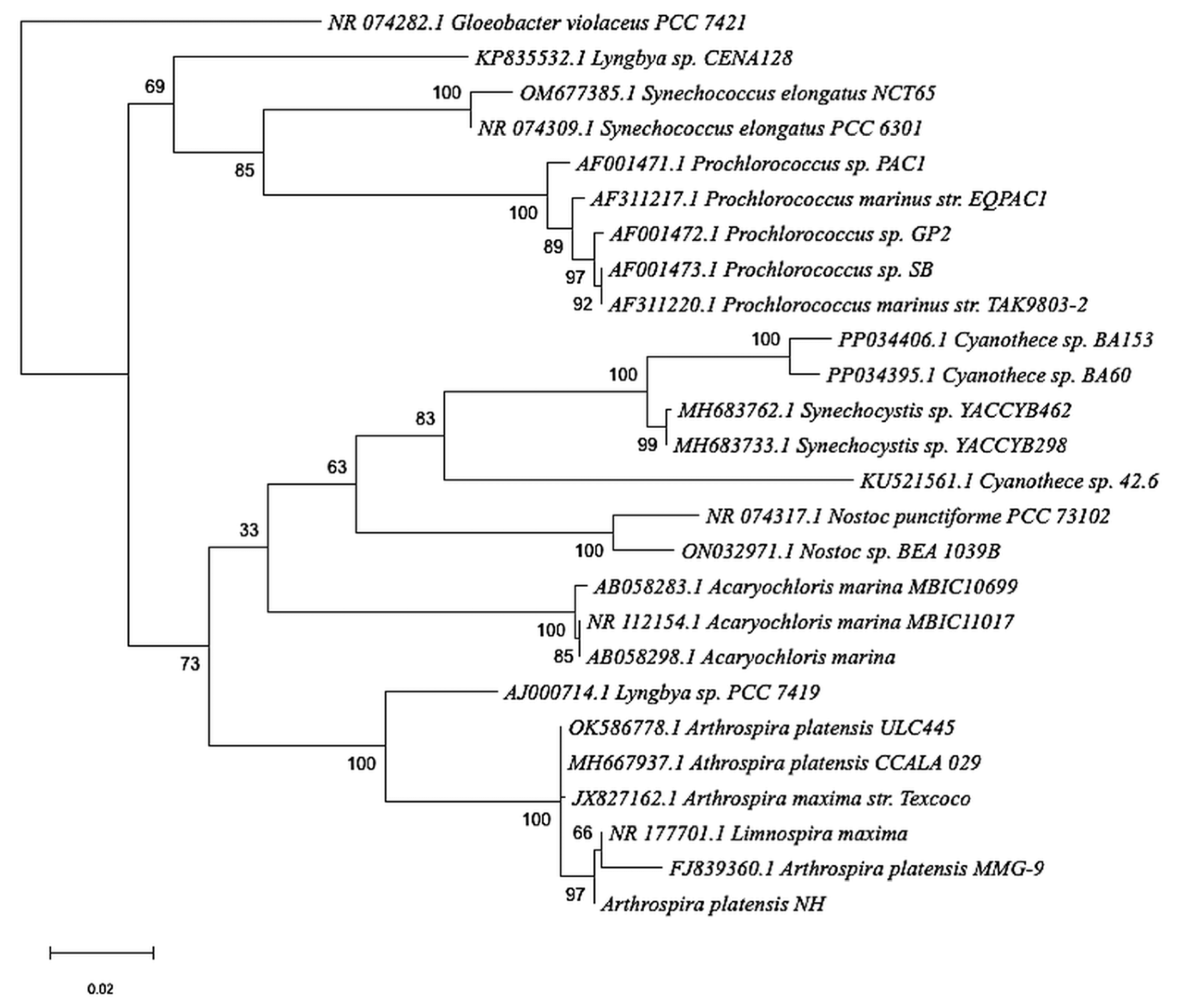
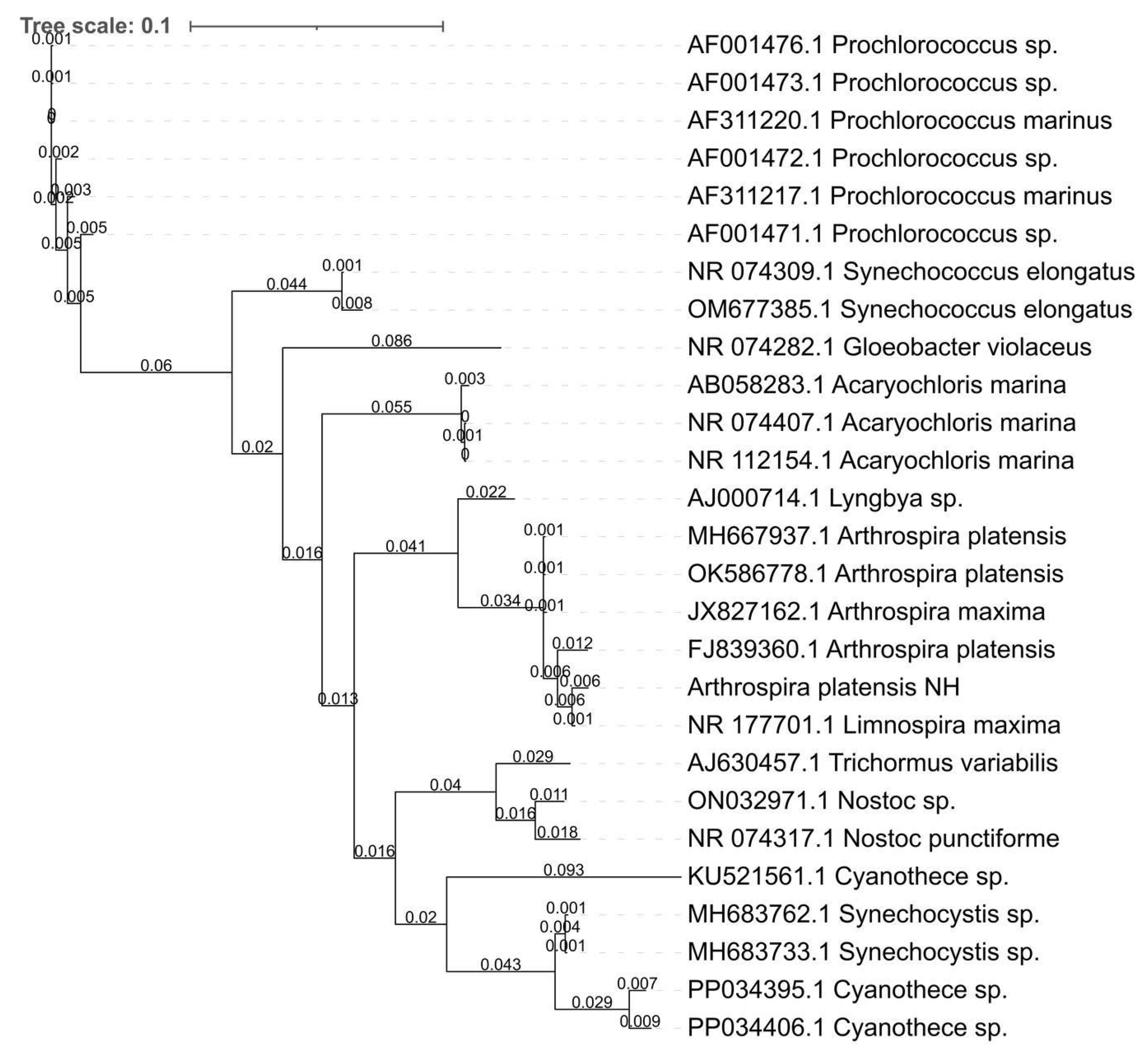
To determine the phylogenetic position of Arthrospira platensis NH and evaluate its genetic relationships relationship with other Arthrospira species, the 16S rRNA gene sequence was aligned with reference sequences retrieved from the GenBank database. Multiple sequence alignment was performed using the ClustalW algorithm implemented in MEGA v12 [29,30]. Phylogenetic reconstruction was carried out using the maximum-likelihood method with the Tamura–Nei substitution model [31,32]. Tree topology robustness was assessed with 1000 bootstrap replicates [33]. Moreover, the phylogenetic tree was reconstructed using the Bayesian inference method implemented in the MrBayes program (v3.2.6) [34]. The analysis was performed under the GTR nucleotide substitution model, as selected by model testing. The Markov Chain Monte Carlo (MCMC) analyses were performed with four chains (one cold and three heated) [35]. The Markov Chain Monte Carlo analyses were run for 10,000,000 generations, with trees sampled every 1000 generations. The initial 25% of sampled trees were discarded as burn-in. In addition, sequence variation sites within the A. platensis NH 16S rRNA gene were identified by a comparison with homologous sequences from other members of the genus Arthrospira.

3. Results

3.1. Classification and Features

Arthrospira species are filamentous cyanobacteria characterized by multicellular, cylindrical trichomes forming open, left-handed helical structures (Table 1). The Maximum likelihood and Bayesian inference phylogenetic trees based on 16S rRNA gene sequences show that Arthrospira platensis NH clusters with reference Arthrospira strains (Figure 1 and Figure 2). The trees illustrate sequence similarity and clustering patterns among selected cyanobacterial taxa.
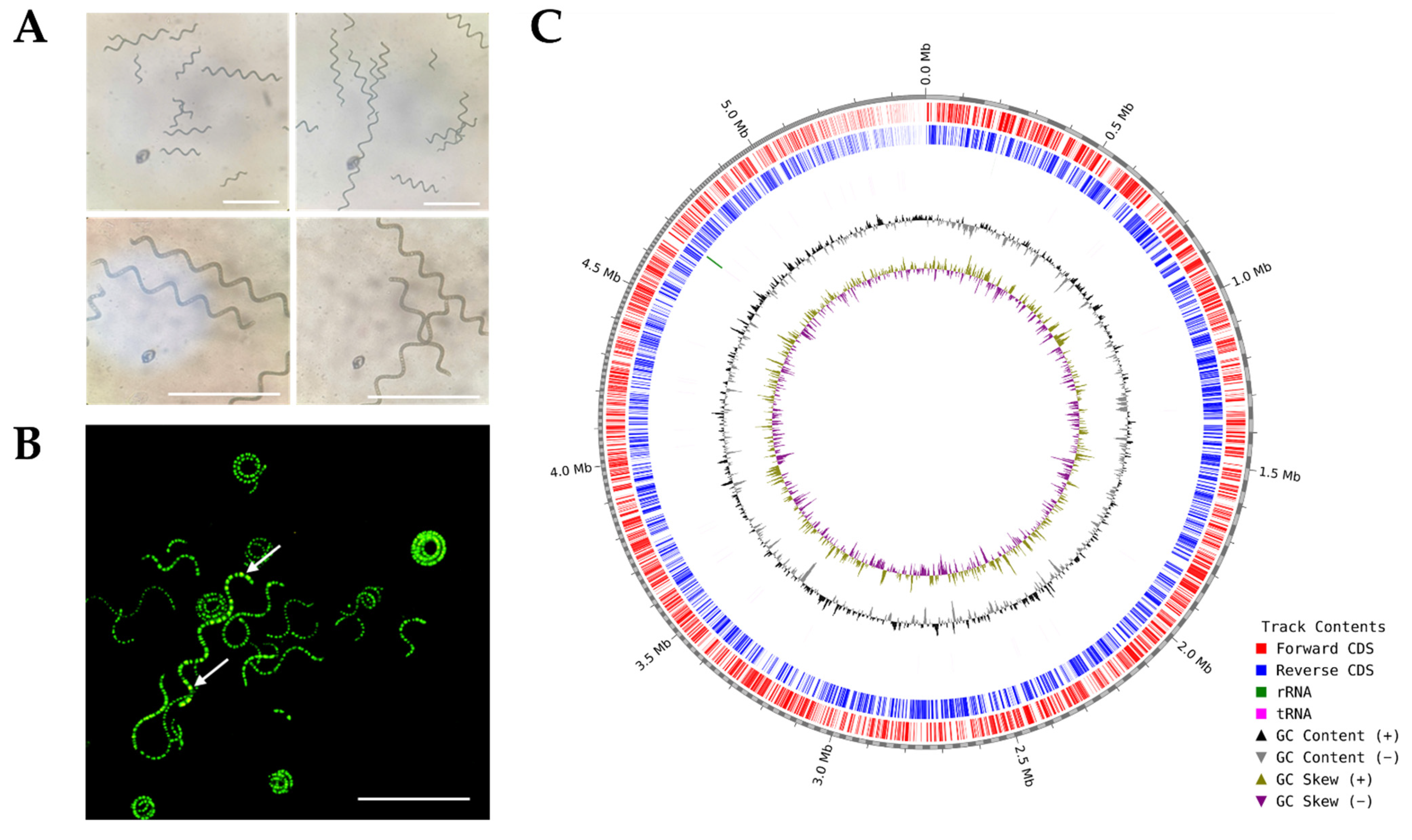
A microscopic examination confirmed that A. platensis NH exhibits a characteristic spiral morphology. Live/dead staining further demonstrated a high proportion of viable cells in the culture (Figure 3A,B), indicating that the strain used for genome sequencing was in good physiological condition.

3.2. Genome Sequencing and Annotation

3.2.1. Genome Sequencing and Assembly

The de novo assembly of the A. platensis NH genome resulted in a total assembled length of 5,548,511 bp contributed to 1352 contigs (Table 2) and the distribution of genes across general COG functional categories (Table 3). The largest contig measured 90,760 bp, accounting for approximately 1.64% of the total assembly length. Assembly statistics yielded an N50 value of 20,730 bp and an L50 value of 82, reflecting a moderately fragmented draft genome. A total of 4728 genes were predicted, including 4683 protein-coding sequences (CDSs), 42 tRNA genes, and 3 rRNA genes. A genome quality assessment using CheckM indicated high completeness (98.9%) with low contamination (0.6%). BUSCO analysis based on the cyanobacteria_odb10 lineage further supported the high quality of the assembly, with 98.9% complete BUSCOs, including 97.7% single-copy and 1.2% duplicated genes.

3.2.2. Genome Properties

A graphical genome atlas of A. platensis NH was constructed using CGView to visualize genome organization (Figure 3C). The circular map illustrated the distribution of coding sequences on the forward and reverse strands, the locations of RNA genes (rRNAs in green and tRNAs in pink), GC content, and GC skew. Despite the fragmented nature of the assembly, the genome exhibited a conserved organization pattern consistent with other Arthrospira strains. The GC content remained relatively stable across the genome, with an average value of approximately 44.45%, suggesting strong compositional conservation. GC skew analysis revealed balanced nucleotide distribution between replichores, consistent with patterns reported in other cyanobacterial genomes.
A comparative genomic analysis was performed between A. platensis NH and two reference strains, A. platensis C1 and A. platensis NIES-39 (Table 4). The NH genome is smaller in size (5.55 Mb) compared to C1 (6.09 Mb) and NIES-39 (6.79 Mb), yet it retains a high proportion of functionally annotated genes.
An average nucleotide identity (ANI) analysis confirmed a close genetic relationship among these strains. A. platensis NH shares 99.28% ANI with strain C1 and 94.19% ANI with strain NIES-39, indicating particularly high genomic similarity with C1. Functional annotation based on COGs, KEGG pathways, and Pfam domains showed that conserved genes are predominantly associated with essential metabolic processes, membrane transport, signal transduction, and stress response mechanisms.
In addition, an antiSMASH analysis identified several biosynthetic gene clusters, including terpene- and RiPP-like clusters. Some of these clusters exhibited divergence relative to those found in strains C1 and NIES-39, suggesting the presence of strain-specific metabolic features that may contribute to environmental adaptation and biotechnological potential.

3.2.3. RNAs Structure

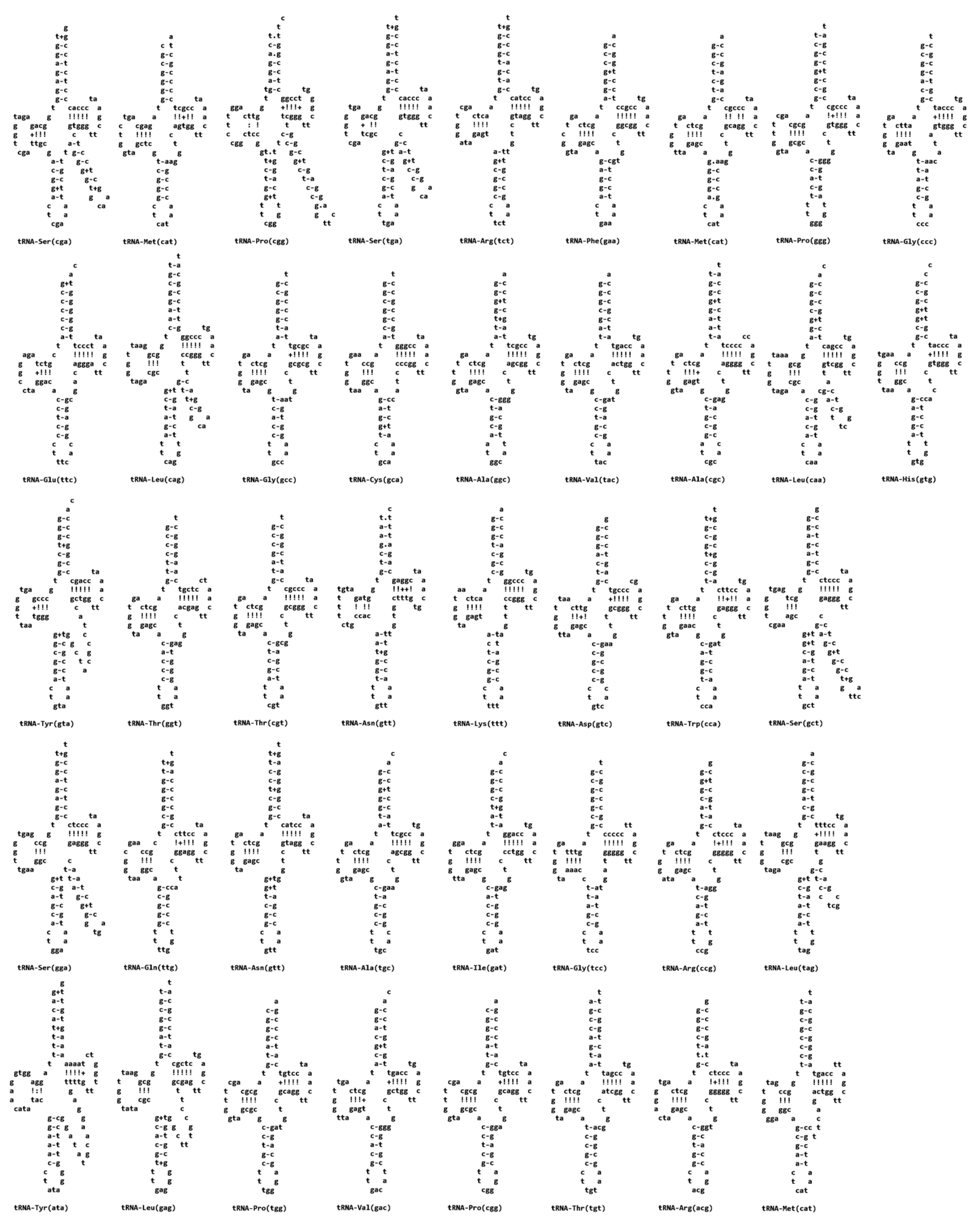
A total of 42 tRNA genes were identified in the A. platensis NH genome. Secondary structure prediction showed that all tRNA genes can be folded into canonical cloverleaf structures (Figure 4). The length of the tRNA genes ranged from 71 bp (tRNA-Cys) to 98 bp (tRNA-Pro), with GC content varying from 38.4% (tRNA-Tyr) to 64.5% (tRNA-Pro). The genome also contained three ribosomal RNA genes, including 16S rRNA (1485 bp), 23S rRNA (2880 bp), and 5S rRNA (109 bp). The A + T contents of the 16S, 23S, and 5S rRNA genes were 44.3%, 46.2%, and 46.8%, respectively, indicating conserved nucleotide composition across ribosomal components.
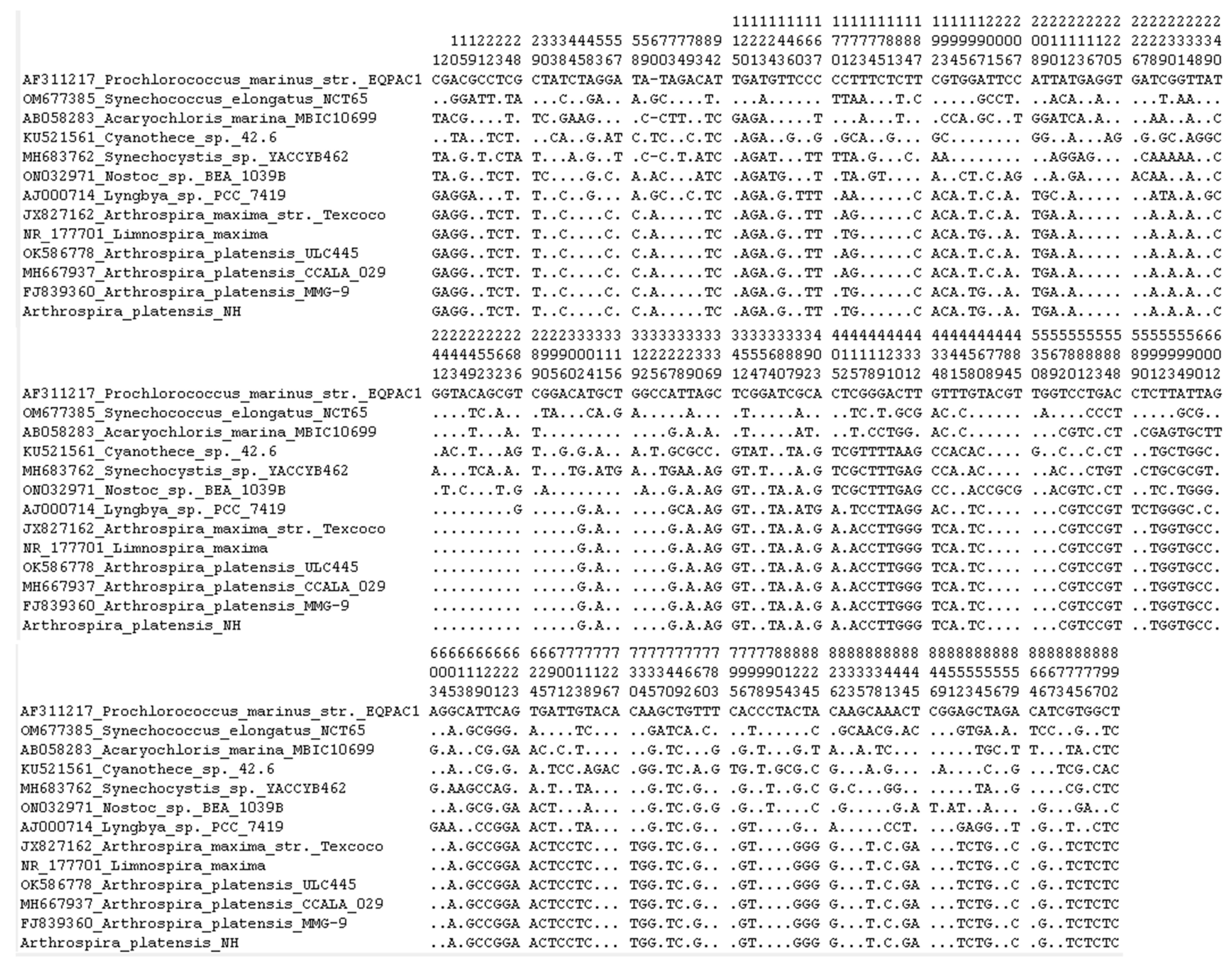
Figure 4. tRNA structures of Arthrospira platensis NH. The analysis of 16S RNA sequences of 13 samples (including 5 Arthrospira, 1 Limnospira, 1 Lyngbya, 1 Nostoc, 1 Synechocystis, 1 Cyanothece, 1 Acaryochloris, 1 Synechococcus, and 1 Prochlorococcus) showed 230 polymorphic sites (Figure 5). These variations reflect genetic divergence among genera and species, especially between Arthrospira and other more distantly related cyanobacteria. However, sequences within the Arthrospira group were highly conserved, supporting their close genetic relationship. The presence of some conserved motifs across multiple genera also highlights shared ancestral traits, while specific substitutions and indels (insertions/deletions) serve as potential markers for phylogenetic discrimination and strain identification. The “+” symbol is used to indicate the specific non-canonical G-T pairing.
Cimb 48 00461 g004
Figure 5. Variable positions of 16S-RNA sequences from Arthrospira platensis strains. Sequence identities are indicated by dots.
Cimb 48 00461 g005

4. Discussion

Studies on Vietnamese Arthrospira (now largely reclassified as Limnospira) have focused on cultivation, biomass production, and biotechnology. Since its introduction in the 1970s, research has emphasized optimizing growth, reducing costs, and improving yield for food and aquaculture uses [43,44,45]. However, phylogenetic research on Vietnamese strains remains limited. A few studies have applied molecular identification (e.g., 16S rRNA analysis, or Multiplex RAPD-PCR) to confirm species such as A. platensis from local habitats, but comprehensive phylogenetic analyses are still scarce [46,47]. Available evidence suggests that Vietnamese strains likely cluster within the globally distributed Limnospira/Arthrospira clade, which has been redefined using taxonomy and molecular data.
In this study, genomic characterization combined with targeted sequence-based analyses provides an overview of the genomic features of Arthrospira platensis NH within the current taxonomic framework of Arthrospira and related genera. Taxonomic assignment was conducted using GTDB-Tk, and a maximum likelihood analysis of the 16S rRNA gene was performed to support genus-level classification. The 16S rRNA tree is presented to illustrate sequence similarity and clustering patterns among selected cyanobacterial taxa and is not intended to represent a comprehensive phylogenetic inference.
Morphological observations confirmed the characteristic spiral trichome structure and high cell viability of strain NH, consistent with previous studies indicating that helicoidal morphology contributes to motility, light utilization, and ecological fitness in alkaline aquatic environments. Such structural traits are widely regarded as adaptive features that enhance survival and physiological performance under fluctuating environmental conditions [48]. Phylogenetic reconstruction based on the 16S rRNA gene placed A. platensis NH firmly within the Arthrospira clade with strong bootstrap support, while also indicating a close genetic relationship with Limnospira. This result is consistent with recent taxonomic revisions based on genome-scale comparative frameworks, which recognize Arthrospira and Limnospira as distinct yet closely related genera. Importantly, the agreement between 16S rRNA-based phylogenetic placement and GTDB-Tk-based taxonomic classification supports the robustness of the species assignment for strain NH.
The assembled genome (≈5.55 Mb, ~4728 genes) shows strong similarities in sequence composition and gene content with A. platensis NIES-39 and C1, consistent with comparative genomics that reported high conservation among sequenced Arthrospira strains [49]. High ANI values, especially the 99.28% identity with strain C1, indicate a very close genetic relationship, while the smaller genome size of NH suggests potential genome streamlining. Genome size variation and potential genome reduction have been reported among Arthrospira/Limnospira strains and are often interpreted as adaptive responses to specific ecological conditions, involving the selective retention of core metabolic functions and the loss of dispensable genomic regions [12,14]. This pattern has been observed in other cyanobacterial lineages inhabiting stable yet extreme environments, such as alkaline or saline waters. The relatively stable GC content (~44–45%) across the NH genome further supports strong compositional conservation and may contribute to maintaining DNA stability under high-pH conditions. Functional annotation revealed that a large proportion of conserved genes are associated with energy metabolism, membrane transport, signal transduction, and stress response pathways. These functional categories are consistent with the metabolic flexibility required for survival in alkaline and nutrient-variable environments and align with previous studies demonstrating the ability of Arthrospira strains to adjust their metabolism under salt stress, mixotrophic cultivation, or alternative nutrient sources [14].
Additional genomic features—including a complete set of 42 tRNAs, structurally conserved rRNAs, and well-maintained translational machinery—indicate strong genetic stability and functional robustness. Furthermore, a 16S rRNA polymorphism analysis across 13 cyanobacterial taxa revealed 230 informative variation sites, which support phylogenetic discrimination among genera while highlighting the high sequence conservation characteristic of Arthrospira [4].
Notably, biosynthetic gene cluster (BGC) analysis revealed the presence of terpene- and RiPP-like pathways in Arthrospira platensis NH, some of which show divergence in gene composition and organization when compared with reference strains such as C1 and NIES-39. Terpene-related genes, including homologs involved in phytoene and carotenoid biosynthesis, have been previously identified in Arthrospira and Limnospira genomes and are known to play important roles in pigmentation, photoprotection, and oxidative stress mitigation in alkaline environments [50]. Comparative genomic analyses further suggest that variation within these terpene-associated pathways may contribute to strain-specific metabolite profiles and adaptive strategies among geographically distinct Arthrospira isolates [51].
In parallel, RiPP-like gene clusters, which are increasingly recognized as a source of bioactive peptides in cyanobacteria, may expand the secondary metabolic repertoire of strain NH, although their functional roles require experimental validation. Beyond secondary metabolism, genes associated with stress adaptation—including heat shock proteins, redox homeostasis systems, and osmotic stress response pathways—have been shown to be transcriptionally regulated under environmental stress conditions in Arthrospira, highlighting their importance for cellular resilience [52]. The coexistence of a conserved core metabolic framework with divergence in secondary metabolite and stress-response gene clusters suggests that A. platensis NH retains the canonical genomic architecture of the genus while harboring locally shaped traits. These genomic features are likely the result of long-term adaptation to the specific physicochemical conditions of alkaline aquatic systems in central Vietnam and may underlie strain-specific physiological performance and biotechnological potential.
In this study, A. platensis NH was characterized using a polyphasic approach integrating morphological, molecular, and genome-based analyses. Morphological observations confirmed the typical spiral trichome structure, while 16S rRNA phylogeny consistently placed the strain within the Arthrospira clade. Genome-based analyses provided stronger support, with Genome Taxonomy Database classification and high Average Nucleotide Identity values (99.28% with strain C1) confirming species-level assignment. Comparative genomics revealed conserved genome architecture and functional profiles, alongside variation in biosynthetic gene clusters, suggesting strain-specific adaptive potential. The concordance among these datasets highlights the robustness of the polyphasic framework for cyanobacterial taxonomy.
Overall, the genomic characterization of A. platensis NH provides a valuable reference for understanding the genomic features, ecological context, and functional potential of Arthrospira strains. The presence of conserved core genes together with strain-specific genomic variations suggests potential adaptive diversity within the genus and supports its continued relevance in biotechnology, nutrition, and environmental applications. Future studies integrating transcriptomic, proteomic, and metabolomic data will help to connect genomic content with functional expression and further clarify mechanisms underlying stress response and metabolic performance.

5. Conclusions

A. platensis NH presents a highly complete and well-annotated draft genome, representing the first genomic resource for this species originating from Vietnam. Comparative genomic analyses, together with genome-based taxonomic assignment and 16S rRNA-based phylogenetic assessment, indicate strong conservation with globally reported Arthrospira/Limnospira lineages while also revealing features associated with environmental tolerance and metabolic diversity. This genomic resource provides a solid foundation for future studies on cyanobacterial genetics, biotechnology, strain improvement, and optimization of industrial cultivation.

Author Contributions

Conceptualization, S.N.H. and L.T.L.; methodology, T.T.H.N., L.T.T.D., A.M.P. and L.K.C.; software, T.T.H.N., L.K.C., T.T.T. and C.N.Q.H.; validation, C.P.M.L., L.T.T.D. and N.L.C.P.; formal analysis, C.N.Q.H., L.T.T.D. and N.L.C.P.; investigation, A.M.P., L.K.C. and T.T.T.; resources, G.D.D. and H.T.M.N.; data curation, T.T.K.D., G.D.D. and T.T.T.; writing—original draft preparation, T.T.H.N., A.M.P. and L.K.C.; writing—review and editing, T.T.K.D., G.D.D., and H.T.M.N.; visualization, T.T.H.N., C.P.M.L. and S.N.H.; supervision, S.N.H. and L.T.L.; project administration, H.T.M.N. and L.T.L.; funding acquisition, L.T.L. All authors have read and agreed to the published version of the manuscript.

Funding

This work was supported by the Vietnam Academy of Science and Technology (Grant number: TĐCPVS.04/23-25).

Institutional Review Board Statement

Not applicable.

Informed Consent Statement

Not applicable.

Data Availability Statement

The original contributions presented in this study are included in the article. Further inquiries can be directed to the corresponding author.

Acknowledgments

We would like to thank Vu Tan for his excellent technical support.

Conflicts of Interest

The authors declare no conflicts of interest.

References

  1. Begum, N.; Qi, F.; Yang, F.; Khan, Q.U.; Faizan; Fu, Q.; Li, J.; Wang, X.; Wang, X.; Wang, J.; et al. Nutritional Composition and Functional Properties of A. Platensis-Derived Peptides: A Green and Sustainable Protein-Rich Supplement. Processes 2024, 12, 2608. [Google Scholar] [CrossRef]
  2. Richmond, A.; Hu, Q. Handbook of Microalgal Culture: Applied Phycology and Biotechnology, 2nd ed.; Blackwell Publishing: Hoboken, NJ, USA, 2004. [Google Scholar]
  3. Xu, T.; Qin, S.; Hu, Y.; Song, Z.; Ying, J.; Li, P.; Dong, W.; Zhao, F.; Yang, H.; Bao, Q. Whole Genomic DNA Sequencing and Comparative Genomic Analysis of Arthrospira platensis: High Genome Plasticity and Genetic Diversity. DNA Res. 2016, 23, 325–338. [Google Scholar] [CrossRef]
  4. Russo, N.P.; Ballotta, M.; Usai, L.; Torre, S.; Giordano, M.; Fais, G.; Casula, M.; Dessì, D.; Nieri, P.; Damergi, E.; et al. Mixotrophic Cultivation of Arthrospira platensis (Spirulina) under Salt Stress: Effect on Biomass Composition, FAME Profile and Phycocyanin Content. Mar. Drugs 2024, 22, 381. [Google Scholar] [CrossRef]
  5. Markou, G.; Kougia, E.; Arapoglou, D.; Chentir, I.; Andreou, V.; Tzovenis, I.; Markou, G.; Kougia, E.; Arapoglou, D.; Chentir, I.; et al. Production of Arthrospira platensis: Effects on Growth and Biochemical Composition of Long-Term Acclimatization at Different Salinities. Bioengineering 2023, 10, 233. [Google Scholar] [CrossRef]
  6. Komárek, J.; Lund, J.W.G. What is Spirulina platensis in fact? Arch. Für Hydrobiol. 1990, 58, 1–13. [Google Scholar]
  7. Nowicka-Krawczyk, P.; Mühlsteinová, R.; Hauer, T. Detailed characterization of the Arthrospira type species separating commercially grown taxa into the new genus Limnospira (Cyanobacteria). Sci. Rep. 2019, 9, 694. [Google Scholar] [CrossRef] [PubMed]
  8. Santos, K.R.S.; Hentschke, G.S.; Ferrari, G.; Andreote, A.P.D.; Fiore, M.F.; Vasconcelos, V.; Sant’Anna, C.L. Molecular, morphological and ecological studies of Limnospira platensis (Cyanobacteria), from saline and alkaline lakes, Pantanal Biome, Brazil. Front. Environ. Sci. 2023, 11, 1204787. [Google Scholar] [CrossRef]
  9. Fujisawa, T.; Narikawa, R.; Okamoto, S.; Ehira, S.; Yoshimura, H.; Suzuki, I.; Masuda, T.; Mochimaru, M.; Takaichi, S.; Awai, K.; et al. Genomic Structure of an Economically Important Cyanobacterium, Arthrospira (Spirulina) platensis NIES-39. DNA Res. 2010, 17, 85–103. [Google Scholar] [CrossRef]
  10. Cheevadhanarak, S.; Paithoonrangsarid, K.; Prommeenate, P.; Kaewngam, W.; Musigkain, A.; Tragoonrung, S.; Tabata, S.; Kaneko, T.; Chaijaruwanich, J.; Sangsrakru, D.; et al. Draft Genome Sequence of Arthrospira platensis C1 (PCC9438). Stand. Genomic Sci. 2012, 6, 43–53. [Google Scholar] [CrossRef] [PubMed]
  11. Beck, C.; Knoop, H.; Axmann, I.M.; Steuer, R. The Diversity of Cyanobacterial Metabolism: Genome Analysis of Multiple Phototrophic Microorganisms. BMC Genom. 2012, 13, 56. [Google Scholar] [CrossRef] [PubMed]
  12. Shi, T.; Falkowski, P.G. Genome Evolution in Cyanobacteria: The Stable Core and the Variable Shell. Proc. Natl. Acad. Sci. USA 2008, 105, 2510–2515. [Google Scholar] [CrossRef]
  13. Misztak, A.E.; Waleron, M.; Furmaniak, M.; Waleron, M.M.; Bazhenova, O.; Daroch, M.; Waleron, K.F. Comparative Genomics and Physiological Investigation of a New Arthrospira/Limnospira Strain O9.13F Isolated from an Alkaline, Winter Freezing, Siberian Lake. Cells 2021, 10, 3411. [Google Scholar] [CrossRef]
  14. Castillo, M.; Guevara, G.; Baldanta, S.; Rodríguez, P.S.; Agudo, L.; Nogales, J.; Carrasco, A.D.; Arribas-Aguilar, F.; Pérez-Pérez, J.; García, J.L.; et al. Characterization of Limnospira platensis PCC 9108 R-M and CRISPR-Cas systems. Microbiol. Res. 2024, 279, 127572. [Google Scholar] [CrossRef] [PubMed]
  15. Bualuang, A.; Boonburapong, B.; Laloknam, S. Optimization of Arthrospira platensis Growth Using Organic Culture Medium. Asia-Pac. J. Sci. Technol. 2022, 27, APST-27-05-03. [Google Scholar] [CrossRef]
  16. Costa, J.A.V.; Freitas, B.C.B.; Rosa, G.M.; Moraes, L.; Morais, M.G.; Mitchell, B.G. Operational and Economic Aspects of Spirulina-Based Biorefinery. Bioresour. Technol. 2019, 292, 121946. [Google Scholar] [CrossRef]
  17. Chen, S.; Zhou, Y.; Chen, Y.; Gu, J. Fastp: An Ultra-Fast All-in-One FASTQ Preprocessor. Bioinformatics 2018, 34, i884–i890. [Google Scholar] [CrossRef]
  18. Wick, R.R.; Judd, L.M.; Gorrie, C.L.; Holt, K.E. Unicycler: Resolving Bacterial Genome Assemblies from Short and Long Sequencing Reads. PLoS Comput. Biol. 2017, 13, e1005595. [Google Scholar] [CrossRef]
  19. Gurevich, A.; Saveliev, V.; Vyahhi, N.; Tesler, G. QUAST: Quality Assessment Tool for Genome Assemblies. Bioinformatics 2013, 29, 1072–1075. [Google Scholar] [CrossRef]
  20. Parks, D.H.; Imelfort, M.; Skennerton, C.T.; Hugenholtz, P.; Tyson, G.W. CheckM: Assessing the Quality of Microbial Genomes Recovered from Isolates, Single Cells, and Metagenomes. Genome Res. 2015, 25, 1043–1055. [Google Scholar] [CrossRef] [PubMed]
  21. Jain, C.; Rodriguez-R, L.M.; Phillippy, A.M.; Konstantinidis, K.T.; Aluru, S. High Throughput ANI Analysis of 90K Prokaryotic Genomes Reveals Clear Species Boundaries. Nat. Commun. 2018, 9, 5114. [Google Scholar] [CrossRef] [PubMed]
  22. Manni, M.; Berkeley, M.R.; Seppey, M.; Simão, F.A.; Zdobnov, E.M. BUSCO Update: Novel and Streamlined Workflows along with Broader and Deeper Phylogenetic Coverage for Scoring of Eukaryotic, Prokaryotic, and Viral Genomes. Mol. Biol. Evol. 2021, 38, 4647–4654. [Google Scholar] [CrossRef]
  23. Seemann, T. Prokka: Rapid Prokaryotic Genome Annotation. Bioinformatics 2014, 30, 2068–2069. [Google Scholar] [CrossRef]
  24. Chaumeil, P.-A.; Mussig, A.J.; Hugenholtz, P.; Parks, D.H. GTDB-Tk: A Toolkit to Classify Genomes with the Genome Taxonomy Database. Bioinformatics 2020, 36, 1925–1927. [Google Scholar] [CrossRef]
  25. Grant, J.R.; Stothard, P. The CGView Server: A Comparative Genomics Tool for Circular Genomes. Nucleic Acids Res. 2008, 36, W181–W184. [Google Scholar] [CrossRef]
  26. Lowe, T.M.; Eddy, S.R. tRNAscan-SE: A Program for Improved Detection of Transfer RNA Genes in Genomic Sequence. Nucleic Acids Res. 1997, 25, 955–964. [Google Scholar] [CrossRef] [PubMed]
  27. Huerta-Cepas, J.; Szklarczyk, D.; Heller, D.; Hernández-Plaza, A.; Forslund, S.K.; Cook, H.; Mende, D.R.; Letunic, I.; Rattei, T.; Jensen, L.J.; et al. eggNOG 5.0: A Hierarchical, Functionally and Phylogenetically Annotated Orthology Resource Based on 5090 Organisms and 2502 Viruses. Nucleic Acids Res. 2019, 47, D309–D314. [Google Scholar] [CrossRef] [PubMed]
  28. eggNOG-Mapper: Fast Genome-Wide Functional Annotation Through Orthology Assignment. Available online: https://hpc.nih.gov/apps/eggNOGmapper.html (accessed on 14 July 2025).
  29. Kumar, S.; Stecher, G.; Suleski, M.; Sanderford, M.; Sharma, S.; Tamura, K. MEGA12: Molecular Evolutionary Genetic Analysis Version 12 for Adaptive and Green Computing. Mol. Biol. Evol. 2024, 41, msae263. [Google Scholar] [CrossRef] [PubMed]
  30. Larkin, M.A.; Blackshields, G.; Brown, N.P.; Chenna, R.; McGettigan, P.A.; McWilliam, H.; Valentin, F.; Wallace, I.M.; Wilm, A.; Lopez, R.; et al. Clustal W and Clustal X version 2.0. Bioinformatics 2007, 23, 2947–2948. [Google Scholar] [CrossRef]
  31. Felsenstein, J. Evolutionary Trees from DNA Sequences: A Maximum Likelihood Approach. J. Mol. Evol. 1981, 17, 368–376. [Google Scholar] [CrossRef]
  32. Tamura, K.; Nei, M. Estimation of the number of nucleotide substitutions in the control region of mitochondrial DNA in humans and chimpanzees. Mol. Biol. Evol. 1993, 10, 512–526. [Google Scholar] [CrossRef]
  33. Felsenstein, J. Confidence Limits on Phylogenies: An Approach Using Bootstrap. Evolution 1985, 39, 783–791. [Google Scholar] [CrossRef]
  34. Ronquist, F.; Teslenko, M.; van der Mark, P.; Ayres, D.L.; Darling, A.; Höhna, S.; Larget, B.; Liu, L.; Suchard, M.A.; Huelsenbeck, J.P. MrBayes 3.2: Efficient Bayesian phylogenetic inference and model choice across a large model space. Syst. Biol. 2012, 61, 539–542. [Google Scholar] [CrossRef]
  35. Altekar, G.; Dwarkadas, S.; Huelsenbeck, J.P.; Ronquist, F. Parallel Metropolis coupled Markov chain Monte Carlo for Bayesian phylogenetic inference. Bioinformatics 2004, 20, 407–415. [Google Scholar] [CrossRef]
  36. Woese, C.R.; Kandler, O.; Wheelis, M.L. Towards a Natural System of Organisms: Proposal for the Domains Archaea, Bacteria, and Eucarya. Proc. Natl. Acad. Sci. USA 1990, 87, 4576–4579. [Google Scholar] [CrossRef]
  37. Woese, C.R.; Stackebrandt, E.; Macke, T.J.; Fox, G.E. A Phylogenetic Definition of the Major Eubacterial Taxa. Syst. Appl. Microbiol. 1985, 6, 143–151. [Google Scholar] [CrossRef] [PubMed]
  38. Mcneill, J.; Barrie, F.R.; Burdet, H.M.; Demoulin, V.; Hawksworth, D.L.; Marhold, K.; Nicolson, D.H.; Prado, J.; Silva, P.C.; Skog, J.E.; et al. International Code of Botanical Nomenclature—Vienna Code. Available online: https://www.iapt-taxon.org/icbn/frameset/0001Viennatitle.htm (accessed on 14 July 2025).
  39. Komárek, J. A Polyphasic Approach for the Taxonomy of Cyanobacteria: Principles and Applications. Eur. J. Phycol. 2016, 51, 346–353. [Google Scholar] [CrossRef]
  40. Kublanovskaya, A.; Chekanov, K.; Solovchenko, A.; Lobakova, E. Cyanobacterial Diversity in the Algal–Bacterial Consortia from Subarctic Regions: New Insights from the Rock Baths at White Sea Coast. Hydrobiologia 2019, 830, 17–31. [Google Scholar] [CrossRef]
  41. Tomaselli, L.; Palandri, R.M.; Tredici, M.R. On the Correct Use of the Spirulina Designation. Algol. Stud./Arch. Für Hydrobiol. 1996, 83, 539–548. [Google Scholar] [CrossRef]
  42. Vonshak, A. Spirulina: Growth, Physiology and Biochemistry. In Spirulina platensis (Arthrospira); Vonshak, A., Ed.; Taylor and Francis: London, UK, 1997; pp. 43–65. ISBN 978-0-7484-0674-6. [Google Scholar]
  43. Tam, L.T.; Thom, L.T.; Ha, N.C.; Hien, H.T.M.; Thu, N.T.H.; Hong, D.D. Assessing the salt tolerance of Spirulina platensis freshwater strains and examining cheap culture media for cultivation of the potential strain. Vietnam. J. Biotechnol. 2021, 19, 381–392. [Google Scholar] [CrossRef]
  44. Nguyen, D.B.; Doan, T.T.Y.; Phi, T.C.M.; Ngo, T.A.; Vu, L.D.H.; Dang, D.K. Arthrospira production in Vietnam: Current status and prospects. Bioresour. Technol. Rep. 2021, 15, 100803. [Google Scholar] [CrossRef]
  45. Hong, D.D.; Hien, H.T.M.; Thom, L.T.; Ha, N.C.; Huy, L.A.; Thu, N.T.H.; Cuong, N.; Tang, D.Y.Y.; Show, P.L. Transcriptome Analysis of Spirulina platensis sp. at Different Salinity and Nutrient Compositions for Sustainable Cultivation in Vietnam. Sustainability 2023, 15, 11906. [Google Scholar] [CrossRef]
  46. Bach, N.D.; Ha, C.D.; Huong, V.L.D.; Mieu, P.T.C. Isolationand Characterization of the Strain Arthrospira plastensis Isolated from Van Quan Lake. Vietnam J. Agri. Sci. 2021, 19, 672–683. [Google Scholar]
  47. Singh, N.K.; Dhar, D.W. Phylogenetic relatedness among Spirulina and related cyanobacterial genera. World J. Microbiol. Biotechnol. 2011, 27, 941–951. [Google Scholar] [CrossRef]
  48. Shiraishi, H.; Sasase, M.; Nakashima, A.S. Helicoid Morphology of Arthrospira platensis NIES-39 Confers Temperature Compensation in the Longitudinal Movement Velocity of Its Trichomes. Phycology 2024, 4, 104–116. [Google Scholar] [CrossRef]
  49. Pinchart, P.-E.; Marter, P.; Brinkmann, H.; Quilichini, Y.; Mysara, M.; Petersen, J.; Pasqualini, V.; Mastroleo, F. The Genus Limnospira Contains Only Two Species, Both Unable to Produce Microcystins: L. maxima and L. platensis. iScience 2024, 27, 110845, Correction in iScience 2025, 28, 112129. https://doi.org/10.1016/j.isci.2025.112129. [Google Scholar] [CrossRef] [PubMed]
  50. Machado, M.J.; Jacinavicius, F.R.; Médice, R.V.; Dextro, R.B.; Feitosa, A.M.T.; Weiss, M.B.; Pellegrinetti, T.A.; Cotta, S.R.; Crnkovic, C.M.; Fiore, M.F. Genetic and Biochemical Diversity of Terpene Biosynthesis in Cyanobacterial Strains from Tropical Soda Lakes. Front. Microbiol. 2025, 16, 1582103. [Google Scholar] [CrossRef] [PubMed]
  51. Dextro, R.B.; Delbaje, E.; Geraldes, V.; Pinto, E.; Long, P.F.; Fiore, M.F. Exploring the Relationship between Biosynthetic Gene Clusters and Constitutive Production of Mycosporine-like Amino Acids in Brazilian Cyanobacteria. Molecules 2023, 28, 1420. [Google Scholar] [CrossRef]
  52. Liu, W.; Li, L.; Yu, Y.; Li, Z.; Chen, L.; Liu, T. Physiological and Transcriptomic Responses of Attached-Cultivated Arthrospira platensis to Heat Stress. J. Appl. Phycol. 2025, 37, 4033–4050. [Google Scholar] [CrossRef]
Figure 1. Maximum likelihood tree based on 16S rRNA gene sequences showing the clustering of Arthrospira platensis NH among representative cyanobacterial taxa. Bootstrap support values (%) based on 1000 replicates are shown at the nodes. The scale bar represents 0.02 substitutions per nucleotide position. Gloeobacter violaceus PCC 7421 was used as the outgroup.
Cimb 48 00461 g001
Figure 2. Bayesian inference phylogenetic tree constructed from 16S rRNA gene sequences, illustrating the phylogenetic position of Arthrospira platensis NH within representative cyanobacterial taxa. The scale bar corresponds to 0.1 substitutions per nucleotide position.
Cimb 48 00461 g002
Figure 3. Microphotographs of Arthrospira platensis NH and a visual representation of its draft genome. (A): Morphology of Arthrospira platensis NH. (B): Live/dead staining indicates live cells (green) and dead cells (yellow; white arrow); scale bar: 50 µm. (C): Graphical representation of contig-based draft genome. From outside to center: genes on forward strand, genes on reverse strand, RNA genes (rRNAs green; tRNAs pink), GC skew, GC content.
Cimb 48 00461 g003
Table 1. Classification and general features of A. platensis NH.
PropertyTermReferences
Current classificationDomain BacteriaTAS [36]
Phylum CyanobacteriaTAS [37,38]
Order OscillatorialesTAS [37,38]
Family MicrocoleaceaeTAS [39]
Genus ArthrospiraTAS [39,40]
Species Arthrospira platensis NHTAS [38]
Gram stain NegativeTAS [41]
Filament morphologySpiralTAS [41]
Gliding motility None
Sporulation None
Temperature range 20–40 °CTAS [41]
Optimum temperature 30–35 °CTAS [41]
pH8.0–10.0TAS [42]
Salinity 0.06 g/LTAS [42]
Draft genome size 5.548 MbIDA
Biotic relationship Free livingNAS
Geographic locationNinh Diem Ward, Ninh Hoa City, Khanh Hoa province, VietnamNAS
Evidence codes—IDA: inferred from direct assay (first time in publication); TAS: traceable author statement (i.e., a direct report exists in the literature); NAS: non-traceable author statement (i.e., not directly observed for the living, isolated sample but based on a generally accepted property for the species or anecdotal evidence).
Table 2. De novo assembly result.
AttributedValue
Genome size (bp)5,548,511
Number of contigs1352
G + C content (bp)44.45%
Genes (total)4728
CDSs (total)4683
The longest contig (bp)90,760
tRNAs42
rRNAs3
N50 value20,730
L50 value82
Note: N50 is defined as the shortest contig length such that the sum of contigs of equal or greater length will cover 50% of the total assembly. L50 is defined as the smallest number of contigs whose total length is half the genome size.
Table 3. Number of genes associated with the general COG functional categories.
CodeValue% ValueDescription
A50.114%RNA processing and modification
B10.023%Chromatin structure and dynamics
C1974.485%Energy production and conversion
D651.480%Cell cycle control, cell division, chromosome partitioning
E1764.007%Amino acid transport and metabolism
F711.617%Nucleotide transport and metabolism
G1122.550%Carbohydrate transport and metabolism
H1523.461%Coenzyme transport and metabolism
I681.548%Lipid transport and metabolism
J1643.734%Translation, ribosomal structure, and biogenesis
K1192.709%Transcription
L3056.944%Replication, recombination, and repair
M2455.578%Cell wall/membrane/envelope biogenesis
N100.228%Cell motility
O1753.985%Post-translational modification, protein turnover, chaperones
P1523.461%Inorganic ion transport and metabolism
Q691.571%Secondary metabolite biosynthesis, transport, and catabolism
S105724.066%Function unknown
T2956.717%Signal transduction mechanisms
U420.956%Intracellular trafficking, secretion, and vesicular transport
V861.958%Defense mechanisms
-56212.796%Not in COG
Table 4. Genome statistics comparison among Arthrospira spp.
Genome NameA. platensis NHA. platensis C1A. platensis NIES-39
Genome size (bp)5,548,5116,089,2106,788,435
Total genes472861536676
Protein-coding genes46836108663
tRNA genes424546
Kegg pathways11101012993
% Kegg pathways23.48%16.45%14.87%
Kegg Orthology (KO)192518371702
% Kegg Orthology (KO)40.71%29.86%25.49%
COGs38303459357
%COGs81.01%56.22%53.48%
Pfam363335293598
%Pfam76.84%57.35%53.89%
Disclaimer/Publisher’s Note: The statements, opinions and data contained in all publications are solely those of the individual author(s) and contributor(s) and not of MDPI and/or the editor(s). MDPI and/or the editor(s) disclaim responsibility for any injury to people or property resulting from any ideas, methods, instructions or products referred to in the content.