Article

Mining and Analysis of Salt Tolerance Genes in Maize at the Seedling Stage

1
College of Agronomy, Gansu Agricultural University, Lanzhou 730070, China
2
State Key Laboratory of Aridland Crop Science, Gansu Agricultural University, Lanzhou 730070, China
3
Seed Industry Research Institute of Gansu Provincial Universities, Lanzhou 730070, China
*
Author to whom correspondence should be addressed.
Curr. Issues Mol. Biol. 2026, 48(4), 423; https://doi.org/10.3390/cimb48040423
Submission received: 16 March 2026 / Revised: 1 April 2026 / Accepted: 18 April 2026 / Published: 20 April 2026
(This article belongs to the Special Issue Plant Hormones, Development, and Stress Tolerance)

Abstract

Salt stress represents a significant abiotic stress factor that adversely affects plant growth and development. It directly inhibits both vegetative and reproductive growth, resulting in substantial reductions in crop yield and quality. Consequently, the identification of salt tolerance genes and the elucidation of their underlying molecular mechanisms are crucial for improving crop salt tolerance and ensuring agricultural productivity. To investigate the molecular basis underlying differential salt tolerance between Zheng58 and PH4CV, we employed pooled sequencing (BSA-seq) using extreme phenotypic individuals from their F2 population and conducted a comparative transcriptome analysis at the seedling stage of the two genotypes. Phenotypic, physiological, biochemical, and ion content analyses revealed that Zheng58 exhibited significantly superior performance compared to PH4CV under salt stress conditions. BSA-seq analysis identified six genomic regions associated with salt tolerance, encompassing a total of 391 genes. Functional annotation enabled the screening of 151 candidate genes potentially involved in salt stress responses. Transcriptome profiling indicated that differentially expressed genes were significantly enriched in biological processes, particularly plant hormone signal transduction and MAPK signaling pathways. Integrating BSA-seq and transcriptome data, key candidate gene ZmACC2 (Zm00001eb419400) was identified as potentially involved in the regulation of salt tolerance in maize. This gene may modulate Na+/K+/Ca2+ homeostasis and reactive oxygen species metabolism through defense responses mediated by ethylene (ETH) and hydrogen peroxide, as well as through ion homeostasis regulatory pathways. This study provides valuable candidate genes and a theoretical foundation for further dissection of the molecular mechanisms governing salt tolerance in maize.

1. Introduction

Maize (Zea mays L.) is one of the world’s three major cereal crops, providing sustenance for nearly 6 billion people. The stability of its production is of critical importance for ensuring global food supply and meeting growing demand [1]. However, under the pressures of global climate change and water scarcity, extensive maize-producing regions are increasingly threatened by soil salinization [2]. This phenomenon can be categorized into three major types based on the dominant salt composition: chloride-type (mainly NaCl), sulfate-type (mainly Na2SO4 and MgSO4), and carbonate-type (mainly Na2CO3 and NaHCO3) [3,4]. Chloride-type salinity is the most common and widely distributed, especially in coastal regions, arid inland basins, and irrigated farmlands suffering from secondary salinization [5,6]. Sulfate-type salinity often occurs in continental saline soils under moderate leaching conditions, while carbonate-type salinity is typically associated with alkaline soils in semiarid regions [7,8]. Considering that chloride-type salinity dominates the majority of salt-affected agricultural lands worldwide and imposes strong osmotic and specific ionic stresses on plants, NaCl was selected as the stress agent in this study to represent the most environmentally relevant scenario [9]. As a salt-sensitive species, maize experiences significant inhibition of growth and development under high salinity conditions, often leading to substantial yield losses. Without the implementation of effective strategies to address this challenge, agricultural sustainability and global food security may be severely compromised. Research indicates that plants exposed to high-salt environments experience dual stresses—osmotic and ionic—and concurrently generate reactive oxygen species (ROS) [10]. Maize varieties exhibit differential salt tolerance: salt-tolerant genotypes maintain elevated antioxidant enzyme activity, effectively scavenging ROS and restricting Na+ uptake and translocation to aerial tissues, thereby mitigating salt damage [11]. Conversely, salt-sensitive genotypes display compromised antioxidant capacity, leading to excessive ROS accumulation, which disrupts physiological functions and impairs primary and secondary metabolism. This ultimately results in severe growth inhibition and substantial reductions in agricultural productivity [12]. Therefore, understanding the physiological and biochemical mechanisms underlying maize adaptation to salt stress, as well as associated changes in ion homeostasis, is essential for the development of salt-tolerant maize varieties [13].
In recent years, significant advances have been achieved in identifying salt tolerance genes and elucidating the mechanisms conferring salt stress tolerance in crops through integrated approaches combining transcriptomics and genetic mapping [14,15,16,17,18,19,20]. Xu et al. demonstrated that under 300 mmol/L NaCl treatment, a salt-tolerant variety, Baiyan2, exhibited significant upregulation of genes involved in energy-consuming and biosynthetic pathways—such as glycolysis, starch, and glucose metabolism—whereas these genes were markedly downregulated in the salt-sensitive variety Baiyan5. Furthermore, Baiyan2 maintained ion homeostasis by modulating the expression of Na+/K+ transporter genes, resulting in higher K+ content and lower Na+ accumulation [21]. Ding et al. compared the salt-tolerant genotype SHEN5003 with the sensitive genotype YZ26 and observed that under salt stress, SHEN5003 displayed superior biomass, SPAD values, and K+/Na+ ratios. Transcriptomic analysis revealed that its enhanced tolerance was associated with the differential regulation of genes involved in plasma membrane homeostasis, including H-ATPase, HKT1, and HAKs, as well as ROS scavenging genes such as CAT2. Additionally, ZmSWEET1b was found to exert a positive regulatory role in salt-tolerant materials [22]. Wang et al. reported that under saline conditions, the salt-tolerant variety L87 exhibited significantly higher activities of superoxide dismutase (SOD), peroxidase (POD), and catalase (CAT) compared to the sensitive variety L29, accompanied by reduced ROS accumulation. Specific expression profiling identified 1856 upregulated genes in L87, including key components of ABA signaling such as SnRK2, along with multiple members of the SOD, POD, and CAT gene families, collectively contributing to enhanced stress resilience [23]. In the realm of genetic mapping, Gao et al. employed QTL-seq and BSA-seq to identify 11 candidate salt-tolerance genes within a 5.24 Mb region on chromosome 4 in a sea-rice SR86 hybrid population [24]. Zhu et al. applied BSA-seq in an F2 extreme population and identified 106 candidate regions and 77 putative genes, ultimately pinpointing two critical salt-tolerance genes, Zm00001d037181 and Zm00001d053925, in the highly tolerant AS5 lineage [25]. Collectively, these studies have uncovered the molecular and physiological bases of salt tolerance from multiple perspectives—including biochemical responses, transcriptional regulation, and genetic architecture—providing valuable genetic resources and a robust theoretical foundation for the breeding of salt-tolerant crop varieties [26,27].
This study utilized the salt-tolerant variety Zheng58 and the salt-sensitive variety PH4CV, previously identified by the research group [28], as experimental materials to systematically investigate the molecular mechanisms underlying their differential salt tolerance. BSA-seq was performed on two phenotypic extreme pools derived from an F2 population to identify candidate genomic regions, followed by functional annotation of genes within these intervals. Subsequently, transcriptome sequencing was conducted to identify differentially expressed genes (DEGs) in response to salt stress, with functional characterization through Gene Ontology (GO) enrichment and Kyoto Encyclopedia of Genes and Genomes (KEGG) pathway analyses. Integrating the BSA-seq and transcriptomic data, 32 candidate genes strongly associated with salt tolerance were screened out. The expression profiles of these candidate genes were further validated using quantitative real-time PCR (RT-qPCR), and the key candidate gene ZmACC2 (1-aminocyclopropane-1-carboxylate synthase) closely related to maize salt tolerance was ultimately determined. This gene helps to deepen the understanding of the physiological and molecular mechanisms of maize salt tolerance, enriches the available genetic resources, and has potential application value in breeding programs aimed at improving maize salt tolerance.

2. Materials and Methods

2.1. Plant Material and Growth Conditions

The salt-tolerant variety Zheng58 and the salt-sensitive variety PH4CV were crossed to generate the F1 generation, which was subsequently self-pollinated to produce the F2 population, thereby completing the construction of the genetic mapping population. At the same time, there were salt-tolerant variety Qi319, salt-sensitive variety N192, as well as varieties Mo17 and B73. Both varieties and the F2 population were provided by the Maize Research Group, College of Agronomy, Gansu Agricultural University, and served as experimental materials for the salt tolerance study.
In this study, salt stress was simulated under controlled conditions using sodium chloride (NaCl) treatment to mimic saline environments [29]. The experiment included two treatment conditions—distilled water (control) and 180 mmol/L NaCl—applied to both genotypes, resulting in four treatment groups: Zheng58 + distilled water (ZCK), Zheng58 + 180 mmol/L NaCl (ZN), PH4CV + distilled water (PCK), and PH4CV + 180 mmol/L NaCl (PN). The experiment followed the method of Xian et al. [30]. The seeds were sown in a seedling pot (15 × 12 × 10 cm). The sterilized vermiculite was uniformly mixed with the corresponding solution (5 g:1 mL). The plant spacing was 10 cm. The treatment lasted for about 15 days. When the leaves of the control group grew to the three-leaf-one-heart stage, the relevant indicators were measured. For each material and each treatment, 5 plants were selected, and the average value was taken after measurement. Three replicates were set. Based on the comprehensive salt tolerance index (D value), 198 individuals were randomly selected from the F2 population, from which 50 salt-tolerant and 50 salt-sensitive phenotypic extremes were selected for DNA extraction and subsequent sequencing analysis. All plant samples were immediately collected after rinsing with double-distilled water, rapidly frozen in liquid nitrogen for 3–4 h, and then stored at −80 °C until further use.

2.2. Phenotypic Characterization

2.2.1. Growth Parameter Analysis

Uniformly developed seedlings were selected for measurement of growth parameters. Root systems were carefully rinsed with distilled water to remove adhering vermiculite, followed by gentle blotting with filter paper to eliminate surface moisture. Morphological traits, including shoot length (SL), root length (RL), aboveground fresh weight (AFW), underground fresh weight (UFW), aboveground dry weight (ADW), and underground dry weight (UDW), were measured using a digital caliper and a precision electronic balance. All measurements were conducted in triplicate, and the mean values were calculated for subsequent statistical analysis.

2.2.2. Physiological and Biochemical Parameter Assessment

Approximately 17 days after treatment, physiological and biochemical parameters of maize seedlings, including superoxide dismutase (SOD), peroxidase (POD), catalase (CAT), malondialdehyde (MDA), proline (Pro), soluble proteins (SP), and soluble sugars (SS), were determined following the method of Alici and Arabaci [31] and Wang et al. [32]. Among them, SOD activity was measured based on the inhibition of nitroblue tetrazolium (NBT) photochemical reduction, POD activity was assayed by monitoring the oxidation of guaiacol at 470 nm, and CAT activity was determined by measuring the disappearance of H2O2 at 240 nm. The contents of malondialdehyde (MDA), proline (Pro), soluble proteins (SP), and soluble sugars (SS) were also quantified spectrophotometrically; MDA was determined via the thiobabituric acid (TBA) reaction, Pro was measured using the ninhydrin method, SP was determined using the Coomassie Brilliant Blue G-250 dye-binding method, and SS was quantified using the anthrone method. Concurrently, ion contents—cations (K+, Na+, Ca2+) and anions (Cl)—were quantified using inductively coupled plasma mass spectrometry (ICP-MS) [33]. Reagent blank controls were performed to correct for background interference, and test solutions were analyzed to determine the concentration of each element. For each genotype and treatment combination, three biological replicates were assayed, and the average values were used for data analysis.

2.3. BSA-Seq

Genomic DNA was extracted from each sample using a modified CTAB method [34], and DNA purity was assessed using NanoDrop 2000 and 8000 micro-spectrophotometers (Thermo Fisher Scientific, Waltham, MA, USA). A total of 100 samples meeting the required quality criteria were submitted to Annoroad Gene Technology Co., Ltd. (Beijing, China). for library preparation and deep sequencing. High-quality DNA samples were pooled in equimolar amounts and diluted to a final concentration of 70 ng/μL to construct two bulked DNA pools representing extreme phenotypes: the salt-tolerant pool (ST) and the salt-sensitive pool (SS). Sequencing was performed on the BGI DNBSEQ-T7 high-throughput sequencing platform (BGI, Shenzhen, China) using a paired-end strategy, with an average sequencing depth of 20×. Raw sequencing data were processed using CASAVA version 1.8.2 (Illumina, San Diego, CA, USA) [35] for base calling to generate raw reads. Subsequently, stringent quality filtering was applied to remove adapter sequences, reads containing more than 5% ambiguous bases (N), and low-quality reads, yielding high-quality clean data for downstream analysis.
Confidence intervals for the Euclidean Distance 4 (ED4) and Ridit values were calculated using Linux operating system (CentOS version 7.0) and the R version 4.2.1 (R Foundation for Statistical Computing, Vienna, Austria) [36]. Among them, ED4 enhances the contrast between true QTL regions and background noise by amplifying allele frequency differences between bulks, while Ridit provides a non-parametric, distribution-relative measure suitable for multi-bulk comparisons [37,38]. Integrated analysis was conducted by aligning these results with the B73 Reference Genome Version 5.0 from the Maize Genetics and Genomics Database (Maize GDB) and supplementary genomic annotations from NCBI. This enabled the identification and functional annotation of genes located within the candidate genomic intervals, providing detailed gene descriptions for further investigation.

2.4. Transcriptome Analysis

2.4.1. Experimental Design and Sample Preparation

Samples derived from Zheng58 and PH4CV under control and salt stress conditions were used for transcriptome analysis. Total RNA was extracted using Trizol reagent (Invitrogen, Carlsbad, CA, USA) [39], and the concentration and integrity of the isolated nucleic acid were assessed using the NanoDrop 2000 spectrophotometer (Thermo Fisher Scientific, Waltham, MA, USA) and the Agilent 2100 Bioanalyzer (LabChip GX Touch) (Agilent Technologies, Santa Clara, CA, USA) [40], respectively. Following rigorous quality assessment, only RNA samples meeting the stringent criteria of a RIN ≥ 7.0 and 260/280 ratios of 1.9–2.1 proceeded to library preparation for RNA-seq analysis (Supplementary Table S1). Transcriptome sequencing of the 12 cDNA libraries was performed using the Illumina NovaSeq 6000 platform (Illumina, San Diego, CA, USA). Clean data were generated, and sequencing quality was assessed based on Q30 scores and GC content. Raw reads were aligned to the maize B73 reference genome (Version 5.0), and mapping rates were calculated. These quality control metrics ensured the reliability of the sequencing data for subsequent gene expression quantification and differential expression analyses (Supplementary Table S2).

2.4.2. RNA Extraction and Library Preparation

Following sequencing, quality control was performed on the raw reads to generate high-quality clean data through the filtering of low-quality sequences and technical artifacts. The resulting clean reads were aligned to the maize reference genome B73 (Zm_B73_REFERENCE_GRAMENE_5.0) using HISAT2 version 2.2.1 [41]. After alignment, paired-end reads were assembled and quantified at the transcript level using StringTie version 2.2.0 [42].

2.4.3. Differential Gene Expression Analysis

Differential gene expression analysis was conducted using the DESeq2 and EBSeq pipelines [43]. Gene expression levels were quantified and normalized using the FPKM (Fragments Per Kilobase of transcript per Million mapped reads) metric. DEGs (Differentially expressed genes) were identified based on stringent criteria: |log2 fold change| ≥ 1 and adjusted p-value < 0.05. Following the comparative analysis across all samples, bidirectional hierarchical clustering of DEGs and samples within each treatment group was performed using the pheatmap package version 1.0.12 (R package) [44] and ComplexHeatmap package version 2.14.0 (R package) [45]. Subsequently, clusterProfiler package version 4.6.0 (R package) [46] was used to conduct GO (Gene Ontology) enrichment analysis and KEGG (Kyoto Encyclopedia of Genes and Genomes) pathway analysis on the identified differentially expressed genes (DEGs).

2.5. Quantitative Real-Time PCR Validation

To validate the RNA-seq results, RT-qPCR was performed on 32 candidate genes (Supplementary Table S3) using gene-specific primers designed with Primer-BLAST (NCBI, https://www.ncbi.nlm.nih.gov/tools/primer-blast/, 13 October 2025) [47]. Total RNA was reverse transcribed into cDNA using the RNA Simple Total RNA Kit (Tiangen, Shanghai, China). The actin gene was employed as an internal reference gene [48], and the relative expression levels of target genes were calculated using the 2−ΔΔCT method [49]. The results were used to confirm the reliability and accuracy of the transcriptome data.

2.6. The Expression Specificity of Candidate Gene in Different Tissues

To further investigate the tissue-specific expression of the ZmACC2 gene in maize plants [50,51], we used RT-qPCR technology to examine the expression pattern of the ZmACC2 gene in different tissues of maize. The experiment included three tissues (root, stem and leaf), applied to six varieties of maize (PH4CV, Zheng58, N192, Qi319, Mo17 and B73), and two treatment conditions—distilled water (CK) and 180 mmol/L NaCl (N), resulting in a total of 36 treatment groups. The group codes are composed as follows: variety abbreviation (P, Z, N, Q, M, or B) + treatment (CK or N) + tissue (R, S, or L). Specifically, the 36 groups are: PCK-R, PCK-S, PCK-L, ZCK-R, ZCK-S, ZCK-L, NCK-R, NCK-S, NCK-L, QCK-R, QCK-S, QCK-L, MCK-R, MCK-S, MCK-L, BCK-R, BCK-S, BCK-L, PN-R, PN-S, PN-L, ZN-R, ZN-S, ZN-L, NN-R, NN-S, NN-L, QN-R, QN-S, QN-L, MN-R, MN-S, MN-L, BN-R, BN-S, BN-L.

2.7. Statistical Analysis

Experimental data were initially processed using Microsoft Excel 2019. Statistical analyses, including paired-sample t-tests and correlation analyses, were conducted using IBM SPSS Statistics 27.0 and Origin 2022. Data are presented as mean ± standard error (SE) derived from at least three independent biological replicates. Significance levels were set at p < 0.05 unless otherwise specified.

3. Results

3.1. Salt Tolerance Test of Zheng58 and PH4CV

3.1.1. Growth Index Under Salt Stress

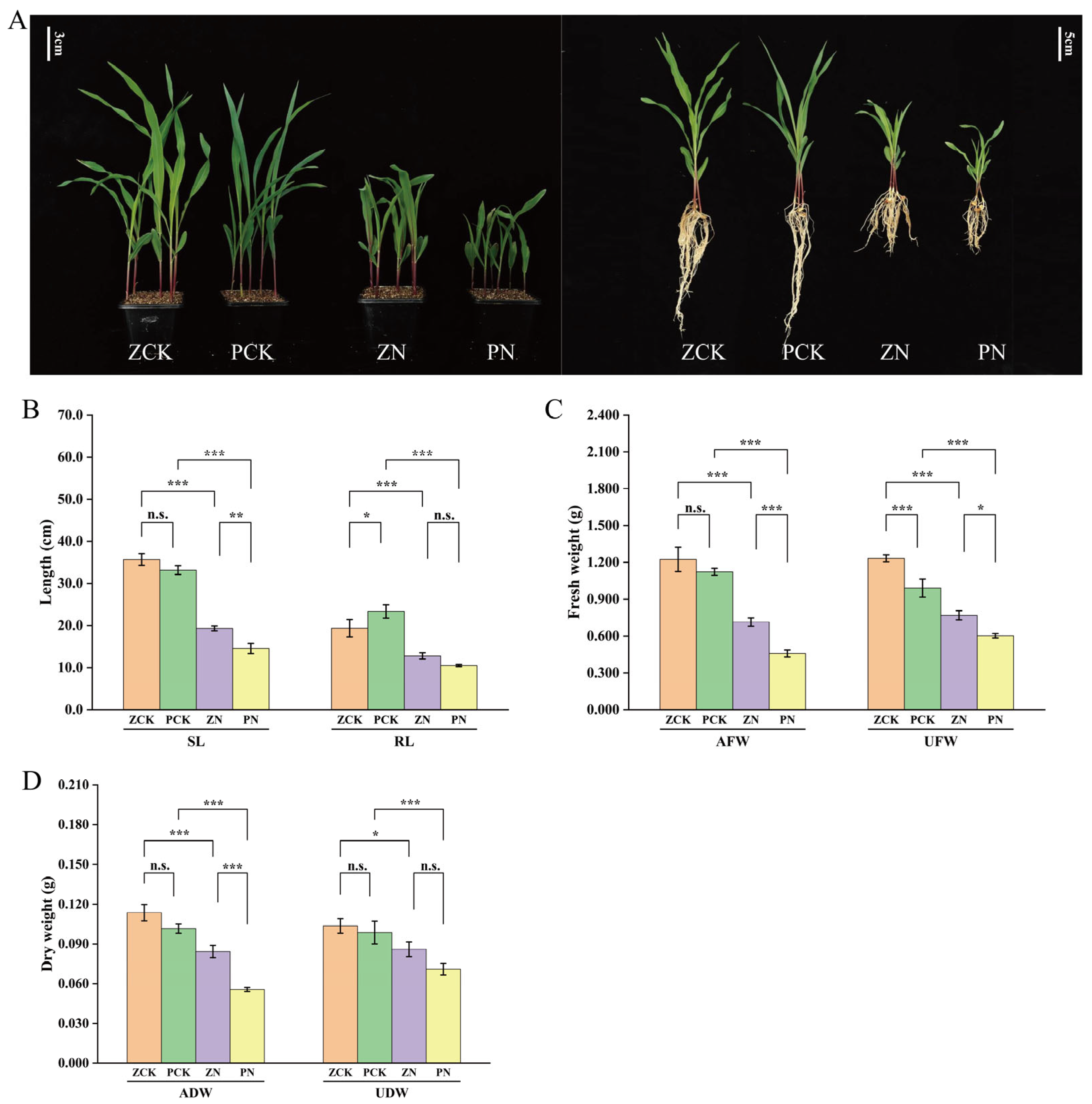
Analysis of growth parameters in Zheng58 and PH4CV revealed that salt stress significantly inhibited seedling growth compared to the control (distilled water treatment). Under the NaCl treatment, SL, RL, AFW, UFW, ADW and UDW all exhibited a marked decline in both genotypes. Specifically, in the salt-sensitive variety PH4CV, these indices decreased by 56.08%, 55.06%, 59.18%, 39.19%, 45.25%, 28.04%, respectively (note: values may correspond to paired control vs. stress comparisons across the six traits, with potential duplication or formatting artifact in reporting). In contrast, the salt-tolerant Zheng58 showed smaller reductions of 45.85%, 33.91%, 41.69%, 37.67%, 25.81%, 17.04%, respectively, indicating a stronger capacity to maintain growth under stress. Statistical analysis revealed significant (p < 0.01) or highly significant (p < 0.001) differences in most growth traits between the two varieties under salt stress conditions. These results demonstrate that salt stress exerts a strong inhibitory effect on maize seedling growth, and Zheng58 exhibits superior salt tolerance compared to PH4CV, as reflected by its relatively higher performance across all morphological and biomass-related indices (Figure 1A–D).

3.1.2. Physiological and Biochemical Indicators Under Salt Stress

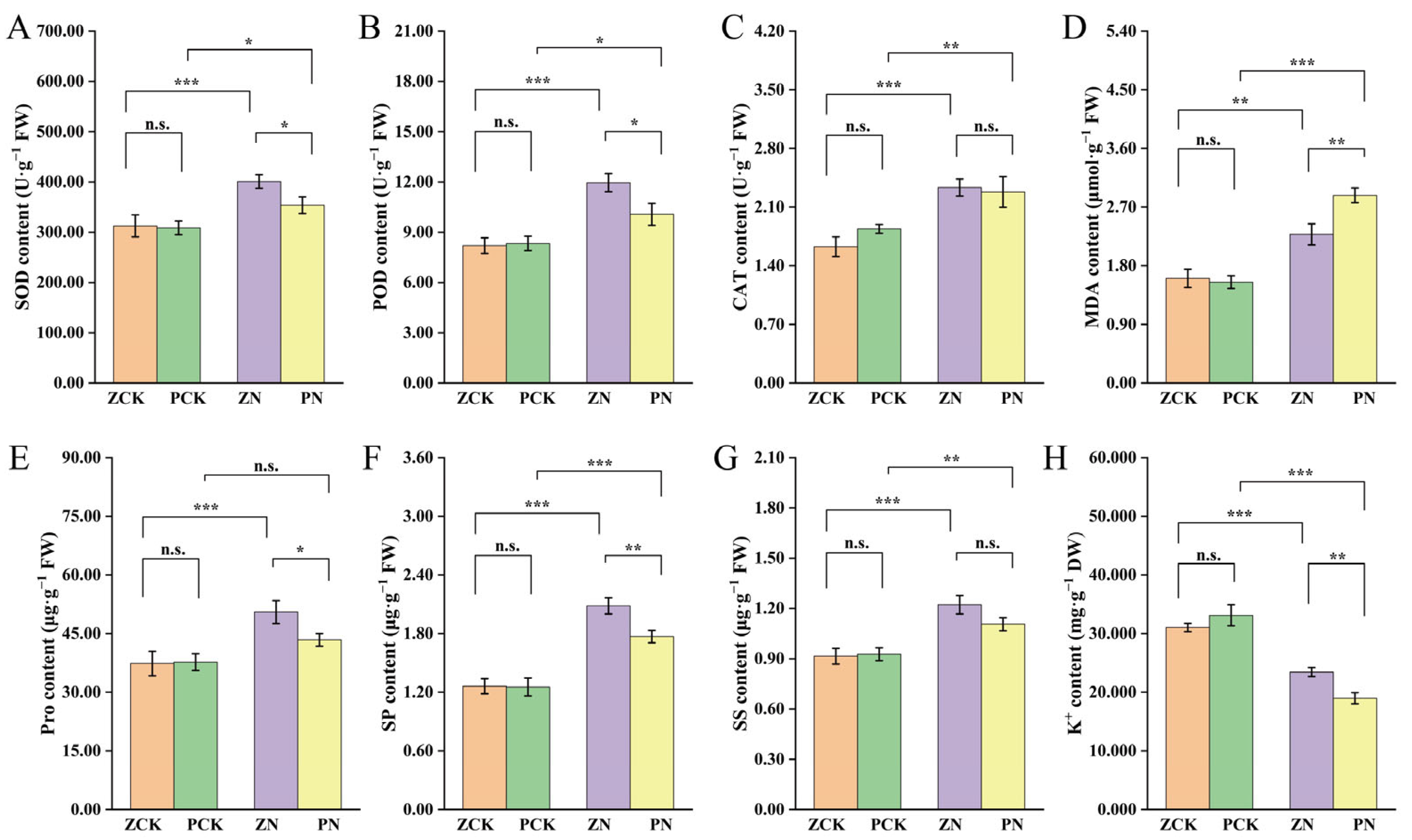
Analysis of physiological and biochemical parameters in Zheng58 and PH4CV revealed that, under the NaCl stress, all measured indicators—SOD, POD, CAT, MDA, Pro, SP, and SS—exhibited varying degrees of increase compared to their respective controls (Figure 2A–G). However, the magnitude of change differed significantly between the two genotypes, reflecting their contrasting salt tolerance capacities. MDA, a key indicator of membrane lipid peroxidation and oxidative damage, increased by 86.08% in the sensitive variety PH4CV and by only 42.02% in the tolerant variety Zheng58 relative to their controls. This substantial accumulation in PH4CV suggests greater cellular damage under salt stress. In contrast, antioxidant enzyme activities showed a more favorable response in Zheng58. SOD, POD, and CAT are crucial components of the plant’s antioxidative defense system, responsible for scavenging ROS. Under salt stress, PH4CV exhibited increases of 14.64% (SOD), 20.92% (POD), and 23.91% (CAT), while Zheng58 showed significantly higher enhancements of 28.31%, 45.72%, and 43.44%, respectively. This indicates that Zheng58 possesses a more robust antioxidant capacity, effectively mitigating oxidative stress. Osmotic substances such as Pro, SP, and SS play vital roles in osmotic adjustment, protein stabilization, and membrane protection. Their accumulation helps maintain cellular turgor and protects macromolecules under stress conditions. Under salt stress, PH4CV showed increases of 15.10% (Pro), 41.18% (SP), and 19.33% (SS) compared to the control. In comparison, Zheng58 exhibited much greater accumulation—35.26% (Pro), 65.04% (SP), and 33.53% (SS)—demonstrating a superior ability to adjust osmotically and stabilize cellular structures.
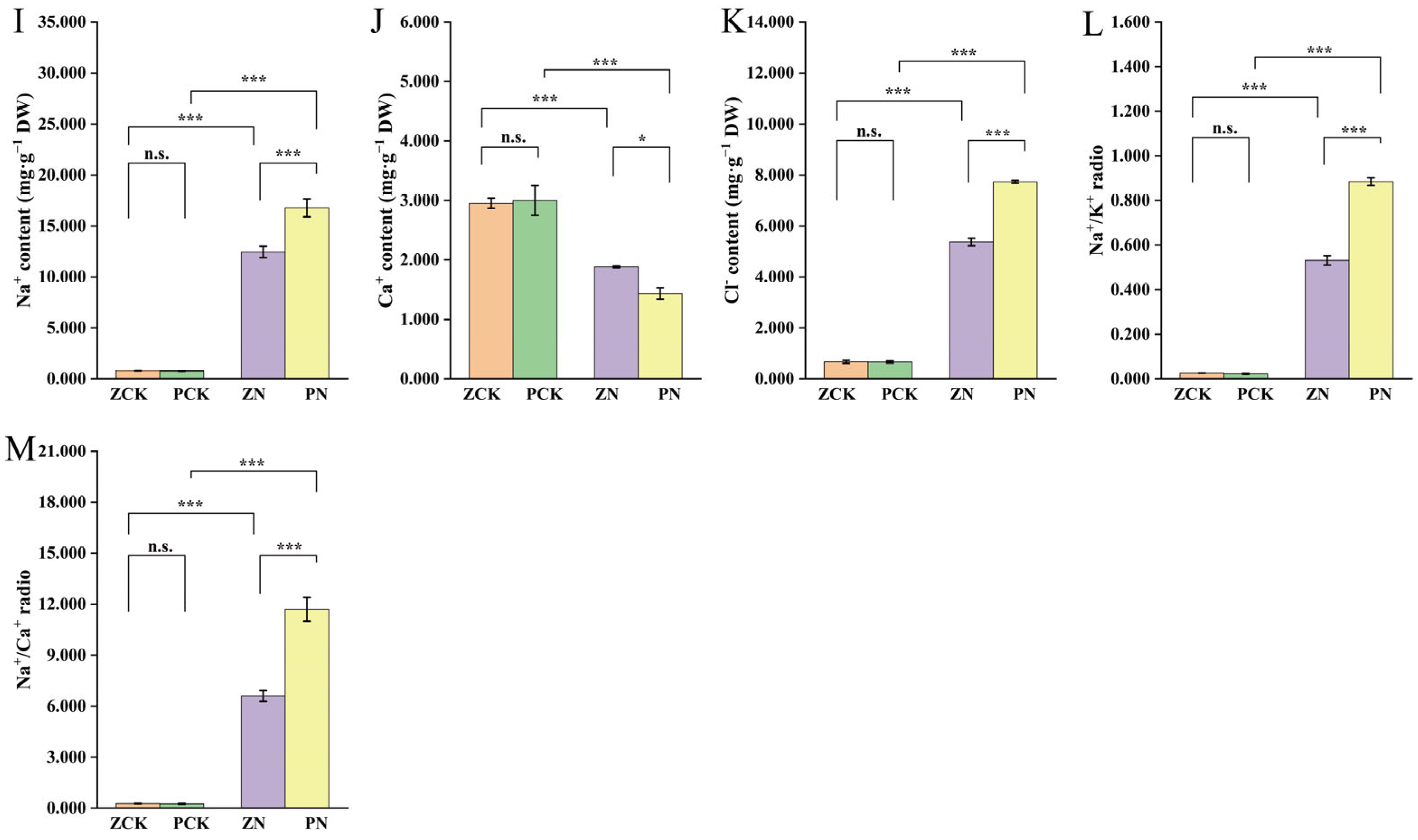
Salt stress significantly altered ion homeostasis in both maize varieties, leading to a general increase in Na+ and Cl concentrations and a concurrent decrease in K+ and Ca2+ levels compared to the control (Figure 2H–M). These shifts resulted in a substantial rise in the Na+/K+ and Na+/Ca2+ ratios, which are critical indicators of salt-induced ionic imbalance and toxicity. Under control conditions (distilled water), no significant differences in ion content or ratios were observed between Zheng58 and PH4CV. However, upon exposure to NaCl, marked genotypic differences emerged. Zheng58 maintained significantly higher levels of essential cations: its K+ content was 1.24 times and Ca2+ content 1.31 times higher than those in PH4CV under salt stress, reflecting a superior ability to retain these vital nutrients. In contrast, PH4CV exhibited a much greater accumulation of toxic ions. Na+ content increased by 2100.40% and Cl by 1064.43% relative to its control, whereas Zheng58 showed comparatively lower increases of 1443.40% (Na+) and 701.58% (Cl). More strikingly, the Na+/K+ and Na+/Ca2+ ratios—key determinants of cellular ionic balance—increased by 3731.44% and 4479.53%, respectively, in PH4CV compared to its control. In Zheng58, the same ratios increased by 1944.11% and 2313.91%, respectively, indicating a significantly better capacity to restrict Na+ influx and preserve K+ and Ca2+ homeostasis. These findings demonstrate that under salt stress, maize seedlings respond by modulating the uptake, transport, and compartmentalization of key ions. The salt-tolerant variety Zheng58 exhibits enhanced ion selectivity and regulation, minimizing Na+ and Cl accumulation while preserving higher levels of K+ and Ca2+. This effective ion balance helps maintain membrane stability, enzyme activity, and overall cellular function, thereby contributing to its superior salt tolerance. In contrast, the excessive Na+/K+ and Na+/Ca2+ ratios in PH4CV suggest severe disruption of ion homeostasis, leading to greater physiological damage and reduced stress resilience.

3.2. Salt Tolerance Candidate Gene Identification Based on BSA-Seq

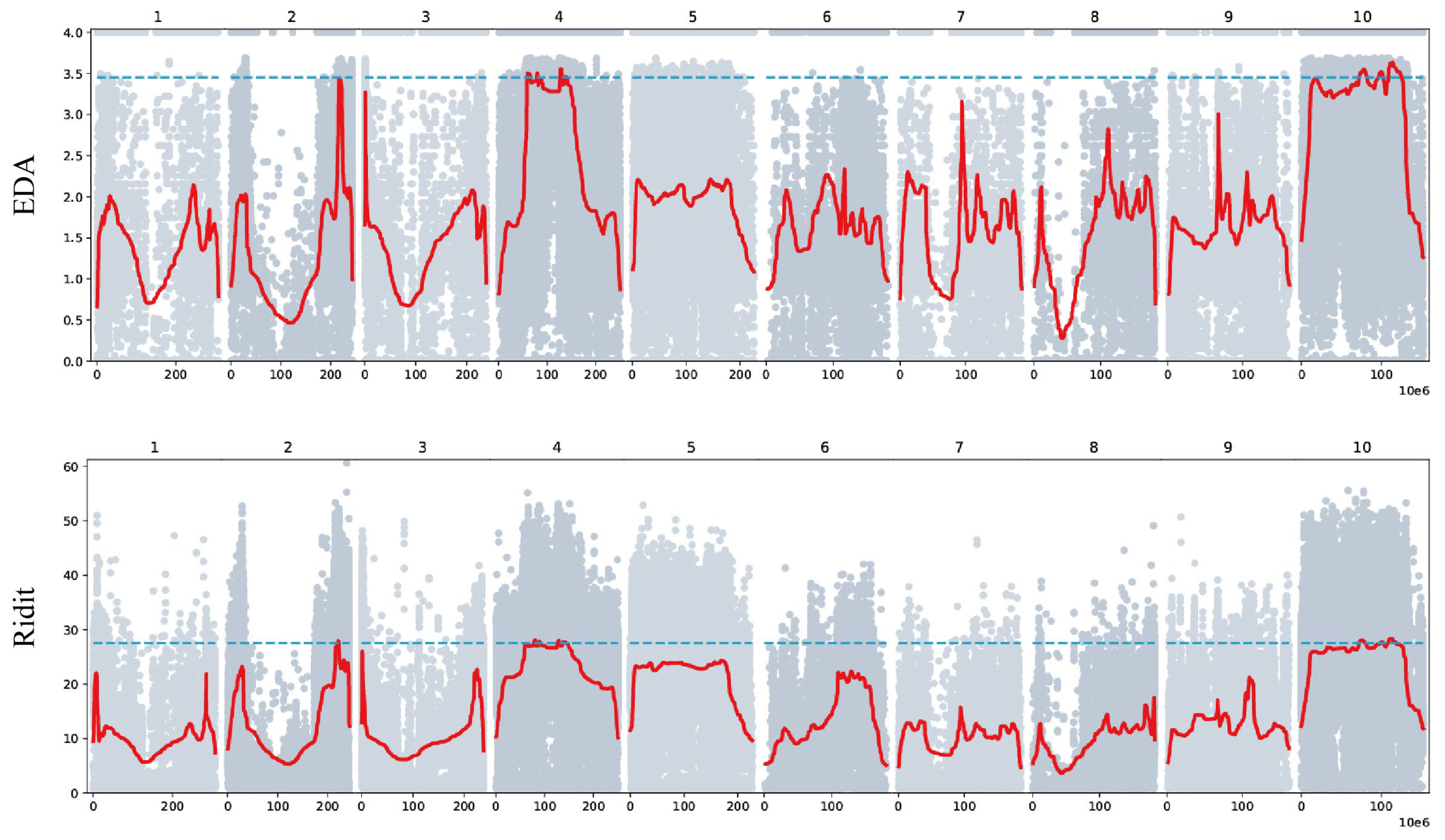
The candidate genomic intervals associated with salt tolerance were identified using two complementary analytical methods: ED4 and Ridit. According to the predefined significance thresholds, the candidate regions detected by the ED4 algorithm were found to be largely nested within the highly significant intervals identified by the Ridit method. The overlapping regions between these two approaches were considered high-confidence candidate intervals linked to salt tolerance. Ultimately, six such consensus regions were confirmed (Figure 3), located on chromosomes 4 and 10. The combined length of these regions spanned 28.60 Mb, with individual sizes of 2.68 Mb, 3.16 Mb, 1.89 Mb, 7.95 Mb, 3.25 Mb, and 9.67 Mb, respectively (Supplementary Table S4).
Following the delineation of these confidence intervals, gene annotation information within each region was retrieved from the Maize GDB (https://www.maizegdb.org/ (accessed on 13 October 2025)) to identify potential candidate genes. A total of 391 annotated genes were located within the six combined intervals (Supplementary Table S5). Subsequent functional annotation and screening—based on gene function, biological processes, and relevance to abiotic stress responses—were performed using integrated data from Maize GDB and the NCBI database (https://www.ncbi.nlm.nih.gov/ (accessed on 17 October 2025)). After filtering for genes potentially involved in ion transport, osmotic regulation, signal transduction, and stress-responsive pathways, a subset of 151 putative salt tolerance-related candidate genes was selected for further analysis (Supplementary Table S6). These genes represent promising targets for dissecting the genetic basis of salt tolerance in maize.

3.3. Transcriptome Analysis of the Seedling Stage of the Two Varieties Under Salt Stress

3.3.1. Differential Gene Expression Analysis

As shown in Supplementary Figure S1A, under salt stress, a total of 2435 DEGs were detected in Zheng58 compared to its control, comprising 1009 up-regulated and 1426 down-regulated genes, representing 41.44% and 58.56% of the total DEGs, respectively. In contrast, the PH4CV exhibited a much broader transcriptional response, with 5788 DEGs identified, including 2652 up-regulated (45.82%) and 3136 down-regulated (54.18%). Venn diagram analysis across the comparison groups—PCK vs. ZCK, PN vs. ZN, ZCK vs. ZN, and PCK vs. PN—revealed 187 common DEGs shared between the two genotypes under stress (Supplementary Figure S1B–D). Among these, 19 genes were consistently up-regulated across all four comparison groups, suggesting their potential core role in the general response to salt stress. Conversely, 20 genes were uniformly down-regulated in all comparisons, possibly indicating conserved repression of specific biological processes under stress conditions. Additionally, differentially expressed genes (DEGs) were categorized into overlapping and uniquely expressed sets across the four treatment comparisons—PCK vs. ZCK, PN vs. ZN, ZCK vs. ZN, and PCK vs. PN. A total of 809, 1893, 522, and 1256 uniquely expressed DEGs were identified in each respective comparison group. This highlights the distinct regulatory strategies employed by the two varieties. The commonly and specifically expressed DEGs provide valuable candidates for further functional studies on salt tolerance mechanisms in maize.
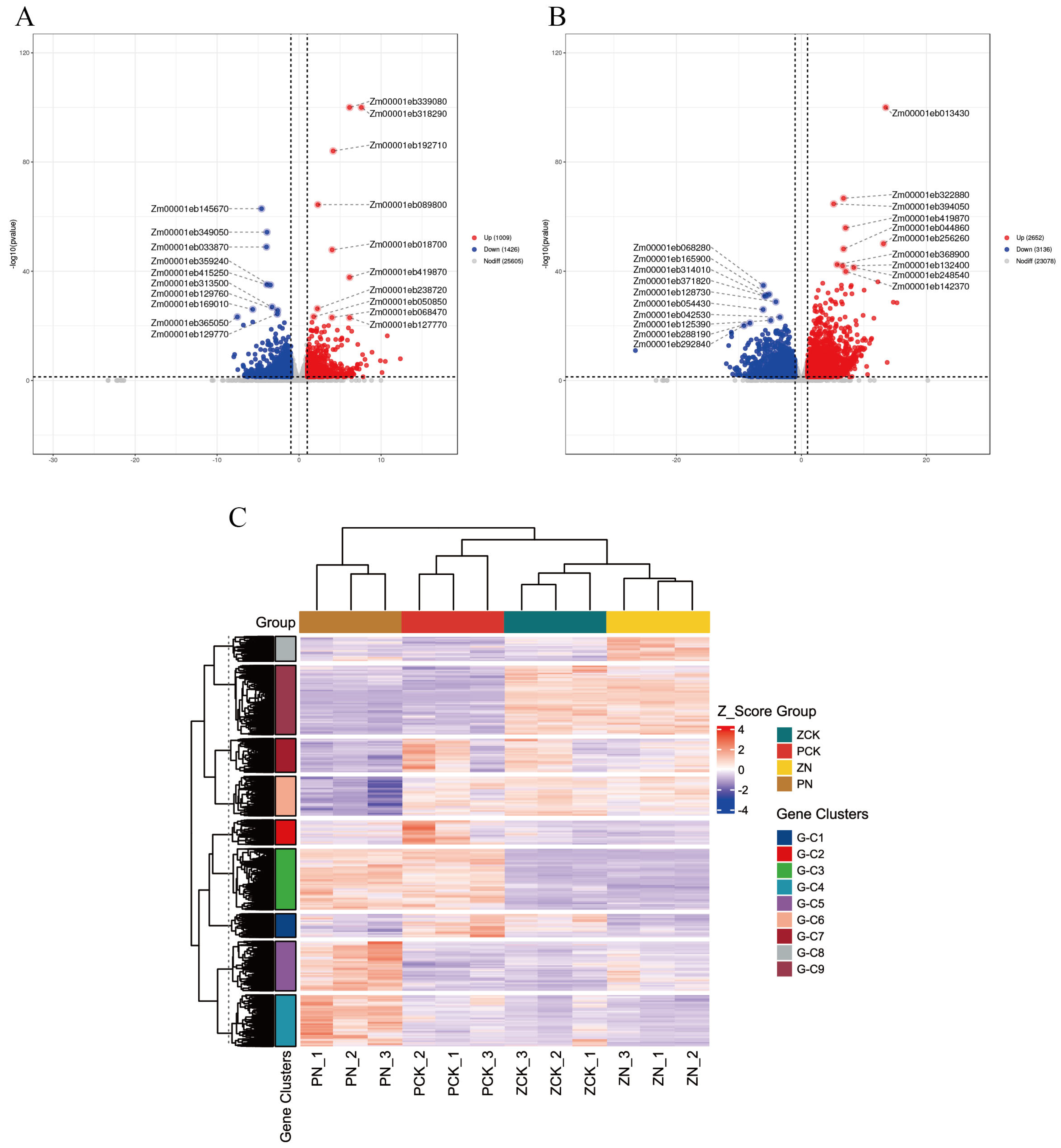
Based on the differential expression analysis, volcano plots were generated to visualize the distribution of gene expression changes between control and salt-stressed samples for both maize varieties (Figure 4A,B). In the ZCK vs. ZN comparison, several genes exhibited significant up-regulation, including Zm00001eb339080, Zm00001eb318290, Zm00001eb192710, Zm00001eb089800, and Zm00001eb018700. These may represent key stress-responsive candidates in the tolerant genotype. Down-regulated genes in Zheng58 under salt stress included Zm00001eb145670, Zm00001eb349050, Zm00001eb033870, Zm00001eb359240 and Zm00001eb415250 suggesting potential repression of growth- or development-related processes under stress. In the PCK vs. PN comparison, up-regulated genes included Zm00001eb013430, Zm00001eb322880, Zm00001eb394050, Zm00001eb419870, and Zm00001eb044860, while down-regulated genes encompassed Zm00001eb068280, Zm00001eb165900, Zm00001eb314010, Zm00001eb371820, and Zm00001eb128730 (Supplementary Table S7).
To further explore expression patterns across all samples, hierarchical clustering analysis was performed based on gene expression levels (Figure 4C). The analysis clustered both genes with similar expression profiles across samples and samples with similar gene expression patterns. The Euclidean distance was used to measure dissimilarity, and the Complete Linkage (farthest neighbor) method was applied for cluster merging. The clustering results revealed distinct co-expression patterns: Genes in clusters G-C6 and G-C9 showed high expression levels in both ZCK and ZN, suggesting constitutive or stress-enhanced activation in the tolerant variety. Clusters G-C8, G-C4, and G-C5 exhibited elevated expression specifically in ZN or PN, indicating stress-induced activation unique to each genotype. Cluster G-C3 displayed high expression in both PCK and PN, implying a baseline expression bias in PH4CV that is maintained regardless of stress condition.

3.3.2. GO Function Enrichment Analysis

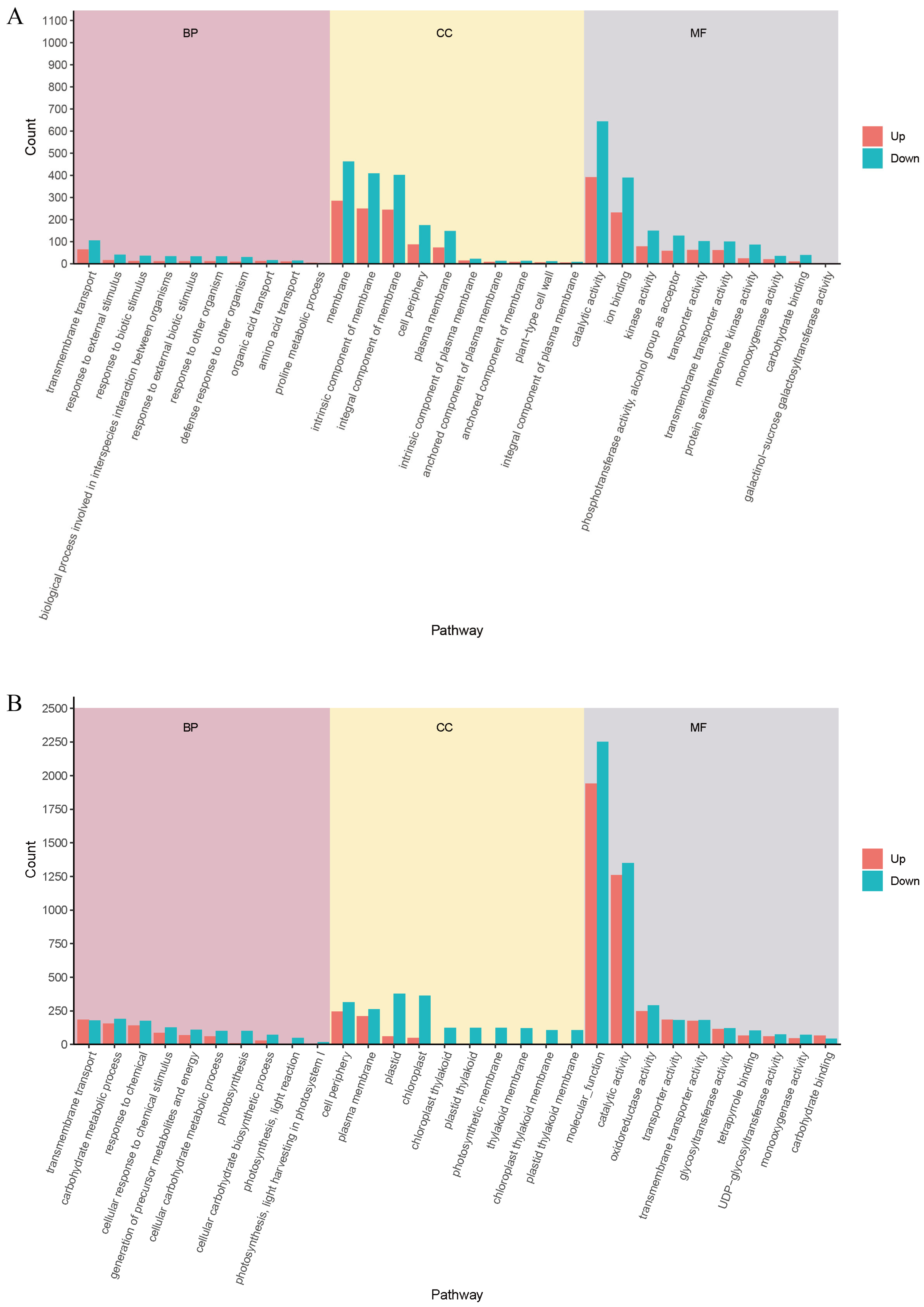
To elucidate the biological functions and processes associated with the DEGs in response to salt stress, GO functional enrichment analysis was performed for both Zheng58 and PH4CV. The analysis categorized significantly enriched GO terms into three main domains: Biological Process (BP), Cellular Component (CC), and Molecular Function (MF), with up- and down-regulated genes analyzed separately (Figure 5A,B). Compared with the control group, under salt stress treatment, the terms of Zheng58 and PH4CV that were significantly upregulated in BP, CC and MF were 220/12/127, 163/36/69, and the terms that were significantly downregulated were 239/12/131, 172/41/68. In Zheng58, the most significantly enriched BP included transmembrane transport, response to external stimulus, response to biotic stimulus, biological processes involved in interspecies interaction, and response to other organisms. The enriched CC were predominantly associated with membrane structures, including membrane, intrinsic component of membrane, integral component of membrane, cell periphery, and plasma membrane. For MF, key enriched terms were catalytic activity, ion binding, kinase activity, phosphotransferase activity, and transporter activity. The GO enrichment profile in PH4CV showed largely similar functional categories, suggesting conservation in the types of biological processes affected by salt stress. However, Zheng58 exhibited fewer DEGs within the same enriched terms, indicating a more targeted and potentially efficient transcriptional response compared to the broader and possibly less specific activation in PH4CV. Overall, the DEGs identified in this study are primarily involved in transmembrane transport and are localized to the cell periphery and plasma membrane. Key molecular functions include catalytic activity, transporter activity, transmembrane transporter activity, monooxygenase activity, and carbohydrate binding.

3.3.3. KEGG Pathway Enrichment Analysis

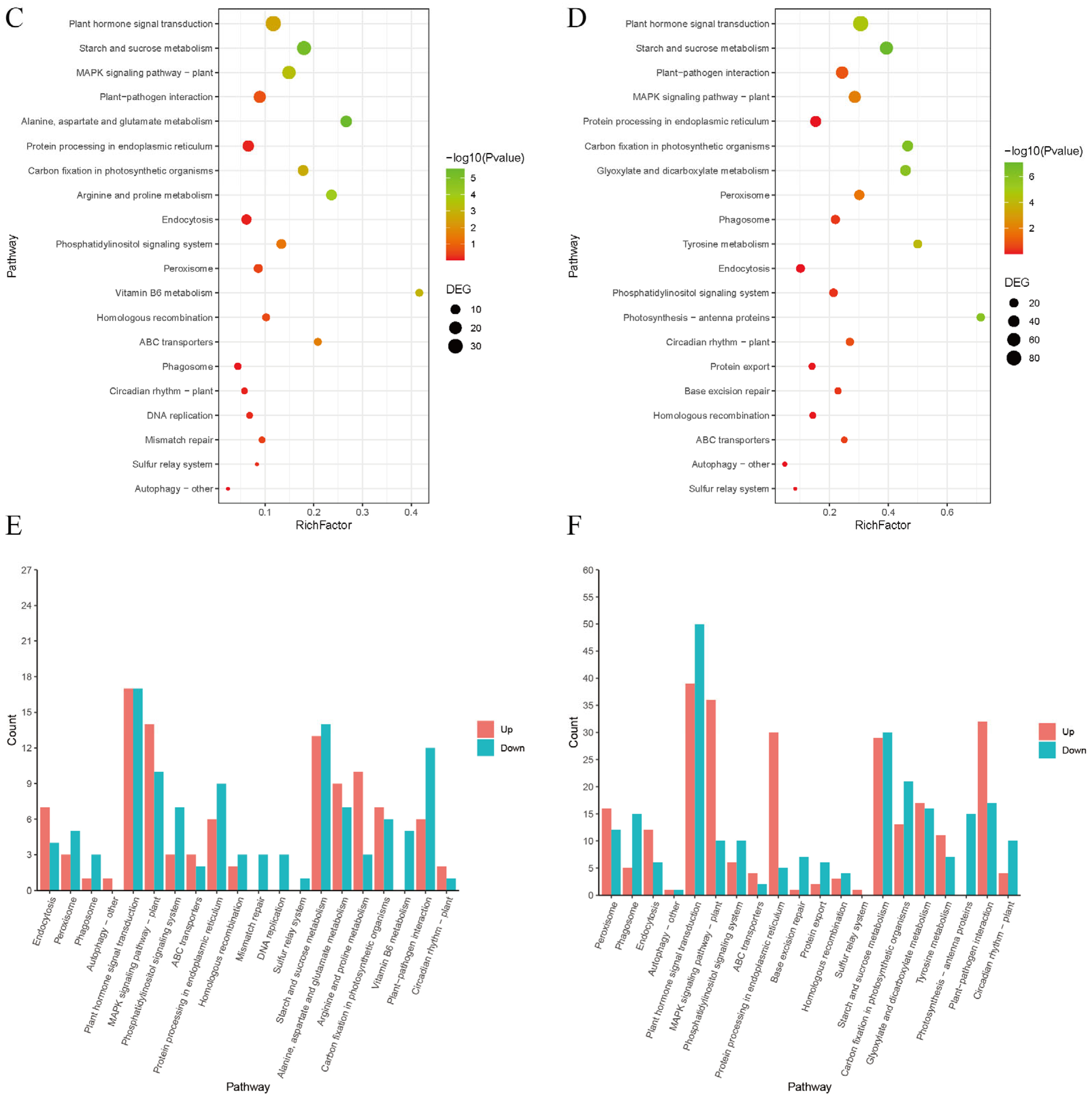
To gain deeper insights into the biological roles and metabolic pathways associated with DEGs under salt stress, KEGG pathway enrichment analysis was conducted for both Zheng58 and PH4CV. The results revealed distinct patterns of pathway activation and suppression between the two genotypes (Figure 5C,D). In Zheng58, 22 out of 111 annotated pathways were significantly enriched under salt stress (Supplementary Table S8). Key enriched pathways included: Plant hormone signal transduction, Starch and sucrose metabolism, MAPK signaling pathway–plant, Plant–pathogen interaction, Alanine, aspartate and glutamate metabolism. In contrast, PH4CV exhibited significant enrichment in 36 out of 124 annotated pathways (Supplementary Table S9). While several pathways overlapped with those in Zheng58—such as Plant hormone signal transduction, Starch and sucrose metabolism, Plant–pathogen interaction, MAPK signaling pathway–plant. Additionally, PH4CV showed enrichment in unique stress-related pathways such as: Glyoxylate and dicarboxylate metabolism, Tyrosine metabolism, Photosynthesis—antenna proteins. Interestingly, several pathways were uniquely enriched in Zheng58, including: Alanine, aspartate and glutamate metabolism, Arginine and proline metabolism, Vitamin B6 metabolism.
Further examination of gene expression trends within these pathways (Figure 5E,F) revealed genotype-specific regulatory strategies: In Zheng58, genes involved in Plant hormone signal transduction, MAPK signaling pathway-plant, Starch and sucrose metabolism, and Arginine and proline metabolism were predominantly up-regulated, indicating active stress signaling and osmotic regulation. Conversely, genes in Plant-pathogen interaction, Protein processing in endoplasmic reticulum, and Phosphatidylinositol signaling system were down-regulated, possibly reflecting resource reallocation away from secondary metabolism and certain lipid signaling pathways. In PH4CV, up-regulation was observed in Plant-pathogen interaction, MAPK signaling pathway–plant, Protein processing in endoplasmic reticulum, and Peroxisome. However, significant down-regulation occurred in key processes such as Plant hormone signal transduction, Carbon fixation in photosynthetic organisms, Phagosome, and Photosynthesis—antenna proteins.

3.4. Identification of Salt Tolerance Candidate Genes

To refine the list of potential salt tolerance genes and identify high-confidence candidates, an integrated analysis was performed by combining results from BSA-seq and RNA-seq. This multi-omics approach enabled the prioritization of candidate genes located within significant QTL intervals that also exhibited differential expression under salt stress. From the initial set of 151 candidate genes identified within the six confidence intervals through functional annotation, 129 genes were found to be plausibly associated with salt stress responses based on their genomic location, expression patterns, and functional relevance. Among these, 69 genes showed detectable and reliable expression levels across the RNA-seq datasets, confirming their transcriptional activity under both control and salt-stressed conditions. Based on gene functional annotation analysis (Supplementary Table S10), a total of 9 and 23 high-confidence candidate genes were identified within the 5.93 Mb interval on chromosome 4 and the 4.58 Mb interval on chromosome 10, respectively (Table 1). These genes are primarily involved in three key biological processes associated with salt stress response in maize: Ion transport and homeostasis: including K16055 (K+ transport), K14652 (Na+/H+ antiporter), K14808 (vacuolar H+-ATPase), and K10251 (plasma membrane H+-ATPase); Antioxidant defense and ROS scavenging: K01922, K02335, K00799, K00111, K11262, K16296, K06949, K20179, K13095, and K21596; Nitrogen metabolism and biosynthesis of osmotic regulatory substances: K00658 (glutamine synthetase) and K03696 (arginine decarboxylase, involved in polyamine synthesis).

3.5. RT-qPCR (Quantitative Real-Time PCR) Validation of the Candidate Genes

In order to further confirm the reliability of the transcriptome sequencing results and identify candidate genes that play a role in the salt tolerance pathway, we conducted RT-qPCR comparison and verification (Supplementary Figure S2) for 32 DEGs (Supplementary Table S11). The RNA-seq results were consistent with the RT-qPCR results, indicating the reliability of the sequencing results. To prioritize candidate genes from the 32 identified candidates, we first examined their expression trends under salt stress. Zm00001eb419400 (ZmACC2, chr10:100241710-100263391) exhibited consistent and significant upregulation, with a greater fold change compared to other candidates. Next, we focused on genes annotated in plant hormone signal transduction and MAPK signaling pathways, as these are well-established regulators of plant stress responses. Among these, ZmACC2, which encodes an ACC synthase involved in ethylene biosynthesis, was prioritized due to its functional relevance in hormone signaling and its potential crosstalk with MAPK cascades under salt stress. Based on these explicit selection criteria, ZmACC2 was identified as the core candidate gene for further analysis (Supplementary Table S12).

3.6. Analysis of Tissue-Specific Differential Expression of the ZmACC2 Gene

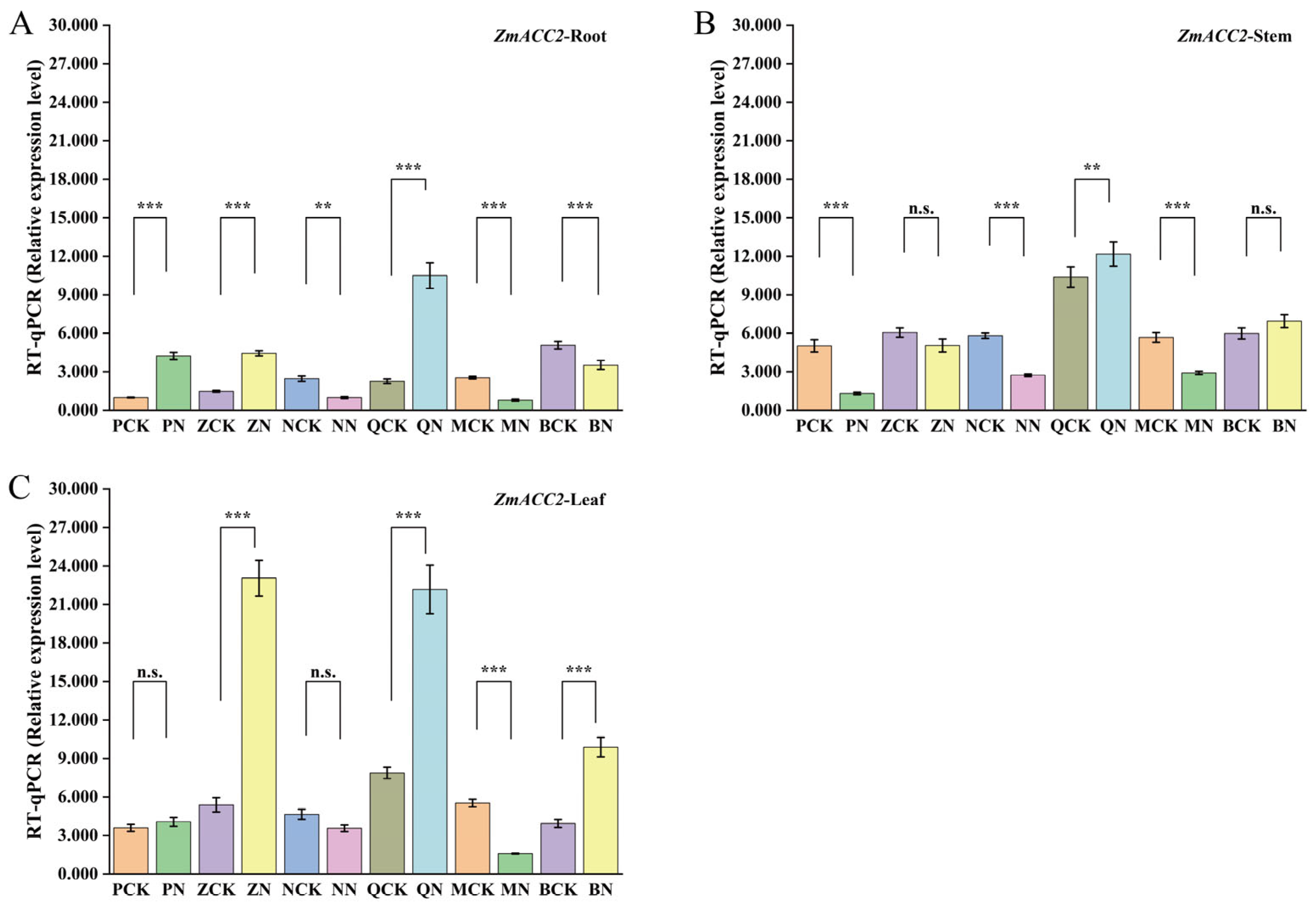
As shown in Figure 6, there are significant differences in the expression pattern of the ZmACC2 gene in different tissues of maize. If the expression level of the ZmACC2 gene in roots is converted to 1, the expression level of ZmACC2 in maize leaves is the highest, and the expression levels in the leaves of Zheng58 and Qi319 are significantly higher than those in the roots. The results indicate that the higher expression of ZmACC2 in leaves compared to roots and stems under salt stress suggests a potential leaf-specific role (Supplementary Tables S13 and S14).

4. Discussion

Salinization is a major abiotic stress that adversely affects maize growth and development, often leading to significant yield losses [52,53,54]. Beyond growth inhibition, salt stress disrupts key physiological processes, including the antioxidant system and osmolyte metabolism. In the present study, Zheng58 and PH4CV showed comparable antioxidant enzyme activities under normal conditions. However, under salt stress, Zheng58 exhibited significantly higher activities of SOD, POD, and CAT—1.13-, 1.19-, and 1.02-fold higher than PH4CV, respectively—suggesting a more robust activation of its antioxidant defense. This aligns with observations in other crops, where coordinated upregulation of these enzymes enhances salt tolerance by efficiently scavenging ROS and preventing oxidative damage [55]. Concurrently, Zheng58 accumulated higher levels of osmotic regulatory substances: Pro was 1.16-fold higher than in PH4CV, while SP and SS were elevated by 1.18- and 1.10-fold, respectively. Pro not only contributes to osmotic adjustment but also stabilizes proteins and membranes under salt-induced water stress [56], reinforcing Zheng58’s superior osmoregulatory capacity. Consistent with the heightened oxidative stress, MDA content markedly increased in leaf tissues under salt treatment, indicating severe lipid peroxidation and membrane damage—a common consequence of ROS accumulation in photosynthetically active tissues [57].
During the maize seedling stage, salt stress induces ionic imbalance by altering the concentrations of key ions such as Na+, K+, Ca2+, and Cl, thereby disrupting normal physiological processes [58]. Excessive Na+ accumulation not only disturbs intracellular ion homeostasis but also interferes with the uptake and translocation of essential cations like K+ and Ca2+, compromising membrane stability and enzyme activity [59,60]. Potassium (K+) is a critical cofactor for numerous enzymes and plays central roles in osmotic regulation, stomatal control, and antioxidant defense. Under salt stress, reduced K+ uptake and increased efflux—as observed in asparagus—lead to lower intracellular K+, higher Na+, and an elevated Na+/K+ ratio, a key indicator of ionic stress [54]. Calcium (Ca2+) acts as a vital secondary messenger in stress signaling, contributing to membrane stabilization and regulation of ion channels, thereby enhancing selective permeability and salt tolerance [61]. Chloride (Cl), while necessary for charge balance and osmotic potential, becomes phytotoxic at high levels, impairing metabolism and growth in maize [62]. In this study, Zheng58 accumulated higher levels of Na+ and Cl than PH4CV under salt stress, which may reflect more efficient sequestration of these ions into vacuoles or less sensitive tissues, minimizing their cytotoxic effects in metabolically active leaf cells. Concurrently, Zheng58 maintained relatively higher K+ and Ca2+ concentrations, suggesting a superior ability to preserve ion homeostasis. Given that leaves are highly sensitive to ionic disturbances, this balanced ion management likely contributes to Zheng58’s enhanced salt tolerance during the seedling stage. These findings indicate that genotypic differences in salt tolerance are closely linked to strategies for ion uptake, transport, and compartmentalization. While variation in energy allocation, protective metabolite synthesis, and ion transport efficiencyunderlie these differences, the genetic and molecular mechanisms remain incompletely understood. Systematic identification and functional characterization of salt-tolerance genes and their regulatory networks are therefore essential to elucidate these processes and provide a foundation for breeding salt-resilient maize varieties.
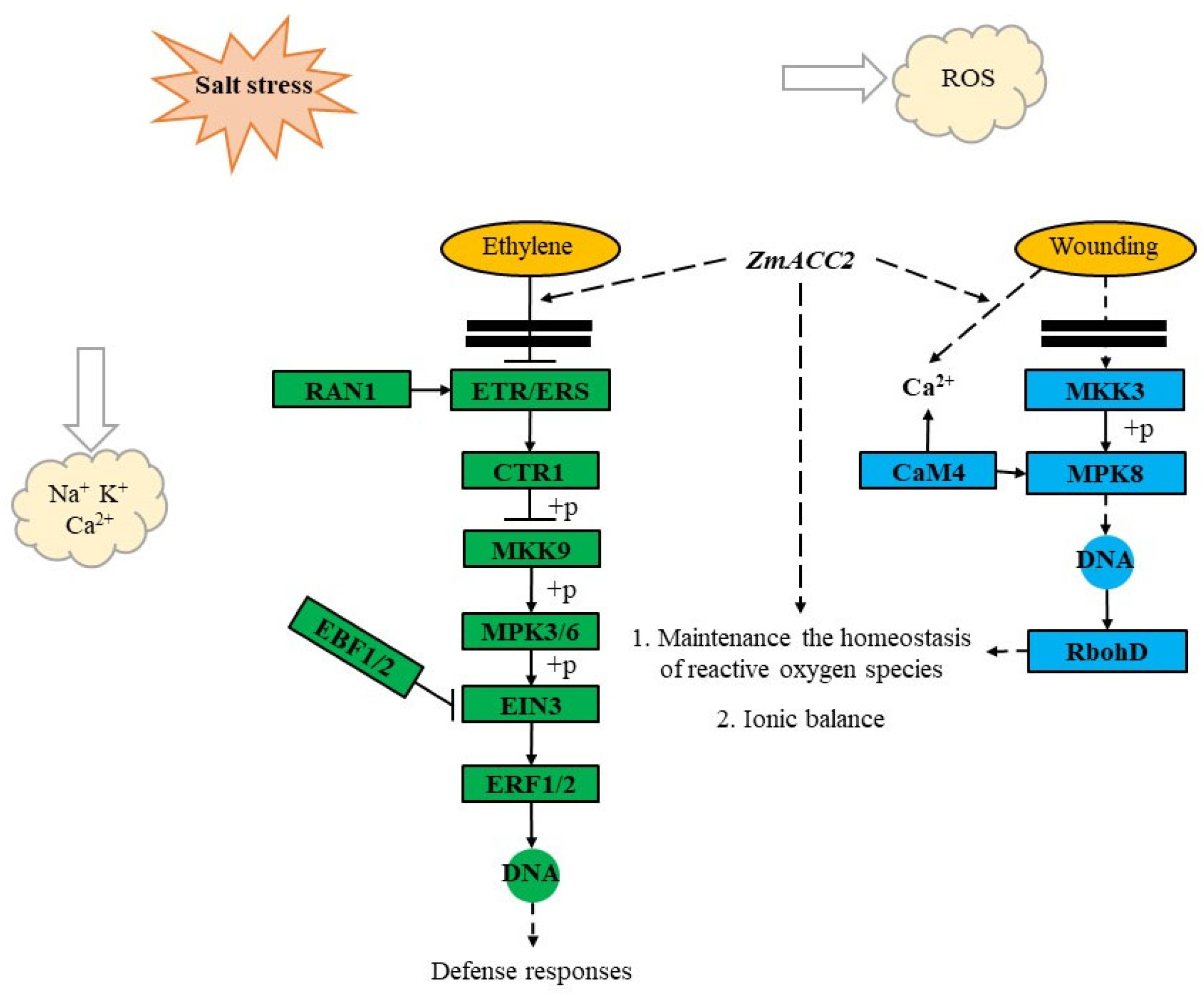
Plant hormone signal transduction and MAPK signaling pathways are central to plant responses to abiotic stresses, coordinating physiological adjustments such as osmotic regulation, ion homeostasis, and antioxidant defense (Supplementary Figure S3). The MAPK signaling cascade transduces stress signals into downstream responses, including hormone signal transduction and gene expression [63,64]. Multiple MAPK pathway genes were differentially expressed under salt stress in our transcriptome data, consistent with their known roles in salt tolerance, particularly MPK3/6 (Mitogen-Activated Protein Kinase 3/6), which directly phosphorylate and stabilize ACC synthases (ACSs), thereby modulating ethylene production, suggesting coordination between MAPK and ethylene pathways in salt stress response [65,66,67]. Ethylene, a gaseous phytohormone, regulates diverse processes including growth, development, and stress responses [68,69]. Given its central role in abiotic stress adaptation, modulating ethylene biosynthesis or signaling offers promising avenues for crop improvement. 1-Aminocyclopropane-1-carboxylate oxidase (ACO) catalyzes the final step of ethylene biosynthesis and is critical for stress-induced ethylene production [70]. In peanut, overexpression of AhACO1 and AhACO2 from a salt-tolerant mutant enhanced growth, photosynthetic performance, and ethylene emission under salt stress, indicating a positive role of ACO in tolerance [71]. Similarly, ACOh4 in another species was shown to improve K+/Na+ homeostasis via Na+/H+ antiport activity, linking ACO-mediated ethylene production to ion regulation [72]. Beyond biosynthesis, ethylene signaling is equally important. The transcription factor EIN3 acts as a central hub in this pathway. Overexpression of GhEIN3 in transgenic plants enhanced salt tolerance by reducing H2O2 and MDA accumulation, boosting antioxidant enzyme activities (SOD, POD), and upregulating ROS- and ABA-related genes [73]. Likewise, rice OSERF19, an ethylene-responsive factor, conferred improved salt tolerance when overexpressed despite being downregulated under stress, underscoring the functional importance of ethylene-responsive elements [74]. In our study, the ethylene pathway was differentially regulated between PH4CV (salt-sensitive) and Zheng58 (salt-tolerant). Under salt stress, PH4CV showed upregulation of EIN3 (Zm00001eb244830, Ethylene Insensitive 3-like 5 protein) and ERF1/2 (Zm00001eb307550, Ethylene Response Factor). In contrast, Zheng58 exhibited downregulation of EBF1/2 (Zm00001eb276590, Ethylene Response Factor)—a negative regulator that targets EIN3 for degradation—alongside upregulation of EIN3 (Zm00001eb331080, protein Ethylene-insensitive 3-like 2), suggesting enhanced EIN3 protein stability in the tolerant genotype. Based on these findings and the established roles of ACO and EIN3 in stress adaptation, we hypothesize that ZmACC2 (1-aminocyclopropane-1-carboxylate synthase, ACS) contributes to salt tolerance in Zheng58 by (1) promoting degradation of EBF1/2, thereby stabilizing EIN3 and activating downstream stress-responsive genes, and (2) potentially regulating ion homeostasis—particularly Na+, K+, and Ca2+ balance—to enhance cellular stability under salinity. Under NaCl stress, ACC significantly enhanced Na+ extrusion, mitigated K+ loss, and elevated both H2O2 accumulation and intracellular membrane Ca2+ levels induced by salt. Based on these findings, Lang et al. proposed that ethylene, triggered by extracellular ATP (eATP) as a novel upstream signaling component, subsequently activates and potentiates the H2O2 and Ca2+ signaling pathways, thereby contributing to the maintenance of K+/Na+ homeostasis under saline conditions [75]. Zhang et al. demonstrated that under 150 mmol/L NaCl stress, transgenic lines overexpressing TaACCD exhibited enhanced salt tolerance and faster growth than WT plants. These lines showed reduced ROS levels and electrolyte leakage, along with increased POD and SOD activities. These findings suggest that heterologous expression of TaACCD represents a promising strategy for enhancing plant salt tolerance [76]. At the same time, in our study, the calcium and ROS signaling components were differentially regulated between PH4CV (salt-sensitive) and Zheng58 (salt-tolerant) under salt stress. In PH4CV, CaM4 (Zm00001eb333100, calmodulin; Zm00001eb352340, probable calcium-binding protein CML9) and RbohD (respiratory burst oxidase homolog D) showed inconsistent regulation—some RbohD copies were upregulated (Zm00001eb197890, respiratory burst oxidase-like protein D), others downregulated (Zm00001eb341260, respiratory burst oxidase homolog protein B)—suggesting a dysregulated ROS–Ca2+ signaling network. By contrast, Zheng58 exhibited consistent downregulation of multiple CaM4 genes (Zm00001eb279150, EF hand family protein; Zm00001eb196020, calmodulin-related protein) and upregulation of a specific RbohD isoform (Zm00001eb131620), indicative of a more coordinated and potentially protective ROS response.
Based on these observations and the established roles of calcium signaling in stress adaptation, we propose that ZmACC2 contributes to salt tolerance by modulating ion homeostasis via CaM4-mediated calcium signaling, while ZmACC2 may enhance cellular protection by fine-tuning H2O2 levels and ionic balance. Together, these pathways likely act in concert to orchestrate the salt stress response in maize (Figure 7). Although our results suggest that ZmACC2 is closely associated with salt tolerance in maize, current evidence remains preliminary. Therefore, further functional validation—including transgenic analysis, gene editing, or allelic complementation assays—will be performed to confirm the role of ZmACC2 in salt tolerance, and to elucidate its precise molecular function and regulatory mechanism under salt stress.

5. Conclusions

In conclusion, this study systematically characterized the salt tolerance phenotypes and underlying genetic mechanisms of the maize varieties Zheng58 and PH4CV. By integrating BSA-seq with transcriptomic profiling, one candidate gene that may be involved in salt tolerance during the seedling stage—ZmACC2—was identified. We propose that under salt stress conditions, this candidate gene plays a pivotal role in maintaining cellular ion homeostasis and regulating ROS metabolism, thereby contributing to plant stress resilience and normal growth and development. Specifically, the ZmACC2 gene maymodulate the dynamic equilibrium of key ions such as Na+, K+, and Ca2+ across cellular compartments. This regulatory function is potentially mediated through the modulation of central signaling components in stress-responsive pathways, including EIN3, ERF1/2, RbohD and CaM4. By fine-tuning the expression of the gene, the candidate loci may promote Na+ efflux or vacuolar sequestration while sustaining efficient K+ uptake, thus preserving optimal cytosolic ion ratios. Concurrently, the gene is implicated in the regulation of antioxidant defense systems, likely through influencing the expression ofgenes involved in ROS scavenging. This activity contributes to the effective suppression of ROS accumulation, thereby mitigating membrane lipid peroxidation and reducing oxidative damage. Through these coordinated and synergistic mechanisms—encompassing ion homeostasis, hormonal signaling, and redox balance—the identified gene enhances maize adaptability to saline environments. This enables significant improvement in salt tolerance without compromising essential physiological functions, highlighting their potential as key targets for molecular breeding and genetic engineering strategies aimed at developing salt-resilient crops. Among the candidates, ZmACC2 emerges as particularly promising for future investigation. Both integrate core stress-response modules—ETH signaling, ion homeostasis, and ROS scavenging—and align with conserved mechanisms shown in other crops to enhance tolerance without yield loss. Prioritizing their functional validation through transgenic or gene-editing approaches, and dissecting their interactions with key signaling components (e.g., CaM4, ERF1/2, EIN3), will be critical to translate these findings into effective breeding strategies for salt-resilient maize.

Supplementary Materials

The following supporting information can be downloaded at https://www.mdpi.com/article/10.3390/cimb48040423/s1.

Author Contributions

Conceptualization, Investigation, Formal analysis, Data curation, Writing—original draft, Writing-review and editing, Software, Z.R.; Data curation, Formal analysis, Z.Z.; Data curation, Investigation, J.B.; Validation, W.T.; Data curation, X.H.; Formal analysis, L.Z.; Funding acquisition, Supervision, Conceptualization, Writing-review and editing, Y.P. All authors have read and agreed to the published version of the manuscript.

Funding

This research was funded by National Key Research and Development Project (2022YFD1201804), Central Guide Local Science and Technology Development Fund Project (25ZYJA002), Tibet Autonomous Region Science and Technology Plan Project (XZ202501ZY0086).

Institutional Review Board Statement

Not applicable.

Informed Consent Statement

Not applicable.

Data Availability Statement

The original contributions presented in this study are included in the article/Supplementary Materials. Further inquiries can be directed to the corresponding authors.

Conflicts of Interest

The authors declare no conflict of interest.

References

  1. Van Zelm, E.; Zhang, Y.; Testerink, C. Salt Tolerance Mechanisms of Plants. Annu. Rev. Plant Biol. 2020, 71, 403–433. [Google Scholar] [CrossRef] [PubMed]
  2. Mansour, M.M.F.; Hassan, F.A.S. How salt stress-responsive proteins regulate plant adaptation to saline conditions. Plant Mol. Biol. 2022, 108, 175–224. [Google Scholar] [CrossRef] [PubMed]
  3. Deinlein, U.; Stephan, A.B.; Horie, T.; Luo, W.; Xu, G.; Schroeder, J.I. Plant salt-tolerance mechanisms. Trends Plant Sci. 2014, 19, 371–379. [Google Scholar] [CrossRef]
  4. Guo, R.; Shi, L.; Yan, C.; Zhong, X.; Gu, F.; Liu, Q.; Xia, X.; Li, H. Ionomic and metabolic responses to neutral salt or alkaline salt stresses in maize (Zea mays L.) seedlings. BMC Plant Biol. 2017, 17, 41. [Google Scholar] [CrossRef] [PubMed]
  5. Cheng, C.; Liu, J.; Wang, Z.; Liu, J.; Wang, Y.; Liao, Y.; Gao, Z.; Lu, Z.; Zhu, B.; Yao, F. Analysis of Effect of Compound Salt Stress on Seed Germination and Salt Tolerance Analysis of Pepper (Capsicum annuum L.). J. Vis. Exp. 2022, 189, e64702. [Google Scholar] [CrossRef]
  6. Guo, H.; Huang, Z.; Li, M.; Hou, Z. Growth, ionic homeostasis, and physiological responses of cotton under different salt and alkali stresses. Sci. Rep. 2020, 10, 21844. [Google Scholar] [CrossRef]
  7. Geng, G.; Li, R.; Stevanato, P.; Lv, C.; Lu, Z.; Yu, L.; Wang, Y. Physiological and Transcriptome Analysis of Sugar Beet Reveals Different Mechanisms of Response to Neutral Salt and Alkaline Salt Stresses. Front. Plant Sci. 2020, 11, 571864. [Google Scholar] [CrossRef]
  8. Yin, Z.; Zhang, X.; Liu, Q.; Tang, X.; Li, X.; Zhang, H.; Liu, X. Metabolic shift and key genes unraveling salt tolerance mechanisms in lilies under alkaline salt stress. J. Sci. Food Agric. 2026, 106, 3152–3166. [Google Scholar] [CrossRef]
  9. Paul, A.; Mondal, S.; Pal, A.; Biswas, S.; Chakraborty, K.; Mazumder, A.; Biswas, A.K.; Kundu, R. Seed priming with NaCl helps to improve tissue tolerance, potassium retention ability of plants, and protects the photosynthetic ability in two different legumes, chickpea and lentil, under salt stress. Planta 2023, 257, 111. [Google Scholar] [CrossRef]
  10. Zhao, S.; Zhang, Q.; Liu, M.; Zhou, H.; Ma, C.; Wang, P. Regulation of Plant Responses to Salt Stress. Int. J. Mol. Sci. 2021, 22, 4609. [Google Scholar] [CrossRef]
  11. Hu, D.; Li, R.; Dong, S.; Zhang, J.; Zhao, B.; Ren, B.; Ren, H.; Yao, H.; Wang, Z.; Liu, P. Maize (Zea mays L.) responses to salt stress in terms of root anatomy, respiration and antioxidative enzyme activity. BMC Plant Biol. 2022, 22, 602. [Google Scholar] [CrossRef] [PubMed]
  12. Mareri, L.; Parrotta, L.; Cai, G. Environmental Stress and Plants. Int. J. Mol. Sci. 2022, 23, 5416. [Google Scholar] [CrossRef] [PubMed]
  13. Yang, Y.; Guo, Y. Elucidating the molecular mechanisms mediating plant salt-stress responses. New Phytol. 2018, 217, 523–539. [Google Scholar] [CrossRef] [PubMed]
  14. do Amaral, M.N.; Arge, L.W.; Benitez, L.C.; Danielowski, R.; Silveira, S.F.; Farias Dda, R.; de Oliveira, A.C.; da Maia, L.C.; Braga, E.J. Comparative transcriptomics of rice plants under cold, iron, and salt stresses. Funct. Integr. Genom. 2016, 16, 567–579. [Google Scholar] [CrossRef]
  15. Fang, X.; Mo, J.; Zhou, H.; Shen, X.; Xie, Y.; Xu, J.; Yang, S. Comparative transcriptome analysis of gene responses of salt-tolerant and salt-sensitive rice cultivars to salt stress. Sci. Rep. 2023, 13, 19065. [Google Scholar] [CrossRef]
  16. Fan, X.; Jiang, H.; Meng, L.; Chen, J. Gene Mapping, Cloning and Association Analysis for Salt Tolerance in Rice. Int. J. Mol. Sci. 2021, 22, 11674. [Google Scholar] [CrossRef]
  17. Han, M.; Cui, R.; Wang, D.; Huang, H.; Rui, C.; Malik, W.A.; Wang, J.; Zhang, H.; Xu, N.; Liu, X.; et al. Combined transcriptomic and metabolomic analyses elucidate key salt-responsive biomarkers to regulate salt tolerance in cotton. BMC Plant Biol. 2023, 23, 245. [Google Scholar] [CrossRef]
  18. Do, T.D.; Vuong, T.D.; Dunn, D.; Smothers, S.; Patil, G.; Yungbluth, D.C.; Chen, P.; Scaboo, A.; Xu, D.; Carter, T.E.; et al. Mapping and confirmation of loci for salt tolerance in a novel soybean germplasm, Fiskeby III. Theor. Appl. Genet. 2018, 131, 513–524. [Google Scholar] [CrossRef]
  19. Zhang, C.; Jiang, K.; Liu, Q.; Xu, H.; Ning, K.; Yu, H.T.; Zhang, M.; Zhu, J.; Chen, M. Screening of salt-tolerant soybean germplasm and study of salt-tolerance mechanism. Plant Cell Rep. 2025, 44, 187. [Google Scholar] [CrossRef]
  20. Luo, Q.; Hu, P.; Yang, G.; Li, H.; Liu, L.; Wang, Z.; Li, B.; Li, Z.; Zheng, Q. Mapping QTL for seedling morphological and physiological traits under normal and salt treatments in a RIL wheat population. Theor. Appl. Genet. 2021, 134, 2991–3011. [Google Scholar] [CrossRef]
  21. Xu, Z.; Chen, X.; Lu, X.; Zhao, B.; Yang, Y.; Liu, J. Integrative analysis of transcriptome and metabolome reveal mechanism of tolerance to salt stress in oat (Avena sativa L.). Plant Physiol. Biochem. 2021, 160, 315–328. [Google Scholar] [CrossRef] [PubMed]
  22. Ding, Y.; Wang, S.; Du, W.; Chen, Y.; Shi, Y.; Wang, Y. Identification of germplasm and sugar transporter gene ZmSWEET1b associated with salt tolerance in Maize. J. Plant Growth Regul. 2023, 42, 7580–7590. [Google Scholar] [CrossRef]
  23. Wang, M.; Wang, Y.; Zhang, Y.; Li, C.; Gong, S.; Yan, S.; Li, G.; Hu, G.; Ren, H.; Yang, J.; et al. Comparative transcriptome analysis of salt-sensitive and salt-tolerant maize reveals potential mechanisms to enhance salt resistance. Genes Genom. 2019, 41, 781–801. [Google Scholar] [CrossRef] [PubMed]
  24. Gao, Q.; Wang, H.; Yin, X.; Wang, F.; Hu, S.; Liu, W.; Chen, L.; Dai, X.; Liang, M. Identification of Salt Tolerance Related Candidate Genes in ‘Sea Rice 86’ at the Seedling and Reproductive Stages Using QTL-Seq and BSA-Seq. Genes 2023, 14, 458. [Google Scholar] [CrossRef]
  25. Zhu, Y.; Ren, Y.; Liu, J.; Liang, W.; Zhang, Y.; Shen, F.; Ling, J.; Zhang, C. New Genes Identified as Modulating Salt Tolerance in Maize Seedlings Using the Combination of Transcriptome Analysis and BSA. Plants 2023, 12, 1331. [Google Scholar] [CrossRef]
  26. Yang, Y.; Guo, Y. Unraveling salt stress signaling in plants. J. Integr. Plant Biol. 2018, 60, 796–804. [Google Scholar] [CrossRef]
  27. Cai, Z.; Gao, Q. Comparative physiological and biochemical mechanisms of salt tolerance in five contrasting highland quinoa cultivars. BMC Plant Biol. 2020, 20, 70. [Google Scholar] [CrossRef]
  28. Wang, X.; Qi, X.; Zhuang, Z.; Bian, J.; Li, J.; Chen, J.; Li, Z.; Peng, Y. Interactions between Brassinosteroids and Strigolactones in Alleviating Salt Stress in Maize. Int. J. Mol. Sci. 2024, 25, 10505. [Google Scholar] [CrossRef]
  29. He, F.; Zhao, X.; Qi, G.; Sun, S.; Shi, Z.; Niu, Y.; Wu, Z.; Zhou, W. Exogenous Melatonin Alleviates NaCl Injury by Influencing Stomatal Morphology, Photosynthetic Performance, and Antioxidant Balance in Maize. Int. J. Mol. Sci. 2024, 25, 10077. [Google Scholar] [CrossRef]
  30. Xian, J.; Zhang, Y.; Zhuang, Z.; Ji, X.; Bai, M.; Peng, Y. Comprehensive evaluation of salt tolerance of 42 maize inbred lines during seedling stage. J. Gansu Agric. Univ. 2023, 58, 95–105. [Google Scholar] [CrossRef]
  31. Alici, E.H.; Arabaci, G. Determination of SOD, POD, PPO and cat enzyme activities in Rumex obtusifolius L. Annu. Res. Rev. Biol. 2016, 11, 1–7. [Google Scholar] [CrossRef]
  32. Wang, Y.; Zhou, S.; Ma, F.; Wang, H.; Han, L. Response of osmoregulatory substances and antioxidant enzyme activities in heteromorphic leaves of Populus euphratica Oliv. to groundwater depth. Plant Sci. 2024, 42, 221. [Google Scholar] [CrossRef]
  33. Van Acker, T.; Theiner, S.; Bolea-Fernandez, E.; Vanhaecke, F.; Koellensperger, G. Inductively coupled plasma mass spectrometry. Nat. Rev. Methods Primers 2023, 3, 52. [Google Scholar] [CrossRef]
  34. Gill, K.; Negi, S.; Kumar, P.; Irfan, M. Improved genomic DNA extraction from citrus species using a modified CTAB method. Mol. Biol. Rep. 2025, 52, 638. [Google Scholar] [CrossRef] [PubMed]
  35. Hosseini, P.; Tremblay, A.; Matthews, B.F.; Alkharouf, N.W. An efficient annotation and gene-expression derivation tool for Illumina Solexa datasets. BMC Res. Notes 2010, 3, 183. [Google Scholar] [CrossRef]
  36. Huang, L.; Tang, W.; Wu, W. Optimization of BSA-seq experiment for QTL mapping. G3 2022, 12, jkab370. [Google Scholar] [CrossRef]
  37. Jiang, N.; Wang, M.; Jia, T.; Wang, L.; Leach, L.; Hackett, C.; Marshall, D.; Luo, Z. A robust statistical method for association-based eQTL analysis. PLoS ONE 2011, 6, e23192. [Google Scholar] [CrossRef]
  38. Takagi, H.; Abe, A.; Yoshida, K.; Kosugi, S.; Natsume, S.; Mitsuoka, C.; Uemura, A.; Utsushi, H.; Tamiru, M.; Takuno, S.; et al. QTL-seq: Rapid mapping of quantitative trait loci in rice by whole genome resequencing of DNA from two bulked populations. Plant J. 2013, 74, 174–183. [Google Scholar] [CrossRef]
  39. Rio, D.C.; Ares, M., Jr.; Hannon, G.J.; Nilsen, T.W. Purification of RNA using TRIzol (TRI reagent). Cold Spring Harb. Protoc. 2010, 2010, pdb.prot5439. [Google Scholar] [CrossRef]
  40. Senst, A.; Bonsiepe, H.; Kron, S.; Schulz, I. Application of the Agilent 2100 Bioanalyzer instrument as quality control for next-generation sequencing. J. Forensic Sci. 2024, 69, 2192–2196. [Google Scholar] [CrossRef]
  41. Kim, D.; Paggi, J.; Park, C.; Bennett, C.; Salzberg, S. Graph-based genome alignment and genotyping with HISAT2 and HISAT-genotype. Nat. Biotechnol. 2019, 37, 907–915. [Google Scholar] [CrossRef] [PubMed]
  42. Pertea, M.; Pertea, G.; Antonescu, C.; Chang, T.; Mendell, J.; Salzberg, S. StringTie enables improved reconstruction of a transcriptome from RNA-seq reads. Nat. Biotechnol. 2015, 33, 290–295. [Google Scholar] [CrossRef] [PubMed]
  43. Wang, D. hppRNA-a Snakemake-based handy parameter-free pipeline for RNA-Seq analysis of numerous samples. Brief. Bioinform. 2018, 19, 622–626. [Google Scholar] [CrossRef] [PubMed]
  44. Hu, K. Become Competent in Generating RNA-Seq Heat Maps in One Day for Novices Without Prior R Experience. Methods Mol. Biol. 2021, 2239, 269–303. [Google Scholar] [CrossRef]
  45. Gu, Z. Complex heatmap visualization. iMeta 2022, 1, e43. [Google Scholar] [CrossRef]
  46. Wu, T.; Hu, E.; Xu, S.; Chen, M.; Guo, P.; Dai, Z.; Feng, T.; Zhou, L.; Tang, W.; Zhan, L.; et al. clusterProfiler 4.0: A universal enrichment tool for interpreting omics data. Innovation 2021, 2, 100141. [Google Scholar] [CrossRef]
  47. Ye, J.; Coulouris, G.; Zaretskaya, I.; Cutcutache, I.; Rozen, S.; Madden, T.L. Primer-BLAST: A tool to design target-specific primers for polymerase chain reaction. BMC Bioinform. 2012, 13, 134. [Google Scholar] [CrossRef]
  48. Qi, X.; Zhuang, Z.; Ji, X.; Bian, J.; Peng, Y. The Mechanism of Exogenous Salicylic Acid and 6-Benzylaminopurine Regulating the Elongation of Maize Mesocotyl. Int. J. Mol. Sci. 2024, 25, 6150. [Google Scholar] [CrossRef]
  49. Livak, K.J.; Schmittgen, T.D. Analysis of relative gene expression data using real-time quantitative PCR and the 2−ΔΔCT Method. Methods 2001, 25, 402–408. [Google Scholar] [CrossRef]
  50. Ji, X.; Gao, Q.; Chen, F.; Bai, M.; Zhuang, Z.; Peng, Y. Mutant lpa1 analysis of ZmLPA1 gene regulates maize leaf-angle development through the auxin pathway. Int. J. Mol. Sci. 2022, 23, 4886. [Google Scholar] [CrossRef]
  51. Ji, X.; Jin, B.; Zhuang, Z.; Chang, F.; Wang, F.; Peng, Y. Study on ZmRPN10 regulating leaf angle in maize by RNA-Seq. Int. J. Mol. Sci. 2022, 24, 189. [Google Scholar] [CrossRef] [PubMed]
  52. Sadak, M.S.; Hanafy, R.S.; Elkady, F.; Mogazy, A.M.; Abdelhamid, M.T. Exogenous Calcium Reinforces Photosynthetic Pigment Content and Osmolyte, Enzymatic, and Non-Enzymatic Antioxidants Abundance and Alleviates Salt Stress in Bread Wheat. Plants 2023, 12, 1532. [Google Scholar] [CrossRef]
  53. Frukh, A.; Siddiqi, T.O.; Khan, M.I.R.; Ahmad, A. Modulation in growth, biochemical attributes and proteome profile of rice cultivars under salt stress. Plant Physiol. Biochem. 2020, 146, 55–70. [Google Scholar] [CrossRef] [PubMed]
  54. Guo, X.; Ahmad, N.; Zhao, S.; Zhao, C.; Zhong, W.; Wang, X.; Li, G. Effect of Salt Stress on Growth and Physiological Properties of Asparagus Seedlings. Plants 2022, 11, 2836. [Google Scholar] [CrossRef] [PubMed]
  55. Hamani, A.K.M.; Wang, G.; Soothar, M.K.; Shen, X.; Gao, Y.; Qiu, R.; Mehmood, F. Responses of leaf gas exchange attributes, photosynthetic pigments and antioxidant enzymes in NaCl-stressed cotton (Gossypium hirsutum L.) seedlings to exogenous glycine betaine and salicylic acid. BMC Plant Biol. 2020, 20, 434. [Google Scholar] [CrossRef] [PubMed]
  56. Nefissi, O.R.; Arasappan, D.; Ruhlman, T.A.; Ben Chikha, M.; Abid, G.; Mejri, S.; Ghorbel, A.; Jansen, R.K. Effects of Salt Stress on Transcriptional and Physiological Responses in Barley Leaves with Contrasting Salt Tolerance. Int. J. Mol. Sci. 2022, 23, 5006. [Google Scholar] [CrossRef]
  57. Etesami, H.; Fatemi, H.; Rizwan, M. Interactions of nanoparticles and salinity stress at physiological, biochemical and molecular levels in plants: A review. Ecotoxicol. Environ. Saf. 2021, 225, 112769. [Google Scholar] [CrossRef]
  58. Tavakkoli, E.; Rengasamy, P.; McDonald, G.K. High concentrations of Na+ and Cl ions in soil solution have simultaneous detrimental effects on growth of faba bean under salinity stress. J. Exp. Bot. 2010, 61, 4449–4459. [Google Scholar] [CrossRef]
  59. Gul, H.; Ali, R.; Rauf, M.; Hamayun, M.; Arif, M.; Khan, S.A.; Parveen, Z.; Alrefaei, A.F.; Lee, I.J. Aspergillus welwitschiae BK Isolate Ameliorates the Physicochemical Characteristics and Mineral Profile of Maize under Salt Stress. Plants 2023, 12, 1703. [Google Scholar] [CrossRef]
  60. Sheikhalipour, M.; Mohammadi, S.A.; Esmaielpour, B.; Zareei, E.; Kulak, M.; Ali, S.; Nouraein, M.; Bahrami, M.K.; Gohari, G.; Fotopoulos, V. Exogenous melatonin increases salt tolerance in bitter melon by regulating ionic balance, antioxidant system and secondary metabolism-related genes. BMC Plant Biol. 2022, 22, 380. [Google Scholar] [CrossRef]
  61. Zhang, M.; Liang, X.; Wang, L.; Cao, Y.; Song, W.; Shi, J.; Lai, J.; Jiang, C. A HAK family Na+ transporter confers natural variation of salt tolerance in maize. Nat. Plants 2019, 5, 1297–1308. [Google Scholar] [CrossRef] [PubMed]
  62. Teakle, N.L.; Tyerman, S.D. Mechanisms of Cl transport contributing to salt tolerance. Plant Cell Environ. 2010, 33, 566–589. [Google Scholar] [CrossRef] [PubMed]
  63. Singh, R.; Jwa, N.S. The rice MAPKK-MAPK interactome: The biological significance of MAPK components in hormone signal transduction. Plant Cell Rep. 2013, 32, 923–931. [Google Scholar] [CrossRef] [PubMed]
  64. Yoo, S.D.; Sheen, J. MAPK signaling in plant hormone ethylene signal transduction. Plant Signal. Behav. 2008, 3, 848–849. [Google Scholar] [CrossRef]
  65. Jia, M.; Luo, N.; Meng, X.; Song, X.; Jing, Y.; Kou, L.; Liu, G.; Huang, X.; Wang, Y.; Li, J.; et al. OsMPK4 promotes phosphorylation and degradation of IPA1 in response to salt stress to confer salt tolerance in rice. J. Genet. Genom. Yi Chuan Xue Bao 2022, 49, 766–775. [Google Scholar] [CrossRef]
  66. Yu, L.; Nie, J.; Cao, C.; Jin, Y.; Yan, M.; Wang, F.; Liu, J.; Xiao, Y.; Liang, Y.; Zhang, W. Phosphatidic acid mediates salt stress response by regulation of MPK6 in Arabidopsis thaliana. New Phytol. 2010, 188, 762–773. [Google Scholar] [CrossRef]
  67. Zhang, F.; Wang, J.; Chen, Y.; Huang, J.; Liang, W. Genome-Wide Identification of MKK Gene Family and Response to Hormone and Abiotic Stress in Rice. Plants 2024, 13, 2922. [Google Scholar] [CrossRef]
  68. Lockhart, J. Salt of the earth: Ethylene promotes salt tolerance by enhancing Na/K homeostasis. Plant Cell 2013, 25, 3150. [Google Scholar] [CrossRef]
  69. Cao, W.H.; Liu, J.; He, X.J.; Mu, R.L.; Zhou, H.L.; Chen, S.Y.; Zhang, J.S. Modulation of ethylene responses affects plant salt-stress responses. Plant Physiol. 2007, 143, 707–719. [Google Scholar] [CrossRef]
  70. Nadeem, S.M.; Zahir, Z.A.; Naveed, M.; Ashraf, M. Microbial ACC-deaminase: Prospects and applications for inducing salt tolerance in plants. Crit. Rev. Plant Sci. 2010, 29, 360–393. [Google Scholar] [CrossRef]
  71. Huang, J.; Zhou, W.; Fang, L.; Sun, M.; Li, X.; Li, J.; Li, X.; Tang, Y.; Jiang, D.; Hong, Z.; et al. Effect of ACC oxidase gene AhACOs on salt tolerance of peanut. Chin. J. Biotechnol. 2023, 39, 603–613. [Google Scholar] [CrossRef]
  72. Liu, M.; Wei, J.W.; Liu, W.; Gong, B.J.N.P. S-nitrosylation of ACO homolog 4 improves ethylene synthesis and salt tolerance in tomato. New Phytol. 2023, 239, 159–173. [Google Scholar] [CrossRef]
  73. Wang, X.Q.; Han, L.H.; Zhou, W.; Tao, M.; Hu, Q.Q.; Zhou, Y.N.; Li, X.B.; Li, D.D.; Huang, G.Q. GhEIN3, a cotton (Gossypium hirsutum) homologue of AtEIN3, is involved in regulation of plant salinity tolerance. Plant Physiol. Biochem. 2019, 143, 83–93. [Google Scholar] [CrossRef]
  74. Huang, S.; Ma, Z.; Hu, L.; Huang, K.; Zhang, M.; Zhang, S.; Jiang, W.; Wu, T.; Du, X. Involvement of rice transcription factor OsERF19 in response to ABA and salt stress responses. Plant Physiol. Biochem. 2021, 167, 22–30. [Google Scholar] [CrossRef]
  75. Lang, T.; Deng, C.; Yao, J.; Zhang, H.; Wang, Y.; Deng, S. A salt-signaling network involving ethylene, extracellular ATP, hydrogen peroxide, and calcium mediates K+/Na+ homeostasis in Arabidopsis. Int. J. Mol. Sci. 2020, 21, 8683. [Google Scholar] [CrossRef]
  76. Zhang, F.; Zhang, J.; Chen, L.; Shi, X.; Lui, Z.; Li, C. Heterologous expression of ACC deaminase from Trichoderma asperellum improves the growth performance of Arabidopsis thaliana under normal and salt stress conditions. Plant Physiol. Biochem. 2015, 94, 41–47. [Google Scholar] [CrossRef]
Figure 1. Growth indexes of seedlings under different treatments. (A) Effects of salt stress on maize seedlings, from left to right as follows: Zheng58 + distilled water (ZCK), Zheng58 + NaCl (ZN), PH4CV + distilled water (PCK), and PH4CV + NaCl (PN). (B) SL and RL. (C) AFW and UFW. (D) ADW and UDW. Significance levels are indicated as: n.s., no significance; *, p < 0.05; **, p < 0.01; ***, p < 0.001.
Cimb 48 00423 g001
Figure 2. Physiological and biochemical indices of seedlings under different treatments. (A) SOD content. (B) POD content. (C) CAT content. (D) MDA content. (E) Pro content. (F) SP content. (G) SS content. (H) K+ content. (I) Na+ content. (J) Ca2+ content. (K) Cl content. (L) Na+/K+ ratio. (M) Na+/Ca2+ ratio. Significance levels are indicated as: n.s., no significance; *, p < 0.05; **, p < 0.01; ***, p < 0.001.
Cimb 48 00423 g002aCimb 48 00423 g002b
Figure 3. Manhattan diagram of maize salt tolerance traits based on BSA. The abscissa is the chromosome name, the blue dotted line represents the significant correlation threshold, and the red line represents the fitting line after the window slides. Among them, grey dots represent SNP markers below the significance threshold.
Cimb 48 00423 g003
Figure 4. (A,B) Volcano map based on differential expression results: (A) ZCK vs. ZN and (B) PCK vs. PN. (C) The expression levels of the same gene in different samples and the expression patterns of different genes in the same sample were clustered. Among them, the dashed line represents the significance threshold.
Cimb 48 00423 g004
Figure 5. Comparative functional enrichment analysis of DEGs in Zheng58 and PH4CV under control and salt stress conditions. (A,B) GO enrichment analysis of DEGs. (C,D) Scatter plots of KEGG pathway enrichment results. Dot size reflects the number of DEGs annotated to each pathway (larger dots, more DEGs). The color gradient from red to green represents the statistical significance of enrichment, with red indicating high significance (small p-value) and green indicating low significance (large p-value). (E,F) KEGG enrichment analysis of up-regulated and down-regulated DEGs. Note: (A,C,E) correspond to the ZCK vs. ZN comparison (Zheng58), while (B,D,F) correspond to the PCK vs. PN comparison (PH4CV).
Cimb 48 00423 g005aCimb 48 00423 g005b
Figure 6. Analysis of the relative expression of ZmACC2 in different tissues in different varieties of maize. Note: The experiment included three tissues, applied to six varieties of maize, and two treatment conditions, resulting in a total of 36 treatment groups: PCK-R, PCK-S, PCK-L, ZCK-R, ZCK-S, ZCK-L, NCK-R, NCK-S, NCK-L, QCK-R, QCK-S, QCK-L, MCK-R, MCK-S, MCK-L, BCK-R, BCK-S, BCK-L, PN-R, PN-S, PN-L, ZN-R, ZN-S, ZN-L, NN-R, NN-S, NN-L, QN-R, QN-S, QN-L, MN-R, MN-S, MN-L, BN-R, BN-S, BN-L. Among them, (A) Root; (B) Stem; (C) Leaf. Significance levels are indicated as: n.s., no significance; **, p < 0.01; ***, p < 0.001.
Cimb 48 00423 g006
Figure 7. Schematic representation of hormone signaling and MAPK cascades involved in salt stress response mechanisms. The diagram illustrates key signaling pathways, with distinct color-coded nodes representing specific stress response components: The dark green frame represents the ETH signal node, and the light blue frame represents the defense response node. Schematic representation of Plant hormone signal transduction and the MAPK signaling pathway involved in salt stress response mechanisms. Among them, arrows indicate putative (speculated) regulatory interactions.
Cimb 48 00423 g007
Table 1. Gene annotation of 32 candidate genes.
GeneChromosomeGene Annotation
Zm00001eb1788904probable alpha, alpha-trehalose-phosphate synthase [UDP-forming] 10
Zm00001eb1789604ubiquitin-protein ligase/zinc ion binding protein
Zm00001eb1790004homeodomain leucine zipper protein CPHB-5
Zm00001eb1790104DEAD-box ATP-dependent RNA helicase 29
Zm00001eb1827804Bifunctional riboflavin biosynthesis protein RIBA 1 chloroplastic
Zm00001eb1830104NAP1-related protein 2
Zm00001eb1839504very-long-chain 3-oxoacyl-CoA reductase 1-like
Zm00001eb1840004cytosolic glyceraldehyde-3-phosphate dehydrogenase GAPC3
Zm00001eb1840504fasciated ear2
Zm00001eb41473010phosphopantothenate-cysteine ligase
Zm00001eb41474010DNA polymerase I A, chloroplastic
Zm00001eb41476010IST1-like protein
Zm00001eb41478010CRS2-associated factor 1 mitochondrial
Zm00001eb41479010somatic embryogenesis receptor kinase 2-like
Zm00001eb41531010rho GTPase-activating protein 1
Zm00001eb41542010ent-copalyl diphosphate synthase
Zm00001eb41546010acyl-CoA-binding protein
Zm00001eb41569010Putative MYB DNA-binding domain superfamily protein
Zm00001eb41919010probable glutathione S-transferase GSTU6
Zm00001eb41921010Glycerol-3-phosphate dehydrogenase SDP6 mitochondrial
Zm00001eb41940010acetyl-CoA carboxylase 2
Zm00001eb42082010serine carboxypeptidase 1
Zm00001eb42089010Small ribosomal subunit biogenesis GTPase RsgA 1, mitochondrial-like
Zm00001eb42095010Vacuolar protein-sorting-associated protein 11-like protein
Zm00001eb42101010splicing factor-related
Zm00001eb42112010calmodulin-binding transcription activator 4
Zm00001eb42129010dihydrolipoyllysine-residue succinyltransferase component of 2-oxoglutarate dehydrogenase complex
Zm00001eb42134010Protein auxin signaling F-box 3
Zm00001eb42136010chaperone protein ClpC1, chloroplastic
Zm00001eb42140010Protein MEI2-like 1
Zm00001eb42187010putative protein kinase superfamily protein
Zm00001eb42217010photoperiod-responsive protein
Disclaimer/Publisher’s Note: The statements, opinions and data contained in all publications are solely those of the individual author(s) and contributor(s) and not of MDPI and/or the editor(s). MDPI and/or the editor(s) disclaim responsibility for any injury to people or property resulting from any ideas, methods, instructions or products referred to in the content.