Physicochemical Characteristics, Phenolic Profile, Antioxidant Potential, and Antimicrobial Activity of Bulgarian Summer Savory (Satureja hortensis L.)

 ,
,  , and
, and
Abstract
1. Introduction
2. Materials and Methods
2.1. Materials
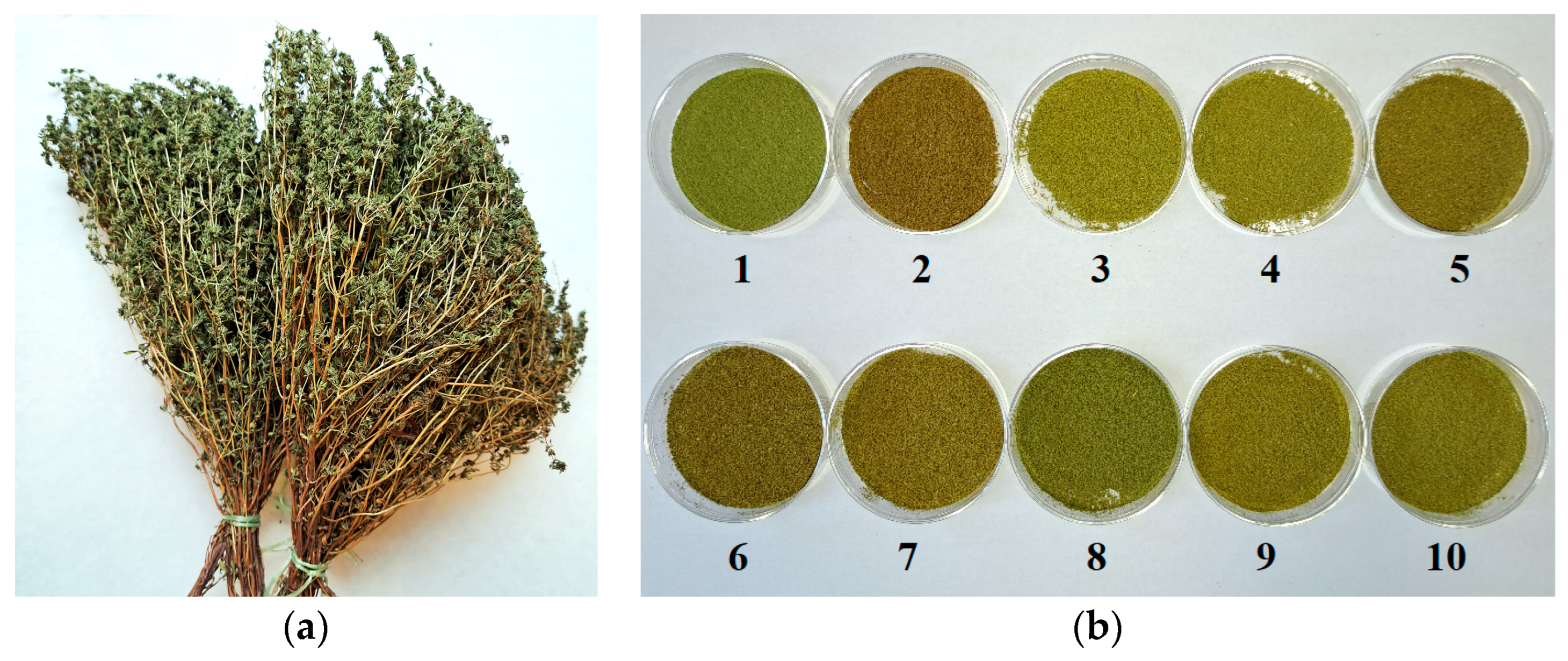
2.1.1. Plant Material
2.1.2. Test Microorganisms
2.1.3. Culture Media
2.2. Methods
2.2.1. Physicochemical Analyses
2.2.2. Preparation of Summer Savory Extracts
2.2.3. Total Phenolic Content (TPC)
2.2.4. Total Flavonoid Content (TFC)
2.2.5. Antioxidant Activity
2.2.6. High-Performance Liquid Chromatography (HPLC) Analysis of Phenolic Acids
2.2.7. HPLC Analysis of Organic Acids
2.2.8. Antimicrobial Activity Assay
2.2.9. Statistical Analysis
3. Results and Discussion
3.1. Physicochemical Characteristics
3.2. Total Phenolic Content, Total Flavonoid Content, and Antioxidant Activity of Summer Savory Extracts
3.3. High-Performance Liquid Chromatography (HPLC) Analysis of Phenolic Acids and Organic Acids of Summer Savory Extracts
3.4. Antimicrobial Activity of Summer Savory Extracts
4. Conclusions
Supplementary Materials
Author Contributions
Funding
Institutional Review Board Statement
Informed Consent Statement
Data Availability Statement
Conflicts of Interest
References
- Ejaz, A.; Waliat, S.; Arshad, M.S.; Khalid, W.; Khalid, M.Z.; Rasul Suleria, H.A.; Luca, M.-I.; Mironeasa, C.; Batariuc, A.; Ungureanu-Iuga, M.; et al. A comprehensive review of summer savory (Satureja hortensis L.): Promising ingredient for production of functional foods. Front. Pharmacol. 2023, 14, 1198970. [Google Scholar] [CrossRef]
- Fierascu, I.; Dinu-Pirvu, C.E.; Fierascu, R.C.; Velescu, B.S.; Anuta, V.; Ortan, A.; Jinga, V. Phytochemical Profile and Biological Activities of Satureja hortensis L.: A Review of the Last Decade. Molecules 2018, 23, 2458. [Google Scholar] [CrossRef]
- Grigore-Gurgu, L.; Dumitrașcu, L.; Aprodu, I. Aromatic Herbs as a Source of Bioactive Compounds: An Overview of Their Antioxidant Capacity, Antimicrobial Activity, and Major Applications. Molecules 2025, 30, 1304. [Google Scholar] [CrossRef]
- Skubij, N.; Dzida, K.; Jarosz, Z.; Pitura, K.; Jaroszuk-Sierocińska, M. Nutritional Value of Savory Herb (Satureja hortensis L.) and Plant Response to Variable Mineral Nutrition Conditions in Various Phases of Development. Plants 2020, 9, 706. [Google Scholar] [CrossRef]
- Tursun, A.O. Impact of different harvest times on yield and quality of summer savory (Satureja hortensis L.) genotypes. PLoS ONE 2025, 20, e0324133. [Google Scholar] [CrossRef]
- Mohtashami, S.; Babalar, M.; Tabrizi, L.; Ghani, A.; Rowshan, V.; Shokrpour, M. Essential oil constituents and variations in antioxidant compounds of dried summer savory (Satureja hortensis cv. Saturn) affected by storage conditions and ammonium sulfate. Food Sci. Nutr. 2021, 9, 4986–4997. [Google Scholar] [CrossRef]
- Mašković, P.; Veličković, V.; Mitić, M.; Đurović, S.; Zeković, Z.; Radojković, M.; Cvetanović, A.; Švarc-Gajić, J.; Vujić, J. Summer savory extracts prepared by novel extraction methods resulted in enhanced biological activity. Ind. Crop. Prod. 2017, 109, 875–881. [Google Scholar] [CrossRef]
- Boroja, T.; Katanić, J.; Rosić, G.; Selaković, D.; Joksimović, J.; Mišić, D.; Stanković, V.; Jovičić, N.; Mihailović, V. Summer savory (Satureja hortensis L.) extract: Phytochemical profile and modulation of cisplatin-induced liver, renal and testicular toxicity. Food Chem. Toxicol. 2018, 118, 252–263. [Google Scholar] [CrossRef] [PubMed]
- Muthukumar, A.; Mittal, S.; Choezom, T.; Bhavani, K.; Das, K.; Joyce, N.; Almuqbil, M.; Almadani, M.E.; Ahmad, F.; Yasmin, F. Evaluation of the cardioprotective activity of summer savory (Satureja hortensis L.) extract in experimental rats with Isoproterenol-induced myocardial infarction. J. King Saud Univ. Sci. 2024, 36, 103236. [Google Scholar] [CrossRef]
- Katar, D.; Kacar, O.; Kara, N.; Aytaç, Z.; Göksu, E.; Kara, S.; Katar, N.; Erbaş, S.; Telci, İ.; Elmastaş, M. Ecological variation of yield and aroma components of summer savory (Satureja hortensis L.). J. Appl. Res. Med. Aromat. Plants 2017, 7, 131–135. [Google Scholar] [CrossRef]
- El-Gohary, A.E.; El Gendy, A.G.; Hendawy, S.F.; El-Sherbeny, S.E.; Hussein, M.S.; Geneva, M. Herbage yield, essential oil content and composition of summer savory (Satureja hortensis L.) as affected by sowing date and foliar nutrition. Genet. Plant Physiol. 2015, 5, 170–178. [Google Scholar]
- Hajhashemi, V.; Ghannadi, A.; Pezeshkian, S.K. Antinociceptive and anti-inflammatory effects of Satureja hortensis L. extracts and essential oil. J. Ethnopharmacol. 2002, 82, 83–87. [Google Scholar] [CrossRef]
- Mosaffa, F.; Behravan, J.; Karimi, G.; Iranshahi, M. Antigenotoxic effects of Satureja hortensis L. on rat lymphocytes exposed to oxidative stress. Arch. Pharm. Res. 2006, 29, 159–164. [Google Scholar] [CrossRef]
- Momtaz, S.; Abdollahi, M. An update on pharmacology of Satureja species: From antioxidant, antimicrobial, antidiabetes and anti-hyperlipidemic to reproductive stimulation. Int. J. Pharmacol. 2010, 6, 346–353. [Google Scholar] [CrossRef]
- Hamidpour, R.; Hamidpour, S.; Hamidpour, M.; Shahlari, M.; Sohraby, M. Summer Savory: From the Selection of Traditional Applications to the Novel Effect in Relief, Prevention, and Treatment of a Number of Serious Illnesses such as Diabetes, Cardiovascular Disease, Alzheimer’s Disease, and Cancer. J. Tradit. Complement. Med. 2014, 4, 140–144. [Google Scholar] [CrossRef] [PubMed]
- Yazdanparast, R.; Shahriyary, L. Comparative effects of Artemisia dracunculus, Satureja hortensis and Origanum marjorana on inhibition of blood platelet adhesion, aggregation and secretion. Vasc. Pharmacol. 2008, 48, 32–37. [Google Scholar] [CrossRef] [PubMed]
- Nabigol, A. Chemical Composition and Anti-Fungal Activities of Three Essential Oils from Satureja spp. on Four Post-Harvest Pathogens of Strawberry Fruit. J. Hortic. Sci. Biotechnol. 2011, 86, 371–376. [Google Scholar] [CrossRef]
- Hosseini, S.F.; Amraie, M.; Salehi, M.; Mohseni, M.; Aloui, H. Effect of Chitosan-based Coatings Enriched with Savory and/or Tarragon Essential Oils on Postharvest Maintenance of Kumquat (Fortunella sp.) Fruit. Food Sci. Nutr. 2019, 7, 155–162. [Google Scholar] [CrossRef] [PubMed]
- Tumbarski, Y.; Ivanov, I.; Ivanova, P.; Yanakieva, V.; Stoyanova, M.; Uzunova, G.; Bachvarova, M.; Vasileva, I.; Parzhanova, A. Phytochemical Composition, Antioxidant Potential and Antimicrobial Activity of Five Culinary Plants and Their Application in the Design of Prebiotic Vegan Mayonnaises. Acta Microbiol. Bulg. 2024, 40, 544–562. [Google Scholar] [CrossRef]
- BSS ISO 928:2004; Spices and Condiments—Determination of Total Ash. Bulgarian Institute for Standardization: Sofia, Bulgaria, 2004. (In Bulgarian)
- BSS 7169:1989; Products from Processed Fruits and Vegetables. Determination of Sugar’s Content. Bulgarian Institute for Standardization: Sofia, Bulgaria, 1989. (In Bulgarian)
- Ivanov, I.; Vrancheva, R.; Marchev, A.; Petkova, N.; Aneva, I.; Denev, P.; Georgiev, V.; Pavlov, A. Antioxidant activities and phenolic compounds in Bulgarian Fumaria species. Int. J. Curr. Microbiol. Appl. Sci. 2014, 3, 296–306. [Google Scholar]
- Mihaylova, D.; Vrancheva, R.; Peltekov, N.; Ognyanov, M.; Desseva, I.; Ivanov, I.; Popova, M.; Popova, A. Carotenoids, tocopherols, organic acids, charbohydrate and mineral content in different medicinal plant extracts. Z. Naturforsch. 2018, 73, 439–448. [Google Scholar] [CrossRef]
- Tumbarski, Y.; Deseva, I.; Mihaylova, D.; Stoyanova, M.; Krastev, L.; Nikolova, R.; Yanakieva, V.; Ivanov, I. Isolation, Characterization and Amino Acid Composition of a Bacteriocin Produced by Bacillus methylotrophicus Strain BM47. Food Technol. Biotechnol. 2018, 56, 546–552. [Google Scholar] [CrossRef] [PubMed]
- Alexa, E.; Danciu, C.; Cocan, I.; Negrea, M.; Morar, A.; Obistioiu, D.; Dogaru, D.; Berbecea, A.; Radulov, I. Chemical Composition and Antimicrobial Potential of Satureja hortensis L. in Fresh Cow Cheese. J. Food Qual. 2018, 2018, 8424035. [Google Scholar] [CrossRef]
- Castillo-Correa, M.; Montalbán-Hernández, C.; Navarro-Hortal, M.D.; Peña-Guzmán, D.; Badillo-Carrasco, A.; Varela-López, A.; Hinojosa-Nogueira, D.; Romero Márquez, J.M. Exploring the Influence of Extraction Methods, Solvents, and Temperature on Total Phenolic Recovery and Antioxidant Capacity in Olive Leaf Extracts: A Systematic Review with Quantitative Synthesis. Separations 2025, 12, 236. [Google Scholar] [CrossRef]
- Güllüce, M.; Sökmen, M.; Daferera, D.; Aǧar, G.; Özkan, H.; Kartal, N.; Polissiou, M.; Sökmen, A.; Şahin, F. In vitro antibacterial, antifungal, and antioxidant activities of the essential oil and methanol extracts of herbal parts and callus cultures of Satureja hortensis L. J. Agric. Food Chem. 2003, 51, 3958–3965. [Google Scholar] [CrossRef]
- Ergün, F. Determination of Phytochemicals and Antioxidant Capacity of Satureja hortensis L. Turk. J. Agric. Food Sci. Technol. 2022, 10, 2635–2639. [Google Scholar] [CrossRef]
- Predescu, C.; Papuc, C.; Ștefan, G.; Petcu, C. Phenolics content, antioxidant and antimicrobial activities of some extracts obtained from Romanian summer savory and Lebanon wild thyme. Sci. Work. Ser. C Vet. Med. 2020, 66, 17–22. [Google Scholar]
- Yesiloğlu, Y.; Sit, L.; Kilic, I. In vitro Antioxidant Activity and Total Phenolic Content of Various Extracts of Satureja hortensis L. Collected from Turkey. Asian J. Chem. 2013, 25, 8311–8316. [Google Scholar] [CrossRef]
- Mohamed, S.H.M.; Ashoush, I.S.; Elhariry, H.M.; El-Hadi, E.M. Antioxidant, Antibiofilm & Biological Activities of Summer Savory. Egypt. J. Nutr. 2023, 38, 138–161. [Google Scholar] [CrossRef]
- Bahramikia, S.; Yazdanparast, R.; Nosrati, N. A Comparison of Antioxidant Capacities of Ethanol Extracts of Satureja hortensis and Artemisia dracunculus Leaves. Pharmacologyonline 2008, 2, 694–704. [Google Scholar]
- Bimbiraitė-Survilienė, K.; Stankevičius, M.; Šuštauskaitė, S.; Gęgotek, A.; Maruška, A.; Skrzydlewska, E.; Barsteigienė, Z.; Akuņeca, I.; Ragažinskienė, O.; Lukošius, A. Evaluation of Chemical Composition, Radical Scavenging and Antitumor Activities of Satureja hortensis L. Herb Extracts. Antioxidants 2021, 10, 53. [Google Scholar] [CrossRef]
- Vrancheva, R. Biologically Active Substances and Antioxidant Activity of Wild Growing Population of of Mountain Savory (Satureja montana L.). J. Mount. Agric. Balk. 2021, 24, 363–377. [Google Scholar]
- Vrancheva, R.; Georgiev, V.; Pavlov, A. Comparative Phytochemical Analysis of Wild Growing and In vitro Cultivated Plants of Satureja montana L. J. Mount. Agric. Balk. 2021, 24, 336–348. [Google Scholar]
- Chkhikvishvili, I.; Sanikidze, T.; Gogia, N.; Mchedlishvili, T.; Enukidze, M.; Machavariani, M.; Vinokur, Y.; Rodov, V. Rosmarinic Acid-Rich Extracts of Summer Savory (Satureja hortensis L.) Protect Jurkat T Cells against Oxidative Stress. Oxid. Med. Cell. Longev. 2013, 2013, 456253. [Google Scholar] [CrossRef]
- Shekarchi, M.; Hajimehdipoor, H.; Saeidnia, S.; Gohari, A.R.; Hamedani, M.P. Comparative study of rosmarinic acid content in some plants of Labiatae family. Pharmacogn. Mag. 2012, 8, 37–41. [Google Scholar] [CrossRef] [PubMed]
- Petersen, M.; Abdullah, Y.; Benner, J.; Eberle, D.; Gehlen, K.; Hücherig, S.; Janiak, V.; Kim, K.H.; Sander, M.; Weitzel, C.; et al. Evolution of Rosmarinic Acid Biosynthesis. Phytochemistry 2009, 70, 1663–1679. [Google Scholar] [CrossRef] [PubMed]
- McKay, D.L.; Blumberg, J.B. A review of the bioactivity and potential health benefits of peppermint tea (Mentha piperita L.). Phytother. Res. 2006, 20, 619–633. [Google Scholar] [CrossRef] [PubMed]
- Huang, S.-S.; Zheng, R.-I. Rosmarinic acid inhibits angiogenesis and its mechanism of action in vitro. Cancer Lett. 2006, 239, 271–280. [Google Scholar] [CrossRef]
- Takeda, H.; Tsuji, M.; Inazu, M.; Egashira, T.; Matsumiya, T. Rosmarinic acid and caffeic acid produce antidepressive-like effect in the forced swimming test in mice. Eur. J. Pharmacol. 2002, 449, 261–267. [Google Scholar] [CrossRef]
- Osakabe, N.; Yasuda, A.; Natsume, M.; Yoshikawa, T. Rosmarinic acid inhibits epidermal inflammatory responses: Anticarcinogenic effect of Perilla frutescens extract in the murine two-stage skin model. Carcinogenesis 2004, 25, 549–557. [Google Scholar] [CrossRef]
- Takano, N.; Osakabe, N.; Sanbongi, C.; Yanagisawa, R.; Inoue, K.-I.; Yasuda, A.; Natsume, M.; Baba, S.; Ichiishi, E.-I.; Yoshikawa, T. Extract of Perilla frutescens enriched for rosmarinic acid, a polyphenolic phytochemical, inhibits seasonal allergic, rhinoconjunctivitis in humans. Exp. Biol. Med. 2004, 229, 247–254. [Google Scholar] [CrossRef]
- Moreno, S.; Scheyer, T.; Romano, C.S.; Vojnov, A.A. Antioxidant and antimicrobial activities of rosemary extracts linked to their polyphenol composition. Free Radic. Res. 2006, 40, 223–231. [Google Scholar] [CrossRef]
- Ono, K.; Li, L.; Takamura, Y.; Yoshiike, Y.; Zhu, L.; Han, F.; Mao, X.; Ikeda, T.; Takasaki, J.-I.; Nishijo, H.; et al. Phenolic compounds prevent β-amyloid protein oligomerization and synaptic dysfunction by site-specific binding. J. Biol. Chem. 2012, 287, 14631–14643. [Google Scholar] [CrossRef]
- Dubois, M.; Bailly, F.; Mbemba, G.; Mouscadet, J.-F.; Debyser, Z.; Witvrouw, M.; Cotelle, P. Reaction of rosmarinic acid with nitrite ions in acidic conditions: Discovery of nitro- and dinitrorosmarinic acids as new anti-HIV-1 agents. J. Med. Chem. 2008, 51, 2575–2579. [Google Scholar] [CrossRef]
- Fratianni, F.; Ombra, M.N.; De Giulio, B.; d’Acierno, A.; Nazzaro, F. Lamiaceae honey: Polyphenol profile, vitamin C content, antioxidant and in vitro anti-inflammatory, cholinesterase and tyrosinase inhibitory activity. Food Chem. Adv. 2025, 7, 100996. [Google Scholar] [CrossRef]
- Dzida, K.; Zawiślak, G.; Nurzyńska-Wierdak, R.; Michałojć, Z.; Jarosz, Z.; Pitura, K.; Karczmarz, K. Yield and quality of the summer savory herb (Satureja hortensis L.) grown for a bunch harvest. Acta Sci. Pol. Hortorum Cultus 2015, 14, 141–156. [Google Scholar]
- Popovici, R.A.; Vaduva, D.; Pinzaru, I.; Dehelean, C.A.; Farcas, C.G.; Coricovac, D.; Danciu, C.; Popescu, I.; Alexa, E.; Lazureanu, V.; et al. A Comparative Study on the Biological Activity of Essential Oil and Total Hydro-Alcoholic Extract of Satureja hortensis L. Exp. Ther. Med. 2019, 18, 932–942. [Google Scholar] [CrossRef] [PubMed]
- Özcan, M.M.; Al-Juhaimi, F.Y. Antioxidant and antifungal activity of some aromatic plant extracts. J. Med. Plant. Res. 2011, 5, 1361–1366. [Google Scholar]
- Dikbas, N.; Kotan, R.; Dadasoglu, F.; Sahin, F. Control of Aspergillus flavus with essential oil and methanol extract of Satureja hortensis. Int. J. Food Microbiol. 2008, 124, 179–182. [Google Scholar] [CrossRef]
- Adiguzel, A.; Ozer, H.; Kilic, H.; Cetin, B. Screening of antimicrobial activity of essential oil and methanol extract of Satureja hortensis on foodborne bacteria and fungi. Czech J. Food Sci. 2007, 25, 81–89. [Google Scholar] [CrossRef]
- Mohammed, F.S.; Dastan, T.; Sevindik, M.; Selamoglu, Z. Antioxidant, antimicrobial activity and therapeutic profile of Satureja hortensis from Erzincan Province. Cumhur. Med. J. 2019, 41, 558–564. [Google Scholar] [CrossRef]
- Kotan, R.; Dadasoglu, F.; Karagoz, K.; Cakir, A.; Ozer, H.; Kordali, S.; Cakmakci, R.; Dikbas, N. Antibacterial activity of the essential oil and extracts of Satureja hortensis agsainst plant pathogenic bacteria and their potential use as seed disinfectants. Sci. Hortic. 2013, 153, 34–41. [Google Scholar] [CrossRef]
- Daglia, M. Polyphenols as antimicrobial agents. Curr. Opin. Biotechnol. 2012, 23, 174–181. [Google Scholar] [CrossRef] [PubMed]


| Savory Sample No. | Village/Town | District/Region | GPS Coordinates | Altitude, m | Voucher No. |
|---|---|---|---|---|---|
| 1 | Kyustendil | Kyustendil | 42°28′ N 22°69′ E | 525 | SOM 179935 |
| 2 | Mramor | Sofia | 42°79′ N 23°27′ E | 526 | SOM 179936 |
| 3 | Yundola | Pazardzhik | 42°03′ N 23°52′ E | 1400 | SOM 179937 |
| 4 | Stara Zagora | Stara Zagora | 42°43′ N 25°63′ E | 214 | SOM 179938 |
| 5 | Pazardzhik | Pazardzhik | 42°19′ N 24°33′ E | 211 | SOM 179939 |
| 6 | Avramovo | Blagoevgrad | 42°03′ N 23°81′ E | 1295 | SOM 179940 |
| 7 | Radomir | Pernik | 42°55′ N 22°95′ E | 764 | SOM 179941 |
| 8 | Krichim | Plovdiv | 42°04′ N 24°46′ E | 253 | SOM 179942 |
| 9 | Pleven | Pleven | 43°42′ N 24°61′ E | 116 | SOM 179943 |
| 10 | Belovitsa | Plovdiv | 42°25′ N 24°31′ E | 293 | SOM 179944 |
| Savory Sample No. | Moisture, % | Dry matter, % | Ash, % | Proteins, % | Carbohydrates, % |
|---|---|---|---|---|---|
| 1 | 12.18 ± 1.28 bcd | 87.82 ± 1.28 bcd | 23.15 ± 0.09 g | 22.78 ± 0.41 a | 5.37 ± 0.00 h |
| 2 | 11.12 ± 0.48 d | 88.88 ± 0.48 d | 23.38 ± 0.09 f | 16.25 ± 0.33 e | 6.96 ± 0.01 f |
| 3 | 11.88 ± 0.21 bcd | 88.12 ± 0.21 bcd | 21.40 ± 0.09 h | 18.00 ± 0.40 bc | 6.27 ± 0.00 g |
| 4 | 11.53 ± 0.30 cd | 88.47 ± 0.30 cd | 25.43 ± 0.09 c | 16.37 ± 0.48 e | 8.20 ± 0.01 e |
| 5 | 11.67 ± 0.46 cd | 88.33 ± 0.46 cd | 25.72 ± 0.09 b | 17.24 ± 0.29 cd | 8.17 ± 0.01 e |
| 6 | 14.21 ± 0.40 a | 85.79 ± 0.40 a | 24.49 ± 0.09 e | 17.04 ± 0.28 de | 8.44 ± 0.01 d |
| 7 | 12.81 ± 0.35 abc | 87.19 ± 0.35 abc | 25.80 ± 0.09 b | 16.92 ± 0.42 de | 9.67 ± 0.01 b |
| 8 | 10.97 ± 0.01 d | 89.03 ± 0.01 d | 19.51 ± 0.09 i | 22.43 ± 0.70 a | 10.01 ± 0.01 a |
| 9 | 13.29 ± 1.51 ab | 86.71 ± 1.51 ab | 26.92 ± 0.09 a | 17.77 ± 0.01 bcd | 8.29 ± 0.01 de |
| 10 | 12.10 ± 0.46 bcd | 87.90 ± 0.46 bcd | 24.79 ± 0.09 d | 18.42 ± 0.03 b | 8.77 ± 0.01 c |
| Savory Sample No. | TPC (mg GAE/g dw) | TFC (mg QE/g dw) | ||
|---|---|---|---|---|
| ASE | MSE | ASE | MSE | |
| 1 | 4.83 ± 0.08 b,A | 4.96 ± 0.35 e,A | 0.17 ± 0.00 e,B | 1.23 ± 0.11 a,A |
| 2 | 2.83 ± 0.33 e,B | 4.45 ± 0.10 e,A | 0.29 ± 0.01 a,B | 0.73 ± 0.01 b,A |
| 3 | 2.57 ± 0.28 ef,B | 7.50 ± 0.19 cd,A | 0.16 ± 0.00 f,B | 0.99 ± 0.16 abc,A |
| 4 | 4.11 ± 0.12 c,B | 6.84 ± 0.30 d,A | 0.27 ± 0.00 b,B | 1.08 ± 0.09 ab,A |
| 5 | 2.29 ± 0.42 fg,B | 8.82 ± 0.46 b,A | 0.14 ± 0.00 h,B | 0.89 ± 0.13 bc,A |
| 6 | 2.99 ± 0.00 c,A | 3.98 ± 0.20 f,B | 0.25 ± 0.00 c,B | 0.83 ± 0.18 bc,A |
| 7 | 1.10 ± 0.17 a,A | 8.60 ± 0.48 b,B | 0.14 ± 0.00 h,B | 0.81 ± 0.12 bc,A |
| 8 | 2.78 ± 0.12 e,B | 8.88 ± 0.27 ab,A | 0.08 ± 0.00 i,B | 1.11 ± 0.12 ab,A |
| 9 | 1.83 ± 0.05 g,B | 9.54 ± 0.39 a,A | 0.23 ± 0.00 d,B | 1.01 ± 0.12 abc,A |
| 10 | 3.37 ± 0.12 d,B | 7.72 ± 0.10 c,A | 0.15 ± 0.00 g,B | 0.96 ± 0.25 abc,A |
| Savory Sample No. | DPPH (mM TE/g dw) | FRAP (µmol Fe2+/g dw) | ||
|---|---|---|---|---|
| ASE | MSE | ASE | MSE | |
| 1 | 35.63 ± 0.25 e,B | 91.85 ± 0.57 a,A | 86.64 ± 0.36 f,B | 196.52 ± 0.27 b,A |
| 2 | 43.09 ± 0.67 d,B | 51.75 ± 0.63 h,A | 89.15 ± 0.62 e,B | 108.20 ± 0.45 i,A |
| 3 | 35.85 ± 0.21 e,B | 83.50 ± 0.62 c,A | 83.85 ± 1.22 g,B | 154.59 ± 0.88 g,A |
| 4 | 42.94 ± 0.68 d,B | 81.20 ± 0.64 d,A | 93.04 ± 0.37 d,B | 179.96 ± 1.37 d,A |
| 5 | 35.69 ± 0.33 e,B | 87.17 ± 0.95 b,A | 81.53 ± 0.33 h,B | 185.13 ± 2.68 c,A |
| 6 | 59.93 ± 1.09 a,A | 62.55 ± 0.76 g,A | 134.85 ± 0.48 a,B | 136.48 ± 0.15 h,A |
| 7 | 49.86 ± 0.36 b,B | 78.48 ± 1.25 e,A | 107.89 ± 0.53 b,B | 164.42 ± 1.19 f,A |
| 8 | 35.07 ± 0.73 e,B | 76.42 ± 0.35 f,A | 81.44 ± 0.36 h,B | 162.09 ± 0.42 f,A |
| 9 | 35.01 ± 0.61 e,B | 83.35 ± 0.75 c,A | 74.49 ± 0.33 i,B | 215.48 ± 0.75 a,A |
| 10 | 45.47 ± 0.68 c,B | 84.76 ± 0.37 c,A | 95.94 ± 0.46 c,B | 171.22 ± 2.36 e,A |
| Methods | Correlation, r2 | |
|---|---|---|
| MSE | ASE | |
| TPC/DPPH | 0.5672 | 0.4649 |
| TPC/FRAP | 0.5822 | 0.4681 |
| TFC/DPPH | 0.6989 | 0.3591 |
| TFC/FRAP | 0.6576 | 0.2488 |
| DPPH/FRAP | 0.8624 | 0.9686 |
| Savory Sample No. | Phenolic Acids, mg/g dw | Organic Acids, mg/g dw | ||||
|---|---|---|---|---|---|---|
| Rosmarinic | Ferulic | Caffeic | p-Coumaric | Ascorbic | Malic | |
| 1 | 5.07 ± 0.10 cd,A | 0.04 ± 0.00 d,C | 0.07 ± 0.00 a,B | 0.005 ± 0.00 c,D | 0.51 ± 0.02 c,A | 0.004 ± 0.00 c,B |
| 2 | 3.98 ± 0.10 f,A | 0.04 ± 0.00 d,C | 0.07 ± 0.01 a,B | 0.006 ± 0.00 b,D | 0.98 ± 0.06 a,A | 0.005 ± 0.00 b,B |
| 3 | 3.54 ± 0.10 g,A | 0.03 ± 0.00 e,C | 0.04 ± 0.00 d,B | 0.005 ± 0.00 c,D | 0.35 ± 0.05 e,A | 0.003 ± 0.00 d,B |
| 4 | 5.90 ± 0.20 a,A | 0.07 ± 0.01 a,B | 0.07 ± 0.01 a,B | 0.005 ± 0.00 c,C | 0.49 ± 0.01 c,A | 0.004 ± 0.00 c,B |
| 5 | 5.28 ± 0.20 bc,A | 0.05 ± 0.00 c,B | 0.05 ± 0.00 c,B | 0.004 ± 0.00 d,C | 0.52 ± 0.07 c,A | 0.004 ± 0.00 c,B |
| 6 | 4.43 ± 0.10 e,A | 0.06 ± 0.01 b,B | 0.04 ± 0.00 d,C | 0.005 ± 0.00 c,D | 0.42 ± 0.02 d,A | 0.006 ± 0.00 a,B |
| 7 | 5.14 ± 0.10 bc,A | 0.06 ± 0.01 b,B | 0.06 ± 0.01 b,B | 0.006 ± 0.00 b,C | 0.51 ± 0.02 c,A | 0.006 ± 0.00 a,B |
| 8 | 4.81 ± 0.10 d,A | 0.04 ± 0.00 d,C | 0.07 ± 0.00 a,B | 0.008 ± 0.00 a,D | 0.41 ± 0.01 de,A | 0.004 ± 0.00 c,B |
| 9 | 5.79 ± 0.20 a,A | 0.05 ±.0.00 c,C | 0.06 ± 0.01 b,B | 0.006 ± 0.00 b,D | 0.78 ± 0.01 b,A | 0.005 ± 0.00 b,B |
| 10 | 5.42 ± 0.20 b,A | 0.06 ± 0.01 b,B | 0.06 ± 0.00 b,B | 0.006 ± 0.00 b,C | 0.41 ± 0.02 de,A | 0.006 ± 0.00 a,B |
| Test MO * | Diameter of the Inhibition Zones, mm | |||||||||||
|---|---|---|---|---|---|---|---|---|---|---|---|---|
| Aqueous Summer Savory Extracts (100 mg/mL) | Controls | |||||||||||
| 1 | 2 | 3 | 4 | 5 | 6 | 7 | 8 | 9 | 10 | C ** | N *** | |
| B. s. | - | - | - | - | - | - | - | - | - | - | 27 ± 0.00 | n.a. |
| B. c. | - | - | - | - | - | - | - | - | - | - | 38 ± 0.00 | n.a. |
| S. a. | - | - | - | - | - | - | - | - | - | - | 45 ± 0.00 | n.a. |
| L. m. | - | - | - | - | - | - | - | - | - | - | 37 ± 0.00 | n.a. |
| E. f. | - | - | - | - | - | - | - | - | - | - | - | n.a. |
| S. e. | - | - | - | - | - | - | - | - | - | - | 40 ± 0.00 | n.a. |
| K. p. | - | - | - | - | - | - | - | - | - | - | 40 ± 0.00 | n.a. |
| E. c. | - | - | - | - | - | - | - | - | - | - | 30 ± 0.00 | n.a. |
| P. a. | - | - | - | - | - | - | - | - | - | - | 20 ± 0.00 | n.a. |
| P. v. | 10 ± 0.00 | 8 ± 0.00 | 8 ± 0.00 | 8 ± 0.00 | 10 ± 0.00 | 8 ± 0.00 | 8 ± 0.00 | 8 ± 0.00 | 10 ± 0.00 | 8 ± 0.00 | 45 ± 0.00 | n.a. |
| C. a. | - | 15 ± 0.00 | 13 ± 0.00 | 15 ± 0.00 | - | - | - | 13 ± 0.00 | 10 ± 0.00 | 10 ± 0.00 | n.a. | 12 ± 0.00 |
| A. n. | - | - | 20 ± 0.00 | 15 ± 0.00 | 21 ± 0.00 | 18 ± 0.00 | 28 ± 0.00 | 20 ± 0.00 | 21 ± 0.00 | 22 ± 0.00 | n.a. | - |
| A. f. | 20 ± 0.00 | - | - | 14 ± 0.00 | 15 ± 0.00 | - | 20 ± 0.00 | 10 ± 0.00 | 10 ± 0.00 | - | n.a. | - |
| P. c. | - | 22 ± 0.00 | 15 ± 0.00 | - | - | 19 ± 0.00 | 16 ± 0.00 | 14 ± 0.00 | 12 ± 0.00 | 10 ± 0.00 | n.a. | - |
| F. m. | 10 ± 0.00 | 15 ± 0.00 | 13 ± 0.00 | - | - | 15 ± 0.00 | 14 ± 0.00 | 10 ± 0.00 | - | 12 ± 0.00 | n.a. | 12 ± 0.00 |
| Test MO * | Diameter of the Inhibition Zones, mm | |||||||||||
|---|---|---|---|---|---|---|---|---|---|---|---|---|
| Methanolic Summer Savory Extracts (100 mg/mL) | Controls | |||||||||||
| 1 | 2 | 3 | 4 | 5 | 6 | 7 | 8 | 9 | 10 | C ** | N *** | |
| B. s. | 11 ± 0.00 | 11 ± 0.00 | 11 ± 0.00 | 11 ± 0.00 | 11 ± 0.00 | 11 ± 0.00 | 11 ± 0.00 | 11 ± 0.00 | 12 ± 0.00 | 10 ± 0.00 | 27 ± 0.00 | n.a. |
| B. c. | 11 ± 0.00 | 12 ± 0.00 | 12 ± 0.00 | 12 ± 0.00 | 12 ± 0.00 | 12 ± 0.00 | 11 ± 0.00 | 11 ± 0.00 | 12 ± 0.00 | 11 ± 0.00 | 38 ± 0.00 | n.a. |
| S. a. | 20 ± 0.00 | 20 ± 0.00 | 20 ± 0.00 | 20 ± 0.00 | 20 ± 0.00 | 20 ± 0.00 | 20 ± 0.00 | 28 ± 0.00 | 28 ± 0.00 | 25 ± 0.00 | 45 ± 0.00 | n.a. |
| L. m. | 12 ± 0.00 | 15 ± 0.00 | 12 ± 0.00 | 12 ± 0.00 | 12 ± 0.00 | 11 ± 0.00 | 11 ± 0.00 | 12 ± 0.00 | 11 ± 0.00 | 12 ± 0.00 | 37 ± 0.00 | n.a. |
| E. f. | 10 ± 0.00 | 12 ± 0.00 | 10 ± 0.00 | 10 ± 0.00 | 10 ± 0.00 | 10 ± 0.00 | 11 ± 0.00 | 10 ± 0.00 | 11 ± 0.00 | 10 ± 0.00 | - | n.a. |
| S. e. | 10 ± 0.00 | 12 ± 0.00 | 10 ± 0.00 | 10 ± 0.00 | 11 ± 0.00 | 11 ± 0.00 | 10 ± 0.00 | 11 ± 0.00 | 11 ± 0.00 | 10 ± 0.00 | 40 ± 0.00 | n.a. |
| K. p. | 10 ± 0.00 | 10 ± 0.00 | 10 ± 0.00 | 10 ± 0.00 | 10 ± 0.00 | 10 ± 0.00 | 9 ± 0.00 | 9 ± 0.00 | 10 ± 0.00 | 10 ± 0.00 | 40 ± 0.00 | n.a. |
| E. c. | 12 ± 0.00 | 12 ± 0.00 | 12 ± 0.00 | 12 ± 0.00 | 12 ± 0.00 | 12 ± 0.00 | 11 ± 0.00 | 13 ± 0.00 | 12 ± 0.00 | 12 ± 0.00 | 30 ± 0.00 | n.a. |
| P. a. | 12 ± 0.00 | 13 ± 0.00 | 13 ± 0.00 | 12 ± 0.00 | 12 ± 0.00 | 12 ± 0.00 | 13 ± 0.00 | 13 ± 0.00 | 12 ± 0.00 | 12 ± 0.00 | 20 ± 0.00 | n.a. |
| P. v. | 8 ± 0.00 | 8 ± 0.00 | 9 ± 0.00 | 9 ± 0.00 | 10 ± 0.00 | 10 ± 0.00 | 10 ± 0.00 | 10 ± 0.00 | 10 ± 0.00 | 10 ± 0.00 | 45 ± 0.00 | n.a. |
| C. a. | 15 ± 0.00 | 15 ± 0.00 | 13 ± 0.00 | 13 ± 0.00 | 14 ± 0.00 | 15 ± 0.00 | 12 ± 0.00 | 10 ± 0.00 | 10 ± 0.00 | 10 ± 0.00 | n.a. | 12 ± 0.00 |
| A. n. | 15 ± 0.00 | 15 ± 0.00 | 13 ± 0.00 | 12 ± 0.00 | 15 ± 0.00 | 13 ± 0.00 | 15 ± 0.00 | 15 ± 0.00 | 12 ± 0.00 | 12 ± 0.00 | n.a. | - |
| A. f. | 15 ± 0.00 | 15 ± 0.00 | 15 ± 0.00 | 12 ± 0.00 | 13 ± 0.00 | 16 ± 0.00 | 15 ± 0.00 | 12 ± 0.00 | 12 ± 0.00 | 12 ± 0.00 | n.a. | - |
| P. c. | 10 ± 0.00 | 10 ± 0.00 | 10 ± 0.00 | 10 ± 0.00 | 10 ± 0.00 | 10 ± 0.00 | 10 ± 0.00 | 12 ± 0.00 | 12 ± 0.00 | 10 ± 0.00 | n.a. | - |
| F. m. | 12 ± 0.00 | 13 ± 0.00 | 13 ± 0.00 | 12 ± 0.00 | 13 ± 0.00 | 11 ± 0.00 | 11 ± 0.00 | 13 ± 0.00 | 12 ± 0.00 | 11 ± 0.00 | n.a. | 12 ± 0.00 |
Disclaimer/Publisher’s Note: The statements, opinions and data contained in all publications are solely those of the individual author(s) and contributor(s) and not of MDPI and/or the editor(s). MDPI and/or the editor(s) disclaim responsibility for any injury to people or property resulting from any ideas, methods, instructions or products referred to in the content. |
© 2025 by the authors. Licensee MDPI, Basel, Switzerland. This article is an open access article distributed under the terms and conditions of the Creative Commons Attribution (CC BY) license (https://creativecommons.org/licenses/by/4.0/).
Share and Cite
Tumbarski, Y.; Stoyanova, M.; Ivanova, P.; Parzhanova, A.; Nikolova, K. Physicochemical Characteristics, Phenolic Profile, Antioxidant Potential, and Antimicrobial Activity of Bulgarian Summer Savory (Satureja hortensis L.). Curr. Issues Mol. Biol. 2025, 47, 1030. https://doi.org/10.3390/cimb47121030
Tumbarski Y, Stoyanova M, Ivanova P, Parzhanova A, Nikolova K. Physicochemical Characteristics, Phenolic Profile, Antioxidant Potential, and Antimicrobial Activity of Bulgarian Summer Savory (Satureja hortensis L.). Current Issues in Molecular Biology. 2025; 47(12):1030. https://doi.org/10.3390/cimb47121030
Chicago/Turabian StyleTumbarski, Yulian, Magdalena Stoyanova, Petya Ivanova, Albena Parzhanova, and Krastena Nikolova. 2025. "Physicochemical Characteristics, Phenolic Profile, Antioxidant Potential, and Antimicrobial Activity of Bulgarian Summer Savory (Satureja hortensis L.)" Current Issues in Molecular Biology 47, no. 12: 1030. https://doi.org/10.3390/cimb47121030
APA StyleTumbarski, Y., Stoyanova, M., Ivanova, P., Parzhanova, A., & Nikolova, K. (2025). Physicochemical Characteristics, Phenolic Profile, Antioxidant Potential, and Antimicrobial Activity of Bulgarian Summer Savory (Satureja hortensis L.). Current Issues in Molecular Biology, 47(12), 1030. https://doi.org/10.3390/cimb47121030