A Review of Cybersecurity Issues in Smart Meter-Based Energy Trading

Abstract
1. Introduction
Organization
2. Review Scope and Methodology
3. Preliminaries
3.1. Smart Meters in Energy Trading
3.2. An Overview of Energy Trading in Smart Metering Systems
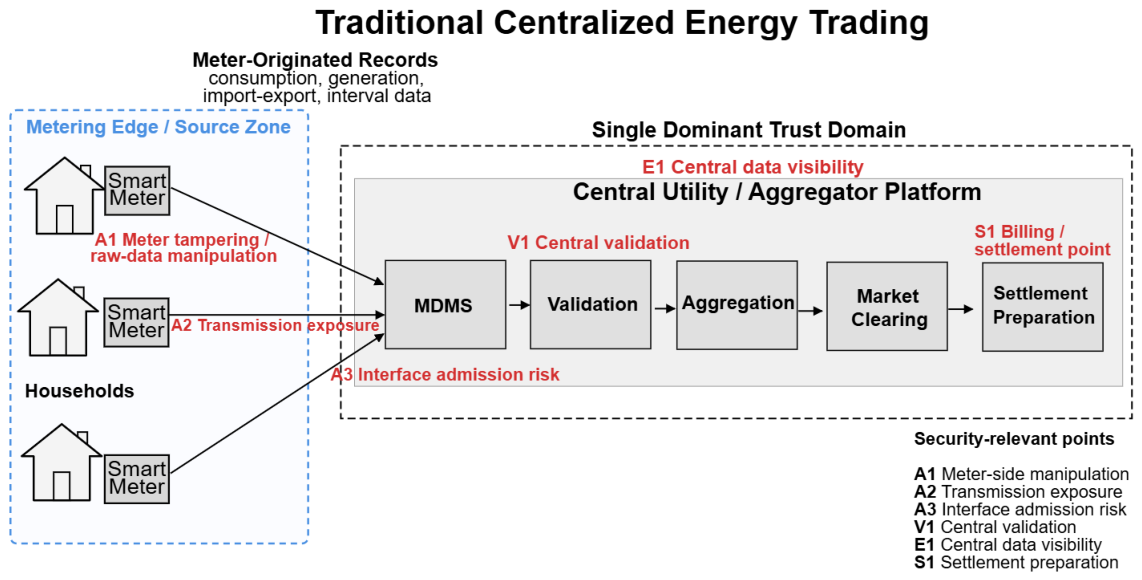
3.3. Traditional Centralized Energy Trading
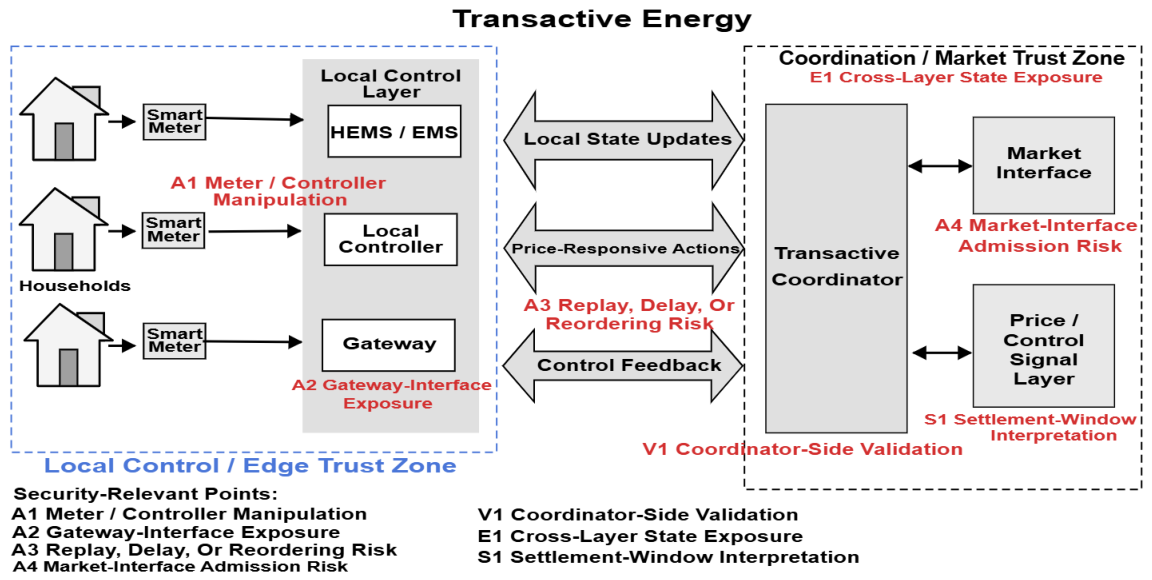
3.4. Transactive Energy
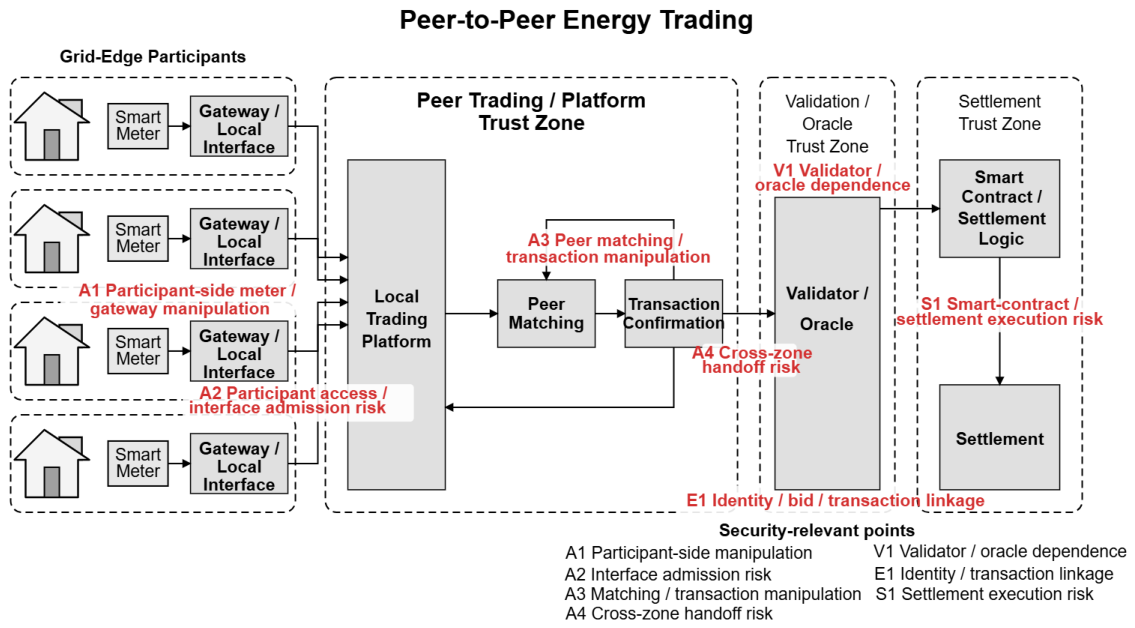
3.5. Peer-to-Peer Energy Trading
3.6. Hybrid and Multi-Framework Energy Trading Studies
4. Security Issues in Smart Meter-Based Energy Trading
4.1. Record Integrity and Temporal Consistency
4.2. Insecure Transmission and Interface Access Security
4.3. Confidentiality and Privacy Exposure of Trading-Relevant Meter Data
5. Mitigation Directions and Remaining Limitations
5.1. Mitigating Record Integrity and Temporal-Consistency Risks
5.2. Mitigating Transmission and Interface-Access Risks
5.3. Mitigating Confidentiality and Privacy-Exposure Risks
6. Future Work
6.1. Post-Challenge Governance and Record Admissibility
- Define admissibility statuses for challenged records, such as accepted, corrected, downgraded, conditionally accepted, rejected, or audit-only;
- Evaluate these statuses in cases involving bypass tampering, false-data injection, replayed or delayed interval records, and committed-versus-delivered energy mismatches.
6.2. Temporal and Operational Continuity Across Trading Stages
- Define interval-level metadata comprising the measurement interval, creation time, receipt time, sequence number, synchronization status, and record lineage;
- Measure the interval-misattribution rate; ordering-error rate; late-record handling time; and settlement-window mismatch under replay, replacement, reordering, delay, and clock drift.
6.3. Workflow-Wide Privacy–Accountability Co-Design
- Specify which record fields are visible to market operators, validators, billing entities, settlement platforms, participants, and dispute arbiters at each trading stage;
- Design bounded-disclosure mechanisms for audit, committed-versus-delivered correction, dispute resolution, and settlement adjustment, evaluated through linkage risk, re-identification risk, disclosure size, and billing accuracy.
6.4. Deployable Protection Across Hybrid Trading Environments
- Build mixed testbeds connecting smart meters, gateways, AMI communication paths, local controllers, market platforms, blockchain or audit layers, and billing or settlement modules;
- Benchmark protection mechanisms under heterogeneous devices, topology changes, intermittent connectivity, participant churn, short clearing intervals, and mixed centralized–transactive–P2P workflows;
- Evaluate deployment using latency, message overhead, validation accuracy, settlement correctness, interoperability, and deployment effort.
7. Conclusions
Author Contributions
Funding
Institutional Review Board Statement
Informed Consent Statement
Data Availability Statement
Conflicts of Interest
References
- Kippke Salomón, M.A.; Carou Álvarez, J.M.; Súárez Ramón, L.; Arboleya, P. Smart Metering as a Regulatory and Technological Enabler for Flexibility in Distribution Networks: Incentives, Devices, and Protocols. Energies 2025, 18, 5269. [Google Scholar] [CrossRef]
- Athanasiadis, C.L.; Papadopoulos, T.A.; Kryonidis, G.C.; Doukas, D.I. A Review of Distribution Network Applications Based on Smart Meter Data Analytics. Renew. Sustain. Energy Rev. 2024, 191, 114151. [Google Scholar] [CrossRef]
- Mitra, S.; Chakraborty, B.; Mitra, P. Smart Meter Data Analytics Applications for Secure, Reliable and Robust Grid System: Survey and Future Directions. Energy 2024, 289, 129920. [Google Scholar] [CrossRef]
- Chen, Z.; Amani, A.M.; Yu, X.; Jalili, M. Control and Optimisation of Power Grids Using Smart Meter Data: A Review. Sensors 2023, 23, 2118. [Google Scholar] [CrossRef]
- Faia, R.; Lezama, F.; Soares, J.; Pinto, T.; Vale, Z. Local Electricity Markets: A Review on Benefits, Barriers, Current Trends and Future Perspectives. Renew. Sustain. Energy Rev. 2024, 190, 114006. [Google Scholar] [CrossRef]
- Goitia-Zabaleta, N.; Milo, A.; Gaztañaga, H.; Fernandez, E. Two-Stage Centralised Management of Local Energy Market for Prosumers Integration in a Community-Based P2P. Appl. Energy 2023, 348, 121552. [Google Scholar] [CrossRef]
- Gorbatcheva, A.; Watson, N.; Schneiders, A.; Shipworth, D.; Fell, M.J. Defining Characteristics of Peer-to-Peer Energy Trading, Transactive Energy, and Community Self-Consumption: A Review of Literature and Expert Perspectives. Renew. Sustain. Energy Rev. 2024, 202, 114672. [Google Scholar] [CrossRef]
- Tooki, O.O.; Popoola, O.M. A Comprehensive Review on Recent Advances in Transactive Energy System: Concepts, Models, Metrics, Technologies, Challenges, Policies and Future. Renew. Energy Focus 2024, 50, 100596. [Google Scholar] [CrossRef]
- Tanis, Z.; Durusu, A.; Altintas, N. A Comprehensive Review on Peer-to-Peer Energy Trading: Market Structure, Operational Layers, Energy Cooperatives and Multi-Energy Systems. IET Renew. Power Gener. 2025, 19, e70075. [Google Scholar] [CrossRef]
- Sepehrzad, R.; Yadav, M.; Lazaroiu, G.C.; Avramidis, I.-I.; Benitez, I.B.; Di Somma, M.; Papadimitriou, C.; Mirsaeedi, H.; Hassankashi, A.; Krami, N.; et al. A Critical Overview of Local Energy Communities: State-of-the-Art, Real-Life Applications & Challenges and Tackling the Academia-Industry Gap. Renew. Sustain. Energy Rev. 2026, 226, 116165. [Google Scholar] [CrossRef]
- Ajiboye, P.O.; Agyekum, K.O.-B.O.; Frimpong, E.A. Privacy and Security of Advanced Metering Infrastructure (AMI) Data and Network: A Comprehensive Review. J. Eng. Appl. Sci. 2024, 71, 91. [Google Scholar] [CrossRef]
- Kua, J.; Hossain, M.B.; Natgunanathan, I.; Xiang, Y. Privacy Preservation in Smart Meters: Current Status, Challenges and Future Directions. Sensors 2023, 23, 3697. [Google Scholar] [CrossRef]
- Bibi, H.; Abolhasan, M.; Lipman, J.; Abdollahi, M.; Ni, W. A Comprehensive Survey on Privacy-Preserving Technologies for Smart Grids. Comput. Electr. Eng. 2025, 124, 110371. [Google Scholar] [CrossRef]
- Sousa-Dias, D.; Amyot, D.; Rahimi-Kian, A.; Mylopoulos, J. A Review of Cybersecurity Concerns for Transactive Energy Markets. Energies 2023, 16, 4838. [Google Scholar] [CrossRef]
- Gržanić, M.; Capuder, T.; Zhang, N.; Huang, W. Prosumers as active market participants: A systematic review of evolution of opportunities, models and challenges. Renew. Sustain. Energy Rev. 2022, 154, 111859. [Google Scholar] [CrossRef]
- IEC 62056-6-1:2023; Electricity Metering Data Exchange—The DLMS/COSEM Suite—Part 6-1: Object Identification System (OBIS). International Standard. International Electrotechnical Commission: Geneva, Switzerland, 2023. Available online: https://webstore.iec.ch/en/publication/67916 (accessed on 3 April 2026).
- Lu, Y.; Lian, J.; Zhu, M.; Ma, K. Transactive Energy System Deployment Over Insecure Communication Links. IEEE Trans. Autom. Sci. Eng. 2024, 21, 2677–2688. [Google Scholar] [CrossRef]
- Erdayandi, K.; Cordeiro, L.C.; Mustafa, M.A. Privacy-preserving and accountable billing in peer-to-peer energy trading markets with homomorphic encryption and blockchain. Sustain. Energy Grids Netw. 2025, 41, 101568. [Google Scholar] [CrossRef]
- Rahmanifard, F.; Barati, M. Improving Privacy in Peer-to-Peer Energy-Sharing Systems: A Data-Centric Architectural Approach. Comput. Electr. Eng. 2025, 123, 110294. [Google Scholar] [CrossRef]
- Tabassum, F.; Azim, M.I.; Islam, M.R.; Rahman, M.A.; Ali, L.; Rahman, M.M.; Hossain, M.J. Energy data security and pricing model in local energy markets using artificial intelligence. Appl. Energy 2025, 401, 126737. [Google Scholar] [CrossRef]
- Ma, X.; Lv, S.; Hu, W.; Huang, C.; Tan, Z. Temporally consistent tri ledger settlement enables robust and noncontestable coordination in interprovincial power systems. Sci. Rep. 2026, 16, 160. [Google Scholar] [CrossRef]
- Tsaousoglou, G.; Giraldo, J.S.; Paterakis, N.G. Market Mechanisms for Local Electricity Markets: A Review of Models, Solution Concepts and Algorithmic Techniques. Renew. Sustain. Energy Rev. 2022, 156, 111890. [Google Scholar] [CrossRef]
- Zade, M.; Lumpp, S.D.; Tzscheutschler, P.; Wagner, U. Satisfying User Preferences in Community-Based Local Energy Markets—Auction-Based Clearing Approaches. Appl. Energy 2022, 306, 118004. [Google Scholar] [CrossRef]
- Gomes, I.L.R.; Ruano, M.G.; Ruano, A.E. From Home Energy Management Systems to Communities Energy Managers: The Use of an Intelligent Aggregator in a Community in Algarve, Portugal. Energy Build. 2023, 298, 113588. [Google Scholar] [CrossRef]
- Song, M.; Cai, Y.; Gao, C.; Chen, T.; Yao, Y.; Ming, H. Transactive Energy in Power Distribution Systems: Paving the Path Towards Cyber-Physical-Social System. Int. J. Electr. Power Energy Syst. 2022, 142, 108289. [Google Scholar] [CrossRef]
- Abdolahinia, H.; Lesani, H.; Moeini-Aghtaie, M. Decentralized Transactive Energy Market Framework under Network Constraints to Deal with Technical Issues in a Radial Distribution Network. Electr. Power Syst. Res. 2023, 223, 109416. [Google Scholar] [CrossRef]
- Islam, S.N. A Review of Peer-to-Peer Energy Trading Markets: Enabling Models and Technologies. Energies 2024, 17, 1702. [Google Scholar] [CrossRef]
- Xia, Y.; Xu, Q.; Li, S.; Tang, R.; Du, P. Reviewing the Peer-to-Peer Transactive Energy Market: Trading Environment, Optimization Methodology, and Relevant Resources. J. Clean. Prod. 2023, 383, 135441. [Google Scholar] [CrossRef]
- Mazrae, A.K.; Naderian, H.; Baghaee, H.R.; Sheikh-El-Eslami, M.K.; Karimi, M. Transactive Energy and Peer-to-Peer Energy Trading Based on Blockchain: A Comprehensive Review and a Generalized Cyber-Physical Framework. Energy Strategy Rev. 2025, 62, 101949. [Google Scholar] [CrossRef]
- Liu, D.; Luo, Z.; Liang, J.; Wang, H.; Li, J.; Yin, Y.; Yu, Y.; Liang, H. Distributed energy management coordinating energy scheduling and trading in transactive energy market. Sustain. Energy Grids Netw. 2025, 41, 101629. [Google Scholar] [CrossRef]
- Zhou, Y.; Lund, P.D. Peer-to-Peer Energy Sharing and Trading of Renewable Energy in Smart Communities—Trading Pricing Models, Decision-Making and Agent-Based Collaboration. Renew. Energy 2023, 207, 177–193. [Google Scholar] [CrossRef]
- Mello, J.; Villar, J. Integrating flexibility and energy local markets with wholesale balancing responsibilities in the context of renewable energy communities. Energy 2023, 282, 128853. [Google Scholar] [CrossRef]
- Gökçek, T.; Turan, M.T.; Ateş, Y. A New Decentralized Multi-Agent System for Peer-to-Peer Energy Market Considering Variable Prosumer Penetration with Privacy Protection. Sustain. Energy Grids Netw. 2024, 38, 101328. [Google Scholar] [CrossRef]
- Dedrick, J.; Perrin, K.A.; Sabaghian, E.; Wilcoxen, P.J. Assessing cyber attacks on local electricity markets using simulation analysis: Impacts and possible mitigations. Sustain. Energy Grids Netw. 2023, 34, 100993. [Google Scholar] [CrossRef]
- Santos, L.; Gomes, A.; Rupino, P. Energy Trading Using Blockchain: Smart Contracts Functionalities—A Systematic Review. Energy Strategy Rev. 2025, 61, 101825. [Google Scholar] [CrossRef]
- Alàs, O.; Sebé, F. Privacy-Preserving Electricity Trading for Connected Microgrids. Appl. Sci. 2024, 14, 1458. [Google Scholar] [CrossRef]
- Rahbaran Ranjbar, F.; Najafi Ravadanegh, S.; Safari, A. Transactive Energy Trading in Distribution Systems via Privacy-Preserving Distributed Coordination. Appl. Energy 2024, 361, 122823. [Google Scholar] [CrossRef]
- Son, S.; Oh, J.; Kwon, D.; Kim, M.; Park, K.; Park, Y. A Privacy-Preserving Authentication Scheme for a Blockchain-Based Energy Trading System. Mathematics 2023, 11, 4653. [Google Scholar] [CrossRef]
- Mitrea, D.; Cioara, T.; Anghel, I. Privacy-Preserving Computation for Peer-to-Peer Energy Trading on a Public Blockchain. Sensors 2023, 23, 4640. [Google Scholar] [CrossRef]
- Wang, B.; Xu, L.; Wang, J. A Privacy-Preserving Trading Strategy for Blockchain-Based P2P Electricity Transactions. Appl. Energy 2023, 335, 120664. [Google Scholar] [CrossRef]
- Schölzel, J.D.; Henn, S.; Tings, M.; Streblow, R.; Müller, D. Comparative analysis of bidding strategies for auction-based local energy markets. Energy 2024, 291, 130211. [Google Scholar] [CrossRef]
- Gasca, M.-V.; Rigo-Mariani, R.; Debusschere, V.; Sidqi, Y. Fairness in energy communities: Centralized and decentralized frameworks. Renew. Sustain. Energy Rev. 2025, 208, 115054. [Google Scholar] [CrossRef]
- Doumen, S.C.; Boff, D.S.; Widergren, S.E.; Kok, J.K. Taming the Wild Edge of Smart Grid: Lessons from Transactive Energy Market Deployments. Electr. J. 2023, 36, 107253. [Google Scholar] [CrossRef]
- Xiong, H.; Luo, F.; Yan, M.; Yan, L.; Guo, C.; Ranzi, G. Distributionally Robust and Transactive Energy Management Scheme for Integrated Wind-Concentrated Solar Virtual Power Plants. Appl. Energy 2024, 368, 123148. [Google Scholar] [CrossRef]
- Tushar, W.; Yuen, C.; Saha, T.K.; Morstyn, T.; Chapman, A.C.; Alam, M.J.E.; Hanif, S.; Poor, H.V. Peer-to-peer energy systems for connected communities: A review of recent advances and emerging challenges. Appl. Energy 2021, 282, 116131. [Google Scholar] [CrossRef]
- Soto, E.A.; Bosman, L.B.; Wollega, E.; Leon-Salas, W.D. Peer-to-peer energy trading: A review of the literature. Appl. Energy 2021, 283, 116268. [Google Scholar] [CrossRef]
- Azim, M.I.; Tushar, W.; Saha, T.K.; Yuen, C.; Smith, D. Peer-to-peer kilowatt and negawatt trading: A review of challenges and recent advances in distribution networks. Renew. Sustain. Energy Rev. 2022, 169, 112908. [Google Scholar] [CrossRef]
- Marques, J.; Soares, T.; Morais, H. P2P Flexibility Markets Models to Support the Coordination between the Transmission System Operators and Distribution System Operators. Sustain. Energy Grids Netw. 2023, 34, 101055. [Google Scholar] [CrossRef]
- Zhao, Z.; Luo, F.; He, Y.; Ranzi, G. Personalized P2P Energy Trading System Based on Socio-Demographic Characteristic Inference and AC Network Constraints. Appl. Energy 2024, 368, 123333. [Google Scholar] [CrossRef]
- Mitrea, D.; Toderean, L.; Cioara, T.; Anghel, I.; Antal, M. Smart Contracts and Homomorphic Encryption for Private P2P Energy Trading and Demand Response on Blockchain. Heliyon 2023, 9, e22357. [Google Scholar] [CrossRef]
- Erdayandi, K.; Mustafa, M.A. PP-LEM: Efficient and Privacy-Preserving Clearance Mechanism for Local Energy Markets. Sustain. Energy Grids Netw. 2024, 39, 101477. [Google Scholar] [CrossRef]
- Capper, T.; Gorbatcheva, A.; Mustafa, M.A.; Bahloul, M.; Schwidtal, J.M.; Chitchyan, R.; Andoni, M.; Robu, V.; Montakhabi, M.; Scott, I.J.; et al. Peer-to-peer, community self-consumption, and transactive energy: A systematic literature review of local energy market models. Renew. Sustain. Energy Rev. 2022, 162, 112403. [Google Scholar] [CrossRef]
- Ying, C.; Zou, Y.; Xu, Y. Decentralized energy management of a hybrid building cluster via peer-to-peer transactive energy trading. Appl. Energy 2024, 372, 123803. [Google Scholar] [CrossRef]
- Liaquat, S.; Hussain, T.; Kassab, F.A.; Ali, A.; Celik, B.; Fourney, R.; Hansen, T.M. An integrated two-stage hybrid P2P-DR transactive energy trading platform using iterative distributed-mixed integer linear optimisation. IET Smart Grid 2025, 8, e70027. [Google Scholar] [CrossRef]
- Tooki, O.O.; Popoola, O.M.; Pam, J.D. Towards Sustainable Energy: Implementation Framework for a Decentralized Peer-to-Peer Transactive Energy System. AIMS Energy 2025, 13, 962–986. [Google Scholar] [CrossRef]
- Pillitteri, V.; Brewer, T. Guidelines for Smart Grid Cybersecurity; NIST Interagency/Internal Report 7628 Revision 1; National Institute of Standards and Technology: Gaithersburg, MD, USA, 2014. [CrossRef]
- Nambundo, J.M.; de Souza Martins Gomes, O.; de Souza, A.D.; Machado, R.C.S. Cybersecurity and Major Cyber Threats of Smart Meters: A Systematic Mapping Review. Energies 2025, 18, 1445. [Google Scholar] [CrossRef]
- Molina-Moreno, I.; Martínez-Cárdenas, F.; Méndez-Patiño, A.; Salazar-Torres, J.A. Active detection of partial bypass in smart meters via embedded load injection. J. Electr. Syst. Inf. Technol. 2026, 13, 4. [Google Scholar] [CrossRef]
- Tatipatri, N.; Arun, S.L. A privacy-preserving based cyber security for communication attacks in active power distribution networks. Int. J. Electr. Power Energy Syst. 2025, 172, 111243. [Google Scholar] [CrossRef]
- Achaal, B.; Adda, M.; Berger, M.; Awde, A. An Intelligent Authentication & Intrusion Detection System for Securing Advanced Metering Infrastructure. Cyber Secur. Appl. 2026, 4, 100115. [Google Scholar] [CrossRef]
- Cheng, Q.; Ma, Y.; Wei, F.; Li, X. An efficient anonymous certificateless authentication and key agreement scheme for smart grids. Comput. Electr. Eng. 2025, 124, 110369. [Google Scholar] [CrossRef]
- Ponnuru, R.B.; Kumar, S.A.P.; Azab, M.; Palaniswamy, B.; Alavalapati, G.R. Robust authentication and key agreement protocol for smart microgrid environment. J. Inf. Secur. Appl. 2025, 94, 104202. [Google Scholar] [CrossRef]
- Reda, H.T.; Anwar, A.; Mahmood, A. Comprehensive survey and taxonomies of false data injection attacks in smart grids: Attack models, targets, and impacts. Renew. Sustain. Energy Rev. 2022, 163, 112423. [Google Scholar] [CrossRef]
- Liu, J.; Long, Q.; Liu, R.-P.; Liu, W.; Hou, Y. Byzantine-Resilient Distributed P2P Energy Trading via Spatial-Temporal Anomaly Detection. IEEE Trans. Smart Grid 2025, 16, 4045–4057. [Google Scholar] [CrossRef]
- Nazir, I.; Mushtaq, N.; Ishfaq, H.; Kanwal, S.; Amin, W.; Afzal, M. A Secure & Reserved Pricing Mechanism for Peer-to-Peer Energy Trading Using Additive Secret Sharing and Blockchain. J. King Saud. Univ.-Comput. Inf. Sci. 2026, 38, 50. [Google Scholar] [CrossRef]
- Liu, Y.; Sun, B.; Wu, Y.; Zhang, Y.; Yang, J.; Wang, W.; Thotakura, N.L.; Liu, Q.; Liu, Y. Time Synchronization Techniques in the Modern Smart Grid: A Comprehensive Survey. Energies 2025, 18, 1163. [Google Scholar] [CrossRef]
- Liu, X.; Sun, S.; Wang, Y.; Duan, Z.; Li, X.; Sun, Q. Modeling and detection of false data injection attacks in cyber-physical distribution system with load aggregator interaction. Sustain. Energy Grids Netw. 2024, 40, 101533. [Google Scholar] [CrossRef]
- Kumar, K.; Kumar, P.; Kar, S. A blockchain-enabled framework for secure synchronization and resilient energy distribution in networked microgrids against false data attacks. Sustain. Energy Grids Netw. 2025, 44, 101880. [Google Scholar] [CrossRef]
- Kermani, A.Y.; Abdollahi, A.; Rashidinejad, M. Cyber-secure energy and flexibility scheduling of interconnected local energy networks with introducing an XGBoost-assisted false data detection and correction method. Int. J. Electr. Power Energy Syst. 2024, 155, 109683. [Google Scholar] [CrossRef]
- Dasgupta, R.; Sakzad, A.; Rudolph, C.; Dowsley, R. FDIAs on Hybrid Trading Transactive Energy Markets: Attacks, Impacts, and Prevention. In 2023 IEEE PES Innovative Smart Grid Technologies Europe (ISGT Europe); IEEE: New York, NY, USA, 2023; pp. 1–6. [Google Scholar] [CrossRef]
- Hernández-Álvarez, L.; Pérez, J.J.B.; Queiruga-Dios, A. Security in advanced metering infrastructures: Lightweight cryptography. Log. J. IGPL 2025, 33, jzae074. [Google Scholar] [CrossRef]
- Dasgupta, R.; Sakzad, A.; Rudolph, C. Cyber Attacks in Transactive Energy Market-Based Microgrid Systems. Energies 2021, 14, 1137. [Google Scholar] [CrossRef]
- von Loessl, V. Smart Meter-Related Data Privacy Concerns and Dynamic Electricity Tariffs: Evidence from a Stated Choice Experiment. Energy Policy 2023, 180, 113645. [Google Scholar] [CrossRef]
- Voyez, A.; Allard, T.; Avoine, G.; Cauchois, P.; Fromont, E.; Simonin, M. The Privacy Cost of Fine-Grained Electrical Consumption Data. Sci. Rep. 2025, 15, 17391. [Google Scholar] [CrossRef]
- Uchida, H.; Kishimoto, K.; Nishizawa, K.; Shimoda, Y.; Yamaguchi, Y.; Togawa, K. Aggregated Smart Meter Data Driven Occupant Behavior Analysis Based on Inverse Problem Optimization. Energy Build. 2025, 345, 116074. [Google Scholar] [CrossRef]
- Chatterjee, A.; Heer, P. Non-Intrusive Load Monitoring (NILM) with Very Low-Frequency Data from Smart Meters in Switzerland. Energy Build. 2025, 344, 116002. [Google Scholar] [CrossRef]
- Zhu, Y.; Zhang, Y.; Zhang, C.; Zhang, B.; Wang, H.; Feng, S. Detection of false data injection in electric energy metering platforms using gradient lifting decision trees and MLP neural networks. Discov. Appl. Sci. 2025, 7, 42. [Google Scholar] [CrossRef]
- Idrees, Z.; Latif, S.; Tahir, H.; Zheng, L. Enhancing IEEE 1588 PTP security for IIoT networks: A lightweight attack detection and mitigation framework. Internet Things 2025, 33, 101669. [Google Scholar] [CrossRef]
- IEC 62351:2026 SER; Power Systems Management and Associated Information Exchange—Data and Communications Security—All Parts. IEC 62351 Series. International Electrotechnical Commission: Geneva, Switzerland, 2026. Available online: https://webstore.iec.ch/en/publication/6912 (accessed on 30 May 2026).
- Gormus, S.; Aydin, H.; Aydin, B.; Dereli, I.H. Towards Reliable and Secure Metering: Implementing OSCORE over 6TiSCH for Smart Grid Advanced Metering Infrastructure Systems. Sustain. Energy Grids Netw. 2025, 43, 101892. [Google Scholar] [CrossRef]
- Ho, T.-C.; Tseng, Y.-M.; Huang, S.-S. LHSC-SGC: A Lightweight Hybrid Signcryption Scheme for Smart Grid Communications in Heterogeneous Cryptographic Public-Key Systems. Comput. Stand. Interfaces 2026, 96, 104078. [Google Scholar] [CrossRef]
- van Schendel, S.; Varenhorst, I.A.M. A Time Aggregation Approach for Reducing Identifiability in Household Energy Data. Util. Policy 2025, 94, 101900. [Google Scholar] [CrossRef]
- Han, Y.; Wang, Y.; Wu, L.; Feng, H.; Wu, X.; Li, R. Survey of Privacy-Preserving Data Aggregation Schemes in Smart Grid. J. King Saud. Univ.-Comput. Inf. Sci. 2025, 37, 263. [Google Scholar] [CrossRef]
- Hoque, M.M.; Khorasany, M.; Azim, M.I.; Razzaghi, R.; Jalili, M. A Framework for Prosumer-Centric Peer-to-Peer Energy Trading Using Network-Secure Export–Import Limits. Appl. Energy 2024, 361, 122906. [Google Scholar] [CrossRef]



| Review | Main Research Object | Analytical Dimensions | Trading Architecture Coverage | Security Issue Classification | Future Research Focus |
|---|---|---|---|---|---|
| Faia et al. [5] | Local electricity markets | Market benefits, barriers, current trends, and implementation perspectives | Covers local market designs and participation models | Security and privacy are not used as the main classification basis | Market development, regulation, participation, and implementation barriers |
| Gorbatcheva et al. [7] | P2P energy trading, transactive energy, and community self-consumption | Conceptual definitions and distinguishing characteristics | Explicitly compares P2P trading, transactive energy, and community self-consumption | Cybersecurity issues are not organized around trading-stage record handling | Clearer terminology, conceptual boundaries, and community energy design |
| Tooki and Popoola [8] | Transactive energy systems | Concepts, models, metrics, technologies, challenges, and policy issues | Focused mainly on transactive energy | Cybersecurity is discussed as one challenge area, without a record lifecycle classification | Transactive energy models, implementation challenges, enabling technologies, and policy directions |
| Tanis et al. [9] | Peer-to-peer energy trading | Market structure, operational layers, energy cooperatives, and multi-energy systems | Focused mainly on P2P trading and related operational layers | Security and privacy are discussed as implementation challenges, without lifecycle issue-layer classification | P2P market operation, scalability, regulation, and multi-energy integration |
| Athanasiadis et al. [2] | Smart-meter data analytics | Distribution-network applications, data analytics methods, and data-driven operation | Does not focus on energy trading architectures | Cybersecurity is not organized around trading-stage record risks | Smart-meter analytics for distribution-network operation, planning, and control |
| Ajiboye et al. [11] and Bibi et al. [13] | AMI data, smart-grid privacy, and privacy-preserving technologies | AMI security, privacy risks, cryptographic methods, and privacy-preserving mechanisms | Energy trading architectures are not the primary comparison frame | Focuses on AMI privacy and security mechanisms, with limited attention to record reuse across trading stages | Privacy-preserving technologies, secure AMI communication, and smart-grid data protection |
| This review | Smart meter-derived records in energy trading | Record formation, transmission, interface admission, validation, billing, settlement, and audit-related reuse | Compares centralized trading, transactive energy, and P2P trading as the main record-handling and trust settings, with hybrid or multi-framework studies discussed separately | Classifies issues into record integrity and temporal consistency, insecure transmission and interface access, and confidentiality and privacy exposure | Lifecycle-level record admissibility, temporal continuity, privacy–accountability co-design, and deployable protection in hybrid trading environments |
| Lifecycle Form | Meaning in This Review | Typical Trading Use | Main Security Relevance |
|---|---|---|---|
| Raw metering data | Time-referenced measurements produced at or near the smart meter, including consumption, generation, import, export, and interval readings [1,16]. | Provide the source evidence for later trading, aggregation, reporting, or verification. | Exposed to sensing-path tampering, meter bypass, local manipulation, timestamp errors, and clock desynchronization. |
| Trading input data | Meter-derived values or abstractions submitted into coordination, bidding, matching, or local market processes [7,9]. | Support participant offers, local surplus or deficit estimation, flexibility coordination, and market interaction. | Affected by false data injection, replay, delayed submission, unauthorized modification, and strategic misreporting. |
| Validation data | Records, metadata, signatures, anomaly scores, timestamps, or consistency checks used to assess whether a submitted trading input is trustworthy [17,20]. | Support authenticity checking, integrity verification, temporal checking, and delivery-consistency assessment. | Depend on authentication, provenance, synchronization, interface admission, and anomaly-detection reliability. |
| Settlement data | Validated or corrected records used for billing, payment, committed-versus-delivered reconciliation, or settlement adjustment [18,21]. | Determine financial outcomes, settlement quantities, billing corrections, and participant obligations. | Sensitive to temporal misattribution, disputed delivery, incorrect correction, privacy leakage, and settlement manipulation. |
| Audit records | Retained evidence used after the trading cycle for dispute resolution, accountability checking, privacy-violation review, or later record verification [18,19]. | Support later review of challenged transactions, billing disputes, privacy claims, and settlement decisions. | Require integrity preservation, controlled disclosure, traceability, and privacy-aware accountability. |
| Attribute | Centralized | Transactive Energy | Peer-to-Peer |
|---|---|---|---|
| Data-path structure | Predominantly platform-facing and relatively bounded [6,24] | Coordinated multi-step flow across local and higher-layer entities [8,26] | Participant-facing and multi-hop across distributed trading components [9,29] |
| Coordination pattern | Central platform or aggregator control [6,24] | Iterative coordination with repeated feedback and state exchange [26,30] | Direct or platform-mediated participant interaction and matching [9,31] |
| Trust structure | Relatively concentrated under a dominant platform or operator [6,23] | Partially distributed across local control and coordination layers [7,8] | More fragmented across gateways, platforms, validators, and participants [7,29] |
| Role of smart meter-derived records | Billing, aggregation, centralized coordination, and settlement input [6,32] | Local state input, coordination support, and market interaction input [26,30] | Matching, transaction logic, validation, and settlement-related input [18,33] |
| Validation/settlement positioning | Mainly retained within platform-centered processing [6,32] | Distributed across coordination and market-facing layers [17,26] | More participant-facing and increasingly reliant on distributed validation or settlement support [18,29] |
| Key interfaces and attack surfaces | Meter–gateway–platform or aggregator-facing interfaces; exposure at the metering source, gateway transmission, platform ingestion, and centralized validation pipeline [11,34] | Meter–controller–gateway–coordinator–market interfaces; exposure at repeated coordination links, local controllers, gateways, and market-facing exchanges [14,17] | Participant–gateway–platform, peer-facing, blockchain, or smart-contract interfaces; exposure at participant access points, peer exchange, distributed validation layers, and settlement logic [29,35] |
| Scope of data exposure | Concentrated visibility within utility, aggregator, distribution-system operator, or platform-side processing [12,36] | Cross-layer visibility across controllers, coordinators, gateways, and market-facing entities [17,37] | Wider exposure across participants, platforms, validators, blockchain records, billing artifacts, and settlement outputs [38,39] |
| Validation responsibility | Central platform, aggregator, utility, distribution-system operator, or market operator [6,32] | Coordinators, local controllers, aggregators, or market-facing coordination layers [26,30] | Platform operator, peers, validators, smart contracts, blockchain-supported mechanisms, or hybrid arrangements [18,29] |
| Privacy and settlement-dispute risks | Centralized correlation of metering, billing, and account records; disputes may arise from aggregation, validation, billing, or operator-side settlement errors [34,36] | Repeated reuse of local state information and participant responses; disputes may arise from mistimed records, inconsistent coordination, scheduling errors, or settlement-window interpretation [17,21] | Linkage among participant identities, bids, transactions, smart-contract execution, billing records, and settlement outcomes; disputes may arise from committed-versus-delivered mismatch, peer transaction disagreement, or distributed reconciliation burden [18,40] |
| Paper | Central Platform/ Coordinator | Platform-Facing Workflow | Aggregator/ Community Manager Explicit | Auction/Clearing Explicit | User/Prosumer Preference Explicit | Billing/Settlement/ Post-Delivery Explicit |
|---|---|---|---|---|---|---|
| [6] | ✓ | ✓ | × | × | × | × |
| [23] | ✓ | ✓ | × | ✓ | ✓ | × |
| [24] | ✓ | ✓ | ✓ | × | × | × |
| [41] | ✓ | ✓ | × | ✓ | × | × |
| [32] | ✓ | ✓ | × | × | × | ✓ |
| [42] | ✓ | ✓ | ✓ | × | × | ✓ |
| Paper | Local Measurement/ Prosumer State Input Explicit | Local Decision/ Coordination Layer Explicit | Repeated/ Iterative Coordination Explicit | Trading/ Price Signal Explicit | Hierarchical Market Interface/ Coordinator Explicit | Deployment/ Interoperability Explicit |
|---|---|---|---|---|---|---|
| [26] | ✓ | ✓ | ✓ | ✓ | ✓ | × |
| [17] | × | × | ✓ | × | ✓ | × |
| [44] | × | ✓ | ✓ | ✓ | × | × |
| [30] | ✓ | ✓ | ✓ | ✓ | × | × |
| [37] | ✓ | × | ✓ | ✓ | × | × |
| [43] | × | × | ✓ | × | ✓ | ✓ |
| Paper | Participant-Side Local Input Explicit | Peer Matching/ Market Clearing Explicit | Participant-Facing Transaction Logic Explicit | Blockchain/ Smart-Contract/ Distributed Validation Explicit | Privacy-Preserving Mechanism Explicit | Settlement/ Post-Trade Accountability Explicit |
|---|---|---|---|---|---|---|
| [33] | ✓ | × | ✓ | × | ✓ | × |
| [49] | ✓ | ✓ | ✓ | × | × | × |
| [40] | ✓ | ✓ | ✓ | ✓ | ✓ | ✓ |
| [50] | ✓ | × | ✓ | ✓ | ✓ | ✓ |
| [51] | ✓ | ✓ | ✓ | × | ✓ | × |
| [18] | ✓ | × | × | ✓ | ✓ | ✓ |
| Attacker Type | Assumed Capability | Affected Lifecycle Form | Main Security Consequence |
|---|---|---|---|
| Meter-side attacker | Manipulates the smart meter, sensing path, local measurement process, timestamp source, local gateway, or local reporting path [57,58]. | Raw metering data and early trading input data. | False or mistimed records may be generated before validation, billing, or settlement reuse. |
| Communication-path attacker | Intercepts, modifies, delays, drops, replays, replaces, or reorders records and trading messages between meters, gateways, controllers, coordinators, platforms, or peers [17,59]. | Trading input data and validation data in transit. | Records may arrive altered, duplicated, stale, out of order, or detached from their intended reporting or settlement interval. |
| Interface or credential attacker | Uses spoofed identities, compromised credentials, weak authentication, or illegitimate session establishment to submit records, requests, commands, or trading messages [60,61,62]. | Interface-admitted trading input data and validation data. | Untrusted inputs may be accepted as legitimate, affecting coordination, validation, billing, or settlement decisions. |
| Malicious or strategic participant | Submits manipulated bids; false local-state information; inaccurate delivery claims, false data; or manipulated import, export, generation, or consumption values [63,64,65]. | Trading input data, validation evidence, and settlement data. | Matching, pricing, delivery reconciliation, and participant obligations may be distorted, especially in participant-facing workflows. |
| Privacy or linkage adversary | Observes, correlates, or links fine-grained records, bids, transactions, participant identifiers, billing artifacts, or settlement outcomes across repeated trading stages [13,38,39,40]. | Trading input data, settlement data, and audit records. | Household behavior, participant identity, bidding behavior, or transaction history may become inferable across trading workflows. |
| Settlement or audit-stage attacker | Affects validation evidence, settlement inputs, smart-contract execution, billing correction, or dispute-related records [18,35,50]. | Settlement data and audit records. | Billing correction, committed-versus-delivered reconciliation, dispute handling, and settlement accountability may become unreliable. |
| Issue | Traditional Centralized Trading | Transactive Energy | Peer-to-Peer Trading | Representative Solutions | Remaining Limitation |
|---|---|---|---|---|---|
| Record integrity | Distorted aggregation, validation, and settlement preparation [67,69]. | Falsified-record propagation through iterative coordination loops [17,70]. | Malicious data and Byzantine manipulation [64]; disputed billing and reconciliation pressure [18,65]. | Embedded load injection [58]; FDIA detection/correction in local energy networks [69]; load-aggregator FDIA detection [67]; metering-platform anomaly detection [77]; Byzantine-resilient anomaly detection in P2P trading [64]. | Targeted protection at multiple attack points; deployment depends, where applicable, on meter-side support, training data, and near-real-time processing; limited basis for later admissibility and reuse decisions. |
| Temporal consistency | Stale or mistimed records disrupt validation and settlement timing [21,66]. | Replay, replacement, and reordering degrade coordination [17]; desynchronization affects scheduling reliability [66,68]. | Timing and delivered-volume mismatches increase validation, billing, and settlement-reconciliation pressure after multiple handoff points [18]. | TES protection with signatures and stamp concatenation [17]; synchronization-targeted false-data detection [68]; lightweight IEEE 1588 PTP attack detection and mitigation [78]. | Protection remains split across timing layers; synchronization and latency requirements may affect deployment; limited continuity of later temporal validity. |
| Issue | Traditional Centralized Trading | Transactive Energy | Peer-to-Peer Trading | Representative Solutions | Remaining Limitation |
|---|---|---|---|---|---|
| Insecure transmission | Platform-facing local energy market workflows [6]; compromised data ingestion and market/settlement preparation under cyber attacks [34]. | TE coordination is exposed to communication-layer attacks [14]; replay, replacement, and reordering can propagate through iterative coordination [17,72]. | Participant-facing and blockchain-enabled P2P workflows create fragmented communication paths [9,29]; secure P2P pricing designs highlight tampering-related verification and settlement-integrity pressure [65]. | OSCORE-over-6TiSCH end-to-end protection [80]; lightweight hybrid signcryption [81]; additive secret sharing, MAC verification, and blockchain-enabled P2P settlement [65]. | Protocol compatibility, topological dynamics, device constraints, participant-scale communication overhead, and settlement-layer coverage remain practical constraints [65,80]. |
| Unauthenticated or unauthorized access at trading interfaces | Bounded platform-facing validation chain [6]; unauthorized admission risk under weak AMI authentication or intrusion detection [60]. | Untrusted inputs are injected into controller–gateway–coordinator loops and distort higher-layer decisions [14,72]. | Participant-facing and blockchain-enabled P2P workflows create multi-hop exchange before distributed validation and settlement closure [9,29]; participant authentication increases identity-verification requirements [38]; untrusted-input risks increase settlement-accountability pressure [65]. | Anonymous, certificateless authentication and key agreement [61]; ECC/PUF/ blockchain-assisted authentication and key agreement [62]; IAIDS with RSSI-aware anomaly detection [60]. | Protocol-level authentication, device legitimacy checking, and AMI runtime detection remain separate; key management, credential renewal and revocation, calibration, and cross-interface authorization remain practical constraints [60,61,62]. |
| Issue | Traditional Centralized Trading | Transactive Energy | Peer-to-Peer Trading | Representative Solutions | Remaining Limitation |
|---|---|---|---|---|---|
| Fine-grained meter-data exposure and behavioral inference | Smart-meter data can expose household production and consumption patterns [12]; connected microgrid trading shows the need to limit operator-side visibility [36]. | Repeated TE coordination reuses local measurements across controllers and market interactions [17]; privacy-preserving coordination work highlights cross-layer privacy concerns [37]. | Participant-facing P2P workflows increase exposure of meter-derived information [9,29]; socio-demographic inference from smart-meter readings shows how prosumer behavior can become market-relevant [49]. | Time aggregation for household energy profiles [82]; privacy-preserving data aggregation [83]; controlled-disclosure trading and billing in connected microgrids [36]. | Time aggregation creates a privacy–operational detail trade-off; aggregation mainly protects data handling and gives limited coverage of later trading-stage linkage [82,83]. |
| Trade linkage and identity disclosure | Metering, billing, and account records remain correlatable under a single authority [36]. | Repeated coordination creates more opportunities for cross-stage linkage of local measurements and participant responses [17,37]. | Participant authentication and repeated trading create association risks [38]; bidding information can be exposed during clearance [40]; on-chain transactional and smart-contract data create linkage risks [39,50]; billing artifacts reinforce linkage over time [18]. | Privacy-preserving authentication [38]; encrypted bidding [40]; privacy-preserving clearance [51]; encrypted smart-contract execution [50]; privacy-preserving billing [18]. | Protection remains stage-specific; linkage risk can reappear across authentication, clearance, smart-contract execution, billing, and settlement, while overhead, clearing frequency, billing workload, and controlled disclosure shape scalability and deployment feasibility. |
| Study | Mitigation Focus | Reported Indicator | Evaluation Setting | Interpretation/Limitation |
|---|---|---|---|---|
| Molina-Moreno et al. [58] | Partial-bypass tamper detection | 100% sensitivity and detection accuracy in 100 simulated cases; all tested bypass conditions were detected across four physical scenarios; estimated detection cycle below | Hardware-assisted embedded-load injection in the smart-meter sensing path | Strong source-side tamper-detection result but based on limited physical scenarios; commercial firmware integration and environmental robustness remain to be explored future work. |
| Kermani et al. [69] | FDIA detection and correction in local energy-network trading | Maximum attack-effect mitigation accuracy of 91.67% | Simulation-based evaluation in interconnected local energy networks with energy and flexibility transactions | Provides a direct accuracy indicator for trading-related FDIA mitigation; results remain tied to the simulated network and attack setting. |
| Zhu et al. [77] | FDIA detection in electric-energy metering platforms | Detection accuracy above 99.97%; delay below 0.04 s; maximum packet capture rate of pps | 4000 metering-data records and 1000 injected false-data samples in an automatic metering-data collection platform | Strong accuracy and latency indicators; evaluation remains platform-specific and requires further validation under more complex attack scenarios and highly concurrent settings. |
| Cheng et al. [61] | Anonymous, certificateless authentication and key agreement | Authentication transmission reduced from three messages to two messages; communication and computation cost compared | Protocol-level security and performance assessment for smart-grid authentication | Useful overhead indicator for authentication but does not evaluate trading-scale deployment or settlement-stage reuse. |
| Nazir et al. [65] | Secure P2P pricing, transmission verification, and blockchain settlement | Evaluation on a 4-year real-time dataset with 22 participants | Additive secret sharing, MAC verification, modified VAM allocation, and blockchain-enabled settlement | Provides dataset and participant-scale evidence for secure P2P trading; larger participant-scale communication overhead remains a key constraint. |
| Erdayandi and Mustafa [51] | Privacy-preserving local-market clearance | Market clearance for 200 users within the order of seconds | Partially homomorphic cryptosystem with Stackelberg game-based local-market clearance | Provides a clear runtime and user-scale indicator for privacy-preserving clearance; results depend on the clearance model and market assumptions. |
| Erdayandi et al. [18] | Privacy-preserving and accountable billing | Support for communities of up to 2000 households | Semi-decentralized billing with homomorphic encryption, blockchain accountability, and dispute resolution | Provides a scalability indicator for privacy-preserving billing; scope is billing and accountability, with limited coverage of the full trading workflow. |
Disclaimer/Publisher’s Note: The statements, opinions and data contained in all publications are solely those of the individual author(s) and contributor(s) and not of MDPI and/or the editor(s). MDPI and/or the editor(s) disclaim responsibility for any injury to people or property resulting from any ideas, methods, instructions or products referred to in the content. |
© 2026 by the authors. Licensee MDPI, Basel, Switzerland. This article is an open access article distributed under the terms and conditions of the Creative Commons Attribution (CC BY) license.
Share and Cite
Yang, X.; Cui, H. A Review of Cybersecurity Issues in Smart Meter-Based Energy Trading. Sensors 2026, 26, 3621. https://doi.org/10.3390/s26123621
Yang X, Cui H. A Review of Cybersecurity Issues in Smart Meter-Based Energy Trading. Sensors. 2026; 26(12):3621. https://doi.org/10.3390/s26123621
Chicago/Turabian StyleYang, Xingyu, and Hui Cui. 2026. "A Review of Cybersecurity Issues in Smart Meter-Based Energy Trading" Sensors 26, no. 12: 3621. https://doi.org/10.3390/s26123621
APA StyleYang, X., & Cui, H. (2026). A Review of Cybersecurity Issues in Smart Meter-Based Energy Trading. Sensors, 26(12), 3621. https://doi.org/10.3390/s26123621