Neuromorphic Technologies for Neuroengineering: From Adaptive Stimulation to SNN-Based Inference and Deployable Biointerfaces


Abstract
1. Introduction
2. Foundations of Neuromorphic Neuroengineering
2.1. Event-Driven Sensing and Spike-Based Representation
2.2. Spiking Neural Networks and Temporal Computation
2.3. Memristive and Synapse-like Devices for Neuromorphic Neuroengineering
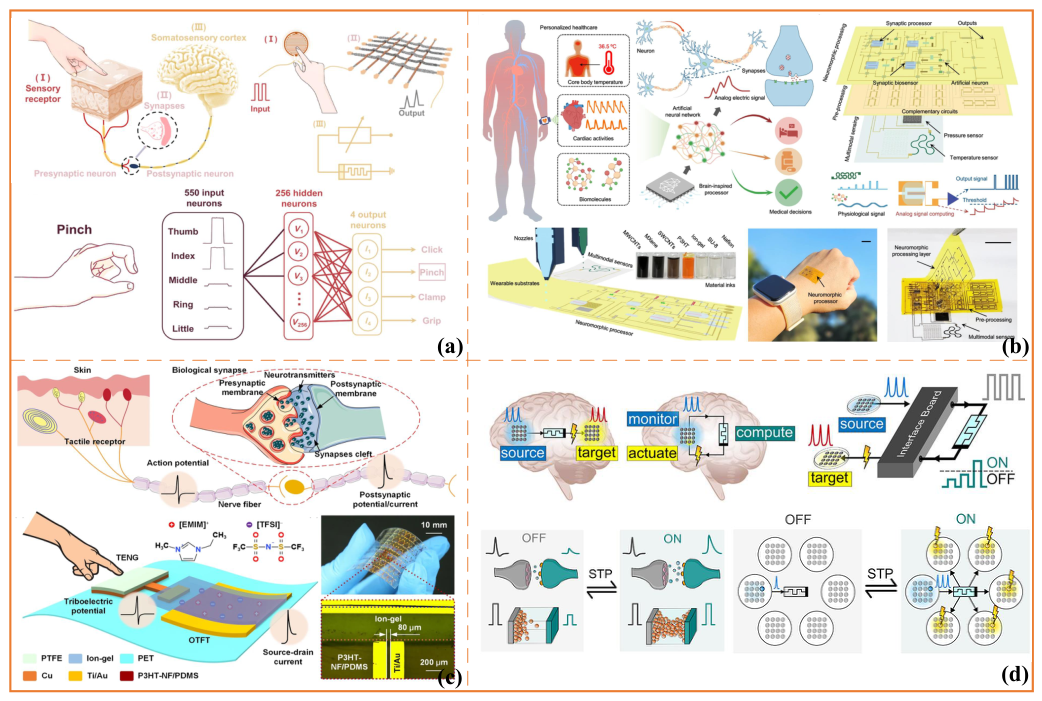
2.4. Hardware Substrates and Interface Pathways for Edge and Near-Body Neuroengineering
3. Neuromorphic Neurostimulation and Adaptive Actuation
3.1. Why Temporal Structure Matters in Neurostimulation
3.2. Event-Driven and State-Dependent Stimulation
3.3. System Integration Requirements
3.4. Relevance to Motor Restoration and Neurorehabilitation
4. Neuromorphic Tactile and Sensory Biointerfaces
4.1. Biomimetic Sensory Front Ends
4.2. Encoding-to-Stimulation Pathways
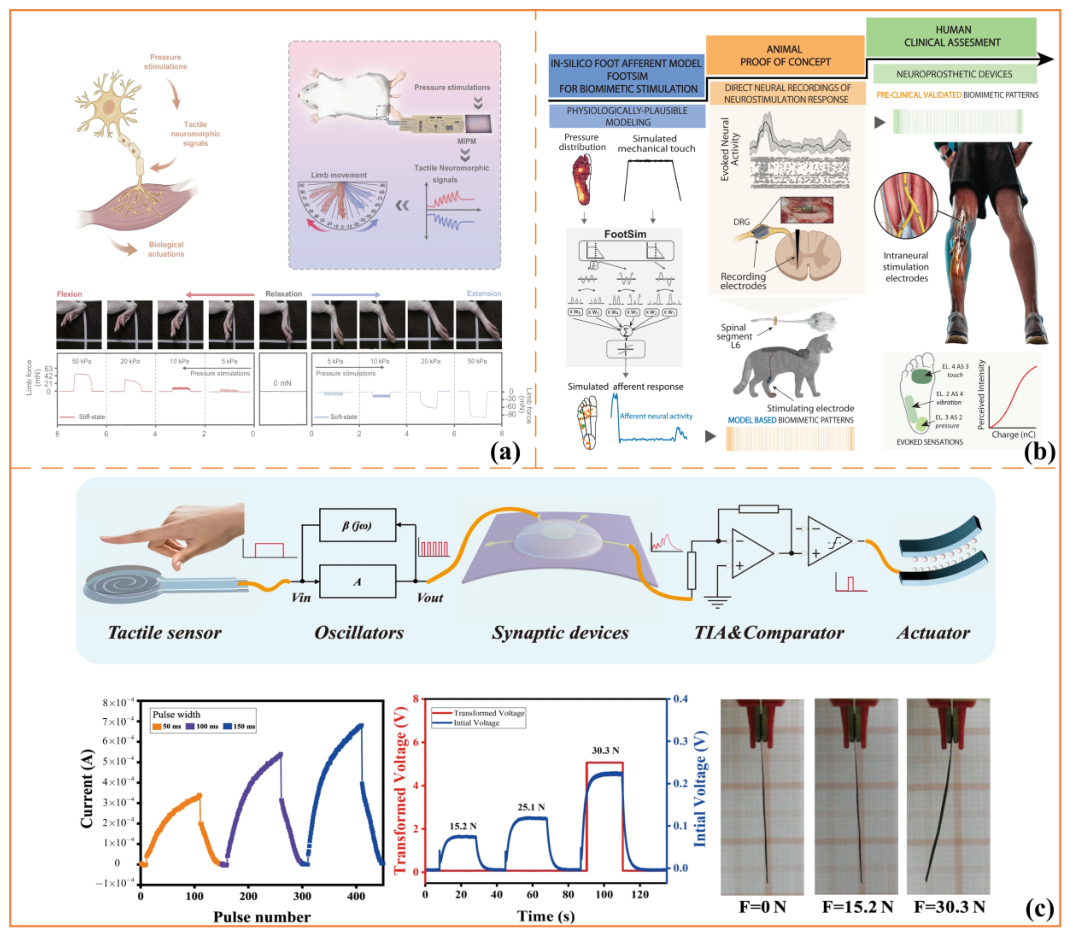
4.3. Tactile and Proprioceptive Feedback in Bidirectional Interfaces
4.4. Application Relevance: Neuroprostheses, Assistive Systems, and Rehabilitation
5. SNN-Based Biosignal Processing and State Decoding
5.1. Algorithmic Foundations of SNN-Based Processing
5.2. Event-Driven Sensing and Spike Encoding Front Ends

5.3. SNN-Based Temporal Inference for Neural and Physiological Signals
5.4. Edge SNN-Based Inference for Intention Decoding, Monitoring, and Adaptive Control
5.5. Evaluation Metrics Beyond Accuracy
6. Wearable and Implantable Neuromorphic Platforms
6.1. Conformable Sensing and Neuromorphic e-Skin/Textiles

6.2. Near-Body Loops and On-Device Memory/Computation
6.3. Implantable Neuromorphic Systems
6.4. Deployment Constraints in Real-World Neuroengineering
7. Neurorehabilitation as a Key Application Scenario
7.1. Why Neurorehabilitation Is a Good Testbed
7.2. Opportunities in Sensing, Feedback, and Stimulation
7.3. Why Translation Remains Limited
8. Challenges and Future Directions
8.1. What Neuromorphic Approaches Change in the Loop
8.2. Event Definition Drift and Nonstationary Signals
8.3. Device Nonidealities and Long-Term Stability
8.4. Safe Adaptation and Bounded Personalization
8.5. Standardized Benchmarks and Translational Pathways
8.6. Toward Edge-Native Closed-Loop Neuroengineering
9. Conclusions
Author Contributions
Funding
Institutional Review Board Statement
Informed Consent Statement
Data Availability Statement
Conflicts of Interest
References
- Wang, K.; Ren, S.; Jia, Y.; Yan, X.; Wang, L.; Fan, Y. Neuromorphic chips for biomedical engineering. Mechanobiol. Med. 2025, 3, 100133. [Google Scholar] [CrossRef]
- Boufidis, D.; Garg, R.; Angelopoulos, E.; Cullen, D.K.; Vitale, F. Bio-inspired electronics: Soft, biohybrid, and “living” neural interfaces. Nat. Commun. 2025, 16, 1861. [Google Scholar] [CrossRef]
- Huang, Z.; Guo, B.; Xu, H.; Ruan, H.; Guo, D. Multimodal Spiking Neural Network With Generalized Distributive Law for Biosignal and Sensory Fusion. IEEE Trans. Biomed. Eng. 2026. [Google Scholar] [CrossRef]
- Aziz, S.; Chetty, G.; Goecke, R.; Fernandez-Rojas, R. A Systematic Literature Review of Healthcare Embedded Systems Using AI-based Biosignal Analysis. ACM Comput. Surv. 2026, 58, 234. [Google Scholar] [CrossRef]
- Pawlak, W.A.; Howard, N. Neuromorphic algorithms for brain implants: A review. Front. Neurosci. 2025, 19, 1570104. [Google Scholar] [CrossRef]
- Kimovski, D.; Saurabh, N.; Jansen, M.; Aral, A.; Al-Dulaimy, A.; Bondi, A.B.; Galletta, A.; Papadopoulos, A.V.; Iosup, A.; Prodan, R. Beyond von neumann in the computing continuum: Architectures, applications, and future directions. IEEE Internet Comput. 2023, 28, 6–16. [Google Scholar] [CrossRef]
- Wang, H.; Sun, B.; Ge, S.S.; Su, J.; Jin, M.L. On non-von Neumann flexible neuromorphic vision sensors. npj Flex. Electron. 2024, 8, 28. [Google Scholar] [CrossRef]
- Choi, S.H. Spiking neural networks for biomedical signal analysis. Biomed. Eng. Lett. 2024, 14, 955–966. [Google Scholar] [CrossRef] [PubMed]
- Donati, E.; Valle, G. Neuromorphic hardware for somatosensory neuroprostheses. Nat. Commun. 2024, 15, 556. [Google Scholar] [CrossRef] [PubMed]
- Dere, M.D.; Jo, J.H.; Lee, B. Event-driven edge deep learning decoder for real-time gesture classification and neuro-inspired rehabilitation device control. IEEE Trans. Instrum. Meas. 2023, 72, 1–12. [Google Scholar] [CrossRef]
- Xiao, Y.; Liu, Y.; Zhang, B.; Chen, P.; Zhu, H.; He, E.; Zhao, J.; Huo, W.; Jin, X.; Zhang, X.; et al. Bio-plausible reconfigurable spiking neuron for neuromorphic computing. Sci. Adv. 2025, 11, eadr6733. [Google Scholar] [CrossRef] [PubMed]
- Cao, T.; Shen, C.; Wang, D.; Zhao, H.; Tan, R.; Zhou, Z.; Li, H.; Li, B.; Zhao, M.; Huang, H.W. Emerging memory devices for neuromorphic computing in the Internet of Medical Things. Cell Rep. Phys. Sci. 2025, 6, 102735. [Google Scholar] [CrossRef]
- Seguin, C.; Sporns, O.; Zalesky, A. Brain network communication: Concepts, models and applications. Nat. Rev. Neurosci. 2023, 24, 557–574. [Google Scholar] [CrossRef]
- Mehonic, A.; Kenyon, A.J. Brain-inspired computing needs a master plan. Nature 2022, 604, 255–260. [Google Scholar] [CrossRef]
- Schuman, C.D.; Kulkarni, S.R.; Parsa, M.; Mitchell, J.P.; Date, P.; Kay, B. Opportunities for neuromorphic computing algorithms and applications. Nat. Comput. Sci. 2022, 2, 10–19. [Google Scholar] [CrossRef] [PubMed]
- Zeng, Y.; Zhao, D.; Zhao, F.; Shen, G.; Dong, Y.; Lu, E.; Zhang, Q.; Sun, Y.; Liang, Q.; Zhao, Y.; et al. Braincog: A spiking neural network based, brain-inspired cognitive intelligence engine for brain-inspired ai and brain simulation. Patterns 2023, 4, 100789. [Google Scholar] [CrossRef]
- Hoch, F.L.; Wang, Q.; Lim, K.G.; Loke, D.K. Multifunctional organic materials, devices, and mechanisms for neuroscience, neuromorphic computing, and bioelectronics. Nano-Micro Lett. 2025, 17, 251. [Google Scholar] [CrossRef] [PubMed]
- Sung, M.J.; Kim, K.N.; Kim, C.; Lee, H.H.; Lee, S.W.; Kim, S.; Seo, D.G.; Zhou, H.; Lee, T.W. Organic artificial nerves: Neuromorphic robotics and bioelectronics. Chem. Rev. 2025, 125, 2625–2664. [Google Scholar] [CrossRef]
- Qi, L.; Wang, Y.; Liang, X. Emerging Implantable Sensor Technologies at the Intersection of Engineering and Brain Science. Biosensors 2025, 15, 762. [Google Scholar] [CrossRef]
- Muir, D.R.; Sheik, S. The road to commercial success for neuromorphic technologies. Nat. Commun. 2025, 16, 3586. [Google Scholar] [CrossRef]
- Park, S.S.; Choi, Y.S. Spiking neural networks for physiological and speech signals: A review. Biomed. Eng. Lett. 2024, 14, 943–954. [Google Scholar] [CrossRef]
- Verma, G.; Gocher, H.; Verma, S. Enhanced arrhythmia detection using spiking neural networks: An in-depth analysis of ECG data from the MIMIC-IV clinical database. Neural Comput. Appl. 2025, 37, 24365–24384. [Google Scholar] [CrossRef]
- Zhang, Q.; Cui, M.; Liu, Y.; Chen, W.; Yu, Z. Low-power and low-cost AI processor with distributed-aggregated classification architecture for wearable epilepsy seizure detection. IEEE Trans. Biomed. Circuits Syst. 2024, 19, 28–39. [Google Scholar] [CrossRef] [PubMed]
- Kim, J.; Lim, K.; Kim, Y. Hardware-Efficient Stochastic Computing-Based Neural Networks with SNN-Isomorphic LIF Activation. Electronics 2026, 15, 768. [Google Scholar] [CrossRef]
- Kadaru, S.D.; Buccapatnam, R.; Liu, C. Exploring Neuromorphic Computing for Reinforcement Learning: A Survey and Review. IEEE Access 2026, 14, 16699–16716. [Google Scholar] [CrossRef]
- Xiao, Y.; Gao, C.; Jin, J.; Sun, W.; Wang, B.; Bao, Y.; Liu, C.; Huang, W.; Zeng, H.; Yu, Y. Recent progress in neuromorphic computing from memristive devices to neuromorphic chips. Adv. Devices Instrum. 2024, 5, 0044. [Google Scholar] [CrossRef]
- Zhang, X.; Ge, L.; Li, S.; Sun, H.; Yang, F.; Zhan, Z.; Dong, X.; Chen, J.; Zhang, X.; Chen, J.; et al. SnNb2O6-Based Capacitive Memristive Synapses with Intrinsic LIF Dynamics for Neuromorphic Epilepsy Detection. Nano Lett. 2026, 26, 871–879. [Google Scholar] [CrossRef]
- Choi, S.; Bezugam, S.S.; Bhattacharya, T.; Kwon, D.; Strukov, D.B. Wafer-scale fabrication of memristive passive crossbar circuits for brain-scale neuromorphic computing. Nat. Commun. 2025, 16, 8757. [Google Scholar] [CrossRef]
- Portillo, S.; Ramirez, P.; Mafe, S.; Cervera, J. Neuromorphic reservoir computing with memristive nanofluidic diodes. Nano Lett. 2025, 25, 9928–9934. [Google Scholar] [CrossRef]
- Tian, Q.; Shan, X.; Bian, J.; Cheng, Y.; Zheng, J.; Wang, Z.; Zhao, X.; Xu, H.; Liu, Y. Metal oxide-based resistive switching memristors for neuromorphic computing. J. Mater. Chem. C 2025, 13, 12046–12065. [Google Scholar] [CrossRef]
- Gao, F.; Li, L.; Li, S. Research progress in gallium nitride-based artificial synaptic devices. eScience 2025, 6, 100519. [Google Scholar] [CrossRef]
- Syed, G.S.; Le Gallo, M.; Sebastian, A. Phase-change memory for in-memory computing. Chem. Rev. 2025, 125, 5163–5194. [Google Scholar] [CrossRef]
- Sun, S.; You, Z.; Ji, Y.; Li, Y.; Feng, Y.; Liu, S.; Cao, J.; Liu, Y.; Yu, Z.; Wu, T. Application and challenges of organic electrochemical transistors in neuromorphic computing: Bionic synapse and multi-mode integration. J. Mater. Chem. C 2025, 13, 19125–19148. [Google Scholar] [CrossRef]
- Koo, R.H.; Park, S.H.; Ko, J.; Im, J.; Lee, J.H. From commercial to emerging memory: Device and circuit perspectives for neuromorphic computing. Device 2025, 4, 100942. [Google Scholar] [CrossRef]
- Li, R.; Cheng, L.; Liu, W.; Jin, C.; Shi, X.; Xie, P.; Sun, Q.; Long, M.; Yang, J.; Ho, J.C.; et al. Ion-mediated oxide transistors for neuromorphic electronics: Materials, devices, and perspectives. Appl. Phys. Rev. 2025, 12, 021318. [Google Scholar] [CrossRef]
- Kim, J.S.; Nam, Y.; Jang, N.; Kim, H.; Kim, S.D.; Vo, V.K.; Han, M.; Kong, S.H. Forming-free chemi-memristive gas sensing for artificial olfactory system. Sens. Actuators B Chem. 2025, 444, 138315. [Google Scholar] [CrossRef]
- Dong, C.; Kang, K.; Wang, Y.; Chen, X.; Yang, C.; Hu, W. Optoelectronic memristive sensor with reconfigurable logic operation capability in ZnO/Nb: SrTiO3 heterojunction. Appl. Phys. Lett. 2025, 127, 023504. [Google Scholar] [CrossRef]
- Davies, M.; Srinivasa, N.; Lin, T.H.; Chinya, G.; Cao, Y.; Choday, S.H.; Dimou, G.; Joshi, P.; Imam, N.; Jain, S.; et al. Loihi: A neuromorphic manycore processor with on-chip learning. IEEE Micro 2018, 38, 82–99. [Google Scholar] [CrossRef]
- Taking Neuromorphic Computing to the Next Level with Loihi 2 Technology Brief, 2021. Available online: https://www.intel.com/content/www/us/en/research/neuromorphic-computing-loihi-2-technology-brief.html (accessed on 29 April 2026).
- Akopyan, F.; Sawada, J.; Cassidy, A.; Alvarez-Icaza, R.; Arthur, J.; Merolla, P.; Imam, N.; Nakamura, Y.; Datta, P.; Nam, G.J.; et al. Truenorth: Design and tool flow of a 65 mw 1 million neuron programmable neurosynaptic chip. IEEE Trans. Comput.-Aided Des. Integr. Circuits Syst. 2015, 34, 1537–1557. [Google Scholar] [CrossRef]
- Chen, G.; Xu, M.; Chen, Y.; Yuan, F.; Qin, L.; Ren, J. A New Era in Computing: A Review of Neuromorphic Computing Chip Architecture and Applications. Chips 2026, 5, 3. [Google Scholar] [CrossRef]
- Orchard, G.; Frady, E.P.; Rubin, D.B.D.; Sanborn, S.; Shrestha, S.B.; Sommer, F.T.; Davies, M. Efficient neuromorphic signal processing with Loihi 2. In Proceedings of the 2021 IEEE Workshop on Signal Processing Systems (SiPS), Coimbra, Portugal, 19–21 October 2021; IEEE: Piscataway, NJ, USA, 2021; pp. 254–259. [Google Scholar] [CrossRef]
- Painkras, E.; Plana, L.A.; Garside, J.; Temple, S.; Galluppi, F.; Patterson, C.; Lester, D.R.; Brown, A.D.; Furber, S.B. SpiNNaker: A 1-W 18-core system-on-chip for massively-parallel neural network simulation. IEEE J. Solid-State Circuits 2013, 48, 1943–1953. [Google Scholar] [CrossRef]
- Greatorex, H.; Richter, O.; Mastella, M.; Cotteret, M.; Klein, P.; Fabre, M.; Rubino, A.; Soares Girão, W.; Chen, J.; Ziegler, M.; et al. A neuromorphic processor with on-chip learning for beyond-CMOS device integration. Nat. Commun. 2025, 16, 6424. [Google Scholar] [CrossRef]
- Baek, Y.; Bae, B.; Shin, H.; Sonnadara, C.; Cho, H.; Lin, C.Y.; Mu, Y.; Shen, C.; Shah, S.; Wang, G.; et al. Edge intelligence through in-sensor and near-sensor computing for the artificial intelligence of things. Npj Unconv. Comput. 2025, 2, 25. [Google Scholar] [CrossRef]
- Zhao, C.; Fang, J.; Jiang, J.; Xue, X.; Zeng, X. Light-CIM: A lightweight ADC/DAC-fewer RRAM CIM DNN accelerator with fully analog tiles and nonideality-aware algorithm for consumer electronics. IEEE Trans. Comput.-Aided Des. Integr. Circuits Syst. 2024, 44, 602–612. [Google Scholar] [CrossRef]
- Huang, X.; Tong, L.; Xu, L.; Shi, W.; Peng, Z.; Li, Z.; Yu, X.; Li, W.; Wang, Y.; Zhang, X.; et al. 2D MoS2-based reconfigurable analog hardware. Nat. Commun. 2025, 16, 101. [Google Scholar] [CrossRef] [PubMed]
- Gao, Y.; Zhang, J.; Zhang, H.; Chow, L.; Zhao, G.; Guo, G.; Yiu, C.K.; Zhang, B.; Huang, Y.; Zhou, J.; et al. A neuromorphic robotic electronic skin with active pain and injury perception. Proc. Natl. Acad. Sci. USA 2025, 122, e2520922122. [Google Scholar] [CrossRef] [PubMed]
- Chen, X.; Zhou, J.; Huang, J.; Liu, J.; Nie, L.; Zhu, Y. A Neuromorphic Multifunctional Sensing Fiber for Deep Learning Enhanced Wearable Human-Machine Interaction. Adv. Funct. Mater. 2025, 36, e24652. [Google Scholar] [CrossRef]
- Xie, R.; Han, F.; Yu, Q.; Li, D.; Han, X.; Xu, X.; Yu, H.; Huang, J.; Zhou, X.; Zhao, H.; et al. A movable long-term implantable soft microfibre for dynamic bioelectronics. Nature 2025, 645, 648–655. [Google Scholar] [CrossRef]
- Bengisu, S.; Demir, N.; Krespi, Y. Effectiveness of conventional dysphagia therapy (CDT), neuromuscular electrical stimulation (NMES), and transcranial direct current stimulation (tDCS) in acute post-stroke dysphagia: A comparative evaluation. Dysphagia 2024, 39, 77–91. [Google Scholar] [CrossRef]
- Shin, H.E.; Kim, M.; Lee, D.; Jang, J.Y.; Soh, Y.; Yun, D.H.; Kim, S.; Yang, J.; Kim, M.K.; Lee, H.; et al. Therapeutic effects of functional electrical stimulation on physical performance and muscle strength in post-stroke older adults: A review. Ann. Geriatr. Med. Res. 2022, 26, 16. [Google Scholar] [CrossRef]
- Bastos-Filho, T.; González-Cely, A.X.; Mehrpour, S.; Schreider, S.; Souza, F.; Cabral, F.; Villa-Parra, A.C. BCI in Stroke Rehabilitation with Robotic Devices, tACS and FES: A Case Study. J. Biomed. Eng. Biosci. (JBEB) 2025, 12, 07–17. [Google Scholar] [CrossRef]
- Hardy, P.B.; Wang, B.Y.; Chan, K.M.; Webber, C.A.; Senger, J.L.B. The use of electrical stimulation to enhance recovery following peripheral nerve injury. Muscle Nerve 2024, 70, 1151–1162. [Google Scholar] [CrossRef]
- Natarajan, C.; Le, L.H.; Gunasekaran, M.; Tracey, K.J.; Chernoff, D.; Levine, Y.A. Electrical stimulation of the vagus nerve ameliorates inflammation and disease activity in a rat EAE model of multiple sclerosis. Proc. Natl. Acad. Sci. USA 2024, 121, e2322577121. [Google Scholar] [CrossRef]
- Zhang, Y.; Chen, S.; Xiao, Z.; Liu, X.; Wu, C.; Wu, K.; Liu, A.; Wei, D.; Sun, J.; Zhou, L.; et al. Magnetoelectric nanoparticles incorporated biomimetic matrix for wireless electrical stimulation and nerve regeneration. Adv. Healthc. Mater. 2021, 10, 2100695. [Google Scholar] [CrossRef]
- Formento, E.; D’Anna, E.; Gribi, S.; Lacour, S.P.; Micera, S. A biomimetic electrical stimulation strategy to induce asynchronous stochastic neural activity. J. Neural Eng. 2020, 17, 046019. [Google Scholar] [CrossRef]
- Krauss, J.K.; Lipsman, N.; Aziz, T.; Boutet, A.; Brown, P.; Chang, J.W.; Davidson, B.; Grill, W.M.; Hariz, M.I.; Horn, A.; et al. Technology of deep brain stimulation: Current status and future directions. Nat. Rev. Neurol. 2021, 17, 75–87. [Google Scholar] [CrossRef]
- Fisher, R.S. Deep brain stimulation of thalamus for epilepsy. Neurobiol. Dis. 2023, 179, 106045. [Google Scholar] [CrossRef]
- Baker, K.B.; Plow, E.B.; Nagel, S.; Rosenfeldt, A.B.; Gopalakrishnan, R.; Clark, C.; Wyant, A.; Schroedel, M.; Ozinga IV, J.; Davidson, S.; et al. Cerebellar deep brain stimulation for chronic post-stroke motor rehabilitation: A phase I trial. Nat. Med. 2023, 29, 2366–2374. [Google Scholar] [CrossRef]
- Xi, P.; Yao, Q.; Liu, Y.; He, J.; Tang, R.; Lang, Y. Biomimetic peripheral nerve stimulation promotes the rat hindlimb motion modulation in stepping: An experimental analysis. Cyborg Bionic Syst. 2024, 5, 0131. [Google Scholar] [CrossRef]
- Yang, C.Y.; Zhao, Z.; Wu, H.Y.; Gao, D.; Huang, J.D.; Ji, J.; Xiong, M.; Liu, T.; Harikesh, P.C.; Marks, A.; et al. High-frequency, low-energy organic event-based sensors for closed-loop neurostimulation. Nat. Sens. 2026, 1, 63–72. [Google Scholar] [CrossRef]
- Balamur, R.; Eren, G.O.; Kaleli, H.N.; Karatum, O.; Kaya, L.; Hasanreisoglu, M.; Nizamoglu, S. A retina-inspired optoelectronic synapse using quantum dots for neuromorphic photostimulation of neurons. Adv. Sci. 2024, 11, 2401753. [Google Scholar] [CrossRef]
- Bao, R.; Wang, S.; Liu, X.; Tu, K.; Liu, J.; Huang, X.; Liu, C.; Zhou, P.; Liu, S. Neuromorphic electro-stimulation based on atomically thin semiconductor for damage-free inflammation inhibition. Nat. Commun. 2024, 15, 1327. [Google Scholar] [CrossRef]
- Hwang, Y.C.E.; Long, L.; Sales Filho, J.; Genov, R.; Zariffa, J. Closed-loop control of functional electrical stimulation using a selectively recording and bidirectional nerve cuff interface. IEEE Trans. Neural Syst. Rehabil. Eng. 2024, 32, 504–513. [Google Scholar] [CrossRef]
- Herbozo Contreras, L.F.; Truong, N.D.; Eshraghian, J.K.; Xu, Z.; Huang, Z.; Bersani-Veroni, T.V.; Aguilar, I.; Leung, W.H.; Nikpour, A.; Kavehei, O. Neuromorphic neuromodulation: Towards the next generation of closed-loop neurostimulation. PNAS Nexus 2024, 3, pgae488. [Google Scholar] [CrossRef]
- Di Florio, M.; Carè, M.; Beaubois, R.; Cota, V.R.; Barban, F.; Levi, T.; Chiappalone, M. Design of an experimental setup for delivering intracortical microstimulation in vivo via spiking neural network. In Proceedings of the 2023 45th Annual International Conference of the IEEE Engineering in Medicine & Biology Society (EMBC), Sydney, Australia, 24–27 July 2023; IEEE: Piscataway, NJ, USA, 2023; pp. 1–4. [Google Scholar] [CrossRef]
- Sahai, E.; Hickman, J.; Denman, D.J. A bioelectric router for adaptive isochronous neurostimulation enables multipolar bioelectric stimulation from a single source. Sci. Rep. 2025, 15, 23958. [Google Scholar] [CrossRef]
- Woods, I.; Spurling, D.; Sunil, S.; Marie O’Callaghan, A.; Maughan, J.; Gutierrez-Gonzalez, J.; McGuire, T.K.; Leahy, L.; Dervan, A.; Nicolosi, V.; et al. 3D-Printing of Electroconductive MXene-Based Micro-Meshes in a Biomimetic Hyaluronic Acid-Based Scaffold Directs and Enhances Electrical Stimulation for Neural Repair Applications. Adv. Sci. 2025, 12, e03454. [Google Scholar] [CrossRef]
- Jin, F.; Li, T.; Wei, Z.; Xiong, R.; Qian, L.; Ma, J.; Yuan, T.; Wu, Q.; Lai, C.; Ma, X.; et al. Biofeedback electrostimulation for bionic and long-lasting neural modulation. Nat. Commun. 2022, 13, 5302. [Google Scholar] [CrossRef]
- Lu, B.; Jia, S.; Wang, Z.; Wu, W.; Yan, L.; Zhu, L.; Hao, D. Sensory-motor coupling electrical stimulation driven by a bionic Z-structured triboelectric nanogenerator improves functional recovery from spinal cord injury. Nano Energy 2023, 107, 108133. [Google Scholar] [CrossRef]
- Mollà-Casanova, S.; Llorens, R.; Borrego, A.; Salinas-Martínez, B.; Serra-Añó, P. Validity, reliability, and sensitivity to motor impairment severity of a multi-touch app designed to assess hand mobility, coordination, and function after stroke. J. Neuroeng. Rehabil. 2021, 18, 70. [Google Scholar] [CrossRef]
- Rahiminejad, E.; Parvizi-Fard, A.; Iskarous, M.M.; Thakor, N.V.; Amiri, M. A biomimetic circuit for electronic skin with application in hand prosthesis. IEEE Trans. Neural Syst. Rehabil. Eng. 2021, 29, 2333–2344. [Google Scholar] [CrossRef]
- Cao, Z.; Xu, Y.; Yu, S.; Huang, Z.; Hu, Y.; Lin, W.; Wang, H.; Luo, Y.; Zheng, Y.; Chen, Z.; et al. A programmable electronic skin with event-driven in-sensor touch differential and decision-making. Adv. Funct. Mater. 2025, 35, 2412649. [Google Scholar] [CrossRef]
- Tamè, L.; Tucciarelli, R.; Sadibolova, R.; Sereno, M.I.; Longo, M.R. Reconstructing neural representations of tactile space. Neuroimage 2021, 229, 117730. [Google Scholar] [CrossRef] [PubMed]
- Wang, J.; Liu, X.; Li, R.; Fan, Y. Biomimetic strategies and technologies for artificial tactile sensory systems. Trends Biotechnol. 2023, 41, 951–964. [Google Scholar] [CrossRef]
- Huang, T.; Li, H.; Dong, Z.; Yuan, Z.; Hua, Q.; Hu, W.; Shen, G. Closed-Loop Haptic–Thermal Perception with Memristor-Based Spiking Neurons for Embodied Neuromorphic Intelligence. Adv. Funct. Mater. 2025, 36, e23270. [Google Scholar] [CrossRef]
- Song, X.; Sun, Y.; Ren, B.; Xu, W.; Xu, J.; Liu, L.; Xu, J.; Chua, L.; Su, R.; Hong, J.; et al. Ultrahigh Sensitive Human Inspired Neurons for Artificial Nociceptor Systems. ACS Nano 2025, 19, 33335–33345. [Google Scholar] [CrossRef]
- Lee, S.W.; Yun, S.Y.; Han, J.K.; Nho, Y.H.; Jeon, S.B.; Choi, Y.K. Spike-Based Neuromorphic Hardware for Dynamic Tactile Perception with a Self-Powered Mechanoreceptor Array. Adv. Sci. 2024, 11, 2402175. [Google Scholar] [CrossRef] [PubMed]
- Chen, S.; Zhou, Z.; Hou, K.; Wu, X.; He, Q.; Tang, C.G.; Li, T.; Zhang, X.; Jie, J.; Gao, Z.; et al. Artificial organic afferent nerves enable closed-loop tactile feedback for intelligent robot. Nat. Commun. 2024, 15, 7056. [Google Scholar] [CrossRef]
- Wei, X.; Wu, Z.; Gao, H.; Cao, S.; Meng, X.; Lan, Y.; Su, H.; Qin, Z.; Liu, H.; Du, W.; et al. Mechano-gated iontronic piezomemristor for temporal-tactile neuromorphic plasticity. Nat. Commun. 2025, 16, 1060. [Google Scholar] [CrossRef] [PubMed]
- Valle, G.; Katic Secerovic, N.; Eggemann, D.; Gorskii, O.; Pavlova, N.; Petrini, F.M.; Cvancara, P.; Stieglitz, T.; Musienko, P.; Bumbasirevic, M.; et al. Biomimetic computer-to-brain communication enhancing naturalistic touch sensations via peripheral nerve stimulation. Nat. Commun. 2024, 15, 1151. [Google Scholar] [CrossRef]
- Sun, F.; Lu, Q.; Hao, M.; Wu, Y.; Li, Y.; Liu, L.; Li, L.; Wang, Y.; Zhang, T. An artificial neuromorphic somatosensory system with spatio-temporal tactile perception and feedback functions. npj Flex. Electron. 2022, 6, 72. [Google Scholar] [CrossRef]
- Katic, N.; Siqueira, R.K.; Cleland, L.; Strzalkowski, N.; Bent, L.; Raspopovic, S.; Saal, H. Modeling foot sole cutaneous afferents: FootSim. iScience 2023, 26, 105874. [Google Scholar] [CrossRef]
- Bensmaia, S.J.; Tyler, D.J.; Micera, S. Restoration of sensory information via bionic hands. Nat. Biomed. Eng. 2023, 7, 443–455. [Google Scholar] [CrossRef]
- Soghoyan, G.; Biktimirov, A.R.; Piliugin, N.S.; Matvienko, Y.; Kaplan, A.Y.; Sintsov, M.Y.; Lebedev, M.A. Restoration of natural somatic sensations to the amputees: Finding the right combination of neurostimulation methods. Front. Neurosci. 2024, 18, 1466684. [Google Scholar] [CrossRef] [PubMed]
- Wu, R.; Yang, P.F.; Wang, F.; Liu, Q.; Gore, J.C.; Chen, L.M. Differential recovery of submodality touch neurons and interareal communication in sensory input-deprived area 3b and S2 cortices. J. Neurosci. 2022, 42, 9330–9342. [Google Scholar] [CrossRef] [PubMed]
- Héroux, M.E.; Butler, A.A.; Robertson, L.S.; Fisher, G.; Gandevia, S.C. Proprioception: A new look at an old concept. J. Appl. Physiol. 2022, 132, 811–814. [Google Scholar] [CrossRef]
- Lee, Y.; Liu, Y.; Seo, D.G.; Oh, J.Y.; Kim, Y.; Li, J.; Kang, J.; Kim, J.; Mun, J.; Foudeh, A.M.; et al. A low-power stretchable neuromorphic nerve with proprioceptive feedback. Nat. Biomed. Eng. 2023, 7, 511–519. [Google Scholar] [CrossRef]
- Kim, J.; Lee, S.; Yoon, J.; Son, D. Soft sensory-neuromorphic system for closed-loop neuroprostheses. Int. J. Extrem. Manuf. 2025, 7, 042001. [Google Scholar] [CrossRef]
- Cimolato, A.; Ciotti, F.; Kljajić, J.; Valle, G.; Raspopovic, S. Symbiotic electroneural and musculoskeletal framework to encode proprioception via neurostimulation: ProprioStim. iScience 2023, 26, 106248. [Google Scholar] [CrossRef]
- Sankar, S.; Cheng, W.Y.; Zhang, J.; Slepyan, A.; Iskarous, M.M.; Greene, R.J.; DeBrabander, R.; Chen, J.; Gupta, A.; Thakor, N.V. A natural biomimetic prosthetic hand with neuromorphic tactile sensing for precise and compliant grasping. Sci. Adv. 2025, 11, eadr9300. [Google Scholar] [CrossRef] [PubMed]
- Zhu, Z.; Chen, K.; Lin, W.; Yan, H.; Liang, L.; Wang, G.; Song, X.; Zhang, C.; Wang, Z. Recent advances in spike-based neural coding for tactile perception. Microsyst. Nanoeng. 2025, 11, 212. [Google Scholar] [CrossRef]
- Liu, R.; Liu, T.; Liu, W.; Luo, B.; Li, Y.; Fan, X.; Zhang, X.; Cui, W.; Teng, Y. SemiSynBio: A new era for neuromorphic computing. Synth. Syst. Biotechnol. 2024, 9, 594–599. [Google Scholar] [CrossRef]
- Shrestha, A.; Fang, H.; Mei, Z.; Rider, D.P.; Wu, Q.; Qiu, Q. A survey on neuromorphic computing: Models and hardware. IEEE Circuits Syst. Mag. 2022, 22, 6–35. [Google Scholar] [CrossRef]
- Stanojevic, A.; Woźniak, S.; Bellec, G.; Cherubini, G.; Pantazi, A.; Gerstner, W. High-performance deep spiking neural networks with 0.3 spikes per neuron. Nat. Commun. 2024, 15, 6793. [Google Scholar] [CrossRef]
- Toğaçar, M.; Ergen, B.; Cömert, Z. Detection of weather images by using spiking neural networks of deep learning models. Neural Comput. Appl. 2021, 33, 6147–6159. [Google Scholar] [CrossRef]
- Wang, Y.; Liu, H.; Zhang, M.; Luo, X.; Qu, H. A universal ANN-to-SNN framework for achieving high accuracy and low latency deep Spiking Neural Networks. Neural Netw. 2024, 174, 106244. [Google Scholar] [CrossRef]
- Rahman, N.A.; Yusoff, N. Modulated spike-time dependent plasticity (STDP)-based learning for spiking neural network (SNN): A review. Neurocomputing 2025, 618, 129170. [Google Scholar] [CrossRef]
- Gygax, J.; Zenke, F. Elucidating the theoretical underpinnings of surrogate gradient learning in spiking neural networks. Neural Comput. 2025, 37, 886–925. [Google Scholar] [CrossRef]
- Ayasi, B.; Carmona, C.J.; Saleh, M.; García-Vico, A.M. A Practical Tutorial on Spiking Neural Networks: Comprehensive Review, Models, Experiments, Software Tools, and Implementation Guidelines. Eng 2025, 6, 304. [Google Scholar] [CrossRef]
- Iaboni, C.; Abichandani, P. Event-based spiking neural networks for object detection: A review of datasets, architectures, learning rules, and implementation. IEEE Access 2024, 12, 180532–180596. [Google Scholar] [CrossRef]
- Safa, A.; Van Assche, J.; Alea, M.D.; Catthoor, F.; Gielen, G.G. Neuromorphic near-sensor computing: From event-based sensing to edge learning. IEEE Micro 2022, 42, 88–95. [Google Scholar] [CrossRef]
- Barleanu, A.; Hulea, M. Neuromorphic sensor based on force-sensing resistors. Biomimetics 2024, 9, 326. [Google Scholar] [CrossRef] [PubMed]
- Wang, J.; Hafidh, B.; Dong, H.; El Saddik, A. Sitting posture recognition using a spiking neural network. IEEE Sens. J. 2020, 21, 1779–1786. [Google Scholar] [CrossRef]
- Yu, L.; Chen, H.; Wang, Z.; Zhan, S.; Shao, J.; Liu, Q.; Xu, S. Spikingvit: A multiscale spiking vision transformer model for event-based object detection. IEEE Trans. Cogn. Dev. Syst. 2024, 17, 130–146. [Google Scholar] [CrossRef]
- Jiang, Y.; Wang, W.; Yu, L.; He, C. Eye tracking based on event camera and spiking neural network. Electronics 2024, 13, 2879. [Google Scholar] [CrossRef]
- Kudithipudi, D.; Schuman, C.; Vineyard, C.M.; Pandit, T.; Merkel, C.; Kubendran, R.; Aimone, J.B.; Orchard, G.; Mayr, C.; Benosman, R.; et al. Neuromorphic computing at scale. Nature 2025, 637, 801–812. [Google Scholar] [CrossRef] [PubMed]
- Mohan, V.; Tay, W.P.; Basu, A. Towards neuromorphic compression based neural sensing for next-generation wireless implantable brain machine interface. Neuromorphic Comput. Eng. 2025, 5, 014004. [Google Scholar] [CrossRef]
- Sharifshazileh, M.; Burelo, K.; Sarnthein, J.; Indiveri, G. An electronic neuromorphic system for real-time detection of high frequency oscillations (HFO) in intracranial EEG. Nat. Commun. 2021, 12, 3095. [Google Scholar] [CrossRef]
- Yuan, R.; Tiw, P.J.; Cai, L.; Yang, Z.; Liu, C.; Zhang, T.; Ge, C.; Huang, R.; Yang, Y. A neuromorphic physiological signal processing system based on VO2 memristor for next-generation human-machine interface. Nat. Commun. 2023, 14, 3695. [Google Scholar] [CrossRef]
- Kolhar, M. A neuromorphic approach to early arrhythmia detection. Sci. Rep. 2025, 15, 39635. [Google Scholar] [CrossRef]
- Yan, J.; Luo, Q.; Chen, Z.; Wang, Z.; Guo, X.; Xie, Q.; Oetomo, D.; Tan, Y.; Niu, C.M. Spike-based Neuromorphic Model of Spasticity for Generation of Affected Neural Activity. IEEE Trans. Neural Syst. Rehabil. Eng. 2025, 33, 1360–1371. [Google Scholar] [CrossRef]
- Li, W.; Fang, C.; Zhu, Z.; Chen, C.; Song, A. Fractal spiking neural network scheme for EEG-based emotion recognition. IEEE J. Transl. Eng. Health Med. 2023, 12, 106–118. [Google Scholar] [CrossRef]
- Tyagi, P.K.; Agrawal, D. Automatic detection of sleep apnea from a single-lead ECG signal based on spiking neural network model. Comput. Biol. Med. 2024, 179, 108877. [Google Scholar] [CrossRef]
- Ma, J.; Wang, L.; Tan, Y.; Chen, J.; Zhang, N.; Tan, L.; Li, G.; Sui, M.; Jiang, N.; Dan, G. Post-Stroke Fine Hand Motion Intention Recognition Based on sEMG Decomposition and Residual Spiking Neural Networks. IEEE Trans. Neural Syst. Rehabil. Eng. 2025, 33, 4147–4158. [Google Scholar] [CrossRef]
- Rusev, G.; Yordanov, S.; Nedelcheva, S.; Banderov, A.; Lafaye de Micheaux, H.; Sauter-Starace, F.; Aksenova, T.; Koprinkova-Hristova, P.; Kasabov, N. NEuroMOrphic Neural-Response Decoding System for Adaptive and Personalized Neuro-Prosthetics’ Control. Biomimetics 2025, 10, 518. [Google Scholar] [CrossRef] [PubMed]
- Tanzarella, S.; Iacono, M.; Donati, E.; Farina, D.; Bartolozzi, C. Neuromorphic decoding of spinal motor neuron behaviour during natural hand movements for a new generation of wearable neural interfaces. IEEE Trans. Neural Syst. Rehabil. Eng. 2023, 31, 3035–3046. [Google Scholar] [CrossRef]
- Li, Y.; Fan, L.; Shen, H.; Hu, D. HR-SNN: An End-to-End Spiking Neural Network for Four-Class Classification Motor Imagery Brain–Computer Interface. IEEE Trans. Cogn. Dev. Syst. 2024, 16, 1955–1968. [Google Scholar] [CrossRef]
- Tian, F.; Yang, J.; Zhao, S.; Sawan, M. NeuroCARE: A generic neuromorphic edge computing framework for healthcare applications. Front. Neurosci. 2023, 17, 1093865. [Google Scholar] [CrossRef]
- Rusev, G.; Yordanov, S.; Nedelcheva, S.; Banderov, A.; Sauter-Starace, F.; Koprinkova-Hristova, P.; Kasabov, N. Decoding Brain Signals in a Neuromorphic Framework for a Personalized Adaptive Control of Human Prosthetics. Biomimetics 2025, 10, 183. [Google Scholar] [CrossRef]
- He, Y.; Corradi, F.; Shi, C.; Van Der Ven, S.; Timmermans, M.; Stuijt, J.; Detterer, P.; Harpe, P.; Lindeboom, L.; Hermeling, E.; et al. An implantable neuromorphic sensing system featuring near-sensor computation and send-on-delta transmission for wireless neural sensing of peripheral nerves. IEEE J. Solid-State Circuits 2022, 57, 3058–3070. [Google Scholar] [CrossRef] [PubMed]
- Mehonic, A.; Sebastian, A.; Rajendran, B.; Simeone, O.; Vasilaki, E.; Kenyon, A.J. Memristors—From in-memory computing, deep learning acceleration, and spiking neural networks to the future of neuromorphic and bio-inspired computing. Adv. Intell. Syst. 2020, 2, 2000085. [Google Scholar] [CrossRef]
- Yang, C.; Wang, H.; Cao, Z.; Chen, X.; Zhou, G.; Zhao, H.; Wu, Z.; Zhao, Y.; Sun, B. Memristor-based bionic tactile devices: Opening the door for next-generation artificial intelligence. Small 2024, 20, 2308918. [Google Scholar] [CrossRef] [PubMed]
- Wang, W.; Jiang, Y.; Zhong, D.; Zhang, Z.; Choudhury, S.; Lai, J.C.; Gong, H.; Niu, S.; Yan, X.; Zheng, Y.; et al. Neuromorphic sensorimotor loop embodied by monolithically integrated, low-voltage, soft e-skin. Science 2023, 380, 735–742. [Google Scholar] [CrossRef]
- Jiang, C.; Huang, S.; Yu, Y.; Zhao, Z.; Cheng, Y.; Hassan, Y.A.; Zhao, C.; Zhang, D.; Ding, Z. A BiOI/TiO2 heterogeneous interface-based fiber memristor for intelligent textile system and high-precision hand gestures recognition. Nano Res. 2025, 18, 94907367. [Google Scholar] [CrossRef]
- Xu, X.; Cho, E.J.; Bekker, L.; Talin, A.A.; Lee, E.; Pascall, A.J.; Worsley, M.A.; Zhou, J.; Cook, C.C.; Kuntz, J.D.; et al. A bioinspired artificial injury response system based on a robust polymer memristor to mimic a sense of pain, sign of injury, and healing. Adv. Sci. 2022, 9, 2200629. [Google Scholar] [CrossRef]
- Xia, Q.; Qin, Y.; Qiu, P.; Zheng, A.; Zhang, X. A bio-inspired tactile nociceptor constructed by integrating wearable sensing paper and a VO2 threshold switching memristor. J. Mater. Chem. B 2022, 10, 1991–2000. [Google Scholar] [CrossRef]
- Choi, Y.; Jin, P.; Lee, S.; Song, Y.; Tay, R.Y.; Kim, G.; Yoo, J.; Han, H.; Yeom, J.; Cho, J.H.; et al. All-printed chip-less wearable neuromorphic system for multimodal physicochemical health monitoring. Nat. Commun. 2025, 16, 5689. [Google Scholar] [CrossRef]
- Zeng, J.; Zhao, J.; Bu, T.; Liu, G.; Qi, Y.; Zhou, H.; Dong, S.; Zhang, C. A flexible tribotronic artificial synapse with bioinspired neurosensory behavior. Nano-Micro Lett. 2023, 15, 18. [Google Scholar] [CrossRef]
- Dias, C.; Castro, D.; Aroso, M.; Ventura, J.; Aguiar, P. Memristor-based neuromodulation device for real-time monitoring and adaptive control of neuronal populations. ACS Appl. Electron. Mater. 2022, 4, 2380–2387. [Google Scholar] [CrossRef]
- Zhang, J.; Zhu, Z.; Meng, J.; Wang, T. Fiber memristor-based physical reservoir computing for multimodal sleep monitoring. Research 2025, 8, 0870. [Google Scholar] [CrossRef]
- Chen, L.; Ren, M.; Zhou, J.; Zhou, X.; Liu, F.; Di, J.; Xue, P.; Li, C.; Li, Q.; Li, Y.; et al. Bioinspired iontronic synapse fibers for ultralow-power multiplexing neuromorphic sensorimotor textiles. Proc. Natl. Acad. Sci. USA 2024, 121, e2407971121. [Google Scholar] [CrossRef]
- Wu, T.; Wang, K.; Sun, B.; Cao, Z.; Gu, J.; Liang, M.; Le, Y.; Li, F.; Wang, J.; Xiao, Y.; et al. An Implantable System Design Based on Neuromorphic Memristor for Post-Craniotomy Intracranial Pressure Monitoring. ACS Appl. Mater. Interfaces 2025, 17, 57284–57296. [Google Scholar] [CrossRef]
- Cao, Z.; Liu, Y.; Sun, B.; Zhou, G.; Gao, K.; Sun, S.; Cui, Y.; Wang, M.; Yan, X.; Zhao, T.; et al. A high-stability pressure-sensitive implantable memristor for pulmonary hypertension monitoring. Adv. Mater. 2025, 37, 2411659. [Google Scholar] [CrossRef]
- Díez-De-los Ríos, I.; Farsani, J.; Ricci, S.; Bridarolli, D.; Camuñas-Mesa, L.; Subramaniyam, N.; Tanskanen, J.; Hyttinen, J.; Ielmini, D.; Serrano-Gotarredona, T.; et al. Neuromorphic hardware based on memristive nanodevices for seizure detection and recovery. Neuromorphic Comput. Eng. 2026, 6, 014008. [Google Scholar] [CrossRef]
- Pisarchik, A.N.; Gerasimova, S.A.; Lebedeva, A.V.; Levanova, T.A.; Malkov, A.E.; Mikhaylov, A.N.; Smirnov, L.A. Advanced neuromorphic engineering approaches for restoring neural activity after brain injury: Innovations in regenerative medicine. Regen. Med. Rep. 2024, 1, 195–210. [Google Scholar] [CrossRef]
- Shim, H.; Jang, S.; Thukral, A.; Jeong, S.; Jo, H.; Kan, B.; Patel, S.; Wei, G.; Lan, W.; Kim, H.J.; et al. Artificial neuromorphic cognitive skins based on distributed biaxially stretchable elastomeric synaptic transistors. Proc. Natl. Acad. Sci. USA 2022, 119, e2204852119. [Google Scholar] [CrossRef] [PubMed]
- Guennes, M.; Cunha, J.; Cabral, I. Smart Textile Design: A Systematic Review of Materials and Technologies for Textile Interaction and User Experience Evaluation Methods. Technologies 2025, 13, 251. [Google Scholar] [CrossRef]
- Li, J.; Song, W.; Yu, Z.; Wang, Z.; Jiang, F.; Dai, B.; Shi, Q.; Xie, Y. Interlocking structure based on AgNWs/Ti3C2Tx hybrid for self-powered bioelectronic. Nano Energy 2026, 147, 111625. [Google Scholar] [CrossRef]
- Yik, J.; Van den Berghe, K.; Den Blanken, D.; Bouhadjar, Y.; Fabre, M.; Hueber, P.; Ke, W.; Khoei, M.A.; Kleyko, D.; Pacik-Nelson, N.; et al. The neurobench framework for benchmarking neuromorphic computing algorithms and systems. Nat. Commun. 2025, 16, 1545. [Google Scholar] [CrossRef]
- Sun, Z.; Mu, A.; Wang, C.; Liu, Q.; Hao, F.; Wei, J.; Li, W. Research on an ankle rehabilitation robot for hemiplegic patients after stroke. Proc. Inst. Mech. Eng. Part H J. Eng. Med. 2023, 237, 1177–1189. [Google Scholar] [CrossRef]
- Chiappalone, M.; Cota, V.R.; Carè, M.; Di Florio, M.; Beaubois, R.; Buccelli, S.; Barban, F.; Brofiga, M.; Averna, A.; Bonacini, F.; et al. Neuromorphic-based neuroprostheses for brain rewiring: State-of-the-art and perspectives in neuroengineering. Brain Sci. 2022, 12, 1578. [Google Scholar] [CrossRef]
- Ali, U.; Khan, J.A.; Ahsan, M.T.; Altaf, B.; Azreen, S.; Alamu, O.S.; Rana, M.S.; Alamu Sr, O.S.; Ranaa, M. Brain-Computer Interfaces in the Rehabilitation of Stroke and Spinal Cord Injury: A Systematic Review and Meta-Analysis of Clinical Efficacy. Cureus 2025, 17, e94833. [Google Scholar] [CrossRef] [PubMed]
- Meng, H.; Zhao, Z.; Li, S.; Wang, S.; Wang, J.; Yang, C.; Tang, C.; Chen, X.; Zhai, X.; Pan, Y.; et al. Active Rehabilitation Technologies for Post-Stroke Patients. Biosensors 2025, 16, 20. [Google Scholar] [CrossRef] [PubMed]
- Hankov, N.; Caban, M.; Demesmaeker, R.; Roulet, M.; Komi, S.; Xiloyannis, M.; Gehrig, A.; Varescon, C.; Spiess, M.R.; Maggioni, S.; et al. Augmenting rehabilitation robotics with spinal cord neuromodulation: A proof of concept. Sci. Robot. 2025, 10, eadn5564. [Google Scholar] [CrossRef] [PubMed]
- Kim, Y.; Kang, K.; Koo, J.H.; Jeong, Y.; Lee, S.; Jung, D.; Seong, D.; Kim, H.; Han, H.S.; Suh, M.; et al. Performance-Recoverable Closed-Loop Neuroprosthetic System. Adv. Mater. 2025, 37, 2503413. [Google Scholar] [CrossRef]
- Lo, Y.T.; Lim, M.J.R.; Kok, C.Y.; Wang, S.; Blok, S.Z.; Ang, T.Y.; Ng, V.Y.P.; Rao, J.P.; Chua, K.S.G. Neural interface-based motor neuroprosthesis in poststroke upper limb neurorehabilitation: An individual patient data meta-analysis. Arch. Phys. Med. Rehabil. 2024, 105, 2336–2349. [Google Scholar] [CrossRef]
- Zhang, X.; Cao, Y.; Huang, J.; Liu, J.; Zhang, Z.Q. A systematic review of spiking neural networks for human-robot interaction in rehabilitative wearable robotics. IEEE Trans. Cogn. Dev. Syst. 2026, 18, 6–21. [Google Scholar] [CrossRef]
- Gomez-Risquet, M.; Cáceres-Matos, R.; Magni, E.; Luque-Moreno, C. Effects of haptic feedback interventions in post-stroke gait and balance disorders: A systematic review and meta-analysis. J. Pers. Med. 2024, 14, 974. [Google Scholar] [CrossRef]



| Device Family | Representative Devices | Mechanism | Strengths | Limitations | Relevance |
|---|---|---|---|---|---|
| Oxide-based memristors | Metal-oxide resistive switching devices | Filamentary or interfacial resistive switching | Dense integration; crossbar compatibility | Variability; drift; nonlinear updates; endurance trade-offs | Compact synaptic arrays; in-memory weighting; edge inference [30,34] |
| Nitride-based artificial synaptic devices | GaN- and related nitride-based devices | Trap-mediated or interface-modulated conductance changes | Robustness; stability potential; low-power behavior | Limited diversity; analog tunability and large-scale validation still developing | Stable neuromorphic elements for harsh or long-duration operation [31,34] |
| Phase-change/PCM-related synaptic devices | PCM-based synaptic devices | Reversible phase transition with multilevel resistance states | Multilevel storage; strong IMC relevance | Programming overhead; thermal effects; repeated-update variability | Dense synaptic storage and analog weight programming [32,34] |
| Electrochemical/ iontronic/transistor-like synaptic devices | OECTs, ion-mediated oxide transistors, and electrolyte-gated synaptic transistors | Ion migration, electrochemical doping, or channel-conductance modulation | Low-voltage operation; rich synaptic dynamics; biointerface relevance | Retention, speed, uniformity, and integration remain challenging | Near-body biointerfaces; adaptive sensing; sensing-memory coupling [33,35] |
| Platform | Integration | Representative Scale | Reported Power/Energy Metric | Key Hardware Feature | Neuroengineering Relevance |
|---|---|---|---|---|---|
| Loihi | 14 nm CMOS | 128 neuromorphic cores; 3 x86 cores; 33 MB SRAM | Over three orders-of-magnitude better energy-delay product in a benchmarked LASSO workload; energy per synaptic spike operation reported as 23.6 pJ (minimum) | On-chip learning; flexible event-driven computation | Suitable for adaptive SNN inference and low-latency closed-loop processing [38,41] |
| Loihi 2 | Programmable digital neuromorphic processor | Microcode-programmable neural engine; up to 8192 neurons per core depending on neuron precision | Supports substantial reductions in output bandwidth and operation count in representative streaming signal-processing tasks | Richer neuron dynamics; graded spikes; broader programmability | Relevant to next-generation embedded neuromorphic signal processing and adaptive edge systems [39,42] |
| TrueNorth | 28 nm CMOS | 4096 cores; 1 million neurons; 256 million synapses | 65 mW while running a typical computer vision application | Ultra-low-power large-scale neurosynaptic integration | Attractive for ultra-low-power neuromorphic sensing and classification workloads [40,41] |
| SpiNNaker | Digital GALS manycore SoC | 18 ARM968 cores per chip; scalable to million-core systems | 1 W peak chip-level power at nominal 180 MHz | Massive parallelism; real-time SNN simulation; packet-switched communication | Relevant to large-scale neuroengineering simulations and closed-loop spiking-network studies [41,43] |
| Study | Target/Scenario | Neuromorphic or Biomimetic Feature | Loop Level | Main Point | Limitation/Evidence Stage |
|---|---|---|---|---|---|
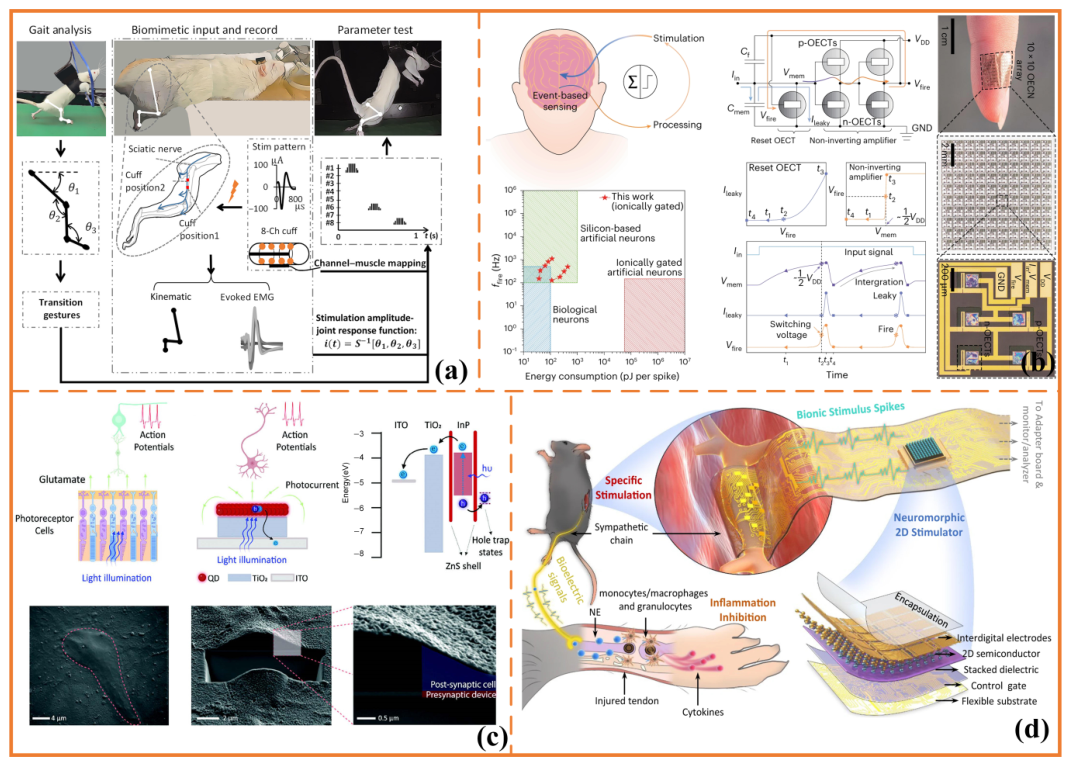
| Xi et al. [61] | Rat hindlimb modulation during stepping | Biomimetic stimulation waveform and temporal pattern | Open-loop | Linked sciatic nerve branch stimulation to hindlimb joint modulation. | Animal feasibility study; not a closed-loop adaptive system. |
| Yang et al. [62] | Implantable responsive neuromodulation for pathological neural activity | Event-driven organic sensing with organic electrochemical neuron (OECN) pulse triggering | Sensor-triggered | Enabled rapid detection-triggered stimulation with low-energy operation. | Early-stage implantable study; long-term in vivo validation is still needed. |
| Balamur et al. [63] | Neuronal photostimulation in aqueous biointerfaces | Integrated sensing–memory–stimulation optoelectronic synapse | Interface-level | Combined photodetection, synaptic memory, and neural stimulation in a single device. | Device/interface proof of concept rather than system-level adaptive control. |
| Hwang et al. [65] | Closed-loop FES control with a bidirectional nerve cuff interface | Selective recording and stimulation within a bidirectional peripheral interface | Closed-loop control | Demonstrated FES control using a selectively recording and bidirectional nerve cuff interface. | Interface-level and control feasibility study; broader translational validation remains limited. |
| Sahai et al. [68] | Adaptive isochronous neurostimulation from a single source | Bioelectric routing for multipolar neurostimulation | Platform-level | Enabled multipolar bioelectric stimulation from a single source through an adaptive bioelectric router. | Platform-level stimulation study; sensing-coupled adaptive validation remains limited. |
| Lu et al. [71] | Sensory–motor coupling stimulation in SCI rats | Self-powered stimulation using a biomimetic triboelectric nanogenerator | Coupled platform | Linked joint-motion energy harvesting to sensory–motor stimulation. | Preclinical platform study; translational feasibility remains unclear. |
| Woods et al. [69] | Electrically stimulated neural repair scaffold | Biomimetic conductive micro-mesh interface | Non-closed-loop | Provided a conductive scaffold interface supporting stimulation-related neural responses. | Primarily an interface-support strategy rather than an adaptive stimulation system. |
| Study | Target/Scenario | Neuromorphic or Biomimetic Feature | Interface Role | Main Point | Limitation/Evidence Stage |
|---|---|---|---|---|---|
| Chen et al. [80] | Closed-loop tactile feedback for intelligent robots | Artificial organic afferent nerve integrating mechanoreceptors and a synaptic transistor | Front-end | Enabled closed-loop slip recognition and prevention in robotic manipulation. | Robotic system demonstration rather than a human neurointerface study. |
| Wei et al. [81] | Temporal-tactile neuromorphic sensing | Mechano-gated iontronic piezomemristor with positive/negative spike outputs | Front-end | Converted complex pressure inputs into excitatory/inhibitory neuromorphic spike trains. | Device-level demonstration focused on tactile plasticity rather than bidirectional biointerface validation. |
| Katic et al. [84] | Foot-sole afferent modeling for biomimetic feedback design | In silico spiking model of four major foot-sole mechanoreceptive afferent classes | Encoding pathway | Provided a computational basis for biomimetic stimulation design. | Modeling framework rather than a deployed closed-loop interface. |
| Valle et al. [82] | Naturalistic touch sensations via peripheral nerve stimulation | Biomimetic stimulation derived from physiologically plausible afferent codes | Encoding-to-stimulation | Produced neural responses that were closer to natural touch than regular-pulse stimulation. | Translational neuroprosthetic feedback study; broader rehabilitation validation remains limited. |
| Lee et al. [89] | Proprioceptive feedback in stretchable neuromorphic implants | Low-power stretchable neuromorphic nerve with integrated proprioceptive feedback | Bidirectional interface | Supported smoother and more coordinated motor output with proprioceptive feedback. | Preclinical implant study rather than a mature human sensory interface. |
| Cimolato et al. [91] | Proprioceptive neurostimulation encoding | Symbiotic electroneural and musculoskeletal modeling framework (ProprioStim) | Bidirectional interface | Provided an anatomically grounded framework for biomimetic proprioceptive stimulation. | Mainly a model-based encoding framework; practical long-term implementation remains open. |
| Sankar et al. [92] | Biomimetic prosthetic hand with tactile feedback | Three-layer neuromorphic tactile sensing in a hybrid prosthetic hand | Application system | Enabled precise and compliant grasping with naturalistic tactile sensing. | Prosthetic-system evidence is promising, but broader rehabilitation relevance remains indirect. |
| Study | Signal/Scenario | Neuromorphic Feature | System Role | Main Point | Limitation/Evidence Stage |
|---|---|---|---|---|---|
| Barleanu et al. [104] | Force monitoring for robotic interaction | FSR-based neuromorphic sensor integrating a spiking neuron | Front-end | Converted applied force into spike-frequency outputs for robotic force sensing. | Robotic sensing demonstration rather than a biosignal decoding study. |
| Wang et al. [105] | Sitting posture recognition from pressure distribution | Pressure-distribution encoding for SNN-based posture classification | Front-end/inference | Demonstrated posture recognition from pressure-sensor-grid data using an SNN. | Posture-classification study; broader neuroengineering deployment relevance remains indirect. |
| Jiang et al. [107] | Eye tracking with event-based vision | Event camera combined with SNN processing | Event-driven inference | Enabled efficient eye tracking from sparse event streams. | Vision-based demonstration rather than a direct neural-interface application. |
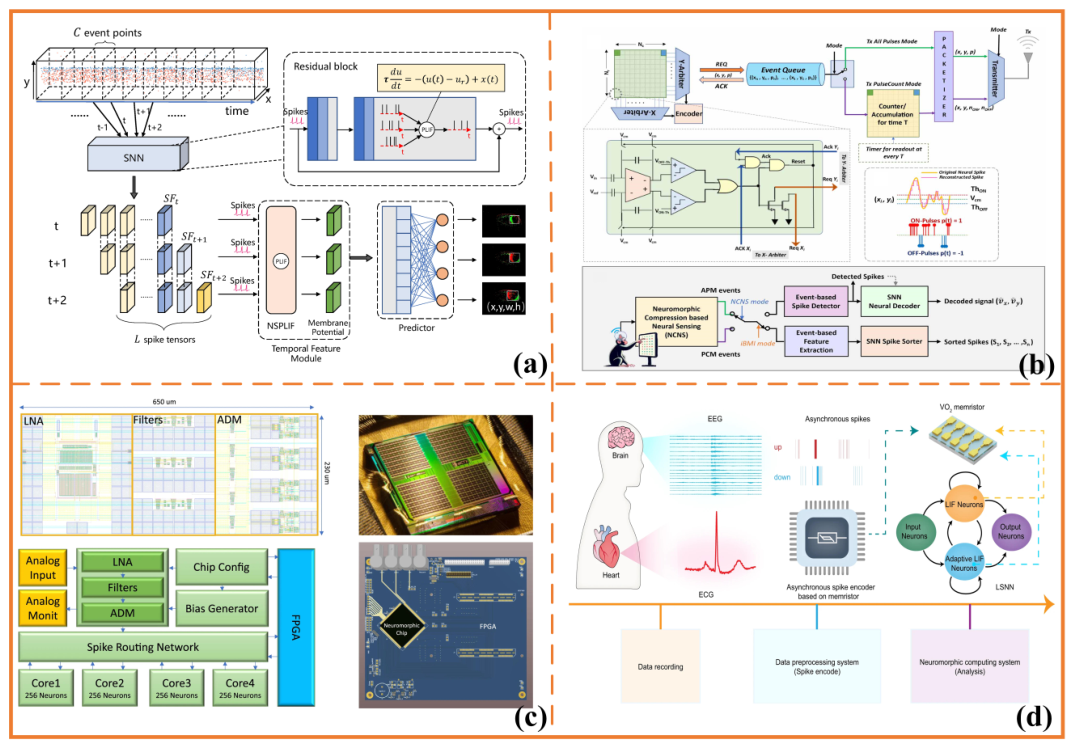
| Sharifshazileh et al. [110] | Real-time HFO detection in intracranial EEG | Electronic neuromorphic system with online SNN-based detection | Temporal inference | Demonstrated real-time detection of high-frequency oscillations from intracranial EEG. | Application-relevant intracranial EEG study, but focused on a specific pathological event-detection task. |
| Yuan et al. [111] | Physiological signal processing for human–machine interfaces | VO2 memristor-based spike encoding and neuromorphic decision module | Hardware-oriented temporal inference | Integrated signal encoding, temporal feature extraction, and classification in one neuromorphic architecture. | Hardware-oriented proof-of-concept study; broader task generalization remains to be established. |
| Ma et al. [116] | Fine hand/wrist motion intention recognition from decomposed sEMG | Motor-unit spike trains processed by a residual SNN | Edge decoding | Supported fine motion intention recognition in both healthy individuals and stroke survivors. | Focused on classification performance; long-term cross-session deployment remains unclear. |
| Mohan et al. [109] | Wireless implantable brain–machine interfaces | Neuromorphic neural compression with AER-inspired readout | Edge pipeline | Reduced front-end data transmission while preserving spike information for downstream detection. | Front-end compression study rather than a complete closed-loop BMI validation. |
| Study | Platform/Scenario | Neuromorphic or Biomimetic Feature | Platform Role | Main Point | Limitation/Evidence Stage |
|---|---|---|---|---|---|
| Wang et al. [125] | Soft e-skin for sensorimotor interfacing | Low-voltage soft e-skin with neuromorphic pulse-train generation | Conformable front-end | Demonstrated a soft e-skin with multimodal perception, neuromorphic signal generation, and closed-loop actuation. | Integrated soft-platform study; long-term wearable deployment remains limited. |
| Jiang et al. [126] | Textile neuromorphic platform for gesture recognition | Fiber memristors woven into a textile architecture | Wearable computing substrate | Showed that woven memristive textiles can support gesture recognition in intelligent textile systems. | Wearable feasibility study; long-term washability and maintenance remain unclear. |
| Chen et al. [133] | Neuromorphic sensorimotor textiles | Bioinspired iontronic synapse fibers for ultralow-power multiplexing | Near-body loop | Combined sensing, local memory, and elementary computation in a distributed textile platform. | Textile-level proof-of-concept study; broader neuroengineering deployment remains to be established. |
| Shim et al. [138] | Distributed neuromorphic cognitive skin | Stretchable synaptic-transistor-based neuromorphic skin | Wearable computational skin | Enabled distributed sensing and local neuromorphic/cognitive processing in a stretchable skin-like platform. | Wearable concept demonstration; neuroengineering-specific long-term validation remains limited. |
| He et al. [122] | Wireless peripheral-nerve recording | Near-sensor computation with send-on-delta transmission | Implantable sensing interface | Reduced communication burden in peripheral neural recording through near-sensor computation and send-on-delta transmission. | Focused on localized neural sensing rather than a complete closed-loop implantable system. |
| Wu et al. [134] | Post-craniotomy intracranial pressure monitoring | Implantable neuromorphic memristor-based pressure-sensing system | Implantable monitoring platform | Co-designed pressure sensing and neuromorphic processing for in vivo monitoring. | Targeted monitoring application; broader implantable neuroengineering generalization remains limited. |
| Dias et al. [131] | Adaptive neuromodulation of neuronal populations | Memristor-based monitor–compute–actuate paradigm | Closed-loop neuromodulation concept | Demonstrated real-time adaptive control of neuronal populations using memristive elements. | In vitro proof-of-concept study; not yet a deployment-ready therapeutic system. |
| Domain/Task | Conventional | Neuromorphic | Quantitative Comparison | Interpretation/Caveat |
|---|---|---|---|---|
| Peripheral-nerve sensing | Nyquist-sampling implantable sensing architectures with high transmission and storage burden [122] | Near-sensor event-based sensing with send-on-delta transmission [122] | >125× compression, 4% NRMSE, 13 W SNN feature extraction, 28.2 W total power in feature-extraction mode, 50 W in full-diagnosis mode, and 10 s temporal precision | Shows reduced data and power burden relative to conventional Nyquist-style implant sensing architectures discussed in the study, while preserving timing fidelity; this remains a system-level contrast rather than a universal implant benchmark. |
| Wireless neural telemetry | Full-sample or prior spike-only telemetry for large-channel implantable recording [109] | AER-inspired neural compression pipeline [109] | 200–50 K compression ratio per channel, about 50× above prior work, CC ≈ 0.9, spike-detection accuracy >90% | Strong evidence that selective event transmission lowers telemetry burden with limited spike-information loss, although the contrast is centered on front-end compression rather than full implant systems. |
| Real-time iEEG HFO detection | Previously published template-matching Morphology Detector algorithm for HFO analysis [110] | Hardware SNN detector for HFO analysis [110] | Hardware SNN correctly predicted postsurgical outcome in 7/9 patients; overall accuracy was comparable to Morphology Detector; both reached 100% specificity | One of the clearest application-level head-to-head contrasts; neuromorphic inference reproduced established detector behavior on edge hardware, but only for a specific pathological-event task. |
| Post-stroke sEMG decoding | Deep residual network (ResNet) baseline for hand and wrist motion recognition [116] | Residual spiking neural network (Res-SNN) with sEMG decomposition [116] | Res-SNN >0.95 accuracy in both cohorts versus ResNet 0.84 ± 0.08/0.90 ± 0.04; in stroke survivors, Res-SNN 0.95 ± 0.03 versus CSNN 0.71 ± 0.16 | Supports spike-based temporal decoding for rehabilitation-oriented intention recognition, but no long-term cross-session validation was reported. |
| Biofeedback nerve stimulation | Square-wave invasive electrical stimulation (Sw-iES); broader perioperative ES studies still report heterogeneous clinical endpoints [54,70] | Biomimetic biofeedback electrostimulation (Bio-iES) synchronized to physiological respiratory behavior [70] | Sw-iES versus Bio-iES: SFI versus , CMAP 2.5 versus 3.7 mV, and NCV 24 versus 36 m/s; autograft reference , 4.1 mV, and 39 m/s | Suggests that physiologically matched adaptive stimulation can outperform static pulses in this task, although the reported endpoints remain task-specific and are not directly comparable to sensing- or inference-oriented engineering metrics. |
Disclaimer/Publisher’s Note: The statements, opinions and data contained in all publications are solely those of the individual author(s) and contributor(s) and not of MDPI and/or the editor(s). MDPI and/or the editor(s) disclaim responsibility for any injury to people or property resulting from any ideas, methods, instructions or products referred to in the content. |
© 2026 by the authors. Licensee MDPI, Basel, Switzerland. This article is an open access article distributed under the terms and conditions of the Creative Commons Attribution (CC BY) license.
Share and Cite
Sun, Z.; Mu, A.; Hao, F.; Wang, H. Neuromorphic Technologies for Neuroengineering: From Adaptive Stimulation to SNN-Based Inference and Deployable Biointerfaces. Sensors 2026, 26, 3049. https://doi.org/10.3390/s26103049
Sun Z, Mu A, Hao F, Wang H. Neuromorphic Technologies for Neuroengineering: From Adaptive Stimulation to SNN-Based Inference and Deployable Biointerfaces. Sensors. 2026; 26(10):3049. https://doi.org/10.3390/s26103049
Chicago/Turabian StyleSun, Zhengdi, Anle Mu, Fuxiang Hao, and Hang Wang. 2026. "Neuromorphic Technologies for Neuroengineering: From Adaptive Stimulation to SNN-Based Inference and Deployable Biointerfaces" Sensors 26, no. 10: 3049. https://doi.org/10.3390/s26103049
APA StyleSun, Z., Mu, A., Hao, F., & Wang, H. (2026). Neuromorphic Technologies for Neuroengineering: From Adaptive Stimulation to SNN-Based Inference and Deployable Biointerfaces. Sensors, 26(10), 3049. https://doi.org/10.3390/s26103049