Figure 1.
Minimal indentation set identification.
Figure 1.
Minimal indentation set identification.
Figure 2.
Estimation and correction pipeline: Reconstruction of internal cavities.
Figure 2.
Estimation and correction pipeline: Reconstruction of internal cavities.
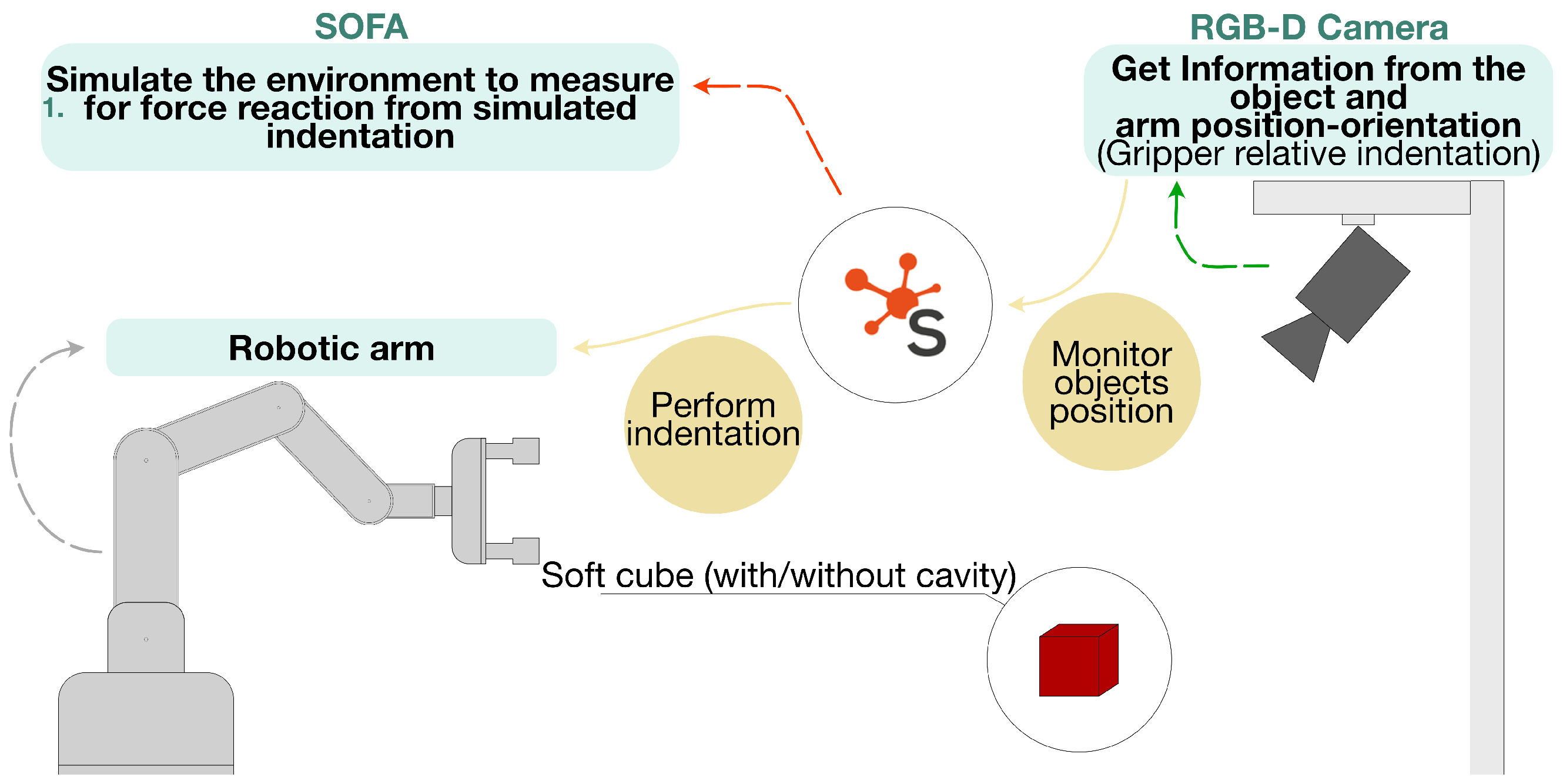
Figure 3.
Overall project schematic.
Figure 3.
Overall project schematic.
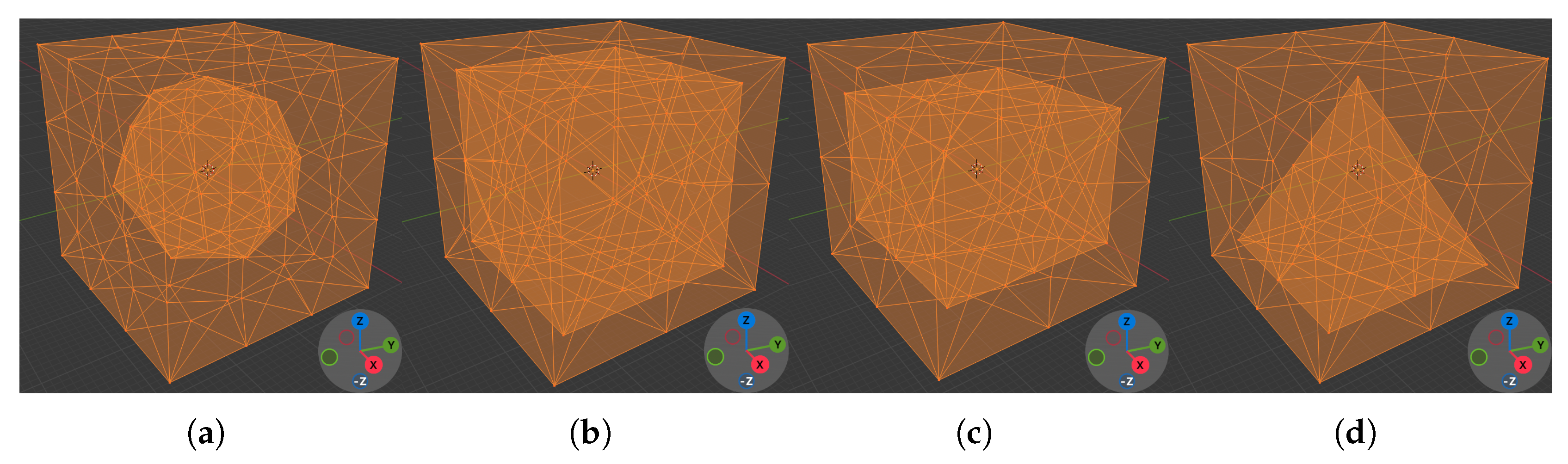
Figure 4.
Material for the experiments: (a) Spherical cavity . (b) Cube cavity . (c) Cuboid cavity . (d) Pyramidal cavity .
Figure 4.
Material for the experiments: (a) Spherical cavity . (b) Cube cavity . (c) Cuboid cavity . (d) Pyramidal cavity .
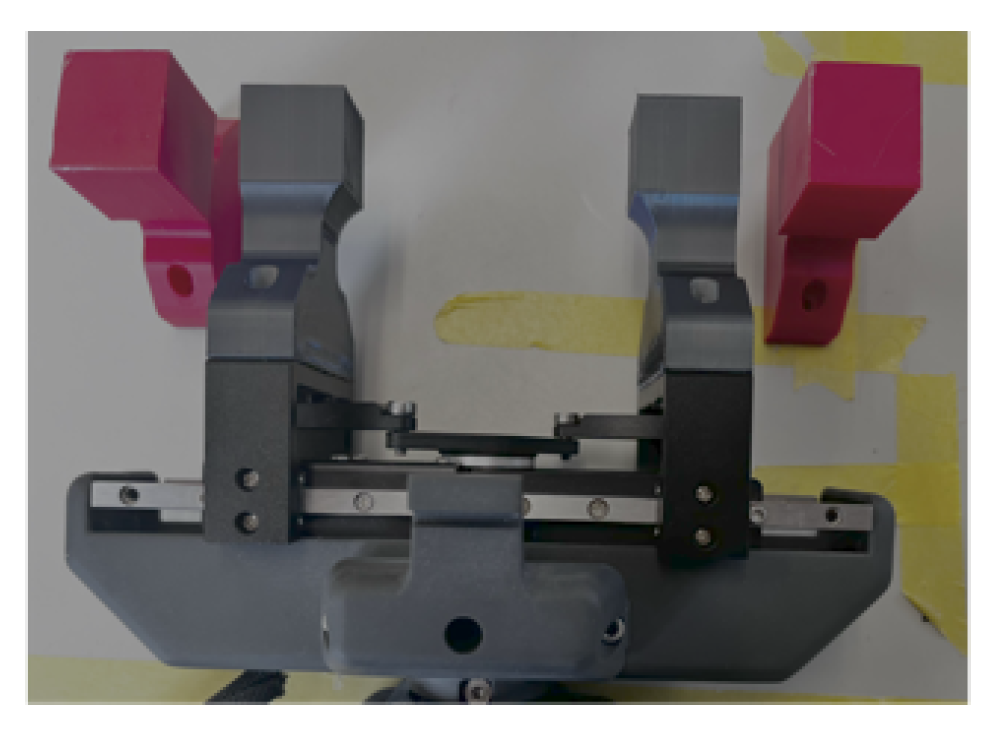
Figure 5.
Robot gripper with 20 mm jaws (mounted), robot gripper with 25 mm jaws (unmounted).
Figure 5.
Robot gripper with 20 mm jaws (mounted), robot gripper with 25 mm jaws (unmounted).
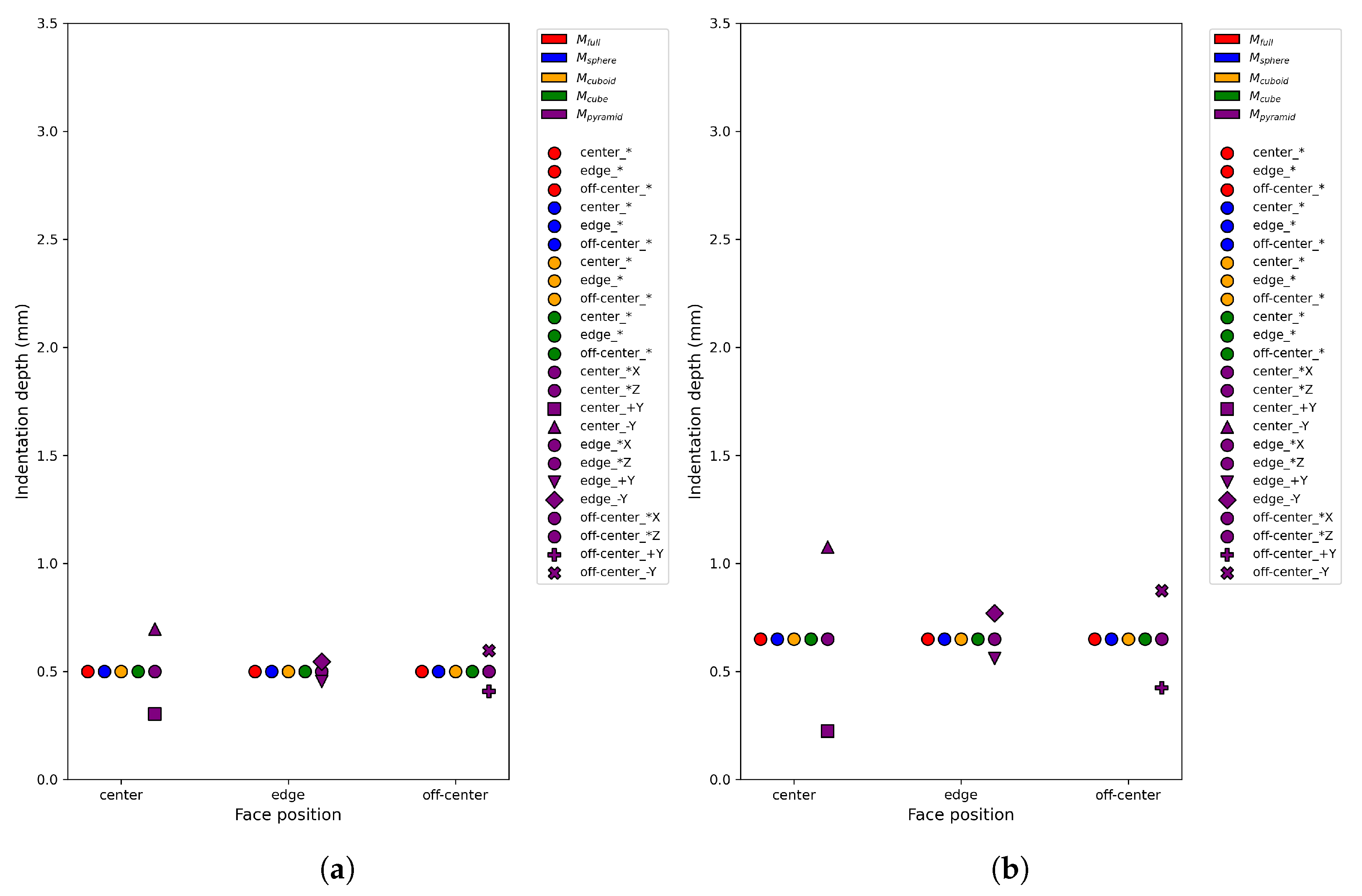
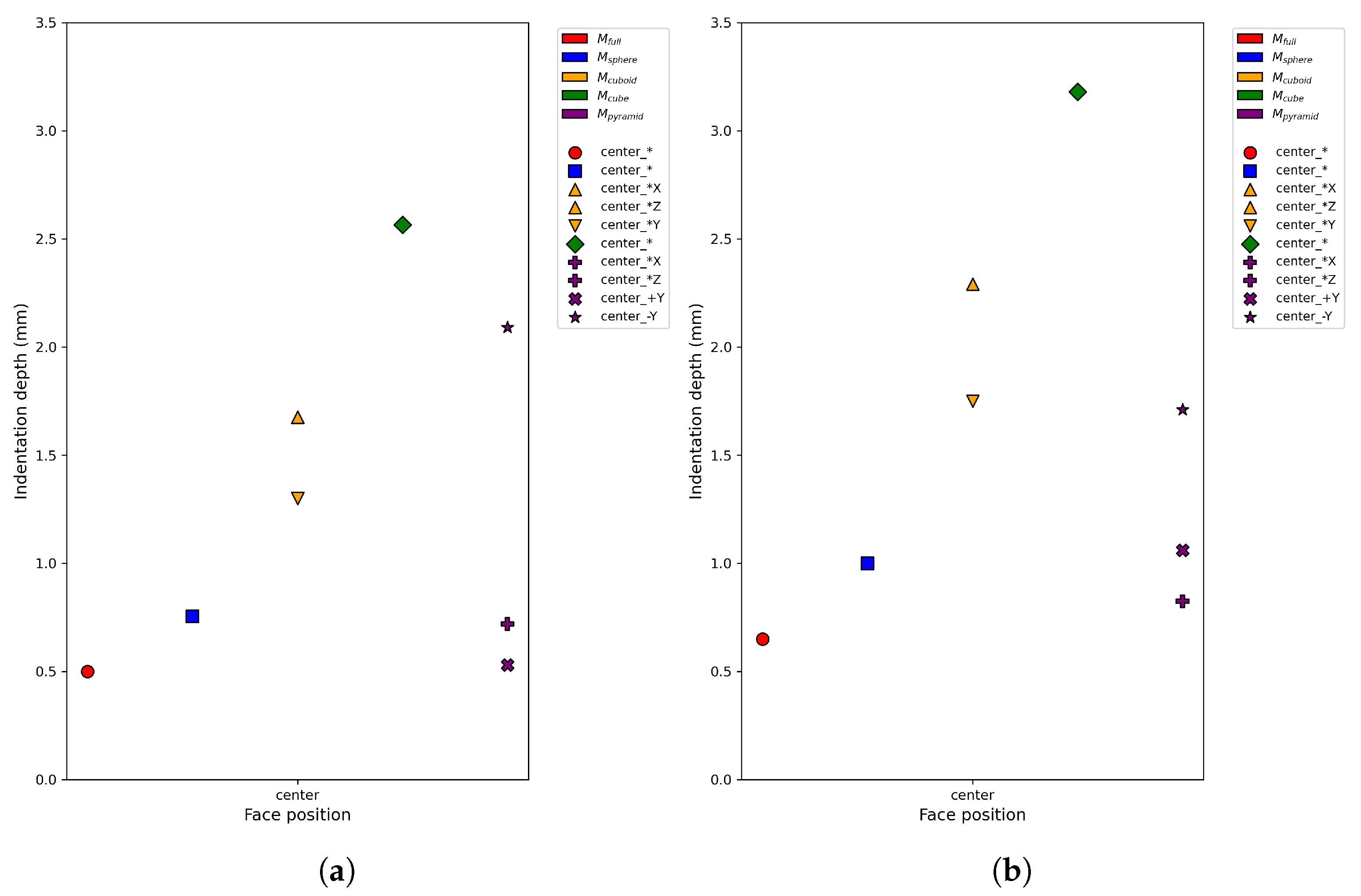
Figure 6.
Simulated indentation in SOFA for gripper (a) and gripper (b). Predicted indentation depths for different cavity hypotheses evaluated at three face positions (center, edge, and off-center). Colors denote cavity types and marker shapes represent geometric placement variants. An asterisk (*) before an axis label indicates that both orientations of that axis (e.g., and ) yield equal values, while a standalone * means all faces share the same value; the absence of * denotes location-dependent indentation with explicit signs identifying the specific face orientation.
Figure 6.
Simulated indentation in SOFA for gripper (a) and gripper (b). Predicted indentation depths for different cavity hypotheses evaluated at three face positions (center, edge, and off-center). Colors denote cavity types and marker shapes represent geometric placement variants. An asterisk (*) before an axis label indicates that both orientations of that axis (e.g., and ) yield equal values, while a standalone * means all faces share the same value; the absence of * denotes location-dependent indentation with explicit signs identifying the specific face orientation.
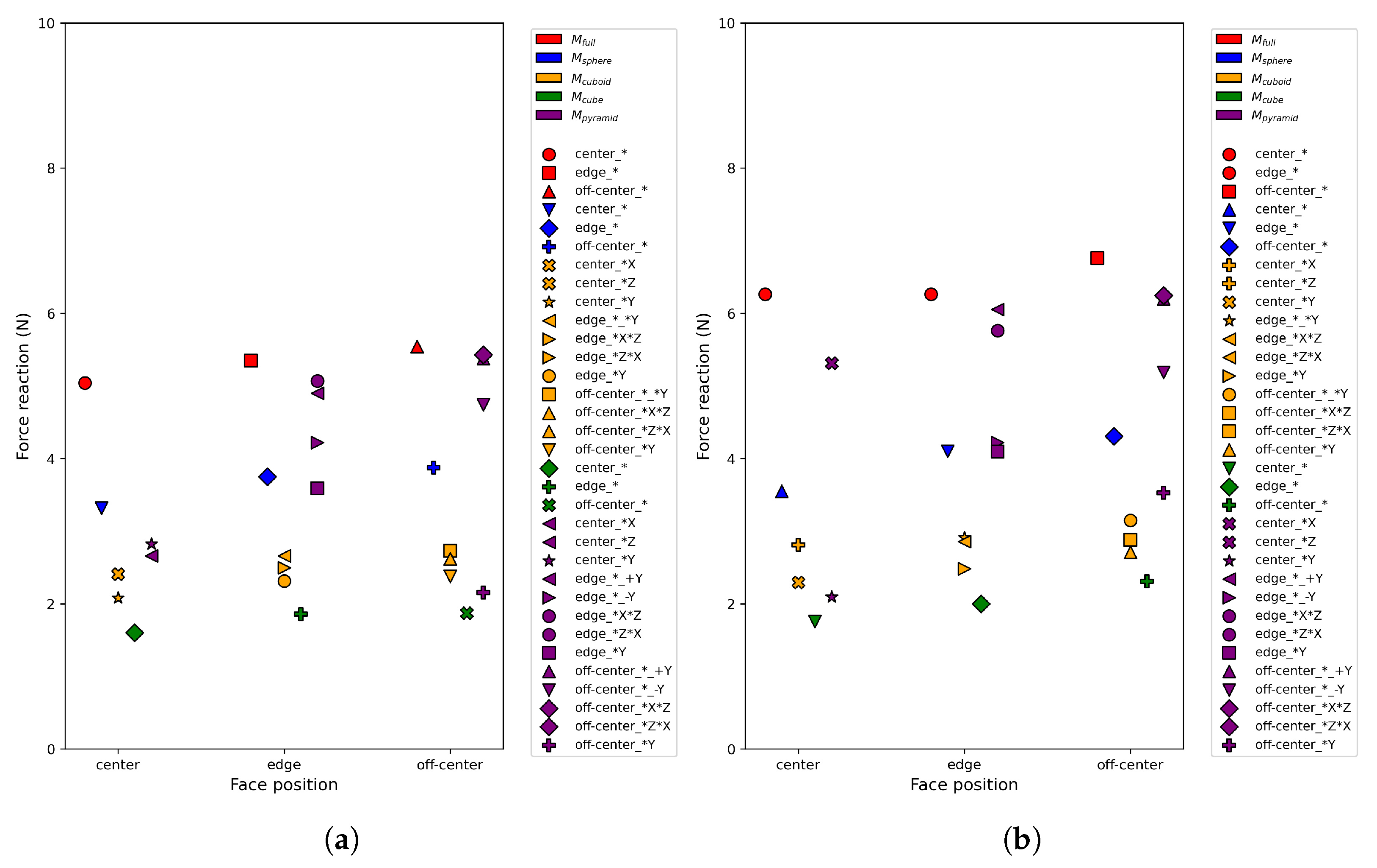
Figure 7.
Force reaction in SOFA for gripper (a), and for gripper (b). Reaction forces predicted for different cavity hypotheses evaluated at three face positions (center, edge, and off-center). Colors denote cavity types and marker shapes represent geometric placement variants. An asterisk (*) before an axis label indicates that both orientations of that axis (e.g., and ) yield equal values, while a standalone * means all faces share the same value; the absence of * denotes location-dependent indentation with explicit signs identifying the specific face orientation.
Figure 7.
Force reaction in SOFA for gripper (a), and for gripper (b). Reaction forces predicted for different cavity hypotheses evaluated at three face positions (center, edge, and off-center). Colors denote cavity types and marker shapes represent geometric placement variants. An asterisk (*) before an axis label indicates that both orientations of that axis (e.g., and ) yield equal values, while a standalone * means all faces share the same value; the absence of * denotes location-dependent indentation with explicit signs identifying the specific face orientation.
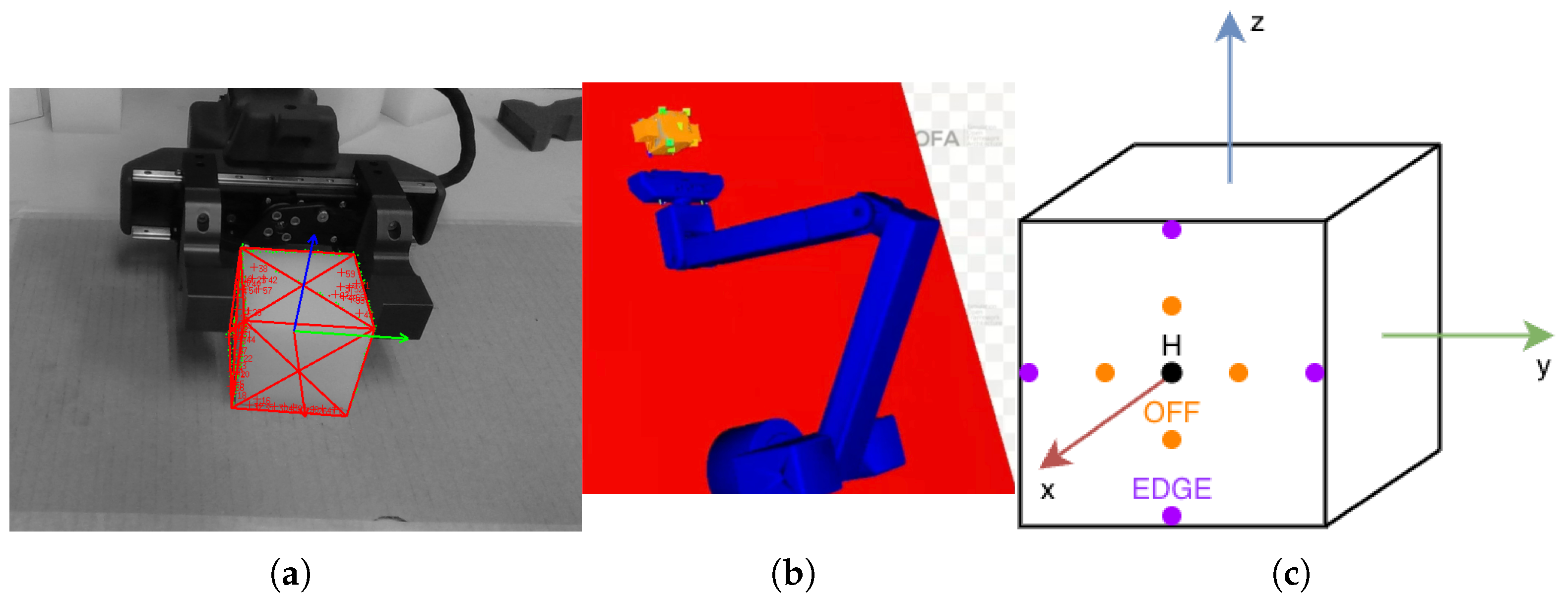
Figure 8.
Real robot grasping cube with cube’s pose tracking (a), SOFA simulating grasping cube motion (b), and cube indentation: center (black dot), off-center as off (yellow dots), and edge (purple dots) (c).
Figure 8.
Real robot grasping cube with cube’s pose tracking (a), SOFA simulating grasping cube motion (b), and cube indentation: center (black dot), off-center as off (yellow dots), and edge (purple dots) (c).
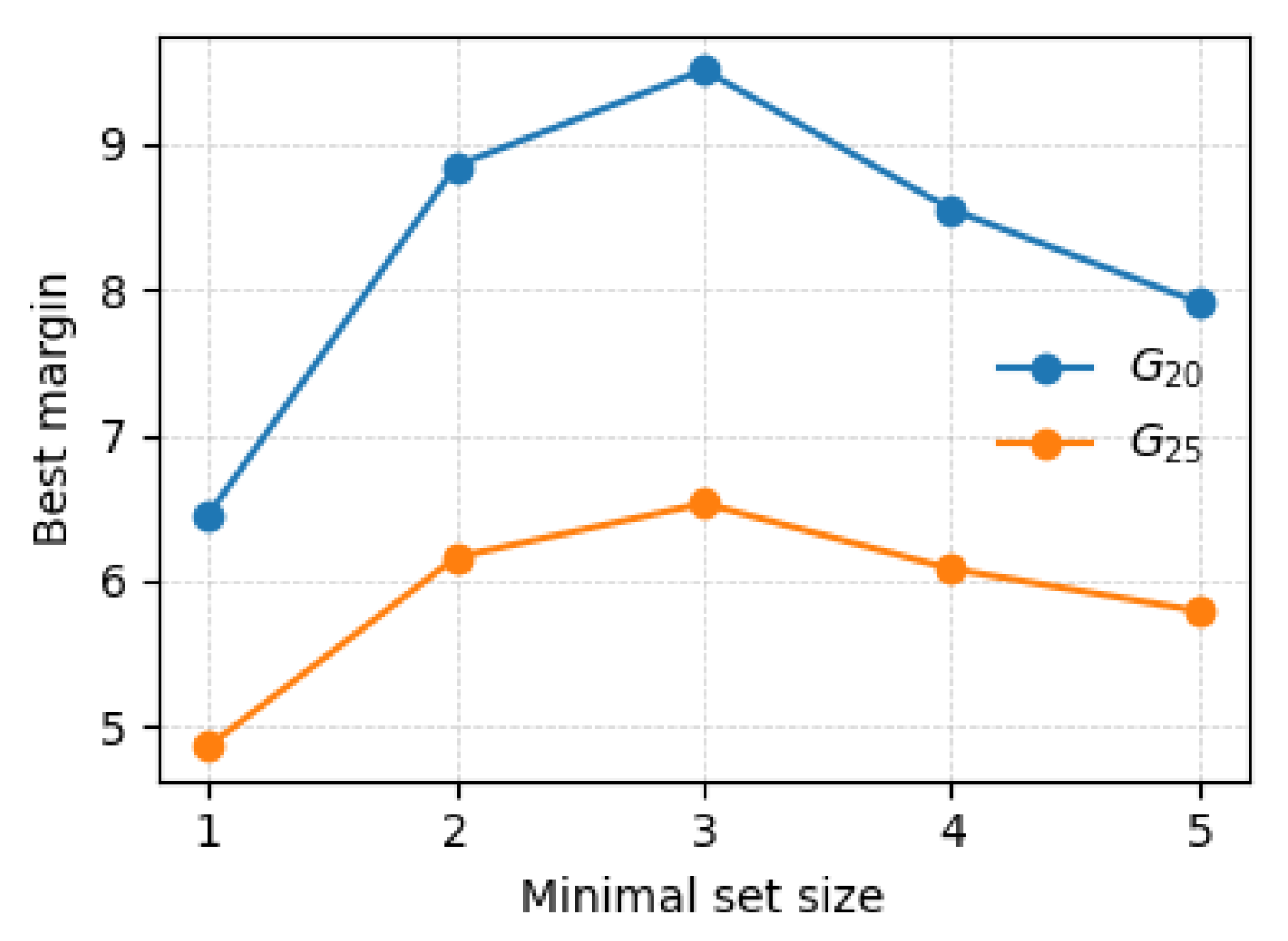
Figure 9.
Maximum achievable separation margin as a function of indentation set size.
Figure 9.
Maximum achievable separation margin as a function of indentation set size.
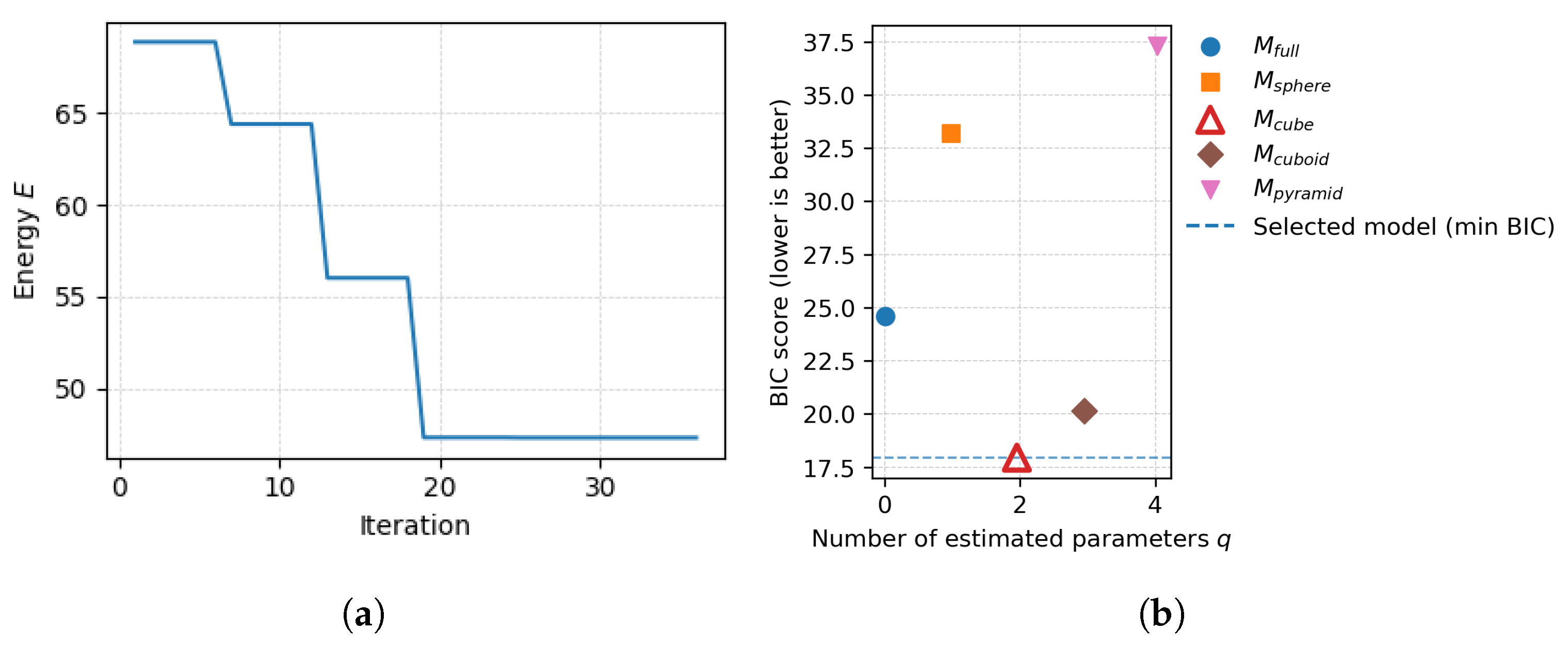
Figure 10.
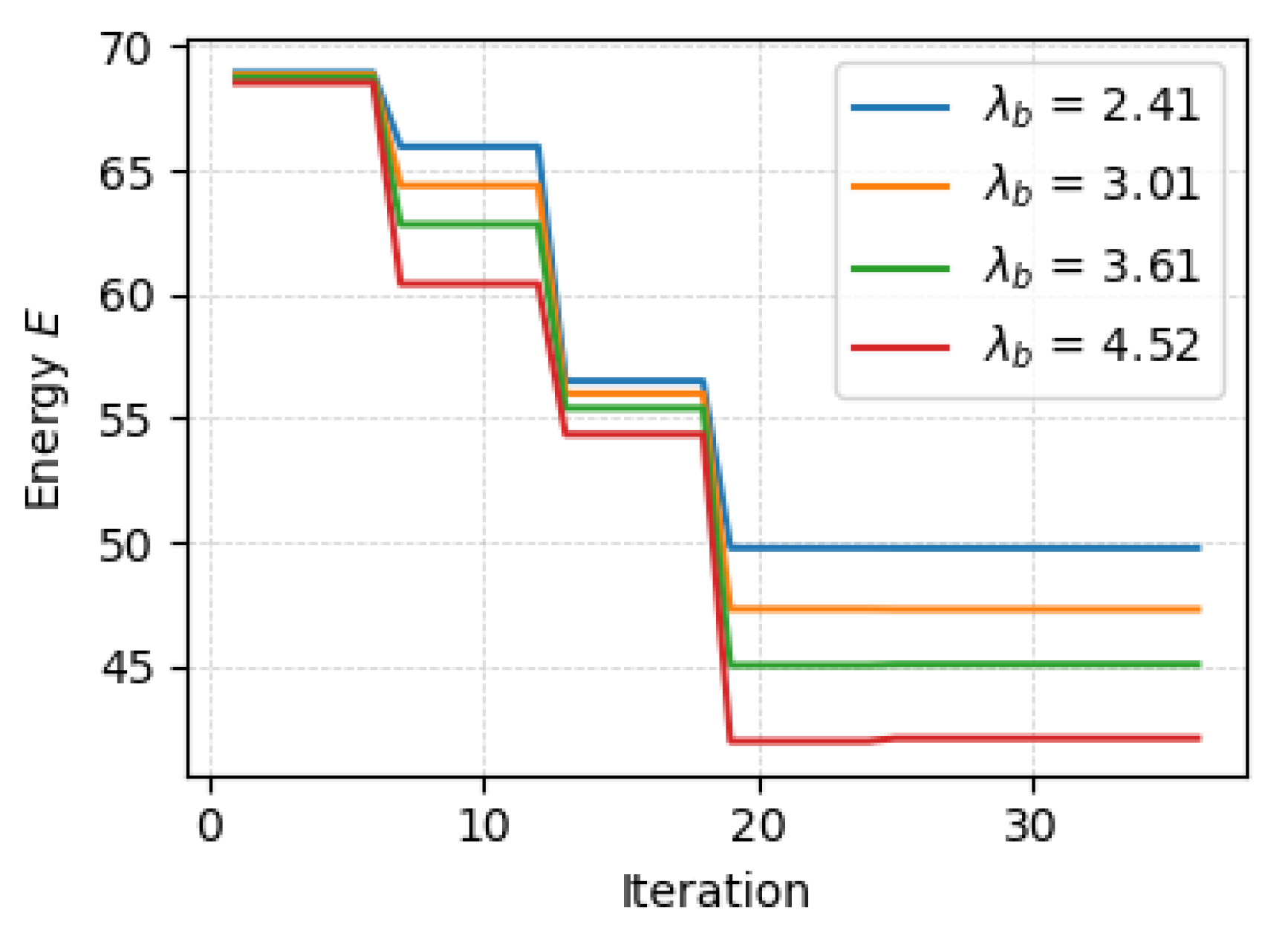
Validation of the preliminary estimation stage (estimation of ): Evolution of the optimization energy during parameter estimation for a representative cavity family, illustrating numerical convergence (a). BIC score obtained for different cavity families, plotted against the number of free parameters k of each model, for gripper , used for cavity family selection after convergence (b).
Figure 10.
Validation of the preliminary estimation stage (estimation of ): Evolution of the optimization energy during parameter estimation for a representative cavity family, illustrating numerical convergence (a). BIC score obtained for different cavity families, plotted against the number of free parameters k of each model, for gripper , used for cavity family selection after convergence (b).
Figure 11.
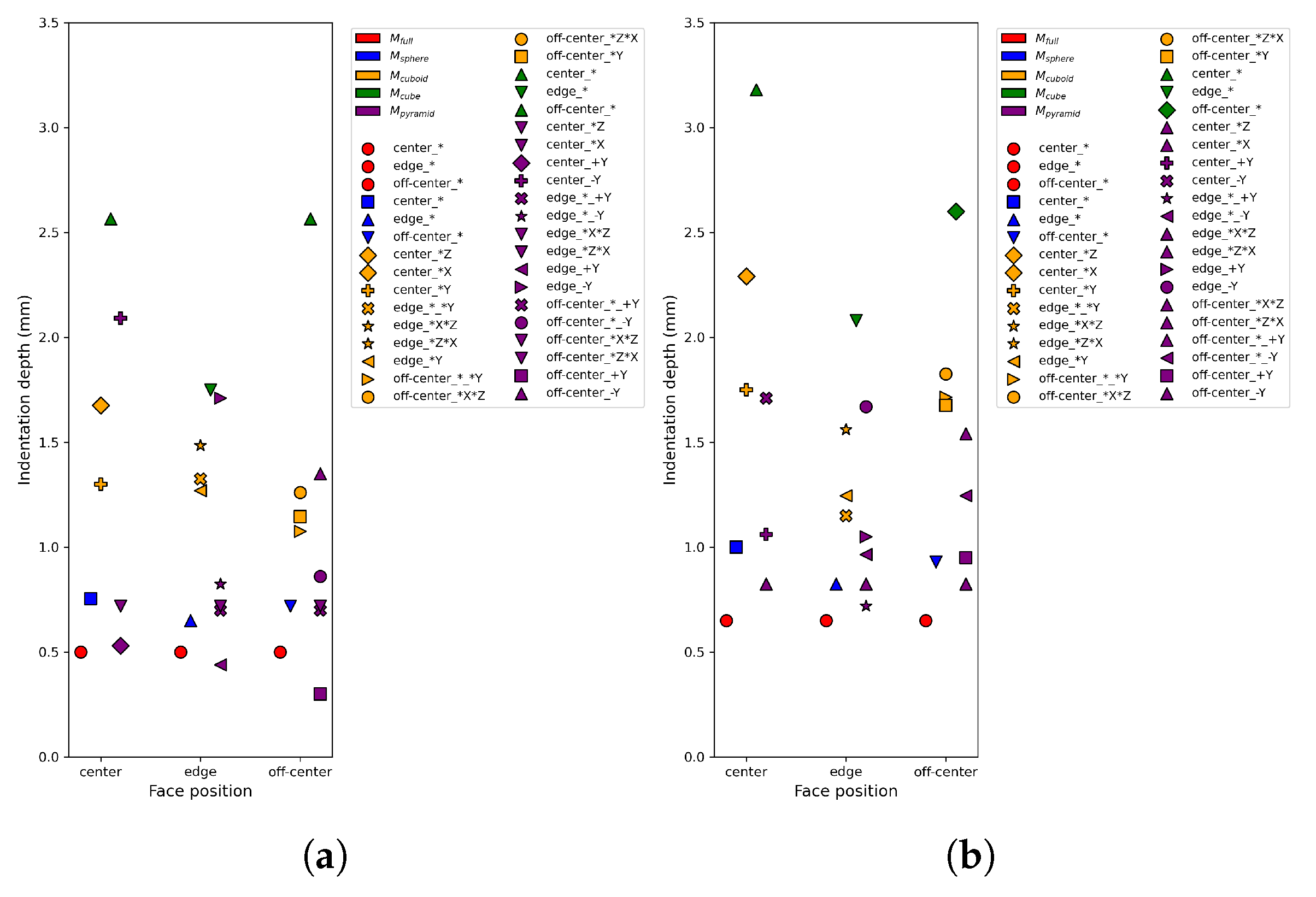
Indentation on minimal indentation set from real gripper (a), and gripper (b). Measured indentation depths for different cavity hypotheses evaluated at three face positions (center, edge, and off-center). Colors denote cavity types and marker shapes represent geometric placement variants. An asterisk (*) before an axis label indicates that both orientations of that axis (e.g., and ) yield equal values, while a standalone * means all faces share the same value; the absence of * denotes location-dependent indentation with explicit signs identifying the specific face orientation.
Figure 11.
Indentation on minimal indentation set from real gripper (a), and gripper (b). Measured indentation depths for different cavity hypotheses evaluated at three face positions (center, edge, and off-center). Colors denote cavity types and marker shapes represent geometric placement variants. An asterisk (*) before an axis label indicates that both orientations of that axis (e.g., and ) yield equal values, while a standalone * means all faces share the same value; the absence of * denotes location-dependent indentation with explicit signs identifying the specific face orientation.
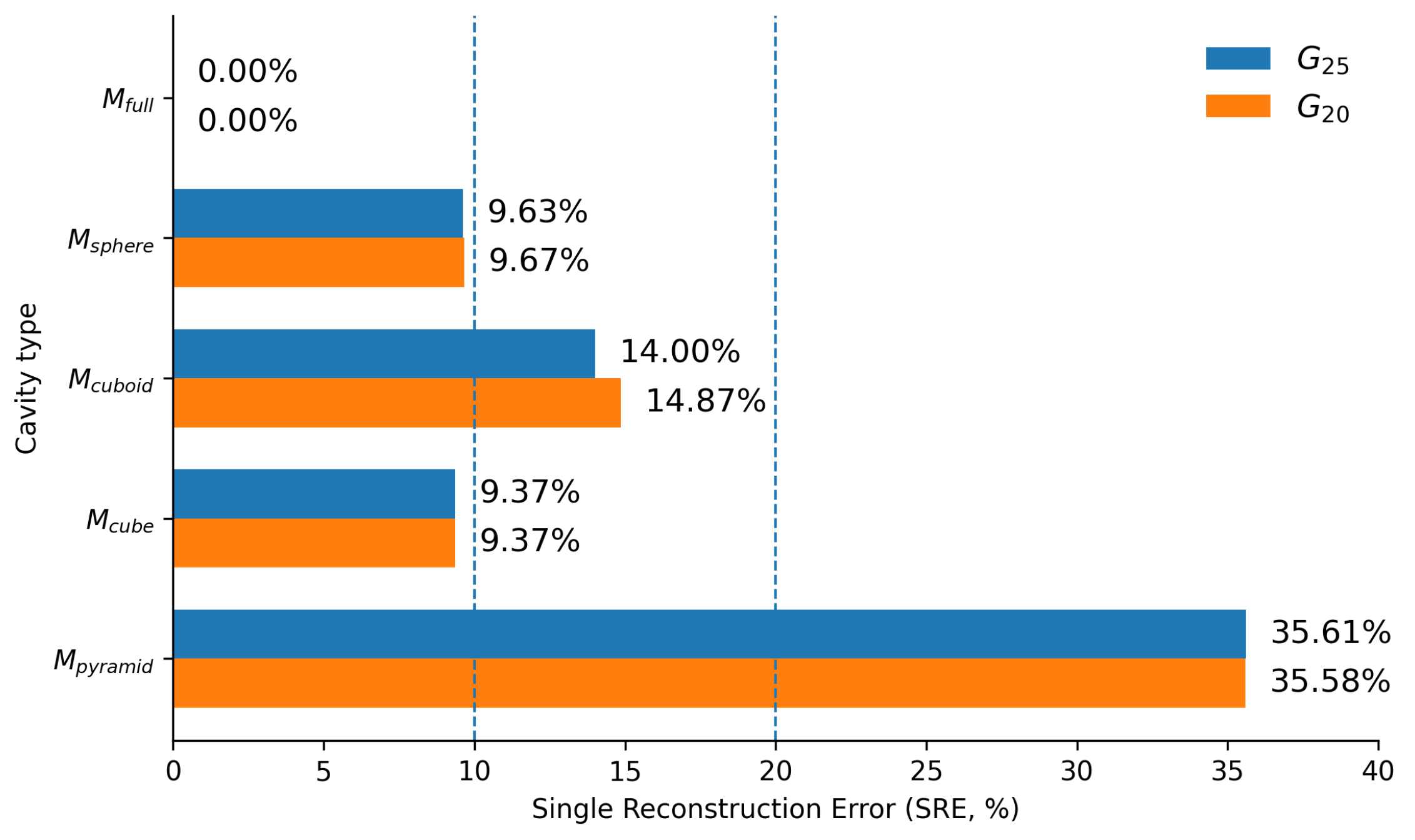
Figure 12.
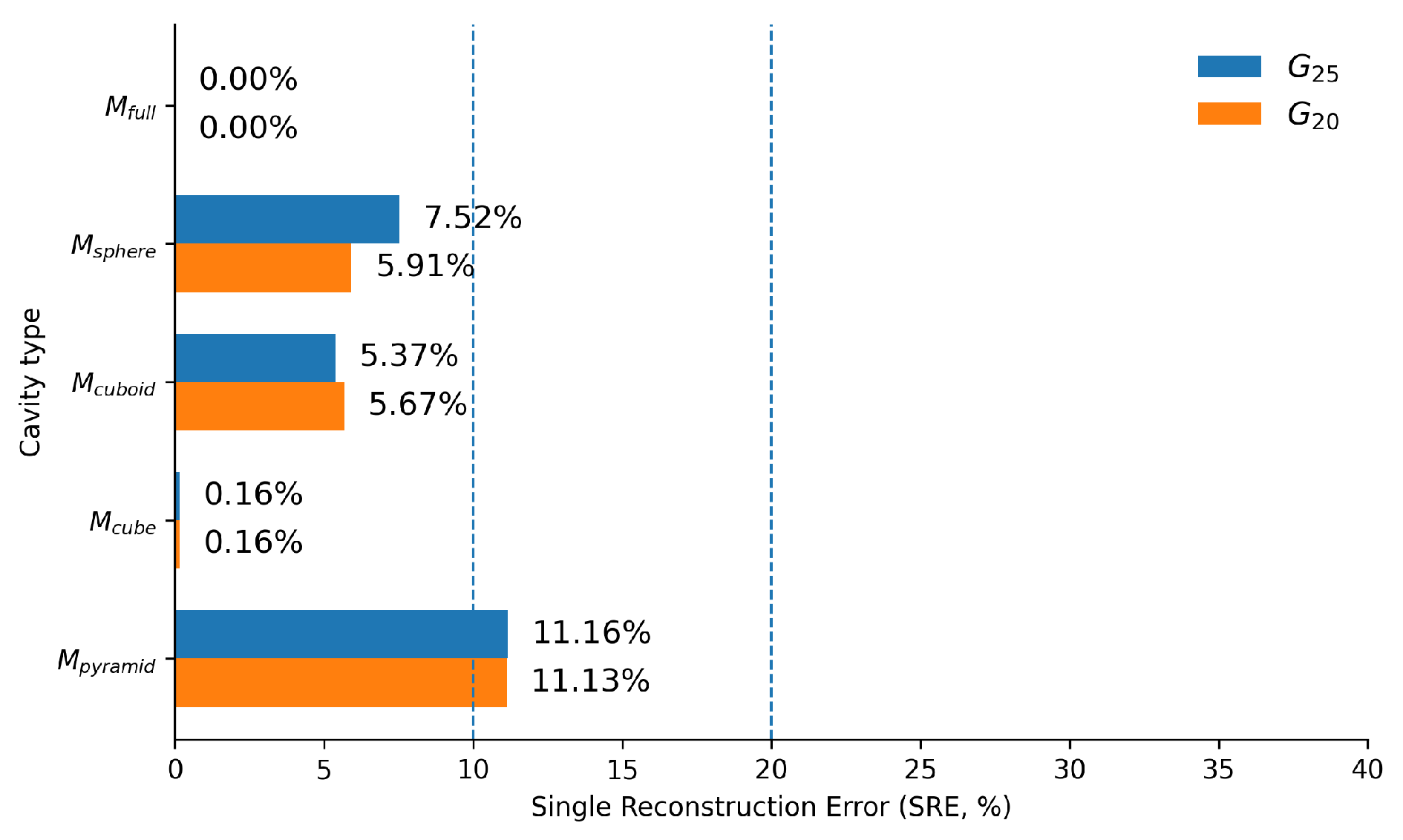
SRE cavity-type identification and preliminary dimension estimation obtained using the minimal indentation set, before FEM-based correction.
Figure 12.
SRE cavity-type identification and preliminary dimension estimation obtained using the minimal indentation set, before FEM-based correction.
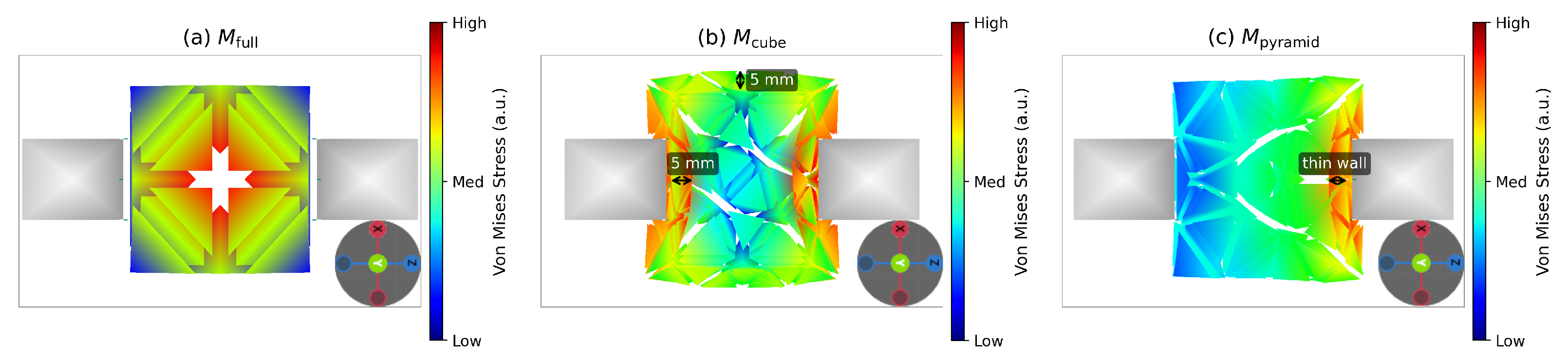
Figure 13.
Von Mises stress distribution from SOFA under centered Y-axis indentation at maximum gripper force ( N) for three configurations: (a) homogeneous cube , showing a smooth stress gradient with no concentration; (b) cube cavity , where the 40 mm cavity leaves a 5 mm wall on all faces, producing high-stress regions at the gripper–wall interface; (c) pyramidal cavity , where the 40 mm base leaves a 5 mm lateral wall on the X and Z faces and the apex approaches the top surface, producing an asymmetric stress distribution.
Figure 13.
Von Mises stress distribution from SOFA under centered Y-axis indentation at maximum gripper force ( N) for three configurations: (a) homogeneous cube , showing a smooth stress gradient with no concentration; (b) cube cavity , where the 40 mm cavity leaves a 5 mm wall on all faces, producing high-stress regions at the gripper–wall interface; (c) pyramidal cavity , where the 40 mm base leaves a 5 mm lateral wall on the X and Z faces and the apex approaches the top surface, producing an asymmetric stress distribution.
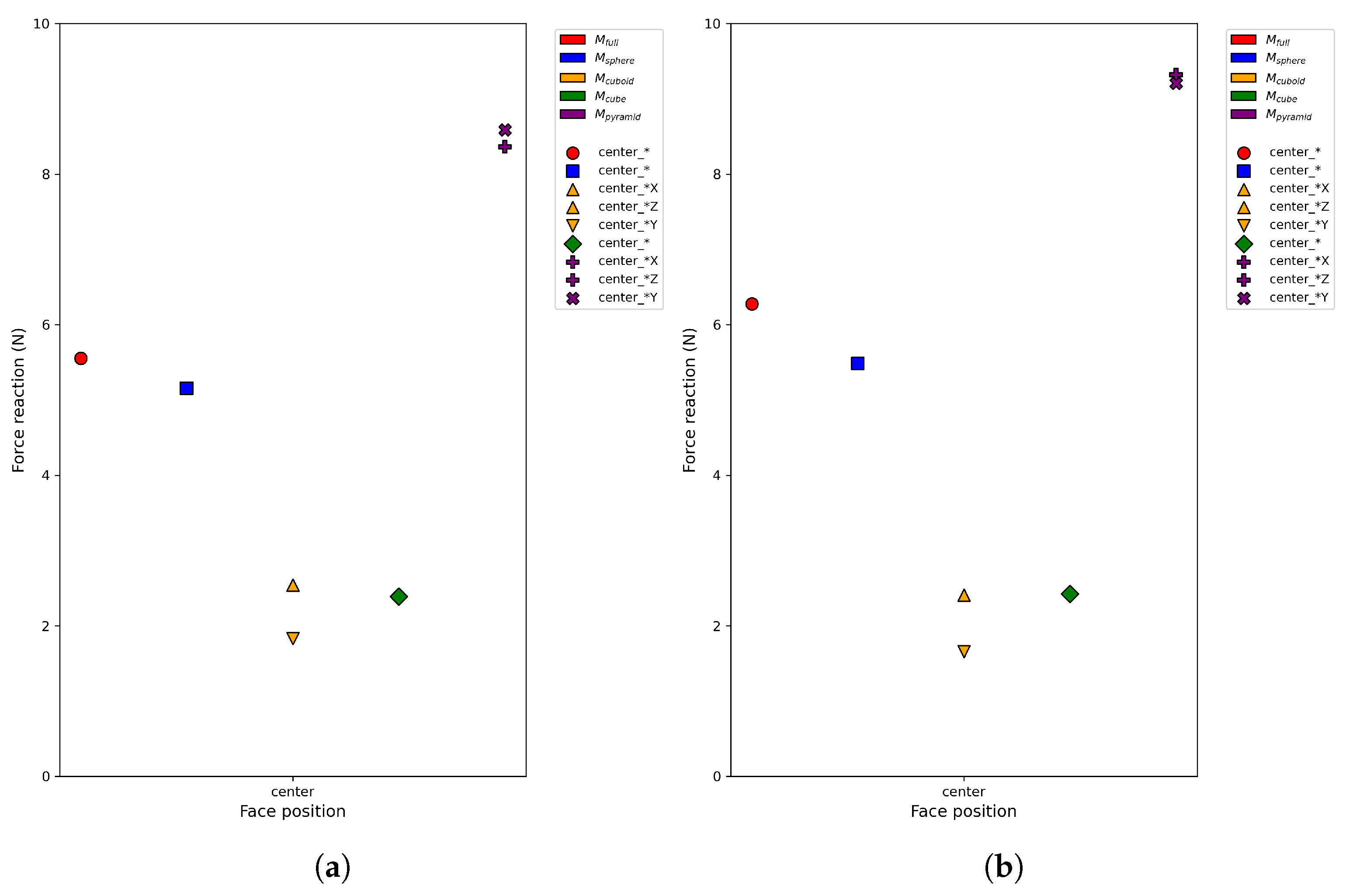
Figure 14.
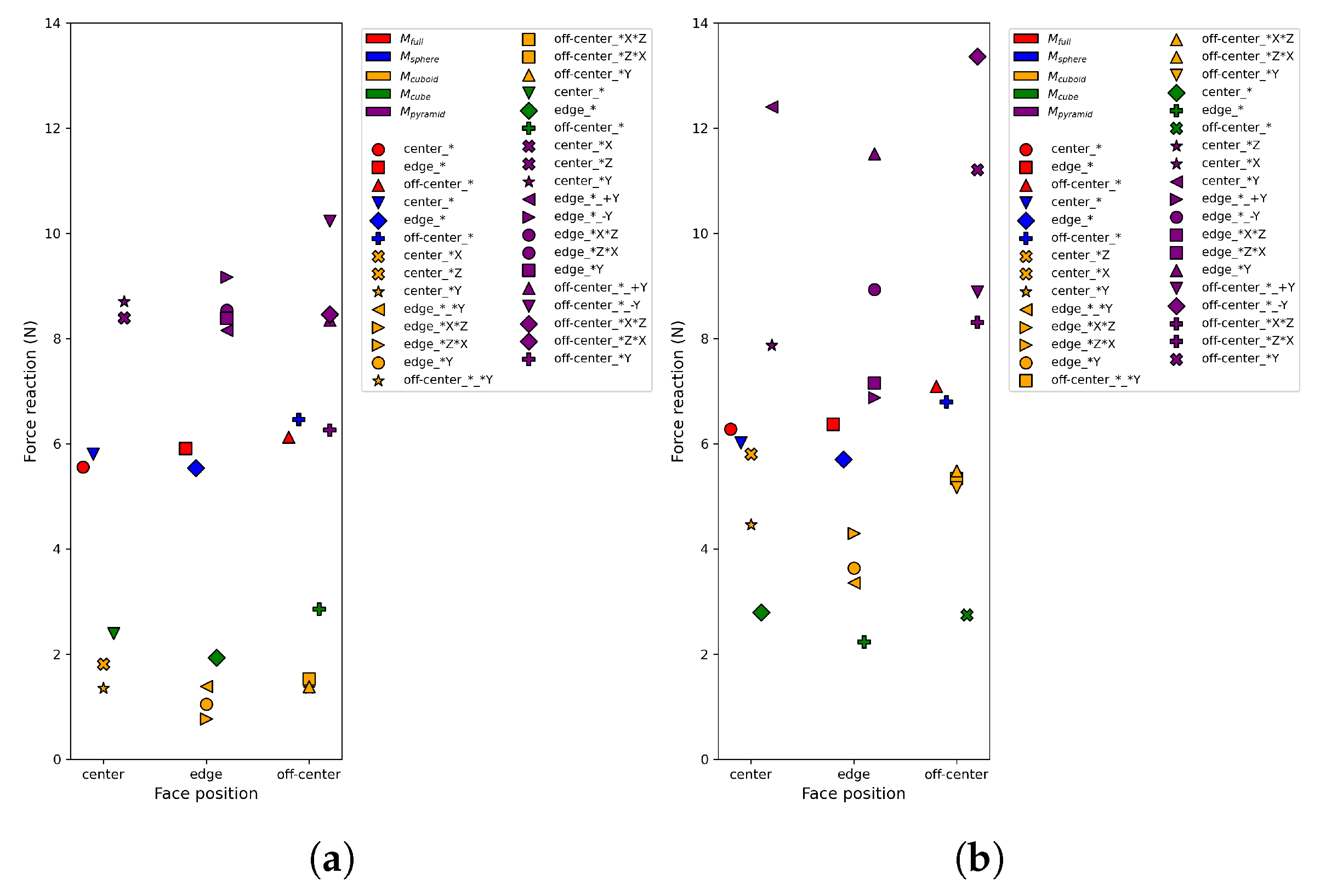
Force reaction on minimal indentation set from real gripper (a), and gripper (b). Reaction forces measured for different cavity hypotheses evaluated at three face positions (center, edge, and off-center). Colors denote cavity types and marker shapes represent geometric placement variants. An asterisk (*) before an axis label indicates that both orientations of that axis (e.g., and ) yield equal values, while a standalone * means all faces share the same value; the absence of * denotes location-dependent indentation with explicit signs identifying the specific face orientation.
Figure 14.
Force reaction on minimal indentation set from real gripper (a), and gripper (b). Reaction forces measured for different cavity hypotheses evaluated at three face positions (center, edge, and off-center). Colors denote cavity types and marker shapes represent geometric placement variants. An asterisk (*) before an axis label indicates that both orientations of that axis (e.g., and ) yield equal values, while a standalone * means all faces share the same value; the absence of * denotes location-dependent indentation with explicit signs identifying the specific face orientation.
Figure 15.
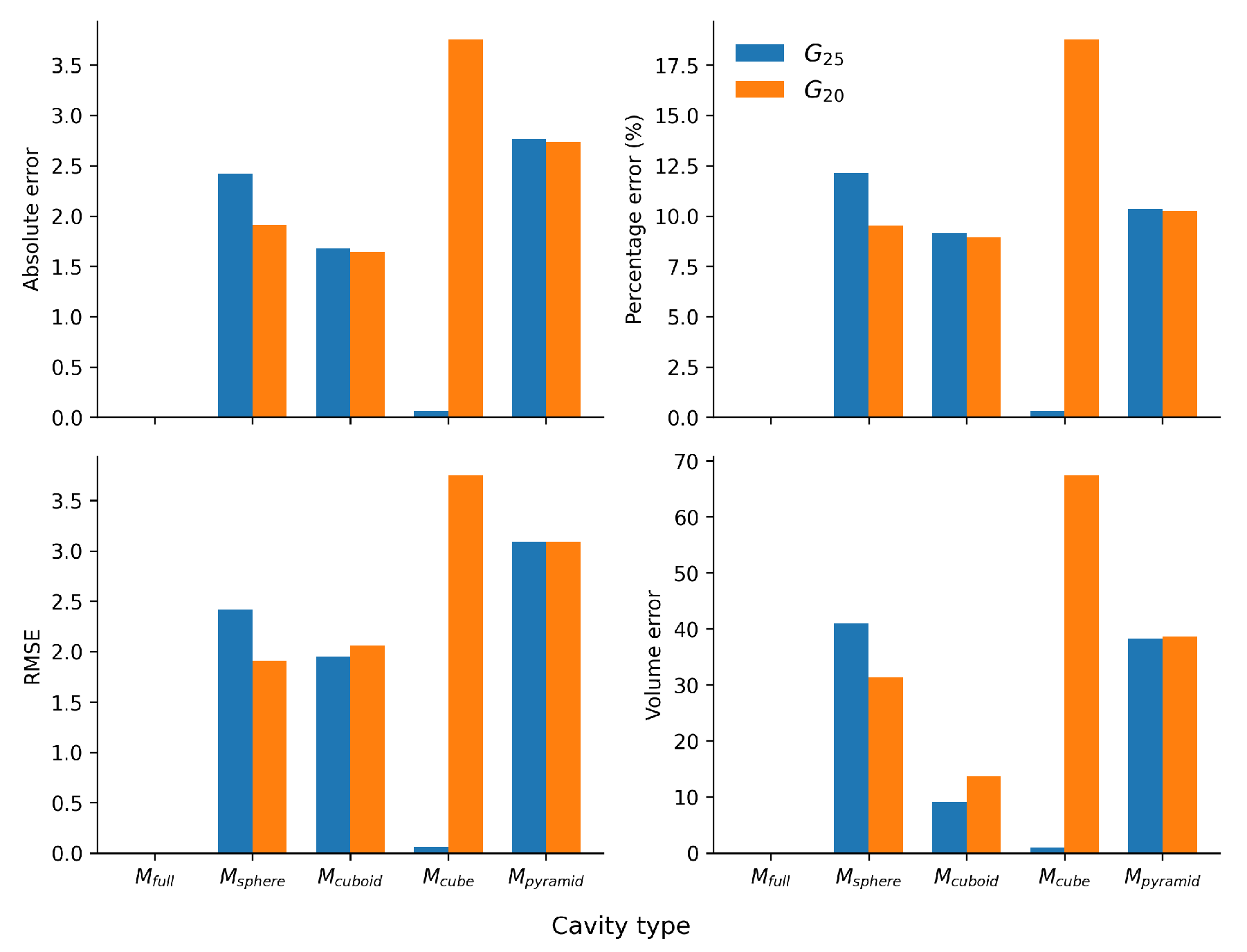
SRE cavity-type identification and dimension estimation obtained using the minimal indentation set, after FEM-based correction.
Figure 15.
SRE cavity-type identification and dimension estimation obtained using the minimal indentation set, after FEM-based correction.
Figure 16.
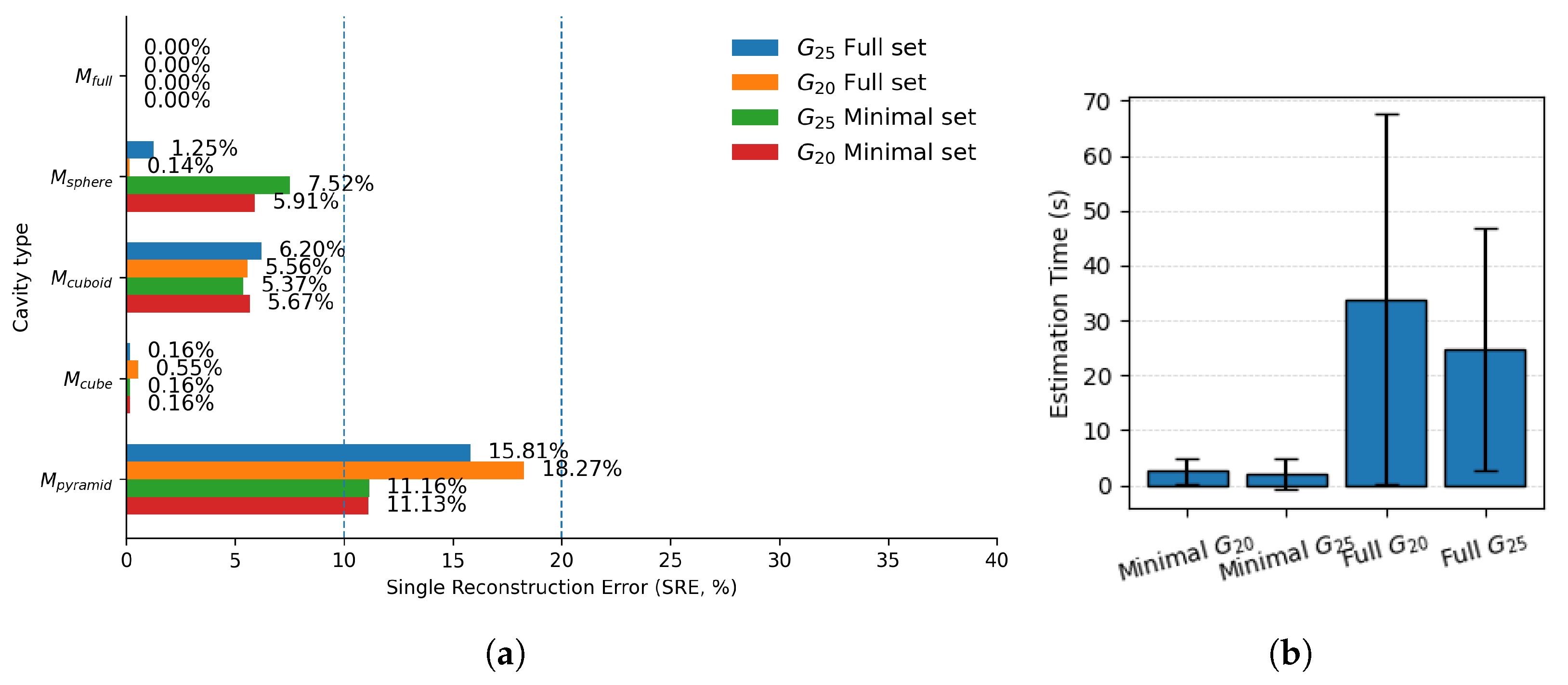
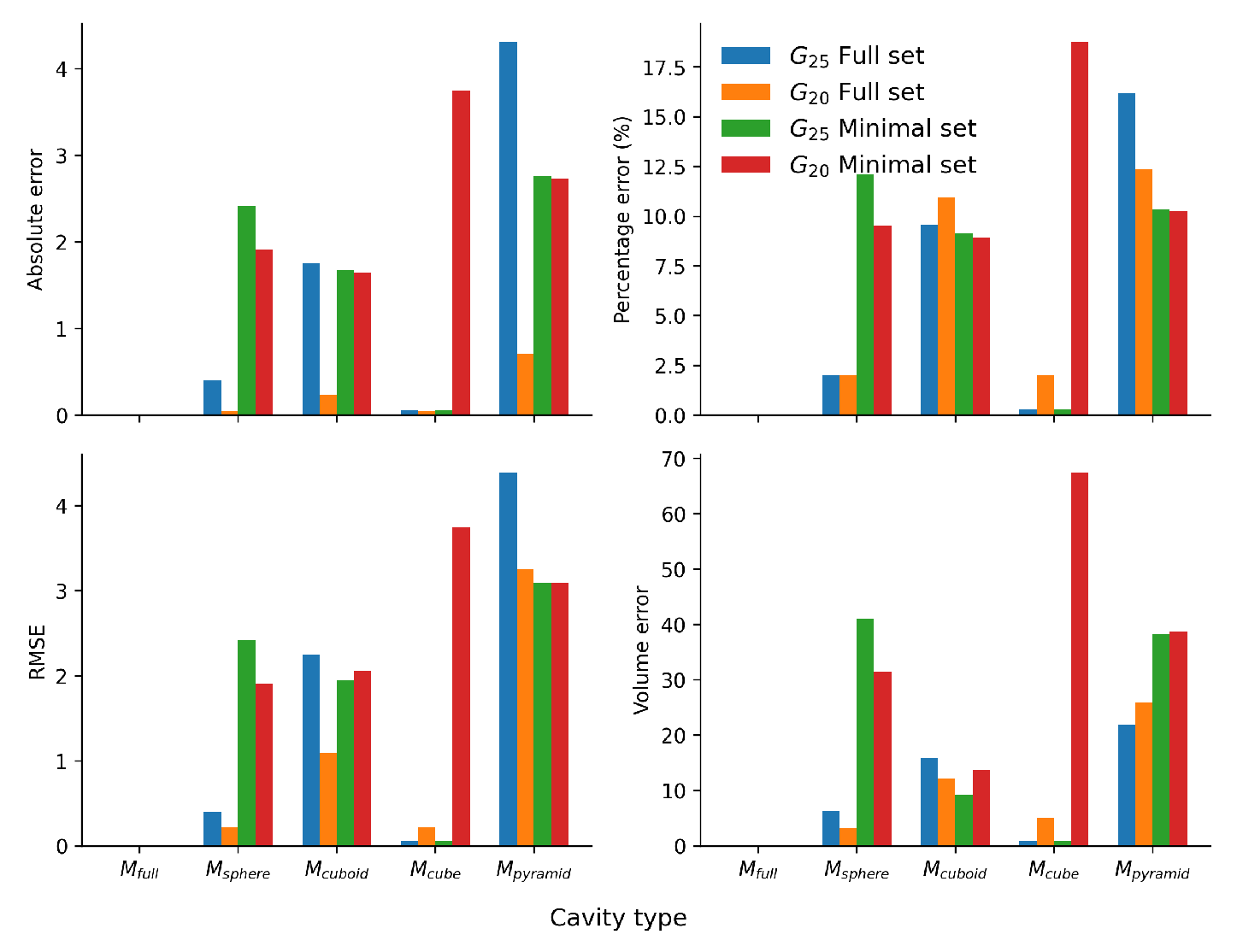
SRE cavity-type identification and dimension estimation obtained using the full indentation set, after FEM-based correction (a). Estimation time comparison (b).
Figure 16.
SRE cavity-type identification and dimension estimation obtained using the full indentation set, after FEM-based correction (a). Estimation time comparison (b).
Table 1.
Table of the cubes’ physical parameters (radius
r, base
b, height
h). The pyramidal cavity origin is defined at the center of its base, located 20 mm below the cube center, consistent with the parameterization used in the estimation stage (
Section 2.2.2).
Table 1.
Table of the cubes’ physical parameters (radius
r, base
b, height
h). The pyramidal cavity origin is defined at the center of its base, located 20 mm below the cube center, consistent with the parameterization used in the estimation stage (
Section 2.2.2).
| Cube Type | Side Dimension (mm) | Cavity Type | Cavity Dimension (mm) | Cavity Origin () (mm) | Young’s Modulus (MPa) | Poisson Ratio | Mass (g) |
|---|
| 50 | None | None | | | 0.49 | 130 |
| 50 | Spherical | | | | 0.49 | 100 |
| 50 | Cuboid | | | | 0.49 | 82 |
| 50 | Cube | | | | 0.49 | 65 |
| 50 | Pyramidal | | | | 0.49 | 111 |
Table 2.
Mesh sensitivity analysis comparing two mesh densities for the homogeneous cube () and spherical cavity () configurations, under a fixed imposed indentation depth at the centered Y-axis location using gripper . : tetrahedral element size; : number of tetrahedral elements; and : simulated reaction forces (N) for the homogeneous and cavity configurations respectively; force ratio: , used as the correction signal in the correction stage.
Table 2.
Mesh sensitivity analysis comparing two mesh densities for the homogeneous cube () and spherical cavity () configurations, under a fixed imposed indentation depth at the centered Y-axis location using gripper . : tetrahedral element size; : number of tetrahedral elements; and : simulated reaction forces (N) for the homogeneous and cavity configurations respectively; force ratio: , used as the correction signal in the correction stage.
| (mm) | () | () | (N) | (N) | Force Ratio |
|---|
| 30 | 100 | 167 | 9.22 | 11.59 | 1.257 |
| 20 | 197 | 328 | 8.26 | 9.22 | 1.116 |
Table 3.
Top-ranked indentation sets evaluated by the margin-based selection procedure for both gripper configurations.
Table 3.
Top-ranked indentation sets evaluated by the margin-based selection procedure for both gripper configurations.
| Gripper | Selected Indentation Pairs | Indentation Locations | Margin | Set Size | Rank |
|---|
| Centered X, Y, Z axis | | 6.53 | 3 | 1 |
| Centered X, Y axis | | 6.15 | 2 | 2 |
| Centered Y, Z axis | | 6.15 | 2 | 2 |
| Centered X, Z axis, X+Z off | + | 5.65 | 3 | 3 |
| Centered X, Z axis, X-Z off | - | 5.65 | 3 | 3 |
| Centered X, Y, Z axis | | 9.52 | 3 | 1 |
| Centered X, Y axis | | 8.85 | 2 | 2 |
| Centered Y, Z axis | | 8.85 | 2 | 2 |
| Centered X, Z axis, X+Z edge | + | 7.68 | 3 | 3 |
| Centered Y, Z axis, X+Y edge | + | 7.68 | 3 | 3 |
Table 4.
Cavity-type identification and preliminary dimension estimation obtained using the minimal indentation set, before FEM-based correction. Dimensions are reported as full edge lengths, equal to twice the half-length parameters used internally in the estimation stage.
Table 4.
Cavity-type identification and preliminary dimension estimation obtained using the minimal indentation set, before FEM-based correction. Dimensions are reported as full edge lengths, equal to twice the half-length parameters used internally in the estimation stage.
| | Minimal Set | Minimal Set |
|---|
|
Cavity
|
SIG
|
Dimension (mm) |
SIG
|
Dimension (mm)
|
|---|
| Full | | None | | None |
| Spherical | | | | |
| | | | | |
| Cuboid | | | | |
| | | | | |
| Cube | | | | |
| | | | | |
| Pyramid | | | | |
| | | | | |
| | | | | |
Table 5.
Per-axis estimation residuals , Huber weights , IRLS weights , applied scale factors , and ideal scale factors (the ratio of ground-truth to estimated cavity dimension along axis A, shown in parentheses) for each cavity type and gripper. Large residual magnitudes indicate local proportionality breakdowns, to which and respond by reducing the influence of the affected measurements. For the pyramidal cavity, and are listed separately; all other ± pairs are collapsed (for pyramidal cavity, rescale the height).
Table 5.
Per-axis estimation residuals , Huber weights , IRLS weights , applied scale factors , and ideal scale factors (the ratio of ground-truth to estimated cavity dimension along axis A, shown in parentheses) for each cavity type and gripper. Large residual magnitudes indicate local proportionality breakdowns, to which and respond by reducing the influence of the affected measurements. For the pyramidal cavity, and are listed separately; all other ± pairs are collapsed (for pyramidal cavity, rescale the height).
| | | Minimal Set | | Minimal Set | |
|---|
|
Cavity
|
Axis
| | | |
Scale Ideal | | | |
Scale Ideal |
|---|
| Full | | | | |
| | | |
|
| | | | | | | | |
| | | | | | | | |
| Spherical | | | | |
| | | |
|
| | | | | | | | |
| | | | | | | | |
| Cuboid | | | | |
| | | |
|
| | | | | | | | |
| | | | | | | | |
| Cube | | | | |
| | | |
|
| | | | | | | | |
| | | | | | | | |
| Pyramid | | | | |
| | | |
|
| | | | | | | | |
| | | | | | | | |
| | | | | | | | |
Table 6.
Cavity-type identification and dimension estimation obtained using the minimal indentation set, after FEM-based correction. Dimensions are reported as full edge lengths, equal to twice the half-length parameters used internally in the estimation stage.
Table 6.
Cavity-type identification and dimension estimation obtained using the minimal indentation set, after FEM-based correction. Dimensions are reported as full edge lengths, equal to twice the half-length parameters used internally in the estimation stage.
| | Minimal Set | Minimal Set |
|---|
|
Cavity
|
SIG
|
Dimension (mm)
|
SIG
|
Dimension (mm)
|
|---|
| Full | | None | | None |
| Spherical | | | | |
| | | | | |
| Cuboid | | | | |
| | | | | |
| Cube | | | | |
| | | | | |
| Pyramid | | | | |
| | | | | |
| | | | | |
Table 7.
Comparison of decision efficiency between the minimal indentation set and the full indentation set. Selection time for the full set is 0.0 s because no margin-based selection is performed; all locations are used directly. Correction time is 0.0 s for all configurations because the scale update reduces to a per-axis closed-form computation once IRLS has converged. denotes the minimal collection of indentation set.
Table 7.
Comparison of decision efficiency between the minimal indentation set and the full indentation set. Selection time for the full set is 0.0 s because no margin-based selection is performed; all locations are used directly. Correction time is 0.0 s for all configurations because the scale update reduces to a per-axis closed-form computation once IRLS has converged. denotes the minimal collection of indentation set.
| Candidate Set Evaluated | Number of Indentations | Selection Time (s) | Estimation Time (s) | Correction Time (s) |
|---|
| Minimal | 6 | 0.25 | 2.58 | 0.0 |
| Minimal | 6 | 0.25 | 1.98 | 0.0 |
| Full | 54 | 0.0 | 33.81 | 0.0 |
| Full | 54 | 0.0 | 24.75 | 0.0 |
Table 8.
Cavity-type identification and dimension estimation obtained using the full indentation set, after FEM-based correction.
Table 8.
Cavity-type identification and dimension estimation obtained using the full indentation set, after FEM-based correction.
| | Full Set | Full Set |
|---|
|
Cavity
|
SIG
|
Dimension (mm)
|
SIG
|
Dimension (mm)
|
|---|
| Full | | None | | None |
| Spherical | | | | |
| | | | | |
| Cuboid | | | | |
| | | | | |
| Cube | | | | |
| | | | | |
| Pyramid | | | | |
| | | | | |
| | | | | |
Table 9.
Validated scope of the proposed framework.
Table 9.
Validated scope of the proposed framework.
| Condition | Status |
|---|
| Known cavity families | Tested |
| Known material parameters | Tested |
| Centered internal structures | Tested (approximately) |
| Non-centered internal structures | Not tested (partly addressed by pyramidal cavity) |
| Unknown material parameters | Not tested |
| Non-cubic external object shape | Not tested |
| Cavities beyond the four tested families | Not tested |



 ,
,