1. Introduction
The massive deployment of wireless communication systems in recent years has caused a shortage of the radio-frequency (RF) spectrum. This shortage can be credited to the fixed spectrum allocation policy, in which a primary user (PU) network is given exclusive rights to use a specific RF band. However, research indicates that many allocated RF bands are not fully utilized in certain regions and time periods, leading to inefficient spectrum usage [
1,
2,
3]. As the Internet of Things (IoT) and 5G/6G networks continue to expand, the RF spectrum scarcity issue is expected to worsen, since these technologies require higher bandwidths and will intensify the competition for the limited spectrum resources [
4].
One potential solution to the problem of inefficient use of the RF spectrum is the adoption of cognitive radio (CR) networks [
5]. These networks are capable of identifying vacant bands resulting from the primary network’s varying spectrum occupation in time and space. A dynamic spectrum access (DSA) policy can be adopted in this case. In DSA, cognitive secondary user (SU) terminals opportunistically make use of unoccupied RF bands. The technique used by the secondary network to utilize vacant bands is called spectrum sensing. This technique is extensively covered in the literature; see for example [
3,
4,
6,
7,
8] and references therein.
Spectrum sensing can be performed independently by each SU, or can apply multiple SUs in collaboration. When performed by each SU, it can have its performance penalized by propagation-related phenomena, such as multi-path fading, shadowing due to signal blockage, and hidden terminals caused by PU signals not arriving at an SU with detectable strength. On the other hand, cooperative spectrum sensing (CSS) applies several SUs to improve the accuracy of decisions upon the channel occupation state. Thus, CSS has been considered the preferred solution for detecting vacant spectrum bands.
In this paper, a centralized CSS with data fusion is considered, in which the samples of the PU signal received by the SUs are forwarded to the FC, where test statistic computation and comparison with a decision threshold are performed to yield the global decision on the occupation state of the sensed band. This decision is then broadcast to the SUs, which subsequently compete for the band if it is vacant using an appropriate multiple-access technique.
1.1. Related Research
The literature is rich in research works proposing detectors for spectrum sensing. Many of them apply the sample covariance matrix (SCM) as the received PU signal, as described for instance in [
9,
10,
11,
12,
13,
14,
15] and references therein. These detectors are usually referred to as covariance-based detectors.
Blind detectors are considered herein. They do not make use of any information about the detected signal or the noise variance. Examples are the Hadamard ratio (HR) detector [
9], the arithmetic to geometric mean (AGM) detector [
10], volume-based detectors (VD), number 1 (VD1) and number 2 (VD2) [
11], the maximum–minimum eigenvalue detector (MMED) [
12], the eigenvalue-based generalized likelihood ratio test (GLRT) [
12] detector, the Gini index detector (GID) [
13], the Gerschgorin radii and centers ratio (GRCR) [
14] detector, and the Pietra–Ricci index detector (PRIDe) [
15].
The computational burdens associated with the calculation of the test statistics of the above-mentioned detectors differ, depending on the operations needed. For example, the HR and VD are based on the determinant of the SCM. The AGM, the MMED, and the GLRT need the estimation of the eigenvalues of the SCM. On the other hand, the GID, GRCR, and PRIDe operate directly on the elements of the SCM, and as a consequence are less complex.
The GID, GRCR, and PRIDe are particularly noteworthy, not only because they have lower computational complexity, but also because they are more robust against signal and noise power variations than the other detectors considered herein.
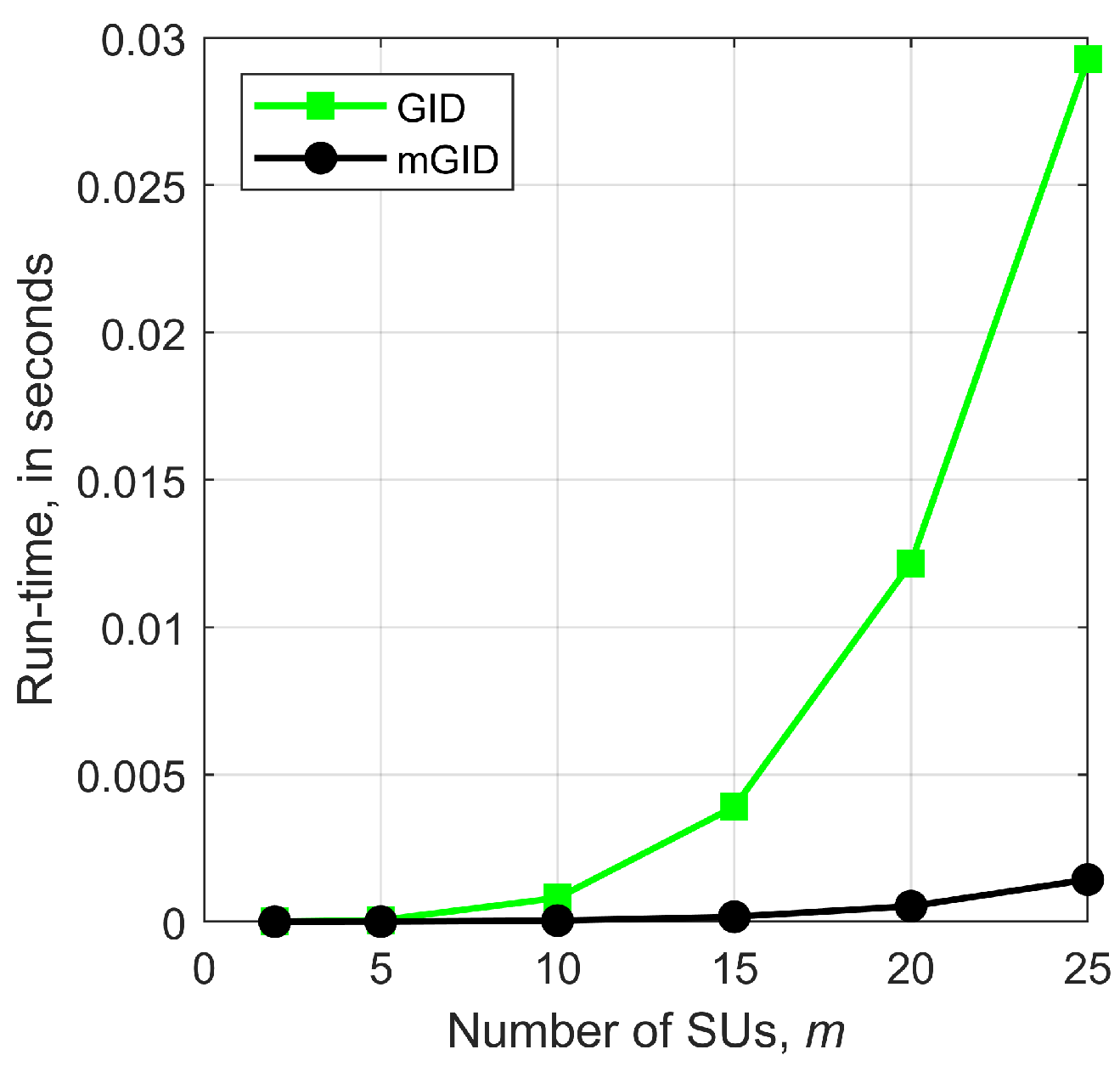
The GID detector is further explored in this work. Its test statistic is based on the Gini index, which is a statistical dispersion metric commonly used in economics and social sciences as a measure of inequality [
13]. Although the GID test statistic does not make use of eigenvalues or determinants of the SCM, its computational cost is penalized due to the relatively high burden associated with the calculation of the magnitude of the elements of the SCM, or the magnitude of the results of operations performed on the SCM elements. This work aims at reducing the computational cost of the GID detector, which is achieved by replacing with real quantities the complex values operated in the test statistic while maintaining the original Gini-index-based operations defined in [
13].
1.2. Contribution and Structure of the Article
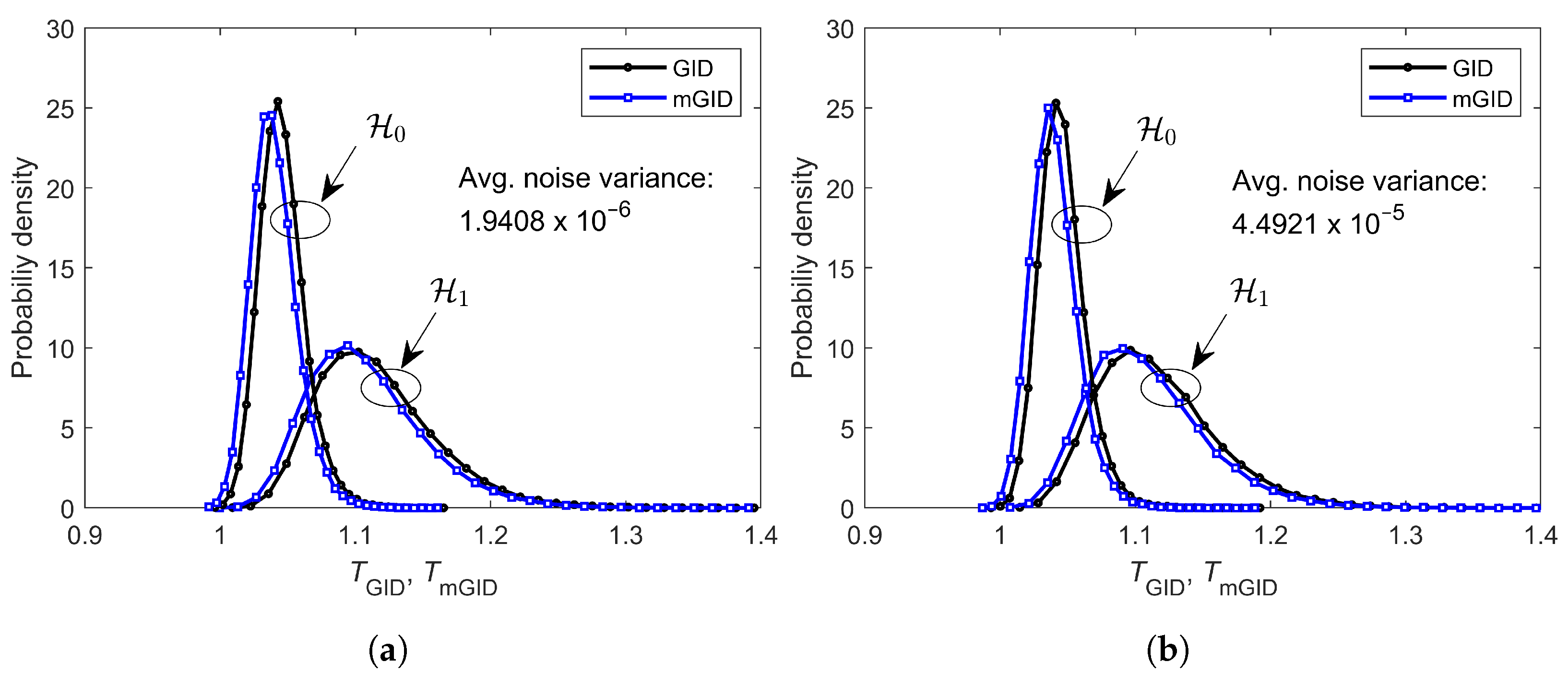
The modified Gini index detector (mGID) is proposed in this paper. Likewise, the GID, the test statistic of the mGID, is formed from the elements of the SCM, which makes it less complex than most of the state-of-the-art detectors proposed so far. The mGID inherits important attributes of the GID, namely, blindness, attractive robustness against nonuniform and time-varying received signal and noise levels, and a constant false-alarm rate (CFAR). Moreover, its performance is practically equal to the GID’s. In summary, the main contributions of the present work are as follows:
The novel and practical mGID test statistic, whose computational cost is drastically reduced when compared to the GID, with practically no performance loss and inherited desirable attributes of the GID.
A two-fold model improvement with respect to [
13] time-varying signal power attached to path-loss and corrected signal-to-noise ratio (SNR) calibration.
Numerical results that provide insight into the system’s operation and support the conclusions of the work.
A fully-commented Matlab simulation code [
16] capable of supporting a complete system analysis under a variety of circumstances and system parameters.
The remainder of the article is organized as follows:
Section 2 describes the signal, noise, and channel models. The GID and mGID test statistics are addressed in
Section 3. Numerical results and interpretations are presented in
Section 4. The conclusions and opportunities for future research are given in
Section 5.
2. Signal, Noise, and Channel Models
The model for centralized CSS with data fusion adopted herein is grounded on [
13,
15]. It considers
m SUs in cooperation, each one collecting
n samples of the PU signal during a sensing interval. The samples gathered by the SUs are transmitted to the FC over an error-free report channel, forming the sample matrix
, which is given by
where the vector
contains the PU signal samples, which can be modeled as zero-mean complex Gaussian random variables or modulated signal samples in the base band. Here, a base-band quaternary phase-shift keying (QPSK) PU signal is adopted.
The channel vector
in (
1) is formed by elements,
, that represent the sensing channel gains between the PU transmitter and the
ith SU, for
. The variation in these gains over time can model the fading effect produced in the signal due to multi-path propagation of the electromagnetic wave and other propagation-related variations imposed on the PU signal, such as shadowing due to blockage by obstacles.
When modeling spectrum sensing, the gains of the channels between the PU transmitter and the SU’s receivers are often considered constant during the sensing interval, and independent and identically distributed among consecutive sensing events. The constant channel gains mean that the duration of the sensing interval is shorter than the coherence time [
17] of the sensing channel, that is, the signal fading produced by the channel changes slowly and can be considered practically constant during the entire sensing interval. On the other hand, the independence between successive sensing events means that the interval between these events is greater than the coherence time of the sensing channel. Additionally, the multiplication between
and
in (
1) is meant to model a flat fading channel whose coherence bandwidth is larger than the bandwidth of the PU signal [
17].
The channel vector is modeled as
, where
is a gain matrix to be defined a little later, and
is a vector formed by complex-Gaussian random variables
, where
is the Rice factor [
17] of the channels between the PU transmitter and the SUs, and where
is the Rice factor in decibels.
When a channel is subjected to Ricean fading, the Rice factor is a measure of the ratio between the signal strength received via the dominant propagation path and the power of the signals coming from the other paths. A dominant propagation path occurs, for example, in a line-of-sight (LoS) condition between the transmit and receive antennas, or when a strong specular reflection of the transmitted signal towards the receiver happens. A larger Rice factor is associated with less variability (i.e., less fading) in the instantaneous received signal strength. A zero Rice factor ( dB) corresponds to a channel with Rayleigh fading. On the other hand, a pure additive white Gaussian noise (AWGN) channel results if dB. In practical terms, dB corresponds to an approximate Rayleigh fading, and dB makes the channel approximately free of fading.
From measurements reported in [
18], it has been found that
is an environment-dependent random variable that can be well characterized by a Gaussian distribution with mean
and standard deviation
, both in dB, i.e.,
. Typical values of
and
are determined according to the propagation characteristics of the area, and are reported in [
18] as well. This model for the Ricean fading is consistent with reality: While moving, an SU receiver experiences different situations in terms of the line of sight with the PU transmitter antenna. For example, urban areas typically have a large number of big obstacles between the PU and the SUs, which reduces the mean Rice factor and increases its variability, which is measured by
. On the other hand, rural or open areas exhibit higher Rice factors, on average, but have lower variability due to the smaller number and small diversity of the obstacles commonly found in these areas. An urban area typically has
dB and
dB. Rural or open areas typically have
dB and
dB. Suburban regions are commonly associated with
dB and
dB [
18].
The present signal model also takes into account that the received signal power levels across the SUs may be unequal and time-varying due to the different distances between the PU transmitter and the SUs, and due to the variation in theses distances across different sensing events caused by the motion of the SUs. To model unequal and time-varying received signal levels, the above-mentioned gain matrix is given by , where is the vector containing the received PU signal powers across the m SUs, with denoting transposition, is the transmitted PU signal power in watts, and the operator returns a diagonal matrix whose diagonal is formed by the elements of the vector in the argument.
The log-distance path-loss prediction model [
17] represents a very simple form to calculate the area-mean received signal power at a distance
d from the transmitter. It can be used to calculate the PU signal power received by the
ith SU,
, yielding
where
is a reference distance in the far-field region of the PU transmit antenna,
is the distance between the PU transmitter and the
ith SU receiver, and
is the environment-dependent dimensionless path-loss exponent [
17]. The larger the value of
, the grater the signal attenuation at a given distance.
Variability in thermal noise at the SUs’ receivers is also assumed in the present model. In practice, this variability cannot be neglected and is caused by multiple factors, such as variations in the ambient temperatures to which the SUs are subjected, uncalibrated receiver front-end circuits, uneven noise figures and gains of the low noise amplifiers (LNAs), and unwanted signals present in the sensed band, such as atmospheric noise and RF interference, which can be considered as background noise added to the receiver thermal noise. In this paper, the nonuniform and time-varying characteristic of the noise power is modeled as follows: since the elements in the
ith row of the matrix
in (
1) are associated with the
ith SU, they are represented by independent Gaussian random variables whose mean is zero and the variance is
where
is a realization of a uniform random variable
in the interval
, that is,
,
is the noise variance averaged across all SUs, and
, which is a predefined parameter of the model, is the fractional variation in the noise power around
.
The instantaneous signal-to-noise ratio,
, across the SUs is a random variable, since it depends on
and on the distances
, which vary according to the random SUs’ locations. In light of (
2) and (
3), a realization of
is given by
Thus, the average SNR across the SUs, which is also a predefined parameter of the model, is given by
where
is the expected value of
.
To implement this variable noise level model, firstly the expectation of the uncalibrated
has to be calculated, which is defined for an uncalibrated average noise variance
and for a given realization of the SUs’ locations. Taking into account that the random variables
are independent from each other, it can be written, in light of (
4), that
where the uniform random variable
lies in-between
and
.
The expectation of the random variable
is given by
Applying this result in (
6), with
and
, the expected value of
for
is found to be
For
, Equation (
8) yields an indeterminate result that can be easily solved taking into account that
in this case yielding
Since
, the calibrated average noise variance is given by
In the last step, this
is plugged into (
3), along with a realization
of the random variable
, to yield
, which is the variance in the noise samples in the
ith row of the matrix
. New values of
are computed in each sensing round, conferring the time-varying character to the noise power.
The present SNR calibration model corrects the one considered in [
13], in which the SNR is given by the ratio between the average signal power and the average noise power, which could be better named average signal to average noise power ratio. Notice from (
4) and (
5) that the correct SNR calculation is the average of the quotient between the instantaneous signal power and the instantaneous noise power. Using the notation adopted herein, in [
13] it is considered that
and here, it is established that
where the factor
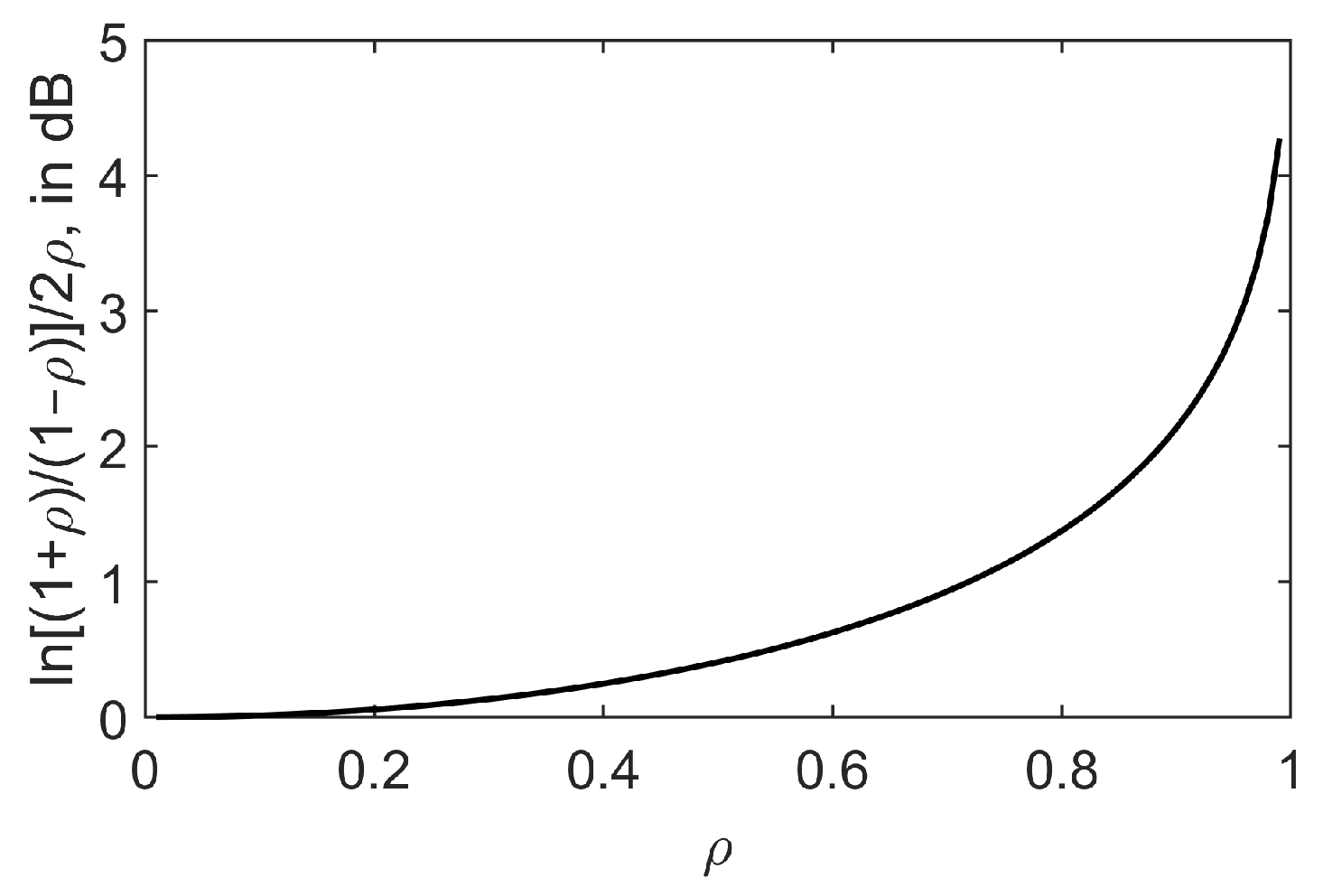
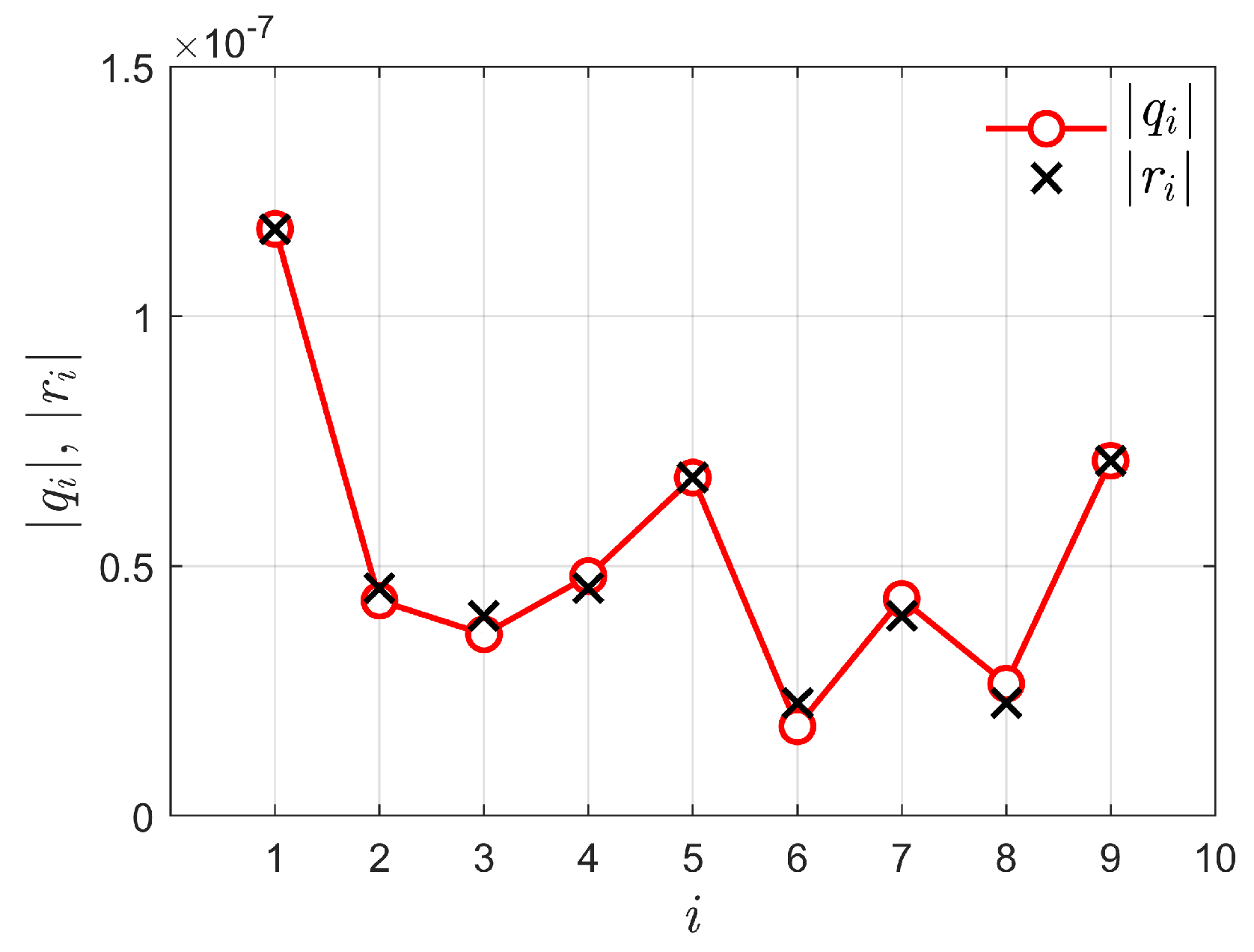
makes explicit the inequality between the two SNR definitions. This factor is plotted in
Figure 1, in dB, as a function of
. If the SNR is defined according to [
13] so that it remains constant for any
, the actual SNR will be
dB higher, progressively overestimating the detector’s performance in regard to the one achieved with the correct SNR, as
becomes larger.
The influence of the correct SNR calibration on the detector’s performance is evidenced by means of a numerical result presented in
Section 4, specifically by Figure 7.
4. Numerical Results
This section addresses the performance of the detectors GID and mGID, as well as of the competing state-of-the-art blind detectors listed in
Section 1, namely, PRIDe, HR, VD1 (VD number 1), GLRT, MMED, AGM, and GRCR. The test statistics of these competing detectors are given in the sequel.
The test statistic of the PRIDe detector [
15] is
where
is the same variable defined in (
12), and
.
The HR test statistic [
9] is computed as
where
is the element in the
i-th row and
j-th column of the sample covariance matrix
, and
is the determinant of
.
The VD1 detector [
11] has a test statistic given by
where
, with
being the diagonal matrix whose main diagonal corresponds to the vector
, where
and
denotes the Euclidean norm.
The test statistic of the eigenvalue-based GLRT detector [
12] is
where
are the eigenvalues of
.
The detector MMED [
12] forms its test statistic according to
In the case of the AGM [
10], the test statistic is given by
and the GRCR [
14] has a test statistic computed according to
The performances reported herein have been measured in terms of the probability of detection,
, for a fixed
, as a function of the main system parameters. All results were generated via Monte Carlo computer simulations using the Matlab R2018a running the source code available in [
16].
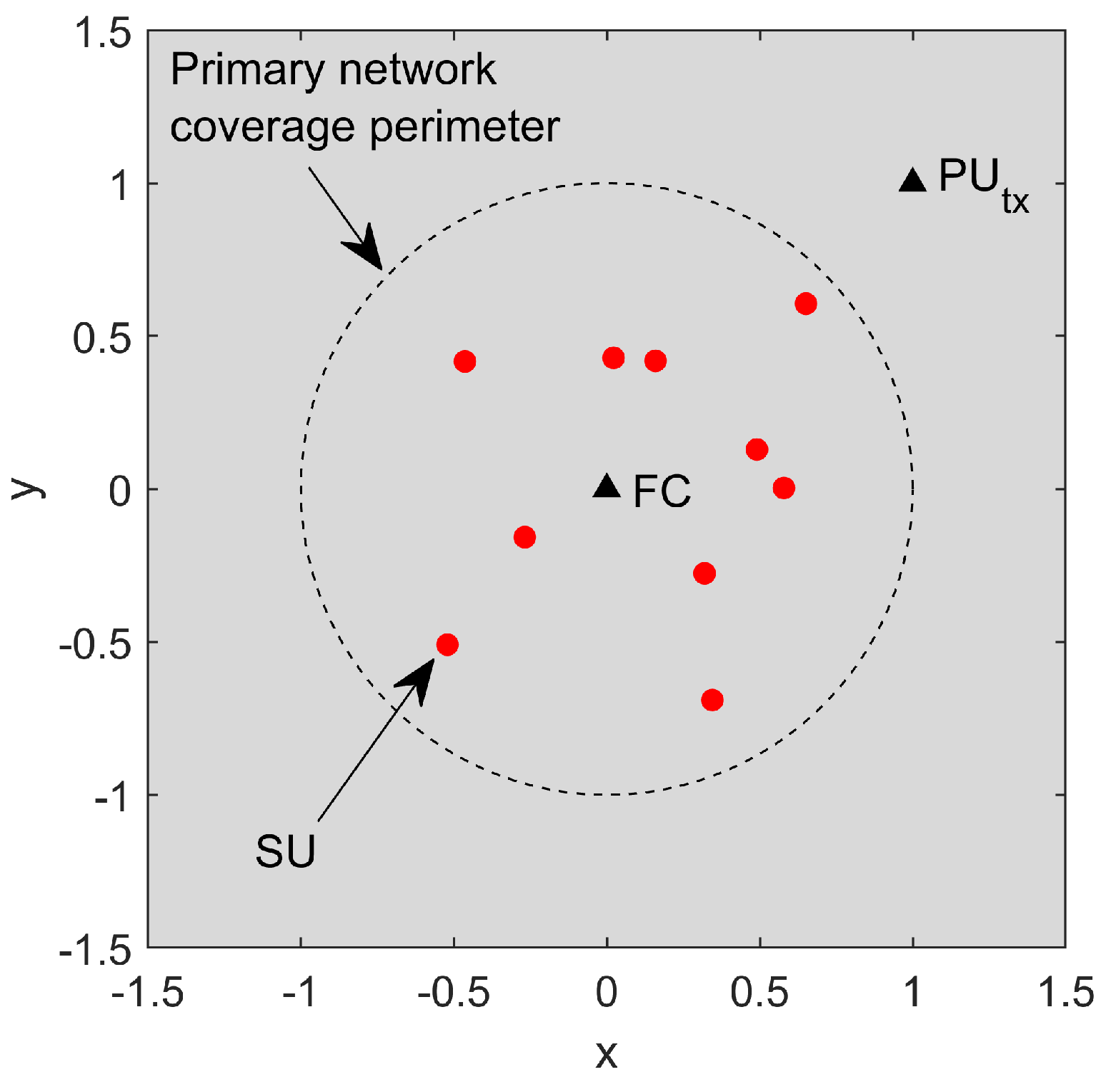
The CSS topology adopted for analysis is exemplified in
Figure 5. It comprises a secondary network with
m SUs (
in this example) uniformly distributed in a circular coverage area with radius
r meters (a normalized
has been used in this figure), with the PU transmitter located at
meters, with
meter in the figure, and the FC located at the center of the coverage area. Each sensing event requires defining new random positions of the SUs, aiming at mimicking mobile SUs. The PU signal samples, which come from a base-band QPSK signal, are then generated according to the model described in
Section 2 for the vector
. These samples are multiplied by the channel vector
and the result is added to the noise matrix
, according to (
1), forming the matrix
of received signal samples. As demonstrated in
Section 2, the channel vector
accounts for multi-path fading and distance-dependent signal attenuation from the PU transmitter to the SUs. Subsequently, matrix
is made available to the FC, where the sample covariance matrix
is computed, and from which the desired test statistics are formed. For each detector under analysis, a number of 20,000 test statistic values are computed under
and
, and used to estimate the cumulative distribution functions (CDFs) from which
is read for the reference
.
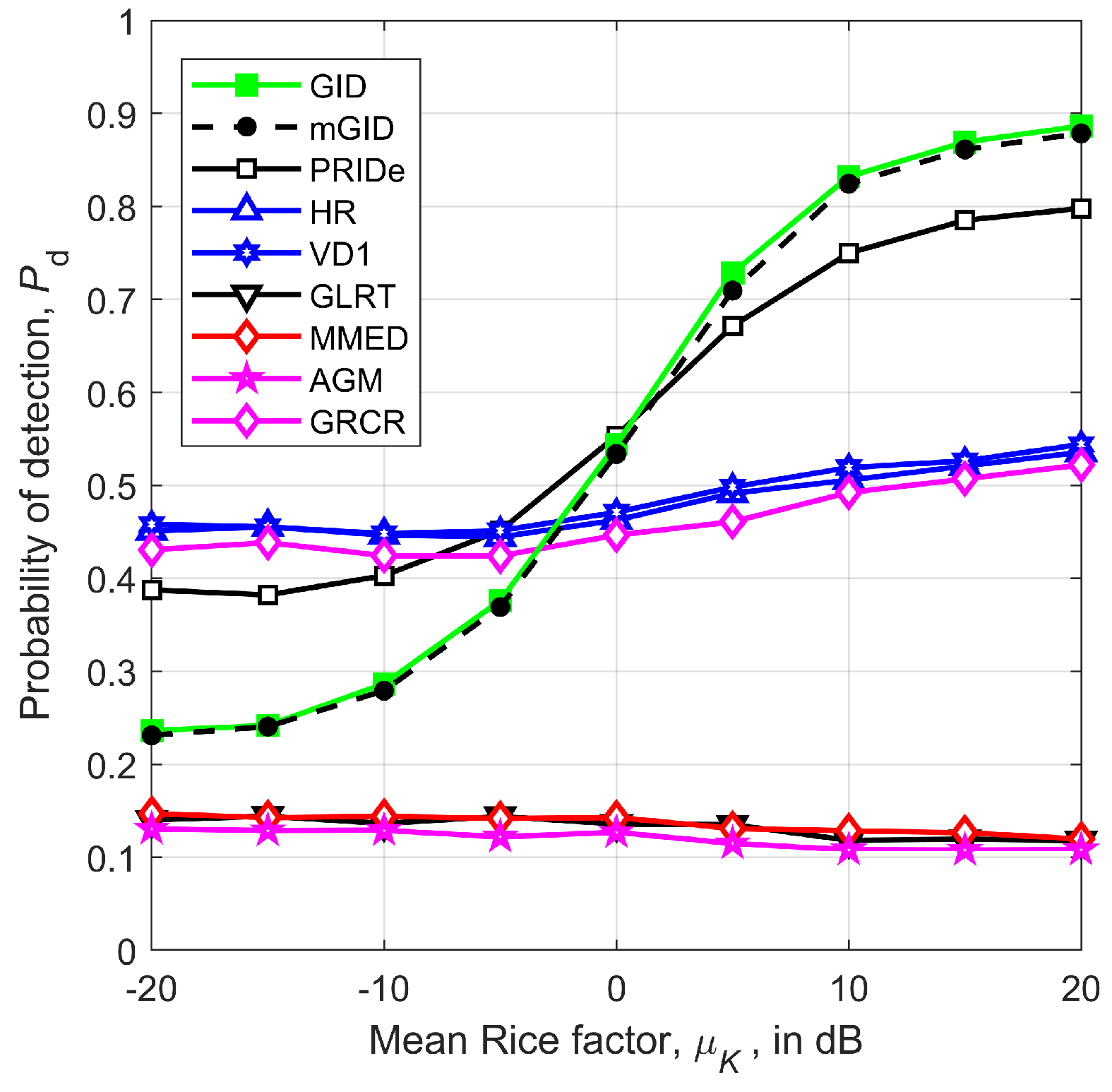
Figure 6 depicts
versus the mean of the Rice factor of the sensing channel,
, for
SUs,
dB, path-loss exponent
, coverage radius
km,
samples per SU, fraction of noise power variation
, and standard deviation of the Rice factor
dB.
The main result unveiled by
Figure 6 is the influence of the line-of-sight condition from the PU transmitter to the SUs on the performance of the detectors, especially in the case of the GID and mGID. Firstly, notice that the GID and mGID achieve practically the same performances. Moreover, they become attractive under a moderate-to-high LoS component, i.e., for
dB. Taking this fact into consideration, the remaining results of this section consider
dB, which tightly approximates a pure AWGN channel. This is to explore the GID and mGID operations under the scenario corresponding to their best performances.
Figure 6 also demonstrates that the performance variation pattern of the PRIDe is similar to the GID and mGID, yielding a better performance for lower values of
and a worse performance for higher values of
. The other detectors exhibit low sensitivity to the variation in
, with the GLRT, MMED, and AGM being practically useless. This is because these three detectors are not robust against variations in the received signal and noise levels, which are implicitly present in the setup used to plot
Figure 6.
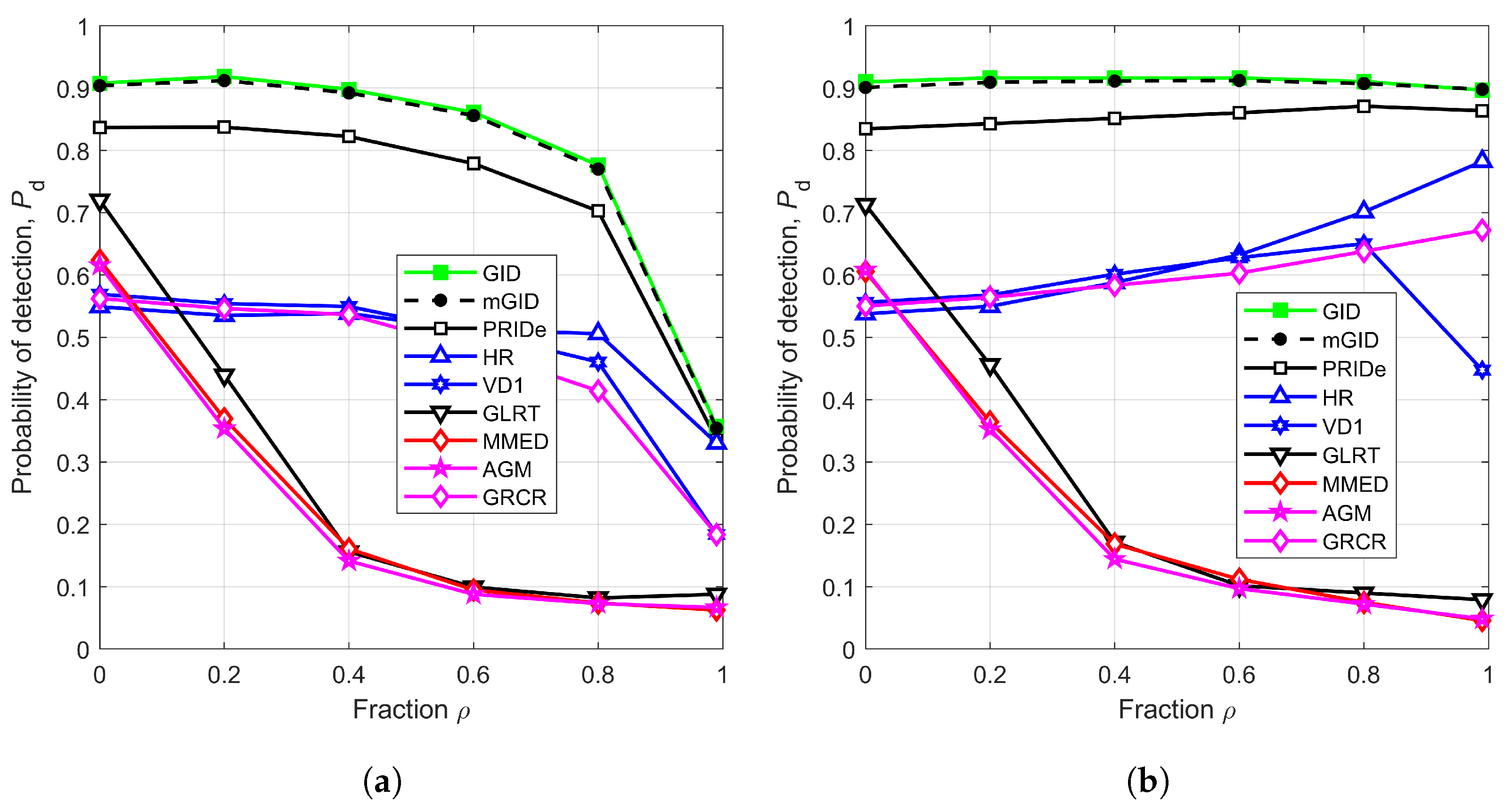
The effect on
due to changes in the fraction
that governs the amount of noise power variation about its average is shown in
Figure 7, for
,
dB,
,
km,
,
dB, and
dB.
Figure 7a considers the new model for calibrating the SNR, according to (
5) and related equations, while
Figure 7b has been plotted under the SNR definition given in [
13], which corresponds to the ratio between the average signal power to the average noise power. Notice that the performances of the GID and mGID are practically the same, and that they are quite robust against the variation in the noise level, up to
, the same occurring with the detectors PRIDe, HR, VD1, and GRCR. The performance of the detectors GLRT, MMED, and AGM are highly affected by the value of
, as anticipated in the comments about
Figure 6.
On the other hand,
Figure 7b suggests a much better robustness of the GID, mGID, and PRIDe than the other detectors; an equivalent conclusion regarding the GID has been reported in [
13]. Since
Figure 7a adopts the correct way of computing the SNR as the average of the quotient between the instantaneous signal and noise powers, the conclusions drawn from it are the correct ones. In
Figure 7b, the probability of detection for all detectors are overestimated at higher values of
, since the actual (correct) SNRs in this case have been measured as
,
,
,
,
, and
dB, respectively, for
,
,
,
,
, and
(recall that the SNR associated with
Figure 7b has been configured as
dB for any
, applying the incorrect definition). Observe that if
dB is subtracted from the above SNR values, the results are approximately the quantities given in
Figure 1.
To put it concisely, the detectors GID, mGID, PRIDe, HR, VD1, and GRCR show some resistance to changes in noise power, but their level of robustness is not as high as perceived when an incorrect definition of the SNR is utilized.
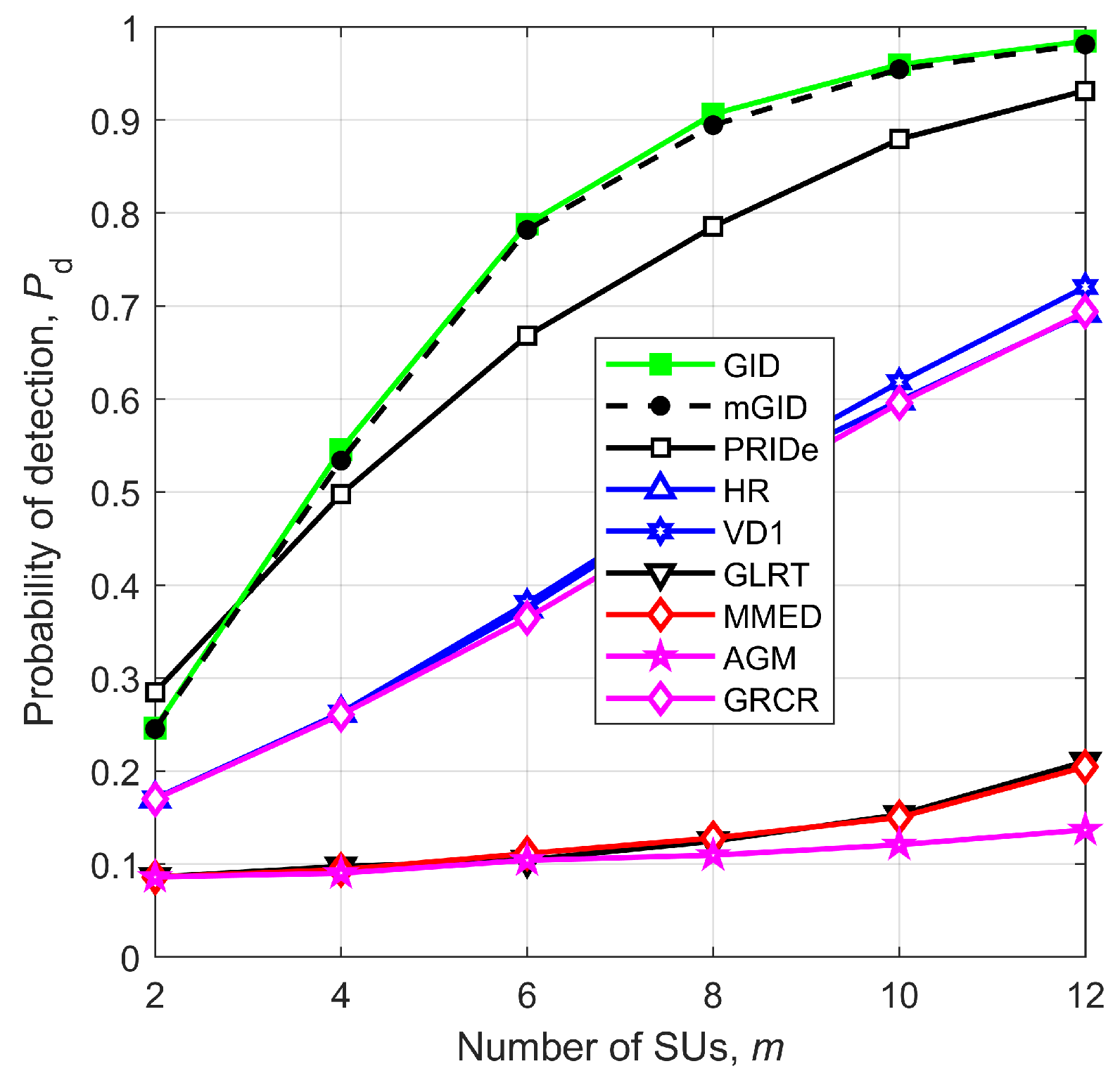
Figure 8 gives
versus the number of SUs,
m, for
dB,
,
km,
,
,
dB, and
dB. As expected, the performances of all robust detectors improve as
m increases, whereas the non-robust ones (GLRT, MMED, and AGM) do not follow this improvement pattern due to the deleterious influence of the signal and noise level variations. For the system settings considered in
Figure 8, the GID and mGID considerably outperform the other detectors, closely followed by the PRIDe. Once again, the results show practically identical performances of the GID and mGID.
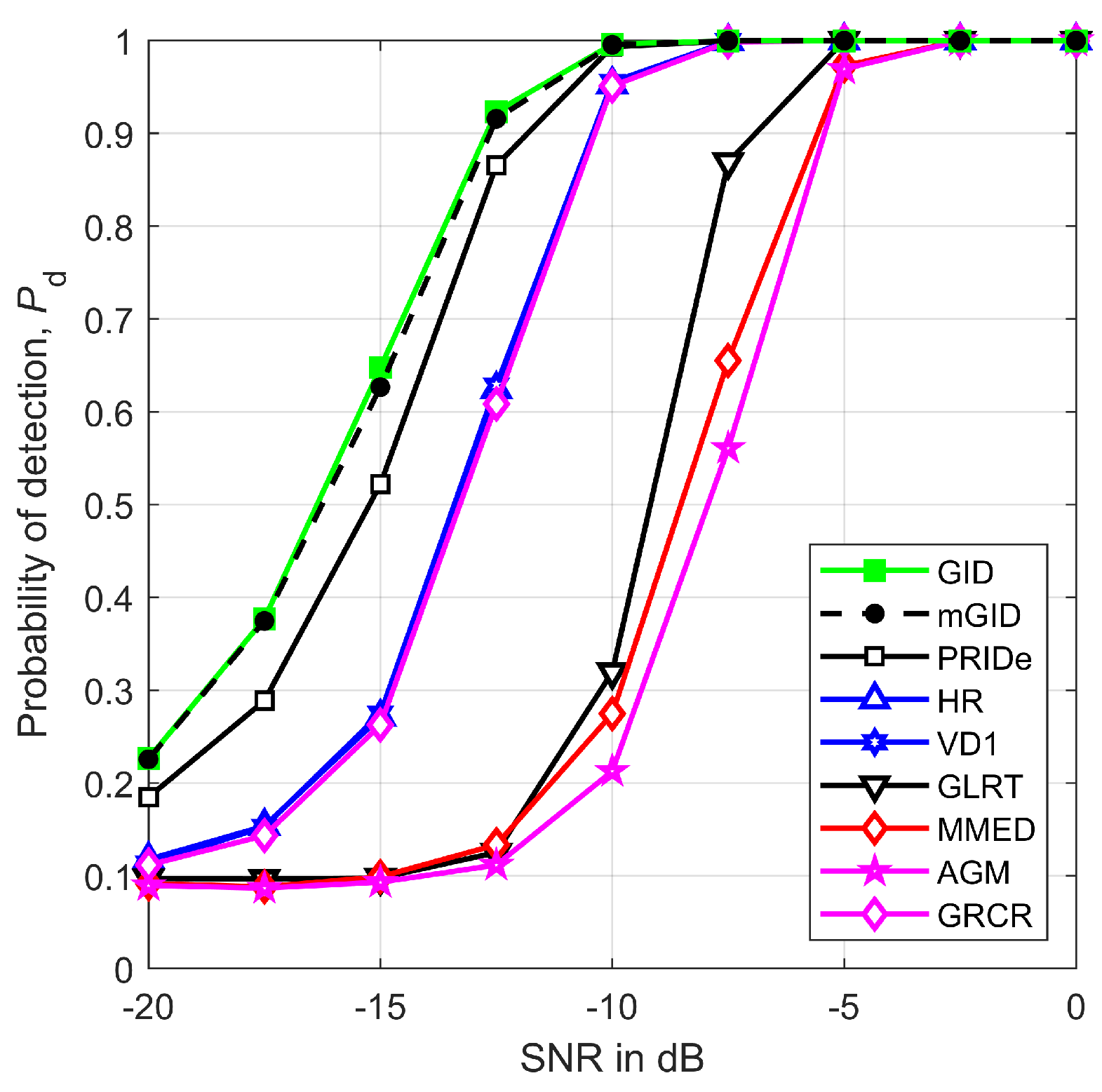
Figure 9 depicts
versus the SNR, in dB, assuming
,
,
km,
,
,
dB, and
dB. The performance improvement observed for all detectors as the SNR increases is the expected outcome. The GID and mGID performances, once again, are in agreement with each other, and are superior to the other detectors, given that the line-of-sight condition has been established by setting
dB. The PRIDe performs quite similarly to the GID and mGID, while the HR, VD1, and GRCR come in third position with practically identical performances. It can be seen that, in spite of being under nonuniform received signal and noise powers, the GLRT, MMED, and AGM are capable of attaining satisfactory performances, but only at relatively higher SNR regimes.
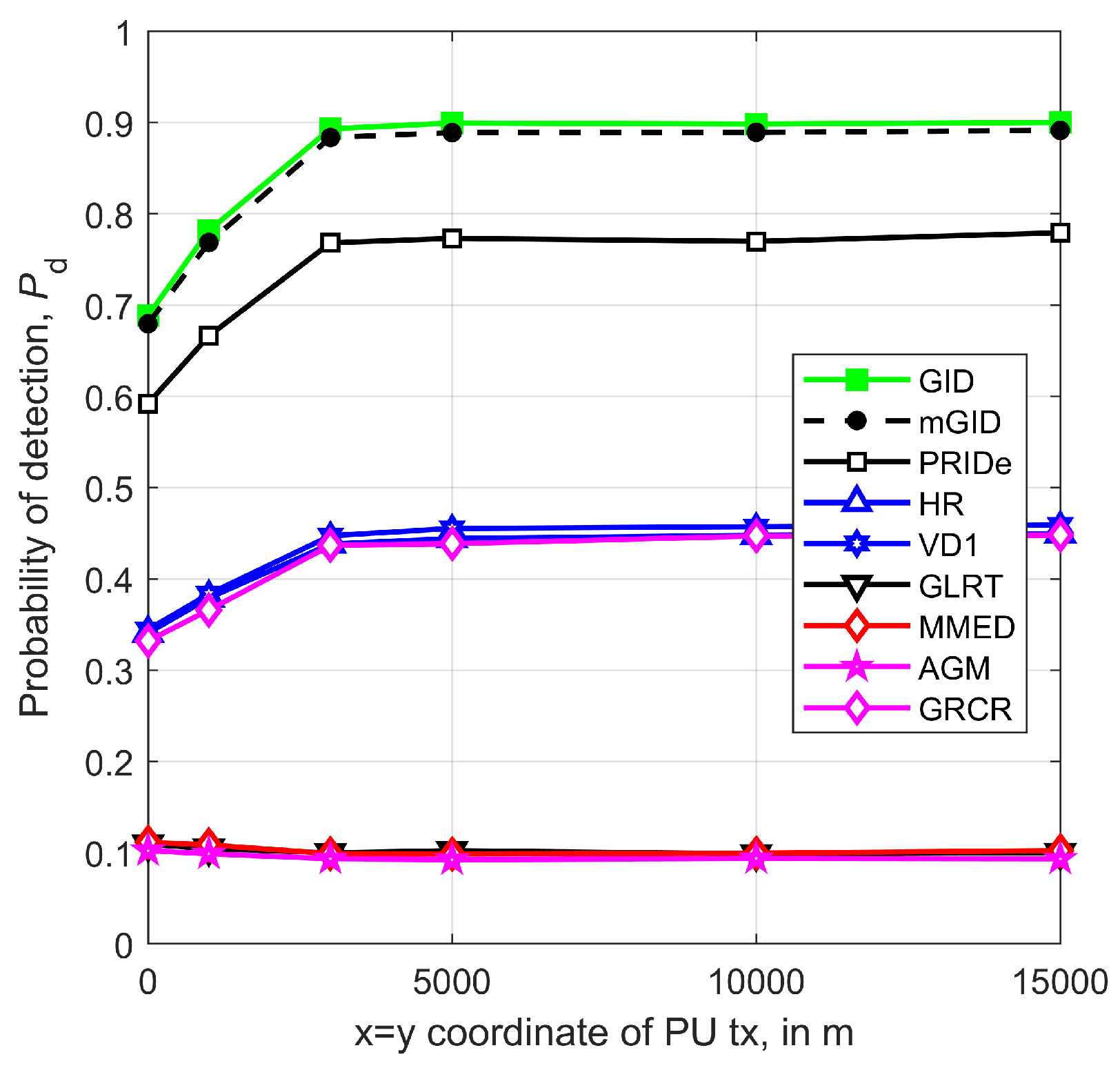
The influence, on
, of the distances from the PU to the SUs, which depend on the
coordinates of the PU, is shown in
Figure 10 for
,
,
dB,
,
km,
,
,
dB, and
dB. The non-robust detectors (GLRT, MMED, and AGM) are useless for any PU coordinate, which is owed to the variability in signal and noise levels and to the SNR value (see
Figure 9). When the PU coordinates
are below
m, the performances of all robust detectors decrease due to the larger relative discrepancies among the received signal powers, similarly to what happens when the path-loss exponent increases. For
above
m, practically no performance changes are observed for all detectors, meaning that the relative discrepancies among the received signal powers were not capable of causing performance loss or improvement.
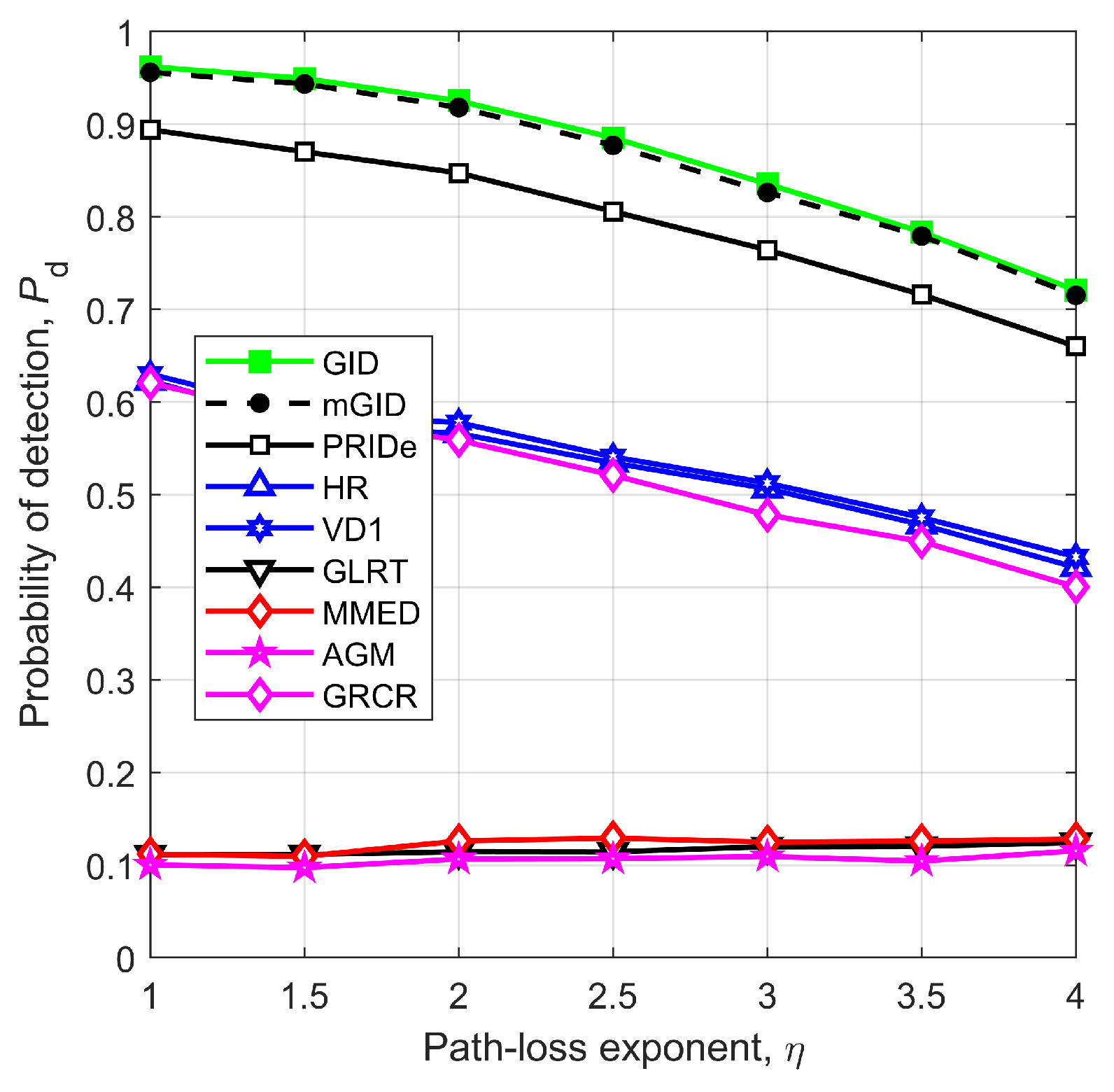
Finally,
Figure 11 gives
as a function of the path-loss exponent,
. The detectors GLRT, MMED, and AGM attain useless performances for any
, a consequence of their non-robustness to the noise and signal power variations. The performances of the remaining detectors reduce as
becomes larger, which seems an expected outcome if one recalls that a larger path-loss exponent means higher signal attenuation from the PU to the SUs. However, the performance reduction shown in
Figure 11 is not directly caused by the higher attenuation, since the SNR has been set as fixed for any
. A higher path-loss exponent produces higher differences among the received signal power levels, which translate into worse spectrum sensing performances. For instance, a realization of the received signal powers, in dBm, for
was
,
,
,
,
, and
. For
, another realization of the signal powers, also in dBm, was
,
,
,
,
, and
. Notice the higher variations in the second case.