Article

Assessing the Photosynthetic Activity of Phytoplankton in Kalmius River Under the Conditions of an Urban Environment


1
Faculty of Biology, Donetsk State University, 24 Universitetskaya St., 383001 Donetsk, Russia
2
Agribusiness Faculty, Don State Technical University, 344000 Rostov-on-Don, Russia
*
Authors to whom correspondence should be addressed.
Diversity 2026, 18(5), 297; https://doi.org/10.3390/d18050297
Submission received: 2 April 2026 / Revised: 6 May 2026 / Accepted: 14 May 2026 / Published: 15 May 2026
(This article belongs to the Section Freshwater Biodiversity)

Abstract

Pollution of rivers and large water bodies, including reservoirs, by wastewater from various sources is one of the most critical issues in the Donetsk region, requiring continuous monitoring and assessment of surface water quality. The research aims to assess the state of the Kalmius River under anthropogenic pressure, as well as to find correlations between the species composition, photosynthetic activity of phytoplankton, and the degree of water pollution. This study presents the results of biomonitoring of the Kalmius River and its tributaries within Donetsk City, which are under intense anthropogenic pressure. Pollution of the river channel by phenol, anionic surfactants, Ferrum ions, chlorides, and sulfates was identified. Based on the combinatorial pollution index, the water in the Kalmius River and its tributaries can be classified as polluted. The pigment composition of water samples was analyzed, and the species composition of river phytoplankton was determined. Dominant species include Chlorella vulgaris Beij., Dictyosphaerium pulchellum H.C.Wood, Scenedesmus quadricauda Brébisson, and Oscillatoria agardhii M.A.Gomont. Photosynthetic activity of the river’s algal flora was assessed based on chlorophyll fluorescence induction curves of natural phytoplankton. A correlation was established between surface water pollution levels and changes in the photosynthetic apparatus of microalgae cells. A strong negative correlation was found between the content of nitrate nitrogen in the aquatic environment and the photosynthetic activity, pigment composition, and abundance of the main dominant forms of phytoplankton, particularly the microalgae of the genus Cyclotella. The data obtained shows that the Kalmius River’s pollution has a significant impact on phytoplankton biodiversity, leading to the growth of cyanobacteria species.

1. Introduction

The Donetsk region is characterized by a high number of coal mining, metallurgical and chemical factories, which leads to environmental pollution. The soil is exposed to pollution by heavy metals: mercury, lead, zinc and cadmium [1,2]. Factory emissions into the atmosphere lead to an increase in the content of lead, carbon dioxide and sulfur oxides in the atmospheric air [3]. Effluent discharge into rivers and groundwater leads to excess of permissible concentrations of heavy metals, total hardness, salinity, sulfates, chlorides, etc. [4,5]. Numerous studies have revealed a significant level of anthropogenic pressure on the ecosystems of the Donetsk region, which results in stress and a decrease in the viability of living organisms [6,7,8,9].
All these factors lead to the ecotopes transformation, which manifests in the appearance of bioinvasions [10,11], which leads to the accumulation of various pollutants in plant tissues [3,12] and changes in the resistance of native species to environmental conditions [6,7,13]. The region’s water resources are most vulnerable to pollution, which affects biodiversity and phytoplankton photosynthetic activity [4,5,14,15].
Given the wide range of pollutants, monitoring the river’s state requires not only physicochemical analysis of samples but also an assessment of biota (phytoplankton, zooplankton, fishes, etc.), which serves as an integrative indicator of environmental pollution. Various phytoplankton cultures are employed for water toxicity biotesting and as indicators of specific pollution types, including exposure to wastewater of diverse origins [16,17,18]. The biodiversity and dynamics of microalgae development can serve as an indicator reflecting the impact of various environmental factors [17,18,19]. Such studies are applicable to various water bodies (rivers [4,20,21], lakes [22,23,24], seas [25], etc.) that are prone to microalgae blooms and serve as recreational areas, sources of drinking water, and are under anthropogenic stress. In addition to analyzing microalgae species composition, fluorimetric analysis of the photosynthetic activity of algal cells was conducted. Fluorimetry is characterized by rapid measurement, high informativeness, and minimal sample preparation, making it suitable for routine monitoring programs.
Fluorimetric methods are widely used in environmental monitoring to solve a variety of problems. The simplest method is to quantify the amount of chlorophyll in the water [26], which reflects the presence of phytoplankton. The use of light sources with different excitation wavelengths of fluorescence makes it possible to conditionally divide microalgae into groups with a predominant content of chlorophyll a, b, and c [27], which is also suitable for the quantitative description of phytoplankton in the studied water body. Fluorescent sensors are also included in submersible multiparametric probes that provide continuous registration of water environment parameters, including fluctuations in phytoplankton biomass, and profiling of deep-water reservoirs, seas, and oceans [28,29,30]. Studying the dynamics of phytoplankton development also makes it possible to assess the bioproductivity of water bodies, which is an essential part of studying the state of the seas and oceans [31]. Fluorimetry methods can also be used to solve these problems [32,33,34]. Remote sensing methods of the water surface are widely used in monitoring, which allow for the assessment of the distribution of phytoplankton biomass over a large area [35], but they often require adjustment through field measurements. In addition to the quantitative determination of microalgae biomass based on the content of photosynthetic pigments, fluorimetric methods are used for a more detailed study of the photosynthetic activity of natural phytoplankton cells based on fluorescence induction curves [36,37]. The functional state of photosystem II can be significantly affected by various types of pollutants [38,39,40], but there may not be any quantitative changes in the algal flora. This approach can help identify sources of water pollution at an early stage.
This study aimed to assess the state of the Kalmius River channel and its tributaries within Donetsk City using bioindication and fluorimetry of natural phytoplankton. Finding the relationship between the biophysical parameters of the photoplankton system and changes in the state of the aquatic environment is an important task, because these parameters can be used in the future to carry out continuous environmental monitoring of water objects on the basis of fluorimetric analysis.

2. Materials and Methods

2.1. Monitoring Points

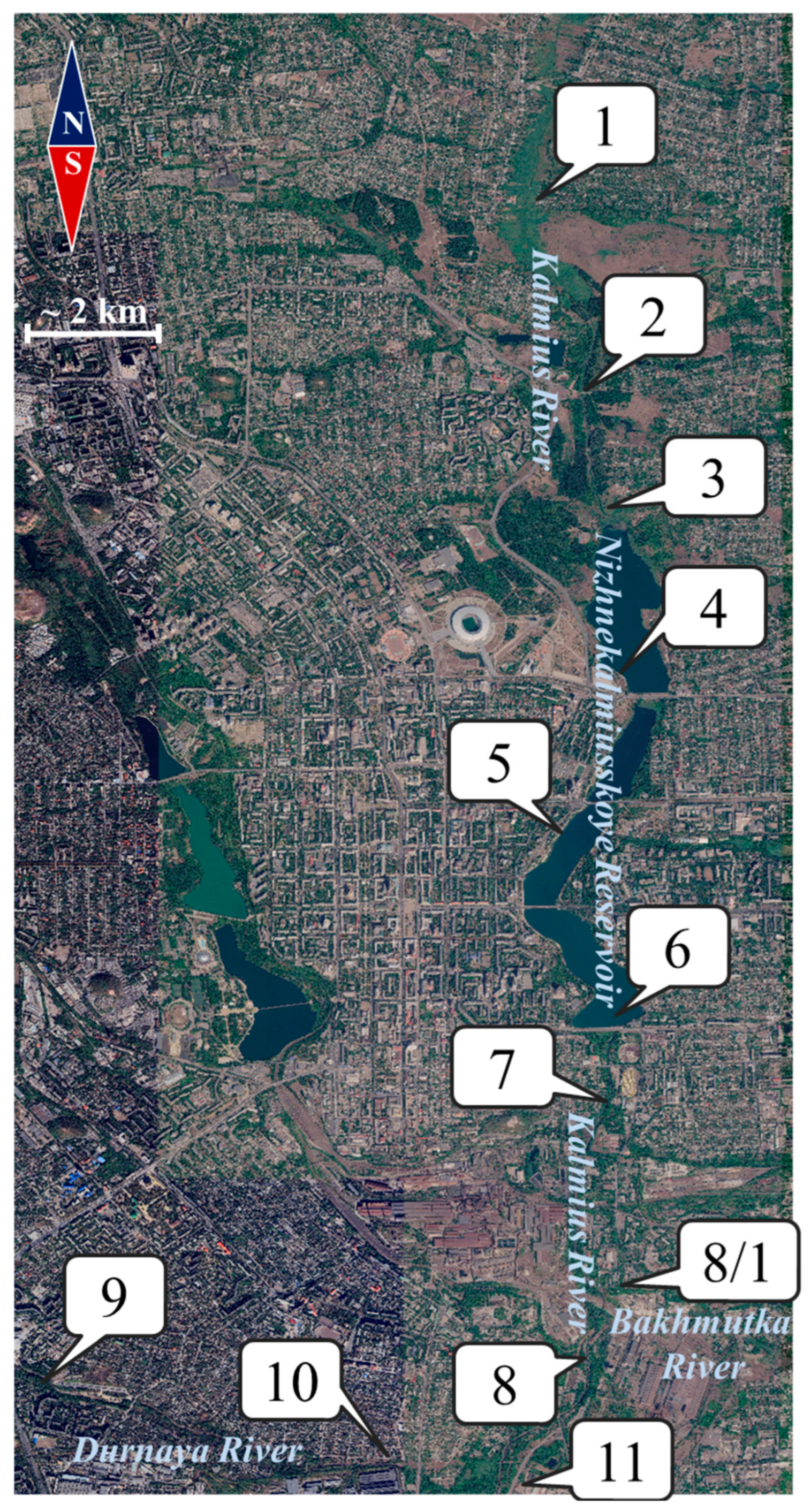
The intensive development of mining and heavy industries leads to pollution of natural water bodies by wastewater, significantly exacerbating water supply challenges [41]. Medium-sized rivers and drinking and reserve reservoirs in the region require focused attention and study. The Kalmius River, part of the Azov Sea basin, is a medium-sized lowland river with a total length of approximately 209 km. Its channel contains four large reservoirs. The study was conducted within Donetsk City, where the river is subjected to significant anthropogenic pressure from mine, industrial, and domestic wastewater discharges. Previous studies have found elevated levels of heavy metals, suspended solids, chlorides, sulfates, and organic compounds in the river’s surface waters [1,41,42]. Within the city, the Verkhnekalmiusskoye Reservoir, located in the river channel, serves as a water source, while its coastal area functions as a recreational zone for residents. The studied section of the Kalmius River includes two tributaries—the Durnaya and Bakhmutka (also known as Skomoroshyna) Rivers—which are also polluted. Not far from the source of the Kalmius River is the Verkhnekalmiusskoye Reservoir, where a pumping and filtering station is located, supplying water to nearby settlements. In this section, the riverbed is practically not exposed to negative anthropogenic load. However, it is currently impossible to conduct research in this area. Therefore, sampling for research to assess the state of the river is territorially carried out in the vicinity of the city of Donetsk. Flowing through the city, the river is filled with rainwater, treated wastewater, industrial and mine water. These urban runoffs cause a significant influx of water volume and also introduce a large number of pollutants. Also on the territory of the city, two tributaries flow into the Kalmius River—the Durnaya and Bakhmutka (otherwise Skomoroshina) rivers, which are also subject to intense anthropogenic load. Directly in the central part of the city, the Nizhnekalmiusskoye Reservoir is formed in the riverbed, which acts as a reserve source of fresh water and also serves as a recreational area for the local population. The reservoir is fed not only by the river, but also by a large number of gullies formed by spring water, rain, mine and industrial wastewater. In late summer–early autumn, as a rule, an intensive “bloom” of blue–green algae is observed in the southern part of the reservoir. Taking into account all of the above factors, 12 monitoring points were selected to assess the state of the Kalmius River in this area (Figure 1).
Monitoring point 1 (48°03′28.1″ N 37°49′01.5″ E) is located near the air shaft of the A.F. Zasyadko mine, and point 2 (48°02′11.8″ N 37°49′10.6″ E) is intended to record the ingress of mine wastewater in the section of the riverbed between points 1 and 2. Point 3 (48°01′43.2″ N 37°49′16.4″ E) is located immediately before the transition of the narrow riverbed into the reservoir. There are three monitoring points (points 4–6) on the territory of the Nizhnekalmiusskoye Reservoir, designed to reflect changes in the reservoir waters, taking into account tributaries and natural processes. Point 4 is located in the upper part of the reservoir (48°01′06.3″ N 37°49′16.5″ E), point 5 (48°00′00.8″ N 37°48′58.2″ E) is near the city beach, in the middle of the reservoir, and point 6 (47°59′38.5″ N 37°49′18.0″ E) is in the lower part of the reservoir, near the dam. Monitoring point 7 (47°59′29.4″ N 37°49′17.8″ E) is located after the Nizhnekalmiusskoye Reservoir, in a narrow part of the riverbed. Wastewater from the metallurgical plant enters near the confluence of the Bakhmutka River and the Kalmius River. Two monitoring points are provided for in this section: 8—the Kalmius River bed (47°58′12.7″ N 37°49′11.7″ E), 8/1—the Bakhmutka River bed (47°58′24.3″ N 37°48′58.5″ E). The second tributary of the Kalmius River—the Durnaya River—is fed by spring waters, as a result of which low water temperatures are observed near the source. There are two monitoring points for this tributary: 9—not far from the source, near a major city highway (47°58′22.1″ N 37°46′05.5″ E), 10—immediately before the confluence with the Kalmius River (47°57′48.2″ N 37°48′23.8″ E). Point 11 (47°57′28.4″ N 37°48′43.9″ E) is located in the southern part of the city, after the confluence of the main tributaries with the Kalmius River.

2.2. Determination of the Physical and Chemical Composition of Water Samples

Water temperature was measured directly during water sampling using Level Line CTD (Aquaread, Broadstairs, UK).
The physicochemical composition of water samples was determined using Hach cuvette tests: LCK 014 (chemical oxygen demand (COD), mg/L O2), LCK 304 (ammonium (NH4), mg/L), LCK 311 (chloride, mg/L), LCK 320 (Fe (total), mg/L), LCK 329 (copper, mg/L), LCK 332 (anionic surfactants, mg/L), LCK 338 (total nitrogen, mg/L), LCK 340 (nitrate, mg/L), LCK 341 (nitrite, mg/L), LCK 345 (phenols, mg/L), LCK 349 (phosphorus total, mg/L), LCK 353 (sulphate, mg/L), LCK 394 (permanganate index, mg/L O2). Measurements were performed on a Hach DR 30900 spectrophotometer (Hach, Loveland, CO, USA).
Water quality was assessed by determining the water pollution index (WPI), based on accounting for the integral impact of all studied chemical parameters of the aquatic environment [43,44,45,46]. The maximum permissible content was determined in concordance with the WHO [47] and also in comparison to SanPin 2.1.4.1074-01 [48].
Analysis of physicochemical parameters was performed for monitoring points 1, 3, 6, 8, 8/1, 10, and 11 (Figure 1).

2.3. Water Sampling and Determination of Phytoplankton Species Composition

Sampling was carried out in the morning and afternoon in plastic or glass containers with a volume of 1.5 dm3. Samples were collected in September 2023. To determine the species composition of phytoplankton in laboratory conditions, samples were concentrated by filtration through MFAS-OS-4 membrane filters from Vladipor (Vladipor, Vladimir, Russia) with a pore diameter of 0.6 μm. The species composition of the samples was determined using a light microscope with a magnification of 600. Cell numbers were counted using a Goryaev chamber (MikMed, Saint-Petersburg, Russia) (total volume 0.9 mm3), according to the formula:
N = k · n · ( A a ) · v · ( 1000 V ) ,
where N is the number of organisms in a liter of water in the studied reservoir; k—coefficient showing how many times the volume of the counting chamber is less than 1 cm3; n—number of cells found in the scanned squares of the camera; A—total number of squares in the counting chamber; a—number of squares in which algae were counted; v—volume of sample concentrate (cm3); V—initial volume of the sample taken (cm3).
The species composition of phytoplankton was determined according to modern classifiers [49,50,51,52,53]. Analysis of the species composition of natural phytoplankton was carried out at monitoring points 1, 3, 6, 8, 8/1, 10 and 11 (Figure 1).

2.4. Spectrophotometric Determination of Photopigment Content

The content of chlorophyll and other photopigments was determined according to the expressions proposed by S.W. Jeffrey and G.F. Humphrey [54] and by R.J. Ritchie [55]. Pigments were extracted using a 90% acetone solution. Margalef pigment index [56] was employed to evaluate the algocenosis diversity by pigment composition. Pigment index was calculated as the ratio of the optical densities at 430 and 664 nm.

2.5. Methodology of Fluorimetric Research

Fluorimetric analysis of water samples was carried out using an FS-2 fluorimeter (Donetsk State University, Donetsk, Russia). During the study, the total chlorophyll content was measured and fluorescence induction curves were recorded. Induction curves are also called OJIP-curves, which corresponds to the values of the local minimum of the curve (denoted as O) and three subsequent peaks—J, I and P, where P corresponds to the maximum value of fluorescence intensity. The curves were analyzed using the PyPhotoSyn program [37], determining and interpreting the OJIP test parameters as proposed in [57,58,59]. Main parameters are given in Table 1.
Before recording fluorescence induction curves, water samples were placed in a darkened place for 20 min for dark adaptation. To induce the chlorophyll fluorescence, a 450 nm diode was used. The saturating pulse intensity was 3000 μmol. quanta m−2 s−1, with a pulse duration of 1 s. A Hamamatsu H10721-01 photomultiplier tube (Hamamatsu Photonics, Hamamatsu, Japan) was used as the detector. For every water sample, at least 10 OJIP curves were measured. A single measurement required 3 mL of water sample to be taken. The chlorophyll content in water samples was determined by the F0 level.

2.6. Data Analysis

Reliability of differences in mean values for all obtained results was determined using non-parametric statistics methods—the Wilcoxon W-criterion, the degree of correlation between samples was assessed using Spearman’s coefficient and the Kendall rank correlation coefficient. Factor analysis [61,62] was used to identify the relationship between changes in the physical and chemical parameters of the aquatic environment, the photosynthetic activity of phytoplankton cells, and the pigment composition of the samples. PCA (principal component analysis) [63,64,65] was used to reduce the dimensionality of the multidimensional data.

3. Results

3.1. Physical and Chemical Composition of Water Samples

The measurement results are presented in Table 2. The values in bold indicate exceedances of maximum permissible concentrations, the “–” sign indicates samples for which measurements were not conducted, and “n/o” indicates substance concentrations below the detection threshold. Excesses in the content of sulfates, chlorides, and phenol are observed at all the monitoring points studied.
The water temperature in the studied monitoring points ranged from 8.5 to 13 °C. A gradual increase in temperature was observed in the area of the Kalmius riverbed between 3 and 8 points. At monitoring point 11, the water temperature decreased as a result of the confluence of the Kalmius River with colder tributaries.

3.2. Species Composition of Phytoplankton of the Kalmius River

In total, 35 main species of phytoplankton were identified in the studied water samples. The richest species composition was identified for monitoring points 6–21 species and 12 identified to the genus, and points 8–20 species and 4 identified to the genus. This is due to the growth of phytoplankton in the lower reaches of the Nizhnekalmiusskoye Reservoir, as a result of which the occurrence of individual species became significantly higher.
Species found in nearly all monitoring points include Chlorella vulgaris Beij., Dictyosphaerium pulchellum H.C.Wood, Tetraedron minimum Hansgirg, and representatives of the genera Scenedesmus and Oocystis. Dominant species in specific monitoring points include C. vulgaris, D. pulchellum, Scenedesmus quadricauda Brébisson, Oscillatoria agardhii M.A.Gomont and the genus Microcystis. Rarely encountered species include Closterium parvulum Nägeli, Franceia tenuispina Korshikov, Merismopedia glauca Kütz., Pediastrum tetras Ralfs, Tetraedron triangulare Korshikov, and the genus Suriella, which was detected only in the Durnaya River.
The division Chlorophyta was the most diverse, comprising 6 orders, 7 families, and 21 species (Table 3). Bacillariophyta included 6 orders, 8 families, 9 genera, and 6 species. Cyanobacteria consisted of 4 orders, 4 families, 4 genera, and 6 species. The divisions Streptophyta and Euglenozoa were represented by several genera. For euglenophytes, identification was limited to the genus level. Bacillariophyta and Cyanobacteria had approximately equal species counts (8 and 6, respectively).
At points 1 and 3 (Figure 1), phytoplankton cell abundance was low, ranging between 1 and 2 × 10³ cells/L. At point 1, Chlorophyta was the most abundant division (66.59% of total abundance), followed by Cyanobacteria (30.63%) and Bacillariophyta (2.78%). At point 3, abundance shifted: Bacillariophyta dominated (47.62%), followed by Chlorophyta (36.51%) and Cyanobacteria (14.29%).
In the reservoir, phytoplankton cell abundance increased nearly tenfold. Proliferation of cyanobacteria and green algae occurred, with the divisions Chlorophyta and Cyanobacteria accounting for 62.12% and 24.82% of total abundance, respectively. Diatoms constituted 9.7% of the algal flora abundance. Additionally, the divisions Euglenozoa and Streptophyta increased to 1.67% and 1.36%, respectively, in the Nizhnekalmiusskoye Reservoir waters. The reservoir exhibited significant growth in D. pulchellum abundance, as well as cyanobacteria O. agardhii and the genus Microcystis.
In the Bakhmutka River (point 8/1), green algae dominated—80.4% of the total cell count. Diatoms accounted for about 13%, cyanobacteria—4.35%, and streptophyte algae—2.2%. In the Kalmius River, in this section of the channel (point 8), green algae also dominated—72.5% of the count. The presence of Cyanobacteria and Bacillariophyta divisions was similar—12.5% and 11.6%, respectively. The total phytoplankton count in monitoring points 8 and 8/1 was similar and did not exceed 5 million cells, which is two times less than in the reservoir. Large numbers of D. pulchellum were preserved. In the Durnaya River, the number of phytoplankton was the lowest in the entire study area and did not exceed 300 thousand cells L−1. The basis was made up of green algae of the species C. vulgaris. Also found were representatives of diatoms of the genus Suriella.
Green algae dominated at monitoring point 11, accounting for 76% of the total cell count. These were primarily the species D. pulchellum and C. vulgaris. There was also a significant amount of cyanobacteria present—17.58%. The orders Bacillariophyta and Streptophyta accounted for 4.61% and 1.47%, respectively.

3.3. Spectrophotometric Determination of Photopigment Composition of Water Samples

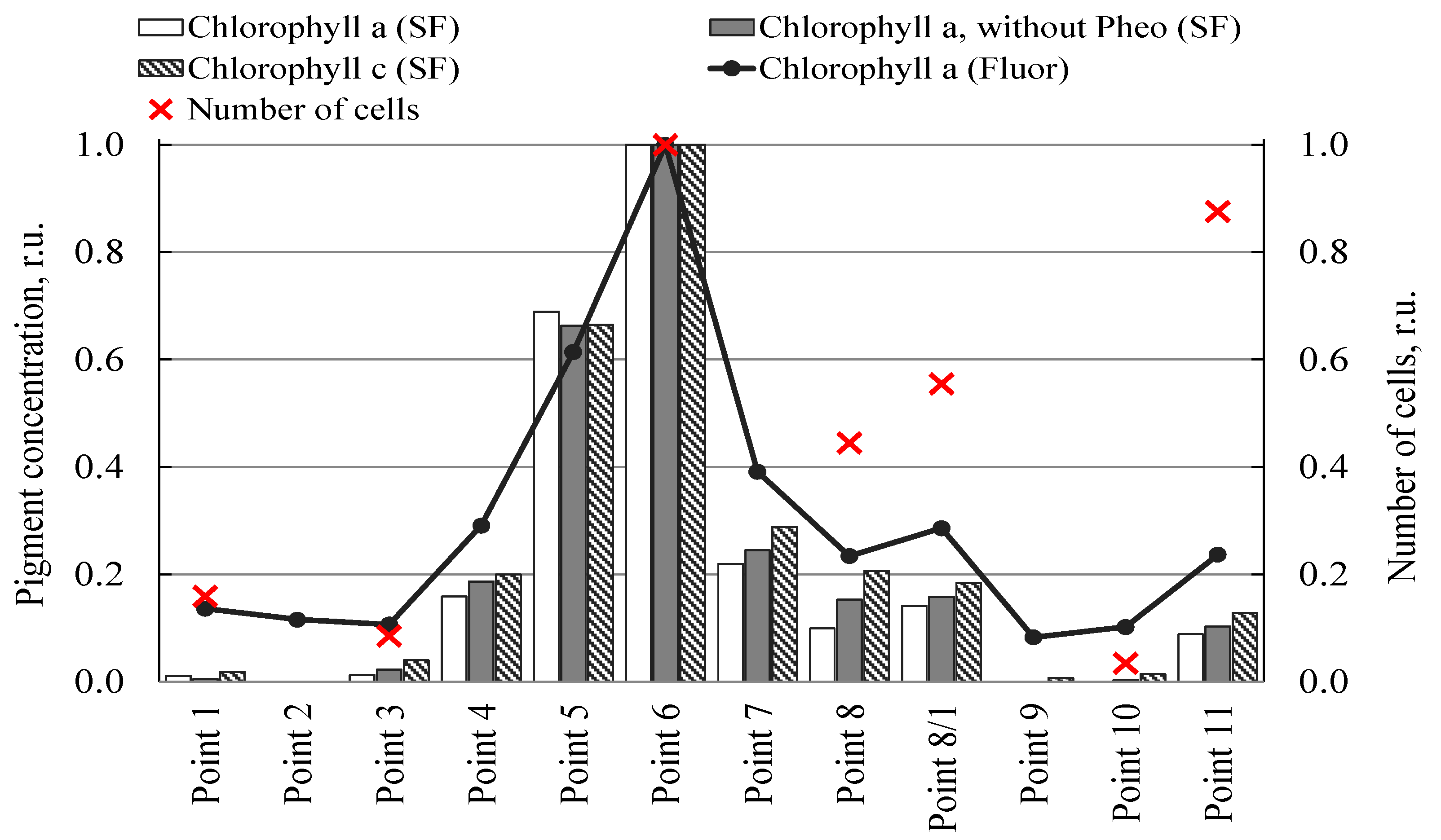
All the studied monitoring points were characterized by the predominance of chlorophyll a and c (Table 4), which is based on the dominance of green and diatom microalgae. A significant number of cyanobacteria were manifested in the presence of carotenoids of these algae. In general, the obtained data are consistent with the change in the number of phytoplankton cells in the water samples.
Photopigments for monitoring point 9 were practically absent, which is due to the low content of phytoplankton in the Durnaya River. The presence of chlorophyll c was detected, which is due to the presence of green microalgae in the samples. Low concentrations of photopigments were also obtained for point 2: only carotenoids of diatoms and green algae were detected. The highest concentrations of photopigments were obtained for samples from the reservoir with a maximum at monitoring point 6. An increase in pigments of the dominant phytoplankton orders Chlorophyta, Cyanobacteria and Bacillariophyta was observed. In the section of the Kalmius River bed between monitoring points 7 and 8, there was a decrease in the content of photopigments, which can be attributed to the negative impact of wastewater from the metallurgical plant. Pigment concentrations in the Kalmius River (point 8) and the Bakhmutka River (point 8/1) were approximately the same, which is also consistent with the number of phytoplankton cells.
The Margalef pigment indices for the monitoring points of the reservoir, the Kalmius River bed (points 1, 7, 8, 11) and the Bakhmutka River (point 8/1) fluctuated within the range of 2–2.4. For monitoring points 2 and 9, due to the lack of absorption at certain wavelengths, it was not possible to calculate the pigment index. An increase in this index at monitoring point 2 indicates a deterioration in the “physiological” state of phytoplankton and an increase in its pigment diversity [66]. The high value of the Margalef index for point 10 indicates not only the presence of background pollution of the river, but also the intensification of phytoplankton growth in the section of the riverbed between points 9 and 10. This is also evidenced by the results of the analysis of the species composition of phytoplankton.
The content of photopigments, determined by chlorophyll fluorescence, corresponded to the results of spectrophotometry. Figure 2 shows the results of spectrophotometric (diagram columns, designated as “SF” in the legend) and fluorimetric (as a line, designated as “Fluor” in the legend) determination of the content of photosynthetic pigments in water samples. The change in the number of phytoplankton cells is shown as individual points (marker ꓫ), since this indicator was not calculated at monitoring points 2, 4, 5, 7 and 9. All presented data are normalized to the maximum value of the sample.
Cell abundance values at points 8, 8/1, and 11 exceeded photopigment concentrations, which reflects the nonlinear relationship between these parameters. At these monitoring points, abundance growth was driven by green algae species C. vulgaris, D. pulchellum, and S. quadricauda, which possess low photopigment content.
Table 5 presents Pearson correlation coefficients between key quantitative phytoplankton parameters. Cases of strong positive or negative correlation are highlighted in bold.
The results obtained using spectrophotometric and fluorimetric methods are characterized by a high positive correlation. The degree of correlation between the number of cells and these methods is lower.

3.4. Analysis of Photosynthetic Activity of Natural Phytoplankton of the Kalmius River

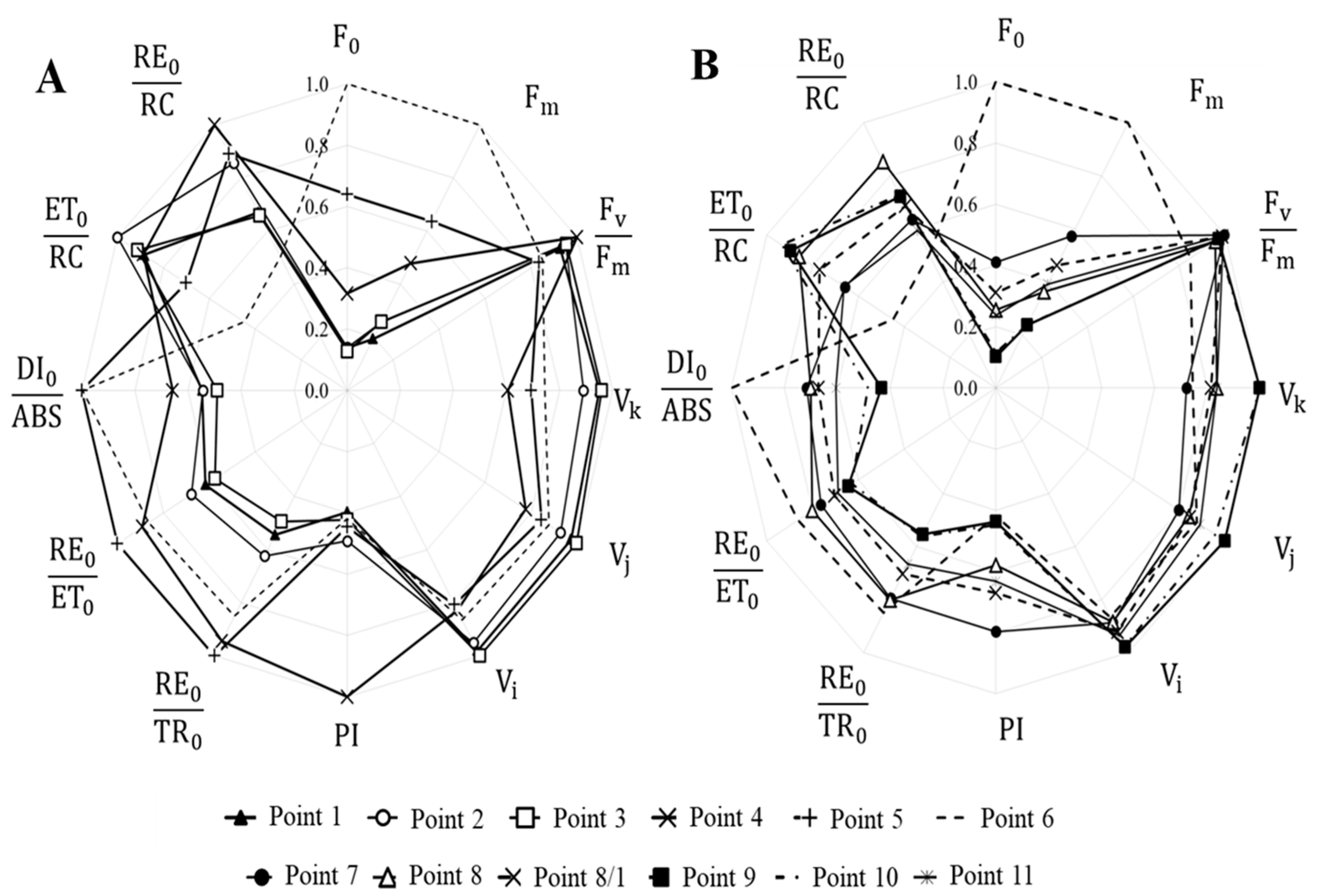
Figure 3 shows the diagrams of the OJIP test parameters for which reliable differences were found between individual monitoring points. For a more convenient display, the monitoring points are divided into two diagrams (Figure 3A,B) relative to monitoring point 6.
Monitoring points up to Nizhnekalmiusskoye Reservoir (points 1–3) were characterized by low fluorescence intensity, which reflects the low content of phytoplankton cells in the samples. Quantum yield Fv Fm−1 and the total photosynthetic index (PI) for these points did not differ. Attitude Fv Fm−1 fluctuated within the range of 0.6–0.65, which indicates a high efficiency of light energy conversion at the PS II level. The phytoplankton of this section of the riverbed was characterized by the presence of a larger number of closed reaction centers of PS II, compared to the points of Nizhnekalmiusskoye Reservoir. The closure of reaction centers could be connected with the high concentration of anionic surfactants, phenol and Ferrum in the water.
Along with the increase in the number of closed RCs, there was an increase in the flow of electrons transferred through one active reaction center to PS I. (parameters ET0/RC and RE0/RC). Probably, with the increase in the flux, the possibility of photochemical transformation of the absorbed light energy remained. In connection with this, no decrease in the parameters was observed in Fv Fm−1 and PI.
Photosynthetic activity of phytoplankton in the reservoir (points 4–6) increased, which was reflected in an increase in the PI and the parameters RE0/TR0, ET0/TR0. This reflects an increase in the number of phytoplankton cells.
After Nizhnekalmiusskoye Reservoir (point 7), the photosynthetic activity of phytoplankton cells decreased, but the PI remained high. Phytoplankton cells in the Durnaya River (points 9 and 10) had low photosynthetic activity. Despite the significant increase in numbers at point 10, the functional activity of the cell photosystems did not increase. Phytoplankton in this area were characterized by the lowest values of electron flows in PS II, the efficiency of excitation energy transfer between carriers of the electron transport chain, and the PI in comparison with other samples.
Near the metallurgical plant, the fluorescence intensity of the samples decreased, which is associated with a decrease in the number of phytoplankton cells, and the photosynthetic activity also decreased, compared to point 7. At the same time, the fluorimetric indicators in this area were similar for the sample from the Kalmius River and from the Bakhmutka River. In the tributary, the phenol content was lower than in the Kalmius River, but still exceeded the MAC, which may be associated with a decrease in the photosynthetic activity of cells. After the confluence of the Durnaya and Bakhmutka rivers, the photosynthetic activity of phytoplankton in the Kalmius River did not change compared to point 8. This indicates the continued negative impact of pollutants on the river waters.

3.5. Influence of Environmental Parameters on Photopigment Composition and Photosynthetic Activity of Phytoplankton

Table 6 shows the Kendall correlation coefficients between the physical and chemical composition of the water samples and the phytoplankton indicators, including the content of photosynthetic pigments, the total number of cells, and the fluorescence parameters. The coefficients that reflect strong correlations (p < 0.05) are highlighted in bold. The table shows the results only for those parameters that had a high correlation with at least one of the studied parameters of the aquatic environment. Despite the local excess of phenol and anionic surfactants (Table 2), there was no correlation between the concentrations of these pollutants and the parameters of phytoplankton.
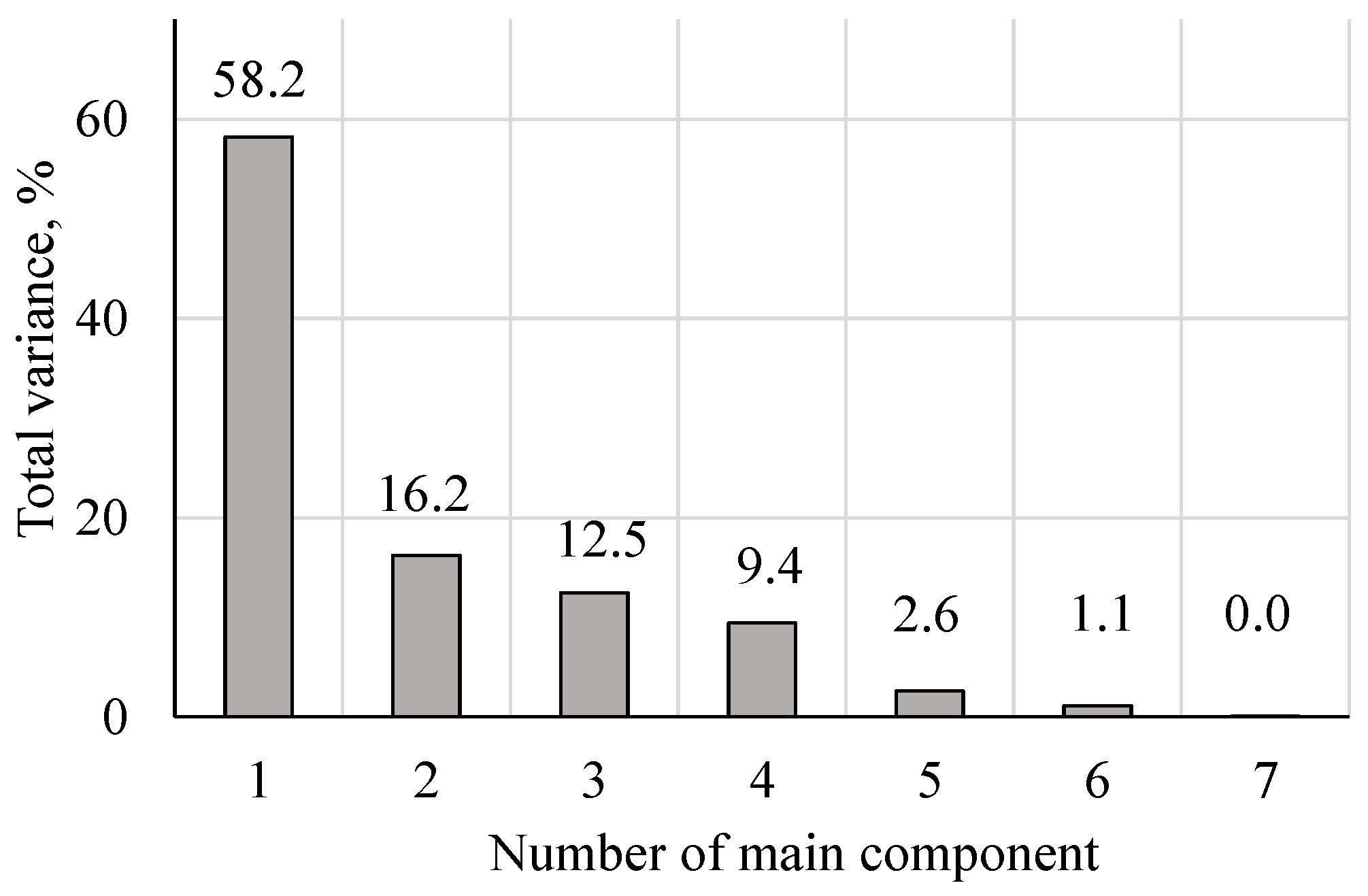
The change in the first three principal components (Figure 4) is responsible for 86% of the total variance of the studied parameters. Thus, it will be sufficient to consider only these components in order to be able to describe the change in the state of the water body under study.
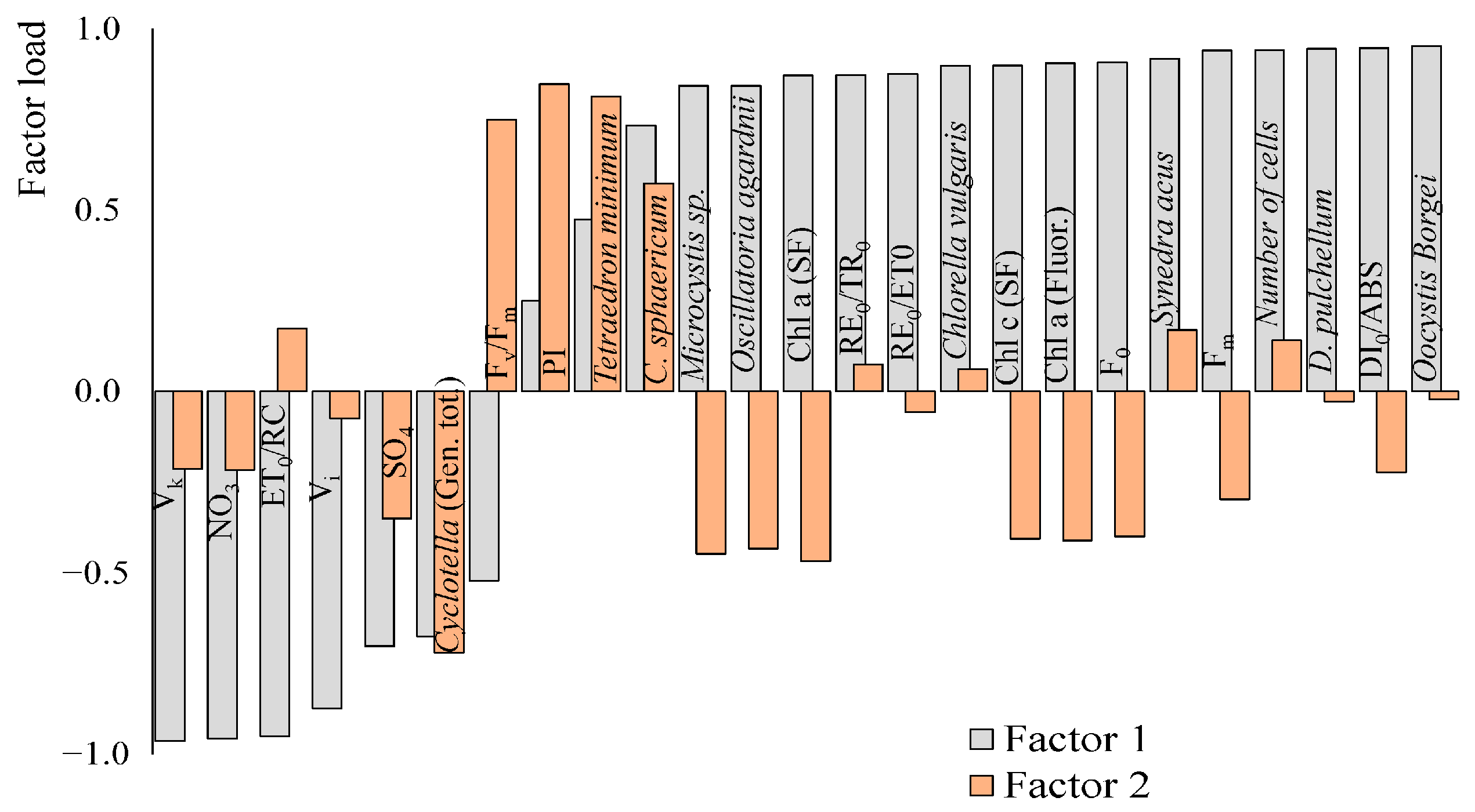
The main changes occurring in the studied section of the Kalmius River bed are caused by two factors. The parameters that determine these factors are shown in Figure 5 as a diagram with the values of the factor loads for each parameter. Total phosphorus, chlorides, and ammonium were not included in the first three principal components, which means that they did not have a significant impact on the state of the water body and the biota. Sulfates and nitrate nitrogen were included in the first factor with high negative factor loads (Figure 5).
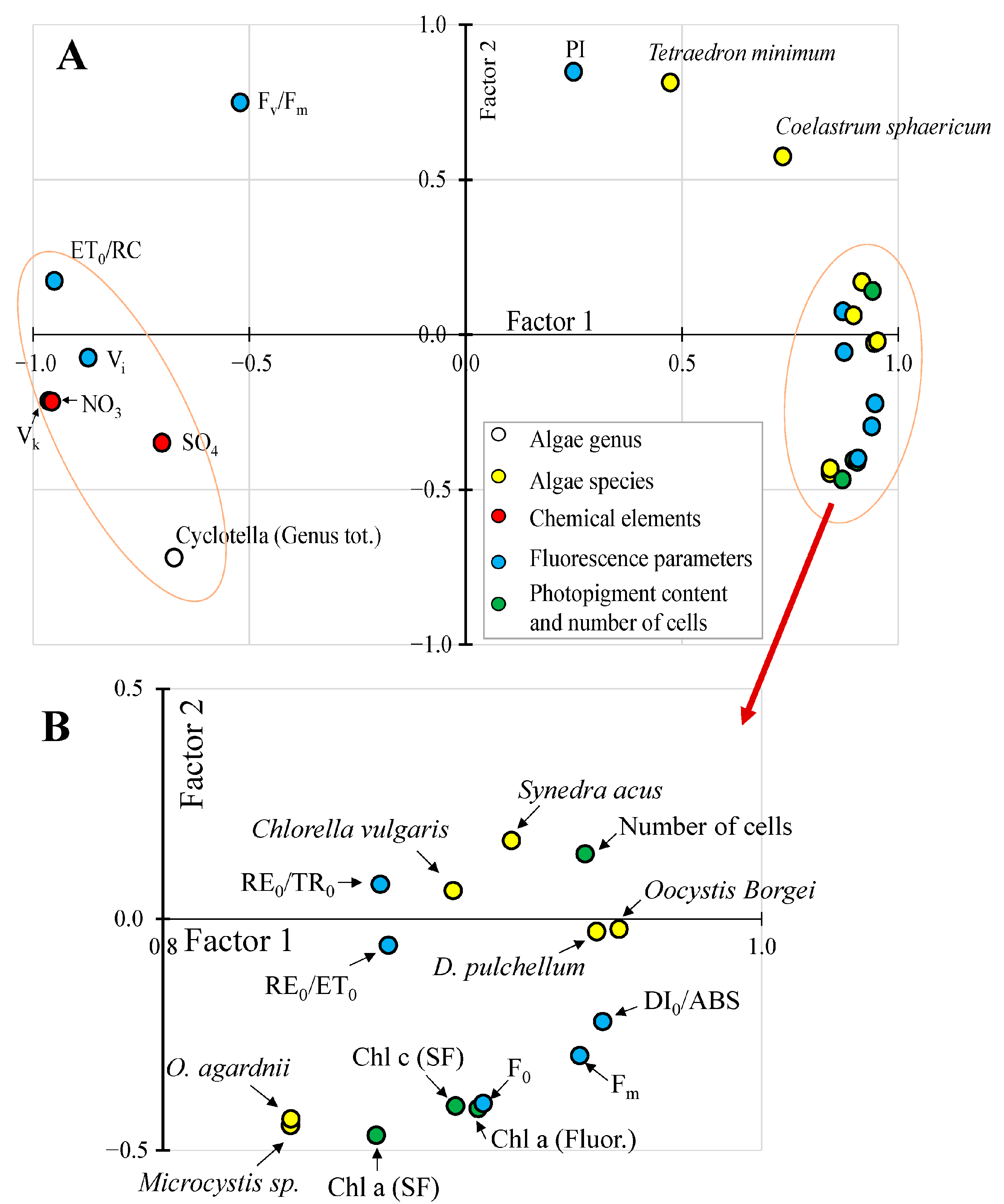
Figure 6 shows a two-dimensional plot of factor loadings, plotted in terms of the first and second effective factors. Since most of the points in the right-hand part of the plot overlap, Figure 6B shows a magnified view of this area. In general, based on multivariate analysis, two main factors can be identified that affect the state of phytoplankton and the studied water body: changes in the abundance of dominant phytoplankton species, an increase in their photosynthetic activity and the overall pigment composition of the environment (Figure 6B), as well as changes in the abundance of Cyclotella species and their photosynthetic activity parameters (Vi and ET0/RC) in relation to changes in the levels of sulfate and nitrate nitrogen (left side of Figure 6).

4. Discussion

The excess chlorides can be attributed to the increased mineralization of the river’s surface waters caused by large volumes of mine water discharged into the riverbed. It was not possible to determine the cause of the excess of phenols in the water samples. Local excesses of MAC were also detected for anionic surfactants at point 1, as well as concentrations of total Ferrum at monitoring point 3 and the lower reaches of the Nizhnekalmiusskoye Reservoir (point 6). An increase in the content of anionic surfactants is usually associated with the discharge of domestic wastewater, while an increase in the Ferrum content is a consequence of the discharge of mine water. According to the data obtained, the water in the Kalmius River bed can be characterized as dirty (pollution class 4, category A).
Changes in water temperature at different monitoring points did not correlate with the species composition of phytoplankton, as well as the content of photopigments and photosynthetic activity. A strong negative correlation was found only for the Vj parameter (Table 6), which is insufficient for reasonable conclusions. It is likely that the presence of nutrients and pollutants in the aquatic environment played a decisive role in comparison with temperature fluctuations. The main influence on the change in the amount of phytoplankton (cell number, content of photopigments) in the Kalmius River is exerted by biogenic substances, in particular the nitrate form of nitrogen (Table 6). At the same time, a negative correlation is traced, which indicates the consumption of the available biogen in the aquatic environment, resulting in an increase in the number of phytoplankton. This relationship is best observed in the Nizhnekamliuskoye Reservoir, where the concentration of nitrate nitrogen decreased from 2.2 mg/L to 0.4 mg/L, while the increase in phytoplankton abundance at monitoring point 6 was 4–5 times higher than at point 3. A strong inverse correlation was observed between the content of biogenic substances and the photosynthetic activity of microalgae cells, which is a result of the intensive growth of phytoplankton in the Nizhnekamliuskoye Reservoir. The concentration of nitrogen-containing inorganic substances, as well as phosphorus, is not high and should not contribute to phytoplankton blooms, but these concentrations were sufficient to compensate for the pollution of surface waters with phenol and anionic surfactants. In the section of the Kalmius River between monitoring points 1 and 6, there was a gradual decrease in the concentrations of phenol and anionic surfactants (Table 2). It is assumed that the pollutants were absorbed by hydrobionts, particularly phytoplankton cells, but due to the intensive growth of microalgae cells in the Nizhnekalmiusskoye Reservoir, the negative effects of pollutants were not observed.
Correlation coefficients do not reflect the relationships between individual phytoplankton species and water environment parameters; therefore, for a more accurate and detailed description of the relationships between the studied parameters, a multivariate factor analysis based on the PCA method was used. When conducting the analysis, the most frequently occurring microalgae species were considered, which were found in most of the monitoring points, while rare species found in individual monitoring points were not taken into account. Thus, the following phytoplankton species were considered: Chlorella ellipsoidea, C. vulgaris, Coelastrum sphaericum, Cyclotella meneghiniana, D. pulchellum, Microcystis sp., Oocystis Borgei, O. agardhii, Oscillatoria sp., S. quadricauda, Synedra acus, and T. minimum. Based on correlations (Table 6) the relationship between the decrease in inorganic nitrogen, including nitrate and ammonium nitrogen, with an increase in the content of photosynthetic pigments in water and the abundance of phytoplankton, i.e., biogen depletion occurs. Factor analysis confirms this relationship but indicates a direct relationship between the genus Cyclotella and the concentration of nitrates and sulfates (Figure 6A). The main increase in the number of dominant phytoplankton species was observed in the lower part of the reservoir (point 6), but only for the genus Cyclotella; nitrogen content was a limiting factor.
The occurrence of the species C. vulgaris, O. agardhii, D. pulchellum, S. acus, O. Borgei, and Microcystis sp. is closely related to changes in the total number of phytoplankton cells, as well as the content of chlorophyll a and c in the water samples (Figure 6). These species are dominant and were found throughout the entire Kalmius River, including the reservoir and the area after the confluence of the tributaries. The species T. minimum and C. sphaericum are also dominant, but they are only found in the riverbed after the reservoir, and do not reflect changes in the state of the water body. The decrease in the total number occurred mainly due to a decrease in the number of green algae and may be caused by pollution of this section of the riverbed with anionic surfactants, phenols and Ferrum.
Thus, the dominance of certain species of phytoplankton is due to several reasons. According to data [67] species C. vulgaris and S. quadricauda are resistant to water pollution, which is confirmed by the results of the study. Nitrate retention in the Kalmius River (points 1 and 3) is 5 times higher than in the Nizhnekalmiusskoye Reservoir (Table 2), causing an intensive increase in species D. pulchellum, O. agardhii and the genus Microcystis. All dominant forms of the phytoplankton belong to the β-mesosaprobic species, which also reflects the degree of pollution of the Kalmius River and its tributaries. A significant increase in the number of genera Oscillatoria and Microcystis leads to seasonal blooming in the Nizhnekalmiusskoye water storage, which is observed annually in autumn. This leads to the deterioration of water quality and fish mortality. The iron contamination of the river caused the growth of the species C. meneghiniana, which according to previous studies [68,69] is not dominant for the Kalmius River, but similar cases of increase in population have been recorded in the southern part of the Kalmius River [69].
Ferrum is generally considered an element of the nutrient medium for phytoplankton [70,71,72]. In studies aimed at identifying the toxic effects of Ferrum, a decrease in the quantum yield of fluorescence and chlorophyll content in the test cultures under study is noted [71]. However, similar changes in fluorescence are also characteristic of the toxic effects of other heavy metal ions on the photosynthetic apparatus of algae [73,74]. Phenol and its derivatives cause a change in the quantum yield of fluorescence, increase the NPQ level, and also have a negative effect on the primary quinone carriers of photosystem II, causing a change in the indicators Vj, M0, Sm, and qE [75,76]. The indicator Vj reflects the change in the number of open and closed reaction centers of photosystems. Therefore, the observed effect can be attributed to the toxic effect of phenol.
According to the results of the fluorimetric analysis of the photosynthetic activity of phytoplankton cells (Figure 3), the most informative parameters were Fv/Fm, PI, RE0/TR0, ET0/TR0, ET0/RC, RE0/RC и DI0/ABS. Based on factor analysis, ET0/RC characterized the state of cells of the genus Cyclotella, RE0/TR0 and DI0/ABS parameters characterized the photosynthetic activity of the dominant forms of phytoplankton, and the overall performance indicators of photosystem II (Fv/Fm and PI) were not associated with any of the phytoplankton species. However, these parameters are often used as indicators for detecting surface water pollution [59,60]. The most significant decreases in Fv/Fm and PI were observed for the Durnaya River, where the phytoplankton cell concentration was lower and the dominant species were not present. Intensive development of phytoplankton took place in the waters of the reservoir, as evidenced by the growth of cell numbers and photopigment concentrations. This was also manifested in an increase in fluorescence intensity. In the upper reaches of the reservoir (point 4), a significant increase in the PI occurred, which indicates an intensification of photosynthetic activity and serves as an indicator of the onset of active division of phytoplankton cells. At points 5 and 6, an increase in the efficiency of electron transfer between PS II carriers was observed (RE0/TR0 and ET0/TR0), as well as an increase in electron flows towards PS I (ET0/RC and RE0/RC). The increase in the intensity of light energy transmission also led to an increase in the processes of thermal dissipation (DI0/ABS) in the antenna complexes of photosystems, as a protective mechanism.
The results of the multivariate analysis indicate that the main factors are the growth processes of the dominant forms of phytoplankton, while the effects of pollutants are not observed. The data obtained make it possible to state that nitrate nitrogen has a greater impact on natural phytoplankton than phenol and anionic surfactants in surface water pollution. The intensive development of dominant forms in the Nizhnekalmiusskoye Reservoir can also be considered the beginning of algae blooming. However, it can also be assumed that there are other chemical components in the environment that have an impact on the natural phytoplankton of the Kalmius River but were not detected during the chemical analysis. In particular, these pollutants include heavy metals, which are the main pollutants in other rivers in the region [4,5,41].

5. Conclusions

The upper reaches of the Kalmius River are polluted, and the surface waters in this part of the river basin are characterized as dirty, with excess of maximum permissible levels for anionic surfactants, sulfates, chlorides, phenol and total Ferrum. The species and quantitative composition of phytoplankton changed in accordance with the hydroregime of the river, with a significant quantitative increase in the Nizhnekalmiusskoye Reservoir, and changes caused by pollution of surface waters also occurred. Changes in photosynthetic activity indicate a negative impact of anionic surfactants and phenol on phytoplankton in the bed of the Kalmius River up to the Nizhnekalmiusskoye Reservoir, as well as phenol and Ferrum on phytoplankton in the Kalmius and Bakhmutka rivers near the metallurgical plant. A strong influence of nitrate nitrogen on the development of the dominant forms of phytoplankton, C. vulgaris, O. agardhii, D. pulchellum, S. acus, O. Borgei, and Microcystis sp., was revealed, while the negative effects of phenol, anionic surfactants, and Ferrum ions on these species were not confirmed. The fluorimetric analysis of photosynthetic activity of phytoplankton significantly expands classical monitoring methods and makes it possible to assess the negative impact of pollutants on the biophysiology of photosynthesis processes.

Author Contributions

Conceptualization, S.C. and B.M.; methodology, S.C. and V.S.; software, S.C.; formal analysis, V.S. and A.M.; investigation, S.C., M.O. and V.S.; data curation, S.C., D.K., M.O. and L.G.; writing—original draft preparation, S.C. and A.M.; writing—review and editing, V.S. and D.K.; visualization—L.G.; project administration, B.M. All authors have read and agreed to the published version of the manuscript.

Funding

This research received no external funding.

Data Availability Statement

The original contributions presented in this study are included in the article. Further inquiries can be directed to the corresponding authors.

Conflicts of Interest

The authors declare no conflicts of interest.

References

  1. Panov, B.S.; Dudik, A.M.; Shevchenko, O.; Matlak, E. On pollution of the biosphere in industrial areas: The example of the Donets coal Basin. Int. J. Coal Geol. 1999, 40, 199–210. [Google Scholar] [CrossRef]
  2. Alemasova, A.S.; Penkova, Y.I.; Pivovarova, A.S.; Ostapenko, R.V. Military activity influence on some metals content in the Saur-Mogila soil, Donbas. Theor. Appl. Ecol. 2018, 3, 33–39. [Google Scholar] [CrossRef]
  3. Zinicovscaia, I.I.; Safonov, A.I.; Yushin, N.S.; Nespirnyi, V.N.; Germonova, E.A. Phytomonitoring in Donbass for Identifying New Geochemical Anomalies. Russ. J. Gen. Chem. 2024, 94, 3472–3482. [Google Scholar] [CrossRef]
  4. Bespalova, S.V.; Romanchuk, S.M.; Chufitskiy, S.V.; Perebeinos, V.V.; Gotin, B.A. Fluorimetric Analysis of the Impact of Coal Sludge Pollution on Phytoplankton. Biophysics 2020, 65, 850–857. [Google Scholar] [CrossRef]
  5. Chufitskiy, S.; Romanchuk, S.; Meskhi, B.; Olshevskaya, A.; Shevchenko, V.; Odabashyan, M.; Teplyakova, S.; Vershinina, A.; Savenkov, D. Assessment of Surface Water Quality in the Krynka River Basin Using Fluorescence Spectroscopy Methods. Plants 2025, 14, 2014. [Google Scholar] [CrossRef] [PubMed]
  6. Kornienko, V.; Pirko, I.; Meskhi, B.; Olshevskaya, A.; Shevchenko, V.; Odabashyan, M.; Teplyakova, S.; Vershinina, A.; Eroshenko, A. Evaluating the Vitality of Introduced Woody Plant Species in the Donetsk–Makeyevka Urban Agglomeration. Plants 2025, 14, 3160. [Google Scholar] [CrossRef]
  7. Kornienko, V.; Reuckaya, V.; Shkirenko, A.; Meskhi, B.; Olshevskaya, A.; Odabashyan, M.; Shevchenko, V.; Teplyakova, S. Silvicultural and Ecological Characteristics of Populus bolleana Lauche as a Key Introduced Species in the Urban Dendroflora of Industrial Cities. Plants 2025, 14, 2052. [Google Scholar] [CrossRef] [PubMed]
  8. Nespirnyi, V.N.; Safonov, A.I. Statistical Analysis of Environmental Monitoring Data in Donbass Region. Ecologica 2025, 32, 189–202. [Google Scholar] [CrossRef]
  9. Safonov, A. Changes in plant CSR strategies under new anthropogenic transformations. E3S Web Conf. 2025, 614, 04022. [Google Scholar] [CrossRef]
  10. Martynov, V.V.; Gubin, A.I.; Nikulina, T.V.; Orlatyi, A.A. The First Record of the Emerald Ash Borer Agrilus planipennis Fairmaire (Coleoptera, Buprestidae) in Donbass. Entomol. Rev. 2024, 104, 279–281. [Google Scholar] [CrossRef]
  11. Gubin, A.I.; Martynov, V.V.; Nikulina, T.V.; Bulysheva, N.I. The first record of the Asian elm aphid Tinocallis (Sappocallis) takachihoensis Higuchi, 1972 (Hemiptera: Aphididae) in the European part of Russia. Acta Biol. Sib. 2024, 10, 1419–1427. [Google Scholar] [CrossRef]
  12. Zinicovscaia, I.; Safonov, A.; Kravtsova, A.; Chaligava, O.; Germonova, E. Neutron Activation Analysis of Rare Earth Elements (Sc, La, Ce, Nd, Sm, Eu, Tb, Dy, Yb) in the Diagnosis of Ecosystems of Donbass. Phys. Part. Nucl. Lett. 2024, 21, 186–200. [Google Scholar] [CrossRef]
  13. Kornienko, V.; Shkirenko, A.; Reuckaya, V.; Meskhi, B.; Dzhedirov, D.; Olshevskaya, A.; Odabashyan, M.; Shevchenko, V.; Mangasarian, D.; Kulikova, N. Taxus baccata L. Under Changing Climate Conditions in the Steppe Zone of the East European Plain. Plants 2025, 14, 1970. [Google Scholar] [CrossRef]
  14. Mirnenko, E.I. Taxonomic diversity of phytoplankton of the Kalmius River and its reservoirs. Ecosyst. Transform. 2022, 5, 3–13. [Google Scholar] [CrossRef]
  15. Mirnenko, E. Ecological monitoring of water bodies: Bioindication, microalgae biodiversity indices. E3S Web Conf. 2024, 555, 02008. [Google Scholar] [CrossRef]
  16. Shevchenko, T.; Klochenko, P.; Nezbrytska, I. Response of phytoplankton to heavy pollution of water bodies. Oceanol. Hydrobiol. Stud. 2020, 49, 267–280. [Google Scholar] [CrossRef]
  17. Barinova, S.; Gabyshev, V.A.; Gabysheva, O.I.; Gabyshev, E.M. Microalgae as Bioindicators of Changes in Permafrost Catchments: A Reference Area of the Olyokma Nature Reserve, Yakutia. Water 2025, 17, 1686. [Google Scholar] [CrossRef]
  18. Tekebayeva, Z.; Bazarkhankyzy, A.; Temirbekova, A.; Rakhymzhan, Z.; Kulzhanova, K.; Beisenova, R.; Kulagin, A.; Askarova, N.; Yevneyeva, D.; Temirkhanov, A.; et al. Ecological Assessment of Phytoplankton Diversity and Water Quality to Ensure the Sustainability of the Ecosystem in Lake Maybalyk, Astana, Kazakhstan. Sustainability 2024, 16, 9628. [Google Scholar] [CrossRef]
  19. Phonmat, P.; Chaichana, R.; Rakasachat, C.; Klongvessa, P.; Chanthorn, W.; Moukomla, S. Phytoplankton and Zooplankton Assemblages Driven by Environmental Factors Along Trophic Gradients in Thai Lentic Ecosystems. Diversity 2025, 17, 372. [Google Scholar] [CrossRef]
  20. Du, W.; Wang, J.; Zhao, X.; Liang, E.; He, J.; Kong, L.; Cai, P.; Xu, N. Algal or bacterial community: Who can be an effective indicator of the impact of reclaimed water recharge in an urban river. Water Resour. 2023, 247, 120821. [Google Scholar] [CrossRef]
  21. Mineeva, N.; Semadeni, I. Chlorophyll Content and Photosynthetic Activity of Phytoplankton in Reservoirs of the Volga River (Russia). Phycology 2023, 3, 368–381. [Google Scholar] [CrossRef]
  22. Xiaofeng, L.; Georgakakos, A.P. Chlorophyll a estimation in lakes using multi-parameter sonde data. Water Resour. 2021, 205, 117661. [Google Scholar] [CrossRef]
  23. Li, H.; Wei, X.; Huang, Z.; Liu, H.; Ma, R.; Wang, M.; Hu, M.; Jiang, L.; Xue, K. Monitoring the Vertical Variations in Chlorophyll-a Concentration in Lake Chaohu Using the Geostationary Ocean Color Imager. Remote Sens. 2024, 16, 2611. [Google Scholar] [CrossRef]
  24. Barinova, S.; Gabyshev, V.A.; Gabysheva, O.I. Response of the Cyanobacteria Plankton Community to Anthropogenic Impact in Small Lakes of Urbanized Territory in the Permafrost Zone of Northeast Asia (Eastern Siberia, Yakutia). Water 2024, 16, 2834. [Google Scholar] [CrossRef]
  25. Zhao, Z.; Li, H.; Sun, Y.; Yang, Q.; Fan, J. Contrasting the assembly of phytoplankton and zooplankton communities in a polluted semi-closed sea: Effects of marine compartments and environmental selection. Environ. Pollut. 2021, 285, 117256. [Google Scholar] [CrossRef]
  26. Wang, J.; Duan, L.; Li, D.; Zhang, Y.; Yuan, Z.; Li, H.; Zhang, H. Comparative Study on the Determination of Chlorophyll-a in Lake Phytoplankton by a YSI Multi-Parameter Water Quality Meter and Laboratory Spectrophotometric Method. Water 2024, 16, 1350. [Google Scholar] [CrossRef]
  27. Ferdinand, O.D.; Friedrichs, A.; Miranda, M.L.; Vob, D.; Zielinski, O. Next generation fluorescence sensor with multiple excitation and emission wavelengths—NeXOS MatrixFlu-UV. In Proceedings of the OCEANS 2017—Aberdeen, Aberdeen, UK, 19–22 June 2017; pp. 1–6. [Google Scholar] [CrossRef]
  28. Kring, S.A.; Figary, S.E.; Boyer, G.L.; Watson, S.B.; Twiss, M.R. Rapid in situ measures of phytoplankton communities using the bbe FluoroProbe: Evaluation of spectral calibration, instrument intercompatibility, and performance range. Can. J. Fish. Aquat. Sci. 2014, 71, 1087–1095. [Google Scholar] [CrossRef]
  29. Zadereev, E.S.; Drobotov, A.V.; Lopatina, T.S.; Ovchinnikov, S.D.; Tolomeev, A.P. Comparison of Rapid Methods Used to Determine the Concentration, Size Structure and Species Composition of Algae. J. Sib. Fed. Univ. Biol. 2021, 14, 5–27. [Google Scholar] [CrossRef]
  30. Catherine, A.; Escoffier, N.; Belhocine, A.; Nasri, A.B.; Hamlaoui, S.; Yéprémian, C.; Bernard, C.; Troussellier, M. On the use of the FluoroProbe®, a phytoplankton quantification method based on fluorescence excitation spectra for large-scale surveys of lakes and reservoirs. Water Resour. 2012, 46, 1771–1784. [Google Scholar] [CrossRef]
  31. Rees, A. Comparison of in Vitro and in Situ Plankton Production Determinations. Aquat. Microb. Ecol. 2009, 54, 13–34. [Google Scholar] [CrossRef]
  32. Suggett, D.J.; Moore, C.M.; Geider, R.J. Estimating Aquatic Productivity from Active Fluorescence Measurements. In Chlorophyll a Fluorescence in Aquatic Sciences: Methods and Applications; Suggett, D., Prášil, O., Borowitzka, M., Eds.; Developments in Applied Phycology; Springer: Dordrecht, The Netherlands, 2010; Volume 4. [Google Scholar] [CrossRef]
  33. Kromkamp, J.C.; Dijkman, N.A.; Peene, J.; Simis, J.G.H.; Gons, H.J. Estimating Phytoplankton Primary Production in Lake IJsselmeer (The Netherlands) Using Variable Fluorescence (PAM-FRRF) and C-Uptake Techniques. Eur. J. Phycol. 2008, 43, 327–344. [Google Scholar] [CrossRef]
  34. Smyth, T. A Methodology to Determine Primary Production and Phytoplankton Photosynthetic Parameters from Fast Repetition Rate Fluorometry. J. Plankton Res. 2004, 26, 1337–1350. [Google Scholar] [CrossRef]
  35. Zhao, D.; Luo, Q.; Qiu, Z. Chromaticity-Based Discrimination of Algal Bloom from Inland and Coastal Waters Using In Situ Hyperspectral Remote Sensing Reflectance. Water 2024, 16, 2276. [Google Scholar] [CrossRef]
  36. Gan, T.; Yin, G.; Zhao, N.; Tan, X.; Wang, Y. A Sensitive Response Index Selection for Rapid Assessment of Heavy Metals Toxicity to the Photosynthesis of Chlorella pyrenoidosa Based on Rapid Chlorophyll Fluorescence Induction Kinetics. Toxics 2023, 11, 468. [Google Scholar] [CrossRef]
  37. Antal, T.; Konyukhov, I.; Volgusheva, A.; Plyusnina, T.; Khruschev, S.; Kukarskikh, G.; Goryachev, S.; Rubin, A. Chlorophyll fluorescence induction and relaxation system for the continuous monitoring of photosynthetic capacity in photobioreactors. Physiol. Plant. 2019, 165, 476–486. [Google Scholar] [CrossRef]
  38. Kaiblinger, C.; Dokulil, M.T. Application of fast repetition rate fluorometry to phytoplankton photosynthetic parameters in freshwaters. Photosynth. Res. 2006, 88, 19–30. [Google Scholar] [CrossRef]
  39. Oxborough, K.; Moore, C.M.; Suggett, D.J.; Lawson, T.; Chan, H.G.; Geider, R.J. Direct estimation of functional PSII reaction center concentration and PSII electron flux on a volume basis: A new approach to the analysis of Fast Repetition Rate fluorometry (FRRf) data. Limnol. Oceanogr. Methods 2012, 10, 142–154. [Google Scholar] [CrossRef]
  40. Campbell, D.A.; Tyystjärvi, E. Parameterization of Photosystem II Photoinactivation and Repair. Biochim. Biophys. Acta 2012, 1817, 258–265. [Google Scholar] [CrossRef]
  41. Udod, V.M.; Zhukova, E.G. Regional-ecological approach to the assessment of possible aftermath of pollution of water basin of the Kalmius River. J. Water Chem. Technol. 2015, 37, 48–50. [Google Scholar] [CrossRef]
  42. Nazarenko, O.V. Hydrochemical features of rivers in coal mining areas (a study of East Donbass). In Proceedings of the 17th International Multidisciplinary Scientific Geoconference SGEM 2017, Albena, Bulgaria, 29 June–5 July 2017; Volume 17, pp. 371–378. [Google Scholar] [CrossRef]
  43. Mama, C. A Comparative evaluation of the water quality standards of different countries. Asian J. Water Environ. Pollut. 2016, 13, 15–28. [Google Scholar] [CrossRef]
  44. Lumb, A.; Halliwell, D.; Sharma, T. Application of CCME water quality index to monitor water quality: A case study of the Mackenzie River Basin, Canada. Environ. Monit. Assess. 2006, 113, 411–429. [Google Scholar] [CrossRef]
  45. Teshome, F.B. Seasonal water quality index and suitability of the water body to designated uses at the eastern catchment of Lake Hawassa. Environ. Sci. Pollut. Res. Int. 2020, 27, 279–290. [Google Scholar] [CrossRef]
  46. Hossain, M.; Patra, P.K. Water pollution index—A new integrated approach to rank water quality. Ecol. Indic. 2020, 117, 106668. [Google Scholar] [CrossRef]
  47. WHO. Guidelines for Drinking-Water Quality, 4th ed.; World Health Organization: Geneva, Switzerland, 2011. [Google Scholar]
  48. SanPin 2.1.4.1074-01; Drinking Water Hygienic Requirements for Water Quality of Centralized Drinking Water Supply Systems. Quality Control (Instead SanPin 2.1.4.559-96). Chief State Sanitary Physician of the Russian Federation: Moscow, Russia, 2001.
  49. Moshkova, N.A.; Hollerbach, M.M. (Eds.) Key to Freshwater Algae of the USSR; Nauka: Leningrad, Russia, 1986. [Google Scholar]
  50. Sadchikov, A.P. Methods of Studying Freshwater Phytoplankton, 1st ed.; Publishing House “University and School”: Moscow, Russia, 2003; pp. 67–79. [Google Scholar]
  51. Kiselev, I.A. Plankton of the Sea and Continental Reservoirs, 1st ed.; Nauka: Leningrad, Russia, 1969; 658p. [Google Scholar]
  52. Guiry, M.D.; Guiry, G.M. AlgaeBase World-Wide Electronic Publication; National University of Ireland: Galway, Ireland, 2013; Available online: http://www.algaebase.org (accessed on 15 March 2026).
  53. Medvedeva, L.A.; Nikulina, T.V. Catalogue of Freshwater Algae of the Southern Part of the Russian Far East; Dalnauka: Vladivostok, Russia, 2014; 271p. [Google Scholar]
  54. Jeffrey, S.W.; Humphrey, G.F. New spectrophotometric equations for determining chlorophyll a, b, c1 and c2 in higher plants, algae and natural phytoplankton. Biochem. Physiol. Pflanz. 1975, 167, 191–194. [Google Scholar] [CrossRef]
  55. Ritchie, R.J. Universal chlorophyll equations for estimating chlorophylls a, b, c, and d and total chlorophylls in natural assemblages of photosynthetic organisms using acetone, methanol, or ethanol solvents. Photosynthetica 2008, 46, 115–126. [Google Scholar] [CrossRef]
  56. Vieira, N.; Amat, F. Variation in chlorophyll a concentrations and Margalef’s index of pigment diversity in two solar salt ponds, Aveiro, Portugal. Int. J. Salt Lake Res. 1993, 2, 41–45. [Google Scholar] [CrossRef]
  57. Stirbet, A.; Govindjee. On the relation between the Kautsky effect (chlorophyll a fluorescence induction) and Photosystem II: Basics and applications of the OJIP fluorescence transient. J. Photochem. Photobiol. B Biol. 2011, 104, 236–257. [Google Scholar] [CrossRef]
  58. Vredenberg, W.; Durchan, M.; Prášil, O. The analysis of PS II photochemical activity using single and multi-turnover excitations. J. Photochem. Photobiol. B Biol. 2012, 107, 45–54. [Google Scholar] [CrossRef]
  59. Strasser, R.J.; Srivastava, A.; Govindjee. Polyphasic chlorophyll a fluorescent transient in plants and cyanobacteria. Photochem. Photobiol. 1999, 61, 32–42. [Google Scholar] [CrossRef]
  60. Stirbet, A.; Lazar, D.; Kromdijk, J.; Govindjee. Chlorophyll a fluorescence induction: Can just a one-second measurement be used to quantify abiotic stress responses? Photosynthetica 2018, 56, 86–104. [Google Scholar] [CrossRef]
  61. Sarmento, R.; Costa, V. Factor Analysis. Comparative Approaches to Using R and Python for Statistical Data Analysis; IGI Global Scientific Publishing: Hershey, PA, USA, 2017; pp. 148–178. [Google Scholar] [CrossRef]
  62. Cullis, B.R.; Jefferson, P.; Thompson, R.; Smith, A.B. Factor analytic and reduced animal models for the investigation of additive genotype-by-environment interaction in outcrossing plant species with application to a Pinus radiata breeding programme. Theor. Appl. Genet. 2014, 127, 2193–2210. [Google Scholar] [CrossRef]
  63. Rao, A.R.; Burke, T.T. Principal Component Analysis of Hydrologic Data. In Integrated Approach to Environmental Data Management Systems; Harmancioglu, N.B., Alpaslan, M.N., Ozkul, S.D., Singh, V.P., Eds.; NATO ASI Series; Springer: Dordrecht, The Netherlands, 1997; Volume 31. [Google Scholar] [CrossRef]
  64. Benkov, I.; Varbanov, M.; Venelinov, T.; Tsakovski, S. Principal Component Analysis and the Water Quality Index—A Powerful Tool for Surface Water Quality Assessment: A Case Study on Struma River Catchment, Bulgaria. Water 2023, 15, 1961. [Google Scholar] [CrossRef]
  65. Maji, K.J.; Chaudhary, R. Principal Component Analysis for Water Quality Assessment of the Ganga River in Uttar Pradesh, India. Water Resour. 2019, 46, 789–806. [Google Scholar] [CrossRef]
  66. Malhotra, A.; Ormeci, B. Detection and Monitoring of Cyanobacteria and Green Algae in River Water Using Derivative Spectrophotometry. Soc. Sci. Res. Netw. 2022, 238. [Google Scholar] [CrossRef]
  67. Palmer, C.M. Composite rating of algae of tolerating organic pollution. Br. Phycol. Bull. 1969, 5, 78–92. [Google Scholar] [CrossRef]
  68. Bestawy, E. X-Ray Microanalytical Study on Cyclotella meneghiniana (Bacillariophyceae) as a Bio-indicator for Metal Pollution in Marine and Fresh Water Environments. Pak. J. Biol. Sci. 2000, 3, 1500–1505. [Google Scholar] [CrossRef][Green Version]
  69. Chufitskiy, S.; Meskhi, B.; Olshevskaya, A.; Shevchenko, V.; Odabashyan, M.; Kozyrev, D.; Mirzoyan, A.; Vershinina, A.; Gukasyan, L. Impact of Surface Water Pollution on Biodiversity and Photosynthetic Activity of Phytoplankton in the Kalmius River. Diversity 2026, 18, 188. [Google Scholar] [CrossRef]
  70. Fukuzaki, K.; Yoshioka, T.; Sawayama, S.; Imai, I. Iron requirements of Heterosigma akashiwo (Raphidophyceae), Heterocapsa circularisquama (Dinophyceae) and two common centric diatoms. Bull. Fish. Sci. Hokkaido Univ. 2016, 66, 121–128. [Google Scholar] [CrossRef]
  71. Golub, N.B.; Tsvetkovych, M.; Levtun, I.I.; Maksyn, V.I. Nanostructured ferric citrate effect on Chlorella vulgaris development. Biotechnol. Acta 2018, 11, 47–54. [Google Scholar] [CrossRef]
  72. Wan, M.; Jin, X.; Xia, J.; Rosenberg, J.N.; Yu, G.; Nie, Z.; Oyler, G.A.; Betenbaugh, M.J. The effect of iron on growth, lipid accumulation, and gene expression profile of the freshwater microalga Chlorella sorokiniana. Appl. Microbiol. Biotechnol. 2014, 98, 9473–9481. [Google Scholar] [CrossRef]
  73. Zayadan, B.K.; Akmuhanova, N.R.; Sadvakasova, A.K.; Kirbaeva, D.K.; Bolatkhan, K.; Bauyenova, M.O. Influence of heavy metals on fluorescence activity of perspective strains of microalgae and cyanobacteria. Int. J. Biol. 2016, 9, 42–45. [Google Scholar] [CrossRef]
  74. Samson, G.; Popovic, R. Use of algal fluorescence for determination of phytotoxicity of heavy metals and pesticides as environmental pollutants. Ecotoxicol. Environ. Saf. 1988, 3, 272–278. [Google Scholar] [CrossRef] [PubMed]
  75. Matorin, D.N.; Plekhanov, S.E.; Bratkovskaya, L.B.; Yakovleva, O.V.; Alekseev, A.A. The effect of phenols on the parameters of chlorophyll fluorescence and reactions of P700 in green algae Scenedesmus quadricauda. Biophysics 2014, 59, 374–379. [Google Scholar] [CrossRef]
  76. Sun, G.; Zhang, X.; Zhang, F.; Wang, Y.; Wu, Y.; Jiang, Z.; Hao, S.; Ye, S.; Zhang, H.; Zhang, X. Use microalgae to treat coke wastewater for producing biofuel: Influence of phenol on photosynthetic properties and intracellular components of microalgae. Chemosphere 2024, 349, 140805. [Google Scholar] [CrossRef] [PubMed]
Figure 1. Map of the location of monitoring points of the Kalmius riverbed in the city of Donetsk.
Diversity 18 00297 g001
Figure 2. Changes in the content of photopigments and the number of phytoplankton cells in the studied monitoring points.
Diversity 18 00297 g002
Figure 3. Parameters of the OJIP test of fluorescence induction curves of natural phytoplankton of the upper reaches of the Kalmius River: (A) points from 1 to 6; (B) points from 6 to 11.
Diversity 18 00297 g003
Figure 4. Results of multivariate analysis of the obtained data: percentage of the total variance of the principal components extracted during the analysis of the obtained data using PCA.
Diversity 18 00297 g004
Figure 5. Values of the factor loadings of the measured parameters based on a multivariate analysis of the obtained data.
Diversity 18 00297 g005
Figure 6. Graph of factor loadings for indicators of phytoplankton condition, species composition, and chemical components of the aquatic environment, grouped based on factor analysis: (A) General view of the graph; (B) Enlarged right-hand part of the figure.
Diversity 18 00297 g006
Table 1. OJIP-test parameters [60].
F0minimal fluorescence;
Fmmaximum fluorescence;
Fv Fm−1maximum quantum fluorescence yield;
Vjvariable fluorescence at J-phase, reflects the proportion of closed reaction centers in photosystem II;
Vivariable fluorescence at I-phase, reflects the ability of photosystem I acceptors to oxidize a plastoquinone pool;
Vkvariable fluorescence at 0.3 ms;
PItotal photosynthetic activity performance index;
RE0 ET0−1efficiency of electron transfer from plastoquinone to photosystem I acceptors;
ET0 ABS−1Quantum yield of electron transport between primary quinone and plastoquinone pool;
RE0 ABS−1Quantum yield of electron transport between primary quinone and to photosystem I acceptors;
DI0 ABS−1Quantum yield of energy dissipation in photosystem II antennae;
RE0 RC−1the flux of electrons transferred between primary quinone and to photosystem I acceptors;
ET0 RC−1the flux of electrons transferred between primary quinone and plastoquinone pool;
TR0 RC−1maximum trapped exciton flux per active photosystem II;
DI0 RC−1the flux of dissipated energy.
Table 2. Physical and chemical parameters of water samples.
MPCPoint 1Point 3Point 6Point 8Point 8/1Point 10Point 11
Temperature, °C9.58.59.513109.510.5
Total nitrogen, mg L−14.144.412.585.73.265.42.93
Phosphorus total, mg L−13.50.0450.0910.0440.1380.0230.3610.07
Anionic surfactants, mg L−10.50.6170.4080.3510.4260.4610.4560.486
Sulfates, mg L−1500793786710755702968797
Chlorides, mg L−1350113010911500>1800151613971714
Nitrite, mg L−1300.009000.030.5740.021
Nitrate, mg L−1452.22.180.4020.9941.052.41.17
Phenols, mg L−10.12.151.630.1721.650.1580.3070.163
Ferrum total, mg L−10.30.2480.3710.0971.050.1390.1710.166
Ammonium, mg L−11.5n/o0.286n/o0.040.0840.7180.158
Table 3. Systematic structure of phytoplankton of the Kalmius River and its tributaries.
DivisionClassOrderFamilyGenusSpeciesIdentified to
Genus
Bacillariophyta268967
Chlorophyta25714215
Cyanobacteria144463
Euglenozoa11233
Streptophyta11222
Total71723323518
Table 4. Content of photopigments (Chl—chlorophyll) in water samples from the Kalmius River and its tributaries in Donetsk.
Pigments, µg L−1Chl aChl a
(Without Pheophytin)
PheophytinChl bChl c1 and c2Cyanobacterial CarotenoidsDiatom
Carotenoids
Pigment Index (D430/D664)
Point 11.450.590.000.009.960.320.797.75
Point 20.000.000.000.000.001.213.030.00
Point 31.562.932.360.0021.631.403.503.52
Point 420.6024.967.620.00107.828.0620.162.14
Point 589.5788.680.000.00359.2033.3683.392.01
Point 6129.98133.817.580.00540.4247.20117.992.01
Point 728.4732.787.590.00155.6711.4328.582.33
Point 812.8920.4212.950.00111.408.5521.362.65
Point 8/118.3721.144.880.0099.457.8919.712.31
Point 90.000.000.000.003.550.260.660.00
Point 100.000.360.610.007.480.631.569.00
Point 1111.4213.814.170.0068.975.4513.632.44
Table 5. Values of the correlation coefficients between the number of phytoplankton cells and the content of photopigments (Chl–chlorophyll).
Chl a (Fluor.)Number of CellsChl a (SF)Chl a, Without Pheo (SF)Chl c (SF)
Chlorophyll a (Fluor.)0.7640.9850.9910.992
Number of cells0.7640.7160.7290.740
Chlorophyll a (SF)0.9850.7160.9980.994
Chlorophyll a, without Pheo (SF)0.9910.7290.9980.999
Chlorophyll c (SF)0.9920.7400.9990.999
Table 6. Values of the Kendall rank correlation coefficient between water temperature (Temp.), chemical composition of water samples, the content of photopigments, photosynthetical activity and the number of phytoplankton cells in the Kalmius River.
Chl a (SF)Chl cChl a (Fluor.)Number of CellsF0FmVkVjViRE0/TR0RE0/ET0DI0/ABSET0/RCRE0/RC
Ntotal−0.43−0.33−0.62−0.71−0.52−0.430.520.050.24−0.24−0.24−0.430.710.71
PO42−−0.43−0.33−0.62−0.52−0.52−0.430.520.240.24−0.24−0.24−0.430.520.33
SO42−−0.71−0.62−0.52−0.43−0.62−0.520.620.330.33−0.33−0.33−0.520.430.05
Cl0.240.330.240.330.330.24−0.33−0.81−0.620.620.620.43−0.330.24
NO3−0.90−1.00−0.71−0.62−0.81−0.710.810.520.71−0.71−0.71−0.900.620.24
NH+4−0.49−0.59−0.49−0.39−0.59−0.290.590.290.49−0.49−0.49−0.680.390.20
Temp.0.210.310.210.310.310.10−0.31−0.72−0.510.510.510.41−0.310.31
Disclaimer/Publisher’s Note: The statements, opinions and data contained in all publications are solely those of the individual author(s) and contributor(s) and not of MDPI and/or the editor(s). MDPI and/or the editor(s) disclaim responsibility for any injury to people or property resulting from any ideas, methods, instructions or products referred to in the content.