Article

Resource–Disturbance Trade-Offs Regulate Grassland Plant Diversity Across Experimental and Model Systems


1
Research Center of Soil and Water Conservation and Ecological Environment, Chinese Academy of Sciences and Ministry of Education, Yangling 712100, China
2
Institute of Soil and Water Conservation, Chinese Academy of Sciences and Ministry of Water Resources, Yangling 712100, China
3
University of Chinese Academy of Sciences, Beijing 100049, China
4
Haixi Prefecture Forestry Station, Delingha 817000, China
5
State Key Laboratory of Soil and Water Conservation and Desertification Control, College of Soil and Water Conservation Science and Engineering, Northwest A&F University, Yangling 712100, China
6
College of Grassland Agriculture, Northwest A&F University, Yangling 712100, China
*
Author to whom correspondence should be addressed.
Diversity 2026, 18(5), 296; https://doi.org/10.3390/d18050296
Submission received: 31 March 2026 / Revised: 13 May 2026 / Accepted: 13 May 2026 / Published: 15 May 2026
(This article belongs to the Section Biogeography and Macroecology)

Abstract

Disentangling the joint effects of resource availability and disturbance on plant diversity is fundamental to understanding community assembly. We developed a stochastic extension of the Lotka–Volterra model that explicitly incorporates resource facilitation and disturbance-induced mortality, both mediated by species-specific trait responses. Combining simulations with a long-term field experiment manipulating nitrogen addition and mowing, we show that mowing consistently increased species diversity, whereas nitrogen addition reduced it, with no significant interaction between the two factors. Notably, mowing increased evenness, suggesting that higher diversity can coincide with more even abundance distributions. Simulations reproduced these patterns and revealed a non-linear resource–disturbance relationship: diversity declined under high-resource, low-disturbance conditions but was maintained at intermediate disturbance and moderate-to-low resource levels. This pattern was further supported by shifts in evenness and dominance across environmental gradients. Our results demonstrate that plant diversity emerges from a balance between resource-driven competitive exclusion and disturbance-mediated coexistence, modulated by species-specific traits.

1. Introduction

The mechanisms that maintain species diversity have always been one of the central topics in ecological research [1]. In community ecology, the Lotka–Volterra competition model serves as a fundamental theoretical framework for describing interactions between species [2,3], characterizing the dynamics of multi-species populations and their coexistence conditions through a series of differential equations [4,5]. The classical Lotka–Volterra model assumes that population growth rates are linearly regulated by intraspecific and interspecific competition, and its equilibrium solutions reveal the theoretical basis for the competitive exclusion principle and niche differentiation [6]. A growing body of empirical research has tested the applicability of this framework in real ecological systems by parameterizing or validating Lotka–Volterra dynamics with field and experimental data. For example, grassland competition experiments have directly estimated species interaction coefficients and shown that empirically derived parameters can reproduce coexistence patterns, while also revealing strong temporal variability in competitive strength across seasons [7]. Extensions incorporating non-linear density dependence, such as crowding effects, have further been supported by empirical observations that high-density mortality enhances intraspecific regulation and promotes multispecies coexistence [8,9].
These studies illustrate that while the classical Lotka–Volterra model provides a foundational theoretical framework, empirical evidence increasingly supports the need to incorporate environmental variability, non-linear interactions, and indirect effects to better explain species coexistence in natural ecosystems [10,11,12]. At present, there is no dynamic model that simultaneously incorporates resource limitation factors and environmental disturbance factors to simulate the long-term diversity changes in actual grassland communities [7,9,13,14]. Based on the classical Lotka–Volterra model, this study constructs a stochastic population dynamics model incorporating both resource facilitation effects and environmental disturbance effects [15]. To investigate the role of the aforementioned mechanisms in shaping species diversity, this study designed a large-scale simulation experiment: 100 plots with randomly generated initial species compositions were created, each with no more than 35 species initially. The model was iterated for 5000 iterations.
The core innovation of the model lies in the introduction of two key parameters: the population growth term e p · e η i driven by resource abundance, and the population reduction term e k · e θ i caused by environmental disturbance. Here, ep and ek represent the levels of resource availability and environmental stress intensity, respectively, while η i and θ i are species-specific trait parameters designed to characterize different species differential responses to resource fluctuations and environmental perturbations. This setup allows the model to simultaneously simulate the combined effects of positive facilitation (such as nutrient enrichment and interspecific facilitation) and negative disturbance (such as extreme climate and anthropogenic disturbances) on population dynamics, thereby better capturing the complexity of real ecosystems [7,15].
Afterward, the diversity indices of each plot were calculated, including species richness, Shannon–Wiener diversity index, Berger–Parker dominance index, and Pielou’s evenness index [16,17,18].
In addition, this study utilized controlled experiments simulating long-term nitrogen addition and mowing to validate the patterns predicted by the model [12,19]. By analyzing the changes in biodiversity under combinations of different resource levels and disturbance intensities, it aims to reveal how the trade-off between resource facilitation and environmental disturbance influences the process of community assembly [20]. The research results are expected to provide a new theoretical perspective for understanding the mechanisms that maintain biodiversity in natural ecosystems, and to offer simulation-based guidance for practical applications such as grassland management and biodiversity conservation.

2. Materials and Methods

2.1. Overview of the Research Area

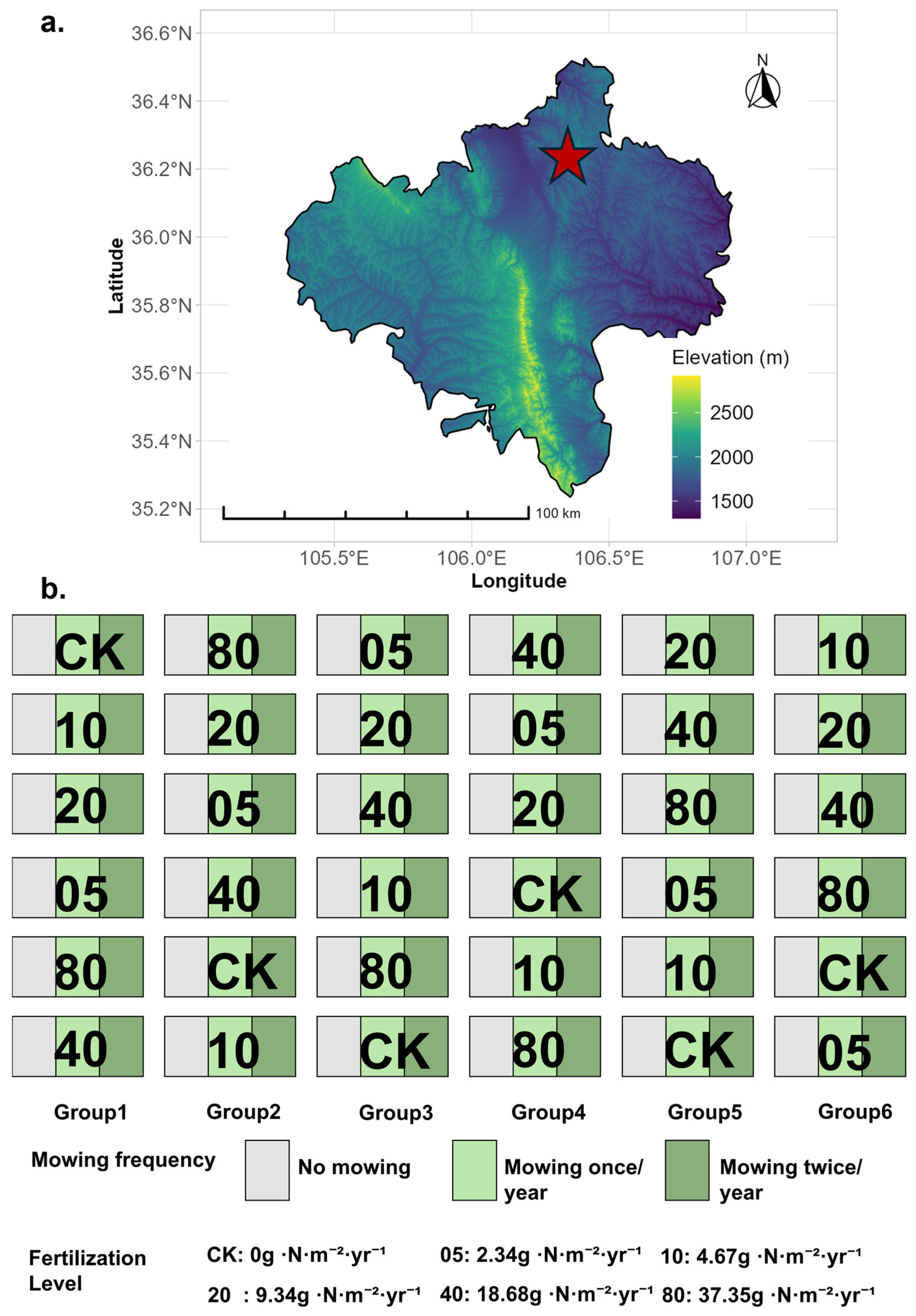
The Ningxia Yunwu Mountain National Grassland Nature Reserve is located in the northeastern part of Guyuan City, Ningxia Hui Autonomous Region, between 106°21′–106°27′ east longitude and 36°10′–36°17′ north latitude (Figure 1). It lies within the temperate semi-arid climatic zone, characterized by a dry climate with scarce and concentrated rainfall. The average annual temperature is 5 °C, and the average annual precipitation is 445 mm [21].

2.2. Nitrogen Addition and Mowing Experiments

Since 2013, a randomized block design has been used, with a total of 108 plots measuring 5 m × 10 m, divided into 6 blocks. Each block contains different gradients of nitrogen enrichment and mowing treatments. To reduce edge effects, a 2 m wide buffer zone was set between all plots. The nitrogen enrichment treatment used urea as the nitrogen source, with 6 gradients set as 0, 5, 10, 20, 40, and 80 g m−2 yr−1 of urea, equivalent to 0, 2.34, 4.67, 9.34, 18.68, and 37.35 g N m−2 yr−1, applied uniformly in late April every year. The mowing treatment was set at 3 gradients of 0, 1, and 2 cuts every year, removing the aboveground parts of the vegetation.

2.3. Sample Plot Survey

This study conducted plot surveys in August 2024 and 2025 by randomly selecting standardized 1 m × 1 m grassland plots. We recorded the species names of all plants appearing within the plots, visually estimated the coverage of each species within the plot, measured the maximum natural height of the plants using a tape measure, and counted the aboveground ramet density to represent abundance.

2.4. Model Simulation

This study is based on the discrete-time Lotka–Volterra competition model and constructs a stochastic population dynamics model, including resource facilitation and environmental disturbance effects, which is used to simulate multi-species population dynamics in plant communities [7]. The model expression is as follows:
N i , t + 1 = r i N i , t 1 + j = 1 S α i j N j , t + e p · e η i e k · e θ i + N i , t
Here, N i , t denotes the population size of species i at time t (generations), where t = 0, 1, …, T, represents the number of discrete generations; r i is the intrinsic growth rate of species i, reflecting the potential growth ability of the species under conditions without competition and disturbance [22]; and α i j is the competition coefficient of species j against species i. The summation term characterizes the total competitive pressure on species i from all species within the community (including itself), where S represents the total number of species in the community. The term e p · e η i represents the promoting effect of abundant resources on population growth, where ep is the coefficient of global resource availability, and η i represents the functional trait of species’ strategy and is used to simulate the differential responses of different species to resource fluctuations; this term is always non-negative, and the promoting effect is ensured not to become negative by using an exponential form. The term e k · e θ i denotes the inhibitory effect of environmental disturbance on population reduction, where ek is the global environmental stress coefficient, and θ i is also a species-specific functional trait that is used to simulate the differential responses of different species to the intensity of disturbance. This non-negative term ensures the non-negativity of the disturbance effect through an exponential form.
In the model, resource facilitation and environmental disturbance are linearly added to the competition term, jointly regulating the population growth rate. To investigate the effects of resource facilitation and environmental disturbance on species diversity, this study randomly generated 100 virtual plots. The initial number of species in each plot was uniformly randomly selected between 3 and 35, and the initial population size of each species was 1. The model iterated for 10 generations, with 5000 time-step iterations. Each time-step iteration simulates population changes over 1 week, and every 50 iterations represent 1 year; that is, one generation.

2.5. Species Diversity Index

This study uses the relative abundance p of populations to calculate species diversity indices: Simpson diversity index, Shannon–Wiener diversity index, Pielou’s evenness index [23], and Berger–Parker dominance index [24]. These four indices are calculated as follows:
L = 1 i = 1 S p i 2
H = i = 1 s p i · ln p i
J = H ln s = i = 1 s p i · ln p i ln s
D = m a x n 1 , , n i , , n S i = 1 s n i
where L represents the Simpson diversity index, H represents the Shannon–Wiener index, J represents Pielou’s index, D represents the Berger–Parker dominance index, pi denotes the importance value of the i-th species in the community, ni represents the number of individuals in the i-th population in the community, and S is the number of populations in the community.

2.6. Statistical Test

In this study, for Shannon–Wiener diversity, which meets the assumptions of normal distribution and homogeneity of variance, we used two-way analysis of variance (ANOVA) to test the effects of nitrogen addition, mowing, and their interaction. For Simpson diversity, Pielou’s evenness, and Berger–Parker dominance, which do not meet the assumption of normal distribution, we used the Scheirer–Ray–Hare rank test to analyze the effects of nitrogen addition, mowing, and their interaction. All models and analyses were performed using R version 4.4.3.

3. Results

3.1. Resource Availability and Disturbance Intensity Change Coexistence Patterns

3.1.1. Resource Availability and Disturbance Intensity Affect the Development Process of Community Diversity

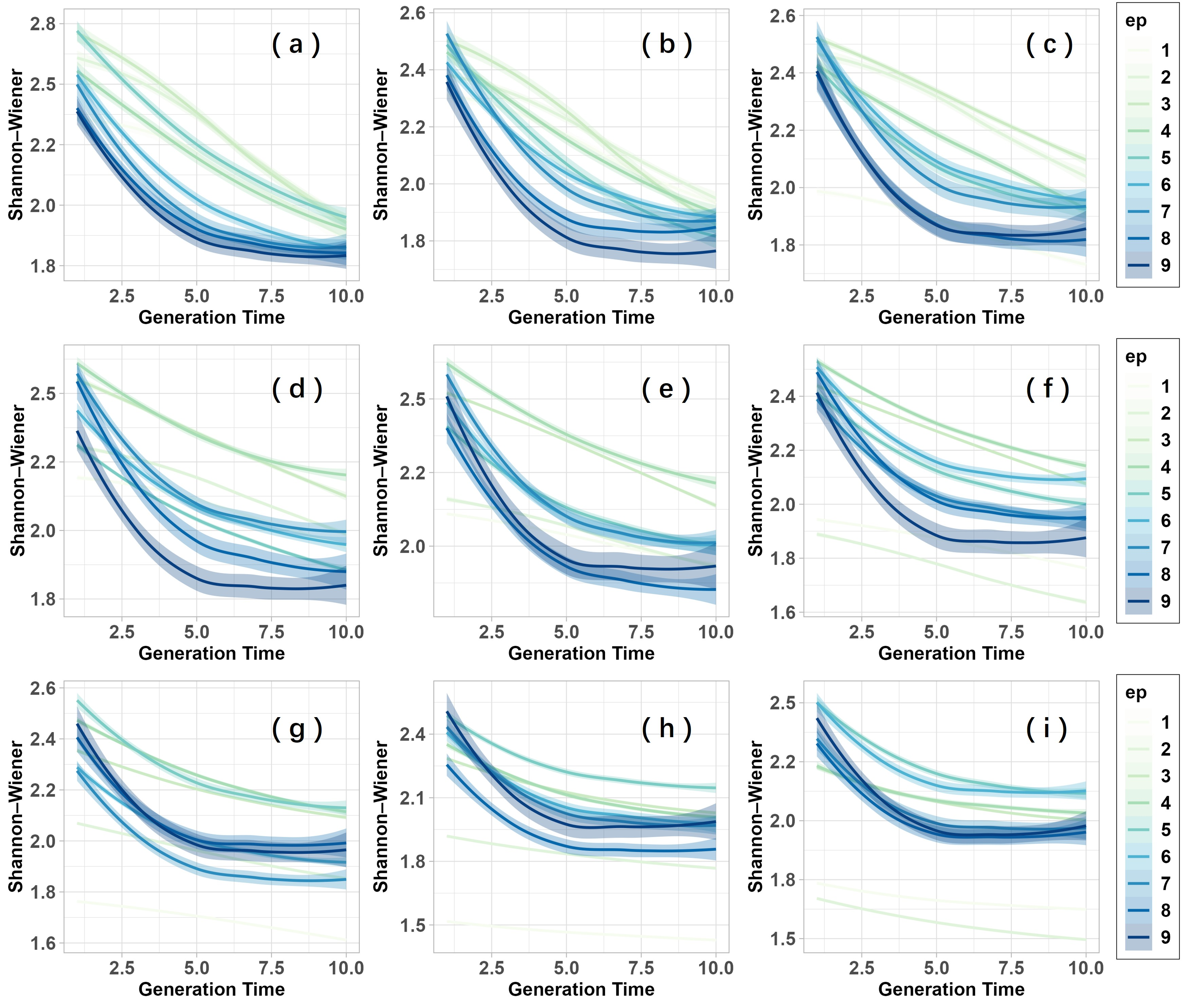
Simulation results show that resource availability and disturbance intensity together determine the dynamics of community diversity, there is a potential interaction effect between resources and disturbance (Figure 2).
At low disturbance intensity, in communities with low resource availability, species diversity decreases slowly with the shortening of generational time, whereas in communities with high resource availability, diversity declines rapidly, and in stable generations, diversity is even lower. Under moderate disturbance, species diversity in low resource availability communities drops sharply, while in communities with medium and high resource availability, diversity, after an initial decline, stabilizes quickly and shows a potential upward trend. Under high disturbance, species diversity in low resource availability communities decreases sharply, whereas communities with high and medium resource availability maintain good diversity. Overall, under moderate disturbance intensity, in scenarios with medium to low resource availability, the average final diversity maintained by simulated communities is actually higher.

3.1.2. Resource Availability and Disturbance Intensity Affect the Final Evenness of the Community

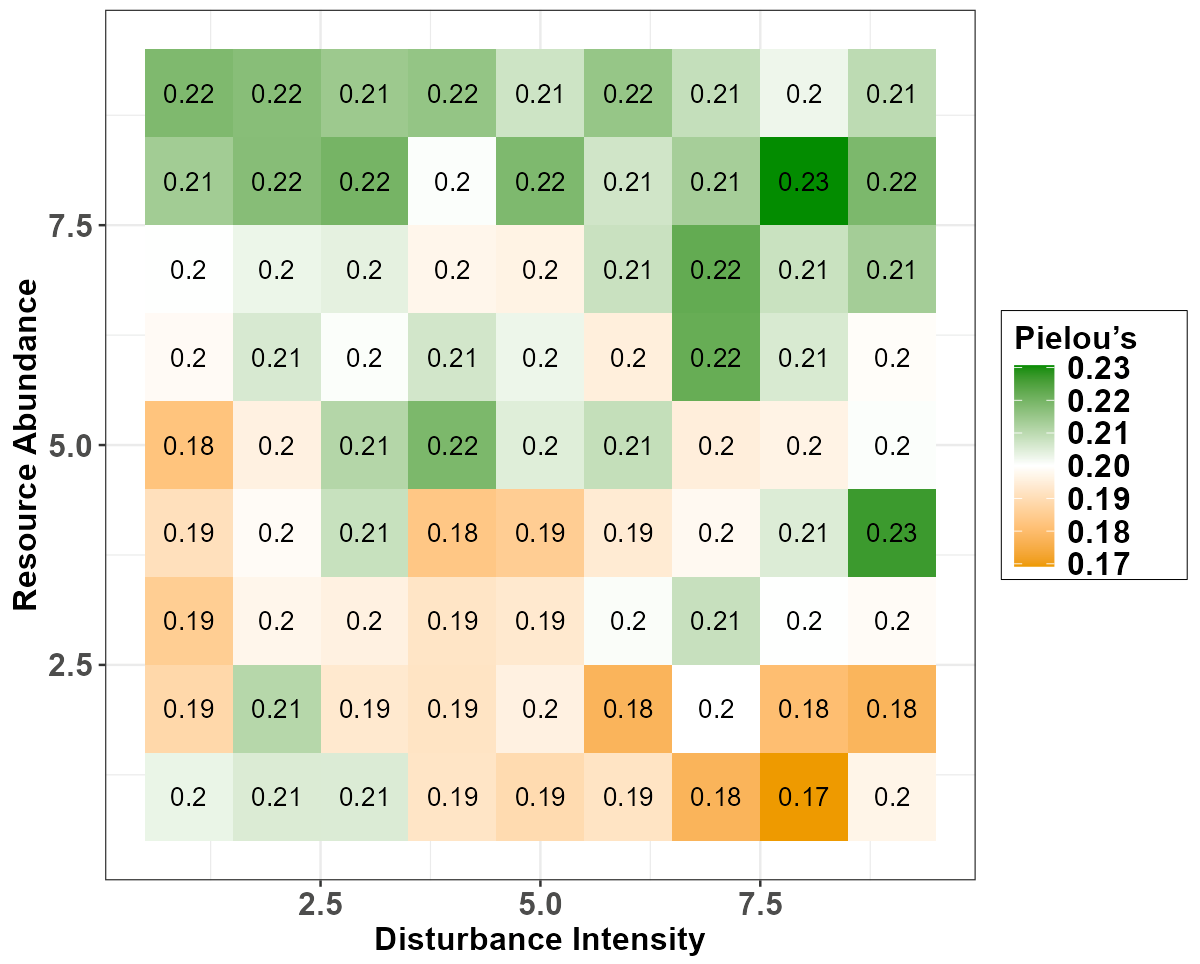
Heatmap analysis revealed the response patterns of the Pielou’s evenness index to different environmental factors of the simulated community (Figure 3). The index range is relatively narrow (0.17–0.23), and the overall uniformity is low. Overall, under conditions of moderate resources and medium to high disturbance, Pielou’s evenness index of the simulated community achieved the maximum value (>0.23), and the species distribution of the community was more uniform. However, under conditions of low resources and high disturbance, Pielou’s evenness index of the simulated communities was significantly lower, showing an abnormal diversity distribution pattern (<0.18), and overall Pielou’s evenness was higher under the condition of high resources.

3.1.3. Resource Availability and Disturbance Intensity Affect the Dominance of Dominant Species

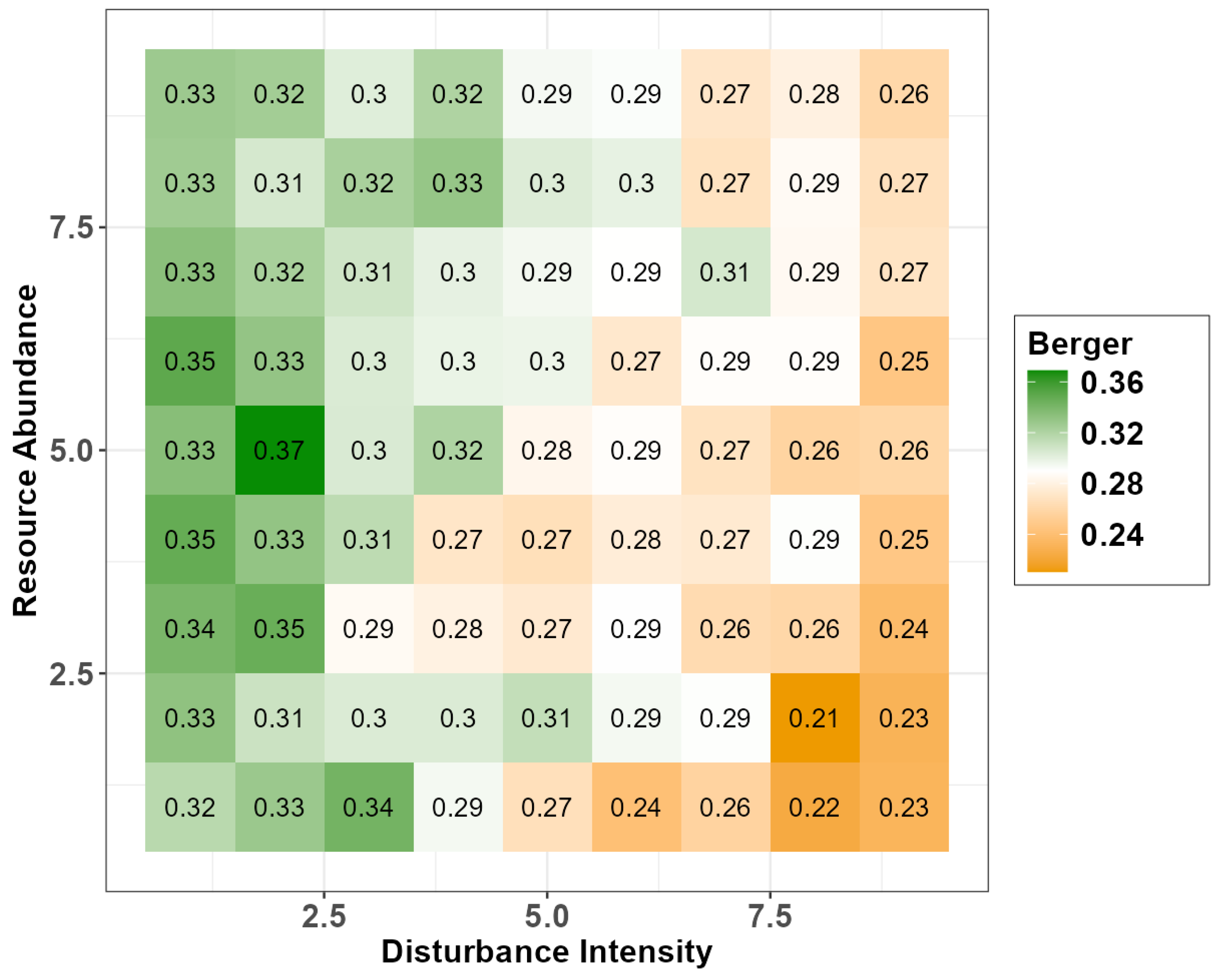
The interaction effects of disturbance intensity and resource abundance on the Berger–Parker index (representing the relative abundance of the most dominant species in the community) were analyzed using a heatmap (Figure 4). The results showed that the index values ranged from 0.27 to 0.36, indicating that within the set parameter range, the communities were always dominated by a few dominant species, but the degree of dominance varied significantly.
The overall trend indicated that the Berger–Parker index peaked under the combination of high resources and low disturbance (maximum 0.36), suggesting that under these conditions, the dominance of a single species was most pronounced. Specifically, in regions with higher resource abundance (Y-axis > 5.0), dominance exhibited a non-linear pattern of initially decreasing and then increasing with increasing disturbance intensity: for example, at a resource abundance of 7.5, the index decreased from 0.36 under low disturbance to 0.28 at medium disturbance (5.0) but rose again to 0.33 under high disturbance (7.5). In contrast, in resource-poor regions (Y-axis < 5.0), dominance was generally lower (mostly between 0.30 and 0.31) and responded weakly to disturbance intensity, showing mild changes.

3.2. Nitrogen Addition and Mowing Significantly Affect Species Diversity

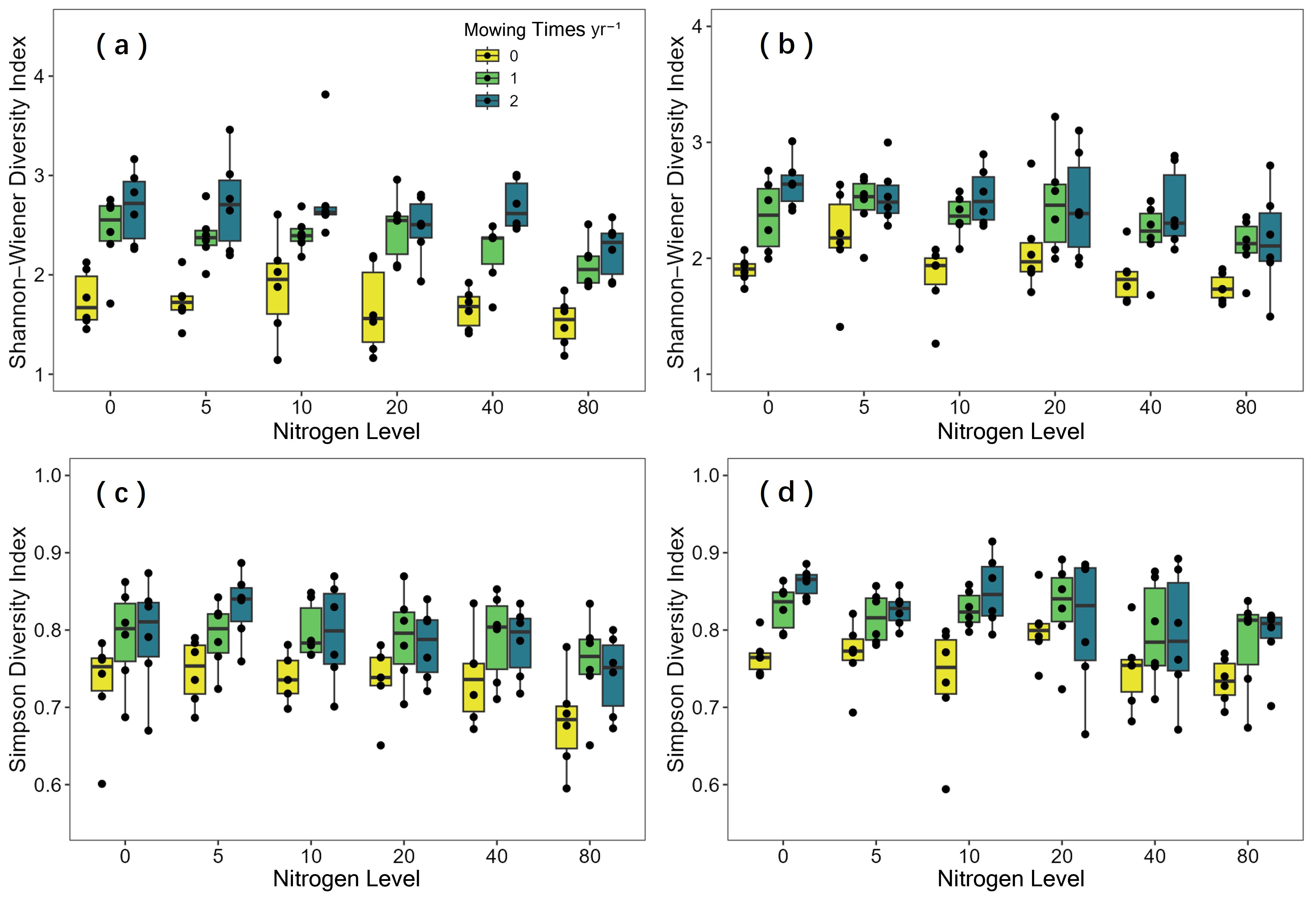
The results of the variance analysis indicate that, in the 2024 plots, fertilization had a highly significant effect on the Shannon–Wiener diversity index (F5,102 = 9.61, p = 0.002), and mowing also had a highly significant effect on the Shannon–Wiener diversity index (F2,104 = 124.70, p < 0.001), but the interaction between fertilization and mowing was not significant (F17,89 = 0.33, p = 0.57) (Figure 5a). In the 2025 plots, fertilization had a highly significant effect on the Shannon–Wiener diversity index (F5,102 = 11.79, p < 0.001), mowing also had a highly significant effect on the Shannon–Wiener diversity index (F2,104 = 51.64, p < 0.001), but again the interaction between fertilization and mowing was not significant (F17,89 = 0.814, p = 0.37) (Figure 5b).
The results of the rank test indicate that, in the 2024 plots, fertilization had a highly significant effect on the Simpson diversity index (H = 8.497, p = 0.131), and mowing also had a highly significant effect on the Simpson diversity index (H = 25.184, p < 0.001), but the interaction between fertilization and mowing was not significant (H = 1.881, p = 0.997) (Figure 5c). In the 2025 plots, fertilization did not have a significant effect on the Simpson diversity index (H = 9.828, p = 0.080), while mowing had a highly significant effect on the Simpson diversity index (H = 27.361, p < 0.001), but the interaction between fertilization and mowing was not significant (H = 5.428, p = 0.861) (Figure 5d).
Overall, the Shannon–Wiener diversity index and Simpson diversity index increased with the frequency of mowing and decreased with the level of nitrogen fertilization. The interaction effect of mowing and nitrogen fertilization level on the species diversity indices was not significant, while mowing frequency was a more important factor affecting species diversity.

3.3. Nitrogen Addition and Mowing Significantly Affect Community Structure

3.3.1. Nitrogen Addition and Mowing Significantly Affect Community Evenness Index

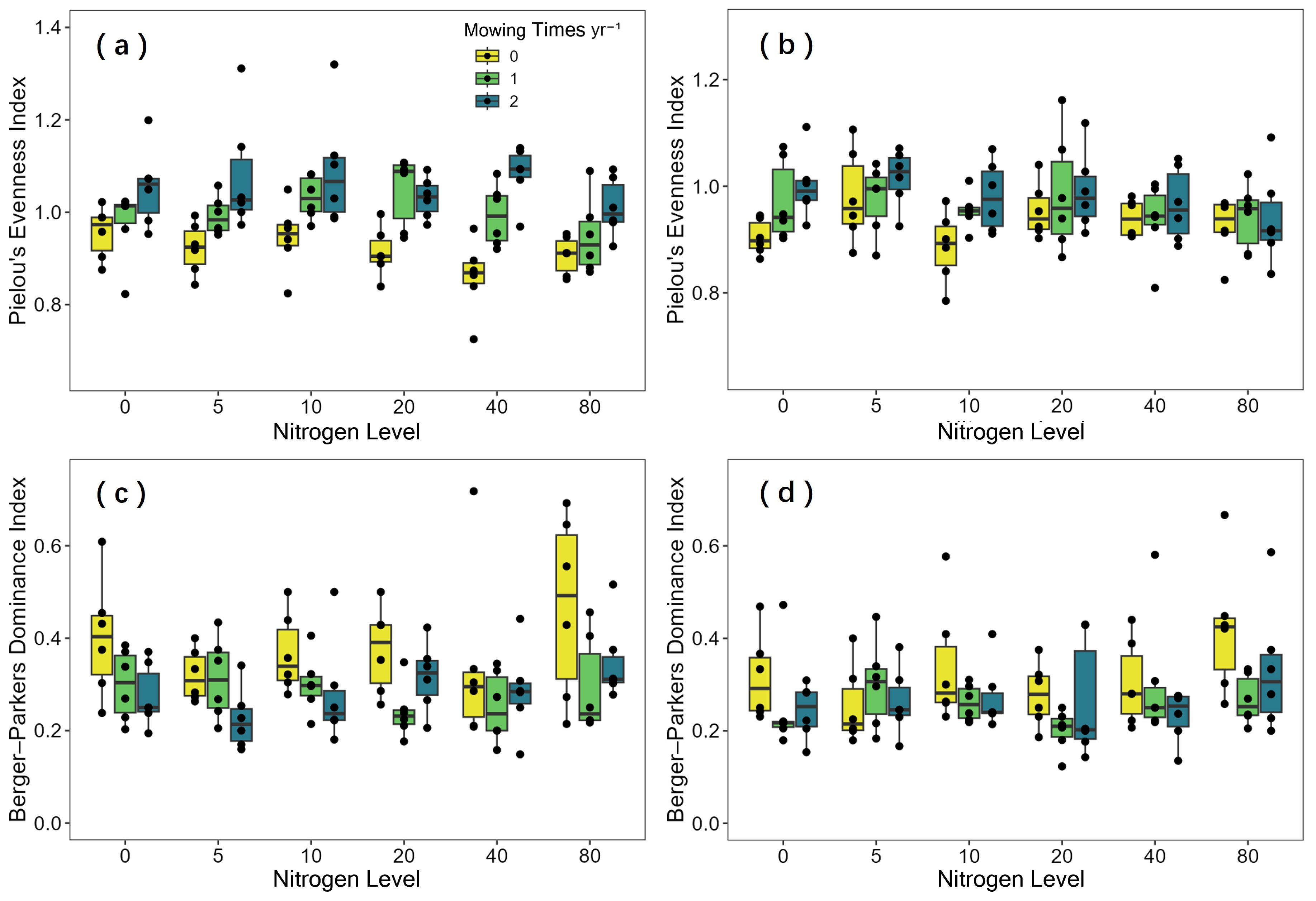
The results of the rank test indicate that, in the 2024 plots, fertilization had no significant effect on the Pielou’s evenness index (H = 5.741, p = 0.332), while mowing had a highly significant effect on the Pielou’s evenness index (H = 44.376, p < 0.001), but the interaction between fertilization and mowing was not significant (H = 5.911, p = 0.823) (Figure 6a). In the 2025 plots, fertilization had no significant effect on the Pielou’s evenness index (H = 7.536, p = 0.184), while mowing had a highly significant effect on the Pielou’s evenness index (H = 9.887, p = 0.007), but the interaction between fertilization and mowing was not significant (H = 6.067, p = 0.81) (Figure 6b).
Overall, Pielou’s evenness index significantly decreased with increasing mowing frequency and showed an increasing trend with higher nitrogen fertilization levels. The interaction effect of mowing and nitrogen fertilization levels on Pielou’s evenness index was not significant, whereas mowing frequency was a more important factor affecting Pielou’s evenness index.

3.3.2. Nitrogen Addition and Mowing Significantly Affect Community Dominance Index

The results of the rank test indicate that, in the 2024 plots, fertilization had no significant effect on the Berger–Parker dominance index (H = 4.7, p = 0.453), while mowing had a highly significant effect on the Berger–Parker dominance index (H = 13.511, p = 0.002), but the interaction between fertilization and mowing was not significant (H = 9.841, p = 0.455) (Figure 6c). In the 2025 plots, fertilization had no significant effect on the Berger–Parker dominance index (H = 8.982, p = 0.11), while mowing had a significant effect on the Berger–Parker dominance index (H = 6.674, p = 0.035), but the interaction between fertilization and mowing was not significant (H = 8.611, p = 0.569) (Figure 6d).
Overall, the Berger–Parker dominance index tended to increase with mowing frequency and decrease with increasing nitrogen fertilization levels. The interaction effect between mowing and nitrogen fertilization had no significant impact on the Berger–Parker dominance index, and mowing frequency was a more important factor affecting the Berger–Parker dominance index.

4. Discussion

4.1. The Dominant Role of Mowing-Induced Disturbance and Its Determinative Effect on Community Diversity

This study indicates that mowing (disturbance) is the primary driver affecting community diversity, with explanatory power significantly higher than nitrogen addition (resource enhancement) [12,25]. In data from both years, mowing had highly significant effects on the Shannon–Wiener index, Simpson index, and Berger–Parker index, although interactions with fertilization were not significant, indicating that the disturbance effect has strong independence in this system [26]. Periodic mowing removes aboveground biomass, primarily weakening the light acquisition ability of tall dominant species, thereby reducing their monopoly over light resources while alleviating asymmetric competition pressure. This process can be understood as a dynamic adjustment of interspecific competition coefficients or the competition terms in the Lotka–Volterra model, allowing originally disadvantaged mid- and low-stature species a window for recovery and expansion, thereby enhancing overall species coexistence [27].
This study further shows that mowing not only increases species diversity but also enhances Pielou’s evenness index of the community, suggesting that disturbance does not simply ‘equalize’ the community, but may reshape abundance distribution patterns by promoting rapid responses of some opportunistic species [12,28]. This result indicates that although disturbances maintain species coexistence, they may also reinforce internal dynamic imbalances within the community, thereby achieving community equilibrium and shifts in community structure [29,30,31]. This phenomenon is significant in grassland ecosystems, indicating that traditional assessments of community stability based solely on species richness or the Shannon–Wiener index may underestimate the complex structural changes within the community [32,33].

4.2. The Effect of Intensified Competition from Resource Enrichment and Its Mechanism for Inhibiting Diversity

In contrast to the disturbance effect, nitrogen addition generally reduced community diversity, especially showing a significant decrease in the Shannon–Wiener index, indicating that resource enrichment primarily drives diversity decline by enhancing interspecific competition [34,35]. This result is consistent with the resource competition theory and the classical conclusion that “eutrophication leads to dominance monopoly”, where enrichment with excessive amounts of nutrients is commonly seen as one of the main causes of diversity loss in terrestrial plant communities—as nutrient addition shifts the species interactions from competition for nutrients to competition for light [36,37], meaning that increased resources amplify the growth advantage of dominant species and accelerate competitive exclusion [11,38,39].
It is worth noting that the effect of nitrogen addition on evenness was either insignificant or showed a slight upward trend in different years. This may reflect that increased resources partially alleviate resource limitations for some species, allowing moderately competitive species to persist and thereby locally enhance evenness. However, this ‘increase in evenness’ did not translate into an overall increase in diversity; instead, it was accompanied by a simplification of species richness and dominance structure. This result highlights that the impact of resource enrichment on communities is multidimensionally inconsistent, and its ecological consequences need to be evaluated comprehensively using multiple diversity metrics [40].

4.3. The Consistent Results from Experiments and Model Simulations Indicate: A Diversity Maintenance Mechanism Driven by Resource–Disturbance Trade-Offs

The traditional Lotka–Volterra model is often limited to the interspecific relationship parameters between predators and prey, and lacks research on the effects of resource input and environmental disturbances on community structure. Based on an extended Lotka–Volterra stochastic model, this study reveals how the trade-off between resource facilitation ( e p · e η i ) and disturbance inhibition ( e k · e θ i ) jointly shapes community diversity patterns. Simulation results show that under moderate disturbance and medium-low resource conditions, communities can maintain higher stable diversity [31,41], whereas under high resource and low disturbance conditions, diversity declines rapidly. This pattern is highly consistent with the empirical rule observed in experiments that fertilization reduces diversity while mowing increases diversity [19]. Heatmap analysis reveals that Pielou’s evenness peaks under a combination of medium resources and medium disturbance, while the Berger–Parker dominance is highest under high resource and low disturbance conditions [42,43]. This result mechanistically supports the Intermediate Disturbance Hypothesis [44] but simultaneously extends its meaning, as optimal diversity depends not only on disturbance intensity but also on the joint regulation by resource availability and species trait strategies [45,46].
Therefore, the results from the models and experiments consistently indicate that the maintenance of diversity is not always driven by a single decisive factor [47,48], instead, the dynamic changes in diversity within a community are jointly influenced by the complex trade-offs of ‘resources–disturbance–plant traits’(The coefficients of variation of the diversity index, evenness index, and dominance index of the simulated communities are driven by the ‘resource-disturbance’ factor, as shown in Figures S1–S4). This framework provides a new theoretical perspective for understanding the formation of diversity patterns in natural ecosystems and offers a quantitative basis for grassland management practices, such as the rational combination of mowing and fertilization.

4.4. Limitations and Future Research Directions

Although the experimental results of this study are highly consistent with model predictions, and the multi-species model constructed based on the assumptions of non-linear resource limitations and non-linear environmental disturbances possesses certain innovativeness, several limitations remain. First, the experiments were conducted only on a single grassland type, and the extrapolation of the research conclusions needs to be further validated across multiple types of grassland ecosystems [49]. Second, the model primarily focuses on diversity patterns after the stable development of communities, and its characterization of long-term community succession and stable-state transitions remains insufficient [35,50]. Additionally, the current analysis has not yet deeply explored the relative contributions of specific species to maintaining diversity [6], nor does the model incorporate spatial heterogeneity or complex ecological interaction networks among species (such as mutualism and cascade effects) [8,51]. Future research should expand to grassland ecosystems in different climatic zones, extend observation periods, and integrate species functional traits with spatially explicit models to more comprehensively reveal the mechanisms by which resource–disturbance–trait trade-offs affect community diversity dynamics.

5. Conclusions

This study systematically reveals the differentiated driving mechanisms of community diversity under mowing (disturbance) and nitrogen addition (resource enrichment). Mowing significantly increases species diversity, richness, and evenness by suppressing competitive exclusion and its effect is independent of fertilization treatment, supporting the classic theory that disturbance promotes coexistence. In contrast, although nitrogen addition has slightly increased evenness in certain years, it overall intensified the dominance of dominant species, leading to a significant decline in the Shannon–Wiener index, validating the mainstream hypothesis that resource enrichment weakens diversity through competitive exclusion. Combined with an extended Lotka–Volterra model and heatmap analysis, it further shows that diversity is jointly shaped by the complex trade-offs among ‘resourcesdisturbancetraits’, reaching an optimum under moderate disturbance and low to moderate resource conditions. This framework not only deepens the understanding of community assembly mechanisms but also provides a theoretical basis for the adaptive management of grassland ecosystems.

Supplementary Materials

The following supporting information can be downloaded at: https://www.mdpi.com/article/10.3390/d18050296/s1, Figure S1: Under different resource coefficients and interference coefficients, the average of the final Shannon-Wiener diversity index of the simulated community is simulated.; Figure S2: Under different resource coefficients and interference coefficients, the standard deviation of the final Shannon-Wiener diversity index of the simulated community is simulated; Figure S3: Under different resource coefficients and interference coefficients, the standard deviation of the final Pielou’s evenness index of the simulated community is simulated; Figure S4: Under different resource coefficients and interference coefficients, the standard deviation of the final Berger-Parkers dominance index of the simulated community is simulated.

Author Contributions

Conceptualization, W.L.; methodology, F.Y.; software, H.T. (Hanghang Tuo), F.Y., and X.L.; validation, Q.Y.; investigation, H.T. (Hanghang Tuo), F.Y., Y.W., and Q.J.; resources, W.L.; data curation, F.Y.; writing—original draft preparation, F.Y.; writing—review and editing, W.L., X.Z., X.M., H.T. (Huihui Tian), Z.Y.; visualization, F.Y.; supervision, W.L.; project administration, W.L.; funding acquisition, W.L. All authors have read and agreed to the published version of the manuscript.

Funding

This research was funded by the National Key Research and Development Program of China (2022YFF1302805), the National Natural Sciences Foundation of China (42277464), the Natural Sciences Foundation of Ningxia (2025AAC030610), and the 2025 Yulin City Science and Technology Plan Project (2025-CXY-045).

Institutional Review Board Statement

Not applicable.

Data Availability Statement

The data presented in this study are openly available in https://doi.org/10.5281/zenodo.19347483.

Conflicts of Interest

The authors declare no conflict of interest.

References

  1. Eisenhauer, N.; Mueller, K.; Ebeling, A.; Gleixner, G.; Huang, Y.; Madaj, A.-M.; Roscher, C.; Weigelt, A.; Bahn, M.; Bonkowski, M.; et al. The Multiple-Mechanisms Hypothesis of Biodiversity–Stability Relationships. Basic Appl. Ecol. 2024, 79, 153–166. [Google Scholar] [CrossRef]
  2. Godoy, O.; Gómez-Aparicio, L.; Matías, L.; Pérez-Ramos, I.M.; Allan, E. An Excess of Niche Differences Maximizes Ecosystem Functioning. Nat. Commun. 2020, 11, 4180. [Google Scholar] [CrossRef]
  3. Levine, J.M.; Adler, P.B.; HilleRisLambers, J. On Testing the Role of Niche Differences in Stabilizing Coexistence. Funct. Ecol. 2008, 22, 934–936. [Google Scholar] [CrossRef]
  4. Adler, P.B.; Smull, D.; Beard, K.H.; Choi, R.T.; Furniss, T.; Kulmatiski, A.; Meiners, J.M.; Tredennick, A.T.; Veblen, K.E. Competition and Coexistence in Plant Communities: Intraspecific Competition Is Stronger than Interspecific Competition. Ecol. Lett. 2018, 21, 1319–1329. [Google Scholar] [CrossRef]
  5. Chesson, P. Multispecies Competition in Variable Environments. Theor. Popul. Biol. 1994, 45, 227–276. [Google Scholar] [CrossRef]
  6. Chesson, P. Updates on Mechanisms of Maintenance of Species Diversity. J. Ecol. 2018, 106, 1773–1794. [Google Scholar] [CrossRef]
  7. Geijzendorffer, I.R.; Van Der Werf, W.; Bianchi, F.J.J.A.; Schulte, R.P.O. Sustained Dynamic Transience in a Lotka–Volterra Competition Model System for Grassland Species. Ecol. Model. 2011, 222, 2817–2824. [Google Scholar] [CrossRef]
  8. Semenov, A.; Fradkov, A. Identification of Parameters of Conservative Multispecies Lotka-Volterra System Based on Sampled Data. Mathematics 2024, 12, 248. [Google Scholar] [CrossRef]
  9. Waniewski, J.; Jedruch, W. Individual Based Modeling and Parameter Estimation for a Lotka–Volterra System. Math. Biosci. 1999, 157, 23–36. [Google Scholar] [CrossRef]
  10. Roschewitz, I.; Gabriel, D.; Tscharntke, T.; Thies, C. The Effects of Landscape Complexity on Arable Weed Species Diversity in Organic and Conventional Farming. J. Appl. Ecol. 2005, 42, 873–882. [Google Scholar] [CrossRef]
  11. Tilman, D. Niche Tradeoffs, Neutrality, and Community Structure: A Stochastic Theory of Resource Competition, Invasion, and Community Assembly. Proc. Natl. Acad. Sci. USA 2004, 101, 10854–10861. [Google Scholar] [CrossRef] [PubMed]
  12. Zhang, H.; Liu, C.; Tan, J.; Bi, W.; Chen, X.; Bai, B.; Namuhan; Wuyunna; Li, G.; Song, Y. Effect of Nutrient Addition and Mowing on Plant Diversity and Soil Carbon Content of Meadow Steppe in Inner Mongolia. J. Environ. Manag. 2025, 393, 127101. [Google Scholar] [CrossRef]
  13. Liao, C.; Xavier, J.B.; Zhu, Z. Enhanced Inference of Ecological Networks by Parameterizing Ensembles of Population Dynamics Models Constrained with Prior Knowledge. BMC Ecol. 2020, 20, 3. [Google Scholar] [CrossRef]
  14. Gavina, M.K.A.; Tahara, T.; Tainaka, K.; Ito, H.; Morita, S.; Ichinose, G.; Okabe, T.; Togashi, T.; Nagatani, T.; Yoshimura, J. Multi-Species Coexistence in Lotka-Volterra Competitive Systems with Crowding Effects. Sci. Rep. 2018, 8, 1198. [Google Scholar] [CrossRef]
  15. Hsu, S.-B.; Zhao, X.-Q. A Lotka–Volterra Competition Model with Seasonal Succession. J. Math. Biol. 2012, 64, 109–130. [Google Scholar] [CrossRef] [PubMed]
  16. Patten, B.C. An Introduction to the Cybernetics of the Ecosystem: The Trophic-Dynamic Aspect. Ecology 1959, 40, 221–231. [Google Scholar] [CrossRef]
  17. Strong, W.L. Biased Richness and Evenness Relationships within Shannon–Wiener Index Values. Ecol. Indic. 2016, 67, 703–713. [Google Scholar] [CrossRef]
  18. Morris, E.K.; Caruso, T.; Buscot, F.; Fischer, M.; Hancock, C.; Maier, T.S.; Meiners, T.; Müller, C.; Obermaier, E.; Prati, D.; et al. Choosing and Using Diversity Indices: Insights for Ecological Applications from the German Biodiversity Exploratories. Ecol. Evol. 2014, 4, 3514–3524. [Google Scholar] [CrossRef]
  19. Wang, Y.; Zhang, J.; He, C.; Meng, P.; Wang, J.; Gao, J.; Xue, P. Effects of Intercropping and Mowing Frequency on Biological Nitrogen Fixation Capacity, Nutritive Value, and Yield in Alfalfa (Medicago sativa L. Cv. Vernal). Plants 2025, 14, 240. [Google Scholar] [CrossRef]
  20. Anderegg, W.R.L.; Martinez-Vilalta, J.; Mencuccini, M.; Poyatos, R. Community Assembly Influences Plant Trait Economic Spectra and Functional Trade-Offs at Ecosystem Scales. Proc. Natl. Acad. Sci. USA 2024, 121, e2404034121. [Google Scholar] [CrossRef] [PubMed]
  21. Zeng, Q.; Liu, Y.; Fang, Y.; Ma, R.; Lal, R.; An, S.; Huang, Y. Impact of Vegetation Restoration on Plants and Soil C:N:P Stoichiometry on the Yunwu Mountain Reserve of China. Ecol. Eng. 2017, 109, 92–100. [Google Scholar] [CrossRef]
  22. Letten, A.D.; Ke, P.; Fukami, T. Linking Modern Coexistence Theory and Contemporary Niche Theory. Ecol. Monogr. 2017, 87, 161–177. [Google Scholar] [CrossRef]
  23. Mi, W.; Ren, W.; Chi, Y.; Zheng, H.; Fry, E.; Yuan, F.; Liu, Y. Heavy Grazing Reduces the Potential for Grassland Restoration: A Global Meta-Analysis. Environ. Res. Lett. 2024, 19, 103001. [Google Scholar] [CrossRef]
  24. Jiang, Y.; Wu, F.; Fang, X.; Wang, H.; Xie, Y.; Yu, C. Effective Palynological Diversity Indices for Reconstructing Angiosperm Diversity in China. Plant Divers. 2025, 47, 244–254. [Google Scholar] [CrossRef]
  25. Guo, A.; Zuo, X.; Zhang, S.; Hu, Y.; Yue, P.; Lv, P.; Li, X.; Zhao, S.; Yu, Q. Contrasting Effects of Plant Inter- and Intraspecific Variation on Community Trait Responses to Nitrogen Addition and Drought in Typical and Meadow Steppes. BMC Plant Biol. 2022, 22, 90. [Google Scholar] [CrossRef] [PubMed]
  26. Dee, L.E.; Miller, S.J.; Helmstedt, K.J.; Boersma, K.S.; Polasky, S.; Reich, P.B. Quantifying Disturbance Effects on Ecosystem Services in a Changing Climate. Nat. Ecol. Evol. 2025, 9, 436–447. [Google Scholar] [CrossRef] [PubMed]
  27. Doni, L.; Briozzo, I.; Cerabolini, B.E.L.; Dalle Fratte, M.; Guerrina, M.; Minuto, L.; Mariotti, M.G.; Casazza, G. Taxonomic, Phylogenetic and Functional Diversity Behave Differently Under Disturbance Pressure and Complex Land-Use History: Assembly Rules in Grassland Communities. Ecol. Evol. 2026, 16, e73075. [Google Scholar] [CrossRef] [PubMed]
  28. Ma, L.; Zhang, Z.; Su, H.; Qin, R.; Wei, J.; Li, H.; Shi, Z.; Li, S.; Hu, X.; Adi, H.; et al. Mowing Mitigates the Negative Impacts of Long-Term Warming on Community Composition and Niche Characteristics of Alpine Meadow on the Tibetan Plateau. Glob. Ecol. Conserv. 2024, 55, e03240. [Google Scholar] [CrossRef]
  29. Zhao, T.; Suo, R.; Alemu, A.W.; Zheng, J.; Zhang, F.; Iwaasa, A.D.; Guo, J.; Zhao, M.; Zhang, B. Mowing Increased Community Stability in Semiarid Grasslands More than Either Fencing or Grazing. Ecol. Appl. 2024, 34, e2985. [Google Scholar] [CrossRef] [PubMed]
  30. Bock, C.E.; Jones, Z.F.; Bock, J.H. Relationships Between Species Richness, Evenness, and Abundance in a Southwestern Savanna. Ecology 2007, 88, 1322–1327. [Google Scholar] [CrossRef]
  31. Kvålseth, T.O. Diversity Analysis: Richness versus Evenness. Ecol. Evol. 2024, 14, e70275. [Google Scholar] [CrossRef]
  32. Liu, K.; Liu, Z.; Zhou, N.; Shi, X.; Lock, T.R.; Kallenbach, R.L.; Yuan, Z. Diversity-stability Relationships in Temperate Grasslands as a Function of Soil pH. Land Degrad. Dev. 2022, 33, 1704–1717. [Google Scholar] [CrossRef]
  33. Zhang, H.; Wang, W. Grassland Degradation Alters the Effect of Nitrogen Enrichment on the Multidimensional Stability of Plant Community Productivity. J. Appl. Ecol. 2023, 60, 2437–2448. [Google Scholar] [CrossRef]
  34. Bobbink, R.; Hicks, K.; Galloway, J.; Spranger, T.; Alkemade, R.; Ashmore, M.; Bustamante, M.; Cinderby, S.; Davidson, E.; Dentener, F.; et al. Global Assessment of Nitrogen Deposition Effects on Terrestrial Plant Diversity: A Synthesis. Ecol. Appl. 2010, 20, 30–59. [Google Scholar] [CrossRef]
  35. Ten Kate, G.M.; Wardle, D.A.; Stangl, Z.R.; Sundqvist, M.K. Plant Community Responses to Long-Term Nutrient Additions Interact with Elevation and Vegetation Type in a Subarctic Tundra. J. Veg. Sci. 2026, 37, e70125. [Google Scholar] [CrossRef]
  36. Behrenfeld, M.; Bisson, K.; Boss, E.; Graff, J. Conceptualizing Phytoplankton Communities in the Absence of Resource Based Competitive Exclusion. Sci. Rep. 2025, 15, 23846. [Google Scholar] [CrossRef]
  37. Burson, A.; Stomp, M.; Greenwell, E.; Grosse, J.; Huisman, J. Competition for Nutrients and Light: Testing Advances in Resource Competition with a Natural Phytoplankton Community. Ecology 2018, 99, 1108–1118. [Google Scholar] [CrossRef]
  38. Xiang, C.; Wang, X.; Chen, Y.; Liu, L.; Li, M.; Wang, T.; Sun, Y.; Li, H.; Guo, X. Nitrogen Deposition Enhances the Competitive Advantage of Invasive Plant Species over Common Native Species through Improved Resource Acquisition and Absorption. Ecol. Process 2024, 13, 61. [Google Scholar] [CrossRef]
  39. Lyu, S.; Alexander, J.M. Functional Traits Predict Outcomes of Current and Novel Competition Under Warmer Climate. Glob. Change Biol. 2024, 30, e17551. [Google Scholar] [CrossRef] [PubMed]
  40. Song, Y.; Kong, W.; Wei, X.; Reich, P.B.; Qiu, L.; Peñuelas, J.; Tedersoo, L.; Bahram, M.; Bullock, J.M.; Bobbink, R.; et al. Global Nitrogen Enrichment Impacts Plant Diversity More than Soil Bacterial and Fungal Diversity: A Meta-Analysis. Nat. Commun. 2026, 17, 1057. [Google Scholar] [CrossRef] [PubMed]
  41. Wang, X.; Wang, Z.; Miao, H.; Zhang, C.; Zou, H.; Yang, Y.; Zhang, Z.; Liu, J. Appropriate Livestock Grazing Alleviates the Loss of Plant Diversity and Maintains Community Resistance in Alpine Meadows. J. Environ. Manag. 2024, 351, 119850. [Google Scholar] [CrossRef] [PubMed]
  42. Wohlgemuth, D.; Solan, M.; Godbold, J.A. Specific Arrangements of Species Dominance Can Be More Influential than Evenness in Maintaining Ecosystem Process and Function. Sci. Rep. 2016, 6, 39325. [Google Scholar] [CrossRef]
  43. Gao, J.; Carmel, Y. Can the Intermediate Disturbance Hypothesis Explain Grazing–Diversity Relations at a Global Scale? Oikos 2020, 129, 493–502. [Google Scholar] [CrossRef]
  44. Moi, D.A.; García-Ríos, R.; Hong, Z.; Daquila, B.V.; Mormul, R.P. Intermediate Disturbance Hypothesis in Ecology. Ann. Zool. Fenn. 2020, 57, 67–78. [Google Scholar] [CrossRef]
  45. Miller, A.D.; Roxburgh, S.H.; Shea, K. How Frequency and Intensity Shape Diversity–Disturbance Relationships. Proc. Natl. Acad. Sci. USA 2011, 108, 5643–5648. [Google Scholar] [CrossRef]
  46. Craven, D.; Eisenhauer, N.; Pearse, W.D.; Hautier, Y.; Isbell, F.; Roscher, C.; Bahn, M.; Beierkuhnlein, C.; Bönisch, G.; Buchmann, N.; et al. Multiple Facets of Biodiversity Drive the Diversity–Stability Relationship. Nat. Ecol. Evol. 2018, 2, 1579–1587. [Google Scholar] [CrossRef]
  47. Kang, S.; Niu, J.; Zhang, Q.; Zhang, X.; Han, G.; Zhao, M. Niche Differentiation Is the Underlying Mechanism Maintaining the Relationship between Community Diversity and Stability under Grazing Pressure. Glob. Ecol. Conserv. 2020, 24, e01246. [Google Scholar] [CrossRef]
  48. Wang, J.; Grimm, N.B.; Lawler, S.P.; Dong, X. Changing Climate and Reorganized Species Interactions Modify Community Responses to Climate Variability. Proc. Natl. Acad. Sci. USA 2023, 120, e2218501120. [Google Scholar] [CrossRef] [PubMed]
  49. Harpole, W.S.; Sullivan, L.L.; Lind, E.M.; Firn, J.; Adler, P.B.; Borer, E.T.; Chase, J.; Fay, P.A.; Hautier, Y.; Hillebrand, H.; et al. Addition of Multiple Limiting Resources Reduces Grassland Diversity. Nature 2016, 537, 93–96. [Google Scholar] [CrossRef]
  50. Du, L.; Guo, X.; Luo, K.; Xiao, X.; Zhong, H.; Sun, J.; Xia, J.; Chen, Q. Long-Term N and NPK Fertilizations Induce Significant Alterations in Microbial Compositions and Co-Occurrence Patterns in Saturated Soil Layers. J. Clean. Prod. 2025, 506, 145531. [Google Scholar] [CrossRef]
  51. Song, C.; Levine, J.M. Rigorous Validation of Ecological Models against Empirical Time Series. Nat. Ecol. Evol. 2025, 9, 2265–2278. [Google Scholar] [CrossRef]
Figure 1. Schematic diagram of the study area and experimental design. (a) Study area located in Guyuan City, with the marked location in the picture indicating the experiment site; (b) experimental design of this study.
Diversity 18 00296 g001
Figure 2. Evolution of simulated community diversity over generations in the model: (a) ek = 1, (b) ek = 2, (c) ek = 3, (d) ek = 4, (e) ek = 5, (f) ek = 6, (g) ek = 7, (h) ek = 8, and (i) ek = 9. Where ek is the global environmental stress coefficient, ep is the coefficient of global resource availability.
Diversity 18 00296 g002
Figure 3. Under different resource coefficients and disturbance coefficients, the final average of Pielou’s evenness index of the simulated community is simulated.
Diversity 18 00296 g003
Figure 4. Under different resource coefficients and disturbance coefficients, the final average of the Berger–Parker dominance index of the simulated community is simulated.
Diversity 18 00296 g004
Figure 5. Shannon–Wiener diversity index and Simpson diversity index of experimental plots: (a) Shannon–Wiener diversity index of 2024, (b) Shannon–Wiener diversity index of 2025, (c) Simpson diversity index of 2024, and (d) Simpson diversity index of 2025.
Diversity 18 00296 g005
Figure 6. Berger–Parker dominance index and Pielou’s evenness index of experimental plots: (a) Pielou’s evenness index of 2024, (b) Pielou’s evenness index of 2025, (c) Berger–Parker dominance index of 2024, and (d) Berger–Parker dominance index of 2025.
Diversity 18 00296 g006
Disclaimer/Publisher’s Note: The statements, opinions and data contained in all publications are solely those of the individual author(s) and contributor(s) and not of MDPI and/or the editor(s). MDPI and/or the editor(s) disclaim responsibility for any injury to people or property resulting from any ideas, methods, instructions or products referred to in the content.