Article

Study on Changes in Biodiversity of the Lhalu Wetland National Nature Reserve in Tibet, China

1
Key Laboratory of Biodiversity and Environment on the Qinghai-Tibetan Plateau, Ministry of Education, School of Ecology and Environment, Xizang University, Lhasa 850000, China
2
Institute of Hydrobiology, Chinese Academy of Sciences, Wuhan 430072, China
3
Lhasa, Urban Wetland Ecosystem, Observation and Research Station of Tibet Autonomous Region, Lhasa 850015, China
*
Author to whom correspondence should be addressed.
Diversity 2026, 18(5), 292; https://doi.org/10.3390/d18050292
Submission received: 20 April 2026 / Revised: 10 May 2026 / Accepted: 11 May 2026 / Published: 13 May 2026
(This article belongs to the Section Biodiversity Conservation)

Abstract

The Lhalu Wetland National Nature Reserve, the largest natural urban wetland on the Qinghai–Tibet Plateau, plays a critical role in maintaining regional ecological balance and biodiversity. However, the baseline biodiversity of this reserve remains unclear because of the extensive temporal span of historical records, shifts in taxonomic systems, and inconsistent survey methodologies, which impedes a robust scientific understanding of its ecological dynamics. This study systematically compiled and taxonomically verified species records from over 50 sources spanning the 1950s to the present. The records cover plants, fish, birds, and amphibians/reptiles, thereby resolving issues of synonyms, homonyms, and misidentifications. Each species record is annotated with its original survey time, allowing users to distinguish historically reported occurrences from those recorded in recent surveys. Species accumulation curves were constructed for major taxa and compared with 45-year climatic trends (1979–2023) and socioeconomic indicators for Lhasa City. A total of 438 vascular plant species (82 families, 251 genera) and 311 animal species (39 orders, 98 families), including 30 fishes, 174 birds, and 11 amphibians/reptiles, were documented. Invasive species comprised 55 alien plants and 13 alien fishes, while 4 plant and 46 animal species are under national protection. Temporal synchrony between increases in alien taxa and anthropogenic pressures (gross domestic product (GDP) and population growth, infrastructure development) suggests that human activities may be a potential driver of biodiversity change, but formal causal inference is precluded by heterogeneity in survey methods and sampling effort. This work provides a structured dataset of the biodiversity baseline of the Lhalu Wetland and offers a descriptive assessment of its temporal patterns in relation to climate and human disturbance, while explicitly acknowledging data limitations. It provides essential data and theoretical support for the scientific management and targeted conservation of plateau urban wetlands.

1. Introduction

According to the Ramsar Convention and the Technical Specification for Wetland Ecological Quality Assessment [1], wetlands refer to natural or artificial areas of marsh, fen, peatland, or water, whether permanent or seasonal, with water that is static or flowing, fresh, brackish, or salt, including areas of marine water the depth of which at low tide does not exceed six meters. Since 1970, an estimated 22% of global wetlands have been lost, with an ongoing annual decline of 0.52% and approximately 25% of remaining wetlands in poor ecological condition [2]. Independent syntheses, including the latest Global Wetland Outlook 2025 (Ramsar Convention), consistently confirm that wetlands rank among the world’s most severely degraded ecosystems [2,3]. The wetlands of the Qinghai–Tibet Plateau constitute a significant distribution area for China’s wetlands, serving as a key region for biodiversity conservation and functioning as a crucial ecological security barrier for both China and Asia at large [4,5]. The Lhalu Wetland National Nature Reserve is situated in the northwestern part of Lhasa, Tibet Autonomous Region, China. It represents the largest natural urban wetland on the Qinghai–Tibet Plateau and is acclaimed as both the “Lung of Lhasa” and the “Kidney of Lhasa” [6]. The wetlands play a vital role in pollution control, ecological balance maintenance, urban microclimate amelioration, and water conservation, while also providing critical habitat for a diverse array of endemic plateau fauna [7] and flora. Owing to these significant ecological values, the Lhalu Wetland was officially inscribed on the List of National Important Wetlands on 8 November 2023. This status further contributed to Lhasa City being formally accredited as Tibet’s first “International Wetland City” during the 15th Meeting of the Conference of the Contracting Parties to the Ramsar Convention (COP15) held in Zimbabwe in July 2025.
However, the ecological security of the Lhalu Wetland is by no means permanently assured; rather, it faces persistent and multifaceted threats and challenges. During the mid-to-late 20th century, under the dual pressures of climate change and urban expansion, the integrity of the Lhalu Wetland ecosystem and its ecological service functions underwent pronounced decline [8]. Remote sensing and field surveys show that the wetland area shrank, water quality worsened, vegetation and soils degraded, biodiversity dropped, and ecosystem productivity fell sharply [8,9,10]. For example, according to a digital interpretation of 1964 1:100,000 topographic maps, 1970 black-and-white aerial photographs, 1985–1991 color infrared aerial photographs, and a 1999 summer field survey [9], the wetland area diminished from 8.64 km2 in 1965 to a mere 5.48 km2 by the summer of 1999 (a reduction of ~36.5%). Vegetation also degraded: as reported in [10], the dominant reed (Phragmites australis) height dropped from >2.0 m in the 1960s to <1.0 m by 2007, and the mean annual grass yield fell from 56 kg/hm2 in the early 1980s to 4.2 kg/hm2 (a 92.6% loss). After initial areal contraction and functional degradation, biological invasion has become a major threat to the Lhalu Wetland. Fish surveys from 2019 to 2021 across the Lhalu and Chabalang wetlands recorded 10 alien fish species, which accounted for 94.86% of total catches by number and 70.71% by weight [11]. In the Lhalu Wetland specifically, alien species dominate the fish assemblage, while native species (including Triplophysa stenura) are only sporadic, together accounting for only 15.53% of total catches by number [12]. Zhu et al. [11] further showed that alien fishes have higher functional diversity than native fishes, enabling them to occupy vacant niches and outcompete natives for food—a clear functional impact. This process aligns with the biotic homogenization hypothesis, whereby regionally distinct native communities are replaced by widespread non-native taxa [13]. The co-occurrence of multiple alien species also raises the possibility of an invasional meltdown [14], a risk amplified by ongoing hydrological disturbance and urban edge effects. Therefore, correctly identifying species and clarifying native versus alien taxa are essential for assessing the ecological impacts of invasive species and for making effective management plans. Yet, a fundamental impediment to achieving this objective lies in the fact that current knowledge of the historical and contemporary biodiversity of the Lhalu Wetland remains incomplete. Filling this gap would directly implement the strategic call from the report to the 20th National Congress of the Communist Party of China, which urges “strengthening biosecurity management and preventing damage caused by invasive alien species.”
Documentation of the biodiversity of the Lhalu Wetland spans from the 1950s to the 1970s. Because different survey periods used different taxonomic systems and nomenclatural standards, the same species often have conflicting Chinese vernacular names or Latin scientific names across sources. Earlier literature also contains instances of synonyms, colloquial names, and even misidentifications. To address the lack of a standardized, fully documented species inventory that combines historical and recent data and transparently resolves taxonomic conflicts, this study compiled a structured dataset of species occurrence data from over 50 sources, including peer-reviewed articles, investigation reports from the Lhalu Wetland Management Authority, and monographs. The compiled records cover plants, fish, birds, amphibians and reptiles. We standardized and verified all species names. Using this dataset, we aimed to: (1) produce a verified “Species Inventory of the Lhalu Wetland National Nature Reserve” (Supplementary Table S1); (2) describe the temporal patterns of recorded species accumulation and alien species spread; and (3) compare the timing of these biodiversity patterns with climatic (temperature, precipitation) and socio-economic (GDP, population) trends, while clearly noting the limitations of our data. The results provide a baseline for future hypothesis-driven research and evidence-based wetland management.

2. Materials and Methods

2.1. Overview of the Lhalu Wetland

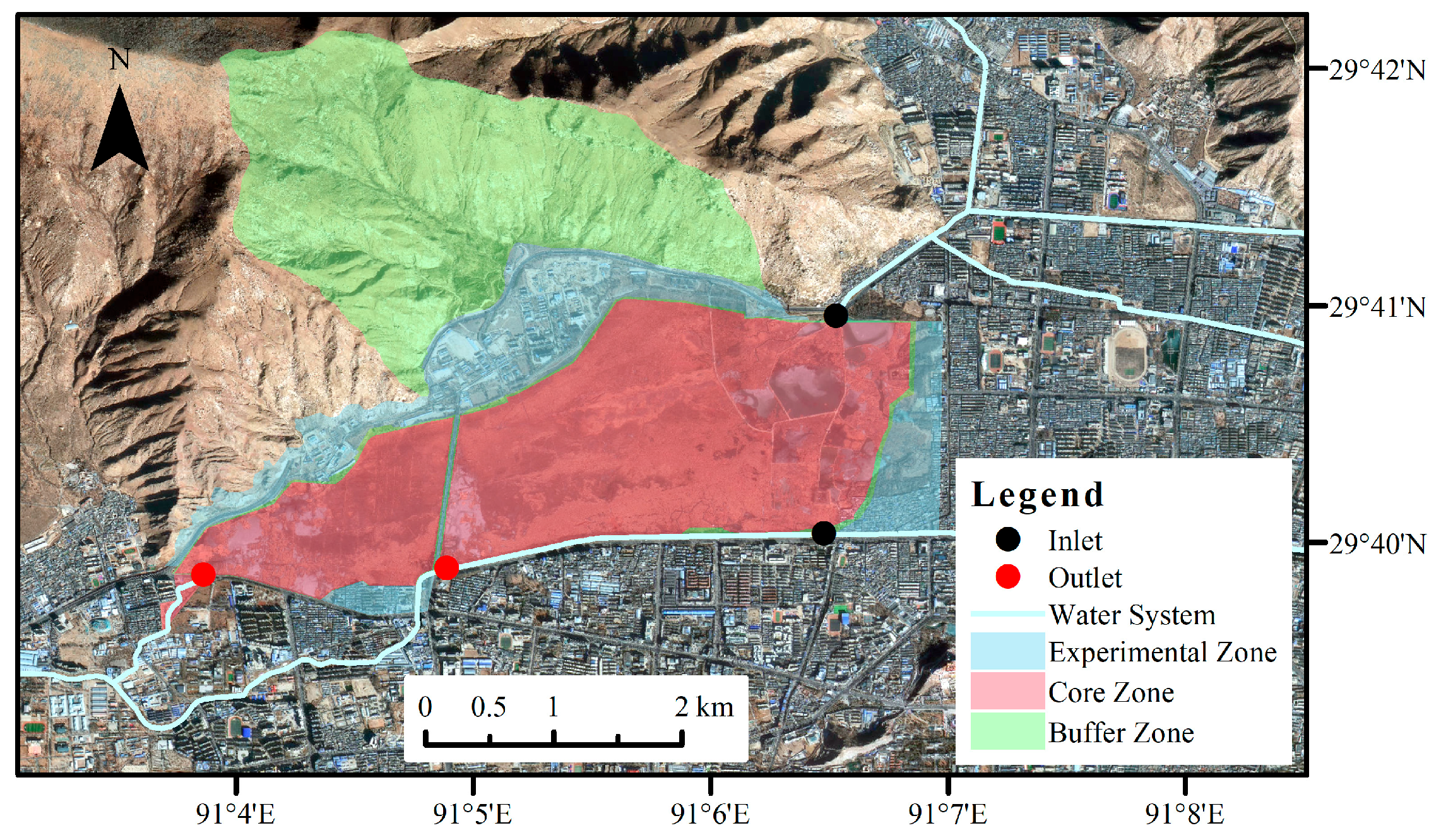
The Lhalu Wetland is situated in the northwestern corner of the urban area of Lhasa City, Tibet Autonomous Region, China. Its geographical coordinates range from 91°03′41″ E to 91°06′48″ E longitude and from 29°39′25″ N to 29°42′08″ N latitude, with an average elevation of 3645 m above sea level. The wetland is a typical alpine meadow marsh wetland. The climate belongs to the plateau temperate semi-arid monsoon type, characterized by cold and dry conditions, frequent winds, and intense solar radiation [10]. From 2000 to 2020, the mean annual precipitation in the study area was 492.3 mm, with a maximum of 658.2 mm and a minimum of 292.2 mm, showing a declining trend [15]. The Lhalu Wetland was established in 1999 as an autonomous region-level nature reserve and upgraded to a national nature reserve in 2005. The reserve currently encompasses a total area of 12.20 km2, which is functionally zoned into a core zone (6.60 km2), a buffer zone (3.39 km2), and an experimental zone (2.21 km2) (Figure 1). The wetland is bordered by residential areas to the east, high mountains to the north, the juncture of Dangre Road and the mountains to the west, and the urban district of Lhasa City directly to the south. The wetland receives water mainly from the tailwater of the Najin Hydropower Station on the Lhasa River (via the North Main Canal and the Middle Main Canal), inflow from the Duodi Valley and Nyangre Valley (Liusha River), and natural precipitation. Additionally, a portion of urban domestic sewage is discharged into the wetland through artificial channels.
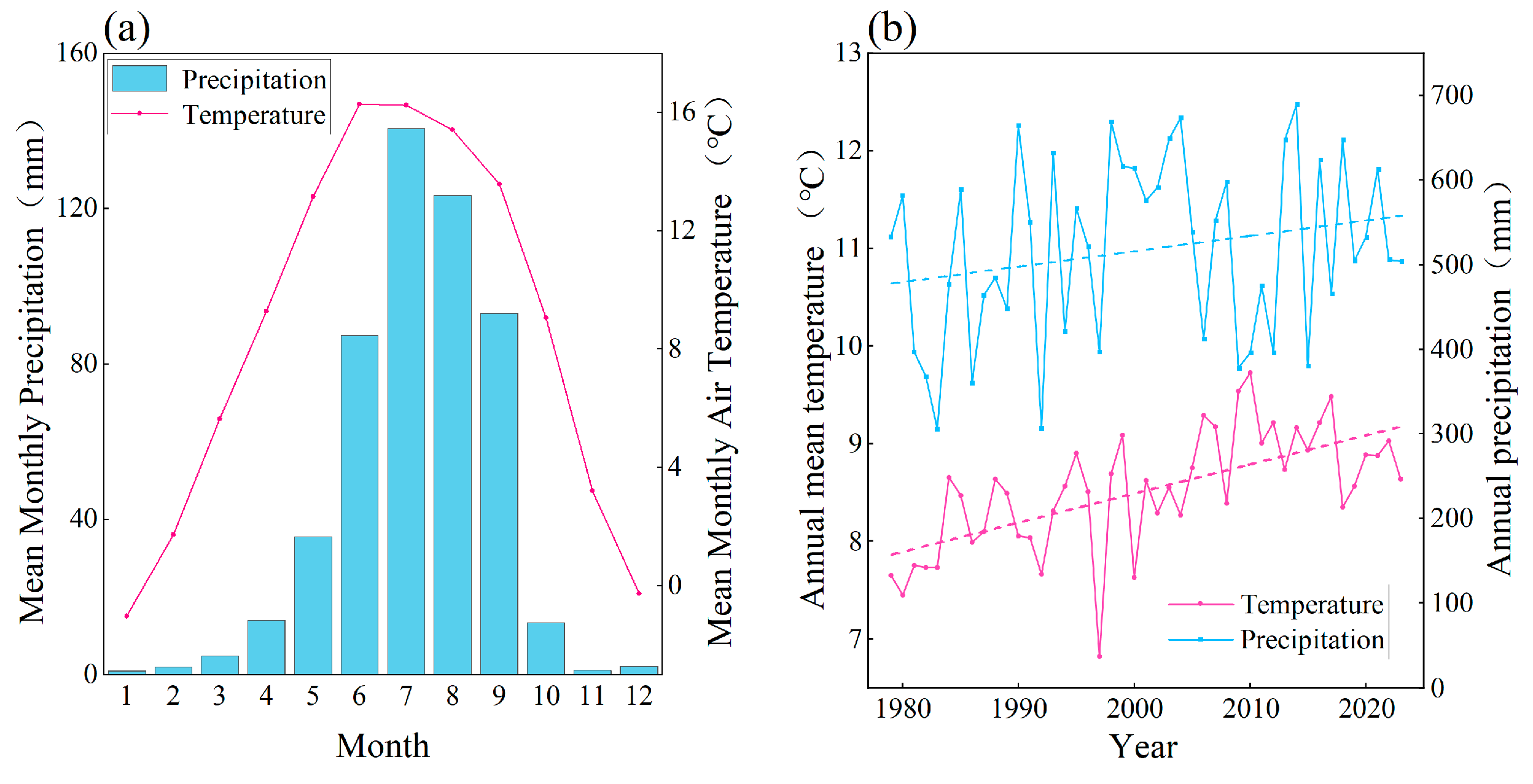
We analyzed climate trends using ordinary least squares (OLS) linear regression over the period 1979–2023 based on the high-resolution near-surface meteorological forcing dataset for the Third Pole region (TPMFD) [16]. Statistical significance was assessed using two-tailed t-tests. The mean annual precipitation was 517 mm, with approximately 85% of the annual precipitation falling between June and September (Figure 2a). Precipitation showed a slight increasing trend that was not statistically significant (OLS slope = +1.82 mm·yr−1, p = 0.139, R2 = 0.05, 95% CI: –0.61 to 4.25 mm·yr−1; n = 45). The mean annual temperature was 8.5 °C, with a statistically significant warming trend of 0.298 °C per decade (p = 2.64 × 10⁻⁶, R2 = 0.40, 95% CI: 0.187–0.410 °C·decade−1; n = 45) (Figure 2b). Overall, the region exhibits a warming trend accompanied by a non-significant wetting trend.

2.2. Data Sources and Processing

To compile historical species occurrence data for the Lhalu Wetland, we performed a systematic literature search. Chinese-language publications came from the China National Knowledge Infrastructure (CNKI, https://www.cnki.net) using the search terms “Lalu Wetland” OR “Lhalu Wetland”. English-language publications came from multiple platforms, including Google Scholar (https://scholar.google.com) and Web of Science (https://www.webofscience.com), using the same search terms. We included peer-reviewed journal articles, theses (both Master’s and Doctoral degrees), official monographs (e.g., China Wetland Resources—Tibet Volume [17]), and publicly available biodiversity survey reports from the former Lhasa Municipal Environmental Protection Bureau [18] and the Lhalu Wetland National Nature Reserve Administration [19,20]. No publication date restrictions were applied. The inclusion criterion required clearly documented species names (Latin or vernacular) with verifiable occurrence records specific to the Lhalu Wetland. Conference abstracts and news items were excluded. To ensure transparency and traceability, every species record included in our dataset is annotated with its original source (literature or report) in the Supplementary Materials (Table S2). Following the compilation of validated records, species were broadly categorized into three groups: plants, animals (fish, birds, mammals, amphibians, reptiles, and insects), and other eukaryotes (e.g., algae and fungi).
The primary steps for data organization were as follows: (1) Data entry. We entered species names from disparate sources into a database, including Latin scientific names, Chinese vernacular names, survey dates, and voucher information. (2) Nomenclatural verification and standardization. For plants, we used the “Plant Name Standardization” tool on the iPlant platform (https://www.iplant.cn/pnc, accessed on 6 October 2025) as the primary resource. This tool also provided hierarchical taxonomic information. For fish, we verified species names against Eschmeyer’s Catalog of Fishes [21] and cross-referenced Chinese names and the taxonomic hierarchy (order, family, genus) with the Latin-Chinese Dictionary of Fish Names [22]. For the remaining animal groups, we used the “Species Name Processing” tool on the Biodiversity Data Processing Platform (https://dp.iflora.cn), relying on the “Catalogue of Life China: 2025” [23] Annual Checklist as the reference database. When taxonomic conflicts arose (e.g., different accepted names for the same species) or when a primary tool could not resolve a name, we adopted the best available information from any of the above databases or additional authoritative sources (e.g., GBIF, FishBase). We documented the final decision and its source tool in Supplementary Table S2. (3) Querying of endangerment and protection status. We referenced threat status using the “Red List of China’s Biodiversity” (http://protection.especies.cn/redlist/list, accessed on 19 October 2025) and the “IUCN Red List of Threatened Species” (https://www.iucnredlist.org). We determined protection status from the “List of National Key Protected Wild Animals” and the “List of National Key Protected Wild Plants”, both promulgated in 2021 by the National Forestry and Grassland Administration and the Ministry of Agriculture and Rural Affairs, accessed via the “Assessment and Protection” tool on the Species Diversity Data Platform (http://www.especies.cn/specialTopic, accessed on 19 October 2025).
The data processed in Steps (1) and (2) are compiled in Supplementary Table S2: Historical Species Records of the Lhalu Wetland National Nature Reserve. After verification, we removed duplicates and consolidated synonyms from the historical records. When Chinese names mismatched Latin scientific names, we gave priority to the corrected Latin name. The final curated list forms Supplementary Table S1 (the Species Inventory), which also includes the endangerment and protection status of each species. All species in the Species Inventory come directly from literature and archival records; this study only corrected the scientific names in a nomenclatural sense. The actual occurrence of each species remains subject to further field investigation and verification. For example, Wei [24] and Purbu et al. [25] reported Gymnocypris waddellii in the wetland; however, previous data suggest that this species does not occur in the Lhasa River basin [26,27,28]. The record of G. waddellii in the Lhalu Wetland may reflect a misidentification of Oxygymnocypris stewartii [29], and the true situation requires further clarification.
Taxonomic coverage. This study covers plants, animals, and other eukaryotes (algae and fungi). Plant data were compiled and verified as described above and appear in the full species inventory (Supplementary Table S1). We include five animal groups: fish, birds, mammals, amphibians and reptiles, and insects. Fish and bird records are relatively abundant and form the basis for the species accumulation and alien species trend analyses in the Results. Records for mammals, amphibians and reptiles, and insects are very sparse—most are occasional observations or vernacular collective terms, not systematic species-level surveys. Other eukaryotes (algae and fungi) are also very limited and often lack species-level identification. Therefore, these groups appear only in the overall species inventory (Supplementary Table S1). They are not discussed in detail in the Results nor used in the trend analyses. Their detailed occurrence records (original names, corrected names, survey dates, and sources) are available in Supplementary Table S2. Data on the population and Gross Domestic Product (GDP) of Lhasa City were obtained from the Tibet Statistical Yearbook (1997–2021), with GDP data for the period 1988–1997 sourced from the China Economic Information Network (CEInet, https://ceidata.cei.cn). We acquired climate data from the National Tibetan Plateau Data Center (https://data.tpdc.ac.cn), specifically the long-term, high-resolution surface meteorological element dataset for the Third Pole region (TPMFD, 1979–2023). This dataset has a spatial resolution of 0.01°–0.05° and is provided in NetCDF (*.nc) format [16]. For this study, we selected monthly data from 1979 to 2023 and extracted precipitation and temperature for the Lhalu Wetland area using Python (Version 3.11.3).

3. Results

Based on the available literature and archival materials, ten biological groups have been documented in the Lhalu Wetland National Nature Reserve: plants, fish, birds, mammals, amphibians and reptiles, insects, algae, fungi, ciliates, and soil fauna, totaling over 1200 species (Supplementary Table S1). Specifically, these records comprise 438 species of vascular plants (251 genera, 82 families); 311 animal species (98 families, 39 orders) with 30 fish species, 174 bird species, 11 amphibian and reptile species; and 411 algae species (including 17 varieties and one form). This paper focuses on the diversity of flora and fauna in the reserve. Between 1979 and 2024, the cumulative number of recorded species has shown a steady increase with a notable rise in alien species after 2019.

3.1. Plant Diversity

This study compiles plant names from 19 sources on the Lhalu Wetland. Earlier records included all taxa identified to the species level, but recent sources only include species actually found in field surveys. We initially collated 763 records. After nomenclatural verification and standardization, we obtained a final list of 438 species (251 genera, 82 families). Supplementary Table S2 (Plants sheet) provides annotations for misidentifications, synonyms, and alternative names. When the Chinese vernacular name and the Latin scientific name did not match, we used the corrected Latin name as the authoritative reference. For discrepancies between species and subspecies, we retained the subspecific epithet. All plant species names discussed in the subsequent text refer to these corrected and standardized names. Taxonomic uncertainty (e.g., unresolved synonyms, potential misidentifications) can affect downstream analyses. To reduce this risk, we have documented all such cases in Supplementary Table S2 and recommend that users treat the dataset as a curated compilation needing further field validation.

3.1.1. Overview of Historical Research

According to early archival sources and local consultations, the flora of the Lhalu Wetland during the 1950s and early 1960s was relatively sparse, with 53 paludal, hygrophytic, or aquatic herbaceous plants from 21 genera and 17 families [30]. In 2000, researchers conducted several plant community surveys. In inundated zones and along ditches, Poaceae and Cyperaceae had the highest species richness [31]. A February survey found marsh vegetation dominated by Phragmites australis (coverage > 90%), meadow vegetation dominated by Carex littledalei, and aquatic vegetation nearly filled by Utricularia aurea, nearly filling the water column [32]. By August, P. australis, Acorus calamus, and C. littledalei dominated the wild plant communities [18]. Each of these three surveys recorded at most 25 plant species, with a cumulative total of 49 species. The missing species were primarily indigenous hygrophytic plants that could not be collected because of urban development in Lhasa [30]. Because the earliest records lack detailed species inventories, we cannot precisely assess changes in species composition.
Researchers conducted plant community surveys in the Lhalu Wetland at the beginning of the 21st century. Li et al. [33] collected 85 plant species (52 genera, 30 families) from 84 quadrats surveyed between June and September 2002. Poaceae (20 species), Cyperaceae (13 species), and Juncaceae (5 species) were the most represented. In contrast, a survey in August of the same year found that the most species-rich families were Asteraceae (9 species), Poaceae (6 species), and Cyperaceae (4 species) [34]. Surveys conducted between 2001 and 2003 recorded 56 plant species (32 families, 51 genera) in the wetland’s peripheral zones [35]. Combining 2004 field surveys with archival data, one compilation listed 177 plant species (79 genera, 26 families); however, it explicitly named only 32 species (22 genera, 16 families), with Cyperaceae (10 species) the most common [36]. For the next ten years, there were no specialized floristic surveys; only incidental records of 16 plant species appeared in studies of fungi and soil fauna [37,38].
In May 2019, a survey documented 18 aquatic plant species across 48 sampling sites along the wetland perimeter and the eastern embankment [39]. In 2023, researchers conducted the first targeted investigation of the composition and distribution of invasive plants in the Lhalu Wetland National Nature Reserve. They found 29 alien invasive plant species (25 genera, 10 families). Dicotyledons accounted for 25 species (86.21% of the total), with main species including Sonchus oleraceus, Galinsoga parviflora, and Chloris virgata [6]. By then, the reserve had recorded 162 plant species identified to the species level from 104 genera and 45 families. The three largest families were Cyperaceae (25 species in 6 genera), Asteraceae (22 species in 13 genera), and Poaceae (18 species in 18 genera).
Furthermore, two additional reports from the Lhalu Wetland Management Authority list many more plant species. Report 1 [19] is based on field quadrat surveys conducted in 2021–2022. It recorded 92 plant species (72 genera, 37 families). Report 2 [20] used reconnaissance and comprehensive survey methods from June to August 2024. It recorded 317 species of higher plants (216 genera, 71 families). In both reports, the three most species-rich families were consistently Asteraceae, followed by Poaceae and Fabaceae. These two surveys sampled the buffer zone on the northern hills, covering a larger area, more habitat types, and more sampling sites than earlier published studies. This likely explains the large differences from historical survey records. Notably, Report 1 states, “based on a combination of field surveys and historical data, there are 435 vascular plant species (249 genera, 74 families).” However, the historical component of that count lacks clear bibliographic or archival sources, so we excluded it from our analysis.

3.1.2. Species Composition and Conservation Status

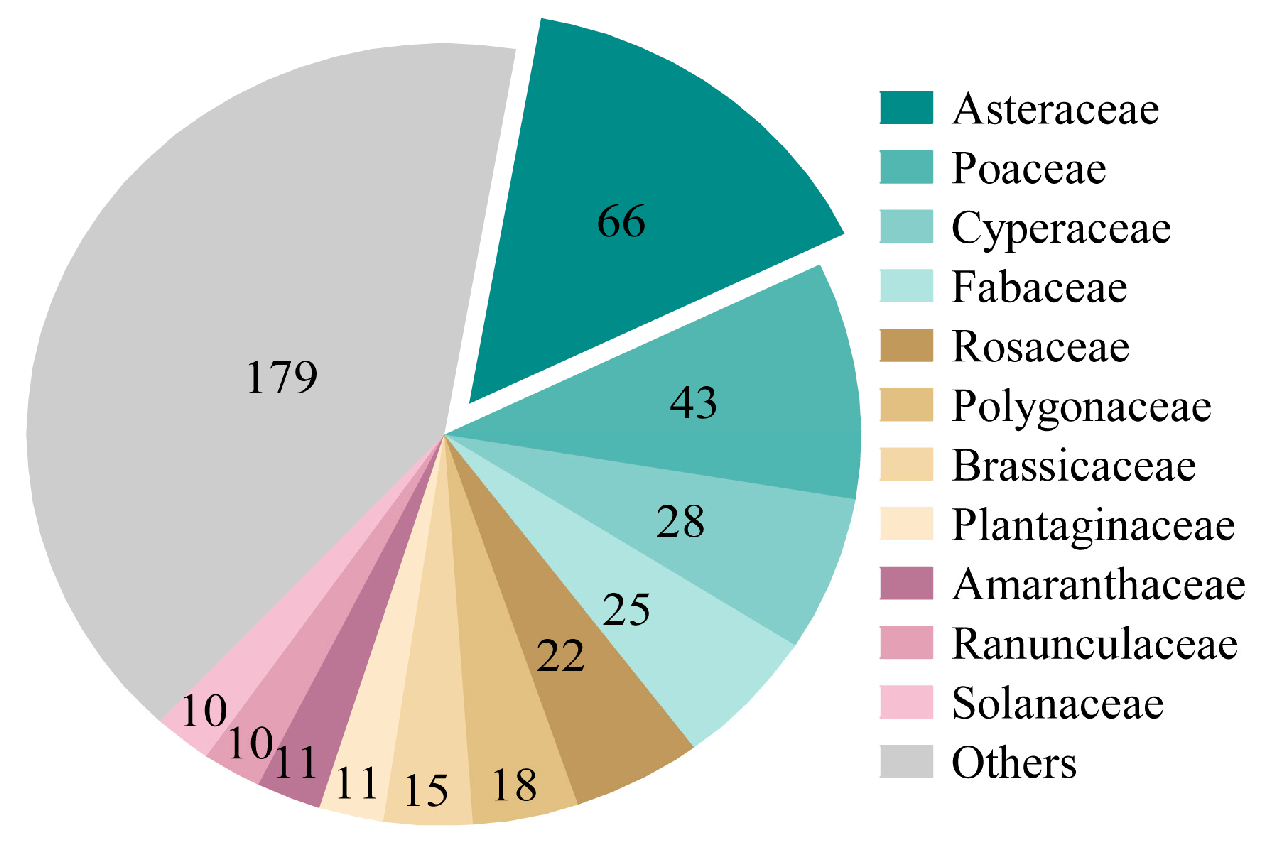
Based on all available sources, the flora of the Lhalu Wetland has 438 species (251 genera, 82 families). The five families with the highest species richness are Asteraceae (66 species in 32 genera), Poaceae (43 species in 30 genera), Cyperaceae (28 species in 7 genera), Fabaceae (25 species in 13 genera), and Rosaceae (22 species in 12 genera) (Figure 3). The four genera with the most species are Carex (16 species), Artemisia (10 species), Cirsium (9 species), and Plantago (7 species). The genera Potamogeton, Persicaria, and Prunus each have six species, tying for fifth. Regarding species distribution among families and genera, 33 families are monotypic (one species each), while 11 families are speciose (over 10 species each) and together make up 259 species, or 59.13% of the total flora. Monotypic genera number 147, covering 33.56% of all species.
According to the “List of National Key Protected Wild Plants (2021)”, the Lhalu Wetland has one first-class protected species—Isoetes sinensis and three second-class protected species: Nelumbo nucifera, Prunus mira, and Rosa rugosa. The record of Isoetes sinensis appeared under that Latin name, but the accompanying Chinese vernacular name was simply the generic term for quillworts (written with a non-standard character), rather than the full species name. This record appears only in the article “A Preliminary Study on the Lhalu Wetland in Lhasa”. There, the species belongs to the Hippuris vulgaris plant community and grows mainly along pond margins and in flooded areas [31]. The record of N. nucifera originally had only a Chinese vernacular name, with no Latin binomial. The original text describes it as a companion species alongside Elymus nutans, Poa spp., Juncus spp., Pedicularis longiflora var. tubiformis, Ranunculus nephelogenes, Glaux maritima, and Gentiana spp. [36]. The remaining two protected species appear only in the Biodiversity Survey Report (2025) [20], with no details about their spatial distribution.

3.1.3. Invasive Alien Plants

We initially compiled records of “alien plants”, “invasive plants”, and “invasive alien plants” from the Qinghai–Tibet region using a systematic literature search (both Chinese and English sources) and the Invasive Alien Species of China (IASC) database (http://www.iplant.cn/ias/, accessed on 8 May 2026), China’s Invasive Alien Species [40], and the “Catalogue of Alien Invasive and Naturalized Plants of China (2023 Edition)” [41]. A preliminary comparison found 90 species in the Lhalu Wetland listed as “invasive alien plants” (Supplementary Table S3). However, definitions of “invasive alien plant” differ among sources, and some of these species may have low invasiveness or be only cultivated. So, we adopted a standardized screening rule to ensure consistency and reproducibility. We used three authoritative datasets as criteria: IASC (invasiveness rank 1–5), the “Dataset on Inventory and Geographical Distribution of Vascular Plants in Xizang, China” (living status = “invasive”), and the “Catalogue of Alien Invasive and Naturalized Plants of China” (living status = “invasive”). We included any species that met the criteria in at least one of these datasets in the final list of invasive alien plants. By this rule, we identified 55 of the 90 candidate species as invasive alien plants (Supplementary Table S3, column “Included in final list (1/0)” coded as 1).
According to the IASC invasion classification (Table 1), 8 of these 55 species are “Malignant Invasion” (Rank 1) and 11 species are “Severe Invasion” (Rank 2). 44 species are classified as invasive (code I) within China, and 49 are considered invasive in Tibet (Ranks 1–5). For five species, including Oxybasis glauca, we lack native distribution information. For the remaining 50 invasive plant species, the native ranges are distributed as follows: 23 species originate from North America, 13 from Africa, 8 from Asia, 4 from South America, and 2 from Europe. Consequently, North America represents the predominant source region of invasive alien plants in the Lhalu Wetland, making up 41.82% of the species with known origins.
Table 1. Main Invasive Alien Plants in Lhalu Wetland.
Scientific NameRankStatus in XizangStatus in ChinaOrigin
Alternanthera philoxeroides1Invasive (1)N/ISA
Amaranthus retroflexus1Invasive (1)N/INA
Bidens frondosa1 N/INA
Bidens pilosa1Native wildN/INA
Erigeron annuus1Invasive (1)N/INA
Erigeron canadensis1Invasive (1)N/INA
Erigeron sumatrensis1Invasive (1)N/ISA
Ipomoea purpurea1Invasive (1)C/E/N/INA
Erigeron bonariensis2Invasive (2)N/INA
Galinsoga parviflora2Invasive (2)N/INA
Lepidium virginicum2Invasive (2)N/INA
Trifolium repens2Invasive (2)C/E/N/IAF
Oenothera biennis2Invasive (2)C/E/N/INA
Veronica persica2Invasive (3)N/IAS
Avena fatua2Invasive (2)N/IAF
Bromus catharticus2 C/E/N/ISA
Datura stramonium2Invasive (2)N/INA
Trifolium pratense3Invasive (2)C/E/N/IAF
Mirabilis jalapa4Invasive (2)C/E/N/INA
Note: “Rank” follows IASC classifications: 1 = Malignant Invasion, 2 = Severe Invasion, 3 = localized invasion, 4 = general invasion; “Status in Xizang” is cited from “A dataset on inventory and geographical distribution of vascular Plants in Xizang, China”, numerals in parentheses following status entries indicate invasion rank; “Status in China” and “Origin” are cited from “A dataset on catalogue of alien plants in China”. Continent abbreviations: C = cultivated plants, E = escaped plants, N = naturalized plants, I = invasive plants, SA = South America, NA = North America, AS = Asia, AF = Africa.

3.2. Animal Diversity

Due to a few mammal and insect records in the compiled dataset, this section covers only fish and bird diversity. Based on available historical records collated from literature surveys, monographic accounts, and relevant investigation reports, the Lhalu Wetland National Nature Reserve has 311 animal species (98 families, 39 orders) (Table 2). Among these, 8 species are nationally protected as Class I and 38 species as Class II. All Class I protected species are birds, such as Aegypius monachus, Mycteria leucocephala, and Grus nigricollis. Class II protected species are mostly birds, with 26 avian taxa such as Anser albifrons, Ibidorhyncha struthersii, and Falco tinnunculus, together with 12 species from other taxonomic groups, including Glyptosternon maculatum, Oxygymnocypris stewartii, and Vulpes vulpes (see Table S4 for the complete list). Because detectability and sampling history differ among animal groups, this total count is a raw list, and we caution against over-interpretation.
Table 2. Statistics of animal diversity in Lhalu Wetland National Nature Reserve based on historical data.
GroupOrderFamilySpeciesClass IClass IIVulnerable (VU)Endangered (EN)Alien Species
IUCNCSRLIUCNCSRL
Insects72777       
Fishes51230 425 213
Amphibians255 111  1
Reptiles236      1
Birds194217482627213
Mammals4919 7 1 41
Total39983118385142719
Note: Class I = first-class national protection; Class II = second-class national protection, according to the List of National Key Protected Wild Animals (2021); CSRL = Red List of China’s Biodiversity; IUCN = IUCN Red List of Threatened Species.
According to the Red List of China’s Biodiversity (CSRL), only one animal species—G. maculatum—is Critically Endangered (CR). Seven species are Endangered (EN): Ptychobarbus dipogon, O. stewartii, and Falco cherrug among others. Fourteen species are listed as Vulnerable (VU), and 30 are Near Threatened (NT). Under the IUCN Red List of Threatened Species, two species—Aquila nipalensis and Falco cherrug—are Endangered, five species are Vulnerable and 14 species are Near Threatened. In total, 52 animal species in the reserve fall into threatened categories (CR, EN, VU, or NT).
The literature lists 19 alien vertebrate species in the reserve: 13 alien fish, three alien bird—Pterorhinus davidi, Acridotheres cristatellus, and Psittacula derbiana—and one alien species each for mammals, amphibians, and reptiles (Mus musculus, Aquarana catesbeiana, and Trachemys scripta elegans). The classification of the three bird species as alien follows the original source [42]; however, their status may change if further biogeographical evidence points to natural range expansion rather than human-mediated introduction.

3.2.1. Fish Diversity

An analysis of changes in the ecological environment and flora/fauna resources of the Lhalu Wetland over nearly 50 years (1951–2000) shows that the fish fauna initially consisted of five species (four genera, two families) [30]. A survey from the late 1970s to mid-1980s similarly also found five fish species (three genera, two families, one order) [24]. Zong et al. [32] listed six native fish species that historically inhabited the area, but their February 2000 field survey caught no native fish; instead, alien species like Carassius auratus and Misgurnus anguillicaudatus had replaced the native community. Using small-mesh nets, Purbu et al. [25] collected seven fish species from 2001 to 2003 (five genera, three families, two orders), of which two were alien. Fan et al. [29] did three seasonal surveys in April and June 2010 and April 2011 using gillnets and trap nets, capturing 12 fish species (10 genera, seven families, three orders). However, they found native species only in very low numbers, while alien species Pseudorasbora parva and C. auratus had become the dominant taxa. Xie and Huang [36] reported 11 fish species from archival and field data, but we later found that two names were synonyms, leaving nine valid species (five genera, three families, two orders). Zhu et al. [11] used gillnets and trap nets from 2019 to 2021, sampling eight alien fish species (seven genera, six families, three orders), with Tinca tinca a new record for the reserve [43]. Feng et al. [12] collected 17 fish species using traditional methods in July 2020; native species made up only 15.53% of the total catch. A field survey conducted in 2021 yielded ten fish species (nine genera, seven families, four orders), with only two species: Schizopygopsis younghusbandi and Triplophysa brevicauda. A 2024 investigation detected a new alien fish, Rhynchocypris lagowskii.
We compiled fish records from ten published articles and two biodiversity survey reports, giving 106 individual occurrence entries for the Lhalu Wetland. After nomenclatural verification and taxonomic query, these entries correspond to 30 valid fish species (17 genera, 12 families, five orders). The only nomenclatural conflict was the common carp: both Cyprinus carpio and C. rubrofuscus appeared in the original records; the final species list (Supplementary Table S1) keeps only C. rubrofuscus, as shown in Supplementary Table S2. Among these 30 fish species, 17 species (six genera, three families, two orders) are native, and the other 13 species (12 genera, 11 families, five orders) are alien. Twentieth-century Survey reports on the Lhasa River basin contain no alien fish records, and none were reported for the Lhalu Wetland at that time [24,27,30]. Since the first two alien fish species were recorded in 2000, the total has now reached 13 alien fish species. Among them, Cyprinus carpio and C. auratus became established and spread throughout the Lhasa region from the late 1970s onward due to artificial stocking and release [34]. The remaining alien fish species are mostly common commercial food fish or incidentally introduced from Lhasa markets. They entered the wetland primarily through human release activities [12]. Such fish releases have already affected the community structure and species diversity of fish in the Lhasa River basin [44] and has caused a severe biological invasion crisis in the Lhalu Wetland.
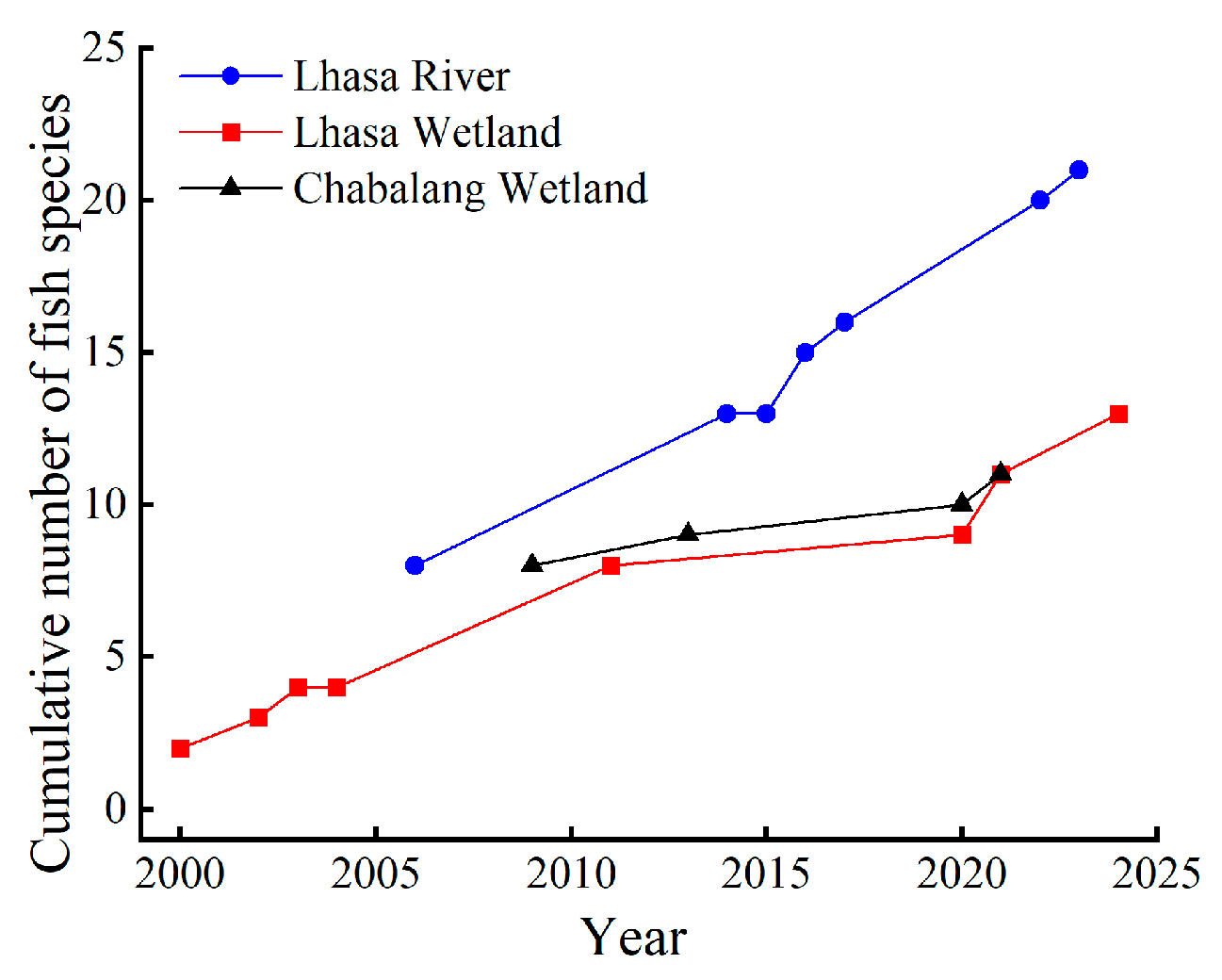
We plotted the cumulative number of alien fish species in the Lhasa region over time using literature records from the Lhasa River, the Lhalu Wetland, and the Chabarlang Wetland. The totals were 21, 13, and 11 species, respectively (Figure 4). The Lhasa River’s alien fish assemblage includes most species recorded in the Lhalu Wetland; only T. pseudoscleroptera and Oryzias sinensis are unique to the Lhalu Wetland. Also, the earliest detection dates for shared alien species vary widely among these water bodies. Combining successive surveys and studies suggests that alien fishes enter the Lhalu Wetland mainly through direct human release within the wetland and through dispersal from the Lhasa River basin via artificial channels. However, we do not know the relative contributions of these two pathways because we lack quantitative data on release events and water connectivity. For the Lhasa River, the main introduction pathways are: (1) the introduction and subsequent escape of aquaculture and ornamental fish; (2) unintentional introduction as contaminants associated with stocked fish; and (3) unregulated human release activities [45]. Natural dispersal from other drainages may also play a role. For example, Abbottina rivularis appeared first in the middle reaches of the Yarlung Zangbo River (2006–2007) [46], then in the Chabarlang Wetland (2009) [47], and later in the Lhasa River basin (2010–2014) [48]. Although this sequence fits a natural dispersal pattern, we currently lack solid evidence for that pathway.

3.2.2. Bird Diversity

Long-term field work from the 1950s to 1970s, plus consultations with experts and local informants, produced “Avifauna of Tibet” [49]. It recorded about 20 genera, 17 families, and nine orders of wetland birds using the Lhalu Wetland for breeding, stopover, foraging, or roosting [34]. From the late 1970s to the mid-1990s, bird species declined, and by the late 1980s only 14 species remained [24]. Surveys in 2001–2002 found only eight bird species [30]. Lhaduo et al. [35] surveyed waterbirds in 2002–2003 and recorded 23 species over two years. Among them, Tadorna ferruginea and Anser indicus had the highest mean encounter rates in winter. This finding contradicts the assertion made by Li [30] that “A. indicus had vanished completely”, likely due to differences in survey seasons or the shorter duration of the earlier assessment. Basang et al. [7] ran a detailed four-year survey from 2001 and documented 62 bird species, far more than any earlier study. Zhou et al. [50] did monthly line-transect surveys from May 2014 to April 2015, recording 69 bird species (46 genera, 28 families, 12 orders). Bird abundance peaked in January, while species richness peaked in May; both reached their lowest in July. Thus, the bird community shows strong monthly fluctuations and seasonality in distribution and abundance. Also, human factors and habitat characteristics—such as proximity to roads and buildings, and vegetation height and coverage—strongly affect winter bird diversity and spatial distribution [51].
Bird records from the Lhalu Wetland cover nearly 70 years (late 1950s to 2024). We gathered 17 sources: 13 journal articles, two monographs, and two biodiversity survey reports (Table 3), giving 620 individual bird observation and distribution records. After verifying species and taxonomic names using the “Catalogue of Life China: 2025 Annual Checklist”, we found 174 bird species historically reported from the Lhalu Wetland (97 genera, 42 families, 19 orders). The three orders with the most species are Passeriformes (78 species), Anseriformes (21 species), and Charadriiformes (20 species); the three most species-rich families are Anatidae (21 species), Accipitridae (19 species), and Fringillidae (10 species). In the historical literature, Passeriformes dominates with 57 species, and Anatidae and Accipitridae each have 17 species. Two recent survey reports (2021–2024) together recorded 117 bird species (76 genera, 39 families, 17 orders), with Passeriformes (56 species) and Anatidae (18 species) still the dominant order and family.

3.3. Trends in Biodiversity Change

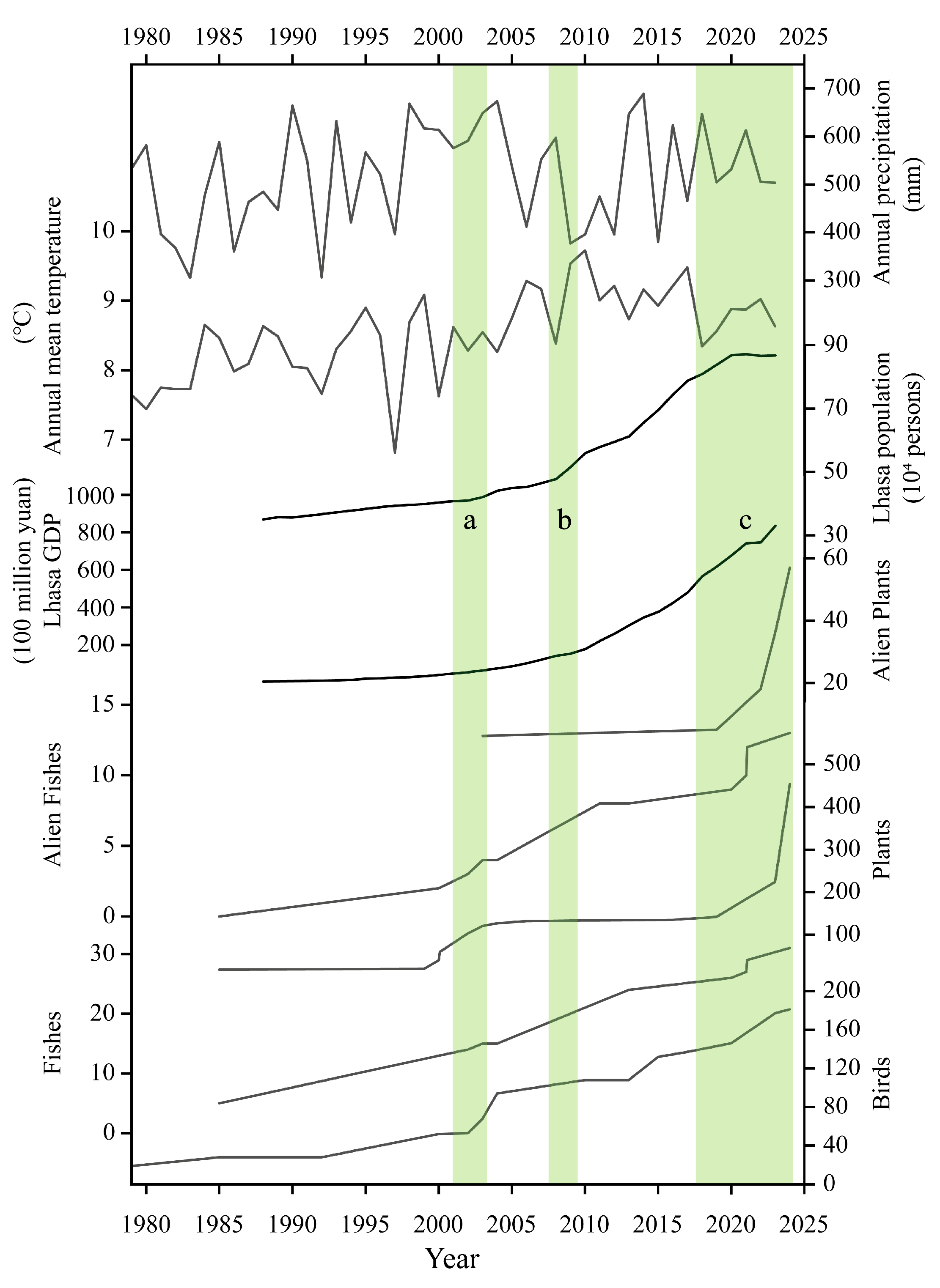
Because historical survey datasets differ in sampling method, spatial coverage, and taxonomic resolution, we cannot directly compare species richness across time periods. To avoid biases from methodological heterogeneity, we did not run significance tests for changes in species numbers. Instead, Figure 5 shows raw species accumulation curves for the major biological groups, based on the verified species inventory. These curves simply show how many species were recorded as survey events or literature sources increased; they are only a descriptive summary of the data compilation. Because the original datasets lack the detailed sampling effort information (e.g., area sampled, gear type, time per survey) needed for methods like rarefaction/extrapolation or coverage-based estimators, do not interpret the curves as quantitative ecological trends. Readers who want standardized comparisons should re-analyze the raw occurrence data in the Supplementary Materials using appropriate statistical frameworks.
From 1979 to 2024, the raw cumulative number of species recorded for the main taxonomic groups rose steadily, with a noticeable rise in alien species records after 2019 (Figure 5). For plants, cumulative recorded species increased faster during 2000–2005 and 2019–2024, and more slowly in between. Alien plant records showed almost no increase from 1979 to 2018, but jumped sharply after 2019. For fish, the cumulative increase came almost entirely from alien fishes; native fish records stayed stable long term. Alien fish records accelerated faster after 2000. For birds, cumulative records trended upward overall, with a faster increase mainly between 2000 and 2005.
These patterns may partly reflect real changes (e.g., new alien species), but because we did not standardize for effort, we cannot rule out that increased sampling over time also contributed. Therefore, interpret these findings as observational trends in recorded data, not as definitive ecological trends.

4. Discussion

4.1. The Need for Further Collation of Taxonomic Records

Early literature has many problems with species names. These include typographical errors in Chinese vernacular names, misspellings of Latin binomials, ambiguous vernacular terms at the genus or group level, records only at the genus level or as collective group terms, colloquial names, and mismatches between Chinese names and Latin names. In contrast, we consider synonyms and alternative names a normal by-product of how scientific nomenclature evolves. Here are a few examples:
  • Multiple early publications record a name that corresponds to the genus Juncus, but with a variant Chinese character. In the absence of an accompanying Latin name, such entries could merely denote a collective reference to the genus. In the Lhalu Wetland, at least five Juncus species have been explicitly identified to the species level: J. effusus, J. allioides, J. thomsonii, J. himalensis, and J. articulatus.
  • A record originally appearing with the designation corresponding to Heleocharis alleculosa (with a variant Chinese character) reflects multiple concurrent problems: a typographical error in the Chinese name, the use of a junior synonym, and a mismatch between the Chinese name and the Latin binomial. The correct Chinese name should correspond to a different specific epithet, and the Latin name Heleocharis alleculosa is a synonym of Eleocharis valleculosa, for which the accepted name is Eleocharis valleculosa. Taking into account the documented occurrence of Eleocharis valleculosa var. setosa in the Lhalu Wetland plant records, the problematic entry is provisionally accepted as referring to Eleocharis valleculosa.
  • Early records of insects were largely obtained through informal consultations and consequently contain only vernacular collective terms such as “butterflies,” “grasshoppers,” “spiders,” “mosquitoes,” and “ladybugs.” Researchers subsequently identified a subset of these to the species level by cross-referencing with the documented insect fauna of Lhasa City [34].
  • The correction of a record originally documented with the name corresponding to Paramisgurnus dabryanus to Misgurnus dabryanus exemplifies a nomenclatural update driven by advances in taxonomic techniques. Zhang et al. [57] revised the classification of the genera Misgurnus and Paramisgurnus based on morphological characters and mitochondrial Cytb and COI gene sequences, demonstrating that Paramisgurnus should be considered a junior synonym of Misgurnus and that P. dabryanus is properly placed within Misgurnus. Despite this taxonomic revision, the combination P. dabryanus remains the accepted name in the “Catalogue of Life China: 2025 Annual Checklist” and in much of the Chinese-language literature.
  • Pre-2005 avian records contain multiple references to a name corresponding to Milvus korschun (Chinese “yuan”, or kite). This name is a junior synonym of M. migrans (black kite). Beyond the synonym issue, the survey by Basang et al. [7] recorded M. migrans, and according to the Avibase—The World Bird Database, the only Milvus species with a confirmed distribution in the Lhasa region is M. migrans. Accordingly, the bird inventory for the Lhalu Wetland presented herein accepts this taxon as M. migrans.
Taxonomic system instability is another challenge, primarily because the classification in original sources often differs from currently accepted frameworks. Therefore, simply counting families and genera in historical documents cannot be used to evaluate changes in biodiversity. For example, Ctenopharyngodon idella was formerly assigned to the family Cyprinidae but is now placed in Xenocyprididae. Regarding algae, only three published studies provide species-level records for the Lhalu Wetland. However, because of inconsistencies in the taxonomic monographs and classification systems, even with the widely used AlgaeBase database, we cannot easily reconstruct temporal changes in algal diversity by name changes alone. Quantifying the impact of taxonomic instability on our species inventory is not possible because the original sources lack the needed information. We have documented and detected nomenclatural conflicts in Supplementary Table S2 with full synonymy chains.

4.2. Limited Comparability of Historical Survey Data

Research on the biodiversity of the Lhalu Wetland spans an extended temporal range, and survey data from different periods make comparison difficult for two reasons: first, taxonomic systems have evolved; second, survey methods lack standardization.
First, historical shifts in taxonomy make it hard to reconcile species inventories. Literature and survey reports from the early 2000s and earlier relied largely on older systems like Insects of Tibet [58], Avifauna of Tibet [49], “A Preliminary Report on the Fishes from Tibet” [59], and Amphibians and Reptiles of Tibet [60]. Since then, many scientific names and generic or familial assignments have been revised based on new molecular data. Examples include the taxonomic reassessment of the genera Misgurnus and Paramisgurnus [57], and synonyms among some wetland plants and fishes. These inconsistencies mean that simply comparing historical and modern species lists can easily cause “pseudo-turnover”—that is, differences that reflect changes in taxonomy, not real changes in species composition.
Second, different survey methods and spatiotemporal scales further reduce data comparability. Spatially, early vegetation surveys chose sites subjectively, placing quadrats only in representative plant communities and missing the wetland’s full heterogeneity. In contrast, more recent investigations emphasize systematic or grid-based sampling, resulting in pronounced differences in spatial representativeness and sampling intensity. Temporally, early surveys were often single-occasion or seasonal collections, sometimes done outside the target organisms’ reproductive season and with no record of sampling frequency. Modern studies, in contrast, favor year-round or multi-season monitoring. Because wetland organisms—especially waterbirds and insects—have strong seasonal rhythms and year-to-year fluctuations, comparing data from different seasons or years cannot reliably separate real biological change from artifacts of timing. For example, Zhou et al. [50] conducted a year-long monitoring program from May 2014 to April 2015, recording 13 wintering bird species (18.84%), with richness and abundance peaking between January and March. In contrast, Yuan et al. [56] performed a single-day bird survey on 25 December 2020, recording eight wintering species (16%), only four shared with the former. Notably, five of the nine wintering species missed in 2020 were later found in surveys conducted between 2021 and 2023. Thus, an apparent decline in wintering bird species may simply come from survey timing that missed the migration window of certain taxa.
Furthermore, different sampling gears and detection methods across generations make data integration harder. Early fish surveys relied primarily on nets, which work poorly for small-bodied or rare species. Newer studies employing molecular tools like environmental DNA (eDNA) can detect more cryptic species. For example, Feng et al. [12] collected ten native fish species with traditional nets in 2020, while eDNA analysis detected 11 native species, including eDNA signals of the rare and endangered Oxygymnocypris stewartii. This shows that eDNA can find elusive species more effectively than conventional methods. Future monitoring in the Lhalu Wetland should combine eDNA surveys with traditional capture methods to better detect rare and elusive species, thus enabling a more robust assessment of fish biodiversity trends.
For other taxonomic groups, early surveys relied on direct visual observation in the field. Currently, small mammal surveys use camera-trap monitoring at fixed stations, and bird surveys use binoculars and spotting scopes as well as better counting and statistical methods. While these advances improve detection, they also make it very hard to link historical and modern datasets for abundance or population density. In other words, we often cannot tell whether a newly recorded species really arrived recently or just appears because earlier methods could not detect it.

4.3. Insufficient Depth of Research on Biological Invasions

The Lhalu Wetland National Nature Reserve is a relatively enclosed ecosystem that protects a unique alpine wetland and its rich biodiversity. But under the combined pressures of climate change and human disturbance, many invasive plants and fish, plus species like Trachemys scripta elegans and Aquarana catesbeiana, have become established in the wetland, threatening its biodiversity and ecosystem stability [6,12,61,62]. Biological invasions, a major factor affecting the wetland’s biodiversity, have received little attention in past surveys. This has hurt our understanding of biodiversity patterns and the management of invasive species. So far, studies focused specifically on alien species in the Lhalu Wetland are very sparse. Invasion mechanisms are poorly understood, and corresponding control measures are largely confined to experience-based discussions, lacking experimental validation of their feasibility and effectiveness. Application of standardized frameworks, such as the invasion stage scheme [63] or the EICAT (Environmental Impact Classification for Alien Taxa) impact classification, could help prioritize management actions and risk assessment, but such assessments have not yet been conducted for this wetland.
Surveys of alien plants were initiated relatively late, resulting in a historical deficit in baseline knowledge. Early vegetation studies focused mainly on the floristic composition and community characteristics of native species, and paid little attention to invasive alien plants. It was not until 2023 that Li et al. [6] conducted the first systematic investigation of invasive alien plants within the Lhalu Wetland National Nature Reserve, clarifying species composition, spatial distribution, occurrence frequency, and the habitat types most susceptible to invasion. Notably, the highly invasive Datura stramonium had already been recorded during 2001–2003 [30,34,35], but was ignored for the next twenty years. By the survey of Li et al. [6], D. stramonium occurred at 50% of 74 sampling sites and had spread into six habitat types—plantations, peripheral roads, visitor walkways, embankments, scrub-grassland, and trestles—which points to a severe invasion trend. However, we have no quantitative estimates of its spread rate (e.g., km2·yr−1) or occupancy models that account for detectability from the current data. Future studies should use repeated surveys and spatially explicit monitoring to better understand its invasion dynamics and predict future expansion.
Both the American bullfrog (Aquarana catesbeiana, formerly Rana catesbeiana) and the red-eared slider (Trachemys scripta elegans) appeared in the “Checklist of Invasive Alien Species in China” (2003 and 2014). Because they adapt well, reproduce prolifically, and have few natural enemies, they invade and spread easily, threatening native amphibians and turtles. The IUCN lists both among the world’s 100 most invasive species [64]. The first reports of the American bullfrog in the Lhalu Wetland come from 2014 to 2015. Since bullfrog farming did not exist in Tibet, people likely released bullfrogs bought from food markets as a religious practice [61]. Studies of body shape and behavior show that the bullfrog has adapted to the high-altitude wetland and can survive there [65]. Zhu et al. [66] studied how bullfrog numbers vary with location; they found the highest densities near the northern entrance (May–July 2021) and the lowest along Luding North Road. Later surveys have only recorded adult bullfrogs; no one has seen larvae or tadpoles. So, we still do not know whether the bullfrog has formed a self-sustaining population in the wetland. Since a single red-eared slider was caught on 16 July 2016 [62], no further systematic observations or studies have been conducted on this species, leaving its current presence and reproductive status in the wetland entirely unknown. Quantitative modeling of population viability or invasion risk (e.g., demographic models, niche modeling) has not been performed due to the lack of long-term monitoring data on survival, reproduction, and dispersal. Future research should prioritize such modeling to assess the likelihood of establishment and spread of these species in the high-altitude environment.
Many publications mention alien fishes in the Lhalu Wetland, but most only give brief descriptive accounts within broader biodiversity surveys, simply listing species without systematic investigation. Fan et al. [29] described fish assemblage composition and alien fish distribution in 2010–2011, confirming that the fish community had become dominated by alien species, with only a few native fishes left. Zhu et al. [11] used a functional trait approach to show that alien fishes in the Lhalu Wetland have diverse habits and feeding types, and that community functional diversity exceeds that of native fishes—suggesting that alien fishes may occupy empty niches or have a competitive advantage in food acquisition. However, current research has not yet examined interspecific interactions. Do alien and native fishes exhibit niche overlap in their spatial distributions? What is the quantitative relationship between their population trajectories? Do alien fishes impact native species through competitive exclusion or predation? These core questions pertaining to invasion mechanisms remain unanswered due to a lack of comparative data derived from simultaneous surveys.
Overall, systematic research on invasion mechanisms remains conspicuously weak. For both plants and fishes, the majority of existing studies only describe species presence and abundance, without substantive exploration of their biological traits, reproductive strategies, environmental adaptability, or the roles of hydrological conditions and human disturbance affecting invasions. The investigation by Sun et al. [67] into the life-history traits of Pseudorasbora parva is one of the few deep case studies. Compared to source populations in its native range, the Lhalu Wetland P. parva exhibited a younger age structure and smaller mean body length. In terms of growth characteristics, individuals of the same age class were relatively smaller and displayed slower growth rates. With respect to reproductive strategy, absolute fecundity was lower, and egg diameter was smaller. Low ambient temperatures and limited food in the high-altitude environment likely explain these flexible life-history shifts. This study provides valuable insights into how alien species adapt to high-altitude wetlands, but such work remains scarce, and the life-history strategies of P. parva cannot be generalized to larger-bodied alien fishes such as Cyprinus carpio or Silurus asotus. More broadly, we infer invasion pathways mostly from indirect evidence, lacking support from molecular markers or rigorous historical documentation. Quantitative assessments of invasion impacts are virtually absent from the literature.
With the current dataset, some assessments can already be performed. For instance, the invasion stage framework of Blackburn et al. [63] can be applied to classify alien species based on their occurrence records and functional traits without additional field data. Similarly, the EICAT impact classification can be assigned using literature-based evidence. However, other critical questions—such as quantifying interspecific competition strength, predation rates, or population viability—require dedicated field monitoring and experimental studies. Making this distinction helps prioritize future research efforts in this wetland system.

4.4. Impacts of Climate Change and Anthropogenic Disturbance on Wetland Biota

The comparisons between biodiversity patterns and climatic/socio-economic trends presented below are exploratory and hypothesis-generating, not causal. Formal quantitative analyses (e.g., time-series modeling, causal inference) would be required to establish causal relationships, but are precluded by the heterogeneity of survey methods and the absence of standardized long-term monitoring data. Therefore, the observed temporal overlaps should be interpreted as descriptive coincidences, not as proven ecological drivers.
In addition to the species accumulation curves for the major biological groups, Figure 5 concurrently presents trends in climate, GDP, and population, and the timing of restoration and conservation projects. The number of plant species, alien plants, and alien fish all increased markedly when various restoration projects were implemented in the Lhalu Wetland. Over the past 45 years, rising trends in mean annual temperature and annual precipitation overlapped with the increasing cumulative species counts, suggesting that climate warming and enhanced precipitation may be linked to observed biodiversity changes and alien invasions. Previous research has shown that climate change and human disturbance can synergistically facilitate the invasion of alien plants [68]. Furthermore, increases in human population and GDP signal increasing human activity, and the synchrony of these trends with alien species implicates human disturbance as a potentially significant driver of biological invasions [69,70].
When implementing measures to control alien species, it is imperative to recognize that restoration and conservation projects, as well as direct management interventions, may themselves amplify human-induced disturbance. Consequently, efforts should be made to minimize habitat perturbation to the greatest extent feasible. As the climate continues to warm, the disparity between extant wetland habitats and the environmental conditions to which native species are adapted is likely to widen progressively. Striking an appropriate balance between ecological restoration measures and the mitigation of anthropogenic disturbance thus emerges as a critical determinant for enhancing the efficacy of biodiversity conservation.

5. Conclusions

This study systematically compiled and taxonomically verified historical biodiversity records spanning nearly seven decades for the Lhalu Wetland National Nature Reserve in Tibet, China, and produced a curated dataset encompassing over 1200 species across ten biological groups, including plants, fish, and birds. The raw species accumulation curves show a steady increase in recorded species from 1979 to 2024, with a notable rise in alien species after 2019. In the compiled records, alien fish dominate the fish community, and invasive alien plants are documented across multiple habitat types. However, due to shifts in taxonomic systems, non-standardized survey methods, and spatiotemporal heterogeneity in sampling effort, these raw patterns should not be interpreted as definitive ecological trends, nor do they support strong causal attribution. Research on the mechanisms underlying biological invasions remains largely descriptive, with a notable absence of experimental and long-term monitoring data to evaluate interspecific interactions and ecological impacts. Temporal synchrony between alien species proliferation and rising GDP/population suggests that anthropogenic disturbance may play a role, but formal causal analysis requires more standardized long-term monitoring. Given ongoing climatic warming and anthropogenic disturbance, the dataset provides a transparent baseline for future hypothesis-driven studies. To move beyond descriptive compilation, we recommend: (1) implementing environmental DNA (eDNA) surveys to improve detection of rare and cryptic species; (2) establishing standardized, permanent vegetation plots for long-term plant community monitoring; and (3) adopting occupancy or capture-recapture designs to estimate population trends while accounting for detectability. Such efforts will enable a more robust assessment of native species decline and alien species expansion in this unique alpine wetland ecosystem.

Supplementary Materials

The following supporting information can be downloaded at: https://www.mdpi.com/article/10.3390/d18050292/s1, Table S1: Species inventory of the Lhalu Wetland National Nature Reserve; Table S2: Historical species records of the Lhalu Wetland National Nature Reserve; Table S3: Checklist of invasive alien plants in the Lhalu Wetland; Table S4: List of key protected species in the Lhalu Wetland National Nature Reserve.

Author Contributions

Conceptualization, P.Z.; methodology, P.Z.; software, P.Z.; validation, P.Z., D.H. and X.G.; formal analysis, P.Z.; investigation, P.Z., X.G., W.Z. and N.Z.; resources, J.Z.; data curation, P.Z.; writing—original draft preparation, P.Z.; writing—review and editing, P.Z., D.H., X.G., W.Z., N.Z. and J.Z.; visualization, P.Z.; supervision, J.Z.; project administration, J.Z.; funding acquisition, J.Z. All authors have read and agreed to the published version of the manuscript.

Funding

This research was funded by the Science and Technology Projects of Xizang Autonomous Region, China, grant numbers XZ202501JD0019, XZ202402ZD0005, and XZ202401ZY0059, and the National Natural Science Foundation of China (General Program), grant number 42371170.

Institutional Review Board Statement

Not applicable.

Data Availability Statement

All species occurrence data compiled and analyzed in this study are derived from published literature, historical survey reports, and institutional archives, as detailed in the References section and the “Data Sources and Processing” subsection of the manuscript. The climate dataset (TPMFD, 1979–2023) was obtained from the publicly accessible National Tibetan Plateau Data Center (https://data.tpdc.ac.cn). The socioeconomic data (GDP and population of Lhasa City) were sourced from the publicly available Tibet Statistical Yearbook (1997–2021) and the China Economic Information Network (https://ceidata.cei.cn). The compiled and verified species inventory is provided as an Excel file in the Supplementary Materials (Supplementary Table S1). Further inquiries can be directed to the corresponding author.

Acknowledgments

We sincerely thank the Lhalu Wetland National Nature Reserve Administration for providing access to unpublished survey reports and historical records. We acknowledge the use of Python (Version 3.11.3) for climate data extraction and processing. During the preparation of this manuscript, the authors used the web-based interface of DeepSeek (Version 3.2) for the purposes of language polishing and text editing. The authors have reviewed and edited the output and take full responsibility for the content of this publication.

Conflicts of Interest

The authors declare no conflicts of interest.

References

  1. Ministry of Ecology and Environment; PRC. Technical Specification for Ecological Quality Assessment in Wetland: HJ 1339—2023; Ministry of Ecology and Environment, PRC: Beijing, China, 2023.
  2. Ramsar Convention Secretariat. Global Wetland Outlook 2025. Available online: https://www.global-wetland-outlook.ramsar.org/ (accessed on 30 April 2026).
  3. Davidson, N. How much wetland has the world lost? Long-term and recent trends in global wetland area. Mar. Freshw. Res. 2014, 65, 934–941. [Google Scholar] [CrossRef]
  4. Sun, H.; Zheng, D.; Yao, T.; Zhang, Y. Protection and Construction of the National Ecological Security Shelter Zone on Tibetan Plateau. Acta Geogr. Sin. 2012, 67, 3–12. [Google Scholar] [CrossRef]
  5. Fu, B.; Ouyang, Z.; Shi, P.; Fna, J.; Wang, X.; Zheng, H.; Zhao, W.; Wu, F. Status of the Ecological Security Barrier on the Qinghai-Tibet Plateau and Conservation Strategies. Bull. Chin. Acad. Sci. 2021, 36, 1298–1306. [Google Scholar] [CrossRef]
  6. Li, S.; Alamu; Lhaduo; Tu, Y. Composition and Distribution Characteristics of Invasive Plants in Lalu Wetlands National Nature Reserve. Xizang Sci. Technol. 2023, 45, 60–72+62. [Google Scholar]
  7. Basang, T.; Lagdor, P. Bird Resources and Its Conservation in Lhalu Wetland Nature Reserve of Lhasa. Resour. Sci. 2009, 31, 1238–1243. [Google Scholar] [CrossRef]
  8. Huang, W.; Chen, X. Analysis of the Ecological Service Functions of the Lhalu Wetland and the Causes of Its Degradation. J. West China For. Sci. 2008, 41–45. [Google Scholar] [CrossRef]
  9. Zhang, Y.; Li, X.; Fu, X.; Xie, G.; Zheng, D. Analysis of Urban Land Use Change in Lhasa City. Acta Geogr. Sin. 2000, 55, 395–406. [Google Scholar] [CrossRef]
  10. Hua, G.; Huang, C.; Li, Y.; Zhang, Y. Ecological Protection and Restoration of Lalu Wetland in Lasa City. Water Resour. Prot. 2007, 23, 93–96. [Google Scholar] [CrossRef]
  11. Zhu, R.; Sui, X.; Sun, H.; JIa, Y.; Feng, X.; Chen, Y. Community Structure and Its Changes of Non-Native Fish from Lhalu Wetland and Chabalang Wetland in Tibet Autonomous Region. Acta Hydrobiol. Sin. 2022, 46, 1761–1769. [Google Scholar] [CrossRef]
  12. Feng, X.; Li, B.; Chen, Y.; Zhu, R.; Jia, Y.; Sui, X. Species-Level Monitoring of Rare and Invasive Fishes Using eDNA Metabarcoding in the Middle and Upper Yarlung Zangbo River, Tibet. Water Biol. Secur. 2023, 2, 100089. [Google Scholar] [CrossRef]
  13. Olden, J.D.; LeRoy Poff, N.; Douglas, M.R.; Douglas, M.E.; Fausch, K.D. Ecological and evolutionary consequences of biotic homogenization. Trends Ecol. Evol. 2004, 19, 18–24. [Google Scholar] [CrossRef]
  14. Simberloff, D.; Von Holle, B. Positive Interactions of Nonindigenous Species: Invasional Meltdown? Biol. Invasions 1999, 1, 21–32. [Google Scholar] [CrossRef]
  15. Yang, A.; Yan, L.; Zhang, X.; Zhang, K.; Li, Y.; Kang, X. Characteristics of Vegetation Index Changes in Lhalu Wetland over the Past 20 Years and Their Responses to Climate Change. Chin. J. Ecol. 2024, 43, 1738–1746. [Google Scholar] [CrossRef]
  16. Yang, K.; Jiang, Y.; Tang, W.; He, J.; Shao, C.; Zhou, X.; Lu, H.; Chen, Y.; Li, X.; Shi, J. A High-Resolution Near-Surface Meteorological Forcing Dataset for the Third Pole Region (TPMFD, 1979–2023). Available online: https://data.tpdc.ac.cn/en/data/44a449ce-e660-44c3-bbf2-31ef7d716ec7 (accessed on 16 October 2025).
  17. State Forestry Administration. China Wetlands Resources. Tibet Volume; China Forestry Press: Beijing, China, 2015; pp. 52–76. [Google Scholar]
  18. Lhasa Municipal Environmental Protection Bureau; Sichuan University. Master Plan of the Lhalu Wetland Nature Reserve, Lhasa; unpublished report; Lhasa Municipal Environmental Protection Bureau: Lhasa, China, 2000.
  19. Lhalu Wetland National Nature Reserve Administration. Biodiversity Survey Report of Lhalu Wetland National Nature Reserve; unpublished report; Lhalu Wetland National Nature Reserve Administration: Lhasa, China, 2023.
  20. Lhalu Wetland National Nature Reserve Administration. Biodiversity Survey Report of Lhalu Wetland National Nature Reserve; unpublished report; Lhalu Wetland National Nature Reserve Administration: Lhasa, China, 2025.
  21. Fricke, R.; Eschmeyer, W.N.; Van der Laan, R. Eschmeyer’s Catalog of Fishes: Genera, Species, References. Available online: http://researcharchive.calacademy.org/research/ichthyology/catalog/fishcatmain.asp (accessed on 18 June 2025).
  22. Wu, H.; Shao, G.; Lai, C.; Zhuang, D.; Lin, P. Latin-Chinese Dictionary of Fish Names by Classification System; China Ocean University Press: Qingdao, China, 2017. [Google Scholar]
  23. Lin, C.; Liu, B.; Zhao, M.; Ma, K.; Ji, L. Catalogue of life China: Towards an index of known species present in China. Innov. Life 2025, 3, 100140. [Google Scholar] [CrossRef]
  24. Wei, X. Ecological Characteristics of the Lhalu Wetland in Lhasa and Measures for Its Restoration and Rehabilitation. Xizang Sci. Technol. 2002, 58–64. [Google Scholar] [CrossRef]
  25. Purbu; Lhagdor; Basang; Tsering. Study on Species Diversity of Vertebrates in the National Reserve of Lhalu Wetland, Lhasa. J. Tibet Univ. 2010, 25, 1–7. [Google Scholar] [CrossRef]
  26. Wu, Y.; Wu, C. The Fishes of the Qinghai-Tibet Plateau; Sichuan Publishing House of Science and Technology: Chengdu, China, 1992. [Google Scholar]
  27. Fisheries Bureau of Tibet. Fish and Resources in Tibet; China Agriculture Press: Beijing, China, 1995. [Google Scholar]
  28. Chen, F.; Chen, Y. Investigation and Protection Strategies of Fishes of Lhasa River. Acta Hydrobiol. Sin. 2010, 34, 278–285. [Google Scholar] [CrossRef]
  29. Fan, L.; Tu, Y.; Li, J.; Fang, J. Fish Assemblage at the Lhalu Wetland: Does the Native Fish Still Exist. Resour. Sci. 2011, 33, 1742–1749. [Google Scholar]
  30. Li, C. Study on the Characteristics of Changes in the Ecological Environment and Flora and Fauna Resources of the Lhalu Wetland. J. Nat. Resour. 2005, 20, 145–151. [Google Scholar] [CrossRef]
  31. Cho-Tsering; La-Qiong. A Preliminary Study on the Lhalu Wetland in Lhasa. J. Xizang Univ. 2000, 40–41. [Google Scholar] [CrossRef]
  32. Zong, H.; Wang, C.; Huang, C.; Xu, H.; Zhang, Y.; Zheng, G.; Ouyang, Y.; Zhang, X. Ecological Characteristics and Degradation Mechanisms of the Lhalu Wetland in Lhasa, Tibet. J. Southwest Minzu Univ. (Nat. Sci. Ed.) 2005, 31, 72–78. [Google Scholar] [CrossRef]
  33. Li, C.; Zhou, K.; Li, H. Species Diversity and Structure of Main Plant Communities in Lalu Wetland. Acta Bot. Boreali-Occident. Sin. 2008, 28, 2514–2520. [Google Scholar] [CrossRef]
  34. Liu, H.; Li, C. Plateau Wetland Research: A Study of the Lhalu Wetland in the Lhasa Region; China Meteorological Press: Beijing, China, 2005; pp. 41–42. [Google Scholar]
  35. Lhaduo; Tesering; Basang; Purbu. A Preliminary Report on the Waterbird Resources of the Lhalu Wetland National Nature Reserve. Xizang Sci. Technol. 2009, 17–19+30. [Google Scholar] [CrossRef]
  36. Xie, H.; Huang, C. Ecological and Environmental Effects of Hydrological Regime Changes in the Lhalu Wetland: A Biological Perspective. Jilin Water Resour. 2013, 17–21. [Google Scholar] [CrossRef]
  37. Yang, F.; Christie, P.; Li, X.; Dai, Y.; Li, G.; Gai, J. A preliminary survey of arbuscular mycorrhizal fungi associated with marsh plants in Lhalu wetland, suburban Lhasa, South Tibet. Wetl. Sci. 2010, 8, 28–36. [Google Scholar] [CrossRef]
  38. Chen, D.; Ma, Z.; Purbu; Basang. Characteristics of Soil Animal Community in Lhalu Wetlands during the Summer. Chin. J. Zool. 2011, 46, 1–7. [Google Scholar] [CrossRef]
  39. Wang, J.; Tian, H.; Zhou, L.; Xu, D.; Zhang, J.; Ci-ren, P.C. Relationship Between Diversity of Aquatic Plant Communities and Water Environmental Factors in Lhalu Wetland. Environ. Sci. 2020, 41, 1657–1665. [Google Scholar] [CrossRef]
  40. Xu, H.; Qiang, S. China’s Invasive Alien Species, Revised ed.; Science Press: Beijing, China, 2018. [Google Scholar]
  41. Qin, F.; Han, B.; Bussmann, R.W.; Xue, T.; Liang, Y.; Zhang, W.; Liu, Q.; Chen, T.; Yu, S. Present Status, Future Trends, and Control Strategies of Invasive Alien Plants in China Affected by Human Activities and Climate Change. Ecography 2024, 2024, e06919. [Google Scholar] [CrossRef]
  42. Wang, K.; Zhou, S.; Li, Z.; Yang, L. Exotic Bird Species in Breeding Birds in Typical Urban Parks in Tibet. Adm. Tech. Environ. Monit. 2019, 31, 31–34. [Google Scholar] [CrossRef]
  43. Zhu, R.; Chen, K.; Cai, X.; Li, G.; Chen, Y.; Shen, Z. The First Wild Record of Invasive Redhead Cichlid, Vieja Melanura (Günther, 1862), in Hainan Island, China. BioInvasions Rec. 2023, 12, 292–297. [Google Scholar] [CrossRef]
  44. Li, J.; Tu, Y.; Lin, J.; Fan, L. Influence of Religious Release on Fish Assemblages in the Lhasa River Basin, Tibet, China. J. Plateau Agric. 2018, 2, 462–469. [Google Scholar] [CrossRef]
  45. Ding, H.; Zhang, Z.; Xie, C.; Huo, B. Effects of Fish Invasion on Aquatic Ecosystem of the Yarlung Zangbo River and the Prevention and Control Strategies. Chin. J. Ecol. 2022, 41, 2440–2448. [Google Scholar] [CrossRef]
  46. Yang, H.; Huang, D. A Preliminary Investigation on Fish Fauna and Resources of the Upper and Middle Yalu Tsangpo River. J. Cent. China Norm. Univ. (Nat. Sci.) 2011, 45, 629–633. [Google Scholar] [CrossRef]
  47. Ding, H.; Qin, J.; Lin, S.; Dawa, K.; Zhang, Z.; Xie, C. Exotic Fishes in Chabalang Wetland of Lhasa. J. Hydroecol. 2014, 35, 49–55. [Google Scholar] [CrossRef]
  48. Fan, L.; Liu, H.; Lin, J.; Pu, Q. Non-Native Fishes: Distribution and Assemblage Structure in the Lhasa River Basin, Tibet, China. Acta Hydrobiol. Sin. 2016, 40, 958–967. [Google Scholar] [CrossRef]
  49. The Comprehensive Scientific Expedition Team to the Qinghai-Tibet Plateau, Chinese Academy of Sciences. Avifauna of Tibet; Science Press: Beijing, China, 1983; pp. 38–339. [Google Scholar]
  50. Zhou, S.; Yang, L.; Liu, S.; Yang, Z.; Weng, S. Seasonal Dynamics of Bird Community in Lhalu Watland National Nature Reserve, Tibet, China. J. Biol. 2020, 37, 66–71. [Google Scholar] [CrossRef]
  51. Tesering; Liu, X.; Gu, Y.; Renqing-Danzeng. Preliminary Report on Species Diversity of Birds in Lhalu Wetland National Reserve Area during the Winter Season. Plateau Sci. Res. 2019, 3, 1–11. [Google Scholar] [CrossRef]
  52. Bao, X.; Zhang, J.; Chodrak; Zhang, Y. Preliminary Investigation on the Bird Community in Summer at Lalu Wetland, Lhasa. Chin. J. Zool. 2005, 86–89. [Google Scholar] [CrossRef]
  53. Lang, A.; Bishop, M.; Sueur, A. An annotated list of birds wintering in the Lhasa river watershed and Yamzho Yumco, Tibet Autonomous Region, China. Forktail 2007, 23, 1–11. [Google Scholar]
  54. Lu, X. Reproductive Ecology of Three Tibetan Waterbird Species, with Special Reference to Life-History Alterations along Elevational Gradients. Zool. Stud. 2011, 50, 192–202. [Google Scholar]
  55. Farrington, J.D. A Survey of the Autumn 2009 and Spring 2010 Bird Migrations at Lhasa, Tibet Autonomous Region, China. Forktail 2016, 32, 14–25. [Google Scholar]
  56. Yuan, Z.; Yuan, J.; Qiao, H.; Yang, L.; Song, G. Rapid Bird Diversity Surveybased on Simultaneous Counting and Zoned Direct Number Methods—A Case of Wetland Birds′ Monitoring in Lalu, 2020 Winter. Plateau Sci. Res. 2022, 6, 45–52. [Google Scholar] [CrossRef]
  57. Zhang, H.; Xiao, Y.; Yang, H.; Tan, H.; Chen, Y. Taxonomic Revision of Chinese Species of the Genera Misgurnus and Paramisgurnus (Cypriniformes: Cobitidae). Acta Hydrobiol. Sin. 2021, 45, 414–427. [Google Scholar] [CrossRef]
  58. The Comprehensive Scientific Expedition Team to the Qinghai-Tibet Plateau, Chinese Academy of Sciences. Insects of Tibet; Science Press: Beijing, China, 1982; pp. 196–230. [Google Scholar]
  59. Zhang, C.; Wang, W. A Preliminary Report on the Fishes from Tibet. Acta Zool. Sin. 1962, 14, 529–536. [Google Scholar]
  60. The Comprehensive Scientific Expedition Team to the Qinghai-Tibet Plateau, Chinese Academy of Sciences. Amphibians and Reptiles of Tibet; Science Press: Beijing, China, 1987; pp. 87–110. [Google Scholar]
  61. Migmar-Wangdwei; Zhuogar; Tenzin-Droga; Pema; Rinchen; Peldan; Tsering-Chodron. The Red-eared Slider (Trachemys scripta elegans) Found at Lhalu Wetland National Nature Reserve, Tibet, China. Chin. J. Zool. 2014, 49, 726. [Google Scholar] [CrossRef]
  62. Fan, L.; Tu, Y.; Li, J.; Yin, J.; Xie, Y. The Red-eared Slider (Trachemys scripta elegans) Found at Lhalu Wetland National Nature Reserve, Tibet, China. Chin. J. Zool. 2016, 51, 1100. [Google Scholar] [CrossRef]
  63. Blackburn, T.M.; Pyšek, P.; Bacher, S.; Carlton, J.T.; Duncan, R.P.; Jarošík, V.; Wilson, J.R.U.; Richardson, D.M. A proposed unified framework for biological invasions. Trends Ecol. Evol. 2011, 26, 333–339. [Google Scholar] [CrossRef] [PubMed]
  64. Lowe, S.; Browne, M.; Boudjelas, S.; De Poorter, M. 100 of the World’s Worst Invasive Alien Species: A Selection from the Global Invasive Species Database; Invasive Species Specialist Group (ISSG): Auckland, New Zealand, 2000; pp. 1–12. [Google Scholar]
  65. Migmar-Wangdwei; Luosang-Wangqiu; Song, Z.; Zhuogar. Study on the Body Condition and Main Behavior Characteristics of American Bullfrog (Lithobates catesbeianus) in the Lhalu Wetland American Bullfrog(Lithobates catesbeianus) in the Lhalu Wetland. Plateau Sci. Res. 2021, 5, 1–4. [Google Scholar] [CrossRef]
  66. Zhu, W.; Li, J.; Wei, L.; Baji, C.; Pubu. Analysis on the Space and Population Variation of Bullfrogs in Lalu Wetland, Xizang. Tibet Sci. Technol. 2025, 47, 10–16+47. [Google Scholar] [CrossRef]
  67. Sun, H.; Liu, Y.; Luosang; Liu, H.; Cao, P. Discussion on the Current Situation and Prevention Measures of Exotic Fishes on the Qinghai-Tibet Plateau. Environ. Ecol. 2022, 4, 63–66+74. [Google Scholar]
  68. Jiang, A.; Zhu, S.; Chen, Y.; Guo, X.; Wang, R. Alien invasive plants in Hong Kong, China. Guihaia 2018, 38, 289–298. [Google Scholar] [CrossRef]
  69. Di Febbraro, M.; Bosso, L.; Fasola, M.; Santicchia, F.; Aloise, G.; Lioy, S.; Tricarico, E.; Ruggieri, L.; Bovero, S.; Mori, E.; et al. Different facets of the same niche: Integrating citizen science and scientific survey data to predict biological invasion risk under multiple global change drivers. Glob. Change Biol. 2023, 29, 5509–5523. [Google Scholar] [CrossRef]
  70. Carlton, J.; Schwindt, E. The concept of biological invasions in the Anthropocene: Introductions and range expansions. Philos. Trans. B 2026, 381, 20240420. [Google Scholar] [CrossRef]
Figure 1. Distribution map of Lhalu Wetland National Nature Reserve, Lhasa City.
Diversity 18 00292 g001
Figure 2. Climatic characteristics of the Lhalu Wetland over the period 1979–2023. (a) Mean monthly temperature and precipitation; (b) Interannual variations in annual mean temperature and annual precipitation.
Diversity 18 00292 g002
Figure 3. Species composition of plant families in Lalu Wetland.
Diversity 18 00292 g003
Figure 4. Interannual variation trend of cumulative alien fish species in Lhasa Area.
Diversity 18 00292 g004
Figure 5. Raw cumulative species records in the Lhalu Wetland (unmarked vertical axes denote cumulative species richness of each group) and their temporal coincidence with environmental changes and human activities. (a) Phase I conservation project; (b) Phase II conservation project; (c) Phase III conservation project, Lhasa downtown water system restoration and ecological management project, and the Phase IV ecological environment improvement project.
Diversity 18 00292 g005
Table 3. Historical statistics of bird observation records in Lhalu Wetland.
Survey PeriodAuthor/SourceNumber of Bird SpeciesTaxonomic Composition
Order—Family—Genus
Dominant
Order
Dominant
Family
1950s–late 1970sLiu [34]1981518PasseriformesAnatidae
Late 1970s–mid 1980sWei [24]148813AccipitriformesAccipitridae
2000.02Zong [32]9789PasseriformesAnatidae
2000.08Lhasa MEPB [18]40102233PasseriformesFringillidae
2001–2002Li [30]8555//
2002–2003Lhaduo [35]235818CharadriiformesAnatidae
2001–2004Basang [7]62133050PasseriformesAnatidae
2004.08Bao [52]2681825PasseriformesMotacillidae
1992, 2003–2005Lang [53]9369Passeriformes/
2001, 2002, 2004, 2007Lu [54]3223//
2009–2010Farrington [55]38111931PasseriformesAnatidae
2013Xie [36]42102336PasseriformesAccipitridae
2014–2015Zhou [50]69122846PasseriformesAnatidae
2017.11–2017.12Tesering [51]43132637PasseriformesAnatidae
2020.12Yuan [56]5091936PasseriformesAnatidae
Before 2021All137173681PasseriformesAnatidae
2021–2023Report 1 [19]110173974PasseriformesAnatidae
2024Report 2 [20]60112546PasseriformesAnatidae
Disclaimer/Publisher’s Note: The statements, opinions and data contained in all publications are solely those of the individual author(s) and contributor(s) and not of MDPI and/or the editor(s). MDPI and/or the editor(s) disclaim responsibility for any injury to people or property resulting from any ideas, methods, instructions or products referred to in the content.