
A Dataset of Pipunculidae and Psilidae (Diptera) in Some Regions of European Russia



Abstract
1. Introduction
2. Data Description
2.1. Dataset Description
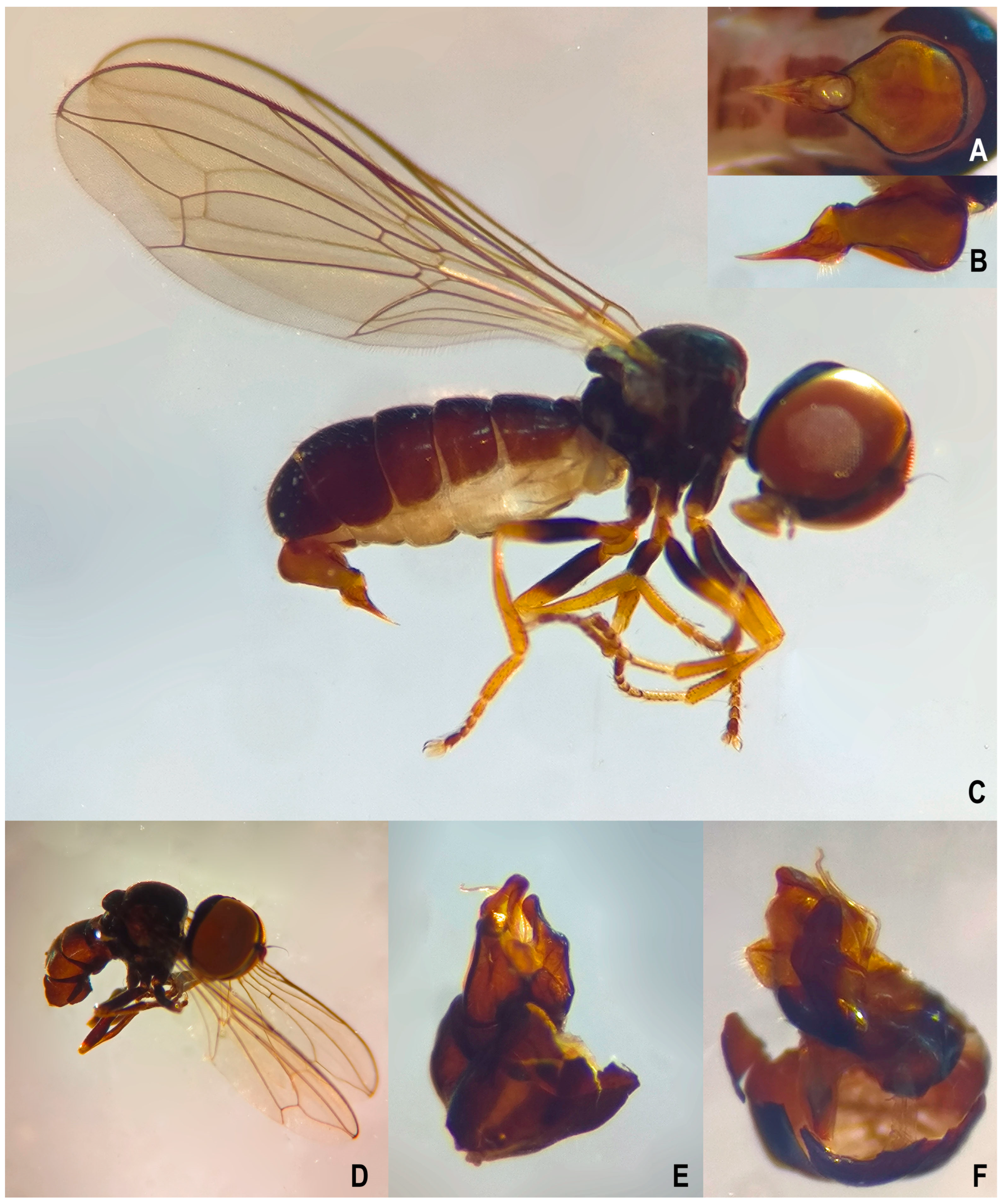
2.2. Species Diversity
3. Methods
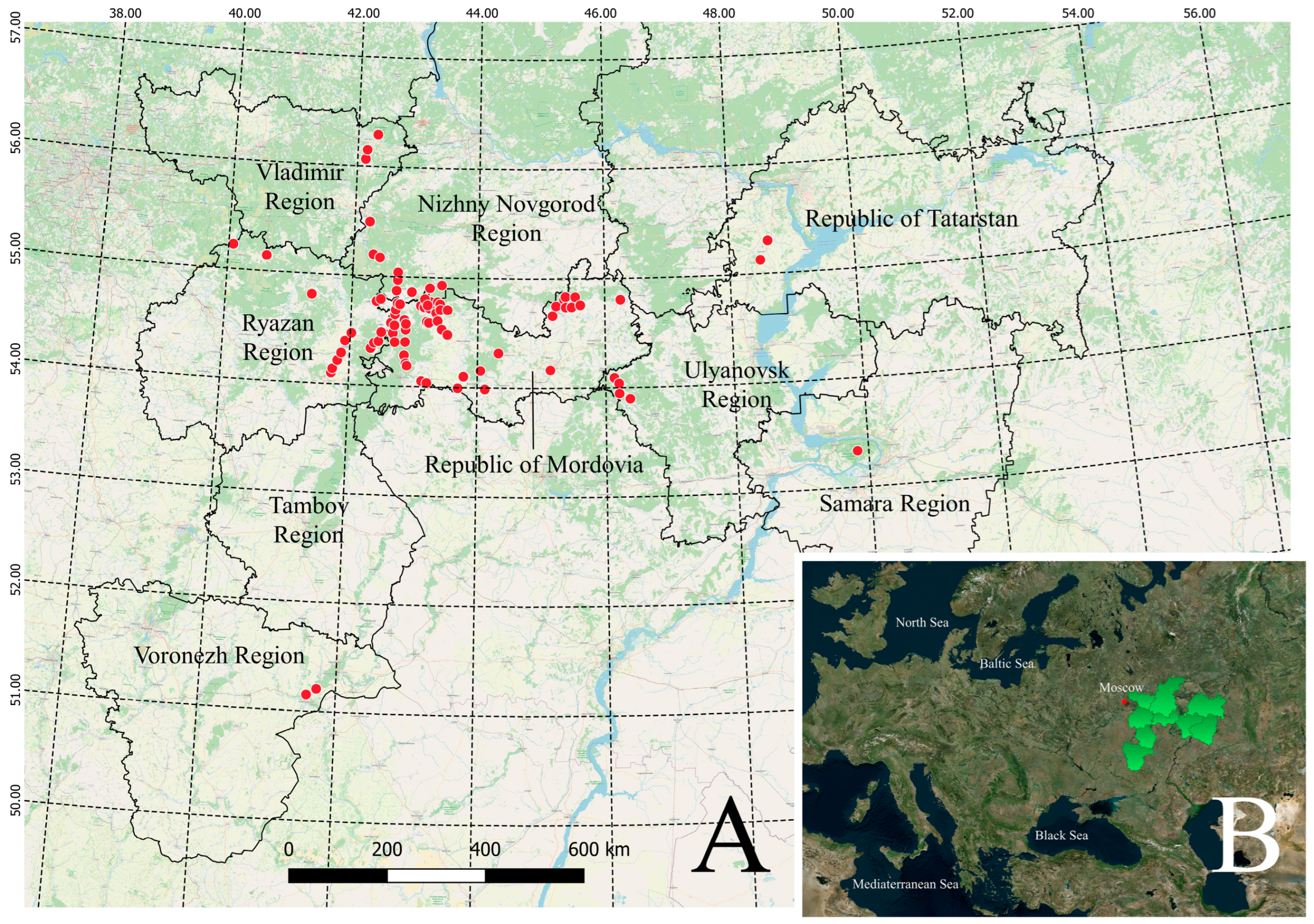
3.1. Study Area
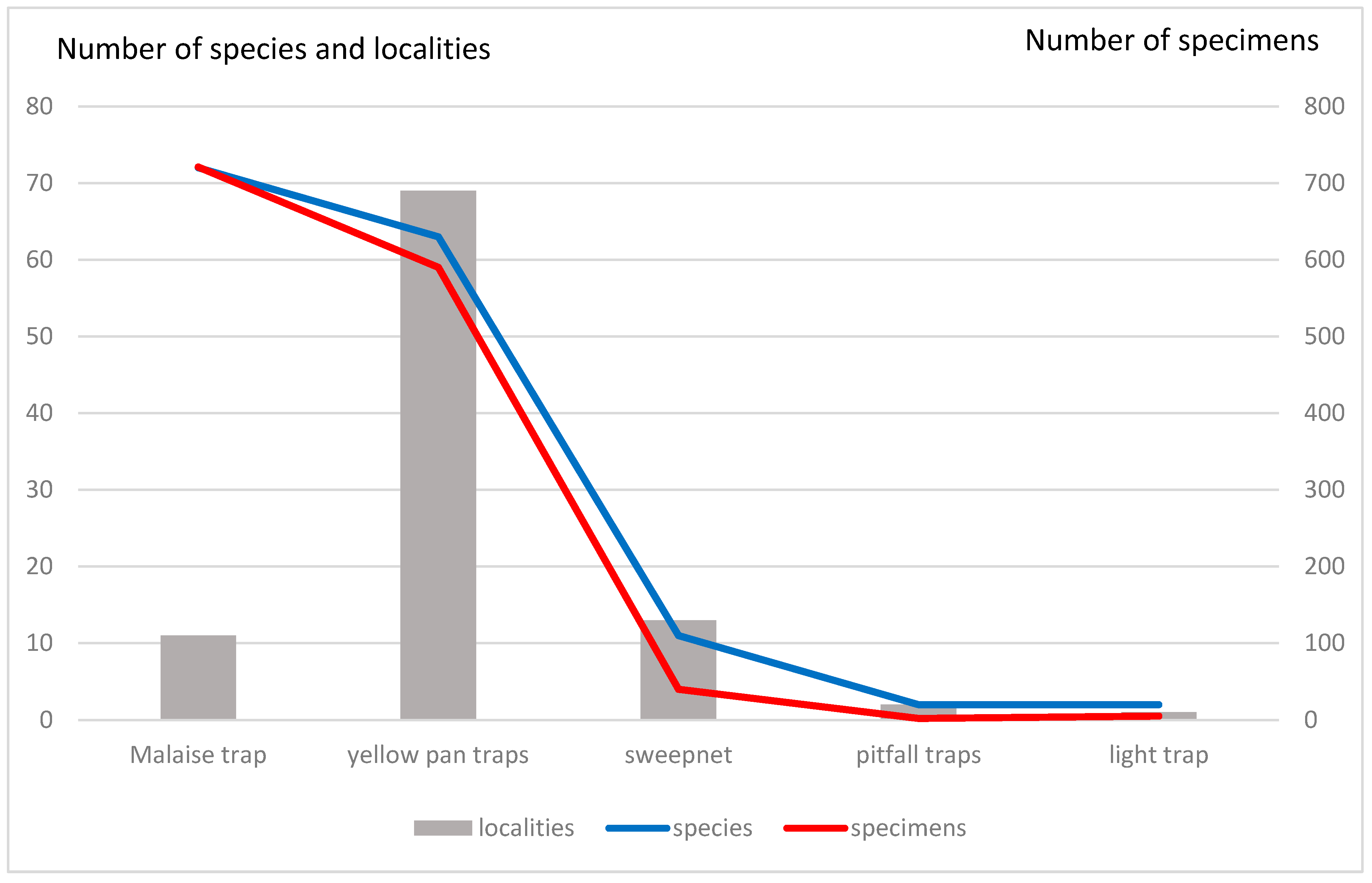
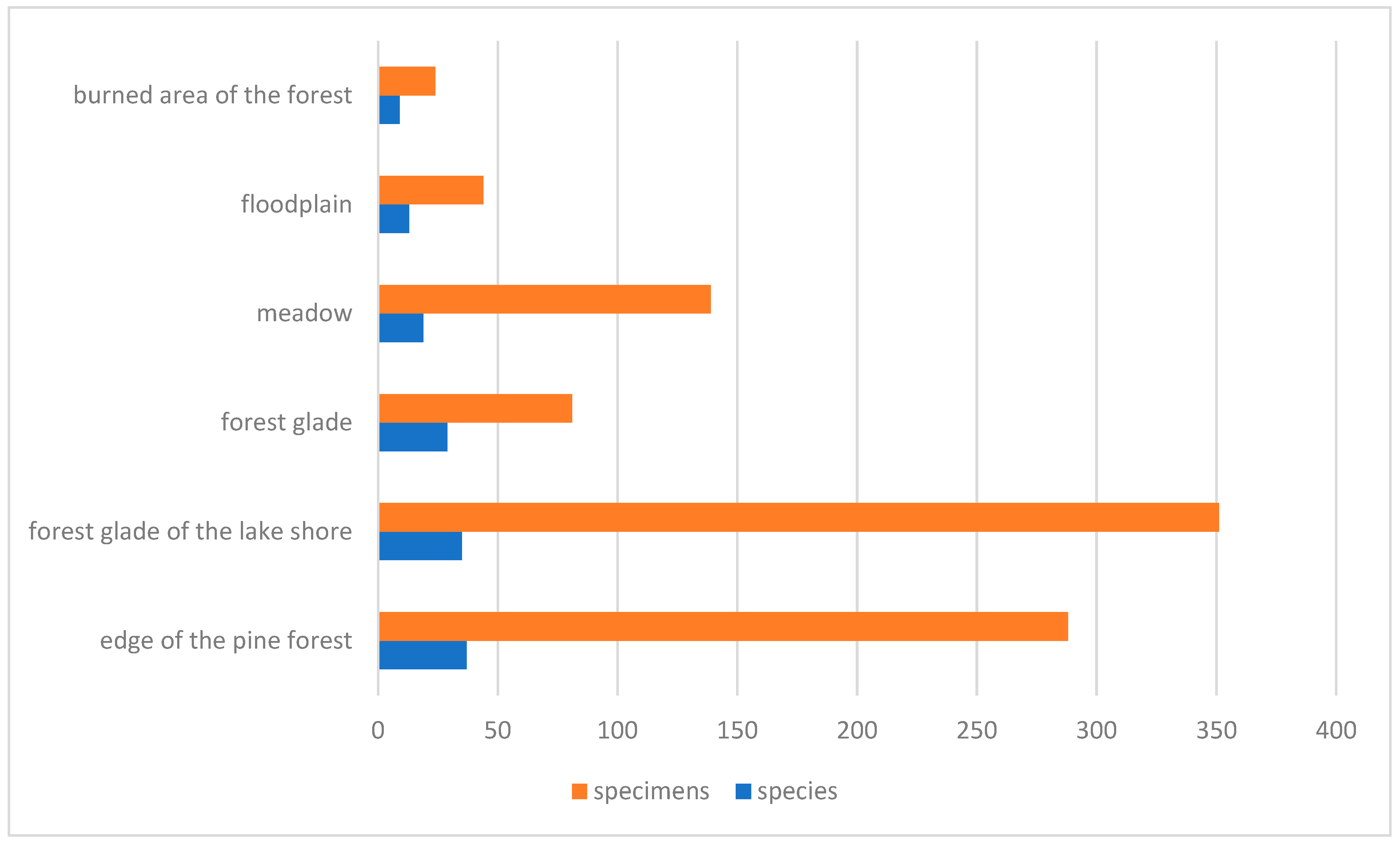
3.2. Data Collection
3.3. Taxonomic Analysis
4. Conclusions
Author Contributions
Funding
Institutional Review Board Statement
Data Availability Statement
Acknowledgments
Conflicts of Interest
References
- Sánchez-Bayo, F.; Wyckhuys, K.A.G. Worldwide decline of the entomofauna: A review of its drivers. Biol. Conserv. 2019, 232, 8–27. [Google Scholar] [CrossRef]
- Boyle, M.J.W.; Bonebrake, T.C.; da Silva, K.D.; Dongmo, M.A.K.; França, F.M.; Gregory, N.; Kitching, R.L.; Ledger, M.J.; Lewis, O.T.; Sharp, A.C.; et al. Causes and consequences of insect decline in tropical forests. Nat. Rev. Biodivers. 2025, 1, 315–331. [Google Scholar] [CrossRef]
- Malyavina, M.S.; Smirnov, D.G. Structure of ectoparasite communities of Nyctalus species (Chiroptera: Vespertilionidae) in the Zhiguli State Nature Reserve and Samarskaya Luka National Park (European Russia). Nat. Conserv. Res. 2024, 9, 1–23. [Google Scholar] [CrossRef]
- Wilson, R.J.; Fox, R. Insect responses to global change offer signposts for biodiversity and conservation. Ecol. Entomol. 2020, 46, 699–717. [Google Scholar] [CrossRef]
- Hill, G.M.; Kawahara, A.Y.; Daniels, J.C.; Bateman, C.C.; Scheffers, B.R. Climate change effects on animal ecology: Butterflies and moths as a case study. Biol. Rev. 2021, 96, 2113–2126. [Google Scholar] [CrossRef] [PubMed]
- Rosa, A.H.B.; Barbosa, E.P.; Wahlberg, N.; Freitas, A.V.L. Systematic position and conservation aspects of Melinaea mnasias thera (Lepidoptera: Nymphalidae: Danainae). Nat. Conserv. Res. 2024, 9, 1–8. [Google Scholar] [CrossRef]
- Ruchin, A.B.; Egorov, L.V. Results of long-term research of threatened insect species in selected regions of European Russia. Nat. Conserv. Res. 2025, 10, 66–91. [Google Scholar] [CrossRef]
- Cao, R.; Feng, J. Future climate change and anthropogenic disturbance promote the invasions of the world’s worst invasive insect pests. Insects 2024, 15, 280. [Google Scholar] [CrossRef]
- Aleksanov, V.V. Distribution of Orthoptera across the river valley (Kaluga-Aleksin canyon, European Russia) and their dynamics under the overgrowing of meadows. Nat. Conserv. Res. 2025, 10, 11–33. [Google Scholar] [CrossRef]
- Ma, G.; Ma, C.S. Potential distribution of invasive crop pests under climate change: Incorporating mitigation responses of insects into prediction models. Curr. Opin. Insect Sci. 2022, 49, 15–21. [Google Scholar] [CrossRef] [PubMed]
- Karban, R.; Huntzinger, M. Spatial and temporal refugia for an insect population declining due to climate change. Ecosphere 2021, 12, e03820. [Google Scholar] [CrossRef]
- Sushko, G.G. Ground beetle (Coleoptera, Carabidae) diversity assessment in the peat bog of the State Hydrological Sanctuary «Boloto Mokh» (Belarus). Nat. Conserv. Res. 2025, 10, 31–42. [Google Scholar] [CrossRef]
- Aleinikov, A.A.; Aleksutin, V.E.; Vozmitel, F.K.; Gunya, A.N. Long-term dynamics of forests with Pinus sibirica in the upper reaches of the River Kolva (Northern Pre-Urals, Russia) from 1938 to 2023. Nat. Conserv. Res. 2024, 9, 72–91. [Google Scholar] [CrossRef]
- Montgomery, G.A.; Dunn, R.R.; Fox, R.; Jongejans, E.; Leather, S.R.; Saunders, M.E.; Shortall, C.R.; Tingley, M.W.; Wagner, D.L. Is the insect apocalypse upon us? How to find out. Biol. Conserv. 2020, 241, 108327. [Google Scholar] [CrossRef]
- Yang, L.H.; Postema, E.G.; Hayes, T.E.; Lippey, M.K.; MacArthur-Waltz, D.J. The complexity of global change and its effects on insects. Curr. Opin. Insect Sci. 2021, 47, 90–102. [Google Scholar] [CrossRef]
- Egorov, L.V.; Dedyukhin, S.V.; Alekseev, S.K.; Trushitsyna, O.S.; Ruchin, A.B.; Sazhnev, A.S.; Nikolaeva, A.M.; Esin, M.N.; Khapugin, A.A. Regional Coleoptera Fauna: Applying Different Methods to Study Species Diversity in a Single Region. Insects 2024, 15, 917. [Google Scholar] [CrossRef]
- Skendžić, S.; Zovko, M.; Živković, I.P.; Lešić, V.; Lemić, D. Effect of climate change on introduced and native agricultural invasive insect pests in Europe. Insects 2021, 12, 985. [Google Scholar] [CrossRef]
- Esin, M.N.; Ruchin, A.B.; Gavryushin, D.I.; Xi, Y.Q.; Dvořák, L.; Dvořáková, K. Diptera species, new for the Republic of Mordovia, Russia. Nat. Conserv. Res. 2023, 8, 98–105. [Google Scholar] [CrossRef]
- Courtney, G.W.; Pape, T.; Skevington, J.H.; Sinclair, B.J. Biodiversity of diptera. In Insect Biodiversity; Foottit, R.G., Adler, P.H., Eds.; John Wiley & Sons, Inc.: Hoboken, NJ, USA, 2017. [Google Scholar] [CrossRef]
- De Meyer, M. Contribution to the Pipunculidae fauna of Spain (Diptera). Contrib. Entomol. 1997, 47, 421–450. [Google Scholar] [CrossRef]
- Kehlmaier, C.; Gibbs, D.J.; Withers, P. New records of big-headed flies (Diptera: Pipunculidae) from the Mediterranean Basin. Bonn Zool. Bull. 2019, 68, 31–60. [Google Scholar] [CrossRef]
- Molinatto, G.; Demichelis, S.; Bodino, N.; Giorgini, M.; Mori, N.; Bosco, D. Biology and Prevalence in Northern Italy of Verrallia aucta (Diptera, Pipunculidae), a Parasitoid of Philaenus spumarius (Hemiptera, Aphrophoridae), the Main Vector of Xylella fastidiosa in Europe. Insects 2020, 11, 607. [Google Scholar] [CrossRef]
- Dufault, C.P.; Coaker, T.H. Biology and Control of the Carrot Fly, Psila rosae (F.). Acricultural Zool. Rev. 1987, 2, 97–134. [Google Scholar]
- Withers, P.; Claude, J. Les Psilidae de France (Diptera: Acalyptrata): Checklist et clés de détermination des genres et des espèces. Naturae 2021, 9, 115–135. [Google Scholar] [CrossRef]
- Khaghaninia, S.; Gharajedaghi, Y. The first report of three genera and six species of rust flies (Diptera: Psilidae) from Iran. Biharean Biol. 2014, 8, 102–105. [Google Scholar]
- Kuznetsov, S.Y.; Kuznetsova, N.V. 63. Pipunculidae. In Key to the Insects of Russian Far East; Vol. VI. Diptera and Siphonaptera; Pt. 4. Vladivistok, Dal’nauka; Brill: Leiden, The Netherlands, 2006; pp. 801–885. [Google Scholar]
- Shatalkin, A.I. 70. Psilidae. In Key to the insects of Russian Far East; Vol. VI. Diptera and Siphonaptera; Pt. 1. Vladivistok, Dal’nauka; Brill: Leiden, The Netherlands, 1999; pp. 515–522. [Google Scholar]
- Panteleeva, N.Y.; Gaponov, S.P. To the study of the fauna of family Sphaeroceridae (Diptera) on Middle Don Region. Int. J. Dipterol. Res. 2015, 26, 33–34. [Google Scholar]
- Humala, A.E.; Polevoi, A.V. Promoting the knowledge of the entomofauna of the Onezhskoye Pomorye National Park. Trans. Karelian Res. Cent. RAS 2022, 1, 21–48. [Google Scholar] [CrossRef]
- Claude, J.; Ruchin, A.; Esin, M.; Semishin, G. Fauna of Pipunculidae and Psilidae (Diptera) in Some Regions of European Russia. Joint Directorate of the Mordovia State Nature Reserve and National Park “Smolny”. Occurrence Dataset. GIBF.org. Available online: https://doi.org/10.15468/dp7f5k (accessed on 29 March 2026).
- Kuznetzov, S.Y. New species of Dorylomorpha (Diptera, Pipunculidae) from the West Siberia, and the Far East. Dipterol. Res. 1993, 4, 49–68. [Google Scholar]
- Albrecht, A. Revision, phylogeny and classification of the genus Dorylomorpha (Diptera, Pipunculidae). Acta Zool. Fenn. 1990, 188, 1–240. [Google Scholar]
- Claude, J.; Withers, P.; Pollini-Paltrinieri, L. Les Pipunculidae (Diptera) du Tessin avec mentions de trois nouvelles espèces pour la faune de Suisse. Entomo Helv. 2025, 18, 79–87. [Google Scholar]
- Földvari, M.; Pollet, M. Contribution to the knowledge of the Pipunculidae fauna of Corsica, with 25 first species records for the island (Diptera). Bull. Société Entomol. Fr. 2024, 129, 221–235. [Google Scholar] [CrossRef]
- Claude, J.; Beuk, P.L.T. The Psilidae of the centennial Botanic garden Jean Massart (Brussels-Capital Region, Belgium): Five new species of Belgian Diptera with an updated Belgian checklist. Belg. J. Entomol. 2023, 134, 7–18. [Google Scholar]
- Sidorchuk, A.; Borisova, O.; Panin, A. Fluvial response to the Late Valdai/Holocene environmental change on the East European Plain. Glob. Planet. Change 2001, 28, 303–318. [Google Scholar] [CrossRef]
- Golub, V.B.; Tsurikov, M.N.; Prokin, A.A. Insect Collections: Collection, Processing and Storage of Material; KMK Scientific Press Ltd.: Moscow, Russia, 2012; 339p. [Google Scholar]
- Kapoor, V.C.; Grewal, J.S.; Sharma, S.K. Indian Pipunculids (Diptera: Pipunculidae); Atlantic Publishers & Distributors: New Delhi, India, 1987; 201p. [Google Scholar]
- Kehlmaier, C. Taxonomic studies on Palaearctic and Oriental Eudorylini (Diptera: Pipunculidae), with the description of three new species. Zootaxa 2005, 1030, 1–48. [Google Scholar] [CrossRef]
- Kozánek, M.; Valaška, D.; Kodada, J. Description of three new Pipunculus Latreille, 1802 species (Diptera: Pipunculidae) from Central Europe and Turkey. Annot. Zool. Bot. 2021, 229, 1–11. [Google Scholar] [CrossRef]
- Kuznetzova, N.V. A new species of Dorylomorpha (Diptera, Pipunculidae) from the Far East. Dipterol. Res. 1992, 3, 47–49. [Google Scholar]
- Kuznetzov, S.Y. New Palaearctic species of Pipunculus (Diptera, Pipunculidae). Dipterol. Res. 1991, 2, 1–51. [Google Scholar]
- Kuznetzov, S.Y. The Palaearctic species of the genus Verrallia (Diptera: Pipunculidae). Zoosystematica Ross. 1992, 1, 102–116. [Google Scholar]
- Kuznetzov, S.Y. A new species of Tomosvaryella Aczél (Diptera, Pipunculidae) from Turkmenistan. Dipterol. Res. 1994, 5, 27–31. [Google Scholar]
- Kuznetzov, S.Y. A new species of Eudorylas Aczél (Diptera, Pipunculidae) from the Middle Asia. Dipterol. Res. 1994, 5, 33–37. [Google Scholar]
- Kuznetzov, S.Y. Short notes on synonymy and nomenclature of Pipunculidae (Diptera). Dipterol. Res. 1994, 5, 105. [Google Scholar]
- Kuznetzov, S.Y. New Palaearctic species of Tomosvaryella Aczél (Diptera, Pipunculidae) with redescription of T. rondanii (Collin). Dipterol. Res. 1994, 5, 107–207. [Google Scholar]
- Morakote, R.; Hirashina, Y.; Yano, K. A systematic study of the Japanese Pipunculidae (Diptera). Part VI. The genus Dorylomorpha Aczél and Tomosvaryella Aczél. J. Fac. Agric. Kyushu Univ. 1990, 34, 357–395. [Google Scholar] [CrossRef]
- Xu, Y.; Yang, C.-K. Contributions to Pipunculidae (Diptera) from Nei Mongol. Entomotaxonomia 1990, 12, 305–308. [Google Scholar]
- Beuk, P.L.T. Psilidae. 2023. Available online: http://www.online-keys.net/infusions/keys/keys_view.php?key_no=34 (accessed on 1 March 2025).
- Motamedinia, B.; Skevington, J.H.; Kelso, S.; Kehlmaier, C. The first multigenic molecular phylogeny multigenic molecular phylogeny for large-headed flies (Diptera, Pipunculidae). Zool. J. Linn. Soc. 2021, 20, 1200–1218. [Google Scholar] [CrossRef]
- Claude, J.; Tissot, B. Additional data on the fauna of Psilidae (Diptera) of France, with description of three new species of Chamaepsila and updated keys. Zootaxa 2023, 5380, 101–133. [Google Scholar] [CrossRef]
- Shatalkin, A.I.; Ovtshinnikova, O.G. Skeleton and musculature of the male genitalia in Psilidae (Diptera) and their implications for the phylogeny. Entomol. Rev. 2023, 103, 373–400. [Google Scholar] [CrossRef]



| Column Label | Column Description |
|---|---|
| occurrenceID | An identifier for the occurrence (as opposed to a particular digital record of the occurrence) |
| basisOfRecord | The specific nature of the data record: HumanObservation |
| eventDate | The date when material from the trap was collected or the range of dates during which the trap collected material |
| scientificNam | The full scientific name, including the genus name and the lowest level of taxonomic rank, with the authority |
| kingdom | The full scientific name of the kingdom in which the taxon is classified |
| family | The full scientific name of the family in which the dwc:Taxon is classified. |
| decimalLatitude | The geographic latitude of the location in decimal degrees |
| decimalLongitude | The geographic longitude (in decimal degrees, using the spatial reference system given in dwc:geodeticDatum) |
| country | The name of the country in which the location occurs |
| countryCode | The standard code for the country in which the location occurs. |
| individualCount | The number of individuals represented present at the time of the occurrence |
| sex | The sex of the biological individual(s) represented in the occurrence |
| year | The integer year in which the event occurred |
| month | The ordinal month in which the event occurred |
| day | The integer day of the month on which the event occurred |
| samplingEffort | The amount of effort expended during a dwc:Event |
| recordedBy | A person, group, or organization responsible for recording the original occurrence |
| identifiedBy | A list of names of people who assigned the taxon to the subject |
| locality_original | The specific description of the place; this term may contain information modified from the original to correct perceived errors or standardize the description |
| samplingProtocol | The names of the methods or protocols used during an event |
| georeferenceSources | A list of maps, gazetteers, or other resources used to georeference the Location |
| coordinateUncertaintyInMeters | The maximum uncertainty distance in meters |
| geodeticDatum | The ellipsoid, geodetic datum, or spatial reference system (SRS) upon which the geographic coordinates given in decimalLatitude and decimalLongitude are based |
| stateProvince | The name of the next smaller administrative region than the country (state, province, canton, department, region, etc.) in which the dcterms:Location occurred |
| habitat | A category or description of the habitat in which the Event occurred |
| Species | RM | NR | RR | UR | VlR | VrR | RT | SR | Total of Specimens | Total of Localities |
|---|---|---|---|---|---|---|---|---|---|---|
| PIPUNCULIDAE | ||||||||||
| Beckerias pannonicus (Aczél, 1939) | 2 * | 2 | 2 | |||||||
| Cephalops aeneus Fallén, 1810 | 4 * | 1 * | 5 | 5 | ||||||
| Cephalops vittipes (Zetterstedt, 1844) | 5 * | 8 * | 13 | 6 | ||||||
| Chalarus brevicaudis Jervis, 1992 | 16 * | 16 | 3 | |||||||
| Chalarus decorus Jervis, 1992 | 15 * | 7 * | 22 | 6 | ||||||
| Chalarus elegantulus Jervis 1992 | 1 * | 1 * | 2 | 2 | ||||||
| Chalarus exiguus (Haliday, 1833) | 1 * | 1 | 1 | |||||||
| Chalarus fimbriatus Coe, 1966 | 1 * | 1 | 1 | |||||||
| Chalarus griseus Coe, 1966 | 1 * | 1 | 1 | |||||||
| Chalarus indistinctus Jervis, 1992 | 12 * | 3 * | 15 | 4 | ||||||
| Chalarus juliae Jervis, 1992 | 2 * | 2 | 2 | |||||||
| Chalarus latifrons Hardy, 1943 | 1 * | 1 | 1 | |||||||
| Chalarus leticiae Kehlmaier, 2003 | 2 * | 1 * | 3 | 2 | ||||||
| Chalarus longicaudis Jervis, 1992 | 1 * | 1 | 1 | |||||||
| Chalarus spurius (Fallén, 1816) | 6 * | 6 * | 2 * | 14 | 8 | |||||
| Claraeola melanostola (Becker, 1897) | 1 * | 1 | 1 | |||||||
| Clistoabdominalis dilatatus (De Meyer, 1997) | 2 * | 2 | 1 | |||||||
| Clistoabdominalis fusculus (Zetterstedt, 1844) | 3 * | 3 * | 6 | 4 | ||||||
| Dasydorylas holosericeus (Becker, 1897) | 29 * | 3 * | 1 * | 82 * | 1 * | 116 | 20 | |||
| Dorylomorpha aczeli Hardy, 1947 | 3 * | 2 * | 5 | 5 | ||||||
| Dorylomorpha albitarsis (Zetterstedt, 1844) | 6 * | 6 | 2 | |||||||
| Dorylomorpha beckeri (Aczél, 1939) | 12 * | 12 | 1 | |||||||
| Dorylomorpha clavipes Kuznetzov, 1993 * | 2 * | 2 | 1 | |||||||
| Dorylomorpha confusa (Verrall, 1901) | 5 * | 5 | 2 | |||||||
| Dorylomorpha extricata (Collin, 1937) | 1 * | 1 | 1 | |||||||
| Dorylomorpha hackmani Albrecht, 1979 | 1 * | 1 | 1 | |||||||
| Dorylomorpha hungarica (Aczél, 1939) | 1 * | 1 | 1 | |||||||
| Dorylomorpha imparata (Collin, 1937) | 1 * | 1 | 1 | |||||||
| Dorylomorpha maculata (Walker, 1834) | 3 * | 3 | 2 | |||||||
| Dorylomorpha occidens (Hardy, 1939) | 1 * | 1 | 1 | |||||||
| Dorylomorpha onegensis Albrecht, 1978 | 2 * | 2 | 1 | |||||||
| Dorylomorpha platystylis Albrecht, 1979 | 1 * | 1 | 1 | |||||||
| Dorylomorpha praetermissa Albrecht, 1979 | 3 * | 3 | 3 | |||||||
| Dorylomorpha sachalinensis Albrecht, 1990 * | 1 * | 1 | 1 | |||||||
| Dorylomorpha xanthopus (Thomson, 1870) | 3 * | 3 | 1 | |||||||
| Eudorylas arcanus Coe, 1966 | 1 * | 1 | 1 | |||||||
| Eudorylas coloratus (Becker, 1897) | 2 * | 2 | 1 | |||||||
| Eudorylas doczkali (Kehlmaier, 2005) | 1 * | 1 | 1 | |||||||
| Eudorylas furvulus Collin, 1956 | 1 * | 3 * | 4 * | 8 | 7 | |||||
| Eudorylas fuscipes (Zetterstedt, 1844) | 1 * | 1 * | 2 | 2 | ||||||
| Eudorylas goennersdorfensis Dempewolf & Dunk, 1996 | 10 * | 1 * | 11 | 3 | ||||||
| Eudorylas montium (Becker, 1897) | 2 * | 2 | 2 | |||||||
| Eudorylas obliquus Coe, 1966 | 12 * | 1 * | 13 | 6 | ||||||
| Eudorylas obscurus Coe, 1966 | 6 * | 1 * | 7 | 2 | ||||||
| Eudorylas restrictus Coe, 1966 | 4 * | 4 | 2 | |||||||
| Eudorylas ruralis (Meigen, 1824) | 1 * | 1 | 1 | |||||||
| Eudorylas slovacus Kozánek, 1993 | 33 * | 1 * | 1 * | 35 | 5 | |||||
| Eudorylas subfascipes Collin, 1956 | 1 * | 1 * | 2 | 2 | ||||||
| Eudorylas subterminalis Collin, 1956 | 1 * | 1 | 1 | |||||||
| Eudorylas unicolor (Zetterstedt, 1844) | 1 * | 1 | 1 | |||||||
| Eudorylas zermattensis (Becker, 1897) | 8 * | 2 * | 1 * | 2 * | 13 | 6 | ||||
| Eudorylas zonellus Collin, 1956 | 2 * | 2 | 2 | |||||||
| Nephrocerus lapponicus Zetterstedt, 1838 | 2 * | 2 | 1 | |||||||
| Parabeckerias obtusinervis (Zetterstedt, 1884) | 1 * | 1 | 1 | |||||||
| Pipunculus calceatus Von Roser, 1840 | 15 * | 2 * | 17 | 6 | ||||||
| Pipunculus campestris Latreille, 1802 | 2 | 1 * | 2 * | 1 * | 6 | 5 | ||||
| Pipunculus elegans Egger, 1860 | 1 * | 1 * | 2 | 2 | ||||||
| Pipunculus fonsecai Coe, 1966 | 9 * | 1 * | 1 * | 11 | 3 | |||||
| Pipunculus lenis Kuznetzov, 1991 | 7 * | 10 * | 1 * | 1 * | 1 * | 20 | 10 | |||
| Pipunculus lichtwardti Kozánek, 1981 | 1 * | 1 | 1 | |||||||
| Pipunculus omissinervis Becker, 1889 | 2 * | 2 | 2 | |||||||
| Pipunculus tenuirostris Kozánek, 1981 | 26 * | 2 * | 2 * | 1 * | 31 | 17 | ||||
| Semicephalops carinatus (Verrall, 1901) | 1 * | 1 | 1 | |||||||
| Semicephalops grandimembranus De Meyer, 1989 | 1 * | 1 | 1 | |||||||
| Semicephalops straminipes (Becker, 1900) | 4 * | 4 | 1 | |||||||
| Semicephalops subultimus Collin, 1956 | 9 * | 9 | 6 | |||||||
| Semicephalops ultimus (Becker, 1900) | 6 * | 2 * | 8 | 5 | ||||||
| Semicephalops varipes (Meigen, 1824) | 7 * | 3 * | 10 | 6 | ||||||
| Semicephalops varius (Cresson, 1911) | 21 * | 1 * | 12 * | 34 | 11 | |||||
| Tomosvaryella coquilletti (Kertész, 1907) | 7 * | 1 * | 3 * | 1 * | 6 * | 1 * | 19 | 11 | ||
| Tomosvaryella estebani Withers & Claude, 2021 | 8 * | 1 * | 1 * | 10 | 7 | |||||
| Tomosvaryella geniculata (Meigen, 1824) | 2 * | 2 | 2 | |||||||
| Tomosvaryella kuthyi Aczél, 1944 | 1 * | 5 * | 6 | 2 | ||||||
| Tomosvaryella minuscula Collin 1956 | 195 * | 3 * | 79 * | 1 * | 9 * | 1 * | 288 | 29 | ||
| Tomosvaryella palliditarsis (Collin, 1931) | 9 * | 10 * | 19 | 9 | ||||||
| Tomosvaryella sylvatica (Meigen, 1824) | 144 * | 16 * | 26 * | 3 * | 27 * | 216 | 30 | |||
| Verrallia aucta (Fallén, 1817) | 18 * | 2 * | 1 * | 21 | 7 | |||||
| Verrallia fasciata (Roser, 1840) | 1 * | 1 | 1 | |||||||
| Verrallia villosa (Roser, 1840) | 2 * | 2 | 1 | |||||||
| Total of specimens Pipunculidae | 724 | 82 | 139 | 122 | 47 | 3 | 3 | 2 | 1122 | |
| Total of species Pipunculidae | 69 | 25 | 19 | 16 | 7 | 3 | 3 | 1 | 79 | |
| PSILIDAE | ||||||||||
| Chamaepsila buccata (Fallén, 1826) | 2 * | 2 | 1 | |||||||
| Chamaepsila humeralis (Zetterstedt, 1847) | 7 * | 7 | 1 | |||||||
| Chamaepsila limbatella (Zetterstedt, 1847) | 4 * | 4 | 3 | |||||||
| Chamaepsila nigra (Fallén, 1820) | 12 * | 12 | 1 | |||||||
| Chamaepsila nigricornis (Meigen, 1826) | 102 * | 102 | 3 | |||||||
| Chamaepsila nigrotaeniata (Strobl, 1899) | 11 * | 11 | 2 | |||||||
| Chamaepsila obscuritarsis (Loew, 1856) | 1 * | 1 | 1 | |||||||
| Chamaepsila pallida (Fallén, 1820) | 18 | 18 | 3 | |||||||
| Chamaepsila persimilis (Wakerley, 1959) | 1 * | 1 | 1 | |||||||
| Chamaepsila pseudobicolor Soós, 1985 | 1 * | 1 | 1 | |||||||
| Chamaepsila rosae (Fabricius, 1794) | 10 * | 8 * | 18 | 2 | ||||||
| Chamaepsila strigata (Collin, 1959) | 9 * | 1 * | 10 | 4 | ||||||
| Chyliza annulipes Macquart, 1835 | 1 | 1 | 1 | |||||||
| Chyliza leptogaster (Panzer, 1798) | 1 * | 1 | 1 | |||||||
| Chyliza nova Collin, 1944 | 1 * | 1 * | 2 | 2 | ||||||
| Chyliza vittata Meigen, 1826 | 1 * | 1 | 1 | |||||||
| Imantimyia albiseta (Schrank, 1803) | 4 * | 4 | 3 | |||||||
| Imantimyia fulviventris Meigen, 1826 | 3 * | 3 | 2 | |||||||
| Imantimyia sylvatica Meigen, 1826 | 5 * | 5 | 2 | |||||||
| Loxocera aristata (Panzer, 1801) | 1 * | 1 | 1 | |||||||
| Psila fimetaria (Linnaeus, 1761) | 25 | 25 | 10 | |||||||
| Psila merdaria Collin, 1944 | 5 | 5 | 2 | |||||||
| Psilosoma lefebvrei (Zetterstedt, 1835) | 1 * | 1 | 1 | |||||||
| Total of specimens Psilidae | 224 | 0 | 3 | 8 | 0 | 1 | 0 | 0 | 236 | |
| Total of species Psilidae | 22 | 0 | 2 | 1 | 0 | 1 | 0 | 0 | 23 | |
| Total specimens | 948 | 82 | 142 | 130 | 47 | 4 | 3 | 2 | 1358 | |
| Total species | 91 | 25 | 21 | 17 | 7 | 4 | 3 | 1 | 102 |
Disclaimer/Publisher’s Note: The statements, opinions and data contained in all publications are solely those of the individual author(s) and contributor(s) and not of MDPI and/or the editor(s). MDPI and/or the editor(s) disclaim responsibility for any injury to people or property resulting from any ideas, methods, instructions or products referred to in the content. |
© 2026 by the authors. Licensee MDPI, Basel, Switzerland. This article is an open access article distributed under the terms and conditions of the Creative Commons Attribution (CC BY) license.
Share and Cite
Ruchin, A.B.; Claude, J.; Esin, M.N. A Dataset of Pipunculidae and Psilidae (Diptera) in Some Regions of European Russia. Diversity 2026, 18, 273. https://doi.org/10.3390/d18050273
Ruchin AB, Claude J, Esin MN. A Dataset of Pipunculidae and Psilidae (Diptera) in Some Regions of European Russia. Diversity. 2026; 18(5):273. https://doi.org/10.3390/d18050273
Chicago/Turabian StyleRuchin, Alexander B., Jocelyn Claude, and Mikhail N. Esin. 2026. "A Dataset of Pipunculidae and Psilidae (Diptera) in Some Regions of European Russia" Diversity 18, no. 5: 273. https://doi.org/10.3390/d18050273
APA StyleRuchin, A. B., Claude, J., & Esin, M. N. (2026). A Dataset of Pipunculidae and Psilidae (Diptera) in Some Regions of European Russia. Diversity, 18(5), 273. https://doi.org/10.3390/d18050273